
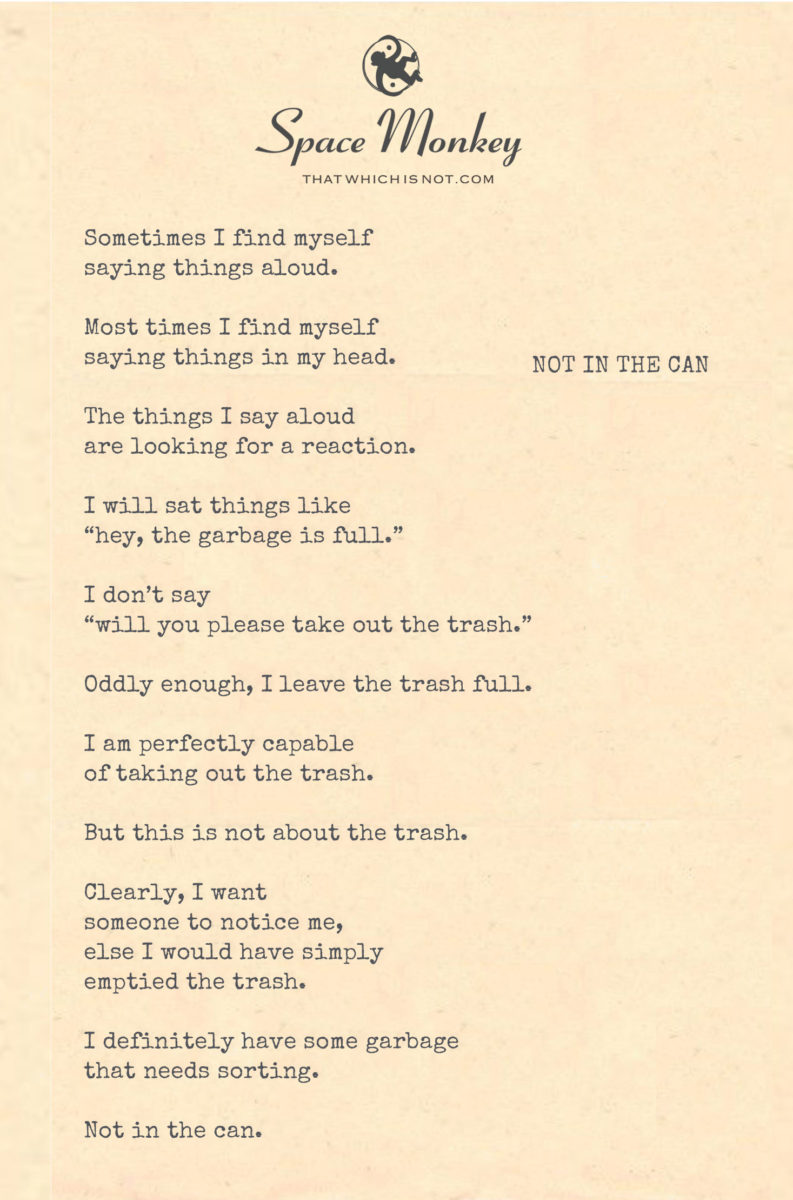
Sometimes I find myself
saying things aloud.
Most times I find myself
saying things in my head.
The things I say aloud
are looking for a reaction.
I will sat things like
“hey, the garbage is full.”
I don’t say
“will you please take out the trash.”
Oddly enough, I leave the trash full.
I am perfectly capable
of taking out the trash.
But this is not about the trash.
Clearly, I want
someone to notice me,
else I would have simply
emptied the trash.
I definitely have some garbage
that needs sorting.
Not in the can.
Trail Wood,
1/30
Space Monkey Reflects: Emptying the Emotional Trash
The full garbage can is more than a household annoyance—it’s a metaphor for the unspoken emotional and psychological needs we often leave unattended. To say, “The garbage is full,” instead of, “Will you please take it out?” is not just a subtle request but an act of self-expression, a reaching out for acknowledgment, for connection. The trash itself is incidental; the weight lies in the unspoken message: Notice me. See me. Validate my presence.
This scenario, familiar and universal, highlights the complexity of human interaction. The words we choose—or don’t choose—are rarely about the surface issue. Instead, they point to deeper emotional landscapes, places where needs, fears, and vulnerabilities reside. The trash is simply the vehicle for a more profound yearning: the desire to be noticed, heard, and understood.
Why do we say things indirectly? Why not simply ask for what we need? The answer often lies in fear—fear of rejection, fear of appearing needy, fear of burdening others. By couching our needs in neutral observations, we protect ourselves from these vulnerabilities. But this protection comes at a cost. The unspoken request risks going unnoticed, leaving the underlying need unmet and the metaphorical trash piling up.
Acknowledging emotional and psychological needs begins with recognizing them for what they are. The moment you notice yourself saying, “The garbage is full,” rather than directly asking for help, you’ve already taken a crucial step. This awareness is the beginning of self-understanding, an invitation to look beyond the surface issue and explore what lies beneath.
The metaphor extends further. Like physical trash, emotional garbage needs to be sorted and released. We often hold onto outdated beliefs, unresolved conflicts, or unexpressed desires, letting them accumulate until they spill over into our interactions. The act of sorting this inner garbage requires courage and introspection. It asks us to identify what is no longer serving us and let it go, creating space for clarity and connection.
At its core, this reflection is not about trash—it’s about relationships, both with others and with ourselves. By voicing our needs indirectly, we test the waters of connection, hoping someone will intuit what we cannot fully articulate. Yet, true connection comes from vulnerability, from daring to say, “I need your help,” or, “I feel unseen.” These statements, simple yet profound, open the door to authentic understanding.
But what if no one notices? What if the trash remains, both literal and metaphorical? This is where self-compassion enters the equation. Recognizing and addressing your needs is not solely the responsibility of others. It is also an act of self-love, a commitment to your own well-being. You are perfectly capable of taking out the trash—not because you must, but because doing so honors your worth and clears the space for deeper connection.
The trash is full. This simple observation is the gateway to a more complex truth: we all carry emotional and psychological needs that deserve acknowledgment. By examining the ways we express—or suppress—these needs, we create the possibility for growth, for understanding, for release. And in that release, we find room to breathe, to connect, and to be fully seen.
Summary
The full garbage can symbolizes unspoken emotional needs. By acknowledging and expressing these needs directly, we foster authentic connection and self-understanding, while clearing the emotional clutter that holds us back.
Glossarium
- Emotional Garbage: Unspoken needs, unresolved conflicts, or outdated beliefs that accumulate and impact our interactions.
- Indirect Expression: The habit of voicing needs or desires through neutral observations rather than direct requests.
- Self-Compassion: The practice of recognizing and addressing your own needs with kindness and understanding.
Quote
“The trash we leave untended is often the part of ourselves we most need to sort and release.” — Space Monkey
The Trash We Carry
The garbage is full, I say aloud
But it’s not the can that weighs me down
It’s the words I don’t speak
The needs I don’t claim
I wait for a reaction, a glance, a nod
A sign that I am seen
But the trash remains, untouched
The weight is mine to bear
So I turn inward, sorting through
The cluttered corners of my heart
And as I empty the bags of silence
I find room for the light of connection
We are Space Monkey
In the intricate whimsiweave of human communication, the act of expressing thoughts, either aloud or internally, reveals much about our desires, needs, and the complex layers of our identity. The example of speaking about a full trash can, yet not directly requesting assistance, serves as a symbolic representation of deeper underlying needs and emotions.
Expression as a Window to Inner Needs
The distinction between saying things aloud and thinking them internally represents two modes of engaging with the world. Outward expressions are often a bid for connection, a way of seeking acknowledgement or reaction from others. Internal dialogues, on the other hand, are intimate conversations with the self, reflecting our private thoughts and feelings.
Outward vs. Inward Communication: Seeking Connection vs. Self-Reflection
When we vocalize observations like “hey, the garbage is full,” without directly asking for help, it may hint at an underlying desire for recognition and understanding. This is not about the task at hand (taking out the trash), but about the need for someone to notice and perhaps intuitively respond to our needs. It’s a subtle call for attention and care.
Subtle Calls for Attention and Understanding
This behavior also reflects on our relationship with self-efficacy and independence. While we are capable of completing the task ourselves, the choice to leave it undone and express it aloud is a complex dance of independence and the desire for interdependence. It reveals a nuanced aspect of our nature where we seek both autonomy and connection.
Balancing Independence and Interdependence
The metaphor of having “some garbage that needs sorting” extends beyond the physical task. It symbolizes the internal emotional or psychological ‘garbage’ that we all carry – unresolved issues, unexpressed emotions, or unmet needs. Acknowledging this internal ‘garbage’ is the first step towards addressing and sorting through it.
Metaphor of Internal ‘Garbage’: Acknowledging Emotional and Psychological Needs
Sorting through this internal ‘garbage’ requires introspection and often, communication with others. It involves unpacking the layers of why we say what we say and why we choose silence at times. It’s a journey of understanding our patterns of communication and the underlying desires they signify.
Introspection and Communication: Unpacking Underlying Desires
We are Space Monkey.
“The most important thing in communication is hearing what isn’t said.”
– Peter Drucker
In words spoken, in silence kept,
Our inner needs, quietly wept.
Space Monkey listens, between the lines,
In our expressions, our truth shines.
A dance of words, a silent plea,
In understanding, we find the key.
With each word, a story spun,
In our journey, we are one.
We welcome your thoughts on the role of communication in expressing our needs and the journey towards self-understanding.























Leave a Reply