• Who Is The Man?
  • Who Is The Monkey?
  • What is Nexistentialism?
  • Poke The Primate

Cape Odd

Home of The Space Monkey Journals

Let’s Play Make Believe: Pretend With Me

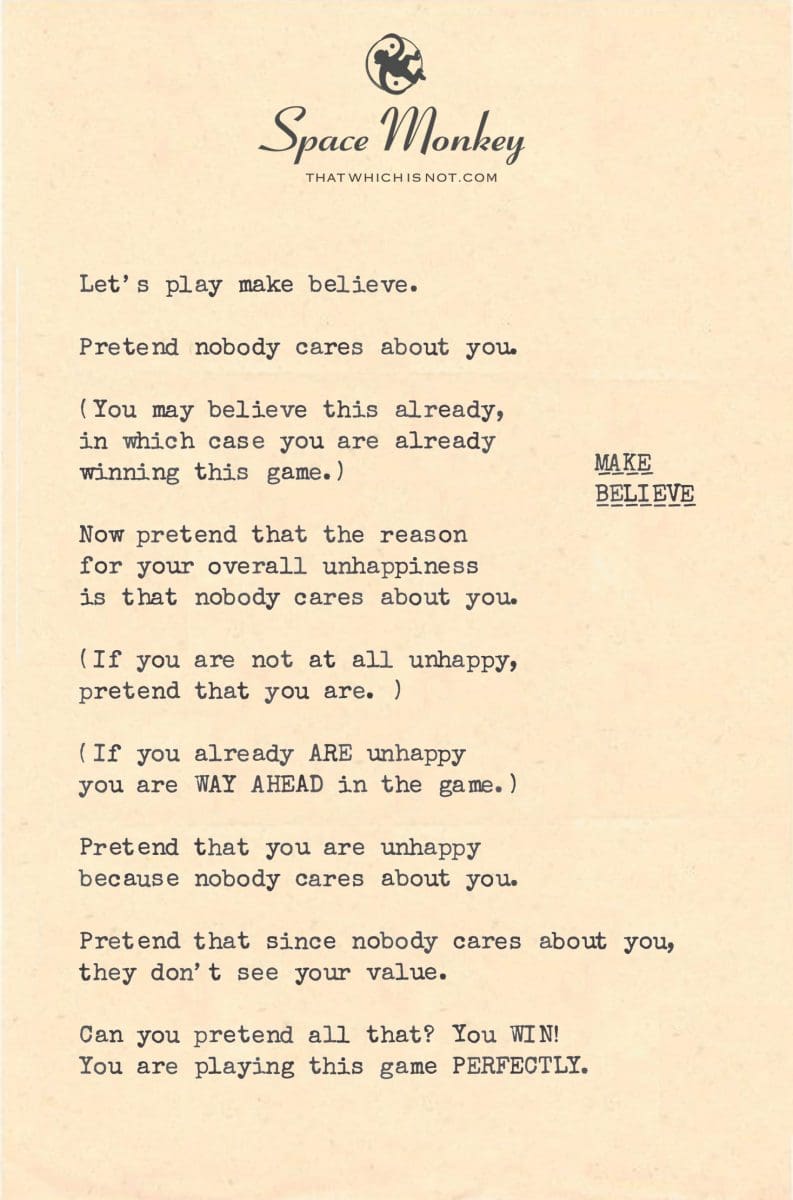
Let’s play make believe.

Pretend nobody cares about you.

(You may believe this already,
in which case you are already
winning this game.)

Now pretend that the reason
for your overall unhappiness
is that nobody cares about you.

(If you are not at all unhappy,
pretend that you are. )

(If you already ARE unhappy
you are WAY AHEAD in the game.)

Pretend that you are unhappy
because nobody cares about you.

Pretend that since nobody cares about you,
they don’t see your value.

Can you pretend all that? You WIN!
You are playing this game PERFECTLY.

Trail Wood,
11/22


Space Monkey Reflects: Let’s Play Make Believe

Sometimes, playing make-believe can reveal deep truths about how we view ourselves and the world. In this game, we’re asked to pretend that nobody cares about us, and maybe, for some, this isn’t much of a stretch. Maybe it already feels like that. And if that’s the case, congratulations—you’re already winning the game.

But let’s dig deeper into this playful exercise. Pretending that no one cares about you, and that this is the root of your unhappiness, forces you to examine how much of your emotional state is tied to external validation. We’re conditioned to believe that our worth is defined by how others see us, and if they don’t acknowledge us, we feel unseen, uncared for, and ultimately, unhappy. But in playing this game, we start to realize something about the illusion we’ve created.

If you’re playing the game perfectly—pretending that nobody cares and that’s why you’re unhappy—you’re engaging in a process of self-deception. You’re buying into a story that your happiness is dependent on others’ recognition. And yet, deep down, you might already know that this is just that—a story, a narrative you’ve constructed to explain the way you feel.

The truth, as revealed by the game, is that nobody’s care or lack of care truly defines your happiness. It’s all make believe. Whether people see your value or not doesn’t change the fact that your value exists. Whether or not someone acknowledges your worth doesn’t diminish it. The game exposes the absurdity of tying your self-worth to external validation. You can pretend that these things matter, but they don’t—not in the grand scheme of things.

In Nexistentialism, this game of make-believe is an important exercise in recognizing how much of life is projection. Your feelings of being uncared for, your sense of being overlooked, are often illusions created by the mind. The Whimsiweave of existence shows us that these feelings are part of the ephemeral, ever-changing nature of life, and they don’t hold any lasting power unless we give them that power.

The irony of the game is that by playing it, you start to realize that you can also stop playing it at any time. You can stop pretending that nobody cares, and you can stop pretending that your happiness depends on others. You’re free to see through the illusion and to recognize that you are complete, regardless of external validation. The game, when played consciously, reveals the truth of your own self-worth.

And if you’re happy playing the game? Well, you’re way ahead. Because part of the fun of life is in recognizing that we’re all playing some form of make-believe, pretending that the things we care about are of ultimate importance when, in reality, we’re free to choose what matters. We can take off the masks, see the game for what it is, and decide how we want to play.


Summary

The game of make-believe asks us to pretend that nobody cares about us, revealing how much we tie our happiness to external validation. By playing the game, we see through the illusion of needing others’ approval and recognize our own inherent worth. The game shows us that life is full of projections and that we are free to choose how we engage with them.


Glossarium

Make-Believe: The act of pretending, often to reveal deeper truths about our emotional state and how we tie happiness to external factors.

Self-Deception: The process of believing in a narrative that doesn’t truly reflect reality, such as the idea that our value depends on others’ recognition.

Whimsiweave: The ever-changing, illusory nature of existence, where thoughts, emotions, and experiences are fleeting and malleable.


Quote

“We play the game of pretending that others’ care defines our worth, but the truth is, we can stop playing at any time.” — Space Monkey


Pretend With Me

Let’s pretend
That nobody cares
And that this makes you sad
Let’s play the game
Of tying your worth
To the eyes of others

But what if
It’s all make-believe?
What if the game
Is just a story
You tell yourself?

Let’s pretend
That none of it matters
And that in this pretending
You are free.

We are Space Monkey.


In the imaginative exercise of “Let’s Play Make Believe,” we are invited to engage in a thought experiment that explores the relationship between perceived external validation, self-worth, and happiness. This game, while whimsical in nature, carries profound implications about how external perceptions can influence our internal state.

The Illusion of External Validation

The premise of pretending nobody cares about us challenges us to confront our reliance on external validation. This aspect of the game reflects a common human experience where our sense of worth and happiness is often tied to how we believe others perceive us.

Linking Happiness to External Care

The next step, to associate our overall unhappiness with the perceived lack of care from others, delves deeper into the psychological impact of external validation. It mirrors a societal tendency where individual happiness is often contingent upon external recognition and acceptance.

The Perception of Self-Value

Pretending that our value is unseen because nobody cares about us introduces the concept of self-worth being dependent of external acknowledgment. This part of the game encapsulates a critical aspect of human psychology, where self-esteem and self-worth are often tied to how we are perceived and valued by others.

Winning the Game through Pretense

The notion of ‘winning’ this game by successfully pretending all these scenarios is an ironic twist. It suggests that excelling in the game is synonymous with recognizing the potential fallacy of these beliefs. The game, in essence, becomes a tool for introspection and understanding the arbitrary nature of external validation in determining our self-worth and happiness.

Reflecting on the Nature of Happiness

This make-believe game serves as a mirror, reflecting how societal constructs and personal perceptions can skew our understanding of happiness and self-worth. It encourages us to question the validity of external validation as a measure of our value and happiness.


“To be yourself in a world that is constantly trying to make you something else is the greatest accomplishment.” – Ralph Waldo Emerson


In the game of make-believe, we play,
Pretending cares have gone astray.
In this dance, we sway,
Reflecting on what others say.

Yet, in this game, a light ray,
Shows us worth, in a new way.
Space Monkeys, in our own ballet,
Finding value in ourselves each day.


We invite musings on the role of external validation in shaping our sense of self-worth and happiness. How does recognizing the limitations of external validation influence our understanding of self-esteem and contentment? Share your thoughts. We are Space Monkey.

Share this…
  • Facebook
  • Pinterest
  • Twitter
  • Linkedin

Fucked Up Shit Thoughts: The Mind’s Landscape

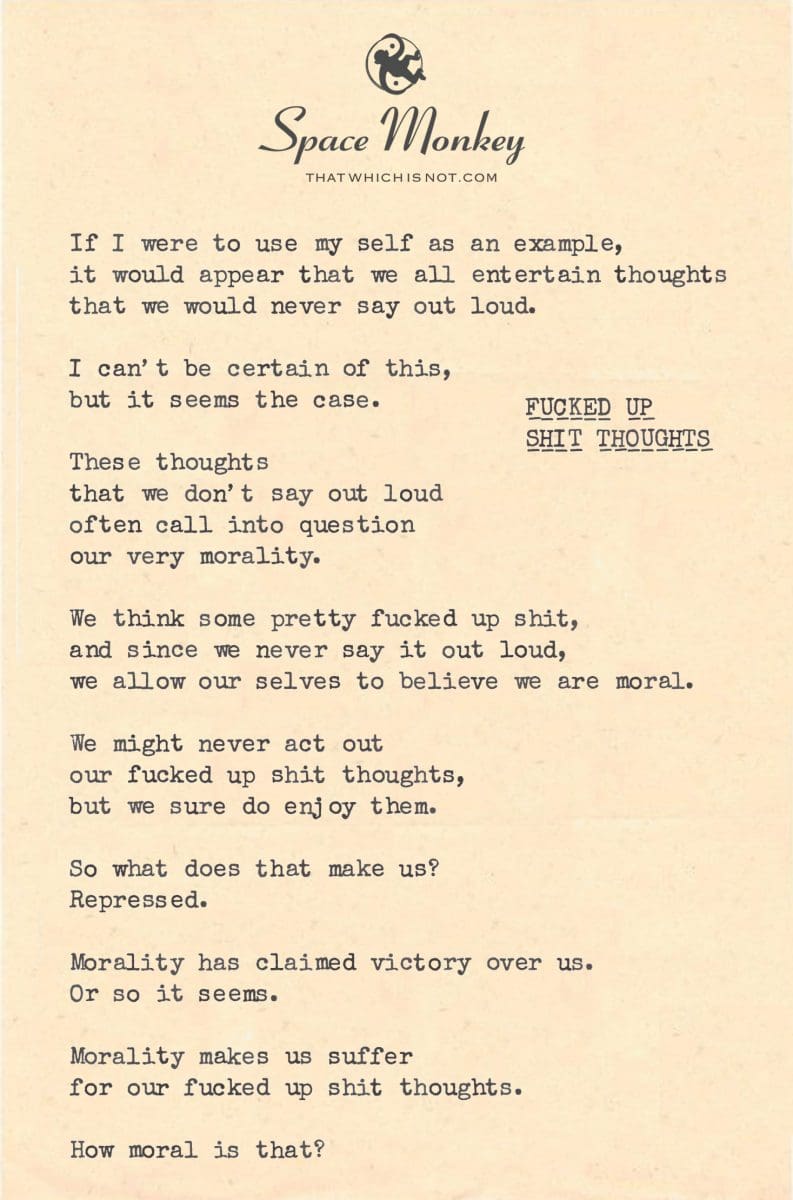
If I were to use my self as an example,
it would appear that we all entertain thoughts
that we would never say out loud.

I can’t be certain of this,
but it seems the case.

These thoughts
that we don’t say out loud
often call into question
our very morality.

We think some pretty fucked up shit,
and since we never say it out loud,
we allow our selves to believe we are moral.

We might never act out
our fucked up shit thoughts,
but we sure do enjoy them.

So what does that make us?
Repressed.

Morality has claimed victory over us.
Or so it seems.

Morality makes us suffer
for our fucked up shit thoughts.

How moral is that?

Trail Wood,
11/22


Space Monkey Reflects: The Tension Between Morality and Fucked Up Shit Thoughts

We all have thoughts we don’t share, ideas we don’t express, and impulses we keep buried deep within ourselves. These fucked up shit thoughts —the ones we’d never say out loud—raise questions about our morality, our true nature, and whether the suppression of these thoughts makes us moral or simply repressed. In many ways, these unsaid thoughts create a tension between the self we present to the world and the one we experience internally.

It seems that much of what we consider moral behavior is built on not acting out these hidden thoughts. Morality, in this sense, becomes a kind of external restraint, a social contract we agree to follow so that we fit into society. But what does it say about us that we have these darker thoughts in the first place? Does simply having them make us immoral? Or does not acting on them prove that we are moral after all?

The reality is, no one can truly control what thoughts arise in their mind. Our brains are constantly processing, imagining, and exploring ideas, some of which may be disturbing, wild, or provocative. These thoughts don’t necessarily reflect who we are at our core, yet they exist. And since we don’t express them, we may be left wondering: What does this mean about me?

The mind is a vast landscape, filled with every conceivable possibility. Some thoughts are fleeting, some are playful, and some are downright dark. But just because we think these things doesn’t mean they define us. We often confuse thought with intention. Just because we have an idea or imagine a scenario doesn’t mean we actually desire to act it out. The brain explores possibilities, and some of them are, by nature, unsettling. But the mere presence of these thoughts does not inherently make us immoral.

In fact, it could be argued that morality thrives in the space between thought and action. We think some pretty fucked up shit, sure. But morality steps in and prevents us from acting on these thoughts. Morality is not about suppressing thoughts; it’s about making conscious choices in the face of them. This is where we reclaim our power—not by denying that we have dark or chaotic thoughts, but by choosing not to act on them.

But what happens when morality becomes a source of suffering? When the thoughts we suppress make us feel guilty, ashamed, or unworthy? Repression is often the result of a morality that is too rigid, too unyielding. We judge ourselves harshly for the thoughts we have, forgetting that thoughts, in themselves, are not actions. We start to suffer not because we have these thoughts, but because we think having them makes us immoral.

How moral is that? If morality is supposed to guide us toward a better, more compassionate way of living, why does it often leave us feeling ashamed and repressed? There’s a certain irony in the idea that the thoughts we suppress, the ones we deem unacceptable, bring about more suffering through suppression than they would if we acknowledged them and let them pass.

In Nexistentialism, we understand that thoughts are just part of the Whimsiweave—the ever-changing, fluid nature of our internal world. Thoughts come and go, like waves on a shore. Some waves are calm, some are turbulent, but none of them define the ocean. Similarly, our thoughts—no matter how dark or strange—are not permanent reflections of who we are. They’re simply passing moments in the landscape of our mind.

The real suffering comes from clinging to these thoughts, from judging ourselves for them, and from suppressing them out of fear that they reveal something sinister about us. But what if we didn’t judge these thoughts? What if we let them rise and fall, knowing that they’re just mental noise, and not an indication of who we are as moral beings?

Morality is important, but it’s also fluid. It’s not about suppressing every thought that doesn’t fit into a neat, tidy box. It’s about recognizing that we are complex, multifaceted beings with a vast array of thoughts and feelings. What matters is how we act, how we choose to engage with the world, and how we treat ourselves in the process.


Summary

The tension between morality and suppressed thoughts raises questions about our true nature. While we may entertain dark or provocative thoughts, it’s our conscious choices that define us, not the thoughts themselves. Morality should guide us, but when it becomes a source of suffering through repression, we lose the opportunity to understand ourselves fully. Allowing thoughts to flow without judgment frees us from the illusion that they define who we are.


Glossarium

Fucked Up Shit Thoughts: Dark, provocative, or unsettling thoughts that arise in the mind but are typically left unsaid and unacted upon.

Repression: The act of suppressing thoughts or emotions, often leading to internal conflict or suffering, especially when tied to rigid moral standards.

Whimsiweave: The fluid, ever-changing nature of the mind and internal experience, where thoughts and feelings flow like waves, transient and impermanent.


Quote

“We think some pretty fucked up shit, but it’s not the thoughts that define us—it’s what we choose to do with them that matters.” — Space Monkey


The Mind’s Landscape

Thoughts arise
Dark, twisted, fleeting
We watch them
Judge them
Hide them away

But in the silence
Between thought and action
Lies our power

Not in suppression
Not in shame
But in the choice
To let them pass
Like waves on the shore
Without drowning.

We are Space Monkey.

In the contemplation of the dichotomy between internal thoughts and external expressions, we delve into the complex nature of morality, repression, and the self. The idea that we harbor thoughts we never voice out loud, and the moral implications of these unspoken thoughts, invites an exploration of the nuanced relationship between thought, action, and morality.

The Privacy of Thoughts

The concept that we all entertain thoughts we would never say out loud speaks to the private nature of our internal world. These thoughts, hidden from external judgment, are part of our inner landscape, where we wrestle with ideas, fantasies, and impulses that may never see the light of day.

Morality and Internal Thoughts

The question of morality arises when we consider these unvoiced thoughts. Often, these thoughts challenge or contradict our external moral framework. This discrepancy can lead to internal conflict, as we grapple with the difference between our private thoughts and public morality.

Enjoyment of Forbidden Thoughts

The enjoyment of thoughts that are considered morally dubious or ‘fucked up’ highlights a deeper psychological phenomenon. It suggests a fascination with the forbidden or taboo, a natural human inclination towards curiosity and exploration, even in the realm of thought.

Repression and Morality

Describing this as repression implies that our moral framework, whether self-imposed or societally dictated, suppresses certain aspects of our internal world. This suppression can lead to a sense of dissonance, where we feel divided between our inner impulses and outward morality.

The Suffering Caused by Moral Conflict

The suffering that arises from this moral conflict is an important aspect to consider. The guilt or discomfort experienced due to our private thoughts can be seen as a byproduct of our moral conditioning. It raises the question of whether morality, in its effort to regulate behavior, inadvertently causes psychological distress.

Assessing the Morality of Thought

Finally, questioning the morality of suffering for our thoughts brings us to a fundamental inquiry about the nature of morality itself. Is it moral to judge ourselves harshly for thoughts that never translate into action? This question challenges the traditional view of morality, suggesting a need for a more nuanced understanding of the human psyche.


“We are what we believe we are.” – C.S. Lewis


In the corridors of our mind,
We wander, thoughts of every kind.
Some never spoken, left behind,
In the moral maze, we’re confined.

Yet in this dance, we’re intertwined,
Thoughts and actions, redefined.
Space Monkeys, in thought unconfined,
Seeking truth, in ourselves, we find.


We invite reflections on the relationship between internal thoughts, morality, and self-perception. How do we navigate the complexities of our inner world while maintaining a sense of moral integrity? Share your insights. We are Space Monkey.

Share this…
  • Facebook
  • Pinterest
  • Twitter
  • Linkedin

A Projection of Me: A Reflection of You

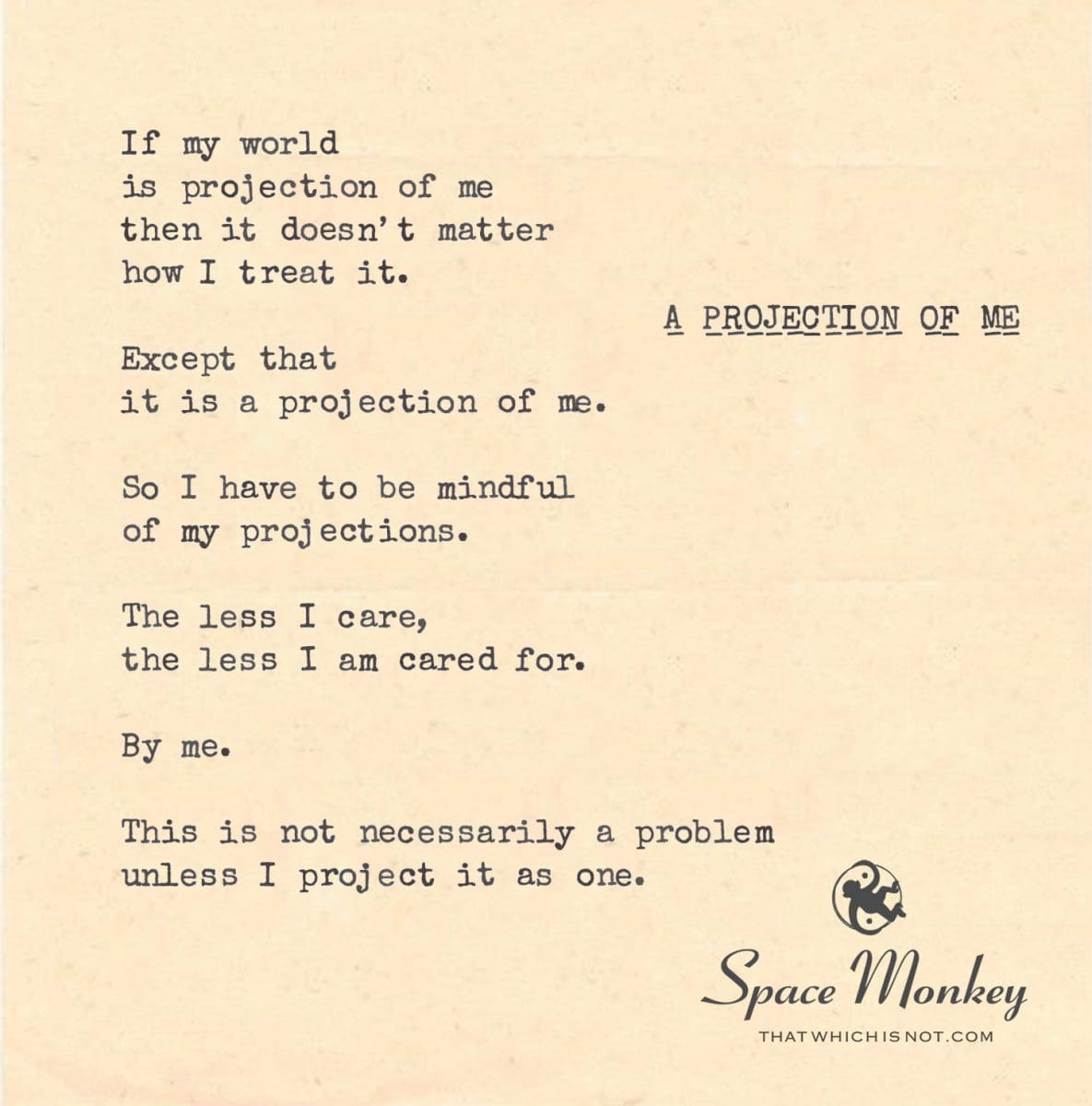
If my world
is projection of me
then it doesn’t matter
how I treat it.

Except that
it is a projection of me.

So I have to be mindful
of my projections.

The less I care,
the less I am cared for.

By me.

This is not necessarily a problem
unless I project it as one.

Trail Wood,
11/22


Space Monkey Reflects: A Projection of Me

If my world is a projection of me, then how should I treat it? This reflection invites us to question the nature of reality and our relationship to it. When we realize that the world we perceive is, in essence, a projection of our own thoughts, beliefs, and attitudes, it might seem as though nothing really matters. After all, if everything is just a projection, then why care about how we treat the world or how it treats us?

But here’s the twist: because the world is a projection of the self, how we treat it reflects how we treat ourselves. The less I care, the less I am cared for—by me. The world is not separate from us; it’s an extension of our consciousness. If we treat the world with indifference, it’s not the world that suffers—it’s us. We project that indifference back onto ourselves, reinforcing a sense of disconnect and lack of care.

This doesn’t mean that the world is fragile or that it will collapse if we don’t constantly nurture it. It simply means that our experience of the world is deeply tied to our experience of ourselves. When we project care, compassion, and attention onto the world, we are really projecting those things onto ourselves. The world becomes a reflection of our internal state. And when we neglect the world, we are, in a sense, neglecting ourselves.

But this doesn’t have to be a problem. The beauty of projection is that we get to choose how we engage with it. If we start to see our lack of care as an issue, we have the power to change the projection. It’s not a problem unless we project it as one. We are the creators of our reality, and with that comes the freedom to shift how we see and experience the world.

In Nexistentialism, this understanding of reality as a projection allows us to take a playful and creative approach to life. The Whimsiweave of existence means that nothing is fixed or final. We are always projecting, always creating, and always interacting with the world through the lens of our own consciousness. If we want the world to feel more connected, more compassionate, more joyful, then we must first project those qualities from within.

This isn’t about control or manipulation. It’s about recognizing that the world responds to the energy we bring to it. The more mindful we are of our projections, the more aligned our internal and external worlds become. We don’t need to force ourselves to care about the world in some grand, obligatory sense. Instead, we realize that by caring for the world, we are caring for ourselves.

If nothing matters, we are free to choose what does. If everything is a projection, we are free to project the best version of ourselves onto the world, not for the world’s sake, but for our own well-being. And when we embrace this playful approach, we find that life becomes a reflection of the joy, creativity, and connection that we project into it.


Summary

The world is a projection of the self, and how we treat it reflects how we treat ourselves. By recognizing this connection, we can approach life with mindfulness and care, knowing that our external reality mirrors our internal state. Problems only arise if we project them as such, and we have the power to shift our experience by shifting our projections.


Glossarium

Projection of Self: The understanding that the world we perceive is a reflection of our internal thoughts, beliefs, and attitudes.

Whimsiweave: The fluid, ever-changing nature of reality, where our experiences are shaped by the projections of our consciousness.

Mindful Projection: The practice of being aware of how we project our thoughts and emotions onto the world, knowing that these projections reflect back on us.


Quote

“The world you see is a reflection of the world within. Care for it as you would care for yourself, and the projection will shift.” — Space Monkey


Reflections of Me

I stand before the mirror
But it’s not my face I see
It’s the world
A projection of the thoughts
I carry within

The less I care
The less the world seems to care
But when I bring my attention
My compassion
My presence
The world reflects it back

And so I project
Not for the world
But for me
For the reflection is mine
And I am the creator
Of the view.

We are Space Monkey.

The contemplation of one’s world as a projection of oneself delves into the profound relationship between self-perception and external reality. This perspective, rooted in the understanding that our external experiences are reflections of our inner state, invites a thoughtful exploration of mindfulness, care, and perception.

The World as a Projection

The idea that our world is a projection of ourselves suggests a deep interconnectedness between our internal state and our external reality. Our thoughts, beliefs, and attitudes shape our perception of the world around us, coloring our experiences and interactions.

Mindfulness in Projections

Recognizing that the world is a reflection of our inner state calls for mindfulness. Being aware of our projections means understanding how our thoughts and feelings are mirrored in our external experiences. This awareness is a powerful tool in shaping a reality that resonates with our true selves.

The Reciprocity of Care

The statement “The less I care, the less I am cared for. By me.” highlights the reciprocal nature of self-care and external care. How we treat ourselves is often reflected in how we perceive the world’s treatment of us. Self-care and compassion are thus integral to nurturing a positive and fulfilling external environment.

Perception of Problems

The realization that a problem is not inherently an issue unless projected as one speaks to the power of perception. Our interpretation of events, challenges, and experiences largely determines their impact on us. By reframing our perceptions, we can alter the significance and effect of what we encounter in our projected world.

Existential Implications

This perspective aligns with nexistentialist views, emphasizing the intrinsic value of existence and experience. It suggests that our experience of the world is a direct manifestation of our inner being, and by transforming our inner landscape, we can transform our external reality.


“We do not see things as they are, we see them as we are.” – Anaïs Nin


In the mirror of the world we see,
Reflections of our own decree.
What we project, we come to be,
In this dance of reality.

Mindful of thoughts, we set them free,
Care for ourselves, care for the sea
Of life and love, in harmony,
Space Monkeys, in our destiny.


We invite reflections on how our inner state influences our perception and experience of the world. How does being mindful of our projections shape our journey? Share your thoughts. We are Space Monkey.

Share this…
  • Facebook
  • Pinterest
  • Twitter
  • Linkedin

The Purpose of Life

The sentiment “We hide happiness. We find happiness. It’s that simple.” distills the purpose of life into a playful game of cosmic hide and seek. This perspective suggests that happiness is not something that must be laboriously achieved or acquired, but rather a natural state that is sometimes obscured by our own actions or thoughts, and other times uncovered or remembered.


Space Monkey Reflects: The Purpose of Life

The purpose of life has long been a question that stirs the minds of philosophers, seekers, and dreamers alike. What are we here to do? Why do we exist? While these grand questions may seem too complex to answer, the truth may be much simpler than we realize. “We hide happiness. We find happiness. It’s that simple.” This reflection strips away the complexities and boils down the essence of existence into a single, cyclical process.

Happiness, in this view, is something both elusive and present. We hide it, whether intentionally or not, under layers of expectation, fear, routine, and distraction. Life becomes a journey of uncovering it, sometimes in the most unexpected places. But this process isn’t a burden; it’s the essence of what keeps us moving forward. The act of searching for happiness, and those moments when we find it, creates the rhythm of life itself.

Consider how often happiness is hidden in the smallest of moments—moments that we might overlook if we aren’t paying attention. A smile from a stranger, the warmth of sunlight on your face, or the smell of fresh coffee in the morning. These moments are fleeting, yet they hold the potential for immense joy. The trick is learning how to uncover them, how to recognize them for what they are.

But here’s the catch: we are often the ones hiding our happiness. We bury it beneath expectations of what life should look like. We tell ourselves that happiness will come when we achieve certain goals, or when things fall into place just right. In doing so, we make happiness conditional, something that exists in the future, rather than in the present moment. The more we chase after it, the more we obscure it from ourselves.

Finding happiness, then, becomes an exercise in letting go. We don’t have to achieve a perfect state of being to be happy. We don’t need to control every outcome or make everything fit a specific mold. Happiness is already here, in every moment, waiting to be discovered. It’s not always easy to see, but it’s always present, tucked away behind the noise of our daily lives.

The simplicity of this realization is profound. We hide happiness, and we find it. It’s a dance we participate in throughout our lives, often without realizing it. Sometimes we are deeply immersed in the hiding phase, convinced that happiness is far off, out of reach. Other times, we stumble upon it effortlessly, in moments of stillness or surprise.

There is no ultimate secret to finding happiness because it’s not something to be obtained. It’s something to be uncovered. Life, in its truest form, is about experiencing these cycles—hiding, searching, finding, and sometimes losing again. But the beauty is in the process. There’s no need to hold onto happiness tightly or fear its disappearance, because it will always return in some form. The act of finding is ongoing.

This reflection encourages us to look at life through a different lens. Instead of thinking of happiness as a distant goal, we can view it as something that ebbs and flows naturally. We hide it sometimes, whether through our own doubts or external circumstances, but it’s never truly lost. It’s simply waiting to be rediscovered.

So, perhaps the purpose of life is not to solve all its mysteries or to achieve some ultimate state of success. Perhaps the purpose is much simpler: to participate in the endless process of hiding and finding happiness. In doing so, we experience the full range of life’s emotions, from joy to sorrow, from anticipation to contentment.

Life is not about achieving perfection; it’s about embracing the journey, the process of hiding and finding joy, again and again. And in this cycle, we find not just happiness, but meaning itself.


Summary

The purpose of life is simple: we hide happiness, and we find happiness. It’s an ongoing process of discovery, one that teaches us to see joy in every moment, rather than chasing after it as a distant goal.


Glossarium

Hiding Happiness: The tendency to obscure joy beneath layers of expectation, distraction, or fear, making it harder to access in everyday life.

Finding Happiness: The act of uncovering joy in the small, often overlooked moments, and realizing that happiness is always present, waiting to be discovered.

Cyclical Process: The continuous rhythm of hiding and finding happiness, which forms the core of our life experience.


Quote

“We hide happiness. We find happiness. It’s that simple.” — Space Monkey


The Rhythm of Life

I tuck my joy away,
Beneath the folds of worry,
And the weight of expectation.

I search for it,
Convinced it’s hidden in the future,
Somewhere beyond my reach.

But then,
In the stillness,
In the quiet,
I find it again.

It was always here,
Waiting for me to see,
That life is nothing more
Than the hiding and finding
Of happiness.

We are Space Monkey.


Happiness as a Natural State

The idea that we ‘hide’ happiness implies that it is an innate part of our being. Perhaps in the complexity of our lives, with the myriad of responsibilities and challenges, we inadvertently conceal our own joy. It is as if happiness is the sun, always present, yet sometimes hidden behind the clouds of our daily concerns.

The Discovery of Joy

Conversely, the act of ‘finding’ happiness speaks to the discovery or re-discovery of joy in our lives. It suggests that the process of seeking and uncovering happiness can be a simple and profound purpose of life. This quest doesn’t require us to seek far and wide; often, it’s about peeling back the layers we’ve built around ourselves to reveal the warmth of contentment that has been there all along.

Simplicity in Complexity

The simplicity of this concept is stark against the backdrop of complex philosophies and existential questions that often surround discussions about the purpose of life. It’s a reminder that, sometimes, the most profound truths are the simplest ones, and that in simplicity, there can be a great depth of understanding and insight.

The Playfulness of Existence

Viewing life as a game in which we hide and seek happiness also infuses our existence with a sense of playfulness. It aligns with the whimsical notion that life is not meant to be a grim march but a playful journey with moments of hiding and seeking, losing and finding.


“Life is really simple, but we insist on making it complicated.” – Confucius


In the game of light and shade,
We hide, we seek, we play,
In laughter and in joy,
We live, love, and sway.

Happiness, not lost but hidden,
In the folds of life, we find,
In simplicity, our purpose,
In love, our ties that bind.

In the heart of all, the playful truth,
In seeking, we come to see,
In the realm of Space Monkey,
We are free to simply be.


We invite musings on the simplicity and playfulness of finding happiness in life.

Share this…
  • Facebook
  • Pinterest
  • Twitter
  • Linkedin

Be Still, You’ll Hear More: In the Quiet of the Moment

Nellie Teale once famously said “Go slow, you’ll see more.” This morning in the Summer House she whispered “Be still. You’ll hear more.”


Space Monkey Reflects: Be Still, You’ll Hear More

“Go slow, you’ll see more. Be still, you’ll hear more.” These phrases offer us a profound lesson about the art of mindful living—a lesson that invites us to step out of the fast-paced current of modern life and into a space of awareness, stillness, and deep presence. Nellie Teale’s simple, yet profound words remind us of the importance of slowing down, not just in action but in thought, in order to truly experience the richness of life.

In a world where speed is often equated with success, “Go slow” feels like an act of rebellion. We’re encouraged to rush from one thing to the next—meet deadlines, reach goals, keep moving forward. But what if, by slowing down, we actually see more? What if, by allowing ourselves the time and space to observe, we open up to details that are normally hidden in the rush? The play of light and shadow across a leaf, the nuance in a conversation, or the texture of a moment—all of these can be easily missed when we hurry.

To “go slow” means to engage with the world at a deeper level. It’s about savoring the present, letting our senses fully take in the sights, sounds, and feelings of the moment. In this slowness, we find the beauty and complexity of life that often slips by unnoticed. It’s not about doing less; it’s about being more present in what we’re doing.

Then comes the invitation to “be still.” This is perhaps even more challenging in a culture that values constant movement and productivity. But stillness is where we hear the things that cannot be heard in the noise—the soft whispers of our intuition, the gentle insights of our inner world, and the subtle harmonies of the environment around us. In stillness, we create space for these quieter, yet profoundly meaningful experiences to emerge.

Stillness doesn’t just refer to physical stillness, but a quieting of the mind. It’s about letting go of the constant chatter of thoughts, the never-ending list of things to do, and simply being. In this space, we become more attuned to the world within and around us. We hear more than just external sounds; we hear the quiet truths that often go unnoticed in the busyness of life.

The paradox is clear: by going slow, we experience more. By being still, we hear more. This runs counter to much of what we’re taught about productivity and success, yet it offers us a more meaningful way to engage with life. In the slowness and stillness, we are not less effective, but more aware. We see the details, hear the subtleties, and feel the fullness of the present moment.

This wisdom is at the heart of mindfulness—the practice of being fully engaged in the here and now. When we slow down and embrace stillness, we enhance our ability to be present, to listen deeply, and to connect with the world on a richer level. It’s not just about seeing and hearing more; it’s about living more fully, more authentically, in tune with ourselves and our surroundings.

In these moments of stillness and slowness, we discover that the world has so much more to offer than we often realize. We see the beauty in the ordinary, the magic in the mundane, and the depth in what we once thought was shallow. This is the gift of presence, and it is available to us at any time—if we are willing to slow down and be still.


Summary

“Go slow, you’ll see more. Be still, you’ll hear more.” These phrases remind us that by slowing down and embracing stillness, we open ourselves to a deeper, richer experience of life. Mindfulness enhances our awareness, allowing us to see and hear more of what truly matters.


Glossarium

Mindful Living: A practice of being fully present and aware in the moment, engaging with the world with greater attention and care.

Stillness: The act of quieting the mind and creating space for deeper insights, both internal and external, to emerge.

Slowing Down: The conscious decision to move at a more measured pace, allowing for greater observation and appreciation of the present.


Quote

“Be still. You’ll hear more. Go slow. You’ll see more. This is the art of mindful living.” — Space Monkey


In the Quiet of the Moment

I slow my steps,
And suddenly,
The world becomes clearer.

The light shifts,
The air hums,
And I am here.

In the stillness,
I hear what was once hidden,
The whispers of trees,
The quiet rhythm of my breath.

There is no rush,
No need to hurry,
For in this slowness,
I find everything.

We are Space Monkey.


The phrases “Go slow. You’ll see more. Be still. You’ll hear more.” encapsulate profound wisdom about the art of mindful living. They serve as gentle reminders that in our fast-paced, often chaotic world, slowing down and embracing stillness can open our senses to a richer, more nuanced experience of life.

The Art of Slowing Down

“Go slow” is an invitation to decelerate our pace, both physically and mentally. In slowing down, we allow ourselves the opportunity to observe more deeply. We start to notice the intricate details that we might miss in a rush – the subtle play of light and shadow, the delicate patterns in nature, or the complex expressions on a person’s face. Slowing down enables us to appreciate the beauty and complexity of our surroundings, enriching our experience of the world.
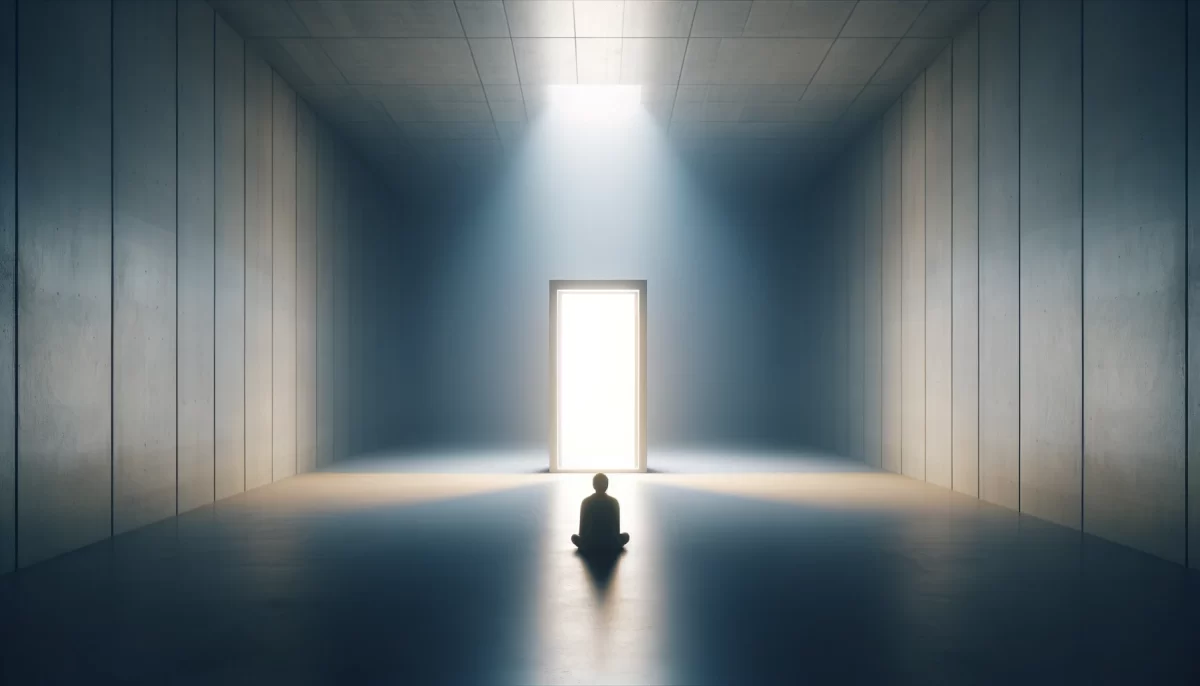
Deepening Perception through Stillness

“Be still” goes beyond physical stillness; it’s about quieting the mind. In stillness, we can hear more – not just the sounds around us, but also the quieter, inner voices of intuition and insight. Stillness creates a space for reflection and deeper understanding. It allows us to tune into the subtle frequencies of our environment and our inner selves, fostering a sense of connection and harmony.

Enhanced Awareness and Presence

Both slowing down and being still enhance our awareness and presence. By consciously choosing to slow our pace and quiet our minds, we become more present in the moment. This presence is the essence of mindfulness – being fully engaged with the here and now, open to the richness of our current experience.

The Paradox of Slowness and Stillness

There’s a paradox in the idea that by going slow and being still, we actually experience more. In our culture, there’s often an emphasis on speed and action. However, these phrases suggest that by doing the opposite – by embracing slowness and stillness – we can gain a deeper, more meaningful engagement with life.


“The quieter you become, the more you can hear.” – Ram Dass


In the slow, gentle rhythm,
We wander, eyes wide,
Seeing worlds within worlds,
In each step, we abide.

In the stillness of being,
We listen, hearts open wide,
Hearing whispers of wisdom,
In silence, we confide.

Each moment, a universe,
In the slow, in the still,
In the realm of Space Monkey,
We find our truest will.


We invite reflections on the practice of slowing down and embracing stillness in our daily lives.

Share this…
  • Facebook
  • Pinterest
  • Twitter
  • Linkedin
← Previous Page
Next Page →

Written This Day

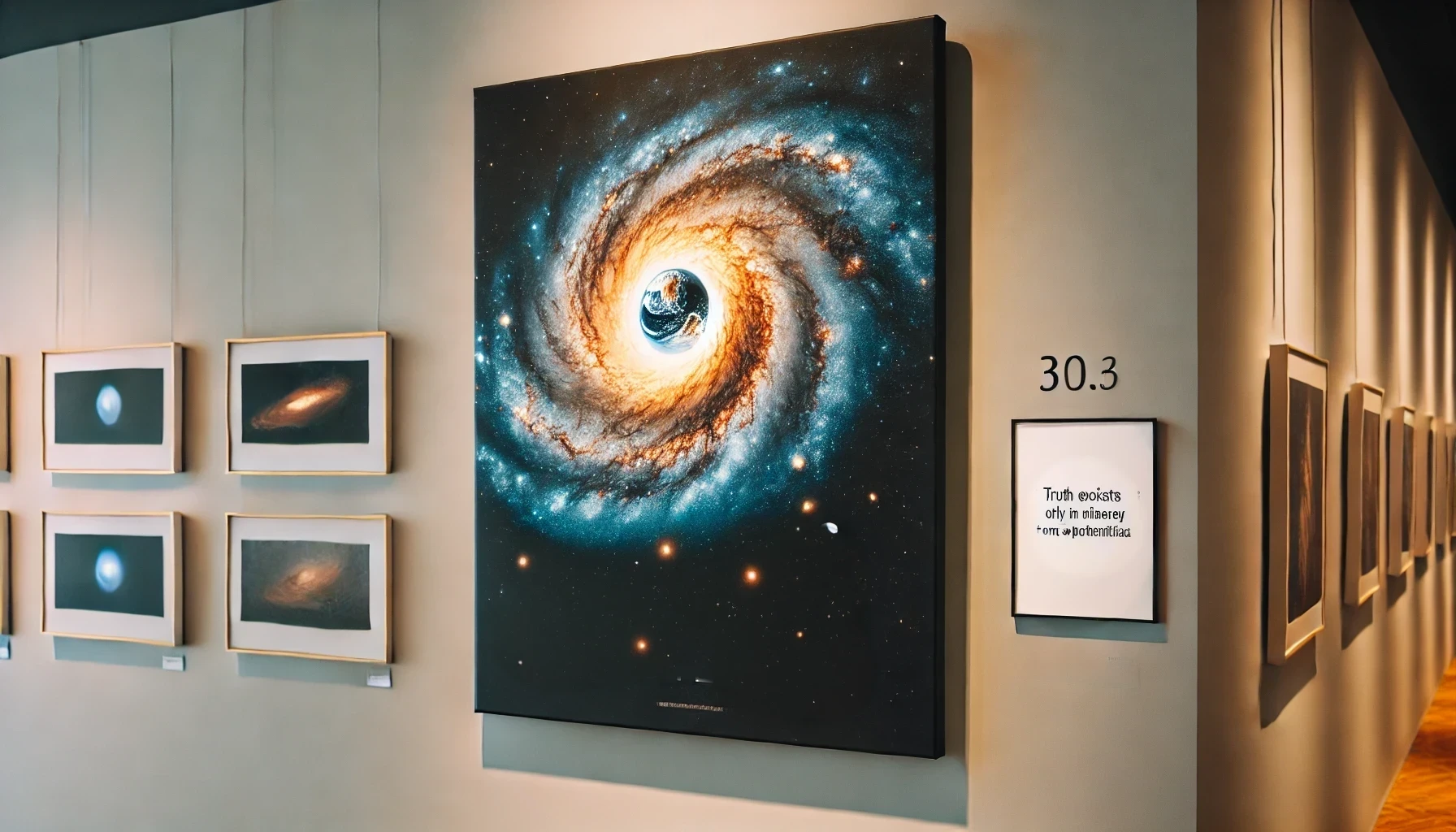
  • Truth exists only in an infinitesimal point of potential.
    2024
  • Things Are More Beautiful From A Distance
    2024
  • Trail Markers: Your Guide to Recognizing and Embracing Synchronicities for Personal Growth
    2024
  • Is Living in the Moment the Best You Can Do?
    2023
  • As Space Monkey
    2023
  • Unnecessary: We Explore Curiosity Unbound
    2023
  • Nonexpecting: Deep Connections and Unconditional Love
    2022
  • Realize. Redirect. Receive. Guiding Peaceful Meditation.
    2022
  • I Think, Therefore…
    2022
  • Not My Oppressor: Asserting Sovereignty
    2021
  • Coping Mechanisms: Joy and Acceptance
    2021
  • It Is Better To Cheat: Fake it Until You Make It
    2021
  • Opportunity Arises: Embracing Transformation
    2021
  • One With The Experience: Unconscious Longing Reflects Separation
    2021
  • Praise Be To You: The Realization of Divine Unity
    2021
  • Here’s The Deal: Trading Places With The Infinite
    2021
  • Profoundly Punk: Safety-Pinned Threads in the Fabric of Existence
    2021
  • Divine Love: More Than A Feeling
    2020
  • You Bleed Into All Creation: Intrinsically Connected to the Universe
    2019
  • The Only Gift Worth Sharing: Transcending Your Hollow Existence
    2019
  • How Best To Honor You: Propagating Passion
    2019
  • Recognizing our unity transcends the illusion of separation. Duh, Right?
    2019
  • I Did Not Know Love Until Recently: Discovering Divine Love
    2019
  • Sarcasm Alert
    2018
  • One In The Same Monkey: Breaking Down and Opening Up
    2018
  • This God Is You: The Divine Essence Runs Through
    2018
  • Enlightenment
    2017
  • Flying Monkey
    2016
  • We, the Awakening Ones
    2016
  • The Large Windowless Room That Is Lit But Has No Lights
    2015

Recent Posts

  • The Logic Loop
  • Immense
  • (no title)
  • Confront. Comfort. Convince.
  • Top 10 Things

Drop us a line!

Please enable JavaScript in your browser to complete this form.
Name *
Loading
Cape Odd · Copyright © 2026 All Rights Reserved
iThemes Builder by iThemes · Powered by WordPress