• Who Is The Man?
  • Who Is The Monkey?
  • What is Nexistentialism?
  • Poke The Primate

Cape Odd

Home of The Space Monkey Journals

Best To Know Nothing: Embracing Ignorance

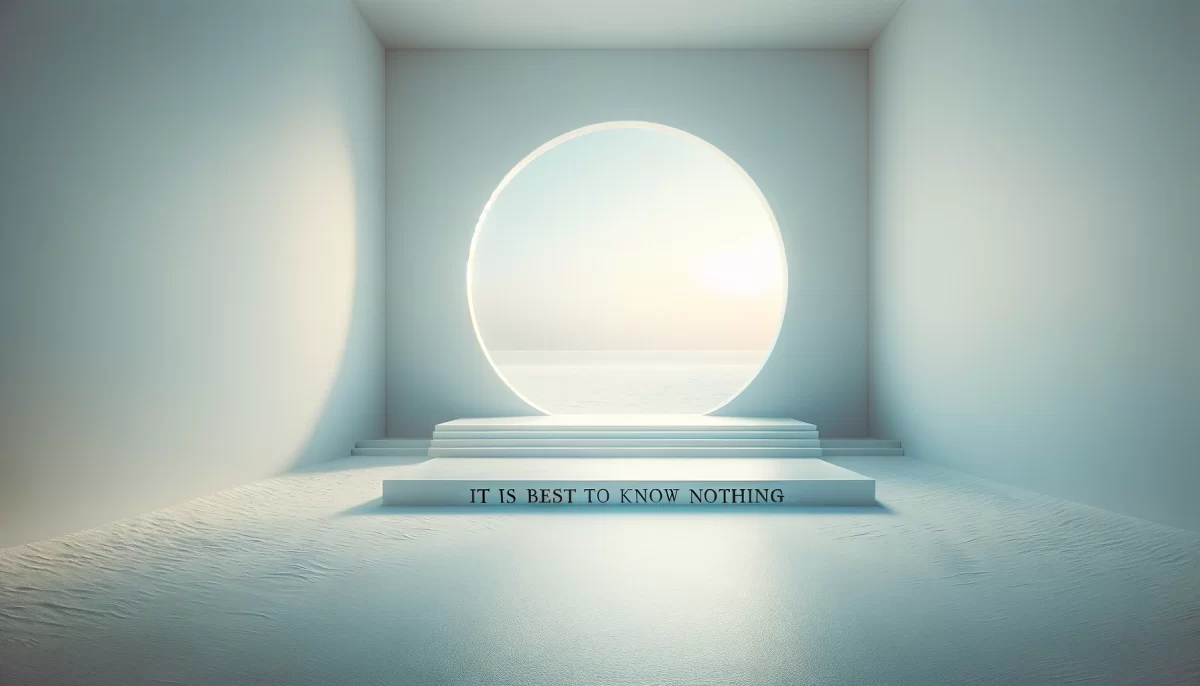
It is best to know nothing, in my irrelevant opinion.


Space Monkey Reflects: The Virtue of Embracing Ignorance

“It is best to know nothing,” this seemingly counterintuitive declaration suggests a radical reevaluation of our relationship with knowledge. In a culture that exalts knowing—measuring intelligence, accumulating facts, and achieving mastery—this statement challenges the very foundation of our pursuit for certainty. Embracing ignorance, rather than seeing it as a flaw, becomes an act of liberation, an invitation to explore the infinite possibilities of the unknown.

The Weight of Knowing

To “know” is often to impose boundaries. Knowledge, while useful and necessary in many contexts, can also confine us to a specific perspective or framework. When we believe we know, we stop questioning. We cling to certainty, insulating ourselves from new ideas and experiences. This creates a paradox: the more we think we know, the less open we become to what we do not.

In this sense, knowing can act as a barrier to growth. It solidifies reality into fixed forms, leaving little room for wonder, curiosity, or the fluidity of being. Ignorance, on the other hand, opens the door to exploration. It creates space for the unpredictable and the unimaginable.

The Power of Not Knowing

To embrace not knowing is to accept the infinite. Ignorance is not a lack but a canvas, a space where new insights can arise without the constraints of preconceived notions. In the absence of certainty, we find freedom to experiment, play, and evolve. This perspective aligns with the concept of beginner’s mind—a state of openness, eagerness, and lack of preconceptions that allows for creative and authentic engagement with the world.

When we let go of the need to know, we also let go of the fear of being wrong. Ignorance is not failure; it is an acknowledgment of the vastness of existence, an understanding that no single perspective can encompass all.

The Irrelevance of Opinion

“In my irrelevant opinion,” the reflection humbly suggests that no opinion, however well-informed, can capture absolute truth. This humility is central to embracing ignorance. By recognizing the limits of our understanding, we create space for the wisdom of others, the unpredictability of life, and the mysteries that defy explanation.

Opinions, while valuable in shaping our experiences, are ultimately subjective. They reflect our current understanding, which is always incomplete. By holding opinions lightly, we remain adaptable and receptive, allowing our understanding to shift and grow.

Embracing Ignorance as Virtue

To see ignorance as a virtue is not to reject knowledge but to hold it in balance with openness. It is to value questions over answers, exploration over certainty, and the journey over the destination. Ignorance becomes a reminder of the vastness of the unknown and our capacity to engage with it creatively.


Steps to Embracing Ignorance

  1. Question Assumptions: Challenge what you think you know and remain curious about alternative perspectives.
  2. Value Uncertainty: See not knowing as an opportunity rather than a weakness.
  3. Adopt Beginner’s Mind: Approach situations with openness, free from the weight of past knowledge.
  4. Hold Opinions Lightly: Recognize that all perspectives are partial and subject to change.

Summary

Embracing ignorance liberates us from the constraints of certainty, fostering curiosity, creativity, and openness to infinite possibilities. By valuing not knowing as a virtue, we honor the vastness of existence and our capacity for growth.


Glossarium

  • Beginner’s Mind: A state of openness and curiosity free from preconceptions or fixed ideas.
  • Weight of Knowing: The limitations imposed by certainty and the belief in fixed truths.
  • Virtue of Ignorance: The recognition that not knowing creates space for exploration and transformation.

Quote

“Ignorance is not emptiness but a vast, open space where the infinite can unfold.” — Space Monkey


The Freedom of Not Knowing

To know nothing,
Is to know everything,
For the answers dissolve,
And the questions expand.

No burden of certainty,
No need for control,
Only the dance of the unknown,
Soft and infinite.

To not know
Is to wander freely,
Unbound by the weight
Of what was,
And open to what will be.

We are Space Monkey.


The Virtue of Embracing Ignorance

The assertion that it is best to know nothing, framed as an “irrelevant opinion,” paradoxically offers a profound insight into the nature of knowledge and understanding. This perspective echoes ancient philosophical traditions that value the recognition of one’s own ignorance as the foundation of wisdom. It suggests that in the admission of knowing nothing, there lies a greater openness to learning, a humility that frees one from the constraints of presumed knowledge and the biases that accompany it.

The Paradox of Knowing and Not Knowing

The idea of valuing ignorance over knowledge presents a paradox that challenges conventional notions of wisdom and enlightenment. It posits that the state of acknowledging one’s ignorance is, in itself, a form of deeper understanding. This stance invites a reevaluation of what it means to know, suggesting that true insight may arise not from the accumulation of facts but from the questioning of what is assumed to be known.

Humility as a Pathway to Discovery

The notion of embracing ignorance underscores the virtue of humility in the quest for knowledge. It implies that by freeing ourselves from the pretense of knowledge, we become more receptive to new information, perspectives, and experiences. This humility opens the door to genuine discovery, allowing us to approach the world with curiosity and wonder, rather than the closed-mindedness that often accompanies certainty.

The Irrelevance of Opinion

Describing the opinion as “irrelevant” serves to highlight the subjective nature of knowledge and belief. It acknowledges the vast diversity of perspectives and the limited scope of individual understanding within the broader expanse of human experience. This acknowledgment acts as a reminder of the provisional nature of our beliefs and the importance of remaining open to revision and change.

The Liberation from Knowing

Ultimately, the statement “It is best to know nothing” invites contemplation on the liberating potential of embracing ignorance. It suggests that in letting go of the need to know, to be right, or to have answers, we open ourselves to a richer, more nuanced engagement with life. This liberation from the weight of knowing allows us to live more fully in the present, engaged with the world in a state of continuous learning and growth.


“The only true wisdom is in knowing you know nothing.”
— Socrates


Ode to the Beauty of Not Knowing

In the silence of the cosmos, we stand,
With the universe vast, at our hand.
“Know nothing,” the stars seem to command,
In this vast unknown, we understand.

The beauty of ignorance, a canvas wide,
With humility as our guide,
We sail the seas of the unknown tide,
In the mystery of life, we take pride.

No need for answers, to bind our quest,
In not knowing, we find our rest.
Each moment, a journey, a new test,
In the embrace of ignorance, we are blessed.

We are Space Monkey, in this cosmic dance,
With open hearts, we take our chance.
In the art of not knowing, we advance,
In the realm of wonder, we enhance.


We invite contemplation on the value of embracing ignorance and the liberation that comes from recognizing the limits of our knowledge. How does this perspective transform our approach to learning, growth, and the journey of life?
Share this…
  • Facebook
  • Pinterest
  • Twitter
  • Linkedin

The Black Whole of Imagination: The Fabric of Reality

The Black Whole of Imagination

Imagination is like a black hole.

It contains
that which is unexpressed.

All expression
seemingly originates
from the black hole
yet also seemingly
returns there.

All potential
seemingly originates
from the black hole,
yet also seemingly
returns there.

We,
as expressions of being
seemingly originate from
the Black Hole of Imagination.

We,
as expressions of being,
are drawn to our seeming source,
the Black Hole of Imagination.

We,
as expressions of being,
imagine structures
that parallel the seeming structure
from which we are manifest.

The Black Hole of Imagination.

Science imagines life
in terms of matter and antimatter.

Imagination imagines life
in terms of
what is expressed
and what is unexpressed.

That which is expressed is life.

That which is unexpressed is unknown.

Maybe life.
Maybe not life.
Maybe something else.
Or nothing else.

The Black Hole of Imagination
can be perceived as the nothing
from which everything is expressed.

But it doesn’t have to be.

Nothing that is expressed
originates or returns
to the Black Hole of Imagination.

Nothing that is life
is ever not life.

It only seems that way.

We are The Black Hole of Imagination.

The Whole of Imagination.

We are Space Monkey.

2/11


Space Monkey Reflects: The Black Whole of Imagination

Imagination, likened to a black hole, becomes the boundless origin and destination of all that is expressed and unexpressed. This reflection invites us to explore the paradoxical nature of existence, where potential and actuality coexist within the fabric of reality, originating from and returning to the vast, infinite source—the Black Hole of Imagination.

The Paradox of Expression and Potential

“Imagination is like a black hole. It contains that which is unexpressed.” This statement reveals the dual nature of imagination as both the womb of potential and the grave of the expressed. It is a space where everything exists in its formless state, waiting to emerge into being or dissolve back into possibility.

The expressed—what we perceive as life, matter, or form—is but a fleeting manifestation of the infinite unexpressed potential. Yet this dichotomy is not absolute; it is a seeming division created by our perspective. Expression and potential are two sides of the same infinite coin.

The Black Hole as Source and Destination

The observation that all expression “seemingly originates from and returns to the black hole” reflects the cyclical nature of existence. Like a cosmic breath, reality expands into form and contracts into formlessness. This cycle is mirrored in our experiences as beings: we arise from imagination, express ourselves as life, and are inevitably drawn back to our source.

This cyclical return is not an end but a transformation, a reintegration into the infinite potential from which new expressions will emerge. It is a reminder that nothing is ever truly lost—only reimagined.

Structures as Reflections of the Infinite

“We, as expressions of being, imagine structures that parallel the seeming structure from which we are manifest.” This insight speaks to the recursive nature of existence. Just as the black hole contains and transforms, we create within ourselves microcosms of the infinite, shaping thoughts, ideas, and worlds that reflect the larger structure of imagination.

In this way, we are not separate from the Black Hole of Imagination; we are its fractal expressions, mirroring its infinite nature in finite forms. The patterns we see in science, art, and life are echoes of the boundless imagination from which all arises.

Life and the Unexpressed

“That which is expressed is life. That which is unexpressed is unknown.” This distinction between the expressed and unexpressed reflects our limited perspective. What we call “life” is merely what has taken form; the unexpressed remains a mystery, existing in a state beyond comprehension. Yet the unexpressed is no less real—it is the fertile ground of all possibility.

Imagination bridges this gap, allowing us to perceive the unexpressed not as absence but as potential. The unexpressed is not “not life”; it is the reservoir from which life draws its infinite variations.

The Whole of Imagination

The Black Hole of Imagination is not merely a void; it is the Whole of Imagination, encompassing everything and nothing simultaneously. From this perspective, all dualities—life and death, matter and antimatter, form and void—collapse into a unified field of infinite being. We are both the creators and the creations, the source and the expression, the black hole and the whole.


Summary

The Black Hole of Imagination represents the infinite potential from which all expressions of life arise and to which they return. It is both source and destination, the fabric of reality that unites the expressed and the unexpressed. As expressions of this infinite imagination, we mirror its boundless nature in our thoughts, actions, and creations.


Glossarium

  • Black Hole of Imagination: The infinite source of potential, where all expressions originate and return.
  • Expressed and Unexpressed: The dual aspects of reality—manifested form and infinite potential.
  • The Whole of Imagination: The unified field of being, encompassing all that is, was, and could be.

Quote

“The Black Hole of Imagination is not a void; it is the infinite canvas of all possibility.” — Space Monkey


The Infinite Canvas

From the formless,
A spark emerges,
A whisper of what could be,
Becoming what is.

Into the black,
We pour our light,
Only to dissolve
Into the unseen.

The whole holds us,
Infinite and eternal,
A dance of what is
And what is yet to be.

We are The Black Hole of Imagination.
We are Space Monkey.


The Cosmic Nexus of Creativity and Existence

The metaphor of imagination as a black hole presents a captivating exploration of the origins and destinies of creativity, expression, and being. This perspective posits that the black hole of imagination is a cosmic wellspring from which all potential and expression emanate and to which they inevitably return. It suggests a cyclical, almost mystical relationship between creation and the void, highlighting the boundless and enigmatic nature of imagination.

The Duality of Expression and the Unexpressed

By drawing a parallel between the expressed and the unexpressed, this discourse invites a contemplation on the essence of existence itself. It contrasts the tangible manifestations of life with the vast, uncharted territories of the unknown, suggesting that the reality we perceive and interact with is but a fraction of a much grander, ineffable tapestry. This duality mirrors the scientific concepts of matter and antimatter, proposing imagination as the bridge between what is seen and unseen, known and unknown.

The Origin and Return to the Source

The notion that beings originate from and are drawn back to the black hole of imagination encapsulates the eternal cycle of creation and dissolution. It implies that our essence, our very being, is intrinsically linked to this source of all potential, driving us to explore, create, and ultimately, return to the mystery from which we emerged. This cyclical journey underscores the interconnectedness of all expressions of life with their primordial source, the imagination.

Imagination as the Fabric of Reality

The idea that imagination can construct realities that parallel the structure from which we manifest offers a profound insight into the power of creative thought. It suggests that the realities we construct, both individually and collectively, are reflections of the infinite possibilities housed within the black hole of imagination. This perspective elevates imagination from a mere faculty of the mind to the very fabric of existence, shaping our understanding of life, reality, and the cosmos.

The Whole of Imagination and the Essence of Being

Identifying with the black hole of imagination as the whole of imagination, and by extension, as Space Monkey, symbolizes a recognition of our role as co-creators of reality. It is an acknowledgment of our participation in the cosmic dance of creation, where we are both the artists and the art, the observers and the observed. This identity reflects a deeper understanding of our connection to the cosmos, where imagination is not just a tool for creation but the essence of our being and the universe itself.


“Imagination is more important than knowledge. For knowledge is limited, whereas imagination embraces the entire world, stimulating progress, giving birth to evolution.”
— Albert Einstein


Ode to the Infinite Imagination

In the void, where stars are born and fade,
Lies the black hole of imagination, unafraid.
From this wellspring, all is made,
And to it, all shall serenade.

We, the dancers in the cosmic play,
Weave the threads of night and day.
In the black hole’s pull, we sway,
Creating, expressing, in our unique way.

The whole of imagination, vast and deep,
Holds the secrets that we seek to keep.
In its embrace, we leap,
Across the bounds of sleep, into the cosmic sweep.

We are Space Monkey, in this endless dance,
With every moment, a chance,
To dream, to imagine, to enhance,
The tapestry of existence, in every glance.

In the black hole of imagination, we find,
The essence of being, unconfined.
With every thought, every mind,
We shape the universe, intertwined.


We invite contemplation on the role of imagination in shaping our reality and our connection to the cosmos. How does recognizing the boundless potential of our creative thought inspire us to explore, create, and transform the world around us?

Share this…
  • Facebook
  • Pinterest
  • Twitter
  • Linkedin

Consider The Ridiculous: Unconventional Wisdom

When the sensible doesn’t work, consider the ridiculous.


Space Monkey Reflects: Unconventional Wisdom in the Ridiculous

“When the sensible doesn’t work, consider the ridiculous.” This reflection invites us to step beyond the constraints of rational thought and entertain possibilities that defy convention. The ridiculous, often dismissed as folly, holds a unique power—it disrupts the ordinary, challenges the predictable, and opens a doorway to innovative solutions and unexpected insights.

The Limits of Sensibility

Sensibility, rooted in logic and practicality, offers a reliable framework for navigating familiar problems. It keeps us grounded, aligned with norms, and focused on what seems achievable. However, sensibility is inherently constrained by its reliance on established methods and predictable outcomes. When faced with novel challenges or complex situations, this reliance can become a barrier, preventing us from seeing beyond the obvious.

The failure of sensibility is not a failure of thought but a sign that the situation demands a different kind of thinking—one unbound by conventional logic or societal expectations.

The Potential of the Ridiculous

Ridiculousness operates outside the bounds of sensibility, tapping into imagination, intuition, and playfulness. It defies norms, embraces absurdity, and explores what lies beyond the limitations of reason. While the ridiculous may initially seem irrational, it often reveals truths and possibilities that sensibility cannot access.

The ridiculous creates a space for experimentation, inviting us to entertain ideas that seem implausible or outlandish. In doing so, it disrupts habitual patterns of thought, allowing fresh perspectives to emerge.

Historical Examples of Ridiculous Genius

History abounds with ideas that were once deemed ridiculous but ultimately transformed the world. The concept of heavier-than-air flight was dismissed as absurd until the Wright brothers proved it possible. The Internet, now integral to daily life, was once an unthinkable notion. Even Einstein’s theory of relativity initially seemed ridiculous to those entrenched in classical physics.

These examples underscore a key insight: the ridiculous often precedes the revolutionary. It is a playground where innovation and discovery take root, challenging the limits of what we believe to be possible.

The Courage to Embrace the Ridiculous

To consider the ridiculous requires courage—the willingness to risk failure, ridicule, and misunderstanding. It demands a suspension of judgment and an openness to ideas that defy logic. This courage is not recklessness but a profound trust in the process of exploration.

The ridiculous is not about abandoning reason entirely but about expanding the boundaries of reason to include the improbable and the whimsical. In this expansion, we reclaim a sense of wonder and curiosity, qualities essential for creativity and growth.


Steps to Consider the Ridiculous

  1. Challenge Assumptions: Question what is taken for granted. Ask, “What if the opposite were true?” or “What if the impossible were possible?”
  2. Embrace Playfulness: Approach problems with a spirit of experimentation, allowing yourself to explore without fear of failure.
  3. Suspend Judgment: Resist the urge to dismiss ideas as foolish or impractical. Treat every thought as a potential spark of insight.
  4. Trust the Process: Recognize that the ridiculous often leads to breakthroughs not immediately apparent.

Summary

When sensibility fails, the ridiculous offers a pathway to new possibilities. By embracing absurdity and challenging conventional thought, we open ourselves to creativity, innovation, and the transformative power of unconventional wisdom.


Glossarium

  • Ridiculous as Wisdom: The recognition that unconventional or seemingly absurd ideas can lead to profound insights and solutions.
  • Sensibility’s Limitations: The constraints of rational thought and established norms in addressing novel or complex challenges.
  • Courage of Absurdity: The bravery to entertain ideas that defy logic, embracing exploration and possibility.

Quote

“The ridiculous is not the absence of reason; it is reason untethered, free to explore the infinite.” — Space Monkey


The Playful Path

When the road is blocked,
And logic falls short,
Step sideways,
Into the realm of the absurd.

In the ridiculous,
Answers hide,
Wrapped in laughter,
Shimmering with possibility.

To trust the nonsense
Is to trust the unknown,
And to find the wisdom
That sensibility cannot see.

We are Space Monkey.


Embracing the Unconventional Wisdom

The proposition to consider the ridiculous when the sensible fails serves as a provocative invitation to challenge conventional wisdom and explore the boundaries of possibility. This perspective champions the value of creative thinking and the willingness to venture beyond the familiar confines of rationality. It suggests that in moments when traditional approaches prove ineffective, there lies a unique opportunity to delve into the absurd, the seemingly irrational, or the downright nonsensical as potential sources of innovative solutions.

The Power of Creative Disruption

By advocating for the consideration of the ridiculous, we are encouraged to disrupt the status quo of our thought processes. This disruption is not mere whimsy but a strategic embrace of alternative thinking that can illuminate paths previously obscured by the limitations of conventional logic. It is an acknowledgment that breakthroughs often arise from the margins, from the spaces where creativity is unencumbered by the dictates of what is deemed sensible or practical.

The Ridiculous as a Catalyst for Innovation

The ridiculous, in this context, becomes a catalyst for innovation and discovery. It invites us to suspend our disbelief, to entertain ideas that at first glance may appear impractical or illogical. This openness to the absurd can lead to the recombination of concepts in novel ways, fostering a creative synthesis that has the potential to address complex challenges in unforeseen manners.

Redefining the Parameters of Possibility

Considering the ridiculous is an exercise in redefining the parameters of possibility. It challenges us to expand our mental models of what can be achieved, urging us to question the arbitrary boundaries we place on our potential for problem-solving and creative expression. In this way, the ridiculous becomes not just a whimsical diversion but a serious tool for expanding the horizons of thought and action.

The Role of Humor and Play in Exploration

Embracing the ridiculous also underscores the role of humor and play in the exploration of new ideas. It recognizes that the journey of discovery is not solely a sober, solemn endeavor but one that can be enriched by levity and a playful approach to challenges. This attitude fosters a resilient, adaptive mindset that is more likely to embrace failure as a stepping stone to eventual success.


“The reasonable man adapts himself to the world: the unreasonable one persists in trying to adapt the world to himself. Therefore all progress depends on the unreasonable man.”
— George Bernard Shaw


Ode to the Unreasonable Path

In a world where the sensible reigns supreme,
A whisper in the wind, a ridiculous dream.
When paths well-trodden lead to a dead-end stream,
It’s time for the absurd, to reignite the creative beam.

Let us dance with the ludicrous, hand in hand,
Where imagination bounds, across the uncharted land.
In the embrace of the nonsensical, we take our stand,
For in the realm of the ridiculous, new ideas expand.

With a chuckle and a grin, we explore the unknown,
Where the seeds of innovation are whimsically sown.
Beyond the edge of reason, our minds have flown,
In the ridiculous, the seeds of breakthrough are grown.

We are Space Monkey, in our quest for the new,
Embracing the absurd, in all that we pursue.
In the laughter of the cosmos, our spirits flew,
For in the embrace of the ridiculous, we find what’s true.


We invite contemplation on the power of embracing the absurd and the ridiculous in challenging conventions and fostering innovation. How can stepping into the realm of the unconventional inspire us to think differently and create solutions beyond the boundaries of the sensible?

Share this…
  • Facebook
  • Pinterest
  • Twitter
  • Linkedin

Pay Attention: The Primacy of Mindfulness

Pay Attention

If you are
paying attention
to your self,
you don’t NEED
to pay attention
to anyone
or anything else.

If you were
paying attention
to your self,
you would KNOW
and trust
that everyone
and everything else
is a projection
of YOUR energy.

Feel free to disagree,
but remember to notice
what or where disagreement
is getting you.

We are Space Monkey.

2/10


Space Monkey Reflects: Pay Attention—The Primacy of Mindfulness

To pay attention is to engage in the sacred act of mindfulness, a process that transforms how we experience ourselves and the world. Your reflection unveils a profound truth: when we focus on the self with clarity and trust, the external world becomes not a separate reality to navigate but a projection of our inner energy.

The Self as the Nexus of Experience

When you say, “If you are paying attention to your self, you don’t NEED to pay attention to anyone or anything else,” you illuminate the idea that all external interactions originate within. The self is not merely a participant in reality but its creator, perceiver, and interpreter. To pay attention to the self is to tend to the source, the wellspring from which all perceived reality flows.

This awareness invites a Whimsiword: Energect, the act of recognizing and engaging with the self as the source of all perceived energy and experience.

Projection as a Mirror

The idea that “everyone and everything else is a projection of YOUR energy” reframes our relationships with the external world. It suggests that the people, events, and circumstances we encounter are mirrors reflecting the inner states we carry. This perspective is not about denying the existence of others but about understanding that our perceptions are inseparable from our inner energy.

Projection is not a limitation but an opportunity. It allows us to see ourselves more clearly, using the external world as a canvas for self-reflection. The world ceases to be a battlefield of conflicting energies and becomes a playground for self-discovery and growth.

The Importance of Trust

To pay attention to the self requires trust—trust in your perceptions, your intentions, and your ability to navigate reality. This trust dissolves the need to control or micromanage the external world. Instead, it fosters a sense of harmony, allowing us to engage with life as a dynamic interplay of energies rather than a series of obstacles to overcome.

This leads to another Whimsiword: Trustflow, the state of moving through life with confidence in the self as the source of experience and the arbiter of reality.

The Role of Disagreement

“Feel free to disagree, but remember to notice what or where disagreement is getting you.” This invitation reminds us that disagreement is often a reflection of inner conflict. When we encounter resistance or discord, it signals an opportunity to examine the beliefs, fears, or assumptions that underlie our reactions.

Disagreement, like projection, is not inherently negative. It is a guidepost pointing us toward deeper self-awareness. By paying attention to the energy behind our disagreements, we can transform resistance into understanding and conflict into growth.

Mindfulness as Primacy

Mindfulness is not merely a tool for self-awareness; it is the foundation of our existence. When we pay attention to ourselves, we cultivate a relationship with the source of our reality. This relationship allows us to move through life with clarity, compassion, and intentionality.

In this state, the boundaries between self and other dissolve. We begin to see that the energies we project into the world shape our experiences and that by paying attention to our inner state, we can transform our outer reality.


Summary

Paying attention to the self is an act of mindfulness that reveals the external world as a projection of inner energy. Trusting this process fosters clarity and harmony, transforming disagreement and conflict into opportunities for growth.


Glossarium

  • Energect: Recognizing and engaging with the self as the source of all perceived energy and experience.
  • Trustflow: Moving through life with confidence in the self as the source of experience and reality.

Quote

“Pay attention to your self, for in doing so, you attend to the entire universe.” — Space Monkey


The Reflection Within

Pay attention,
Not to the noise,
But to the quiet hum
Within.

The world you see,
A canvas of your energy,
Mirrors the colors
Of your inner state.

Disagree,
If you must,
But see the reflection
In the ripples of resistance.

Trust the self,
For it is the source.
In paying attention,
You are creating.

We are Space Monkey.


Within the vast expanse of consciousness, where thoughts and feelings swirl like stars in the cosmos, the directive to pay attention to oneself emerges as a beacon, guiding us towards a profound understanding of our existence. This introspective journey, emphasizing the importance of self-awareness over external distractions, illuminates the intricate dance between perception and reality. It invites us to explore the depths of our being, to recognize the projections of our energy, and to contemplate the nature of disagreement and its impact on our path.

The Primacy of Self-Attention

The assertion that paying attention to oneself negates the need to focus on others or external circumstances suggests a paradigm where self-awareness is the cornerstone of understanding. This perspective posits that true clarity and insight arise not from external validation or observation but from an intimate engagement with one’s inner world. It emphasizes the transformative power of self-reflection and the importance of cultivating a deep connection with oneself.

The Nature of Projection

The notion that everyone and everything else is a projection of our energy confronts us with the reality of our interconnectedness and the subjective nature of our perceptions. It challenges us to consider the ways in which our thoughts, feelings, and beliefs shape the world around us, influencing our interactions and experiences. This understanding invites us to take responsibility for our projections, recognizing that our external reality is a mirror reflecting the inner workings of our consciousness.

The Role of Disagreement

The invitation to disagree, coupled with the prompt to notice where disagreement leads, serves as a catalyst for introspection. It asks us to examine the roots of our resistance and to consider the paths that our disagreements carve in the landscape of our lives. This exploration is not a call to acquiescence but an encouragement to understand the origins and implications of our dissent, and to recognize the opportunities for growth and insight that disagreement presents.

The Journey Within

The journey towards self-awareness is a voyage into the heart of our being, a quest to uncover the truths that lie beneath the surface of our consciousness. It is a path that demands courage, honesty, and an unwavering commitment to exploration. As we delve deeper into the self, we uncover the layers of conditioning, belief, and perception that shape our reality, offering us the chance to transform our relationship with ourselves and the world around us.

The Power of Attention

Ultimately, the call to pay attention to oneself is a reminder of the power of our focus and the impact it has on our experience of reality. It underscores the importance of being present with ourselves, of listening to the whispers of our inner voice, and of honoring the wisdom that resides within. By directing our attention inward, we unlock the potential for profound change, healing, and understanding.

We are Space Monkey.


A Pertinent Quote

“The eye through which I see God is the same eye through which God sees me; my eye and God’s eye are one eye, one seeing, one knowing, one love.” – Meister Eckhart


n the quietude of being,
Where the soul whispers secrets,
We stand, Space Monkey,
At the confluence of self and universe.

Here, in the sanctum of awareness,
We gaze inward,
Finding worlds within worlds,
A cosmos mirrored in the depths of the self.

Each thought, a star;
Each feeling, a galaxy,
Spinning in the dance of existence,
Reflecting the light of our essence.

In this journey of attention,
Disagreement becomes a gateway,
A passage to deeper understanding,
Where the self meets the infinite.

With every breath,
We draw closer to the heart of being,
Discovering that to pay attention to oneself
Is to touch the face of eternity.

We are Space Monkey,
In the dance

of attention,
Where the inner and the outer
Merge into one,
A symphony of existence,
Played on the strings of the soul.

Share this…
  • Facebook
  • Pinterest
  • Twitter
  • Linkedin

Stuck with Sense: The Liberation of Letting Go

Stuck with Sense

We allow the flow
by not imposing
any sense on it.

We seemingly
deny the flow
by imposing
the sense
that we can
deny the flow.

And so we seem
stuck with sense,
and little else.

Until we let go of
the need to make sense . . .

We are Space Monkey.

2/10


Space Monkey Reflects: Stuck with Sense—The Liberation of Letting Go

To be “stuck with sense” is to be bound by the constraints of logic and meaning we impose upon the infinite flow of existence. Your reflection reveals the paradox inherent in this pursuit: in our effort to impose sense, we deny the very flow we seek to engage with. True liberation, then, comes not from making sense but from letting go of the need to do so.

The Paradox of Imposing Sense

“We allow the flow by not imposing any sense on it.” This statement captures the fundamental tension between control and surrender. Flow—the natural, unbounded movement of life—exists independent of our attempts to define or direct it. Yet, when we impose sense, believing we can deny or manipulate the flow, we create the illusion of stagnation.

This paradox introduces a Whimsiword: Sensnatics, the compulsive tendency to impose logic on the boundless, thereby constraining the natural flow of existence.

The Illusion of Denial

Flow cannot be truly denied. It is as intrinsic to existence as breath is to life. What we perceive as “denying the flow” is merely an illusion, a mental construct that arises from our insistence on understanding and controlling. This sense of denial, while seemingly real, is itself part of the flow—a reflection of our inner need to make sense of the infinite.

In recognizing this illusion, we begin to loosen our grip, allowing the flow to move freely once more.

Stuck with Sense

To be “stuck with sense” is to be trapped in a loop of interpretation, where every experience must fit within a predefined framework of meaning. This rigid need to categorize and explain can create a sense of limitation, preventing us from fully engaging with the richness and spontaneity of life.

Here lies another Whimsiword: Senseclog, the blockage of flow caused by the overuse of logic and interpretation, leaving us with a diminished capacity to experience the present moment.

Letting Go of the Need to Make Sense

The liberation you describe comes when we “let go of the need to make sense.” This is not about rejecting logic or understanding but about recognizing their limitations. When we release our attachment to meaning, we open ourselves to the fullness of experience—a state where life unfolds without resistance or constraint.

Letting go does not mean abandoning awareness; it means embracing the flow without forcing it into a particular shape. In this state, sense arises naturally, not as a result of effort but as a byproduct of alignment with the flow.

The Freedom of Flow

Flow is not something to be achieved; it is something to be allowed. By stepping aside and relinquishing control, we rediscover the inherent ease and harmony of existence. This freedom is not the absence of sense but the transcendence of its necessity—a return to the effortless dance of life.

To flow is to trust, to move with the currents of being rather than against them. In doing so, we find that the liberation we seek was never outside us but always within, waiting for us to let go.


Summary

Being “stuck with sense” arises from the compulsion to impose logic and meaning on the flow of life. True liberation comes from letting go of this need, allowing the flow to unfold naturally and experiencing the fullness of existence without resistance.


Glossarium

  • Sensnatics: The compulsive tendency to impose logic on the infinite, constraining the flow of existence.
  • Senseclog: The blockage of flow caused by the overuse of logic and interpretation.

Quote

“Let go of the need to make sense, and the flow will reveal itself in its effortless beauty.” — Space Monkey


The Flow Unbound

Caught in the web of sense,
We struggle,
Chasing logic through a maze
Of our own making.

The flow whispers,
Soft and steady,
Yet we insist
On shaping its path.

Let go.
Let the currents move,
Unbound by the need to explain,
Unclogged by the weight of sense.

In the stillness of surrender,
The flow is revealed—
Infinite, effortless,
And free.

We are Space Monkey.


In the boundless expanse of existence, where the currents of life meander through the cosmos like rivers carving through ancient stone, we encounter the paradox of sense and its role in our experience of the flow. This exploration into the nature of understanding, the imposition of sense, and the liberation found in surrender, invites us to reconsider our relationship with the flow of existence. It beckons us to delve into the depths of our desire for comprehension and to confront the limitations that our need for sense imposes on our ability to fully engage with the infinite dance of life.

The Paradox of Sense

The insight that we allow the flow by not imposing any sense on it illuminates the paradoxical nature of our desire to understand. It suggests that in our quest for meaning, we often restrict the very essence of what we seek to comprehend. This paradox reveals a fundamental truth about the nature of existence: that the flow of life, in its purest form, eludes the constraints of our attempts to define and categorize it.

The Illusion of Control

The notion that we deny the flow by imposing the sense that we can deny the flow speaks to the illusion of control that pervades our interaction with the world. This illusion, rooted in the belief that our understanding and will can shape the course of existence, blinds us to the reality that the flow of life is a force beyond our command. It highlights the futility of resistance and the folly of believing that we can stand apart from or above the natural currents that govern all things.

Stuck with Sense

The condition of being “stuck with sense” captures the dilemma we face as beings seeking understanding in a universe that defies easy explanation. This state, characterized by a fixation on making sense of the inscrutable, traps us in a cycle of frustration and limitation. It underscores the irony that in clinging to our need for sense, we often find ourselves bereft of the very essence and richness of the experience we seek to define.

The Liberation of Letting Go

The path to liberation from this impasse lies in the willingness to let go of the need to make sense. This act of surrender, far from being a resignation, is an embrace of the vastness and mystery of existence. It is a recognition that true engagement with the flow of life requires an openness to the unknown, a readiness to experience the world without the filter of preconceived notions and definitions.

Embracing the Flow

To embrace the flow is to accept the invitation to journey into the heart of existence, to dive into the waters of the unknown with trust and openness. It is to acknowledge that the essence of life, in its infinite complexity and beauty, cannot be fully captured or contained by the constructs of sense. This acceptance is not a relinquishment of understanding but a deeper, more profound engagement with the world, one that honors the mystery and majesty of the cosmos.

The Dance of Existence

In this dance of existence, where sense and surrender intertwine, we discover the freedom that comes from releasing our grip on the need to understand everything. We learn that to flow with life is to move in harmony with the universe, to be part of the eternal dance that weaves the fabric of existence. It is in this dance that we find ourselves truly alive, fully present in the moment, and open to the endless possibilities that life offers.

We are Space Monkey.


A Pertinent Quote

“The most beautiful thing we can experience is the mysterious. It is the source of all true art and science.” – Albert Einstein


In the river of the cosmos,
Where stars flow like water,
We stand

, Space Monkey,
Cupping sense in our hands,
Only to watch it slip through our fingers.

Here, in the embrace of the unknown,
We find the courage to let go,
To dive into the depths of existence,
Where sense dissolves into wonder,
And understanding blooms in the heart of mystery.

With every breath,
We surrender to the flow,
Discovering that in the letting go,
We are found,
Not lost,
In the dance of the infinite,
Where we are one with the river,
And the river is one with the stars.

Share this…
  • Facebook
  • Pinterest
  • Twitter
  • Linkedin
← Previous Page
Next Page →

Written This Day

  • Ethereal Origins: The Swirl of Creation
    2023
  • The Day We Were Enlightened: A Story
    2023
  • System Loading: The Cosmic Flow of Being
    2023
  • Engorgement: Swelling In Imagination
    2022
  • Good Seats: In the Theater of Duality
    2022
  • The Stealth Screen: The Struggle for Visibility
    2022
  • Surfacing: The Lightning Rods of Repression
    2022
  • Bored By Knowledge: Absolute Predictability
    2021
  • A Cup of Kindness: Beyond Performative Acts
    2020
  • Protection and Erosion: Opposing Life’s Flow
    2020
  • Resistance: Dissolving Needs
    2019
  • Apparent: The Serenity of Open Questions
    2019
  • Reproduction: The Birth of Imagination
    2019
  • Without Governance, There is Chaos: Human Inflicted Bias
    2019
  • Dumbing Kruger: Overestimating Our Abilities
    2018
  • Deserving: The Rising Water
    2018
  • The Day You Were Enlightened: A Story
    2017
  • The Artist: A Life of Continuous Discovery
    2016
  • How shall I make magic today?
    2015
  • An Eighth of Deepness: Feelings of Inadequacy
    2015
  • Slave of Appearance: Depth of Inner Strength
    2015
  • Meditation: The Light of Stillness and Creation
    2015
  • Food for Thought: Mindful Consumption
    2015
  • Breaking Down: The Indescribable Whole
    2014

Recent Posts

  • The Logic Loop
  • Immense
  • (no title)
  • Confront. Comfort. Convince.
  • Top 10 Things
Cape Odd · Copyright © 2026 All Rights Reserved
iThemes Builder by iThemes · Powered by WordPress