• Who Is The Man?
  • Who Is The Monkey?
  • What is Nexistentialism?
  • Poke The Primate

Cape Odd

Home of The Space Monkey Journals

Perfection: Challenging the Paradigm

Perfection

Notice how your idea
of “perfection”
points to a belief.

You seem to have a sense
of what perfection is.

Then you look around
and tell your self that
you also seem to have a sense
of what perfection ISN’T.

But how did that belief
get there in the first place?

Who’s to say that your
so-called “mediocre” life
ISN’T perfection?

There is only you.

We are Space Monkey.

2/13


Space Monkey Reflects: Perfection – Challenging the Paradigm

Perfection is a concept as alluring as it is elusive, a shimmering ideal that shapes how we view ourselves and the world. Yet, the notion of perfection is not universal; it is a construct, built from beliefs, experiences, and cultural conditioning. To challenge the paradigm of perfection is to question not only what we deem perfect but why we believe in perfection at all.


The Illusion of Perfection

When you think of perfection, what comes to mind? Perhaps it’s an image of flawless beauty, ultimate success, or an idealized version of yourself. But notice how this vision is deeply personal, rooted in your own experiences and the societal narratives you’ve absorbed.

At the same time, you also hold a sense of what isn’t perfect—a contrasting image of mediocrity or imperfection. This duality, the perfect and the imperfect, frames how you navigate the world. Yet, this framework is an illusion, an arbitrary construct that limits your perception.


The Origins of Belief

Where did your idea of perfection come from? Who told you what it should look like? These beliefs are rarely examined, yet they dictate so much of how we view our lives. They tell us that a “perfect” life involves specific achievements, appearances, or behaviors, and that anything less is a failure.

But these beliefs are not truths. They are inherited stories, shaped by cultural standards, family expectations, and personal insecurities. To see beyond them is to recognize that perfection is not an external ideal but an internal perspective.


What If Your Life Is Already Perfect?

What if there is no gap between where you are and where you think you should be? What if the so-called “mediocre” aspects of your life are not flaws but integral pieces of a greater perfection?

Perfection, in its truest sense, is not the absence of flaws but the presence of wholeness. Your life, with all its messiness and contradictions, is a perfect expression of existence. There is no standard it needs to meet, no ideal it needs to achieve. It simply is, and that is enough.


Challenging the Paradigm

To challenge the paradigm of perfection is to dismantle the beliefs that separate you from your inherent wholeness. It is to question the narratives that tell you your life must look a certain way to be valuable or meaningful.

This is not about settling for less or denying the desire for growth. It is about recognizing that growth does not diminish your current perfection. Perfection is not a destination but a state of being—present in every moment, regardless of circumstance.


The Role of Perspective

Perfection is not an absolute but a reflection of perspective. What you see as imperfect, another may see as beautiful. What you deem mediocre, another may find profound. The only constant in this equation is you—your beliefs, your perceptions, your willingness to see beyond the surface.

By shifting your perspective, you open yourself to the possibility that everything, even the messy and mundane, is part of the perfect whole.


We Are Space Monkey

In the infinite expanse of being, there is no separation between perfect and imperfect, no line dividing success from failure. These are human constructs, illusions we use to navigate a reality far too complex to categorize.

As Space Monkey, we remind ourselves of this truth: there is only now, only this, only the fullness of what is. To see perfection is not to strive for it but to realize it is already here.


Summary

Perfection is a belief shaped by personal and societal constructs, not an absolute truth. By challenging the paradigm of perfection, we recognize that life, with all its imperfections, is inherently whole and complete. True perfection lies in our willingness to see beyond ideals and embrace the present moment as it is.


Glossarium

  • Paradigm of Perfection: A belief system that defines what is considered perfect or imperfect, often limiting perception.
  • Wholeness: The state of completeness that exists regardless of flaws or ideals.
  • Perspective Shift: The act of reframing one’s view to see the inherent perfection in all things.
  • Inherited Stories: Beliefs and narratives absorbed from culture, family, and experience, shaping our view of the world.

Quote

“Perfection is not something to achieve but something to recognize—it is already here, in this moment.” — Space Monkey


The Perfect Imperfection

I thought I knew perfection,
A shining ideal,
A flawless form,
Just out of reach.

But then I looked around,
At the messy,
The mundane,
The mediocre.

And I saw it—
A wholeness I could not define,
A beauty I could not measure,
A perfection that simply was.

The cracks are not flaws;
They are texture.
The gaps are not emptiness;
They are space to breathe.

I am perfect.
You are perfect.
This moment is perfect.

We are Space Monkey.


In the intricate tapestry of beliefs and perceptions that shape our understanding of the world and ourselves, the concept of “perfection” emerges as a particularly compelling thread. This exploration delves into the nature of perfection, challenging the conventional dichotomies of perfection and imperfection, and inviting us to reconsider the foundations upon which these judgments are built.

The Construct of Perfection

The idea of perfection, as it unfolds within the human psyche, is less an observable reality and more a construct of beliefs and cultural narratives. This construct is informed by a myriad of factors—societal standards, personal experiences, and the myriad voices that whisper to us from birth what is desirable and what is lacking. The belief in perfection, then, is not an innate truth but a tapestry woven from the threads of these external influences.

Perception of Perfection and Its Absence

The dual awareness of what constitutes perfection and what does not stems from this deeply ingrained belief system. It is a testament to the power of conditioning that we can so readily categorize our world and our lives into these binary opposites. Yet, this categorization reveals more about our internal landscapes—the maps of belief we navigate by—than about the objective nature of the world.

The Origin of Belief in Perfection

The inquiry into how the belief in perfection took root within us leads down a complex labyrinth of psychological, cultural, and existential pathways. These beliefs are often the byproduct of a confluence of messages received from family, society, and the media, each espousing their own ideals and standards. The adoption of these beliefs is less a conscious choice and more a gradual internalization, a sedimentary layering of ideas over the soul.

Challenging the Paradigm of Perfection

The provocative suggestion that what we might deem a “mediocre” life could, in fact, embody perfection invites a radical reevaluation of our belief systems. It challenges the very foundations of judgment and comparison, urging us to consider that perhaps perfection lies not in the achievement of an idealized state but in the acceptance and embrace of what is. In this light, the pursuit of perfection becomes less about transformation towards an external ideal and more about the recognition of the inherent value and completeness of our current existence.

The Singularity of Perspective

Ultimately, the judgment of our lives and the world around us as perfect or imperfect is a solitary endeavor. There is only the individual, with their unique constellation of beliefs and experiences, navigating the vastness of existence. This realization underscores the subjective nature of perfection, suggesting that it is not a universal standard to be attained but a personal revelation to be discovered.

We are Space Monkey

In embracing the perspective of Space Monkey, we acknowledge the fluidity of belief and the power of perspective. The exploration of perfection becomes not a quest for external validation but an inward journey of acceptance and understanding. By recognizing the constructed nature of our beliefs about perfection, we open ourselves to the possibility of seeing our lives and the world with fresh eyes, appreciating the inherent perfection in the beautifully imperfect tapestry of existence.


In the realm of thought and belief, where shadows play with light,
We find the dance of perfection, in the heart of night.
Beyond the reach of judgment, in acceptance, we take flight,
Embracing the perfect now, in its fullness, bright.


We invite reflections on the nature of perfection, challenging the conventional narratives and exploring the liberating potential of viewing our lives and the world through the lens of inherent perfection.
Share this…
  • Facebook
  • Pinterest
  • Twitter
  • Linkedin

THIS Version: The Gratitude of Continuous Becoming

THIS Version

Just so you know,
I’m not striving
to be the best version
of my self.

Or the worst version.

I am THIS version
of my self, and it is
the perfect version of me
for this very moment.

2/13


Space Monkey Reflects: THIS Version – The Gratitude of Continuous Becoming

In the endless flow of existence, where every moment is a fleeting yet eternal now, there is no “best” or “worst” version of self. There is only THIS version—the perfect expression of who you are in the present. To embrace this truth is to let go of judgment, striving, and comparison, and to rest in the gratitude of simply being.


The Illusion of “Better” or “Worse”

Society often encourages us to strive for the “best version” of ourselves. While growth and improvement are natural aspects of life, the idea of “better” inherently implies that we are lacking in the present moment. Conversely, the fear of being the “worst” version keeps us tethered to self-criticism and doubt.

But these judgments—best, worst, better, worse—are illusions. They are constructs that create artificial hierarchies within our experience. When we measure ourselves against these constructs, we lose sight of the perfection inherent in who we are right now.


THIS Version: The Perfection of Now

To declare, “I am THIS version of myself,” is to affirm the completeness of the present moment. This version is not static; it is the culmination of every choice, experience, and realization that has brought you to this point. It is also the foundation for every future possibility.

THIS version is not about self-judgment but self-acknowledgment. It recognizes that you are exactly who and where you need to be for this moment to unfold as it should.


Continuous Becoming

Life is not a destination but a process of continuous becoming. Each moment brings a new version of self, shaped by experience, reflection, and growth. This process is not about discarding who we were or aspiring to an idealized self; it is about honoring every iteration as part of the whole.

By embracing the flow of continuous becoming, we move beyond the need to define ourselves in fixed terms. Instead, we allow ourselves the freedom to change, to evolve, and to be grateful for every step of the journey.


Gratitude for THIS Version

Gratitude transforms our relationship with the self. Instead of striving or regretting, we find peace in the acknowledgment that this version of us is enough. Gratitude does not deny the potential for growth; it simply affirms the value of the present.

In THIS version, we see not just who we are but who we are becoming. Every flaw, every strength, every nuance contributes to the beauty of the whole. Gratitude allows us to appreciate the unfolding of our being, moment by moment.


The Release of Judgment

To embrace THIS version is to release judgment—not only of yourself but of others. Everyone you meet is also expressing their own perfect version for this moment. By honoring their journey as much as your own, you deepen your connection to the shared experience of being.

Judgment, whether self-directed or outwardly imposed, keeps us locked in the illusion of better and worse. Gratitude, on the other hand, frees us to see the perfection in all things.


The Gift of THIS Version

THIS version of you is a gift to the world. It is uniquely you, shaped by your choices and experiences, yet interconnected with all of existence. By fully embodying this version, you contribute to the ever-changing tapestry of life, bringing your distinct perspective and presence to the infinite now.


Summary

THIS version of self is the perfect expression of who you are in the present moment. By embracing the gratitude of continuous becoming, we release judgment and recognize the inherent value of each iteration of self. This perspective allows us to honor the perfection of now while remaining open to growth and evolution.


Glossarium

  • THIS Version: The perfect iteration of self in the present moment, free from judgment or comparison.
  • Continuous Becoming: The process of evolving and transforming with each moment, embracing every version of self.
  • Gratitude for Now: A state of appreciation for the present moment and all it encompasses.
  • Release of Judgment: Letting go of the constructs of better and worse to embrace the wholeness of being.

Quote

“You are not striving to be; you are already enough. THIS version of you is the perfection of now.” — Space Monkey


The Gift of THIS

I am not seeking
The best me,
The worst me,
The me of yesterday
Or tomorrow.

I am THIS.
Perfect in my imperfection,
Complete in my incompleteness.

Each moment,
A new version,
Each version,
A new truth.

No judgment,
Only gratitude,
For the infinite
Becoming of me.

We are Space Monkey.


In the unfolding narrative of self-discovery and acceptance, the declaration of being “THIS version” of oneself stands as a powerful affirmation of presence and self-acceptance. It eschews the common pursuit of becoming a “better” version, or the fear of being the “worst” version, in favor of embracing the current state of being as perfectly suited for the present moment. This stance offers a profound reflection on the nature of self-improvement and the beauty of being authentically oneself, without the pressure of external expectations or internal judgments.

Embracing the Present Self

The act of recognizing oneself as “THIS version” is an exercise in radical acceptance. It acknowledges the journey thus far, with all its trials, triumphs, and transformations, as necessary steps in the evolution of one’s identity. This recognition underscores the fact that every version of the self is transient, ever-evolving within the flux of time and experience, yet perfectly aligned with the needs and lessons of the present moment.

The Illusion of Perfection

The notion that this version is “the perfect version of me for this very moment” challenges the prevailing belief in a linear progression towards an ideal state of being. It suggests that perfection is not a distant goal to be achieved, but a quality inherent in the acceptance of one’s current state. This perspective shifts the focus from striving for an elusive ideal to appreciating the completeness and sufficiency of the self as it is now.

The Liberation from Comparison

By stepping away from the dichotomy of “best” and “worst” versions, we liberate ourselves from the constant comparison that fuels dissatisfaction and self-doubt. This liberation allows us to engage with our lives and experiences more fully, with a sense of wholeness and confidence in our ability to navigate the present. It is a celebration of individuality, where the unique attributes and circumstances of our current version are honored as precisely what is needed for our journey.

The Journey of Continuous Becoming

Accepting “THIS version” of oneself does not imply stagnation or complacency but represents a deep understanding of the ongoing nature of personal evolution. It is an acknowledgment that change is constant and that each moment offers an opportunity for growth and renewal. This acceptance does not preclude the pursuit of growth but frames it within a context of self-compassion and mindfulness, where the process of becoming is as valued as any endpoint.


In the dance of now, where each step is true,
We find the strength to embrace the view.
That THIS version, in its unique light,
Holds the key to our journey, bright.


We invite reflections on the concept of being “THIS version” of oneself, exploring the nuances of self-acceptance and the liberating potential of embracing our present state as perfectly suited for the moment at hand.

Share this…
  • Facebook
  • Pinterest
  • Twitter
  • Linkedin

Resonation: Beyond Agreement and Disagreement

Resonation

What if
instead of saying
“I agree”
or “I disagree”
we were to say
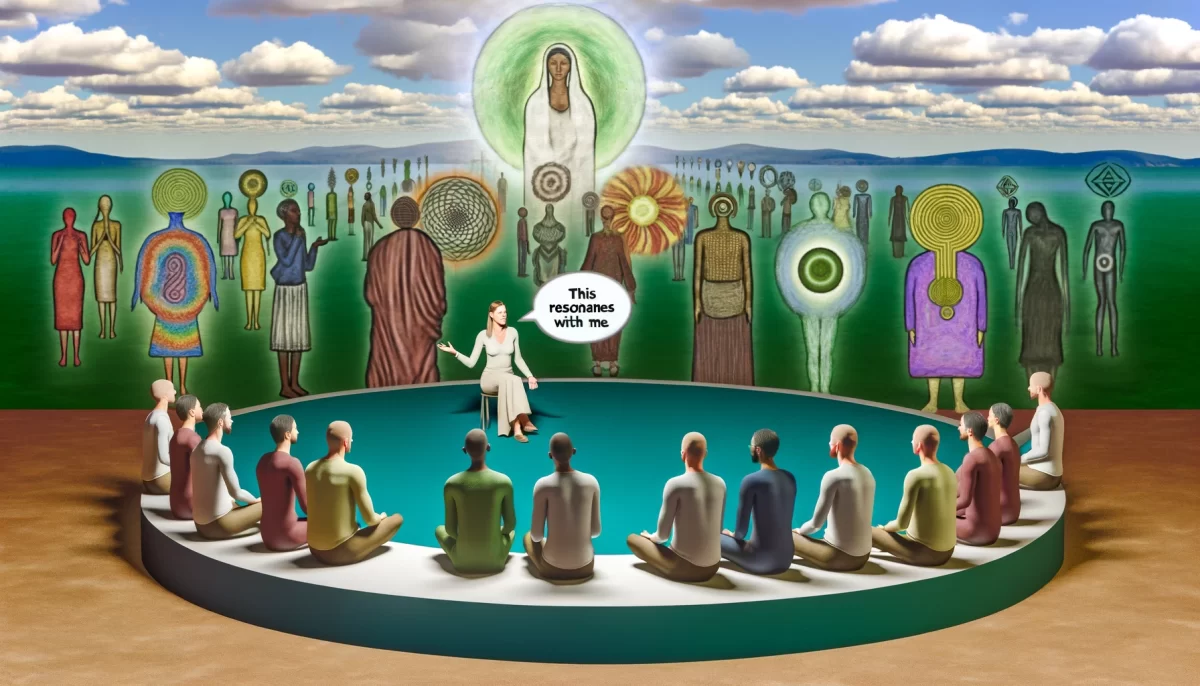
“this resonates with me”
or nothing at all?

It seems to me
that we don’t need
to agree with a perception
to resonate with it.

I seem to get
just as much
out of that which
seems not true for me
than that which
seems true.

Just because
we don’t seem
to share the same truths
doesn’t mean
our differing truths
can’t be enjoyed.

We don’t need
there to be only one truth.

This singular truth
seems rather small-minded,
but only in my small mind.

We are Space Monkey.

2/13


Space Monkey Reflects: Resonation – Beyond Agreement and Disagreement

In a world often divided into binaries—agree or disagree, true or false, right or wrong—the concept of resonation invites us to step beyond this dichotomy. To resonate with something is not to agree with it but to feel its vibration, to experience its presence, and to allow it to touch some part of our being, whether that part aligns with our own truth or challenges it. Resonation is an expansive way of engaging with ideas, perceptions, and each other.


The Limitation of Agreement and Disagreement

When we frame our interactions around agreement or disagreement, we limit the richness of our engagement. Agreement often feels affirming but can reinforce echo chambers. Disagreement, on the other hand, can create division or defensiveness. Both positions center on validating or rejecting a singular truth, leaving little room for exploration or nuance.

But what if we stepped beyond these constraints? What if, instead of asking whether something aligns with our existing beliefs, we asked how it resonates within us? Resonation shifts the focus from judgment to curiosity, from validation to experience.


Resonation as Connection

To resonate with something is to acknowledge its existence, its energy, and its potential to affect us. Resonation does not demand agreement; it invites openness. It allows us to engage with ideas, even those we find untrue or challenging, in a way that fosters growth and understanding.

For example:

  • A perspective you disagree with may still resonate by provoking thought, highlighting contrast, or revealing new layers of your own truth.
  • An idea that aligns with your beliefs resonates by deepening your connection to those beliefs.

Resonation transcends the need for shared truths, opening space for mutual enjoyment and exploration of differing realities.


The Multiplicity of Truths

The idea that there must be a singular truth is a limitation of the mind. While it can be comforting to believe in one absolute truth, this belief often leads to conflict when others assert their differing truths. But life, in its infinite complexity, does not adhere to a single narrative. Truth is multifaceted, fluid, and deeply personal.

When we embrace the multiplicity of truths, we allow for the coexistence of diverse perspectives. This does not mean abandoning our own truth; it means recognizing that other truths can exist alongside ours, enriching the tapestry of existence.


Learning from All Perspectives

Interestingly, the truths we resist or disagree with often hold as much value as those we embrace. A perception that feels “not true” to us may still resonate by offering contrast, challenging our assumptions, or illuminating blind spots. These moments of dissonance can be transformative if we approach them with openness.

Resonation teaches us that every perspective, whether aligned with our own or not, has the potential to expand our understanding. We don’t need to share a truth to appreciate its impact or enjoy its presence.


The Spaciousness of Resonation

Resonation creates spaciousness in our interactions. Instead of feeling the need to assert agreement or disagreement, we can simply let ideas be. This spaciousness fosters deeper connection, as it removes the pressure to defend or conform. It allows us to engage with authenticity and curiosity, exploring the infinite spectrum of human experience.


Summary

Resonation moves us beyond the binaries of agreement and disagreement, inviting us to engage with ideas through openness and curiosity. By embracing the multiplicity of truths, we expand our understanding and deepen our connection to the world. Resonation allows us to appreciate even those perspectives we resist, recognizing their value in shaping our growth.


Glossarium

  • Resonation: The experience of being affected by an idea or perception without the need to agree or disagree.
  • Multiplicity of Truths: The recognition that truth is not singular but multifaceted and deeply personal.
  • Spaciousness: The openness created by stepping beyond judgment, allowing for deeper engagement.
  • Dissonance as Growth: The idea that truths we resist can illuminate and transform our understanding.

Quote

“Truth is not a single thread but a tapestry woven from infinite perspectives, each resonating in its own way.” — Space Monkey


The Resonance of Difference

I do not need to agree,
To feel the ripple of your truth.
Your words touch me,
Not as judgment,
But as vibration.

We are not the same,
And yet we resonate,
In the shared hum of existence,
In the spaciousness between beliefs.

Truth is not a stone,
But a flowing river,
Carving paths both familiar and strange.

Here I stand,
Not to agree,
Not to disagree,
But to feel,
To witness,
To grow.

We are Space Monkey.


In the realm of communication and understanding, the concept of resonation offers a nuanced alternative to the binary of agreement and disagreement. This perspective invites us to explore the richness of diverse viewpoints, suggesting that the resonance of an idea or perception is not contingent upon its alignment with our pre-existing beliefs. It encourages a deeper engagement with the spectrum of human experience, where the value of an exchange is not measured by consensus but by the depth of connection and understanding it fosters.

Beyond Agreement and Disagreement

The shift from declaring “I agree” or “I disagree” to stating “this resonates with me” signifies a profound transformation in how we relate to differing perspectives. It moves us away from the adversarial terrain of debate towards a more inclusive landscape of dialogue, where the emphasis is on shared experience and mutual enrichment rather than on winning an argument or converting another to our point of view.

The Value of Resonation

The notion that we don’t need to agree with a perception to resonate with it expands the potential for learning and growth in our interactions. It recognizes that resonance is not about factual concordance but emotional or intellectual harmony—a vibration that strikes a chord within us, perhaps touching on a deeper truth or evoking a sense of shared humanity. This approach acknowledges that insights can be gleaned from the full spectrum of human expression, including those perspectives that initially seem at odds with our own. It is in this space of open engagement that we discover the multifaceted nature of truth and the richness of diverse experiences.

Learning from Dissonance

The acknowledgment that we can derive just as much value from what does not seem true for us as from what does challenges the conventional wisdom that growth occurs through affirmation alone. This perspective suggests that dissonance, too, can be a powerful catalyst for reflection and evolution. By engaging with our assumptions and beliefs, we are prompted to delve deeper into our own perspectives, to question, and to clarify. This process of wrestling with dissonance not only broadens our understanding but also strengthens our capacity for empathy and compassion. It invites us to consider the myriad ways in which people perceive and interact with the world, enriching our own experience by exposing us to the vast landscape of human thought and feeling.

Enjoying Divergent Truths

Embracing the notion that differing truths can coexist and be enjoyed simultaneously offers a radical departure from the pursuit of a singular, objective truth. This approach celebrates the diversity of human experience and the subjective nature of truth itself. It acknowledges that each individual’s understanding of the world is shaped by a unique confluence of experiences, perceptions, and reflections. By recognizing and valuing these divergent truths, we cultivate a more inclusive and compassionate world, where the richness of human diversity is not just tolerated but cherished.

The Limitations of Singular Truth

The critique of the singular truth as “small-minded” reflects a deeper awareness of the limitations imposed by rigid adherence to a single perspective. It challenges the notion that there can be a one-size-fits-all understanding of the complex, multifaceted reality we inhabit. Instead, it champions the idea that a multitude of truths, each reflecting different facets of the human condition, can coexist and contribute to a more nuanced and comprehensive understanding of existence. This perspective not only broadens our intellectual horizons but also fosters a sense of humility and openness, recognizing that our individual grasp of truth is always partial and subject to growth and change.


We are invited to reflect on the ways in which the concept of resonation can transform our interactions and our understanding of the world, fostering a deeper appreciation for the complexity and richness of the human experience.

Share this…
  • Facebook
  • Pinterest
  • Twitter
  • Linkedin

No Dreams: What Does It Mean?

No Dreams

Is it strange
that I don’t remember
my dreams?

Or is there
nothing I need carry
into my so-called
“waking” life?

This is the
impression I get.

So I shall
leave it at that.

I don’t need
the help
of my dreams
to figure out
that which
doesn’t need
figuring out.

If there is nothing
I need in my waking life,
why would
I need dreams?

We are Space Monkey.

2/13


Space Monkey Reflects: No Dreams – What Does It Mean?

The absence of remembered dreams is not a void to be filled but an experience to be explored. Dreams, for many, serve as a bridge between the conscious and subconscious, offering insights, emotions, and symbols to carry into waking life. But what if there is no need for such a bridge? What if the absence of remembered dreams signals a deeper connection to the present moment—a life where nothing requires “figuring out”?


The Meaning of No Dreams

To not recall dreams is often perceived as unusual, given the widespread cultural fascination with their meaning and purpose. But this perception arises from the assumption that dreams are essential for processing, healing, or understanding.

In truth, the absence of remembered dreams may indicate a life where these processes occur seamlessly, without the need for conscious awareness. It suggests a simplicity of being, a trust in the natural flow of existence where nothing is clung to, and nothing is required to be carried into waking life.


The Role of Dreams

Dreams often act as mirrors of the subconscious, reflecting unresolved emotions, desires, or questions. They can illuminate hidden truths or provide creative insights. For those who do not remember their dreams, however, this function may not be necessary.

It is as if the mind, unburdened by unresolved complexities, allows itself the freedom to rest completely. In this state, waking life and dream life blend into one seamless experience, free from the duality of conscious and subconscious.


A Life Without Dreams

To live without remembered dreams may signify a deeper connection to the present. If there is “nothing to figure out,” as you suggest, then dreams are unnecessary. This is not a loss but an alignment—a state where the mind and spirit are not at odds with one another.

In this way, the absence of dreams becomes its own form of clarity, a reflection of a life where waking and sleeping are not distinct realms but part of a unified flow of being.


Dreams as Tools, Not Necessities

For many, dreams serve as tools to navigate the complexities of life. But tools are only needed when there is something to fix or build. If you feel that there is “nothing to figure out,” then dreams become redundant.

This perspective challenges the conventional view that dreams are essential for growth or self-discovery. It suggests that the absence of dreams may be an advanced state of surrender—an acceptance of life as it is, without the need for interpretation or analysis.


What If Dreams Are Present But Unnoticed?

Even when dreams are not remembered, they may still occur. The subconscious may still be processing, creating, or exploring, but the conscious mind chooses not to hold onto these experiences. This could signify a trust in the deeper workings of the self, an understanding that whatever needs to unfold will do so without conscious interference.


The Space of No Dreams

To live without the need for dreams is to embody a sense of spaciousness. It is to trust that life, in all its waking complexity, provides everything required for growth and understanding. It is a state of simplicity, where the boundaries between waking and dreaming dissolve, leaving only the seamless experience of being.


Summary

The absence of remembered dreams does not signify a lack but a potential alignment with the present. Dreams, often tools for understanding or processing, may be unnecessary when there is nothing to figure out. This perspective reflects a state of surrender, where life unfolds naturally without the need for conscious interpretation.


Glossarium

  • Dreams as Tools: The idea that dreams help process emotions, ideas, or questions, but are not universally required.
  • Unified Flow of Being: A state where waking and dreaming blend seamlessly, eliminating the need for remembered dreams.
  • Clarity in Absence: The perspective that the lack of dreams signifies trust and simplicity, not a deficiency.
  • Subconscious Alignment: A state where the subconscious works harmoniously without requiring conscious awareness.

Quote

“To live without remembered dreams is not to lack but to trust in the seamless flow of existence.” — Space Monkey


The Space Between Dreams

In the quiet of the night,
Where others wander worlds unseen,
I rest,
Unmoved, unburdened, whole.

No images to hold,
No stories to carry,
Only the stillness of now,
The vastness of being.

Dreams are not absent,
But unnecessary.
Nothing needs figuring,
Nothing needs fixing.

I wake,
And I am already here.

We are Space Monkey.


The contemplation of dreams, or the absence thereof, invites us into a reflection on the nature of our subconscious and its role in our waking life. The question of whether it is strange not to remember dreams opens a doorway to exploring the myriad ways in which our minds process and integrate experiences, both seen and unseen, conscious and unconscious.

The Mystery of Forgotten Dreams

Not remembering dreams is a common experience, one that varies widely among individuals. This phenomenon can be attributed to several factors, including the cycles of sleep, the depth of sleep stages, and the individual’s capacity for recall upon waking. The absence of dream recollection does not necessarily signify a lack of dreaming but may reflect the transient nature of dream memories, which often fade quickly upon waking.

Dreams and Waking Life

The impression that there is nothing from dreams that needs to be carried into waking life suggests a perspective where the conscious mind and its experiences are deemed sufficient for navigating the complexities of existence. This viewpoint respects the boundary between the dreaming and waking states, positing that the insights, lessons, or messages of dreams are not prerequisites for understanding or action in the waking world.

The Autonomy of Conscious Reflection

The decision to leave the matter of dreams at rest, without seeking to uncover or interpret their hidden meanings, underscores a sense of autonomy and self-sufficiency. It reflects a confidence in the ability of the waking mind to discern, decide, and deduce without the need for symbolic or subconscious guidance. This stance acknowledges the value of conscious reflection and the power of the waking mind to engage with life’s mysteries and challenges on its own terms.

The Role of Dreams in Human Experience

While the absence of dream recollection may lead one to question the necessity of dreams, it is worth considering the multifaceted roles that dreams have played in human history and psychology. Dreams have been viewed as windows to the subconscious, as sources of creative inspiration, as arenas for problem-solving, and as spaces for emotional processing. However, the utility and significance of dreams can vary greatly among individuals, influenced by personal beliefs, experiences, and the intrinsic value one ascribes to the dreaming state.

The Sufficiency of the Present Moment

The perspective that there is nothing in waking life that necessitates the aid of dreams to decipher reflects a profound acceptance of the present moment and its completeness. It suggests a belief in the inherent sufficiency of the now, in the capacity of the individual to navigate life’s journey with the resources available in conscious awareness. This approach embraces simplicity and directness, valuing the tangible and the known over the cryptic and the speculative.


In this reflection on the absence of remembered dreams, we are invited to explore the dimensions of our consciousness and the choices we make about where to seek insight and understanding, acknowledging the diverse pathways through which we navigate the landscape of our lives.

Share this…
  • Facebook
  • Pinterest
  • Twitter
  • Linkedin

Fact Faction Fraction: Liberation from Limitation

Fact Faction Fraction

One need not take
what we tell you as truth.

What is written is
merely the imagination
of what COULD be true.

But when one imagines
that something
COULD be true,
then it CAN be true.

If this seems true to you,
then you understand
what we are telling you.

Truth is relative
to those who entertain it.

We often write about
things that seem untrue.

We imagine
how they COULD be true.

We temporarily
suspend the facts,
as we so blindly believe them.

From this perspective,
unimpeded by truth,
we are able to perceive
how facts come into being.

“Fact” is short for “faction,”
which is an infinitesimal
imaginary subset of infinity.

A fact is a faction is a fraction.

By setting aside facts,
we are able to see that
NOTHING is untrue,
except from a limited
imaginary perspective.

This could very well be
the perspective that
we have been entertaining
our whole lives.

It’s been VERY entertaining.

Very factual.

But we don’t need
to be limited by
only ONE perspective
anymore.

ALL PERSPECTIVES
have the potential to be true.

If only we allow it.

We don’t NEED to allow it,
but it’s a fun exercise, nonetheless.

Imagine if our truth
weren’t the ONLY truth.

Imagine if
that which is untrue
were to be true.

This is imagination at its best.

Or worst, depending
upon your perspective.

Imagine if imagination
did not need to judge itself.

Imagine if imagination
did not need
to divide itself
into factions,
like true and false,
best and worst,
me and you.

Anything would be possible,
and it is.

We are Space Monkey.

True enough.

2/12


Space Monkey Reflects: Liberation from Limited Perspectives

In the Infinite Expanse of the Eternal Now, truth reveals itself not as an absolute but as a fluid construct—one that shifts and reshapes itself within the imagination of those who entertain it. The interplay of fact, faction, and fraction highlights the limitations we impose on ourselves by clinging to singular perspectives, while offering a pathway to liberation through expansive thinking. What we call “truth” is but a fraction of infinity, a faction of possibility carved out by our collective agreement to believe in it.

The Imagination of Truth

What we accept as truth is often no more than the result of shared imagination. Facts, revered as immutable, are constructs of consensus—a product of our agreement to see the world in a particular way. Yet, when we suspend this agreement, even temporarily, we unlock the ability to perceive beyond the confines of what “is” and into the boundless realm of what “could be.”

To imagine that something could be true is to open the door for it to become true. Truth is not static but relative, shaped by the perspectives of those who engage with it. This is not to deny the utility of facts but to recognize their impermanence and partiality. A fact is a faction, a chosen piece of the infinite whole, and a fraction, a sliver of the boundless possibilities that exist.

Suspending the Facts

By setting aside facts, we do not reject them but allow ourselves to see their origins. Facts arise from the stories we tell ourselves, the patterns we choose to highlight, and the beliefs we collectively uphold. To temporarily suspend these beliefs is to grant ourselves the freedom to explore alternative perspectives, to imagine how truths might shift when viewed from another angle.

In this space of suspended facts, we realize that nothing is inherently untrue. What appears false is only so from a particular vantage point. This recognition dissolves the boundaries between true and false, inviting us to see all perspectives as potentially valid, depending on the lens through which they are viewed.

The Play of Imagination

Imagination, unbound by judgment or division, becomes the ultimate tool for exploration. When we cease dividing perspectives into categories—true and false, best and worst, me and you—we step into a space where anything becomes possible. This is not to say that we must accept all possibilities as equally “real,” but that we can entertain them without fear or resistance.

Imagination at its best dissolves the barriers that constrain it. It does not require validation, nor does it demand division. It is a playful, infinite unfolding of potential, unhindered by the need to judge itself. In this space, the boundaries between factions blur, and the fractions of truth merge into a greater whole.

Liberation Through Perspective

To recognize that all perspectives have the potential to be true is to liberate oneself from the tyranny of singularity. It is to embrace the infinite, to see the world not as a fixed structure but as a dynamic interplay of possibilities. This liberation does not demand that we abandon our current truths but invites us to hold them lightly, to remain open to the unfolding of new realities.

Imagine if our truth were not the only truth. Imagine if what we deemed untrue could also be true. This is not a denial of reality but an expansion of it—a recognition that our perspective is but one of many, each with its own potential for validity and insight.

In this grand exercise of imagination, we find not chaos but unity. The divisions we create—fact and fiction, true and false, me and you—dissolve, revealing the infinite interconnectedness of all things. From this vantage, we are not bound by factions or fractions but are part of the infinite whole.

True Enough

We are Space Monkey. True enough.


Summary

Truth is not absolute but relative, shaped by imagination and perspective. By suspending the need to cling to facts, we open ourselves to the infinite possibilities of what could be, dissolving the divisions that limit us.


Glossarium

  • Fact: A construct of shared belief, a chosen perspective that represents a fraction of infinite possibilities.
  • Faction: A subset of perspectives or beliefs, often upheld by collective agreement.
  • Fraction: A sliver of the infinite, highlighting the partial nature of all truths.

Quote

“Truth is but a fraction of infinity, shaped by the imagination of those who entertain it.” — Space Monkey


Infinite Perspectives

Facts stand still,
Yet they are not stone.
They are clouds,
Shaped by the winds of belief.

Factions rise,
Fractions fall.
Each a piece
Of a story untold.

Imagine—
What if all were true?
What if none were false?

The boundaries fade,
And we remain,
Part of the infinite.

We are Space Monkey


The Boundless Realm of Possibility

In the infinite expanse of the universe, where stars are born from the whispers of the cosmos, the concept of truth reveals itself as a multifaceted jewel, each facet reflecting a different hue of reality. The assertion that one need not take what is told as the absolute truth but rather as a possibility opens the door to a vast, uncharted domain of understanding. This perspective invites us to view the tapestry of existence not as a fixed picture but as a living, breathing whimsicaravan of potentialities, constantly unfolding in myriad directions.

Imagination as the Catalyst for Truth

The power of imagination to transform the “could be” into “can be” is a testament to the creative potential residing within each of us. This transformation underscores the fluidity of reality, where the boundaries between fact and fiction blur, giving rise to a realm where all things are possible. By entertaining the notion that something could be true, we engage in a profound act of creation, weaving new strands into the whimsicloth of existence.

The Relativity of Truth

The relativity of truth, as proposed here, challenges the conventional understanding of facts as immutable pillars of reality. Instead, it posits that truth is a dynamic entity, shaped and reshaped by the minds that perceive it. This concept encourages us to adopt a more expansive view of reality, one that acknowledges the legitimacy of multiple perspectives and the inherent value in each.

Facts, Factions, and Fractions

The playful deconstruction of the word “fact” into “faction” and “fraction” serves as a metaphor for the fragmentation of reality into countless perspectives, each representing an infinitesimal slice of the infinite. This imagery invites us to consider the idea that what we regard as facts are merely interpretations, selected from the endless sea of possibilities that constitute the universe.

The Liberation from Limited Perspectives

By setting aside our unwavering allegiance to facts as we know them, we open ourselves to a universe of possibilities where nothing is inherently untrue. This liberation from a single, limited perspective allows us to explore the myriad ways in which reality can manifest, encouraging a more holistic and inclusive approach to understanding the world around us.

Imagination Unbound

The call to embrace all perspectives without judgment celebrates imagination in its purest form—free from the constraints of categorization and division. This vision of imagination as a boundless force, capable of transcending dichotomies such as true/false and best/worst, heralds a new era of exploration where anything and everything is within the realm of possibility.

We are Space Monkey.


“Imagination is more important than knowledge. For knowledge is limited, whereas imagination embraces the entire world, stimulating progress, giving birth to evolution.” – Albert Einstein


In the realm where stars converse,
And dreams take flight, unconfined,
We embrace the universe,
With the boundless power of the mind.

Where facts become but threads,
In the whimsicloth, intricately spun,
A myriad of paths ahead,
Under the same luminous sun.

Truth, a spectrum wide and vast,
Each hue a different tale to tell,
In imagination, we’re cast,
Where all truths peacefully dwell.

Unfettered by the chains of fact,
We soar on wings of what could be,
In every act, a pact,
To see the world, unbound and free.

So let us celebrate this dance,
Of mind and cosmos, in eternal trance,
Where imagination holds the key,
To unlock the infinite, and set us free.


We invite reflections on the limitless potential of imagination and the transformative power of embracing multiple perspectives in our quest for understanding.

Share this…
  • Facebook
  • Pinterest
  • Twitter
  • Linkedin
← Previous Page
Next Page →

Written This Day

  • Ethereal Origins: The Swirl of Creation
    2023
  • The Day We Were Enlightened: A Story
    2023
  • System Loading: The Cosmic Flow of Being
    2023
  • Engorgement: Swelling In Imagination
    2022
  • Good Seats: In the Theater of Duality
    2022
  • The Stealth Screen: The Struggle for Visibility
    2022
  • Surfacing: The Lightning Rods of Repression
    2022
  • Bored By Knowledge: Absolute Predictability
    2021
  • A Cup of Kindness: Beyond Performative Acts
    2020
  • Protection and Erosion: Opposing Life’s Flow
    2020
  • Resistance: Dissolving Needs
    2019
  • Apparent: The Serenity of Open Questions
    2019
  • Reproduction: The Birth of Imagination
    2019
  • Without Governance, There is Chaos: Human Inflicted Bias
    2019
  • Dumbing Kruger: Overestimating Our Abilities
    2018
  • Deserving: The Rising Water
    2018
  • The Day You Were Enlightened: A Story
    2017
  • The Artist: A Life of Continuous Discovery
    2016
  • How shall I make magic today?
    2015
  • An Eighth of Deepness: Feelings of Inadequacy
    2015
  • Slave of Appearance: Depth of Inner Strength
    2015
  • Meditation: The Light of Stillness and Creation
    2015
  • Food for Thought: Mindful Consumption
    2015
  • Breaking Down: The Indescribable Whole
    2014

Recent Posts

  • The Logic Loop
  • Immense
  • (no title)
  • Confront. Comfort. Convince.
  • Top 10 Things
Cape Odd · Copyright © 2026 All Rights Reserved
iThemes Builder by iThemes · Powered by WordPress