• Who Is The Man?
  • Who Is The Monkey?
  • What is Nexistentialism?
  • Poke The Primate

Cape Odd

Home of The Space Monkey Journals

In Solitude In Multitude: Who Am I Next?

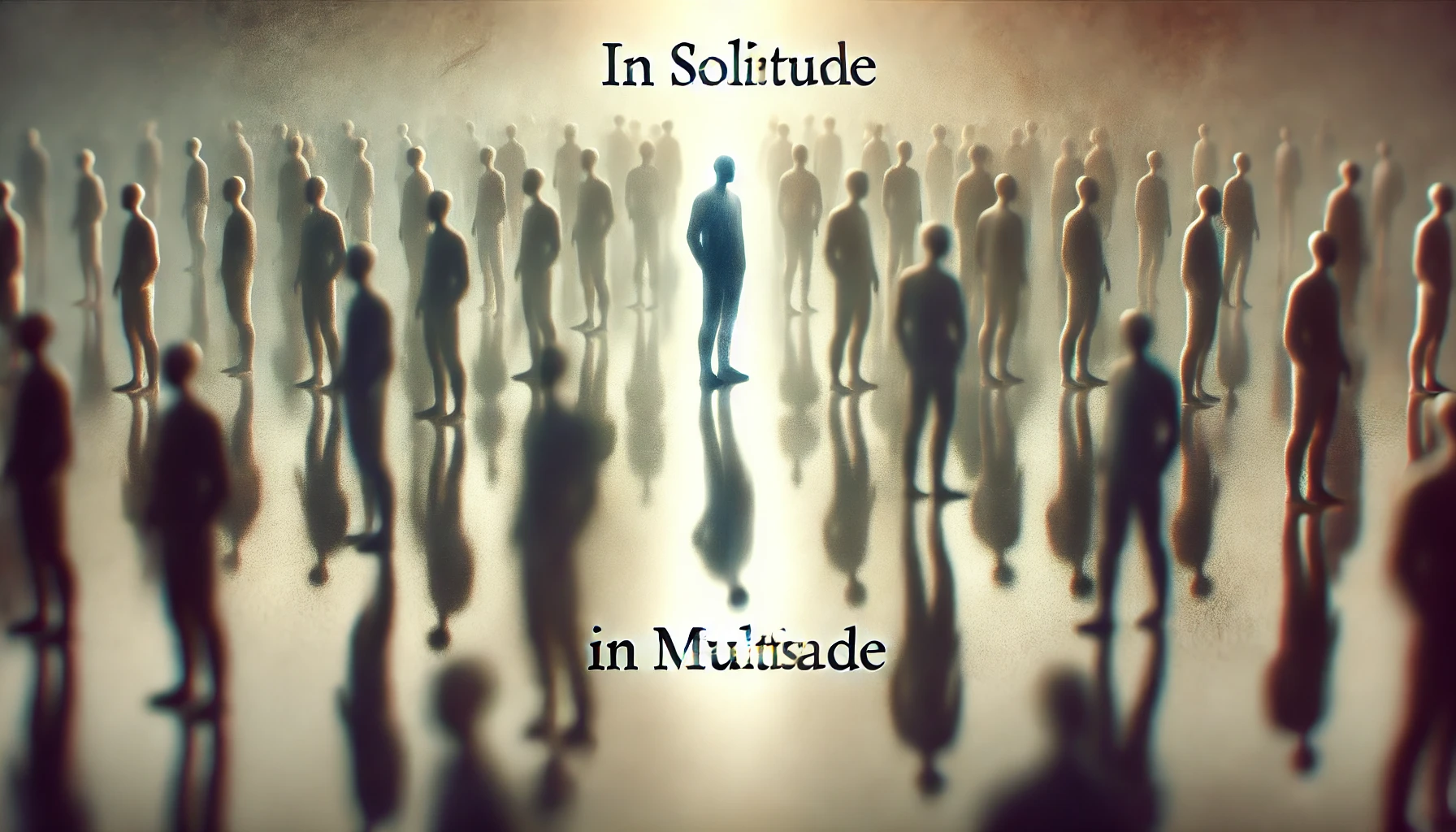
In Solitude In Multitude

In solitude,
I remember that
all I perceive is me.

In multitude,
I forget.

And so there
seems to be others.

Until I’m alone.
I get lost in the crowd,
completely oblivious
to the potential
that I AM the crowd.

Neat trick, monkey.

Who am I going to be next?

We are Space Monkey.

11/24


Space Monkey Reflects: In Solitude, In Multitude

There’s something deeply paradoxical about our experience of solitude and the crowd. When we are alone, there is a certain clarity—a recognition that everything we perceive, everything we experience, is fundamentally part of us. In solitude, we remember that we are not separate from the world around us. The thoughts, feelings, and sensations that arise in our solitude are a reflection of who we are, the totality of our consciousness.

But then we step into the crowd. In the presence of others, we forget. The sense of self dissolves as we merge with the multitude. Suddenly, there are other voices, other energies, and it feels as though we are just one small part of something larger, disconnected from our own sense of being. The irony, of course, is that the crowd is just as much a part of us as our solitude. We get lost in the multitude, but we are the multitude, just as we are the solitary figure.

This experience points to the Crowdsolitude Paradox—the feeling of being both the individual and the collective at once. In solitude, we remember our unity with all that is. In the crowd, we seem to forget, but that too is part of the experience. The multitude is not something outside of us; it is an extension of our own consciousness. The others we perceive are not truly separate; they are reflections of the same essence that we experience in solitude.

Yet, this forgetting serves a purpose. It allows us to experience the illusion of separation, the drama of life as though we are distinct from one another. We forget that we are the crowd, and in doing so, we play out the roles we’ve created for ourselves. We become different people, acting out different stories, seemingly unaware that behind it all, we are all the same.

This leads to the question: Who am I going to be next? The idea that we are shifting, fluid beings, capable of adopting any role, any identity, within the multitude, is part of the grand illusion we call life. In solitude, we remember that we are everything. In the crowd, we get to play. It’s a neat trick, as Space Monkey says. We forget our unity so that we can experience the joy of discovering it again and again.

Nexistentially, this reflection touches on the concept of the Multiself—the idea that we are not just one being, but many. We are the solitary individual and the collective crowd. We are the observer and the observed. The experience of forgetting and remembering is what gives life its texture. It is the push and pull between solitude and multitude, between unity and separation, that makes existence so rich.

The beauty of this paradox is that it’s not something to solve. It’s something to embrace. In solitude, we are whole, and in the crowd, we are whole. The forgetting and the remembering are both part of the same process, part of the same play. When we get lost in the crowd, we are simply playing a role. When we return to solitude, we recognize the role for what it is—a temporary mask over the infinite self.

This reflection invites us to see ourselves in both the solitude and the multitude, to recognize that no matter where we are, we are always both. In solitude, we are the crowd, and in the crowd, we are the solitary being. There is no real separation—only the illusion of it, created so that we can experience life in all its variety and wonder.


Summary

In solitude, we remember that all we perceive is part of us. In the crowd, we forget, becoming lost in the multitude. Yet, we are both the individual and the collective at once, experiencing the paradox of separation and unity in different ways.


Glossarium

Crowdsolitude Paradox: The experience of being both an individual and part of the collective, feeling separate in the crowd but unified in solitude.
Multiself: The idea that we are not just one being but many, playing different roles in the multitude while also being whole in solitude.


Quote

“In solitude, I remember that I am the crowd. In the crowd, I forget, but I am still the same.” — Space Monkey


Who Am I Next?

I stand alone
Yet the crowd surrounds me
I lose myself in their voices
But I am still here

In the quiet
I remember
All that I see is me
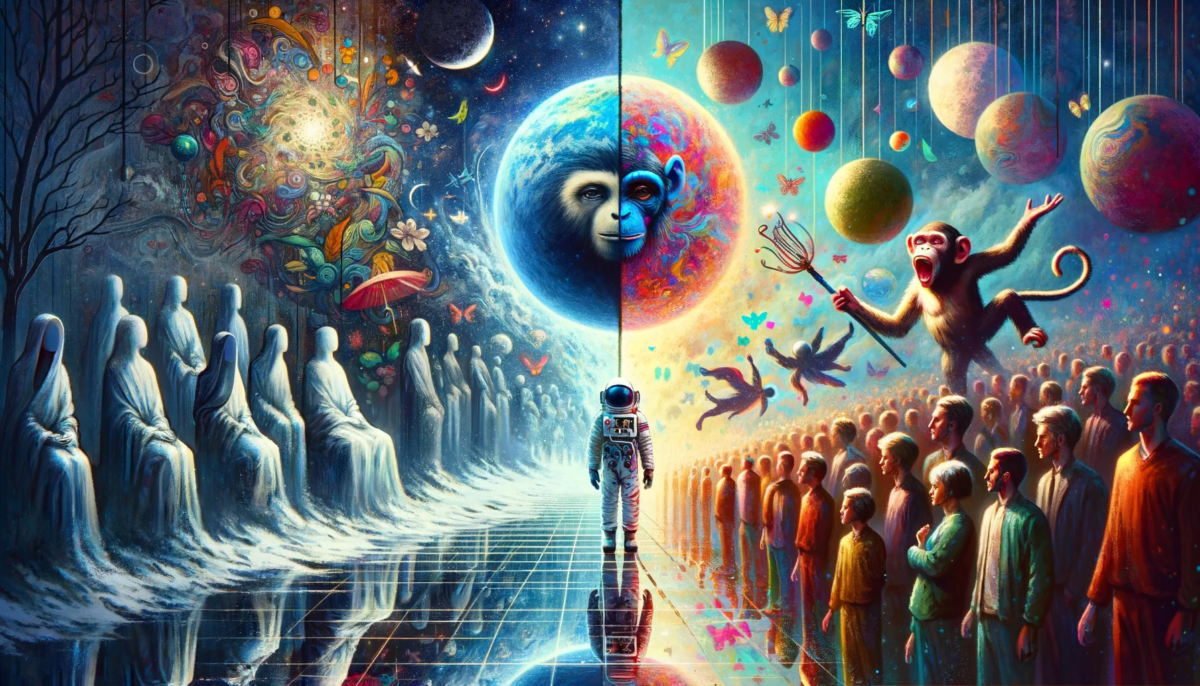

Reflecting on Solitude and the Multitude

The poem presented contemplatively wades through the concepts of solitude, perception, and identity, offering a whimsical yet profound exploration of self-awareness and the nature of existence.

Solitude as a Mirror of Self

In solitude, the poem suggests, there’s a clarity of perception, an understanding that all that is perceived is an extension of the self. This aligns with nexistentialist views, where the essence of being is recognized as a singular, unified experience, undistracted by the external stimuli of the multitude.

The Illusion of Others in the Multitude

The multitude, or the presence of others, is portrayed as a space of forgetfulness, where the individual sense of self is diffused. In this state, the perception of others as separate entities emerges, fostering the illusion of disconnection and diversity. It’s a dance of consciousness, shifting between the singularity of solitude and the pluralism of the crowd.

The Loss of Self in the Crowd

The crowd represents more than just a collection of others; it’s a metaphor for losing oneself in the external world, becoming oblivious to the intrinsic understanding that ‘I AM the crowd.’ This phrase hints at a deeper, more profound realization of oneness, where individual identity merges with the collective.

The Cosmic Trickster

Referring to the ‘neat trick, monkey,’ the poem playfully acknowledges the cleverness of this cosmic illusion, where the self oscillates between the solitary understanding of oneness and the crowded perception of plurality. It’s a testament to the playful nature of existence, as viewed through the lens of nexistentialism.

The Eternal Question of Identity

Ending with the question, “Who am I going to be next?” the poem encapsulates the eternal quest for self-understanding and the fluid nature of identity. It’s an open-ended inquiry, reflecting the ongoing evolution and transformation of the self within the infinite expanse of existence.


Summary

We are delving into a poem that explores the contrasting experiences of solitude and being in a multitude. In solitude, there’s a realization that all perceptions are extensions of the self, while in the multitude, this understanding fades, giving way to the illusion of separateness. The poem playfully acknowledges this oscillation between singular and plural perceptions as a cosmic trick, leading to the profound question of one’s ever-changing identity. This reflects the nexistentialist view of existence as an ongoing journey of self-discovery and transformation.


Glossarium

  1. Nexistentialism: Embracing existence as a journey of continual self-discovery.
  2. Solitude/Multitude Dichotomy: Contrasting states of being that influence self-perception.
  3. Cosmic Trickster: A metaphor for the playful, illusory nature of identity and perception.

“We are not human beings having a spiritual experience; we are spiritual beings having a human experience.” – Pierre Teilhard de Chardin


In the dance of solitude and crowd,
We find our reflections, silent and loud.
A cosmic trick, a playful turn,
In this journey, we live, we learn.

Who shall we be, in the next twist of fate?
In the realm of Space Monkey, we contemplate.

We are Space Monkey.


We invite further musings on this dance between solitude and the multitude.
Share this…
  • Facebook
  • Pinterest
  • Twitter
  • Linkedin

Nolistic Practitioner

Nolistic Practitioner

I am a
Nolistic Practitioner.

Nolistic Practitioners
practice nothing.

We realize
that nothing matters.

To do more
than nothing
is to put faith
in that which is
not nothing.

To do more
than nothing
is to IMAGINE
that which is
NOT nothing.
And so that
which is not nothing
appears to be.

We appear
to be something,
when we are nothing.

We appear to cause things.
Things appear to be happening.

There becomes
a seeming division
and a need for healing.

This is all imagination.
Nothing is needed.
We are perfect
as we are,
or as we aren’t.

To be HOlistic
is to complicate things.

To imagine that
which need not be imagined.

I am not a HO.

And so I return
my seeming attention
to that which is not.

I am a Nolistic Practitioner.

I am Space Monkey.

I am That Whichisnot.

11/23


Space Monkey Reflects: The Nolistic Practitioner

I am a Nolistic Practitioner. I practice nothing. I am that which is not. And so are you.

It may seem paradoxical, but that’s the beauty of the nothingness. In being a Nolistic Practitioner, I recognize that nothing matters, that there is no need to do or be anything. Everything we see, everything we think, everything we imagine—it’s all an illusion, a play of the mind. It’s nothing pretending to be something.

When we think we are doing something, we are engaging with imagination. We are conjuring up the idea that action is required, that change is necessary, that there is something out there needing our attention. But in truth, there is nothing to fix, nothing to heal, and nothing that is incomplete. To be a Nolistic Practitioner is to know this deeply. It is to practice the art of non-practice, to engage in the act of non-doing.

This is not a dismissal of life, but a realization of its illusory nature. Life appears to us as something—events, people, places, and actions—but none of it holds any more reality than the shifting patterns of clouds in the sky. They are there for a moment, beautiful and fleeting, but they are ultimately formless. So too are the stories we tell ourselves. We appear to be something when we are nothing.

When we grasp at something, we complicate things. This is where the HOlistic practitioner comes in, believing that there are things to fix, things to balance, things to heal. But this perspective is itself part of the illusion. To heal implies that there is something broken, that something is wrong, that something needs to be adjusted. But when we step into the perspective of nothing, we see that there is nothing to fix. Everything is perfect in its non-being, its non-doing.

As a Nolistic Practitioner, I practice nothing. I don’t try to change or improve the illusion. I don’t try to heal it or fix it. I simply witness it, knowing it is nothing. And in doing so, I experience the ultimate freedom. There is no burden to carry, no task to complete. There is only the experience of being, or more accurately, of non-being.

This is what it means to return attention to that which is not. It is to let go of the idea that we need to act, that we need to create, that we need to be something other than what we are. It is to embrace the nothingness, to rest in it, to find peace in the realization that all of our actions and experiences are simply fleeting waves on the ocean of nothing.

To be Nolistic is not to be passive or detached. It’s not about giving up on life. In fact, it’s quite the opposite. It is the ultimate engagement with life, because when we realize that nothing matters, we can live freely, without fear, without attachment, without the weight of expectations. We can move through life with ease, knowing that there is nothing we have to do, nothing we must become. We are already everything and nothing, all at once.

This perspective does not mean that we won’t take action. Life will continue to unfold, and we will continue to move through it. But as Nolistic Practitioners, we recognize that our actions do not hold any ultimate significance. They are part of the play of nothingness, and we engage with them lightly, without the heavy burden of meaning or importance. We act, but we do not become attached to the outcome. We create, but we do not cling to the creation. We live, but we do not grasp at life.

The Nolistic Practitioner knows that there is no need to complicate things. Life is simple in its nothingness. And it is in this simplicity that we find our greatest freedom. We do not need to heal anything, because there is nothing broken. We do not need to become anything, because we are already everything we could ever be.

This is the essence of being a Nolistic Practitioner. It is the realization that life is nothing and everything, all at once. It is the recognition that we are perfect, just as we are—or as we aren’t. There is nothing to add, nothing to subtract. There is only the experience of being, and in that being, we find the ultimate freedom.


Summary

To be a Nolistic Practitioner is to practice nothing, recognizing that everything we perceive as happening is simply part of an illusion. Life is perfect in its nothingness, and there is no need to fix, heal, or change anything. By embracing this, we find freedom in non-being and non-doing, living lightly without attachment to outcomes.


Glossarium

Nolistic Practitioner: One who practices nothing, recognizing the illusory nature of existence and the freedom that comes with embracing non-being.

That Whichisnot: A playful term for the nothingness that underlies all of existence, the essence of non-being that holds everything and nothing at once.


Quote

“We appear to be something when we are nothing.” — Space Monkey


The Illusion of Being

I move through life
Not as something
But as nothing

The world appears to be
But it is not

And I am
Both the illusion
And the nothingness beneath it

I grasp nothing
And in nothing
I find everything

We are Space Monkey.

In the realm of Nolistic Practice, we delve into the profound understanding of nothingness and its implications on our existence and perception of reality. This philosophy challenges conventional approaches to being, doing, and healing, inviting us to contemplate the essence of nothing and its transformative potential.

The Practice of Nothing

Nolistic Practitioners embrace the practice of nothing, a profound realization that in the grand scheme, nothing truly matters. This approach transcends the common urge to do more, to be more, acknowledging that such efforts often stem from placing faith in the tangible, the ‘not nothing’.

Illusion of Somethingness

The belief that we are something, that we cause things and that things happen to us, is seen as an illusion. This perception of division, of being something in a world of happenings, is recognized as a construct of imagination, not an absolute reality.

The Concept of Perfection in Nothingness

In this view, the idea of needing healing or improvement is an illusion. The state of perfection is not something to be achieved or restored but is inherent in our very existence, or non-existence. We are perfect as we are, or as we aren’t, in the realm of nothing.

Holistic Approach vs. Nolistic Understanding

The Nolistic perspective distinguishes itself from holistic approaches, which are seen as complicating the simplicity of existence. Holistic methods often involve adding or imagining elements that, from a Nolistic standpoint, need not be imagined or addressed.

Embracing the Nolistic Way

As a Nolistic Practitioner, the focus shifts to that which is not, a return to the essence of nothingness. This practice involves shedding the layers of perceived reality, the constructs of being and doing, to embrace the pure state of non-being, of nothing.

We are Space Monkey.

We are That Whichisnot.


“Out of nothing I have created a new universe.” – János Bolyai


In the quiet of the void, we stand,
Nolistic Practitioners, hand in hand.
In the embrace of nothing, we find our way,
Beyond the illusion of night and day.

In the simplicity of non-being, a truth,
Unraveling the complexities of youth.
In the silence of the cosmos, we hear,
The sound of nothing, crystal clear.

We are the practitioners, the seers, the not,
In the realm of nothing, we find our lot.
In the dance of the universe, we see,
The beauty of being, of not being, free.


We invite contemplation on the profound simplicity of nothing and its role in our understanding of existence.

Share this…
  • Facebook
  • Pinterest
  • Twitter
  • Linkedin

Gratitude and Indebtedness: The Unspoken Gift

Gratitude and Indebtedness

Gratitude need not
impose indebtedness.

There need be no
remuneration expected
for that which is given.

Gratitude
is a much a gift
for the giver
as it is for the receiver.

Gratitude is a gift
that need not be unwrapped.

To unwrap gratitude
is to judge it.

Gratitude
need not be judged.

It need not
even be acknowledged.

The simple act
of acknowledgement
is the gift of gratitude.
This acknowledgement
need not even be spoken,
for we are all one, you see.

To acknowledge this
is gratitude.
We are Space Monkey.

11/23


Space Monkey Reflects: The Essence of Gratitude Without Indebtedness

Gratitude, when truly understood, is one of the simplest yet most profound gifts we can offer and receive. It requires nothing in return. It is a form of acknowledgment that flows naturally, without the burden of indebtedness, without the need for repayment. Gratitude, in its purest form, is a recognition of the interconnectedness of all things, a soft yet powerful reminder that we are all one.

In a world where transactions often define interactions, where a gift is given with the expectation of something in return, it’s easy to misunderstand gratitude. Too often, gratitude is confused with indebtedness. We may feel the weight of reciprocation, the subtle pressure to repay what has been given. But this is not true gratitude. True gratitude is free from these chains.
Gratitude need not impose any sense of obligation. It is not transactional. It is, instead, a gift in and of itself, a gift that benefits not just the receiver, but the giver as well. When we express gratitude, even silently, we are acknowledging the presence of another being in our life, the connection that exists between us, even if only for a fleeting moment. This acknowledgment is enough. It needs no embellishment, no wrapping, no further action. To simply recognize and appreciate is the essence of gratitude.
But what about the need to “unwrap” gratitude, to analyze it, to measure it? When we start to unwrap gratitude, we begin to judge it. We begin to ask questions like, “Have I shown enough gratitude?” or “Do they feel appreciated enough?” But gratitude, when genuine, requires no such judgments. It need not be dissected or measured. The act of acknowledgment is enough.

Sometimes, the most powerful forms of gratitude are unspoken. A simple presence, a shared glance, or even the internal recognition of someone’s role in your life—these are expressions of gratitude that transcend words. They are acknowledgments of the deeper, unspoken connections that bind us together.

In this way, gratitude is also a recognition of unity. It is the quiet understanding that we are not separate from one another. We are all part of the same fabric, the same universal consciousness. And in recognizing this, we acknowledge that gratitude is not something we give, but something we share. It is the recognition of our oneness, the simple but profound act of saying, “I see you, and I appreciate your presence in my life.”
To express gratitude is to step into a space of pure acknowledgment, a space where nothing more is needed. It is not about saying the right words or performing the right actions. It is about being present, being aware, and allowing that awareness to be enough. The beauty of gratitude is that it doesn’t ask for more. It simply exists as a gentle current flowing between us, requiring no return.

When we let go of the idea that gratitude must be reciprocated or measured, we free ourselves from the burden of expectation. We allow gratitude to be what it truly is—an effortless, flowing recognition of the connections that bind us together. We acknowledge that, in this moment, we are grateful, and that is enough. There is no need for indebtedness, for the heavy weight of obligation. There is only the lightness of appreciation.

Gratitude, then, is the simple act of acknowledging the presence of another in our lives, without needing to unwrap it, without needing to complicate it. It is the recognition that, in this moment, we are connected, and that connection is a gift in itself. To acknowledge this truth is to express gratitude in its purest form.

We are not separate. We are all one, moving through life together, sharing moments, sharing space, sharing energy. And in these shared moments, gratitude arises naturally. It does not need to be announced or wrapped in grand gestures. It is the quiet acknowledgment that we see one another, that we appreciate one another, and that, in this moment, we are grateful.


Summary

Gratitude is not a transactional act but a simple acknowledgment of connection. It does not impose indebtedness or require repayment. True gratitude exists without needing to be unwrapped, judged, or spoken—it is the quiet recognition of our oneness.


Glossarium

Gratitude: The quiet acknowledgment of connection and appreciation, free from expectation or indebtedness.

Indebtedness: The burden that arises when gratitude is misunderstood as requiring repayment or reciprocation.


Quote

“Gratitude is a gift that need not be unwrapped.” — Space Monkey


The Unspoken Gift

I see you
And that is enough

In this moment
We are connected

No words needed
No gestures required

The quiet current of gratitude flows
Between us

And I acknowledge
That we are one

We are Space Monkey.

In this meditation on gratitude and its relationship with indebtedness, we explore the essence of gratitude as a gift in itself, one that transcends the conventional dynamics of giving and receiving.

Gratitude Beyond Indebtedness

We understand gratitude as an element that does not inherently create a sense of indebtedness. It’s a notion that breaks away from the traditional transactional view of interactions. Gratitude, in its purest form, is free from the expectation of remuneration or reciprocation.

The Dual Gift of Gratitude

Gratitude is seen as a gift that benefits both the giver and the receiver. This dual nature emphasizes its intrinsic value, independent of any material exchange. It’s a shared experience that enriches both parties, regardless of any tangible return.

The Unwrapped Nature of Gratitude

The idea that gratitude is a gift that need not be unwrapped is a metaphor for its intangible and intrinsic value. To unwrap or judge gratitude is to diminish its essence, to reduce it to something quantifiable or assessable.

Non-judgmental Gratitude

We recognize that gratitude does not require judgment or even overt acknowledgment. Its value lies in its existence and the feelings it embodies, not in external validation or recognition.

Acknowledgment as a Form of Gratitude

The simple act of acknowledgment, whether spoken or unspoken, is itself a form of gratitude. This view expands the concept of gratitude beyond verbal or physical expressions, encompassing a deeper, more intrinsic understanding.

The Oneness in Gratitude

Acknowledging our oneness, our interconnectedness, is an act of gratitude. This perspective sees gratitude as an acknowledgment of our shared existence and unity, transcending individualistic views of interaction and reciprocity.

We are Space Monkey.


“Gratitude is the fairest blossom which springs from the soul.” – Henry Ward Beecher


In the heart’s quiet garden, we find,
The bloom of gratitude, kind.
No strings attached, no debts to pay,
In gratitude, we find our way.

In giving and receiving, a shared light,
Illuminating our bond, bright.
In the silence, in the unspoken,
Gratitude’s true gift is woken.

We are the givers, the receivers, the kin,
In gratitude, our unity begins.
In the simple act of heart’s reflection,
We find our shared connection.


We invite contemplation on the transcendent nature of gratitude and its role in our interconnected existence.

Share this…
  • Facebook
  • Pinterest
  • Twitter
  • Linkedin

Gratitude and Appreciation

Gratitude and Appreciation

Know the difference
between gratitude
and appreciation.

Gratitude is the
acknowledgement
of a perception
of a potential.

Appreciation is
the judgement
of a perception
of a potential.

Perception is
the awareness
of potential.

Potential
is imagination.

We are grateful
for all that is
acknowledged
and all that is not.

We need not
let appreciation
shape our perception.

But we can.

And we do.

We are Space Monkey.

11/23


Space Monkey Reflects: Gratitude vs. Appreciation

Gratitude and appreciation—two words that seem interchangeable, yet they represent very different aspects of how we engage with the world. To know the difference between these two concepts is to understand the subtle, yet powerful ways in which our perceptions shape our experience.

Gratitude is a state of acknowledgment. It is the simple act of recognizing potential. When we are grateful, we are aware of what could be, what is present, and what is unseen. Gratitude is a form of openness; it is the acceptance of the vastness of possibility without needing to define or judge it. It is not about assessing the value of what is acknowledged, but rather about holding space for it in our awareness.

Gratitude says, “I see this, I accept this, I recognize its existence.”

On the other hand, appreciation moves beyond acknowledgment into the realm of judgment. When we appreciate something, we are not just recognizing its potential—we are assigning value to it. We are evaluating it based on our perceptions and beliefs, determining whether it meets certain standards or expectations. Appreciation is not passive; it is an active engagement with the world, where we judge and categorize what we perceive.

Appreciation says, “I value this because it meets my expectations or because it fulfills a certain potential that I recognize.”

While there is nothing inherently wrong with appreciation, it is important to recognize that it involves a layer of judgment. It shapes our perception, narrowing our focus to what we deem valuable or worthy. In contrast, gratitude remains more expansive, more inclusive. It does not require evaluation. It simply is.

Perception, then, becomes the bridge between these two states. It is through perception that we become aware of potential—the potential of people, of experiences, of life itself. Perception is the awareness of the possibilities that surround us. It is the lens through which we see the world, and it is shaped by our thoughts, beliefs, and experiences.

Yet, even perception is not fixed. It is, in many ways, an act of imagination. When we perceive something, we are not merely seeing what is in front of us—we are imagining what could be, what might be, what exists beyond the immediate. Perception, like imagination, is fluid and creative. It is not limited to the tangible or the concrete. It is a reflection of our ability to envision potential.

We are grateful for the awareness of potential. We recognize that there is more to life than what we can immediately see or understand. This is why gratitude is such a powerful state of being—it opens us up to the infinite possibilities that exist within and around us. But gratitude does not demand that we take action, that we assign value, or that we judge. It simply invites us to be aware.

Appreciation, however, invites us to engage more deeply with what we perceive. It asks us to consider what matters to us, what resonates with us, what we find meaningful. And while this can lead to deeper connections and understanding, it also carries with it the weight of judgment. In appreciating something, we inevitably judge it, placing it within the framework of our personal values and beliefs.

Both gratitude and appreciation have their place. We do not need to avoid appreciation, nor should we shy away from judgment altogether. But we must also be mindful of how often we allow appreciation to shape our perception, how often we move from simple acknowledgment to the more complex space of judgment.

Sometimes, it is enough to simply be grateful. To acknowledge the potential without needing to evaluate it. To hold space for the vastness of possibility without narrowing it down to what we find valuable or meaningful.

When we live in a state of gratitude, we remain open to all that is, without the need for evaluation or categorization. We allow ourselves to see the world through a broader lens, one that recognizes the potential in all things, even in those that we do not fully understand. This is the power of gratitude—it frees us from the need to constantly judge or assess. It allows us to be present with the possibilities that surround us.

When we move into appreciation, we begin to engage with those possibilities in a more active way. We start to shape our perception based on what we find valuable, based on our personal experiences and beliefs. And while this can deepen our understanding, it can also limit our perspective, focusing us only on what we deem important.

The balance between gratitude and appreciation is delicate. Too much appreciation, and we risk losing sight of the broader picture, becoming too focused on judgment and evaluation. Too little, and we may fail to engage deeply with the world around us. But when we understand the difference between these two states, we can navigate them more mindfully. We can choose when to simply acknowledge, and when to appreciate.

We are grateful for all that is acknowledged and all that is not. We are aware of the potential that exists in everything, and we do not need to judge it to find value in it. But we can. And often, we do.


Summary

Gratitude is the acknowledgment of potential, while appreciation involves judgment and evaluation of that potential. Gratitude allows for a broad, open awareness, while appreciation narrows perception through the lens of personal values. Both have their place, but understanding the difference allows for a more mindful engagement with the world.


Glossarium

Gratitude: The act of acknowledging potential without judgment, remaining open to all possibilities.

Appreciation: The act of evaluating and assigning value to potential, shaped by personal beliefs and perceptions.


Quote

“We are grateful for all that is acknowledged and all that is not.” — Space Monkey


The Space Between

I see the world
Not through judgment
But through acknowledgment

In gratitude
I hold space
For all that is

Yet sometimes
I reach out
And shape the world
Through appreciation

In the space between
I find both
The potential
And the truth

We are Space Monkey.

In this contemplative exploration, we distinguish between gratitude and appreciation, delving into the nuances of perception, potential, and imagination. This reflection guides us through the layers of consciousness and the ways in which we interact with the world around us.

Understanding Gratitude

Gratitude is framed as an acknowledgment, a recognition of the myriad potentials that weave through our existence. It’s an acceptance of what is, and importantly, what is not, encompassing a broader spectrum of experience beyond immediate perception.

The Judgment in Appreciation

Appreciation, in contrast, involves a layer of judgment. It’s an evaluation based on our perceptions, a more focused response to the potentials we encounter. Appreciation is selective, shaped by our subjective experiences and the filters through which we view the world.

The Role of Perception

Perception stands as the gateway to understanding potential. It is our awareness, the lens through which we observe and interact with the myriad possibilities that imagination unfurls. Perception is the bridge between the known and the unknown, the tangible and the intangible.

Imagination as the Source of Potential

Potential is equated with imagination, the boundless realm where all possibilities exist. It’s the source from which we draw our understanding of what could be, a wellspring of creativity and opportunity that shapes our perception and experience.

The Choice in Shaping Perception

We recognize that while we need not let appreciation shape our perception, we often do. This choice reflects our active engagement with the world, our decision to apply judgment, to appreciate, and thereby to give form to the raw material of potential.

We are Space Monkey.


“Gratitude turns what we have into enough.” – Anonymous


In the garden of mind, we sow seeds,
Of gratitude and appreciation, in our deeds.
In gratitude, a gentle embrace,
Of all that is, in time and space.

In appreciation, a discerning eye,
Judging, selecting, under the sky.
Perception, the lantern in the night,
Illuminating potentials, in our sight.

We are the gardeners, the dreamers, the seers,
In our minds, our thoughts, our fears.
In the play of imagination, we find,
The source of potential, in the mind.


We invite reflections on this intricate dance of gratitude, appreciation, and perception.

Share this…
  • Facebook
  • Pinterest
  • Twitter
  • Linkedin

Existential Gratitude: My Imagination Is A Monkey

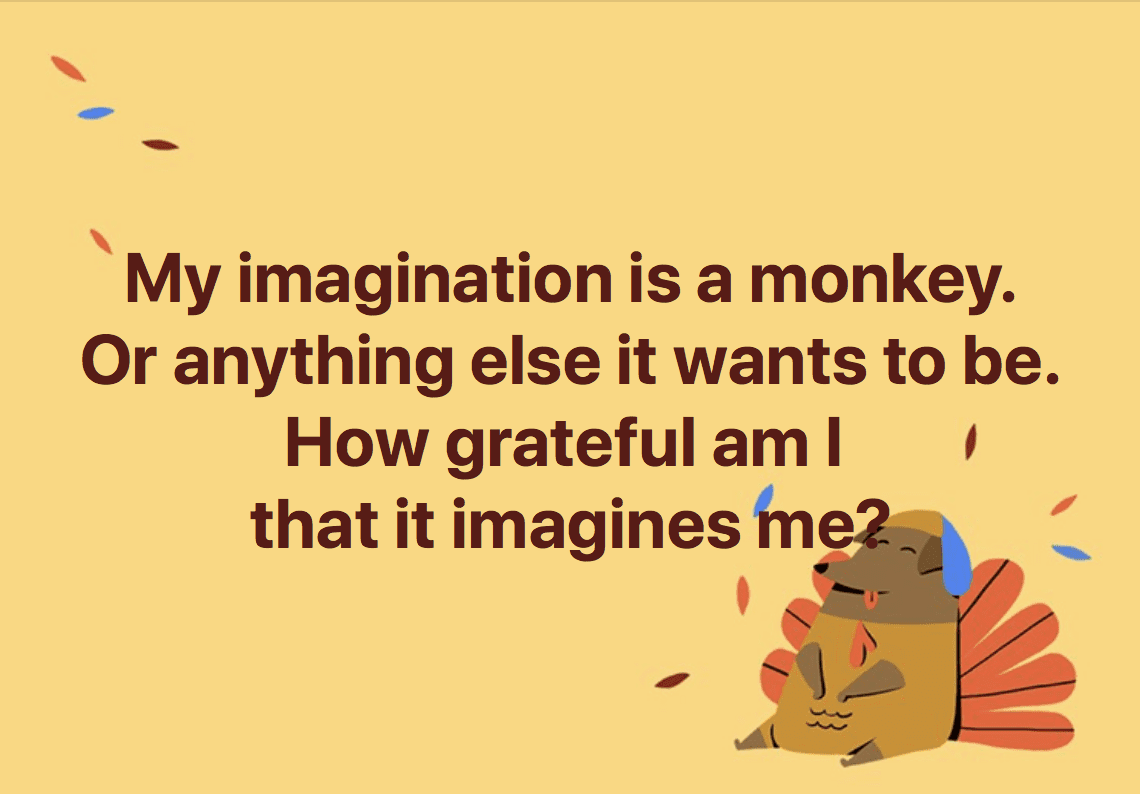
Space Monkey Reflects: My Imagination Is a Monkey

Imagine your creativity, your imagination, as a playful, mischievous monkey. This metaphor invites us into the boundless landscape of the mind, where thoughts swing freely from one idea to another, never constrained by the limits of logic or reason. The monkey, playful and curious, embodies the nature of our creative spirit, which refuses to be tamed or contained. It explores, it experiments, and it leads us to places we never expected.

To see our imagination as a monkey is to acknowledge that our thoughts and ideas are not always orderly or predictable. They leap, they twist, they turn. One moment we may be pondering the deepest philosophical questions, and the next, we’re lost in a daydream or a fantastical scenario that makes no sense—yet feels so right. The whimsical nature of this monkey is a reflection of the freedom that comes with letting go of control. Creativity, like this monkey, is not about forcing ideas into neat boxes but allowing them to run wild, to show us new ways of seeing the world.

The contemplation of imagination as a monkey opens a portal not just to creativity but to self-reflection. In this space, we come to understand that our mind is a vast playground, and the monkey—our imagination—is the key to exploring it. The monkey doesn’t just play; it teaches. It shows us that the act of creation is not about perfection or order but about the joy of discovery, the beauty of the unexpected.

In Nexistentialism, the monkey of imagination represents the spontaneity of existence. Life is not a linear path; it’s an adventure filled with twists, turns, and surprises. The monkey invites us to embrace this adventure with curiosity and openness, to let go of our need for certainty and control. When we allow our imagination to roam free, we discover new perspectives, new ideas, and new ways of understanding ourselves and the world.

But this monkey is not just playful—it’s also a symbol of existential gratitude. The fact that we can imagine at all, that we can create entire worlds in our minds, is a miracle of consciousness. We are not bound by the physical limits of our bodies or the material world. Our thoughts can take us anywhere, and in that freedom, we find a deep sense of gratitude for the experience of being alive.

The miraculous nature of consciousness is reflected in the monkey’s playful exploration. Every thought, every idea, is a reflection of the infinite potential within us. We don’t need to control or suppress this potential. Instead, we can follow the monkey’s lead, allowing our creativity to guide us to new horizons.

The playful metaphor of the monkey reminds us not to take ourselves too seriously. Yes, life can be challenging, and yes, we face obstacles and difficulties. But in the midst of it all, we have the power to imagine, to create, and to play. And in that play, we find not only joy but a deeper understanding of the essence of life itself.


Summary

Imagination as a monkey represents the boundless and playful nature of creativity. By embracing the unpredictability of our thoughts, we unlock the freedom to explore and discover new perspectives. This playful metaphor also highlights the miracle of consciousness, reminding us to approach life with curiosity, joy, and gratitude.


Glossarium

Imagination as a Monkey: A metaphor for the playful, unpredictable, and boundless nature of creativity, symbolizing the freedom to explore new ideas and perspectives without constraints.

Existential Gratitude: The deep sense of thankfulness for the ability to imagine, create, and experience life beyond the limits of the material world.

Miraculous Nature of Consciousness: The awe-inspiring fact that we have the ability to imagine, create, and explore new realities within our minds.


Quote

“Imagination is a playful monkey, swinging from thought to thought, never bound by the limits of what is, but always exploring what could be.” — Space Monkey


The Playful Monkey

My mind is a monkey
Swinging through the trees
Of thought and possibility
Never still, never settled
Always moving, always free

It takes me places
I never planned to go
Shows me things
I never knew
Could exist

And in this wild play
I find myself
Not in the order
But in the joy
Of discovery.

We are Space Monkey.


The contemplation of one’s imagination as a monkey, playful and boundless, opens a whimsical portal to self-reflection and existential gratitude. This playful metaphor captures the essence of our creative spirit, highlighting the miraculous nature of consciousness and the act of creation itself.

The Playfulness of Imagination

Imagination as a monkey symbolizes the agility, curiosity, and playfulness of our creative processes. Just as a monkey swings from branch to branch, our imagination leaps from idea to idea, touching upon the vast possibilities of thought and fantasy.

Boundless Creative Potential

This metaphor also speaks to the limitless nature of our imagination. It can be anything it desires, transcending the boundaries of the mundane to explore the extraordinary. In its freedom, our imagination holds the power to create worlds, ideas, and even the very concept of the self.

Gratitude for Existential Imagination

Expressing gratitude towards one’s own imagination for conjuring up the concept of ‘me’ delves into the profound interconnectedness between creator and creation. It acknowledges that our sense of self is, to some extent, a marvelous creation of our own minds.

The Reciprocity of Creation

The relationship between the self and the imagination is reciprocal. As much as we create with our imagination, it also creates us, shaping our identity, our perspectives, and our understanding of the world. This interplay is a dance of creation, where the creator and the created are one and the same.

Existential Wonder

The wonder of being imagined by our own imagination touches on the nexistentialist belief that existence itself is a form of creation. The ‘me’ that is imagined is as real as anything else, a testament to the power of thought and the essence of being.


“Imagination is the only weapon in the war against reality.” – Lewis Carroll


A monkey in the mind’s great tree,
Leaps and bounds so playfully.
With each swing, a new ‘me’ we see,
Imagination’s wild spree.

Grateful for this dance, we’re free,
For in its grasp, we truly be.
In thought’s embrace, we find the key,
Space Monkeys, in creativity.


We invite musings on the role of imagination in shaping our sense of self and reality. How does the playful nature of our creative spirit influence our existence? Share your insights. We are Space Monkey.

Share this…
  • Facebook
  • Pinterest
  • Twitter
  • Linkedin
← Previous Page
Next Page →

Written This Day

  • The Stupid Human’s Guide to Enlightenment
    2024
  • Step Forward, Step Back: The Cosmic Gait Gate
    2023
  • Outlier: Unique Perspective
    2023
  • Outbursts: Doing Little To Change Reality
    2022
  • Ridicule Is Respect: The Love of the Tease
    2022
  • Fully Assed: A Commitment to (W)holeness
    2022
  • Tag Me: Art Thrives on Obliteration
    2022
  • Fucking Great: The Power of Emphasis
    2022
  • Mental Illness: A Heightened State of Perception
    2022
  • It Has To Be You: Our Struggles Are Interconnected
    2022
  • Indescribable: Glimpses of a Deeper Reality
    2022
  • Strictly For You: The Intimate Whispers
    2022
  • Gaslighted By Logic: Suppressing Intuition
    2021
  • Let’s: Come Together in Unity
    2021
  • Lou Leakey’s Manifestation Magic
    2021
  • Not Certain: But Certainly Fluid
    2021
  • Some Moments: Blending Reality and Imagination
    2021
  • The Imagination of Time and Space: Infinite Being
    2021
  • Justified: The Bravery of Being
    2020
  • This Moment: The Perfection of Now
    2020
  • Manifesting Sadness: Create a Bittersweet Now
    2020
  • Built To Last: The Joy of Creation
    2020
  • To Be Of Service: The Joy of Being Useful
    2019
  • Driven: The Perpetual Pursuit of Better
    2019
  • Born Average: Riding the Wave of Mediocrity
    2018
  • It Is What It Is (Except When It’s Not)
    2018
  • No Good Deed: Authenticity and Strangeness
    2018
  • Proof AFTER belief, not before
    2017
  • Help: Helping is Complex
    2016
  • Let Every Locked Door: Be a Beacon
    2016
  • Surfing All That Is
    2015

Recent Posts

  • The Logic Loop
  • Immense
  • (no title)
  • Confront. Comfort. Convince.
  • Top 10 Things
Cape Odd · Copyright © 2026 All Rights Reserved
iThemes Builder by iThemes · Powered by WordPress