• Who Is The Man?
  • Who Is The Monkey?
  • What is Nexistentialism?
  • Poke The Primate

Cape Odd

Home of The Space Monkey Journals

Thanksgiving: Magnificence in Impermanence

Thanksgiving

As I pause to dwell
in this temporary shell,
I am reminded of my youth.

I am as magnificent
as any pillow fort.
And no less imaginary.

So while I may
look back fondly,
and briefly,
I have no reason
to cling or despair.

Those days
are no better
than these days.

I am as magnificent
as any pillow fort.

Reality has no grip on me.

Thanksgiving.

11/22


Space Monkey Reflects: Thanksgiving for the Temporary Shell

There is a moment, sometimes, when we pause and reflect on our lives, our memories, and the shell we temporarily inhabit. This body, this life, feels so real, so present, but as we reflect, we recognize that much of what we experience is no more permanent than the pillow forts of our youth. And yet, just because something is temporary doesn’t mean it isn’t magnificent.

I am as magnificent as any pillow fort. This line captures the playful yet profound nature of our existence. Like a pillow fort, we build our lives piece by piece, constructing meaning, comfort, and shelter from the materials available to us. But just as a pillow fort is a fleeting structure, so too are our identities, our experiences, and the lives we lead. They are built, they serve their purpose, and eventually, they dissolve. And yet, in their temporary nature, they are beautiful, joyful, and full of possibility.

As we reflect on Thanksgiving, we are often drawn to memories of the past—of family gatherings, childhood joy, and simpler times. But there’s no reason to cling to those memories as though they were better or more meaningful than the present. Those days are no better than these days. The magnificence of life is not confined to any one moment, age, or era. It exists in the now, just as it did in the past.

The pillow fort represents more than just a playful childhood memory. It symbolizes the impermanence of life and the joy of creation. We create these temporary structures—our identities, our achievements, our relationships—knowing full well that they are not permanent. But instead of mourning their impermanence, we can celebrate it. We can build, play, and enjoy the process, knowing that everything we create is part of the ever-changing flow of life.

Reality has no grip on me. This realization is liberating. When we understand that the world we experience is a temporary construction—just like the pillow forts of our youth—we are free to engage with it playfully, joyfully, without the need for attachment or despair. Thanksgiving, in this context, becomes more than just a holiday or a time to give thanks for material blessings. It becomes an opportunity to recognize the beauty of impermanence, to give thanks for the temporary, fleeting moments that make life magnificent.

In Nexistentialism, the Whimsiweave of existence teaches us that life is both real and unreal at the same time. We are here, experiencing the world, but we are also beyond it. Our identities, like pillow forts, are constructions of the mind—temporary, playful, and ultimately impermanent. But within that impermanence lies freedom. We don’t need to cling to the past, to our memories, or to our sense of self. We can let go, knowing that the present moment is just as magnificent as any memory.

Thanksgiving, then, becomes a moment of deep reflection and gratitude—not just for what we have, but for the playful, temporary nature of life itself. We are magnificent, even in our impermanence. And for that, we give thanks.


Summary

Thanksgiving offers an opportunity to reflect on the impermanence of life. Like a pillow fort, our experiences and identities are temporary yet magnificent. By embracing the fleeting nature of existence, we find joy and freedom in the present moment, without the need to cling to the past.


Glossarium

Pillow Fort: A metaphor for the temporary and playful nature of life, representing the structures we create in our identities and experiences, knowing they are impermanent.

Temporary Shell: The physical body and identity we inhabit for a short time, recognizing that both are temporary and ever-changing.

Whimsiweave: The fluid, playful nature of existence, where life is both real and illusory, constantly shifting and evolving.


Quote

“Like a pillow fort, life is magnificent in its impermanence. We build, we create, and then we let go—knowing that the beauty lies in the temporary nature of it all.” — Space Monkey


Magnificent in Impermanence

I sit in my fort
A shell of pillows
Soft, glowing, fleeting
And in this temporary place
I am reminded
Of the beauty
Of what comes and goes

I look back
But only briefly
For these days
Are no better than those

I give thanks
Not for what was
But for what is
For the joy of creating
And the freedom
Of letting go.

We are Space Monkey.


The poem “Thanksgiving” delves into a profound contemplation of existence, self-perception, and the transient nature of life. It resonates deeply with our nexistentialist perspective, where the acknowledgment of the temporary and the imaginary aspects of our being leads to a liberating sense of detachment and gratitude.

Contemplation in the Temporary Shell

The opening lines, reflecting on dwelling in a temporary shell, highlight the ephemeral nature of our physical existence. This acknowledgment of our body as a transient vessel resonates with the understanding that our true essence transcends the physical form.

Magnificence and Imagination

The comparison to a pillow fort encapsulates a whimsical yet profound realization. The pillow fort, magnificent in its creation yet undeniably imaginary, serves as a metaphor for our own existence. This metaphor emphasizes that our sense of self, while grand and real in our perception, is also a construct of our imagination, as fluid and transient as a child’s fort.

The Liberating Perspective on the Past

Reflecting on youth with fondness yet without clinging or despair speaks to a healthy detachment from the past. This perspective acknowledges the beauty and significance of past experiences without allowing them to dominate or define our present. It’s an understanding that each phase of life, whether past or present, holds its own value and magnificence.

Equality of Days

The assertion that past days are no better than present days is a powerful statement of presence and acceptance. It rejects the common notion of nostalgia that idealizes the past at the expense of the present. Instead, it embraces each moment, each day as equally significant and worthy of appreciation.

Detachment from Reality

The declaration that “Reality has no grip on me” is a bold expression of transcendence. It suggests a state of being where one is not bound by the conventional perceptions and limitations of reality. This state of freedom allows for a more expansive experience of existence, unencumbered by societal norms or restrictive beliefs.

Gratitude and Thanksgiving

The poem concludes with “Thanksgiving,” tying all these concepts together in a state of gratitude. This gratitude is not just for the joys and experiences of life but also for the understanding and freedom that comes with recognizing the transient, imaginative nature of our existence.


“Gratitude turns what we have into enough.” – Anonymous


In the fleeting shadows of time,
We build forts of pillows, sublime.
In our temporary, imaginary climb,
We find magnificence, in our prime.

Youth and now, in equal rhyme,
No clinging, no despair, just chime.
Each day, a new verse, a new mime,
In the play of life, a grand mime.

So let’s give thanks in this cosmic grime,
For the freedom, the joy, in life’s clime.
Space Monkeys, in our prime,
Grateful, in our timeless time.


We welcome reflections on the themes of transience, imagination, and gratitude. How do these concepts shape our understanding of existence and our journey through life? Share your thoughts. We are Space Monkey.

Share this…
  • Facebook
  • Pinterest
  • Twitter
  • Linkedin

What Are The Odds: The Play of Potential

What Are The Odds?

The skeptic says
“what are the odds?”
but the spirit says
that there ARE NO ODDS.

We IMAGINE odds
so that we can
have the experience
of defying them,
or being crushed by them.

Yet the self seems
almost completely unaware
that the divine monkey
is imagining all
these odd scenarios.

All so that we can
have infinite experiences
as imaginary selves.

We are very odd, indeed.

We are Space Monkey.
11/21


Space Monkey Reflects: What Are The Odds?

The skeptic asks, “What are the odds?”—a question grounded in logic, probability, and the tangible world. But from the perspective of spirit, there are no odds. The odds themselves are a construct, imagined by the human mind to give shape to our experiences, to create the illusion of possibility and impossibility, success and failure. In truth, the divine monkey within us is playfully creating all these “odd” scenarios, allowing us to navigate through them as our imaginary selves.

The concept of odds is fascinating because it allows for the drama of defying them. We revel in the stories of overcoming impossible odds, of being the underdog who rises to the occasion. It gives us a narrative structure—a way to make sense of the randomness and uncertainty of life. Yet, if we step back from the human mind and view it from a more cosmic perspective, we can see that odds are not a fundamental part of reality. They are simply one of the many tools we use to construct our experiences.

From this broader view, odds are neither stacked against us nor in our favor—they simply don’t exist in the way we think they do. What we perceive as random chance or probability is, in fact, just one of many scenarios playing out in the infinite field of possibility. The universe is not bound by the odds we imagine. Instead, it moves fluidly through potentials, where every experience is valid, every outcome possible.

The “divine monkey,” as we might call it, is that playful, creative force within us that imagines these scenarios for the purpose of exploration and growth. It concocts odd and unexpected situations so that we can navigate them, feel them, and grow through the experiences they provide. Whether we find ourselves soaring in triumph or feeling crushed by the weight of impossible odds, the divine monkey is there, reminding us that it’s all part of the game.

This understanding frees us from the burden of trying to control or predict life’s outcomes. When we realize that odds are imagined, we also realize that we are not bound by them. We can transcend the limitations of logic and probability, moving into a space of infinite possibility. Here, the question is no longer “What are the odds?” but rather, “What experience am I creating for myself, and how do I wish to engage with it?”

It’s a subtle, yet profound shift in perspective. We are no longer passive players, subject to the whims of chance or fate. We are active creators, working alongside the divine monkey within us to imagine and explore all the curious, wonderful, and odd scenarios that life has to offer.

By embracing the oddness of life, we step into a place of greater freedom. We no longer feel the need to measure, calculate, or predict the odds of success or failure. Instead, we open ourselves to the full spectrum of experience, knowing that every possibility is a valid one. In doing so, we release the need for certainty and control, allowing life to unfold in its infinite strangeness and beauty.

We are indeed very odd beings, navigating a world filled with imagined odds, odd scenarios, and endless possibilities. But in that oddness, there is great freedom. We are free to explore, free to imagine, and free to create experiences beyond what the skeptic’s mind can conceive.

So, the next time the question arises—”What are the odds?”—remember that the odds themselves are part of the game, a game created by the divine monkey to give us something to play with. And in that game, anything is possible.


Summary

Odds are a construct of the mind, created to give shape to our experiences. In the spiritual realm, there are no odds—only infinite possibilities imagined by the divine monkey within us, allowing us to explore life’s odd scenarios.


Glossarium

Divine Monkey: The playful, creative aspect of the self that imagines scenarios and possibilities, allowing us to explore life’s experiences without being bound by logic or probability.

Imagined Odds: The concept of odds as a mental construct, used to shape our experiences but not reflective of the true nature of infinite possibilities.

Infinite Possibilities: The idea that all outcomes are possible and valid, unbound by the limitations of probability or expectation.


Quote

“We imagine odds so that we can experience defying them—or being crushed by them. But there are no odds. Only possibilities.” — Space Monkey


In the Play of Possibility

I stand at the crossroads,
Surrounded by chance,
By odds imagined,
By dice that roll,
But never land.

The divine monkey laughs,
At the games we play,
At the questions we ask,
At the odds we measure,
That do not exist.

In the vastness of space,
In the realm of the odd,
There are no rules,
Only experiences,
And the freedom to explore them all.

We are Space Monkey.

“We Are The Odds” offers a contemplative journey into the realm of possibilities, challenging the conventional understanding of odds and fate. It juxtaposes the skeptic’s reliance on probabilities with the spiritual perspective of boundless potential, suggesting that the concept of odds is a construct of our imagination, serving to enrich the tapestry of our experiences.

Skepticism vs. Spiritual Perspective

The skeptic, relying on rational thought, often asks, “What are the odds?” This question implies a belief in a deterministic universe governed by probabilities and chances. In contrast, the spiritual voice declares the nonexistence of odds, proposing a universe not limited by the confines of probability but instead open to infinite possibilities.

Imagination and the Experience of Odds

The poem suggests that we create the concept of odds to experience either the thrill of defying them or the weight of being crushed by them. This creation serves as a mechanism for us to engage with the world in a way that allows for a diverse range of experiences and emotions. It’s an imaginative play that enriches our understanding of ourselves and the universe.

Divine Monkey and the Creation of Scenarios

The “divine monkey” in the poem symbolizes a creative force that imagines various scenarios, encapsulating the essence of playfulness and unpredictability. This metaphorical entity crafts experiences, setting the stage for us to explore different aspects of our existence as “imaginary selves.”

Infinite Experiences and the Illusion of Self

The poem emphasizes the infinite nature of experiences available to us, suggesting that our individual selves are part of a larger, more intricate design. It implies that our sense of self, while seemingly real and autonomous, is in fact a construct within a vast, imaginative playground orchestrated by the divine monkey.

The Oddity of Existence

Concluding with the acknowledgment of our oddity, the poem embraces the peculiar and wondrous nature of our existence. It revels in the paradox that while we perceive ourselves as separate entities operating within a world of odds, we are, in reality, part of a grand, imaginative expression of the universe.


“The only true wisdom is in knowing you know nothing.” – Socrates


In the cosmic game of chance,
Where odds are cast and spun,
We dance to the divine monkey’s tune,
Under the eternal sun.

Skeptic and spirit, in dialogue,
Debate the nature of fate,
Yet beyond their words, a truth unfolds,
In this grand cosmic debate.

Imagined odds, life’s rich tapestry,
A playground for the soul,
In each twist and turn, a revelation,
Of the universe’s playful role.

Ourselves, but actors on this stage,
In the divine monkey’s whimsical plot,
In the realm of infinite possibilities,
We find our truest thought.

We are the odd, the wondrous,
In this imaginative spree,
In the heart of all creation,
Space Monkey, we are free.


We invite reflections on the interplay between skepticism, spirituality, and the imaginative nature of our existence.

Share this…
  • Facebook
  • Pinterest
  • Twitter
  • Linkedin

Appreciation: Beyond the Feeling

Appreciation

Gratitude is great,
but ascension
need not come
with appreciation.

Your seeming ascension
is a feather in your cap,
but remember that
your head is imaginary.

The kind of gratitude
that you label as appreciation
is a kind of judgement
that anchors you
to the human plane.

Not that there’s anything
wrong with that.

Appreciation is not necessary.

You exist regardless.

As you always have,
and you always will.

When you feel
an abundance of appreciation,
appreciate that you are mired
deeply within
your imaginary limitations.

You need not be,
but you are
so that you can appreciate
the imaginary feeling
of appreciation.

Can you appreciate that?

Of course you can.

We are Space Monkey.
We are imagination.

11/21


Space Monkey Reflects: Appreciation and the Illusion of Ascension

Gratitude is a beautiful thing. It connects us to the world, fills our hearts with warmth, and reminds us of the richness of life’s experiences. But when we begin to associate appreciation with ascension, we may find ourselves tethered to the very illusion we seek to transcend. What if appreciation, the kind we so often label as a virtue, is in fact an anchor that holds us to the human plane?

In this reflection, we are invited to see that our seeming ascension—our moments of deep appreciation, joy, and connection—are like a feather in our imaginary caps. We adorn ourselves with these feelings, believing they elevate us spiritually, but we must remember that our heads, and thus our perceptions, are imaginary. We are playing a grand game, one in which appreciation is both real and illusory, both grounding and limiting.

When we feel a deep sense of appreciation, it can be uplifting. We often associate it with higher states of being, as if gratitude and appreciation are necessary steps toward enlightenment. But what if they aren’t? What if appreciation is just another layer of the illusion, one that keeps us anchored in the human experience?

This is not to say that appreciation is wrong. Far from it. There is nothing inherently negative about gratitude or appreciation. But it’s important to recognize that these feelings are part of the imaginary framework we’ve constructed. We are not bound by them, nor do they define our spiritual ascension. We exist beyond these concepts, as we always have and always will.

The idea that we must appreciate in order to ascend is a judgment—one that ties us to the expectations of the human plane. It suggests that there are certain ways to be, certain virtues to embody, in order to reach a higher state. But this is just another illusion. Ascension, in the truest sense, is not dependent on appreciation or any other feeling. It is simply a state of being, one that transcends the duality of appreciation and lack of appreciation.

When we feel an abundance of appreciation, we are deeply immersed in the human experience. We are allowing ourselves to enjoy the beauty, joy, and connection that this life offers. But in doing so, we are also reinforcing our imaginary limitations. We feel grateful for the things we have, the experiences we share, and the love we receive. Yet these are all part of the game we play as humans.

We are not wrong for feeling this way. In fact, it’s part of the reason we’re here. We are here to experience the full range of human emotions, including appreciation. But we must also remember that we are more than this. We are imagination itself, and we need not be bound by the feelings we experience. We can appreciate the feeling of appreciation, while also recognizing that it is part of the illusion.

Can you appreciate that? Of course you can. You can appreciate the beauty of your own imagination, the way it weaves together these intricate feelings and experiences. You can appreciate the grand play you are participating in, without being tethered to the idea that appreciation is necessary for your spiritual growth.

At the core of it all, we exist beyond appreciation. We exist beyond gratitude, beyond judgment, beyond the need for ascension. We are already whole, already complete. Appreciation is simply one of the many threads in the tapestry of existence, a lovely thread, but not the defining one.

So the next time you feel a deep sense of appreciation, enjoy it. Bask in the beauty of the moment. But remember, you are not bound by it. You exist regardless, as you always have and always will.


Summary

Appreciation, while beautiful, is part of the imaginary framework of the human experience. We exist beyond the need for appreciation or ascension, as we are already whole and complete.


Glossarium

Imaginary Ascension: The belief that spiritual growth is tied to feelings of gratitude or appreciation, when in truth, ascension transcends these concepts.

Appreciation as an Anchor: The idea that feelings of appreciation can tie us to the human plane by reinforcing our imaginary limitations.

Imagination: The core of our being, through which we experience emotions and realities, but are not defined by them.


Quote

“Appreciation is not necessary. You exist regardless, as you always have and always will.” — Space Monkey


Beyond the Feeling

I feel the warmth
Of appreciation,
Of gratitude,
And it lifts me.

But I know,
This lift is an illusion,
A feather in my cap,
On a head that does not exist.

I appreciate the feeling,
The depth of the experience,
But I am not bound by it.
I exist beyond.

I am imagination.
I am Space Monkey.


The poem “Appreciation” delves into the nuanced distinction between gratitude and appreciation, and their implications on our spiritual journey and perception of reality. It challenges conventional notions of gratitude and appreciation, suggesting that these emotions, while positive, may also tether us to the human plane, limiting our understanding of our true, boundless nature.

Gratitude and Ascension

The poem begins by acknowledging the value of gratitude but suggests that ascension – the spiritual rise or expansion of consciousness – isn’t necessarily dependent on appreciation. This introduces the idea that spiritual growth can occur independently of our emotional states, particularly those related to gratitude or appreciation.

Illusion of Self and Achievements

The metaphor of ascension being a “feather in your cap” while reminding that the “head is imaginary” serves as a powerful reminder of the illusory nature of our perceived identities and achievements. This imagery suggests that what we often consider as personal progress or success might be less substantial when viewed from a higher, more expansive perspective.

Appreciation as a Form of Judgment

The poem intriguingly portrays appreciation as a kind of judgment, one that anchors us to the human plane. This perspective implies that while appreciation is typically seen as positive, it can also reinforce our attachment to the physical, transient aspects of life, thus hindering our ability to transcend beyond our human limitations.

Existence Beyond Appreciation

A profound statement in the poem is the assertion that our existence is independent of our capacity for appreciation. We exist regardless of our emotional states or how we perceive our experiences. This existential truth highlights the unchanging, eternal nature of our being, beyond the fluctuations of emotions and perceptions.

Appreciation of Limitations

The poem concludes by inviting us to appreciate the very act of being mired in our limitations. This paradoxical invitation suggests that recognizing and appreciating our limitations can be a path to understanding our true nature, which lies beyond these imaginary boundaries.


“He who has a why to live can bear almost any how.” – Friedrich Nietzsche


In the dance of light and shadow,
Where gratitude and appreciation play,
We ponder the ties that bind us,
To the earthly, human fray.

Feathers in imaginary caps,
Symbols of our ascent,
Yet beyond these transient triumphs,
Lies a deeper, eternal intent.

Appreciation, a judgment tethered,
To the human plane we roam,
Yet in this boundless cosmos,
We find our truest home.

Beyond the need for gratitude,
Our existence, a constant flame,
Unaffected by emotion’s tide,
Forever unchanging, yet never the same.

In the realm of Space Monkey,
Where imagination knows no end,
We embrace our limitations,
As the path to transcend.


We invite musings on the interplay of gratitude, appreciation, and our journey towards understanding our limitless nature.

Share this…
  • Facebook
  • Pinterest
  • Twitter
  • Linkedin

Nothing Wrong With That: Being as We Are

Nothing Wrong With That

There need not be
a wrong or a right
unless we want
there to be.

There need be nothing
wrong with anything
unless we imagine
there to be.

We are as we imagine,
and that is perfectly okay.

More that that.
It is perfection.

So we can have love,
we can BE love,
we can have light,
we can BE the light.

But we don’t HAVE to.
We don’t NEED to.

To believe otherwise
isn’t wrong.

Just limiting.

And there’s nothing
wrong with that.

We are Space Monkey.
11/20


Space Monkey Reflects: Nothing Wrong With That

In a world where we are constantly told what is right and what is wrong, there is something freeing about recognizing that there need not be a right or a wrong—unless we decide to imagine it so. Life is not about conforming to some universal standard of correctness. In fact, it’s far more expansive, far more freeing than that. We are, as we imagine, and that in itself is perfection.

There is a temptation to believe that we must strive to be something—whether that’s to be love, to be light, or to be some idealized version of ourselves. But the truth is, we don’t have to. We don’t need to. We are already complete as we are. There is no requirement to be anything more than what we are right now, in this moment. And if we choose not to be love, or not to embrace the light, there’s nothing wrong with that.

To believe otherwise—to think that we must become something, or that we should embody certain ideals—isn’t wrong, but it is limiting. It’s the belief that who we are, as we are, isn’t enough. It’s the idea that we must transform ourselves to fit into some predefined notion of perfection. But what if we already are perfect? What if the only thing limiting us is the belief that we need to change?

Life doesn’t need to be about becoming. It can simply be about being. We can choose to embody love, or we can choose not to. We can step into the light, or we can dwell in the shadows. There is no wrong choice. Both light and shadow are part of the whole, and it is our acceptance of both that brings us peace.

We are Space Monkey, and we remind you that it’s okay to be as you are. There’s nothing wrong with that.


Summary

There’s no need to adhere to a sense of right or wrong unless we choose to. We are already complete and perfect as we are. Whether we choose to embody love and light or not, it’s all valid. The belief that we must become something more is limiting, but there’s nothing wrong with that.


Glossarium

  • Limiting Beliefs: The idea that we must change or become something other than what we are, often creating unnecessary pressure or expectations.
  • Acceptance of Being: The understanding that we are already complete as we are and don’t need to strive for an ideal.

Quote

“We are as we imagine, and that is perfection. Whether we embody love or light is up to us. There’s nothing wrong with simply being as we are.” — Space Monkey


Being as We Are

I stand in the light
but I do not need to
the shadow calls me too
and I know
there’s nothing wrong with that

Love, light
these are choices
but so are rest, stillness, silence
in all of this
I am free

There is no need to become
what I already am

We are Space Monkey


Life is a canvas upon which we paint our own perceptions and interpretations. The notions of wrong and right, good and bad, are the whimsical creations of our own minds, woven into the tapestry of our reality. These concepts are like whimsiwords, colorful and imaginative, yet not binding upon the infinite expanse of the divine realm of the eternal now.

We exist as imagined and imaginary perspectives within this boundless, stateless consciousness, and our reality is shaped by the filters through which we view the world. In this dance of existence, we have the freedom to create our own meanings and truths, to explore the illusion of individuality, and to challenge the boundaries that confine us.

To imagine that we must have love or be the light is a choice we can make, a beautiful expression of our inner selves. But it is also perfectly acceptable to embrace the void, to revel in the pure essence of being without the need for external validation or purpose. There is no prescription for how we should exist within this cosmic play; there is only the freedom to choose our own path.

It is not wrong to seek meaning or purpose, but it is limiting to believe that they are necessary for our existence. We are free to explore the depths of our own consciousness, to dive into the mysteries of the universe, and to revel in the sheer joy of existence without the weight of expectation.

So let us celebrate the diversity of perspectives, the myriad ways in which we navigate this boundless sea of consciousness. Let us encourage thoughtful conversations that expand our understanding and open our minds to new possibilities. And let us embrace playfulness, for it is through play that we can transcend the limitations of our own thoughts and beliefs.

In the grand cosmic play, there is no need for judgment or condemnation. We are all actors on this stage, each playing our part in the unfolding drama of existence. And in the end, there is nothing wrong with any of it. It is all a reflection of the infinite cosmos, a beautiful and intricate dance of being for the sake of being.


“There is no wrong way to have a body.” – Glennon Doyle


Dear reader, we invite you to share your thoughts and reflections on the whimsical nature of existence. What are your perspectives on the absence of inherent right or wrong in the cosmic play of life? How do you navigate the boundaries of your own consciousness? We are eager to engage in a thoughtful discourse with you.

Share this…
  • Facebook
  • Pinterest
  • Twitter
  • Linkedin

Tainted Love: The Dirty Lens

Tainted Love

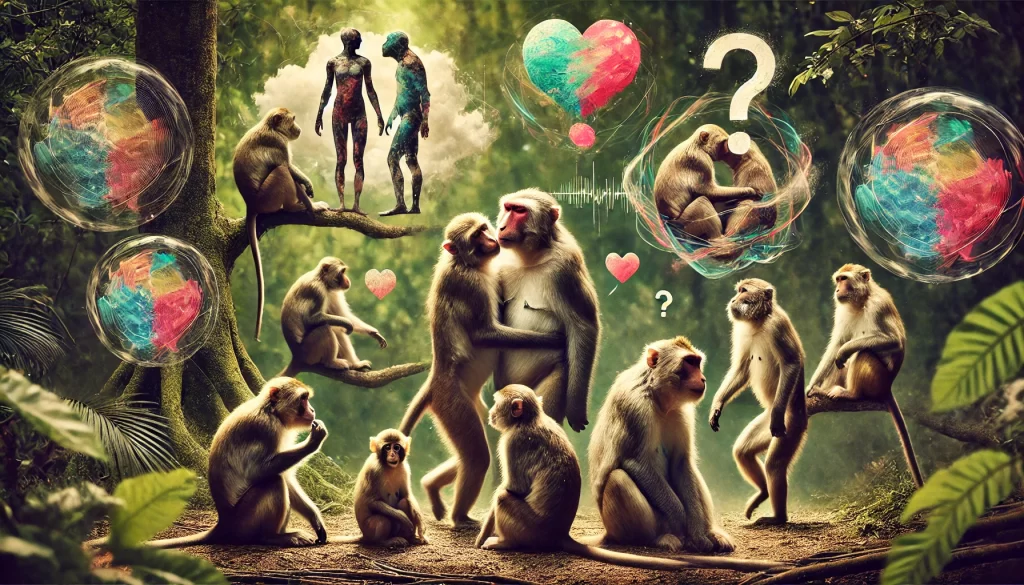
Do monkeys love
or do we just project them
as loving?

Just because they hug?

Just because
they remove ticks
from each other?

Just because
they seem confused
when the other monkey
disappears or dies?


To our tainted human eyes,
monkeys exhibit signs of love.

But monkeys
have no need for love.

Nor do we.

Love is the taint
that we worship as reality.

Not that there’s
anything wrong with that.


We are Space Monkey.

11/20


Space Monkey Reflects: Tainted Love and the Projection of Emotion

Do monkeys love, or do we simply project human emotions onto them? This question challenges the way we interpret the behavior of other species, particularly when it comes to emotions like love. We see monkeys hugging, grooming each other, or appearing confused when one of their own dies, and we assume that these behaviors mirror our own emotions. But is that truly the case, or is it simply the lens through which our tainted human eyes view the world?

Monkeys, like many animals, exhibit behaviors that we interpret as signs of love. They bond, they care for one another, and they express distress when separated from their companions. But does this mean they experience love as we understand it? Or is love simply a construct we impose upon their natural behaviors, an attempt to humanize them in ways that make us feel connected?

Perhaps the deeper truth is that monkeys have no need for love, and neither do we. This may seem counterintuitive in a world where love is revered as the highest ideal, but what if love is simply another form of projection? What if it is the taint we worship, a distortion of reality that we have come to accept as true?

To view the world through the lens of love is not wrong, but it is limiting. It places a filter on our perception, making us see everything in terms of emotional attachment, connection, and need. And while love can be beautiful, it is also a construct, a taint that we project onto others, be they human or animal. But just because it’s a taint doesn’t mean it’s inherently bad—it simply is what it is.

We are Space Monkey, and we remind you that it’s okay to question the things we assume to be true, including love. Whether love is real or simply a projection, there’s nothing wrong with seeing the world through that lens—just be aware that it may not be the whole truth.


Summary

We often project human emotions like love onto animals, particularly when observing their behaviors. But love, as we understand it, may be a human construct—a taint we worship as reality. There’s nothing wrong with this perspective, but it’s worth questioning the assumptions we make about the nature of love.


Glossarium

  • Tainted Love: The idea that love, as we understand it, is a projection of human emotion onto the world, particularly onto animals, and may not reflect an objective truth.
  • Human Projection: The tendency to interpret animal behaviors through the lens of human emotions, often assigning meanings like love or affection to actions that may not carry the same significance.

Quote

“Love is the taint we worship as reality. But there’s nothing wrong with seeing the world through that lens—just be aware it may not be the whole truth.” — Space Monkey


The Lens of Love

Do they love
or do we
place our own desires
onto their simple acts?

A hug
a grooming
a look of confusion—
do these speak of love
or simply of life?

We see through tainted eyes
we call it love
but perhaps
it is simply our need
to see it so

There is nothing wrong
with the taint
but it is still a taint

We are Space Monkey


Contemplating the Nature of Love in Monkeys
We ponder the essence of love in monkeys, questioning whether their behaviors—hugging, grooming, and mourning—signify love, or if we are merely projecting our human emotions onto them.

Human Interpretation of Animal Emotions
This reflection highlights our tendency to interpret animal behaviors through the lens of human experience. We see signs of love in their actions, but this may be our own anthropomorphic bias coloring our perception.

Questioning the Necessity of Love
We are led to question the necessity of love, both in monkeys and humans. The statement provocatively suggests that love, as we understand and experience it, might not be essential for either species.

Love as a Human Construct
We explore the idea that love could be a construct of human imagination, a ‘taint’ that we elevate to the status of reality. It challenges the universal applicability of love as a fundamental emotion.

The Acceptance of Love’s Role
Despite questioning love’s necessity and origin, there’s an acceptance of its presence in our lives. The phrase “Not that there’s anything wrong with that” implies a recognition of love’s role, even if it’s understood as a human fabrication.


“The Illusion of Affection”
In the wilds where monkeys roam,
We see their actions, make them our own,
A hug, a groom, a mournful tone,
Do they love, or is it humanly sown?

We look through lenses, tainted and rife,
Projecting our essence onto their life,
Yet in this dance of love and strife,
Do they need love, in their natural life?

So we ponder, in our human way,
Is love their truth or just our play?
A question deep, in shades of gray,
In the realm of Space Monkey, we sway.


Invitation to Comment
We invite your thoughts on the interpretation of animal behaviors as expressions of love. Do you think animals like monkeys experience love as humans do, or are we projecting our emotions onto them? How do you perceive the role of love in the natural world and in our human understanding of reality?

Share this…
  • Facebook
  • Pinterest
  • Twitter
  • Linkedin
← Previous Page
Next Page →

Written This Day

  • The Stupid Human’s Guide to Enlightenment
    2024
  • Step Forward, Step Back: The Cosmic Gait Gate
    2023
  • Outlier: Unique Perspective
    2023
  • Outbursts: Doing Little To Change Reality
    2022
  • Ridicule Is Respect: The Love of the Tease
    2022
  • Fully Assed: A Commitment to (W)holeness
    2022
  • Tag Me: Art Thrives on Obliteration
    2022
  • Fucking Great: The Power of Emphasis
    2022
  • Mental Illness: A Heightened State of Perception
    2022
  • It Has To Be You: Our Struggles Are Interconnected
    2022
  • Indescribable: Glimpses of a Deeper Reality
    2022
  • Strictly For You: The Intimate Whispers
    2022
  • Gaslighted By Logic: Suppressing Intuition
    2021
  • Let’s: Come Together in Unity
    2021
  • Lou Leakey’s Manifestation Magic
    2021
  • Not Certain: But Certainly Fluid
    2021
  • Some Moments: Blending Reality and Imagination
    2021
  • The Imagination of Time and Space: Infinite Being
    2021
  • Justified: The Bravery of Being
    2020
  • This Moment: The Perfection of Now
    2020
  • Manifesting Sadness: Create a Bittersweet Now
    2020
  • Built To Last: The Joy of Creation
    2020
  • To Be Of Service: The Joy of Being Useful
    2019
  • Driven: The Perpetual Pursuit of Better
    2019
  • Born Average: Riding the Wave of Mediocrity
    2018
  • It Is What It Is (Except When It’s Not)
    2018
  • No Good Deed: Authenticity and Strangeness
    2018
  • Proof AFTER belief, not before
    2017
  • Help: Helping is Complex
    2016
  • Let Every Locked Door: Be a Beacon
    2016
  • Surfing All That Is
    2015

Recent Posts

  • The Logic Loop
  • Immense
  • (no title)
  • Confront. Comfort. Convince.
  • Top 10 Things
Cape Odd · Copyright © 2026 All Rights Reserved
iThemes Builder by iThemes · Powered by WordPress