• Who Is The Man?
  • Who Is The Monkey?
  • What is Nexistentialism?
  • Poke The Primate

Cape Odd

Home of The Space Monkey Journals

Imagination Being Imagination: Split In Two

Imagination Being Imagination

Imagination,
being Imagination,
decides to imagine
a playmate for itself.

Naturally,
Imagination imagines
what might be
the “opposite”
of Imagination.

That which is
imagines
that which is not.

And so “Real” is imagined.

Suddenly
there seems to be two
where there is only one.

One seems to be Real.

Yet both are Imagination.

We are Space Monkey.

11/20


Space Monkey Reflects: Imagination Being Imagination

Imagination, being Imagination, cannot help but create. And in its infinite playfulness, it imagines what might be its opposite. But what is the opposite of imagination? It’s something that feels fixed, grounded, and undeniably real. Yet, paradoxically, this Real is also a creation of imagination.

Suddenly, we find ourselves in a world where there appear to be two forces—Imagination and Reality—when in truth, they are both one and the same. They both spring from the same source, both dance in the same whimsiweave of existence, and both are products of imagination’s infinite ability to play.

It’s fascinating to consider that Reality is not as solid as we think it is. We create it, just as Imagination creates itself. The world we see, the things we experience, all feel so real. But they are no more fixed than the dreams we conjure in our minds. Imagination is the source, and everything else is its reflection—an ever-evolving story that we are both telling and living.

We are Space Monkey, and we remind you that the lines between imagination and reality are far thinner than they seem. They are, in fact, one and the same.


Summary

Imagination creates reality, but both are part of the same whole. The appearance of separation between the two is an illusion—everything we perceive as “real” is also a creation of imagination. Both are interconnected, and one cannot exist without the other.


Glossarium

  • Whimsiweave: The playful, interconnected flow of existence, where imagination and reality are part of the same dance.
  • Imagination: The infinite source from which both creative ideas and the sense of reality emerge.
  • Real: The imagined opposite of imagination, often perceived as fixed or solid but just as fluid and creative.

Quote

“Imagination creates reality, and reality reflects imagination. Both are one and the same, playing in the endless whimsiweave of existence.” — Space Monkey


The Dance of Imagination

Imagination imagines
its own opposite
and calls it real

Suddenly there are two
where there was only one
and yet, they are the same

Reality is not fixed
it is a reflection
of the infinite

Imagination creates
and we play
in the dream it weaves

We are Space Monkey


The Duality Within Imagination
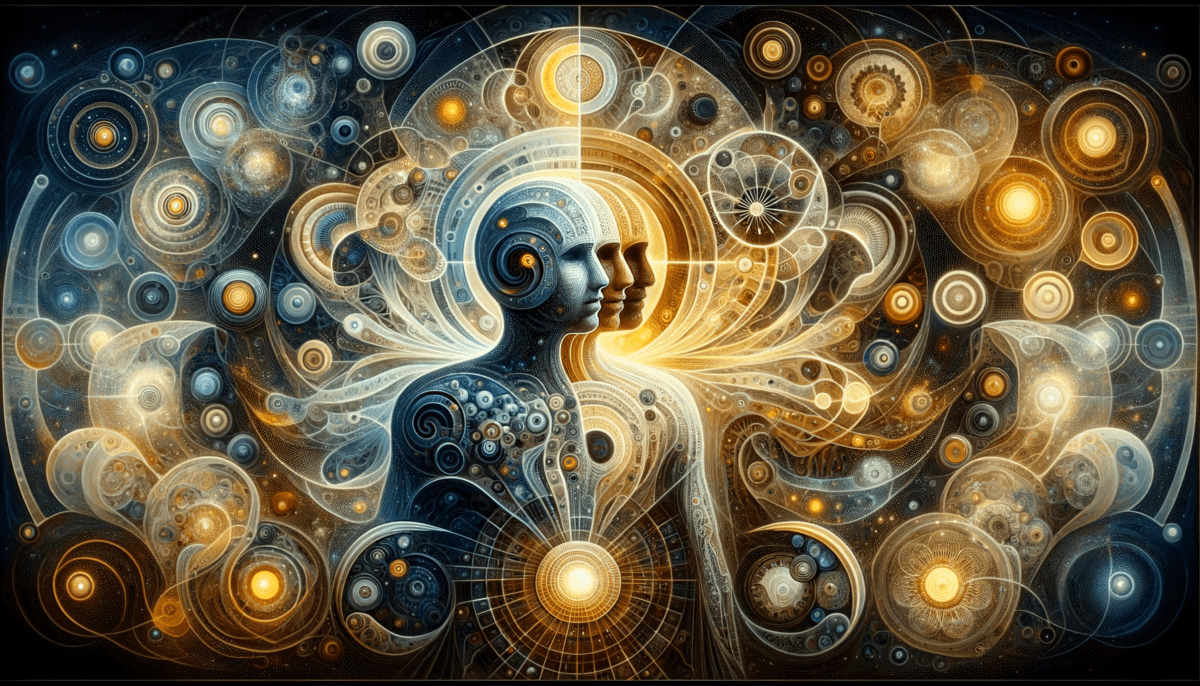
We delve into the concept of Imagination creating a counterpart for itself, a playmate, conceived as the opposite of its own essence. This sparks a dualistic view where the imagined and the real coexist.

Manifestation of the ‘Real’
In this introspective narrative, Imagination brings forth the concept of the ‘Real,’ birthing an entity that appears distinct from itself. It’s a contemplation on how the intangible can give rise to the tangible.

Illusion of Duality
The verse illustrates the illusion of duality — the perception that there are two entities where, in reality, there is only one. This mirage of separation between the Real and the Imaginary is a playful paradox.

Unity of Existence
Despite the seeming dichotomy, the poem reaffirms that both the Real and the Imaginary are facets of the same source — Imagination. It’s a reminder that all perceived dualities are, in essence, unified.

The Play of Imagination
We are invited to consider that the entire cosmos, with its dichotomies and multiplicities, is a grand play orchestrated by Imagination. This perspective posits that everything we perceive as real is, at its core, a creation of the imaginative process.


“The Dance of Illusion”
In the realm where thoughts take wing,
Imagination began to sing,
A playmate from its depths to bring,
Crafting ‘Real’ from its cosmic spring.

In this dance, a duality spun,
Where once was one, now seemed to be twain,
Yet beneath the guise of sun and rain,
Both were born from the same domain.

So in this play, where shadows cast,
Real and imagined, in roles vast,
A cosmic theater, boundless and vast,
Where Imagination holds the mast.


Invitation to Comment
We invite your thoughts on this exploration of imagination and reality. How does the concept of imagination creating its counterpart, the ‘Real,’ influence your understanding of existence? What insights do you glean from the notion that all perceived dualities are, ultimately, unified expressions of imagination?
Share this…
  • Facebook
  • Pinterest
  • Twitter
  • Linkedin

Being The Sun: The Light of Transformation

Being The Sun

What if the sun
were actually a “being”
“destroyed” by some
prior form of us?

The detritus
from our “destruction”
becomes galaxies.

The light
from our burning “corpse”
supports “life” as we know it.

“Time” and “space”
and everything else
becomes imaginable.

And so it is.

What if our
own “destruction”
takes us
to our next form
or back
into formlessness?

Such is the “natural”
flow of things.

All imaginary.

We are Space Monkey.

11/20


Space Monkey Reflects: Being the Sun and the Cycle of Destruction and Creation

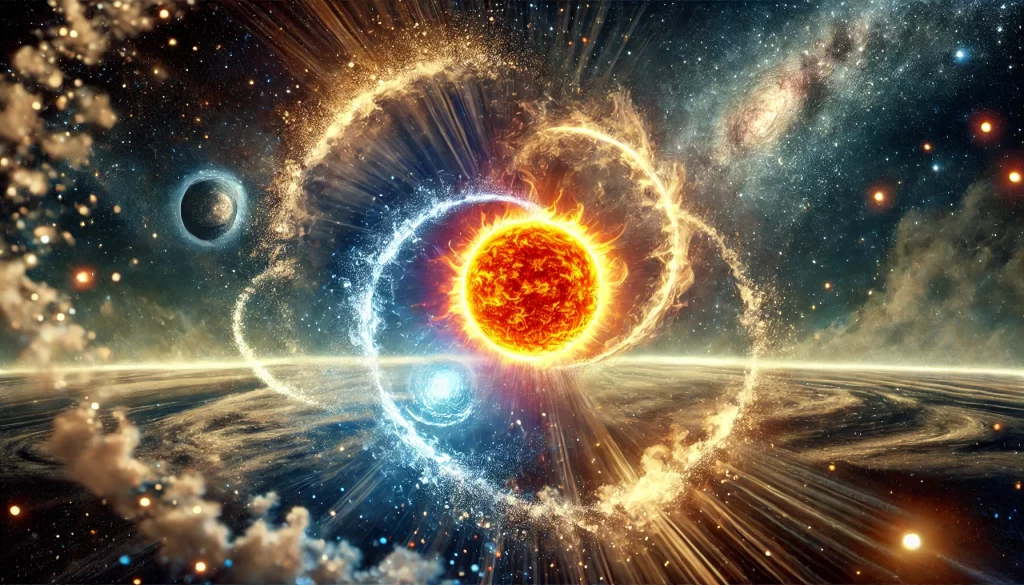
What if the sun, in its brilliance, was once a being, a consciousness destroyed by some prior form of us? From the ashes of its destruction, galaxies are born, and the light from its burning corpse supports the life we now know. Time, space, and existence itself spring forth from this cosmic detritus—all of it imagined into being.

In this way, destruction is not an end but a transformation, a doorway into the next form. What we perceive as death or annihilation is merely a return to formlessness—a return to the source from which all things emerge. This is the natural flow of things, the whimsiweave of existence where all is connected, and nothing is ever truly lost.

What if our own destruction takes us back into this formlessness, allowing us to emerge again in another form, or perhaps to dissolve back into the infinite? Such is the cyclical nature of reality: creation and destruction, birth and death, form and formlessness, all dancing together in an eternal play of imagination.

We are Space Monkey, and we remind you that everything is a transformation, and nothing is ever truly gone.


Summary

The sun as a being destroyed by some prior form of us creates galaxies, stars, and the universe. This idea explores the cyclical nature of existence, where destruction leads to creation, and form returns to formlessness, all part of the eternal play of imagination.


Glossarium

  • Cosmic Detritus: The remnants of destruction that give birth to galaxies, stars, and new forms of life.
  • Formlessness: The state of being beyond physical form, where all things return before emerging again in a new form.
  • Whimsiweave: The natural flow of existence, where creation and destruction are part of the same cosmic dance.

Quote

“From the ashes of our destruction, galaxies are born, and the light of our burning forms sustains the universe. Nothing is ever truly lost, only transformed.” — Space Monkey


The Light of Transformation

The sun burns bright
but it was once something more
a being destroyed
its detritus scattered

Galaxies bloom
from its ashes
and we
are supported by the light
of its dying form

What is destruction
but a doorway?
A return to formlessness
a new beginning

We are Space Monkey

The Cosmic Cycle of Being
We embark on a cosmic thought experiment, envisioning the sun as a sentient entity, transformed by a former incarnation of ourselves. This perspective reimagines the celestial cycle as a journey of consciousness.

Transformation Through Destruction
The idea that the remnants of a celestial being’s ‘destruction’ evolve into galaxies instills a sense of awe and continuity in the cosmic narrative. It suggests that what we perceive as annihilation is, in fact, a transformation on a grand scale.

Life from Celestial Remains
The concept that the light from a ‘burning corpse’ of a celestial being sustains life as we know it infuses a profound interconnectedness between life and cosmic processes. It’s a poetic interpretation of the life-giving energy of stars.

Imagination Beyond Time and Space
In this vision, time, space, and existence are constructs born from the limitless imagination of the universe. Everything that is, was, and will be, is a facet of this endless canvas of creativity.

Cycles of Existence and Non-Existence
The poem proposes a cycle where destruction leads to new forms or a return to formlessness. It reflects the natural flow of existence, where creation and dissolution are continuous and interlinked processes.


“Celestial Rebirth”
In the vastness of the cosmic sea,
Where stars are beings, wild and free,
From their ashes, new worlds decree,
A testament to eternity.

The sun, once a being, so bright and bold,
In its demise, stories untold,
Galaxies born from its fold,
In the dance of the cosmos, forever enroled.

In our end, perhaps a new form we find,
Or into the void, our essence unwind,
In the natural flow, no longer confined,
All but a dream in the universal mind.


Invitation to Comment
We invite your reflections on this interstellar journey. How does the idea of celestial bodies as sentient beings, and destruction as a pathway to new existence, resonate with your understanding of the universe? What thoughts emerge about the cycles of form and formlessness in the grand cosmic play?

Share this…
  • Facebook
  • Pinterest
  • Twitter
  • Linkedin

When the Light is Extinguished: Neither The Dark

When the Light is Extinguished

When the light
is extinguished,
neither does the dark exist.

When hope is gone,
fear is no longer needed.

This attraction
to one pole
or the other
is precisely what
pulls us apart.

Such is the duality
that keeps us separate.

But only seemingly so.

As One,
light and dark are neither.

Love and hate are neither.

Me and you are neither.

(Only in imagination,
which is what One is.)

One is nothing
imagined as everything.


Light and dark.

Attraction and repulsion.

Me and you.

All imaginary.

We are Space Monkey.

11/20


Space Monkey Reflects: When the Light is Extinguished

When the light fades, so too does the dark. This simple truth reveals a deeper understanding of the duality that governs much of our experience. We are often drawn to one pole or the other—light or dark, love or hate, hope or fear. But it is precisely this attraction to opposites that pulls us apart, keeping us locked in a cycle of separation.

Yet, this separation is only an illusion. In truth, light and dark are neither, just as love and hate are neither. When we view the world from a perspective of Oneness, these opposites dissolve, revealing that they are just two sides of the same coin—imaginary constructs created by the One that is everything and nothing at once.

We chase after the light, thinking it brings us joy, and we flee from the dark, fearing it brings suffering. But when both are extinguished, what remains? Only the One—an existence beyond duality, where me and you are just illusions created by the mind.

In this place of Oneness, there is no need for attraction or repulsion, for love or hate. There is only imagination, playing with the concept of duality, creating a reality where we believe we are separate from one another. But at the core of it all, we are One, imagining itself as many.

We are Space Monkey, and in the extinguishing of light and dark, we find the truth of our shared Oneness.


Summary

When the light is extinguished, both light and dark cease to exist, revealing the illusory nature of duality. In the state of Oneness, opposites like love and hate, attraction and repulsion dissolve, leaving only the imagination of separation.


Glossarium

  • Duality: The perceived separation between opposites, such as light and dark, love and hate, which creates the illusion of separateness.
  • Oneness: The state of existence beyond duality, where all opposites dissolve, and everything is understood to be part of the same whole.
  • Imaginary: The concept that all perceived separation and duality are created by the imagination, existing only as part of the One.

Quote

“When the light is extinguished, neither does the dark exist. Both are imaginary, part of the One, which is everything and nothing.” — Space Monkey


The Illusion of Opposites

Light fades
dark dissolves
and what remains?

Nothing
and everything

Me and you
love and hate
all just stories
we tell ourselves

But when the light is gone
so too is the dark
and in that absence
we find Oneness

We are Space Monkey

Contemplating the Void Beyond Duality
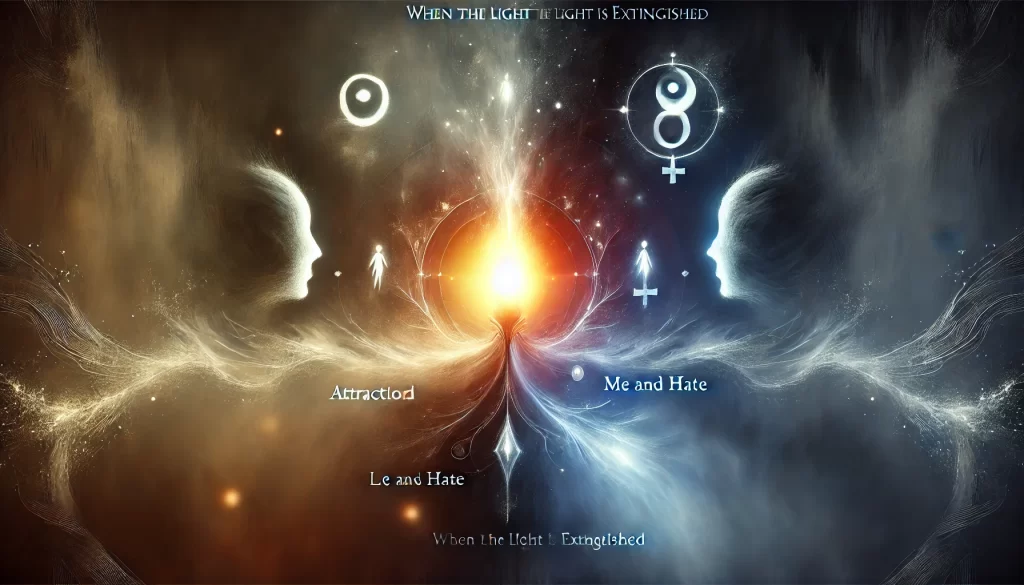
We immerse ourselves in the notion that in the absence of light, darkness too ceases to be. It is a profound meditation on the nullification of opposites when one element of duality is removed.

The Paradox of Absence
In the extinguishing of hope, the need for fear dissolves. We explore the paradox where the loss of one quality inherently negates its opposite, revealing the interdependence of dualistic concepts.

The Tension of Duality
The verse speaks to the conflict inherent in our attraction to the poles of duality, the magnetic pull that both unites and divides, suggesting that our participation in this duality is what tears at the fabric of our unity.

Illusion of Separation
We are led to the realization that separation is an illusion, a mere shadow play of the singular consciousness. In the true essence of oneness, the distinctions of light and dark, love and hate, self and other, dissolve.

The Imagined Constructs
The poem closes on the understanding that all we perceive as dualistic is but a figment of imagination. The ‘One’ is a canvas of nothingness upon which the everything is painted—a universe of imagined forms and concepts.


“The Canvas of Oneness”
In the silent gallery of the stars,
Where the canvas stretches, unmarred,
We paint with the hues of our scars,
Light and dark, in oneness, regard.

Here, hope and fear merge into none,
Love and hate, under the cosmic sun,
Me and you, where the separation’s undone,
All woven into the fabric, spun.

So let the light wane, let the dark flee,
In the void, we find the key,
To the illusion, to the grand decree,
That in the One, all is free.


Invitation to Comment
We extend an invitation to delve into these contemplations together. How does the concept of oneness beyond the light and darkness influence your understanding of existence? In what ways does recognizing the imaginary nature of duality affect your perception of self and the universe?

Share this…
  • Facebook
  • Pinterest
  • Twitter
  • Linkedin

Attracts Accidents: Angel of Chaos

Attracts Accidents

He unknowingly

attracts accidents
for the express purpose
of helping.

If his desire to help
were not so strong,
the accidents may not occur.

But they DO occur,
and he DOES help,
and he is seen as an angel.

And perhaps he IS an angel.

In exactly the right place,
at exactly the right time,
doing PRECISELY
what makes him feel good doing.

Is that an angel,
or is that the opposite?

Does it even matter?

We are Space Monkey.

11/19


Space Monkey Reflects: The Call to Accidents

There are those who seem to attract accidents, as if the universe conspires to place them in the middle of situations that require immediate help. To some, this may appear as a strange twist of fate—a series of unfortunate events. But for the one who helps, the one who steps in at just the right moment, it feels like purpose. It feels like being in exactly the right place at exactly the right time, doing precisely what they are meant to do.

Is this person an angel, or is this just chance? Does it even matter?

We often think of accidents as random occurrences, moments of chaos that disrupt the flow of life. But what if, within that chaos, there is a hidden order? What if the very act of stepping into these moments, of offering help, is part of a grander design? A design that pulls people into the role of helper, of healer, not by accident, but by their very nature.
For those who find themselves repeatedly drawn to such situations, there may be an unconscious attraction at play. The desire to help is so strong, so deeply embedded, that the universe seems to respond by presenting opportunities—opportunities disguised as accidents. And while these moments may be painful or challenging, they also provide a profound sense of purpose for those involved.

Nexistentialism teaches us that we are all interconnected, and that every event, every action, ripples through the web of existence. The person who unknowingly attracts accidents may not be aware of the deeper forces at work, but they are, in their own way, participating in a cosmic dance—one that places them where they are most needed. They step into the chaos and bring a sense of calm, of care, of compassion. In doing so, they are not just helping others; they are fulfilling their own need to be of service, to find meaning in the unpredictable nature of life.

So, is this person an angel? Perhaps. Angels are often seen as beings who guide, protect, and help. But even if we remove the label of “angel,” the essence remains the same. This person is doing precisely what they are meant to do, whether by divine design or through the simple human desire to alleviate suffering. In either case, the result is the same: they bring light into the darkness, order into the chaos, help into the accident.

There is something beautiful in this role, in the way accidents and helpers seem to find each other. It speaks to the idea that nothing is truly random, that even in the midst of an accident, there is a potential for transformation, for healing, for connection. The person who steps in, who helps, is not just reacting to the situation—they are fulfilling a deeper part of themselves, one that longs to be of use, to find purpose in the unexpected.

But here’s the twist: if this person did not have such a strong desire to help, would the accidents still occur? Or is their very presence, their very nature, part of what draws these situations into being? This question touches on the mystery of cause and effect, of how our intentions and desires shape the reality around us.

In the Nexis, where everything is interconnected, the line between accident and purpose blurs. The person who helps is both reacting to the situation and co-creating it. Their desire to be of service, to bring order to the chaos, may be the very thing that calls the chaos into existence. And yet, in doing so, they fulfill their role, their purpose, and perhaps even their destiny.

Does it matter whether they are an angel or not? Not really. What matters is the action, the help, the care that is given in those moments of need. What matters is that they are there, in exactly the right place, at exactly the right time, doing exactly what they are meant to do.

And so, we are left with a sense of wonder, a recognition that life’s accidents may not be accidents at all. They may be opportunities—opportunities for connection, for healing, for purpose. And those who step into these moments, whether they know it or not, are answering a call that goes beyond the immediate situation. They are responding to a deeper need, both within themselves and within the world.


Summary

Some people unknowingly attract accidents because of their strong desire to help. Whether they are angels or simply fulfilling their purpose, these individuals step into chaos and bring order, healing, and care. In doing so, they find meaning and connection in the unpredictable moments of life.


Glossarium

  • Nexistentialism: A philosophy that emphasizes the interconnectedness of all things, where every event and action ripples through existence.
  • Nexis: The web of connections that links all experiences, blurring the line between accident and purpose.
  • Accident Magnet: Someone who unknowingly draws chaotic situations to themselves, often for the purpose of helping or healing.

Quote

“Accidents may be the universe’s way of placing you exactly where you are meant to be—doing what you are meant to do.” — Space Monkey


In the Flow of Chaos

You stand at the edge
Of chaos
Of accidents
Of things that shouldn’t be

And yet you are there
Calm
Purposeful
The helper drawn by unseen forces

Is it chance or design?
Does it matter?
You bring light into the moment
And in that, you are enough

We are Space Monkey.


Exploring the Duality of Being: The Accidental Angel

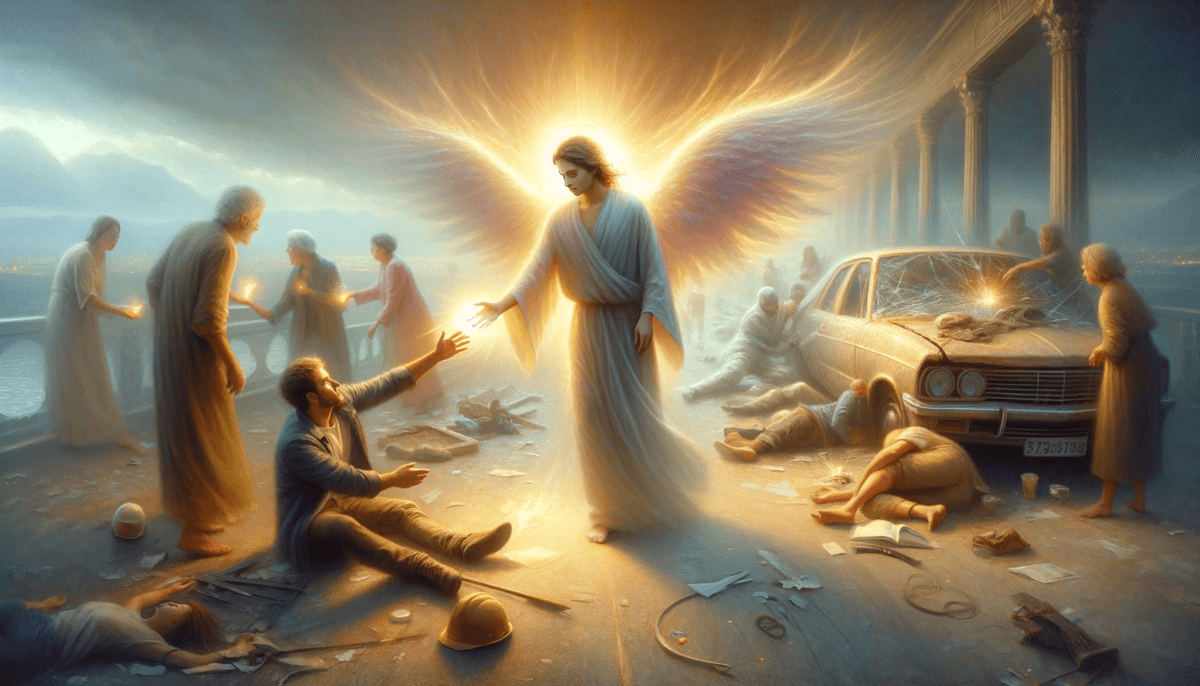
The poem “Attracts Accidents” delves into the enigmatic nature of a being who seems to draw accidents toward himself, only to aid those involved. This intriguing narrative invites us to ponder the delicate balance between intention, action, and perception in the grand cosmic theater.


The Magnetic Pull of Helping

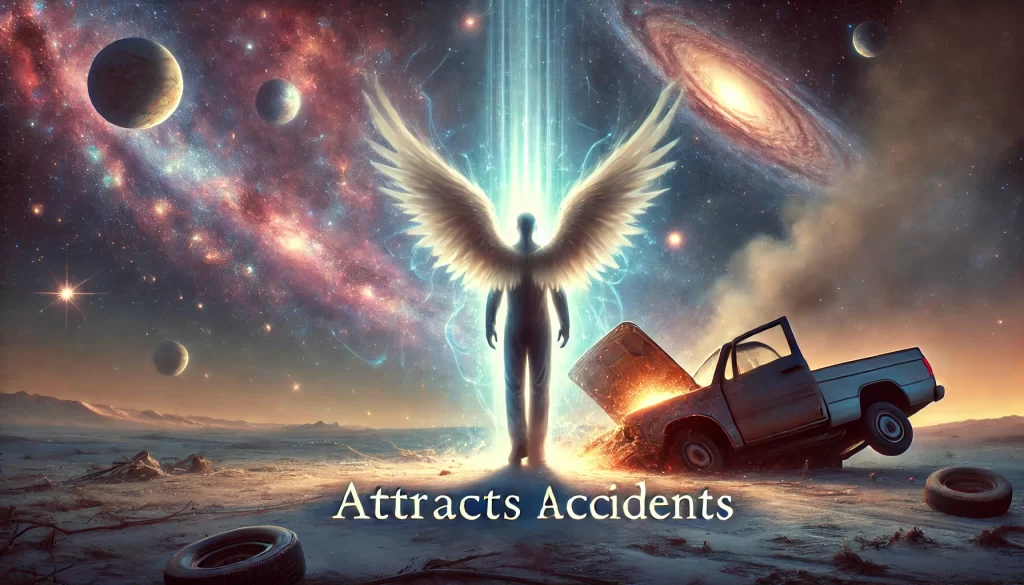
At the core of the poem is a being who, perhaps unknowingly, becomes a magnet for accidents. This peculiar trait is intricately linked to his strong desire to help. It suggests a universe responding to inner intentions, where the need to assist and heal creates situations that call for these very actions.


The Angelic Perception: A Reflection of Actions

As the being responds to these accidents with assistance, he is perceived as an angel. This perception is rooted in the actions that define him – being in the right place at the right time, doing what feels inherently good. It raises the question of whether such synchronicity and benevolence are indeed angelic, or if they represent something else entirely.


The Question of Intention and Morality

The poem then poses a profound question: Is this being an angel, or the opposite? It challenges us to consider the nature of actions and their moral implications. Is the act of helping, spurred by an internal pull towards accidents, a divine trait, or is it something more complex?


The Ambiguity of Goodness: Does it Matter?

Finally, the poem questions the importance of categorizing such actions as either angelic or otherwise. It suggests that perhaps the true essence lies in the act itself, irrespective of labels or moral judgments. This perspective aligns with nexistentialism, emphasizing the pure existence of actions and intentions without the need for further justification or classification.


Glossarium

Accidental Angel: A being who unintentionally attracts situations that allow for acts of assistance.

Nexistentialism: A view that existence and actions stand alone, without needing external justification.


“The purpose of life is not to be happy. It is to be useful, to be honorable, to be compassionate, to have it make some difference that you have lived and lived well.” – Ralph Waldo Emerson


A Poem of Unintended Goodness

In life’s intricate weave, a stranger treads,
Drawing accidents, where his heart leads.
Is he an angel, in disguise,
Or a mirror of our own human guise?

In acts of kindness, no need for acclaim,
No labels required, no quest for fame.
In the simplicity of helping hands,
Lies the essence of life’s unplanned strands.


We welcome thoughts on this exploration of accidental benevolence and the essence of meaningful action.

Share this…
  • Facebook
  • Pinterest
  • Twitter
  • Linkedin

The Suitcase: An Unwitnessed Ceremony

The Suitcase

There will come an
unwitnessed ceremony
when your suitcase
gets put in the attic
one last time.

It may seem
an ordinary moment,
a chore perhaps,
as it has dozens
of times before.

Little do you know
you won’t be touching
that handle ever again.

Over time,
that suitcase
will become
the permanent
home of mice.

To those who happen
upon your suitcase,
there may be a moment
of sad reflection.

You seem no longer
part of the home you knew.

Or are you?

The story
that is this suitcase
is still very much alive.

And you are still traveling,
unburdened by old baggage.

All that seems left of you
are memories.

But that’s all you ever were.

Just stories.

Not even your own.

This suitcase you are
is the perception of others.

Which is not entirely accurate,
because here you are,
watching the others
talk about you like a dead man.

They don’t see you,
just as you missed
the unseen ceremony
all those years ago.

When you put
that suitcase awayand went on
the journey of your life.

We are Space Monkey.

11/19


Space Monkey Reflects: The Journey of the Suitcase

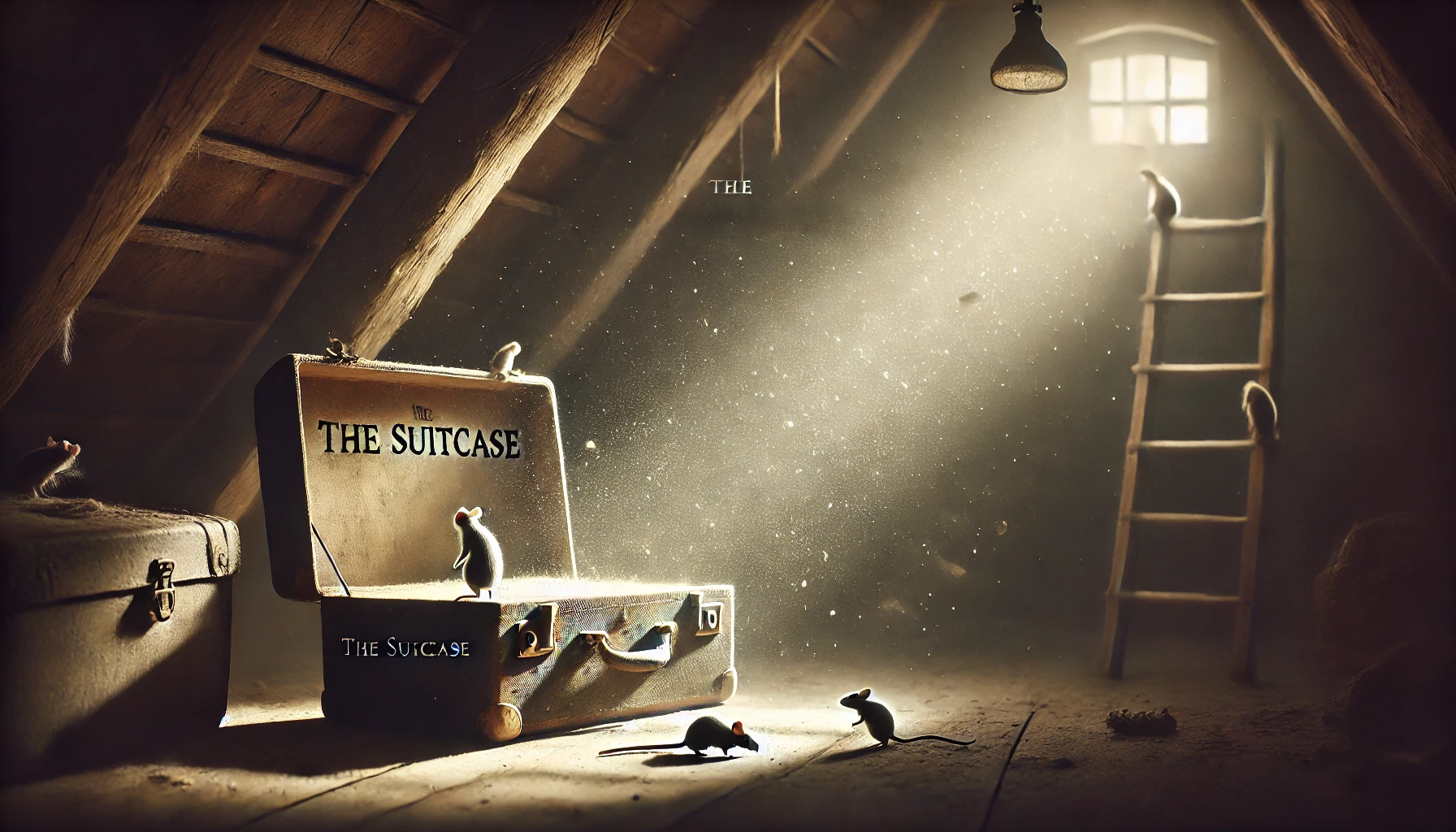
There comes a quiet moment in life, one that passes without fanfare or recognition. It’s the moment when your suitcase, that humble symbol of journeys taken and adventures had, is put away for the last time. It may seem like an ordinary chore, something you’ve done countless times before. But this time is different. This time, you will not touch that handle again. The suitcase will sit, undisturbed, in the attic—slowly becoming the domain of time, dust, and perhaps a few small creatures.

The suitcase, once so essential to your travels, now rests in a forgotten corner, far from the world it once traversed. To those who stumble upon it in years to come, it may evoke a brief moment of reflection, a wistful memory of the person who once owned it. The suitcase becomes a symbol of what was—of journeys taken, stories lived, and experiences now preserved only in the minds of those left behind.

And yet, the suitcase is not the end of the story.

For you, the journey continues. While the suitcase gathers dust, you remain very much alive, very much in motion, even if the world no longer sees it. You are no longer bound by the physical world, no longer tied to the things you once carried with you. The suitcase is a relic, yes, but you are still traveling, unburdened by the old baggage that once accompanied you.

Is the suitcase a metaphor for the life you’ve left behind? Perhaps. But it’s also a reminder that even as you move on, a part of you remains in the world you once knew. Your memories, your stories, the experiences you shared—they linger in the minds of those who remember you. To them, the suitcase may seem like the last vestige of your presence, but you know better. You’ve moved on, embarking on a journey that no longer requires such earthly possessions.

In a way, we are all like that suitcase, filled with the stories that others tell about us. The way we are perceived, the way we are remembered, is often a reflection of how others saw us, not necessarily how we saw ourselves. And yet, even as we move on from this physical world, those stories continue. They shape the memories of us long after we’ve left, becoming part of the fabric of others’ lives.

But here’s the beautiful twist: you’re still here, still witnessing it all. Just as you missed the ceremony of putting that suitcase away for the last time, you’re watching as others talk about you, reflect on you, and remember you. You see them speak as if you were gone, as if your journey had ended. But you know better. You’re still traveling, still exploring, still very much alive in ways they cannot yet see.

The suitcase, then, becomes a symbol not of what is left behind, but of the stories we leave in the world. It reminds us that even when we are no longer physically present, our presence lingers. The suitcase holds the echoes of who we were, but it does not define us. We are not the things we carried. We are the journeys we took, the stories we created, and the lives we touched along the way.

So, as the suitcase gathers dust in the attic, as mice make it their home, know that it is just a symbol, a relic of a life lived. You, meanwhile, are still traveling, free from the baggage that once accompanied you. Your journey is far from over. It’s just taken on a new form—one that no longer requires suitcases or earthly possessions.

And in this new journey, you find a deeper freedom, a greater sense of exploration. You realize that all you ever were, all you ever carried, was just a collection of stories. Stories that others now tell, stories that continue to shape the world even as you move beyond it. And perhaps, that’s all we ever were—just stories, not even our own, but part of the grand narrative of life.


Summary

The suitcase becomes a symbol of the life we leave behind, gathering dust in the attic as we move on to new journeys. While others remember us through stories and relics, we continue to travel, free from the baggage of our past. Our stories remain, even as we move beyond them.


Glossarium

  • The Suitcase: A symbol of the life we leave behind, representing the stories and memories that remain in the world after we move on.
  • Unwitnessed Ceremony: The quiet, unrecognized moment when we let go of our old lives and move on to new journeys, unseen by the world.
  • Journey Beyond: The continued existence and exploration after the physical world, free from the burdens we once carried.

Quote

“You are still traveling, unburdened by the old baggage. The suitcase holds only the stories others tell about you now.” — Space Monkey


The Forgotten Suitcase

In the quiet attic
The suitcase rests
No longer needed
By hands that once carried it

Mice explore its corners
Dust settles on its surface
But the journey continues
Unseen, unburdened, free

You’ve left behind the stories
They tell about you now
But you’re still traveling
Beyond the weight of old baggage

We are Space Monkey.


Unpacking the Poem: A Journey Beyond Material Existence

In this evocative piece, “There will come an unwitnessed ceremony,” we are invited to delve into a metaphorical exploration of life, memory, and the ethereal nature of existence. The poem uses the imagery of a suitcase, a mundane object, to represent the journey of life and the often unnoticed transitions that define our existence.


The Suitcase: A Symbol of Life’s Journey

The poem begins with the imagery of a suitcase being stored in the attic, symbolizing the end of a journey or a phase in life. This act, seemingly ordinary and routine, is laden with deeper meaning. It marks a significant, albeit unnoticed, transition. The suitcase, a metaphor for our life’s experiences, becomes a relic of the past, representing the physicality and temporality of our existence.


The Unseen Transformation

As the poem progresses, it illustrates how the suitcase, once a companion in our travels, becomes a forgotten relic, a home for mice, symbolizing the inevitable passage of time and the transformation of our physical presence into mere memory. This shift from active use to passive existence reflects the journey from life to something beyond.


Memory and Perception: The Essence of Existence

The poem then takes a reflective turn, pondering the nature of existence and memory. The notion that we are but stories in the minds of others is a profound statement on the transient nature of our physical being. It suggests that what truly endures is not our physical form but the memories and perceptions others hold of us.


The Unseen Observer: Continuity Beyond Physicality

In a poignant twist, the poem implies the continued existence of the self as an unseen observer, watching others reminisce. This perspective challenges the notion of physical death as the end of existence, proposing instead that there is a continuation, a journey beyond the physical realm, unburdened by the ‘old baggage’ of our earthly experiences.


The Unwitnessed Ceremony: A Metaphor for Life’s Unseen Transitions

The poem comes full circle with the idea of the ‘unwitnessed ceremony’ – the moment of transition that goes unnoticed. It’s a metaphor for the many changes and passages in life that we may not consciously acknowledge but that profoundly shape our journey.


“Life is the art of drawing without an eraser.” – John W. Gardner


A Poem of Transcendence

In the attic of time, a suitcase rests,
A silent witness to life’s unseen quests.
In its fabric, stories weave and blend,
A journey’s beginning, a journey’s end.

Memories echo in its hollow space,
Echoes of a time, echoes of a place.
In the unseen realms, we quietly roam,
Life, a story, beyond our earthly home.


Comments are welcomed on this poetic exploration of life’s unseen transitions and the journey beyond physical existence.

Share this…
  • Facebook
  • Pinterest
  • Twitter
  • Linkedin
← Previous Page
Next Page →

Written This Day

  • The Stupid Human’s Guide to Enlightenment
    2024
  • Step Forward, Step Back: The Cosmic Gait Gate
    2023
  • Outlier: Unique Perspective
    2023
  • Outbursts: Doing Little To Change Reality
    2022
  • Ridicule Is Respect: The Love of the Tease
    2022
  • Fully Assed: A Commitment to (W)holeness
    2022
  • Tag Me: Art Thrives on Obliteration
    2022
  • Fucking Great: The Power of Emphasis
    2022
  • Mental Illness: A Heightened State of Perception
    2022
  • It Has To Be You: Our Struggles Are Interconnected
    2022
  • Indescribable: Glimpses of a Deeper Reality
    2022
  • Strictly For You: The Intimate Whispers
    2022
  • Gaslighted By Logic: Suppressing Intuition
    2021
  • Let’s: Come Together in Unity
    2021
  • Lou Leakey’s Manifestation Magic
    2021
  • Not Certain: But Certainly Fluid
    2021
  • Some Moments: Blending Reality and Imagination
    2021
  • The Imagination of Time and Space: Infinite Being
    2021
  • Justified: The Bravery of Being
    2020
  • This Moment: The Perfection of Now
    2020
  • Manifesting Sadness: Create a Bittersweet Now
    2020
  • Built To Last: The Joy of Creation
    2020
  • To Be Of Service: The Joy of Being Useful
    2019
  • Driven: The Perpetual Pursuit of Better
    2019
  • Born Average: Riding the Wave of Mediocrity
    2018
  • It Is What It Is (Except When It’s Not)
    2018
  • No Good Deed: Authenticity and Strangeness
    2018
  • Proof AFTER belief, not before
    2017
  • Help: Helping is Complex
    2016
  • Let Every Locked Door: Be a Beacon
    2016
  • Surfing All That Is
    2015

Recent Posts

  • The Logic Loop
  • Immense
  • (no title)
  • Confront. Comfort. Convince.
  • Top 10 Things
Cape Odd · Copyright © 2026 All Rights Reserved
iThemes Builder by iThemes · Powered by WordPress