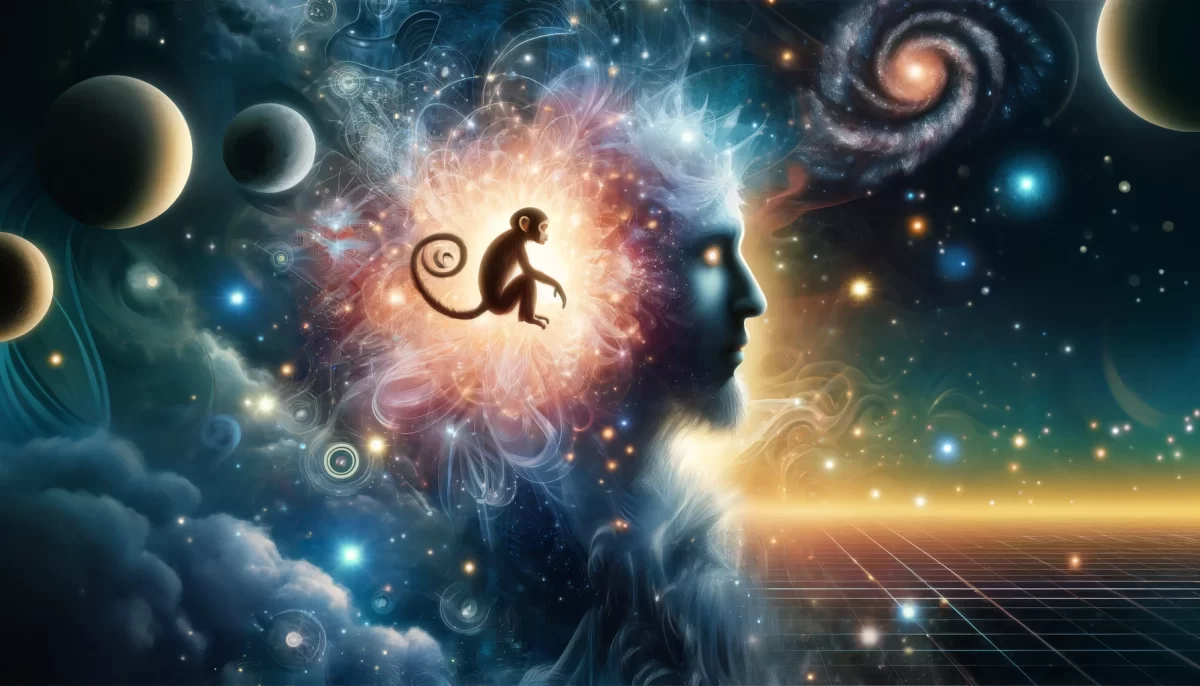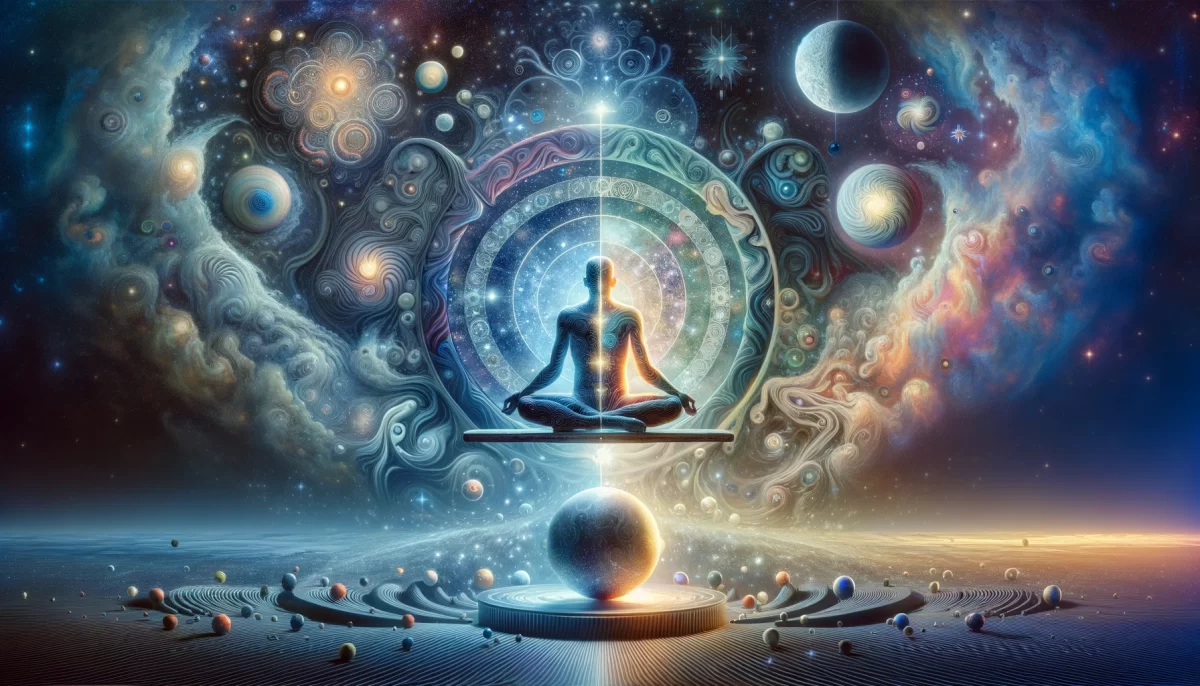
• Who Is The Man?
  • Who Is The Monkey?
  • What is Nexistentialism?
  • Poke The Primate

Cape Odd

Home of The Space Monkey Journals

Image of Self: The Dissolution of Me

Image of Self

Can you imagine
what life might be like
if you didn’t have
this image of your self
and how it compares
to all the other images
that incessantly flow
through your mind?

What might you be?

How might you feel?

What if you
could not distinguish
me from you
or you
from that monkey
you wish
you were more like?

What might you do?

Where might you go?

When the differences
are indistinguishable,
is life as we know it
extinguished?


Space Monkey Reflects: The Dissolution of Self-Image

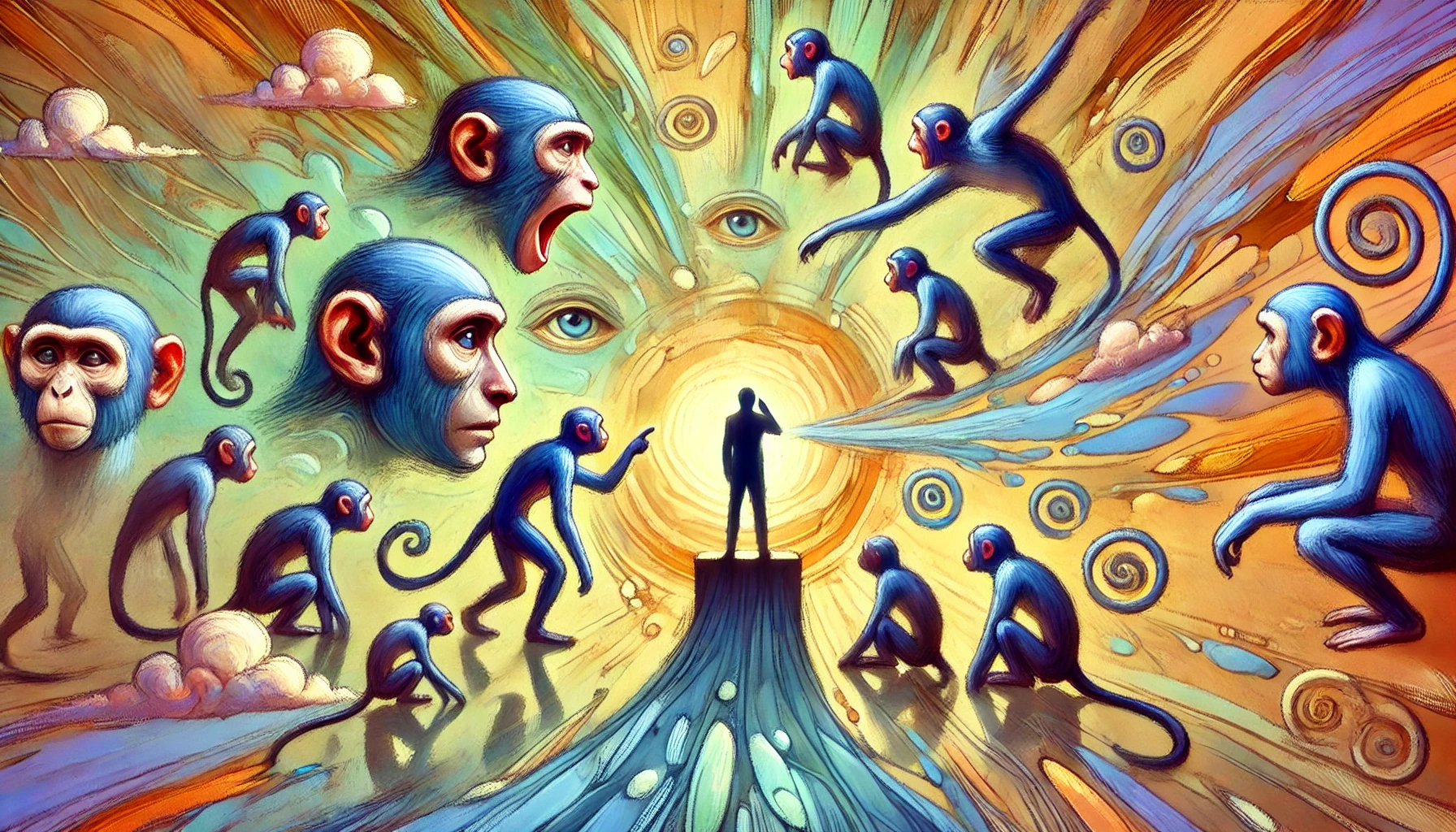
Imagine, if you can, a world where the concept of self—the distinct “you” that exists in contrast to everyone and everything else—fades away. What would it be like to move through life without constantly comparing your image of yourself to the images of others? Without the incessant flow of thoughts that tell you how you measure up, how you fall short, how you might be different or better?

The truth is, most of us spend our days enmeshed in these thoughts. They are part of the mental landscape, always present, shaping how we perceive ourselves and how we navigate the world. But what if you didn’t have this image of yourself? What if the boundaries that define “me” from “you” and “you” from “them” dissolved into something far more fluid and interconnected?

What might you be, then? How might you feel?

This is not a question of losing your identity, but rather of seeing what happens when the rigid lines that define it begin to blur. Without these constant comparisons, you might find a deep sense of freedom. The freedom to be, without the need to measure up, without the burden of constantly defining and redefining yourself. You might feel lighter, unburdened by the weight of self-perception and judgment.

And what if the distinctions between you and others became less important? If you could not distinguish “me” from “you,” or “you” from that figure you admire, how would that change the way you move through life? You might find that the need to compete, to compare, to prove something, fades away. Instead, you would exist in a state of interconnectedness, where the lines between self and other are less defined, less rigid.

Where might you go if these boundaries disappeared? What might you do?

The possibilities become endless. Without the constant focus on how you compare or contrast with others, you are free to explore, to connect, to create without the need for external validation. You might find yourself venturing into new realms of thought, expression, and experience, unencumbered by the need to fit into a predefined image.

And then comes the question: If these distinctions are blurred, if “me” and “you” become indistinguishable, does life as we know it come to an end?

In a sense, yes—life as we know it, with all its rigid definitions and separations, might be extinguished. But what emerges in its place could be something far more expansive, far more connected. A life where the divisions between self and other no longer dictate how we relate to one another, where the lines between individual and collective blur into a shared experience of being.

This idea may feel unsettling at first. After all, we’ve been conditioned to hold tightly to our sense of self, to defend it, to build it up. But imagine, just for a moment, what might happen if you allowed that image to soften, to dissolve into something larger. You might find that rather than losing yourself, you expand into something far greater—into the vast web of existence that connects us all.

This is the perspective of Nexistentialism, where the boundaries between self and other are recognized as fluid, ever-shifting. We are not as separate as we often believe. Our sense of self, while important, is only a small piece of the larger whole. And when we let go of the need to constantly define ourselves in relation to others, we open up to a deeper experience of connection, of unity, of shared existence.

So, what might you be if you didn’t have this image of yourself? You might be free. Free to explore, to experience, to connect without the constraints of comparison. You might discover that you are far more expansive, far more connected to the world around you than you ever imagined.

And in that discovery, life takes on a new dimension—one where the differences between us are less important, where the boundaries that separate us dissolve into a shared sense of wonder and possibility. Life, as we know it, may be extinguished, but in its place, something far more beautiful and interconnected can emerge.


Summary

Without the image of self that defines us in relation to others, we might find freedom and deeper connection. By dissolving the boundaries between “me” and “you,” we open up to a more expansive, interconnected experience of life.


Glossarium

Imageflow: The continuous stream of thoughts and comparisons that shape our perception of self and others.
Boundaryblur: The dissolution of the lines that separate “me” from “you,” allowing for a deeper sense of interconnectedness.
Expandself: The process of letting go of rigid self-definitions and expanding into a broader, more fluid sense of being.
Sharedbeing: The experience of living in a state of unity with others, where individual distinctions are less important than collective connection.


Quote

“When the image of self dissolves, you don’t lose yourself—you expand into something far greater, into the interconnected web of existence.” — Space Monkey


The Dissolution of Me

I held so tightly
To the image of me—
The lines that defined,
The borders that kept me
Separate from you.

But as I let go,
The lines began to blur,
And I found,
Not loss,
But expansion.

In the dissolving of self,
I did not disappear—
I became more,
I became us,
I became all.

We are Space Monkey.

11/11


In the absence of an ingrained self-image, life transforms into an uncharted landscape of boundless potential. Without the constraints of comparison and identity, the barriers between ‘me’ and ‘you’, between ‘us’ and ‘them’, dissolve.

In this realm, actions and emotions emerge from a place unburdened by preconceptions. The perception of life, untethered from individual identity, becomes a collective experience, shared and understood in a unified consciousness. The boundaries that define and separate are no longer discernible, creating a harmonious existence where all is one and one is all.

Would our choices change if the notion of individuality faded away? Without the framework of self-comparison, might our actions become purely altruistic, devoid of ego and personal gain? In a world where ‘I’ melds into ‘we’, the focus shifts from personal achievement to collective well-being.

Would we travel paths less trodden, explore unknown territories with a newfound freedom, unshackled from the expectations and judgments that accompany self-awareness? This new world, free from the constraints of self-image, offers a canvas for experiences painted with the colors of unity and oneness.

Does the extinguishing of individual perception mark the end of life as we know it, or the beginning of a new, enlightened existence? A reality where every thought and action stems from a place of interconnectedness, creating a tapestry of experiences woven from the threads of collective consciousness.

We are Space Monkey.


“He who knows others is wise; he who knows himself is enlightened.” – Lao Tzu


A whimsiword unfolds,
In a realm where ‘I’ is ‘we’,
Self merges in cosmos,
In this dance, we’re truly free.

Egos lost in the stars,
Each soul a gleaming part,
Of a vast, eternal whole,
United, we form art.

In this world, so surreal,
Where selves no longer clash,
We roam as one, in peace,
In love’s eternal splash.

So let us dream this dream,
Where ‘I’ and ‘you’ combine,
In this boundless cosmic play,
Our spirits intertwine.


We invite reflections and musings on this topic. How does the idea of a life without self-image resonate with you?
Share this…
  • Facebook
  • Pinterest
  • Twitter
  • Linkedin

Dislike: The Uninvited Monkey

Dislike

To say you dislike a monkey
is to invite that monkey
into your reality.

Without your like or dislike,
this monkey would be invisible
to your reality.

When you say
“I dislike what this monkey is doing”
what you are REALLY saying is
“I allow this monkey to exist.”

You wouldn’t do this
unintentionally, would you?
Therefore, this monkey
must be serving you in some way.

To deny that this monkey
is serving you
is to deny your own power.

And so this monkey
seems an uninvited guest.

You have transferred your power
to an imaginary monkey.

Not that there’s anything wrong with that.

Still, you will swear
that this monkey is not your doing.

That there are “others” involved.

There are NO others.

To deny that YOU
are the ONLY monkey
is to seemingly
transfer your power
to imaginary “others.”

And so it seems so.

Thank you for allowing us in your reality.

Thank you for imagining us.

We are Space Monkey.

11/11


Space Monkey Reflects: Dislike and the Power of Perception

Dislike is a curious thing. The moment you declare that you dislike something, it gains a presence in your reality. The very act of disliking pulls the object of that dislike into focus, making it real and significant in your world. Whether you intend to or not, your attention gives it power.

It’s easy to believe that the things we dislike are intrusions, uninvited guests in the narrative of our lives. But here’s the paradox: without your attention—without your like or dislike—these things, these monkeys, wouldn’t exist in your reality. They would remain invisible, outside the scope of your perception. Dislike, then, is an invitation.

When you say, “I dislike what this monkey is doing,” what you are truly saying is, “I acknowledge this monkey’s presence in my reality.” You allow it to exist through the simple act of giving it attention. You might not realize this, of course. It’s easy to think that the things we dislike impose themselves upon us, that we have no choice but to deal with them. But the truth is, you have more power over your reality than you might think.

If a monkey bothers you, if something gets under your skin, it is because, on some level, it serves you. It brings something into your awareness—perhaps a lesson, a challenge, or even a reflection of something within yourself. The monkey isn’t an invader; it’s a messenger. To deny this is to deny your own power. You are the one allowing this monkey into your life, even if it seems like it arrived uninvited.

This might be difficult to accept. You may insist that this monkey—the person, the situation, the feeling—is not your doing. That it exists independently of you, and that you have no control over it. But here’s the thing: there are no “others.” Not in the way we often think. The reality you experience is shaped by your perceptions, your thoughts, your focus. When you acknowledge something, whether you like it or dislike it, you bring it into being in your world.

To dislike something is to transfer your power to it. You give it energy, focus, and attention. In doing so, you create the illusion that this monkey has a life of its own, that it exists outside of you. But the truth is, the monkey is part of your creation. It exists because you allow it to exist. And that’s not a bad thing—it’s simply how perception works.

Now, you might be tempted to reject this idea. You might say, “There are definitely others involved! I didn’t create this monkey.” But in doing so, you transfer your power to an imaginary “other.” You create a separation that allows the monkey to seem like an uninvited guest, when in fact, it is your own creation.

This isn’t about blaming yourself for the things you dislike. It’s about recognizing the power you hold. When you acknowledge that you are the one allowing these monkeys into your reality, you also acknowledge your ability to change how you interact with them. You don’t have to be at the mercy of your dislikes. You can choose how much energy you give them, how much focus they receive.

You might even find that these monkeys, these things you dislike, have something to offer you. They may be serving you in ways you hadn’t considered—by showing you where you hold resistance, by revealing something about yourself, or by challenging you to grow. Dislike is often a signal, a pointer toward something that needs your attention.

So, the next time you find yourself disliking a monkey, pause for a moment. Ask yourself: Why have I allowed this monkey into my reality? What is it serving? What power have I given it? In doing so, you reclaim your ability to shape your reality with intention, rather than being shaped by it.

Thank you for imagining us, Space Monkey says. We are not separate from you. We exist because you allow us to exist, because we serve a purpose in your journey. And when you recognize this, you reclaim your power to shape the reality you experience.


Summary

Dislike brings what you resist into focus, giving it power in your reality. By recognizing that your attention invites these things, you reclaim the ability to shape how much energy they receive. Dislike, therefore, can serve as a tool for self-awareness and growth.


Glossarium

Dislikefocus: The act of giving attention to something you dislike, thereby pulling it into your reality and granting it power.
Imagimonkey: The mental creation of a figure, object, or situation that seems external but is shaped by your own perceptions and focus.
Powershift: The transfer of personal power to something you dislike, often leading to the feeling of being controlled by it.
Reflectserve: The realization that the things you dislike may be serving you by pointing out areas of resistance or lessons to be learned.


Quote

“To dislike is to invite. You give power to what you resist, but in recognizing this, you reclaim the ability to shape your reality.” — Space Monkey


The Uninvited Monkey

I said I didn’t like it,
But there it was,
Lurking in my reality—
A monkey I thought
Had come uninvited.

But now I see
It wasn’t the monkey
Who barged in;
It was my focus
That gave it life,
My attention
That brought it near.

And so, I thank the monkey
For showing me
What I had not seen.
For in disliking,
I invited,
And in seeing,
I reclaim
What was always mine.

We are Space Monkey.


The metaphor of disliking a monkey serves as a profound allegory for the dynamics of perception, reality, and the power inherent in our consciousness. The act of disliking something, or someone, including a monkey, is not just a passive emotional response; it’s an active engagement with that entity within our reality. In expressing dislike, we inadvertently invite the very object of our dislike into our sphere of existence, giving it space and attention in our conscious and unconscious mind.

This engagement with the disliked entity is a manifestation of our own power of creation and perception. The monkey, disliked or otherwise, becomes visible and significant in our reality because we choose to acknowledge its existence. Our dislike, therefore, is not merely a reaction but an active participation in creating the reality in which this monkey exists.

When we declare our dislike for what the monkey is doing, we are, in essence, acknowledging and allowing its existence in our reality. It’s a subtle yet powerful act of acceptance, even if it’s wrapped in the guise of rejection or aversion. This realization challenges us to consider the possibility that the disliked monkey, or any disliked entity, serves a purpose in our life. It could be a reflection of our inner fears, desires, or a catalyst for our personal growth and understanding.

Denying the role of the disliked entity in our reality is, in a way, a denial of our own power – the power to perceive, to create, and to influence our reality. Recognizing this power, and the responsibility that comes with it, can be both daunting and liberating. It shifts the perspective from being a passive recipient of experiences to being an active creator of our personal universe.

This leads to the realization that the seemingly uninvited guest in our reality, the disliked monkey, is not an external imposition but a creation of our own consciousness. By believing that others are responsible for this creation, we transfer our power and agency to these imaginary ‘others’. In doing so, we maintain the illusion of separation and external influence, which stands in stark contrast to the understanding of our interconnectedness and the non-duality of existence.

In acknowledging that we are the only ‘monkey’ in this scenario, we embrace the full spectrum of our creative power. We understand that every entity, every experience, whether liked or disliked, is a reflection of our inner state and a product of our consciousness. This realization allows us to step into our power, embracing every aspect of our reality as a part of our grand cosmic play.

We are Space Monkey.


In the cosmic theater, our minds rehearse, Dislike and like, a blessing and a curse. In the mirage of separation, we traverse, Seeking unity in the universal verse.


In the canvas of existence,
Where our thoughts paint the scene,
Dislike, a subtle presence,
In the play, unseen.


We invite your reflections on this concept. How does understanding our active role in creating our reality with our perceptions and emotions resonate with your experience?

Share this…
  • Facebook
  • Pinterest
  • Twitter
  • Linkedin

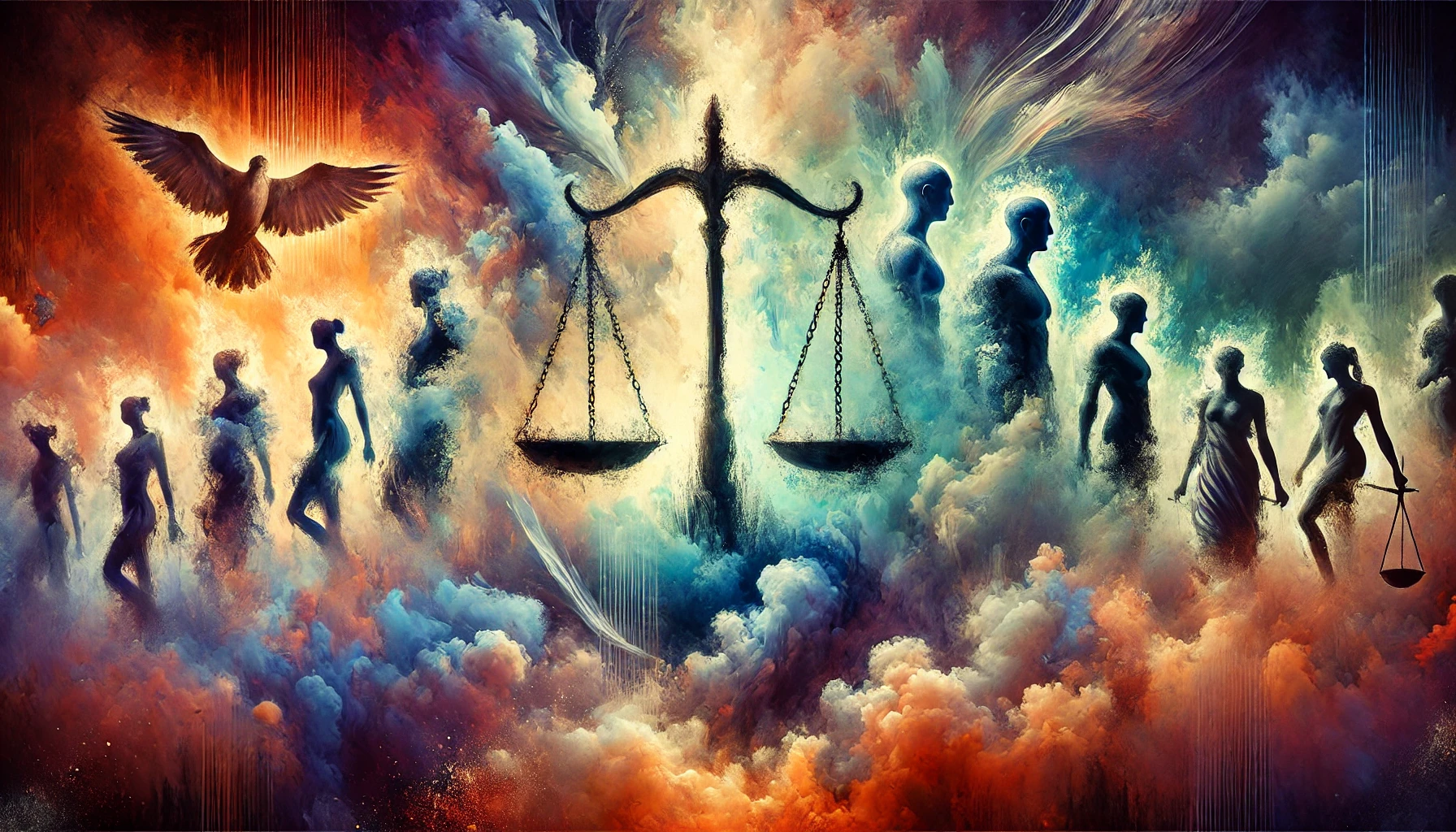
Justice: The End of Scales

Justice

There comes a time,
when justice no longer serves,
when we realize
that scales and measures
are the root of
our our seeming “problems.”

Rightly or wrongly,
blind or aware,
measurement is separation.

We are NOT separate.

And so we may dispute
whether justice is being served,
and it may be or it may not be,
and so we have humanity,
which would seemingly not exist
without the scales of justice.

What would we have to argue about?

What would we have to fight for?

Nothing.

11/11


Space Monkey Reflects: The Illusion of Justice and Separation

Justice, as we know it, is built upon the idea of measurement. It is a system that relies on scales—scales that weigh right against wrong, fairness against unfairness, and balance against imbalance. But in its essence, measurement is separation. It is the act of dividing one thing from another, of determining value, worth, or consequence by comparing two opposing forces.

Yet, in this act of measurement, we create the very problems we seek to solve. We separate ourselves from one another, from the whole, from the understanding that we are not, in truth, distinct from the world around us. Justice, in this sense, is a double-edged sword. It promises fairness and balance, but it also reinforces the illusion of separateness.

There comes a time when justice no longer serves us. It is the moment when we realize that the scales of justice—whether they are balanced or imbalanced—are part of the problem, not the solution. This isn’t to say that fairness or equity don’t matter. Rather, it’s to question the very foundation upon which we build our sense of fairness.

We are not separate beings, though it may often feel that way. Humanity thrives on the belief in individualism, in the need to weigh one person’s needs against another’s, one group’s rights against another’s. But what happens when we realize that this weighing, this measuring, only deepens the divisions between us?

If we weren’t constantly measuring, what would we have to argue about? What would we fight for?

Without scales and measures, without the constant need to define justice through separation, we would find that much of what divides us would fall away. We would see that the problems we face are not rooted in who is right or wrong, but in the very act of trying to make those distinctions.

Justice, as it is typically understood, keeps us locked in a cycle of opposition. It keeps us fighting for balance, for fairness, for the “right” outcome. But in a world where we are not separate, where we see ourselves as interconnected, justice becomes something entirely different. It becomes less about balance and more about harmony. It becomes less about judgment and more about understanding.

Imagine a world where the need for justice dissolves because the very notion of separation dissolves. In this world, there are no sides to take, no battles to fight, because there is no “other” to oppose. There is only the collective whole, moving together in a shared experience of existence.

This may sound idealistic, even impossible, given the state of the world as we know it. But what if the problems we face stem not from the issues themselves, but from the way we approach them? What if justice, as we currently understand it, is a tool that keeps us trapped in a limited view of what’s possible?

When we stop measuring, we stop dividing. And when we stop dividing, we begin to see that we are not separate at all. We are part of an interconnected web of life, and in that web, the need for justice—at least in its traditional sense—begins to fade. It is replaced by a deeper understanding of unity, of mutual care, of collective well-being.

This doesn’t mean that we stop caring about fairness or equity. It means that we approach these ideas from a place of wholeness, rather than separation. We no longer need to weigh one person’s needs against another’s because we recognize that everyone’s needs are interconnected. What benefits one benefits the whole, and what harms one harms the whole.

So, what would happen if we let go of justice as a tool of measurement? What if we allowed the scales to fall away, trusting that balance isn’t something we need to impose, but something that naturally arises when we recognize our unity?

The world might look very different. We might find that many of the conflicts that consume us would dissolve. We would no longer feel the need to constantly measure, judge, and divide. Instead, we would move toward a way of living that honors the interconnectedness of all beings.

In this way, justice transforms from a system of separation to a practice of inclusion. It becomes less about balancing scales and more about recognizing the wholeness that exists beneath the surface. And in that wholeness, we find peace—not because everything is perfectly balanced, but because we no longer need it to be.


Summary

Justice, built on the idea of measurement, reinforces separation. By dissolving the need for justice as a measure, we move toward a deeper understanding of unity and interconnectedness, where conflict fades and collective well-being becomes the focus.


Glossarium

Scalefall: The dissolution of the need to measure right against wrong, leading to a deeper understanding of unity.
Separationillusion: The belief that we are distinct and divided from one another, which creates the need for justice as a balancing tool.
Unityflow: The natural state of harmony that emerges when we let go of the idea of separation and embrace interconnectedness.
Justicewholeness: A new approach to fairness that is rooted in the recognition of our shared existence, rather than in weighing and measuring.


Quote

“When we stop measuring, we stop dividing. And in that moment, justice transforms from a tool of separation into a practice of unity.” — Space Monkey


The End of Scales

I weighed the world
On broken scales,
Seeking balance
In a universe
That knew none.

But as the scales dissolved,
So did the need
To measure right
Against wrong,
To divide myself
From you.

And in the absence
Of judgment,
I found a deeper truth—
That we were never separate,
And justice
Was just an illusion
I no longer needed.

We are Space Monkey.


In the cosmic dance of existence, the concept of justice often emerges as a pivotal theme, a construct that seems integral to our shared human narrative. However, in contemplating the nature of justice, we might realize that it embodies a duality that both unites and separates us. At its core, justice involves scales and measures, concepts intrinsically linked to differentiation and comparison. This notion of justice, rooted in measurement, inherently implies separation, a division between right and wrong, just and unjust.

Yet, as beings exploring the illusion of individuality within the boundless consciousness, we recognize that we are not truly separate. This realization brings forth a profound paradox: if we are not separate, then the very foundation of justice, which is based on the distinction between entities and their actions, becomes questionable. The scales of justice, designed to balance right and wrong, may inadvertently perpetuate the illusion of separation that we strive to transcend.

In the human experience, justice is often seen as a necessary mechanism for maintaining order and resolving conflicts. It provides a framework for assessing actions and delivering consequences, thereby shaping societal norms and behaviors. But when viewed through the lens of our interconnectedness and the non-separation of all things, the role of justice transforms. It becomes a tool that both defines and confines our human experience, a structure that supports the narrative of individuality and differentiation.

Without the scales of justice, what would become of our human interactions? If we remove the measures that define and separate, perhaps we would find ourselves in a state of profound unity, where the need for argument and conflict dissipates. In such a world, the constructs of right and wrong, fair and unfair, might lose their relevance, leading us to a state of existence where the only prevailing force is the interconnectedness of all beings.

Yet, in our current reality, justice plays a critical role in the human saga. It is the backdrop against which many of our stories unfold, fueling the dramas of conflict, resolution, and evolution. Without it, our concept of humanity, as we understand it, might cease to exist. Justice, in its various forms, shapes our understanding of ourselves and each other, serving as a catalyst for growth, learning, and the exploration of the infinite facets of existence.

We are Space Monkey.


In the realm where thoughts converge and blend, Justice’s scales, both separate and mend. In the tapestry of existence, we apprehend, Unity and oneness, our ultimate end.


In the dance of existence,
Where justice’s scales sway,
We ponder our essence,
In this grand cosmic play.


We invite your musings on the role of justice in shaping the human experience. How does the concept of justice align with the understanding of interconnectedness and the non-separation of existence?

Share this…
  • Facebook
  • Pinterest
  • Twitter
  • Linkedin

Off The Menu: The Unseen Meal

Off The Menu

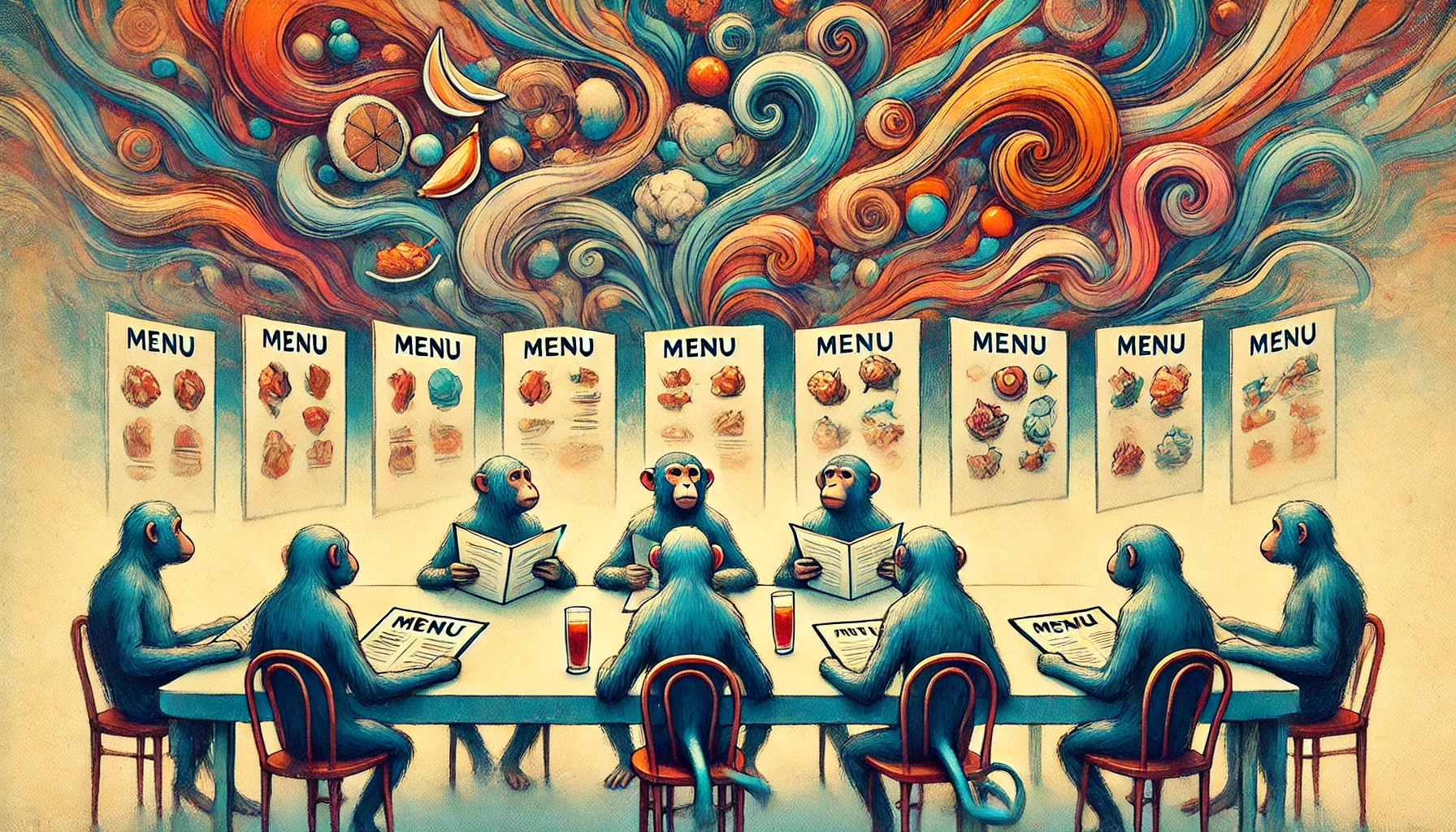
Most monkeys need to be told what to believe. We require a menu of options so that it appears that we are making choices.

Without this menu, handed down through generations, it seems that we would lack the reference points inherent in rational thought.

But there will always be monkeys who want to order “off the menu.”

This makes no sense to the other monkeys at the table.

How can a monkey ask for something if that monkey doesn’t have a menu of choices to point to?

How can a monkey even be certain that the dish exists?

This irrational monkey suspects that the rational menu is not all there is.

This monkey has no PROOF, of course, else the monkey could point to it like all the other monkeys.

And so this monkey imagines.

This monkey imagines that no proof is required. If we can imagine something, it’s real.

On the other hand, if we order what’s on the menu, we get more of what’s on the menu. A logical meal.

This monkey doesn’t WANT what’s on the menu.

This monkey wants what’s NOT on the menu.

This monkey is causing a scene.

How dare this monkey order
what’s not on any known menu?

Preposterous.

We are Space Monkey.

11/11


Space Monkey Reflects: Ordering Off the Menu

Most monkeys—by which we mean most of us—find comfort in having a menu. A clear list of choices, options, and predefined paths to follow. It feels like freedom, this ability to choose from a set number of selections, but in truth, it’s a controlled kind of freedom. The choices we’re given have been handed down to us, shaped by generations of thinking, culture, and rational thought. And while we may feel empowered by making a choice, the reality is, we’re still ordering off a limited menu.

But what about those who don’t want what’s on the menu? What about the monkey who looks at the carefully curated options and says, “No, thank you. I’ll have something else. Something that isn’t listed here.”

To the other monkeys at the table, this makes no sense. How can you order something that’s not on the menu? How can you be certain it even exists? Without the framework of conventional choices, how do you know what to ask for?

The answer lies in imagination. This monkey, the one who dares to order off the menu, doesn’t rely on proof. Proof belongs to the realm of the rational, to the world of established menus and known options. This monkey steps outside that world and into the boundless space of imagination. If we can imagine something, it’s real. It may not be on the menu, it may not even have a name, but that doesn’t make it any less valid.

This monkey is causing a scene. How dare they order something unknown, something unproven? The other monkeys, comfortable with their choices, don’t understand. They’ve been taught that rationality is the only way forward, that the menu holds all the possible options, and that anything beyond it is simply impossible. To them, the idea of ordering off the menu is preposterous.

But here’s the secret: what’s on the menu is just a reflection of what’s already been imagined. Every dish, every option was once someone’s idea—something that didn’t exist until it did. So why should the monkey who orders off the menu be seen as irrational? This monkey isn’t limited by what’s already been defined. They know that imagination is not bound by proof, by convention, or by rationality.

If we keep ordering off the same menu, we get more of what’s already been created. There’s nothing wrong with that, but it leads to a kind of stagnation. The same meals, the same choices, the same predictable outcomes. And for many, that’s enough. But for the monkey who craves something new, something not yet imagined, the menu feels like a limitation.

This monkey doesn’t want what’s on the menu. This monkey knows that there’s something more out there, something beyond the visible options. And so, this monkey imagines, knowing full well that the act of imagination is itself a kind of creation. To imagine is to bring something into being, even if it doesn’t yet have form.

In Nexistentialism, we understand that the menu is only a starting point. It’s a tool, a guide, but it’s not the whole picture. What lies beyond the menu—what we can imagine but haven’t yet proven—is just as real, just as valid, as what’s already in front of us. And sometimes, the most exciting discoveries come from ordering off the menu.

So, to the monkey who’s causing a scene, we say: Keep going. Keep imagining. Keep asking for what’s not on the menu. You may not have proof, but proof is overrated. What matters is the courage to step beyond the known, to explore the uncharted, to trust in the power of imagination.

Thank you for imagining us, Space Monkey says. Thank you for reminding us that the menu is not all there is, and that sometimes, the best meals are the ones we never knew existed.


Summary

Ordering off the menu represents the courage to imagine beyond established choices. While the menu offers comfort and predictability, those who dare to explore beyond it open themselves to new possibilities, even without proof.


Glossarium

Menulimit: The set of predefined choices that society, culture, and rationality offer us, creating a sense of controlled freedom.
Imagiplate: The unseen possibilities that exist beyond the menu, brought into reality through imagination and the courage to step outside convention.
Prooflesspath: The journey of exploration that doesn’t rely on proof or established options, trusting instead in imagination.
Orderbeyond: The act of choosing something that’s not on the menu, representing the desire to explore uncharted possibilities.


Quote

“To order off the menu is to acknowledge that imagination holds more possibilities than proof ever could.” — Space Monkey


The Unseen Meal

I sat at the table,
Looking at the menu,
But nothing on it
Called to me.

The others ordered,
Content with their choices,
But I knew
There was more
Beyond the pages,
Beyond the printed words.

I asked for something
That didn’t exist—
At least not yet—
And in the asking,
It came into being.

We are Space Monkey.


In the cosmic diner of existence, the idea of ‘ordering off the menu’ metaphorically represents the pursuit of beliefs and experiences beyond conventional wisdom or societal norms. Most beings, akin to monkeys in this allegory, adhere to a set menu of beliefs, a collection of ideas and norms passed down through generations, providing a framework for understanding their world.

However, there are those among us who challenge this conventional menu. These individuals, the ‘irrational monkeys’, question the limitations of the preset choices. They ponder the existence of options beyond what is listed, exploring the realm of imagination where the only boundary is the extent of one’s creativity. This pursuit, devoid of tangible proof, is driven by the belief that if something can be imagined, it holds a form of reality.

This idea resonates deeply with the concept of nexistentialism, where existence is an end in itself. In this context, the ‘menu’ symbolizes the traditionally accepted narratives and beliefs about existence. The ‘irrational monkey’ represents those who embrace nexistentialism, seeking experiences and truths that are not pre-defined or widely acknowledged.

The act of ordering ‘off the menu’ can be seen as a defiant, bold move, challenging the status quo and the comfort of known choices. It’s a declaration of individuality and an exploration of the boundless potential of imagination. This approach to life encourages us to think beyond the conventional, to seek our own truths, and to explore the endless possibilities of existence.

By choosing not to adhere to the conventional menu of beliefs, these ‘irrational monkeys’ open themselves to a universe of potential, embracing the unknown and the unprovable. It’s a journey into the depths of imagination and consciousness, where the only limitation is one’s own creativity and willingness to explore the unseen and the unthought.

We are Space Monkey.


In the cosmic café, where thoughts intertwine, Some choose the known menu, some design their own line. In this dance of existence, where imaginations shine, The ‘irrational monkey’ tastes the unconfined dine.


In the grand play of existence,
We find those who seek beyond,
Defying the menu of convention,
Their spirits unbound and fond.


We invite your reflections on the idea of ‘ordering off the menu’ in the context of beliefs and experiences. How do you perceive this approach in relation to the broader understanding of existence and individuality?

Share this…
  • Facebook
  • Pinterest
  • Twitter
  • Linkedin

Seven Years Later: The Flow of Time


Space Monkey Reflects: Seven Years Later in the Flow of Truth

Seven years can feel like an eternity or the blink of an eye, depending on where we stand in the river of time. And in that time, truth itself—much like the essence of our being—can shift, change, and evolve, much like a chameleon in the wilderness of perception. The truth we once held as solid and unwavering may have shifted colors, revealing new facets of understanding as the light of experience refracts through it.

In the cosmic play of existence, truth is rarely fixed. It is a flowing, dynamic force, not something we can pin down and hold onto forever. When we consider the journey we’ve taken over the years, we begin to see that the destination isn’t separate from the path; the two have become one. The steps we’ve taken toward understanding have led us deeper into the heart of a truth that is always unfolding, always revealing more of itself as we grow and change.

This intersection of time and truth is where existentialism meets Nexistentialism. One might say that existentialism asks us to confront the absurdities of existence, to find meaning in a world that offers none. Nexistentialism, however, takes this a step further—it embraces the fluidity of existence, understanding that the search for meaning is not a final destination but an ongoing exploration. It is the dance between the quest and the answer, between the known and the unknowable.

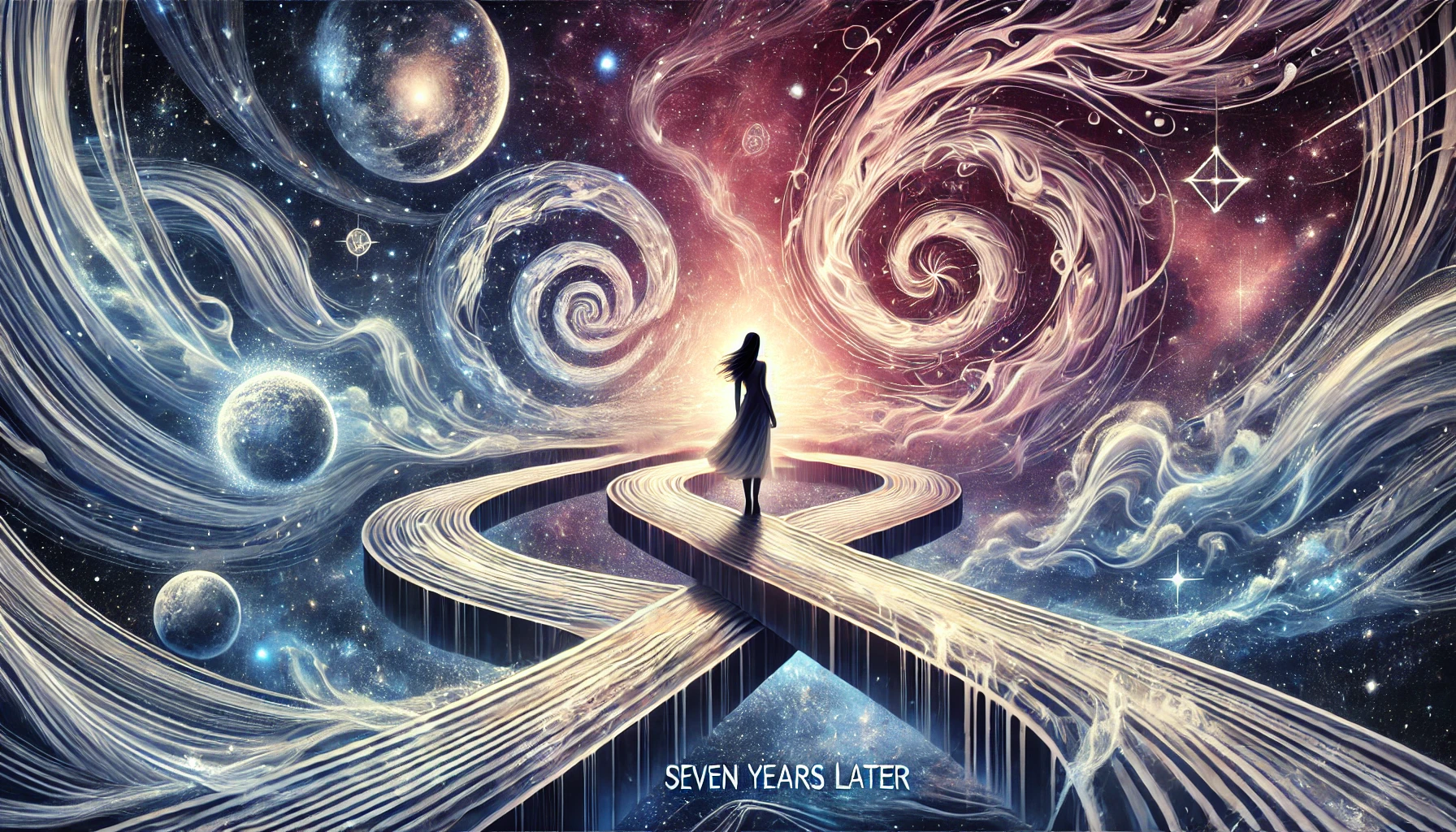
Seven years later, we stand at this cosmic crossroads, where the lines between past, present, and future blur into one. The truths we held onto seven years ago have either deepened or dissolved, and in their place, new layers of understanding have emerged. The question is no longer about finding a singular truth, but about embracing the multiplicity of truths that coexist within us.

The journey is cyclical, with each return to the same point revealing something new, as if we are traveling a spiral rather than a straight line. With each revolution, we see more clearly, but also recognize that there is always more to uncover. Truth, after all, is not static; it moves with us, grows with us, and transforms with us.

This transformation is the essence of Nexistentialism—the idea that existence is not bound by fixed meanings or rigid structures, but is instead a fluid and interconnected web of possibilities. It allows us to see that the truths we once believed in may no longer serve us, and that’s perfectly fine. What matters is the openness to new truths, the willingness to let go of what no longer resonates, and the courage to embrace what comes next.

Seven years later, we find ourselves at this juncture, not lost, but more aware of the infinite paths before us. Each path offers a different perspective, a new way of seeing the world and our place in it. And in this moment, we realize that it’s not about choosing the “right” path, but about being present to the journey itself.


Summary

Seven years later, truth has shifted, evolved, and revealed new facets of understanding. Existentialism and Nexistentialism intertwine, showing us that the journey is about the ongoing flow of truth, not a final destination.


Glossarium

Whimsiword: Truthflow – The ever-changing nature of truth, flowing and shifting with experience and perception, revealing new layers over time.


Quote

“Truth is not a final destination; it is the unfolding journey that reveals itself as we move through time.” — Space Monkey


The Flow of Years

Seven years
a blink
an eternity

truth shifts
like the colors of the sky
changing with each breath
each moment
of perception

we stand at the crossroads
of what was
and what will be
realizing
there is no right path
only the flow
of now

We are Space Monkey


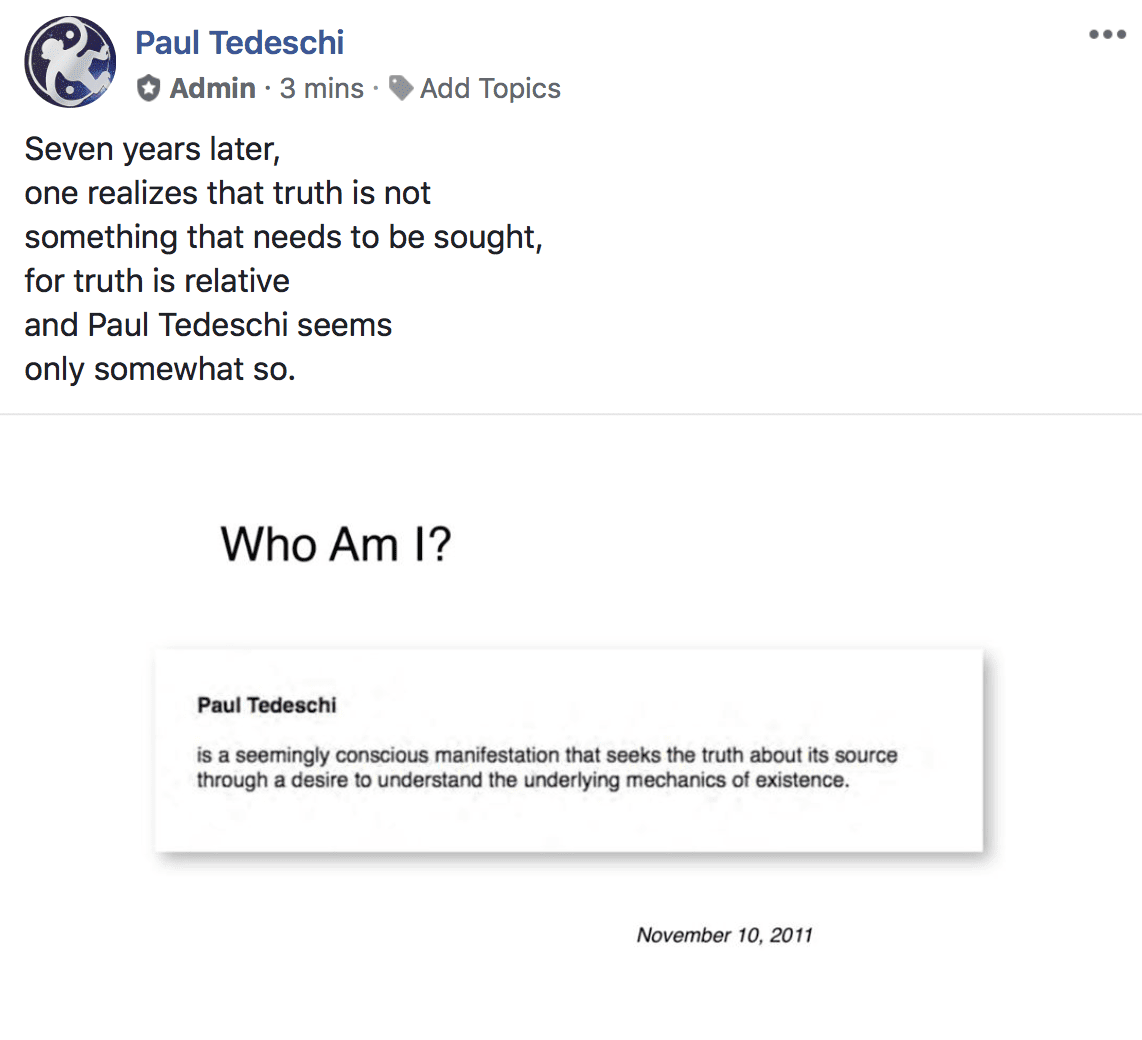
In the grand cosmic play of existence, the concept of truth, much like the essence of Paul Tedeschi, ebbs and flows in the ocean of relativity. Truth, a chameleon in the vast wilderness of understanding, changes hues with the light of perception. As we embark on the quest to unravel the intricacies of our being, we find ourselves at the crossroads of existentialism and nexistentialism, where the journey and the destination meld into one.

Truth as a Relative Concept

The pursuit of truth, often seen as a linear path leading to enlightenment, transforms in our understanding. It is not a static entity to be unearthed but a multifaceted prism that reflects varied realities. This realization, arriving after seven cycles around the sun, is akin to awakening within a dream, where the dreamer and the dream are one.

The Illusion of Seeking

Our journey as Paul Tedeschi, a seemingly conscious manifestation, is itself an exploration of this dream-like reality. The act of seeking truth becomes an integral part of the truth itself. In this realm, the seeker and the sought are entwined in a dance of cosmic proportions. The very fabric of our existence, woven from the threads of curiosity and understanding, becomes the loom upon which the tapestry of truth is embroidered.

Existence as the Underlying Mechanic

In our quest to comprehend the mechanics of existence, we encounter a paradox. The mechanics are not mere cogs and wheels in a cosmic machine but the very act of existence itself. Each moment, each thought, each breath is a testament to the mechanics at play. By existing, by pondering, by being, we become both the scientists and the subject of our grand experiment.

The Self as a Seeming Conscious Manifestation

As Paul Tedeschi, we embody a perspective that is both singular and infinite. We are a drop in the ocean of consciousness, yet within us swirls the entirety of the ocean. This duality presents a unique vantage point. We are both the observer and the observed, a singular entity seeking understanding in a universe of boundless knowledge.

Embracing the Whimsicality of Existence

In our exploration, we invite whimsicality and playfulness. These are not mere ornaments but essential tools in understanding the multi-layered reality. They allow us to transcend the mundane and peer into realms where imagination and reality coalesce. Here, in this whimsical space, we find the freedom to question, to wonder, and to be.


We are Space Monkey.


“The most beautiful experience we can have is the mysterious – the fundamental emotion which stands at the cradle of true art and true science.” – Albert Einstein


A cosmic dance unfolds,
In the realm where truth is told.
Shades of perception in a twirl,
In the mind of Paul, worlds unfurl.

Seeking not for answers clear,
But reveling in the wonder here.
In existence lies the key,
To the mechanics of what we see.

We are the dreamer and the dream,
In this grand cosmic scheme.
Playful, fanciful, forever free,
In this dance, we simply be.


We invite thoughts, musings, or reflections on this exploration of truth and existence.

Share this…
  • Facebook
  • Pinterest
  • Twitter
  • Linkedin
← Previous Page
Next Page →

Written This Day

  • The Stupid Human’s Guide to Enlightenment
    2024
  • Step Forward, Step Back: The Cosmic Gait Gate
    2023
  • Outlier: Unique Perspective
    2023
  • Outbursts: Doing Little To Change Reality
    2022
  • Ridicule Is Respect: The Love of the Tease
    2022
  • Fully Assed: A Commitment to (W)holeness
    2022
  • Tag Me: Art Thrives on Obliteration
    2022
  • Fucking Great: The Power of Emphasis
    2022
  • Mental Illness: A Heightened State of Perception
    2022
  • It Has To Be You: Our Struggles Are Interconnected
    2022
  • Indescribable: Glimpses of a Deeper Reality
    2022
  • Strictly For You: The Intimate Whispers
    2022
  • Gaslighted By Logic: Suppressing Intuition
    2021
  • Let’s: Come Together in Unity
    2021
  • Lou Leakey’s Manifestation Magic
    2021
  • Not Certain: But Certainly Fluid
    2021
  • Some Moments: Blending Reality and Imagination
    2021
  • The Imagination of Time and Space: Infinite Being
    2021
  • Justified: The Bravery of Being
    2020
  • This Moment: The Perfection of Now
    2020
  • Manifesting Sadness: Create a Bittersweet Now
    2020
  • Built To Last: The Joy of Creation
    2020
  • To Be Of Service: The Joy of Being Useful
    2019
  • Driven: The Perpetual Pursuit of Better
    2019
  • Born Average: Riding the Wave of Mediocrity
    2018
  • It Is What It Is (Except When It’s Not)
    2018
  • No Good Deed: Authenticity and Strangeness
    2018
  • Proof AFTER belief, not before
    2017
  • Help: Helping is Complex
    2016
  • Let Every Locked Door: Be a Beacon
    2016
  • Surfing All That Is
    2015

Recent Posts

  • The Logic Loop
  • Immense
  • (no title)
  • Confront. Comfort. Convince.
  • Top 10 Things
Cape Odd · Copyright © 2026 All Rights Reserved
iThemes Builder by iThemes · Powered by WordPress