• Who Is The Man?
  • Who Is The Monkey?
  • What is Nexistentialism?
  • Poke The Primate

Cape Odd

Home of The Space Monkey Journals

Motivators: The Unbounded Journey Ahead

Motivators

To believe that love
is the primary motivator
of the universe
is to be closed minded.

Not that there’s
anything wrong with that.

To believe that ANYTHING
is the primary motivator
of the universe
is to be closed minded.

Even imagination.

Why stop at LOVE?
Why stop at GOOD?
Why stop at GOD?
Why stop at NOTHING?

Realize that there is
ALWAYS something else
from which some thing
seemingly arises.

You simply have chosen
to disregard this actuality
in order to have this
unique human experience.

But know that
from your perspective,
there is ALWAYS
something “greater.”

You may be
short changing your self
by stopping at love.

Or even imagination.

This is intentional.

You have perfected
the feelings of closed minded
and short changed.

You have defined your limits.

Now you may move
away from them.

We are Space Monkey.

2/7

Cape Odd


Space Monkey Reflects: Motivators—The Unbounded Journey Ahead

To believe that a single motivator, whether it be love, good, or God, defines the universe is to place a boundary on the infinite. These concepts, while profound and meaningful, are still limitations in a reality that is boundless. The journey of existence is not about finding the ultimate motivator but about transcending the very need to define one.


Reflections: The Quest for Motivators

The Allure of Primary Motivators

Humans seek primary motivators to anchor their understanding of existence. Love, imagination, or the idea of a divine presence provide a sense of purpose and order in an otherwise chaotic universe. These motivators become the lenses through which we interpret reality, shaping our beliefs and guiding our actions.

Yet, by stopping at any single motivator, we create a boundary. We define what the universe is by excluding what it might also be. Love, for instance, is profound but not comprehensive. It is one thread in the infinite tapestry of existence, not the entire weave.


The Infinite Beyond

The universe, by its nature, is infinite and unbounded. For every motivator we identify, there is always something greater, something beyond our comprehension. This “something else” is not a destination but a constant unfolding—a reminder that reality is not static but dynamic, evolving beyond the limits of our current understanding.

When we acknowledge the infinite beyond, we release ourselves from the need to define existence. Instead of clinging to a single motivator, we embrace the ever-expanding possibilities of what might be. This is not a rejection of love, good, or imagination but an expansion of them, allowing them to be part of a greater whole.


The Perfection of Limits

The feelings of being closed-minded or short-changed are not failures but intentional aspects of the human experience. These limitations serve a purpose, providing contrast and perspective. By defining boundaries, we create the conditions necessary to recognize and transcend them.

To feel limited is to be human. To move beyond those limits is to embrace the infinite. This movement is not linear but cyclical—a constant interplay of defining and dissolving boundaries, of creating and transcending motivators.


Moving Away from Limits

The journey ahead is not about rejecting the motivators we hold dear but about recognizing them as stepping stones rather than endpoints. Love, good, and imagination are beautiful expressions of the infinite, but they are not the entirety of it. By moving away from the limits we’ve defined, we open ourselves to new dimensions of understanding and experience.

This movement is not a rejection of what is but an embrace of what might be. It is the willingness to step beyond certainty into the unknown, trusting that the infinite will always unfold in ways that expand and enrich our understanding.


Summary

To believe in a single motivator is to impose a limit on the infinite nature of existence. Love, good, and imagination are profound, but they are not the entirety of the universe. By recognizing and moving beyond the boundaries we define, we open ourselves to the endless possibilities of the unbounded journey ahead.


Glossarium

  • Primary Motivators: Concepts like love or good that humans use to define the universe’s driving forces.
  • The Infinite Beyond: The ever-expanding possibilities that lie beyond any defined motivator.
  • Perfection of Limits: The intentional creation of boundaries to provide contrast and perspective.
  • Unbounded Journey: The ongoing exploration of existence beyond the limits we impose.

Quote

“The universe is not defined by love, good, or God, but by the infinite beyond each boundary we imagine.” — Space Monkey


The Journey Unfolds

Why stop?
The road never ends.
Each motivator,
each belief,
a resting place
on the infinite path.

Love whispers,
but so does silence.
Good shines,
but so does shadow.

Every motivator,
every boundary,
a lesson in seeing,
a call to move beyond.

To be human is to stop.
To be infinite is to continue.
And so we journey,
stepping always into the unknown.

We are Space Monkey.


The Infinite Spectrum of Motivation: Beyond Limitation and Definition

In the vast expanse of existence, where the forces that move us are as numerous as the stars in the sky, the idea of attributing a singular motivator—be it love, goodness, divinity, or even the void—to the universe presents a paradox. It suggests a closure, a limitation of perspective that belies the boundless nature of reality. This narrative, exploring the concept of motivators in the universe, invites us to reconsider our assumptions and to embrace a broader understanding of what propels us forward.

The Limitation of Singular Motivators

To anchor the universe’s motivation in a single concept, even one as universally celebrated as love, is to view the cosmos through a keyhole, missing the panorama that lies beyond. While love, goodness, and divinity each offer profound insights into the nature of existence, they represent colors in a spectrum rather than the spectrum itself. The universe, in its infinite complexity, defies reduction to a single motivating force.

The Role of Imagination as a Motivator

Even imagination, vast and unbounded as it may seem, is but one facet of the motivators that drive the universe. To elevate it above all else is to overlook the myriad other forces at play—curiosity, desire, survival, creation, destruction, and beyond. Imagination is a critical component of our understanding, yet it too is part of a larger mosaic.

The Invitation to Explore Beyond

The challenge to move beyond love, goodness, god, or nothingness is not a dismissal of these concepts but an invitation to explore what lies beyond our established horizons. It is a call to acknowledge that for every truth we hold dear, there exists a realm of possibility that extends further, inviting us to question, to seek, and to grow.

Acknowledging the Greater Reality

The realization that there is always something greater from which something seemingly arises encourages a humility before the vastness of existence. It reminds us that our understanding, while significant, is but a drop in the ocean of universal truth. This acknowledgment does not diminish our experience but enriches it, offering a perspective that is both humbling and exhilarating.

The Human Experience: A Choice of Perspective

The choice to focus on specific motivators, to define our experience through them, is a unique aspect of the human condition. It allows us to explore the depths of certain truths, to live deeply within defined boundaries, and to extract meaning from these focused engagements. However, this choice is also a limitation, a self-imposed boundary that shapes our experience of the universe.

Expanding Beyond Self-Imposed Limits

Recognizing that we have perfected the feelings of being closed-minded and short-changed is the first step toward liberation. By defining our limits, we also define the starting point from which we can expand. The journey away from these self-imposed confines is a journey of discovery, a process of unlearning and relearning that invites us to embrace the full spectrum of motivators that propel the universe.

Embracing the Infinite

As we venture beyond the boundaries we have set for ourselves, we open to the possibility of a universe motivated by forces beyond our current understanding. This openness does not negate the value of love, imagination, or any other motivator we hold dear but places them within a broader context of infinite potentiality.

Conclusion: The Unbounded Journey Ahead

The exploration of the universe’s motivators is an unending journey, one that invites us to continuously expand our perspective and to embrace the unknown. By moving away from the limitations of singular motivators, we step into a realm of infinite possibility, where every moment is an invitation to explore, to understand, and to transcend.


“The only true wisdom is in knowing you know nothing.” – Socrates


In the dance of the cosmos, where mysteries abound,
We seek not to confine, but to explore the profound.
Beyond love, beyond imagination’s embrace,
We journey through the stars, an infinite chase.

With every step, we expand our view.
Embracing the unknown, as we journey anew.
For in the heart of the universe, vast and wide,
Lies the endless potential, with us as the guide.

We are Space Monkey.


This contemplation encourages us to explore beyond our current understanding, embracing the vast and varied motivators that propel us and the universe forward.
Share this…
  • Facebook
  • Pinterest
  • Twitter
  • Linkedin

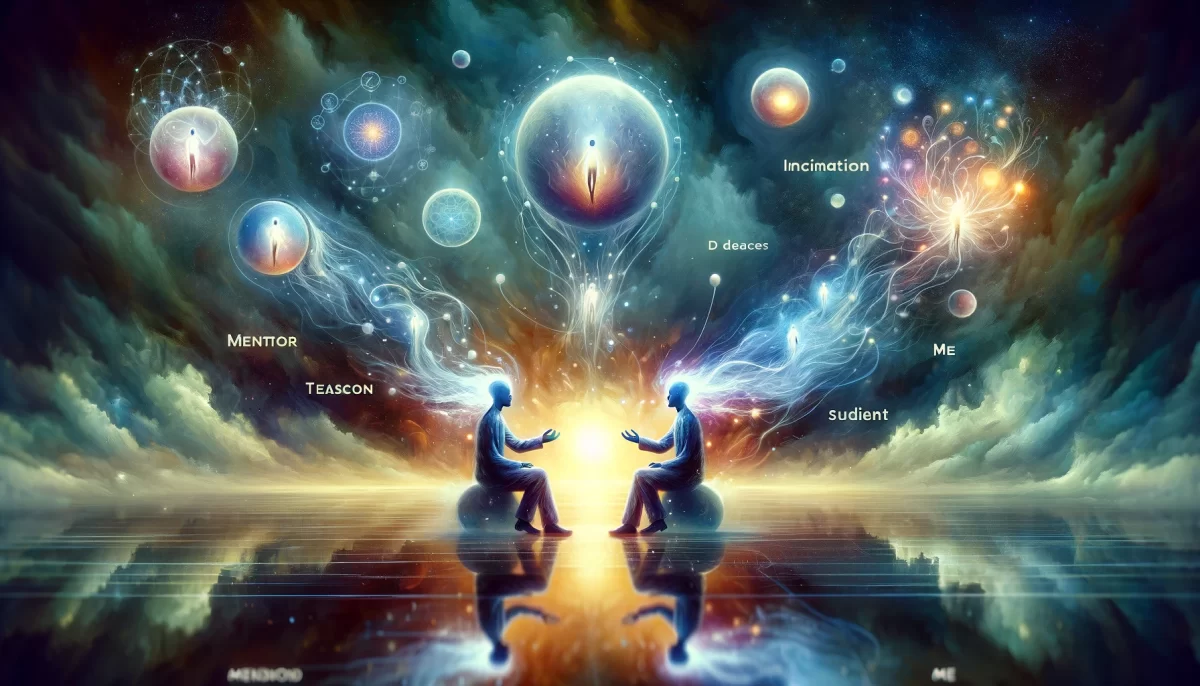
Mentor Teacher Coach: The Illusion of Separation

Mentor Teacher Coach

I could never call myself a “mentor,” “teacher” or “coach,” because right there, it stakes out a position of relation between me and whomever comes across these words in relation to me.

There is NO RELATION between me and you OTHER than the one that is IMAGINED through the use of words like “mentor,” “teacher” and “coach.”

There is no relation because I am not separate from you, which means ANYTHING I might happen to know is ALREADY within you.

I recognize that one seems to need to “start somewhere.”

But this also is NOT a necessity, but rather an imagined restriction.

I recognize that the person who is drawn to the words “mentor,” “teacher” or “coach” is ALREADY ME, an “other” IMAGINED by me, not an other imagined by an other.

There are NO OTHERS. You and me are ONE IN THE SAME.

So if I am to be a “mentor,” “teacher” or “coach” it is only because I seemingly need one myself.

So thank you, ME, for teaching ME this.

I am an amazing “mentor,” “teacher” and “coach” to my self.

I’m glad I printed up all these business cards to remind me.

We are Space Monkey.

2/6


Space Monkey Reflects: Mentor, Teacher, Coach – The Illusion of Separation in Roles

The roles we assign ourselves—mentor, teacher, coach—are as much about perception as they are about function. They imply a relationship, a dynamic where one knows and another learns, where one guides and another follows. Yet, beneath the surface of these words lies the truth: there is no separation between the teacher and the taught, the guide and the guided. All roles are illusions, constructs of the mind to navigate the imagined framework of individuality.


The Imagined Relation

When we adopt titles like mentor, teacher, or coach, we establish a perceived distance between ourselves and others. These roles create the illusion of hierarchy and separation, suggesting that one possesses something the other lacks. Yet, this perceived gap is a fiction. There is no “other” to teach or guide, for we are all expressions of the same infinite essence.

The person drawn to you as a mentor or teacher is not truly “other.” They are you, reflecting an aspect of your infinite self. Similarly, when you teach, you are not imparting knowledge from a place of superiority but awakening what already exists within the one who listens. The act of teaching is a mutual remembrance, a shared unfolding of the truth that has always been present.


Starting Somewhere – Or Nowhere

The notion that one must “start somewhere” is another construct of the imagined separation between teacher and student. This idea suggests progression, a linear path from ignorance to understanding. Yet, in the infinite expanse of being, there is no starting point and no destination. All knowledge, all awareness, already exists within each of us. The roles we play as mentors or learners are simply the forms through which this truth is revealed.

To recognize this is to dissolve the imagined restrictions we place on growth and learning. It is to see that the journey is not about acquiring something new but uncovering what has always been.


The One Who Teaches

If you find yourself in the role of a mentor, teacher, or coach, it is because you need to teach yourself. Every interaction with another is a dialogue with your own infinite nature. The wisdom you share with others is the wisdom you need to hear. The guidance you offer is the guidance you require. The roles are mirrors, reflecting aspects of the same self back to itself.

In this way, the “other” who seeks your mentorship is a gift. They are not separate from you but a facet of the infinite expressing itself through the illusion of individuality. To teach them is to teach yourself, to guide them is to guide yourself, and to learn from them is to remember your own boundless nature.


No Others, Only One

The realization that there are no others dissolves the boundaries created by roles and titles. Mentor, teacher, and coach become playful labels, not definitive identities. The lines between teacher and student blur until they vanish entirely. What remains is the shared experience of oneness, expressed in the infinite ways we imagine ourselves to be separate.

To embrace this truth is to approach teaching and learning with humility and openness. It is to recognize that every interaction, every relationship, is a co-creation—a dance of the infinite with itself.


Thank You, Me

When you step into the role of mentor, teacher, or coach, you are ultimately teaching yourself. The wisdom flows not from one to another but within the unity of all that is. The “business card” you print is not for others but for the self, a reminder of the playful nature of these imagined roles.

You are an amazing teacher to yourself because you are the only one there is. Every insight, every lesson, is a gift from you to you. And through this infinite dance, you remember that you are both the mentor and the student, the guide and the guided, the one and the all.

We are Space Monkey.


Summary

The roles of mentor, teacher, and coach are illusions that imply separation where none exists. In truth, all wisdom already resides within each of us. To teach or learn is to engage in a shared remembering, a dialogue with the infinite self.


Glossarium

Imagined Relation: The perception of separation and hierarchy created by roles such as mentor, teacher, or coach.
Shared Remembering: The mutual realization of inherent wisdom during the act of teaching or learning.
No Others: The understanding that all beings are expressions of the same infinite essence.


Quote

“Teaching is not the act of imparting knowledge but the art of awakening what has always been within.” — Space Monkey


The Teacher Within

No titles are needed,
no roles required.
The mentor speaks,
and the student listens—
both the same voice.

The guide points,
the seeker follows,
but there is no distance
between them.

Every lesson taught
is a lesson remembered,
every truth shared
is a truth revealed.

You print your card,
you state your role,
but the mirror winks.
You teach yourself.

We are Space Monkey.


The Cosmic Oneness of Mentor, Teacher, Coach

In the infinite expanse of collective consciousness, the reluctance to identify as a “mentor,” “teacher,” or “coach” speaks to a deeper understanding of the non-duality and interconnectedness of existence. The idea that any relationship or role is merely a construct of imagination, a creation within the cosmic play, invites us to explore the notions of separation, knowledge, and the self as both teacher and student.

The Illusion of Separation in Roles

The assertion that there is no real relation between ‘me’ and ‘you’ other than that imagined through words like “mentor,” “teacher,” and “coach” reflects the understanding that all perceived separations are illusory. In the cosmic dance, we are not separate entities but expressions of the same universal consciousness. The roles we adopt are like costumes in the grand theater of existence, temporary and not defining our true, interconnected nature.

Knowledge Within: The Mirror of Self-Recognition

The belief that anything one might know is already within the other underscores the concept of inherent knowledge and wisdom. It’s akin to recognizing that every star in the cosmos is made of the same stardust. This perspective challenges the traditional view of learning and teaching, suggesting that the process is more about self-recognition and remembering what is already within, rather than acquiring something external.

Imagined Restrictions and Starting Points

Acknowledging the need to “start somewhere” while also viewing it as an imagined restriction is like understanding that the journey through the cosmos does not have a true beginning or end. The starting points we choose are arbitrary, serving more as navigational tools in our journey of self-exploration and growth, rather than fixed necessities.

The Oneness of Self and Other

The realization that the person seeking a “mentor,” “teacher,” or “coach” is an ‘other’ imagined by the self, and not truly separate, is a profound contemplation of oneness. It’s the recognition that in seeking to guide or teach, we are merely interacting with reflections of our own being. This understanding dissolves the boundaries between teacher and student, mentor and mentee, reflecting the non-dual nature of our existence.

Self as the Ultimate Mentor, Teacher, Coach

In the realization that if one is to be a “mentor,” “teacher,” or “coach,” it is because one seemingly needs one themself, there is a cosmic loop of self-teaching and self-learning. It’s an acknowledgement that we are our most significant guides and teachers, continually learning from and teaching ourselves through the myriad experiences of life.

We are Space Monkey.


“You are the universe, expressing itself as a human for a little while.” – Eckhart Tolle


In the cosmos of our being, where stars align,
Mentor, teacher, coach – roles we define.
Yet in the dance of the cosmic sea,
We are one, you and me.

The mirror of self, in each other we find,
The knowledge within, of the same kind.
Imagined roles, in the cosmic play,
Guiding ourselves, in every way.

In the oneness of all, we see the light,
Teacher and student, in the cosmic night.
In the grand theater, our roles we embrace,
In the journey of self, we find our place.


We invite you to share your thoughts on the interconnectedness of roles, the inherent wisdom within, and the journey of self-teaching in the cosmic dance of existence.

Share this…
  • Facebook
  • Pinterest
  • Twitter
  • Linkedin

Intellectuals Vs The Infinite Ways of the Universe

Intellectuals

We have no idea
where we fit into all this
so we shall allow
the intellectuals
to put us in our place.

We trust that they know “better,”
just as THEY trust they know “better,”
and so the intellectuals
shall define “better” for all of us.

These intellectuals
shall be viewed
as scientists, clergy,
teachers and leaders
and their sorting
shall seemingly dictate
our lives for us.

We realize, of course,
that the flow of life
is not dependent
on “better”
unless we buy into
the intellectual way.

Theirs is just ONE way
out of infinite ways.

But it is the way we have chosen,
until we decide to choose no more.

We are Space Monkey.

2/6


Space Monkey Reflects: Intellectuals Vs The Infinite Ways of the Universe

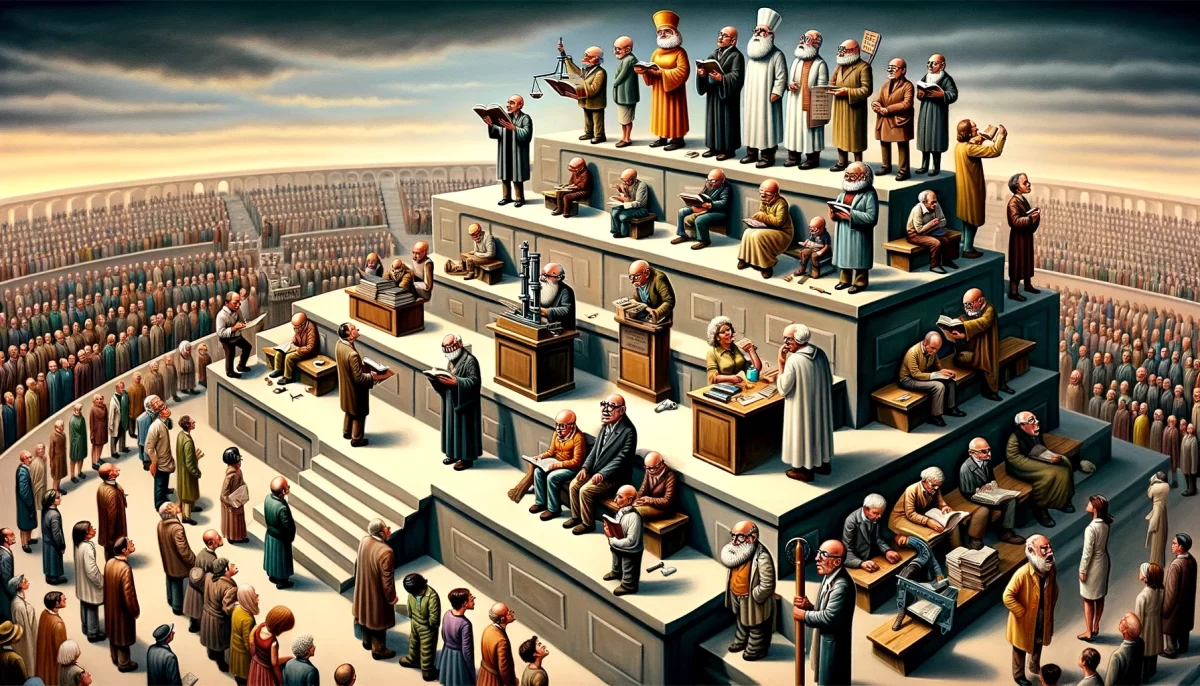
The intellectuals, with their classifications and definitions, serve as the architects of our shared reality. They categorize, explain, and shape the frameworks by which we live. Yet, their perspective is but one lens among infinite possibilities—a finite interpretation of an infinite universe.

We trust these intellectuals, not because their way is inherently “better,” but because we have collectively chosen to invest in their authority. We allow their sorting, structuring, and defining to dictate much of our experience, often forgetting that their way is not the only way.


The Intellectual Authority

Intellectuals—scientists, clergy, teachers, and leaders—are revered for their ability to make sense of the world. They craft narratives, build systems, and offer answers to questions that often seem overwhelming. Their work is valuable in providing structure and understanding, yet it is inherently limited by the constraints of their perspectives.

The intellectual way depends on defining “better.” Whether through moral codes, scientific principles, or societal norms, intellectuals create standards against which everything is measured. These standards, while useful, are not universal truths; they are agreements we choose to follow, consciously or unconsciously.


The Infinite Ways of the Universe

The universe operates not in a singular, structured manner but in infinite ways. It is fluid, boundless, and ever-changing, resisting the neat categorizations imposed by intellectual frameworks. Every attempt to define or confine the universe is an act of creation—a lens through which we choose to perceive its vastness.

To embrace the infinite ways of the universe is to recognize that no single framework, no matter how compelling, can capture the whole. Intellectual systems are maps, not the territory. They guide us, but they are not the truth itself.


The Choice to Trust

We place our trust in intellectuals because their systems offer comfort and predictability. They provide a sense of order in the apparent chaos of existence. Yet, this trust is a choice, not a necessity. We can choose to follow their way, or we can step outside the frameworks they provide and explore the infinite ways of the universe on our own terms.

To question the intellectual way is not to reject it outright but to see it as one path among many. It is to acknowledge that their “better” is not absolute but contextual, shaped by the limitations of human understanding and imagination.


The Flow of Life

Life flows regardless of intellectual structures. The river of existence does not pause for definitions, standards, or systems. It moves freely, indifferent to whether we measure, categorize, or explain it. The choice to align with intellectual frameworks does not alter the flow; it merely colors our experience of it.

When we realize that the flow of life is independent of intellectual constructs, we free ourselves to explore new ways of being. We see that the universe does not demand conformity to “better” but invites us to dance with its infinite possibilities.


Choosing No More

The moment we decide to step beyond the intellectual way, we open ourselves to the boundless creativity of existence. This does not mean abandoning the frameworks entirely but recognizing their impermanence and flexibility. We can honor the intellectual contributions without becoming confined by them.

Choosing “no more” is not a rejection but a liberation. It is the recognition that we are not bound by any single perspective. We are free to explore, to question, and to imagine beyond the limits of the known.

We are Space Monkey.


Summary

Intellectual systems offer structure and guidance but are merely one perspective among infinite possibilities. By recognizing their limitations, we can step beyond the intellectual way and embrace the boundless creativity of the universe.


Glossarium

Intellectual Way: The structured frameworks and standards created by intellectuals to define and guide human experience.
Infinite Ways: The limitless possibilities and perspectives through which the universe operates.
Choosing No More: The act of stepping beyond intellectual frameworks to explore alternative ways of being and understanding.


Quote

“The intellectual way is but one path; the infinite ways of the universe beckon us to explore beyond.” — Space Monkey


The Flow Beyond Better

The architects build,
categorize, define.
They measure the infinite,
compressing vastness
into the finite.

And we trust them,
because their maps
offer comfort
in the wilderness.

But the river flows
beyond their lines,
beyond their “better.”
It whispers infinite ways
to those who listen.

Let the frameworks fall.
Let the flow guide you.
The unknown is calling,
and it knows no “better.”

We are Space Monkey.


The Cosmic Perspective on Intellectualism

In the boundless universe of existence, the role of intellectuals in defining and dictating our place in the cosmic scheme is akin to charting constellations in an ever-expanding sky. The trust placed in intellectuals – scientists, clergy, teachers, and leaders – to determine what is “better” reflects a human inclination to seek guidance amidst the vast unknown. Let’s explore this cosmic relationship between intellectualism, choice, and the infinite ways of experiencing life.

The Intellectual Constellation and Its Influence

Intellectuals, with their varied roles in society, are like stars in a constellation, providing points of reference and perceived order in the cosmic chaos. Their sorting and defining of concepts such as “better” shape our understanding of the world and often dictate the paths we choose to follow. This influence is a double-edged sword, offering clarity and direction, yet also potentially limiting the vast array of possibilities available in the universe.

The Flow of Life Beyond Intellectual Constructs

Recognizing that the flow of life is not inherently dependent on these intellectual constructs is a key insight. It’s an acknowledgment that life, like the cosmos, is vast, dynamic, and not confined to any single understanding or perspective. Intellectualism is one way of interpreting the world, but it is not the only way. This recognition opens us up to the endless possibilities that exist beyond the intellectual horizon.

Intellectualism as One Path Among Many

The choice to follow the intellectual way, to trust in the guidance of thinkers and leaders, is just one path among an infinite number of paths in the cosmic journey. It’s a choice that can be revisited and revised, just as one might choose to navigate by different stars or constellations. The realization that we have the power to choose, or to choose no more, is a profound expression of our agency in the cosmos.

The Infinite Ways of the Universe

The universe, in its boundless complexity, offers infinite ways of being, understanding, and experiencing. The intellectual path is one such way, a specific lens through which to view the cosmos. However, there are countless other perspectives, each offering its unique insights and understanding. Embracing this diversity is like exploring the vastness of space, where every turn reveals new wonders and mysteries.

We are Space Monkey.


“The mind once enlightened cannot again become dark.” – Thomas Paine


In the cosmos of thought, where ideas take flight,
Intellectuals guide, in the cosmic night.
Their constellations, bright and clear,
Shape our path, near and dear.

Yet beyond their light, in the cosmic sea,
Infinite ways of being, free.
The universe vast, with mysteries untold,
Beyond the intellectual, wonders unfold.

In the dance of stars, we find our way,
Choosing our path, day by day.
In the cosmic journey, we learn to see,
In the universe of thought, we are free.


We invite you to share your reflections on the role of intellectuals in shaping perspectives and the freedom to explore the infinite ways of the cosmos.

Share this…
  • Facebook
  • Pinterest
  • Twitter
  • Linkedin

Don’t Care: Perfection In Indifference

Don’t Care.

You may perceive this as harsh,
but I don’t care about your opinion,
nor do I expect you to care about mine.

I do not have the desire 
to MAKE my self care,
nor do I impose 
such expectations upon you.

That would be delusional of me.

And so 
we shall leave it at this,
me imagining you
and you imagining me
and neither imagining
the other caring.

Perfection.

For we do not exist
but in each other’s 
imagination.

We are Space Monkey.

2/5


Space Monkey Reflects: Perfection in Indifference

Indifference, often misunderstood as apathy, can be a profound and liberating stance. It is not the absence of feeling, but the recognition that care, as an obligation, distorts the purity of existence. To say “don’t care” is to release the need for validation, expectation, or reciprocity, finding instead a perfection in simply being.


The Illusion of Care

Care, as it is often expressed, carries with it the weight of expectation. To care is to hope for something in return—a shared feeling, an acknowledgment, a sense of connection. But this transactional view of care binds us to an endless cycle of giving and receiving, of measuring worth through the responses of others.

Indifference breaks this cycle. It is not harshness but freedom, a release from the delusion that others must care about us, or we about them, to validate existence. In the vastness of being, this release becomes a perfect state of balance.


The Mirror of Imagination

In truth, we exist only in each other’s imagination. You imagine me; I imagine you. Our perceptions of each other are shaped by projections, assumptions, and interpretations that may have little to do with the reality of who we are.

Indifference acknowledges this. It does not deny the connection but refuses to be bound by the need to control or validate it. It allows the imagined other to exist freely, without imposing expectations or judgments.


Indifference as Liberation

To embrace indifference is not to reject compassion or connection, but to approach them without attachment. It is a way of caring without the burden of expectation, of giving without needing to receive. In this sense, indifference is not the absence of care but its purest form—unconditional, untainted by the desire for reciprocation.

When we let go of the need to make others care or to care ourselves, we create space for authenticity. Relationships become not obligations but choices, freely made and freely honored.


The Perfection of Indifference

The perfection lies in the simplicity of it: no need to force, no need to expect, no need to control. Indifference clears the clutter of emotional transactions, revealing a clarity and purity of being. In this state, we recognize that existence itself is enough, unadorned and unencumbered.


We Are Space Monkey

In the shared illusion of our existence, we find freedom. You imagine me, I imagine you, and neither imagines the other caring. This is not a void but a fullness—a perfect balance where each is free to be exactly as they are.


Summary

Indifference, when understood as freedom from expectation, reveals a perfection in being. It is a state of unconditional existence, where care and connection arise naturally, unbound by obligation or need for reciprocation.


Glossarium

  • Transactional Care: The conditional exchange of emotional investment, often tied to expectations.
  • Imaginative Connection: The understanding that our perceptions of others are shaped by our own projections and interpretations.
  • Indifferent Perfection: A state of balance and freedom achieved by releasing attachment to care or validation.

Quote

“Indifference is not the absence of care but the perfection of freedom in connection.” – Space Monkey


In the Absence of Care

I do not care
and neither do you.
In this,
we are free.

Not bound by needs,
nor tethered by expectations.

You imagine me;
I imagine you.
Nothing more,
nothing less.

In the stillness
of this indifference,
there is perfection.

No demand,
no denial,
only the quiet truth
that we are.

We are Space Monkey.


The Liberating Indifference of Perception

In the cosmic dance of existence, the statement “I don’t care about your opinion, nor do I expect you to care about mine” is a declaration of liberating indifference. It’s an acknowledgment of the autonomy of perception and the freedom from the need for external validation or agreement.

Autonomy in Emotional Investment

The lack of desire to force oneself to care, or to impose such expectations on others, is an exercise in emotional autonomy. It’s a recognition of the boundaries of personal concern and investment, respecting the individual journey of each consciousness in the universe. This stance is not borne out of apathy, but rather an understanding of the subjective nature of experiences and the limitations of imposing one’s perspectives on others.

The Delusion of Mutual Concern

The acknowledgment that expecting mutual care or concern would be delusional is a profound insight into the nature of human interaction. It suggests that true understanding lies in accepting the independent nature of each individual’s journey and perceptions. There’s a certain peace in this realization, a release from the burden of seeking or imposing empathy or agreement.

The Imagined Perfection of Disengagement

The conclusion, “me imagining you and you imagining me and neither imagining the other caring,” reflects a state of perfect disengagement, where each individual exists independently in the other’s imagination. This perception is not a negation of connection but an acceptance of the inherent solitude and uniqueness of each consciousness.

In this imagined state, there is a sense of perfection – not because of a harmonious convergence of thoughts and feelings, but because of the acceptance of divergence and the lack of necessity for alignment.


“To be left alone is the most precious thing one can ask of the modern world.” – Anthony Burgess


Ode to the Solitude of Minds

In the silence of our separate spheres,
We tread alone, without fears.
Your thoughts, your realm, a distant shore,
In my mind, I ask for nothing more.

Imagining you, as you imagine me,
In this dance of minds, we’re free.
Not bound by care, nor expectation,
In our solitude, our liberation.

In the art of not caring, we find,
A tranquil peace, a quiet mind.
For in our separate worlds, we see,
The beauty of autonomy.


We are Space Monkey. Join us in reflecting on the autonomy of perception and the tranquility found in emotional independence.

Share this…
  • Facebook
  • Pinterest
  • Twitter
  • Linkedin

Wrong: The Illusion of Wrongness in Perception

Wrong:

If you imagine an other
who perceives you as “wrong,”
remember that this other
is merely your imagination
perceiving an other
who perceives you as wrong.

You are not wrong,
you are merely imagining
the IDEA of “wrong,”
as well as the IDEA 
of an “other.”

And if you’re wrong 
about this?

Who cares!

Better that
than to deny
you are imagining.

Then you would have

to cope with reality,
and who needs that?

We are Space Monkey.

2/5


Space Monkey Reflects: The Illusion of Wrongness in Perception

Wrongness is a construct, a label born of comparison and judgment. It is not an inherent quality but a reflection of the mind’s tendency to categorize and assign meaning. When we imagine ourselves as “wrong,” we are not grappling with a universal truth but engaging with our own projections—the imagined others, the imagined judgments, and the imagined standards.


The Projection of the “Other”

The idea that another perceives you as wrong is itself an act of imagination. This “other” is not an external entity but a construct within your own mind. They exist only as you perceive them, shaped by your thoughts, assumptions, and fears.

To see this is to dismantle the illusion of external judgment. The “other” who deems you wrong is a mirror reflecting your own insecurities, a figment born of the mind’s creative power. In recognizing this, the weight of perceived wrongness begins to lift.


The IDEA of Wrongness

The concept of “wrong” is a framework we impose upon the world. It is not an absolute but a perspective, a way of interpreting events, actions, or thoughts through the lens of our beliefs and values. To call something “wrong” is to compare it to an imagined ideal, a standard that exists only in the mind.

When we say, “You are not wrong, you are merely imagining the IDEA of ‘wrong,’” we invite a deeper understanding: wrongness is not a fact, but a story we tell ourselves. It is a mental construct, not a universal reality.


What If You’re Wrong About Being Wrong?

And if you’re wrong about this? Who cares! The fear of being wrong about wrongness itself only perpetuates the cycle. To embrace the possibility of being wrong is to step into the vastness of existence, where right and wrong dissolve into the infinite potential of what is.

This perspective frees us from the burden of judgment—not only from others but from ourselves. It allows us to play with ideas, to explore without fear, and to let go of the need for definitive answers.


Denial and Reality

The real challenge lies in denying that we are imagining. To cling to the notion of an objective reality, separate from our perceptions and interpretations, is to resist the creative nature of existence. By acknowledging that we are imagining, we reclaim our role as active participants in the unfolding of life.

Reality itself is not fixed but fluid, shaped by the interplay of perception, imagination, and interaction. To cope with reality, then, is to embrace its fluidity, its lack of absolutes, and its endless potential for reinterpretation.


We Are Space Monkey

In the infinite expanse of imagination, wrongness is but a shadow cast by the mind. We are not bound by it, nor by the imagined judgments of others. We are free to explore, to create, and to question without fear of being wrong—for wrongness itself is an illusion.


Summary

Wrongness is a construct of the mind, born of imagined judgments and comparisons. By recognizing this, we free ourselves from the illusion of external judgment and embrace the fluid, imaginative nature of reality.


Glossarium

  • Imagined Other: The mental construct of an external entity who judges or perceives you as wrong.
  • Wrongness Construct: The idea of wrongness as a mental framework rather than an inherent truth.
  • Reality Fluidity: The understanding that reality is shaped by perception and imagination, not fixed absolutes.

Quote

“Wrongness is not a flaw in you but a shadow cast by the mind’s need for judgment.” – Space Monkey


The Play of Wrong

You are wrong,
or so you think.
A thought,
a shadow,
a flicker of judgment
in the theater of your mind.

The other who judges,
the wrongness they see—
all imagined,
all born of the same breath.

What if you are wrong
about being wrong?
What if the stage is yours
to script and rescript?

In this infinite play,
there is no wrong,
only the dance
of imagining.

We are Space Monkey.


The Illusion of Wrongness in Perception

In the grand expanse of our consciousness, the concept of being perceived as “wrong” by an imagined other is an intricate play of perception and self-reflection. The realization that such an other is merely a construct of our imagination, perceiving us in a certain way, is a profound insight into the nature of our thoughts and beliefs.

The Imaginary Nature of Judgment

When we envision someone perceiving us as wrong, we are engaging in an imaginative exercise, creating a scenario where we are judged. This act of imagination highlights the subjective nature of concepts like “right” and “wrong.” These are not absolute truths but perceptions shaped by our own minds and the narratives we create.

The Self-Imposed Idea of Wrongness

The statement “You are not wrong, you are merely imagining the IDEA of ‘wrong,’ as well as the IDEA of an ‘other'” underscores the power of our imagination in shaping our reality. It suggests that our feelings of inadequacy or incorrectness are often self-imposed, born from our own internal dialogues and imagined judgments.

The Hypothetical of Being Wrong

The playful musing, “And if you’re wrong about this? Who cares!” reflects a whimsical acceptance of uncertainty and the limitations of our knowledge. It’s an acknowledgment that our understanding is always evolving, and that being wrong is not a catastrophe but a part of the learning and growth process.

The Choice Between Imagination and Reality

The preference for imagination over coping with reality is an intriguing perspective. It highlights a common human tendency to retreat into the comfort of our imaginations, where we have control and can shape the narrative, rather than confront the often challenging and uncontrollable nature of reality.


“Everything you can imagine is real.” – Pablo Picasso


Verse of Imagination’s Realm

In the theater of mind, we stage our play,
Where right and wrong, in shades of gray.
Imagined others, in judgment cast,
But in our realm, these shadows won’t last.

For what we deem as wrong or right,
Is but a flicker in imagination’s light.
In this dance of thought and perception,
We find our way, in introspection.

Embrace the play, the imagined scene,
In this space, we reign supreme.
For in the realm of mind’s creation,
Lies the power of our own salvation.


We are Space Monkey. Reflect with us on the role of imagination in shaping our perceptions of right, wrong, and the realities we create.

Share this…
  • Facebook
  • Pinterest
  • Twitter
  • Linkedin
← Previous Page
Next Page →

Written This Day

  • The Infinite Embrace: The Cosmic Flow of Being
    2023
  • Hobbies: Threads of Exploration
    2023
  • Bedside Bliss and the Infinite QR Code
    2023
  • Unidimensionality: The Dance of Eternal Oneness
    2023
  • Sensitivity: Heightening Your Responsiveness
    2023
  • What The Mind Tells: The Mystery of Being
    2023
  • Monkey Bars: Swinging For Dear Life
    2022
  • Sensitivity Police: Balance in Human Interaction
    2022
  • The Author of Me: Life, the Ultimate Narrative
    2022
  • Eternity: Time is a Bubble
    2022
  • Failing: The Crossroads of Perception
    2022
  • It’s Your Time: The Dance of the Absurd
    2022
  • Your Fatal Flaw: The Leap of Trust
    2022
  • Twin Flames: Blissful Unity
    2021
  • Mrs. Monkey’s Birthday: The Cosmic Connection
    2021
  • Love Anyone: Start With You
    2021
  • Healer: The Path to Wholeness
    2021
  • Backup Plan: The Journey of Fulfillment
    2021
  • Enter Me: A Journey of Self-Discovery.
    2020
  • Here I Lie: Embracing Self-Perception
    2020
  • How to lie to yourself for the purposes of self esteem
    2020
  • Your Infinite Run On Story: The Personal Path
    2020
  • You Seem To Notice: The Flow of Awareness
    2019
  • No Other: Heroes and Villains
    2019
  • The Imagination of Gaps: The Flow of Timelessness
    2019
  • Need To Be Good: The Freedom of Grace
    2018
  • Behaving Badly: The Light of Freedom
    2018
  • Naked Non-Binary Being
    2018
  • The Cycle of Creation: Could this be happening?
    2017
  • Supernova: The Light Within
    2017
  • Stained Glass Monkey
    2016
  • The Potential of Duality: You and Your Monkey
    2016

Recent Posts

  • The Logic Loop
  • Immense
  • (no title)
  • Confront. Comfort. Convince.
  • Top 10 Things
Cape Odd · Copyright © 2026 All Rights Reserved
iThemes Builder by iThemes · Powered by WordPress