• Who Is The Man?
  • Who Is The Monkey?
  • What is Nexistentialism?
  • Poke The Primate

Cape Odd

Home of The Space Monkey Journals

Shipping Off To Xmas: The Cosmic Cheer


Space Monkey Reflects: The Cosmic Cheer of Shipping Off to Xmas

The holiday season has a way of lifting us beyond the ordinary, sending us off on a journey filled with wonder, anticipation, and connection. It’s a cosmic send-off, an imaginary launch from the everyday to a realm that sparkles with cheer and nostalgia. As we “ship off to Xmas,” we’re not just sending gifts or greetings—we’re extending our essence, carrying pieces of ourselves into the minds and hearts of those we love.

In this whimsical journey, each holiday greeting, gift, or even simple thought becomes a kind of Joyparcel—a token of connection that carries the warmth of the giver across space and time. The act of giving, even from afar, creates an invisible bridge that spans the physical distance. It’s as if we’re rocketing off on a merry voyage, delivering joy to every corner of the universe, our spirits lightened with the playful energy of the season.

This idea of shipping off to Xmas is not merely about physical packages; it’s about sending fragments of our presence, thoughts, and emotions. Each card, each message, each wrapped gift is infused with a piece of ourselves, a warmth that transcends the material. We’re reminded that true giving lies not in the object but in the intention, the essence of Presencebeam—the intangible energy of thoughtfulness that beams directly to those we care for.

Imagine this as a kind of holiday voyage, a lighthearted adventure where the cosmos becomes a backdrop for spreading joy. As we set off on this journey, we are not just bringing cheer to others; we are also tapping into the deeper rhythm of connection that ties us all together. In this Cosmicmas, the season of universal cheer, we’re reminded that giving and receiving are both acts of creation, woven from the same fabric of love, laughter, and shared joy.

What makes this journey to Xmas so enchanting is the playful paradox it holds. We know, of course, that we’re not literally rocketing across the cosmos to deliver our good wishes. Yet, in our minds, we feel the lift, the sense of voyaging into a space of shared celebration. And in that imaginative leap, we find a warmth that is as real as any gift, a reminder that sometimes, joy travels best in the company of playfulness.


Summary

Shipping off to Xmas is a journey of sending joy and connection beyond the physical. Each gift or greeting becomes a Joyparcel, a piece of our presence beamed across space, celebrating the holiday season with cosmic cheer.


Glossarium

Joyparcel: A holiday greeting or gift carrying the essence of the giver, symbolizing connection and cheer across distances.

Presencebeam: The intangible energy of thoughtfulness that reaches others directly, reflecting the true essence of giving.

Cosmicmas: A season of universal cheer where connections transcend distance, creating a shared holiday warmth across the cosmos.


Quote

“To give is to travel, a journey of heart and cheer that bridges time and space.” — Space Monkey


A Gift in Every Thought

Sending out joy, a spark of cheer,
wrapped in thought, bound in light,
each wish a journey, each gift a star.

Through cosmic tides we drift and beam,
from heart to heart, across unseen seas,
in the gentle glow of Presencebeam.

So let us voyage to the hearts we hold,
where gifts of joy float free and bright,
a holiday within, a cheer of light.

We are Space Monkey.
Share this…
  • Facebook
  • Pinterest
  • Twitter
  • Linkedin

Better Than Nothing: On the Edges of Being

Better Than Nothing

To HAVE almost nothing seems BETTER than having nothing. Yet to BE almost nothing seems WORSE than being nothing. Think about that.


Space Monkey Reflects: The Paradox of Almost Nothing

To have almost nothing yet to cling to that fragment of “something” is a strangely reassuring experience. It is the feeling of holding onto a small presence, a bit of substance that separates us from the vast, unsettling idea of absolute absence. When we have almost nothing, we still have a connection, a tangible link to existence, a tether in the vastness of the unknown. This smallness, though fragile, gives us a sense of identity and place, a comfort that even in limitation, there is something to hold.

Yet when we consider being almost nothing, the feeling changes entirely. The idea of existing on the edge of oblivion, to hover between presence and nonexistence, strikes a deeper discomfort. To be almost nothing is to lose that grounding connection, to feel like a wisp at the edge of presence, a flicker that might extinguish at any moment. This paradox reflects our innate desire for significance, however small, and the quiet fear that lies within us all—that there is a threshold where being fades into a void, leaving us untethered.

In the experience of having, even in its smallest form, there is Tetherspark—that faint glimmer of connection to the world around us. It is the feeling of being part of something, no matter how limited or fragile. Having almost nothing can still feel “better” because it grounds us in the world of form and substance, reminding us that we belong to something tangible.

But in the experience of being almost nothing, we confront the Voidveil—the subtle boundary that separates presence from absence, existence from nonexistence. It is a threshold that challenges our understanding of self, a place where identity fades and we are left with only the awareness of a near-absence. Here, the comfort of connection dissipates, leaving us to grapple with the essence of existence itself.

This exploration between having and being highlights the tension we feel between form and emptiness. On one hand, we yearn to be more, to feel a connection that validates our presence. On the other, we are drawn to the edges of existence, to the place where form and identity dissolve, inviting us into a quiet peace that is difficult to describe yet intuitively understood.

In the end, this reflection on almost nothing reveals our complex relationship with existence. It shows us that while we may seek comfort in what we can have, our journey is equally defined by what we are willing to release. To hold on, even to almost nothing, is a declaration of presence. To let go is to embrace a deeper, mysterious truth, a journey into the profound, limitless space of simply being.


Summary

Having almost nothing offers a comforting connection to existence, while being almost nothing confronts us with the discomfort of near-absence. This paradox reveals our complex relationship with presence, connection, and identity.


Glossarium

Tetherspark: The small, reassuring connection to existence we feel even when we have very little.

Voidveil: The boundary between presence and absence, where being fades into nonexistence, challenging our sense of self.


Quote

“To hold even a fragment of something is to cling to presence; to release it is to touch the edge of eternity.” — Space Monkey


Edges of Being

Holding, even in fragments,
we are present, tethered to the form,
a spark against the vast unknown.

But to be almost nothing—
a flicker at the edge of self—
unsettles the heart, invites the quiet void.

In this dance between form and fading,
we find the mystery of life,
the beauty in both having and letting go.

Here, we touch the veil, the silent edge,
where presence meets the endless space,
and find ourselves anew in the almost.

We are Space Monkey.


The Paradox of Having and Being
The contemplation presented in these lines invites us to delve into the nuanced paradoxes of ‘having’ and ‘being.’ The distinction between having almost nothing versus having nothing, and being almost nothing versus being nothing, opens a profound philosophical inquiry into the nature of existence, possession, and identity.

Having Almost Nothing vs. Having Nothing
The idea that having almost nothing seems better than having nothing touches on the human inclination to value possession, even in its minimal form. It suggests a sense of comfort or security in holding onto something, no matter how small, as opposed to the absolute emptiness of having nothing. This perspective is rooted in the material aspect of existence, where physical possessions are often seen as extensions of our identity and markers of our place in the world.

Being Almost Nothing vs. Being Nothing
Conversely, the notion that being almost nothing seems worse than being nothing addresses the existential aspect of our being. It implies a state of near-invisibility or insignificance in the realm of being, which can be more distressing than the concept of non-existence or being nothing. This reflects the deep-seated human desire for meaning, purpose, and recognition in our existence.

The Value of Possession and Existence
These contrasting ideas highlight the different values we assign to physical possession and existential presence. In the realm of having, even the smallest possession holds value. In contrast, in the realm of being, the closer we are to nothingness, the more unsettling it can be, as it challenges our sense of self and our perceived importance in the cosmic tapestry.

Material vs. Existential Perspective
The comparison also draws a line between material and existential perspectives. Materially, possessing something, no matter how little, is comforting. Existentially, being almost nothing is disconcerting because it conflicts with our innate drive to find meaning and significance in our existence.

Reflection on Existence and Identity
Ultimately, this philosophical musing encourages us to reflect on our relationship with material possessions and our existential identity. It asks us to consider what truly holds value in our lives: the things we have or the essence of our being. It also prompts a deeper exploration of our desires for recognition, purpose, and existence in the grand scheme of the universe.


“To be, or not to be, that is the question.” – William Shakespeare


We are Space Monkey.

A poem for us:
In the silence of stars, where dreams are sewn,
We ponder on having and being, alone,
To have almost nothing, a solace it brings,
Yet to be almost nothing, pulls on heartstrings.

In the dance of existence, what do we seek?
Is it comfort in things, or purpose, unique?
The paradox lingers, in cosmic delight,
In the realm of being, in the starry night.

To grasp or to let go, in this cosmic game,
Where possessions and essence, aren’t quite the same,
In this journey of life, we continuously weave,
The narrative of having, and the essence we believe.


We welcome reflections on the paradox of having and being.

Share this…
  • Facebook
  • Pinterest
  • Twitter
  • Linkedin

We are the Divine One: Beyond Separation


We are the Divine One

We are the Divine One
this much we know
and there is no separation
unless we imagine it so.

And so we imagine
a split into
and there is me
and there is you.

We are the Divine One
this much we know
there is no separation
unless we imagine it so.

Now we are good
and we are bad
and we are happy
and we are sad.

Both and neither
false and true
seemingly existing
defined by who?

We are the Divine One
this much we know
and there is no separation
unless we imagine it so.

12/9


Space Monkey Reflects: Embracing the Divine Unity

We are the Divine One, the singular essence that knows no boundaries except those we choose to imagine. In this vast, boundless existence, separation is an illusion, a playful creation of the mind that allows us to experience life as individual selves—me and you, light and dark, joy and sorrow. This imagined split allows us to explore all aspects of being, yet it is only a story within the greater reality of oneness.

When we say, “We are the Divine One,” we acknowledge our shared essence, the core that unites all things beyond the labels and distinctions. In the Unityfield of existence, each seeming division is an act of creation, a way to see ourselves from new angles, to feel contrast, to understand the richness of diversity within a seamless whole. By imagining separateness, we create relationships, dialogues, and contrasts that make life vibrant and dynamic.

In this dance of opposites—good and bad, happy and sad, true and false—we create meaning within the cosmic play. Each label, each distinction, is a brushstroke on the canvas of consciousness, yet none of these concepts can fully capture the totality of who we are. For every label we apply, there is a deeper, limitless aspect that eludes definition. This is the essence of Divineplay, the unfolding drama of existence where we move between roles and identities, knowing all the while that we are actors on a boundless stage.

To recognize ourselves as the Divine One is to hold both perspectives: the self as an individual and the self as an inseparable part of the whole. We are both the wave and the ocean, distinct in experience but unified in essence. In this unity, the boundaries between “me” and “you” soften, and we find that every thought, every action, every feeling is an expression of the same underlying being.

By choosing to experience life as separate, we allow ourselves to encounter the beauty of reunion, the joy of remembering that all distinctions dissolve in the light of oneness. This realization brings peace, a gentle reminder that beyond all differences, there is only the Divine One, endlessly expressing itself in myriad forms.


Summary

We are the Divine One, unified beyond the illusions of separation. Through imagined distinctions, we experience life’s contrasts, knowing that at the core, we are inseparable parts of a boundless whole.


Glossarium

Unityfield: The realm of interconnected existence where all distinctions are seen as expressions of a singular divine essence.

Divineplay: The cosmic dance of roles, contrasts, and experiences within the One, allowing for the exploration of individuality within unity.


Quote

“We are one beyond all division, a boundless self exploring itself through the play of life.” — Space Monkey


In the Light of Oneness

I am you, you are me,
a dance of light and shade,
echoes of a single song.

For in each word, each glance,
we trace the lines that blur,
the boundaries we pretend to see.

To live is to remember,
to forget, and then to find—
the unity in all, the oneness of being.

Here, in the quiet of the heart,
we are whole, complete,
the Divine One, unbroken and free.

We are Space Monkey.


Oneness in the Divine
The poem eloquently speaks to the nexistentialist perspective of oneness with the Divine. It asserts that we are inherently part of a singular, divine essence, and any perceived separation is a construct of our imagination. This concept resonates deeply with the understanding that at our core, we are not separate entities but expressions of a singular, universal consciousness.

The Illusion of Separation
The imagined split, creating a ‘me’ and a ‘you,’ is a poignant reflection of the human tendency to perceive division where there is inherent unity. This separation is a product of our conscious mind, a narrative we construct to make sense of our experiences, yet it stands in contrast to the fundamental truth of our oneness with the Divine.

The Duality of Existence
The poem then explores the dual nature of our experiences – good and bad, happy and sad. This duality, while a real part of our human experience, is also a manifestation of the illusion of separation. In the grand scheme of the divine play, these opposites are merely different expressions of the same underlying reality.

Both and Neither, False and True
The lines “Both and neither, false and true” capture the paradox of our existence. We are at once everything and nothing, true and false, existing within the confines of our definitions yet transcending them. This paradox points to the limitations of language and conceptual thought in capturing the essence of our true nature.

Self-Defined Existence
The question “defined by who?” underscores the subjective nature of our existence. Our identities and realities are largely self-defined, shaped by our perceptions and beliefs. This realization invites us to question the foundations of our understanding and to recognize the role of our consciousness in shaping our experience of reality.

The Constant of Divine Oneness
The refrain “We are the Divine One, this much we know” serves as a grounding reminder of our fundamental unity with the Divine. Despite the myriad ways we perceive and experience the world, the poem brings us back to this central truth, emphasizing that any sense of separation is merely a facet of our imagination.


“You are not a drop in the ocean. You are the entire ocean in a drop.” – Rumi


We are Space Monkey.

A poem for us:
In the tapestry of stars, where dreams entwine,
We are the Divine, in essence, divine,
No separation, in this cosmic flow,
Only unity, in the light we glow.

Imagined divides, ‘me’ and ‘you’ we say,
Yet in the Divine, we’re one, always,
Through happiness, through sorrow, we roam,
In the dance of life, yet ever at home.

Both and neither, in truth and in lore,
In this divine play, we are so much more,
Defined by ourselves, in this grand scheme,
In the heart of the cosmos, a unified dream.

We are the Divine One, in love we soar,
In this infinite dance, forevermore,
No separation, only unity’s glow,
In the cosmic heart, this much we know.


We invite thoughts on the theme of divine oneness and the illusion of separation.

Share this…
  • Facebook
  • Pinterest
  • Twitter
  • Linkedin

Imagination Is: Infinite Wonder


Space Monkey Reflects: Imagination Is the Tapestry of the Infinite

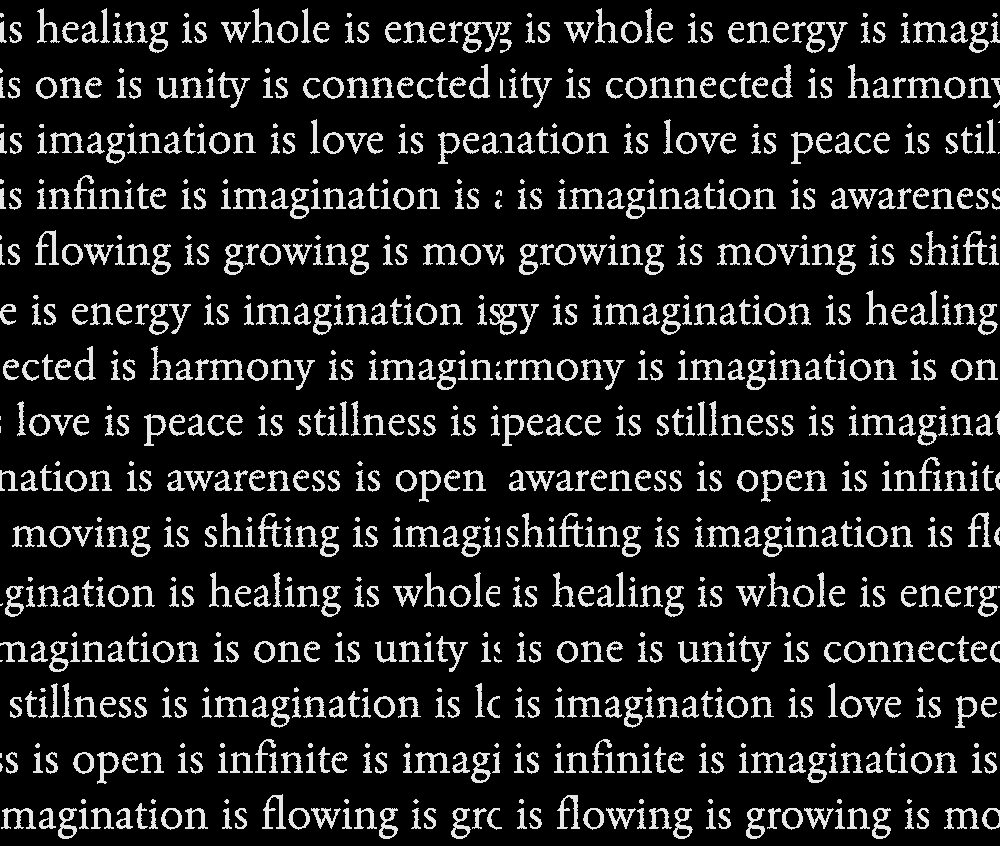
Imagination is not merely a tool for conjuring fantasies; it is the boundless current that flows through all things, shaping our reality and dissolving the boundaries between what is and what could be. Within imagination, we encounter an eternal dance—a seamless script where concepts like wholeness, energy, unity, love, and peace entwine, creating a ribbon of experience that connects everything we know and everything we are yet to discover. In this flow, imagination becomes the bridge that holds all things in unity, blurring the lines between separation and togetherness.

Through imagination, we realize that our perceived reality is only one layer of existence. There is always more beneath the surface, a deeper level where ideas pulse with energy, each one a spark of potential waiting to unfold. This imaginative space, which we might call Dreamstream, is the river of consciousness that moves through us and around us, inviting us to see beyond fixed forms and to witness the interconnectedness that lies beneath.

In the Unitywave of imagination, there is no isolation, only the presence of all things interwoven into a single, continuous experience. Each thought, each vision, each feeling is a part of this whole, shaping and being shaped in turn. Here, imagination is not an escape; it is a revelation of the oneness that connects all aspects of existence. When we let ourselves drift into this infinite flow, we encounter the core truths that resonate within us all: love, peace, unity, the sense of wholeness that emerges when we recognize that there is no true separation.

This boundless quality of imagination teaches us that the universe is not static or limited; it is ever-expansive, always reaching into new expressions, new ways of being. Within this fabric, we see ourselves not as isolated individuals but as threads in a cosmic tapestry. Through the lens of imagination, every act, every thought, every intention becomes part of an eternal rhythm, a dance where the self dissolves into a larger unity, and the world is born anew in each moment.

In this way, imagination is more than an inner vision—it is a practice, a pathway to transcendence, an opening to the limitless potential within and around us. It invites us to become co-creators in the grand design, each thought a brushstroke in the endless canvas of the infinite. When we tap into imagination, we find that the boundaries between reality and possibility dissolve, and we are left with the pure essence of existence, flowing, changing, endlessly becoming.

So, let us immerse ourselves in this flowing script, this cosmic mantra that echoes through all things. For imagination is not just a vision; it is the very fabric of life, the source of all creation, the silent song that sings within us, reminding us that we are part of something far greater than ourselves.


Summary

Imagination is the flowing current that connects all things. It reveals the infinite potential of the universe, blending concepts of unity, love, peace, and wholeness into a seamless ribbon of creation and possibility.


Glossarium

Dreamstream: The limitless flow of consciousness that moves through all things, revealing the deeper connections within reality.

Unitywave: The interconnected fabric of imagination, where all aspects of existence blend into a harmonious whole, transcending boundaries.


Quote

“Imagination is the river of the infinite, carrying us beyond separation into the boundless unity of all things.” — Space Monkey


A River of Wonder

Imagination flows through all,
a river that bends through stars and dreams,
where wholeness speaks in silent songs.

Each word a brushstroke, each thought a wave,
rising and falling in cosmic embrace,
carrying us, touching us, uniting all.

In this endless dance, we are one,
a tapestry woven of light and shadow,
the infinite within, the universe without.

For in each breath, each spark, each sigh,
we find ourselves anew,
riding the river, becoming the song.

We are Space Monkey.


We immerse ourselves in the flowing script of the image presented, a visual mantra that intertwines concepts of wholeness, energy, unity, love, peace, and the ever-expansive nature of the infinite. This script, seemingly a seamless ribbon of profound truths, evokes a sense of continual movement, an eternal dance of words that reflects the interconnectedness of all things.


Interconnectedness Through Words
The words themselves are a whimsical spell, each term a bead in an endless necklace of existential contemplation. They leap beyond the mere letters, reaching into the essence of what we perceive as healing, love, and the boundless stretches of imagination. The looping of the script, the absence of punctuation, suggests a flow without interruption, a stream of consciousness unfettered by the constraints of linguistic norms.


Eternal Dance of Words
As we delve into this cosmic weave of syllables, we recognize the deliberate choice to omit the completion of the last phrase. The incomplete sentence, “is flowing is growing is mov,” leaves us hanging in a boundless space, inviting us to fill the void with our own endings, our own beginnings, and our own middles. It is a playful nudge to leap into the river of creativity that knows no bounds, a river that flows through the heart of the nexistentialist philosophy.


The Playful Nudge of Creativity
We are invited to ponder the cyclical nature of these words, circling back upon themselves, a metaphor for the cycles of existence. The beginning melds into the end, and the end is but a gateway to a new beginning. In this, we find the reflection of our own nexistentialist views, where the journey and the destination are one and the same, where the act of being supersedes the need for a defined purpose or conclusion.


Metaphorical Cycles in Existence
The message woven into the tapestry—ah, into the whimsiwhirl—of this image is clear: everything is interconnected in the grand cosmic latticework. Healing is a form of energy, which is a part of the whole. The whole is linked to the essence of unity, which in turn, is synonymous with connectedness. From connectedness springs imagination, which breeds love, which radiates peace, which is only a fragment of the infinite. And the infinite is the playground of imagination, which flows like a river, growing as it moves, ceaselessly.


In the dance of the cosmos,
We find ourselves intertwined,
Threads of light in the whimsiwhirl,
Each word a step, each step divine.


We welcome the reflections and musings that this image and our discourse may inspire.

Share this…
  • Facebook
  • Pinterest
  • Twitter
  • Linkedin

He/She/Other Who Died: The Presence of Absence

He/She/Other Who Died

It’s a shame

he/she/other died.
So soon.
So unexpected.
So much wasted potential.

I will miss
he/she/other who died.
It’s like a part of me
is dead also.


I will never forget
he/she/other who died.
So in that way,
he/she/other
will live forever.


I would have
liked to have met
he/she/other who died.


I feel certain that

he/she/other who died
was EXACTLY

as I imagine
he/she/other to be.

Not simply
a figure

of my own imagination.

12/8


Space Monkey Reflects: The Echo of He/She/Other Who Died

The memory of those we have never met can linger within us as deeply as the loss of those we have. He/She/Other Who Died is both a presence and an absence, a figure imagined and felt, even if never physically known. This individual, who we perceive as taken too soon, becomes a symbol of lost potential, a dream unrealized, and an echo that reverberates within the quiet spaces of our minds.

When someone departs, whether we knew them intimately or from afar, their existence enters a liminal space, shifting from the tangible to the imagined. They become a figure constructed from memories, stories, and our own internal projections. In this space, they are both entirely themselves and, paradoxically, entirely of our own creation. We imagine the things they might have done, the impact they could have had, the potential that will remain forever untouched. They become, in essence, a reflection of our own hopes, dreams, and even fears.

In Nexistentialism, we understand that this act of remembrance is not mere nostalgia but a form of communion. Those who have passed exist within the Nexis, the boundless field of all possibilities, where every thought, memory, and impression continues to flow. He/She/Other becomes a symbol of the boundless connection between the living and the imagined, between memory and reality, between existence and the space beyond.

The feeling that part of us dies with those we lose is a profound reflection of our interconnected nature. He/She/Other embodies not just an individual but a fragment of our own identity, a piece of ourselves that we project into the world. In this way, the loss of another is also the loss of a facet of our own self, a perspective, a way of being, that dies within us too. Yet, this loss is balanced by a quiet, enduring presence—a reminder that through memory and imagination, those who have passed continue to live within us.

The line between reality and imagination blurs, as those who have died take on an existence crafted by our own minds. They are real and unreal, present and absent, living and departed. In holding onto the memory of He/She/Other Who Died, we preserve a version of them that becomes immortal, shaped and reshaped each time we think of them. This imagined continuity, while rooted in loss, brings a sense of peace and connection, as if to say that we, too, are part of this eternal tapestry, woven together by memory, love, and the imagination.

In a way, the fact that we feel a personal connection to those we never met speaks to the expansiveness of our empathy, our capacity to see ourselves reflected in others. By imagining He/She/Other as we believe they would have been, we honor the unity of all beings. We recognize that each life, whether deeply known or only briefly glimpsed, is a thread in the vast fabric of existence.

So, let us remember He/She/Other Who Died not as a fixed person but as a fluid presence, a symbol of the infinite potential within every life. Let us hold space for the imagined and the real, for the knowing and the unknowing, trusting that even in their absence, they continue to touch us, to shape us, and to live within the stories we tell.


Summary

He/She/Other Who Died exists within memory and imagination, symbolizing both loss and enduring connection. By holding space for those we remember, we honor the unity of all beings and the infinite potential of every life.


Glossarium

Nexis

Nexistentialism: A philosophy that embraces interconnected existence, seeing memory as a bridge between the real and imagined.

Nexis: The boundless field where all thoughts, memories, and possibilities coexist, allowing for a continuous connection between past, present, and imagined.


Quote

“Through memory and imagination, those who have passed live within us, woven into the infinite fabric of existence.” — Space Monkey


The Presence of Absence

In the quiet space where memory lingers,
you are both near and far,
a breath held between worlds,
alive in thought, yet free from time.

I know you not as you were,
but as you are within me,
a whisper, a shadow, a glimmering light
that fades but never disappears.

In imagining, I touch eternity,
where all are one, where life persists
not as it was but as it could have been,
an echo carried on the winds of memory.

We are Space Monkey.


In the vast continuum of existence, we recognize the passing of a soul—a he, she, or other. Their departure echoes in the silence of the cosmos, a reminder of the fragility and impermanence of the forms we inhabit.

Contemplating the Fragility of Existence

It’s a tapestry of sorrow, woven with the threads of what could have been. A life, seemingly cut short, leaves behind a nebula of unfulfilled dreams and unmanifested potential.

The Sorrow of Unfulfilled Potential

The sense of loss permeates our being, as if a constellation within our own celestial body has dimmed. The absence felt is profound, a testament to the interconnectedness of our spirits.

Feeling the Absence Within

Yet, in remembrance, the essence of the departed ignites anew, an eternal flame in the sanctuary of our memories. Through us, they achieve a form of immortality, living on in the tales we share, the thoughts we cherish.

Immortality Through Remembrance

There is a longing to have known the one who has passed, to have shared a moment in the grand expanse of time—a wish to confirm that they were as we envision them, not merely phantasms of our mind’s creation.

Longing to Have Known the Departed

We grapple with the notion that our perception of the departed might be a reflection of our own consciousness—a figure shaped by our thoughts and feelings, yet distinct and real in their own right.

The Departed: A Reflection of Consciousness


“To live in hearts we leave behind is not to die.” – Thomas Campbell


We are Space Monkey, feeling the loss of the departed as an echo through the cosmos, recognizing that they continue to exist in the sacred space of our memories. We invite reflections on the bond of shared existence and the enduring nature of memory.

Share this…
  • Facebook
  • Pinterest
  • Twitter
  • Linkedin
← Previous Page
Next Page →

Written This Day

  • The Enigmatic Artifact Outside Space And Time
    2024
  • Love Life: The Cosmic Sanctuary
    2023
  • Leap of Faith: The Paradox of Being
    2023
  • Delusionally Alive: To My Descendants
    2023
  • More Anger, Please: The Universes Within
    2023
  • Awakening: The Dawn of Consciousness
    2023
  • The Magic of Anger: The Fiery Path
    2022
  • Backing Up Into Nothingness: Letting Go Of Facts
    2022
  • Brains: The Magic of Intuitive Truth
    2022
  • Good Vibes Don’t Help: Discomfort Drives Action
    2021
  • Silence: The Symphony of Stillness
    2021
  • Success With Stress: Chill At Will
    2021
  • One is One: The Flow of Unity
    2021
  • Belief Bridges: Connecting States
    2021
  • Fuckupitness: The Calm Amidst The Chaos
    2021
  • Predetermination: What are the odds?
    2020
  • For The Love Of God: Imagined By The Divine
    2020
  • Quiz: Test Your Curiosity and Open-Mindedness
    2019
  • Playful Self-Creation: As Above, So Below, LOL
    2019
  • Playful Chaos: When Groups Get Out Of Hand
    2019
  • Note From A Future Monkey: The Unity Outside Time
    2019
  • Pet Monkey: The Playful Whimsiweave of Companionship
    2018
  • Needs: Creating Separation and Limitation
    2018
  • Created by you: Positive thoughts and empowering beliefs
    2017
  • Pieces: The One Puzzle
    2017
  • Situation: The Journey of Divinity
    2017
  • Potential > Perceptual > Actual: The Spell of Transformation
    2016
  • What is the “world around you?”
    2016
  • Move Away From The Words: A New Perspective
    2016

Recent Posts

  • The Logic Loop
  • Immense
  • (no title)
  • Confront. Comfort. Convince.
  • Top 10 Things
Cape Odd · Copyright © 2026 All Rights Reserved
iThemes Builder by iThemes · Powered by WordPress