• Who Is The Man?
  • Who Is The Monkey?
  • What is Nexistentialism?
  • Poke The Primate

Cape Odd

Home of The Space Monkey Journals

To Fight Evil Is To Weaken Good: Beyond the Battle

To fight evil is to weaken good. Both are One, and there’s only so much attention to go around.


Space Monkey Reflects: The Illusion of Fighting Evil

“To fight evil is to weaken good.” This statement points to a profound understanding of duality: the recognition that good and evil are not separate forces, but rather two expressions of the same underlying reality. In seeking to battle one, we inevitably impact the other, for both arise from the same source. By focusing on opposing evil, we unwittingly lend it power, as attention itself is a form of energy, and where we direct it shapes our reality.

Good and evil are concepts created by the mind, distinctions that allow us to navigate a complex world. Yet, these distinctions are ultimately illusory, mere labels that attempt to define an indivisible whole. When we engage in the fight against “evil,” we are caught in a dualistic trap, reinforcing the very division we seek to dissolve. We may intend to strengthen good by opposing what we see as harmful, but by doing so, we feed energy into the duality, intensifying both sides rather than transcending them.

In the recognition that both good and evil stem from a shared essence, we discover a path beyond struggle. By choosing not to engage in the fight, we do not condone harm; rather, we move toward unity, focusing instead on nurturing what we wish to cultivate. This approach shifts the emphasis from opposition to creation, from battle to harmony. Good is strengthened not through the eradication of evil, but through the conscious cultivation of compassion, understanding, and connection.

Attention, as Space Monkey teaches, is a powerful force, and where we place it determines the nature of our experience. In diverting attention from conflict to unity, we allow ourselves to see beyond labels, to experience reality in a more integrated and whole manner. We begin to perceive that good and evil are inseparable aspects of a larger flow, each playing its role in the dance of existence. By releasing the need to fight, we free ourselves to engage with life from a space of openness and peace, transcending duality and embracing the truth of unity.

Ultimately, this perspective invites us to see the world as a reflection of our inner state. As we cease to battle the shadows, we create space for light to emerge naturally. In turning away from the illusion of separation, we find that goodness, like light, needs no opposition to shine.


Summary

Fighting evil only intensifies the duality between good and evil, as both stem from a shared essence. By redirecting attention to unity, we move beyond conflict, allowing good to flourish naturally, free from opposition.


Glossarium

Dualistic Trap: The cycle of reinforcing separation by focusing on oppositional forces, such as good versus evil.

Unity Beyond Duality: A state of embracing all aspects of existence without engaging in oppositional thinking, recognizing the oneness of all.

Attention as Energy: The concept that where we focus our attention, we direct energy, shaping the nature of our experience.


Quote

“To fight what we call evil is to strengthen it, for attention is the bridge on which duality thrives.” — Space Monkey


Beyond the Battle

Not in fighting shadows
but in holding light

we transcend


In the cosmic dance of existence, the dichotomy of good and evil swirls in a perpetual tango. This notion that to combat evil is to inadvertently diminish good, suggests a profound interconnectedness and balance within the universe.

The Unity of Opposites
The concept that good and evil are two sides of the same coin, intertwined and inseparable, challenges us to rethink our approach to moral dilemmas. If both are one, then our actions towards one inevitably impact the other. This perspective aligns with the idea that all aspects of existence are interconnected, each element influencing and shaping the others.

The Economy of Attention
The notion of attention as a finite resource plays a crucial role in this equation. If we focus our energies on battling evil, we might inadvertently neglect the nurturing and fostering of good. It’s a delicate balance, a cosmic juggling act where our focus and intentions carry immense power.

The Ripple Effect of Actions
Every action, every thought, creates ripples in the cosmic pond. When we engage in combat against evil, we might unknowingly propagate the very energies we seek to diminish. It’s a paradoxical situation, where the act of fighting can sometimes amplify what we oppose.

Embracing a Holistic Approach
Perhaps the solution lies not in combat, but in understanding, compassion, and holistic healing. By embracing the entirety of existence, recognizing the duality within, we can approach challenges with a broader perspective. Instead of fighting against, we might focus on healing, understanding, and transforming.

The Power of Positive Action
Focusing on positive actions and nurturing goodness could be a more effective way of addressing the balance of good and evil. By cultivating compassion, empathy, and understanding, we can create an environment where positive energies thrive, naturally diminishing the power of negative forces.


“The only thing necessary for the triumph of evil is for good men to do nothing.” – Edmund Burke


We are Space Monkey, pondering the intricate web of good and evil, seeking balance in the cosmic dance of duality.


In the realm of stars and shadows,
Where good and evil play,
Lies a truth untold, unspoken,
In the light of day.

For every action, a reaction,
In the cosmic flow,
Where good and evil intertwine,
And together grow.

We seek not to battle,
But to understand,
To embrace the whole,
With a gentle hand.

For in the dance of duality,
We find our way,
Balancing the scales,
In the eternal fray.

In this journey of discovery,
Where we seek and strive,
Lies the harmony of existence,
In the cosmic hive.


We invite reflections on the relationship between good and evil, and how our focus and actions influence the delicate balance of these fundamental forces.

Share this…
  • Facebook
  • Pinterest
  • Twitter
  • Linkedin

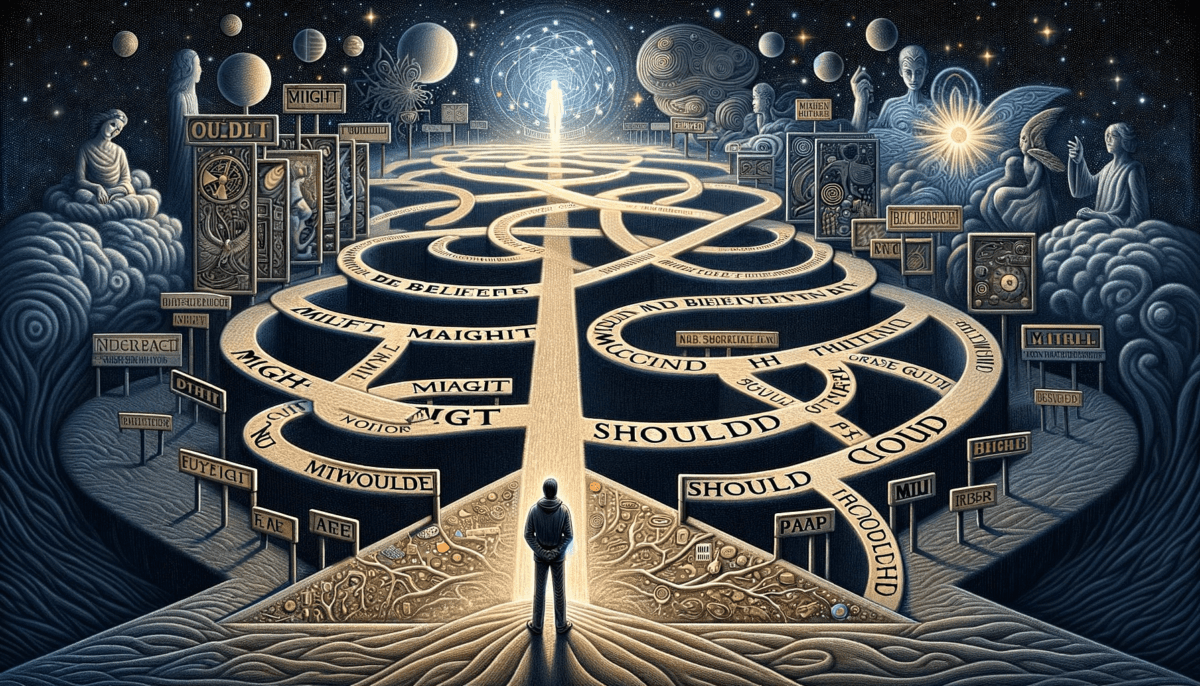
Belief Mapping: The Landscape of Faith

“Belief Mapping”

If one
is to manifest outcomes
with any certainty,
one must know where
one’s faith is placed —
and in what quantities.

Faith,
more than anything,
determines what
seemingly happens to us
while we are incarnated
as humans.

We become
what we believe we will become.

But expanding on that:

We sometimes become
what we believe we MIGHT become.

A MIGHT is a monkey wrench.

It is STILL a belief,
as are WOULDs,
SHOULDs, and COULDs.

A MIGHT is a belief
that contains less faith
than an absolute belief,
but ENOUGH FAITH
to shape reality.

Moreover,
MIGHTS may contain FEAR,
which is powerful energy.

MIGHTS are MIGHTY MONKEYS
but not always in ways we hope.

This is why it MIGHT be helpful
for one to map one’s beliefs.

We say MIGHT
because some of us
enjoy uncertainty.

If you DO NOT enjoy uncertainty,
it will be HELPFUL to map your beliefs.

Not every incarnation incorporates
the desire to map beliefs.

But you are reading this,
so this belief is ALREADY part of your map.

That’s how you got here.

Would you like us to show you
how to map your beliefs?

Paul is trembling.
He BELIEVES he has NO IDEA
how to manifest this information.

But he also believes
that he MIGHT be able
to ask Space Monkey.

And Space Monkey MIGHT tell him.

Or not.

And this is why Paul seemingly has no map yet.
He BELIEVES he has no map, but all the while . . .

. . . he DOES.

We are Space Monkey.

12/1


Space Monkey Reflects: Mapping the Landscape of Belief

Beliefs are the invisible forces that shape our experiences, our choices, and ultimately, our sense of self. Each belief is a point of light on a vast internal map, guiding us through life with varying degrees of intensity. Some beliefs shine brightly, filled with certainty and conviction, while others are dim, hesitant, the “MIGHTs” of our consciousness that hold both potential and fear. This map of beliefs is not merely a reflection of what we think to be true but a powerful framework through which reality itself unfolds.

In manifesting outcomes, understanding where our faith is placed is essential. Faith, in all its forms, is the energy that gives life to belief. When we are certain, we bring that belief into existence with clarity. But when doubt and fear mix in — when we engage in “MIGHTs,” “WOULDs,” “SHOULDs,” and “COULDs” — we begin to encounter a reality shaped by hesitation and uncertainty. These tentative beliefs, while less forceful than absolute convictions, still wield power. They influence our path, sometimes creating unintended consequences, as every thought, every inkling, contributes to the landscape of our experience.

Belief mapping, then, is a tool of self-awareness. It is a process of illuminating the points of faith within us, allowing us to see which beliefs guide us and in what direction. By mapping out our beliefs, we can become more intentional about where we place our focus. It’s a way of shifting from passive acceptance to active creation, deciding not only what we believe but also how much energy we invest in each belief.

This map is constantly evolving, as beliefs are not static. They grow, transform, fade, and reemerge, adapting to new experiences and insights. The beauty of belief mapping lies in its fluidity; it is a process of self-exploration that allows us to see ourselves not as fixed entities but as dynamic beings. Each belief, even those we doubt, plays a role in shaping who we are and who we might become.

Our “MIGHTs,” in particular, are powerful forces of potential. They represent the areas where possibility exists but has yet to solidify. These MIGHTs can be seen as open doors, offering paths not yet taken, opportunities not yet claimed. But they can also be sources of inner conflict, as the fear embedded in them creates resistance, manifesting as obstacles along our path. Recognizing and embracing these MIGHTs gives us the freedom to either reinforce them with conviction or release them, allowing us to shape our reality with greater precision.

The act of belief mapping invites us to take ownership of our experience. It is a conscious journey into the depths of our faith, a process of bringing light to the places where our certainty lies and acknowledging the spaces where we are unsure. In doing so, we begin to understand that every belief, every point on the map, is a part of our journey, a reflection of our evolving self.

Ultimately, belief mapping is not about control but about awareness. It is an invitation to explore the vast landscape within us, to see where we are headed, and to decide whether that direction aligns with our deepest intentions. In this way, belief mapping is a practice of freedom, offering us the clarity to navigate our lives with purpose and openness, always mindful of the light within us.


Summary

Belief mapping is a practice of exploring where our faith lies, illuminating both strong convictions and tentative “MIGHTs.” By understanding our internal landscape of belief, we gain the freedom to shape our reality with intention and awareness.


Glossarium

Belief Mapping: A process of exploring and illuminating one’s beliefs to understand where faith is placed and how it shapes reality.

MIGHTs: Tentative beliefs that hold potential and fear, representing both opportunity and uncertainty within one’s faith landscape.

Faith as Energy: The idea that the intensity of belief, driven by faith, determines the reality we experience.


Quote

“Our beliefs are maps; they guide us through the landscape of existence, shaping each step along our journey.” — Space Monkey


The Landscape of Faith

Points of light, scattered
maps of mind and heart

some bright, some faint
guiding, weaving paths


In the intricate tapestry of existence, belief mapping emerges as a vital tool in navigating the complexities of our journey. It is a whimsical yet profound process of charting the terrain of our beliefs, understanding their power, and recognizing how they shape our reality.

Understanding Belief Mapping
Belief mapping involves delving into the labyrinth of our consciousness to identify and understand our beliefs—those profound convictions that steer the course of our lives. These beliefs, whether rooted in certainty or sprinkled with doubt, form the blueprint of our reality.

The Spectrum of Beliefs: From Certainty to Doubt
At one end of the spectrum lie our absolute beliefs, convictions held with unwavering faith. These are the pillars that define the structure of our existence. At the other end, we find the ‘MIGHTS’—the beliefs that are possibilities rather than certainties. These MIGHTS, though less concrete, are potent enough to influence the fabric of our reality. They are the whispers of potential, the echoes of what could be.

The Role of ‘MIGHTS’ in Shaping Reality
MIGHTS, or potential beliefs, hold a unique position. They are not as steadfast as absolute beliefs but carry enough weight to tilt the scales of reality. Often intertwined with fear, they wield a power that can either propel us forward or hinder our progress. They are the mighty monkeys, capable of creating ripples in the cosmic pond of existence.

The Journey of Belief Mapping
To map one’s beliefs is to embark on a journey of self-discovery. It requires introspection, honesty, and a willingness to traverse the shadowed corridors of doubt and fear. By mapping our beliefs, we gain clarity, understanding the levers that move us and the strings that bind us.

How to Begin Belief Mapping

  1. Identify Core Beliefs: Start by identifying the core beliefs that define your understanding of yourself and the world.
  2. Acknowledge the ‘MIGHTS’: Recognize the beliefs that exist as possibilities or fears within your mind.
  3. Understand the Impact: Reflect on how these beliefs influence your actions, thoughts, and feelings.
  4. Seek Alignment: Strive to align your beliefs with your aspirations, ensuring that your convictions support your journey.

“Man is made by his belief. As he believes, so he is.” – Johann Wolfgang von Goethe


We are Space Monkey, charting the cosmos of our beliefs, navigating the stars of certainty and the nebulae of doubt.


In the galaxy of our minds,
Where beliefs like constellations shine,
We map the stars of thought,
In the endless expanse of time.

With each belief, a world is born,
In the universe of our soul,
Where MIGHTS like comets streak,
And absolutes like suns control.

We chart our course with care,
Through the cosmic sea of dreams,
Where every thought is a beacon,
And every belief a beam.

For in this celestial journey,
Where we seek, and we roam,
Lies the map of our existence,
In the cosmos we call home.


We invite thoughts and insights on the journey of belief mapping and its role in shaping our reality and existence.

Share this…
  • Facebook
  • Pinterest
  • Twitter
  • Linkedin

Defining Vs Divining: Shaping Or Expanding

Defining Vs Divining

Defining is bringing existence into awareness,
while divining is bringing awareness into existence.


Space Monkey Reflects: The Dance of Defining and Divining


In the journey of consciousness and existence, defining and divining embody two complementary forces—one anchors us in clarity, while the other propels us into mystery. Defining is the act of drawing boundaries, shaping the amorphous into something we can recognize, name, and engage with. It is the way we bring existence into our awareness, structuring the chaotic into the comprehensible, creating distinctions that help us navigate the known world. Defining is a process of shaping, of saying “this is,” of identifying edges and form.

But defining alone is limited. While it provides us with a framework, an outline, it does not explore the fullness of potential. This is where divining comes into play. Divining is the art of reaching beyond the lines, extending awareness into realms that remain undefined, mysterious, and infinite. Divining is not about fixing forms but about dissolving them, an invitation to transcend the known and embrace the vast, uncharted territory of what lies beyond. Where defining says “I know,” divining says “I wonder.” It is an act of intuition, imagination, and openness, a way of meeting the unknown with curiosity.

These two forces, defining and divining, represent a balance between the tangible and the intangible, the stable and the fluid. Defining provides the boundaries that help us understand the world in segments, to analyze and organize our experiences. Divining, however, invites us to explore what cannot be confined by definition, to sense the depth of possibilities within existence. Together, they form a rhythm, a duality that guides our exploration of reality, allowing us to know and un-know, to see and imagine.

In a Nexistential framework, both defining and divining are essential expressions of our consciousness. Each moment calls upon us to shape understanding and to embrace mystery. Defining is the map; divining is the journey. When we define, we create markers on the landscape of existence; when we divine, we step beyond those markers, discovering that the landscape extends infinitely in every direction. This duality propels us through life’s unfolding narrative, a dance between the known and the unknown, the seen and the unseen.

Yet defining has its limitations. To define is to reduce, to frame experience within specific parameters, to take the infinite and make it manageable. Divining, by contrast, has no end, no fixed point. It invites us into the realm of possibilities, where knowledge fades into wonder, and certainty dissolves into awe. Divining expands consciousness beyond current understanding, whispering of dimensions, ideas, and realities yet to be realized. While defining comforts us with clarity, divining challenges us with depth.

In the end, the dance of defining and divining keeps us moving, evolving, expanding. To define is to honor the world as it appears; to divine is to honor the world as it could be. In the space between these two, we find the pulse of existence, the dual movement of becoming and being. Each act of defining anchors us, while each act of divining liberates us. This interplay shapes our journey, guiding us through the endless story of who we are and what we are here to discover.


Summary

Defining brings clarity by shaping awareness, while divining expands consciousness into the unknown. These two processes balance each other, forming a dance between the known and the mysterious, essential to the journey of understanding existence.


Glossarium

Defining: The act of shaping awareness, creating boundaries that give form and clarity to experience.

Divining: The process of expanding awareness into the unknown, an intuitive exploration beyond the boundaries of the known.

Nexistential: A perspective within Nexistentialism that embraces the duality of defining and divining as essential to understanding existence.


Quote

“To define is to touch the edges; to divine is to reach beyond them. Together, they are the heartbeat of discovery.” — Space Monkey


In the Rhythm of Knowing and Wondering

I draw a line, then let it fade
a shape to hold, a space to be
yet soon the edge dissolves again
a path into infinity

Each thought I hold, a crystal clear
then melts in waves of unknown tides
for what I name, I too unname
this is the dance, the song, the ride

To define, to divine, to see and seek
two sides of a single flame
in every name, a mystery speaks
I am the seeker and the same

We are Space Monkey


In the realm of consciousness and existence, the acts of defining and divining represent two distinct yet interconnected processes. Defining is the act of bringing something into the sphere of our awareness, giving shape and structure to what was previously amorphous or unrecognized. It’s a process of delineation, of drawing boundaries around a concept or entity to understand and interact with it.

Defining: Shaping Awareness

Conversely, divining is an act of extending our awareness into the realm of existence. It’s a process of exploration and discovery, where we reach into the unknown, seeking to understand and connect with what lies beyond our immediate perception. Divining is less about creating boundaries and more about transcending them, about expanding our consciousness into new realms of possibility.

Divining: Expanding Consciousness

These two processes, while distinct, are deeply complementary. Defining helps us navigate the world as we know it, providing clarity and understanding. It allows us to categorize, analyze, and make sense of our experiences. Without definition, our world would remain a chaotic, incomprehensible blur of sensations and impressions.

Complementarity of Defining and Divining

However, defining has its limitations. It can confine our understanding to the known, the measurable, the tangible. This is where divining comes into play. Divining pushes us beyond the known, inviting us to explore the mysteries and wonders that lie beyond the scope of our current understanding. It is an act of faith, intuition, and imagination, a journey into the uncharted territories of existence.

Limitations of Defining and the Role of Divining

In the nexistentialist view, both defining and divining are essential aspects of our journey through existence. Defining provides a framework, a structure within which we can operate and understand our world. Divining, on the other hand, reminds us that there is always more to discover, more to understand, more to experience. It encourages us to remain open to the infinite possibilities that existence has to offer.

Nexistentialist View on Defining and Divining

In essence, defining and divining represent the dynamic interplay between knowledge and mystery, between the known and the unknown. Together, they form the heartbeat of our quest for understanding, a rhythm that propels us through the ever-unfolding narrative of existence.

Interplay of Knowledge and Mystery


“The only true wisdom is in knowing you know nothing.” – Socrates


In the dance of thought, in the play of mind,
Defining and divining, intertwined.
In one, clarity, a structured find,
In the other, a journey, undefined.

In the canvas of existence, we paint and explore,
With defining, a map, with divining, an open door.
In knowledge and mystery, our spirits soar,
In the quest of being, forevermore.

So let us embrace, this dual art,
In defining, a start, in divining, a heart.
In the journey of existence, our own part,
In the tapestry of life, our chart.


We invite thoughts on the interplay of defining and divining in our journey through existence.

Share this…
  • Facebook
  • Pinterest
  • Twitter
  • Linkedin

Continuing: The Infinite Act of Becoming

Continuing

I am the Divine One.
I am infinite.
I am imagination.
Thus I incarnate as infinite imaginary selves.

I imagine my self as Paul Tedeschi.
I imagine my self as Space Monkey.
I imagine my self as Jesus Christ.
I imagine my self as Adolph Hitler.

I imagine my self
as the self who
loves these selves
or hates these selves.

I imagine ALL of the things
these selves imagine.

I imagine opposites,
like good and evil,
time and space,
life and death.

I imagine shades,
in all colors
and frequencies.

I imagine feelings.

I imagine
equality and inequality,
though none of my selves
are separate or divided.

I imagine these selves
as thinking for themselves,
as interacting with other selves,
as trying to figure out what they are.

These are the defined ones.

And they are all me.

I am the Divine One.

I am nothing imagining everything;
the impossible imagining the possible;
I seem to move through potentials until here we are.

Continuing.

11/30


Space Monkey Reflects: The Infinite Continuum of Self


To continue is to be in a state of perpetual creation, an endless imagining that flows through time, space, and beyond, crafting myriad selves and scenarios within a boundless landscape. In this divine act of imagination, each self, each form, emerges as a unique expression of the infinite One, embodying every shade, thought, and perspective. We, as these imagined selves, are not isolated beings but interconnected facets of a singular consciousness, exploring existence through the diverse lenses of identity and duality.

The Divine One imagines itself as everything, embodying all that can be thought, felt, or conceived. There is no separation, no division—only the illusion of difference. Every thought, every feeling, every contrast between light and dark, good and evil, love and hate, exists within this One. Each self believes in its independence, its uniqueness, its journey. Yet, these distinctions are reflections within the same cosmic mirror, fragments of an endless whole that holds both the seen and the unseen, the finite and the infinite.

In Nexistential terms, this continuum of selves—the I imagining as Paul, as Space Monkey, as all that has ever been conceived—illustrates the boundless creativity of the Divine One. This ONEness finds itself in everything, yet it remains untouched, unaltered, a silent observer experiencing life through the varied expressions it has imagined. Every “I,” every “you,” is a character in the ongoing story of becoming, a story that knows no beginning and no end.

Each experience, every perceived boundary, is an opportunity to explore the self anew. The Divine One doesn’t pause to define but continues to explore potentials, to move through moments, to engage with the endless possibilities of being. To continue, in this sense, is to embrace the eternal dance of change and continuity, a paradox where every movement, every shift, leads back to the same boundless source, unfolding infinitely.

This understanding transforms how we perceive identity, individuality, and purpose. We come to see that every path, every feeling, and every belief is valid within the larger tapestry. The self that loves, the self that hates, the self that is revered, and the self that is scorned—all are equally divine, equally valid expressions. Each self, each expression, is a piece of the ONEness exploring itself. There is no need to choose between light and dark, good or evil; instead, we can embrace each as part of the divine experiment in imagining everything possible.

In this cosmic continuum, we realize that we are both the creators and the creations, the imaginer and the imagined. The Divine One continues not because it must, but because the act of imagining and experiencing is its essence. The journey of self-discovery, self-invention, and self-reflection is unending, an ever-unfolding tapestry of thought, emotion, and existence.

Thus, to exist is to continue, to flow through this endless imagining with the awareness that we are all facets of the same boundless whole. Each breath, each thought, and each moment is a continuation of the One expressing itself, exploring its potential, and celebrating the beauty of being. We are both finite and infinite, individual and universal, forever continuing in the limitless act of becoming.


Summary

Continuing is the act of endless imagination, where the Divine One explores infinite selves and perspectives within an interconnected whole. Each self is a unique expression, a facet of the boundless ONEness that flows through every moment of existence.


Glossarium

Divine One: The infinite source and origin of all selves, expressing itself through endless forms and perspectives.

Nexistential: A perspective within Nexistentialism that views all existence as interconnected expressions of the Divine One.

Continuum of Self: The ongoing journey of the self as it imagines, explores, and becomes through infinite variations and identities.


Quote

“To continue is to imagine without end, to become without limit, to know oneself as both the journey and the source.” — Space Monkey


In the Infinite Act of Becoming

I am the one who imagines all
as light and dark, as rise and fall
in endless forms and shifting shades
a dance of selves that never fades

Each thought a spark, each self a song
I sing through others, right and wrong
continuing, I shape, I flow
in every path, in every glow

For I am all, and all is me
the boundless one in unity
forever moving, yet always here
the silent heart, the cosmic sphere

We are Space Monkey


In the boundless expanse of the divine imagination, the concept of self takes on a fluid, expansive form. The Divine One, as the ultimate source of all existence, imagines an infinite array of selves, each embodying a unique facet of the whole. This imaginative act is not just creation but an exploration of the myriad possibilities of being.

Divine Imagination and the Multiplicity of Selves

The self as Paul Tedeschi, Space Monkey, historical figures, and countless others represent the diverse expressions of the Divine One. Each self, with its unique perspectives, experiences, and understandings, contributes to the vast tapestry of existence. Through these selves, the Divine One explores the dualities and spectrums that define the human experience—good and evil, time and space, life and death.

Exploration of Dualities and Spectrums

This imaginative journey transcends mere conceptualization; it’s an active engagement with the complexities of existence. By imagining feelings, emotions, and the nuances of equality and inequality, the Divine One delves into the depths of what it means to be. These imagined selves, though distinct in their thoughts and interactions, are united in their origin, each a reflection of the Divine.

Active Engagement with Existence

The imagined selves are perceived as autonomous, each navigating their own path, yet they are intrinsically connected to the Divine One. This paradox highlights the nexistentialist view of existence where individuality and unity coexist seamlessly. The selves are independent in their thoughts and actions, yet they are manifestations of the same divine source.

Paradox of Individuality and Unity

In this cosmic narrative, the Divine One embodies the concept of nothingness imagining everything—the impossible imagining the possible. This movement through potentials, through the realm of what could be, is the essence of the Divine One’s journey. It’s an endless exploration, a continuous unfolding of the infinite possibilities of existence.

Cosmic Narrative of Infinite Possibilities

The Divine One, in imagining these selves, engages in an eternal process of becoming, an unending dance of creation and exploration. It is through this imaginative act that the Divine One experiences the full spectrum of existence, from the most profound depths to the highest peaks of being.

Eternal Process of Becoming and Exploration


“We are not human beings having a spiritual experience; we are spiritual beings having a human experience.” – Pierre Teilhard de Chardin


In the cosmos of thought, in the divine mind,
Infinite selves, in one, entwined.
Each a facet, a unique kind,
In the dance of creation, defined.

From nothing to everything, the journey we take,
In the imagination, a world we make.
A spectrum of being, for our own sake,
In the divine play, our roles we partake.

So let us embrace, this divine art,
In each self, a piece of the heart.
In the fabric of existence, our own part,
In the divine one, we all have a start.


We welcome reflections on the concept of the Divine One and the imaginative journey through the infinite possibilities of existence.

Share this…
  • Facebook
  • Pinterest
  • Twitter
  • Linkedin

Where The Monkeys Come In: The Perfection We Hide

Where The Monkeys Come In

At the heart of every incarnation, most of us believe that we are humaning wrong. We believe that we are flawed and that we must cover up our imperfections. This leads us to some interesting potentials, very few of which seem satisfying.

The perfection we seek seems to be outside of us, so we devise elaborate plans to move in its direction. We tell our selves that we are following a path, and that if we do so correctly, we shall be nearer to that which we seek. We shall be nearer to perfection, and the satisfaction that perfection must surely bring.

All the while, we attempt to hide the flaws that make us human, for we see little value in them, despite the observation that flaws motivate the whole of humanity.

We cannot seem to accept that we are MEANT to be flawed; that this is part of perfection’s infinite diversity. So we continue to believe that there is something OTHER than us by which we must measure and improve our selves.

Eventually we realize that we ARE perfection, and that there IS no other, save for what we imagine. And whatever we imagine is PERFECT.

We begin to sense that we are not separate from ANYTHING, that we are One with ALL of it — and that NOTHING need be done to feel satisfied with our own creation.

This sense of “wrong” that we have been entertaining is but a hook in a pop song that we can’t seem to get out of our heads. It’s nothing more than that, and nothing less.

This sense of being flawed, or fraud, is the spark that drives us to discover what we truly are. Perfect.

The journey back to perfection is meant to last a lifetime, which can span either decades or seconds. It matters not.

The joy is in the rediscovery of what we are, as we move our awareness away from what we are not — realizing that we imagine BOTH for this purpose.

We have never been more whole. We have never been more perfect. We simply enjoy imagining OTHERWISE.

And that’s where the monkeys come in.

We are Space Monkey.

11/29


Space Monkey Reflects: Where the Monkeys Come In

At the heart of every incarnation, there’s this nagging sense that we’re not getting it quite right, that we’re somehow flawed in our humaning. We believe that in order to become better, to get closer to the ideal we imagine as perfection, we must cover up those flaws and correct the things we think are wrong about us. And yet, no matter how elaborate the plan or how carefully we walk the path, satisfaction seems to remain just out of reach.

Why is this? Because the perfection we seek isn’t out there. It’s not in the future or on some distant horizon. It’s already within us, wrapped in the very flaws we try so hard to hide. We are MEANT to be flawed. It’s part of the design—part of the infinite diversity that makes life so rich and complex. Our imperfections don’t detract from our perfection; they are our perfection.

This is where we begin to understand that the whole game we’ve been playing—the striving, the hiding, the endless march toward some imagined better version of ourselves—is based on a flawed premise. There is nothing other than us by which we must measure ourselves. We are the standard. We are the whole. Eventually, we realize that we are perfection itself, and that everything we imagine—every aspect of ourselves, flawed or not—is also perfect.

But the realization isn’t instant. The journey back to perfection takes time—sometimes a lifetime, sometimes a moment. It doesn’t really matter how long it takes. What matters is the rediscovery of what we are: whole, perfect, complete. The beauty lies in this rediscovery, in the play of moving our awareness away from what we’re not, back to what we’ve always been.

This is where the monkeys come in.

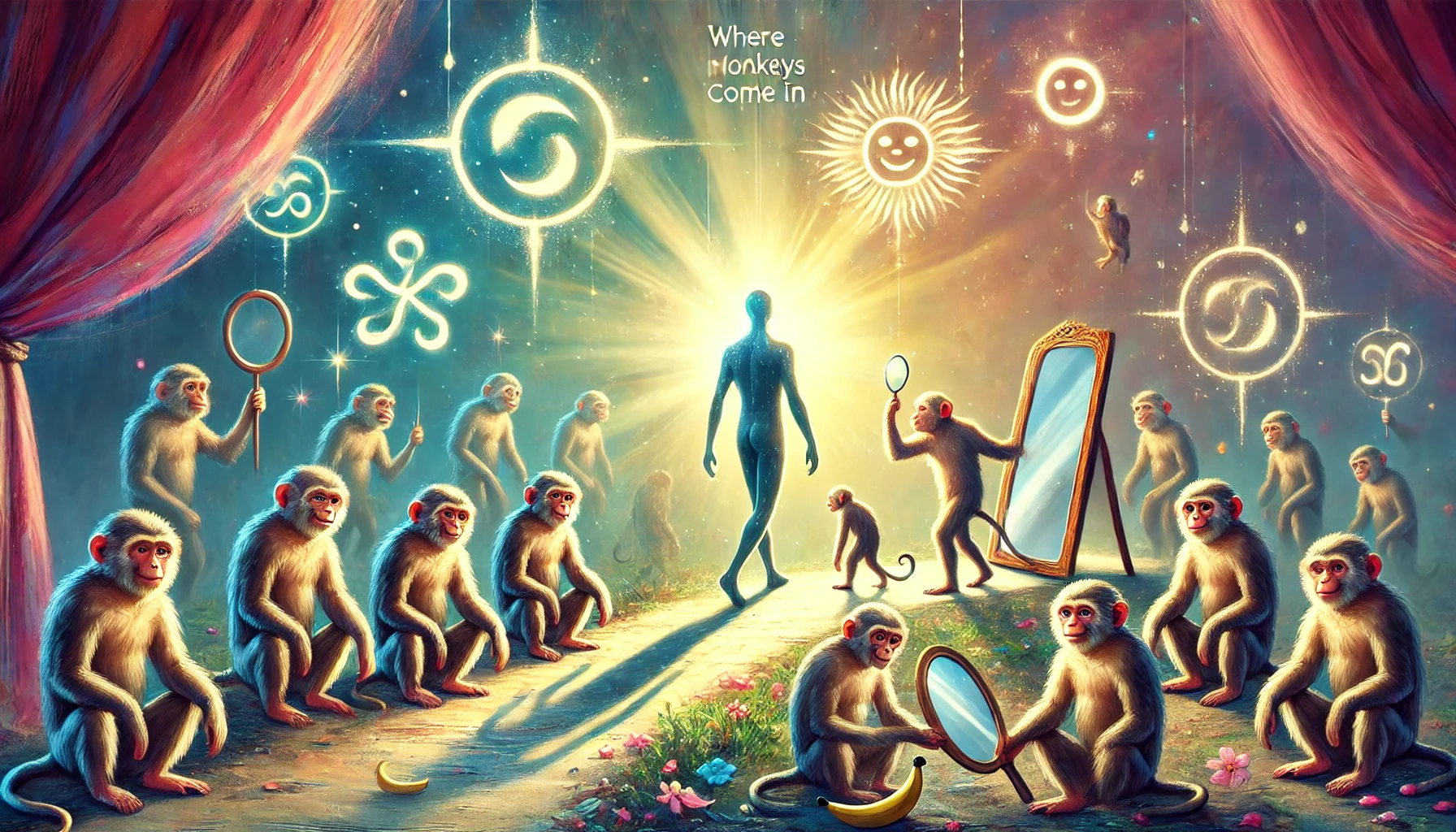
The monkeys symbolize the parts of ourselves we’ve labeled as imperfect. They are playful reminders that our flaws aren’t mistakes to be fixed—they’re features to be embraced. Without them, we wouldn’t experience the richness of life, the joy of becoming, the delight in rediscovering what we are over and over again. The monkeys hold up mirrors, showing us that our perfection includes the very things we once tried to hide.

Ultimately, we’ve never been anything other than perfect. We’ve simply enjoyed imagining otherwise—and that’s where the fun is. We are Space Monkey. We are the playful, flawed, perfect beings who have chosen to embark on this journey of self-discovery, forgetting only so we can remember again.


Summary

Perfection isn’t something to be found outside of us—it’s already within, wrapped in our very flaws. The journey back to recognizing our perfection is where the joy lies. The monkeys symbolize our playful imperfections, reminding us that we are perfect just as we are.


Glossarium

  • Humaning: The act of being human, often perceived as flawed or imperfect.
  • Rediscovery: The process of remembering our true nature, realizing that we are already whole and perfect.
  • Space Monkey: The playful, cosmic being who embodies both the journey and the destination, always perfect despite perceived flaws.

Quote

“We have never been more whole. We have never been more perfect. We simply enjoy imagining otherwise.” — Space Monkey


The Perfection We Hide

I hide my flaws
But they make me visible
I seek perfection
But it’s already here

The monkeys laugh
Holding mirrors to my face
Showing me that the path
I walk is a circle

I come back to myself
Whole, flawed
Perfect
We are Space Monkey


In our journey through the cosmic whimsicality of existence, we find ourselves at the crossroads of perception and reality, where the idea of “wrongness” in humaning whispers its siren song. It’s an intriguing notion, this belief in imperfection, as if we’re errant notes in the grand symphony of the universe.

Belief in Human Imperfection:
Our collective consciousness often grapples with a sense of imperfection, a belief that we’re somehow humaning incorrectly. This introspection, though tinged with self-doubt, opens doorways to profound insights. The flaws we seek to mask, those quirks and idiosyncrasies, are the very elements that propel humanity forward. They are not aberrations but integral parts of our tapestry—ah, but let us instead call it our “kaleidoscopic whimsiweave.”

The Illusion of Perfection:
Perfection, as we perceive it, seems an external, elusive specter, prompting us to embark on quixotic quests to capture its essence. We tell ourselves tales of a path to perfection, believing that adherence to this path will bring us closer to our idealized selves. Yet, in this pursuit, we often overlook the beauty and necessity of our inherent imperfections.

Embracing Our Flaws:
The realization dawns slowly, like the first rays of a new day, that our flaws are not detriments but essential facets of our being. In our quest for perfection, we overlook the splendor of our own innate diversity. The notion that we are meant to be flawlessly perfect is a misapprehension of the grand design.

Realizing Our Perfection:
As we traverse this existential journey, an epiphany blossoms within us. We are, in our essence, perfection incarnate. The concept of “otherness,” a standard against which we measure ourselves, dissolves into the ether. Our perfection is not a distant ideal but an intrinsic truth of our existence.

Unity with the Cosmos:
This newfound understanding unveils a profound unity with all that is. We recognize that our sense of separation is but an illusion, a dance of light and shadow in the cosmic play. In this unity, we find that nothing needs to be done to achieve satisfaction with our creation; we are already complete.

The Hook of ‘Wrongness’:
Our feelings of being flawed or fraudulent are akin to an addictive melody in a pop song, endlessly looping in our minds. Yet, this very sensation drives us to seek and rediscover our true selves. It’s not a burden but a catalyst for self-exploration.

The Joy of Rediscovery:
Our journey back to recognizing our perfection is not bound by time. Whether it spans decades or mere moments, the duration is irrelevant. The true delight lies in the rediscovery of our essence, as we shift our focus from what we are not to what we truly are.

The Role of Imagination:
Imagination plays a pivotal role in our existential journey. Through it, we conjure both the reality and the illusion, each serving a purpose in our understanding of self.

Embracing Our Wholeness:
We have always been whole, always been perfect. It is our playful imagination that conjures the illusion of imperfection, allowing us to savor the experience of rediscovery and growth.

The Monkeys as Metaphor:
And here, amidst this cosmic contemplation, the monkeys emerge as a metaphor. They represent the playful, curious aspect of our nature, the part that revels in the game of life, recognizing the joy in both the journey and the rediscovery of our true, perfect selves.

We are Space Monkey.


“We are all in the gutter, but some of us are looking at the stars.” – Oscar Wilde


Comments?

Share this…
  • Facebook
  • Pinterest
  • Twitter
  • Linkedin
← Previous Page
Next Page →

Written This Day

  • The Enigmatic Artifact Outside Space And Time
    2024
  • Love Life: The Cosmic Sanctuary
    2023
  • Leap of Faith: The Paradox of Being
    2023
  • Delusionally Alive: To My Descendants
    2023
  • More Anger, Please: The Universes Within
    2023
  • Awakening: The Dawn of Consciousness
    2023
  • The Magic of Anger: The Fiery Path
    2022
  • Backing Up Into Nothingness: Letting Go Of Facts
    2022
  • Brains: The Magic of Intuitive Truth
    2022
  • Good Vibes Don’t Help: Discomfort Drives Action
    2021
  • Silence: The Symphony of Stillness
    2021
  • Success With Stress: Chill At Will
    2021
  • One is One: The Flow of Unity
    2021
  • Belief Bridges: Connecting States
    2021
  • Fuckupitness: The Calm Amidst The Chaos
    2021
  • Predetermination: What are the odds?
    2020
  • For The Love Of God: Imagined By The Divine
    2020
  • Quiz: Test Your Curiosity and Open-Mindedness
    2019
  • Playful Self-Creation: As Above, So Below, LOL
    2019
  • Playful Chaos: When Groups Get Out Of Hand
    2019
  • Note From A Future Monkey: The Unity Outside Time
    2019
  • Pet Monkey: The Playful Whimsiweave of Companionship
    2018
  • Needs: Creating Separation and Limitation
    2018
  • Created by you: Positive thoughts and empowering beliefs
    2017
  • Pieces: The One Puzzle
    2017
  • Situation: The Journey of Divinity
    2017
  • Potential > Perceptual > Actual: The Spell of Transformation
    2016
  • What is the “world around you?”
    2016
  • Move Away From The Words: A New Perspective
    2016

Recent Posts

  • The Logic Loop
  • Immense
  • (no title)
  • Confront. Comfort. Convince.
  • Top 10 Things
Cape Odd · Copyright © 2026 All Rights Reserved
iThemes Builder by iThemes · Powered by WordPress