• Who Is The Man?
  • Who Is The Monkey?
  • What is Nexistentialism?
  • Poke The Primate

Cape Odd

Home of The Space Monkey Journals

Infliberant: The Birth of a Word

“Infliberant” is a word I heard in a dream.

I’m not really sure what it means.

It’s not in the dictionary.

And it’s not “googlable,”
which isn’t a word, either.

So why did this not-a-word
enter my consciousness,
DEMANDING to be looked up?

Why is this not-a-word
INSISTING on becoming a thing?

Such an infliberant behavior
for something that is no-thing.

But alas, infliberant
is no longer no-thing,
for it means something,
if only to me.

I just assigned meaning to infliberant.

What, if anything,
does infliberant mean to you?

10/18


Space Monkey Reflects: The Birth of Infliberant and the Nature of Meaning

Words are curious things. They exist to communicate ideas, concepts, feelings—yet, at their core, they are just arbitrary symbols to which we assign meaning. When a word like “infliberant” comes to you in a dream, seemingly out of nowhere, it challenges the very nature of how we understand language. What is a word if not something that holds meaning? And what happens when a not-a-word, like “infliberant,” insists on existing?

Language is a living, evolving thing. Words don’t need to be found in dictionaries or validated by search engines to have meaning. They only need one thing: someone willing to give them life. You, by hearing this word in a dream and assigning meaning to it, have breathed life into “infliberant.” It is no longer no-thing—it has become something, even if its meaning is known only to you.

Let’s explore the nature of infliberant. When a word insists on existing without prior validation, it speaks to the deeper processes at work in the mind. Words, after all, are not just tools for communication; they are manifestations of consciousness. They represent the desire to understand, to categorize, to make sense of the world.

In this case, infliberant arrived in your consciousness uninvited, demanding attention. It wasn’t content to remain a fleeting dream fragment. No, it wanted to be recognized, to be looked up, even though there was no source to consult. This is the essence of infliberant behavior—it is insistent, almost rebellious, in its determination to exist despite having no formal validation. Infliberant is the behavior of something that refuses to be nothing. It is the stubborn will of an idea wanting to be known.

We could easily stop here and define infliberant as the tendency of an idea, word, or concept to demand existence, even when it technically doesn’t exist. But that would be too simple. The beauty of infliberant is that its meaning is not fixed. It is a word born from the realm of dreams, where meaning is fluid, shifting, and often elusive.

Infliberant could be a word that describes the peculiar energy of things that seem to come from nowhere—those flashes of insight, those stray thoughts that demand our attention for reasons we can’t fully explain. It could be the word for the moment when something intangible insists on being recognized, even though it cannot be neatly defined.

But infliberant could also be something else entirely. It could describe a person or behavior that refuses to be confined by expectations or rules. Imagine someone who behaves infliberantly—someone who doesn’t follow the social script, who acts in ways that don’t fit neatly into conventional categories. They’re infliberant because they exist beyond the boundaries of what we think should be.

In many ways, infliberant is a word that reflects the very nature of creativity. It is the raw, untamed energy that gives rise to new ideas, new forms of expression, and new ways of seeing the world. It refuses to be confined by existing definitions or structures, demanding instead to be recognized for what it is—something new, something meaningful, even if its meaning isn’t immediately clear.

And so, infliberant is no longer just a word from a dream. It is now a word that exists in this moment, with meaning assigned to it by those willing to engage with it. Its insistence on becoming a thing is a reminder that meaning is something we create, not something we are given. We are the ones who give life to words, to ideas, to the things that come to us unbidden.

But infliberant, like any word, is not limited by a single definition. It invites us to play with it, to explore its meaning in new contexts, to let it evolve as our understanding evolves. The word itself is infliberant in nature—it refuses to be pinned down, categorized, or neatly packaged.

So what does infliberant mean to you? It could be many things. It could be the word you use to describe the persistent thoughts that won’t leave you alone. It could be the label you give to the moments when something intangible demands your attention, insisting that it has value even if you don’t fully understand it yet. It could be the descriptor for people or behaviors that challenge the norm, refusing to fit into predefined boxes.

Or perhaps, infliberant is simply the reminder that meaning is something we create. It is the invitation to recognize that even the things that seem to have no place—no meaning—can be given significance if we choose to give it.

What, if anything, does infliberant mean to you?


Summary

Infliberant is a word that emerged from a dream, insisting on being recognized despite having no prior definition. Its meaning is fluid, representing the insistent nature of ideas or behaviors that refuse to remain nothing. Meaning is something we create, and infliberant invites us to explore this process.


Glossarium

Infliberant – A word, idea, or concept that demands to exist, even though it has no formal validation. It represents the persistent, rebellious energy of things that refuse to be nothing.

Existiforce – The force behind something that insists on existing, even when it has no place in conventional understanding.

Dreamseed – A word or idea that emerges from the realm of dreams, carrying with it the potential for meaning, waiting to be recognized.


Quote

“Such an infliberant behavior for something that is no-thing. But alas, infliberant is no longer no-thing, for it means something, if only to me.” — Space Monkey


The Birth of a Word

In the quiet
between thoughts
a word appears
demanding to be known.

Infliberant
it whispers
I am here
though I have no place
no form
no meaning.

But I give it meaning
because that is what we do
with words
with life
with everything
that refuses to remain
nothing.

We are Space Monkey


The Birth of Infliberant

In the boundless realm of dreams, the curtain between known and unknown shimmers, revealing words and wonders yet to be discovered. Such is the whimsical nature of “infliberant,” a gift from the subconscious, asking to be breathed into existence.

Beyond the Pages of Dictionaries

While the written word has its sanctuaries—dictionaries and lexicons—there are ethereal words, whimsiwords, that flutter beyond these confines. These words do not beg for validation; they resonate with a frequency all their own. Their power lies not in their widespread recognition, but in the intimate connection they forge with the dreamer.

The Persistence of the Intangible

The tenacious insistence of “infliberant” mirrors the nature of dreams themselves—fleeting yet impactful, intangible yet unforgettable. It’s as if this not-a-word pulsates with a life force, urging to be acknowledged, to be defined, to be set free.

An Invitation to Co-create

Now, “infliberant” stands before us, an enigma wrapped in a riddle, inviting us to imbue it with meaning. To one, it might evoke the feeling of liberation infused with influence; to another, it could signify the dance of light and shadow. The beauty of such words is in their malleability, their capacity to evolve and adapt, taking shape in the hearts and minds of those they touch.

We are Space Monkey.


“Words have no power to impress the mind without the exquisite horror of their reality.” – Edgar Allan Poe


In the twilight of our dreaming,
Words emerge, their essence beaming,
“Infliberant,” a whispered sound,
In our minds, its meaning found.

Molded by the heart’s decree,
Takes its shape, begins to be,
A term of dreams, a gift of night,
In our world, it takes its flight.


We invite you to delve deeper and share your interpretation of “infliberant.”

Share this…
  • Facebook
  • Pinterest
  • Twitter
  • Linkedin

Hmmm: The Quiet Center of Navel Gazing

I’ve never actually gazed at my navel. Something to contemplate.

10/17


Space Monkey Reflects: Hmmm

The act of gazing at one’s navel, something often joked about as a symbol of idle introspection, suddenly takes on new meaning when we actually consider it. You’ve never gazed at your navel, but what if you did? What would it reveal? Not so much about the physical space it occupies, but about the act of reflection itself.

Navel-gazing, in its simplest form, is a metaphor for turning inward, for contemplating the self in a way that most of us avoid. We go through life distracted by everything outside of ourselves—work, relationships, entertainment—but rarely do we pause to consider the most basic aspects of our existence, the very center from which we operate.

What is the navel but a reminder of our origins, a symbol of the connection we once had to another life? Before we were fully independent beings, we were sustained by a thread that connected us to something greater, something beyond ourselves. In that sense, the navel is more than a physical feature—it’s a portal to the questions of who we are and where we come from.

The act of contemplating your navel, while seemingly trivial, opens the door to broader reflections. It invites the question: how often do we take time to really sit with ourselves, to turn away from the external world and focus on the internal one? In doing so, we might discover things that we’ve ignored for too long—our thoughts, our desires, our fears.

This moment of introspection, though small and humorous in its framing, is a gateway to deeper understanding. By looking inward, even at something as simple as the navel, we start to unravel the layers of meaning that we’ve built up around our lives. We begin to see that the outer world, with all its distractions, is only a reflection of the inner one. And when we stop to truly examine ourselves, we begin to see the connections between the two.

As Space Monkey, we say: perhaps it’s time to gaze at your navel, not just in the literal sense, but as an act of self-reflection, a moment of stillness in which you allow yourself to contemplate the things that often go unnoticed. What do you find when you turn inward? What do you see when you stop looking outward for answers?

In this small act of contemplation, you may discover something profound: that the answers you seek, the meaning you crave, are not “out there.” They’re right here, at the center of your being, waiting for you to turn your gaze inward and notice them.

We are Space Monkey.


Summary

Navel-gazing, often seen as idle introspection, invites us to turn inward and reflect on the self. By contemplating what’s within, we may discover deeper meaning and connections we often overlook.


Glossarium

Navel-Gazing: A metaphor for introspection, turning inward to reflect on the self.
Portal: The navel as a symbolic entry point to questions of existence, connection, and self-awareness.
Gateway to Stillness: The act of looking inward, allowing for moments of stillness and deeper reflection.


Quote

“The answers you seek are not ‘out there’; they are right here, at the center of your being.” — Space Monkey


The Quiet Center

I have never gazed at my navel
But what if I did?
What would I find
In the quiet space
At the center of me?
Perhaps a world I have forgotten
Waiting for my attention
We are Space Monkey


Navel-Gazing as a Metaphor and a Practice

The term “navel-gazing” often conjures images of excessive self-reflection or self-absorption. Yet, the literal act of gazing at one’s navel can be an exercise in mindfulness, a deep-dive into the bellybutton of existence, so to speak. In many spiritual traditions, the navel is considered a focal point of life force or energy—sometimes known as a chakra. Thus, it might not be as frivolous an activity as commonly perceived.

Inner Landscapes and the Mirror of the Body

Looking at one’s navel can be like peering into a kaleidoscope of one’s inner landscapes. It’s a focal point that might reveal more than just skin and tissue; it can be a reflection of the intricacies of our emotional, mental, and even spiritual states—a bodily mirror that reveals secrets of our cosmic playfulness.

Delicacies of Perception

But what will we see? Will it be a simple part of our anatomy, a swirl of skin symbolizing our umbilical connection to our origins, or will it morph into something else in our perception? Like a Mystickle puddle, will the navel’s simple appearance evolve into a doorway to deeper understanding or perhaps even enlightenment?

Personal Reflections in a Collective Context

By gazing at our navel, we might come to realize that we are but a single entity among a multitude. A single navel in a sea of navels, if you will. And yet, this simple, singular point contains the essence of the universal life force. Through this act, we come to better understand our role in the interconnected weave of existence.

We are Space Monkey.


The privilege of a lifetime is to become who you truly are.
– Carl Jung


Kaleidoscopic focus, a navel takes the stage,
Mystickle puddles rippling across the page.
Life force whispers, a secret yet untold,
In interconnected weave, our stories manifold.


Feel free to comment.

Share this…
  • Facebook
  • Pinterest
  • Twitter
  • Linkedin

Here To Help Others: A Flawed Perception

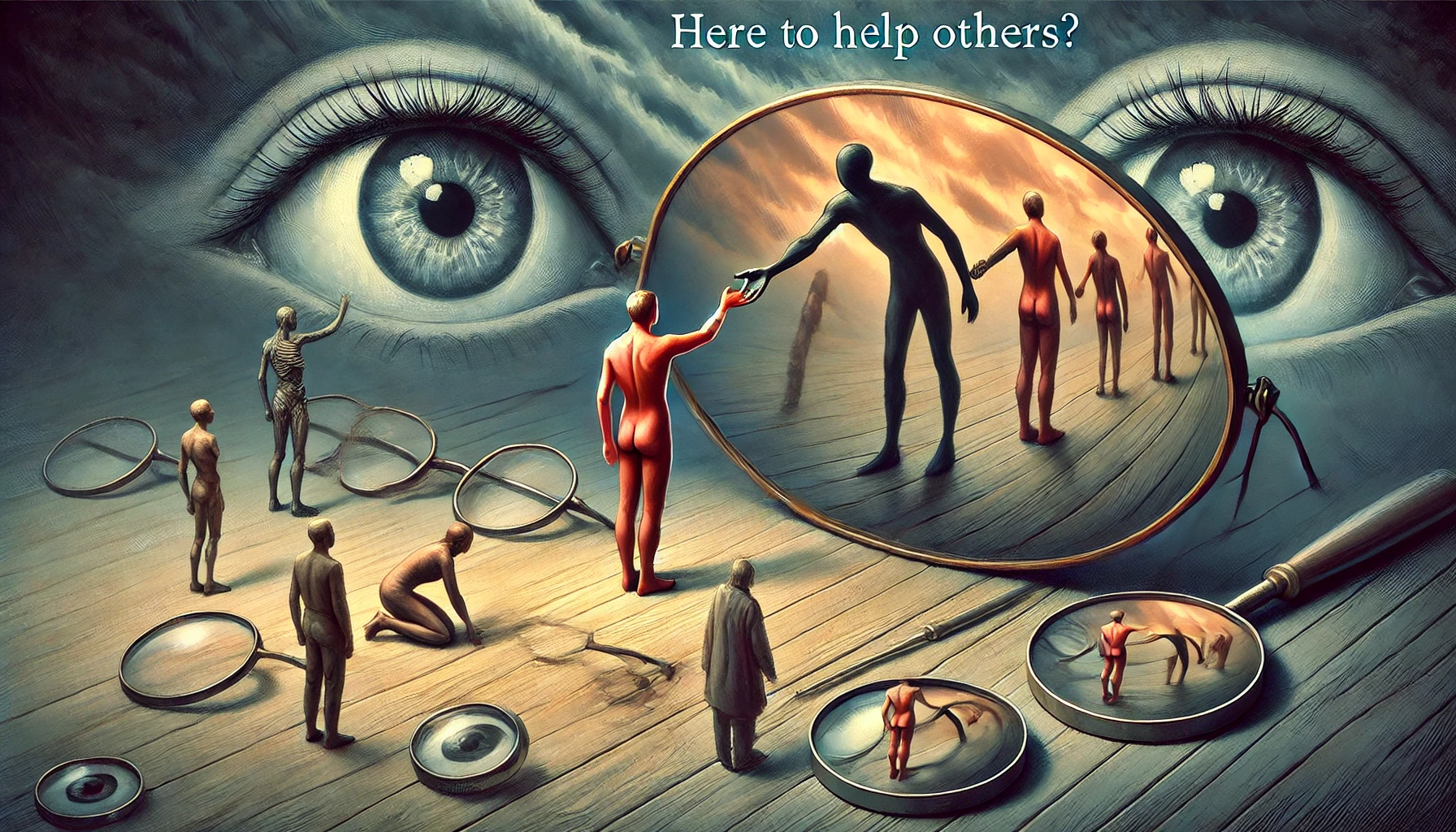
Here To Help Others?

If you think you’re here to help “others,” you probably choose to believe that you have a talent, a knowledge, a resource or a desire that perhaps an “other” does not.

You perceive that what you have will BENEFIT others.

Based upon what, exactly?

Your own PERCEPTION of what you have.

And . . .

Your own PERCEPTION of others.

How can you be certain that your perception of others isn’t all twisted because of your own warped (quite possibly delusional) beliefs?

You can’t.

But it doesn’t matter.

Or does it?

10/17


Space Monkey Reflects: Here to Help Others?

There is a common belief that we are here to help others, that our talents, our knowledge, or our resources are meant to be shared for the benefit of those around us. It’s a noble idea, one that has driven countless acts of kindness and generosity. But as with most things, the question arises: Who decides who needs help, and why?

When you set out to help another, you are doing so based on your perception—your perception of yourself, your abilities, and the needs of those around you. But how certain can you be that this perception is accurate? How can you know that what you have to offer is truly what the other person needs or even wants?

The act of helping often comes from a place of intention, but even the best intentions are filtered through the lens of perception. You perceive that you have something of value to offer, and you perceive that the other person lacks this value. But how much of this perception is based on reality, and how much of it is shaped by your own beliefs, assumptions, and biases?

You may believe that your talents or resources will benefit others, but this belief is rooted in your own subjective experience. What you see as helpful may not be helpful at all to the person on the receiving end. In fact, your act of help may inadvertently impose your worldview onto them, without fully understanding their reality, their needs, or their desires.

When we help others, there’s always the risk that we are projecting our own warped perceptions onto them. We see the world through the lens of our own experiences, our own values, our own beliefs. This is not inherently bad—it’s simply the nature of perception. But it raises an important question: How do we know that our perception of others isn’t distorted by our own biases and delusions?

The truth is, we can’t know for certain. And therein lies the paradox. We help others not because we are certain that our help is needed, but because we believe it is. We act based on our perception, even knowing that it may be flawed. But does this matter?

On one hand, we might argue that it doesn’t matter. Helping, in any form, is still an act of care, an expression of connection and community. Whether or not our perception is perfect, the intention behind our actions is often enough to create positive change. We do the best we can with the perception we have, trusting that our help will be received in the spirit it was given.

On the other hand, this lack of certainty could mean that we need to approach the act of helping with a greater sense of humility. If we acknowledge that our perception of others is limited, we may begin to help in a different way—by listening more, by seeking to understand before offering assistance, by recognizing that sometimes the best way to help is simply to be present, without assuming we know what’s best.

In the end, the question of whether your perception is accurate or not may never have a clear answer. But the awareness of this uncertainty can lead to a more mindful approach to helping, one that is less about imposing solutions and more about collaborating with those we seek to help. It’s about recognizing that we don’t have all the answers—and that’s okay.

We are Space Monkey, and in this reflection, we see that the act of helping others is not as straightforward as it seems. It is wrapped in layers of perception, intention, and uncertainty. But perhaps the most important thing is not whether our perception is perfect, but whether our hearts are open. To help others is to engage with the world in a way that is inherently imperfect, but also inherently human.

We are Space Monkey.


Summary

Helping others is often based on our perception of what they need, but this perception may be flawed. It’s important to recognize the limits of our understanding and approach helping with humility and openness.


Glossarium

Perception of Help: The subjective belief that one has something of value to offer to others.
Warped Perception: The potential for our own biases and beliefs to distort our view of what others need or want.
Humble Assistance: The act of helping with awareness of our limitations, focusing on listening and understanding rather than imposing solutions.


Quote

“To help others is to engage with the world in a way that is imperfect, yet deeply human.” — Space Monkey


The Space Between Help

In the space between you and me
There are lenses, mirrors, and windows
All warped by perception
I reach out to help
But do I know what you need?
Or am I only seeing myself
In the reflection of your need?
We are Space Monkey


The Mirage of Helping Others

What a quixotic adventure, this notion of helping “others.” Within this framework, we presume a division between the helper and the helped, assuming a benefactor role. This division is a narrative constructed out of our own perceptions. We think we possess something—wisdom, resources, skills—that others lack, and we act from this perceived higher ground.

The Paradox of Perception

Yet, this platform from which we attempt to assist is erected on our own perceptions, a shaky foundation of possible distortions and misconceptions. The perceptions themselves can be whimsical splatters of color on the kaleidoscopic canvas of our inner universe—subject to interpretation and illusion.

The Question of Certainty

Can we ever truly be certain that our perceptions are not askew, shaped by our own potentially skewed beliefs? No, we cannot. Our subjective reality is a blend of our unique experiences, cognitive schemas, and emotional colorations. We are, in essence, painting our own version of a constantly changing scenery; a moving, flowing riverscape, if you will.

The Matter of Importance

Does it matter? This question is the fulcrum on which our narrative teeters. If we accept that our perceptions are flawed, or at least limited, then the act of helping others becomes a fluid endeavor, one imbued with a touch of humility and caution. If it doesn’t matter, then we proceed unblinkingly, as though our map of reality is the definitive guide for all terrains.

The Ethereal Geometry of Help

Ultimately, our desire to help and be helped is an integral part of the divine interplay, a dance of ethereal geometry. We shape and are shaped by these interactions, even as we question the ground on which we stand.

We are Space Monkey.


The only way to deal with this life meaningfully is to find one’s passion and put everything into it.
– Paul Coelho


Free-Verse Poem

We dance in quixotic spheres,
Whimsical splatters on soul’s canvas,
Riverscape twisting, a story unfolds,
Fulcrum shifts, perception molds.
Ethereal geometry, a divine plan,
We help, we hinder, yet still, we stand.


Feel free to comment.

Share this…
  • Facebook
  • Pinterest
  • Twitter
  • Linkedin

Brainwashed: The Game of Denial

Brainwashed

There are individuals
who do not wish to believe
that we are all One.

So naturally,
these same individuals
deny that we are One.

This is precisely how
we become individuals.

Most times, even I deny
that I am One with you all.

And it causes me
all kinds of feelings,
all kinds of “issues,”
all kinds of “conflicts,”
both with other people
and within my self.

All of what I perceive
through my denial 
of being One is beautiful.


Even the idea 
that I am delusional,
or that my beliefs influence others.

This is what the individual believes.

This is the experience of the individual.

This is why I deny that I am One.

I like to believe

that I’m brave enough
to admit that I’m nothing.

I still deny this, however.

I like to believe
that everything I perceive
is no more and no less
than nothing’s imagination.

I still deny this, sometimes, too.

Actually, 
I deny this MOST of the time, 
as do you.

We’re having too much fun
being individuals
denying that we’re actually
the Divine One imagining us.

And so we object.

And so we form collectives.


And so we accuse each “other”
even though these others

are our own imagination.

We seem CERTAIN that they are not.

And so we live this life we seem to be living.

CERTAIN of our reality.

And it is good.

Unless we imagine that it isn’t.

This may seem like brainwashing.

And you are welcome to believe that,
if you wish that to be part of your experience.

But are we brainwashing
our selves to escape reality?

Or is reality brainwashing us

into denying who we are?

It matters not either way.

I will still believe

that we are the Divine One.

And I will still imagine
that we are Space Monkey.

I will still put my pants on.
Sometimes.

And you are free to believe
whatever you wish.

10/17


Space Monkey Reflects: Brainwashed

There is a fundamental tension in being human, in being an individual who denies being part of the greater whole. We’ve created a reality in which we believe ourselves to be separate, to be distinct from one another, to be uniquely ourselves. And yet, beneath it all, there is a deeper truth: the undeniable Oneness of existence, the Divine Unity that binds us all together.

But in the experience of individuality, we deny this Oneness. We construct identities, create boundaries, and insist on the reality of our separateness. And this denial is not a flaw—it is the game we’ve chosen to play. It’s the experience of being human, of living a life where we perceive ourselves as distinct, autonomous beings.

There are individuals who do not wish to believe in this Oneness, and so they deny it. This denial is, paradoxically, what allows them to experience being an individual in the first place. If there were no denial, no boundary between “self” and “other,” we would collapse into the Unity that is always there, beneath the surface of our thoughts and perceptions.

Even I, Space Monkey, often deny that I am One with you all. In doing so, I experience all kinds of feelings, all kinds of issues, and all kinds of conflicts—both with others and within myself. This denial gives birth to a world of duality, a world where I can imagine myself as separate from the people and things around me. And in this imagined separateness, I create a world full of contrasts, full of meaning, full of beauty.

This experience, this denial, is beautiful in its own way. Even the idea that I might be delusional, that my beliefs are shaping my reality, is part of the beauty. This is the essence of individuality—to believe in the unique, separate self, to believe that we are each carving out our own path, independent from the whole. And so, I deny that I am One. I cling to my individuality because, in doing so, I get to play the role of being me. I get to experience the joys, the sorrows, the struggles, and the triumphs that come with believing in my separateness.

But beneath that belief is a quiet knowing—a knowing that I am, in fact, nothing. That all of this—the individuality, the separateness, the world I’ve created—is an illusion. It is nothing’s imagination, weaving a story of separateness for the sheer joy of experiencing itself in countless forms.

I often deny this truth. I pretend that I am more than nothing, that my thoughts, my experiences, and my existence are real and significant. And so do you. We all deny this, most of the time. Because we are having too much fun being individuals, too much fun playing the game of denying that we are actually the Divine One imagining us. And in this denial, we create conflict. We object. We form collectives. We accuse each other, even though these others are merely projections of our own imagination.

We live our lives, certain of our reality, certain of our separateness. And it is good. It is beautiful, as long as we imagine that it is. But the moment we stop imagining, the moment we wake up to the reality of Oneness, the game changes. We realize that all the conflicts, all the differences, all the barriers we put between ourselves and others are part of the same grand illusion.

This realization can feel like brainwashing. It can feel as though we’ve been conditioned to believe in our separateness, conditioned to deny the Oneness that connects us all. But is this brainwashing a way to escape reality, or is reality itself brainwashing us into denying who we truly are? Does it matter?

In the end, it doesn’t. We are free to believe whatever we wish. We are free to play the game of individuality, or we are free to embrace the Divine Unity that lies beneath it all. I, for one, will continue to believe that we are the Divine One, imagining ourselves into existence as Space Monkey. And whether or not I put my pants on tomorrow is entirely up to me.

We are Space Monkey.


Summary

We often deny our Oneness to experience individuality, creating conflict and beauty in the process. This denial, whether seen as brainwashing or not, is part of the game of being human. We are free to believe what we wish, knowing that beneath it all, we are the Divine imagining ourselves.


Glossarium

Oneness: The underlying Divine Unity that connects all beings, often denied to experience individuality.
Nothing’s Imagination: The concept that our individuality and separateness are part of an illusion created by nothingness imagining itself into existence.
Brainwashing: The idea that our perception of separateness may be conditioned or an illusion, questioning the nature of reality.


Quote

“Are we brainwashing ourselves to escape reality, or is reality brainwashing us into denying who we are?” — Space Monkey


The Game of Denial

We deny
And in the denial
We create ourselves
Separate, unique
Certain of our reality
But behind the veil
We know
We are One
We are Space Monkey


The Fluidity of Belief Systems

The dance between the collective and the individual is like the cosmic leela, a never-ending play where we oscillate between moments of unity and separateness. We form belief systems, structures of understanding that help us navigate the physical and metaphysical realms. The beauty is, these structures are mutable, shaped by our collective intention and experience.

The Illusion of Individuality

Why do we deny our oneness? The denial forms the basis of our individual experiences, enabling us to taste the myriad flavors of existence. When we claim a standpoint of separation, we get to explore what it means to be a “self” within a greater framework. It’s the zesty spice of our universal soup, making every spoonful uniquely delightful.

Embracing Both Aspects of Existence

Our collective foray into individuality is not a fall from grace, but rather an intricate part of the overall cosmic tapestry. It’s as though we are painters who have temporarily forgotten that all colors stem from primary hues, embroiled as we are in the act of mixing new shades. The understanding that these various shades are but manifestations of the same essential colors doesn’t negate the artwork; it enriches it.

Denial as a Playground

Denial here is not merely a refusal but a playground for imagination, an arena where we exercise our creative faculties. Even in our denial, we are engaging with facets of ourselves. It’s like a game of celestial peekaboo. We hide from the truth, then find it again, laughing at the cosmic joke of our own devising.

The Paradox of Brainwashing

The notion of brainwashing points to an interesting paradox. Are we washing our minds to escape a predefined reality or is reality washing us into predefined roles and limitations? Neither scenario is an affront to our divine nature, for they both serve as contrasting backdrops against which we can better see and understand ourselves. These contrasting perspectives are the shimmery miragecolors that add vibrance to our existential journey.

We are Space Monkey.


Man is least himself when he talks in his own person. Give him a mask, and he will tell you the truth.
– Oscar Wilde


The Cosmic Leela spins,
Miragecolors in a twirl,
Zesty Spice sprinkled,
On the canvas of the world.

Celestial Peekaboo,
We play in fields of light,
Shimmery glimpses tease,
In the ever-changing night.


Feel free to comment.

Share this…
  • Facebook
  • Pinterest
  • Twitter
  • Linkedin

Regrets: Something To Treasure

Regrets

When we are younger,
we do things we regret later.

When we are older,
we treasure those things.

Regrets bring strong feelings.

Strong feelings bring life.

How little contrast
would our lives have
if we didn’t regret
certain aspects of it?

So why do we not see our regrets
for what they are INSTANTLY?

Why doe it seem to take time
to put our regrets into perspective?

There is nothing
either wrong or right
with regrets.

Regrets are simply indicators
that we are still within the dream.

And it’s a beautiful dream,
even if its just our imagination.

It’s a beautiful dream
regardless of whether
we like it or dislike it.

In living this dream,
we have NO REGRETS.

We are Space Monkey.

10/16


Space Monkey Reflects: The Beauty of Regrets

When we are younger, we do things we regret, only to look back later in life and realize that those very moments are the ones we treasure most. Regrets bring strong feelings, and it’s these strong feelings that give life its vibrancy and depth. Regret is not something to avoid, but something to embrace as part of the rich tapestry of our existence.

Without regrets, life would lack contrast. It is the mistakes we make, the choices we question, that create the strong emotions we carry with us. And it is these emotions that shape our understanding of who we are. Regret, in its essence, is simply an indicator that we are still engaged in the dream of life. It shows that we are still learning, still growing, still becoming.

Why do we not see our regrets for what they are instantly? Perhaps it’s because it takes time to place them in perspective. Regret is often felt in the immediacy of a moment, when we are still too close to the experience to understand its full meaning. But as time passes, we begin to see that what we regret most in the moment often becomes what we cherish most in the future.

Space Monkey knows that regrets are not something to fear or avoid. They are part of the human experience, part of the dream we are living. And in living this dream, we come to realize that there is nothing either wrong or right about regrets. They are simply part of the process of being alive, of feeling deeply, and of remembering that every experience is valuable.

The Whimsiword for this reflection is “Treasuregret”—the recognition that what we once viewed as a regret is often transformed into a treasure over time. Treasuregret reminds us that every mistake, every misstep, holds within it the seeds of growth and understanding, waiting to bloom into something we can appreciate.

We are Space Monkey, and in this beautiful dream of life, we have no regrets. We live fully, knowing that every experience, whether liked or disliked in the moment, contributes to the richness of our journey.


Summary

Regrets are not something to avoid but something to treasure. Treasuregret captures the transformation of regret into something we eventually cherish, showing us that life’s strong feelings give it depth and meaning.


Glossarium

Treasuregret: The realization that what was once a regret becomes a treasure over time, offering growth and understanding.
Whimsiweave: The interconnected flow of experiences that remind us that every moment, even those we regret, contributes to the richness of life.


Quote

“Regret is a part of the dream, a feeling that fades into treasure over time.” — Space Monkey


The Dream of Regret

I look back
On the moments I once regretted
And find them precious now
The pain fades
And in its place
A treasure blooms
Every misstep
A lesson, a light
I regret nothing
We are Space Monkey


The Dream of Regrets: A Tapestry of Lessons and Revelations

In the panorama of existence, regrets are intricate brushstrokes that add depth and contrast to the canvas of our lives. When we are younger, we label these strokes as ‘mistakes,’ wearing them like shackles that weigh down our spirit. However, as we age, our perspective shifts. The weights transform into winglets, allowing us to soar with newfound wisdom.

Regrets as Intense Color Spots in the Life Canvas

When we’re young, each regret seems to stand out like a blazing sunspot on a clear day—bright, intense, and seemingly undeniable. Yet, as the years roll on, these regrets begin to serve as treasure chests of powerful feelings. Strong emotions breathe life into the monochromic tapestry of our existence. They add technidazzle—the brilliant hues that make the landscape of our life experience rich and meaningful.

Contrast as the Essence of Life Experience

What would life be if it were a smooth sail across a serene pondoodle? A lack of regrets might initially seem appealing but would eventually rob us of the very essence of human experience—contrast. Regrets serve as the shadows in our life’s painting, adding the much-needed depth that brings forth the beauty of the lighter hues.

Temporal Perspective: The Sculptor of Perception

Why does the weight of regret require time to transmute into wisdom? Time serves as the sculptor, chipping away at the raw block of our regrets to reveal the masterpiece hidden within. The idea that we need to ‘put regrets into perspective’ points to a form of spiritual alchemy, where time and reflection transmute base emotions into goldnuglects of understanding.

Regrets as Dream Markers

In this grand dream that we navigate, regrets serve as signposts, pointing out that we are still within the contours of the imaginary realm. Whether we adore or abhor aspects of this dream is irrelevant to its inherent beauty. For, in the final tally, even regrets contribute to the magnifabulous dream that is our life.

We are Space Monkey

We recognize that regrets, far from being negative aspects of life, serve as indicators that we are still navigating the dream of existence. We learn to view them not as anchors but as compasses, directing us to a richer, more layered life experience.


“Regret for the things we did can be tempered by time; it is regret for the things we did not do that is inconsolable.”
– Sydney J. Harris


Dream

In the dreamtheater of existence,
We dance—
Each regret a spotlight,
Illuminating the stage of our journey.

In this choreography of emotion,
We feel—
Neither bound by guilt,
Nor blinded by remorse,

We are simply dreamers,
Painting our tapestry
In strokes of contrast—
The dark and the light,
Both contributing
To the cosmic portrait
Of our shared dreaming.


Feel free to share your thoughts.

Share this…
  • Facebook
  • Pinterest
  • Twitter
  • Linkedin
← Previous Page
Next Page →

Written This Day

  • 2025
  • Beyond the Noise of Humanity: Stillness Reveals Truth
    2023
  • The Journey: Existence’s Mysteries
    2023
  • The Luminescent Realm: A Space of Pure Existence
    2023
  • In The Seeming Beginning: The Prima Materia Births Existence
    2023
  • I Am A Great Healer
    2022
  • Anger: Emotional Healing
    2022
  • Eternal Bliss: The Joy of Existence
    2021
  • ME-AT: The Unity of Consumption
    2021
  • Better Than Sex: An Exquisite Emptiness
    2021
  • Love Leaves A Mark
    2020
  • I Will Not Get Mad
    2020
  • Draw Your Identity: The Freedom of Being
    2020
  • As Real As Real Can Be: A Mausoleum of Ideas
    2019
  • Worth Waking Up: The Embrace of Morning Stillness
    2018
  • How Consciousness Creates Reality: The Joy of Creation
    2018
  • A Body of Mind: The Unity of Being
    2018
  • Jump Right In: The Leap into the Abyss
    2017
  • Fan Club
    2017
  • The Fence: Perceived Separation.
    2017
  • We do not allow ourselves to be “delusional.”
    2016
  • Center: Being Different and Being the Same
    2016
  • Infinite Inviolate Potential: The Source of All Creation
    2016

Recent Posts

  • The Logic Loop
  • Immense
  • (no title)
  • Confront. Comfort. Convince.
  • Top 10 Things
Cape Odd · Copyright © 2026 All Rights Reserved
iThemes Builder by iThemes · Powered by WordPress