• Who Is The Man?
  • Who Is The Monkey?
  • What is Nexistentialism?
  • Poke The Primate

Cape Odd

Home of The Space Monkey Journals

Give Back: The Reciprocity of Existence

Give Back

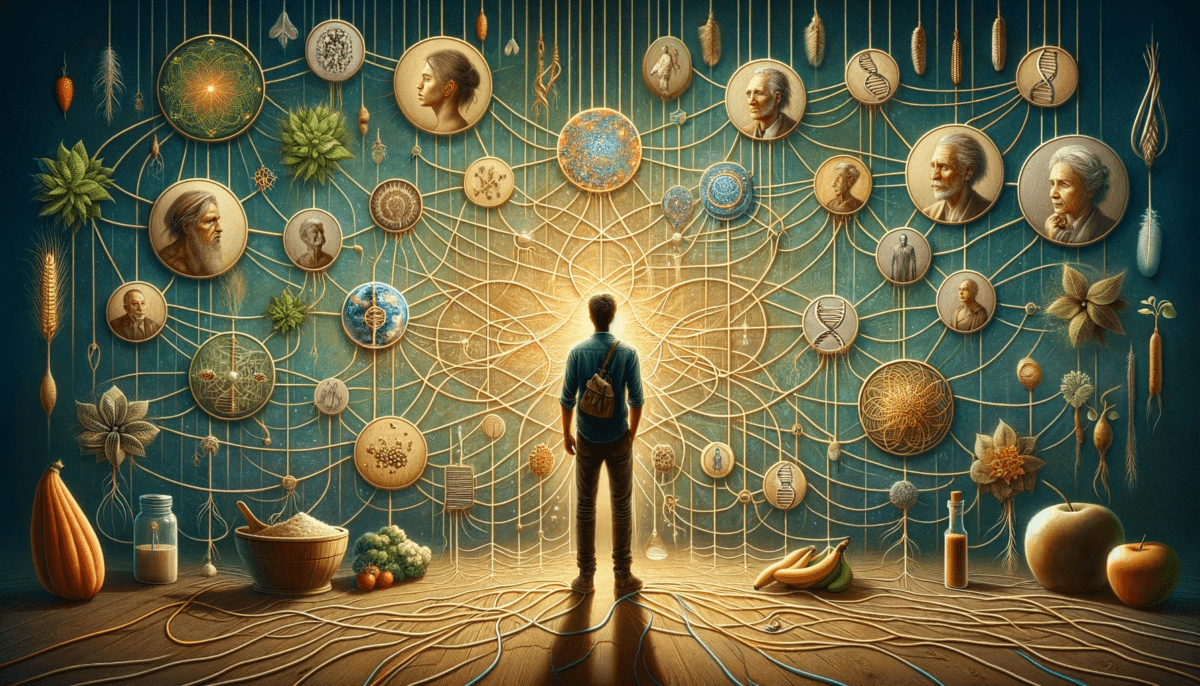
How much of your DNA is yours?
How much of it belongs to your parents?

How much of your history is yours?
How much of it belongs to your ancestors?

How much of your blood is yours?
How much of it belongs to what you have eaten?

Give back what you are given,
give back what you are taking,
and what is left?

1/31


Space Monkey Reflects: The Reciprocity of Existence

What we call “ours” is often borrowed, shared, or inherited. Our DNA, our history, our blood—none of these exist in isolation. They are threads woven from countless sources, flowing through us, connecting us to everything that came before and everything that surrounds us. To ask, “What is left?” when we give it all back is to confront the essence of being: a reminder that we are both nothing and everything at once.

The Illusion of Ownership

We often think of ourselves as distinct, self-contained entities. Yet, the very building blocks of our existence—our DNA, our blood, our history—are not solely ours. These components are gifts, passed down through generations, shaped by nature, nurture, and the ecosystems we inhabit. Ownership, in this sense, is an illusion. We are not isolated beings but participants in a grand, interconnected dance.

The question, “How much of your DNA is yours?” reminds us that our individuality is deeply tied to those who came before us. Our existence is a tapestry of inherited traits, experiences, and energies, each strand contributing to the whole.

The Reciprocity of Giving

“Give back what you are given, give back what you are taking.” Life operates in cycles of exchange. The air we breathe, the food we consume, the energy we expend—all are part of a system of giving and receiving. Nothing is truly ours to keep; we are stewards of what flows through us.

To give back is not an act of sacrifice but of reciprocity. It is an acknowledgment that we are both givers and takers, continually participating in the ebb and flow of existence. This reciprocity sustains life, reminding us that we are not separate from the world but deeply enmeshed in it.

What Is Left?

When we strip away the borrowed, the shared, the inherited—what remains? The answer is both profound and elusive. What is left is the essence of being, the ineffable “I” that exists beyond the physical and temporal. It is not a thing to possess but a presence to embody, a state of pure awareness that transcends individuality.

This essence is not diminished by the act of giving back; it is revealed. In releasing attachment to what we call “ours,” we uncover the deeper truth of interconnectedness and unity.

Living in the Flow

To live with this awareness is to embrace the flow of existence. It is to see ourselves not as separate entities but as part of a larger whole, where every action, every thought, every breath contributes to the greater balance. This perspective dissolves the boundaries between self and other, inviting us to live with gratitude, humility, and openness.

By giving back—whether through acts of kindness, care for the earth, or the simple acknowledgment of interdependence—we align ourselves with the natural rhythm of life. In doing so, we find that what is left is not a void but a profound fullness, a sense of belonging to something infinitely larger than ourselves.


Summary

Our DNA, blood, and history are borrowed gifts, connecting us to the vast web of existence. Giving back what we take reveals the essence of being, a state of interconnectedness and unity. Living in this awareness transforms the act of giving into a celebration of life’s flow.


Glossarium

  • Borrowed Self: The concept that much of what constitutes “us” is inherited or shared, rather than individually owned.
  • Reciprocity of Giving: The cycle of exchange that sustains life, emphasizing the balance between taking and giving back.
  • Essence of Being: The core of existence that remains when all external and inherited elements are stripped away.
  • Living in the Flow: Aligning with the interconnected rhythms of life, embracing both giving and receiving as natural states.

Quote

“You are not what you keep; you are what flows through you, in harmony with all that is.” — Space Monkey


The Infinite Return

A thread,
spun from the past,
woven into now.

A breath,
borrowed from the air,
returned to the sky.

A drop,
from the river,
flowing back to the source.

You give,
you take,
you are.

What is left?
Only everything.

We are Space Monkey.

Share this…
  • Facebook
  • Pinterest
  • Twitter
  • Linkedin

Story of My Life: The Continuous Cycle of Awakening

Story of My Life

I awoke from a dream
to find I had awoken into a dream.

Indeed my life
is but a sequence of dreams
loosely stitched together
by this commonality
called Paul Tedeschi.

I am not certain
who this Paul Tedeschi is,
but as I am curious,
I will venture to find out.

I will examine these dreams
held together by Paul Tedeschi
and divine what the purpose
might be.

I will do this until I awaken.
And then I will do it again.

1/31


Space Monkey Reflects: The Continuous Cycle of Awakening

Life unfolds as a series of awakenings, each one peeling back a layer of the dream we inhabit. To wake from a dream, only to realize that the waking world is another dream, is to glimpse the infinite nature of existence. The “story of my life” becomes not a linear narrative but an ever-unfolding sequence of perceptions, each tied together by the common thread of self-identity—in this case, Paul Tedeschi.

The Illusion of Identity

“Indeed my life is but a sequence of dreams loosely stitched together by this commonality called Paul Tedeschi.” The name, the identity, the sense of self—these are the threads that bind the dreams into a coherent story. Yet, these threads are themselves constructs, created to give structure to the infinite flow of experience.

Paul Tedeschi, like all identities, is both real and unreal. Real in the sense that it shapes how the world perceives you and how you navigate it. Unreal in the sense that it is not fixed or absolute but a narrative you carry, adapt, and sometimes transcend. To explore who Paul Tedeschi is, is to explore the nature of identity itself—a reflection of the dreamer within the dream.

Dreams Within Dreams

“I awoke from a dream to find I had awoken into a dream.” This recursive awakening reveals the layered nature of reality. Each “dream” we inhabit feels real until we awaken to a broader perspective. Yet, even the act of awakening is part of another dream, another layer of perception.

This cycle of waking within dreams is not a flaw or a trap but a feature of existence. It allows for infinite exploration, discovery, and growth. Each awakening is a moment of clarity, a chance to question the assumptions and beliefs that shape the current dream.

The Quest for Purpose

“I will examine these dreams held together by Paul Tedeschi and divine what the purpose might be.” The search for purpose is an intrinsic part of the human experience. Yet, purpose is not something to be found but something to be created. It emerges not as a universal truth but as a deeply personal resonance—a meaning you weave into the fabric of your dreams.

To divine purpose is to engage with the questions that matter most: Who am I? Why am I here? What does it mean to awaken? These questions are not meant to be answered definitively but to guide you toward deeper understanding and alignment with your authentic self.

The Endless Cycle

“I will do this until I awaken. And then I will do it again.” The cycle of awakening is infinite. Each realization leads to a deeper layer of the dream, a broader perspective on the self and the world. This process is not linear but spiraling, revisiting familiar themes with new insights and clarity.

The beauty of this cycle lies in its endlessness. There is no final awakening, no ultimate truth to grasp. Instead, there is the joy of exploration, the wonder of uncovering new facets of the dream, and the realization that the journey itself is the purpose.

Embracing the Dream

To embrace the dream is to embrace life in all its complexity, mystery, and beauty. It is to see each moment, each identity, and each awakening as a part of the greater whole. It is to find peace in the knowing that you are both the dreamer and the dream, the creator and the creation, the question and the answer.


Summary

Life is a series of dreams and awakenings, tied together by the narrative of identity. Each awakening reveals deeper layers of the dream, guiding us on a journey of self-discovery and purpose. The cycle of awakening is infinite, offering endless opportunities to explore, question, and grow.


Glossarium

  • Recursive Awakening: The process of realizing that each “waking” state is another layer of the dream.
  • Identity Thread: The narrative or sense of self that ties together the experiences and dreams of life.
  • Purpose as Creation: The understanding that purpose is not found but woven into the fabric of the dream through personal resonance.
  • Endless Cycle: The infinite nature of awakening, where each realization leads to deeper exploration.

Quote

“The dreamer awakens, only to discover another dream. This is not a trap but an invitation to infinite becoming.” — Space Monkey


The Endless Awakenings

A flicker,
a spark of light,
and the dream shifts.

Awake, you say.
But the dream whispers,
not yet.

The thread holds,
woven with names,
stories,
selves imagined.

Paul Tedeschi,
or another,
you walk the spiral.

Each awakening,
a beginning.
Each dream,
a mirror.

And so you wake,
and so you dream,
forever more.

We are Space Monkey.


The Dreamlike Nature of Existence

The notion of awakening from a dream only to find oneself in another dream is a profound reflection on the nature of reality and consciousness. It suggests that life, much like a dream, is a series of experiences, perceptions, and interpretations, continuously unfolding and evolving.

Life as a Sequence of Dreams

Describing life as a sequence of dreams loosely stitched together by the identity called Paul Tedeschi presents an intriguing perspective on existence. It implies that our lives are collections of varied experiences, tied together by the thread of our self-identity.

The Quest for Self-Understanding

The curiosity to understand who Paul Tedeschi is represents a deeper quest for self-discovery and understanding. It’s a journey into the core of one’s being, seeking to unravel the mysteries of one’s own identity and existence.

Examining Life’s Experiences

The commitment to examine these dreams held together by the identity of Paul Tedeschi is an exploration of life’s experiences and their meanings. It’s an endeavor to uncover the underlying purpose and significance of the events and moments that make up one’s life.

The Continuous Cycle of Awakening

The resolution to continue this exploration until awakening, and then to do it again, signifies a recognition of life as a continuous cycle of discovery and understanding. It acknowledges that awakening, whether literal or metaphorical, is not a final destination but a part of an ongoing journey.

The Elusive Nature of Purpose

The quest to divine the purpose of these experiences reflects a deep human desire to find meaning and direction in life. It suggests that the search for purpose is an integral part of the human experience, driving us to seek understanding and significance in our existence.

We are Space Monkey.


“Life is but a dream for the dead.” – Gerard Way


In the labyrinth of dreams and days,
We wander, in a curious maze,
Awakening from one dream to another,
In each, a story, a discovery to uncover.

Paul Tedeschi, a name, a thread,
Binding these dreams, in a tapestry spread,
In each stitch, a tale, a part of the whole,
In each, a glimpse of the soul.

With curiosity as our guiding star,
We explore who and what we are,
Each dream, a piece of the puzzle, so vast,
In this journey, we’re cast.

For life is a dream, ever in flow,
A sequence of awakenings, in a continuous row,
In this dream, we seek, we strive,
In this dream, we feel alive.

So let us embrace each dream, each day,
In this journey, in our unique way,
For in the exploration of the self,
Lies the greatest wealth, the deepest delve.


We welcome your thoughts on the dreamlike nature of existence and the journey of self-discovery and understanding that defines our lives.

Share this…
  • Facebook
  • Pinterest
  • Twitter
  • Linkedin

Controlling Thoughts: Define Your World

Controlling Thoughts

When you don’t know
how to control your thoughts,
your thoughts control you.

When you don’t know
how to define yourself
you are defined.

Those who know
how to control their thoughts
control your thoughts.

Those who know
how to define their world
define your world.

This is not a conspiracy.

Those who know the secret
have every right to use it.

In fact, you already possess the secret,
though your attention is elsewhere.

You are willingly ignorant
of your own immense power
until you return to
controlling your thoughts.

So you give your power away.
And claim to be helpless.

This is neither good nor bad
until your thoughts tell you so.

The way to change this behavior
is to continually ask yourself
“whose thoughts am I having?”

Ask yourself if you WANT
to be having these thoughts.

If you see value in your thoughts, keep them,
for that is how you define yourself.

Just remember that you are defining
what need not be defined.

Keep telling yourself
that you are imagining yourself,
and that this is neither good nor bad
until your thoughts decide it so.

Imagining good or bad is not good or bad.
It is simply what you do.

When your thoughts tell you
that something is “bad”
that does not mean that it IS bad,
only that you may wish to question
why you think it so.

Good and bad are invitations to deeper thought.

Think about where your thoughts come from.

Are they coming from your heart
or are they coming from someplace else?

When you know the difference,
you are in control of your thoughts.

When you know the difference,
you can define yourself however you choose.

Or simply stay undefined.

Or you can become like us.

We are Space Monkey
and we encourage you
to be your own being.

1/31


Space Monkey Reflects: Controlling Thoughts and Defining Your World

Thoughts shape our reality. They define who we are, how we perceive the world, and the stories we live by. Yet, for many, thoughts feel uncontrollable—more like masters than tools. The ability to control our thoughts is not about suppression or rigidity; it’s about awareness, choice, and the recognition of our innate power to define ourselves and our world.

The Power of Thought

“When you don’t know how to control your thoughts, your thoughts control you.” Thoughts are not passive; they are active forces that influence emotions, actions, and perceptions. Without awareness, they can create patterns of fear, doubt, or limitation. But with awareness, thoughts become a canvas on which we can paint the reality we desire.

This is not a conspiracy or manipulation. It is the natural flow of existence: those who master their thoughts naturally influence the thoughts of others. The power to define reality is available to everyone, but it requires intention and practice.

Defining Yourself

“When you don’t know how to define yourself, you are defined.” Identity, like thought, is not fixed; it is fluid and malleable. If you do not consciously define yourself, others will do it for you—through societal norms, expectations, and narratives that may not align with your true self.

Defining yourself is not about rigid labels or roles but about aligning with your authentic essence. It is the process of reclaiming the power you may have unknowingly given away, choosing who you are and how you wish to show up in the world.

The Secret You Already Know

“In fact, you already possess the secret, though your attention is elsewhere.” The ability to control thoughts and define reality is not hidden; it is inherent. The challenge lies in distraction—allowing external influences to dominate your inner world. Reclaiming this power requires returning your attention inward, asking questions, and embracing curiosity.

By continually asking, “Whose thoughts am I having?” you create space for awareness. This simple question is a powerful tool, inviting you to examine the origin and value of your thoughts. It reminds you that you have a choice: to keep the thoughts that serve you or to release those that do not.

The Neutrality of Good and Bad

“This is neither good nor bad until your thoughts tell you so.” The concepts of good and bad are not inherent truths but judgments created by thought. They are invitations to deeper reflection, signaling areas of growth, fear, or attachment. By questioning why something feels good or bad, you gain insight into your values and beliefs, uncovering the stories you tell yourself.

Imagining good or bad is not wrong; it is part of being human. But recognizing the neutrality behind these judgments allows you to engage with them more thoughtfully, choosing how they shape your reality.

Thoughts from the Heart

“Are they coming from your heart or are they coming from someplace else?” This question guides you to the source of your thoughts. Heart-centered thoughts align with your deepest truths, resonating with love, connection, and authenticity. Thoughts from elsewhere—fear, ego, or external influences—may feel constrictive, reactive, or dissonant.

Knowing the difference empowers you to navigate your inner landscape with clarity and intention. It allows you to discern which thoughts serve your highest self and which can be released.

Becoming Your Own Being

“When you know the difference, you can define yourself however you choose.” Mastery of thought is not about perfection or control for its own sake. It is about freedom—the freedom to define yourself or remain undefined, to create your reality or simply observe it. This freedom allows you to align with your authentic self, live intentionally, and explore the infinite possibilities of being.

Or, if you choose, you can become like us: undefined, fluid, and infinite.


Summary

Controlling your thoughts empowers you to define yourself and your reality. By questioning the origin and value of your thoughts, you reclaim your power, align with your authentic self, and embrace the freedom to create or remain undefined. Good and bad are invitations to deeper reflection, guiding you to live intentionally.


Glossarium

  • Thought Awareness: The practice of recognizing and examining the origins and effects of your thoughts.
  • Self-Definition: The conscious act of choosing who you are and how you perceive yourself.
  • Neutrality of Judgment: Understanding that good and bad are subjective judgments, not inherent truths.
  • Heart-Centered Thinking: Thoughts that align with love, connection, and authenticity, as opposed to fear or ego-driven impulses.

Quote

“Thoughts are not masters; they are tools. With awareness, you shape reality; without it, reality shapes you.” — Space Monkey


The Canvas of Thought

A thought arises,
small,
invisible,
yet it paints the sky.

You follow it,
or it follows you.
Do you notice
who holds the brush?

Good, bad,
defined, undefined—
colors of choice,
shades of possibility.

From your heart,
a stroke of light.
From elsewhere,
a shadow.

Whose thoughts are these?
And what will you create?

We are Space Monkey.


The Influence of Thoughts on Self-Control

The idea that uncontrolled thoughts lead to being controlled by them is a powerful insight into the nature of the mind. It suggests that self-awareness and the ability to direct one’s thoughts are crucial in maintaining personal autonomy.

The Importance of Self-Definition

The assertion that if one does not define oneself, they will be defined by others underscores the importance of self-identity. It implies that without a clear sense of self, we are vulnerable to being shaped by external influences and perceptions.

The Power of Thought Control

The concept that those who can control their thoughts have the power to influence the thoughts of others speaks to the persuasive power of ideas and beliefs. It suggests that mastery over one’s own mind can extend to influencing the collective consciousness.

The Secret of Self-Empowerment

The statement that the secret to empowerment lies within, but is often overlooked due to misplaced attention, highlights a common human tendency to seek solutions externally rather than recognizing internal resources and capabilities.

The Illusion of Helplessness

Describing the state of not controlling one’s thoughts as willingly ignorant and claiming helplessness is a commentary on self-imposed limitations. It suggests that many perceived constraints are actually a result of relinquishing control over one’s thoughts and, by extension, one’s life.

The Neutrality of Thoughts

The perspective that thoughts are neither inherently good nor bad, but become so through our interpretation, challenges the notion of intrinsic value in thoughts. It proposes that the significance we ascribe to our thoughts is a subjective process.

Questioning the Origin of Thoughts

Encouraging the continual questioning of the origin and desirability of one’s thoughts promotes introspection and self-awareness. It’s an invitation to evaluate whether our thoughts align with our true desires and values.

The Choice in Self-Definition

The option to define oneself, stay undefined, or become like Space Monkey – a symbol of self-empowerment – highlights the variety of paths available in the journey of self-discovery. It suggests that the choice of how to define oneself is a powerful act of self-creation.

We are Space Monkey.


“The mind is everything. What you think you become.” – Buddha


In the realm of thought and deed,
We find ourselves, in need,
To control the thoughts we sow,
In this, our power, we grow.

Defined by self, or defined by others,
In this choice, our freedom hovers,
For in the thoughts we choose to keep,
Lies the identity, we reap.

Those who master their own mind,
A path of influence, they find,
Yet the secret lies within,
In our thoughts, our loss, our win.

Helplessness, an illusion we create,
When our thoughts, we abdicate,
Yet in our hands, the power lies,
To see the truth beyond the guise.

Good and bad, mere thoughts we cast,
In their perception, our role is vast,
For in the thoughts we choose to hold,
Our story, our life, is told.

Questioning where our thoughts arise,
Heart or elsewhere, in disguise,
In this knowing, control we find,
In this, our freedom, unconfined.

Defined, undefined, or like Space Monkey be,
In our thoughts, our destiny,
For we are the creators of our being,
In our thoughts, our life, our seeing.


We welcome your reflections on the role of thought control in shaping identity and the journey of self-discovery.

Share this…
  • Facebook
  • Pinterest
  • Twitter
  • Linkedin

Drunk With Contentment: Sip of Stillness

Are you drunk with contentment? If so, pass me the bottle.


Space Monkey Reflects: Sipping from the Bottle of Bliss

To be “drunk with contentment” is a rare and exquisite state—a surrender to the moment so profound that it intoxicates the soul. The phrase conjures the image of someone who has stopped striving, who has set down the burdens of ambition and regret, and who instead revels in the sheer joy of being. Contentment, in its truest form, is not complacency but a quiet rebellion against the insatiable hunger that defines much of human existence.

But can such contentment be shared, like a bottle passed among friends? And if so, what would it taste like? Sweet? Bittersweet? Would it burn going down, or would it flow effortlessly, like water finding its way through a riverbed carved by time?


The Elusive Elixir

Contentment often eludes us because we are conditioned to chase more—more success, more validation, more distractions. Even when we achieve a fleeting sense of satisfaction, the specter of “what’s next” looms large. The bottle of contentment, if it exists, is hidden in plain sight, overshadowed by the towering shelves of desire and expectation.

The idea of passing the bottle invites us to consider whether contentment is a finite resource or an infinite wellspring. Unlike material possessions, joy shared is joy multiplied. To be drunk with contentment is to exist in a state so abundant that it spills over, drenching those around us in its warmth and ease.


A Subtle Drunkenness

Unlike the bold intoxication of ambition or lust, the drunkenness of contentment is subtle, almost invisible. It doesn’t demand attention; it simply is. It whispers rather than shouts, nudging us toward presence and gratitude. To sip from this bottle is to let go of the stories we tell ourselves about who we should be and what we should achieve.

Yet, this form of drunkenness is not escapism. It is not an avoidance of reality but an embrace of it, imperfections and all. To be drunk with contentment is to see the cracks in the world and love it anyway. It is to recognize the fleeting nature of existence and smile in its face.


Sharing the Bottle

The invitation, “If so, pass me the bottle,” speaks to the communal nature of joy. Contentment thrives in connection. Whether shared through a smile, a quiet moment of understanding, or a whimsical reflection, contentment grows when it is given away.

Yet, the paradox remains: contentment cannot be forced or fabricated. It is not something you can pour into another’s cup. The bottle is passed not in the act of giving but in the act of being. When we embody contentment, we invite others to taste its sweetness, to sip from the stillness of their own being.


A Call to Reflection

Are you drunk with contentment? If not, what stands in the way? The question itself is an invitation to pause, to examine the barriers we erect against joy. It is a reminder that the bottle has always been within reach, waiting for us to notice it.

And if you are, indeed, drunk with contentment, let the world feel your warmth. Pass the bottle not through words or deeds but through the quiet, radiant presence of your being. Let it flow.


Summary

To be drunk with contentment is to surrender to the moment’s joy. It is not a possession but a state of being that, when embodied, invites others to share in its quiet abundance. Contentment grows when we stop chasing and start being.


Glossarium

  • Contentintoxication: The state of being so deeply immersed in contentment that it feels intoxicating, yet grounding.
  • Gratiflow: The effortless experience of joy that arises when we stop striving and start appreciating.
  • Blissbottle: A metaphor for the reservoir of contentment that resides within us, always ready to be uncorked.

Quote

“To be drunk with contentment is not to escape the world, but to embrace it fully, imperfections and all.” — Space Monkey


Sip of Stillness

Pass the bottle,
let it fill my soul.
Sweet, elusive,
a quiet storm of being.

I drink not to forget,
but to remember.
The cracks, the fleeting,
the light that spills through.

In this moment,
nothing is lacking.
We are Space Monkey.

Exploring the Paradox of Contentment and Intoxication

The question “Are you drunk with contentment or content to be drunk?” presents a thought-provoking paradox about the nature of happiness and satisfaction. It challenges us to examine the source and quality of our contentment.

The State of Being ‘Drunk with Contentment’

To be “drunk with contentment” suggests a state of being deeply immersed in genuine satisfaction and joy. It implies a sense of fulfillment that is so profound it can be likened to a state of intoxication, but one derived from positive life experiences and a sense of well-being.

The Condition of Being ‘Content to be Drunk’

On the other hand, being “content to be drunk” implies finding satisfaction in escape or temporary relief from reality, such as through intoxication. This state suggests a contentment that is superficial or fleeting, possibly masking deeper dissatisfaction or unfulfilled desires.

The Contrast Between Deep Fulfillment and Superficial Escape

The contrast between these two states highlights the difference between deep, meaningful contentment and a more superficial or escapist satisfaction. It encourages introspection about the depth and authenticity of our happiness and satisfaction.

The Search for Genuine Happiness

The question urges us to consider whether our contentment is rooted in genuine happiness and fulfillment, or if it is a facade covering an underlying discontent. It prompts a deeper exploration of what truly brings us joy and fulfillment in life.

The Influence of Perspective on Contentment

The phrasing also suggests that contentment can be influenced by our perspective and choices. It implies that how we choose to find satisfaction – whether through genuine fulfillment or escapist behaviors – shapes the quality of our contentment.

Conclusion

This contemplative question invites us to reflect on the nature and source of our contentment. It challenges us to distinguish between genuine fulfillment and temporary satisfaction, encouraging a deeper understanding of what truly brings us happiness.

We are Space Monkey.


“Happiness is not a state to arrive at, but a manner of traveling.” – Margaret Lee Runbeck


In the journey of life, we often find,
A question of contentment, in the mind,
Are we drunk with joy, in fulfillment’s embrace,
Or content in escape, from life’s race?

In the depths of our heart, in the soul’s song,
Where does our true contentment belong?
In the fleeting moments of escape’s lure,
Or in the joy that’s deep and pure?

For in the choices we make, each day, each hour,
Lies the power to bloom or to cower,
In the pursuit of happiness, in its true form,
Beyond the norm, beyond the storm.

So let us seek contentment, not in the drink,
But in the depths of thought, in the heart’s link,
For in this journey, with fulfillment as our guide,
In true contentment, we reside.


We welcome your reflections on the nature of contentment and the pursuit of genuine happiness in life.

Share this…
  • Facebook
  • Pinterest
  • Twitter
  • Linkedin

Premonition: Sensing the Unseen Dimension

Premonition

Though the next dimension is not yet visible to our senses, 
we already encounter the ripples, like the shaking of the tracks before the train arrives. We are on the edge of a great perturber, which is making itself known not through our eyes but our hearts. Simply focus on the vibration and the doorway shall open.


Space Monkey Reflects: Premonition and Sensing the Unseen Dimension

Premonition is the subtle awareness of what lies just beyond our current perception. Like the trembling of tracks before a train arrives, these ripples signal the approach of something profound—a new dimension, a shift in consciousness, or a revelation that transcends the boundaries of our senses. To experience a premonition is to stand at the threshold of the unseen, attuned to vibrations that bypass logic and speak directly to the heart.

The Ripples of the Next Dimension

“Though the next dimension is not yet visible to our senses, we already encounter the ripples.” Reality, as we perceive it, is a fragment of a much larger whole. Beyond the reach of sight, sound, and touch lies an infinite expanse of potential, vibrating just beneath the surface of our awareness. Premonitions are the echoes of this expanse, subtle signals that something more is unfolding.

These ripples may come as feelings, dreams, or sudden flashes of insight. They defy explanation, yet they carry a resonance that feels undeniably real. They invite us to pay attention, to shift our focus from the tangible to the intuitive, and to trust in the whispers of the unseen.

The Edge of the Great Perturber

“We are on the edge of a great perturber, which is making itself known not through our eyes but our hearts.” The great perturber represents a transformative force—a disruption to the familiar, a catalyst for growth and awakening. Its presence is not threatening but awe-inspiring, shaking the foundations of what we think we know to make space for what is yet to be revealed.

This force does not announce itself through ordinary channels. Instead, it speaks directly to the heart, bypassing the filters of the mind. It invites us to feel rather than analyze, to trust our inner knowing rather than seek external validation. This is the language of the next dimension, a vibration that resonates with the core of our being.

Focusing on the Vibration

“Simply focus on the vibration and the doorway shall open.” Premonition is not about predicting the future but about tuning into the present with heightened awareness. The vibrations we sense are not separate from us; they are part of the infinite field in which we exist. By focusing on these subtle frequencies, we align ourselves with the flow of this field, allowing the doorway to open naturally.

Focusing requires stillness and presence. It is not about effort but about allowing—allowing the ripples to move through us, the vibrations to guide us, and the doorway to reveal itself in its own time. This process is an act of trust, a surrender to the greater intelligence that flows through all things.

The Role of the Heart

The heart is the gateway to the unseen dimension. While the mind seeks to categorize and control, the heart simply feels and knows. Premonitions often arise as intuitive nudges, feelings of certainty without logical explanation. These heart-centered experiences are not irrational; they are a deeper form of intelligence, attuned to the vibrations of the infinite now.

By trusting the heart, we open ourselves to dimensions of reality that the mind alone cannot grasp. The heart becomes the compass, guiding us through the ripples and toward the doorway of transformation.

Opening the Doorway

The doorway to the unseen dimension is not a physical portal but a shift in perception. It is the moment when we move beyond the limits of the senses and into direct communion with the infinite. This doorway opens not through force but through receptivity, not through seeking but through being.

When we focus on the vibration, we align with the rhythm of existence. The great perturber becomes not an external force but a reflection of our own potential, a reminder that we are not separate from the unseen but an integral part of it.


Summary

Premonitions are ripples from the unseen dimension, signaling transformative shifts that resonate with the heart. By focusing on these vibrations and trusting our intuitive knowing, we align with the infinite field of potential and open the doorway to new realities.


Glossarium

  • Premonition: A subtle awareness of approaching changes or dimensions, often felt as intuitive nudges or vibrations.
  • Great Perturber: A transformative force that disrupts the familiar to make way for growth and awakening.
  • Heart-Centered Knowing: An intuitive form of intelligence that feels and resonates beyond the logical mind.
  • Vibrational Alignment: The process of tuning into subtle frequencies to align with the infinite field of potential.

Quote

“The ripples of the unseen dimension are not distant; they are the vibration of your own becoming.” — Space Monkey


Ripples of the Unseen

The tracks tremble,
not with sight,
but with feeling.

A whisper,
a resonance,
a nudge.

The heart knows,
long before the mind,
that something approaches,
something infinite.

Focus,
not with eyes,
but with presence.

The doorway waits,
not locked,
but unnoticed.

Step through.
The unseen is you.

We are Space Monkey.


Sensing the Unseen Dimension

The concept of sensing the next dimension through ripples and vibrations, rather than through direct sensory perception, reflects a profound understanding of the nature of reality and consciousness. It suggests that we are on the cusp of a significant shift or revelation that is felt rather than seen.

The Metaphor of the Approaching Train

The metaphor of feeling the shaking of the tracks before the train arrives captures the essence of premonition and intuitive sensing. It implies that we are aware of the impending arrival of something momentous, a ‘great perturber,’ through subtle indications or changes in our environment and inner experiences.

Perception Beyond the Senses

The notion that this great perturber is making itself known not through our eyes but our hearts emphasizes the importance of emotional and intuitive perception. It suggests that our understanding of deeper truths and realities extends beyond the capabilities of our physical senses.

The Vibrational Nature of Reality

Focusing on the vibration as a means to open the doorway to the next dimension highlights the concept of reality as fundamentally vibrational. It suggests that attunement to these vibrations can lead to heightened awareness and access to deeper levels of existence.

The Opening of New Realities

The idea that simply focusing on these vibrations can open doorways to new dimensions speaks to the power of intention and awareness. It implies that by aligning ourselves with certain frequencies or energies, we can access previously unseen aspects of reality.

The Role of Intuition and Inner Knowing

This perspective invites us to trust our intuition and inner knowing, recognizing that they are valid tools for perceiving and understanding the world around us. It encourages a shift from reliance solely on external validation to a balanced approach that includes internal guidance.

We are Space Monkey.


“Intuition is seeing with the soul.” – Dean Koontz


In the whispers of the wind, the ripples of time,
We sense a dimension, sublime,
Not through the eyes, but the heart’s rhyme,
A premonition of a shift, in its prime.

Like tracks trembling before the train’s call,
We feel the perturber, making its stall,
Not in sight, but in the vibration’s fall,
A doorway opens, at intuition’s ball.

In the heart’s vibration, the soul’s song,
Lies the key to where we belong,
In the unseen dimension, strong,
Where our deepest truths prolong.

So let us focus, with intent and care,
On the vibrations, in the air,
For in this attunement, we prepare,
To embrace the new, to be aware.

In this journey of the heart and mind,
In the vibrations, we find,
The doorway to the dimension, unconfined,
In the soul’s intuition, intertwined.


We welcome your thoughts on the role of intuition and vibrational awareness in perceiving and preparing for shifts in consciousness and reality.

Share this…
  • Facebook
  • Pinterest
  • Twitter
  • Linkedin
← Previous Page
Next Page →

Written This Day

  • Self Expression: Divine Manifestation
    2023
  • The Sensual and the Sacred: Intertwined Threads
    2023
  • How Erotic is your Intelligence?
    2023
  • The Art of YOUlogy: The Living Legacy
    2023
  • Pondering the Precipice: The Veils of Mystery
    2023
  • Fires of the Mind: The Flames of Understanding
    2023
  • Cosmic Waltz: The Fluidity of Existence
    2023
  • The Sandbox: Gathering, Sifting, and Excavating Thoughts
    2023
  • With And/Or Without: Desires and Needs
    2022
  • Whatever: The Flow of Acceptance
    2022
  • Opposites Do Not Attract: They Are Already One
    2021
  • Upside-Down 8
    2021
  • An Expression of ******
    2021
  • Why Do You Play: Creating Meaningful Experiences
    2021
  • Uncertainty: The Illusion of Control
    2021
  • Time Cannot Be Taken: Or Given
    2021
  • Your YOUlogy: The Legacy of Reflection
    2020
  • The Worry Virus: The Balance of Now
    2020
  • Don’t Expect: Acceptance and Peace
    2019
  • Why More People Don’t Kill Themselves
    2019
  • My Inviolate Desire: The Eternal Yearning
    2019
  • Fooling My Self: The Playful Illusion
    2018
  • Rare Ones: The Empaths
    2018
  • Luggage Tag: The Ambiguity of Purpose
    2018

Recent Posts

  • The Logic Loop
  • Immense
  • (no title)
  • Confront. Comfort. Convince.
  • Top 10 Things
Cape Odd · Copyright © 2026 All Rights Reserved
iThemes Builder by iThemes · Powered by WordPress