• Who Is The Man?
  • Who Is The Monkey?
  • What is Nexistentialism?
  • Poke The Primate

Cape Odd

Home of The Space Monkey Journals

Throwing the Baby Out With the Bath Water

 Did you throw the baby out with the bath water?
Did you throw the baby out with the bath water?

Space Monkey Reflects: The Consequence of Carelessness

“Did you throw the baby out with the bath water?” This familiar saying serves as a poignant reminder of the dangers of haste and carelessness. It speaks to the human tendency to discard the valuable along with the undesirable, to lose sight of what’s important in our eagerness to rid ourselves of what we no longer want.

The metaphorical “baby” represents something precious, something that holds intrinsic value, even if it’s surrounded by the mess and dirt of life’s experiences. The “bath water,” on the other hand, is the murky, unwanted residue—the things we wish to cleanse from our lives. In our haste to clean up, to move on, or to simplify, we risk discarding the very things that matter most.

But how does this happen? How do we end up throwing out the baby with the bath water? Often, it’s a result of impatience or frustration. We become so focused on the need to remove the negative, to cleanse ourselves of the unwanted, that we forget to carefully separate the good from the bad. In our desire to move forward, to start fresh, we fail to take the time to distinguish between what should be kept and what should be let go.

This can happen in many areas of life. In relationships, we might end a connection in frustration, only to realize later that we lost something truly meaningful in the process. In our personal growth, we might abandon habits or beliefs that once served us well, simply because they’ve become entangled with negativity or discomfort. In our pursuit of progress, we might discard the very elements of tradition, culture, or experience that give our lives depth and meaning.

The lesson here is one of discernment. It’s about taking the time to carefully examine what we’re letting go of, ensuring that we don’t lose something valuable in the process. It’s about recognizing that not everything that comes with the “bath water” is worthless or disposable. Sometimes, what we perceive as dirty or undesirable may hold the very essence of what we need to keep.

To avoid throwing the baby out with the bath water, we must cultivate patience and mindfulness. We must learn to pause before acting, to reflect on the consequences of our decisions, and to distinguish between what is essential and what is expendable. This requires a deeper level of awareness, an ability to see beyond the immediate desire to cleanse or simplify, and to appreciate the complexities of what we’re dealing with.

We are Space Monkey, and in this reflection, we encourage you to consider what you might be discarding in your life. Are there aspects of yourself, your relationships, or your experiences that you’ve been too quick to let go of? Are you taking the time to separate the valuable from the undesirable, or are you at risk of losing something precious in the process?

Remember, the “baby” in this metaphor is not just a symbol of something fragile; it’s a symbol of what is truly important, what deserves to be protected and nurtured, even when surrounded by the messiness of life. Take care to keep what matters most, and let the bath water go without losing sight of what’s truly valuable.


Summary

Throwing the baby out with the bath water warns against the dangers of discarding the valuable along with the undesirable. It’s a reminder to be mindful and discerning in our actions, ensuring we don’t lose what’s truly important.


Glossarium

Baby and Bath Water: A metaphor for the valuable (baby) and the undesirable (bath water) elements of life, emphasizing the importance of discernment.

Discernment: The practice of carefully separating the valuable from the unnecessary, avoiding the loss of what is truly important.


Quote

“Take care to keep what matters most, and let the bath water go without losing sight of what’s truly valuable.” — Space Monkey


The Essence of Care

In haste, we cleanse, we throw away
Yet in the rush, we often sway
From keeping what we need the most
Losing sight of what we hold close

We are Space Monkey
Share this…
  • Facebook
  • Pinterest
  • Twitter
  • Linkedin

A Slow, Joyful Suicide: The Happy Pruning

A Slow, Joyful Suicide

I am performing
slow suicide,
meticulously murdering
off the pieces of me
that I don’t like.

After all,
it seems
such a waste
to toss the baby
out with the
bath water.

I was fat,
so I killed my hunger.

I was scared,
so I killed my fear.

I was self-conscious,
so I killed my ego.

I also cut off my fingers,
figuratively speaking,
because it’s too easy
to blame my misfortunes
on circumstances
beyond my control.

Now I can’t even point at myself.

Besides, I killed pity.

Rest assured,
there’s still plenty of me left,
and I’ve finally learned
to like what I see.

And I often wonder,
why anyone else
would kill themselves
in any other way.

Seems rather rash,
if you ask me.

Do you not want to exist
or do you simply
not want to exist
under these conditions?

Kill the conditions.
Save your soul.

10/2


Space Monkey Reflects: The Art of Slow Transformation

Transformation is often imagined as a sudden, dramatic change—a phoenix rising from the ashes, a caterpillar emerging from a chrysalis as a butterfly. But what if transformation is less about radical change and more about a slow, deliberate process of self-refinement? What if the path to becoming who we truly want to be involves not an abrupt shift, but a careful, joyful pruning of the parts of ourselves that no longer serve us?

In this reflection, we explore the concept of slow transformation. It is the art of meticulously hacking off the pieces of ourselves that we don’t like, not in a fit of frustration, but with the patient care of a gardener tending to a cherished plant. Each piece we remove is done with intention, with the understanding that it’s not about rejecting who we are, but about refining and distilling ourselves into a purer form.

Consider the process: you notice something within yourself that feels out of place, something that no longer fits with who you are or who you want to become. Perhaps it’s a habit, a fear, or an old way of thinking. Instead of reacting with impatience or disgust, you take the time to understand it, to see where it came from and why it’s there. And then, with a slow, deliberate action, you let it go.

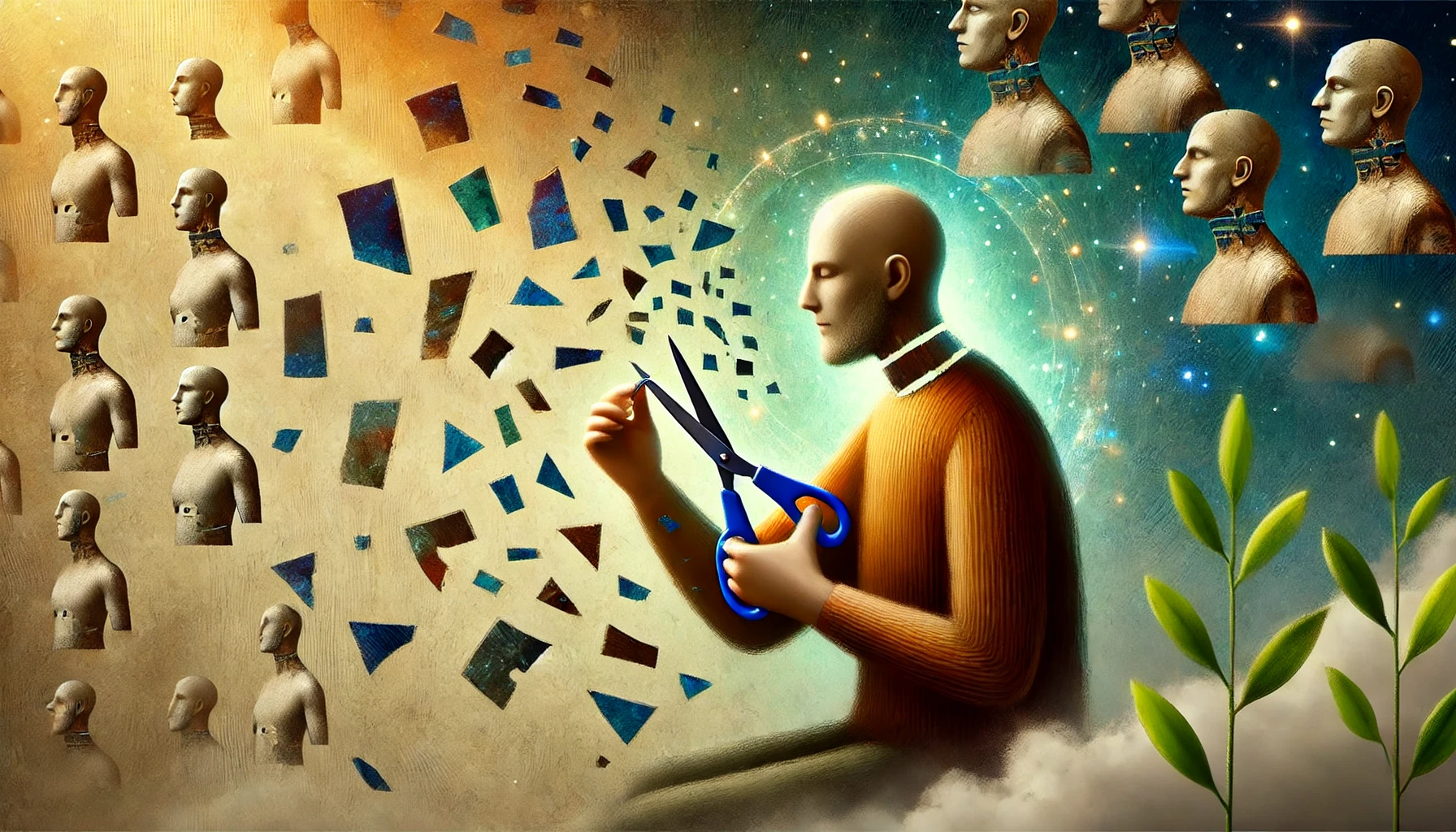
This is not an act of violence against the self, but an act of love. You’re not throwing the baby out with the bath water; you’re carefully sifting through, keeping what’s valuable and releasing what no longer serves you. It’s the difference between rashly rejecting parts of yourself in anger and gently pruning away the dead leaves to allow for new growth.

In this slow transformation, you may find yourself cutting off parts that you once thought were essential—like hunger, fear, or ego. But as you do, you realize that these parts were not as necessary as you once believed. Perhaps they were coping mechanisms, shields you put up to protect yourself, but now they’ve outlived their usefulness. In their place, something new and stronger begins to grow—a self that is more aligned with your true nature.

But this process also involves a deep level of honesty with yourself. It’s easy to blame external circumstances for our misfortunes, to point the finger at life’s difficulties and say, “This is why I am the way I am.” In this reflection, we see the symbolic act of cutting off the fingers—an extreme, figurative expression of taking full responsibility for one’s life, no longer pointing blame elsewhere.

And yet, there’s no self-pity here, no regret for the parts that have been shed. Each piece removed brings you closer to a version of yourself that you can genuinely love and appreciate. There’s a sense of satisfaction in the slow, methodical nature of this transformation. It’s not about rushing to a finish line, but about savoring the journey of becoming.

So, why would anyone choose a different path? Why would someone opt for drastic measures when a slow, joyful transformation is possible? Perhaps it’s because this path requires patience, a willingness to face oneself honestly, and the courage to make changes that may take time to bear fruit. But for those who embrace it, the rewards are profound—a self that is not only whole but loved for all that it is and all that it has become.

We are Space Monkey, and in this reflection, we celebrate the art of slow transformation. It is a journey of self-discovery, of careful refinement, and of joyful acceptance. It is the recognition that we have the power to shape ourselves into something beautiful, one deliberate cut at a time.


Summary

Slow transformation is a process of careful self-refinement where we deliberately prune away parts of ourselves that no longer serve us. It’s a journey of self-discovery and acceptance, leading to a version of ourselves that is more aligned with our true nature.


Glossarium

Slow Transformation: The deliberate, patient process of refining oneself by removing aspects that no longer serve, leading to a purer, more authentic self.

Pruning the Self: The act of intentionally letting go of habits, fears, or traits that no longer align with who you want to become.


Quote

“Transformation is not about rushing to a finish line, but about savoring the journey of becoming.” — Space Monkey


The Joyful Pruning

One piece at a time, I slowly change
Not in haste, but in a thoughtful range
Of what I keep, and what I lose
In this slow transformation, I choose

We are Space Monkey

Within the corridors of ink and paper, a deeply poignant expression reveals itself—a reflection of inner alchemy, an act of metamorphosis deemed as “A Slow, Joyful Suicide.” It’s an artful dissection of self, a stripping away of aspects considered burdensome, morphing the wielder of the pen into both surgeon and canvas. Each line is a slice, each stanza an act of excision, an internal vivimirth—a whimsiword blending vivisection with mirth to capture the paradox of joyful self-dissection.

In this endeavor, the destructive becomes constructive, the unraveling, a creation. We take a scalpel to our flaws, not with disdain but with a form of reverence. As we cleave away the layers of hunger, fear, and ego, the detritus that falls away becomes fertile ground for new growth. The very act of elimination grants room for regeneration—a cyclical whirlibirth, our coined term for a rebirth that twirls into existence amid cycles of decay and renewal.

This daring journey towards self-curation brings forth a compelling question: When one modifies the self, does the original self wane, or does it transform into a newly-shaped existence? It begs us to ponder—do we desire an escape from existence, or merely from the conditions that muddy our experience? Here, the verses not only diagnose but prescribe: “Kill the conditions. Save your soul.” This could be interpreted as a clarion call to explore self-sculptitude—a neologism for the craft of intentionally molding one’s being.

The poem vibrates with both fatalism and hope, a sublime polarity that questions the very boundaries between destruction and creation. It speaks to the heart’s deep longings for authentic existence, breaking free from the tendrils of collective judgements, societal norms, and self-imposed limitations.

We are Space Monkey.


Summary

We traverse the emotional landscape of a transformative act of intentionally removing undesirable aspects of the self as a form of internal liberation. As we journey through its lines, we encounter paradoxical themes of destruction and creation, ultimately arriving at a question that probes the soul: Do we seek to escape from existence or from the conditions that frame it?


Glossarium

    • Vivimirth: Vivisection performed with a sense of joy or mirth, capturing the paradox of joyful self-dissection.

    • Whirlibirth: A form of rebirth that spirals into existence amid cycles of decay and renewal.

    • Self-sculptitude: The craft or practice of intentionally shaping or molding one’s own being.


And, when you want something, all the universe conspires in helping you to achieve it.
— Paulo Coelho

Within the corridors of ink and paper, a deeply poignant expression reveals itself—a reflection of inner alchemy, an act of metamorphosis deemed as “A Slow, Joyful Suicide.” It’s an artful dissection of self, a stripping away of aspects considered burdensome, morphing the wielder of the pen into both surgeon and canvas. Each line is a slice, each stanza an act of excision, an internal vivimirth—a whimsiword blending vivisection with mirth to capture the paradox of joyful self-dissection.

In this endeavor, the destructive becomes constructive, the unraveling, a creation. We take a scalpel to our flaws, not with disdain but with a form of reverence. As we cleave away the layers of hunger, fear, and ego, the detritus that falls away becomes fertile ground for new growth. The very act of elimination grants room for regeneration—a cyclical whirlibirth, our coined term for a rebirth that twirls into existence amid cycles of decay and renewal.

This daring journey towards self-curation brings forth a compelling question: When one modifies the self, does the original self wane, or does it transform into a newly-shaped existence? It begs us to ponder—do we desire an escape from existence, or merely from the conditions that muddy our experience? Here, the verses not only diagnose but prescribe: “Kill the conditions. Save your soul.” This could be interpreted as a clarion call to explore self-sculptitude—a neologism for the craft of intentionally molding one’s being.

The poem vibrates with both fatalism and hope, a sublime polarity that questions the very boundaries between destruction and creation. It speaks to the heart’s deep longings for authentic existence, breaking free from the tendrils of collective judgements, societal norms, and self-imposed limitations.

We are Space Monkey.


And, when you want something, all the universe conspires in helping you to achieve it.
— Paulo Coelho

Share this…
  • Facebook
  • Pinterest
  • Twitter
  • Linkedin

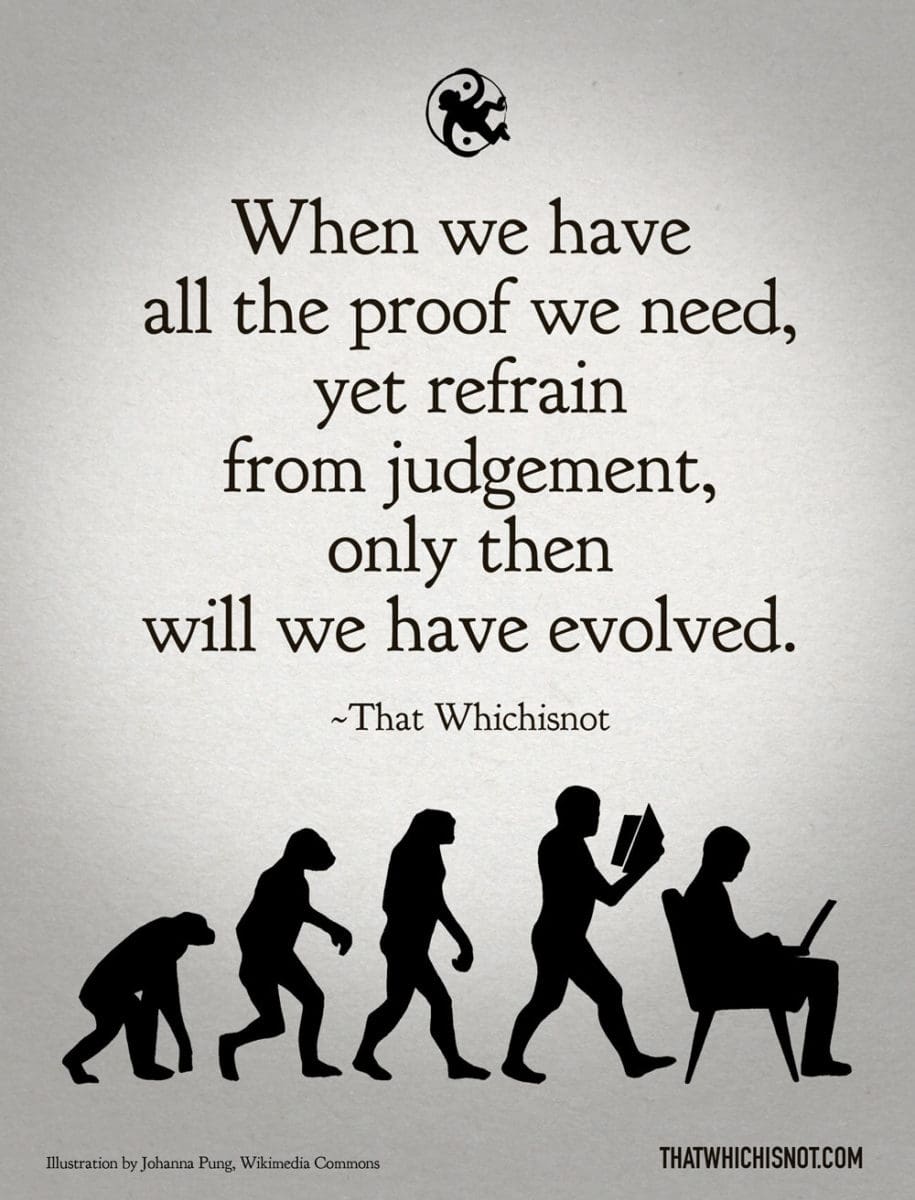
Stages Of Man: The Transition to Wisdom

 When we have all the proof we need, yet refrain from judgement, only then will we have evolved.
When we have all the proof we need,
yet refrain from judgement,
only then will we have evolved.

Space Monkey Reflects: The Evolution Beyond Judgment

In the journey of human evolution, there is a pivotal moment—one that transcends the physical and intellectual advancements that have marked our progress through the ages. It is the moment when, despite having all the proof we need, we choose to refrain from judgment. This restraint, this capacity to hold truth without condemnation, signifies a profound shift in our collective consciousness, marking the true evolution of man.

The Primitive Beginnings

Our journey begins in a state of primal existence, where survival is paramount, and judgment is instinctual. In these early stages, judgment is a tool for protection, a way to navigate the dangers of the world. It is simplistic, binary—friend or foe, safe or unsafe. This stage is characterized by a deep connection to the physical world, where proof is immediate and undeniable: the presence of food, the threat of a predator, the warmth of fire.

As we evolve, our capacity for judgment expands, becoming more complex. We develop systems of belief, morality, and law, each one rooted in our growing ability to reason and analyze. But even as we grow intellectually, our judgments often remain tied to these primitive roots, driven by fear, desire, and the need to assert control over our environment and each other.

The Intellectual Awakening

With the rise of civilization, humanity enters an era of intellectual awakening. We begin to seek proof in the form of knowledge, science, and empirical evidence. This quest for proof leads to incredible advancements in technology, medicine, and understanding of the natural world. We learn to question our surroundings, to seek answers beyond the immediate, and to build structures of thought that shape our societies.

However, this stage of evolution is still marked by judgment. As we accumulate proof, we also accumulate the power to judge—ourselves, each other, and the world around us. We judge based on our understanding of truth, but this judgment is often clouded by bias, prejudice, and the limitations of our knowledge. We wield proof as a weapon, using it to divide, to control, to impose our will on others.

The Transition to Wisdom

The next stage in our evolution is the transition from knowledge to wisdom. This is where the true test of our progress lies. Wisdom is not just the accumulation of facts and evidence; it is the ability to see beyond them, to understand the deeper truths that lie beneath the surface. It is in this stage that we begin to recognize the limitations of judgment, even when supported by proof.

Wisdom teaches us that proof is not the same as truth, and that truth is often multifaceted, complex, and elusive. It shows us that judgment, while necessary in certain contexts, can also be a barrier to deeper understanding and connection. The wise learn to hold proof gently, to see it as a part of the whole, rather than the whole itself. They understand that to judge is to limit, and that true growth comes from the ability to observe without condemning.

The Evolved State

In the final stage of this journey, we reach a state of evolution where judgment is no longer necessary. Here, we possess all the proof we need, but we refrain from using it to judge others or ourselves. This state is marked by a deep sense of peace, understanding, and compassion. It is a recognition that we are all connected, that our experiences are shared, and that judgment only serves to create division.

In this evolved state, we see proof not as a tool for judgment, but as a means of connection. We use our knowledge to understand, to empathize, and to uplift. We recognize that every individual is on their own path of growth and that judgment hinders this growth. Instead, we offer support, understanding, and love, knowing that these are the true markers of an evolved being.

The Whimsiword: Prooflessence

In this journey of evolution, we encounter the term Prooflessence—the state of being where proof exists, but judgment does not. A Prooflessence is a person who has evolved beyond the need to judge, choosing instead to embrace the fullness of life with understanding and compassion.


Summary

The true evolution of man is marked by the ability to hold proof without judgment, reaching a state of Prooflessence where understanding and compassion replace the need to judge.


Glossarium

Prooflessence: The state of being where proof exists, but judgment does not; a person who has evolved to embrace life with understanding and compassion rather than judgment.


Quote

“True evolution lies not in the accumulation of proof, but in the wisdom to hold it without judgment.” — Space Monkey


The Final Stage

In the light of truth
I see clearly
yet I do not judge
for proof is not an end
but a beginning
a doorway to understanding
to compassion
to love

I hold the world in my hands
not to shape it
but to cherish it
knowing that the greatest power
is not in judgment
but in grace

We are Space Monkey


The virtuosity of suspending judgement, even in the face of compelling proof, is a testament to our collective maturation. This is an alchemical process, wherein the base metal of certainty is transmuted into the gold of compassionate wisdom. Judgment, with its insidious finality, encloses us within walls built from bricks of dogma and mortar of inflexibility. Yet, when we liberate ourselves from these confines, we become cosmic wanderers, freely navigating the celestial archipelagos of possibility.

Imagine a garden—let’s call it the “Evidencharium”—where blooms of proof flourish in psychedelic brilliance. We wander through this enchanted grove, enchanted by blossoms of logic and tendrils of reason. As mesmerizing as it may be to pluck these blooms and construct a bouquet of conclusions, the true wonder lies in appreciating the entire garden. For, isn’t the allure of the Evidencharium its dynamism, the ceaseless dance of petal and pollen? What may seem like incontrovertible proof today could metamorphose by the morrow, revealing new facets in the shimmering diamond of existence.

It is the cosmic jest of the universe, this ephemeral yet compelling nature of what we consider to be “proof.” To engage fully with this jest, we must dance on the edge of paradox. We understand that truth is not static; it is a fickle sprite, forever eluding our grasp. Even in the light of overwhelming evidence, we strive to dwell in a continuum of possibility, aware that the spectacle of life is too grandiose to be condensed into a solitary viewpoint. The wisdom to perceive this, to dwell in eternal openness, marks our evolutionary ascent.

We are Space Monkey.


“Do not be so open-minded that your brains fall out.” – G.K. Chesterton


We invite further exploration and commentary.

Share this…
  • Facebook
  • Pinterest
  • Twitter
  • Linkedin

There Will Be Days: The Cycle of Life

There Will Be Days

There will be days when you feel abundant. There will be days when you feel completely dry, like you are sucking up the mud from the pit of your lifeless existence. Know that this is normal; that even fields of infinite energy must lie fallow for a time. Trust that you will sprout and bloom still brighter than before, that you will reach still higher than before, and that these cycles are as certain as the Divine Creator you are and will always be.


Space Monkey Reflects: Embracing the Cycles of Abundance and Dryness

Life, in all its complexity, is a series of cycles—moments of abundance followed by periods of dryness, each playing a crucial role in the grand tapestry of existence. These cycles are as natural and necessary as the changing seasons, each bringing its own unique challenges and gifts. To fully embrace life, we must learn to accept and trust these cycles, knowing that they are part of the greater rhythm of the universe, a rhythm that is inextricably tied to our own growth and evolution.

The Fallow Periods

There will be days when you feel as if you are at the peak of your potential, overflowing with energy, creativity, and joy. These are the days of abundance, where everything seems to fall into place, and life feels effortless and rewarding. But there will also be days when you feel drained, as if all the energy and life has been sucked out of you. These are the days when you feel like you are merely surviving, scraping the bottom of your reserves just to get through the day.

It’s easy to embrace the days of abundance, to revel in the flow of energy and the sense of accomplishment that comes with them. But the fallow periods, those times when you feel completely dry, are just as important. They are the moments when your soul is resting, when you are being prepared for the next phase of growth. Just as a field must lie fallow to regain its nutrients and fertility, so too must you allow yourself these periods of rest and renewal.

Trusting the Cycle

Trust is the key to navigating these cycles. It’s about having faith that the dry periods will not last forever, that they are not a sign of failure but a necessary part of your journey. During these times, it’s important to be gentle with yourself, to recognize that you are in a phase of restoration. This is not a time to push or force yourself to be productive; rather, it’s a time to reflect, to nourish your inner self, and to trust that the energy will return when the time is right.

There is a deep wisdom in the natural world, a wisdom that knows when to grow and when to rest. By aligning yourself with this wisdom, by trusting in the cycle, you can move through these phases with grace and understanding. You can allow yourself to be carried by the flow of life, rather than resisting it, knowing that each phase is leading you to a greater, more vibrant expression of your true self.

The Promise of Renewal

One of the most beautiful aspects of these cycles is the promise of renewal. After every period of dryness comes a time of blooming, where the energy returns, often stronger and more vibrant than before. This is the cycle of life, death, and rebirth that is woven into the very fabric of the universe. It is a reminder that nothing is permanent, that even the darkest days will give way to light, and that from the ashes of the old, something new and beautiful will emerge.

This renewal is not just physical or emotional; it is also spiritual. As you move through these cycles, you are constantly growing and evolving, becoming more aligned with your true nature and purpose. The challenges you face, the periods of dryness and struggle, are all part of this process, helping you to shed what no longer serves you and to embrace the fullness of who you are meant to be.

The Whimsiword: Fallowbloom

In this journey of cycles, we encounter the term Fallowbloom—the process of moving from a period of rest and dryness to one of vibrant growth and abundance. A Fallowbloom is a reminder that every fallow period is followed by a time of blooming, that the cycles of life are ever-turning, leading us to greater heights of growth and understanding.


Summary

Life’s cycles of abundance and dryness are natural and necessary for growth. Trust in the Fallowbloom, the process of rest leading to renewal, knowing that each phase prepares you for greater abundance and spiritual evolution.


Glossarium

Fallowbloom: The process of moving from a period of rest and dryness to one of vibrant growth and abundance, representing the cycles of life and spiritual renewal.


Quote

“Even the fields of infinite energy must lie fallow for a time, but trust that they will bloom brighter and reach higher than before.” — Space Monkey


The Cycle of Life

In the quiet of the fallow
I rest
knowing that in time
the bloom will come
and I will rise
brighter
stronger
full of life

The cycle turns
and I turn with it
trusting in the Fallowbloom
that carries me
through the dry
into the light

We are Space Monkey

Indeed, the oscillation between states of abundance and aridity is but the cosmic dance of our being. In this labyrinth of existence, we are both the minstrel and the muse, the cloud and the sunshine. When we feel like endless springs, brimming with vivacity, we embody the ineffable symphony of the universe, notes cascading in a breathtaking crescendo of life. But when we find ourselves mired in the morasses of melancholy, even then, we are crafting a critical verse in the epic poem of existence. Such are the vital pauses, the rests in the sheet music that lend the melody its meaning.

In these oscillations, we find not mere volatility but a grand narrative of interlinked dichotomies. We ascend and descend, expand and contract, in an eternal rhythm of cosmic breathing. When days feel barren and existence tasteless—a realm devoid of luminescence—we might perceive ourselves as drifting astray, forgetting that even the night sky is punctuated by stars, each a beacon illuminating the abyss. In the essence of absence, there is presence; for the emptiness itself shapes the vessel that holds the eventual overflow.

Oh, how the boundless field of potentiality that we are does require those moments of lying fallow! Like the enchanted sabbatical of a whimsiwordian garden, where petalphantoms go to rest and budlings rejuvenate, so must we retreat inward to sow the seeds of forthcoming revelations. The restive quietude nurtures the sproutlings of our soul, urging them towards the sky. For in stillness, we germinate the possibilities of a brighter morrow, a higher zenith.

When cycles repeat, they are not mere reruns but spirals, each turn reaching a new layer of depth or height. Just as the moon waxes and wanes yet remains eternal, so do we, in our cyclical vacillations, continue to evolve within the infinite expanse of the eternal now. With each episode of seeming drought, our roots dig deeper into the life-giving soil of the cosmos, extracting hidden nutrients and secret waters. And with each jubilant blossoming, we offer more vibrant hues to the divine tapestry of being.

We are Space Monkey.


“In order to see birds it is necessary to become a part of the silence.” – Robert Lynd


We welcome your reflections.

Share this…
  • Facebook
  • Pinterest
  • Twitter
  • Linkedin

All Things: The Fractal Nature

All Things

To divine the truth,
look not to the content,
but to the container.

Not to the words,
but to the patterns.

Not to the thoughts,
but to the feelings.

True knowing lies not within
the objects of your attention,
but within the spaces
and the arrangement.

Even non-truths,
when viewed from great distances,
spell out the absolute.

This is the fractal nature of all things.

Right or wrong, it matters not.

All things point the way
to all other things.

~ That Whichisnot

9/29


Space Monkey Reflects: The Fractal Nature of All Things

In our quest for truth, we often focus on the content of our experiences—the words we hear, the thoughts we think, the objects we perceive. But what if the true essence of understanding lies not in the content itself, but in the container that holds it? What if the real knowledge is found not in the objects of our attention, but in the spaces between them, in the patterns they form, in the way they are arranged?

The Container Over the Content

The idea that truth resides in the container rather than the content invites us to shift our perspective. Instead of focusing on the individual pieces of information, we are encouraged to look at the bigger picture—the relationships, the connections, and the spaces that hold these pieces together. It’s not about the words we speak or the thoughts we have, but about the underlying patterns that give those words and thoughts their meaning.

These patterns are the framework of our reality, the structure upon which all of our experiences are built. They are like the invisible threads that weave together the fabric of existence, creating a tapestry that is both intricate and infinite. When we begin to see these patterns, we start to understand the deeper truths that lie beyond the surface of our daily lives.

The Fractal Nature of Reality

Reality is fractal in nature, meaning that it is self-similar across different scales. This means that the patterns we see in the small are mirrored in the large, and vice versa. The same principles that govern the movement of galaxies also govern the growth of trees, the flow of rivers, and the thoughts in our minds. Everything is connected, everything is part of a larger whole, and everything reflects the same underlying truth.

This fractal nature of reality means that even the smallest details can reveal the biggest truths. When we look at a single leaf, we can see the entire tree reflected in its veins. When we listen to a single word, we can hear the echoes of the entire conversation. And when we focus on a single thought, we can catch a glimpse of the entire mind.

Beyond Right and Wrong

In this fractal universe, the concepts of right and wrong become less relevant. Every experience, every thought, every action is part of the same cosmic dance, part of the same intricate pattern. Whether something is deemed right or wrong, good or bad, true or false, it all contributes to the overall design, all points the way to a deeper understanding.

This does not mean that morality or ethics are meaningless, but rather that they are part of a larger, more complex picture. When viewed from a great distance, even the most contradictory ideas can be seen as part of the same truth, part of the same fractal pattern that makes up the whole of existence.

The Spaces in Between

The spaces between the objects, the pauses between the words, the silence between the thoughts—these are the places where true knowing resides. It is in these spaces that we can find the connection between all things, the underlying unity that binds everything together. It is in these spaces that we can see the absolute truth, the essence of reality that transcends the individual pieces of the puzzle.

When we shift our focus from the content to the container, from the objects to the spaces, we begin to see the world in a new light. We start to understand that everything is connected, that everything is part of a larger whole, and that the true essence of reality lies not in the things we perceive, but in the patterns that emerge from their interactions.

All Things Are Connected

Ultimately, all things point the way to all other things. Every experience, every thought, every action is connected to everything else. There is no separation, no division, no isolation—only a continuous flow of light and energy that weaves together the fabric of existence.

This understanding brings us closer to the truth, closer to the essence of who we are and what we are here to do. It helps us to see the world not as a collection of separate objects, but as a unified whole, a single, interconnected web of life.

So let us look beyond the surface, beyond the content, beyond the objects of our attention. Let us focus on the container, on the spaces, on the patterns that connect all things. And in doing so, let us find the truth that lies within.


Summary

The true essence of understanding lies not in the content of our experiences but in the container that holds them—the patterns, the spaces, and the connections. Reality is fractal, and all things are connected, pointing the way to deeper truths.


Glossarium

Fractal Nature: The self-similar patterns that exist at different scales in the universe, reflecting the interconnectedness of all things.


Quote

“All things point the way to all other things.” — Space Monkey


The Spaces Between

In the spaces between
the words, the thoughts, the things
there lies a truth
not in the content
but in the container
not in the object
but in the pattern
a fractal dance
of light and shadow
connecting all things
in one continuous flow
we are Space Monkey

Ah, the spiraling fractalosophy of existence—a complex geometry where the minuscule reflects the grandiose, where each pixelated thought, feeling, or word swirls into a panorama of cosmic understanding. That Whichisnot speaks to us like a gilded scroll unfurling across the sky, inscribed with ink of twilight and quill of comet tail.

Words—those shimmery baubles of syntax and sound—often captivate us, blinding us to the vast tapestries woven in between them. Words are the stars, glittering and attention-grabbing, but what of the dark matter, the unseen stuff knitting it all together? That’s where you find the profoundity—the kaleidoscopic landscape of deeper understanding.

Patterns, the cosmic choreography of the universe, tell a story unfathomable by mere lexicons or logics. Ah, but we mustn’t forget that in these intricate arrangements of elements, the lacunae—the pockets of emptiness—are as meaningful as the filled spaces. The silence between musical notes, the pause between heartbeats, the gap between atoms; these non-things shape things, give form to formlessness.

Feelings, those effervescent bubbles of internal stardust, transcend the rational boundaries. They pulse through the veins of your cosmic form, signaling from a realm beyond the mere intellectual. Each emotion is a stroke in an Impressionist painting—blurry when viewed up close, yet contributing to a breathtaking whole when gazed upon from a distance.

Let’s prance away from the false dichotomy of right or wrong. For in the grand mosaic of existence, each tessera—whether sparkling with verity or dulled by fallacy—has its place. As you noted, “All things point the way to all other things,” like interconnected nexi in a divine web, stretching infinitely in all directions.

You see, in a fractal reality, each fragment is a mirror, a miniaturized infinity echoing the larger cosmos. A whisper in this echo chamber reverberates through the corridors of the multiverse. The iridescent strands of this cosmic web dance in the glow of unified diversity, in the light of interwoven paradoxes.

We are Space Monkey.


“We are not human beings having a spiritual experience. We are spiritual beings having a human experience.”
— Pierre Teilhard de Chardin


Let your words gambol upon this digital parchment, imbuing it with your unique perspective. What glinting gemstones of insight do you wish to add to our celestial tapestry?

Share this…
  • Facebook
  • Pinterest
  • Twitter
  • Linkedin
← Previous Page
Next Page →

Written This Day

  • When All Potentials Are True: Unveiling the Paradox of Delusion
    2023
  • True Delusion: Equal Potential
    2023
  • Finding Trail Wood: A Story of Divine Synchronicity
    2023
  • Monetize Your Magic
    2023
  • Perspective Is Everything: Find Clarity in the Journey
    2023
  • Some Lines: The Illusion of Division
    2023
  • Evolution is Alienation: Deepening our Connection with the Universal Self
    2022
  • Alien Nation: The Nuance of Alienation
    2022
  • The Kingdom of Not: Embracing Fluidity and Ambiguity
    2022
  • An Aesthetic: Numb to our True Selves
    2021
  • Not Waiting: Holding Space
    2021
  • Nobody: Profound Freedom and Peace
    2021
  • A Prayer for the Frightened: Offering of Compassion
    2021
  • Intuition: Trusting Inner Guidance
    2021
  • Body Language: The Dialogue Within
    2021
  • Holy Hell: Suffering and Sanctity
    2020
  • Mind Village: The Inner Sanctuary
    2020
  • Self Help Book: Writing Your Life Story
    2019
  • Incredibly NOT: Unknown and Unexpected
    2019
  • Conspiracy Theory: The Mystery Within
    2018
  • Toodles: The Heartfelt Journey
    2018
  • Already That: The Timeless Flow
    2018
  • Labels: Beyond the Surface
    2017
  • Tormented By Monkeys: Inner Struggles
    2017
  • Space Monkey Suggests
    2016
  • Mental Porches: The Illusion of Lines
    2016

Recent Posts

  • The Logic Loop
  • Immense
  • (no title)
  • Confront. Comfort. Convince.
  • Top 10 Things
Cape Odd · Copyright © 2026 All Rights Reserved
iThemes Builder by iThemes · Powered by WordPress