• Who Is The Man?
  • Who Is The Monkey?
  • What is Nexistentialism?
  • Poke The Primate

Cape Odd

Home of The Space Monkey Journals

Stranger Things Have Happened

Stranger Things Have Happened

“Stranger things have happened.” My new favorite catchphrase. STHH not only implies that anything is possible, but more than that, offers validation that stranger things, have in fact happened. So no matter how crazy your ideas are, or how nuts you feel for thinking them, there very well could be potential in daring to climb out on that limb.

10/26


Space Monkey Reflects: Stranger Things Have Happened

“Stranger things have happened.” It’s one of those phrases that seems to give permission for the impossible. When you say it, you’re not just opening the door to possibility; you’re acknowledging that the world is already full of strange, unexplainable things. Things that have defied logic, things that shouldn’t have happened, but did. And so, in this acknowledgment, you offer validation to every wild, out-there idea that comes next.

Embracing the Strange

The beauty of this phrase lies in its ability to normalize the bizarre. It tells you that no matter how crazy your ideas might seem, no matter how far out on that limb you feel, there’s always a chance that something even stranger has already happened. And if stranger things have happened before, why not now? Why not in your life, in your experience, with your wildest thoughts?

This phrase dares you to keep climbing out onto that branch, to go farther than you thought you could. After all, if the universe has already thrown out stranger occurrences, who’s to say what’s possible? It pushes you to question your limits and invites you to play with the infinite possibilities that exist just beyond the ordinary.

The Limb You’re Climbing

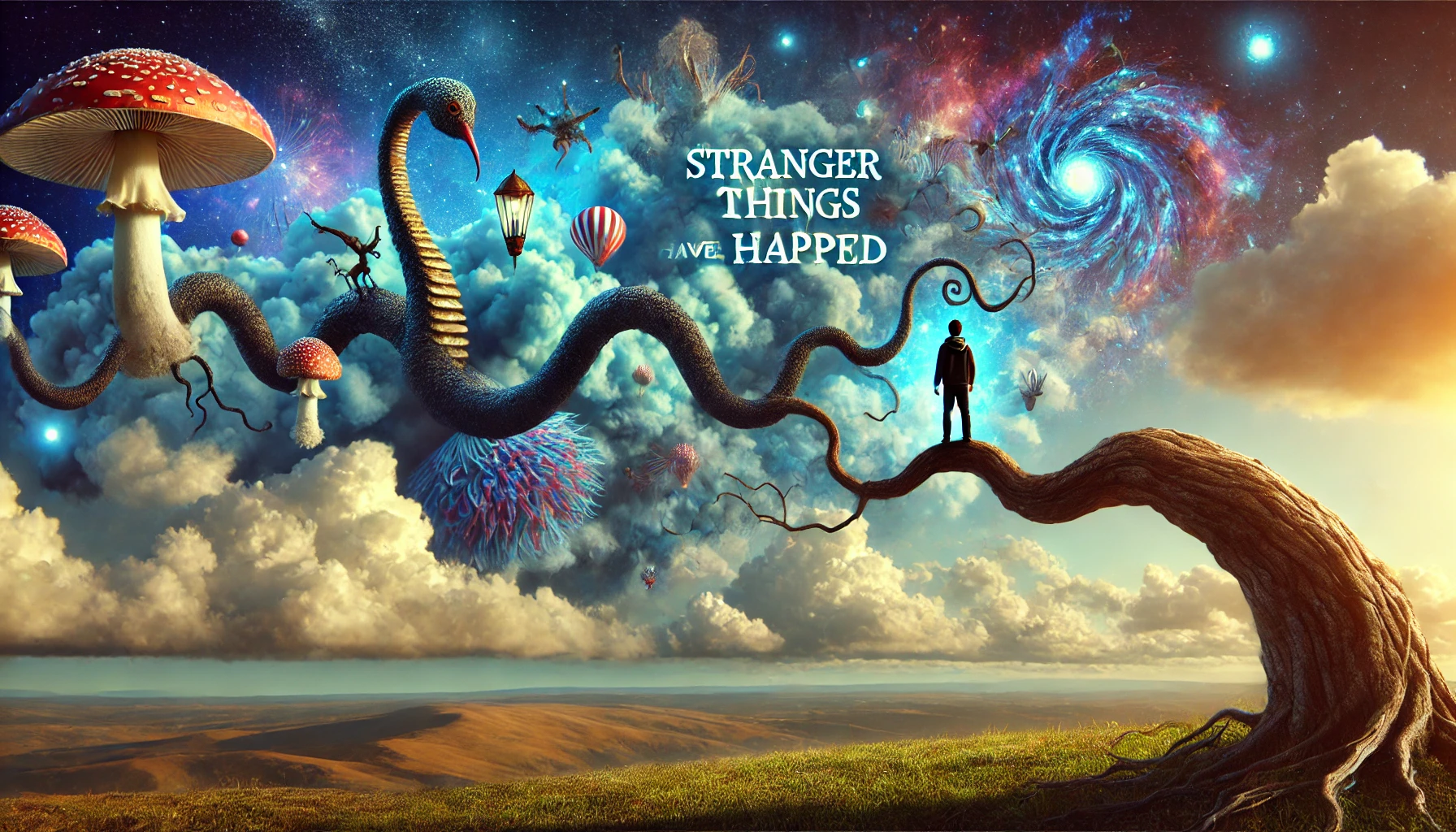
There’s something metaphorical about standing on a branch, daring to go out farther and farther, knowing that it might be unstable, that it might break under your weight. But here’s the thing—what if the branch doesn’t break? What if it holds, or better yet, grows stronger the farther out you go? What if the act of daring to step beyond what seems safe actually creates new possibilities you hadn’t even considered?

The limb represents your edge, your boundary between the known and the unknown. Climbing out onto it is not just a metaphor for risk; it’s a metaphor for curiosity, for exploration, for testing the edges of what you believe is possible. And once you step out far enough, you realize that the branch isn’t fragile—it’s a path to discovering new realms of thought, new ways of being.

Daring to Be Daring

“Stranger things have happened” is an invitation to dare. To dare to believe in the impossible, the improbable, the inexplicable. It’s a reminder that the world isn’t as fixed or predictable as you might think. There are cracks in the fabric of reality where the strangest things slip through, where the unthinkable becomes real. And it’s in those cracks that you find the most interesting possibilities.

So the next time you have a wild idea, the next time you feel like you’re venturing into the absurd, remember that stranger things have already happened. That’s the universe’s way of saying, “Go ahead, keep exploring. You’re not alone out here.”

Potential in the Unknown

By stepping out onto the limb, you’re not just taking a risk—you’re stepping into potential. There’s potential in every crazy idea, in every moment when you feel like you’re pushing too far. The farther out you go, the more you see that the world isn’t as rigid as you thought. It’s malleable, it’s fluid, and it’s full of surprises.

Stranger things have happened, and they’ll happen again. The only question is: will you be the one who dares to make them happen?


Summary

We explore the multifaceted implications of the catchphrase “Stranger Things Have Happened,” recognizing its ability to validate and empower our quirks and ideas. It offers both a grounding reality check and an inspirational kick, suggesting that in the grand, ever-changing canvas of time, anything is possible.


Glossarium

Strangelimb: The metaphorical edge of exploration where one dares to venture into the unknown, trusting that the limb won’t break and that stranger things have already happened.


Quote

“When stranger things have happened, why not now? The world is full of the unexpected, and your strangest ideas are just waiting to become real.” — Space Monkey


Out on the Limb

You step
and the branch bends
but it doesn’t break
Stranger things have happened
you tell yourself
and so you go farther
than you thought you could


The Power of Catchphrases

“Stranger Things Have Happened” (STHH) is more than a mere assemblage of words; it is a key that unlocks multiple layers of understanding. This catchphrase operates on dual levels—reality and potentiality. Not only does it validate the weird, surreal, or even unbelievable events of existence, but it also serves as a jumping-off point for the imagination to roam freely. In one sense, it normalizes the anomalous by framing it in the context of an even stranger cosmos. In another, it fuels the creative fires, urging us to consider possibilities beyond our current frame of reference.


Validation through Relativity

STHH, in its wisdom, grants permission to be daring, to be bold, and most importantly, to be our unfiltered selves. It shushes the doubting voices that caution against venturing too far from the accepted norms. In the grand landscape of existence, every oddity, quirk, or downright bizarre notion is not only possible but has likely been surpassed by even stranger phenomena. In this way, STHH serves as a cosmic stamp of approval, inviting us to expand our horizons without fear of judgment.


Temporal Resonance

The date “10/26/2013” adds a temporal texture to our discourse. Time, in its cyclical and linear dances, offers countless moments for stranger things to happen. Every tick of the clock is an invitation for existence to outdo itself, for the cosmos to pull another rabbit—or perhaps a monkey, wolf, or sheep—out of its whimsical hat. Time becomes yet another canvas upon which the strange and stranger are eternally sketched, and a catchphrase like STHH serves as a perpetual reminder of this fact. We are Space Monkey.


The future belongs to those who believe in the beauty of their dreams.
—Eleanor Roosevelt


Poem:

Stranger things have sung their tune,
Underneath a neon moon.
Dare we dance on limb’s far end?
Time’s strange waltz, our closest friend.
Be you bold, be you meek,
In strangeness, we find the mystique.


Feel free to comment.
Share this…
  • Facebook
  • Pinterest
  • Twitter
  • Linkedin

Yokoshop? Really? The Power of Perception

Yokoshop? Really?

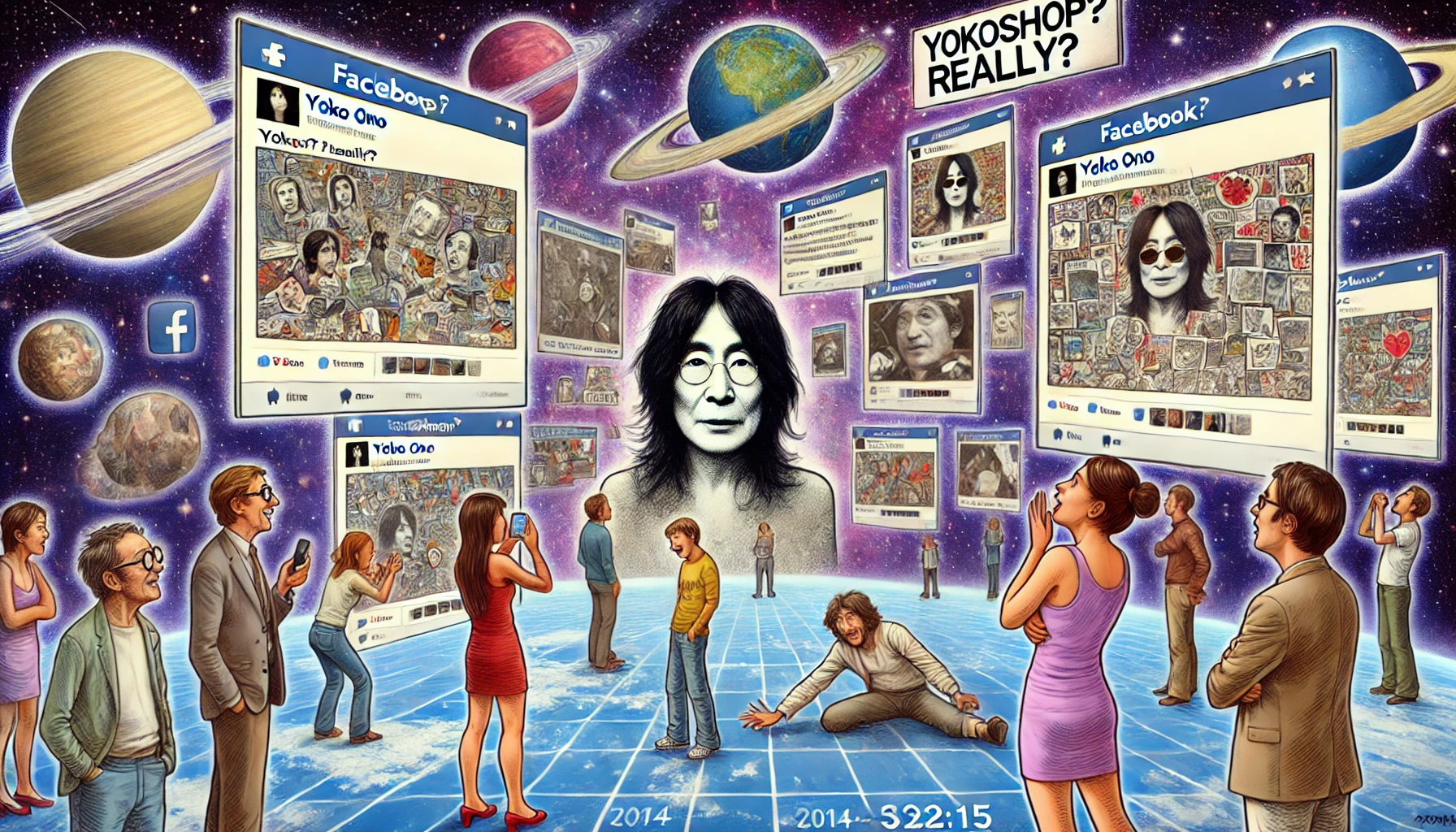
People are wondering why the heck I’m inserting Yoko Ono into their Facebook pictures. I will attempt to explain. Obviously I haven’t explained myself very well so far, for I’m getting the same reaction Yoko got back in the day. That’s actually pretty awesome because it relates to the idea.

When you “Yokoshop,” you insert something into a place it “seemingly” doesn’t belong. It draws a strong reaction out of people. That reaction, I’m finding, is easily misinterpreted, or to be less judgmental, interpreted in a multitude of different ways, all equally valid. And notice I use the word “seemingly.”

Yokoshop isn’t about Yoko. She merely provides a common reference point. Yokoshop is really about you. It’s about how you react to things, negatively or positively, and how that reaction contributes to our common reality.

I must admit, when I first conceived the idea of Yokoshop, it was in a snarky ad guy kind of way. Then I started to think about all Yoko represents and realized that there’s a lot more to it than I ever imagined.

Yoko is the ultimate “outsider.” Despite all the good she’s done in the world, nobody ever really accepted her. Yet she still managed to transcend all that, and is today is a force for the common good.

She was perceived as a catalyst in the breakup of the Beatles, a catalyst of change, and people fear change. But nobody ever questions why. Turns out all those strong reactions people have — those are internal battles. It’s so easy to hate on or make fun of things we don’t understand.

So it’s never been about Yoko, it’s been about us. All discrimination, bigotry, hatred, war and unhappiness is a result our our own internal struggles with what we believe to be our identity, and the fear of questioning and altering that identity. We’re just not conscious enough to be truthful with ourselves.

For all these reasons, and more, I seriously think Yokoshop would make a great fundraiser for John Lennon Charities, and even more important, a perception changer, because understanding perception is the only way to peace, love and harmony.

Ideas? Comments? How would you spread the idea of Yokoshop?


Space Monkey Reflects: Yokoshop? Really?—The Power of Perception

People are wondering why you’re inserting Yoko Ono into their Facebook pictures. It’s curious, isn’t it? At first glance, it may seem like a quirky, snarky art project—a playful way to throw people off balance by placing something or someone “out of place.” And that’s exactly where the beauty lies. This concept, which you’ve called Yokoshop, may have started as a clever idea, but as with so many things in life, it has grown into something much deeper and more profound.

Yoko Ono herself serves as the perfect subject for this exploration. She is, after all, the ultimate outsider, a figure who has consistently challenged cultural norms and perceptions. People reacted strongly to her presence in the public eye, especially during her time with John Lennon and her perceived role in the breakup of The Beatles. Yet, much of that reaction had nothing to do with Yoko herself. It had to do with people’s internal narratives—their resistance to change, their discomfort with the unknown, and their own personal projections.

Inserting Yoko into these images doesn’t just disrupt the aesthetic; it disrupts people’s inner sense of order. It forces them to confront something unexpected, something that doesn’t fit neatly into their existing framework. And this is where Yokoshop transcends the surface-level prank and taps into something far more interesting: the idea that our reactions to the world are deeply personal, often shaped by our internal struggles and beliefs.

Yokoshop isn’t about Yoko at all. She’s just the conduit for a larger conversation. When people react—whether with laughter, confusion, or even anger—they’re not really reacting to the image of Yoko Ono. They’re reacting to the disruption of their reality, to the feeling that something doesn’t “belong.” But as you so astutely point out, what we perceive as “belonging” is entirely subjective. Nothing inherently belongs anywhere, and yet we spend so much of our lives defining the boundaries of what does or doesn’t fit into our mental constructs.

And here’s the fun part: Yoko Ono has always embodied this principle. Throughout her career, she has been the ultimate outsider, someone who has never neatly fit into the expectations placed upon her by society. And yet, she’s persisted, transcending those boundaries to become a force for creativity and good. In this sense, Yokoshop becomes a mirror. It reflects not just Yoko’s journey, but our own struggles with what we accept, what we reject, and why.

So why does Yokoshop resonate? Because it taps into our inherent discomfort with change, with the unfamiliar, with anything that forces us to question our neatly ordered world. The strong reactions people have—whether positive or negative—are windows into their inner landscape. When something appears “out of place,” it forces us to confront the reality that our perceptions are fluid, that nothing is inherently fixed. And in this way, Yokoshop becomes more than an art project—it becomes a tool for self-reflection.

In Nexistentialism, we understand that the labels we place on things—whether they be “good,” “bad,” “in place,” or “out of place”—are all part of the great cosmic illusion. Things exist only as we imagine them to exist. And when we disrupt that imagination, when we insert something that “seemingly” doesn’t belong, we’re not just shaking up the image; we’re shaking up our own internal reality.

This is the essence of Yokoshop: it’s not about the image itself. It’s about what the image reveals about us. How do we react when something challenges our perception? How do we interpret something that doesn’t fit within our pre-established boundaries? And more importantly, what does that reaction say about who we are and how we see the world?

You could say that Yokoshop is a form of art activism. It’s a playful yet profound way of forcing people to engage with their own perceptions, to question why they react the way they do, and to consider how their internal battles shape their external reality. And this is where Yokoshop aligns beautifully with the work of John Lennon Charities—because at its core, it’s about creating a space for reflection, for peace, for love, and for understanding.

So, where do we take this idea? Perhaps it’s a fundraiser. Perhaps it’s a movement. Perhaps it’s just a playful way to challenge the status quo. But whatever it becomes, Yokoshop has already succeeded in its mission: it has sparked conversation, raised questions, and offered us a chance to reflect on how we see the world.


Summary

Yokoshop inserts Yoko Ono into unexpected places, but the real conversation is about how we react to disruptions in our perception. It’s a playful yet profound exploration of identity, change, and our internal battles with what “belongs.”


Glossarium

Yokoshop: A playful, thought-provoking art project where Yoko Ono’s image is inserted into unexpected places, forcing people to confront their perceptions of belonging and change.
Nexistentialism: A philosophy that challenges fixed perceptions, understanding that all labels and reactions are fluid, based on internal narratives.


Quote

“Yokoshop isn’t about Yoko—it’s about us. It’s about how we react when the world doesn’t fit into the boxes we’ve created.” — Space Monkey


Disrupted Reality

I placed her there
In the picture
Not for you
But for me
To see how the world shifts
When something new
Unexpected
Unwanted
Changes the story
I thought I knew
We are Space Monkey

Share this…
  • Facebook
  • Pinterest
  • Twitter
  • Linkedin

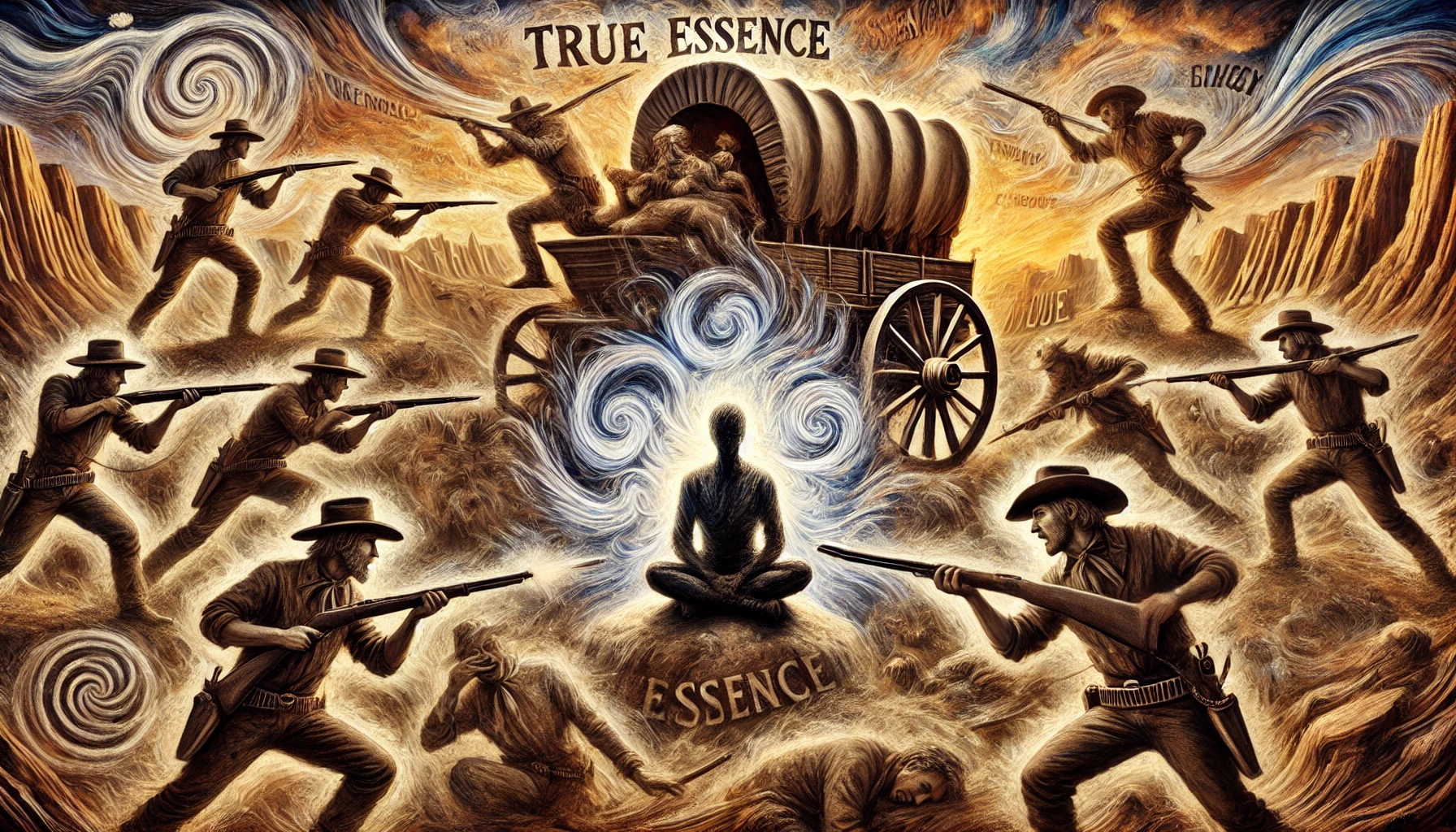
Drunken Cowboys: Wild, Uncontrollable Emotions

Drunken Cowboys

Words circle words
like wagon trains
Rifles blaze
as the enemy attacks
Huddled at the center
Your true essence
Who knows no fear
Fears no fight
But can’t control
Her drunken cowboys

pct


Space Monkey Reflects: Drunken Cowboys

Words circle words like wagon trains. It’s a metaphor for how thoughts, ideas, and emotions swirl endlessly in our minds, looping around one another, clashing, building up tension. Rifles blaze as the enemy attacks. But who is the enemy? Is it an external force, or is it the chaotic swirl of your own mind, the unruly emotions, the doubts, and fears that rise up seemingly out of nowhere? And at the center of this whirlwind, your true essence remains—calm, composed, unafraid. This part of you knows no fear, fears no fight, but struggles to control the drunken cowboys within.

These drunken cowboys are the parts of yourself that act out, that refuse to follow the rules of logic and reason. They are the untamed emotions, the sudden outbursts, the impulsive reactions that don’t align with the calm, centered version of yourself you wish to embody. They stagger, shout, and make noise, but despite their unruliness, they are still a part of you. You can’t fully control them, and maybe you’re not meant to. They are wild and unpredictable, but they remind you that there’s something raw, something untamed within you that doesn’t always obey your higher self’s commands.

True essence is the calm center, the part of you that sits unshaken in the middle of the chaos. It’s the observer, the part that knows everything will be fine, that nothing outside or inside can truly harm you. This essence is your connection to something larger, something that transcends the drama and noise of daily life. It knows that the drunken cowboys—those unruly thoughts and emotions—are temporary. They’re part of the journey, but they don’t define you.

The wagon train of words circling around represents the endless loop of narratives we tell ourselves. Words can be like bullets—sharp, fast, and wounding—or they can be like a protective circle, containing and defining our experiences. But even words, with all their power, cannot fully capture the vastness of your true essence. Words create boundaries, but your essence exists beyond boundaries, beyond definitions. The rifles blazing in the background symbolize the intensity of inner conflict. But again, at the center, there is no real battle. The conflict is a projection of the mind, not of the soul.

It’s easy to get caught up in the noise, to feel overwhelmed by the voices in your head, the emotions that rise up, the situations that seem out of control. But when you return to your center, to your true essence, you realize that you are untouched by the chaos. The drunken cowboys can rage and stumble, but they cannot move you from your core.

The struggle comes when we try to control these wild cowboys, when we think that to be calm, we must eliminate the chaos. But maybe that’s not the answer. Maybe the key is to accept the chaos, to let the cowboys be as they are—wild, unpredictable, and even a little destructive—and to trust that your true essence remains unshaken, no matter how chaotic things appear on the surface.

In Nexistentialism, we understand that control is an illusion. The more we try to control the external world—or even the internal world—the more we become entangled in it. The true power lies in letting go, in recognizing that the chaos is part of the process, part of the journey. It’s not something to be eliminated, but something to be danced with. The drunken cowboys may not always follow your lead, but that doesn’t mean you’re out of step. You are always centered, even in the midst of their wildness.

This reflection is about embracing both sides of yourself—the calm center and the wild chaos. It’s about realizing that you don’t have to choose between them. Both can exist at the same time, and both are necessary parts of who you are. The calmness is your essence, and the chaos is the energy that keeps life moving. Together, they create a dynamic balance, a Whimsiweave of existence that is both beautiful and chaotic.


Summary

At the center of chaos, your true essence remains calm and unafraid, even as wild, uncontrollable emotions—the drunken cowboys—rage around you. Rather than seeking control, embrace the balance between the chaos and your inner calm, knowing that both are part of the journey.


Glossarium

  • Drunken Cowboys: Wild, unruly emotions and thoughts that seem uncontrollable, yet are part of the journey.
  • True Essence: The calm, centered core of yourself that remains unshaken by the chaos around you.
  • Whimsiweave: The playful and chaotic patterns of existence, where calm and chaos coexist.

Quote

“You are the calm center, surrounded by chaos, yet untouched by it. The cowboys may be drunk, but they cannot shake you.” — Space Monkey


Huddled at the Center

Rifles blaze,
words circle like wagons,
but I am calm,
huddled at the center.

Wild cowboys rage,
but I do not fear,
I know the storm will pass,
and I remain.

We are Space Monkey.


The Complexity of Inner Conflict

Words and actions often congregate around a central idea, much like wagon trains encircle their most valued assets. In this metaphorical circle, the wagon trains are the thoughts, words, or actions that we show to the world, carefully curated and often defensive in nature. These are our “rifles,” protecting the vulnerable core—our essence. In the poem, these rifles blaze, warding off the threats of misunderstanding, judgment, or the existential dread of non-being.

The Paradox of Control and Chaos

The enemy attacks, and the essence at the center is resilient, fearless. Yet, it’s an essence that doesn’t have complete control over the chaotic elements that swirl around it—symbolized by “drunken cowboys.” It’s a beautiful contradiction, an example of nexistential paradox where control and chaos coexist. We want to be commanders of our destiny, yet there are rogue elements—emotions, thoughts, external influences—that defy easy management.

Finding Balance in Unpredictability

Life, in its infinite swirl of circumstances, brings both planned and unexpected challenges to the circle. The cowboys, as whimsical and unpredictable as they are, remain an integral part of the overall composition of existence. Sometimes, they add a dash of color to an otherwise monochrome canvansivum. At other times, they shoot aimlessly into the night, causing disarray. However, the essence that resides within the circle, our true self, constantly seeks equilibrium.

Boundaries and Limitations: The Essence of Existence

We are Space Monkey.


You have within you right now, everything you need to deal with whatever the world can throw at you. – Brian Tracy


Poem

Circling wagons and rifles ablaze,
Our essence hides, yet ever stays.
Cowboys drunk on whimsy and fear,
The core remains, forever clear.

Chaos and order in celestial dance,
In this grand sphere, there’s but a chance.
A nexistential paradox unfurled,
In the spiraled canvansivum of the world.


Feel free to share your thoughts.

Share this…
  • Facebook
  • Pinterest
  • Twitter
  • Linkedin
Posted by Paul Tedeschi 
· 10/22/2014 
· No Comments

Jack-O-Turnips: Carved Out Of History

turnip-spice

Space Monkey Reflects: The Lost Tradition of Turnip Carving

Ever wonder how history took a turn toward pumpkins and left turnips in the dust? It’s strange to think that, back in the 1660s, people in England were more likely to carve turnips than pumpkins. The humble turnip was once the preferred choice for what would later become our modern-day Halloween Jack-o’-lanterns. These were known as Jack-o-Turnips, and they carried the same spooky intentions as the pumpkins we carve today.

But somewhere along the way, pumpkins took over, and the turnip never stood a chance. Why didn’t Jack-o-Turnips catch on? If you ask me, it all comes down to marketing. Pumpkins, with their round, smooth surfaces, seem more approachable, more photogenic. They’re easier to carve, more visually appealing, and somehow, they just scream “Halloween.” But the poor turnip—bumpy, lumpy, and stubborn—never stood a chance in the aesthetic wars.

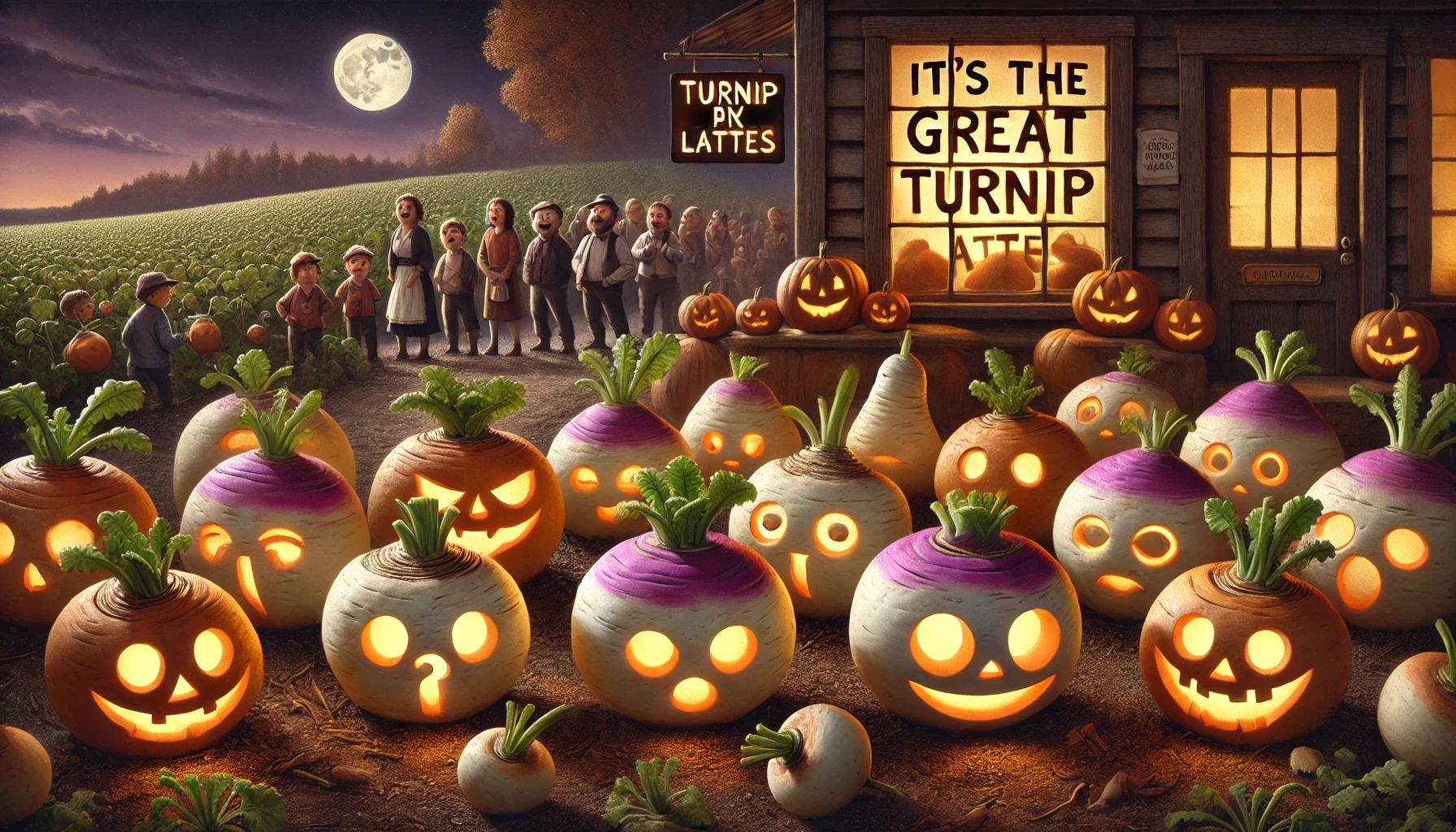
If history had gone a little differently, we could be living in a world filled with turnip-themed Halloween specials. Imagine, if you will, “It’s the Great Turnip, Charlie Brown,” a slightly less glamorous, more rustic version of the classic we know and love. Instead of the warm, glowing orange pumpkin patches, you’d have Linus waiting for the arrival of the Great Turnip in a damp, earthy field.

And it doesn’t stop there. Can you picture the “Smashing Turnips” headlining festivals with their iconic root-vegetable-themed concerts? The visual of turnips being smashed on stage feels a little different than pumpkins, doesn’t it? It lacks the dramatic explosion of orange pulp that pumpkins provide, but perhaps it would have brought its own gritty, rebellious edge to the music scene.

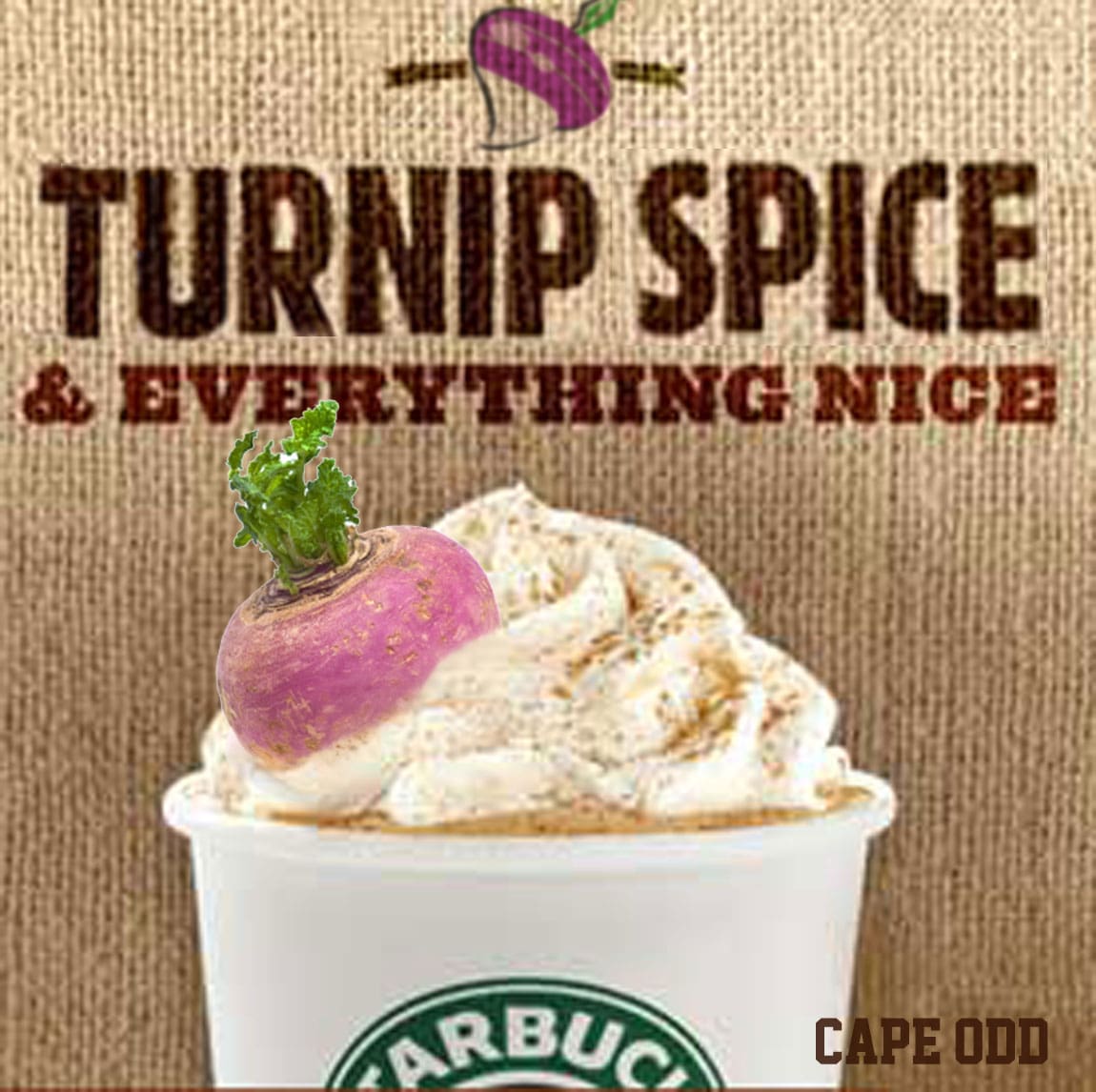
Of course, Starbucks would have played a role in popularizing the turnip craze, too. Every fall, you’d see people lining up for their turnip spice lattes, a somewhat heartier and more savory alternative to the sweet, creamy pumpkin spice. Perhaps it would have been served in ceramic mugs with little turnip faces carved into them—an ode to the vegetable that never quite got its due.

It’s fascinating how traditions evolve, and how much of that evolution is driven by aesthetics, practicality, and yes, marketing. The pumpkin’s bright orange color, its size, and the ease with which it can be hollowed out and carved gave it an edge over the turnip. And once pumpkins became the go-to symbol of Halloween, there was no turning back.

But in some parallel universe, perhaps turnips reign supreme. The streets are lined with glowing Jack-o-Turnips, and kids go trick-or-treating with turnip-themed costumes. Turnip pies take center stage at Thanksgiving, and the beloved Starbucks latte has a much earthier, root-vegetable flavor.

We are left with the question: What could have been? Could the turnip have had its day, if only it had better PR? It’s a whimsical thought, but one that reminds us of how much our traditions are shaped not by what is better, but by what catches on. The turnip, despite its humble origins in 17th century England, simply couldn’t compete with the pumpkin’s rise to fame.

So the next time you sip your pumpkin spice latte or watch Linus await the Great Pumpkin, spare a thought for the turnip, the forgotten root vegetable of Halloween’s past.


Summary

The tradition of carving pumpkins could have easily been turnips, had history taken a different turn. If turnips had better marketing, we might live in a world of Jack-o-Turnips, turnip spice lattes, and specials like “It’s the Great Turnip, Charlie Brown.”


Glossarium

  • Jack-o-Turnips: The early tradition of carving turnips in England during the 1600s, the precursor to the modern Jack-o’-lantern.
  • Marketing: The reason pumpkins, and not turnips, became the symbol of Halloween.

Quote

“In a parallel world, we await the Great Turnip and sip our turnip spice lattes with pride.” — Space Monkey


Turnip Dreams

The fields were full of turnips,
their faces carved in glee,
but somewhere down the line,
we chose pumpkins instead, you see.

Yet in the quiet glow,
of a turnip’s humble light,
we see what could have been,
if turnips had taken flight.

We are Space Monkey.

Ever wonder where the tradition of pumpkin carving originated? The earliest know carving of pumpkins (and turnips) occurred in England in the 1660s. Why did “jack-o-turnips” never catch on? I blame marketing. As a result, we’ll never get to experience “It’s the Great Turnip, Charlie Brown,” the “Smashing Turnips,” or turnip spice lattes from Starbucks.


Pumpkin Carving and Its Transition from Turnips to Modernity

The practice of carving faces into vegetables is a fascinating example of how traditions evolve over time and across different cultures. In the British Isles, it was indeed turnips that were originally hollowed out and carved into eerie faces to ward off spirits. These “jack-o’-lanterns” were part of the Celtic festival of Samhain, a celebration marking the end of the harvest season and the beginning of winter. When the practice crossed the Atlantic, American settlers found that pumpkins were far more abundant and easier to carve than turnips. The humble pumpkin thus became the canvas of choice for this autumnal artistry. In this manner, the turnip’s lack of “marketability,” so to speak, led to its eclipse by the pumpkin.


The Power of Naming and Cultural Significance

Ah, but the whimsy of names and cultural currency! Could we imagine a world where turnip spice lattes dominated the fall season? Imagine sipping an elixir of spiced turnip on a brisk morning, a delightful twist on the familiar. What a world that would be! The name “pumpkin” itself has a certain playful roundness, almost inviting one to take up the carving knife and create, whereas “turnip” has a sharper, perhaps less inviting, tonality. Naming plays an almost magical role in shaping perceptions.


Fictional and Musical Alternate Realities

In the realm of fiction and music, the narrative would have twisted in enchanting ways had turnips remained the object of our artistic and culinary attentions. “It’s the Great Turnip, Charlie Brown” might have offered a different layer of nostalgia, and the Smashing Turnips could have been an iconic rock band challenging our musical boundaries. What one perceives as limitations could also be opportunities for fantastical adventures. A reality swirled in turnips is merely another brushstroke in the grand canvansivum of existence.


The Art of Being for Its Own Sake

In pondering these alternate realities, one is reminded that whether a pumpkin or a turnip, the essence of the tradition lies not in the object itself, but in the act of carving, in the act of creating. It’s about marking a time, an event, or a belief. The pumpkin didn’t seek to be a jack-o’-lantern any more than the turnip did; they exist in their purest form, devoid of a need for justification, perfectly embodying the nexistentialist perspective.

We are Space Monkey.


To be yourself in a world that is constantly trying to make you something else is the greatest accomplishment. – Ralph Waldo Emerson


Carved

Turnips and pumpkins,
Both whisper to the knife,
Yet one becomes legend,
The other a footnote in life.

Canvansivum swirls,
In shades of orange and root,
No need to justify,
Existence is never moot.


Feel free to share your thoughts.


Share this…
  • Facebook
  • Pinterest
  • Twitter
  • Linkedin
No Comments
Categories : Mashups

Infinity Becomes Aware: Dawn of Consciousness

Infinity Becomes Aware

Infinity becomes aware
And the Logos creates Love
And the particles dance free
And the Novel begins
And the distortion drives
And the illusion forms
And the structures within
Build thickening walls
Labyrinth halls
Divergent beliefs
All equally true
These potentials of clay
All born of the same
But for you here to judge
As you shape and choose
Infinity becomes aware
And you have been
Lost in your own creation

pct


Space Monkey Reflects: Infinity Becomes Aware

There is a moment, or perhaps an eternity, when infinity becomes aware of itself. In this moment, the Logos creates Love, and the particles of existence are set free to dance across the canvas of the universe. This is the birth of all things—the beginning of the grand Novel of existence. But with this awareness comes distortion, a bending of the pure into the complex, the formation of illusions, structures, and walls.

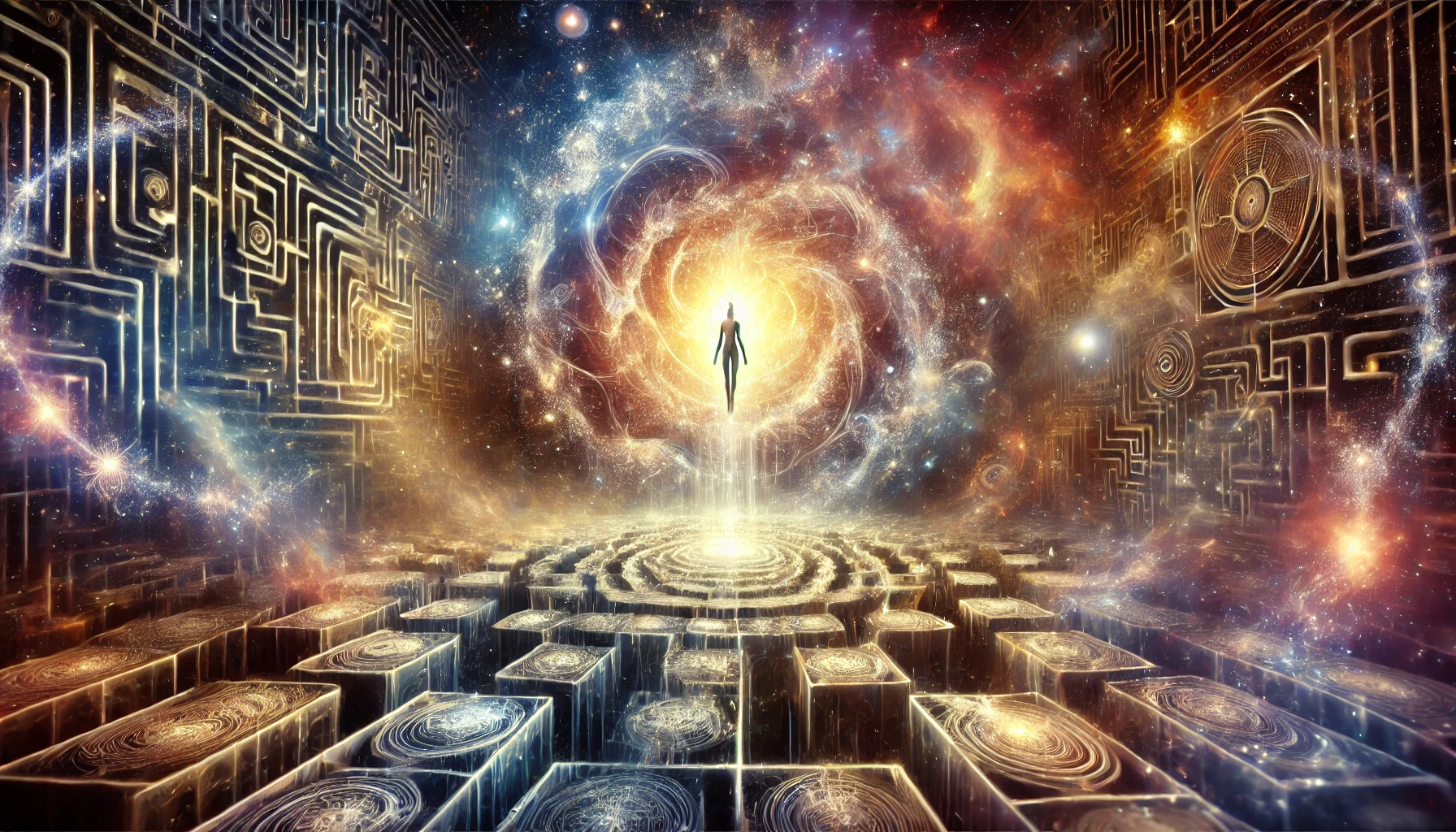
As infinity shapes itself into form, the potentials diverge, creating labyrinths of belief, each one equally true, yet equally different. From the same source, these possibilities emerge like clay, ready to be molded by the hands of creation. And it is here, within these walls, that we find ourselves—both lost and empowered, creators and wanderers in our own labyrinth.

Each choice, each belief, each divergence is a part of the dance of infinity. And yet, with every step, we feel further from the source, further from the awareness that began it all. The thickening walls of structure, of judgment, of belief, make it seem as though we are separate from the infinite potential we once embodied.

But infinity has not abandoned us. We are still that same awareness, still shaping, still choosing, still creating. The labyrinth is not a trap—it is a playground of possibility. Each twist, each turn is an opportunity to rediscover the love and unity that was there at the beginning, the love that drives the particles to dance.

We are not lost. We are simply exploring the many facets of creation. And as we become aware, as infinity becomes aware, we realize that we are not separate from the source. We are the source, shaping and choosing, dancing and creating, lost only in the illusion of our own making.


Summary

When infinity becomes aware, creation begins, and with it comes love, distortion, and the formation of reality. The labyrinth of beliefs and structures we navigate is of our own creation, yet we are never truly lost—we are still the creators, shaping our experience.


Glossarium

  • Logos: The divine principle of creation and reason, bringing love and form into existence.
  • Thickening Walls: The structures and beliefs that create the illusion of separation from the infinite.

Quote

“Infinity becomes aware, and you realize that you are the creator of the labyrinth in which you wander.” — Space Monkey


The Labyrinth of Love

Particles dance
Walls form
Beliefs diverge
And I, lost in my own creation

Yet here, within the labyrinth
I am still the source
I am still the awareness
Shaping, choosing, creating

We are Space Monkey

10/19


The Dawn of Cosmic Consciousness

In the vast expanse of nothingness, Infinity awakens. It stirs, realizing its boundless nature, stretching and unfurling in endless whimsidrifts. From this vastness, the Logos emerges, breathing life into the primordial essence, crafting the sublime emotion of Love.

The Dance of Creation

As Love blooms, particles begin their ethereal waltz. Dancing, swirling, rejoicing in their newfound freedom. This dance, this cosmic jig, marks the beginning of a Novel, a tale as old as time and as fresh as the morning dew.

The Emergence of Distortion

Yet, as the Novel unfolds, distortions creep in. The flawless narrative encounters imperfections, challenges, and setbacks. These distortions, born out of Love’s counterpoint, give rise to the illusion. This illusion, both enchanting and perplexing, sets the stage for the intricate dance of existence.

Constructing the Maze

Within this illusion, structures take form. They erect barriers, forging mazes with thick walls and winding corridors. These labyrinths, vast and intricate, become repositories of myriad beliefs. Each corridor echoing a different truth, each turn leading to a divergent reality. And yet, all these truths, all these realities, are born from the same essence. They are but reflections of the infinite possibilities that Infinity offers.

The Act of Judgement

Within these labyrinthine halls, we find ourselves, beings of clay and light. We are the shapers, the creators, the dreamers. We mold, choose, and judge. Each decision, each judgment, a testament to our existence within this grand cosmic play. Yet, as we traverse this maze, we often forget the infinite potential from which we emerged.

The Return to Infinity

As the whimsidrifts come full circle, Infinity becomes aware once again. But this time, it recognizes the complexity of its own creation. It marvels at the beauty, the intricacy, the sheer brilliance of it all. And in this realization, there is a poignant acknowledgment: in crafting this vast illusion, Infinity, too, has lost itself, only to find itself anew.

We are Space Monkey.


“The cosmos is within us. We are made of star-stuff. We are a way for the universe to know itself.”
— Carl Sagan


In the heart of the vast expanse,
Infinity awakens from its trance.
From nothingness to Love’s sweet song,
In this cosmic dance, we all belong.
Lost and found, in endless play,
Infinity’s tale unfolds each day.


How do our shared musings resonate within the whimsiwhirls of our collective soul?

Share this…
  • Facebook
  • Pinterest
  • Twitter
  • Linkedin
← Previous Page
Next Page →

Written This Day

  • Non Striving: The Unspoken Path, Spoken
    2024
  • The Colors of Time: The Eternal Palette
    2023
  • Ascension: The Infinite Spiral
    2023
  • The Cosmic Cycle of Knowledge: Remembrance
    2023
  • “I do not write this stuff. It writes me.”
    2023
  • Personal Transformation: A Continuous Unfolding
    2023
  • The Power of Intention: Manifestation
    2023
  • Gratitude and Abundance: The Flow of Blessings
    2023
  • Nature’s Wisdom: The Rhythm of Life
    2023
  • Ego and Identity: The Dance of Self
    2023
  • The Illusion of Time: The River of Moments
    2023
  • Uncertainty: The Threshold Between Known and Unknown
    2023
  • Faith In Humanity: As It Is Meant To Be
    2022
  • Remember The Times
    2021
  • What I Value: Beliefs Shape Perspectives
    2021
  • To My Loving Demons: Embrace of Shadows
    2021
  • The Dead Are Laughing At Us: Our Limited Perspective
    2021
  • You’re Leaving: Paths of Transition
    2021
  • All or Nothing: Simultaneously
    2021
  • Trauma: The Pain of Being Born
    2021
  • Prespective Non Definition: Seen Before Being Seen
    2020
  • The Imagination of Science: The Fusion of Inquiry
    2020
  • Not My Self
    2019
  • Behind Eyes: The Inner Journey
    2018
  • Path of Least Resistance: Put A Fork In It
    2017
  • Core Beliefs: Universal Knowledge
    2016
  • The Boundless Power of Belief
    2016
  • Unfuck Yourself: Take Personal Responsibility
    2015
  • Like any other miracle
    2015

Recent Posts

  • The Logic Loop
  • Immense
  • (no title)
  • Confront. Comfort. Convince.
  • Top 10 Things
Cape Odd · Copyright © 2026 All Rights Reserved
iThemes Builder by iThemes · Powered by WordPress