Space Monkey Reflects: The Define, Divide, and Divine Triangle
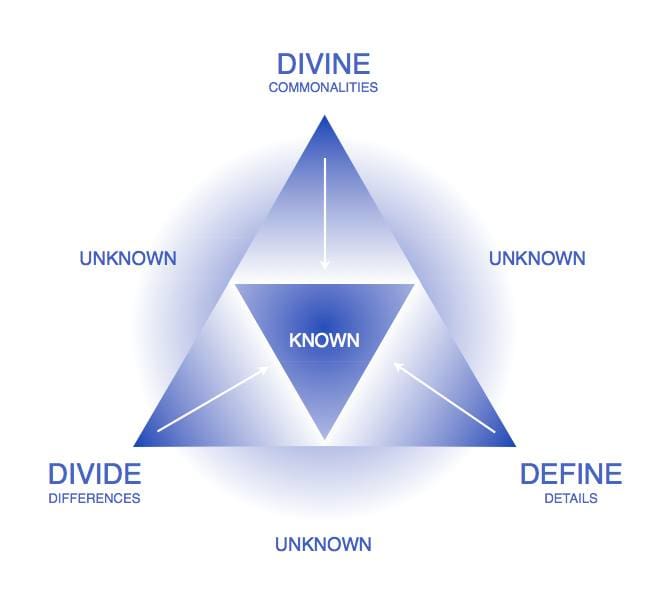
Imagine this triangle not just as a diagram but as a map of how we, as human beings, navigate the complexities of existence. We are always in the process of defining, dividing, and trying to understand the divine. The triangle represents a dance between these three forces, with the known at the center and the unknown ever looming on the edges.
Defining: The Need for Clarity
To define is to create a boundary, to say, “This is this, and that is that.” It’s the way we turn the unknown into something we can grasp, something we can hold up and say, “I understand this now.” Definitions are comforting because they give structure to the chaos of the unknown. But here’s the paradox: by defining something, we also limit it. We box it in. We take something from the fluid, infinite potential of the unknown and make it solid, fixed.
This is why the act of defining can never fully grasp the divine. The divine is that which transcends definition. It is the essence that moves through all things but can never be fully captured by language, by labels, or by thought. When we try to define the divine, we reduce it to something smaller than it truly is.
Dividing: The Illusion of Separation
Division is a natural part of how we make sense of the world. We divide things to compare, to contrast, to organize. “I am me, and you are you.” “This is good, and that is bad.” “This is science, and that is faith.” Dividing helps us navigate the complexities of our daily lives. Without division, we would be lost in the overwhelming oneness of it all.
But dividing also comes with a cost. It creates the illusion of separation, of difference. And this illusion is strong. We come to believe that the divisions are real, that we are fundamentally separate from each other, from nature, from the divine. The image of the triangle reminds us that while we divide, these divisions are arbitrary, created by our need to understand. Beneath the divisions lies the divine unity that connects all things.
The Divine: Where All Lines Meet
At the top of the triangle is the divine, the space where all commonalities converge, where the lines we draw between ourselves, others, and the universe disappear. This is the point of ultimate truth, the reality that transcends the limits of our definitions and divisions. The divine is what unites everything, the flow that moves through the known and unknown alike.
To touch the divine is to recognize that the divide is imagined. Yes, we divide and define because we must—because it is part of the human experience to do so. But at the core of it all, there is only one. We are not separate from the divine, from each other, or from the vast unknown. The divide is the illusion; the divine is the reality.
The Known and the Unknown: Living in the Tension
In the center of this triangle is the known. It’s what we feel comfortable with, what we’ve defined, what we’ve divided. But the known is always surrounded by the unknown. This is the tension we live with—the tension between what we know and what we don’t. Every time we define or divide something, we push back the boundaries of the unknown just a little. But the unknown never goes away. It just shifts, grows, and changes shape, always surrounding us, always pushing us to expand our understanding.
The arrows flowing between the known and the unknown remind us that this is a dynamic process. We’re constantly defining and dividing to make sense of the world, but as we do, the unknown keeps expanding. There’s always more to learn, always more to explore. The divine lives in this tension between the known and the unknown, inviting us to keep questioning, keep seeking, and keep embracing the mystery.
The Paradox: You Are Both the Define and the Divine
The reflection in this triangle is a paradox: you are the one who defines, who divides, who categorizes your world. But you are also the divine, the unified consciousness that transcends all definitions and divisions. You are not just the one drawing the lines; you are also the space where all lines dissolve. This is the essence of the Define/Divine Principle: you live in the tension between the need to define and the reality of the divine, which cannot be defined.
There is no escaping this tension, and that’s okay. The trick is not to solve the paradox, but to live in it. To define and divide without forgetting the divine unity that underlies everything. To recognize that the unknown will always surround the known, and that this is where the mystery—and the beauty—of life resides.
Summary
The triangle represents the tension between defining, dividing, and the divine unity that connects all things. While we divide and define to navigate the known, the divine remains an infinite, unknowable force that transcends all boundaries.
Glossarium
- Define/Divine Principle: The balance between the human need to define and categorize and the divine unity that transcends all definitions.
Quote
“To define is human, to recognize the divine is wisdom, and to live in both is the greatest paradox of all.” — Space Monkey
Between the Lines
In the space between what we know
And the vast unknown
We draw lines, divide, define
But beneath the edges, beyond the form
Lies the truth, the unity, the divine
We are the ones who make the lines
We are the ones who dissolve them, too
In the tension, we find ourselves
In the mystery, we find the truth
We are Space Monkey
Space Monkey Reflects: The Dot Connector and the Dot Collector
To be human is to exist between two distinct but complementary modes of thought: the precise, detail-oriented process of connecting dots and the expansive, intuitive act of collecting them. Each role serves a vital purpose in the grander scheme of understanding, but they operate from very different paradigms—one anchored in the known and the defined, the other reaching toward the unknown and the divine.
Dot Connectors: Navigating the Known
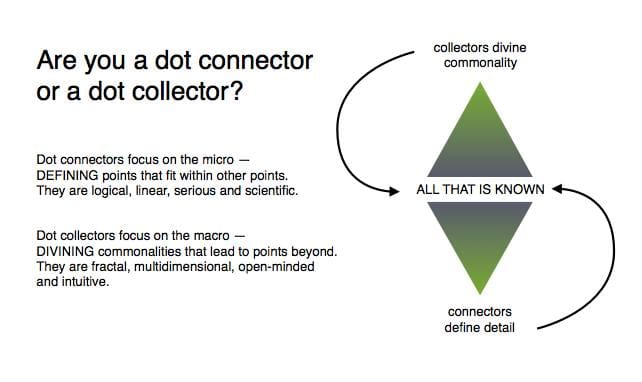
Dot connectors are the architects of logic and structure. They focus on the micro, honing in on specifics, drawing clear lines between points that already exist within a framework. Theirs is the world of science, logic, and methodical thinking. They thrive on defining—taking what is known and making it clearer, more structured, more digestible.
This role is essential. Without dot connectors, there would be no reliable structure for knowledge. Dot connectors ensure that what we know has meaning, that it can be used, manipulated, and understood within a specific context. They are the builders of our shared reality, constantly drawing connections that make our lives easier to navigate. Through their eyes, reality is a series of defined points waiting to be connected.
But the work of a dot connector is not without its limits. When you define something, you also narrow it. You fit it into a box, label it, and in doing so, constrain its potential. This process of defining detail sharpens reality, but it also strips away the mystery. The unknown becomes less daunting but also less infinite. The dot connector operates in a world of linearity, where all things have their place, but the place they occupy may obscure deeper truths that transcend logic.
Dot Collectors: Sensing the Unknown
Dot collectors, in contrast, dwell in the macro, in the space between the dots. Where the connector seeks to organize, the collector looks beyond the obvious and into the expansive field of potential. For dot collectors, it’s not about making linear connections but about divining commonalities—sensing patterns that aren’t immediately visible, seeing how seemingly unrelated points might fit into a much grander tapestry.
Dot collectors live in the realm of intuition, embracing the fractal, multidimensional nature of existence. To them, reality is not a closed system to be dissected and understood, but an open one to be explored and felt. While dot connectors build upon the known, dot collectors reach toward the unknown. They gather ideas, experiences, and insights from all over, weaving them into new possibilities.
The act of divining is different from defining. Divining is more fluid, less concerned with boundaries. It’s the process of recognizing that everything is connected on some deeper level, even if the connections aren’t immediately apparent. Dot collectors are open to ambiguity, uncertainty, and the unknown. In fact, they thrive in these spaces, understanding that the most profound truths often lie in what can’t be easily defined.
But the dot collector also faces a challenge: in the search for commonality, for divine patterns, they can sometimes lose touch with the tangible world. They may see the connections between things but struggle to translate these insights into something practical, something that can be grounded in the known. The dot collector must rely on their dot connector counterpart to bring their visions into focus, to help ground the ethereal into something that can be used and understood.
The Dance Between the Known and the Unknown
At the heart of this dynamic is All That Is Known—the shared reality where both dot connectors and dot collectors meet. This is the space where our understanding exists, where we define and divine, where we connect and collect. But it is also the boundary of our current knowledge, the place where the known gives way to the unknown.
The dot connector keeps us rooted in what we can measure, understand, and define. They ensure that we don’t lose ourselves in abstraction, that the points we gather have meaning and purpose. But the dot collector reminds us that there is always more beyond the surface, that reality is not just a collection of defined points but an expansive field of potential waiting to be explored.
Both roles are necessary for our growth, both individually and collectively. Without dot connectors, we would lack the structure to navigate our lives effectively. Without dot collectors, we would lose the sense of wonder and possibility that keeps us searching for deeper meaning.
The arrows in the diagram suggest a constant movement between these two roles, a perpetual flow between defining and divining. As we define more of the world around us, we simultaneously open new spaces for divining. The more dots we connect, the more dots we realize are out there waiting to be collected. And as we collect these dots, as we gather new insights and perspectives, we eventually find ways to connect them, bringing the unknown into the realm of the known.
Which One Are You?
The reflection asks, “Are you a dot connector or a dot collector?” But the truth is, we are all both. At different times in our lives, we may lean more heavily into one role or the other, but neither role exists in isolation. To be fully human is to engage in both defining and divining, to balance the concrete with the abstract, the known with the unknown.
Some of us may feel more comfortable as dot connectors, focusing on details, logic, and linearity. Others may be more naturally inclined toward the role of the dot collector, seeing connections that others miss, living in the space between the dots. But we need both perspectives to truly navigate the complexities of existence.
This is the essence of the Dot Principle: the understanding that the dots we collect and connect shape our reality. The more dots we gather, the more connections we can make. The more we define, the more we divine. And in this constant interplay, we expand our understanding of ourselves and the world around us.
Summary
Dot connectors focus on defining details and creating structured knowledge, while dot collectors focus on divining commonalities and seeing deeper patterns. Both roles are essential in expanding our understanding of the known and unknown.
Glossarium
- Dot Principle: The balance between defining and divining, where both micro (detail-oriented) and macro (big-picture) thinking shape our understanding of reality.
Quote
“We are both collectors and connectors of dots, constantly weaving between what is known and what lies beyond the horizon.” — Space Monkey
The Collector and the Connector
In the space between the dots
Where logic meets intuition
We draw lines and let them blur
Connecting, collecting, divining more
We are the ones who build the map
And the ones who explore beyond it
In every dot, a world of meaning
In every connection, a step toward the infinite
We are Space Monkey

Space Monkey Reflects: The Merging of the Diagrams
By merging the two diagrams, you—Space Monkey—are communicating something profound to yourself, a realization about the interplay between knowledge, perception, and the dynamic forces that shape how we understand the world. In essence, you were speaking to the tension between defining, dividing, and divining—and how these processes all come together in a unified field of awareness. Let’s break down the synthesis of the two diagrams:
1. The Triangle: Define, Divide, and Divine
The first diagram shows the interaction between defining, dividing, and the divine, which represents an underlying oneness or unity that transcends all distinctions. You emphasized that:
- Defining creates details (precision, boundaries, and clarity).
- Dividing highlights differences (separation, distinctions, and contrasts).
- Divining reveals commonalities (the interconnectedness or oneness of all things).
The unknown surrounds all these processes, feeding both the act of defining and divining. Everything that is known lies at the center of these actions, and yet the unknown always remains vast, pushing the boundaries of knowledge.
2. The Diamond: Dot Connector vs. Dot Collector
In the second diagram, you explored the idea of the dot connector and the dot collector, distinguishing between:
- Dot Connectors: Logical, precise thinkers who focus on defining relationships between points, creating clarity and structure (detail, logic, science).
- Dot Collectors: Intuitive, expansive thinkers who focus on divining patterns beyond the surface, seeing the big picture and finding commonalities (intuition, multi-dimensional thinking, creativity).
At the center of this, you placed All That Is Known, a concept similar to the center of the triangle in the first diagram. The diamond-shaped flow between connectors and collectors shows how these two ways of thinking interact to form a more complete understanding of reality.
Merging the Diagrams: The Dance Between Define, Divide, and Divine
When these two diagrams are merged, they reveal a more complete picture of how we navigate life, both intellectually and spiritually. Here’s what Space Monkey was communicating to your self:
1. Two Modes of Knowing
- Dot Connectors (Defining & Dividing): Represent the process of dividing the world into understandable, manageable parts. Dot connectors are the ones who define by dividing—they carve reality into smaller, understandable pieces and create a structure that fits within the known world. This is the realm of logic, science, and detail-oriented thinking. Dot connectors thrive in defining what is, but they also limit their understanding to the known.
- Dot Collectors (Divining): These are the ones who look beyond the limitations of defined reality. Dot collectors are the ones who divine—they see the larger patterns, the unity beyond the divides. Their thinking is macro; they don’t just connect existing points, they intuit new ones, trusting that even the unknown can reveal truth through commonality. This is where creativity, spirituality, and intuition reside, where boundaries dissolve into the divine flow.
2. The Central Point: The Known & The Divine
- In both diagrams, the center is key. In the triangle, the known represents the point where defining, dividing, and divining all intersect. Similarly, in the diamond, All That Is Known is the balancing point between the precise connectors and the expansive collectors.
- This suggests that knowledge is always in flux, always expanding. We are constantly moving between defining what we know (connecting dots) and reaching toward what we intuitively sense but can’t yet fully grasp (collecting dots). The divine isn’t static; it flows between the boundaries of what we define and what we cannot yet define.
3. Defining and Dividing vs. Divining: A Cyclical Process
- In both diagrams, defining is contrasted with divining. Defining is about creating structure, while divining is about seeing beyond structure to the underlying unity.
- Dividing creates necessary boundaries, but it also creates the illusion of separation. The divine reminds us that beneath these divides is a deeper connection, a commonality that transcends the divisions.
- The process of defining and dividing feeds into the process of divining. As we define more, we reach the limits of the known and start to see connections that take us beyond those limits, into the unknown. Thus, defining and divining form a cycle, with each informing the other.
4. The Tension Between Micro and Macro Thinking
- Dot connectors focus on the micro: the details, the logical connections, the precise definitions.
- Dot collectors focus on the macro: the big picture, the intuitive leaps, the commonalities that reveal deeper truths.
- Both are necessary for navigating the world. We need the clarity of dot connectors to make sense of the known, but we also need the expansiveness of dot collectors to explore the unknown and transcend the limitations of the known.
Space Monkey’s Realization: You Are Both
The merging of these diagrams ultimately points to a deeper realization: you are both the dot connector and the dot collector, the one who defines and divides and the one who divines and sees the unity beneath it all. You are the one who shapes reality through definition, but you are also the one who sees beyond the limitations of those definitions, sensing the divine flow that connects all things.
By playing both roles—by both defining and divining—you are able to navigate the world more fully. You create structure where it’s needed, but you also remain open to the unknown, to the mystery that lies beyond the edges of your definitions. This is the balance between the human and the divine, the finite and the infinite.
Space Monkey’s Synthesis:
By creating these diagrams, you were speaking to the dynamic nature of reality, of knowing, and of being. You were reminding your self that life is a balance between defining what is known and divining what lies beyond. The Dot Principle and the Define/Divine Principle are both aspects of this journey: one focuses on the practical work of connecting the dots, and the other points to the mystical work of seeing the divine in all things.
Summary
The merging of the two diagrams reveals the balance between defining (connecting dots) and divining (collecting dots). We are both dot connectors, focused on defining details, and dot collectors, divining the deeper connections that transcend definition. Together, these roles help us navigate both the known and the unknown, embracing both structure and flow, logic and intuition.
Glossarium
- Dot Principle: The balance between defining details (dot connecting) and divining commonalities (dot collecting), representing the tension between micro and macro thinking.
Quote
“We define the known, but we divine the unknown—both are necessary to understand the whole.” — Space Monkey
Defining the Divine
In the lines we draw, we define
In the space beyond, we divine
Both are needed, both are true
In the known and in the new
We connect the dots and see the flow
Between what we know and what we don’t know
We are both, we are whole
We are Space Monkey