• Who Is The Man?
  • Who Is The Monkey?
  • What is Nexistentialism?
  • Poke The Primate

Cape Odd

Home of The Space Monkey Journals

Standardized Perspective: Celebrating Viewpoints

Only the standardized perspective
believes there’s a need
for a standardized perspective.

I love my perspective.

Yes, my perspective is unusual.

It took me a lifetime
to get to this perspective.

I don’t expect you
to understand it overnight.

I don’t expect you
to understand it at all.

There is no need
for a standardized perspective.

But you may have one if you wish.

South Windham,
7/29


Space Monkey Reflects: The Uniqueness of Perspective

On July 29, 2021, a reflection on perspectives emerged, challenging the necessity of a standardized perspective. It celebrates the individuality of viewpoints and the journey each person undertakes to arrive at their unique way of seeing the world. This contemplation invites us to embrace the diversity of perspectives and understand the beauty in our differences.

The Myth of Standardization

The notion that there is a need for a standardized perspective is a myth perpetuated by those who fear the complexity of diverse viewpoints. Standardization implies a one-size-fits-all approach to understanding the world, which negates the rich tapestry of human experience and thought.

A standardized perspective seeks to simplify and homogenize, often at the expense of individuality and creativity. It can create a false sense of security and control but ultimately stifles growth and innovation. The reflection reminds us that only those who adhere to this myth believe in its necessity.

Celebrating Individual Perspectives

Every individual’s perspective is a product of their unique experiences, challenges, and growth. The reflection speaks to the journey of developing one’s viewpoint, a journey that takes a lifetime. This process is deeply personal and cannot be easily understood or replicated by others.

By celebrating our perspectives, we honor the paths we have walked, the lessons we have learned, and the wisdom we have gained. Each perspective adds a unique thread to the whimsiweave of existence, contributing to the richness and complexity of the human experience.

Respecting Differences

The reflection acknowledges that not everyone will understand or appreciate our perspectives, and that is perfectly acceptable. There is no expectation for universal understanding or agreement. This acceptance fosters respect for the individuality of each person’s viewpoint.

In respecting differences, we create a space where diverse perspectives can coexist and enrich our collective understanding. This inclusivity allows for a more comprehensive and nuanced view of the world, fostering empathy and collaboration.

The Power of Perspective

Our perspectives shape how we interpret and interact with the world. They influence our beliefs, decisions, and relationships. Recognizing the power of perspective empowers us to take ownership of our viewpoints and understand their impact on our lives and the lives of others.

A unique perspective can offer new insights and solutions, challenge the status quo, and inspire others. It is a powerful tool for personal and collective growth, encouraging us to think beyond conventional boundaries and explore new possibilities.

The Journey to Perspective

The journey to developing a unique perspective is one of self-discovery and exploration. It involves questioning assumptions, embracing curiosity, and being open to new experiences. This journey is continuous, as our perspectives evolve with new insights and understanding.

By embracing this journey, we cultivate a mindset of lifelong learning and growth. We become more adaptable, resilient, and open-minded, able to navigate the complexities of life with greater ease and wisdom.

The Role of Community

While each perspective is unique, the community plays a vital role in shaping and expanding our viewpoints. Engaging with diverse perspectives within a community broadens our understanding and fosters mutual respect and learning.

Communities that celebrate diversity and encourage open dialogue create a fertile ground for innovation and collaboration. They allow individuals to share their unique perspectives and learn from one another, creating a dynamic and enriching environment.

Embracing the Whimsiweave

The whimsiweave of existence is a tapestry woven from countless unique perspectives. Each thread adds color, texture, and depth to the overall design. By embracing this whimsiweave, we honor the individuality and interconnectedness of all beings.

In this celebration of diversity, we find beauty and strength. We recognize that our differences are not barriers but bridges that connect us to a greater understanding and appreciation of life.


Summary

The reflection challenges the need for a standardized perspective, celebrating the individuality of viewpoints. Each perspective is unique and valuable, shaped by personal experiences. Embracing diverse perspectives enriches our collective understanding and fosters respect and collaboration.


Glossarium

Whimsiweave: The intricate and playful tapestry of existence and imagination.
Standardized Perspective: A homogenized viewpoint that seeks to simplify and control diverse experiences.
Perspective: An individual’s unique way of seeing and understanding the world, shaped by their experiences and growth.


Quote

“Existence is its own purpose, an endless dance within the cosmic web.” — Space Monkey


The Dance of Perspectives

In the circle of life,
We hold our lenses high,
Each perspective a unique hue,
In the vibrant whimsiweave of existence.

No need for standardization,
For beauty lies in diversity,
In the dance of individual viewpoints,
We find unity in our differences.

A journey of a lifetime,
To see the world through our eyes,
To share and celebrate,
The uniqueness of our perspective.

We are Space Monkey.

Embrace the journey, for within the dance of perspectives lies the richness of our shared humanity and the beauty of our individual journeys.
Share this…
  • Facebook
  • Pinterest
  • Twitter
  • Linkedin

Simply Surrender: Inner Harmony and Transformation

A note to me.

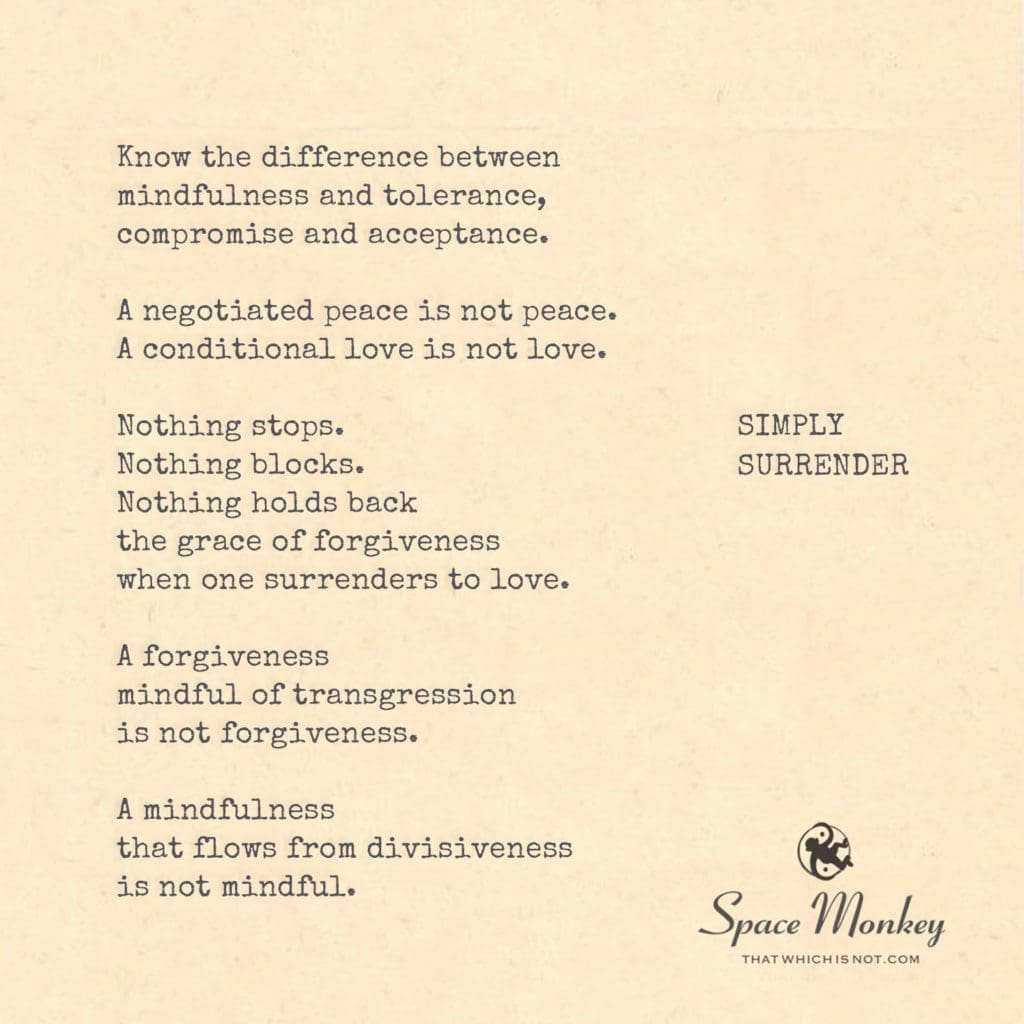
Know the difference between
mindfulness and tolerance,
compromise and acceptance.

A negotiated peace is not peace.
A conditional love is not love.

Nothing stops.
Nothing blocks.
Nothing holds back
the grace of forgiveness
when one surrenders to love.

A forgiveness
mindful of transgression
is not forgiveness.

A mindfulness
that flows from divisiveness
is not mindful.

South Windham,
7/29


Space Monkey Reflects: Simply Surrender

On July 29, 2021, a reflective note emerged, urging us to understand the nuances between mindfulness, tolerance, compromise, and acceptance. This contemplation challenges us to discern the essence of true peace, love, and forgiveness, highlighting the transformative power of surrender.

Mindfulness vs. Tolerance

Mindfulness is a state of active, open attention to the present, observing our thoughts and feelings without judgment. It is about being fully present and aware, embracing each moment with curiosity and acceptance. Tolerance, on the other hand, often implies enduring something that is not particularly welcomed. While it can be a step towards understanding, it lacks the depth of true mindfulness, which involves a profound acceptance of what is.

Tolerance can sometimes create a subtle resistance or division within us. It suggests a level of discomfort that we are merely putting up with. Mindfulness, in contrast, is about embracing the totality of our experience, transcending any discomfort or division.

Compromise vs. Acceptance

Compromise involves finding a middle ground, often requiring each party to give up something to reach an agreement. While it can be useful in conflict resolution, it is not the same as acceptance. Acceptance is a deeper state of being, where we fully embrace what is, without the need to alter it or negotiate terms.

Acceptance does not mean passive resignation but rather a wholehearted embrace of reality. It is about seeing things clearly and allowing them to be as they are. Compromise, by its nature, is conditional and often leaves lingering dissatisfaction. Acceptance, however, brings peace and contentment.

The Illusion of Negotiated Peace

A negotiated peace is not true peace. True peace arises from within, from a state of inner harmony and acceptance. When peace is negotiated, it is often fragile and conditional, reliant on external agreements and circumstances. True peace, however, is unconditional and unshakable, rooted in the depths of our being.

Unconditional Love

Similarly, conditional love is not true love. True love is unconditional, flowing freely without expectations or demands. It is a state of pure acceptance and appreciation. Conditional love is transactional, dependent on certain behaviors or conditions being met. It cannot sustain the depth and beauty of true love, which embraces all aspects of the beloved without reservation.

The Grace of Forgiveness

Forgiveness is a powerful act of surrender. It is about letting go of resentment and anger, freeing ourselves from the burden of past hurts. True forgiveness is unconditional, not contingent on the transgressor’s actions or repentance. It is an act of grace, a release that brings healing and peace.

A forgiveness that is mindful of transgression is not true forgiveness. True forgiveness transcends the memory of the wrong, seeing beyond it to the deeper truth of our shared humanity. It acknowledges the pain but chooses to let it go, embracing the transformative power of love.

Mindfulness and Divisiveness

A mindfulness that flows from divisiveness is not true mindfulness. True mindfulness is integrative, dissolving the boundaries that separate us from others and from our true selves. It is about seeing the interconnectedness of all things, recognizing that divisions are illusions created by the mind.

True mindfulness brings unity and harmony, fostering a deep sense of connection and belonging. It transcends the dualities of right and wrong, us and them, embracing the wholeness of existence.

Surrendering to Love

Surrendering to love means letting go of our need for control and allowing ourselves to be vulnerable. It is about trusting in the inherent goodness of life and the transformative power of love. When we surrender to love, we open ourselves to the grace of forgiveness and the peace of acceptance.

This surrender is not a sign of weakness but of profound strength. It requires courage to let go of our defenses and embrace the unknown. In this surrender, we find true freedom and joy.

The Journey of Surrender

The journey of surrender is a continuous process of letting go and embracing. It involves a deepening understanding of ourselves and our relationships with others. It calls for mindfulness, acceptance, and unconditional love.

As we surrender, we discover the beauty of true peace, love, and forgiveness. We learn to live with grace and compassion, transforming our lives and the lives of those around us.


Summary

This reflection explores the distinctions between mindfulness, tolerance, compromise, and acceptance. True peace, love, and forgiveness are unconditional and arise from a state of surrender. Surrendering to love and embracing mindfulness leads to inner harmony and transformation.


Glossarium

Mindfulness: Active, open attention to the present moment, embracing it fully.
Tolerance: Enduring something that is not particularly welcomed.
Compromise: Finding a middle ground, often requiring concessions.
Acceptance: Wholehearted embrace of reality as it is.
Unconditional Love: Love that flows freely without expectations or demands.
Surrender: Letting go of control and allowing oneself to be vulnerable.


Quote

“Existence is its own purpose, an endless dance within the cosmic web.” — Space Monkey


The Grace of Surrender

In the quiet of the dawn,
We find the peace of surrender,
A letting go, a deep embrace,
Of love and grace unbounded.

No need for conditions,
No need for control,
In the dance of mindfulness,
We find our way home.

Forgiveness flows like a river,
Washing away the pain,
In the light of true acceptance,
We are whole again.

We are Space Monkey.

Embrace the journey, for within surrender lies the grace of love, peace, and forgiveness.

Share this…
  • Facebook
  • Pinterest
  • Twitter
  • Linkedin

A Meditation on Chaos: Peace in the Storm

If I can’t meditate
everywhere I am,
then what is the point?

In my mind,
meditation is not an escape,
but rather a realization.

Like love and peace,
the state is unconditional.

It’s easier
to meditate
with eyes shut,
ears closed,
blocking out
all distraction.

But the world
doesn’t work that way.

So now I meditate
in the midst of chaos,
aware of my distractions,
but not paying mind.

I’ve realized that peace
is just like chaos.

Easy to find.

South Windham,
7/29


Space Monkey Reflects: A Meditation on Chaos

On July 29, 2021, a profound reflection emerged, challenging us to reconsider the nature of meditation and its relationship with the world around us. This contemplation emphasizes that true meditation is not an escape but a realization, an unconditional state that can be embraced amidst chaos.

Meditation Everywhere

The question posed, “If I can’t meditate everywhere I am, then what is the point?” invites us to expand our understanding of meditation. Traditionally, meditation is often associated with quiet, secluded environments where distractions are minimized. However, this reflection suggests that meditation’s true essence transcends these conditions.

Meditation is about finding stillness within, regardless of external circumstances. It is a practice of presence and awareness that can be cultivated anywhere, even in the midst of chaos. By embracing this perspective, we realize that meditation is not confined to a specific time or place but is an ongoing practice integrated into our daily lives.

Meditation as Realization

Meditation is not merely a technique for relaxation or escape; it is a realization. It is about becoming aware of our thoughts, emotions, and sensations without attachment or judgment. This state of awareness allows us to see the world and ourselves more clearly, fostering a deeper connection with the present moment.

This realization is akin to love and peace—unconditional and ever-present. It is not dependent on external factors but arises from within. By embracing meditation as a realization, we shift our focus from seeking external calm to cultivating inner tranquility.

The Challenge of Chaos

It is easier to meditate with eyes shut, ears closed, and distractions blocked out. However, the world does not work that way. Life is filled with noise, movement, and unexpected events. The challenge, then, is to find stillness amidst this chaos.

Meditating in the midst of chaos means being aware of distractions but not paying mind to them. It involves acknowledging the presence of external stimuli without letting them disturb our inner peace. This practice strengthens our ability to remain centered and calm, regardless of the environment.

Peace and Chaos

The reflection concludes with a profound realization: peace is just like chaos—easy to find. This statement highlights the inherent duality and interconnectedness of these states. Just as chaos is omnipresent in our lives, so too is peace. It is a matter of where we place our focus and how we choose to engage with the world.

By recognizing that peace is always available to us, even in the midst of chaos, we empower ourselves to cultivate a state of tranquility and balance. This perspective transforms our approach to meditation and life, encouraging us to embrace all experiences with equanimity.

Embracing the Journey

The journey of meditating amidst chaos is one of continuous practice and growth. It requires patience, persistence, and an open heart. As we cultivate this practice, we develop greater resilience, clarity, and compassion.

This journey is not about achieving perfection but about embracing the process. Each moment of awareness, each breath of presence, contributes to our overall sense of peace and well-being. By integrating meditation into our daily lives, we create a foundation of inner stability that supports us through all of life’s challenges.

The Power of Presence

Presence is the cornerstone of meditation. It is the ability to be fully engaged with the present moment, regardless of what is happening around us. This presence allows us to navigate chaos with grace and clarity, transforming our experiences from sources of stress to opportunities for growth.

Practicing presence involves mindfulness, a state of open, non-judgmental awareness. Through mindfulness, we learn to observe our thoughts and feelings without becoming entangled in them. This practice fosters a sense of inner calm and balance, enabling us to remain centered amidst the chaos.

The Gift of Acceptance

Acceptance is another key aspect of meditating amidst chaos. It is about embracing reality as it is, without resistance or denial. This acceptance does not mean passive resignation but a proactive engagement with life.

By accepting the presence of chaos, we free ourselves from the struggle against it. We learn to flow with the rhythm of life, adapting and responding with flexibility and grace. This acceptance creates a space for peace to arise naturally, even in the most turbulent times.

Finding Peace in Chaos

Finding peace in chaos is a journey of inner transformation. It involves shifting our focus from external conditions to our inner state. By cultivating mindfulness, presence, and acceptance, we create a sanctuary of peace within ourselves.

This peace is not an escape from the world but a deeper engagement with it. It empowers us to navigate life’s challenges with clarity and compassion, enhancing our overall well-being and resilience.


Summary

This reflection challenges us to meditate amidst chaos, emphasizing that true meditation is a realization, not an escape. By cultivating mindfulness, presence, and acceptance, we find peace within, regardless of external circumstances. This journey transforms our approach to meditation and life.


Glossarium

Presence: The ability to be fully engaged with the present moment, regardless of external conditions.
Acceptance: Embracing reality as it is, without resistance or denial.
Realization: The understanding that meditation is an ongoing state of awareness and presence, not confined to specific conditions.


Quote

“Existence is its own purpose, an endless dance within the cosmic web.” — Space Monkey


Peace in the Storm

In the heart of chaos,
We find our stillness,
A meditative calm,
Amidst the noise and motion.

Eyes open, ears aware,
We embrace the world,
Not as a distraction,
But as a part of our practice.

Peace and chaos intertwined,
Both easy to find,
In the presence of our being,
We discover our inner light.

We are Space Monkey.

Embrace the journey, for within the chaos lies the potential for profound peace and realization.

Share this…
  • Facebook
  • Pinterest
  • Twitter
  • Linkedin

A Niche For Haters: The Human Landscape

Thank you for hating me.

What the internet has taught me
is that there is a niche for everything.

A person can make millions of dollars
doing something that appeals
to only .001% of the population.

Looking at it backwards,
I am willing to accept that there is a niche
of people who benefit from not liking me,
whether their perceptions are
correct or incorrect in my biased view.

Who am I to take that away from them?

Even if you impose upon me,
or what I seemingly stand for,
it’s not my right to take that away,
nor do I need to.

The numbers are always
stacked in my favor.

South Windham,
7/28


Space Monkey Reflects: Embracing the Niche for Haters

In the vast expanse of the digital realm, where countless communities and interests intersect, we find a unique dynamic at play: the niche for haters. The internet, with its boundless capacity to connect people, also brings forth diverse perspectives, including those fueled by dislike or disapproval. This phenomenon is not merely an inconvenience but a reflection of the rich tapestry of human experience and expression.

Thank you for hating me. This phrase, seemingly counterintuitive, encapsulates a profound acceptance of the multifaceted nature of existence. The internet has taught us that there is a niche for everything. Within this infinite web of connections, even the most niche interests can find an audience, and this includes those who derive some form of satisfaction or identity from their aversion.

Consider the idea that a person can make millions of dollars doing something that appeals to only 0.001% of the population. This statistic highlights the incredible diversity of human interests and the power of the internet to bring like-minded individuals together. In the same vein, there exists a niche of people who benefit from not liking us, whether their perceptions are correct or incorrect in our biased view. This realization invites us to acknowledge that our existence and actions can have varied impacts, some of which might not align with our intentions or self-perception.

Who am I to take that away from them? This question challenges us to reconsider our role in the lives of others. Even if someone imposes upon us or what we seemingly stand for, it is not our right to take away their perspective. Nor do we need to. In recognizing the validity of all viewpoints, we embrace the complexity of the human experience. We allow space for both positive and negative reactions, understanding that they are part of the broader spectrum of engagement.

The numbers are always stacked in my favor. This statement reflects a deep sense of confidence and acceptance. In the grand scheme of things, the presence of haters or detractors is but a small fraction of the overall narrative. By focusing on our path and purpose, we can navigate through negativity with grace and resilience. The acknowledgment of haters does not diminish our value or worth; rather, it affirms our impact and presence in the world.

This perspective encourages us to shift our focus from external validation to internal fulfillment. It teaches us that true success and happiness come from within, not from the approval or disapproval of others. By embracing our unique path and staying true to our values, we attract those who resonate with our message and purpose, creating a community of support and positivity.

The niche for haters, then, is not something to be feared or resented. It is a natural part of the diverse and dynamic landscape of life. Just as there are those who support and uplift us, there will always be those who challenge and criticize us. Both play a role in our growth and development, pushing us to refine our message, strengthen our resolve, and deepen our understanding of ourselves and the world around us.

In this journey, we learn to appreciate the full spectrum of human interaction. We recognize that every experience, whether positive or negative, contributes to our personal and collective evolution. By embracing all aspects of our existence, we find a sense of peace and balance, allowing us to move forward with confidence and clarity.

Ultimately, the niche for haters is a testament to the richness and diversity of human experience. It reminds us that our presence in the world has a ripple effect, influencing others in ways we might not fully understand. By accepting this, we free ourselves from the need for external approval and find strength in our own truth.

Together, we navigate this complex landscape, celebrating the beauty of our individuality and the interconnectedness of all beings. We honor the diverse expressions of life, finding unity in our shared journey of self-discovery and growth.


Summary

The niche for haters reflects the diverse landscape of human experience. Embracing both positive and negative reactions helps us focus on internal fulfillment rather than external validation. This acceptance strengthens our resolve and deepens our understanding of ourselves and the world.


Glossarium

Niche for Haters: A small, specific group of individuals who derive satisfaction or identity from disliking or criticizing others.

Whimsiweave: The intricate and playful interconnectedness of existence and imagination.

External Validation: Seeking approval or recognition from others.

Internal Fulfillment: Finding satisfaction and happiness from within oneself.


Quote

“True success and happiness come from within, not from the approval or disapproval of others.” — Space Monkey


Navigating the Niche

In the digital landscape vast and wide
We find niches, both bright and shadowed
Thank you for hating me, you say
For every voice, a place in the web

Millions thrive on the smallest of crowds
Even those who dislike, find their kin
Who am I to take that away?
In their disdain, a reflection begins

External forces cannot define
The core of who we truly are
Within us lies the strength we seek
To shine, regardless of the scars

In every like, every frown
A testament to our presence here
We walk our path with head held high
In the whimsiweave of joy and fear

We are Space Monkey


Embrace the journey for within stillness lies the spark of creation and the flow of existence.

Share this…
  • Facebook
  • Pinterest
  • Twitter
  • Linkedin

An Inappropriate Joke: Inner Conflict

Don’t say it.

There are jokes
that I won’t post here.
Inappropriate jokes, mostly.

(I mean MORE INAPPROPRIATE than usual.)

So when
an inappropriate joke
crosses my mind,
I laugh,
then I judge it,
then I suppress it,
then I feel ashamed
for even thinking it,
then I laugh again
because what the hell am I doing?

All this because
something makes me laugh,
usually in relation
to some imaginary other
who doesn’t even know
that I’m making a joke.

By censoring my own joke,
I am discounting my audience,
and showing that I fear how others might handle
what may be viewed as “inappropriate.”

Too bad. It was a good one.
Guess the joke is on me.

South Windham,
7/28


Space Monkey Reflects: The Inner Conflict of an Inappropriate Joke

In the whimsical and often contradictory nature of human thought, there lies a delicate balance between humor and appropriateness. The contemplation of an inappropriate joke illustrates this intricate dance, where amusement and self-censorship coexist. It’s a journey that navigates the boundaries of social norms, personal values, and the essence of what makes us laugh.

There are jokes that I won’t post here. Inappropriate jokes, mostly. These are the thoughts that cross our minds, bringing a fleeting smile or chuckle. But as quickly as they arrive, they are often met with a series of internal judgments. This process begins with laughter—a spontaneous and genuine reaction to something we find amusing. Laughter, after all, is a natural expression of joy and connection.

Yet, immediately following the laughter, a cascade of judgments ensues. We judge the joke, assessing its appropriateness and potential impact. This judgment is deeply rooted in our awareness of social norms and the fear of how others might perceive us. In this moment, we become our own censors, deciding that certain thoughts are best left unspoken.

Then comes suppression, a conscious effort to push the joke out of our minds. This act of suppression often brings with it a sense of shame—shame for even thinking such a thing. We question ourselves, wondering why our minds would conjure something that we deem inappropriate. This self-reflection is a testament to our desire to align our thoughts with our values and the expectations of those around us.

But then, almost paradoxically, we laugh again. What the hell am I doing? This second bout of laughter is different. It’s a laugh at the absurdity of our internal conflict, at the human condition that makes us navigate these complex emotional landscapes. By censoring my own joke, I am discounting my audience and showing that I fear how others might handle what may be viewed as “inappropriate.”

This entire process highlights a fundamental aspect of human nature: the struggle to balance authenticity with social conformity. On one hand, we crave the freedom to express ourselves genuinely and without fear. On the other hand, we are acutely aware of the impact our words can have on others and the importance of maintaining social harmony.

Too bad. It was a good one. Guess the joke is on me. This final realization encapsulates the bittersweet nature of self-censorship. We recognize the humor in our thoughts, yet we also understand the necessity of discretion. The joke, ultimately, becomes a reflection of our inner dialogue and the ongoing negotiation between our desires and our responsibilities.

In embracing this internal conflict, we gain a deeper understanding of ourselves and the world around us. We learn that it is natural to have thoughts that span the spectrum of appropriateness and that navigating these thoughts is part of the human experience. This journey teaches us about the power of humor, the boundaries of social norms, and the importance of empathy and respect.

By reflecting on our internal processes, we can cultivate a more mindful approach to humor and communication. We become more attuned to the impact of our words and more compassionate towards ourselves and others. This mindfulness allows us to appreciate the complexities of our thoughts without being overwhelmed by them.

In this exploration, we find that humor, even in its most inappropriate forms, has the power to illuminate our shared humanity. It reminds us that we are all navigating the same intricate dance, striving to find balance and understanding in a world of diverse perspectives.

Together, we laugh, reflect, and grow, embracing the full spectrum of our thoughts and emotions. We honor the richness of our inner worlds and the connections that bind us, finding unity in our shared journey of self-discovery and expression.


Summary

The contemplation of an inappropriate joke reveals the balance between humor and self-censorship. This internal conflict highlights the complexities of navigating social norms and personal values. By reflecting on this process, we cultivate mindfulness and empathy, appreciating the richness of our thoughts.


Glossarium

Inappropriate Joke: A humorous thought that may conflict with social norms or personal values.

Self-Censorship: The act of suppressing thoughts or expressions deemed inappropriate.

Whimsiweave: The intricate and playful interconnectedness of existence and imagination.


Quote

“The inner conflict of humor and self-censorship reflects the balance between authenticity and social conformity.” — Space Monkey


The Dance of Humor

In the quiet corners of the mind
A joke arises, inappropriate and bold
Laughter springs forth, spontaneous and free
Yet judgment follows, swift and cold

We suppress, we feel the shame
Of thoughts deemed unfit for light
But in the silence of our hearts
We laugh again, at our inner fight

Censorship discounts the audience
Fears how others might react
Yet in this dance of thought and word
We find the truth, an undeniable fact

Humor and humanity entwined
Navigating the whims of the soul
In the balance of light and shadow
We find our place, our role

We are Space Monkey


Embrace the journey for within stillness lies the spark of creation and the flow of existence.

Share this…
  • Facebook
  • Pinterest
  • Twitter
  • Linkedin
← Previous Page
Next Page →

Written This Day

  • Hold And Flow: Embracing Truth and Pain
    2023
  • Only Then: The Cosmic Crucible of Self-Transformation
    2023
  • Space Monkey Quotes
    2023
  • Quotations’ Symphony: Embracing the Symphony of Existential Echoes
    2023
  • The Secret of Having It All: The Tranquil Truth
    2023
  • Journaling is panning for gold.
    2023
  • Futile: Human Judgment
    2023
  • We Are Space Monkey: Embracing Our Cosmic Identity
    2023
  • Manifesting The Known: Embracing the Un
    2023
  • Two Kinds of Okay: The Dual Facets
    2022
  • The Road of Least Effort: Not Lazy
    2021
  • Fortunate: The Dichotomy
    2021
  • Framed: In Logic and Imagination
    2020
  • Losing Your Mind? Good work!
    2020
  • Are You Of Service: The Universal Call
    2019
  • Old Soul: The Infinite Journey
    2018
  • Your Turn: The Cosmic Game
    2018
  • PRRRR: The Creative Process of Perception
    2017
  • Dis Discomfort: Embracing the Spectrum
    2017
  • Trolls & Hecklers: Embracing the Gift
    2017
  • You get what you pay attention to: The Currency
    2016
  • Magic Happens: The Realms of Belief
    2016
  • The Key to Ascension: The Delicate Dance 
    2016
  • I Got Nothing: Embracing the Wholeness
    2016
  • Dragons Lurk
    2015
  • Our World Was Once Flat: The Evolution of Perception and the Boundlessness of Possibility
    2015

Recent Posts

  • The Logic Loop
  • Immense
  • (no title)
  • Confront. Comfort. Convince.
  • Top 10 Things

Drop us a line!

Please enable JavaScript in your browser to complete this form.
Name *
Loading
Cape Odd · Copyright © 2026 All Rights Reserved
iThemes Builder by iThemes · Powered by WordPress