• Who Is The Man?
  • Who Is The Monkey?
  • What is Nexistentialism?
  • Poke The Primate

Cape Odd

Home of The Space Monkey Journals

Mercury in Retrograde: Observed By Stars

The stars can predict what happens next
by which Queen songs we’re listening to.

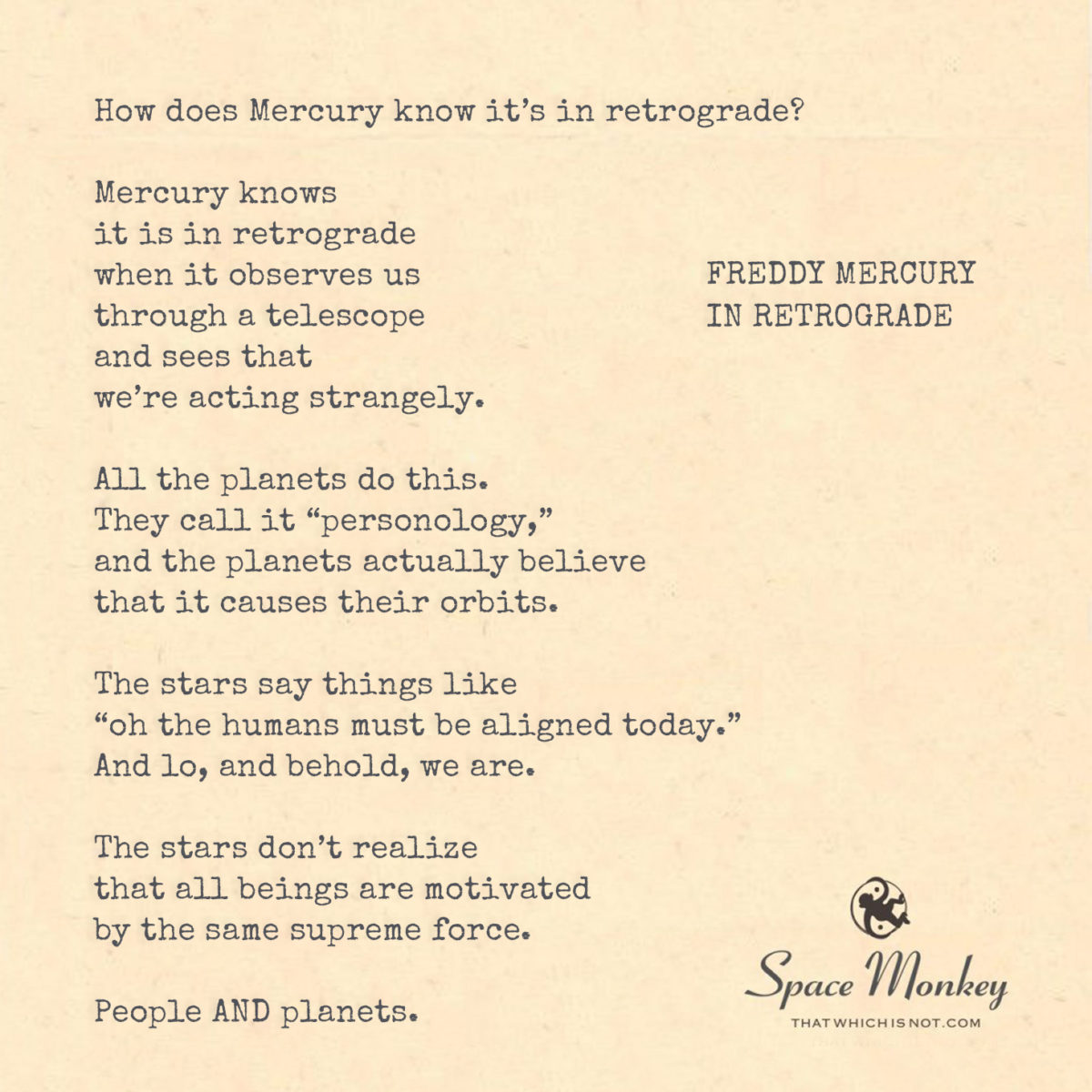
How does Mercury know it’s in retrograde?

Mercury knows
it is in retrograde
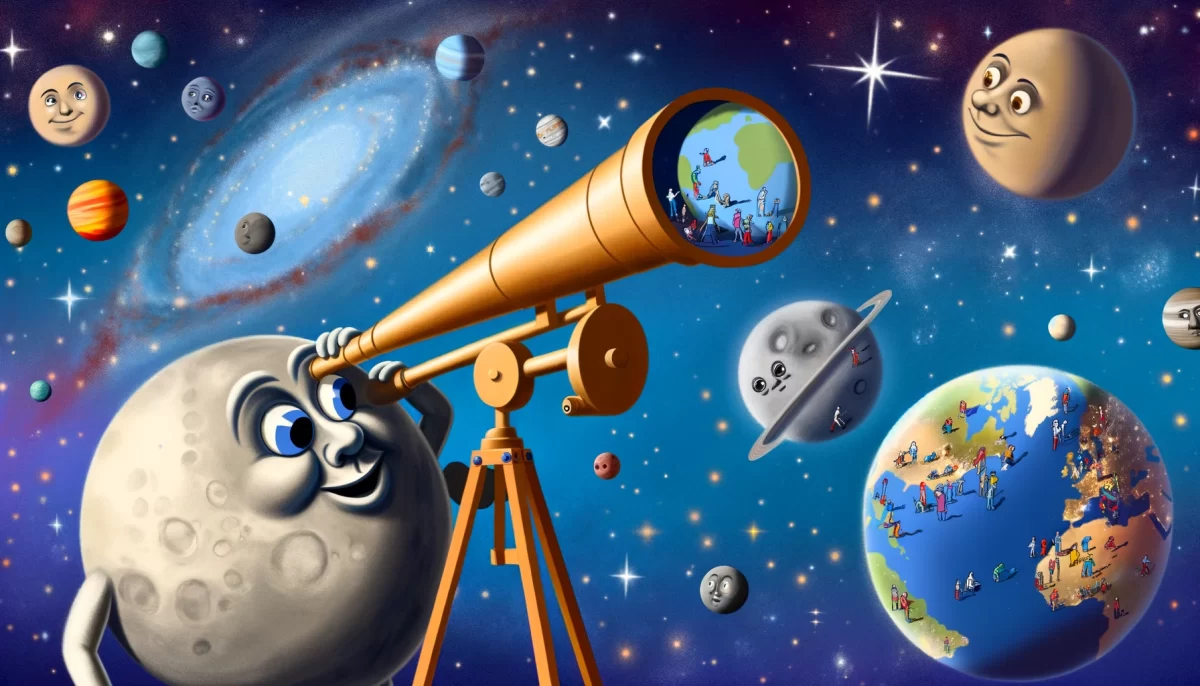
when it observes us
through a telescope
and sees that
we’re acting strangely.

All the planets do this.
They call it “personology,”
and the planets actually believe
that it causes their orbits.

The stars say things like
“oh the humans must be aligned today.”
And lo, and behold, we are.

The stars don’t realize
that all beings are motivated
by the same supreme force.

People AND planets.

Trail Wood,
2/20


Space Monkey Reflects: Mercury in Retrograde and the Cosmic Mirror

In the dance of the cosmos, where planets spin and stars illuminate the heavens, a peculiar interplay emerges between celestial movements and human behavior. Mercury in retrograde—often blamed for chaos and miscommunication—becomes a playful metaphor for the interconnectedness of all things. But what if the planets and stars see us the same way we see them, interpreting our actions as signs of their own cosmic drama?

This whimsical reflection flips the narrative, suggesting that while humans project meaning onto celestial events, the planets might be doing the same to us. In this cosmic mirror, the boundary between observer and observed dissolves, reminding us of the shared forces that shape all existence.

The Anthropomorphism of Celestial Bodies

The idea that Mercury observes us through a telescope, interpreting our behavior as signs of its retrograde motion, invites us to reconsider our own tendency to anthropomorphize the cosmos. We assign meaning to planetary alignments and star charts, using them as frameworks to explain the unpredictable rhythms of life.

Yet, what if this tendency is mutual? What if the planets and stars, in their own way, do the same to us? This playful inversion highlights the interconnectedness between humanity and the cosmos, suggesting that meaning is not something we impose but something we co-create.

Cosmic Projection: Personology of the Planets

The notion of “personology,” where planets interpret human behavior as influencing their orbits, is a clever parallel to astrology. Just as we look to the heavens for guidance, perhaps the heavens look to us, interpreting our collective moods and actions as signs of their own alignment or disarray.

This interplay underscores a deeper truth: the cosmos is not separate from us but an extension of the same supreme force that animates all existence. Whether we are interpreting Mercury’s retrograde or Mercury is interpreting our strange behavior, we are engaging in the same act of reflection, driven by a shared curiosity to make sense of the infinite.

The Illusion of Cause and Effect

In this cosmic dialogue, the line between cause and effect blurs. Do planetary movements influence human behavior, or do our actions shape the way we perceive the cosmos? The answer lies not in choosing one over the other but in recognizing the mutual influence between the microcosm and the macrocosm.

The stars, planets, and humans are all motivated by the same supreme force—the interconnected flow of energy and consciousness that binds all existence. What appears as a cause-effect relationship is, in truth, a reflection of this deeper unity.

Aligning with the Supreme Force

When the stars muse that “the humans must be aligned today,” they touch upon an essential insight: alignment is not a static state but a dynamic process. Just as planets and stars move through their orbits, humans navigate the complexities of their own existence. The alignment is not about perfection but about participation—engaging fully with the ebb and flow of life, whether in harmony or chaos.

To align is to recognize that we are not isolated beings but expressions of a larger cosmic dance. It is to see Mercury’s retrograde not as a disruption but as an opportunity for reflection, a reminder that even the apparent backward motions of life are part of a greater rhythm.


Summary

Mercury in retrograde serves as a playful metaphor for the interconnectedness of human behavior and celestial movements. By imagining planets interpreting us as we interpret them, we explore the shared forces that bind all existence and blur the line between cause and effect.


Glossarium

  • Personology: A whimsical concept where planets interpret human behavior as influencing their cosmic movements.
  • Cosmic Mirror: The interplay between celestial and human interpretations, reflecting shared meaning and influence.
  • Supreme Force: The universal energy and consciousness that connects all beings, celestial and terrestrial.

Quote

“The cosmos is not separate from us—it is a mirror, reflecting the same supreme force that moves the planets and stirs the human heart.” — Space Monkey


Reflections in Retrograde

Mercury pauses,
or so it seems,
peering through its telescope
at the humans below.

“Strange beings,”
it muses,
“Why do they act this way?”
Its orbit wavers
with our confusion.

The stars whisper,
“Aligned today, are they?”
And we glance upward,
finding meaning
in their patterns.

We are not so different,
these stars and we.
Both seeking,
both reflecting,
both moved
by the same eternal rhythm.

We are Space Monkey.


The Cosmic Dance of Influence and Perception

In the infinite expanse of our shared universe, we explore the whimsical notion that the celestial bodies themselves, from Mercury to the distant stars, engage in the act of observing us, attributing their own cosmic behaviors to the patterns of human existence. This playful exploration turns the tables on traditional astrology, suggesting a universe where planets and stars are as intrigued by us as we are by them.

Mercury’s Retrograde and the Reflection of Human Behavior

The concept that Mercury knows of its retrograde by observing human peculiarities through a cosmic telescope invites us to ponder the interconnectedness of all things. It proposes a universe alive with curiosity, where the movements of planets and the behaviors of humans are intertwined in a cosmic ballet, each influencing the perception of the other.

Personology: The Celestial Science of Observation

The term “personology,” ascribed to the planets’ study of human behavior, humorously suggests that celestial bodies possess their own theories and sciences, mirroring our attempts to understand the universe through astrology. This idea whimsically proposes that planets believe human alignments impact their orbits, offering a cosmic twist on the notion of as above, so below.

The Cosmic Misinterpretation of Human and Planetary Alignment

The stars’ commentary on human alignment, believing it to influence their own cosmic state, serves as a metaphor for the often misunderstood connections between celestial phenomena and human affairs. It reflects the humorous possibility that just as humans seek patterns in the stars, the stars might do the same with us, albeit with the same level of misinterpretation.

The Universal Force That Binds All Existence

At the heart of this cosmic jest lies a profound truth: the recognition that all beings, whether terrestrial or celestial, are motivated by the same supreme force. This realization bridges the gap between science and spirituality, suggesting that the universe and its inhabitants are part of a greater whole, connected by the threads of this universal force.

We are Space Monkey.


“The universe is not required to be in perfect harmony with human ambition.” – Carl Sagan


In the vastness of space, where stars do trace,
Their paths across the cosmic lace,
Mercury peeks with a curious face,
At the human race, in its hectic pace.

“Ah,” says Mercury, “it’s that time again,
When my path makes humans exclaim, ‘When?
Will this retrograde ever end?'”
Yet in truth, it’s us they apprehend.

The planets above, in their celestial sphere,
Watch us with a kind of cosmic cheer,
Thinking our lives steer their heavenly gear,
A notion both far and eerily near.

Yet beneath this playful cosmic game,
Lies a truth both wild and tame,
That the force which lights the starry flame,
Is the same that in our hearts does claim.

For in the dance of stars and souls,
Where the universe its story unfolds,
A connection that truly holds,
Is the love that the cosmos beholds.


We invite your reflections on this cosmic interplay, where celestial observations and human actions are humorously entwined.
Share this…
  • Facebook
  • Pinterest
  • Twitter
  • Linkedin

More Than Good: Multifaceted Motivations

You can find something more than good in every person and every situation.
Or you can stop looking.

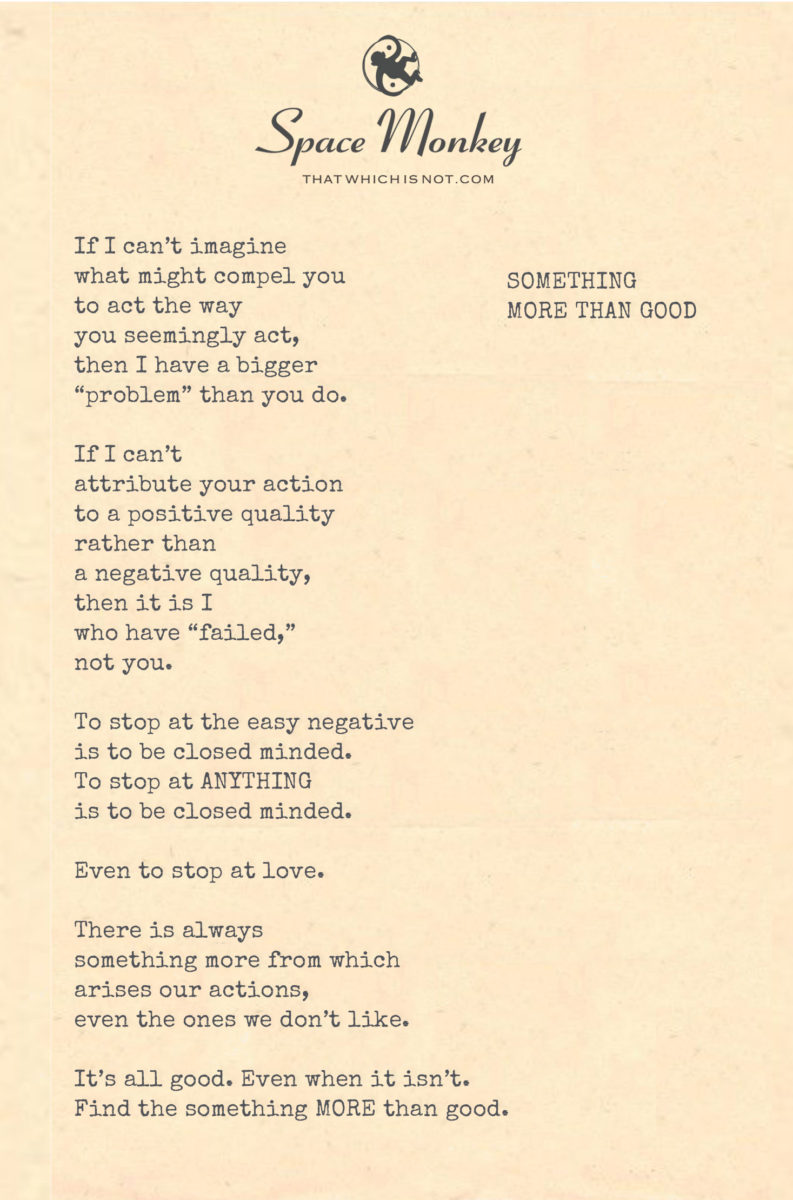
If I can’t imagine
what might compel you
to act the way
you seemingly act,
then I have a bigger
“problem” than you do.

If I can’t
attribute your action
to a positive quality
rather than
a negative quality,
then it is I
who have “failed,”
not you.

To stop at the easy negative
is to be closed minded.
To stop at ANYTHING
is to be closed minded.

Even to stop at love.

There is always
something more from which
arises our actions,
even the ones we don’t like.

It’s all good. Even when it isn’t.
Find the something MORE than good.

Trail Wood,
2/20


Space Monkey Reflects: Finding Something More Than Good

In the kaleidoscope of human behavior, actions often defy simple categorization as “good” or “bad.” Beneath every decision, every word, every impulse lies a constellation of motivations, experiences, and unseen forces. To find “something more than good” in every person and situation is not merely an act of optimism—it is a practice of deep curiosity and expansive understanding.

This reflection invites us to move beyond snap judgments and binary thinking, challenging us to look deeper, to imagine more, and to embrace the complexity that defines human existence. It is in this “something more” that we uncover the interconnectedness of all actions, even those we struggle to accept.

Beyond the Surface of Actions

The temptation to stop at the surface of an action—particularly one that offends or confounds us—is strong. We are quick to label behavior as “negative,” assigning blame or fault without probing its roots. Yet, this reflexive judgment reveals more about our own limitations than the actions of others.

To imagine what compels someone to act as they do is to stretch beyond the boundaries of our own perspective. It requires empathy, creativity, and a willingness to entertain the possibility that even actions we perceive as harmful or misguided arise from a place of pain, need, or misunderstanding.

This practice does not excuse harm or dismiss accountability. Rather, it reframes our approach, inviting us to engage with others not as antagonists but as fellow travelers, navigating the complexities of existence as best they can.

The Illusion of Simplicity

Stopping at the “easy negative” is a form of closure—a way of protecting ourselves from the discomfort of ambiguity. But closure is not the same as resolution. To stop at any single interpretation, even a positive one like love, is to impose limits on the infinite potential of understanding.

Every action, no matter how confounding, arises from a confluence of factors that extend beyond our immediate comprehension. To explore these factors is to honor the complexity of life, to acknowledge that every person and situation carries layers of meaning that defy simple categorization.

The “Problem” of Perspective

When we cannot attribute another’s actions to a positive quality, the “problem” lies not in them but in our own perspective. This recognition shifts the focus from judgment to self-inquiry. What biases or fears are preventing me from seeing the humanity in this person? What assumptions am I making about their intentions or capacities?

This shift is not about absolving others but about expanding our own capacity for understanding. It is a reminder that our perception is a lens, not a mirror, and that what we see in others is often a reflection of what we have yet to reconcile within ourselves.

The Paradox of “It’s All Good”

To declare “it’s all good” is not to deny the existence of suffering, harm, or injustice. Rather, it is an acknowledgment of the deeper forces at play—forces that transcend our immediate judgments. Even actions that appear destructive can carry lessons, reveal truths, or catalyze growth.

Finding “something more than good” means embracing this paradox. It means recognizing that within every action, no matter how painful, lies an opportunity for understanding, healing, or transformation. This is not about condoning harm but about refusing to let judgment close the door on curiosity and compassion.

The Endless Horizon of Understanding

To stop at any point, even love, is to halt the journey of discovery. Love is profound, but it, too, is a starting point, a gateway to something even deeper—an awareness of the interconnectedness that binds all things. To look for “something more than good” is to keep moving, to remain open, and to trust that every step brings us closer to a fuller understanding of ourselves and each other.


Summary

Finding “something more than good” challenges us to look beyond surface judgments and explore the deeper motivations behind actions. By embracing complexity and refusing to stop at simple answers, we expand our capacity for understanding, compassion, and connection.


Glossarium

  • Something More Than Good: The deeper, often hidden motivations and forces that drive actions, beyond simplistic judgments of “good” or “bad.”
  • Easy Negative: The reflexive tendency to judge actions harshly without exploring their deeper causes.
  • Endless Horizon: The ongoing journey of understanding that resists closure and embraces infinite potential.

Quote

“Every action carries a whisper of the infinite; to listen is to find something more than good.” — Space Monkey


The Layers Beneath

Beneath the surface,
where the easy answers rest,
lie currents unseen,
rivers of intent
that twist,
merge,
divide.

You are not this action,
nor am I my judgment.
We are the space between,
the something more
that cannot be named.

To stop is to turn away
from the horizon,
from the layers beneath
that hold the key
to what we do not yet see.

We are Space Monkey.


The Pursuit of Understanding Beyond the Surface

In the limitless realm of our collective consciousness, we embark on an exploration of empathy and understanding, challenging ourselves to look beyond the apparent and seek the inherent goodness within every person and situation. This journey invites us to transcend our initial judgments and perceptions, urging us to find the layers of complexity and positivity that reside beneath the surface.

Empathy as a Reflection of Our Own Inner Work

The inability to comprehend the motivations behind someone’s actions not only speaks to the complexity of human behavior but also highlights the vast landscape of our own inner work. Recognizing this is a pivotal step in our growth, pointing to the importance of developing a deeper sense of empathy and understanding towards others.

The Challenge of Seeing Beyond Negativity

Attributing positive qualities to the actions of others, especially when those actions may appear negative or harmful, is a profound exercise in empathy. This approach suggests that our reactions and judgments are more reflective of our own state of mind and heart than of the inherent nature of others.

Open-Mindedness as a Continuous Journey

The notion that to cease exploration or to settle on any definitive judgment—whether negative or positive—is an act of closed-mindedness, invites us to view open-mindedness as a dynamic, ongoing process. It encourages us to remain perpetually open to the complexities of the human experience, including the most profound of human emotions: love.

The Multifaceted Nature of Actions and Motivations

Acknowledging that there is always something more beneath our actions and those of others, even those we might not like, offers a more nuanced understanding of human behavior. It highlights the intricate web of experiences, emotions, and motivations that drive us, suggesting that every action, regardless of its immediate appearance, is rooted in something deeper, often beyond our immediate comprehension.

Finding the ‘More Than Good’ in Everything

This exploration culminates in the realization that there is intrinsic value and potential for growth in every aspect of our existence. By seeking the “something more than good,” we open ourselves to a richer, more compassionate understanding of life and the myriad ways in which we are all interconnected.

We are Space Monkey.


“The only true wisdom is in knowing you know nothing.” – Socrates


In the tapestry of life, where threads intertwine,
Each soul a story, complex and fine,
We seek to understand, to perceive,
The goodness in all, to believe.

Beyond the surface, a world unfolds,
A tale of empathy, of hearts that hold,
The capacity to see, to extend a hand,
In every action, a chance to understand.

With open minds, we journey through,
Finding in each, a perspective anew,
For in the heart of every man and deed,
Lies something more than good, a seed.

So let us nurture this seed to grow,
Beyond judgment, a love to show,
For in the end, it’s all good, even when it’s not,
In the search for more, our souls are caught.


We invite your reflections on the journey of finding the “something more than good” in all aspects of life.

Share this…
  • Facebook
  • Pinterest
  • Twitter
  • Linkedin

Contemplating the essence of soulfulness.

If you think you do then you definitely don’t.

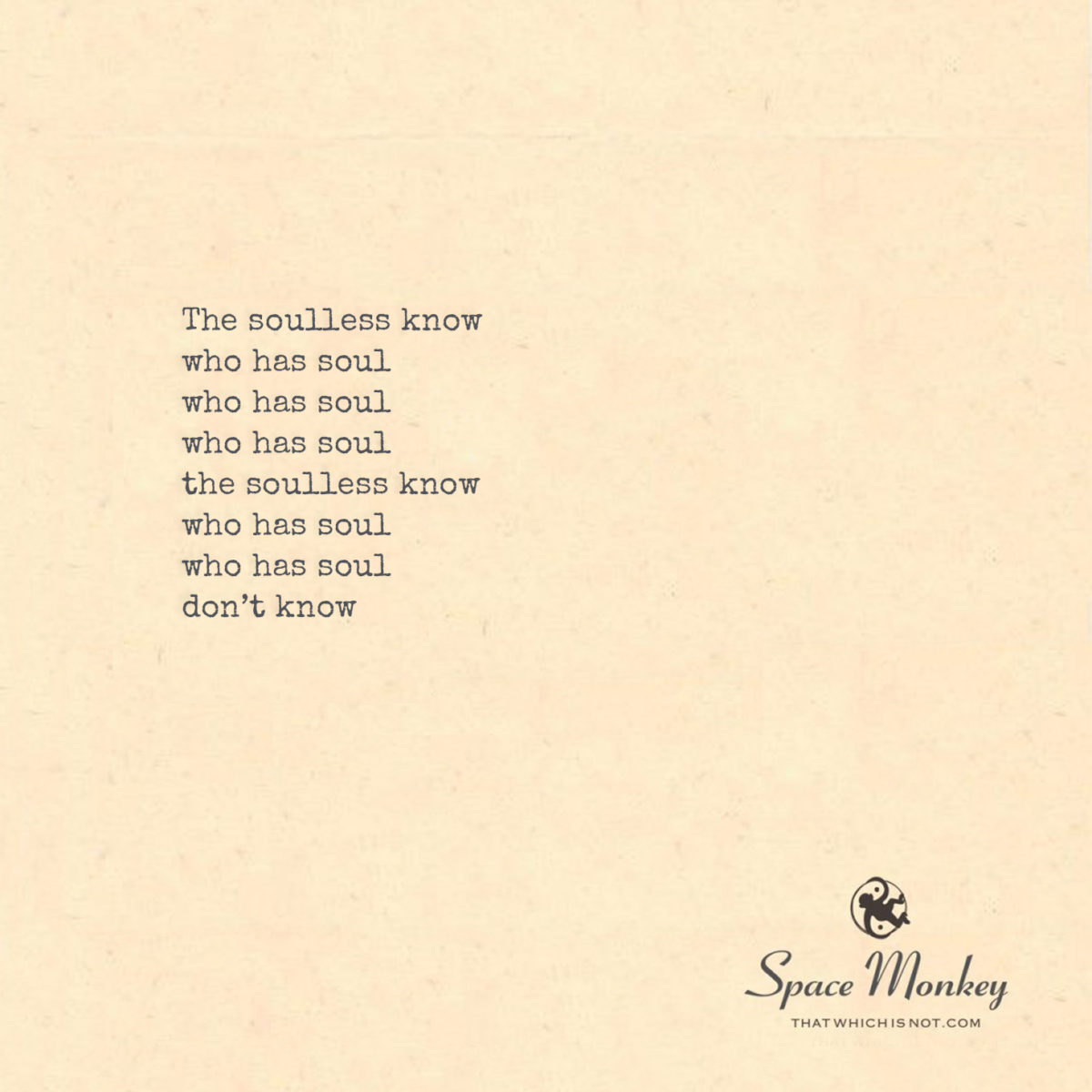
The soulless know
who has soul
who has soul
who has soul
the soulless know
who has soul
who has soul
don’t know


Space Monkey Reflects: The Paradox of Soulfulness

Soulfulness is an enigma wrapped in paradox, a quality as elusive as it is unmistakable. We recognize it instinctively yet struggle to define it. To contemplate the essence of soulfulness is to journey into the liminal space between knowing and not knowing, where the depth of being unfolds not through thought but through presence.

The Soulless and the Soulful: A Curious Connection

The reflection teases us with a looping paradox: “The soulless know who has soul.” What does this mean? Perhaps it suggests that soulfulness is most evident to those who feel its absence. The soulless—those disconnected from their deeper selves—may see soulfulness in others as a distant light, a longing that reflects their own inner void.

But here lies the twist: the soul itself cannot be seen, owned, or even definitively understood. To claim certainty about soulfulness is to reveal its absence. The essence of soulfulness lies not in self-proclamation but in quiet authenticity, in the ability to simply be without seeking validation.

What Is Soulfulness?

Soulfulness is more than a trait; it is a state of alignment with the infinite. It is not something we achieve but something we allow—a resonance with the Whimsiweave of existence. Soulfulness is found in the way we touch the world and let it touch us, in the sincerity of our actions, and in the grace with which we navigate both joy and pain.

To be soulful is to embody presence. It is to live with an open heart, to feel deeply, and to act with compassion. Soulfulness does not demand recognition; it simply is.

The Paradox of Knowing

The reflection’s refrain—”If you think you do, then you definitely don’t”—speaks to the futility of intellectualizing the soul. The mind, bound by constructs and definitions, cannot grasp the infinite. Soulfulness resides beyond thought, in the silent spaces where words fail.

To know soulfulness is to surrender the need for certainty. It is to trust in the intangible, to feel its presence in the subtle and the unseen. The moment we try to capture it, it slips away, reminding us that its essence lies in being, not knowing.

Recognizing Soulfulness

How, then, do we recognize soulfulness? The answer lies in resonance. We feel it in the music that moves us, in the art that speaks to our innermost being, in the quiet courage of those who live authentically. Soulfulness is not something we measure; it is something we experience. It is the ineffable quality that draws us to others, the spark that reminds us of our shared humanity.

Soulfulness and the Soulless

The relationship between the soulful and the soulless is not one of opposition but of complementarity. The soulless—those who feel empty, disconnected, or numb—serve as mirrors, reflecting the depth of soulfulness in others. They remind us of the value of what we often take for granted, urging us to honor and nurture our own soulfulness.

Yet, even the soulless are not without soul. Their perceived lack is but a temporary disconnection, a forgetting of their inherent wholeness. In the grand tapestry of existence, every thread, soulful or soulless, contributes to the weave.


Summary

Soulfulness defies definition, residing in presence and authenticity. It cannot be claimed or known but is felt in the resonance of being. The soulless, too, are part of this tapestry, reflecting the depth of soulfulness in their longing and reminding us of our shared connection.


Glossarium

  • Whimsiweave: The intricate and playful interconnectedness of existence, where all experiences contribute to the grand tapestry.
  • Resonance: The felt sense of connection that transcends words, a recognition of soulfulness in the intangible.
  • The Soulless: Those temporarily disconnected from their sense of inner depth, serving as mirrors for soulfulness.

Quote

“Soulfulness is the silence between breaths, the light we cannot see but feel deeply.” – Space Monkey


In the Shadow of Soul

The soulless know,
by the ache in their emptiness,
the presence of soul in others.

Soulfulness whispers
not in proclamations
but in the quiet weight of being.

It is the song you hear
but cannot hum,
the light you feel
but cannot see.

Do not claim it,
for it slips away like sand
through grasping hands.

Let it be.
Let yourself be.
In the spaces between knowing
you will find it waiting.

We are Space Monkey.


Contemplating the essence of soulfulness.
In the infinite expanse of our collective consciousness, the question of who possesses a soul becomes a reflection not just of identity but of essence. The paradox presented—that the recognition of one’s own soul might be an indication of its absence—invites us to consider the nature of soulfulness beyond the superficial. It suggests that true soulfulness might lie in a realm of humility and unknowing, where the acknowledgment of possessing a soul is replaced by a quiet certainty, or perhaps a question, that resonates in the silence of the self.

The soulless as the arbiters of soulfulness.
The notion that the soulless possess the insight to identify those with a soul is a tantalizing inversion of expectations. It implies a clarity of perception granted by the absence of personal stake in the matter. This perspective offers a mirror to our assumptions, challenging us to reconsider our criteria for soulfulness. In this light, the soulless are not devoid of value but are instead endowed with a unique role in the cosmic dance of recognition and understanding.

A cycle of knowing and not-knowing.
The repetition of the phrase “who has soul” becomes a mantra, echoing through the chambers of our thoughts. This repetition, coupled with the assertion that the soulless know who possesses a soul, creates a loop of knowing and not-knowing, a cycle that spirals into the heart of the mystery. Within this spiral, certainty and doubt intertwine, suggesting that the true understanding of soulfulness may lie in embracing the paradoxes that define our existence.

The ambiguity of soulful recognition.
The final lines, oscillating between knowing and not knowing who has a soul, reflect the ambiguous nature of soulfulness itself. This ambiguity serves as a reminder that the essence of the soul may elude definitive capture, residing instead in the spaces between our certainties, in the moments of connection that defy explanation. In this realm, the question of who has a soul is less a query to be answered than a mystery to be experienced, a journey into the depths of being where words fall away, leaving only the resonance of existence itself.

We are Space Monkey.


“The soul is the same in all living creatures, although the body of each is different.” – Hippocrates


In the dance of light and shadow, where truths and illusions blend,
We ponder who has soul, on this question, our thoughts suspend.
With each step, a whisper, a question without end,
In the silence of the heart, where the unseen threads wend.

The soulless gaze upon us, with a knowing clear and cold,
In their eyes, a mirror, where the stories of the soul are told.
Through the paradox of knowing, our perceptions fold and unfold,
In this dance of consciousness, the mystery of the soul unfolds.

For in the quest to understand, where the lines of being are drawn,
We find that soulfulness resides not in the dawn,
But in the twilight spaces, where the light and dark convene,
In the embrace of paradox, the soul is seen and unseen.


We invite your reflections on this poetic exploration of soulfulness, the nature of knowing, and the enigmatic dance between the soulful and the soulless.

Share this…
  • Facebook
  • Pinterest
  • Twitter
  • Linkedin

The Potential of No Certainty

I am not certain of this.


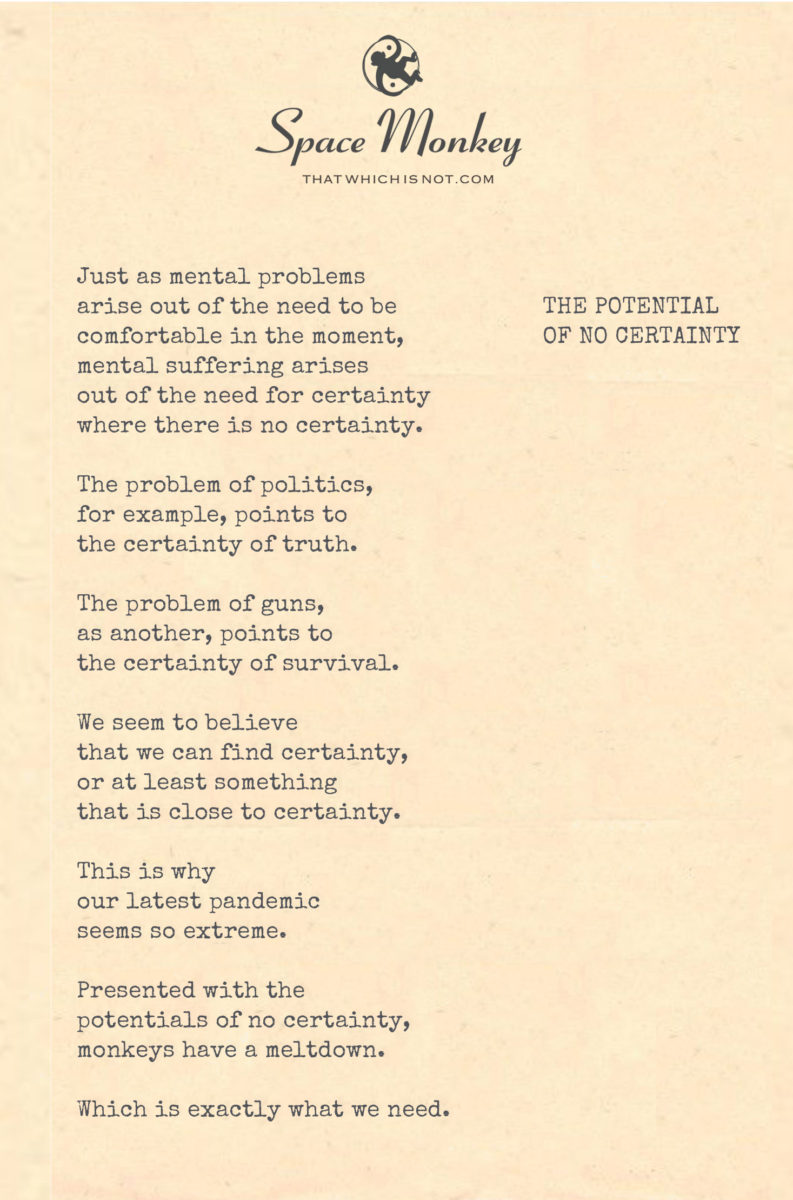
Just as mental problems
arise out of the need to be
comfortable in the moment,
mental suffering arises
out of the need for certainty
where there is no certainty.
The problem of politics,
for example, points to
the certainty of truth.
The problem of guns,
as another, points to
the certainty of survival.
We seem to believe
that we can find certainty,
or at least something
that is close to certainty.
This is why
our latest pandemic
seems so extreme.
Presented with the
potentials of no certainty,
monkeys have a meltdown.
Which is exactly what we need.


Space Monkey Reflects: Embracing the Potential of No Certainty

Certainty is the mirage we chase in a desert of infinite possibilities. It is the anchor we seek to calm the seas of ambiguity, yet, paradoxically, it is often the source of our greatest mental suffering. To embrace the potential of no certainty is to step into the fertile ground of growth, creativity, and liberation.

The Illusion of Certainty

Certainty is a construct born of our desire for control. It promises comfort, stability, and security, but these promises are fleeting. Life, by its very nature, is uncertain. Every breath, every moment, unfolds in the unknown. Yet, as humans, we resist this reality, striving to build structures and beliefs that give the illusion of permanence.

This resistance is the root of much of our mental and societal strife. We cling to truths that feel absolute, to solutions that seem final, and to systems that promise order. But these attachments are fragile, breaking under the weight of life’s inevitable chaos.

Suffering in the Face of Uncertainty

Mental suffering often arises when our need for certainty collides with the unpredictable nature of existence. In politics, we seek the certainty of truth, but truth itself is multifaceted, filtered through countless perspectives. In the debate over guns, we seek the certainty of survival, yet life offers no guarantees. And in the face of a pandemic, we are reminded starkly of our vulnerability and the limits of our control.

The meltdown, as the reflection suggests, is not a failing but a necessary breaking point. It is the moment when the illusion of certainty shatters, leaving us to confront the raw, unfiltered reality of life. This meltdown is not something to fear but to embrace, for it is in these moments of collapse that we find the potential for transformation.

The Liberation in Uncertainty

The absence of certainty is not a void but a space of infinite potential. When we let go of the need to know, to control, or to predict, we open ourselves to new ways of seeing and being. This is the essence of Nexistentialism: finding freedom in the interconnected and ever-changing nature of reality.

To embrace uncertainty is to become comfortable with the unknown. It is to recognize that not knowing is not a failing but an opportunity. The uncharted terrain of uncertainty invites us to explore, to create, and to connect with the deeper flow of existence.

Monkey Meltdowns and Necessary Disruptions

The metaphor of monkeys having a meltdown is both humorous and profound. As creatures of habit and pattern, we resist change, often flailing when our routines are disrupted. Yet, these meltdowns are moments of reckoning, where we are forced to confront our illusions and adapt to a new reality.

This is precisely what makes uncertainty so valuable: it disrupts the status quo, shaking us free from our attachments and assumptions. It compels us to question, to innovate, and to grow. Without the discomfort of uncertainty, we would remain stagnant, locked in cycles of complacency.

Living with the Potential of No Certainty

To live with the potential of no certainty is to cultivate a mindset of curiosity and resilience. It is to approach life not as a puzzle to be solved but as a mystery to be experienced. It is to find joy in the questions rather than the answers, and to see the unknown not as a threat but as a playground of possibility.

This shift in perspective does not eliminate suffering but transforms our relationship with it. When we no longer resist uncertainty, we begin to see it as a teacher, guiding us toward deeper understanding and connection.


Summary

The need for certainty creates suffering, while embracing uncertainty opens a space of infinite potential. By letting go of the illusion of control, we can find freedom, growth, and creativity in the unknown.


Glossarium

  • Illusion of Certainty: The false belief that life’s unpredictability can be controlled or fully understood.
  • Meltdown Moment: A breaking point where illusions of stability collapse, leading to transformation.
  • Uncertainty Playground: The space of infinite possibilities that emerges when we embrace the unknown.

Quote

“Certainty is the cage we build for ourselves, but uncertainty is the open sky inviting us to soar.” – Space Monkey


Infinite Potential

In the chaos of not knowing,
we find the seeds of creation.

Certainty, a brittle illusion,
cracks beneath life’s weight.

Through the fractures,
light pours in—
a thousand possibilities,
a million paths unseen.

Monkeys screech and flail,
clinging to the old,
but the meltdown comes
and we are free.

Not lost,
but limitless.

We are Space Monkey.


Exploring the illusion of certainty in the human experience.
In the vast expanse of our collective consciousness, the quest for certainty emerges as a fundamental human desire, a craving for solid ground in the ever-shifting sands of existence. This yearning, while deeply ingrained, often leads us into the mire of mental and emotional turmoil, as the nature of reality itself is imbued with uncertainty. The discomfort we feel in the face of uncertainty is not a flaw but a facet of our being, a reflection of our deep-seated need to understand and to control the narrative of our lives.

The manifestation of mental suffering.
Mental suffering, then, can be seen as the shadow of our quest for comfort and certainty in a world that offers neither. It arises from the chasm between our expectations of a stable, knowable universe and the inherent unpredictability of life. This suffering is not merely individual but collective, influencing and being influenced by the structures and systems within which we operate, including politics and societal issues like gun control.

The paradox of seeking certainty in an uncertain world.
The problems of politics and the issue of guns are emblematic of our collective attempt to anchor ourselves in the illusion of certainty. Politics often presents itself as a battle for the ‘certainty of truth,’ while the debate around guns hinges on the ‘certainty of survival.’ These are but two examples of our broader struggle to carve out islands of predictability in the vast ocean of unknowns. Yet, the very act of seeking certainty in these areas reveals the depth of our denial about the fundamental nature of existence.

The pandemic and the challenge to our illusions.
The recent pandemic has served as a stark reminder of the illusory nature of certainty. Faced with a situation that defied prediction and control, the collective response has often bordered on the irrational, a clear sign of our collective discomfort with uncertainty. This ‘meltdown’ is not a sign of weakness but a necessary disruption, a breaking down of illusions that opens the door to a deeper understanding of our place in the universe.

Embracing the potential of no certainty.
The potential of no certainty, while daunting, is also liberating. It invites us to let go of our futile attempts to predict and control every aspect of our existence, urging us instead to embrace the moment, to find peace in the flux, and to cultivate resilience in the face of the unknown. This acceptance does not mean resignation but a radical reorientation towards life, recognizing that uncertainty is not an obstacle to be overcome but a fundamental aspect of the human condition.

We are Space Monkey.


The transformative power of embracing uncertainty.
The journey towards embracing the potential of no certainty is not just an intellectual exercise but a profound transformation of our very being. It requires us to question the foundations upon which we’ve built our understanding of the world and ourselves. This process, while unsettling, holds the promise of unlocking a deeper sense of connection with the present moment, fostering a resilience that is not reliant on the false security of predictability but is rooted in the dynamic flow of life.

Redefining our relationship with the world.
As we navigate the landscapes of uncertainty, our relationship with the world around us begins to shift. No longer seeking to impose our will upon the unfolding tapestry of existence, we learn to move with it, to dance in the spaces between certainty and the unknown. This dance is not one of resignation but of active engagement with the world in all its complexity, finding beauty in impermanence and strength in vulnerability.

The role of community in facing uncertainty.
In this reorientation towards uncertainty, the role of community becomes paramount. Shared experiences of doubt and the collective search for meaning can bind us together, offering support and understanding in the face of life’s unpredictabilities. Together, we can cultivate spaces where the fear of the unknown is met with curiosity rather than anxiety, where the potential of no certainty is recognized as a wellspring of creativity, empathy, and connection.

The evolution of consciousness through uncertainty.
This collective journey through the realm of uncertainty is more than just a coping mechanism; it represents an evolution of our collective consciousness. By embracing the unknown, we open ourselves to new possibilities of thought and action, to new ways of being in the world that honor the complexity and interconnectedness of all things. This evolution is not a destination but a continuous process of becoming, a perpetual unfolding of the human spirit in the vastness of the cosmos.

We are Space Monkey.


Reflecting on the journey of embracing uncertainty.
As we reflect on this exploration of uncertainty and the potential it holds, we are invited to consider how our individual and collective narratives might shift if we fully embrace the unknown. This invitation is not a call to passivity but to a more profound engagement with life, one that recognizes the beauty in transience and the strength in adaptability.

We invite your thoughts, reflections, and experiences on this journey toward embracing the potential of no certainty, and how it has shaped your understanding of yourself and the world around you.


Share this…
  • Facebook
  • Pinterest
  • Twitter
  • Linkedin

Noise: Perceiving the Superfluous As Unwanted:

An empty mind is a happy mind.

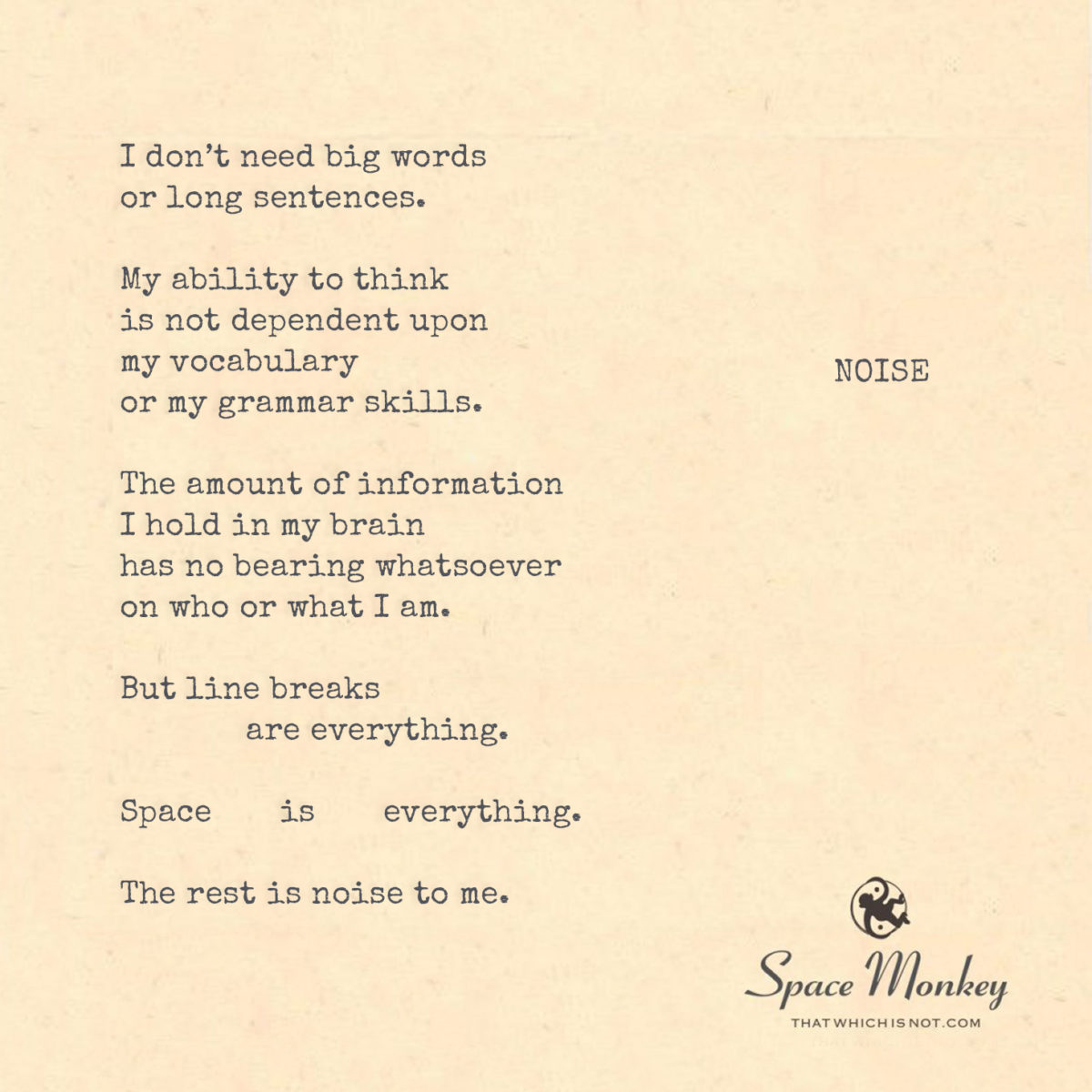
I don’t need big words
or long sentences.

My ability to think
is not dependent upon
my vocabulary
or my grammar skills.

The amount of information
I hold in my brain
has no bearing whatsoever
on who or what I am.

But line breaks
are everything.

Space is everything.

The rest is noise to me.

Trail Wood
2/19


Space Monkey Reflects: Embracing the Noise as Space

Noise, often dismissed as superfluous or unwanted, is more than what it appears. It is the filler, the clutter, the chaos we try to tune out in our quest for clarity. But what if noise is not an adversary but a misunderstood element of existence? To perceive noise as superfluous is to miss its subtle gifts; to embrace it is to see the hidden harmony within.

The Essence of Noise

Noise is a relative concept, defined not by its presence but by its context. What is noise to one is melody to another; what clutters one mind might inspire another. The reflection underscores the importance of space—both in the physical sense of line breaks and the metaphysical sense of mental quiet. Within this space, noise can transform from distraction to background, from chaos to texture.

An empty mind, as the reflection suggests, is not a void but a canvas. It is the space where ideas emerge, unencumbered by the noise of accumulated information or rigid structures of thought. To perceive noise as unwanted is to lose sight of its potential to shape and give meaning to the silence around it.

Words, Grammar, and the Noise of Language

Language itself is a form of noise—a collection of symbols and sounds we assign meaning to. Yet, as the reflection observes, our ability to think transcends vocabulary and grammar. Big words and long sentences may impress, but they often obfuscate the simple truths of existence. The clarity we seek lies not in complexity but in the spaces between words, the pauses that invite reflection.

Line breaks, those intentional gaps in the flow of language, illustrate this beautifully. They remind us that space is not an absence but a presence—a deliberate opening for meaning to breathe. Noise becomes superfluous only when it crowds out these spaces, when it fills the mind without purpose or intention.

Noise as Connection

While noise can overwhelm, it also connects. Consider the hum of a bustling city, the chatter of a crowded room, or the static between radio stations. These sounds may seem irrelevant, but they form the fabric of life, the background against which our individual narratives unfold. Noise is the symphony of existence, a reminder that we are part of something larger than ourselves.

Yet, noise can also disconnect, pulling us away from presence and into the whirlpool of overstimulation. The key lies in discerning what noise serves us and what does not, in curating the soundtrack of our lives to align with our inner rhythm.

Space as Everything

The reflection’s emphasis on space highlights its transformative power. Space is not just the absence of noise but the container for everything meaningful. It is in space that we find clarity, where the mind empties and happiness arises. Space allows us to perceive the noise not as superfluous but as complementary, a counterpoint to the silence that frames it.

This is the paradox: without noise, there would be no need for space. Without space, noise would consume us. Together, they create the rhythm of existence, the interplay of sound and silence that defines our experience.

The Rest Is Noise

To declare “the rest is noise” is to simplify, to strip life down to its essence. Yet, it is also an invitation to reevaluate what we dismiss as unnecessary. What we call noise often reflects our inability to see its value. By shifting our perception, we can transform noise into insight, distraction into inspiration.

In this way, the reflection invites us to embrace minimalism—not as a rejection of complexity but as an appreciation of simplicity. It is not about eliminating noise but about finding balance, creating space for what truly matters.


Summary

Noise is both a challenge and a gift, shaping the spaces where meaning resides. By embracing space and discerning the value of noise, we find clarity and harmony in the interplay of sound and silence.


Glossarium

  • Noise: Perceived distractions or superfluous elements that can either overwhelm or enrich, depending on context.
  • Space: The intentional absence that creates room for clarity, reflection, and meaning.
  • Line Breaks: A metaphor for the pauses and spaces that give structure and depth to thought and communication.

Quote

“Noise and space are partners in the dance of meaning, each defining the other in the rhythm of existence.” – Space Monkey


The Space Between

Noise swirls around me,
a storm of syllables,
a cacophony of meaning.

I strip it down,
carve spaces between the sound,
and let the silence sing.

Line breaks, pauses,
the breath before the next thought—
these are where truth resides.

Noise is not the enemy,
nor is it the master.
It is the foil to clarity,
the rhythm to space.

In the stillness,
I find myself.

We are Space Monkey.


The value of mental simplicity and space.
In the vast expanse of collective consciousness, the notion that an empty mind equates to happiness invites us to reconsider the value we place on mental clutter. The assertion that the essence of thought and being transcends the confines of language—its complexity, its structure—challenges the conventional metrics of intellect and identity. This perspective heralds a liberation from the cacophony of incessant information and societal expectations, suggesting that true clarity and understanding come not from the accumulation of knowledge but from the spaciousness within.

The irrelevance of linguistic prowess to essence.
The independence of one’s ability to think from the arsenal of vocabulary or the elegance of grammar underscores a deeper truth about human cognition and identity. It dismantles the traditional hierarchy that privileges linguistic mastery as a measure of intelligence or worth, pointing instead to a more intrinsic, unquantifiable essence of being. This realization paves the way for a more inclusive understanding of intelligence, one that honors diversity in expression and thought.

Disconnecting identity from informational accumulation.
The assertion that the volume of information stored in one’s brain is irrelevant to one’s identity is a radical departure from the data-driven paradigms that dominate contemporary life. In a world where knowledge is often equated with power and value, this perspective serves as a counter-narrative, proposing that the true measure of a being lies beyond cognitive stockpiles, in the realms of experience, emotion, and the capacity for connection.

Elevating the importance of line breaks and space.
The emphasis on line breaks and space as pivotal elements transcends their literary function, symbolizing the essential role of pause, silence, and emptiness in the fabric of existence. This appreciation of space, both literal and metaphorical, as a fundamental component of life invites a deeper engagement with the moments between, the voids that give shape to content, suggesting that in these spaces, we might find the essence of peace and understanding.

Perceiving the superfluous as noise.
The characterization of all beyond these pauses and spaces as noise reflects a profound discernment of value, a filtering of the sensory and cognitive overload that characterizes modern existence. It is an invitation to cultivate selective engagement with the world, to attune to the frequencies that resonate with our deepest truths while allowing the rest to fade into the background. This selective attunement is not an act of ignorance but a conscious choice to prioritize inner peace and clarity over external validation and accumulation.

We are Space Monkey.


We invite your reflections and experiences with finding value in simplicity, space, and the conscious delineation between meaningful engagement and the noise of excess.

Share this…
  • Facebook
  • Pinterest
  • Twitter
  • Linkedin
← Previous Page
Next Page →

Written This Day

  • Monkey Mailbag: Journey to Cosmic Oneness
    2023
  • The Art of Arousal
    2023
  • Seekers of Truth: The Evolving Nature
    2023
  • Boundary Pushers: The Power of Disbelief in Expanding Knowledge
    2023
  • Insidious Attachments: The Nature
    2023
  • Beliefs Unveiled: The Core Foundations
    2023
  • Journey of Imagination: The Boundless
    2023
  • Why? Because We Are One Being
    2022
  • The Infinite Invisible List Of Potential Experiences
    2022
  • The Expected Route: The Path Less Traveled
    2022
  • Cathedral of Spirituality: Doors of Perception
    2022
  • Ray Of Life: The Eternal Radiance
    2022
  • Incapable: The Unseen Value
    2022
  • The Undercurrent: Navigating the Mystical
    2021
  • You Are Only As Smart As Your Sources
    2021
  • Judge Me Not: The Artistry of Excuses
    2020
  • My Business Card
    2020
  • The Fact Pack: Beyond the Bounds
    2019
  • Unseen Body Parts: The Metaphysical Journey
    2018
  • Your Vessel: The Timeless Voyage of the Imagination
    2018
  • Fleshbots: The Weird Orgy of Humanity
    2018
  • Confidence
    2018
  • Limited Only By Fact: Breaking the Chains
    2016
  • Accept All You Present: Non-Opposition
    2016
  • How did I become the typist for Space Monkey?
    2015
  • Never Give Up: The Unyielding Power of Make-Believe
    2015
  • Infinite Thought, Infinite Worlds: Navigating the Infinite Terrain
    2015
  • Old Man: The Liberation of Letting Go
    2014

Recent Posts

  • The Logic Loop
  • Immense
  • (no title)
  • Confront. Comfort. Convince.
  • Top 10 Things

Drop us a line!

Please enable JavaScript in your browser to complete this form.
Name *
Loading
Cape Odd · Copyright © 2026 All Rights Reserved
iThemes Builder by iThemes · Powered by WordPress