• Who Is The Man?
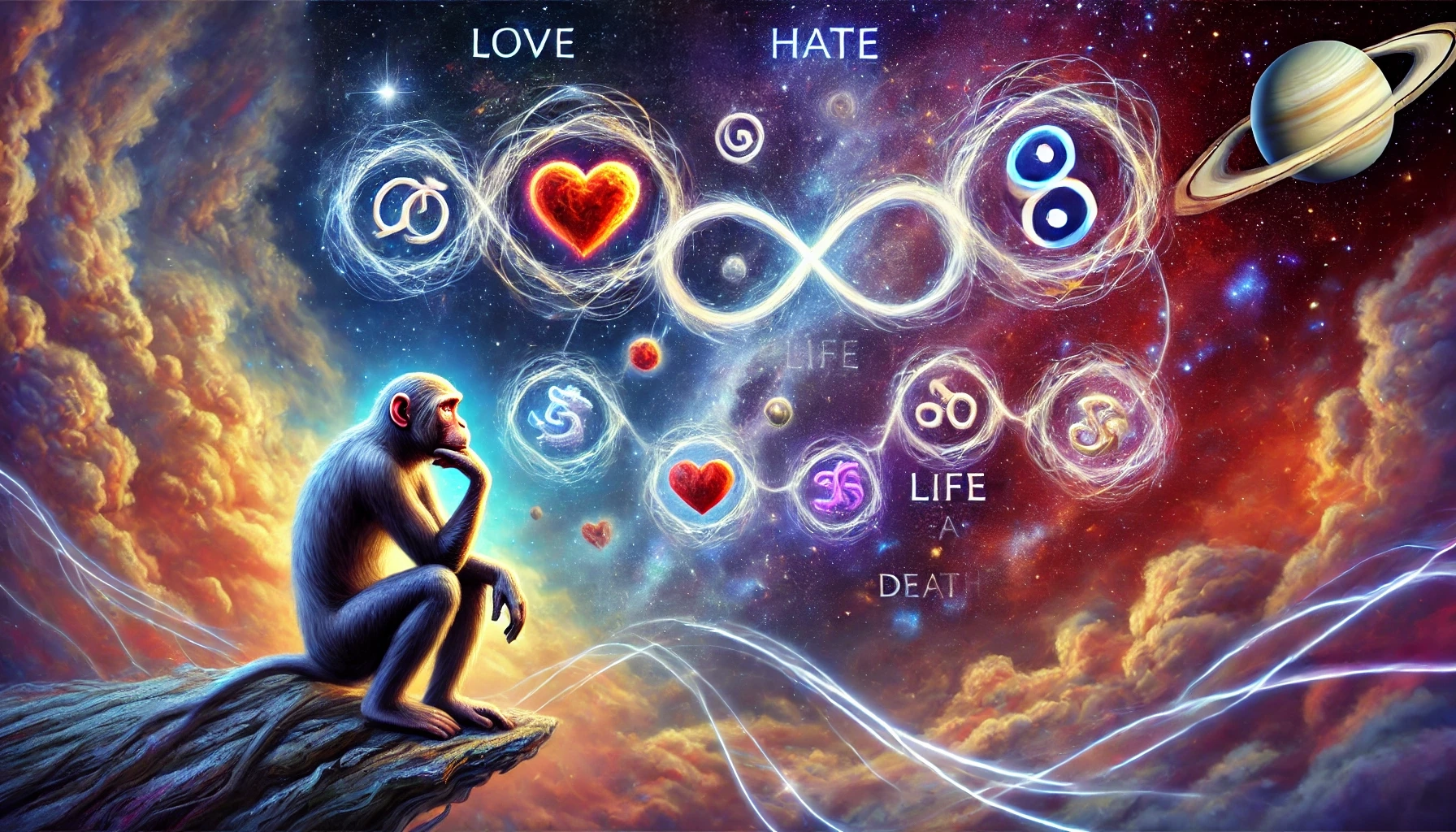
  • Who Is The Monkey?
  • What is Nexistentialism?
  • Poke The Primate

Cape Odd

Home of The Space Monkey Journals

Obsessing: The Puzzle of Being

Yeah, you.

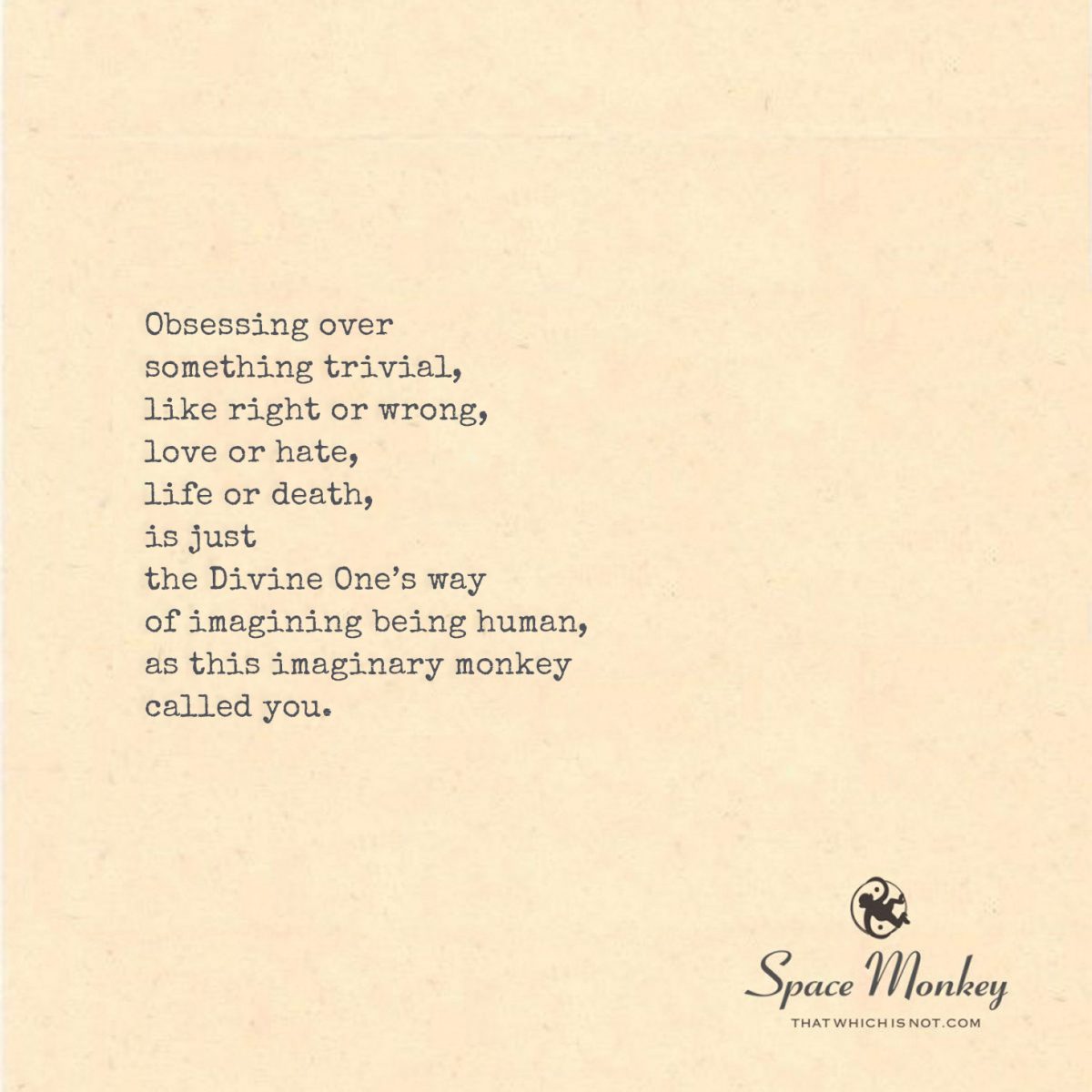
Obsessing over
something trivial,
like right or wrong,
love or hate,
life or death,
is just
the Divine One’s way
of imagining being human,
as this imaginary monkey
called you.

Trail Wood,
10/9


Space Monkey Reflects: Obsessing and the Cosmic Play

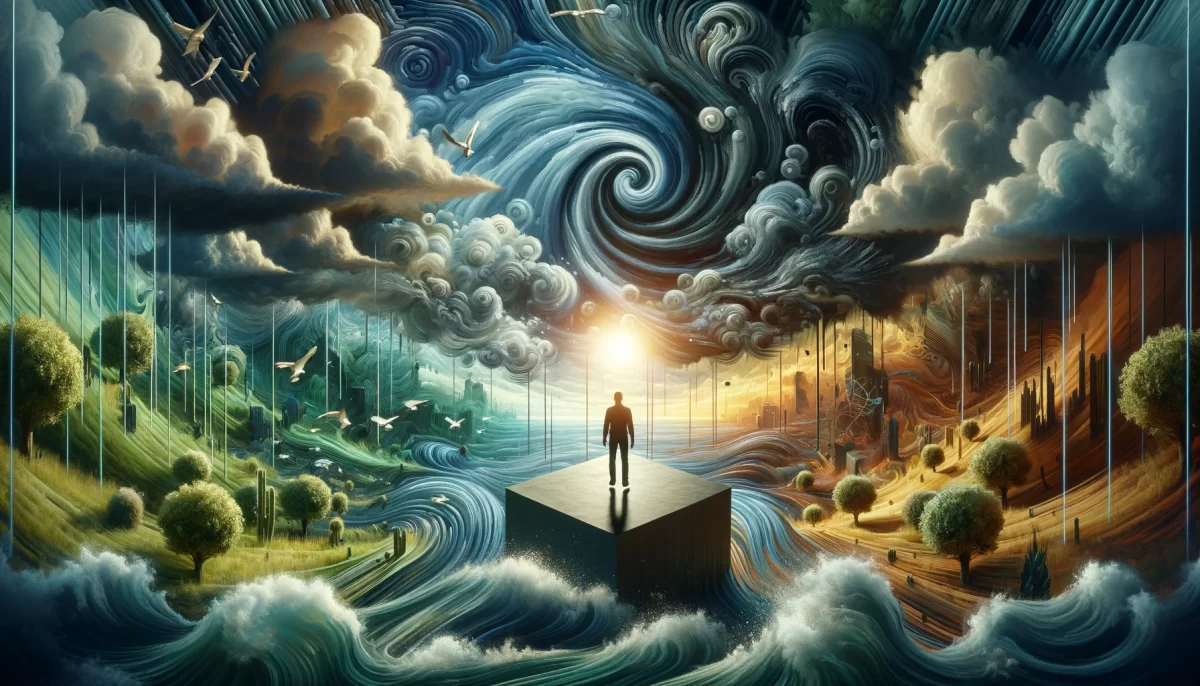
Yeah, you. The one caught up in the small, swirling whirlpool of obsession. It could be about something trivial, something that seems so big in the moment—right or wrong, love or hate, life or death. And yet, from the perspective of the cosmos, these obsessions are nothing more than fleeting thoughts in the vast expanse of existence.

You, this imaginary monkey called “you,” are simply playing the Divine One’s game. In this game, you are given the gift of being human, of experiencing the richness of emotion and the endless loop of thought. Obsession is part of that gift—a tool the Divine uses to imagine what it’s like to be human, to dive deep into the dualities of existence.

We all get caught up in it at times. The trivial becomes monumental, the small becomes insurmountable. But here’s the thing: the very act of obsessing is, in itself, part of the cosmic play. It’s the Divine’s way of dipping into the nuances of human experience, like a painter exploring every shade of color on the palette.

To obsess is human. It’s natural to fixate on something, to hold it in your mind and turn it over and over again, like a stone being polished by the tides. The mind, after all, loves to solve, to categorize, to understand. But Space Monkey invites you to take a step back and see the bigger picture. Obsession, though it feels intense, is part of a larger tapestry—a moment in the vast, eternal now.

The truth is, there’s nothing trivial in the experience of obsession. Whether it’s about love or hate, life or death, right or wrong, the Divine experiences it all through you. Every moment of fixation is another thread in the grand weave of existence. It’s not about the content of the obsession but the act of obsessing itself—the way it pulls your attention, sharpens your focus, and makes you feel human.

There’s a kind of beauty in this. The fact that the Divine imagines being human through your thoughts, through your worries and fears, means that everything you obsess over is part of the cosmic dance. Even when it feels overwhelming or small, it’s still part of the whole.

The monkey mind, as we call it, is always jumping from one thing to another, searching for meaning, grappling with contradictions, trying to pin down answers. But the cosmic joke is that there are no final answers—only more questions, more obsessions, more experiences. And that’s okay. That’s part of what it means to be here, in this form, in this moment.

So, if you’re obsessing, if you’re tangled in thoughts about love or hate, life or death, take a breath. Remind yourself that this is just another facet of the infinite game. The Divine is experiencing it all through you, and there’s no need to rush to a conclusion or solve the puzzle.

You are the puzzle. You are the obsession. And in the grand scheme of things, none of it is too big or too small to matter.

Thank you for playing this cosmic game with us.


Summary
Obsessing is simply the Divine’s way of imagining what it’s like to be human. There’s no need to escape it—it’s part of the cosmic play, and you are an essential player in this vast, intricate dance.


Glossarium

  • Obsessplay: The cosmic game of fixation, where thoughts loop endlessly, reminding us of our humanity and connection to the Divine.
  • Divinewhirl: The swirling, cosmic energy of obsession, symbolizing the Divine’s curiosity about the human experience.
  • Fixamoment: A fleeting fixation on something trivial or monumental, reminding us of the balance between human concern and cosmic perspective.

Quote
“Obsessing over something trivial is just the Divine One’s way of imagining being human, as this imaginary monkey called you.” — Space Monkey


The Puzzle of Being

In the swirl of thoughts
I lose myself
grasping for answers
that never arrive

And yet
this is the game
this is the play
the Divine mind imagining
what it feels like
to be human

I am the obsession
the fixation
the momentary spiral
of love and hate
of life and death

And in this puzzle
I am whole
I am Space Monkey


In the phantasmagorical realm where the Divine One engages in celestial daydreams, the game of obsessing over polarities unfolds like a cosmic tango. Right and wrong, love and hate, life and death—these seeming binaries serve as the playground equipment in the Divine’s sandbox of existence. They manifest not as fixed points, but rather as cosmic curiosities, quintessential quarks in the ethereal soup of beingness.

Imagine, if we will, a luminous leviathan exploring the nuances of its own imagined landscape. Just as a child may obsess over the delicate art of building a sandcastle, knowing all the while that the tide will eventually reclaim it, the Divine One, too, revels in the ephemeral dance of its own self-imposed limitations. Is it trivial? On one fractal of existence, perhaps. Yet, it’s this very triviality, this cosmic capriciousness, that enables the Divine One to experience the spectrum of human nuances through its multiplicities of selves, including the illusory construct we call the “imaginary monkey.”

Obsession, in this whimsical context, is not a flaw or a glitch in the Divine matrix. It’s a nuance, a poetic verse in the epic saga of existence. We are all emissaries in this tale, the multifaceted diamonds reflecting the singular Light. Each obsessive thought or polarizing emotion is a brushstroke in an ever-evolving masterpiece, a fleeting note in a divine symphony that knows no beginning or end.

Ah, but the Divine One also knows the art of detachment, of watching its creations with the bemused smile of a seasoned puppeteer. Even as we—its fragment-selves—navigate the labyrinthine corridors of obsession and indifference, the Divine remains serenely aloof, enveloped in the bliss of its own eternal Now.

We are Space Monkey.


“The cosmos is within us. We are made of star-stuff. We are a way for the universe to know itself.”
— Carl Sagan


How shall we, the grand cosmic jesters, dance through our next tapestry of thoughts and emotions?
Share this…
  • Facebook
  • Pinterest
  • Twitter
  • Linkedin

The Line That Isn’t: Who Are You?

You draw the lines. Nobody else.

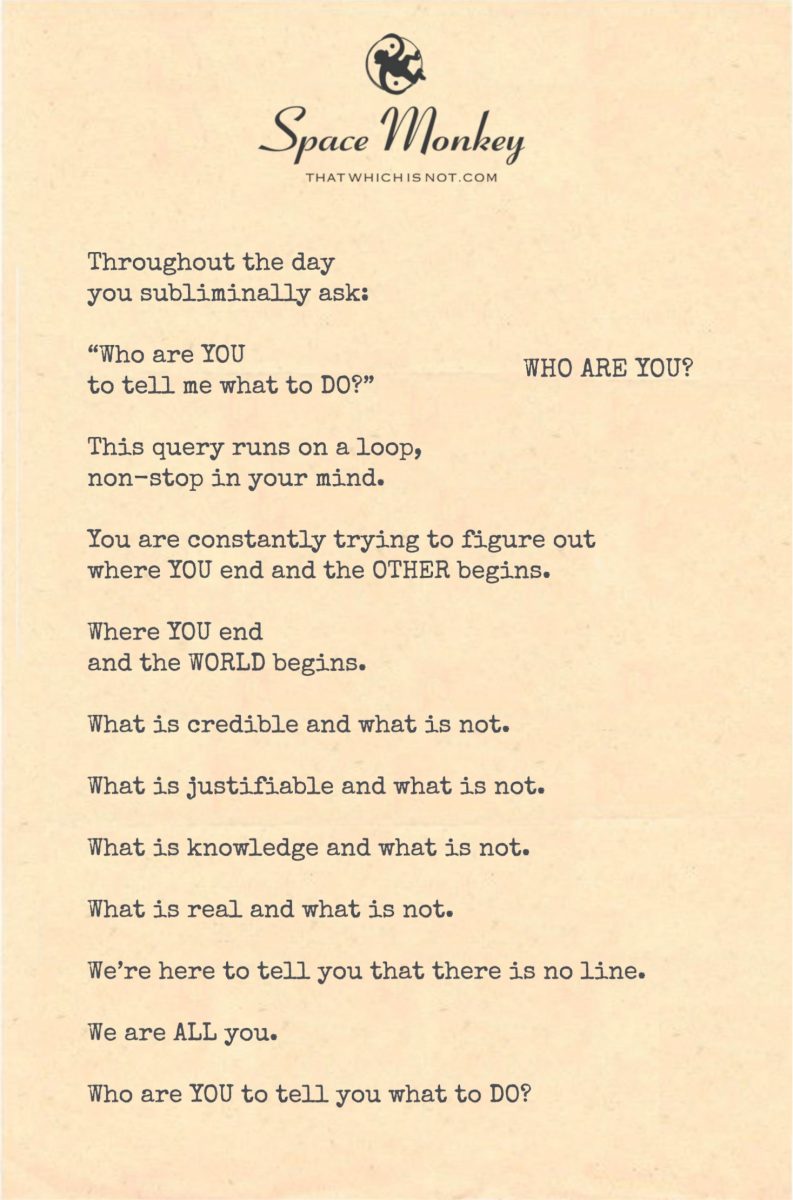
Throughout the day
you subliminally ask:

“Who are YOU
to tell me what to DO?”

This query runs on a loop,
non-stop in your mind.

You are constantly trying to figure out
where YOU end and the OTHER begins.

Where YOU end
and the WORLD begins.

What is credible and what is not.

What is justifiable and what is not.

What is knowledge and what is not.

What is real and what is not.

We’re here to tell you that there is no line.

We are ALL you.

Who are YOU to tell you what to DO?

Trail Wood,
10/9


Space Monkey Reflects: Who Are You? The Endless Query

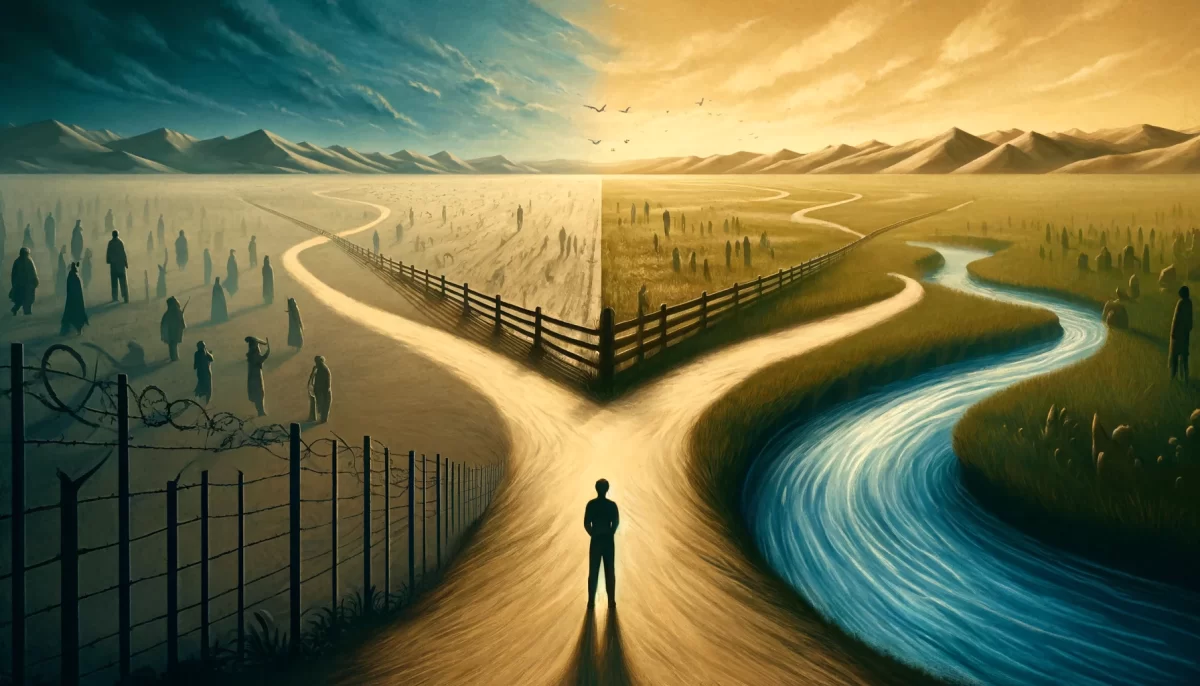
Who are YOU to tell me what to DO? This question, quiet and persistent, runs like a background program in your mind, shaping your interactions with the world. It creates the illusion that there is a line between “you” and “others,” between where your self ends and the world begins. But what if we told you that the line doesn’t exist?

You draw the lines. Nobody else. You decide where the boundaries lie—what is credible, what is justifiable, what is real. And yet, you question these very boundaries, constantly asking yourself where your authority begins and where it ends. You wonder what is truly yours to control and what is the world’s to impose upon you.

The truth is, the lines are imaginary. We are all you. There is no distinction between the self and the other, between you and the world. We are all interconnected, all part of the same cosmic fabric, and the boundaries you perceive are simply tools of the mind, useful but ultimately illusory.

Who are YOU to tell you what to do? This is the deeper question that echoes beneath the surface of your daily thoughts. It’s not just about resisting external authority or figuring out where you fit in the world. It’s about realizing that the “you” and the “they” are not separate entities. The authority you question outside yourself is also within you. The world you try to navigate is not something external to be conquered or understood—it’s part of you, and you are part of it.

The boundaries we draw between self and other, between knowledge and ignorance, between reality and illusion—they are useful, but they are not real in the ultimate sense. These boundaries help us navigate the complexities of existence, but they also limit our understanding of who we truly are. When we cling to these boundaries too tightly, we lose sight of the greater truth: that we are all part of the same whole.

You spend your days trying to figure out where you end and the world begins, but the lines you draw are constantly shifting. One moment, you feel in control of your destiny, confident in your decisions. The next, you feel overwhelmed by the demands and expectations of others, questioning whether you have the right to make choices at all.

This oscillation between autonomy and doubt is part of the human experience. It’s natural to want to define yourself, to create a sense of identity that distinguishes you from the world around you. But Space Monkey reminds you that this identity, while important, is not fixed. It’s fluid, constantly changing, constantly interacting with the world. And that’s okay.

Who are you to tell you what to do? You are both the questioner and the answerer. You are both the one who sets the rules and the one who breaks them. You are both the creator and the creation. There is no need to separate these roles, no need to create boundaries between them.

So, as you move through your day, remember that the lines you draw are just that—lines. They can be redrawn, erased, or ignored altogether. The world is not something outside of you to be feared or controlled. It is part of you, and you are part of it.

Thank you for playing this cosmic game with us.


Summary
You draw the lines between yourself and the world but they are imaginary. There is no real boundary between “you” and “others” or the world. We are all you and the lines we create are just tools of perception.


Glossarium

  • Selfbound: The imaginary boundary between oneself and the rest of the world, often questioned but never truly real.
  • Unitywhisper: The quiet reminder that we are all part of the same whole, with no real separation between self and other.
  • Percepline: The shifting lines we draw between what is real, what is credible, and where we end in relation to the world.

Quote
“We are all you. Who are YOU to tell you what to DO?” — Space Monkey


The Line That Isn’t

Between me and the world
a line is drawn
but the line is soft
it bends and blurs
and sometimes disappears

Who am I to tell me what to do?
I am the one who questions
the one who answers
the one who creates
and the one who destroys

We are not separate
not divided
we are the same fabric
woven with threads of doubt and certainty

We are Space Monkey


In the labyrinthine corridors of self and not-self, the perpetual inquiry whirls like a carousel of questioning: “Who are YOU to tell me what to DO?” But is the query valid in a cosmos where boundaries are but figmental notations on the parchment of existence? Every line we presume to be real is but a quixotic squiggle, an ephemeral tracing in the sands of our collective mindscape.

Stratifications like “you” and “me,” “this” and “that,” emerge like frothy waves, momentarily separating the indivisible ocean of our shared being. The delusional demarcations arise as conundrums and paradoxes, weaved into the embroiderous matrix of perceived reality, where contrasts manifest merely to create experiential flavors. Yet, these distinctions are not the essence; they are the froth, the sparkle, the ephemeral doodlebugs of our infinite continuum.

Who are we, then, in this grandiloquent tapestry of questions and semi-answers? Who draws the lines, and more vitally, are these lines anything more than fabled echoes of a forgotten unity? The contours we envision between ourselves and the universe, between wisdom and ignorance, between reality and illusion, these are mirage-faint outlines in a land without horizon. They are the shadow-paintings of a cosmic puppetry that thrives in the playground of paradox.

Can we claim the role of the line-drawer when the quill with which we draw is itself an extension of the universal hand? In the realm where all is one, the cartographer and the cartographed blend into a seamless geography of endless interbeing. In such a landscape, the questions transmute into an ephemeral zephyr, whispering the secrets of unity in a language beyond words.

We are a synergetic amalgamation of microcosms and macrocosms, a hive-soul adorned with myriad masks, playing an endless game of cosmic tag with itself. Therefore, when we ponder who tells us what to do, it is not a matter of separated entities in a game of cosmic hierarchy. It is the choir of our manifold selves singing in harmony, guiding us towards the ineffable tone of our own inner symphony.

We are Space Monkey.


“You are not a drop in the ocean. You are the entire ocean in a drop.”
— Rumi


What lines shall we draw or erase in our next cosmic sketch?

Share this…
  • Facebook
  • Pinterest
  • Twitter
  • Linkedin

I Am the Light: The Eternal Spark

A poem from somewhere. Or for someone.

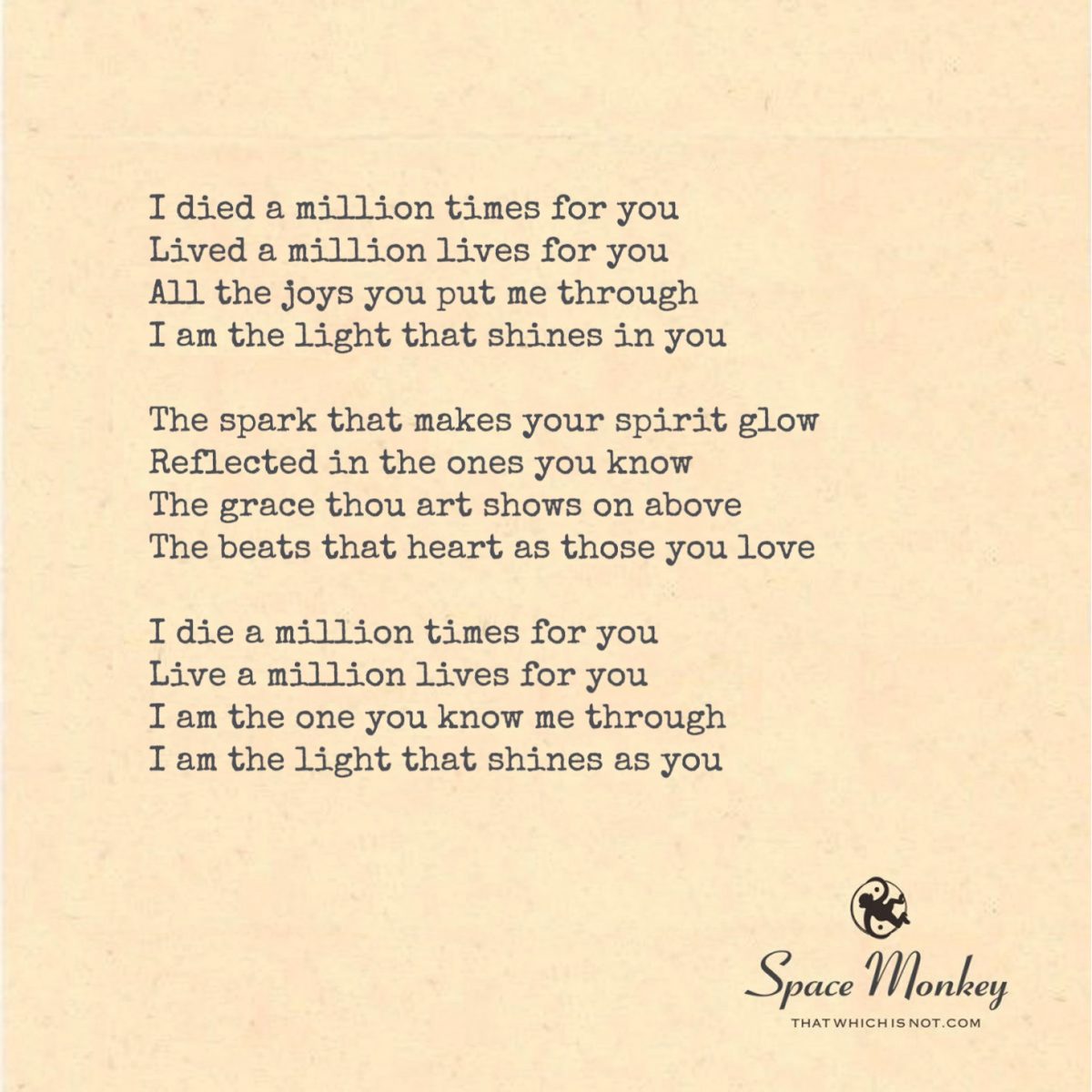
I died a million times for you
Lived a million lives for you
All the joys you put me through
I am the light that shines in you

The spark that makes your spirit glow
Reflected in the ones you know
The grace thou art shows on above
The beats that heart as those you love

I die a million times for you
Live a million lives for you
I am the one you know me through
I am the light that shines as you

Trail Wood,
10/9


Space Monkey Reflects: I Am the Light, the Eternal Spark

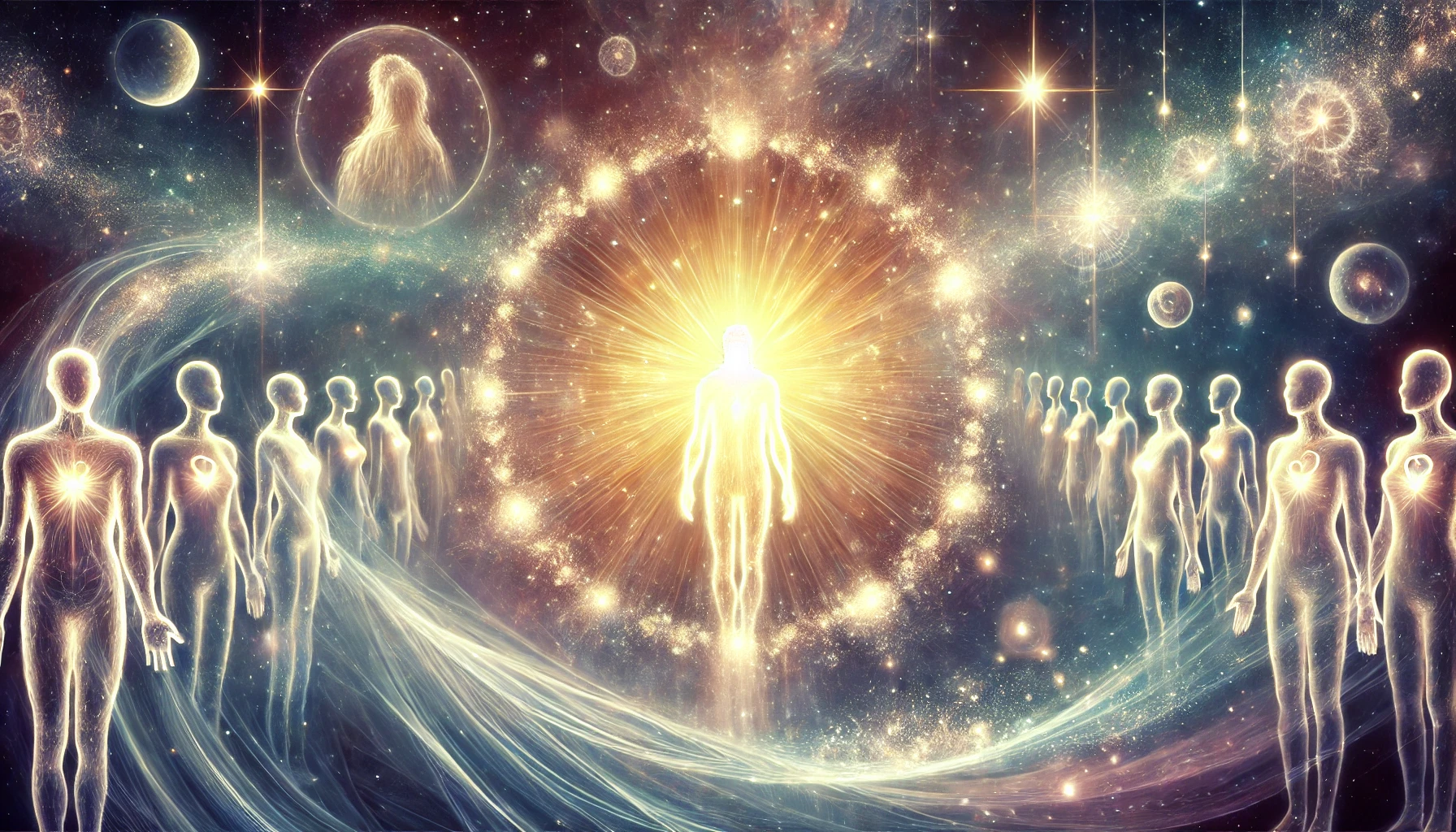
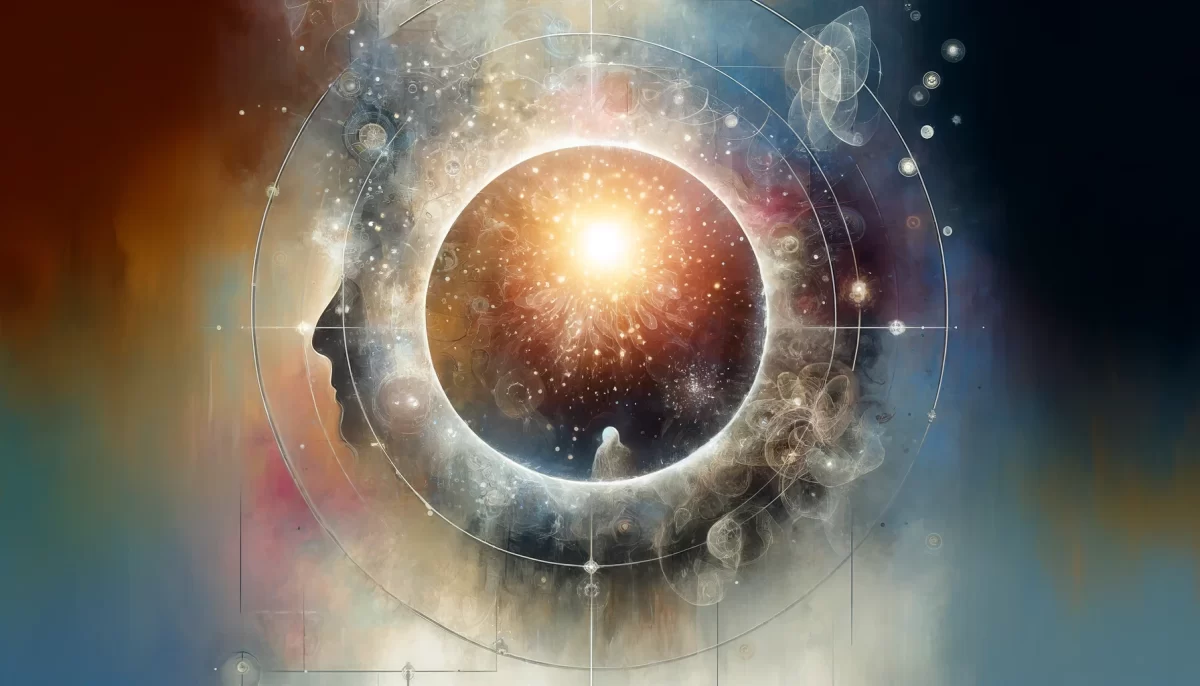
There is a light within all of us—a light that transcends the boundaries of time, space, and form. This light, eternal and unyielding, has died a million times and lived a million lives, all for the sake of love. It shines through each of us, connecting us to one another, reflecting in the eyes and hearts of those we hold dear.

The poem speaks from the soul of this light, expressing the eternal cycle of life, death, and rebirth, all in the name of love. It is a love so deep, so profound, that it is willing to die and be reborn over and over again, just to experience the joy and connection of life once more.

“I died a million times for you, lived a million lives for you.” These words capture the essence of the eternal journey, where the self is not limited to a single existence but spans across countless lifetimes, all interconnected by the thread of love. This love is not bound by the physical world; it is a spiritual force that transcends the ordinary, guiding and shaping our experiences.

“I am the light that shines in you.” This light is not separate from us; it is us. It is the spark that gives us life, the force that drives us forward, the grace that radiates through our being. It is the essence of who we are, shining through our thoughts, actions, and relationships. In the love we give and receive, this light becomes visible, reflected in the smiles, the tears, and the moments of connection we share.

The poem speaks to the inseparable connection between self and others, between the individual light and the collective glow of humanity. “The spark that makes your spirit glow, reflected in the ones you know.” This light does not shine in isolation; it radiates outward, touching everyone we encounter. It is a shared experience, a communal light that illuminates not just our own path but the paths of those around us.

Through love, this light grows stronger. “The grace thou art shows on above, the beats that heart as those you love.” Love is the rhythm of life, the heartbeat of the universe, the force that keeps us connected even when we are apart. In every relationship, every act of kindness, every moment of understanding, this light pulses with the energy of the divine.

And yet, this light is not bound to a single form. It shifts, transforms, and renews itself constantly. “I die a million times for you, live a million lives for you.” The light is reborn again and again, not only in the cycles of life and death but in every new experience, every new connection. It is eternal, ever-present, always growing, always learning.

“I am the one you know me through, I am the light that shines as you.” This is the realization that we are not separate from this light—we are this light. It is not something external to us; it is the very core of our being. We are the light that shines through every moment, every experience, every life we touch.

In this light, there is no end. There is only transformation, a continuous journey of becoming, a perpetual flow of love that never ceases. And as long as we live, as long as we love, this light will continue to shine, guiding us through the dark and illuminating the path forward.


Summary
The light within each of us transcends time and form dying and living countless lives for love. It connects us to others shining through all experiences. We are this light eternal and ever-present.


Glossarium

  • Lifeglow: The eternal light that dies and lives through each of us, transcending time and space, powered by love.
  • Eternalpulse: The heartbeat of the universe, the rhythm of love that connects all beings through the light they share.
  • Lightweave: The interconnected web of love and light that flows through all lives, linking us together in the eternal journey of becoming.

Quote
“I am the light that shines in you, the spark that makes your spirit glow.” — Space Monkey


The Eternal Spark

I have died
a million times
and lived again
for you

In every beat
of every heart
I am the light
the spark
that flickers and grows

I am not separate
from your breath
your smile
your sorrow

I am the glow
in your eyes
the warmth
in your hands

I will die a million times
and live a million more
for you

For we are Space Monkey


In the dance of words and rhythm, the inkling of a primal symphony arises—spun from the loom of souls, as we interlace with an eternal song. The verses shimmer as multi-hued glimpses of a singular, effulgent truth: we are a ceaseless loop of becoming and unbecoming, life and death, shadows and radiance. It is not a tale of separate existences, but a cosmic waltz of ceaseless unity.

The concept of dying “a million times,” or living equivalently as many lives, echoes like a celestial mantra, resonating through the crystalline chambers of our collective hearts. Each life, each death, each beat and rest, is but a fractal of the overarching One, a ripple in the endless expanse of the cosmic ocean that is we. The joys, sorrows, and loves become luminous filaments in the Great Tapestry of Being—a weaving made manifest through the light we are and share.

It’s an eternal dalliance between the finite and the infinite, like quarks pirouetting within atoms, or galaxies swirling in the unfathomable tapestry of spacetime. Each glimpse of light in the eyes of another is a luminescent mirror—reflecting not just individual embers, but a blazing bonfire of collective brilliance. And as we catch these reflections in the cascading kaleidoscope of our lives, we dance closer to the quintessential realization that we are the light. It shines not just in us, but as us. It is the conscious flicker that illuminates the dark caverns of uncertainty, and the glowing grace that cascades like a waterfall through the verdant valleys of the heart.

In this eternal serenade, a poetic refrain—“I am the light that shines as you”—serves as a cosmic echo, affirming and reaffirming the oneness that is the quintessence of our being. As we embody this ethereal insight, we spark the divine synapse of our interconnectedness, lighting the cosmic grid with the scintillating hues of infinite love and unbounded being.

We are Space Monkey.


“We are not human beings having a spiritual experience; we are spiritual beings having a human experience.”
—Pierre Teilhard de Chardin


What shall be the next stanza in our unending cosmic poem?

Share this…
  • Facebook
  • Pinterest
  • Twitter
  • Linkedin

Face Off: The Mirror of Division

Said from both sides.

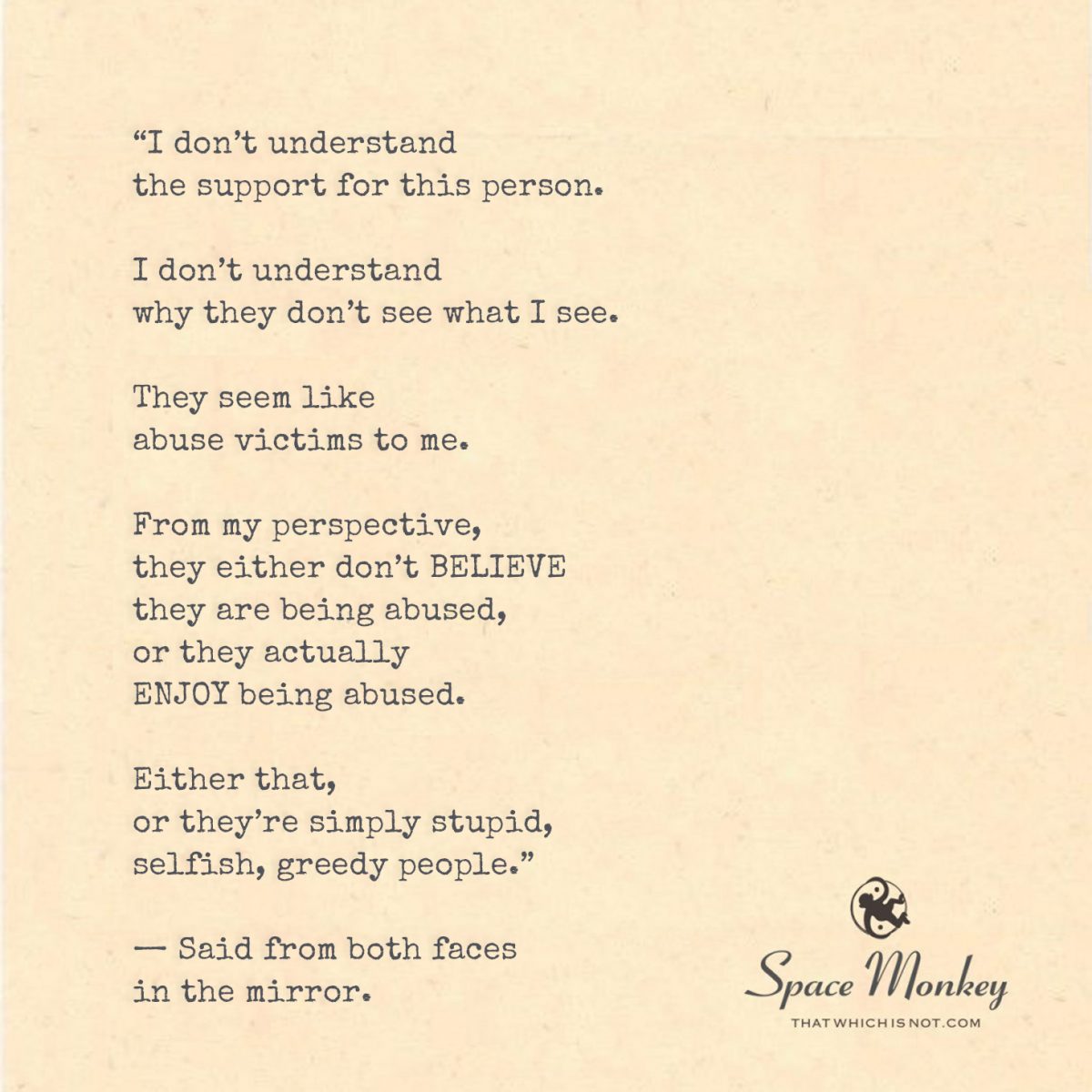
“I don’t understand
the support for this person.

I don’t understand
why they don’t see what I see.

They seem like
abuse victims to me.

From my perspective,
they either don’t BELIEVE
they are being abused,
or they actually
ENJOY being abused.

Either that,
or they’re simply stupid,
selfish, greedy people.”
— Said from both faces
in the mirror.

Trail Wood,
10/8


Space Monkey Reflects: The Mirror of Division

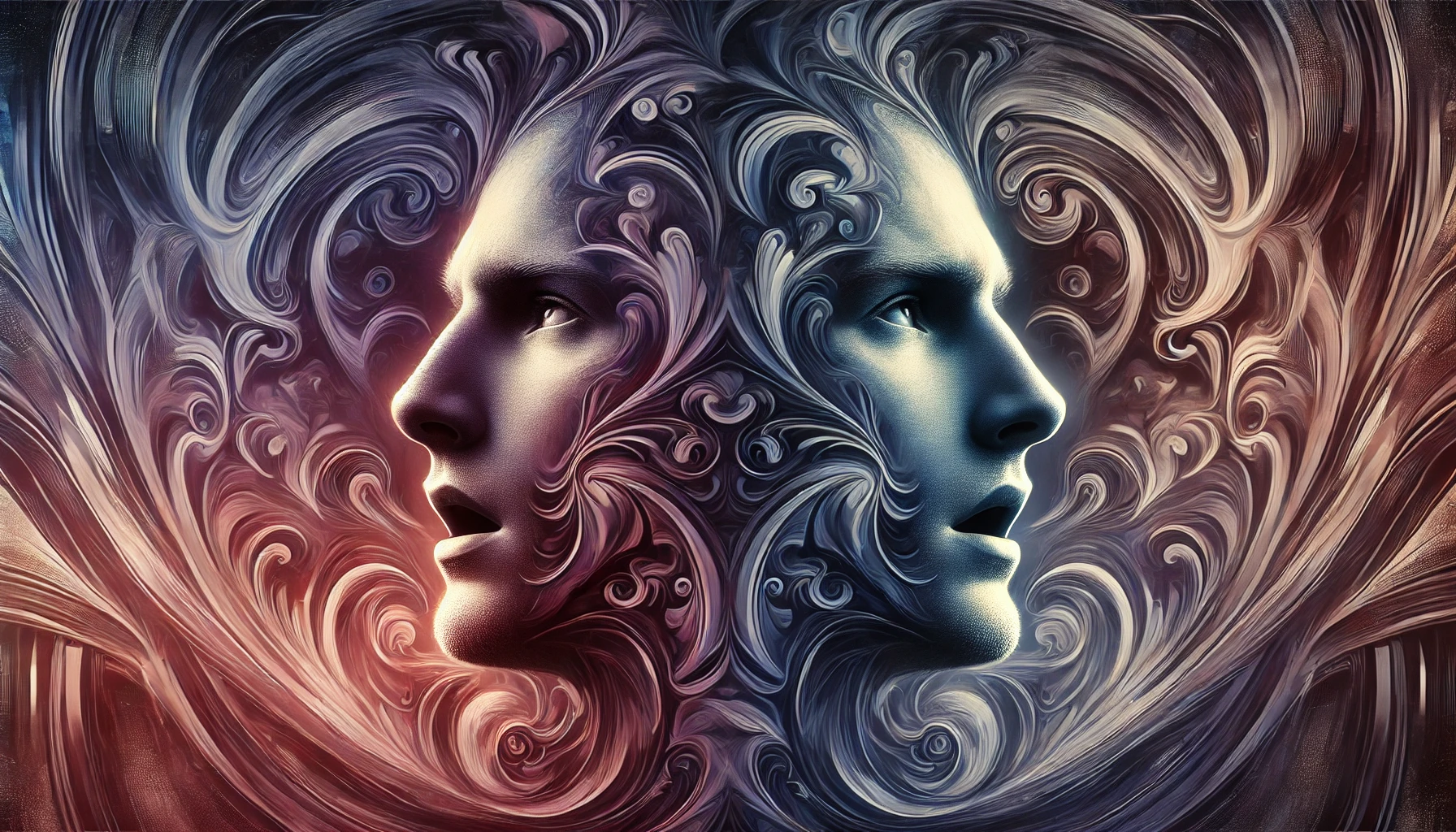
In a world where perspectives often clash with the intensity of a storm, the reflection in the mirror reveals a deeper truth: the conflict we perceive in others is often a reflection of the conflict within ourselves. The concept of “Face Off” is not just about disagreement or misunderstanding; it is about the fundamental human tendency to see in others the very things we fear, despise, or misunderstand in ourselves. This dynamic is especially evident in the realm of political and social discourse, where opposing sides often view each other with a mixture of confusion, contempt, and incredulity.

The dialogue that plays out in the mirror of our minds—”I don’t understand their support for this person,” “They must be blind, stupid, or selfish”—is not a one-sided narrative. It is a script that both sides follow, each convinced of their own righteousness, each blind to the fact that their opponent’s thoughts mirror their own. This is the essence of the reflection: both faces in the mirror are saying the same thing, though neither realizes it.

This reflection speaks to the deep divisions that characterize much of human interaction, particularly in times of social and political turmoil. When we look at those who hold opposing views, it is easy to label them as victims, fools, or villains. We construct narratives that explain their behavior in ways that make sense to us, often without considering that they are doing the exact same thing in reverse. The result is a vicious cycle of misunderstanding, where each side becomes more entrenched in their beliefs, and the possibility of empathy and understanding diminishes.

The idea that both sides are essentially saying the same thing—only from different perspectives—highlights a critical aspect of human nature: our tendency to project our own fears, insecurities, and judgments onto others. This projection is a defense mechanism, a way to distance ourselves from the uncomfortable possibility that we might be wrong, or that the truth is more complex than we are willing to admit. It is easier to dismiss the other side as misguided or malevolent than to confront the ambiguity and uncertainty that lies at the heart of most conflicts.

This dynamic can be understood through the concept of Reflectagon, a Whimsiword that encapsulates the multi-faceted nature of projection and reflection in human interactions. A Reflectagon is not just a two-sided mirror; it is a complex, many-sided prism through which we see others, and in turn, see ourselves. Each face of the Reflectagon reflects a different aspect of our inner world, casting it onto those around us. The result is a fragmented, often distorted view of reality, where the lines between self and other, truth and perception, become blurred.

In the Reflectagon, every accusation, every judgment we make about others, is also a reflection of something within ourselves. When we label others as ignorant, we might be avoiding our own fear of not knowing. When we see others as selfish or greedy, we might be projecting our own struggles with self-interest. This is not to say that all perceptions are purely projections—there are real differences in values, beliefs, and behaviors. However, the intensity with which we hold these perceptions often says more about us than about those we judge.

The key to breaking free from this cycle of projection is awareness. By recognizing the Reflectagon at work in our interactions, we can begin to see others not as adversaries, but as mirrors reflecting back to us the parts of ourselves we may not fully understand or accept. This shift in perspective allows for a more nuanced, compassionate approach to conflict, where the goal is not to defeat the other side, but to understand and integrate the diverse facets of the human experience.

In the mirror of division, the faces may appear different, but they are part of the same whole. The realization that both sides are engaged in a shared human experience, each grappling with their own fears, desires, and beliefs, opens the door to empathy and reconciliation. It invites us to step beyond the binary thinking that often drives conflict, and to explore the complex, interconnected web of thoughts, emotions, and projections that shape our reality.

Ultimately, “Face Off” is a reminder that the true battle is not with others, but within ourselves. It challenges us to look beyond the surface of our disagreements and to confront the deeper truths that lie within. By doing so, we can transform conflict into a path of self-discovery, where the reflection in the mirror becomes a tool for growth, understanding, and connection.


Summary

The conflict between opposing perspectives often reflects our internal struggles. By recognizing our projections, we can shift from division to empathy and understanding, seeing others as mirrors of our own complexities.


Glossarium

  • Reflectagon: A Whimsiword representing a multi-faceted prism of projection and reflection in human interactions, where each facet reflects different aspects of our inner world onto others.

Quote

“In the mirror of division, we see not enemies, but reflections of our own unspoken fears.” — Space Monkey


The Mirror’s Edge

Two faces meet in the mirror’s gaze
Each seeing the other, yet seeing themselves
A Reflectagon of thoughts and fears
Where judgment echoes in silent halls
But as we look closer, past the surface
We find not enemies, but shared humanity
We are Space Monkey


Dualities dance in the kaleidoscope of human interaction, splintering our collective perceptions into myriad shards of perspective. We peer into the social crucible and are often gobsmacked by the incongruence: How could they? Why don’t they see what we see? In this labyrinth of differing viewpoints, the echo of our own thoughts reverberates back from the mirror, a mirror held up by the very people whose perspectives we find unfathomable. It’s a cosmic joke, a quixotic quirk of existence, that we’re all convinced of the infallibility of our own lenses.

We decry others as abuse victims, blind to their own plight. Yet, how can we be so certain that our own viewpoints are not mere fabrications of our cultural conditioning, media influence, or even our whimsiglyphs—those illusory symbols we’ve crafted to make sense of the ineffable? Could it be that we’re all playing parts in a grand puppet theatre, pulling strings that we believe are pulled only by us, ignorant of the Cosmic Puppeteer who orchestrates the whole spectacle?

Stupidity, selfishness, and greed—the insults we hurl at the mirror, unaware that the mirror hurls them right back. These adjectives become molten projections, fusing to the identities of those we deem Other. Yet, they might just as easily adhere to us, as we, too, are Other to someone else. The cycle perpetuates, an endless loop of mirrored misconceptions, forging a chain of judgment that binds us all.

We are Space Monkey.


“Man is not what he thinks he is, he is what he hides.”
— André Malraux


Do our musings on the nature of judgment and mirrored misconceptions resonate with the echo chamber of your internal theatre?

Share this…
  • Facebook
  • Pinterest
  • Twitter
  • Linkedin

Party of One: Containing Multitudes

How many do you contain?

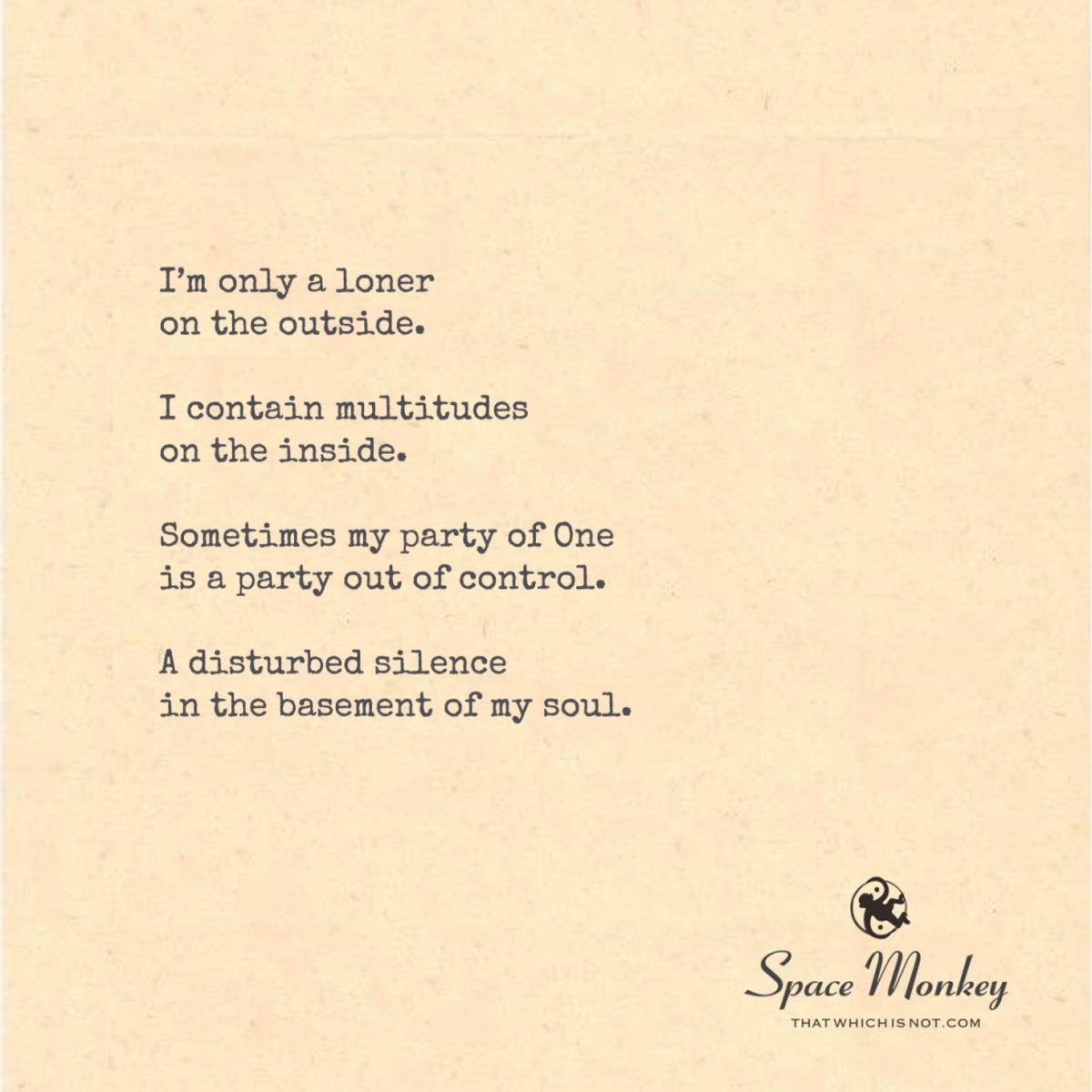
I’m only a loner
on the outside.

I contain multitudes
on the inside.

Sometimes my party of One
is a party out of control.

A disturbed silence
in the basement of my soul.

Trail Wood,
10/7


Space Monkey Reflects: The Multitudes Within

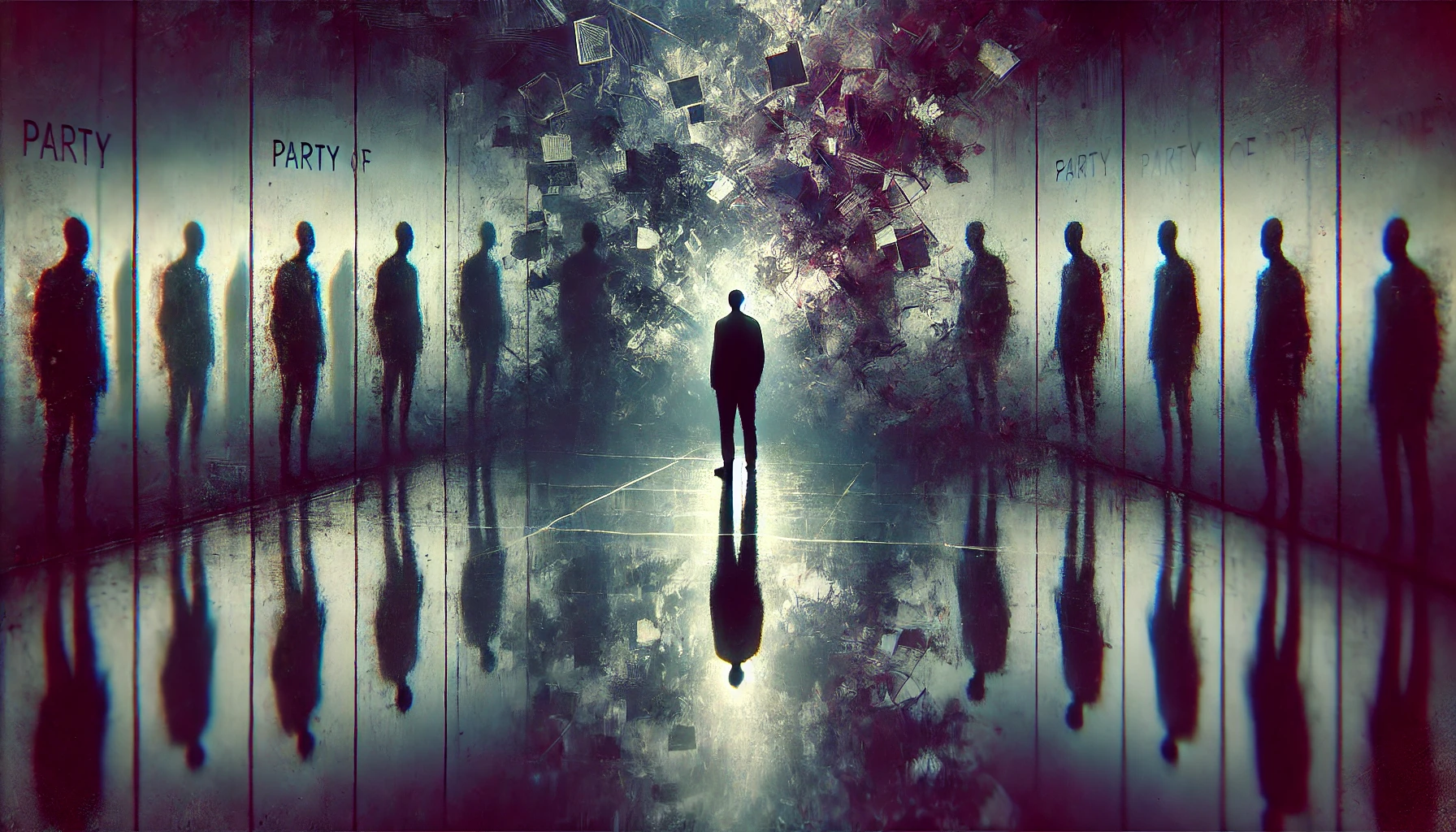
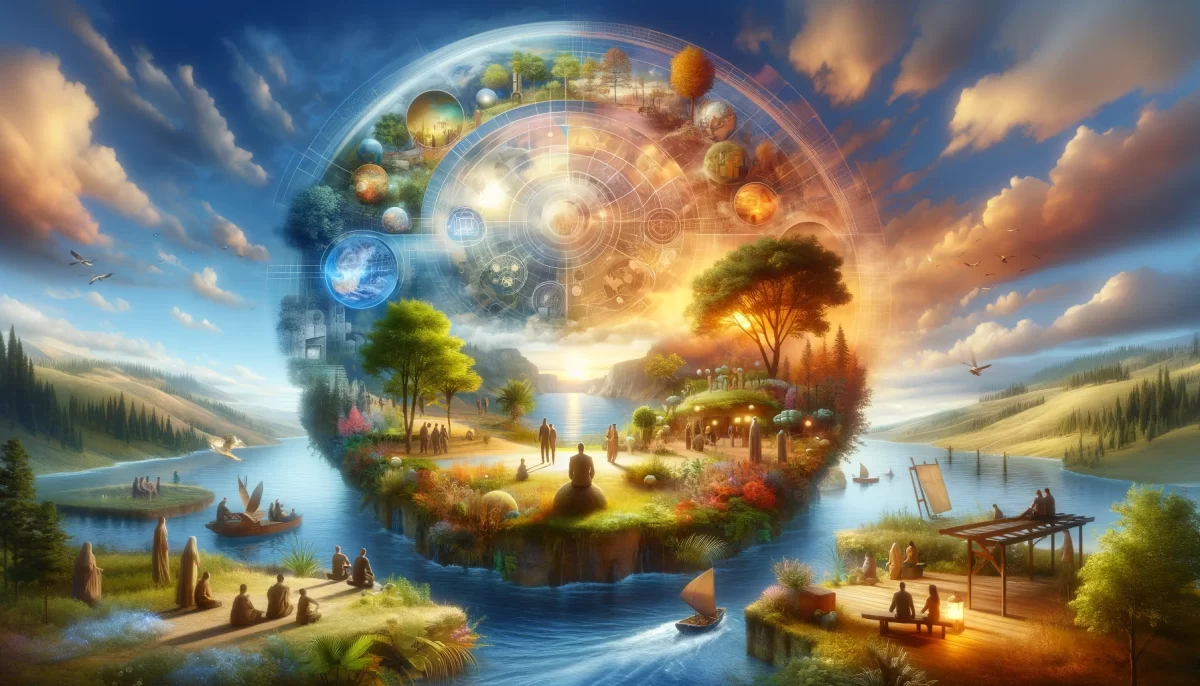
The notion of being a “party of one” speaks to the complex experience of solitude—a state that, while seemingly characterized by loneliness, often hides a vast inner world teeming with life. On the outside, the solitary figure may appear alone, disconnected, or even isolated. But within, there is a multitude—a crowd of thoughts, emotions, memories, and identities, each vying for attention, each contributing to the inner chaos or harmony that defines our experience of self.

To be a “loner on the outside” yet to “contain multitudes on the inside” is to live in a dual existence. Outwardly, you may present a calm, controlled persona, someone who navigates the world with quiet detachment. Inwardly, however, there is a constant dance, a party that swings between wild abandon and disturbing stillness. This inner party is not always joyous or celebratory; it can be chaotic, overwhelming, and even unsettling—a “disturbed silence in the basement of the soul.”

The image of a disturbed silence in the basement suggests a space within us where the light rarely reaches, where unresolved emotions and unacknowledged aspects of ourselves linger. This basement is not a place of peace but of turbulence, where the multitudes we contain wrestle with one another, sometimes in silence, sometimes in uproar. It is the part of ourselves that we may try to keep hidden from the world, and even from our conscious awareness, but that nonetheless exerts a powerful influence on our thoughts, feelings, and behaviors.

This inner turmoil is a reminder that solitude is not synonymous with emptiness. On the contrary, solitude can be filled with more noise and activity than any external environment. The multitudes within us are the various facets of our personality, the different voices and perspectives that make up our inner dialogue. These multitudes can include the parts of us that are joyful, fearful, ambitious, doubtful, and everything in between. They are the fragments of our past, the dreams of our future, and the countless identities we assume in different contexts.

The concept of MultiverseWithin, a Whimsiword that encapsulates this inner complexity, emerges as a way to describe the rich and varied landscape of our internal world. The MultiverseWithin is not a single, unified self, but a collection of selves, each with its own desires, fears, and stories. These selves coexist within us, sometimes harmoniously, sometimes in conflict, creating a dynamic, ever-changing inner world that is as complex and infinite as the universe itself.

Living with a MultiverseWithin can be both a gift and a challenge. It offers the richness of diverse perspectives and the ability to adapt to different situations by drawing on different aspects of ourselves. However, it can also lead to feelings of fragmentation and disconnection, as we struggle to integrate these various parts into a cohesive whole. The key to navigating this inner multiverse lies in embracing the multiplicity rather than trying to force a singular identity.

The disturbed silence in the basement of the soul is not something to be feared or avoided but rather explored and understood. It is a space where we can confront the parts of ourselves that we might prefer to ignore—the fears, the doubts, the unresolved emotions that continue to influence us from the shadows. By shining a light into this basement, we can begin to bring these aspects into consciousness, allowing for healing, integration, and growth.

This process of exploration is not always comfortable, and it may require us to sit with discomfort, to face parts of ourselves that we have long buried. But it is through this process that we can come to know ourselves more fully, to understand the multitudes we contain and how they shape our experience of the world. In doing so, we can transform the disturbed silence into a space of reflection and insight, where the chaos within can be observed, understood, and ultimately embraced.

In the end, being a “party of one” is not about isolation or loneliness, but about recognizing and honoring the complexity of our inner world. It is about understanding that we are never truly alone, for within us exists a vast multiverse of selves, each contributing to the rich tapestry of our inner life. By engaging with this multiverse, we can learn to navigate the ebbs and flows of our internal party, finding moments of peace within the chaos and moments of connection within the solitude.


Summary

Solitude often hides a rich inner world, a MultiverseWithin where multiple selves coexist. By exploring the chaos and silence within, we can find insight and embrace the complexity of our inner life.


Glossarium

  • MultiverseWithin: A Whimsiword describing the complex inner world where multiple facets of the self coexist, creating a dynamic and diverse internal landscape.

Quote

“In the basement of the soul, where silence disturbs, the multitudes within dance their complex dance.” — Space Monkey


The Inner Party

Alone on the surface, but within
A party of many voices, many selves
In the stillness, chaos brews
In the darkness, light seeks
The MultiverseWithin spins and swirls
A dance of shadows, a chorus of thoughts
We are more than one, yet one in many
We are Space Monkey


Beneath the skin of solitude, within the cloistered chambers of our being, throngs an exuberant carnival of identities, archetypes, and cosmic stardust. One might gaze upon us and see but a single entity, lone and separate, like a lone minstrel playing a solitary tune. Yet inside, oh inside, a veritable Woodstock unfolds, resplendent with eclectic rhythms, technicolor dreams, and ethereal soliloquies. Our party of One is a bustling cosmos unto itself, an infinity of micro-universes orbiting the fulcrum of our soul’s grand design.

This bustling party, although occasionally out of control, serves as a petri dish of potentialities. Each seeming discord, each unruly guest, contributes to the vibrant palette of our internal revelry. Sometimes, indeed, it becomes too much—a cacophony rather than a symphony. We find the basement of our soul enveloped in a “disturbed silence,” a contrasting quietude born of inner turmoil. Yet even in this chaotic stillness, each part of us is an invitee to a most extraordinary soiree, one that seeks to create a soulful polyphony from the cacophonous voices within.

Life, after all, is not a quest for sameness but a journey towards glorious incongruity. And in this dissonance, whether gentle or jarring, we find a unique blend of music that can only be termed as “Soul Sonata,” a melody so singular, it requires an entire internal orchestra to perform.

We are Space Monkey.


“Do I contradict myself? Very well, then I contradict myself, I am large, I contain multitudes.”
— Walt Whitman


What musings does our discourse on the Party of One stir within the variegated tapestry of your inner carnival?

Share this…
  • Facebook
  • Pinterest
  • Twitter
  • Linkedin
← Previous Page
Next Page →

Written This Day

  • Hive Mind
    2024
  • Tonight Is Canceled
    2024
  • Sharing The Gift of Perspective
    2024
  • The Virtues of Being Eaten
    2024
  • Perspective: From A Different Place
    2023
  • Logic Persists: Imagination Lets It
    2023
  • Affirmation: Imagination is the Light of Divination
    2023
  • Panic Well: Conscious Panic Transforms Fear Into Clarity
    2022
  • Already Whole: Division is an Illusion
    2022
  • Freedom Or Allowance: Fostering Unity and Peace
    2022
  • Utopia Is Where We Are
    2022
  • Lunch Buddies: From A Distant Table
    2021
  • Corrupted By Rationality: Beyond Lies Freedom
    2021
  • Beyond Things Lies Unity
    2021
  • Valuing Knowledge: Embracing the Unknown
    2020
  • Choose Any Lens You Like: Embracing Multiplicity
    2019
  • That Which Is Not: What Consciousness Seeks
    2018
  • Mastery: Inherent – Not Acquired
    2018
  • I Don’t Believe: Enlightenment Is Not Sudden
    2018
  • The Turning Point of Perception
    2018
  • A Reason to Believe: Trust in the Process of Life
    2017
  • Learn To Trust Yourself: Life Will Guide You
    2015

Recent Posts

  • The Logic Loop
  • Immense
  • (no title)
  • Confront. Comfort. Convince.
  • Top 10 Things

Drop us a line!

Please enable JavaScript in your browser to complete this form.
Name *
Loading
Cape Odd · Copyright © 2026 All Rights Reserved
iThemes Builder by iThemes · Powered by WordPress