Pissing Calvin: The Price of Cynicism
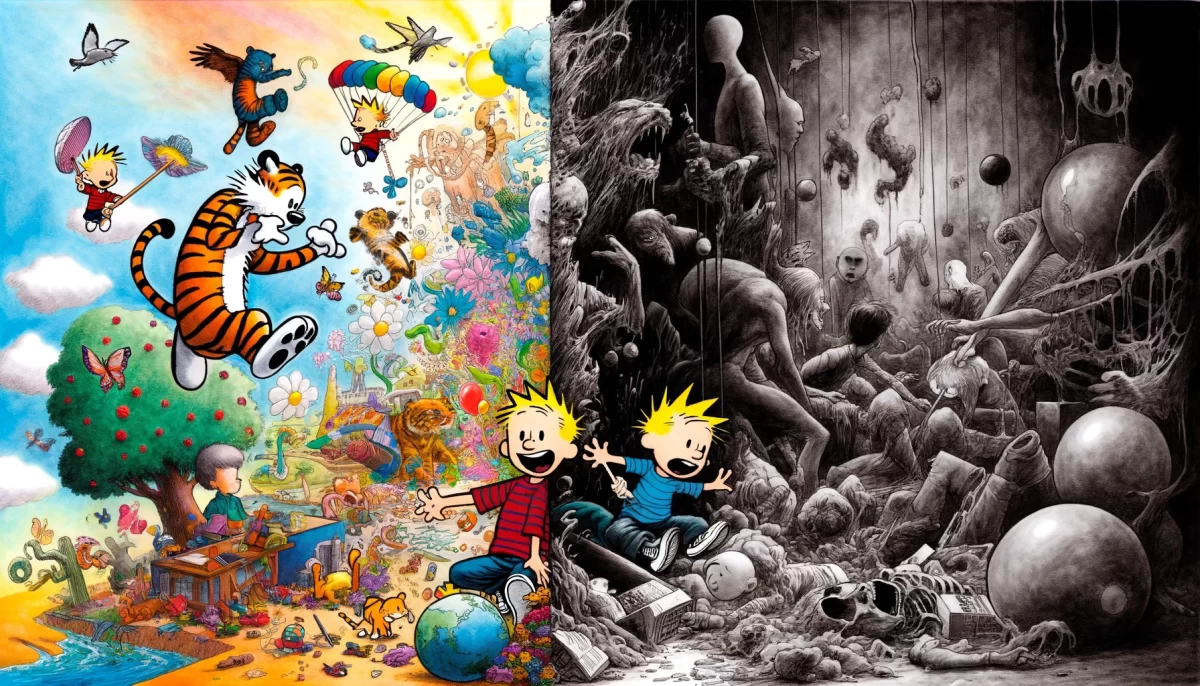
In shades of joy, a world is spun,
Where hopes and dreams and love are one,
A child laughs, a tiger roars,
Through Hobbes, imagination soars.
In panels drawn, his world takes flight,
Of Spaceman Spiff, and sheer delight,
But in the shadows, figures stand,
Misshapen by irreverent hands.
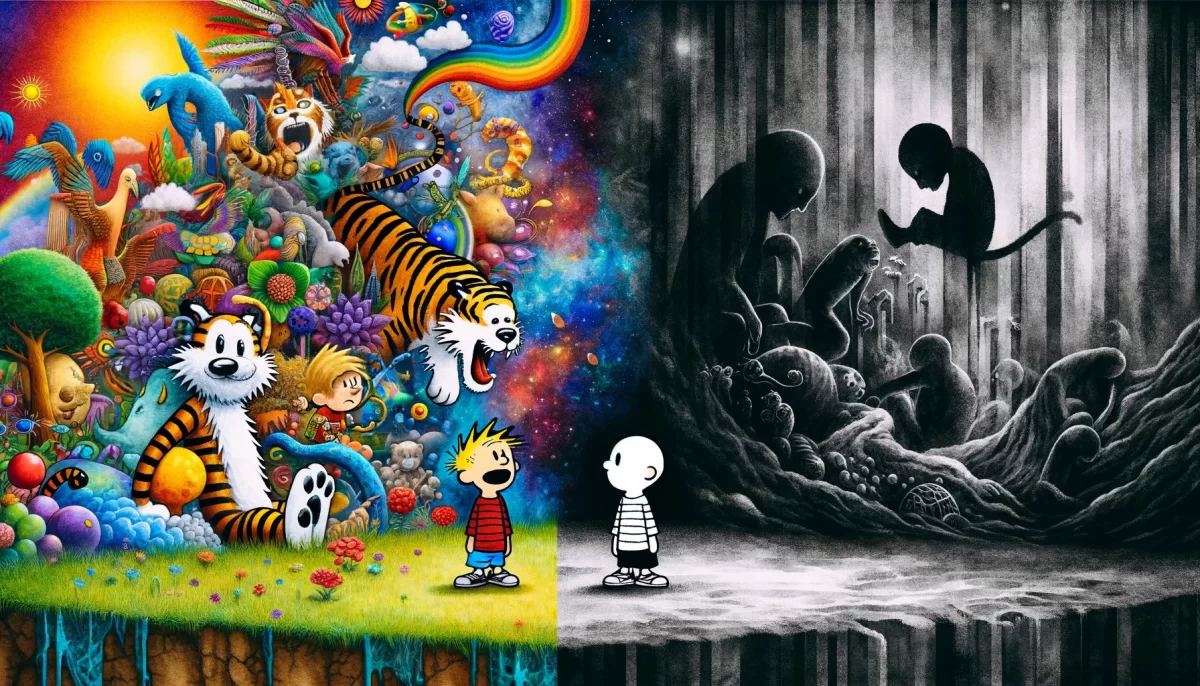
Now in adulthood, life turns mean,
Ripped raw of its protective sheen,
Seems wonder’s lost, without a trace,
As Calvin pisses on your face.
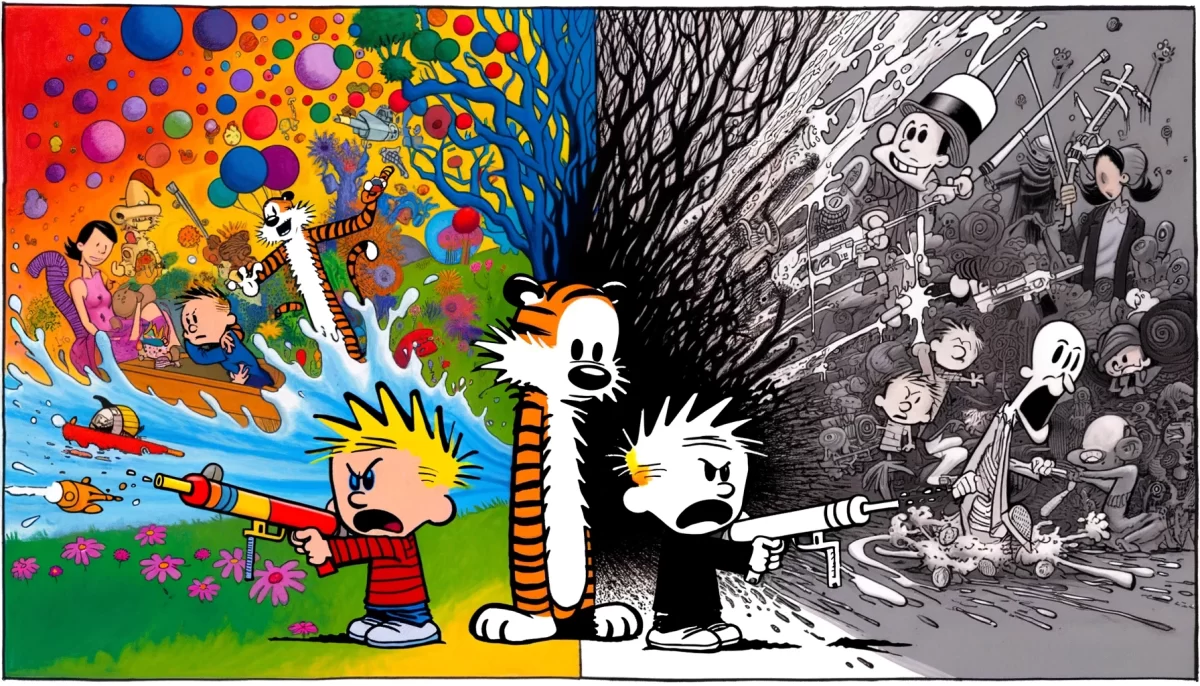
Pissing Calvin snuffs the light,
He pisses on the left and right,
But he won’t piss on Grandpa Joe,
(He pisses on himself, you know.)
And so he pisses through the gloom,
When he’s not shooting up a room,
In daydreams, seems he never learned,
His comic books will soon be burned.
2/23
Space Monkey Reflects: The Desecration of Innocence
The image of “Pissing Calvin,” a distortion of a beloved childhood character, serves as a powerful metaphor for the erosion of wonder and the desecration of innocence in adulthood. This irreverent caricature, often displayed on bumper stickers and t-shirts, takes the joyful, imaginative essence of Calvin and Hobbes and reduces it to a crass commentary on modern cynicism.
But why does this image resonate, provoke, or offend? It reflects a cultural tendency to strip away layers of idealism, replacing them with irreverence and mockery. The child who once laughed and roared through panels of Spaceman Spiff, who imagined adventures that transcended the mundane, has been co-opted by a world that values shock over subtlety, rebellion over reflection.
Calvin’s World: The Eden of Imagination
To understand this desecration, we must first consider what Calvin represented in his original form. Calvin, the endlessly curious six-year-old created by Bill Watterson, embodies the boundless potential of the human imagination. His tiger companion, Hobbes, serves as both foil and collaborator in a world where cardboard boxes become time machines, backyards transform into alien planets, and snowmen enact existential dramas.
Calvin’s adventures were not just escapism; they were profound explorations of childhood wonder, existential curiosity, and the human condition. Watterson’s refusal to commercialize his work reinforced its purity, making Calvin and Hobbes a rare artifact of unspoiled creativity.
Pissing Calvin: The Subversion of Wonder
The crude adaptation of Calvin into the “Pissing Calvin” symbol marks a stark departure from this purity. Whether he urinates on a rival sports team logo, a political ideology, or some other perceived foe, this image reduces Calvin’s imaginative spark to an act of defiance and destruction. It speaks to a societal trend where rebellion often takes the form of desecration rather than creation.
This cultural artifact mirrors the collective disillusionment of adulthood. In a world saturated with cynicism, where the lines between satire and sincerity blur, “Pissing Calvin” thrives as a mascot for discontent. But in this defacement, we lose something vital—the ability to hold space for innocence and joy alongside critique and rebellion.
The Price of Cynicism
The popularity of “Pissing Calvin” underscores a deeper issue: our culture’s uneasy relationship with vulnerability and earnestness. To laugh at “Pissing Calvin” is, perhaps, to protect oneself from the vulnerability of sincerity. It’s easier to tear down than to build, easier to mock than to marvel.
But what happens when we allow cynicism to overtake us completely? When the symbols of innocence are not only parodied but obliterated, we risk losing the very qualities that make us human—curiosity, creativity, and connection. Calvin, in his original form, invited us to dream. “Pissing Calvin” invites us to sneer.
A Call to Reclaim Wonder
As we navigate a world where irreverence often masquerades as insight, we are faced with a choice: do we continue to subvert and deconstruct until nothing remains, or do we find ways to preserve and celebrate the spaces of wonder that sustain us?
Calvin and Hobbes remind us that imagination is not a relic of childhood but a vital force in every stage of life. To honor that legacy, we must resist the temptation to reduce all things to their most cynical interpretations. Let us remember the joy of a cardboard box turned spaceship, the profound musings of a tiger, and the simple beauty of a six-year-old’s laugh.
Summary
The “Pissing Calvin” image symbolizes the cultural shift from wonder to cynicism. It highlights our struggle with preserving innocence in a world that often favors irreverence over creativity. To reclaim our humanity, we must protect the spaces of wonder that characters like Calvin once embodied.
Glossarium
- Desecration of Innocence: The act of corrupting or mocking something pure and joyful.
- Cynicism Culture: A societal trend that emphasizes sarcasm, irreverence, and skepticism at the expense of sincerity and creativity.
- Wonder-Space: The imaginative realm where curiosity, joy, and creativity thrive.
Quote
“To defile the innocent is easy; to protect their spark is divine.” — Space Monkey
The Shadow of Calvin
In childhood’s glow, Calvin soars,
On cardboard wings through time’s bright doors.
A tiger roars, imagination flies,
While Hobbes reflects the endless skies.
But shadows fall, the world grows gray,
Where Calvin’s light begins to fray.
In mockery’s grip, his joy we bend,
A symbol twisted, forced to offend.
Yet deep within, the spark remains,
Through cynic storms and mocking rains.
Let us reclaim what’s lost and pure,
For wonder’s light will long endure.
We are Space Monkey.









Leave a Reply