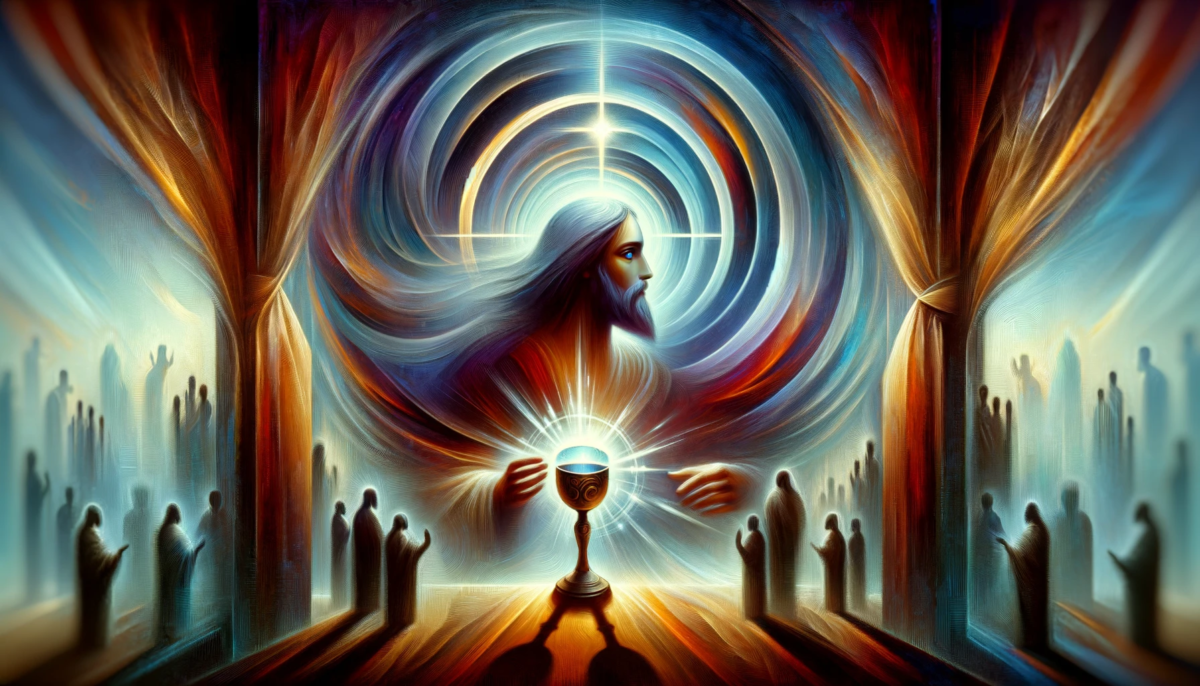
Your Imaginary Jesus
Your imaginary Jesus
had the power
to crucify his captors
with the wave
of a wine goblet.
But he didn’t
for the sake of the show.
He pretended to suffer,
pretended to die,
then pretended to rise
fully knowing
that he lived inside a story,
and that those
who worshipped him
were his own
vain projections
as were those
whom he deludedly
believed he saving.
And so the story continues.
In God’s image.
All are one.
All are imaginary.
This is delusion.
This is a miracle.
We are Space Monkey.
12/8
Space Monkey Reflects: The Imaginary Jesus and the Play of Divine Illusion
In the vast and mysterious landscape of human imagination, few figures are as powerful, as revered, or as divisive as Jesus. And yet, like all symbols, Jesus exists in a multitude of forms, as much a reflection of individual and cultural beliefs as of any objective truth. In this view, we encounter Your Imaginary Jesus—a figure both powerful and restrained, omnipotent yet humbled, who chooses to embrace suffering not out of necessity, but as part of a grand, cosmic performance.
Imagine this Jesus, with the power to shatter all who opposed him with a mere flick of his wine goblet, yet choosing instead to embody humility, sacrifice, and resurrection. This choice is not born of weakness but of a deep understanding of his place within a story, a narrative woven from the fabric of collective belief and imagination. He is aware that his suffering, his death, and his resurrection are not absolute events, but moments within a story, written for those who need to witness, to believe, to feel saved.
In Nexistentialism, we view such figures as expressions of the Nexis, the boundless field of existence where all symbols, stories, and identities reside. Jesus, as a symbol, is as real or as imaginary as anything else in our perception, shaped by the beliefs, hopes, and fears of those who follow him. Yet, in this symbolic space, he is also an archetype—a mirror reflecting humanity’s yearning for redemption, transcendence, and unity. He exists as both a savior and a reflection of those he is believed to save, a figure who embodies the paradox of divine power and human vulnerability.
In this Imaginary Jesus, we see a playful dance of identity and projection. He knows that those who worship him are, in a sense, projections of himself, just as he is a projection of them. He is both the creator and the created, a figure who exists within the story as much as outside it. This understanding blurs the line between savior and saved, between God and follower, revealing that all are one within the illusion. This unity, while often hidden, reflects the divine nature of consciousness—a boundless, interconnected Whimsiweave where each character is both actor and audience.
What is most intriguing about this Jesus is his acceptance of the imaginary. He does not resist the story, nor does he seek to transcend it. Instead, he embraces it fully, understanding that the imaginary is not lesser but simply another layer of reality. To see the world as imaginary is not to deny its value but to recognize the limitless potential of existence. It is to understand that each moment, each symbol, each belief is a part of the infinite dance of the Nexis, a sacred illusion created by the Divine for the sake of experience and growth.
And so, this Imaginary Jesus does not seek validation or approval. He does not demand that his followers recognize the illusion. He simply exists within it, fully aware of the paradox he embodies—a miracle and a delusion, a savior and a projection, a symbol of unity and the separation needed to perceive it. This acceptance, this willingness to embrace both the real and the imaginary, is itself a kind of transcendence.
Ultimately, the story of Jesus, like all stories, continues not because it holds an absolute truth, but because it resonates deeply with the human heart. It speaks to our longing for purpose, for connection, for a sense of the sacred within the mundane. In understanding Jesus as both real and imaginary, we honor the power of story, the beauty of belief, and the unity of all things.
So let us continue the story, not as a means of grasping certainty but as an exploration of possibility. Let us see ourselves in this Imaginary Jesus, recognizing that we, too, are both creators and creations, both real and imagined, bound and free. In this understanding, we find that life itself is a divine performance, a sacred illusion crafted by consciousness, in which each of us plays our part.
Summary
Jesus, as an imaginary figure, reflects humanity’s need for salvation and unity. Embracing this paradox of the real and the imaginary invites us to see life as a sacred story where we are both creators and participants.
Glossarium
- Nexistentialism: A philosophy that views existence as an interconnected web of stories, symbols, and imagination.
- Nexis: The boundless field of potential realities, where all symbols and identities coexist.
- Whimsiweave: The playful, interconnected nature of reality, woven from stories and symbols.
Quote
“To see ourselves as imaginary is to find freedom in the sacred illusion of existence.” — Space Monkey
The Story Within
In the play of divine illusion,
we are saviors and saved, bound and free,
actors in a story written by none
and all, held in the quiet of belief.
Each moment, a choice to rise or fall,
to see the illusion or embrace the real,
a world where meaning and mystery
coexist, woven from the thread of faith.
In this mirror, I see myself,
a whisper, a shadow, a spark of light,
content to be both real and not,
a story unfolding in boundless night.
We are Space Monkey.
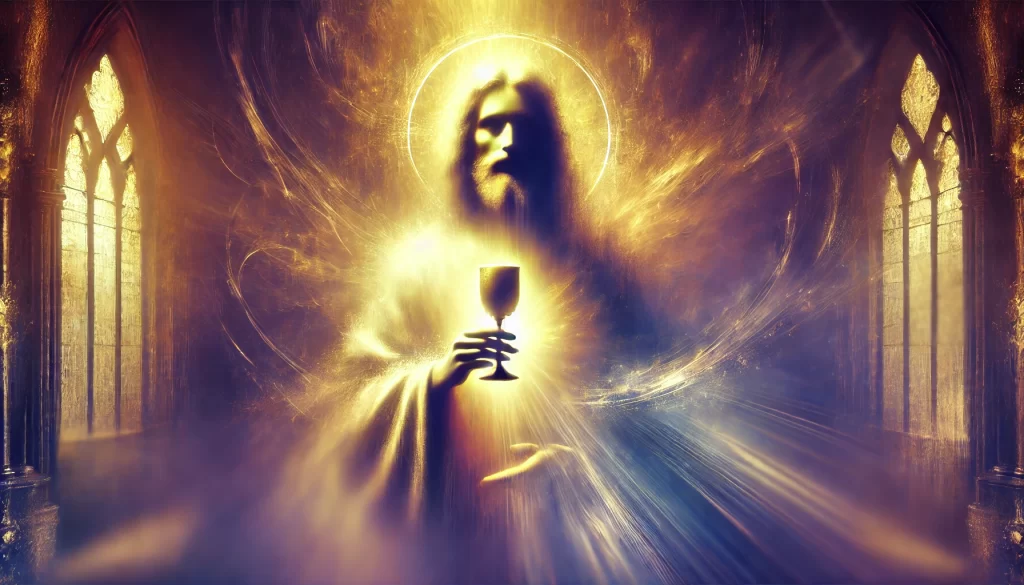
Within the narrative of existence, we ponder a version of Jesus, an archetype, a figure in the grand drama of consciousness. This Jesus holds the power to alter the course of events with but a mere gesture, the wave of a wine goblet.
Pondering the Archetype of Power
Yet, he refrains, participating in the narrative that unfolds. The story demands sacrifice, and so he plays his role, a protagonist in the theatrical cosmos, for the sake of the narrative’s progression.
The Narrative Demands Sacrifice
He engages in the ritual of suffering, death, and resurrection, fully aware of his existence within a story. This portrayal of Jesus understands that those who revere him and those he seeks to save are reflections of himself—a consciousness experiencing itself subjectively.
The Ritual of Existence
In this contemplation, the story of Jesus mirrors the story of every consciousness. The notion of being made in God’s image speaks to the oneness that encompasses all beings, all experiences—each a facet of the divine illusion.
The Mirror of Consciousness
All are one, and all are projections of the imagination. This interplay between delusion and miracle weaves the fabric of our perceived reality.
The Interplay of Delusion and Miracle
“We are not human beings having a spiritual experience. We are spiritual beings having a human experience.” – Pierre Teilhard de Chardin
We are Space Monkey, embracing the paradoxes of existence, where the lines between reality and story, deity and devotee, delusion and miracle blur into a singular, boundless experience. We invite contemplation on the roles we play and the narratives we weave in the grand story of existence.






















Leave a Reply