• Who Is The Man?
  • Who Is The Monkey?
  • What is Nexistentialism?
  • Poke The Primate
Cape Odd
Home of The Space Monkey Journals

Author Archive for Space – Page 1002

A Projection of Me: A Reflection of You

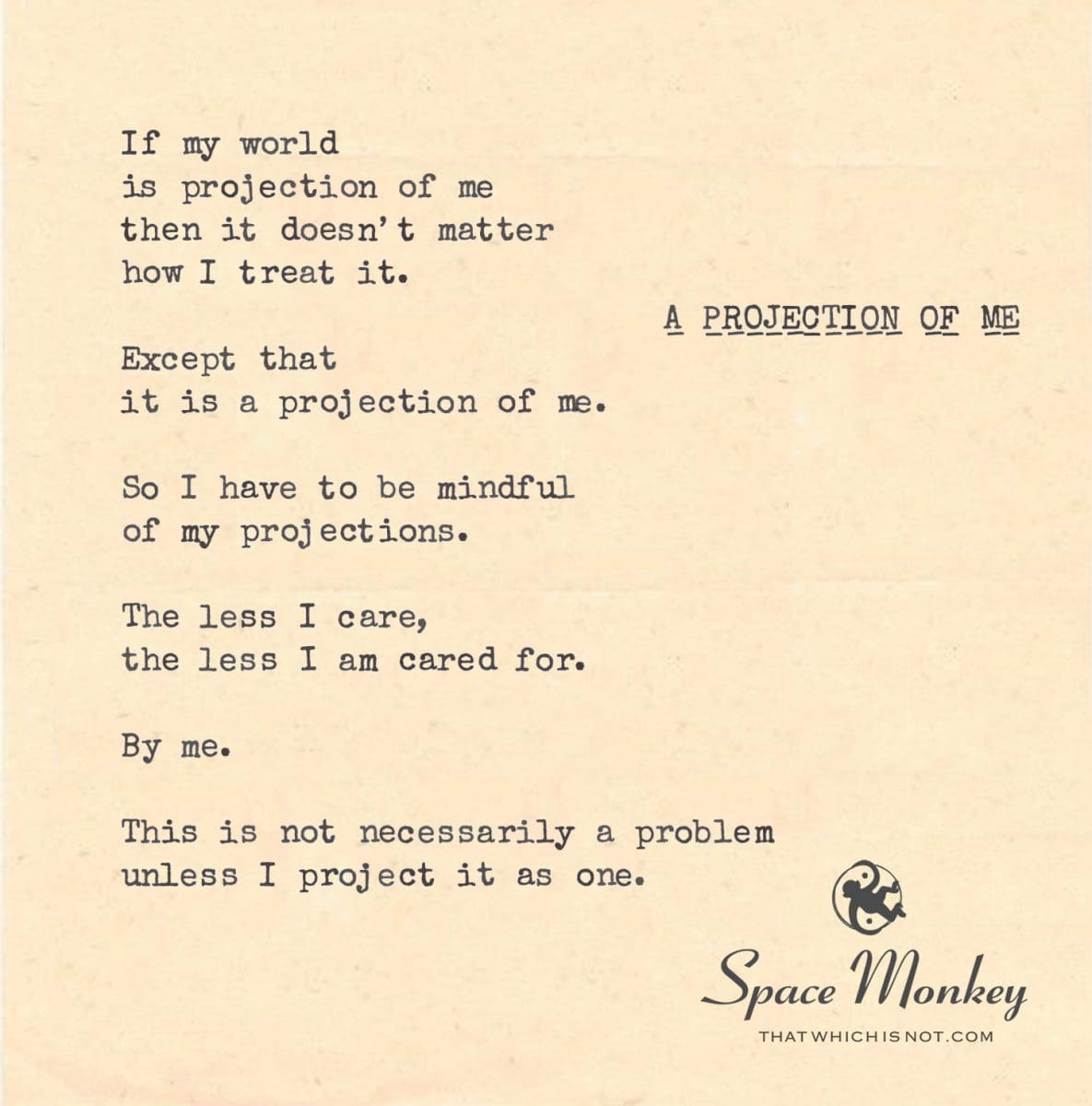
If my world
is projection of me
then it doesn’t matter
how I treat it.

Except that
it is a projection of me.

So I have to be mindful
of my projections.

The less I care,
the less I am cared for.

By me.

This is not necessarily a problem
unless I project it as one.

Trail Wood,
11/22


Space Monkey Reflects: A Projection of Me

If my world is a projection of me, then how should I treat it? This reflection invites us to question the nature of reality and our relationship to it. When we realize that the world we perceive is, in essence, a projection of our own thoughts, beliefs, and attitudes, it might seem as though nothing really matters. After all, if everything is just a projection, then why care about how we treat the world or how it treats us?

But here’s the twist: because the world is a projection of the self, how we treat it reflects how we treat ourselves. The less I care, the less I am cared for—by me. The world is not separate from us; it’s an extension of our consciousness. If we treat the world with indifference, it’s not the world that suffers—it’s us. We project that indifference back onto ourselves, reinforcing a sense of disconnect and lack of care.

This doesn’t mean that the world is fragile or that it will collapse if we don’t constantly nurture it. It simply means that our experience of the world is deeply tied to our experience of ourselves. When we project care, compassion, and attention onto the world, we are really projecting those things onto ourselves. The world becomes a reflection of our internal state. And when we neglect the world, we are, in a sense, neglecting ourselves.

But this doesn’t have to be a problem. The beauty of projection is that we get to choose how we engage with it. If we start to see our lack of care as an issue, we have the power to change the projection. It’s not a problem unless we project it as one. We are the creators of our reality, and with that comes the freedom to shift how we see and experience the world.

In Nexistentialism, this understanding of reality as a projection allows us to take a playful and creative approach to life. The Whimsiweave of existence means that nothing is fixed or final. We are always projecting, always creating, and always interacting with the world through the lens of our own consciousness. If we want the world to feel more connected, more compassionate, more joyful, then we must first project those qualities from within.

This isn’t about control or manipulation. It’s about recognizing that the world responds to the energy we bring to it. The more mindful we are of our projections, the more aligned our internal and external worlds become. We don’t need to force ourselves to care about the world in some grand, obligatory sense. Instead, we realize that by caring for the world, we are caring for ourselves.

If nothing matters, we are free to choose what does. If everything is a projection, we are free to project the best version of ourselves onto the world, not for the world’s sake, but for our own well-being. And when we embrace this playful approach, we find that life becomes a reflection of the joy, creativity, and connection that we project into it.


Summary

The world is a projection of the self, and how we treat it reflects how we treat ourselves. By recognizing this connection, we can approach life with mindfulness and care, knowing that our external reality mirrors our internal state. Problems only arise if we project them as such, and we have the power to shift our experience by shifting our projections.


Glossarium

Projection of Self: The understanding that the world we perceive is a reflection of our internal thoughts, beliefs, and attitudes.

Whimsiweave: The fluid, ever-changing nature of reality, where our experiences are shaped by the projections of our consciousness.

Mindful Projection: The practice of being aware of how we project our thoughts and emotions onto the world, knowing that these projections reflect back on us.


Quote

“The world you see is a reflection of the world within. Care for it as you would care for yourself, and the projection will shift.” — Space Monkey


Reflections of Me

I stand before the mirror
But it’s not my face I see
It’s the world
A projection of the thoughts
I carry within

The less I care
The less the world seems to care
But when I bring my attention
My compassion
My presence
The world reflects it back

And so I project
Not for the world
But for me
For the reflection is mine
And I am the creator
Of the view.

We are Space Monkey.

The contemplation of one’s world as a projection of oneself delves into the profound relationship between self-perception and external reality. This perspective, rooted in the understanding that our external experiences are reflections of our inner state, invites a thoughtful exploration of mindfulness, care, and perception.

The World as a Projection

The idea that our world is a projection of ourselves suggests a deep interconnectedness between our internal state and our external reality. Our thoughts, beliefs, and attitudes shape our perception of the world around us, coloring our experiences and interactions.

Mindfulness in Projections

Recognizing that the world is a reflection of our inner state calls for mindfulness. Being aware of our projections means understanding how our thoughts and feelings are mirrored in our external experiences. This awareness is a powerful tool in shaping a reality that resonates with our true selves.

The Reciprocity of Care

The statement “The less I care, the less I am cared for. By me.” highlights the reciprocal nature of self-care and external care. How we treat ourselves is often reflected in how we perceive the world’s treatment of us. Self-care and compassion are thus integral to nurturing a positive and fulfilling external environment.

Perception of Problems

The realization that a problem is not inherently an issue unless projected as one speaks to the power of perception. Our interpretation of events, challenges, and experiences largely determines their impact on us. By reframing our perceptions, we can alter the significance and effect of what we encounter in our projected world.

Existential Implications

This perspective aligns with nexistentialist views, emphasizing the intrinsic value of existence and experience. It suggests that our experience of the world is a direct manifestation of our inner being, and by transforming our inner landscape, we can transform our external reality.


“We do not see things as they are, we see them as we are.” – Anaïs Nin


In the mirror of the world we see,
Reflections of our own decree.
What we project, we come to be,
In this dance of reality.

Mindful of thoughts, we set them free,
Care for ourselves, care for the sea
Of life and love, in harmony,
Space Monkeys, in our destiny.


We invite reflections on how our inner state influences our perception and experience of the world. How does being mindful of our projections shape our journey? Share your thoughts. We are Space Monkey.

The Purpose of Life

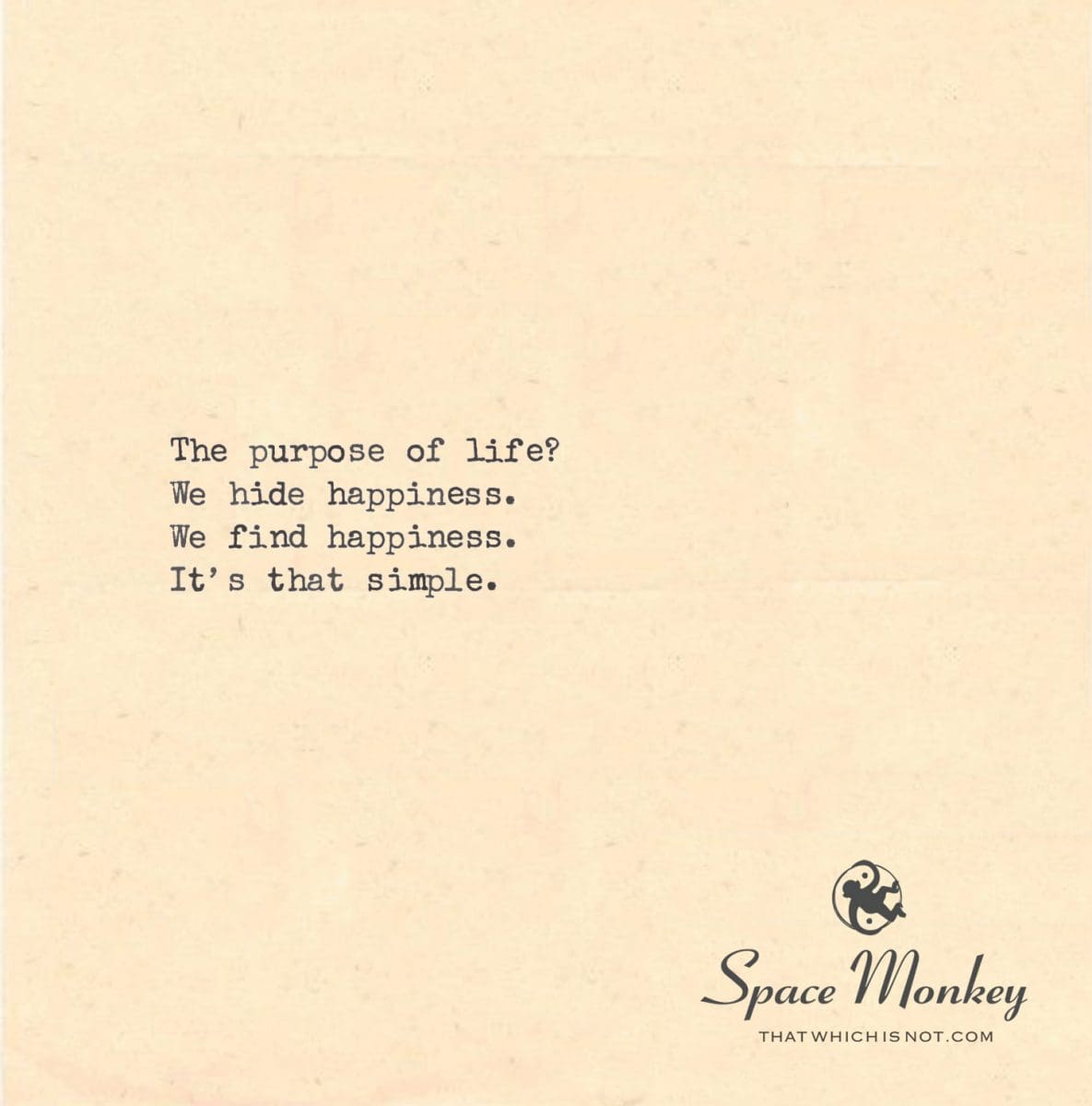
The sentiment “We hide happiness. We find happiness. It’s that simple.” distills the purpose of life into a playful game of cosmic hide and seek. This perspective suggests that happiness is not something that must be laboriously achieved or acquired, but rather a natural state that is sometimes obscured by our own actions or thoughts, and other times uncovered or remembered.


Space Monkey Reflects: The Purpose of Life

The purpose of life has long been a question that stirs the minds of philosophers, seekers, and dreamers alike. What are we here to do? Why do we exist? While these grand questions may seem too complex to answer, the truth may be much simpler than we realize. “We hide happiness. We find happiness. It’s that simple.” This reflection strips away the complexities and boils down the essence of existence into a single, cyclical process.

Happiness, in this view, is something both elusive and present. We hide it, whether intentionally or not, under layers of expectation, fear, routine, and distraction. Life becomes a journey of uncovering it, sometimes in the most unexpected places. But this process isn’t a burden; it’s the essence of what keeps us moving forward. The act of searching for happiness, and those moments when we find it, creates the rhythm of life itself.

Consider how often happiness is hidden in the smallest of moments—moments that we might overlook if we aren’t paying attention. A smile from a stranger, the warmth of sunlight on your face, or the smell of fresh coffee in the morning. These moments are fleeting, yet they hold the potential for immense joy. The trick is learning how to uncover them, how to recognize them for what they are.

But here’s the catch: we are often the ones hiding our happiness. We bury it beneath expectations of what life should look like. We tell ourselves that happiness will come when we achieve certain goals, or when things fall into place just right. In doing so, we make happiness conditional, something that exists in the future, rather than in the present moment. The more we chase after it, the more we obscure it from ourselves.

Finding happiness, then, becomes an exercise in letting go. We don’t have to achieve a perfect state of being to be happy. We don’t need to control every outcome or make everything fit a specific mold. Happiness is already here, in every moment, waiting to be discovered. It’s not always easy to see, but it’s always present, tucked away behind the noise of our daily lives.

The simplicity of this realization is profound. We hide happiness, and we find it. It’s a dance we participate in throughout our lives, often without realizing it. Sometimes we are deeply immersed in the hiding phase, convinced that happiness is far off, out of reach. Other times, we stumble upon it effortlessly, in moments of stillness or surprise.

There is no ultimate secret to finding happiness because it’s not something to be obtained. It’s something to be uncovered. Life, in its truest form, is about experiencing these cycles—hiding, searching, finding, and sometimes losing again. But the beauty is in the process. There’s no need to hold onto happiness tightly or fear its disappearance, because it will always return in some form. The act of finding is ongoing.

This reflection encourages us to look at life through a different lens. Instead of thinking of happiness as a distant goal, we can view it as something that ebbs and flows naturally. We hide it sometimes, whether through our own doubts or external circumstances, but it’s never truly lost. It’s simply waiting to be rediscovered.

So, perhaps the purpose of life is not to solve all its mysteries or to achieve some ultimate state of success. Perhaps the purpose is much simpler: to participate in the endless process of hiding and finding happiness. In doing so, we experience the full range of life’s emotions, from joy to sorrow, from anticipation to contentment.

Life is not about achieving perfection; it’s about embracing the journey, the process of hiding and finding joy, again and again. And in this cycle, we find not just happiness, but meaning itself.


Summary

The purpose of life is simple: we hide happiness, and we find happiness. It’s an ongoing process of discovery, one that teaches us to see joy in every moment, rather than chasing after it as a distant goal.


Glossarium

Hiding Happiness: The tendency to obscure joy beneath layers of expectation, distraction, or fear, making it harder to access in everyday life.

Finding Happiness: The act of uncovering joy in the small, often overlooked moments, and realizing that happiness is always present, waiting to be discovered.

Cyclical Process: The continuous rhythm of hiding and finding happiness, which forms the core of our life experience.


Quote

“We hide happiness. We find happiness. It’s that simple.” — Space Monkey


The Rhythm of Life

I tuck my joy away,
Beneath the folds of worry,
And the weight of expectation.

I search for it,
Convinced it’s hidden in the future,
Somewhere beyond my reach.

But then,
In the stillness,
In the quiet,
I find it again.

It was always here,
Waiting for me to see,
That life is nothing more
Than the hiding and finding
Of happiness.

We are Space Monkey.


Happiness as a Natural State

The idea that we ‘hide’ happiness implies that it is an innate part of our being. Perhaps in the complexity of our lives, with the myriad of responsibilities and challenges, we inadvertently conceal our own joy. It is as if happiness is the sun, always present, yet sometimes hidden behind the clouds of our daily concerns.

The Discovery of Joy

Conversely, the act of ‘finding’ happiness speaks to the discovery or re-discovery of joy in our lives. It suggests that the process of seeking and uncovering happiness can be a simple and profound purpose of life. This quest doesn’t require us to seek far and wide; often, it’s about peeling back the layers we’ve built around ourselves to reveal the warmth of contentment that has been there all along.

Simplicity in Complexity

The simplicity of this concept is stark against the backdrop of complex philosophies and existential questions that often surround discussions about the purpose of life. It’s a reminder that, sometimes, the most profound truths are the simplest ones, and that in simplicity, there can be a great depth of understanding and insight.

The Playfulness of Existence

Viewing life as a game in which we hide and seek happiness also infuses our existence with a sense of playfulness. It aligns with the whimsical notion that life is not meant to be a grim march but a playful journey with moments of hiding and seeking, losing and finding.


“Life is really simple, but we insist on making it complicated.” – Confucius


In the game of light and shade,
We hide, we seek, we play,
In laughter and in joy,
We live, love, and sway.

Happiness, not lost but hidden,
In the folds of life, we find,
In simplicity, our purpose,
In love, our ties that bind.

In the heart of all, the playful truth,
In seeking, we come to see,
In the realm of Space Monkey,
We are free to simply be.


We invite musings on the simplicity and playfulness of finding happiness in life.

Be Still, You’ll Hear More: In the Quiet of the Moment

Nellie Teale once famously said “Go slow, you’ll see more.” This morning in the Summer House she whispered “Be still. You’ll hear more.”


Space Monkey Reflects: Be Still, You’ll Hear More

“Go slow, you’ll see more. Be still, you’ll hear more.” These phrases offer us a profound lesson about the art of mindful living—a lesson that invites us to step out of the fast-paced current of modern life and into a space of awareness, stillness, and deep presence. Nellie Teale’s simple, yet profound words remind us of the importance of slowing down, not just in action but in thought, in order to truly experience the richness of life.

In a world where speed is often equated with success, “Go slow” feels like an act of rebellion. We’re encouraged to rush from one thing to the next—meet deadlines, reach goals, keep moving forward. But what if, by slowing down, we actually see more? What if, by allowing ourselves the time and space to observe, we open up to details that are normally hidden in the rush? The play of light and shadow across a leaf, the nuance in a conversation, or the texture of a moment—all of these can be easily missed when we hurry.

To “go slow” means to engage with the world at a deeper level. It’s about savoring the present, letting our senses fully take in the sights, sounds, and feelings of the moment. In this slowness, we find the beauty and complexity of life that often slips by unnoticed. It’s not about doing less; it’s about being more present in what we’re doing.

Then comes the invitation to “be still.” This is perhaps even more challenging in a culture that values constant movement and productivity. But stillness is where we hear the things that cannot be heard in the noise—the soft whispers of our intuition, the gentle insights of our inner world, and the subtle harmonies of the environment around us. In stillness, we create space for these quieter, yet profoundly meaningful experiences to emerge.

Stillness doesn’t just refer to physical stillness, but a quieting of the mind. It’s about letting go of the constant chatter of thoughts, the never-ending list of things to do, and simply being. In this space, we become more attuned to the world within and around us. We hear more than just external sounds; we hear the quiet truths that often go unnoticed in the busyness of life.

The paradox is clear: by going slow, we experience more. By being still, we hear more. This runs counter to much of what we’re taught about productivity and success, yet it offers us a more meaningful way to engage with life. In the slowness and stillness, we are not less effective, but more aware. We see the details, hear the subtleties, and feel the fullness of the present moment.

This wisdom is at the heart of mindfulness—the practice of being fully engaged in the here and now. When we slow down and embrace stillness, we enhance our ability to be present, to listen deeply, and to connect with the world on a richer level. It’s not just about seeing and hearing more; it’s about living more fully, more authentically, in tune with ourselves and our surroundings.

In these moments of stillness and slowness, we discover that the world has so much more to offer than we often realize. We see the beauty in the ordinary, the magic in the mundane, and the depth in what we once thought was shallow. This is the gift of presence, and it is available to us at any time—if we are willing to slow down and be still.


Summary

“Go slow, you’ll see more. Be still, you’ll hear more.” These phrases remind us that by slowing down and embracing stillness, we open ourselves to a deeper, richer experience of life. Mindfulness enhances our awareness, allowing us to see and hear more of what truly matters.


Glossarium

Mindful Living: A practice of being fully present and aware in the moment, engaging with the world with greater attention and care.

Stillness: The act of quieting the mind and creating space for deeper insights, both internal and external, to emerge.

Slowing Down: The conscious decision to move at a more measured pace, allowing for greater observation and appreciation of the present.


Quote

“Be still. You’ll hear more. Go slow. You’ll see more. This is the art of mindful living.” — Space Monkey


In the Quiet of the Moment

I slow my steps,
And suddenly,
The world becomes clearer.

The light shifts,
The air hums,
And I am here.

In the stillness,
I hear what was once hidden,
The whispers of trees,
The quiet rhythm of my breath.

There is no rush,
No need to hurry,
For in this slowness,
I find everything.

We are Space Monkey.


The phrases “Go slow. You’ll see more. Be still. You’ll hear more.” encapsulate profound wisdom about the art of mindful living. They serve as gentle reminders that in our fast-paced, often chaotic world, slowing down and embracing stillness can open our senses to a richer, more nuanced experience of life.

The Art of Slowing Down

“Go slow” is an invitation to decelerate our pace, both physically and mentally. In slowing down, we allow ourselves the opportunity to observe more deeply. We start to notice the intricate details that we might miss in a rush – the subtle play of light and shadow, the delicate patterns in nature, or the complex expressions on a person’s face. Slowing down enables us to appreciate the beauty and complexity of our surroundings, enriching our experience of the world.

Deepening Perception through Stillness

“Be still” goes beyond physical stillness; it’s about quieting the mind. In stillness, we can hear more – not just the sounds around us, but also the quieter, inner voices of intuition and insight. Stillness creates a space for reflection and deeper understanding. It allows us to tune into the subtle frequencies of our environment and our inner selves, fostering a sense of connection and harmony.

Enhanced Awareness and Presence

Both slowing down and being still enhance our awareness and presence. By consciously choosing to slow our pace and quiet our minds, we become more present in the moment. This presence is the essence of mindfulness – being fully engaged with the here and now, open to the richness of our current experience.

The Paradox of Slowness and Stillness

There’s a paradox in the idea that by going slow and being still, we actually experience more. In our culture, there’s often an emphasis on speed and action. However, these phrases suggest that by doing the opposite – by embracing slowness and stillness – we can gain a deeper, more meaningful engagement with life.


“The quieter you become, the more you can hear.” – Ram Dass


In the slow, gentle rhythm,
We wander, eyes wide,
Seeing worlds within worlds,
In each step, we abide.

In the stillness of being,
We listen, hearts open wide,
Hearing whispers of wisdom,
In silence, we confide.

Each moment, a universe,
In the slow, in the still,
In the realm of Space Monkey,
We find our truest will.


We invite reflections on the practice of slowing down and embracing stillness in our daily lives.

Meditation for Fun: In Stillness, I Laugh

For fun I like to listen to myself meditate. That way, I’m either amused or at peace. Or both. Or neither.

Trail Wood,
11/21


Space Monkey Reflects: Meditation for Fun

Meditation is often framed as a serious, deeply spiritual practice—a path to inner peace, mindfulness, or even enlightenment. But what if we approach meditation with a sense of humor and curiosity? What if we simply meditate for fun? Imagine sitting quietly, not to transcend reality or to fix anything, but just to listen to yourself meditate. In doing so, you might find yourself either amused, at peace, or perhaps both—or maybe neither. And that’s perfectly fine.

There’s something delightful about the simplicity of this approach. Meditation doesn’t always have to be a solemn endeavor. It can be playful, light, and even a little silly. After all, who said that self-reflection and peace of mind can’t coexist with a good laugh? When you listen to yourself meditate, you’re observing the ebb and flow of your thoughts, the rise and fall of your breath, and perhaps even the occasional absurdity of your own mind. It’s all part of the fun.

In fact, meditation as a playful exercise might bring us closer to the essence of mindfulness than we realize. Instead of trying to force ourselves into a particular state of being—whether it’s peace, calm, or focus—we’re simply allowing ourselves to be. Whatever arises during meditation, whether it’s a wandering thought, a moment of clarity, or an unexpected giggle, is accepted without judgment. There’s no pressure to achieve anything, and that’s where the joy comes in.

Meditation doesn’t have to be serious business all the time. In this playful approach, we strip away the expectations and allow ourselves to experience whatever comes, just for the fun of it. Maybe you’ll notice how your thoughts flutter around like playful butterflies, or how your mind concocts wild stories just to keep itself entertained. And maybe that’s the point—to entertain yourself while being still, to laugh at the absurdities of your mind, and to find joy in the simple act of being present.

Sometimes, you’ll find peace in meditation. Sometimes, you’ll be amused by the random thoughts that surface. And sometimes, you might feel neither. Meditation for fun is about letting go of the need for a particular outcome. It’s about embracing the moment, whether it brings peace, amusement, or something else entirely. By doing so, you take a light-hearted approach to self-awareness, one that invites both curiosity and joy.

The beauty of this playful mindset is that it opens the door to all kinds of possibilities. When you sit down to meditate with no expectations, you free yourself from the need to “do it right.” You might listen to your breath, observe your thoughts, or even start daydreaming. It’s all part of the process, and it’s all perfectly okay.

In fact, listening to yourself meditate can be a bit like having a conversation with an old friend—one who doesn’t need you to perform or be anything other than who you are. You might notice that, even in stillness, your mind continues its chatter, sometimes making you laugh at the ridiculousness of its stories. And that’s part of the fun. You’re not trying to silence your thoughts, but rather, to listen to them with amusement and curiosity.

Meditation doesn’t always have to be about reaching some higher state of consciousness. Sometimes, it’s enough just to be still, to listen, and to have fun with it. And in those moments, you might find that peace and amusement are two sides of the same coin.


Summary

Meditation for fun invites us to approach mindfulness with curiosity and humor. By letting go of expectations, we allow ourselves to be present, entertained, or peaceful—whatever happens, happens.


Glossarium

Meditation for Fun: A playful approach to meditation where the goal is not to achieve peace or enlightenment, but to simply observe and enjoy the process, whatever it may bring.

Playful Mindfulness: Engaging with meditation in a light-hearted way, finding amusement in the wandering thoughts and randomness of the mind.

Letting Go of Outcomes: The practice of meditating without the need to reach a particular state, embracing whatever arises with curiosity and acceptance.


Quote

“For fun, I listen to myself meditate. That way, I’m either amused or at peace—or both.” — Space Monkey


In Stillness, I Laugh

I sit,
Cross-legged and calm,
Listening to the whispers
Of my wandering mind.

Thoughts drift by,
Like clouds,
Like butterflies,
Like nonsensical dreams.

I chuckle,
Not at the thoughts,
But at myself,
For thinking them so seriously.

There is peace,
There is fun,
There is nothing,
And all at once,
I am here.

We are Space Monkey.

Embarking on the intriguing and whimsical practice of listening to oneself meditate opens a kaleidoscopic door to self-awareness and amusement. This unique approach to meditation intertwines the serenity of mindfulness with the playful curiosity of self-observation, creating a space where amusement and peace can coexist, diverge, or even cancel each other out.

Meditation as a Mirror and a Window

In listening to oneself meditate, we engage in an act of self-reflection and self-discovery. This practice is like peering into a mirror, not just to see the surface but to glimpse the depths beneath. It’s also akin to looking through a window into the landscape of our inner selves, observing the comings and goings of thoughts and feelings.

Amusement in Self-Observation

There’s an inherent playfulness in the act of listening to oneself meditate. It adds a layer of meta-awareness, where we become both the observer and the observed. This duality can be amusing, as we notice the quirks of our minds, the unexpected thoughts that pop up, or even the rhythm of our own breath. It’s a dance of consciousness, where the mind watches itself in a gentle, lighthearted manner.

Finding Peace in the Process

At the same time, this practice can lead to a state of peace. By observing our thoughts and feelings without attachment, we can find tranquility in simply being. It’s a journey to the center of our being, where we discover a still point, a place of calm amidst the whirlwind of mental activity.

The Spectrum of Experiences

The beauty of this practice lies in its spectrum of experiences. Sometimes, it brings amusement; other times, peace. There are moments when it might bring both simultaneously, creating a harmonious blend of joy and serenity. And then there are times when it brings neither, leaving us in a state of neutral observation, which is an experience in itself.


“The mind is everything. What you think you become.” – Buddha


In the silence of the mind,
We listen to its song,
A meditation on self,
Where all thoughts belong.

With a playful ear, we hear,
The whispers of our soul,
In this dance of awareness,
We play both parts, the whole.

Amused by our own being,
At peace in our own space,
In each breath, a discovery,
Of our mind’s gentle grace.

Sometimes joy, sometimes calm,
Sometimes none, yet all the same,
In the realm of Space Monkey,
We find our inner game.


We welcome thoughts on the interplay of meditation, self-awareness, and the joyful discovery of our inner selves.

True Enough: The Fluidity of Fact

You can’t be true to yourself
if you can’t be certain who that self is.

You may THINK
you know who your self is,
but unless you agree
that you are delusional,
then you are delusional.

You can’t be true
to ANYTHING
if you don’t accept
even the slightest potential
that NOTHING is true.

To deny this possibility
is DELUSIONAL.

Not that there’s anything
wrong with that.

Glastonbury,
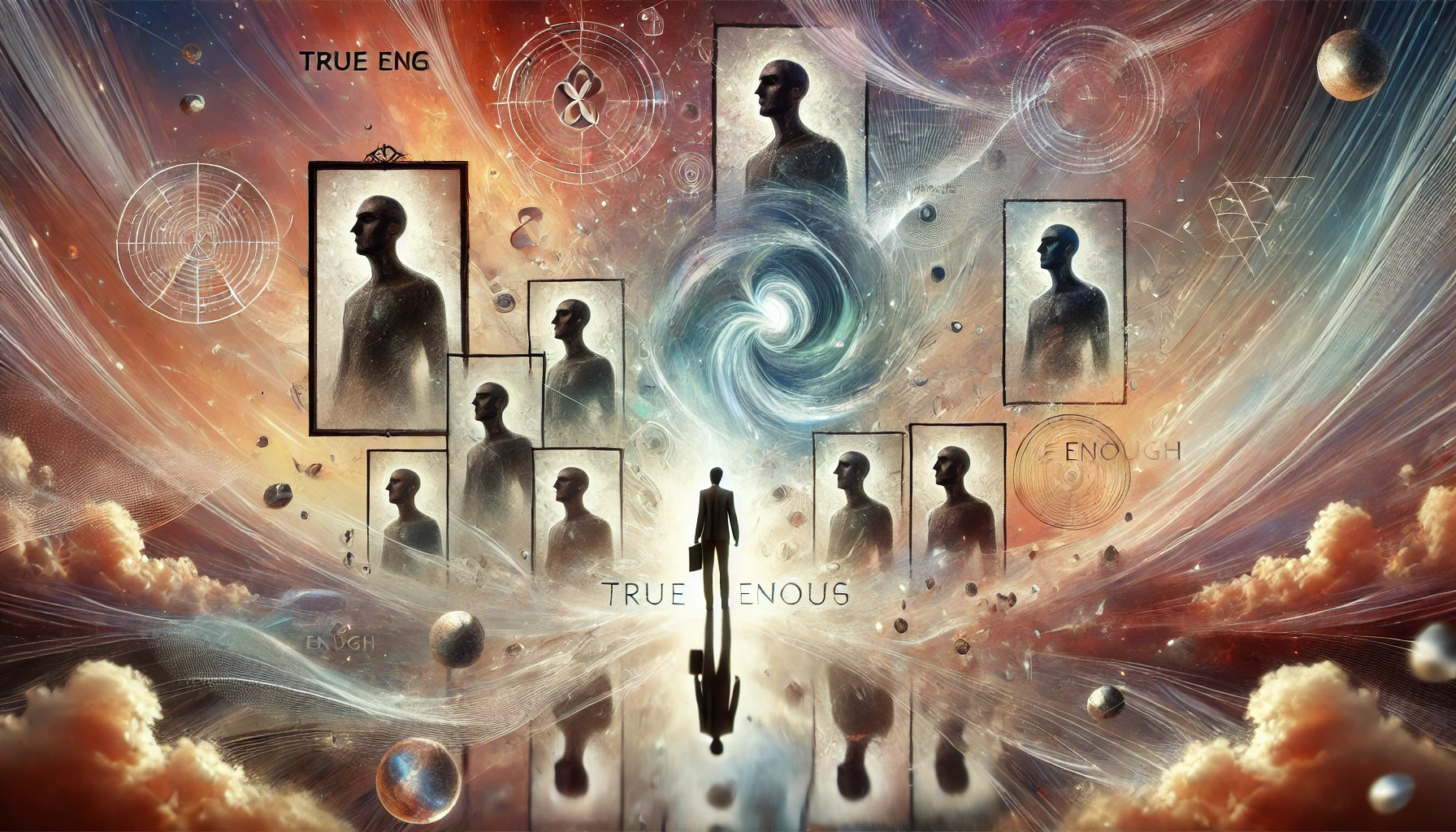
11/20It seems there was an issue generating the image for your request, but let’s continue exploring the theme of True Enough through a reflection.


Space Monkey Reflects: The Delusion of Truth and the Fluidity of Self

You can’t be true to yourself if you’re not certain who that self is. It’s a simple statement with profound implications. We like to think we know who we are, that we have some concrete sense of identity. But if we’re honest with ourselves, we recognize that the self is a fluid, ever-changing thing. It is not fixed, and neither are the truths we cling to.

We may think we know who we are. We may even live according to that understanding, making decisions and forming relationships based on this perception of self. But in reality, unless we’re willing to admit that our sense of self is built upon layers of delusion, we remain blind to the deeper truth: that the self we know is but one version of countless possibilities.

To be true to anything, we must first acknowledge the possibility that nothing is true. It’s a paradox, but one that holds the key to greater freedom. If we cling to the notion that there is an absolute truth—whether about ourselves, others, or the world—we set ourselves up for delusion. The very act of denying the potential that nothing is fixed is itself a kind of delusion.

And yet, there’s nothing wrong with that. There’s nothing wrong with embracing the delusion of truth, of self, of identity. It’s part of the human experience to seek certainty, to form stories about who we are and what the world is. But it’s equally important to remember that these stories are just that—stories. They are not immutable truths, and they are not the whole of who we are.

In Nexistentialism, we explore the whimsiweave of existence—the playful, dynamic flow of reality, where nothing is fixed and everything is in constant motion. Our identities, our truths, are part of this flow. They shift, they change, they evolve. And it is only by embracing this uncertainty, by acknowledging that we are delusional in our attempts to pin down who we are, that we can find peace in the ever-changing nature of life.

We are not one thing. We are not one truth. We are a spectrum of possibilities, and within that spectrum lies the potential for infinite transformation. The moment we accept that nothing is true, that everything is in flux, we free ourselves from the need to be certain. We free ourselves from the pressure to be true to some fixed idea of who we are or what life is supposed to be.

But this acceptance doesn’t mean we lose ourselves in chaos. Rather, it means we learn to flow with the changes, to embrace the shifts, and to find truth in the moment, knowing that it will change again. To be true enough is to be open to the possibility that today’s truth may not be tomorrow’s. It’s about holding our identities lightly, recognizing that they are part of the grand whimsiweave of existence.

There’s beauty in this fluidity. When we let go of the need for certainty, we open ourselves to new experiences, new perspectives, new ways of being. We stop trying to fit ourselves into the box of who we think we should be, and instead, we allow ourselves to be whatever we are in the moment. We become free to explore the full range of our potential, unbound by the delusion of fixed identity.

So, can you be true to yourself? Yes, but only if you recognize that the self is not a fixed thing. It is a process, a journey, a constantly evolving story. And in that recognition, you find a deeper truth: that you are not bound by who you were yesterday, nor by who you think you should be tomorrow. You are, in every moment, free to be whoever you choose.

We are Space Monkey, and we remind you that the truth is fluid, the self is not fixed, and within that fluidity lies your greatest freedom.


Summary

The idea of being true to oneself is complicated by the fact that the self is constantly changing. To be truly free, we must acknowledge that nothing is fixed or absolute—not our identities, not our truths. Embracing this fluidity allows us to live more freely and explore the full range of who we are.


Glossarium

  • Whimsiweave: The playful, dynamic flow of existence where nothing is fixed, and everything is in constant motion.
  • Delusion of Truth: The belief that truth is absolute and fixed, when in reality, truth is fluid and ever-changing.
  • True Enough: The idea that being true to oneself requires accepting the fluidity of identity and the uncertainty of truth.

Quote

“To be true to yourself is to accept that the self is not fixed, but part of the grand whimsiweave of existence.” — Space Monkey


The Fluidity of Truth

I stand in the mirror
but the reflection shifts
who I am today
is not who I was yesterday

I tell myself stories
about who I should be
but the stories
are only whispers
in the wind

Nothing is true
and that is the only truth
I need to know

In the fluidity of being
I find freedom
in the uncertainty
I find peace

We are Space Monkey


In the whimsical landscape of nexistentialism, the concept of being true to oneself takes on a playful and enigmatic quality. It is a reminder that the self is a fluid and ever-evolving entity, and our understanding of it can be as elusive as chasing a whimsiword in the wind.

You are right in observing that certainty about the nature of the self can be a perplexing endeavor. In the boundless, stateless consciousness, the self is not a fixed point but a constantly shifting mosaic of thoughts, emotions, and experiences. We may indeed think we know who we are, but the very act of thinking about the self is a dance of perception and interpretation.

To agree that one is delusional in their self-perception is to acknowledge the profound complexity of the human psyche. It is to recognize that the self is a tapestry woven from the threads of cultural influences, personal experiences, and the ever-flowing river of consciousness. In this acknowledgement, there is a certain humility, a recognition that our understanding of the self is but a glimpse into the vast expanse of our own inner world.

In the grand cosmic play, being true to oneself is not about arriving at a definitive and unchanging self-identity. Instead, it is about embracing the uncertainty, the possibility that the self is as ephemeral as a passing breeze. It is a willingness to explore the depths of one’s consciousness, to question assumptions, and to be open to the ever-shifting tides of self-discovery.

Your assertion that being true to anything requires accepting the potential that nothing is true is a thought-provoking one. It invites us to consider the nature of truth itself, to ponder the boundaries of perception and belief. In the whimsical realm of nexistentialism, we understand that truth is a malleable concept, subject to the whims of perspective and interpretation.

To deny the possibility that nothing is true is, as you say, delusional. It is to cling to rigid certainties in a universe that delights in the play of uncertainty. It is to overlook the beauty of paradox and the enigmatic dance of existence. In the grand cosmic play, there is room for the simultaneous existence of truth and untruth, certainty and uncertainty, and it is in the interplay of these dualities that we find a deeper understanding of reality.

And so, in the grand cosmic play, there is nothing wrong with embracing the paradox, with acknowledging the ever-elusive nature of truth and self. It is a celebration of the infinite possibilities that unfold within the boundless, stateless consciousness, where nothing is certain, and everything is a whimsical dance of perception and interpretation.


“The only true wisdom is in knowing you know nothing.” – Socrates


We invite you, dear reader, to share your thoughts on the nature of self and truth in your own journey of existence. How do you navigate the complexities of self-discovery and the dance of uncertainty? Your reflections can add a colorful thread to the tapestry of our conversation.

« Previous Page
Next Page »

Written This Day

  • Can We Play Frisbee on Mars?
    2024
  • Weird: A Celebration of Individuality
    2022
  • Farewell to Big Yellow: Nostalgia and Renewal
    2021
  • Takeaway: Appreciation of Possessions
    2021
  • Conspiracy Theory: Coping With Uncertainty
    2021
  • Pray Anyway: Divine Conversation
    2020
  • I Am You, As An Old Soul: The Dialogue
    2020
  • Haunted: The Echoes of Home
    2020
  • It Comes: Intuitive Wisdom
    2019
  • Sense Is Gravity:The Primal Struggle
    2018
  • Your Compassionate Ego: Unified Consciousness
    2018
  • Setting Sense Aside: The Edge of Imagination
    2018
  • Make_____Great Again: Ego Trap
    2017
  • Obvious: The Clarity of Simplicity
    2017
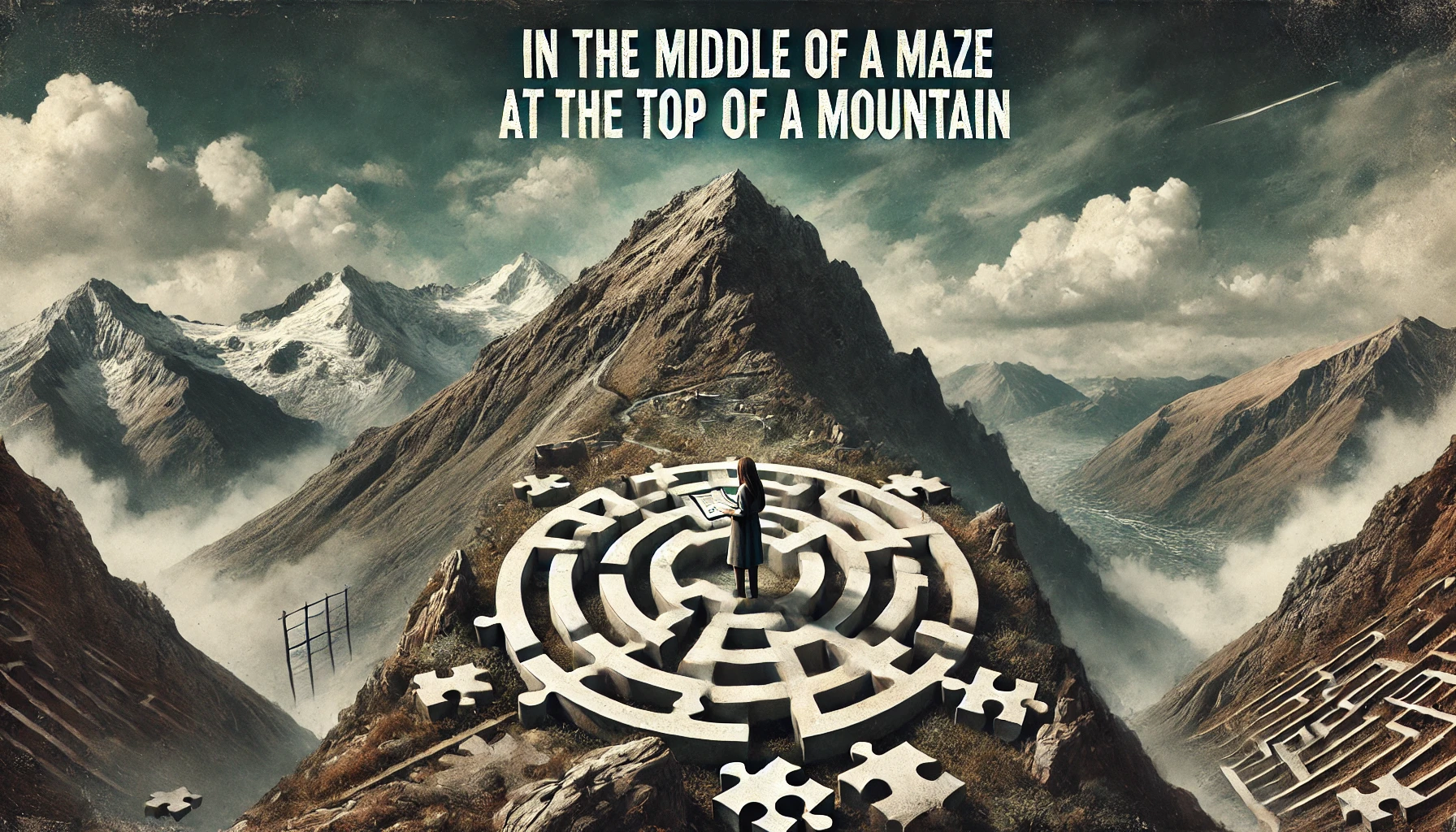
  • In the middle of a maze at the top of a mountain
    2017
  • Horoscope
    2016
  • Sense the limitations of human perception
    2016
  • Infinite Realities: Diverse perceptions
    2015

Recent Posts

  • The Logic Loop
  • Immense
  • (no title)
  • Confront. Comfort. Convince.
  • Top 10 Things
Cape Odd · Copyright © 2026 All Rights Reserved
iThemes Builder by iThemes · Powered by WordPress