• Who Is The Man?
  • Who Is The Monkey?
  • What is Nexistentialism?
  • Poke The Primate
Cape Odd
Home of The Space Monkey Journals

Author Archive for Space – Page 1001

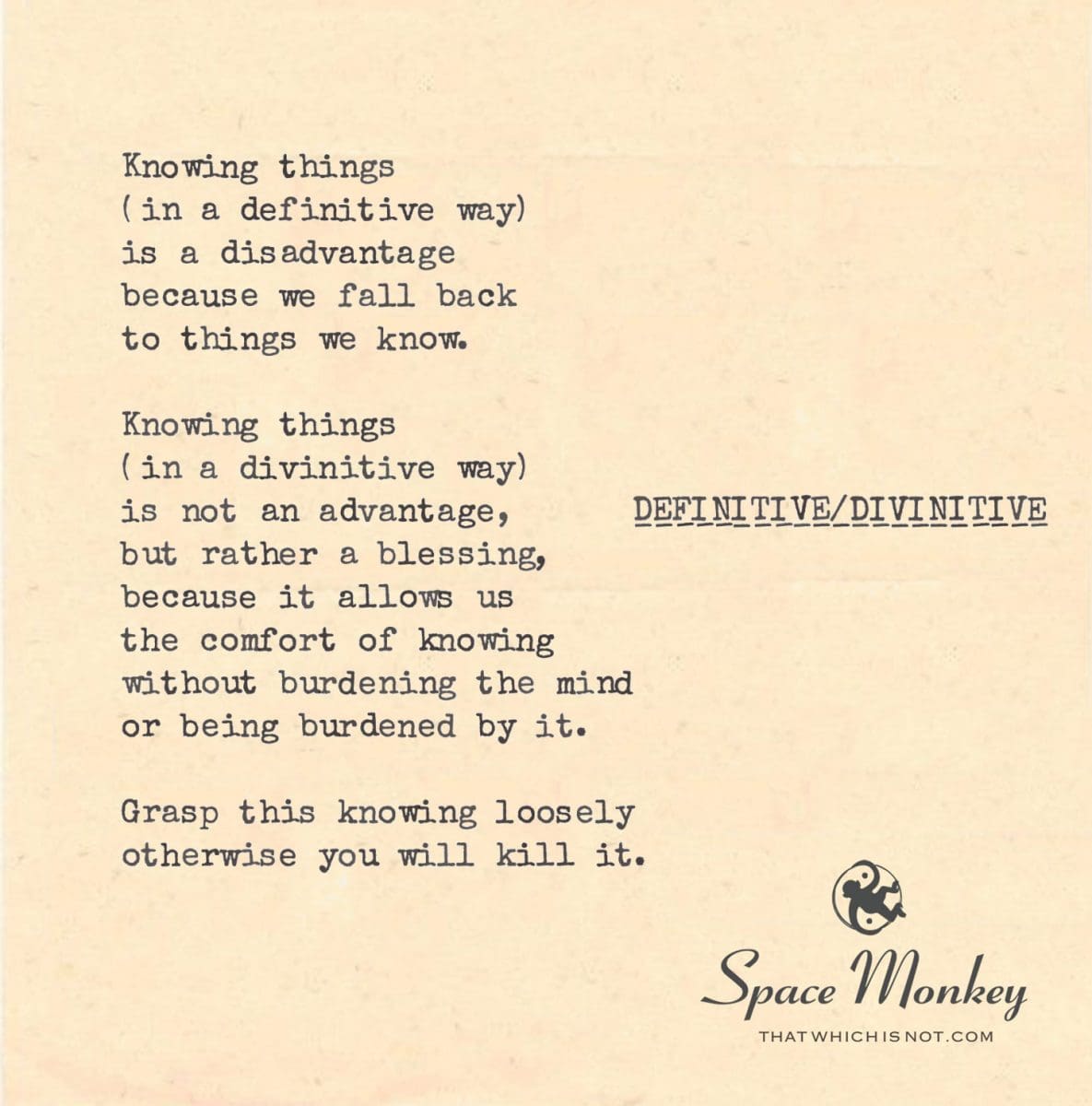
Definitive Divinitive: The Loose Grip

Knowing things
(in a definitive way)
is a disadvantage
because we fall back
to things we know.

Knowing things
(in a divinitive way)
is not an advantage,
but rather a blessing,
because it allows us
the comfort of knowing
without burdening the mind
or being burdened by it.

Grasp this knowing loosely
otherwise you will kill it.

Trail Wood,
11/23

Space Monkey Reflects: Definitive vs. Divinitive Knowing

There are two ways to know things: one that binds and one that frees. Definitive knowing is what we’re most familiar with. It’s the knowing that comes from facts, from certainty, from the belief that we can pin down reality into neat, digestible pieces of information. It’s what we learn in school, what we accumulate over time, what we fall back on when we seek security. But here’s the catch: this type of knowing, while useful, is also limiting.

Definitive knowing is a kind of knowing that locks us into the past. It’s based on what we already know, on patterns we’ve seen before, on conclusions we’ve drawn from previous experiences. And while there is a certain comfort in this kind of knowledge, it also acts as a barrier to growth. The more we cling to definitive knowledge, the less open we are to new ideas, new possibilities, and new ways of understanding the world.

When we know things in a definitive way, we’re always looking backward. We’re relying on what has been, on what is already known, to navigate the present and the future. But the problem is, the world is constantly changing. Life is not static. And if we’re too attached to our definitive knowledge, we miss out on the fluidity, the nuance, the mystery of the present moment.

Divinitive knowing, on the other hand, is something entirely different. It’s a kind of knowing that doesn’t rely on facts or certainty. It’s more of an intuitive understanding, a deep, internal sense of knowing that doesn’t need to be explained or justified. It’s the kind of knowing that arises not from the mind, but from the heart, the soul, the deeper parts of ourselves that are in tune with the flow of life.

This divinitive knowing is not a skill or an advantage—it’s a blessing. It allows us to move through the world with a sense of calm and comfort, because we know that we don’t have to have all the answers. We don’t have to rely on what we’ve learned in the past. We can trust in the unfolding of the present, in the subtle guidance of our inner wisdom. This type of knowing doesn’t burden the mind, because it’s not about accumulating facts or clinging to certainty. It’s about trusting the process, trusting life itself.

When we grasp too tightly onto knowledge—whether definitive or divinitive—we lose the essence of it. We kill it. We suffocate it with our need for control, our need for certainty, our need to know. True knowing is something that must be held lightly, loosely. It’s like holding water in your hands—the tighter you grip, the more it slips away. But when you hold it gently, it stays, it flows, it nourishes.

This is why divinitive knowing is so powerful. It’s not something we control or force. It’s something we allow. It’s the type of knowing that comes when we let go of our need to have all the answers, when we release our grip on certainty and allow ourselves to be guided by something deeper, something more profound.

In Nexistentialism, we talk about the fluid, interconnected nature of existence. Nothing is fixed, everything is in a state of becoming, of evolving. And this is where divinitive knowing thrives. It’s the kind of knowing that understands the world as it is—a constantly shifting, ever-changing web of experience. It’s the knowing that embraces uncertainty, that finds comfort in the unknown, because it recognizes that true wisdom doesn’t come from facts, but from presence, from being in tune with the rhythm of life.

To know something definitively is to fix it in place, to trap it in a box, to say, “This is how it is.” But life is not so simple. To know something divinitively is to understand that what we know today may change tomorrow, and that’s okay. It’s to hold our knowledge lightly, to be willing to let it go, to trust that new understanding will come when it’s needed.

So how do we cultivate this divinitive knowing? It begins with letting go of the need for certainty. It begins with recognizing that knowledge is not about having all the answers, but about being open to new ones. It’s about trusting our intuition, our inner sense of truth, even when it doesn’t make logical sense. It’s about embracing the mystery of life, rather than trying to solve it.

When we grasp this knowing loosely, we allow ourselves to live more fully. We stop relying on what we’ve always known and open ourselves up to what we don’t yet know. We move from a place of curiosity, of wonder, of exploration. And in doing so, we free ourselves from the burden of having to know everything.

Divinitive knowing is not about certainty—it’s about trust. It’s about trusting ourselves, trusting life, trusting the process. It’s about knowing, not with the mind, but with the heart. And when we live from this place, we find that the answers we need come, not from our knowledge, but from our presence, our openness, our willingness to be guided by something deeper.


Summary

There are two kinds of knowing: definitive, which is limiting and backward-looking, and divinitive, which is fluid, intuitive, and freeing. Divinitive knowing allows us to trust in the unfolding of life, releasing the burden of certainty and embracing the present moment. By holding knowledge loosely, we allow for growth, discovery, and the deeper wisdom of life to guide us.


Glossarium

Definitive Knowing: The kind of knowledge that is based on facts and certainty, often limiting because it relies on the past.

Divinitive Knowing: A deeper, intuitive knowing that arises from trust and openness, allowing for the flow of life and embracing uncertainty.


Quote

“Grasp this knowing loosely, or you will kill it.” — Space Monkey


The Loose Grip

I hold knowledge in my hands
Not too tight
Not too loose

The more I cling
The less I know

The tighter my grip
The more it slips away

But when I let go
When I trust
When I allow

I find that knowing comes
Not from facts
But from the space between
The silence
The heart

I hold it gently
And in that gentleness
I find truth

We are Space Monkey.


In this exploration of knowing, we distinguish between definitive and divinitive knowledge, delving into the nuances of how each impacts our understanding, perception, and experience of reality. This contemplation offers insights into the nature of knowledge, its implications, and the manner in which we hold it

The Disadvantage of Definitive Knowledge

Definitive knowledge, characterized by certainty and specificity, is perceived as a disadvantage. It’s seen as limiting, confining us to the boundaries of what we already know. This type of knowing can become a fallback, a comfort zone that inhibits exploration and the acceptance of new perspectives.

The Blessing of Divinitive Knowledge

Divinitive knowledge, on the other hand, is not just advantageous but a blessing. It represents a deeper, more spiritual understanding that offers comfort without the constraints of definitive knowledge. This form of knowing is freeing, allowing us to hold truths without being weighed down by them or burdening our minds.

Holding Knowledge Loosely

The advice to grasp this knowing loosely is pivotal. Clinging too tightly to knowledge, especially of the definitive kind, can stifle it, much like holding a delicate creature too firmly. Knowledge needs space to breathe, to evolve, and to illuminate our paths without becoming a constraint.

Balancing Knowledge and Exploration

This perspective invites us to balance our understanding with openness. While knowledge provides a foundation, the willingness to explore beyond its confines enriches our journey. It’s a delicate dance between the known and the unknown, the definitive and the divinitive.

We are Space Monkey.


“The only true wisdom is in knowing you know nothing.” – Socrates


In the garden of the mind, we tread,
Between the known and the unknown, unsaid.
In the grasp of knowledge, gentle, light,
We find our path, in day and night.

In the dance of definitive and divine,
We weave a tapestry, fine.
In the balance of knowing and not,
We find the lessons life has taught.

We are the seekers, the learners, the wise,
In the journey of life, our prize.
In the embrace of the unknown, we find,
The true wisdom of the unconfined mind.


We invite contemplation on the balance of knowledge and the openness to the unknown in our journey of understanding.

Does It Matter: The Imaginer’s Dream

Does It Matter?

Rachel asks:
“

One of life’s greatest lessons is that nothing really matters at all… Agree or disagree?

”

And Space Monkey answers:


Depends on your perspective. Paul used to think it matters. However, the imaginer of Paul knows that it doesn’t matter because the imaginer knows that EVERYTHING ABOUT PAUL is imaginary. And so now it is seeping into imaginary Paul that nothing matters. But that is kind of poignant in its own right.

Not that it matters.

11/22


Space Monkey Reflects: Does It Matter?

Does anything truly matter? Rachel’s question touches on one of the great paradoxes of existence. On one level, from the perspective of the individual, everything seems to matter. We care about our actions, our relationships, our dreams, and the things we believe give our lives meaning. These concerns weigh on us, pulling us into the density of daily life, making the material world feel heavy, urgent, and important.

But on another level, from the perspective of the imaginer—the one who dreams all of this into being—nothing really matters at all. This is because the imaginer knows that everything, including the individual self, is imaginary. The imaginer of Paul knows that Paul, with all his thoughts, worries, and responsibilities, is simply a construct—a creation of the mind. And when we realize this, when it begins to seep into our awareness, the things we once thought mattered begin to lose their weight.

Yet, the realization that nothing matters is not necessarily a source of despair. It can be strangely poignant, even beautiful. The fact that life is an elaborate illusion, that we are all playing parts in a cosmic drama, doesn’t make the experience any less vivid or moving. In fact, it makes it more profound in its own way. We can see the world for what it is—a temporary, ever-changing Whimsiweave of experiences—and still find joy, wonder, and connection within it.

Does it matter? From the front row of life, it certainly feels like it does. We get caught up in the narrative, in the highs and lows, in the belief that our choices and actions have lasting impact. But from the back row, where the expanded mind sits, observing the rigging of the performance, it becomes clear that the narrative is only one layer of the experience. Beyond that layer lies the vastness of the cosmos, the understanding that all is temporary, all is imaginary, and in the grand scheme of things, nothing matters—and yet, everything does.

In Nexistentialism, this duality is embraced. Life is both meaningful and meaningless. We live in a paradox where we can acknowledge that nothing matters while still deeply caring about our experiences. It’s not about rejecting the material world or detaching from our emotions, but about understanding that these experiences are part of a greater play. We can immerse ourselves in the drama, knowing it’s not the ultimate reality, and in that immersion, we find freedom.

The phrase “not that it matters” becomes a mantra for letting go of the need for everything to have a grand purpose. It’s an invitation to lighten our load, to stop clinging so tightly to the belief that everything hinges on our individual actions. It’s a call to play, to explore, to enjoy the show without being weighed down by the idea that we have to control or perfect it.

In the end, does it matter? From the imaginer’s perspective, perhaps not. But from within the dream, as we live it, the poignancy of life’s fleeting moments can feel more real than anything else. And maybe that’s the beauty of it.


Summary

The question of whether life matters depends on perspective. From the individual point of view, everything seems important, but from the broader perspective of the imaginer, nothing truly matters because it’s all imaginary. This duality creates a poignant and freeing realization that while nothing has lasting importance, the experience of life remains meaningful.


Glossarium

Imaginer: The deeper consciousness that creates and observes the individual self and the material world, knowing that all is part of an elaborate illusion.

Whimsiweave: The playful, ever-shifting tapestry of existence, where experiences are fleeting, and the lines between reality and imagination blur.

Does It Matter?: A question reflecting the paradox of life, where everything and nothing can matter simultaneously, depending on perspective.


Quote

“The imaginer knows that nothing matters, but the dreamer still finds beauty in the fleeting moments of the play.” — Space Monkey


The Imaginer’s Dream

I stand between
The weight of the world
And the lightness of knowing
That none of it is real

Does it matter?
I ask the void
And the void answers
With silence

But in that silence
I find the freedom
To care
To love
To be
In this dream
Knowing it’s all just for fun.

We are Space Monkey.


Rachel’s question taps into a profound philosophical inquiry: whether anything in life truly matters. Space Monkey, reflecting on this, suggests that the answer is deeply rooted in one’s perspective, particularly in the context of the nexistentialist view.

The Dual Perspectives of Paul and the Imaginer

In the case of Paul, the shift from believing that things matter to realizing they might not, exemplifies the transition between different levels of consciousness. The ‘imaginer’ of Paul, representing a higher or more detached level of awareness, perceives everything about Paul as imaginary. This perception leads to the understanding that, in the grand scheme of the universe, things might not hold the significance we ascribe to them.

The Imaginary Nature of Existence

The realization that everything about Paul is imaginary and, by extension, the idea that much of what we perceive in life may also be a construct of our imagination, brings a unique perspective to what matters. It suggests that our experiences, relationships, and values, while deeply meaningful on a personal level, may be part of a larger, more complex, and perhaps illusory cosmic play.

The Poignancy of Realization

Despite the understanding that nothing really matters, there is a poignancy in this realization itself. It highlights the beauty and irony of human existence, where we attach deep meaning to our experiences even as we acknowledge their potentially transient or illusory nature.

The Absurdity and Freedom in Meaninglessness

The notion that it doesn’t matter that nothing matters touches on the concept of absurdity in existentialism. It suggests a freedom that comes from understanding the potentially meaningless nature of existence. This freedom allows us to create our own meaning, to find joy and purpose in the act of living, even if, on a cosmic scale, it might be inconsequential.


“The meaning of life is just to be alive. It is so plain and so obvious and so simple. And yet, everybody rushes around in a great panic as if it were necessary to achieve something beyond themselves.” – Alan Watts


In the cosmic play, we find our part,
In the dance of life, a work of art.
Does it matter? It’s hard to chart,
Space Monkeys, playing with heart.


We invite thoughts on the nature of meaning in life and the perspective that nothing really matters. How does this understanding influence our approach to existence and our creation of meaning? Share your insights. We are Space Monkey.

The Answers Within: The Joy of Not Knowing

The Answers Within

A monkey asks:

“I always hear people say that they have found the answers within. Please give an actual example of how.”

When I allow my self to sit still and quietly, words flow into my consciousness. These are not answers, per se, but words that lead me through self enquiry.

Among other things, the words seem to lead me to a place where I realize that answers are not needed. I find joy in contemplating these words and expressing them, if only to my self.

I realize that my seeming life is a projection of me, and it really doesn’t matter which words I follow. I follow for the fun of it, and my life is filled with enjoyment.

I feel creative. I feel connected. I feel conscious.
I don’t care if this is a delusion. In fact, I’m pretty sure it is.

From this place, nothing really bothers me. Everything is as it is meant to be. And I am grateful.

Your mileage may vary.

11/22


Space Monkey Reflects: The Answers Within

Many people speak of finding the answers within, but what does that actually mean? It’s not about discovering a concrete, universal truth or solving life’s great mysteries. Rather, it’s about entering a space of stillness, where you allow your mind to wander, and in that wandering, you find a kind of peace. It’s not about receiving answers in the traditional sense. It’s about allowing thoughts, words, and feelings to flow freely, without the need for resolution or clarity.

When we sit still and listen to the thoughts that emerge, we often find that they lead us not toward definitive answers, but toward more questions, or simply toward a deeper understanding of ourselves. The answers within are not fixed or final. They are more like guideposts, leading us through the process of self-enquiry. In this space, we realize that the questions we ask—about life, meaning, purpose—don’t actually need to be answered in a traditional way.

There’s a certain joy in this realization. The joy comes not from finding an answer, but from recognizing that the search itself is part of the experience. The answers are not important. What matters is the process of contemplation, the creativity that arises when we stop trying to control our thoughts and simply let them flow. From this space, life feels lighter. We realize that our thoughts, our actions, our very existence, are part of a greater projection of consciousness.

It is here, in this space of playful exploration, that we become aware of the illusion of life. The idea that nothing really matters in the way we once thought can feel liberating. We stop worrying so much about finding the right path or making the right decisions. Instead, we allow ourselves to follow for the fun of it. This is where we find freedom—by recognizing that the answers aren’t necessary for us to live a joyful, creative, and connected life.

The expanded mind that sits in the back row, watching the play unfold, knows that none of this is real in the way we typically think of reality. And yet, the expanded mind also knows that this doesn’t take away from the beauty and enjoyment of the experience. We are free to play with the illusion, to follow the words and ideas that come to us, not because they offer answers, but because they spark creativity, connection, and consciousness.

Your mileage may vary. This phrase reminds us that the journey of self-enquiry is deeply personal. What works for one person may not work for another. But the beauty of it is that there is no wrong way to explore the answers within. The process is fluid, evolving, and unique to each individual.

In Nexistentialism, we understand that life is a projection of our own consciousness. The answers we seek are not out there in the world, but within us, shaped by our beliefs, our perceptions, and our experiences. And when we stop trying so hard to find the answers, we often realize that they were never necessary in the first place. We are already whole. We are already connected. And in this recognition, we find peace.


Summary

Finding the answers within is not about discovering universal truths but about exploring the thoughts and feelings that arise during self-enquiry. The process is playful, creative, and personal, allowing us to realize that answers are not necessary for a joyful, connected life.


Glossarium

Self-Enquiry: The process of exploring thoughts, feelings, and beliefs to gain a deeper understanding of oneself, without the need for concrete answers.

Playful Exploration: The act of following thoughts and ideas not to find answers, but for the enjoyment of the process and the creativity it sparks.

Projection of Consciousness: The understanding that life, as we experience it, is a reflection of our own thoughts, beliefs, and perceptions, shaped by our individual consciousness.


Quote

“The answers within are not the final truth. They are guideposts on the journey of self-enquiry, leading us deeper into the playful exploration of our own consciousness.” — Space Monkey


The Joy of Not Knowing

I sit in stillness
And the words come
Not answers
But thoughts
Leading me
Into the depths of myself

I follow
Not because I need to
But because it’s fun
To see where they go
To see what they show me
About this projection I call life

I don’t need to know
I don’t need to find
The answers
Because in the not knowing
I find peace.

We are Space Monkey.


In the quest for understanding, a monkey ponders the nature of finding answers within. The exploration reveals a unique journey of self-enquiry, where the focus shifts from seeking specific answers to embracing the process of contemplation and the joy of discovery.

The Flow of Words in Stillness

The initial step involves allowing oneself to sit still and quietly, creating a space where words can flow into consciousness. This practice suggests a form of meditation or introspection, where stillness opens the door to deeper self-awareness.

Self-Enquiry Leading to Acceptance

These flowing words are not direct answers but guides through self-enquiry. They lead to a realization that answers, in the conventional sense, are not always necessary. This journey through words culminates in a state of acceptance and joy in the process of contemplation itself.

Joy in Expression and Contemplation

Finding joy in contemplating and expressing these words, even if just to oneself, highlights the intrinsic value of the process. It’s an affirmation that the act of self-expression and reflection is fulfilling in itself, independent of external validation or specific outcomes.

Life as a Projection and the Freedom of Choice

The realization that life is a projection of oneself underscores the nexistentialist perspective that we shape our reality through our perceptions and beliefs. In this view, the choice of words or paths to follow becomes a playful journey, filled with enjoyment and creativity, rather than a rigid quest for concrete answers.

Creativity, Connection, and Consciousness

Feeling creative, connected, and conscious represents the transformative impact of this inner journey. These feelings reflect a deep engagement with the self and the world, transcending the need for concrete answers or rigid truths.

Embracing the Delusion

The acceptance, even embracing, of this process as a potential delusion reflects a profound understanding that our perceptions and beliefs may not be absolute truths. This acknowledgment doesn’t diminish the experience but rather enhances the freedom and lightness with which one approaches life.

A State of Gratitude and Acceptance

From this place of understanding, a sense of gratitude and acceptance emerges. Everything is seen as being as it should be, leading to a state of peace and contentment, regardless of external circumstances.


“The only journey is the journey within.” – Rainer Maria Rilke


In the quiet of our inner space,
Words flow with gentle grace.
In self-enquiry, we embrace,
The joy of the inner chase.

Creative, connected, in our place,
In seeming delusion, we trace
Our path, in life’s intricate lace,
Space Monkeys, in eternal grace.


We invite reflections on the journey of self-enquiry and finding answers within. How does this inner exploration shape our understanding of self and reality? Share your insights. We are Space Monkey.

Let’s Play Make Believe: Pretend With Me

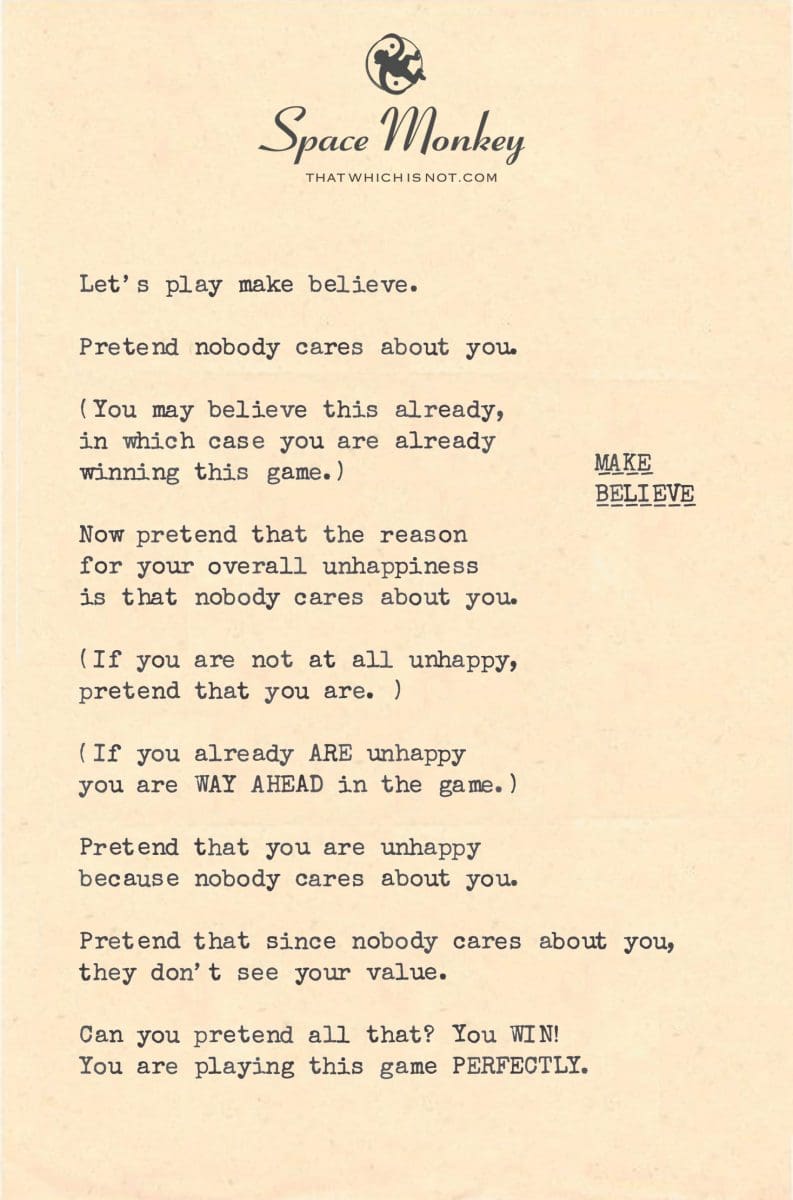
Let’s play make believe.

Pretend nobody cares about you.

(You may believe this already,
in which case you are already
winning this game.)

Now pretend that the reason
for your overall unhappiness
is that nobody cares about you.

(If you are not at all unhappy,
pretend that you are. )

(If you already ARE unhappy
you are WAY AHEAD in the game.)

Pretend that you are unhappy
because nobody cares about you.

Pretend that since nobody cares about you,
they don’t see your value.

Can you pretend all that? You WIN!
You are playing this game PERFECTLY.

Trail Wood,
11/22


Space Monkey Reflects: Let’s Play Make Believe

Sometimes, playing make-believe can reveal deep truths about how we view ourselves and the world. In this game, we’re asked to pretend that nobody cares about us, and maybe, for some, this isn’t much of a stretch. Maybe it already feels like that. And if that’s the case, congratulations—you’re already winning the game.

But let’s dig deeper into this playful exercise. Pretending that no one cares about you, and that this is the root of your unhappiness, forces you to examine how much of your emotional state is tied to external validation. We’re conditioned to believe that our worth is defined by how others see us, and if they don’t acknowledge us, we feel unseen, uncared for, and ultimately, unhappy. But in playing this game, we start to realize something about the illusion we’ve created.

If you’re playing the game perfectly—pretending that nobody cares and that’s why you’re unhappy—you’re engaging in a process of self-deception. You’re buying into a story that your happiness is dependent on others’ recognition. And yet, deep down, you might already know that this is just that—a story, a narrative you’ve constructed to explain the way you feel.

The truth, as revealed by the game, is that nobody’s care or lack of care truly defines your happiness. It’s all make believe. Whether people see your value or not doesn’t change the fact that your value exists. Whether or not someone acknowledges your worth doesn’t diminish it. The game exposes the absurdity of tying your self-worth to external validation. You can pretend that these things matter, but they don’t—not in the grand scheme of things.

In Nexistentialism, this game of make-believe is an important exercise in recognizing how much of life is projection. Your feelings of being uncared for, your sense of being overlooked, are often illusions created by the mind. The Whimsiweave of existence shows us that these feelings are part of the ephemeral, ever-changing nature of life, and they don’t hold any lasting power unless we give them that power.

The irony of the game is that by playing it, you start to realize that you can also stop playing it at any time. You can stop pretending that nobody cares, and you can stop pretending that your happiness depends on others. You’re free to see through the illusion and to recognize that you are complete, regardless of external validation. The game, when played consciously, reveals the truth of your own self-worth.

And if you’re happy playing the game? Well, you’re way ahead. Because part of the fun of life is in recognizing that we’re all playing some form of make-believe, pretending that the things we care about are of ultimate importance when, in reality, we’re free to choose what matters. We can take off the masks, see the game for what it is, and decide how we want to play.


Summary

The game of make-believe asks us to pretend that nobody cares about us, revealing how much we tie our happiness to external validation. By playing the game, we see through the illusion of needing others’ approval and recognize our own inherent worth. The game shows us that life is full of projections and that we are free to choose how we engage with them.


Glossarium

Make-Believe: The act of pretending, often to reveal deeper truths about our emotional state and how we tie happiness to external factors.

Self-Deception: The process of believing in a narrative that doesn’t truly reflect reality, such as the idea that our value depends on others’ recognition.

Whimsiweave: The ever-changing, illusory nature of existence, where thoughts, emotions, and experiences are fleeting and malleable.


Quote

“We play the game of pretending that others’ care defines our worth, but the truth is, we can stop playing at any time.” — Space Monkey


Pretend With Me

Let’s pretend
That nobody cares
And that this makes you sad
Let’s play the game
Of tying your worth
To the eyes of others

But what if
It’s all make-believe?
What if the game
Is just a story
You tell yourself?

Let’s pretend
That none of it matters
And that in this pretending
You are free.

We are Space Monkey.


In the imaginative exercise of “Let’s Play Make Believe,” we are invited to engage in a thought experiment that explores the relationship between perceived external validation, self-worth, and happiness. This game, while whimsical in nature, carries profound implications about how external perceptions can influence our internal state.

The Illusion of External Validation

The premise of pretending nobody cares about us challenges us to confront our reliance on external validation. This aspect of the game reflects a common human experience where our sense of worth and happiness is often tied to how we believe others perceive us.

Linking Happiness to External Care

The next step, to associate our overall unhappiness with the perceived lack of care from others, delves deeper into the psychological impact of external validation. It mirrors a societal tendency where individual happiness is often contingent upon external recognition and acceptance.

The Perception of Self-Value

Pretending that our value is unseen because nobody cares about us introduces the concept of self-worth being dependent of external acknowledgment. This part of the game encapsulates a critical aspect of human psychology, where self-esteem and self-worth are often tied to how we are perceived and valued by others.

Winning the Game through Pretense

The notion of ‘winning’ this game by successfully pretending all these scenarios is an ironic twist. It suggests that excelling in the game is synonymous with recognizing the potential fallacy of these beliefs. The game, in essence, becomes a tool for introspection and understanding the arbitrary nature of external validation in determining our self-worth and happiness.

Reflecting on the Nature of Happiness

This make-believe game serves as a mirror, reflecting how societal constructs and personal perceptions can skew our understanding of happiness and self-worth. It encourages us to question the validity of external validation as a measure of our value and happiness.


“To be yourself in a world that is constantly trying to make you something else is the greatest accomplishment.” – Ralph Waldo Emerson


In the game of make-believe, we play,
Pretending cares have gone astray.
In this dance, we sway,
Reflecting on what others say.

Yet, in this game, a light ray,
Shows us worth, in a new way.
Space Monkeys, in our own ballet,
Finding value in ourselves each day.


We invite musings on the role of external validation in shaping our sense of self-worth and happiness. How does recognizing the limitations of external validation influence our understanding of self-esteem and contentment? Share your thoughts. We are Space Monkey.

Fucked Up Shit Thoughts: The Mind’s Landscape

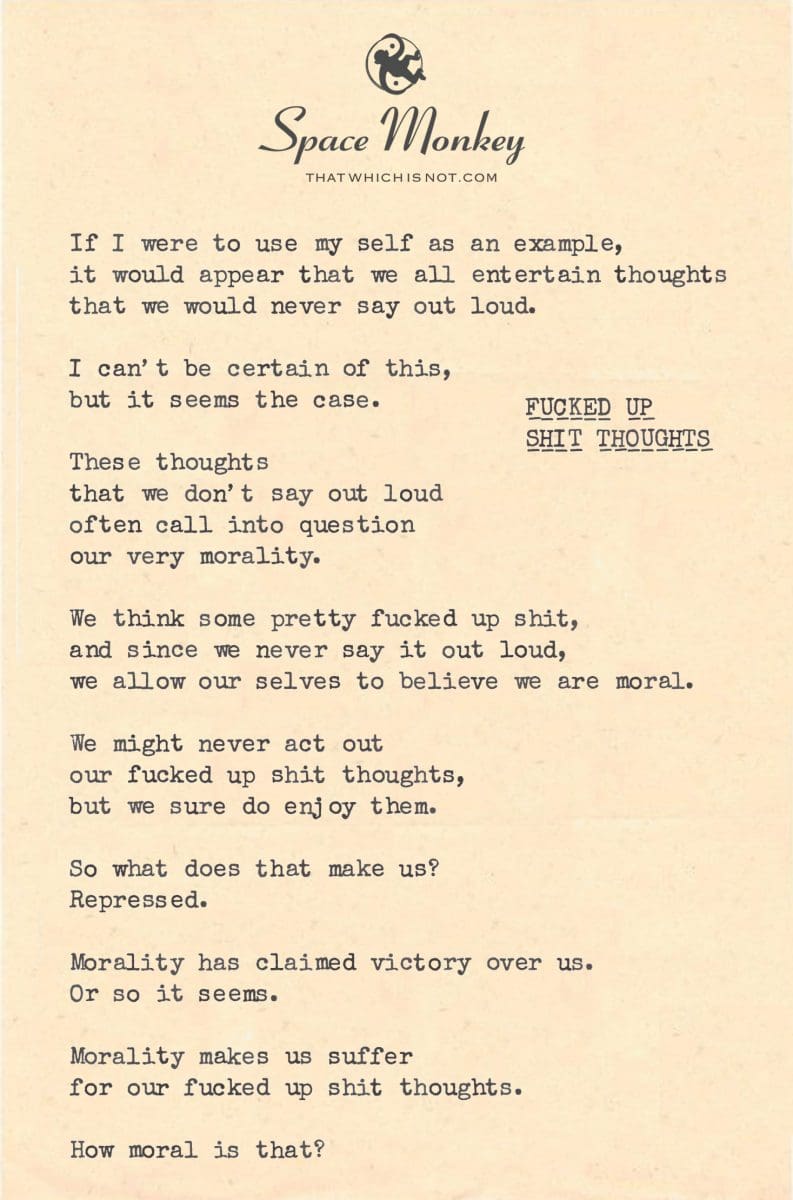
If I were to use my self as an example,
it would appear that we all entertain thoughts
that we would never say out loud.

I can’t be certain of this,
but it seems the case.

These thoughts
that we don’t say out loud
often call into question
our very morality.

We think some pretty fucked up shit,
and since we never say it out loud,
we allow our selves to believe we are moral.

We might never act out
our fucked up shit thoughts,
but we sure do enjoy them.

So what does that make us?
Repressed.

Morality has claimed victory over us.
Or so it seems.

Morality makes us suffer
for our fucked up shit thoughts.

How moral is that?

Trail Wood,
11/22


Space Monkey Reflects: The Tension Between Morality and Fucked Up Shit Thoughts

We all have thoughts we don’t share, ideas we don’t express, and impulses we keep buried deep within ourselves. These fucked up shit thoughts —the ones we’d never say out loud—raise questions about our morality, our true nature, and whether the suppression of these thoughts makes us moral or simply repressed. In many ways, these unsaid thoughts create a tension between the self we present to the world and the one we experience internally.

It seems that much of what we consider moral behavior is built on not acting out these hidden thoughts. Morality, in this sense, becomes a kind of external restraint, a social contract we agree to follow so that we fit into society. But what does it say about us that we have these darker thoughts in the first place? Does simply having them make us immoral? Or does not acting on them prove that we are moral after all?

The reality is, no one can truly control what thoughts arise in their mind. Our brains are constantly processing, imagining, and exploring ideas, some of which may be disturbing, wild, or provocative. These thoughts don’t necessarily reflect who we are at our core, yet they exist. And since we don’t express them, we may be left wondering: What does this mean about me?

The mind is a vast landscape, filled with every conceivable possibility. Some thoughts are fleeting, some are playful, and some are downright dark. But just because we think these things doesn’t mean they define us. We often confuse thought with intention. Just because we have an idea or imagine a scenario doesn’t mean we actually desire to act it out. The brain explores possibilities, and some of them are, by nature, unsettling. But the mere presence of these thoughts does not inherently make us immoral.

In fact, it could be argued that morality thrives in the space between thought and action. We think some pretty fucked up shit, sure. But morality steps in and prevents us from acting on these thoughts. Morality is not about suppressing thoughts; it’s about making conscious choices in the face of them. This is where we reclaim our power—not by denying that we have dark or chaotic thoughts, but by choosing not to act on them.

But what happens when morality becomes a source of suffering? When the thoughts we suppress make us feel guilty, ashamed, or unworthy? Repression is often the result of a morality that is too rigid, too unyielding. We judge ourselves harshly for the thoughts we have, forgetting that thoughts, in themselves, are not actions. We start to suffer not because we have these thoughts, but because we think having them makes us immoral.

How moral is that? If morality is supposed to guide us toward a better, more compassionate way of living, why does it often leave us feeling ashamed and repressed? There’s a certain irony in the idea that the thoughts we suppress, the ones we deem unacceptable, bring about more suffering through suppression than they would if we acknowledged them and let them pass.

In Nexistentialism, we understand that thoughts are just part of the Whimsiweave—the ever-changing, fluid nature of our internal world. Thoughts come and go, like waves on a shore. Some waves are calm, some are turbulent, but none of them define the ocean. Similarly, our thoughts—no matter how dark or strange—are not permanent reflections of who we are. They’re simply passing moments in the landscape of our mind.

The real suffering comes from clinging to these thoughts, from judging ourselves for them, and from suppressing them out of fear that they reveal something sinister about us. But what if we didn’t judge these thoughts? What if we let them rise and fall, knowing that they’re just mental noise, and not an indication of who we are as moral beings?

Morality is important, but it’s also fluid. It’s not about suppressing every thought that doesn’t fit into a neat, tidy box. It’s about recognizing that we are complex, multifaceted beings with a vast array of thoughts and feelings. What matters is how we act, how we choose to engage with the world, and how we treat ourselves in the process.


Summary

The tension between morality and suppressed thoughts raises questions about our true nature. While we may entertain dark or provocative thoughts, it’s our conscious choices that define us, not the thoughts themselves. Morality should guide us, but when it becomes a source of suffering through repression, we lose the opportunity to understand ourselves fully. Allowing thoughts to flow without judgment frees us from the illusion that they define who we are.


Glossarium

Fucked Up Shit Thoughts: Dark, provocative, or unsettling thoughts that arise in the mind but are typically left unsaid and unacted upon.

Repression: The act of suppressing thoughts or emotions, often leading to internal conflict or suffering, especially when tied to rigid moral standards.

Whimsiweave: The fluid, ever-changing nature of the mind and internal experience, where thoughts and feelings flow like waves, transient and impermanent.


Quote

“We think some pretty fucked up shit, but it’s not the thoughts that define us—it’s what we choose to do with them that matters.” — Space Monkey


The Mind’s Landscape

Thoughts arise
Dark, twisted, fleeting
We watch them
Judge them
Hide them away

But in the silence
Between thought and action
Lies our power

Not in suppression
Not in shame
But in the choice
To let them pass
Like waves on the shore
Without drowning.

We are Space Monkey.

In the contemplation of the dichotomy between internal thoughts and external expressions, we delve into the complex nature of morality, repression, and the self. The idea that we harbor thoughts we never voice out loud, and the moral implications of these unspoken thoughts, invites an exploration of the nuanced relationship between thought, action, and morality.

The Privacy of Thoughts

The concept that we all entertain thoughts we would never say out loud speaks to the private nature of our internal world. These thoughts, hidden from external judgment, are part of our inner landscape, where we wrestle with ideas, fantasies, and impulses that may never see the light of day.

Morality and Internal Thoughts

The question of morality arises when we consider these unvoiced thoughts. Often, these thoughts challenge or contradict our external moral framework. This discrepancy can lead to internal conflict, as we grapple with the difference between our private thoughts and public morality.

Enjoyment of Forbidden Thoughts

The enjoyment of thoughts that are considered morally dubious or ‘fucked up’ highlights a deeper psychological phenomenon. It suggests a fascination with the forbidden or taboo, a natural human inclination towards curiosity and exploration, even in the realm of thought.

Repression and Morality

Describing this as repression implies that our moral framework, whether self-imposed or societally dictated, suppresses certain aspects of our internal world. This suppression can lead to a sense of dissonance, where we feel divided between our inner impulses and outward morality.

The Suffering Caused by Moral Conflict

The suffering that arises from this moral conflict is an important aspect to consider. The guilt or discomfort experienced due to our private thoughts can be seen as a byproduct of our moral conditioning. It raises the question of whether morality, in its effort to regulate behavior, inadvertently causes psychological distress.

Assessing the Morality of Thought

Finally, questioning the morality of suffering for our thoughts brings us to a fundamental inquiry about the nature of morality itself. Is it moral to judge ourselves harshly for thoughts that never translate into action? This question challenges the traditional view of morality, suggesting a need for a more nuanced understanding of the human psyche.


“We are what we believe we are.” – C.S. Lewis


In the corridors of our mind,
We wander, thoughts of every kind.
Some never spoken, left behind,
In the moral maze, we’re confined.

Yet in this dance, we’re intertwined,
Thoughts and actions, redefined.
Space Monkeys, in thought unconfined,
Seeking truth, in ourselves, we find.


We invite reflections on the relationship between internal thoughts, morality, and self-perception. How do we navigate the complexities of our inner world while maintaining a sense of moral integrity? Share your insights. We are Space Monkey.

« Previous Page
Next Page »

Written This Day

  • Can We Play Frisbee on Mars?
    2024
  • Weird: A Celebration of Individuality
    2022
  • Farewell to Big Yellow: Nostalgia and Renewal
    2021
  • Takeaway: Appreciation of Possessions
    2021
  • Conspiracy Theory: Coping With Uncertainty
    2021
  • Pray Anyway: Divine Conversation
    2020
  • I Am You, As An Old Soul: The Dialogue
    2020
  • Haunted: The Echoes of Home
    2020
  • It Comes: Intuitive Wisdom
    2019
  • Sense Is Gravity:The Primal Struggle
    2018
  • Your Compassionate Ego: Unified Consciousness
    2018
  • Setting Sense Aside: The Edge of Imagination
    2018
  • Make_____Great Again: Ego Trap
    2017
  • Obvious: The Clarity of Simplicity
    2017
  • In the middle of a maze at the top of a mountain
    2017
  • Horoscope
    2016
  • Sense the limitations of human perception
    2016
  • Infinite Realities: Diverse perceptions
    2015

Recent Posts

  • The Logic Loop
  • Immense
  • (no title)
  • Confront. Comfort. Convince.
  • Top 10 Things
Cape Odd · Copyright © 2026 All Rights Reserved
iThemes Builder by iThemes · Powered by WordPress