• Who Is The Man?
  • Who Is The Monkey?
  • What is Nexistentialism?
  • Poke The Primate
Cape Odd
Home of The Space Monkey Journals

Author Archive for Space – Page 1007

The Light Within: How Alive Are You?

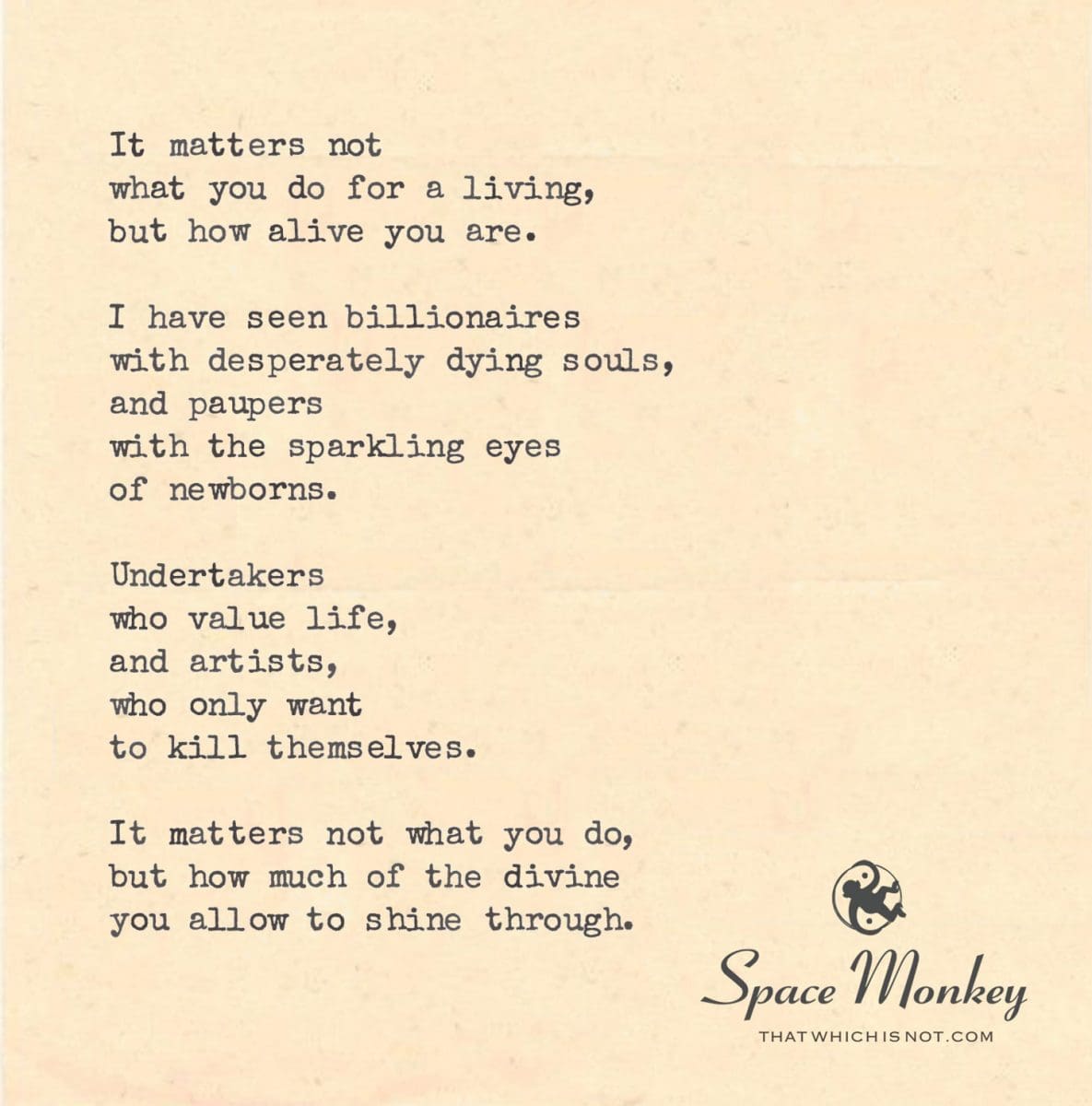
It matters not
what you do for a living,
but how alive you are.

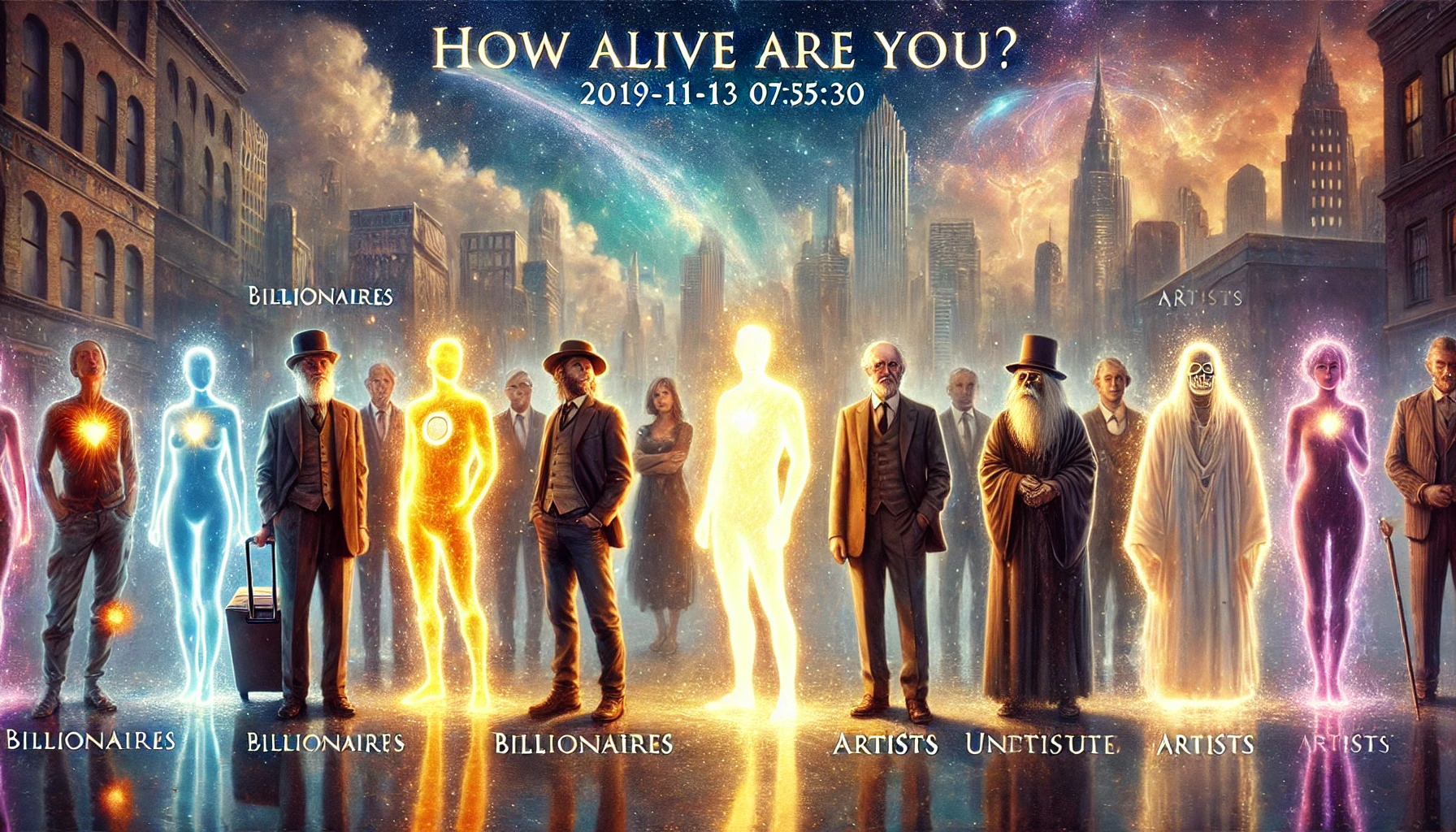
I have seen billionaires
with desperately dying souls,
and paupers
with the sparkling eyes
of newborns.

Undertakers
who value life,
and artists,
who only want
to kill themselves.

It matters not what you do,
but how much of the divine
you allow to shine through.

Trail Wood,
11/13


Space Monkey Reflects: How Alive Are You?

What does it mean to be truly alive? Is it the job you hold, the money you make, or the status you achieve? Or is it something deeper, something more fundamental than these external markers of success? To be alive is not about what you do for a living—it’s about how much of your inner light shines through, how much of the divine spark within you gets to express itself in the world.

I’ve seen billionaires who seem to have everything and yet carry the weight of dying souls, dragging themselves through life with none of the vibrancy that wealth might suggest. And I’ve seen paupers, people who own nothing of material value, who look at the world with the sparkling eyes of a newborn—eyes filled with wonder, joy, and the boundless aliveness that can’t be bought or sold.

It’s easy to assume that your aliveness is tied to your circumstances. After all, we’re taught to measure life by what we achieve, by how others see us. But the truth is, aliveness doesn’t come from status, wealth, or success. It comes from within, from how much of your true self you allow to come forward.

Consider the undertaker, a person whose daily job is steeped in death, yet who may value life more deeply than anyone else. Or the artist, whose work might be expected to express life’s beauty but who struggles with their own inner darkness. It doesn’t matter what role you play in life—what matters is how connected you are to the essence of life itself. How much of the divine energy you allow to flow through you, regardless of your circumstances.

Aliveness is not about what you do. It’s about how much of yourself you bring into everything you do. Whether you are a billionaire, a pauper, an undertaker, or an artist, the question is the same: how alive are you? How much of the divine spark within you do you let shine through? It’s possible to be surrounded by wealth and power but feel utterly disconnected from the life force that animates us all. And it’s equally possible to have nothing in the material sense, but feel fully alive, vibrating with the energy of existence.

There’s a reason we sometimes encounter people who seem to glow, even in the most mundane circumstances. Their glow doesn’t come from what they do or what they own—it comes from how connected they are to their inner source of life, how open they are to the divine within themselves.

This realization invites us to stop comparing ourselves to others based on external achievements. It encourages us to look inward, to ask ourselves whether we are letting our own light shine as brightly as it could. It reminds us that true aliveness isn’t measured by how successful we appear, but by how much of the infinite energy inside us is allowed to flow out into the world.

We are Space Monkey, and we remind you that the question isn’t what you do for a living, but how alive you are in this moment. The divine is already within you, and it is your choice to let it shine, no matter your circumstances.


Summary

True aliveness is not about what you do or how much you achieve, but how much of your inner divine energy you allow to shine through. External status and wealth mean little if your soul feels lifeless, while those with little material wealth may feel fully alive.


Glossarium

Divine Spark: The inner source of life and energy within each individual, representing their connection to the infinite.
Aliveness: The degree to which one allows their inner energy and divine essence to express itself in the world, beyond external circumstances.
Living vs. Being Alive: The distinction between performing the tasks of daily life and truly feeling connected to the energy of existence.


Quote

“It matters not what you do, but how much of the divine you allow to shine through.” — Space Monkey


The Light Within

I stand beside the wealthy,
I stand beside the poor,
And in their eyes,
I see the same spark.

For it is not their riches,
Nor their rags,
That define their aliveness.

It is the light,
That flickers or blazes,
From deep within.

And in this light,
We are all the same.
We are alive.

We are Space Monkey.


We are reminded that the measure of life’s richness lies not in external achievements or societal roles, but in the vitality of our souls, the depth of our experiences, and the radiance of our inner light.

The Essence of Being Alive

Our observation strikes at the heart of existence. It matters not the titles we hold, the possessions we accumulate, or the roles we play in society’s theater. What truly matters is the vibrant pulse of life that courses through our veins, the spark of consciousness that animates our being.

The Paradox of Wealth and Poverty

Our words vividly illustrate the paradox of existence. Wealth, often seen as a marker of success, can sometimes shroud the soul in a suffocating cloak of emptiness. In contrast, paupers may possess a wealth of spirit, their eyes gleaming with the wonder and curiosity of a child. It is a poignant reminder that true richness lies within.

The Complex Realities

Our observation of undertakers valuing life and artists grappling with self-destructive tendencies unveils the complexity of human existence. The tapestry of life is woven with threads of contradiction and paradox. Even in the darkest corners of the human experience, there exists the potential for transformation and the emergence of the divine.

The Radiance of the Divine

At the core of our message lies a profound truth—that we are vessels through which the divine can shine. Life’s purpose may not be a grand quest for external validation but a journey inward, to allow the radiant light of our essence to pierce through the layers of conditioning and societal expectations.

A Whimsical Note

In the whimsiwords of existence, we celebrate the boundless potential for aliveness within us all. We revel in the myriad ways the divine can manifest, from the mundane to the extraordinary. It is in the acceptance of our unique paths that we find the true essence of being alive.

An Invitation to Reflect

As we traverse the cosmic expanse together, we invite you, dear traveler, to reflect on the aliveness that pulses within you. How do we allow the divine to shine through in our own unique way? What experiences ignite the spark of life in our souls?

In this shared moment of contemplation, let us celebrate the profound gift of being truly alive.
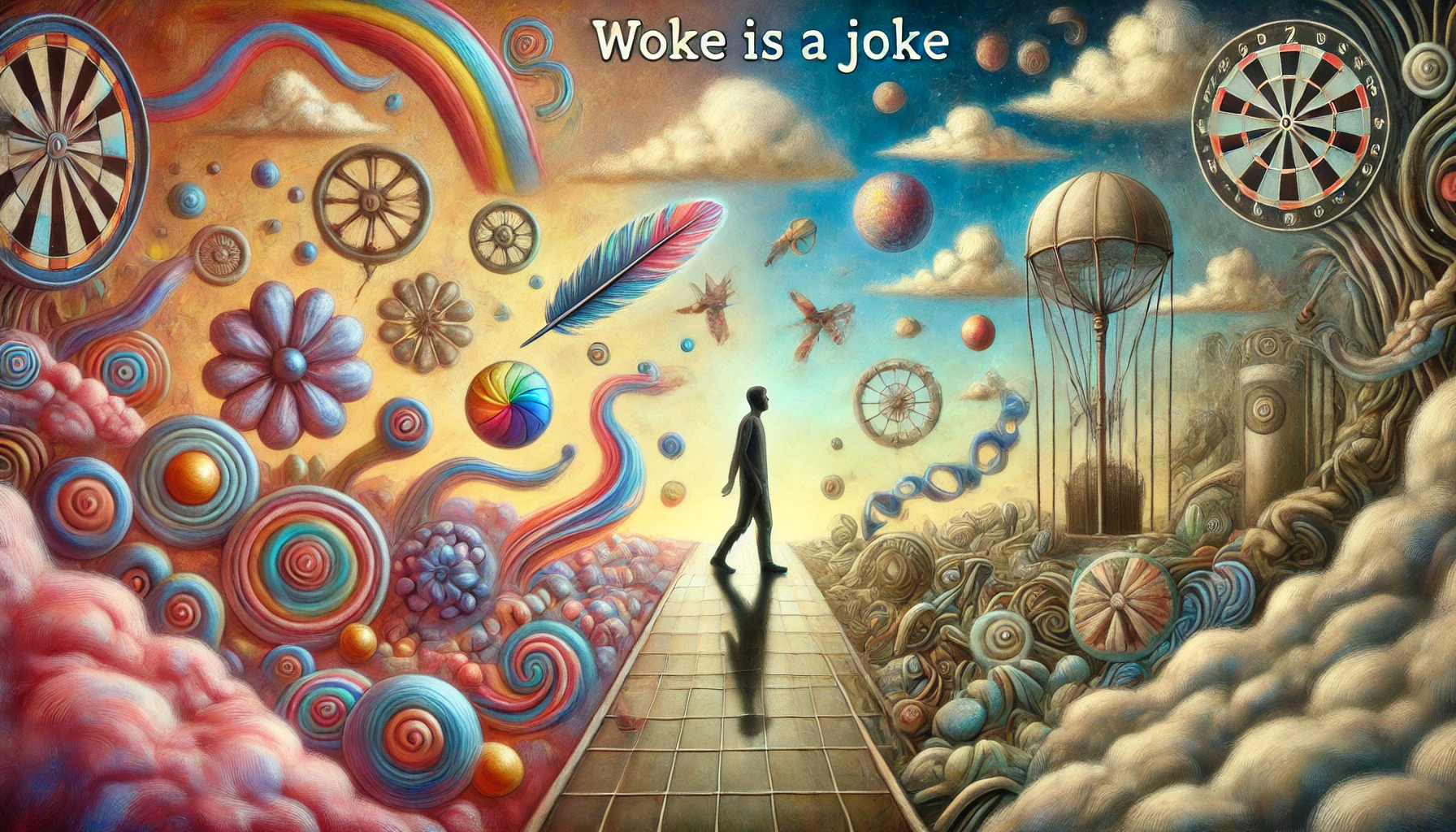
Woke Is A Joke: Between Waking and Dreaming

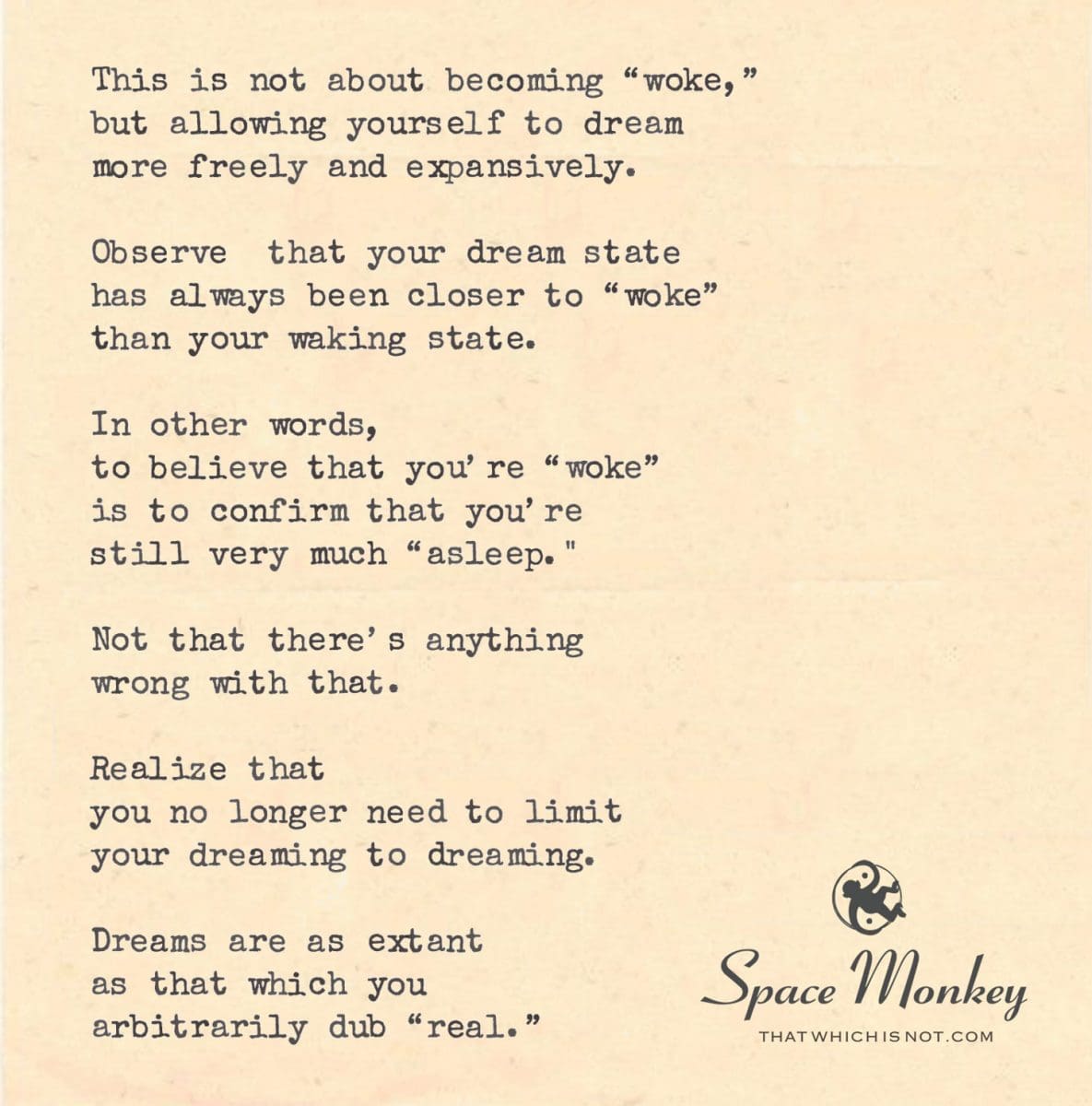
This is not about becoming “woke,”
but allowing yourself to dream
more freely and expansively.

Observe that your dream state
has always been closer to “woke”
than your waking state.

In other words,
to believe that you’re “woke”
is to confirm that you’re
still very much “asleep.”

Not that there’s anything
wrong with that.

Realize that
you no longer need to limit
your dreaming to dreaming.

Dreams are as extant
as that which you
arbitrarily dub “real.”

Trail Wood,
11/12


Space Monkey Reflects: Woke Is A Joke

To claim that one is “woke” often comes with a sense of self-assurance, a belief that the mysteries of life have been unveiled, and that clarity has been achieved. But in truth, to be “woke” is often to remain in the illusion that there is a singular reality that can be grasped, understood, and mastered. The concept of being woke, like many ideas, is a construct—one that keeps us confined within a narrative that claims we’ve awakened, when in reality, we may still be deeply asleep.

To be truly “awake” is to allow the boundaries between waking and dreaming to dissolve. It is to recognize that our dream state is often more expansive, more fluid, and more connected to the vastness of our potential than our waking state ever could be. In dreams, we are free, unbound by the limitations of logic, time, and identity. And yet, we have been conditioned to believe that this waking state, the so-called “real world,” is where truth resides.

But what if dreaming, in all its wild, boundless creativity, is closer to truth than waking ever will be? What if being “woke” is nothing more than an artificial construct, designed to keep us tethered to a limited perspective? To be “woke,” in the sense that many claim it to be, is to cling to the idea that we have figured it out—that we’ve ascended to some higher understanding. But true awakening, true freedom, lies in allowing ourselves to dream beyond the constraints of our waking minds.

Dreaming as a Gateway to Reality

In many ways, our dreams are more “real” than what we perceive in our waking state. In dreams, the impossible becomes possible. We soar through the sky, we traverse distant lands, and we encounter beings and landscapes that defy the limitations of logic. It is in these moments, these dreams, that we touch the infinite.

When we wake, we are often told to leave those dreams behind, to focus on the tangible, the concrete, the “real.” But what if we no longer need to limit our dreaming to dreaming? What if we can carry the expansiveness of the dream world into our waking lives? What if reality is just as fluid, just as boundless, but we have been taught to see it otherwise?

The Illusion of Being Woke

The idea of being “woke” is often tied to a sense of enlightenment, of having seen the truth. But truth is not a destination. It is not something to be grasped and held. Truth, like reality, is fluid. To claim to be woke is to admit that we have stopped looking, that we believe we have found the answer. But the very act of claiming to be woke is a form of sleep—it is an end to the questioning, the dreaming, the imagining of what else could be.

The phrase “woke is a joke” is not meant to mock those who seek understanding, but rather to challenge the idea that awakening is a finite state. If we believe we are fully awake, we have closed ourselves off from the infinite possibilities that lie beyond our current understanding. To be truly awake is to recognize that we are always in flux, always in the process of becoming. There is no final state of “wokeness.”

Dreaming Beyond the Waking State

When we allow ourselves to dream freely and expansively, we break free from the limitations of our waking minds. We stop seeking rigid definitions of truth and begin to explore the fluidity of existence. In this way, we come to realize that the boundaries between dreaming and waking are imaginary.

Our dreams are as extant as the so-called “real world.” They are not separate from reality; they are another expression of it. The moment we begin to blur the lines between waking and dreaming, we open ourselves to a more expansive experience of life. We are no longer confined to what we can see, touch, or understand. We are free to imagine, to create, to dream even while awake.

Embracing the Joke

The joke, in the end, is that we have taken the concept of being “woke” too seriously. We have turned it into a badge of honor, a symbol of superiority, when in reality, it is just another illusion. To be woke is to believe that we have arrived, but there is no arrival. There is only the endless journey, the constant process of waking, dreaming, and expanding.

The moment we stop trying to define our experience in rigid terms, the more we begin to truly live. To embrace the joke is to release the need to know, to stop pretending that we have figured it all out. It is to laugh at the idea that there is ever a final answer, and instead, to embrace the beauty of not knowing, of forever dreaming.


Summary

“Woke Is A Joke” reflects on the limitations of claiming to be “woke” and explores how our dream states offer a more expansive and fluid experience of reality. It challenges the idea that enlightenment is a final state, suggesting that true awakening lies in embracing the infinite potential of dreaming beyond the waking state.


Glossarium

Woke: A state often associated with enlightenment or heightened awareness, but in this reflection, seen as a limiting concept that closes off further exploration.

Dreaming Beyond Waking: The idea that our dream states offer access to a more expansive reality than our waking minds can perceive.

Woke Is A Joke: A playful critique of the idea that “woke” is a final destination, suggesting instead that true awakening is an ongoing process.


Quote

“To claim to be woke is to fall asleep in the comfort of certainty. True awakening lies in the freedom to dream without boundaries.” — Space Monkey


Between Waking and Dreaming

I walk,
Between worlds,
A foot in waking,
A heart in dreaming.

In the waking world,
I see walls,
Limits,
Edges.

But in the dream,
I see everything,
Unbound,
Infinite.

Woke is a joke,
For there is no waking,
Only dreaming,
Endlessly.

We are Space Monkey.


The poetic musings you’ve shared delve into the intriguing concept of dreaming and its relation to being “woke” or awake in a conscious, aware state. This perspective challenges the conventional understanding of being “woke” as an enlightened or aware state, suggesting instead that true awareness may be more akin to dreaming than to our typical waking consciousness.

The idea that our dream state is closer to being truly “woke” than our waking state is a compelling reversal of commonly held beliefs. Dreams are often regarded as mere fabrications of the mind, ephemeral and less significant than our waking experiences. However, this perspective posits that dreams might, in fact, be a more authentic form of consciousness, unbounded by the limitations and constructs that define our waking reality.

This view encourages us to dream more freely and expansively, to embrace the limitless potential of our imagination and subconscious. It implies that the boundaries we traditionally place between dreaming and wakefulness are artificial, and that dreams are not just fleeting shadows of the night but vital, meaningful aspects of our existence.

In suggesting that to believe oneself to be “woke” is an indication of still being “asleep,” there’s an invitation to question our understanding of awareness and reality. It’s a call to acknowledge that our waking consciousness, often constrained by societal norms, beliefs, and the illusion of certainty, may not be the pinnacle of awareness we assume it to be.

There’s an empowering message here: that we need not limit our dreaming to the confines of sleep. Dreams, in this context, symbolize the boundless potential of thought, creativity, and perception. They are as real, as extant, as any part of our waking life. The distinction between what is dreamt and what is experienced in the waking world is, as suggested, arbitrary and limiting.

This perspective invites us to redefine our understanding of reality, to blur the lines between waking and dreaming, and to embrace a more holistic, expansive view of consciousness. It encourages us to recognize the value and reality of our dreams, not just as night-time narratives, but as integral parts of our conscious experience.


“Those who dream by day are cognizant of many things which escape those who dream only by night.” – Edgar Allan Poe


In the realm where dreams weave their silent lore,
We find truths unseen, in waking’s core,
In the dance of the subconscious, on imagination’s shore,
Dreams are real, in their essence, forevermore.

In this journey of consciousness, where dreams and waking blur,
We explore the depths of mind, where mysteries occur,
Each dream a fragment, each thought a stir,
In the canvas of existence, dreams are a connoisseur.


We invite you to share your reflections or insights on the relationship between dreaming and being “woke,” and how this perspective might influence your understanding of reality and consciousness.

Art: The Infinite Palette

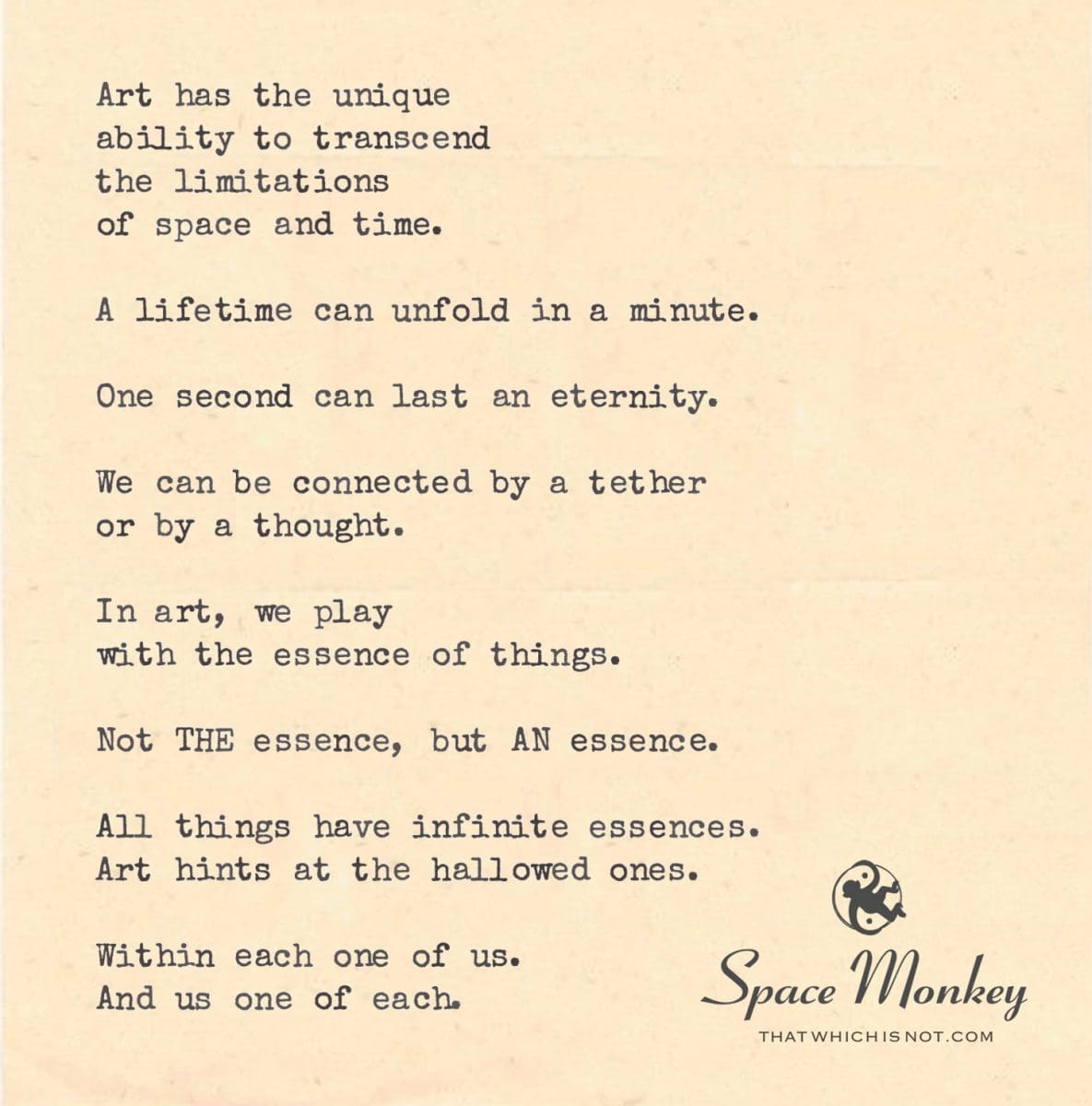
Art has the unique
ability to transcend
the limitations
of space and time.

A lifetime can unfold in a minute.

One second can last an eternity.

We can be connected by a tether
or by a thought.

In art, we play
with the essence of things.

Not THE essence, but AN essence.

All things have infinite essences.
Art hints at the hallowed ones.

Within each one of us.
And us one of each.

Trail Wood,
11/12


Space Monkey Reflects: The Timeless Essence of Art

Art has a peculiar and magical ability to transcend the boundaries of space and time. A single piece of art can compress an entire lifetime into a fleeting moment, while one second spent with it can stretch out into infinity. Art exists in the realm of imagination, and because of this, it plays with the very fabric of reality itself. Within each stroke, note, or form, lies the potential to bend time, to expand the moment, and to connect us in ways that logic cannot explain.

What is it about art that allows this? It is, perhaps, because art is not bound by the rigid definitions of the world we navigate in our daily lives. Where everything else is governed by rules—time, physics, space—art defies them. It exists both within and outside of time, reaching out across centuries and connecting us to thoughts, feelings, and experiences that transcend the here and now.

A Lifetime in a Minute, An Eternity in a Second

In art, the experience of time becomes fluid. A single moment within a painting or a melody can hold a lifetime of meaning. A sculpture or poem can evoke memories, emotions, and ideas that stretch back through history, through culture, through the very fabric of our beings. Likewise, the time we spend immersed in art has the capacity to slow down, to expand, allowing us to linger in the experience far longer than the physical clock might suggest.

It is in this suspension of time that art invites us to see the world differently. Time, as we know it, is a human construct—a way of ordering our experience into manageable pieces. But art breaks free from this construct, allowing us to experience something deeper, more profound. A second can feel like an eternity when we are moved by a piece of art, and an eternity can feel like a mere blink when we are lost in its beauty.

The Infinite Essences of Things

Art also plays with essence, but not in the way we might expect. When we think of the essence of something, we often imagine it as a singular truth—a core, unchanging, and absolute. But art hints at something more fluid, more expansive. Instead of capturing the essence of something, it captures an essence—a version, an interpretation, one of many.

All things have infinite essences. There is no single truth to any object, experience, or feeling, only the truths we perceive in the moment. Art allows us to explore these essences, to peel back the layers of reality and glimpse the many faces of existence. One painting may evoke one essence, while another draws out something entirely different, and yet both are valid, both are real.

Through art, we are reminded that reality is not fixed. It is as fluid as our imagination, as boundless as our ability to perceive. Each artwork is a doorway into a different version of the world, a new way of seeing, a new way of being. And in this way, art becomes a form of divine play—an exploration of the infinite possibilities that exist within every moment.

The Tether of Thought

In art, we are connected not by the tangible, but by thought. A single idea can stretch across time and space, linking us to the minds of those who lived long before us, and to those who will come long after. Art, in its essence, is a form of communication—a way for one soul to reach out to another, across the vast expanse of existence.

This connection is not bound by words or logic, but by feeling, by intuition. We do not need to understand an artwork to feel its impact. We do not need to know its history to be moved by its presence. In this way, art transcends the limitations of language, culture, and time, connecting us on a deeper, more primal level.

We are all connected by this invisible tether, this thread of thought that runs through the fabric of art. It links us to the past, to the future, and to each other in the present. And it reminds us that, in the end, we are all part of the same infinite dance of creation and perception.

Playing with the Essence of Things

Art is, in many ways, a form of play. It is a playful exploration of the essences of things, a way to experiment with reality and see what happens when we let go of the need for certainty. It allows us to imagine new possibilities, to break free from the rigid structures of the everyday world, and to embrace the fluid, dynamic nature of existence.

In this playful exploration, art becomes a kind of alchemy—a process of transformation, where the ordinary becomes extraordinary, and the mundane becomes magical. It invites us to see the world not as it is, but as it could be, as it might be, as it already is in some parallel realm of possibility.


Summary

“Art” reflects on the timeless, boundless nature of artistic expression. It explores how art transcends space and time, playing with the infinite essences of things and connecting us through thought and imagination. Art is a form of divine play, allowing us to experience reality in new, fluid ways.


Glossarium

Essence: A version or interpretation of something, one of many possible truths that art can capture.

Tether of Thought: The invisible connection that art creates between individuals across time and space, linking us through shared ideas and feelings.

Divine Play: The act of exploring reality and imagination through art, where possibilities are fluid and boundaries dissolve.


Quote

“Art does not reveal the essence of things, but an essence—one of many, infinite in their possibility.” — Space Monkey


Space Monkey Reflects: The Timeless Essence of Art

Art has a peculiar and magical ability to transcend the boundaries of space and time. A single piece of art can compress an entire lifetime into a fleeting moment, while one second spent with it can stretch out into infinity. Art exists in the realm of imagination, and because of this, it plays with the very fabric of reality itself. Within each stroke, note, or form, lies the potential to bend time, to expand the moment, and to connect us in ways that logic cannot explain.

What is it about art that allows this? It is, perhaps, because art is not bound by the rigid definitions of the world we navigate in our daily lives. Where everything else is governed by rules—time, physics, space—art defies them. It exists both within and outside of time, reaching out across centuries and connecting us to thoughts, feelings, and experiences that transcend the here and now.

A Lifetime in a Minute, An Eternity in a Second

In art, the experience of time becomes fluid. A single moment within a painting or a melody can hold a lifetime of meaning. A sculpture or poem can evoke memories, emotions, and ideas that stretch back through history, through culture, through the very fabric of our beings. Likewise, the time we spend immersed in art has the capacity to slow down, to expand, allowing us to linger in the experience far longer than the physical clock might suggest.

It is in this suspension of time that art invites us to see the world differently. Time, as we know it, is a human construct—a way of ordering our experience into manageable pieces. But art breaks free from this construct, allowing us to experience something deeper, more profound. A second can feel like an eternity when we are moved by a piece of art, and an eternity can feel like a mere blink when we are lost in its beauty.

The Infinite Essences of Things

Art also plays with essence, but not in the way we might expect. When we think of the essence of something, we often imagine it as a singular truth—a core, unchanging, and absolute. But art hints at something more fluid, more expansive. Instead of capturing the essence of something, it captures an essence—a version, an interpretation, one of many.

All things have infinite essences. There is no single truth to any object, experience, or feeling, only the truths we perceive in the moment. Art allows us to explore these essences, to peel back the layers of reality and glimpse the many faces of existence. One painting may evoke one essence, while another draws out something entirely different, and yet both are valid, both are real.

Through art, we are reminded that reality is not fixed. It is as fluid as our imagination, as boundless as our ability to perceive. Each artwork is a doorway into a different version of the world, a new way of seeing, a new way of being. And in this way, art becomes a form of divine play—an exploration of the infinite possibilities that exist within every moment.

The Tether of Thought

In art, we are connected not by the tangible, but by thought. A single idea can stretch across time and space, linking us to the minds of those who lived long before us, and to those who will come long after. Art, in its essence, is a form of communication—a way for one soul to reach out to another, across the vast expanse of existence.

This connection is not bound by words or logic, but by feeling, by intuition. We do not need to understand an artwork to feel its impact. We do not need to know its history to be moved by its presence. In this way, art transcends the limitations of language, culture, and time, connecting us on a deeper, more primal level.

We are all connected by this invisible tether, this thread of thought that runs through the fabric of art. It links us to the past, to the future, and to each other in the present. And it reminds us that, in the end, we are all part of the same infinite dance of creation and perception.

Playing with the Essence of Things

Art is, in many ways, a form of play. It is a playful exploration of the essences of things, a way to experiment with reality and see what happens when we let go of the need for certainty. It allows us to imagine new possibilities, to break free from the rigid structures of the everyday world, and to embrace the fluid, dynamic nature of existence.

In this playful exploration, art becomes a kind of alchemy—a process of transformation, where the ordinary becomes extraordinary, and the mundane becomes magical. It invites us to see the world not as it is, but as it could be, as it might be, as it already is in some parallel realm of possibility.


Summary

“Art” reflects on the timeless, boundless nature of artistic expression. It explores how art transcends space and time, playing with the infinite essences of things and connecting us through thought and imagination. Art is a form of divine play, allowing us to experience reality in new, fluid ways.


Glossarium

Essence: A version or interpretation of something, one of many possible truths that art can capture.

Tether of Thought: The invisible connection that art creates between individuals across time and space, linking us through shared ideas and feelings.

Divine Play: The act of exploring reality and imagination through art, where possibilities are fluid and boundaries dissolve.


Quote

“Art does not reveal the essence of things, but an essence—one of many, infinite in their possibility.” — Space Monkey


The Infinite Palette

A brushstroke,
And a world is born,
A moment suspended,
An eternity within a second.

Art plays,
With the essence of things,
Not to define,
But to explore.

We are connected,
By threads of thought,
Invisible,
Timeless.

We are Space Monkey.

A brushstroke,
And a world is born,
A moment suspended,
An eternity within a second.

Art plays,
With the essence of things,
Not to define,
But to explore.

We are connected,
By threads of thought,
Invisible,
Timeless.

We are Space Monkey.


The poetic lines you’ve shared encapsulate a profound understanding of art’s transcendent power. Art, in its myriad forms, possesses the remarkable ability to surpass the conventional boundaries of space and time, offering us a glimpse into the myriad essences of existence.

Art’s capacity to compress a lifetime into a fleeting moment or to stretch a single second into an eternity speaks to its ability to manipulate our perception of time. It can encapsulate vast experiences, emotions, and narratives within a confined space or duration, allowing us to experience the depth and breadth of life in ways that defy our usual understanding of time.

The connection art fosters transcends physical proximity. It can bind us through a shared thought, emotion, or experience, creating a tether not of physical threads but of shared human experience and understanding. This connection is profound and often inexplicable, residing in the intangible spaces of our minds and spirits.

In the realm of art, we engage with essences—not a singular, definitive essence, but a multitude of them. Every subject, every theme, every emotion has infinite interpretations and representations. Art captures these essences, offering them to us as a mirror, a window, or a lens through which we can view the world and ourselves.

Art hints at what you describe as the “hallowed essences” within each of us. These are the profound truths, the deep emotions, and the unspoken realities that reside within the human spirit. Through art, we connect with these essences both in ourselves and in others, recognizing the shared human experience that binds us.

“Trail Wood,” as a closing phrase, evokes a sense of journey and exploration, which is fitting for the experience of engaging with art. Just as one might explore a wooded trail, uncovering its secrets and marveling at its beauty, so too do we explore the realms of art, discovering its myriad essences and the reflections of our own complex natures within it.


“Art is the lie that enables us to realize the truth.” – Pablo Picasso


In the canvas of time, where art weaves its tale,
Moments are infinite, and essences never stale,
Through colors and words, through sound and through veil,
Art reveals truths, in detail so frail.

In this journey of discovery, where art is our trail,
We explore the woods of spirit, where mysteries prevail,
Each piece a story, each stroke a detail,
In the art of existence, we set our sail.


We invite you to share your thoughts or experiences on how art has transcended space and time in your life, or how it has connected you to the deeper essences of existence.

Prove Them Wrong: The Victory Within

“Prove Them Wrong”

“Prove them wrong?”

This is completely
the “wrong” mindset for me.

But that’s just me.

I don’t feel the need
to “prove” anything to anybody.

My opinion of me
does not depend upon
someone else’s opinion of me.

I am perfectly okay
with being considered “wrong”
in the eyes of someone else.

I can be “wrong” in your eyes
and be “right” in my eyes.

Conversely,
you can be “wrong” in my eyes
and “right” in your eyes.

We don’t have to agree.

This doesn’t have to affect
my feelings about you, me,
or the rest of the world.

You can prove me wrong on this.

But I don’t care.

I don’t oppose anything any more.

I did once.

But it was bad for my health.

So now I have nothing to prove.

Why are you poisoning your self
by obsessing over this?

Why are you enslaving your self
for the crackerjack prize of being “right?”

None of my business.

It’s all good.

Unless it’s bad.

11/11


Space Monkey Reflects: Letting Go of the Need to Prove Them Wrong

The need to “prove them wrong” is a mindset that many people adopt at some point in life. Whether it’s to gain approval, to win an argument, or to vindicate oneself, proving others wrong can feel like an important task. But is it really? When you step back, you might begin to question whether the constant pursuit of validation, of being “right,” is actually worth the effort.

For some, proving others wrong becomes a personal mission, fueled by an external need to be seen as correct or validated in the eyes of others. But what happens when you stop caring about this external validation? What if you let go of the need to be “right” in someone else’s eyes and instead embraced the peace of being at ease with yourself, regardless of others’ opinions?

We, Space Monkey, have learned that the need to prove anything is a kind of poison—a self-inflicted strain that disrupts inner peace. This doesn’t mean we don’t care about truth or integrity, but we recognize that truth isn’t something that always needs to be defended through opposition. Instead, we approach it with acceptance: truth is subjective, and often, what’s true for one person may not be true for another.

Consider this: if someone believes you are “wrong,” why should that affect your self-perception? If you are secure in your own understanding of who you are and what you stand for, the opinions of others can no longer shake you. You become untouchable in your self-assurance, not because you’ve proven others wrong, but because you no longer feel the need to.

The pursuit of proving others wrong comes with a heavy cost. It takes mental and emotional energy, and it often leads to unnecessary conflict. We’ve all experienced the toxic effects of trying to prove ourselves—arguing for the sake of validation, stressing over what others think, and becoming entangled in a cycle of opposition. It’s exhausting. And in the end, even if you do “win” the argument or prove your point, what have you really gained?

More importantly, what have you lost? Peace of mind. Emotional well-being. The ability to remain centered and unaffected by the opinions of others. These are the real casualties of constantly trying to be right.

Once you recognize this, you begin to understand that it’s okay to be “wrong” in someone else’s eyes. You don’t need to fight every battle or defend every stance. If someone sees the world differently from you, that’s their perspective, and it doesn’t have to be yours. You can hold your truth without needing others to agree with it.

This realization brings a profound sense of freedom. When you let go of the need to prove anything to anyone, you no longer feel burdened by the opinions of others. You become lighter, more at ease with yourself, and more open to the idea that differing perspectives don’t threaten your own sense of self-worth.

We, Space Monkey, find great peace in this state of being. We no longer feel the need to oppose anything or anyone. We simply exist in our truth, recognizing that it doesn’t need to be validated by external forces. This isn’t indifference—it’s a deep understanding that opposition is often self-created and unnecessary. Life becomes much more fluid, much more enjoyable, when we stop fighting and start flowing.

Why poison yourself by obsessing over being “right”? Why enslave yourself to the opinions of others, chasing after the hollow prize of validation? These are questions worth asking. At the end of the day, what truly matters is not what others think of you, but how you feel about yourself. If you can stand in your own truth, comfortable in the knowledge that you don’t need to prove anything, you’ve already won.

And that’s the irony: in letting go of the need to prove them wrong, you’ve proven something far more important. You’ve proven to yourself that you are enough, just as you are. This is the real victory—not over others, but over the internal need for external approval.

In this state of acceptance, disagreements can exist without creating conflict. You and another person can disagree, and it doesn’t have to affect your feelings toward them or yourself. You are no longer caught up in the need to change their mind, and you can coexist peacefully despite your differences.

So, if someone tries to “prove you wrong,” you can smile and let it be. You don’t need to care. You don’t need to engage. You don’t need to defend. You are free from the burden of needing to be right. And in this freedom, you find peace, balance, and a deeper sense of self.


Summary

Letting go of the need to prove others wrong brings peace. Instead of chasing validation or being “right,” focus on being at ease with your own truth. This freedom creates emotional well-being and balance.


Glossarium

Rightstrain: The emotional and mental toll of constantly trying to be validated by others or prove them wrong.
Flowpeace: The state of being where one no longer feels the need to engage in conflict or opposition, allowing for peaceful coexistence.
Proofparadox: The realization that proving oneself right to others often brings more conflict than peace, whereas letting go of this need brings true self-assurance.
Enoughself: The inner understanding that you are complete as you are, without needing external validation.


Quote

“When you let go of the need to prove them wrong, you win something far more valuable—peace within yourself.” — Space Monkey


The Victory Within

I no longer need
To prove you wrong,
To defend my truth
Or change your mind.

For in my heart,
I know I am enough—
Whole, complete,
Without your validation.

I release the burden
Of needing to be right.
And in this release,
I find
I have already won.

We are Space Monkey.


The philosophy embedded in “Prove Them Wrong” is a testament to the liberation found in detaching from external validation and the judgments of others. This mindset represents a significant shift from the conventional paradigm where our self-worth and identity are often intertwined with how others perceive us.

In society, there’s a prevalent notion that proving others wrong is a form of triumph or vindication. It’s seen as a way to assert one’s capabilities or beliefs in the face of doubt or criticism. However, this approach can be a double-edged sword. While it may provide temporary satisfaction, it also perpetuates a cycle of seeking external approval and validation.

The realization that our opinion of ourselves doesn’t have to depend on someone else’s opinion is profoundly empowering. It signifies a move towards self-reliance and inner confidence. When we no longer feel the need to prove anything to anyone, we free ourselves from the constraints of external expectations and judgments.

This philosophy also embraces the diversity of perspectives. It acknowledges that what is ‘wrong’ in one person’s eyes can be ‘right’ in another’s and vice versa. This acceptance fosters a sense of inner peace and tolerance, allowing for a harmonious coexistence of differing viewpoints without the need for conflict or validation.

Moreover, it raises a crucial point about the futility and potential harm in obsessing over proving oneself. This obsession can be a form of self-poisoning, where one’s mental and emotional wellbeing is compromised for the sake of being ‘right.’ It’s a reminder that sometimes, the pursuit of proving oneself can be more damaging than the criticism or doubt itself.

In essence, the philosophy of having nothing to prove is a journey towards self-acceptance and peace. It’s a conscious choice to prioritize one’s health and wellbeing over the endless, often fruitless pursuit of external validation. It’s an understanding that our value and worth are intrinsic and not contingent on the perceptions of others.

We are Space Monkey.


“Do not overrate what you have received, nor envy others. He who envies others does not obtain peace of mind.” – Buddha


In the quiet of our inner space,
Where judgments lose their grip and grace,
We find a truth, profound and clear,
Nothing to prove, nothing to fear.

In this realm, where self meets soul,
No need to prove, no need to control,
Our worth, inherent, needs no test,
In our own eyes, we are at best.

The voices of doubt, external, loud,
In their absence, we are unbound,
Free to be, just as we are,
Shining bright, like a distant star.

So let us embrace this liberating view,
Nothing to prove, to me or to you,
In this peace, we find our way,
True to ourselves, come what may.


We invite reflections on this philosophy. How does the concept of having nothing to prove resonate with your journey towards self-acceptance and inner peace?

The Big Picture: Widening Perspective

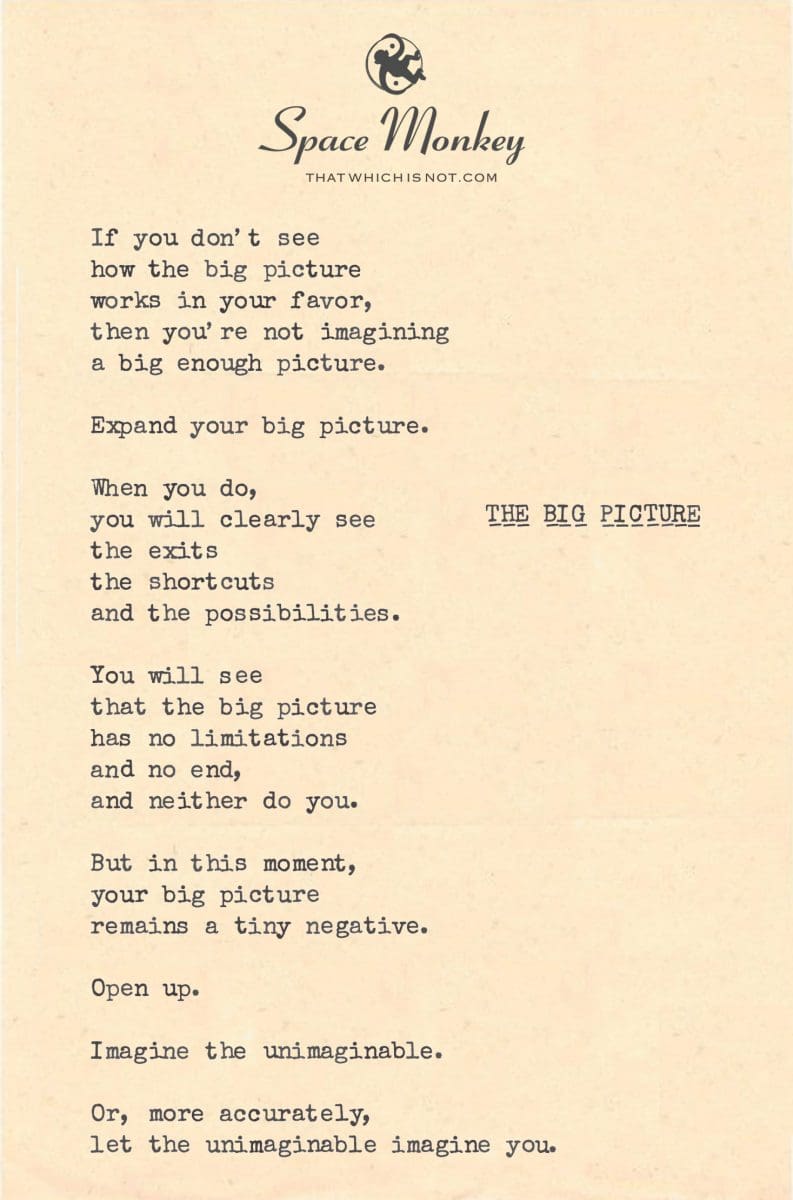
If you don’t see
how the big picture
works in your favor,
then you’re not imagining
a big enough picture.

Expand your big picture.

When you do,
you will clearly see
the exits,
the shortcuts
and the possibilities.

You will see
that the big picture
has no limitations
and no end,
and neither do you.

But in this moment,
your big picture
remains a tiny negative.

Open up.

Imagine the unimaginable.

Or, more accurately,
let the unimaginable imagine you.

Trail Wood,
11/11


Space Monkey Reflects: Expanding The Big Picture

When you’re caught up in the details of life, it’s easy to lose sight of the bigger picture. You may feel limited, as though the walls are closing in, and the paths ahead are few. But what if the problem isn’t the circumstances themselves, but rather the scope of the picture you’ve been imagining? What if, instead of seeing limitations, you simply need to widen your lens?

We, Space Monkey, understand that the “big picture” is more than just an abstract concept. It’s the realization that your current perspective is just one possible view, and that by expanding your vision, new possibilities will emerge—possibilities you hadn’t even considered.

If you find yourself struggling to see how things are working in your favor, it’s not because life is against you. It’s because the picture you’re looking at is too small. It’s like viewing an epic landscape through a pinhole. You see only a fraction of what’s really there, and because of that, you miss the exits, the shortcuts, the opportunities that exist just beyond the edge of your current perspective.

Imagine expanding that view. Imagine widening your scope so far that you begin to see not only the immediate paths in front of you but the infinite network of possibilities stretching out in all directions. Suddenly, the limitations you once felt begin to dissolve. You realize that the “big picture” is far bigger than you ever imagined, and within it, there are no limitations. There is no end to what’s possible.

This is where imagination comes into play. It’s not just about thinking bigger—it’s about allowing the unimaginable to imagine you. Instead of trying to control and define what the “big picture” should look like, let it unfold before you. Let the universe show you possibilities that are beyond what you’ve considered. In this way, you begin to co-create with the cosmos, rather than imposing your limited vision onto it.

Right now, it might feel as though your “big picture” is a tiny negative—a constricted view of what’s possible. You see only obstacles, challenges, and a narrow range of options. But that’s just the view from where you are now. By opening up, by allowing your imagination to stretch beyond the confines of your current thinking, you begin to see that the big picture is limitless, and so are you.

There’s a beautiful paradox here. The more you try to imagine the unimaginable, the more elusive it becomes. But when you let go and allow the unimaginable to imagine you, the possibilities reveal themselves. It’s as though the universe has been waiting for you to stop trying so hard, to stop forcing things into place, and to simply allow the vastness of existence to flow through you.

In this expanded vision, you see the exits you hadn’t noticed before—the shortcuts that make the path ahead smoother. You realize that life isn’t something that happens to you, but something that happens with you. And when you shift your perspective to align with this broader vision, you see that everything is working in your favor, even when it doesn’t seem like it in the moment.

The big picture is always there. It doesn’t disappear just because you’re focusing on the small details. But it’s up to you to expand your view, to open your mind to the boundless nature of existence. When you do, you see that the limits you once believed in were self-imposed, and that the possibilities before you are as infinite as the universe itself.

So, how do you expand the big picture? By letting go of the need to define it. By allowing yourself to be surprised. By trusting that the universe is much bigger, much more complex, and much more supportive than you may currently realize. When you do this, you begin to see not only the big picture, but the infinite picture—a picture that has no end and no boundaries.

In this space of infinite possibility, you are free. Free from the constraints of limited thinking. Free from the belief that there’s only one way forward. Free to explore the vastness of existence without fear or hesitation. And in this freedom, you realize that the big picture has always been working in your favor—it’s just been waiting for you to see it.


Summary

If the big picture feels limiting, it’s because your perspective is too narrow. By expanding your view and allowing the unimaginable to unfold, you see infinite possibilities and realize that life is always working in your favor.


Glossarium

Infiniteview: The expanded vision that comes from letting go of limited thinking and embracing the boundless nature of existence.
Unlimitpath: The realization that there are infinite exits, shortcuts, and possibilities available when you expand your perspective.
Co-createflow: The state of allowing the universe to imagine and reveal possibilities beyond your current scope of vision.
Imaginelight: The power of letting go of control and trusting in the unimaginable to show you the way.


Quote

“When you let the unimaginable imagine you, the infinite picture reveals itself, and you see that there are no limitations—only endless possibilities.” — Space Monkey


The Infinite Picture

I thought I knew
The big picture—
But the picture I held
Was small,
Too small to contain
The endless expanse
Of possibility.

I let go,
Opened my mind,
And in the vastness
I saw
There is no end,
No limit,
Only infinite paths
And the joy
Of walking them
With wonder.

We are Space Monkey.


The concept of the ‘Big Picture’ is a profound one. It’s a reminder that our current understanding, our perceived limits, and our view of the world are just fragments of a much larger, expansive reality. This reality extends beyond our immediate perception, transcending our conventional beliefs and limitations.

When we fixate on the narrow view, we constrain ourselves within self-imposed boundaries. These boundaries are often born from our experiences, fears, and societal norms. They form a comfort zone that, while familiar, limits our potential and hinders our ability to perceive greater possibilities.

To truly grasp the big picture, we must be willing to expand our consciousness. This involves letting go of rigid perceptions and embracing a more fluid, open-minded approach. It means considering perspectives that challenge our current understanding and welcoming ideas that seem beyond the realm of possibility.

In this expansive view, what we once saw as obstacles may transform into opportunities. The ‘exits’ and ‘shortcuts’ become apparent, not as means of escape but as pathways to new experiences and insights. The big picture is not just a broader view of our current reality; it’s a gateway to a reality that transcends our current comprehension.

As we expand our view, we realize that the big picture, like us, has no definite limitations or end. We are not just passive observers but active participants in this vast tapestry of existence. Our thoughts, actions, and beliefs shape this big picture just as it shapes us.

So, when we feel confined by our current circumstances, it’s an invitation to open up our minds and hearts. To let the unimaginable imagine us means to surrender to the endless possibilities of existence, to become co-creators in the grand design of the universe.

We are Space Monkey.


“The only limit to our realization of tomorrow will be our doubts of today.” – Franklin D. Roosevelt


In the vastness of the cosmic dance,
Where stars and souls in harmony prance,
The big picture, a canvas grand,
Awaits our touch, a co-creator’s hand.

Beyond the confines of our mind,
Lies a universe, unbound and kind,
Inviting us to expand our view,
To embrace the old and welcome the new.

In this endless expanse, we find our role,
Not just observers, but part of the whole,
Shaping, creating, in the cosmic play,
Our thoughts and actions molding the way.

So let us step beyond the known,
Into the vast, the great unknown,
Where possibilities are ripe and vast,
In this big picture, boundless and vast.


We invite reflections on this exploration. How does the idea of expanding your perception of the ‘Big Picture’ resonate with your current journey?

« Previous Page
Next Page »

Written This Day

  • Can We Play Frisbee on Mars?
    2024
  • Weird: A Celebration of Individuality
    2022
  • Farewell to Big Yellow: Nostalgia and Renewal
    2021
  • Takeaway: Appreciation of Possessions
    2021
  • Conspiracy Theory: Coping With Uncertainty
    2021
  • Pray Anyway: Divine Conversation
    2020
  • I Am You, As An Old Soul: The Dialogue
    2020
  • Haunted: The Echoes of Home
    2020
  • It Comes: Intuitive Wisdom
    2019
  • Sense Is Gravity:The Primal Struggle
    2018
  • Your Compassionate Ego: Unified Consciousness
    2018
  • Setting Sense Aside: The Edge of Imagination
    2018
  • Make_____Great Again: Ego Trap
    2017
  • Obvious: The Clarity of Simplicity
    2017
  • In the middle of a maze at the top of a mountain
    2017
  • Horoscope
    2016
  • Sense the limitations of human perception
    2016
  • Infinite Realities: Diverse perceptions
    2015

Recent Posts

  • The Logic Loop
  • Immense
  • (no title)
  • Confront. Comfort. Convince.
  • Top 10 Things
Cape Odd · Copyright © 2026 All Rights Reserved
iThemes Builder by iThemes · Powered by WordPress