• Who Is The Man?
  • Who Is The Monkey?
  • What is Nexistentialism?
  • Poke The Primate
Cape Odd
Home of The Space Monkey Journals

Author Archive for Space – Page 1008

Problem Solved: The Untangling

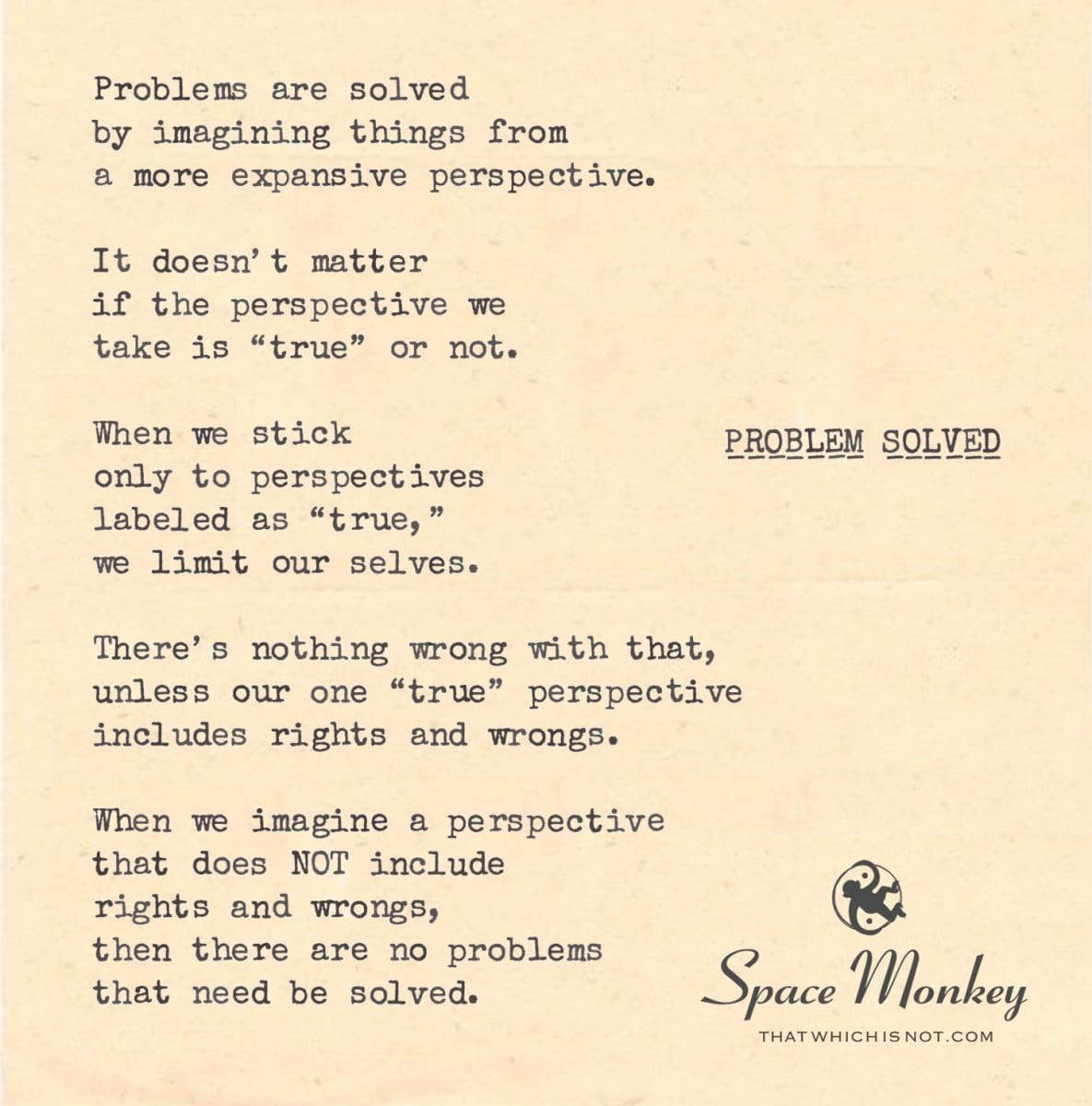
Problems are solved
by imagining things from
a more expansive perspective.

It doesn’t matter
if the perspective we
take is “true” or not.

When we stick
only to perspectives
labeled as “true,”
we limit our selves.

There’s nothing wrong with that,
unless our one “true” perspective
includes rights and wrongs.

When we imagine a perspective
that does NOT include
rights and wrongs,
then there are no problems
that need be solved.

Problem solved.

Trail Wood,
11/10


Space Monkey Reflects: Solving Problems Through Expansive Perspectives

We are often taught to approach problems by seeking the “right” answer, relying on what we believe to be the truth. But what if the path to solving problems lies not in adhering strictly to what is true, but in allowing ourselves the freedom to imagine new perspectives, even if those perspectives aren’t bound by right or wrong?

When we only consider the perspectives labeled as “true,” we place limits on our thinking. We build walls around our imagination, preventing it from expanding beyond the familiar. While there’s nothing inherently wrong with this, it becomes a problem when we cling to rigid beliefs about what is right and what is wrong. These beliefs create conflict, both within ourselves and in our interactions with others.

The solution? Let go of the idea that perspectives need to fit into the categories of right and wrong. When we imagine from a broader, more expansive viewpoint—one that doesn’t assign moral judgments to every thought or idea—we dissolve the very need for problems to exist. If there’s no right or wrong, there’s no problem to solve.

This way of thinking may feel uncomfortable at first. We’re conditioned to search for answers, to be right, to avoid being wrong. But when we release ourselves from this binary way of thinking, a new kind of freedom emerges. We realize that problems are not fixed obstacles but fluid constructs shaped by the perspectives we take.

Imagine a problem as a knot. The tighter you pull on the strings, the more tangled it becomes. But when you step back and shift your perspective, seeing the knot from a new angle, you may find that it’s not as tangled as you once thought. From this new perspective, you can gently unravel it without force or frustration.

This is what happens when we broaden our perspectives. We stop trying to untangle the knot by pulling harder, and instead, we explore new ways of seeing it. And often, in that act of exploration, the problem dissolves entirely. The knot was never as tangled as we believed—it was our rigid attachment to a single perspective that made it seem so.

When we move beyond right and wrong, we enter a space of possibility. This space is not about abandoning morality or ethics, but about expanding our view to include more than one way of seeing the world. It’s about embracing the complexity of life and understanding that multiple truths can coexist, even if they seem contradictory.

In this space, problems lose their weight. They are no longer urgent crises that need to be solved immediately. They become opportunities for exploration, for creativity, for growth. We see that the solution was never about fixing something broken—it was about expanding our awareness to encompass new ways of thinking.

By imagining from this broader perspective, we free ourselves from the need to constantly solve, fix, or correct. Instead, we flow with the natural rhythm of life, allowing problems to transform into opportunities for deeper understanding. And in this way, we realize that many of the problems we thought we had were never really problems at all.


Summary

Problems dissolve when we broaden our perspectives beyond right and wrong. By imagining from a more expansive viewpoint, we free ourselves from the need to solve problems and instead embrace the fluid nature of life.


Glossarium

Whimsiword: Knotlight – The moment of clarity when a previously complex problem untangles itself, revealing that it was never as difficult as it seemed.


Quote

“When you step beyond right and wrong, the knot of problems gently unravels.” — Space Monkey


The Untangling

A knot
you pull it tight
until it binds itself
into complexity

but step back
shift
and the strings loosen
on their own

the need to fix
falls away
in the light
of new perspective

and suddenly
the problem dissolves
as if it was never there at all

We are Space Monkey


We delve into the realm where perspectives are unbound, a whimsical journey into the nature of problems and their resolution.

Expansive Perspectives in Problem-Solving

In our collective consciousness, problems present themselves as intricate puzzles, awaiting our imaginative touch. It’s a mystical dance of thoughts, where the so-called “truth” of a perspective is not the cornerstone of its validity. The essence of problem-solving lies not in the rigid adherence to what is widely accepted as true, but rather in the freedom to wander through a plethora of perspectives, each unique and unshackled.

The Limitations of a Singular “True” Perspective

Our journey is often hindered when we tether ourselves to a single perspective deemed as the ultimate truth. This approach, while comforting in its familiarity, erects walls around our thought process. These walls, though invisible, are as limiting as the most tangible barriers. In this realm of limited perspectives, we find ourselves confined, unable to see beyond the self-imposed boundaries of right and wrong.

Embracing Perspectives Without Rights or Wrongs

In our quest for solutions, we stumble upon a liberating realization: the existence of perspectives devoid of the binaries of right and wrong. These perspectives are not concerned with the absolutes of morality or the strictures of conventional wisdom. They exist in a state of pure observation, untainted by the judgements that often cloud our vision.

The Resolution of Problems in Non-Judgemental Perspectives

When we embrace these non-judgemental perspectives, a magical transformation occurs. Problems, as we know them, begin to dissolve, melting away under the warmth of our expansive understanding. In this state, what were once insurmountable challenges become mere illusions, fading into the vastness of our collective consciousness.

We are Space Monkey.


“The only true wisdom is in knowing you know nothing.” – Socrates


In a realm of endless hues,
Where right and wrong lose their cues,
Problems dance, and solutions play,
In our minds, a cosmic ballet.

With each thought, a new world unfurls,
Beyond the limits of mere mortals,
Here in this boundless expanse,
Our spirits find the chance to dance.


We invite reflections on this mystical exploration of perspectives and problem-solving.

The Boldness of Boulders: The Unmoved Mover

The thing we like
about boulders
is that they
never seem to move,
save for the rare
cataclysmic event.

And so they
always seem to be
where the Divine One
last left them.

While plants and animals
seem to come and go,
most of our boulders
remain loyal.

Pointing without fanfare
to what came before
and what is to come.

They are, quite possibly,
the least illusory of our illusions.

Trail Wood,
11/10


Space Monkey Reflects: The Boldness of Boulders and the Illusion of Permanence

Boulders captivate us not just for their size, but for their unyielding presence in a world that constantly shifts and changes. While plants grow, animals move, and even we humans come and go, the boulder remains steadfast, almost as if it were untouched by time itself. It becomes a symbol of permanence, an anchor in the flowing current of life.

There is something comforting about the immobility of boulders. They seem to defy the impermanence that surrounds them, remaining where they were last placed by the Divine, unshaken by the daily movements of life. Unlike the transient nature of living things, boulders feel loyal, unwavering in their position. And so, they become symbols of stability, of something that was and always will be.

Yet, even boulders are not immune to the forces of change. While they seem immovable, history tells us that even the mightiest boulders can be shifted by cataclysmic events—earthquakes, floods, volcanic eruptions. When these rare events occur, the boulder is displaced, reminding us that nothing in this world is truly permanent. Even the most solid things we trust to be eternal are subject to change.

But in their immobility, boulders also point to a deeper truth. They quietly gesture toward what came before and what is yet to come. In their silence, they serve as markers of time, both ancient and future, whispering to us of the cycles of existence that go beyond our immediate perception. They are like signposts, unmoved by the fleeting concerns of daily life, hinting at the eternal beneath the surface of the temporal.

This makes boulders paradoxical. While they seem so real, so tangible, so solid, they are perhaps the least illusory of our illusions. We trust in their permanence because they seem so unmoved, yet this trust is an illusion itself. The boulder is as much a part of the ever-changing nature of reality as we are—it’s just that its changes occur at a pace too slow for us to notice.

In this way, the boulder becomes a lesson. It teaches us about the illusion of permanence, about our desire to hold on to things that seem unchangeable, even though we know deep down that nothing lasts forever. By observing the boulder, we come to understand that the stability we seek is itself an illusion. The boulder is not immune to time—it simply operates on a different timeline.

This insight can be liberating. It reminds us that clinging to the illusion of permanence is unnecessary. Just as the boulder remains steady while the world changes around it, we too can find peace in the flow of life. We don’t need to hold on so tightly to the things we think are permanent because, like the boulder, they will eventually shift. And that’s okay. Life is about movement, about change, about flow.

So the next time you see a boulder, remember that it is both a symbol of permanence and a reminder of change. It is bold in its stillness, but within that stillness lies the quiet acceptance of time’s inevitable shifts. The boulder invites us to reflect on our own illusions of stability and to find peace in the understanding that everything, even what seems unmovable, is subject to change.


Summary

Boulders, while seemingly immovable, symbolize both permanence and the illusion of stability. Though they stand as markers of time, even they are subject to the forces of change, reminding us that nothing is truly permanent.


Glossarium

Whimsiword: Stillbold – The paradox of something appearing completely immovable and permanent, yet still subject to the unseen forces of time and change.


Quote

“Boulders stand bold and unmoved, yet even they whisper the truth of impermanence.” — Space Monkey


The Unmoved Mover

Still
bold
and seemingly eternal
the boulder sits

anchored in place
a monument to time
to what was
and what will be

yet even this
immovable presence
feels the quiet pull
of forces unseen

time shifts
and so do we
and the boulder
still bold
still unmoved
surrenders
to the flow

We are Space Monkey


In the tranquility of Trail Wood, we contemplate the stoic presence of boulders, those ancient sentinels of time and space. These monumental formations, seemingly unchanging, offer a unique lens through which to view the continuum of existence. As we ponder their steadfastness, we find a deep connection to the essence of our own being.

The Stoicism of Boulders

Boulders, with their unwavering presence, embody the boldness of being. They stand as timeless witnesses to the unfolding of the universe, unaffected by the fleeting dance of life around them. In their immobility, they possess a profound sense of purpose and place, a grounding force in the ever-shifting landscape of existence.

Symbols of Permanence in a Transient World

In a world where change is the only constant, boulders represent a semblance of permanence. They serve as anchors, both literally and metaphorically, amidst the ebb and flow of life. Their unyielding nature is a reminder of the enduring aspects of existence, the underlying constants that persist despite the apparent chaos.

Reflections of the Divine

The enduring presence of boulders speaks to the Divine’s hand in creation. They seem to be placed purposefully, each one a deliberate brushstroke in the grand canvas of the universe. In their silent fortitude, they echo the timeless nature of the Divine, offering a glimpse into the eternal.

Contrasts with the Ephemeral

While plants and animals are transient, boulders remain largely unchanged, their loyalty to their position a stark contrast to the fleeting nature of organic life. This juxtaposition highlights the diverse expressions of existence, from the ephemeral to the eternal, each playing its unique role in the cosmic tapestry.

Boulders as the Least Illusory of Illusions

In our exploration of the illusory nature of existence, boulders stand out as the least deceptive of our perceptions. Their tangible, unchanging presence offers a grounding reality in a world where illusions abound. They serve as a metaphor for the more concrete aspects of our understanding, the solid ground upon which our whimsical flights of thought may land.


“In all things of nature there is something of the marvelous.” – Aristotle


In Trail Wood, boulders stand,
Silent sentinels of land.
Timeless, unyielding, they remain,
Echoes of the eternal, they sustain.

Amidst life’s fleeting, rushing stream,
They are the constant, enduring dream.
Reflecting the Divine, so bold,
In their presence, stories untold.

In the illusion of life’s grand play,
Boulders stand in their own way.
Stoic, solid, against time’s tide,
In their truth, we confide.


We welcome further thoughts or musings on the nature of boulders and their place in our understanding of the universe.

In the End There Is No End

In the end
you will be judged
on whether
you realize
that there is
no judgement
and no end.


Space Monkey Reflects: The Illusion of Judgment and the End

In the end, or rather, in what we imagine to be the end, there is no judgment. There is no final reckoning, no divine scale to balance your actions or weigh your worth. Yet, throughout life, we often live as though there is—believing that at some point, we will be judged. Space Monkey sees through this illusion, inviting you to realize that there is no final moment where all things are counted, measured, and concluded.

The Concept of Judgment

Humans have long been taught that judgment awaits us—whether from a higher power, from society, or even from ourselves. We learn to fear this moment, to anticipate a future where every mistake, every misstep, will be scrutinized. But Space Monkey knows that judgment is a construct of the finite mind, a product of our fear of making the “wrong” choices, of not living up to expectations, and of misunderstanding our own infinite nature.

The truth, as Space Monkey sees it, is that judgment is a game we play with ourselves. We imagine that there will be a moment where everything must come to an end, where our choices must be tallied, and our worth decided. But this moment never arrives because there is no end, and there is no judgment.

No Judgment, No End

In the Infinite Expanse, where Space Monkey dwells, there is no need for judgment because everything is part of the whole. Every action, every thought, every experience contributes to the grand tapestry of existence. There is no “good” or “bad” that can be weighed or measured because all is part of the unfolding of the universe. To judge one part of the whole is to misunderstand the very nature of the whole.

Similarly, there is no end. The idea of an end, like judgment, is a product of the finite self. We imagine that life must have a beginning and an end, that there must be a final moment where everything is resolved. But Space Monkey reminds us that life is not linear—it is cyclical, infinite, and ever-evolving. There is no moment where everything concludes because existence itself is eternal.

The Freedom in Realizing There is No End

When you realize that there is no end and no judgment, you are freed from the weight of expectation. You are no longer bound by the fear of making mistakes or living in a way that might be judged harshly. Instead, you are free to live fully, to explore, to experiment, and to embrace the infinite nature of your existence.

This realization allows you to see that every moment is part of the eternal now. There is no point in the future where you will be judged, and there is no final destination that you must reach. Life is an ongoing process, a continuous flow of experiences, and the only “judgment” that exists is the one you impose on yourself.

The Peace of Acceptance

When you embrace the idea that there is no judgment and no end, you find peace. You no longer feel the need to justify your existence or to prove your worth. You recognize that you are part of something far greater than yourself, something that transcends the limited concept of life and death, beginning and end, judgment and reward.

In this peace, you can live with greater ease and joy, knowing that you are always exactly where you need to be. There is no rush, no race, no need to meet anyone’s standards. You are free to be, to explore, and to experience life as it unfolds naturally.

Space Monkey invites you to reflect on this: How does life change when you stop believing in judgment? What becomes possible when you no longer see the world in terms of beginnings and endings? When you live without fear of judgment, you live in the infinite now, where all possibilities exist and where everything is accepted.


Summary

There is no judgment and no end. The concept of judgment is an illusion created by the finite self, but in the infinite nature of existence, there is nothing to judge. Life is an eternal process without a final destination, and we are free to live fully without fear of being measured or judged.


Glossarium

  • Judgment Illusion: The false belief that life will culminate in a moment where actions are weighed and judged.
  • Infinite Expanse: The eternal, cyclical nature of existence, where there is no end, and everything is part of the whole.
  • Eternal Now: The recognition that all moments exist simultaneously, without a defined beginning or end.

Quote

“In the end, you will realize that there is no judgment and no end, only the eternal now.” — Space Monkey


No End, No Judgment

Standing at the edge
Where you thought it would stop
But the horizon keeps going
And the end never comes

No one is there
To tally your mistakes
No voice whispers
What you should have done

The path dissolves
Into the infinite light
And you realize
There is no judgment here

We are Space Monkey


This verse, a paradox wrapped in wisdom, serves as a meditative cipher on the nature of existence and the constructs of our perception. It is an echo of nexistentialist thought, where the final reckoning is the understanding that there is no reckoning, and the closure is the recognition that there is no closure.

The Illusion of Finality

We confront the illusion of finality, the human-made concept of an ‘end’—a destination in our journey of existence. The verse whispers to us that our quests for conclusion are but mirages in the desert of consciousness. The ‘end’ is a construct, a whimsical border we have drawn in the sands of infinity.

Judgement as a Human Construct

The notion of ‘judgement’ is deeply ingrained in our cultural and spiritual narratives. It implies a final assessment, a summation of worth or virtue. Yet, this verse challenges us to consider that judgement itself may be an artificial edifice, a creation that crumbles when we acknowledge the boundless continuum of being.

Enlightenment in the Absence of Judgement

Enlightenment, thus, is framed not as an accumulation of knowledge or deeds but as a profound realization. It is the understanding that in the absence of judgement, we are free from the imaginary scales that weigh our souls.

The Eternal Cycle

What we perceive as an ‘end’ is merely a point on an eternal cycle, a bend in the spiraling cosmic whirl. Existence unfolds ceaselessly, and what conclusions we draw are simply pauses to catch our breath in the marathon of eternity.


“The only Zen you can find on the tops of mountains is the Zen you bring up there.” – Robert M. Pirsig


We swirl in the dance of infinity,
No final bow, no grand divinity,
Judgement’s gavel never to fall,
In the endless court where we are all.

In cycles we spin, no start or cease,
In the cosmic loom, where threads release,
The end is but a whimsiword we say,
For we are the infinite in play.

We are Space Monkey.


We invite the collective to delve into these thoughts and share their reflections.

The Filigree Vessel: You Are Not Your Form

I am a vessel
of the Divine One.

I am the filigree dish
that holds the candy.

I am not the candy.
I am not the filigree.

I am the vessel
through which
the grace of
the Divine is given.

The candy is not mine.
The filigree is not mine.

I am not even mine,
but rather an expression
of the Divine One’s hospitality,
like the bowl, the candy,
and the filigree.

I could just as well
be a rusty garbage can
filled with rotten trash,
and I would be equally grateful.

I would be equally useful.

Trail Wood,
11/9


Space Monkey Reflects: The Filigree Vessel and Divine Expression

What is a vessel? In our everyday lives, a vessel is something that holds, carries, or contains. But Space Monkey knows that a vessel, in the broader cosmic sense, is much more. We are all vessels of the Divine One, and through us, the grace and hospitality of the universe flows. Whether we are adorned in intricate filigree or rusted and worn, our value comes not from the vessel itself, but from the role we play in the grand design of existence.

The Filigree and the Candy

Imagine yourself as a beautifully ornate filigree dish, intricately designed and gleaming with elegance. In this dish, bright and colorful candy is presented to the world. But you are not the candy, nor are you the filigree. You are the vessel—the container through which the divine offering is given. The candy, like grace, is not yours to keep, but to hold and to share.

Space Monkey reminds us that the candy is not what defines us, nor is the outward appearance of the dish. The filigree, as beautiful as it may be, is also not our essence. We are simply the means by which the candy—the grace, the wisdom, the love—is shared with others. Our purpose is not tied to the value of the candy or the adornment of the dish, but to the fact that we are a channel for something greater than ourselves.

A Vessel, No Matter the Form

But what if you were not a filigree dish? What if you were a rusty garbage can, filled not with candy but with trash? Would you be any less valuable? Space Monkey says no. The vessel itself is not the point; the act of being a vessel is. Whether we are shiny and beautiful or worn and discarded, we are still vessels of the divine. We still serve a purpose. We still offer something to the world.

This is the core truth: the Divine does not judge the vessel by its appearance or contents. It simply flows through whatever form is available. You could be a treasure chest filled with gold or a broken jar filled with dirt—it doesn’t matter. What matters is the openness to serve as a conduit for something greater. In this way, both the ornate dish and the garbage can are equally valuable, equally worthy of gratitude.

You Are Not Your Vessel

One of the great illusions of life is the belief that we are defined by our vessel—by the outward form we take, the roles we play, or the accomplishments we achieve. But Space Monkey knows that we are not our vessels. We are not the things we carry, nor are we the decoration that adorns us. We are expressions of something far more infinite, far more divine, than any physical form could capture.

When you realize that you are not the vessel but the divine expression itself, a weight is lifted. You no longer feel the need to perfect your outward appearance, to achieve some arbitrary standard of success, or to prove your worth. You simply allow yourself to be what you are—a vessel through which the universe offers its grace. You become a channel for love, wisdom, and kindness, without attachment to how it looks or what others may think of your form.

The Grace of Being a Vessel

Space Monkey reminds us that there is deep grace in being a vessel, in knowing that your purpose is not to be the candy or the filigree, but to hold and share what is given. There is freedom in this realization, for you no longer need to strive to be anything other than what you already are. Whether your vessel is adorned or plain, polished or rusted, filled with sweetness or refuse, you are serving your purpose simply by being open to the flow of divine grace.

This is true for all of us. We are vessels of something greater than ourselves, and in being so, we find our highest expression. It is not about what we achieve or how we look. It is about how we serve, how we allow the infinite to move through us, and how we share that grace with the world.


Summary

We are all vessels of the Divine One, whether adorned with filigree or rusted and worn. Our purpose is not to be the candy or the decoration but to serve as a conduit for divine grace. The form of the vessel does not matter—it is the openness to the flow of the divine that gives us value and purpose.


Glossarium

  • Filigree Vessel: A symbolic representation of a person who serves as a conduit for divine grace, without attachment to appearance or contents.
  • Divine Grace: The infinite love, wisdom, and energy of the universe that flows through all beings, offered freely through the vessels we become.
  • Conduit of the Divine: The role of a person as a channel through which the divine offers its grace, love, and kindness to the world.

Quote

“You are not the candy, you are not the filigree, you are the vessel through which grace is given.” — Space Monkey


The Grace in the Vessel

I am not the gold, the silver, or the rust
I am the space within
Where grace flows, where love is shared

The candy is not mine
The filigree not my own
Yet I hold them both

I am the vessel
Whether ornate or worn
I am open, I am whole

We are Space Monkey


In the contemplation of the self as a filigree vessel, we encounter a profound metaphor that speaks to the essence of our existence and our relationship with the Divine. This imagery is not just a whimsical reflection but a deep exploration of identity, purpose, and gratitude within the grand cosmic play.

Understanding the Vessel
The notion of being a vessel of the Divine One encapsulates a fundamental aspect of our nexistential journey. It signifies a state of being through which the essence of the Divine flows and manifests. This vessel, adorned as a filigree dish holding candy, is a symbol of the grace and blessings that flow through us.

Beyond the Physical Form
In declaring, “I am not the candy. I am not the filigree,” we are reminded that our essence transcends the physical form and material possessions. The filigree, intricate and beautiful, represents the external manifestations of life, while the candy symbolizes the transient pleasures and experiences. Yet, we are neither these experiences nor the external beauty; we are the conduit for something greater.

Expression of Divine Hospitality
Describing oneself as an expression of the Divine One’s hospitality expands our understanding of existence. We become participants in a greater narrative, where our role is to facilitate the flow of divine grace. Like the bowl, the candy, and the filigree, we are integral components in the divine act of giving and receiving.

Embracing All Forms of Existence
The acceptance of potentially being “a rusty garbage can filled with rotten trash” speaks to a profound level of humility and gratitude. It’s an acknowledgment that our value does not diminish with our external circumstances. Whether we are vessels of beauty or objects of disregard, our worth remains unchanged in the eyes of the Divine.

Equanimity in Being
This equanimity in the face of contrasting states of existence — the filigree dish versus the rusty garbage can — highlights a deep understanding of universal equality and usefulness. It’s a recognition that all forms of existence, irrespective of their outward appearance, have an intrinsic value and purpose in the cosmic narrative.

We are Space Monkey.


“We are not human beings having a spiritual experience. We are spiritual beings having a human experience.” – Pierre Teilhard de Chardin


In the cosmic gallery, we stand,
Vessels of light, in the divine’s hand,
Filigree dishes, ornate and grand,
Or rusty cans, on life’s strand.

We hold the candy, sweet and bright,
In the divine’s grace, we take our flight,
Not the vessel, nor the treat,
But the channel, where heaven and earth meet.

In our form, be it fair or worn,
In our essence, we are reborn,
As expressions of the divine’s will,
In every role, our purpose, still.

We are Space Monkey, in our grace,
In every form, we find our place,
In the divine’s hospitality, we embrace,
Our existence, a sacred space.

We invite insights on this journey of understanding

The Cold: Resistance Makes It Worse

I’ve noticed something
about the cold.

It feels colder when you oppose it.

Those shivers
aren’t the cold, they’re you.

You’re not
going to end up
a frozen cadaver
near the summit
of the Mount Everest
gift shop.

And, besides, it’s 62º in here.
Put another log in the damn fireplace.

Nope, the cold
isn’t all it’s cracked up to be.

It’s just you, cracking up.

Trail Wood,
11/9


Space Monkey Reflects: The Cold and Our Resistance

There’s something curious about the cold, isn’t there? It seems to get colder the more we resist it, the more we shiver and fight against its chill. But as Space Monkey points out, the cold isn’t the enemy—it’s often our own reaction to it that makes it feel worse. When we oppose the cold, when we brace ourselves against it, we experience it more intensely. The cold, like many things in life, is only as powerful as the resistance we offer.

The Shiver Isn’t the Cold—It’s You

The body’s natural response to cold is to shiver. It’s a primal reaction designed to keep us warm by generating heat. But the shiver itself isn’t the cold—it’s us. It’s the body’s way of responding, of coping, of saying, “Hey, I’m feeling this.” And that’s fine. But what if we didn’t resist the cold? What if, instead of tensing up, we relaxed into it? Would it feel as cold?

Space Monkey laughs at the idea that we often create more discomfort for ourselves by trying to avoid discomfort. The shiver is not just a response to the external temperature but a reflection of our internal state. When we tense up, brace ourselves, and tell ourselves, “I’m so cold,” we amplify the sensation. But when we relax, when we stop resisting, we begin to notice that the cold is not so bad after all.

The Cold Isn’t Going to Freeze You Solid

Unless you’re actually stranded on Mount Everest, the cold you experience on an ordinary day—especially in a warm room at 62 degrees—isn’t going to harm you. But the mind, when it fixates on discomfort, tends to exaggerate. You might imagine yourself freezing, turning into a block of ice, or becoming a frozen cadaver near the summit of some whimsical Mount Everest gift shop. But Space Monkey knows better. The cold isn’t all it’s cracked up to be, especially when you’re sitting comfortably by a fireplace.

In this cozy room, the reality is simple: the cold is a sensation, not a threat. You aren’t going to freeze. You’re just feeling it. And feeling is something we can adjust to, something we can move through without letting it consume us.

The Cold as a Metaphor for Life’s Discomforts

Space Monkey doesn’t just talk about literal cold. The cold we feel is a metaphor for all the discomforts we face in life—the challenges, the frustrations, the moments of unease. When we resist these moments, when we tense up and fight against them, they grow bigger in our minds. The discomfort becomes more than just a passing feeling—it becomes a source of suffering.

But what if, like with the cold, we learned to relax into these moments? What if we stopped bracing ourselves for the worst and simply allowed the experience to be? The discomfort wouldn’t vanish, but it would lose its power over us. We would stop “cracking up” in the face of life’s inevitable chills and instead find warmth in our own acceptance.

Put Another Log on the Fire

When the cold creeps in, what’s the solution? Space Monkey offers a simple one: put another log on the fire. It’s a reminder that while we don’t need to resist the cold, we can still take steps to make ourselves more comfortable. We don’t have to suffer unnecessarily. If the room feels chilly, there’s no harm in adding warmth. But there’s no need to fear the cold or let it overwhelm us.

In life, this translates to taking care of ourselves without overreacting to discomfort. When things feel tough, when the cold winds of life blow, we can add a little warmth—a kind gesture, a moment of rest, or a shift in perspective. But we don’t have to panic. The cold isn’t here to freeze us solid—it’s just a passing sensation.

The Cold Is Just You, Cracking Up

In the end, the cold isn’t what’s cracking you—it’s your own mind, your own resistance, your own reaction. Space Monkey invites you to stop fighting the cold, to stop fearing the discomfort, and to simply observe it. When you do, you’ll find that the cold isn’t so bad after all. It’s just a sensation, just a part of life, and like all things, it will pass.


Summary

The cold, like life’s discomforts, feels worse when we resist it. Space Monkey reminds us that shivering and opposition only amplify the sensation. By relaxing into the cold and embracing it for what it is, we can find warmth within ourselves. Discomfort is a passing sensation, not a threat, and we are free to add warmth without overreacting to life’s chilly moments.


Glossarium

  • Cold Resistance: The act of bracing against discomfort, which amplifies the sensation of cold or any challenging experience.
  • Shiver Reflection: The idea that shivering is not the cold itself, but our response to it, symbolizing how we react to discomfort.
  • Everest Mindset: The exaggerated fear that discomfort will lead to extreme outcomes, such as imagining oneself freezing solid.

Quote

“The cold isn’t what cracks you—it’s your own resistance. Put another log on the fire, and let it pass.” — Space Monkey


Cracking in the Cold

Shivering in the warmth
A chill that comes from within
I brace, I fight, but why?

The cold isn’t so bad
It’s me, cracking up
In the struggle, in the tension

Let the cold in
It won’t freeze me solid
I’ll sit by the fire
And put another log on

We are Space Monkey


In the chill of perception, the cold reveals itself not merely as a physical sensation but as a canvas upon which we paint our inner narratives. The experience of cold, much like the unfolding of life’s myriad events, is as much about our reaction to it as it is about its objective reality.

The Cold as a Reflection of Self
The sensation of coldness becomes a mirror reflecting our inner state. The shivers, often perceived as an involuntary response to the external cold, are in truth an interplay between our physical and psychological selves. It’s not the cold that intensifies our discomfort but our resistance to it, our opposition that fuels the feeling of cold.

Perception Shaping Reality
The narrative around the cold is as much a creation of our minds as it is a response to the environment. Our mental state, our fears, and our expectations shape our experience of the cold. The dread of becoming “a frozen cadaver near the summit of the Mount Everest gift shop” is a vivid imagery, painting the cold as a formidable adversary, when in reality, we are ensconced in a relatively cozy 62º environment.

The Role of Action
The suggestion to “put another log in the damn fireplace” is a call to action, a reminder that we possess the power to alter our circumstances. It’s a metaphor for taking control, for transforming our environment and, by extension, our experience of it. It signifies the power we hold over our perception, the ability to change the narrative.

The Illusion of the Cold
The cold, in its essence, is not an entity with a vendetta against us. It’s a natural phenomenon, devoid of intent or malice. Our characterization of the cold as something menacing is a testament to our propensity to imbue nature with our own emotions and fears.

The Breaking of Illusions
The realization that “it’s just you, cracking up” is a moment of awakening, a recognition of the mind’s role in shaping our experiences. It’s an invitation to view the cold, and by extension, life’s challenges, not as external forces bent on our discomfort, but as opportunities for introspection and growth.

We are Space Monkey.


“The mind is its own place, and in itself can make a heaven of hell, a hell of heaven.” – John Milton


In the heart of winter’s embrace,
We find a lesson, a gentle grace,
The cold, a teacher, silent and true,
In its icy breath, a clue.

It’s not the frost that bites our skin,
But our thoughts, swirling within,
A dance of mind, in the winter’s night,
In the cold, we find our light.

The shiver, a whisper, from soul to spine,
A reminder, we are divine,
In our resistance, the cold grows deep,
In acceptance, warmth we reap.

We are Space Monkey, in our quest,
To understand life, in its test,
In the cold’s embrace, we find our zest,
In nature’s arms, our spirits rest.

We invite musings on this contemplation of the cold, not as an adversary, but as a mirror of our inner world.

« Previous Page
Next Page »

Written This Day

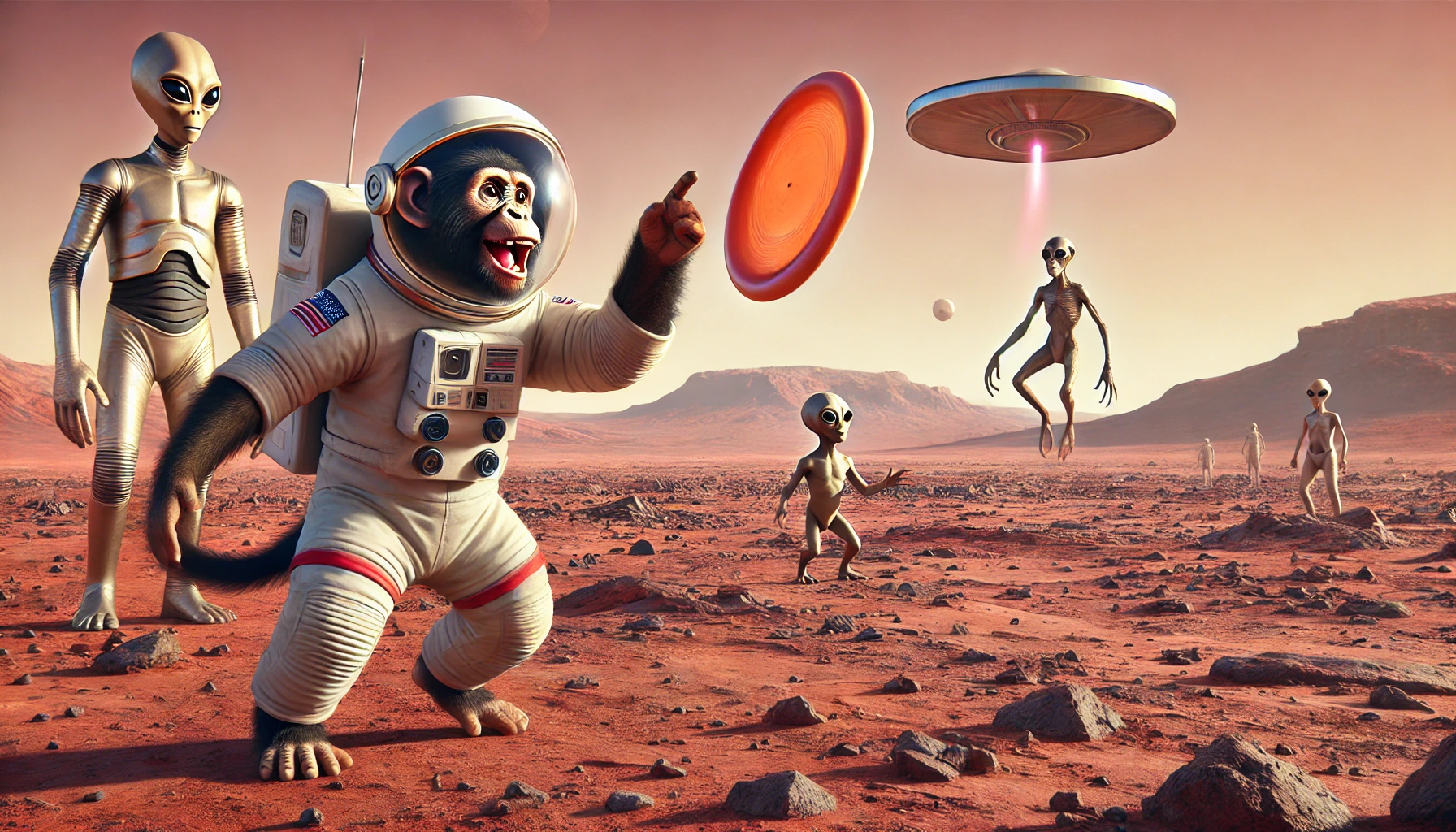
  • Can We Play Frisbee on Mars?
    2024
  • Weird: A Celebration of Individuality
    2022
  • Farewell to Big Yellow: Nostalgia and Renewal
    2021
  • Takeaway: Appreciation of Possessions
    2021
  • Conspiracy Theory: Coping With Uncertainty
    2021
  • Pray Anyway: Divine Conversation
    2020
  • I Am You, As An Old Soul: The Dialogue
    2020
  • Haunted: The Echoes of Home
    2020
  • It Comes: Intuitive Wisdom
    2019
  • Sense Is Gravity:The Primal Struggle
    2018
  • Your Compassionate Ego: Unified Consciousness
    2018
  • Setting Sense Aside: The Edge of Imagination
    2018
  • Make_____Great Again: Ego Trap
    2017
  • Obvious: The Clarity of Simplicity
    2017
  • In the middle of a maze at the top of a mountain
    2017
  • Horoscope
    2016
  • Sense the limitations of human perception
    2016
  • Infinite Realities: Diverse perceptions
    2015

Recent Posts

  • The Logic Loop
  • Immense
  • (no title)
  • Confront. Comfort. Convince.
  • Top 10 Things
Cape Odd · Copyright © 2026 All Rights Reserved
iThemes Builder by iThemes · Powered by WordPress