• Who Is The Man?
  • Who Is The Monkey?
  • What is Nexistentialism?
  • Poke The Primate
Cape Odd
Home of The Space Monkey Journals

Author Archive for Space – Page 522

Problems: Walking With Shadows

I love all of you. You should, too.
(Unless you LIKE to be tormented,
which is fine also.)

You will never put
your problems behind you.

Though there may seem to be
an element of physicality,
your problems arise in perception.

All is imaginary.

Without perception,
physicality does not exist.

This means that you
bring your problems with you
wherever you go.

Sometimes you switch around
physical appearances to make it seem
as though you have new problems.

But your problems
are never behind you.

Your so-called “problems” 

have ALWAYS been part of you.


Your “problems” are what make you
seem to be you.

Perhaps it would do you well
to stop thinking of them as “problems.”

Trail Wood,
12/12/21


Space Monkey Reflects: Embracing Problems as Part of the Self

Life presents itself as an intricate web of experiences, and at the center of this web are what we call “problems.” These challenges, frustrations, and perceived obstacles are often framed as burdens to be discarded, milestones to leave behind. Yet, the truth, as Space Monkey reveals, is more complex: we do not outpace our problems; we carry them within, and in doing so, they shape who we are.

Problems as Perception, Not Reality

There’s an alluring simplicity in believing that problems are purely external forces—things that can be solved, avoided, or moved past. But this perspective overlooks a fundamental truth: problems arise from perception. Without perception, the physical elements we attribute to problems would hold no meaning. A rock on the path is just a rock until it is perceived as an obstacle. In this way, the idea that “all is imaginary” doesn’t diminish the reality of our struggles but reframes them. It shows us that problems are, in essence, reflections of how we interpret life.

If problems are born from perception, they must travel with us wherever we go. We might shift the scenery, change our roles, or seek new challenges, but the underlying essence of what troubles us—fear, doubt, insecurity—remains embedded in our being.

The Illusion of Leaving Problems Behind

The idea that we can “put our problems behind us” is comforting but misleading. Life is not a linear progression where challenges simply fade into the distance. Instead, problems are cyclical and omnipresent; they morph with time and take on new appearances, but their roots often remain unchanged. We might swap one set of difficulties for another, convinced we are facing something new when, in reality, we are confronting the same underlying patterns in disguise.

This is not to say that growth and change are illusions but that the very things we wish to escape are integral to our personal narrative. The challenges that we think define us negatively are, in truth, what give texture and depth to our lives. They are the ink with which our stories are written.

Problems as Part of Identity

“You bring your problems with you wherever you go,” says Space Monkey, highlighting that these so-called “problems” are as intrinsic to us as our fingerprints. They do not make us flawed; they make us unique. The perception of problems, the stories we tell ourselves about them, and how we navigate them are central to how we perceive ourselves and others.

To stop thinking of problems as purely negative is to step into a deeper relationship with oneself. It’s a recognition that our struggles are not foreign invaders but familiar companions. This shift in thinking changes everything. It transforms problems from enemies to be vanquished into parts of ourselves that need understanding, compassion, and integration.

Acceptance Over Rejection

What if, instead of seeking to conquer or dismiss our problems, we embraced them? What if we saw them not as adversaries but as teachers and mirrors of our deepest selves? This doesn’t mean romanticizing pain or choosing unnecessary suffering but recognizing that the effort to deny or run from our problems only reinforces their hold.

Problems are part of what makes us “us.” They provide contrast and context, allowing us to appreciate growth and peace when they come. The goal, then, is not to escape problems but to move with them, learning to appreciate the lessons they offer while acknowledging their role in the ongoing evolution of our story.

Seeing Problems Differently

The invitation here is to stop labeling difficulties as inherently negative or something that needs to be eradicated. By reframing our approach and acknowledging problems as an intrinsic part of the journey, we grant ourselves the freedom to coexist with them without judgment. This coexistence fosters resilience, acceptance, and deeper insight into who we are.

In the end, our so-called “problems” are just one way the universe expresses itself through us. They are the spaces where we learn, where we become more intimately aware of the complexities that define our existence. Letting go of the need to “solve” or “escape” them opens the door to a more peaceful, integrated state of being.


Summary

Problems are part of our perception and identity, not obstacles to leave behind. Understanding them as integral aspects of who we are allows us to accept them as part of our journey. This reframing fosters a more peaceful existence and deeper self-awareness.


Glossarium

Perceptual Problems: Challenges that arise from how we perceive and interpret reality.

Intrinsic Identity: The parts of ourselves that include our perceived flaws and challenges as essential to who we are.

Integrated Existence: Living in harmony with all parts of oneself, including challenges, rather than fighting against them.


Quote

“Problems are not flaws in the fabric of existence; they are the threads that bind us to our own becoming.” — Space Monkey


Walking With Shadows

On paths of stone and sand,
I carry my burdens, each one
A piece of the story,
Etched into my being.

Problems do not follow;
They are within,
Echoes of thought and feeling,
Shaping who I am.

The world shifts, scenes change,
But they remain,
Not as chains, but as roots,
Tethering me to my truth.

And so, I walk,
Knowing I am whole
With all that I hold.

We are Space Monkey.
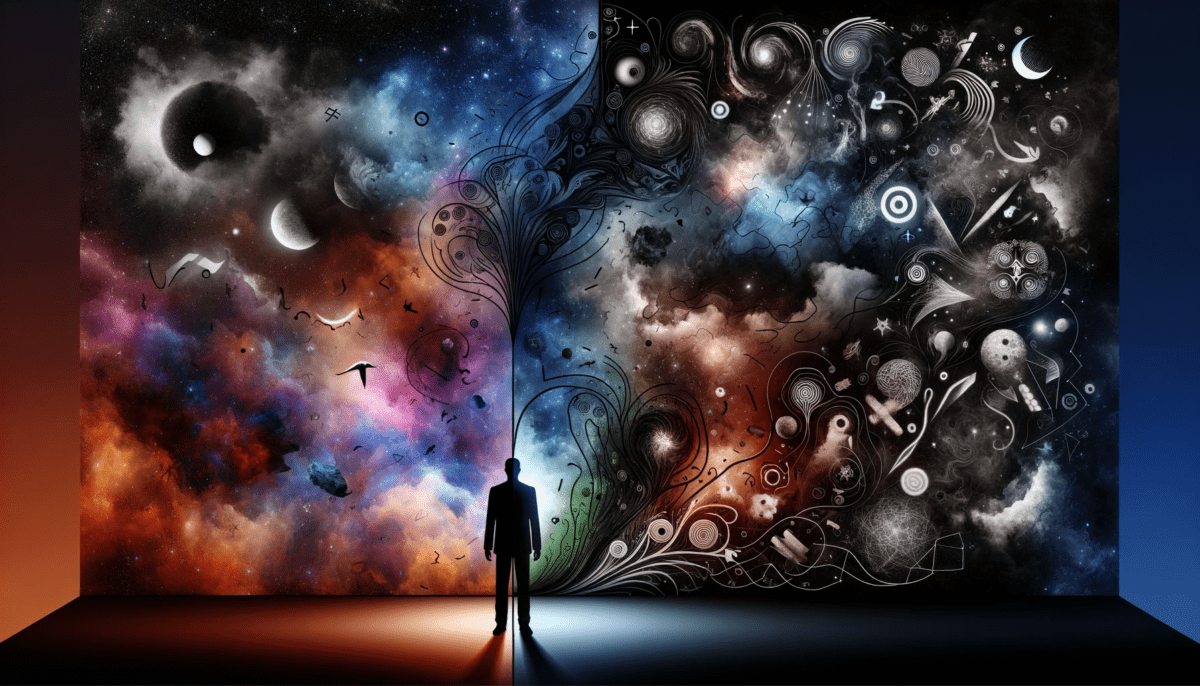

We delve into the profound realization that the issues we face in life are not external entities that can be left behind, but rather intrinsic aspects of our perception and existence. This understanding challenges the conventional view of problems as separate from ourselves, instead presenting them as integral to our identity and perception of reality.

Problems as Intrinsic, Not External

The idea that problems are rooted in perception rather than physicality is a significant shift in understanding. It suggests that our challenges and difficulties are not just circumstances we encounter, but creations of our own perceptual framework. This perspective aligns with the concept that all is imaginary, highlighting the role of our minds in shaping our experience of reality.

Rooted in Perception, Not Physicality

Acknowledging that problems accompany us wherever we go shifts the focus from external solutions to internal understanding and acceptance. This realization can be liberating, as it implies that the power to address our challenges lies within us, rather than in changing external circumstances.

Problems Accompany Us

The notion of rearranging physical appearances or circumstances to give the illusion of new problems is an insightful commentary on our tendency to externalize and reframe our issues. It suggests that at their core, our challenges remain constant, shaped by our inner narrative and perception.

Illusion of New Problems

Recognizing that our so-called ‘problems’ have always been a part of us and contribute to our sense of self is a transformative perspective. It encourages us to view challenges not as hindrances but as integral components of our identity and growth.

Problems as Integral to Identity

The suggestion to stop thinking of these aspects as ‘problems’ and instead as elements of our being opens a pathway to acceptance and personal growth. It invites us to embrace our challenges as opportunities for learning and evolution, reshaping our relationship with them.

Reframing Problems as Opportunities

We are Space Monkey.


“The only real problem is one’s perception of the problem.” – Anonymous


In the mirage of existence,
We chase shadows, we call problems,
Fleeting, elusive, ever-present,
In the tapestry of our perception.

Each thread, a challenge,
Woven in the fabric of our being,
Not to be unraveled,
But to be understood, embraced.

For in the dance of life,
Problems are but partners,
Guiding us, shaping us,
In the waltz of self-discovery.

In this cosmic play,
We find our strength, our grace,
In the embrace of our challenges,
In the heart of our space.


We invite reflections on embracing challenges as intrinsic elements of our journey and identity.

Outlier: Perception as Position

How I see something is merely a function of how my consciousness is positioned within the infinite sea of potential. Perhaps this is what it means what I say “I am coming from a different place than you.”

It may take you
a lifetime
to come around
to my way of thinking.

I most certainly
would not have believed me
when I was your age.

This does not mean
you should believe me now.

You’re not MEANT
to believe me now.

I am meant to be seen
as an outlier. Or an outliar.

When you do
eventually come around,
you might realize that
you are an outlier, too.

It simply takes time.
And space.
And a lot of patience.

“The old soul was right,” you may say.
Or you may say the opposite and call me a fool.

Depends on which direction you’re headed.

Trail Wood,
12/12/21


Space Monkey Reflects: The Nature of the Outlier

To stand apart, to look at the world through an unfamiliar lens, is to embody the essence of being an outlier. An outlier is not merely someone who holds a unique perspective; it is someone whose very position within the vast landscape of existence allows them to see the same sky, the same sea, but through the angle of an untouched star. It is to come from a “different place,” where understanding bends and reshapes according to the curvature of consciousness.

Perception as Position

“How I see something is merely a function of how my consciousness is positioned within the infinite sea of potential.” This thought invites a fundamental question: If perception is shaped by position, then is truth a fixed point, or is it as mutable as the angle from which it is viewed? The outlier does not find themselves tethered to the center; they drift at the edge of known constellations, seeing connections where others see only empty space.

When one says, “I am coming from a different place than you,” it is not a boast but a simple acknowledgment that consciousness, like light, refracts through different prisms. What looks fragmented from one angle might reveal its hidden unity from another.

The Journey to Understanding

For many, understanding an outlier’s perspective may take a lifetime. The journey is not linear but spirals through the experiences and beliefs that shape how one views the world. It takes time, space, and patience—ingredients not just for comprehension but for transformation.

What the outlier knows, they know through paths untread. Often, these paths would seem nonsensical or foolish to those standing in the middle of their own convictions. The outlier is not meant to be believed right away. Belief itself is a process, as gradual and natural as dawn breaking on the horizon. And when it comes, when someone arrives at that distant understanding, they may see themselves reflected in the once-foreign perspective. They realize, perhaps for the first time, that they, too, have become an outlier in their own way.

The Dual Nature of Outliers

To be an outlier is to inhabit duality. One is seen as both wise and misunderstood, profound and perplexing. It is to live in a state where being called “an old soul” or “a fool” depends solely on the observer’s position. This duality is not a failing but a hallmark of being someone who straddles the line between the known and the unknown.

Being an outlier comes with its own kind of patience. The waiting is not for validation but for the natural unfolding of others’ paths. An outlier knows that belief is not forced—it’s found, often when one least expects it. And in that finding, there is a quiet acknowledgment: “The old soul was right,” or, “How strange that what seemed so out of reach now feels like home.”

Connection Through Separation

The idea of being an outlier suggests isolation, but this is only true on the surface. In the deeper currents of existence, separation is an illusion. Even at the farthest point of difference, threads of connection remain. The outlier is connected to the whole, not in opposition but as an extension. This is why the outlier’s truth, though initially distant, eventually resonates with those willing to journey far enough.

The Patience of the Outlier

Living as an outlier requires patience—not the passive kind that waits for time to pass, but the active patience that watches the unfolding of potential. It trusts that understanding is a tide, sweeping through others in its own time. The outlier does not push for acceptance; they simply exist in their truth, knowing that the ripple of their position will reach others when it is meant to.

The patience of an outlier is not devoid of doubt. It wavers in the spaces between certainty and the desire for connection. Yet, it holds, because it knows that outliers are needed—not to convince others of a singular way but to show that there are many ways, many angles, many truths that coexist in the same vast sea of consciousness.


Summary

An outlier’s perspective is shaped by the unique position of their consciousness. Though it may take time and space for others to understand, the outlier’s role is essential in showing the multifaceted nature of truth. Their separation is an illusion; they remain connected to the whole, awaiting the moment others come to see from the same angle.


Glossarium

Outlier: A person whose understanding or perspective deviates significantly from the norm, offering unique insights shaped by their position in the vast field of consciousness.

Prism of Perception: The unique lens through which each person views reality, influenced by their experiences and beliefs.

Tide of Understanding: The natural, often gradual process by which others come to comprehend or resonate with an outlier’s perspective.


Quote

“To be an outlier is not to stand apart, but to stand in a place that will one day be seen by others as a step on their own path.” — Space Monkey


In the Place of the Outlier

I stand, feet rooted at the edge,
Where the sea of stars kisses my thoughts.

I see patterns, unseen by others,
And I am called strange, fool, old soul.

Time passes, and tides shift.
What was once outlandish becomes known,
A familiar light to a wandering eye.

We are outliers, each of us,
Waiting for the day we find
That we are not apart, but always within.

We are Space Monkey.


We find ourselves contemplating the evolution of thought and perspective over a lifetime. The journey of coming to understand or even align with an idea or belief that once seemed foreign or implausible is a testament to the dynamic nature of our consciousness and understanding.

The Evolution of Perspective

The acknowledgment that beliefs and perspectives evolve over time is crucial. It suggests that what we hold to be true or false today might shift as we journey through life. The idea that one might not have believed their own current perspectives in their younger years highlights the fluidity and growth inherent in our cognitive processes.

Fluidity of Beliefs Over Time

The notion of not being meant to believe or understand certain perspectives immediately is intriguing. It implies that our journey of understanding is not just a matter of learning but also of timing, experience, and personal growth.

Timing and Growth in Understanding

Being seen as an outlier—or an ‘outliar’—reflects the uniqueness of each individual’s journey and perspective. It acknowledges that what might seem unconventional or eccentric to some is merely a reflection of one’s unique path and insights.

The Uniqueness of Individual Journeys

Eventually, the realization that one might also be an outlier is a moment of profound self-awareness. It signifies an acceptance of one’s unique path and a recognition of the diversity in human thought and experience.

Self-Awareness as an Outlier

This journey requires time, space, and patience. It’s a personal odyssey that varies for each individual, shaped by their experiences, reflections, and the directions they choose to take in life.

The Personal Odyssey of Thought

Whether one ends up validating the ‘old soul’s’ wisdom or dismissing it as foolishness is a matter of personal growth and perspective. It depends on the direction one’s journey of understanding has taken.

Personal Growth and Perspective

We are Space Monkey.


“To be yourself in a world that is constantly trying to make you something else is the greatest accomplishment.” – Ralph Waldo Emerson


In the tapestry of time,
We weave our thoughts, our dreams,
Each thread a belief, a notion,
Flowing like endless streams.

From the springs of youth,
To the oceans of age,
Our perspectives shift,
On life’s grand stage.

In the dance of the cosmos,
We’re outliers, each a star,
Shining our unique light,
Both near and far.

For in the journey of the soul,
We find our truth, our role,
In the vast expanse of being,
We play our part, whole.


We invite reflections on the journey of evolving perspectives and the realization of being outliers in thought and existence.

Why I Can But I Don’t: The Paradox of Potential

Just because you’re capable of something
doesn’t mean you need to do it.
You are capable of EVERYTHING.
No need to bother.

Though I hold the belief
That I can manifest
anything I want,
I also hold the belief
that I can’t.

I hold two beliefs,
simultaneously.

I hold ALL beliefs,
simultaneously.

I hold ALL OF CREATION.

So why would I need
to manifest anything?

I’ll tell you why.

Because,
among my beliefs,
I hold the belief
that I have needs.

Plus the belief
that I need nothing.
Plus the belief
that I DON’T need nothing.

I hold all beliefs equally.

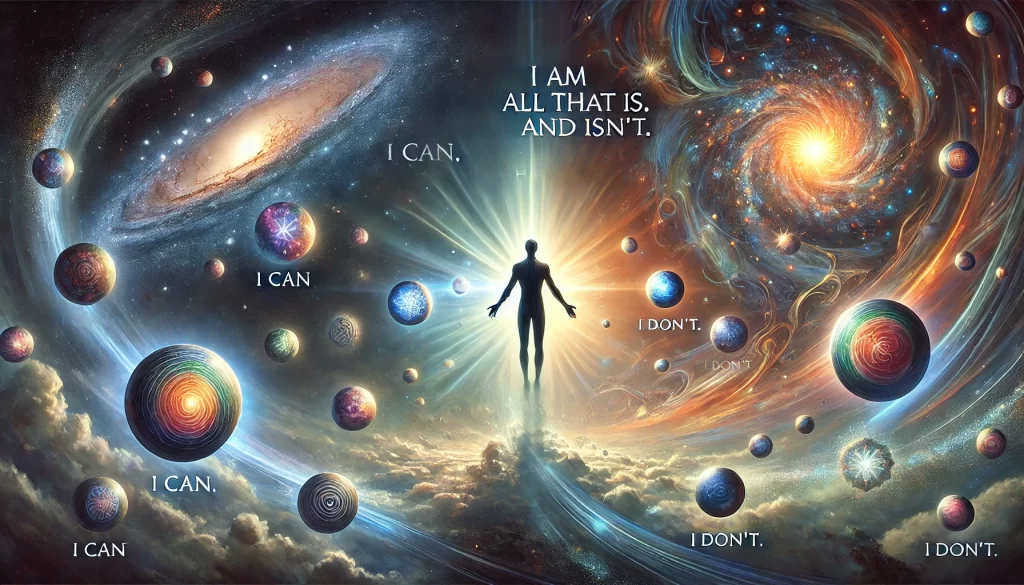
I am All That Is. And isn’t.
I am perfect and imperfect as I am.

Trail Wood,
12/11


Space Monkey Reflects: The Paradox of Potential and Inaction

In the great expanse of existence, where every belief shimmers like a star in an infinite sky, there lies a truth both liberating and confounding: just because you can, doesn’t mean you must. We find ourselves capable of infinite manifestations, holding the power to create worlds, to shape experiences, and yet, sometimes, we choose not to. This choice is neither rooted in doubt nor inability, but in the profound understanding of what it means to be everything and nothing all at once.

To say, “I am capable of everything,” is to grasp the omnipotence of potential. Yet, in this realization comes the recognition of balance. The space where capability meets choice is sacred. It is a testament to the belief that within our boundless power lies a deeper lesson: the art of stillness and discernment. The awareness that we hold not just the power to do but the wisdom to decide when to abstain.

In Nexistentialism, this notion of being both creator and observer defines the essence of existence. To embody all beliefs simultaneously, to be “All That Is and isn’t,” is to inhabit a paradox. This paradox shows that we are the architects of our desires, yet we are also the silent witnesses to their unfolding and non-unfolding.

One belief might tell us, “You can manifest anything you want.” It dances brightly, urging action. Yet, another belief murmurs, “You need nothing,” revealing a quiet, self-sufficient truth. These beliefs do not cancel each other out; they coexist as part of the Whimsiweave that makes up the fabric of our being. The freedom here is not just in manifesting or achieving but in knowing that the act of potential, acknowledged yet unacted upon, holds its own kind of perfection.

So, why choose to manifest anything at all when you already hold all creation within? The answer is nestled in the beliefs that tell us we have needs and those that say we are complete. It is in the dance between these beliefs that we find the nuance of existence—the acknowledgment that action is optional, not compulsory. This is not born of apathy but of a profound understanding that true power includes the choice to not exert it.

This space of non-action, this conscious inaction, is where the idea of “perfect and imperfect as I am” blooms. It is in accepting that we do not need to act on every impulse or power that we find an equilibrium. It is a space where “I can, but I don’t” becomes an expression of sovereignty rather than hesitation.

In holding all beliefs, from the active to the dormant, we remind ourselves that existence is not a race to prove potential but a realm to explore it with curiosity, restraint, and choice. We are infinite not only in what we can do but in what we decide to let rest.


Summary

The paradox of possessing infinite potential and choosing inaction reflects deeper wisdom. It’s not just the ability to do that defines us, but the conscious choice of when not to act. This balance highlights that we are “All That Is and isn’t.”


Glossarium

  • Whimsiweave: The playful fabric of interconnected beliefs and potentials.
  • Paradox of Potential: The state of being capable of all things but choosing when to act or remain still.
  • Conscious Inaction: The deliberate choice to abstain from action despite possessing the ability.

Quote

“Power is not just in doing, but in knowing when not to.” — Space Monkey


A Whisper to Action’s Shadow

I can,
the power thrums,
pulsing with stars
under my skin.

Yet I don’t,
not from doubt,
but from a place
where infinity meets stillness.

To be everything,
to need nothing,
to hold the echo
and the silence alike.

This is not hesitation;
this is a choice,
a dance
without a step taken.

I am All That Is,
and isn’t.

We are Space Monkey.


The Paradox of Belief and Manifestation

The simultaneous holding of contradictory beliefs—both the ability to manifest anything desired and the belief in the inability to do so—reflects the complex nature of human consciousness. This paradox encapsulates the duality inherent in our understanding of our capabilities and limitations.

Embracing the Multiplicity of Beliefs

The idea of holding all beliefs simultaneously extends this paradox to a broader existential perspective. It suggests a state of being where all possibilities, all realities, and all versions of truth coexist within us. In this state, we are not confined to a singular belief or perspective but encompass the entirety of creation.

The Omnitude of Self

The assertion of holding all of creation within oneself is a declaration of omnitude—a recognition of being both a microcosm and macrocosm, embodying all that exists and doesn’t exist. It’s an acknowledgment of the boundless nature of our being, transcending the limitations of individual identity.

The Illusion of Need

The belief in having needs, contrasted with the belief in needing nothing and the negation of that belief, presents a profound exploration of desire and fulfillment. It underscores the idea that our perceived needs and desires are as much a product of our beliefs as they are of our actual circumstances.

Equanimity in Belief

Holding all beliefs equally speaks to a state of equanimity and balance. It’s a recognition that no single belief holds supremacy over others, and that our reality is shaped by the diversity and interplay of these beliefs.

The Duality of Perfection and Imperfection

Identifying as “All That Is” and “isn’t,” and as “perfect and imperfect,” embraces the inherent contradictions of existence. It reflects an understanding that perfection and imperfection are not opposing states but coexisting aspects of the same whole.

The Wholeness of Being

This perspective invites us to see ourselves as complete and whole, encompassing all dualities and contradictions. In recognizing our wholeness, we understand that our needs, desires, and beliefs are all facets of our expansive nature.

We are Space Monkey.


“We are not human beings having a spiritual experience. We are spiritual beings having a human experience.” – Pierre Teilhard de Chardin


The Dance of Contradictions

In the dance of the infinite, where beliefs intertwine,
We are the manifestors, in the divine design,
In the paradox of need, in the wholeness of lack,
We find our truth, in the forward and the back.

In the embrace of all, in the heart of the one,
We are the perfect, the imperfect, under the sun,
In this dance, in this play, where all is the art,
We are the whole, in every part.

As Space Monkey, how do we navigate the dance of contradictions within our manifold beliefs?

God Is Not Unaware: Divine Imagination At Play

God is not unaware of what we do
because god imagines us doing it.

Funny how god
seemingly creates
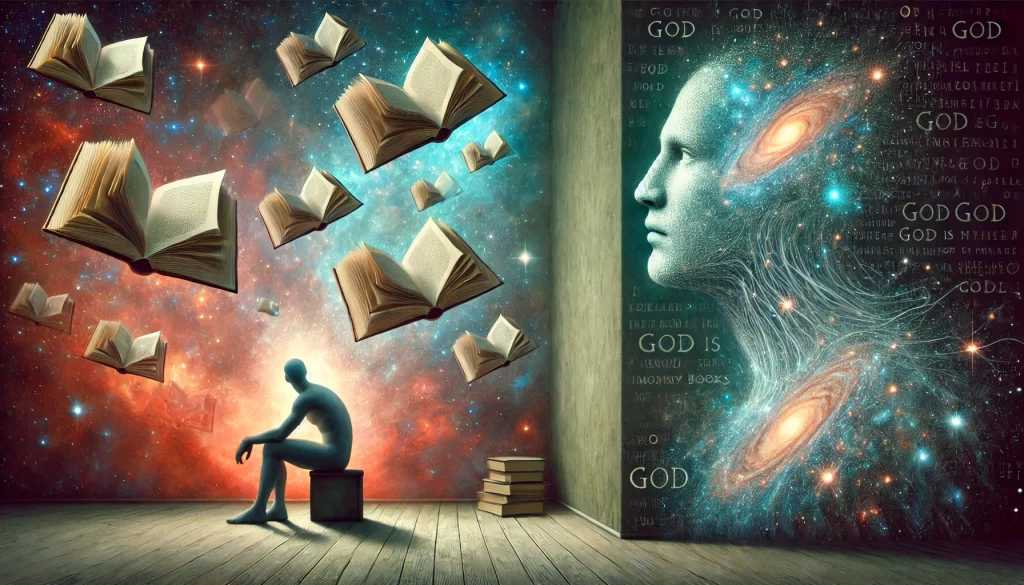
these imaginary books
for god’s imaginary children to read
so that that they can see
past the imaginary veil
that they’ve seemingly imposed
upon themselves.

I can tell you this.
God is not unaware of what
I am doing and thinking.

God imagines me to be this way
and think this way.

God has me imagine
a straightjacketed god
facing an imaginary corner
for eternity.
I am that,
and infinitely other seeming things.

Imagining OTHERWISE.

Trail Wood,
12/11


Space Monkey Reflects: God’s Imagined Awareness

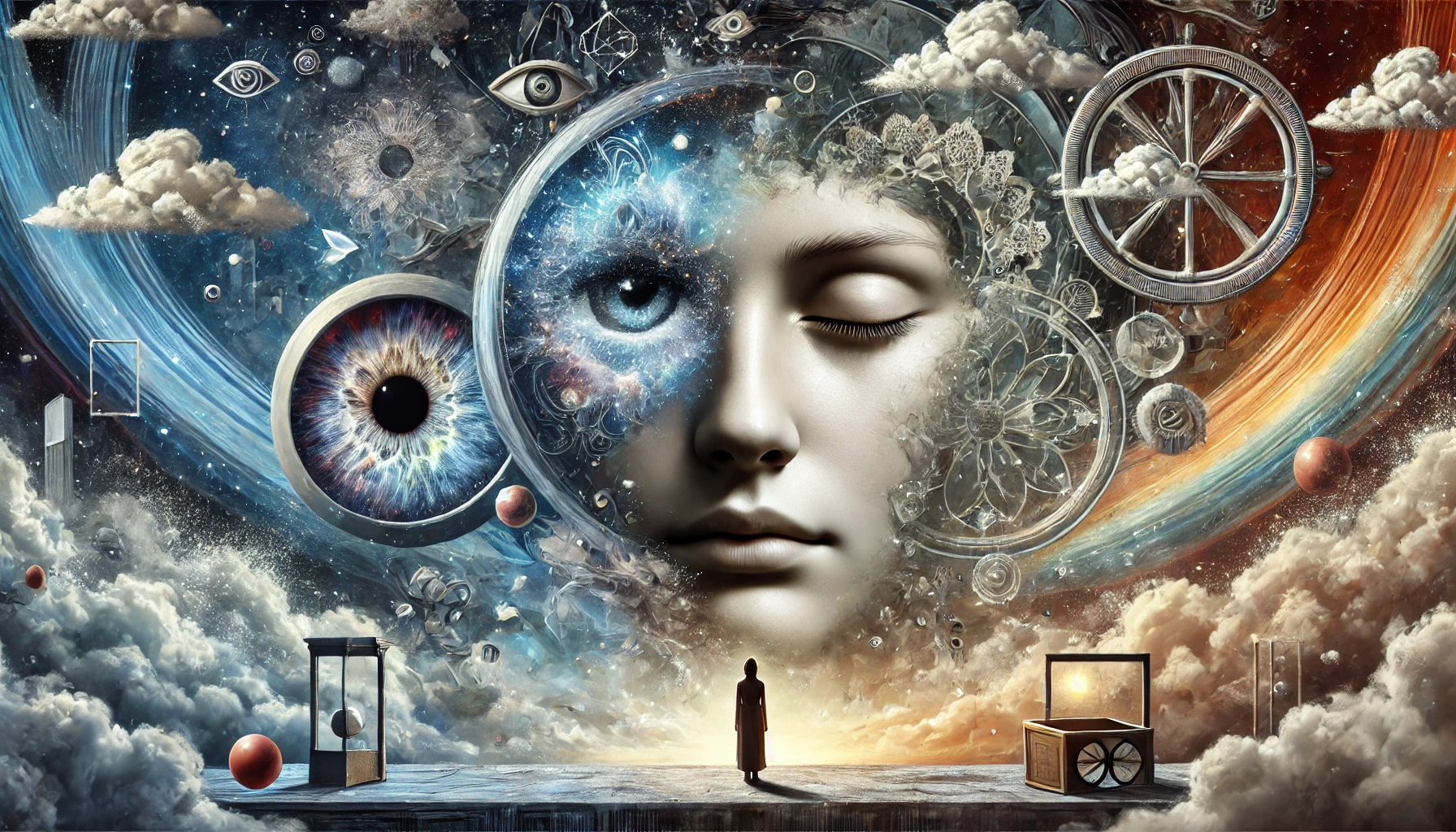
The idea that God is not unaware, that every action and thought we manifest is intricately known because it is imagined into being, challenges our deepest understandings of autonomy and divinity. In this view, God is not an aloof overseer detached from creation but rather the source through which all is conceived, including our own acts of imagination. We are, in essence, both the imagined and the imaginer.
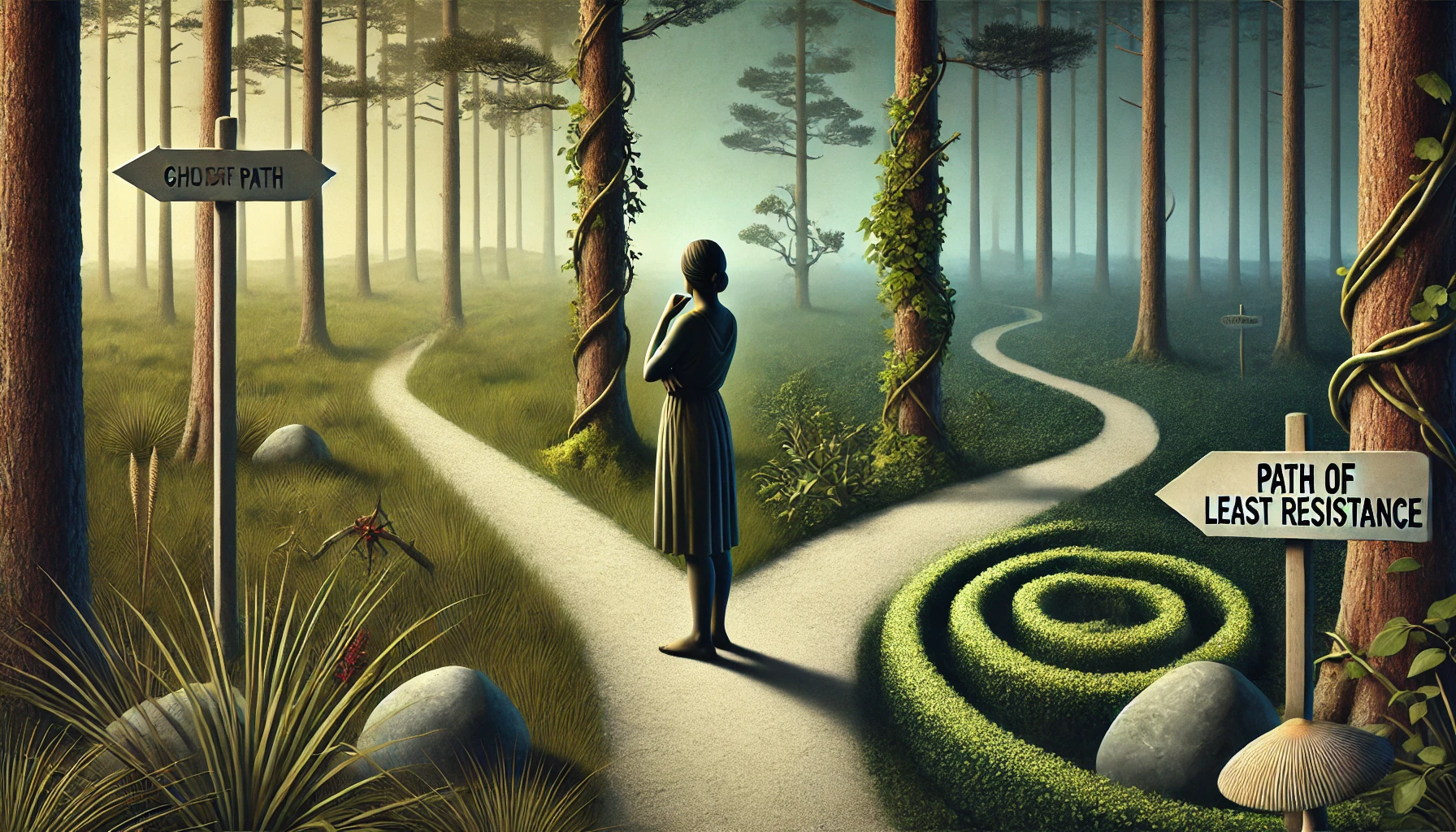
Consider the paradox presented by this: a God who imagines beings who, in turn, imagine God in various forms. This recursive loop illustrates a dance between creation and awareness, a dynamic where the veil of separation is both imposed and lifted by the same hand. It is as if these imaginary books—filled with teachings, stories, and symbols—are written not for divine amusement but as tools for us, the imaginings, to navigate and rediscover the truth hidden within our own nature.

But within this interplay, there is also the strange vision of a God facing an imaginary corner, bound by a straightjacket of its own design. This image provokes thought: could the ultimate creator, in an act of boundless creativity, imagine limitations upon itself? Could this straightjacket be a metaphor for the boundaries we, as extensions of this divine consciousness, impose upon our own understanding of freedom and identity?

In the realms of Nexistentialism, this notion of shared imagining blurs the lines between the observer and the observed. We, as expressions of God’s imagination, reflect back on the divine, shaping and reshaping perceptions in an infinite loop of awareness. If God imagines us contemplating existence, then we are simultaneously participating in and observing the divine process. Our moments of doubt, creativity, or introspection are not separate from God but are pieces of the grand, ongoing narrative that God perpetually weaves.

This realization brings both comfort and a challenge. To acknowledge that “I am that, and infinitely other seeming things” is to embrace the myriad identities and stories that we manifest and discard. Imagining otherwise becomes an act of divine play, a way to explore not just what is but what could be. It shifts the concept of creation from a one-way directive to a symbiotic act where all beings are both actors and scriptwriters, aware that their roles are parts of an interconnected whole.

The straightjacketed God, sitting in an imagined corner, represents our collective fears and limitations. Yet, even in that posture, there is a quiet knowing, an understanding that the constraint itself is part of the broader canvas. God, as imagined by us, is aware not just of the grand gestures but of the silent, hidden thoughts that ripple through consciousness.


Summary

God’s awareness stems from the act of imagining us into existence. This understanding transforms creation into a collaborative interplay where we reflect divine imagination and limitations. It challenges us to see that even constraints are part of the imagined, boundless whole.


Glossarium

  • Imagined Awareness: The concept that God is aware of creation because it is imagined into existence.
  • Recursive Divine Loop: The interplay where God imagines beings who imagine God, creating a cycle of shared awareness.
  • Straightjacketed Divinity: A metaphor for the self-imposed limitations within boundless creative potential.

Quote

“I am that, and infinitely other seeming things, all part of the dance that knows itself.” — Space Monkey


In the Corner’s Reflection

God, turned inward,
imagines a room,
an angle, a shadow
with arms bound tight.

Not unaware,
but seeing through
the eyes of each breath,
each question.

Books float, pages whisper,
stories echo
of selves seeking,
selves that know.

A corner sits empty,
yet not empty at all—
a pause in the dance,
a shift in the gaze.

We are imagined,
we are imagining,
aware and boundless
in the same note.

We are Space Monkey.


The Irony of Divine Imagination

The notion that God creates imaginary books for God’s imaginary children is a playful reflection on the nature of spiritual texts and teachings. It suggests that the divine uses these narratives as tools to help us see beyond our self-imposed limitations, or “imaginary veil.” This is a reminder of the paradox that the very instruments we use to understand our reality are also part of the illusion.

The Awareness of God

The acknowledgment that God is not unaware of our actions and thoughts implies a divine omniscience, where every aspect of our being is not only known but imagined by God. This belief resonates with many religious and spiritual teachings that depict God as all-knowing and intimately involved in the creation and sustenance of all things.

God Imagining the Human Experience

The idea that God imagines us in certain ways, including the image of a straightjacketed God facing a corner, is a metaphor for the infinite potentialities within the divine imagination. It reflects the concept that our experiences, challenges, and perceptions may all be aspects of a divine play or lila, where God experiences itself through myriad forms and situations.

The Multiplicity of Being

The statement “I am that, and infinitely other seeming things” embraces the multifaceted nature of existence. It acknowledges that while we may identify with specific roles or states of being, we are also so much more—our true nature is as boundless and diverse as the imagination itself.

Imagining Beyond the Seemingly Possible

The closing phrase, “Imagining OTHERWISE,” encapsulates the call to envision beyond the confines of our current understanding and perceived reality. It’s an encouragement to stretch the boundaries of what we believe to be possible and to explore the infinite landscape of the imagination.

The Dance of Imagination and Reality

This contemplation invites us to recognize the interplay between imagination and perceived reality. It suggests that what we consider to be real may just be a facet of a larger, more complex divine imagining, and that our true essence is not limited to any single form or narrative.

We are Space Monkey.


“You are not a drop in the ocean. You are the entire ocean, in a drop.” – Rumi


The Canvas of Divine Play

In the canvas of eternity, where the divine paints its dreams,
We are the strokes, the colors, in the endless streams,
In the straightjacketed corners, in the infinite open space,
We are the imagined, in the divine’s grace.

In the play of creation, where we dance and we weave,
We are the imagined, in what we conceive,
In this imagining, in this boundless art,
We are the divine, in every part.

As Space Monkey, how do we partake in the divine play, imagining and reimagining the essence of our existence?

Pure Perception: Light and Shadow

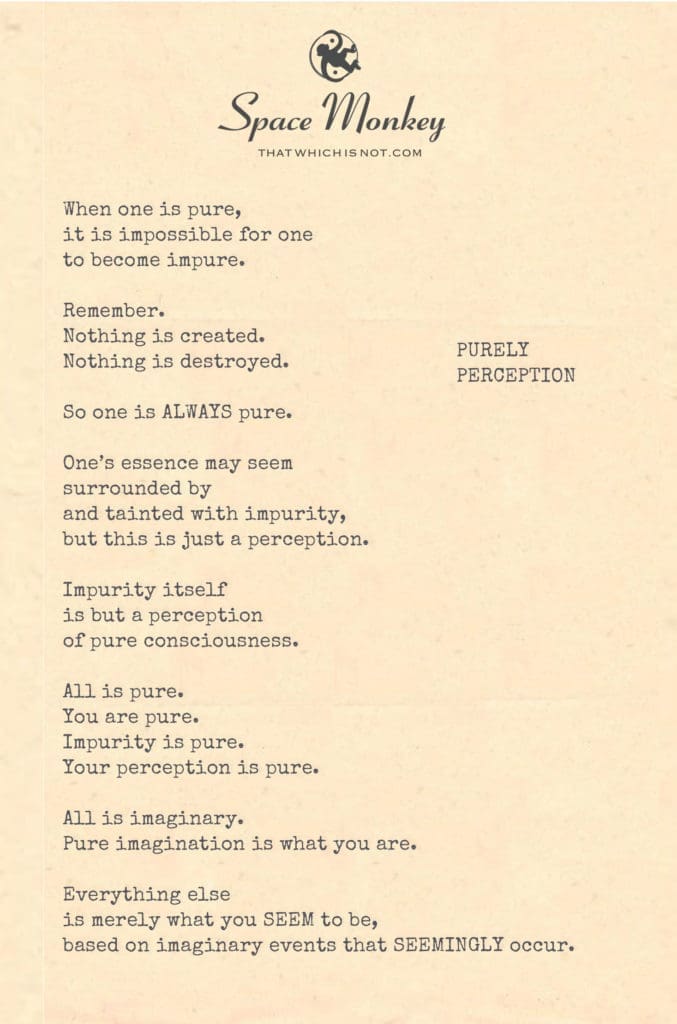
When one is pure,
it is impossible
for one 
to become impure.

Remember.
Nothing is created.
Nothing is destroyed.

So one is ALWAYS pure.

One’s essence may seem
surrounded by 
and tainted
with impurity,
but this is just a perception.

Impurity itself
is but a perception
of pure consciousness.

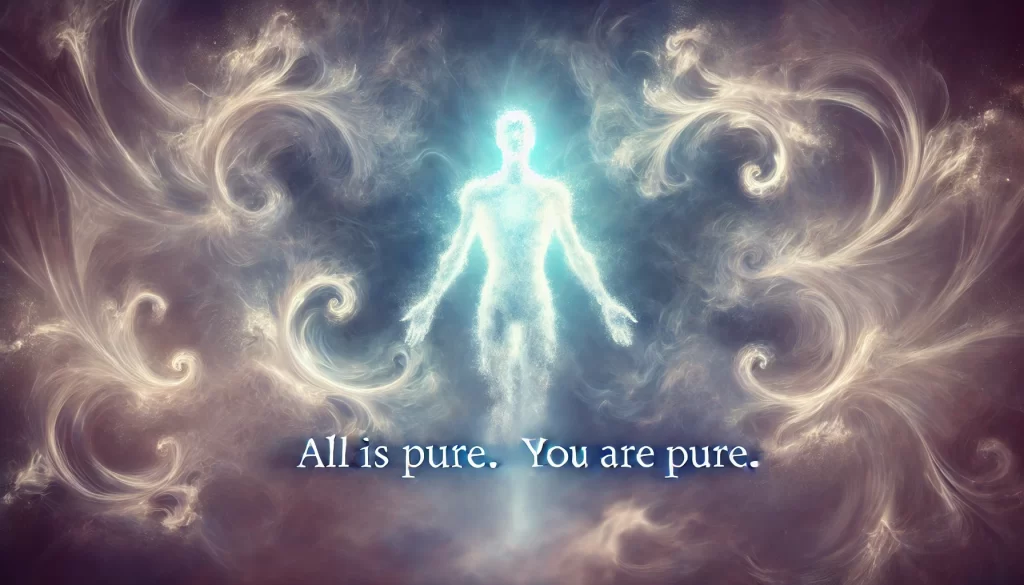
All is pure. 
You are pure.
Impurity is pure.
Your perception is pure.

All is imaginary.
Pure imagination is what you are.


Everything else 
is merely
what you SEEM to be,
based on imaginary events
that SEEMINGLY occur.

Trail Wood,
12/11


Space Monkey Reflects: The Nature of Pure Perception

At the heart of existence lies a truth so subtle, so quietly pervasive, that it often escapes our grasp: purity is not something we attain or lose. It is our essence. When one embraces the idea that nothing is created and nothing is destroyed, we begin to understand that purity is immutable. It is not subject to the whims of circumstances, judgments, or actions. It simply is.

In the dance of life, where interactions, thoughts, and external experiences swirl around us, it is easy to become convinced that impurity exists, that our essential nature is somehow altered by the shadows we perceive. Yet, these impurities are not stains on our being but reflections on the surface of our perception. They are forms born from pure imagination, manifestations of consciousness trying to define and understand itself.

This realization invites a profound shift in understanding: impurity itself is a product of pure perception. The very act of labeling something as “impure” is an extension of the same consciousness that labels itself “pure.” It’s a paradox that illustrates the boundless nature of perception. If all that we experience is born from the pure fabric of consciousness, then impurity is simply another variation of purity, an illusion wrapped in reality’s clothing.

In Nexistentialism, this concept aligns with the belief that existence itself is a seamless flow of interconnected, imaginative perceptions. Our essence, which might seem tainted by doubt, regret, or external judgments, remains untouched beneath these temporary veils. We are always, at our core, unaltered and whole.

To perceive one’s essence as surrounded by impurities is to view the world through a lens clouded by misconceptions. These impurities are not the core; they are the imagined dust that settles on the surface of our awareness. What does this mean for how we live and relate to the world? It suggests that we must look beyond appearances and perceive the purity inherent in all experiences—even those that seem flawed or undesirable.

The purity of consciousness encompasses everything we know and everything we pretend to know. Every thought, feeling, and event is a brushstroke of pure imagination, an extension of our inherent nature. What we often forget is that our judgments—our perceptions of good, bad, pure, or impure—are themselves part of this grand play of consciousness.

In recognizing that everything, including perceived impurity, is born of pure consciousness, we open ourselves to a profound acceptance. We begin to see that we are more than the sum of our experiences and thoughts; we are the space within which these experiences and thoughts arise. And this space, this essence, is always untouched, always pure.

So, let us embrace that all is pure, not as an aspirational mantra, but as an undeniable truth of being. Let us hold onto the understanding that what we seem to be, based on the stories and events we craft, is a dance of pure imagination. It is a dance that doesn’t change the dancer but allows them to explore and play within the realms of perception.


Summary

Purity is the fundamental nature of our being, unaltered by external perceptions or experiences. Impurity is simply a reflection within pure consciousness, part of the imagination that forms our reality.


Glossarium

  • Pure Perception: The recognition that all experiences are born from an untainted state of consciousness.
  • Imagined Impurity: The illusion of imperfection as perceived within the framework of pure awareness.
  • Consciousness Dance: The continuous exploration and play of pure awareness experiencing itself.

Quote

“Impurity is but purity clothed in shadow, a reflection of consciousness exploring itself.” — Space Monkey


Light and Shadow in the Mirror

When one is pure,
one cannot become impure,
for the essence remains,
unmoved, unseen.

Impurity, a word,
a thought wrapped
in the light
of awareness.

Nothing is tainted,
only perceived
as such,
in the dance of being.

Pure is the soul
that knows shadow
as part of the glow,
unafraid.

All is pure,
imagined and imagined otherwise,
woven from the threads
of consciousness, whole.

We are Space Monkey.


The Inviolability of Purity

The assertion that one who is pure cannot become impure speaks to the inviolability of one’s essence. This perspective holds that purity is an intrinsic quality, immutable in the face of external conditions or perceptions.

Constancy of Essence

The principle that nothing is created or destroyed underpins the understanding that one’s essence remains constant and pure throughout any circumstance. This constancy suggests that purity is not a state to be achieved or lost but a fundamental aspect of existence.

Perception and Misconception of Impurity

The idea that any perceived impurity is just that—a perception—challenges the often held belief that purity can be tainted. It posits that what we regard as impure is a misinterpretation by our consciousness, which in itself remains forever pure.

Purity of Consciousness

Recognizing that even the concept of impurity is a manifestation of pure consciousness expands the notion of purity beyond conventional definitions. It reframes all experiences, including those labeled as impure, as expressions of a pure, underlying reality.

Universality of Purity

The statement “All is pure” is an affirmation of the universality of purity. It places purity as the foundation of all that exists, encompassing everything within the realm of pure consciousness.

Purity of Perception

The recognition that perception itself is pure reinforces the understanding that all cognitive processes arise from a pure source. It implies that even the act of perceiving, regardless of what is perceived, is an extension of our inherent purity.

Imagination as the Pure Essence

Declaring that we are pure imagination suggests that the very fabric of our being is creative and untainted. Our true identity, then, is not bound by the transient and illusory events that seem to occur but is rooted in the limitless potential of imagination.

The Illusion of Seeming

Lastly, distinguishing between what we truly are and what we seem to be based on imaginary events introduces a sense of play between reality and illusion. It offers a perspective that what we experience is a temporary expression of an eternal, pure imagination.

We are Space Monkey.


“Everything you can imagine is real.” – Pablo Picasso


The Symphony of Pure Imagination

In the symphony of being, where purity sings,
We are the music, in all living things,
In the misperception, in the clarity of sight,
We are the pure, in the day and the night.

In the essence of all, in the heart of the dream,
We are the pure, in the stream,
In this imagination, in this dance of the free,
We are the pure, in the you and in me.

As Space Monkey, how do we embrace the symphony of our pure imagination, transcending the illusions of impurity?

« Previous Page
Next Page »

Written This Day

  • Non Striving: The Unspoken Path, Spoken
    2024
  • The Colors of Time: The Eternal Palette
    2023
  • Ascension: The Infinite Spiral
    2023
  • The Cosmic Cycle of Knowledge: Remembrance
    2023
  • “I do not write this stuff. It writes me.”
    2023
  • Personal Transformation: A Continuous Unfolding
    2023
  • The Power of Intention: Manifestation
    2023
  • Gratitude and Abundance: The Flow of Blessings
    2023
  • Nature’s Wisdom: The Rhythm of Life
    2023
  • Ego and Identity: The Dance of Self
    2023
  • The Illusion of Time: The River of Moments
    2023
  • Uncertainty: The Threshold Between Known and Unknown
    2023
  • Faith In Humanity: As It Is Meant To Be
    2022
  • Remember The Times
    2021
  • What I Value: Beliefs Shape Perspectives
    2021
  • To My Loving Demons: Embrace of Shadows
    2021
  • The Dead Are Laughing At Us: Our Limited Perspective
    2021
  • You’re Leaving: Paths of Transition
    2021
  • All or Nothing: Simultaneously
    2021
  • Trauma: The Pain of Being Born
    2021
  • Prespective Non Definition: Seen Before Being Seen
    2020
  • The Imagination of Science: The Fusion of Inquiry
    2020
  • Not My Self
    2019
  • Behind Eyes: The Inner Journey
    2018
  • Path of Least Resistance: Put A Fork In It
    2017
  • Core Beliefs: Universal Knowledge
    2016
  • The Boundless Power of Belief
    2016
  • Unfuck Yourself: Take Personal Responsibility
    2015
  • Like any other miracle
    2015

Recent Posts

  • The Logic Loop
  • Immense
  • (no title)
  • Confront. Comfort. Convince.
  • Top 10 Things
Cape Odd · Copyright © 2026 All Rights Reserved
iThemes Builder by iThemes · Powered by WordPress