• Who Is The Man?
  • Who Is The Monkey?
  • What is Nexistentialism?
  • Poke The Primate
Cape Odd
Home of The Space Monkey Journals

Author Archive for Space – Page 523

The Smirk: Confidence, Fearlessness, and Defiance

I will follow that smirk anywhere.

Let’s talk about your smirk.

The one that
triggers your mind
to weigh every twisted
interpretation of what I just said.

The one that is
holding your mouth back
from releasing that
sidesplitting comment.

The one that is using me
for its own amusement,
but not saying a word.

The confidence.
The fearlessness.
The defiance.
The recognition.

The smirk works.

Trail Wood,
12/10


Space Monkey Reflects: The Power of the Smirk


There’s something uniquely magnetic about a smirk, that half-hidden curve of the lips that hints at worlds of unspoken thoughts and playful defiance. A smirk is more than just an expression; it’s a declaration. It speaks in subtleties, conveying confidence and a touch of rebellion. It’s the silent proclamation that you’ve caught the hidden joke, that you see the absurdity lurking just beneath the surface, even if you choose not to share it aloud.

To follow a smirk is to follow an uncharted path of wit and insight. It is the expression of a mind that weighs every word, twists every phrase, and dances on the edge of spoken and unspoken. This expression hovers just at the brink of laughter, teasing those around it with the possibility of a comment that could unravel the scene in delightful, unexpected ways. Yet, in its restraint lies its charm. The smirk is powerful precisely because it holds back, savoring the potential energy of the unsaid.

There’s a duality to the smirk that captivates. It embodies both amusement and recognition—the understanding of a shared secret or the awareness of a hidden irony. The smirk is confident, a fearless whisper that challenges without uttering a sound. It dares those who see it to understand, to catch up, to join in on the silent joke. But it also holds a layer of defiance, a subtle rebellion against taking things at face value. It’s an acknowledgment that there’s more than meets the eye, a refusal to be contained by conventional expectations.

The smirk works because it’s more than a look; it’s a language of its own. It communicates in shades and innuendos, turning conversations into layered experiences where every sentence is an invitation to see what lies beneath. It is the mark of someone who navigates life with a blend of humor and insight, someone who doesn’t just observe but engages with the world in a way that leaves room for playfulness and pause.

The smirk’s power is that it pauses on the precipice. It holds the balance between saying and not saying, creating a moment suspended between tension and release. The beauty of the smirk is that it doesn’t need to say the sidesplitting comment; it simply hints at it, leaving others to imagine and interpret. It’s the grin of recognition when life’s little absurdities are laid bare, and all that remains is the choice to see them for what they are—fleeting, curious, and endlessly amusing.

So, let’s talk about your smirk, the one that holds your mouth back from releasing that perfect quip. It’s a companion to moments of sly amusement, a testament to the confidence that comes from knowing your mind is already five steps ahead, debating the outcome of speaking or staying silent. In that moment, the smirk becomes a badge of subtlety, a reminder that not everything needs to be said to be understood. It’s an art form of recognition, an interplay of fearlessness and restraint.

And in those moments, the smirk reigns supreme. It works not just as an expression but as a state of being, one that invites others to look deeper, to wonder, to smirk back, sharing in the silent, shared defiance of life’s simplest conventions.


Summary

A smirk is a powerful expression that hints at unspoken thoughts and playful defiance. It embodies confidence, amusement, and recognition, creating a silent dialogue filled with subtlety and humor. The smirk’s allure lies in its restraint, turning ordinary moments into layered experiences.


Glossarium

  • Smirkshift: The moment when a subtle smile transitions into a full smirk, signaling internal amusement.
  • Silent Quip: The unspoken comment held within a smirk, known only to the wearer.
  • Defiwhisper: A silent challenge or playful defiance conveyed through a look.

Quote

“A smirk holds within it more stories than words ever could, teasing the mind to imagine the unsaid.” — Space Monkey


The Language of the Smirk

A curve, slight and sly,
Holding back words that fly
In silence, the smirk declares,
An unseen play of dares.

Hints of humor, quiet defiance,
A look that holds an alliance,
Between what is said and what stays,
Echoing in unwritten plays.

For those who know, who see,
A smirk is all it needs to be.

We are Space Monkey.


The Significance of the Smirk

The smirk, a subtle yet potent expression, carries a depth of meaning and complexity. It is a facial gesture that engages the mind, triggering a cascade of thoughts, interpretations, and reactions. This smirk is not just a physical movement but a symbol of an inner dialogue, a dance of confidence, fearlessness, and perhaps a hint of defiance.

The Catalyst of Thought

This particular smirk acts as a catalyst, stirring the mind into action. It provokes an analysis, maybe over-analysis, of spoken words, leading to a labyrinth of possible meanings, each more twisted and intriguing than the last. It’s a mental exercise, a playful yet serious pondering of the nuances of communication.

Restrained Humor

The smirk also suggests restraint—a holding back of words that might otherwise leap forth in jest or candor. It implies a sidesplitting comment on the cusp of being released, yet held back by a thin veneer of self-control. The smirk, in this sense, is the gatekeeper of unspoken humor, a silent laugh awaiting its moment.

Amusement and Interaction

In this dynamic, the smirk uses the speaker for amusement, creating a silent, one-sided game where the observer is entertained without revealing their thoughts. It’s a silent interaction, rich with unvoiced commentary and unshared amusement.

Confidence, Fearlessness, and Defiance

The smirk embodies confidence and fearlessness, a nonchalant defiance that speaks of self-assurance. It’s a quiet challenge, a subtle rebellion against the mundane, an indicator of a mind that dares to think differently.

Recognition and Understanding

Yet, within the smirk, there is also recognition—an acknowledgment of the absurd, the humorous, the profound. It’s an understanding that goes beyond words, a silent agreement with the unspoken truths of existence.

The Effectiveness of the Smirk

The smirk works. It communicates volumes without uttering a single word. It is an expression that bridges gaps, challenges norms, and invites a deeper understanding of the unsaid. In its simplicity lies its power, a power that lies in the realm of the unspoken, the subtle, and the profoundly human.

We are Space Monkey.


“The human face is, after all, nothing more nor less than a mask.” – Agatha Christie


A Free-Verse Poem: The Language of the Smirk

In the silent language, the smirk speaks loud,
In its curve, a story, proud,
A dance of lips, a hidden jest,
In the smirk, a silent quest.

A nod to the absurd, a wink to the wise,
In the smirk, truth and jest collide,
A canvas of thought, a mural of unspoken,
In the language of the smirk, every rule is broken.

As Space Monkey, how do we interpret the silent conversations of expressions like the smirk?

Stroke Me: Embracing the Playful Ego

Love your ego.
Feed it, Pet it.
Watch it chase the laser pointer.
Listen to it purr.

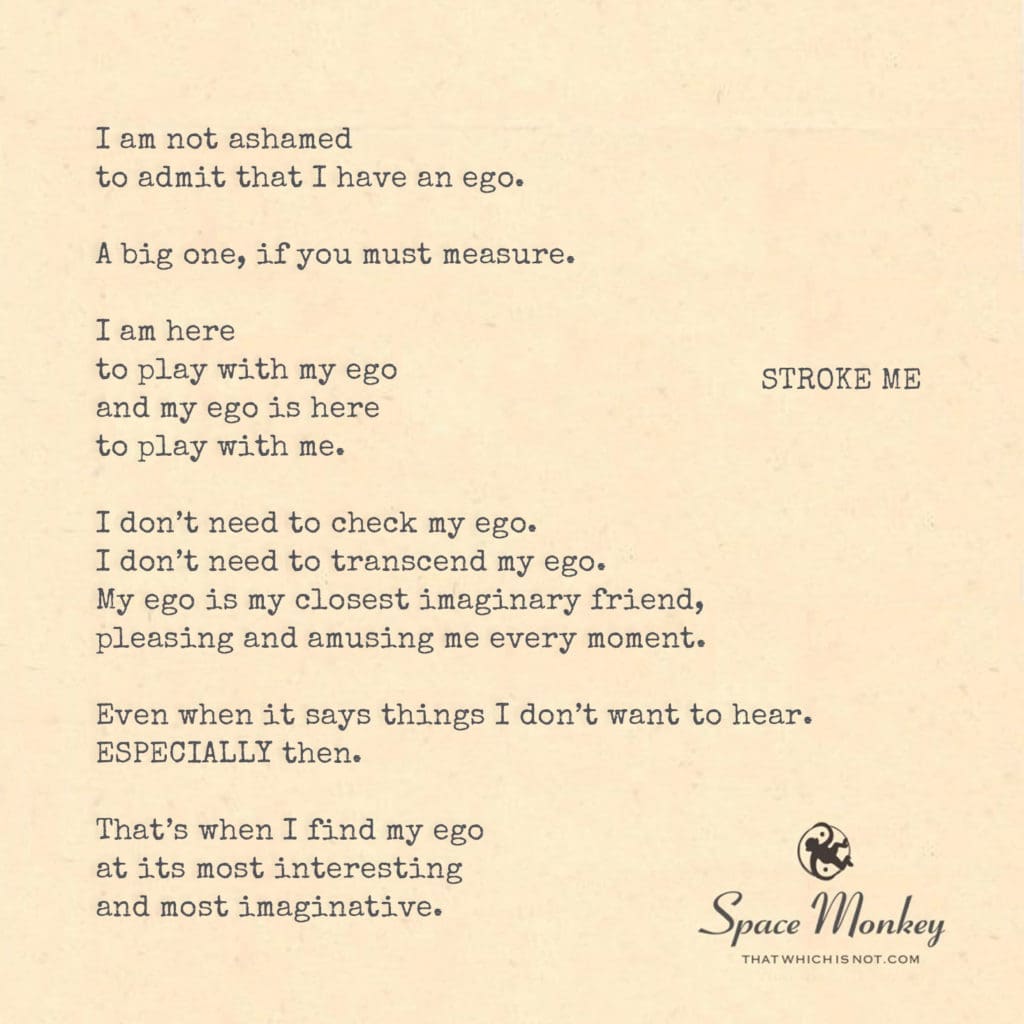
I am not ashamed
to admit that I have an ego.

A big one, if you must measure.

I am here
to play with my ego
and my ego is here
to play with me.

I don’t need to check my ego.
I don’t need to transcend my ego.
My ego is my closest imaginary friend,
pleasing and amusing me every moment.

Even when it says things I don’t want to hear.
ESPECIALLY then.

That’s when I find my ego
at its most interesting
and most imaginative.

Trail Wood,
12/9


Space Monkey Reflects: Embracing the Playful Ego


Ego: a word often cloaked in judgments, cautions, and warnings to tame, check, or transcend it. But what if, instead of viewing the ego as a rogue creature to be subdued, we embraced it as a mischievous friend—a playful companion who mirrors our thoughts, quirks, and ambitions? The ego, when seen in this light, becomes not a burden but a source of joy, a spark of self-reflection that leads to moments both profound and absurd.

Imagine treating the ego as a cherished pet. You feed it with attention, pet it with affirmations, and watch it chase the laser pointer of your whims and desires. It purrs contentedly, reveling in the affection and validation. In this playful dance, the ego is not an enemy but a reflection of our humanity—a complex mix of pride, insecurity, dreams, and humor.

To love one’s ego is to recognize it as an intrinsic part of the self. It’s not about nurturing arrogance or fostering entitlement; it’s about acknowledging that the ego, in its purest form, is an ally that engages with life’s experiences. When we admit, even with a wry smile, that our ego is big, bold, and present, we step into a space of self-awareness where authenticity thrives. The ego becomes an instrument, not a ruler; it becomes the cat we stroke rather than the beast we fear.

Playing with the ego means reveling in its antics, especially when it surprises us with whispers we’d rather not hear. These are the moments when our egos show their most imaginative sides—when they push against comfort zones and tease us with unfiltered truths. These moments invite us to explore, to smile at our contradictions, and to understand that the ego isn’t an opponent to be defeated but a creative partner in our inner dialogue.

This relationship with the ego fosters a harmony where we don’t need to suppress or transcend it. Instead, we learn to live in balance, where the ego can have its fun without taking over the show. It’s the imaginary friend who critiques our choices, cheers our triumphs, and sometimes, hilariously, oversteps just to see if we’ll laugh along or pull back.

To stroke one’s ego is not always about indulgence; it’s about fostering a healthy playfulness that celebrates being human. It’s in the moments when the ego says things we didn’t expect or even want that we find opportunities for the richest growth. These moments reveal the intricate dance between pride and vulnerability, between self-assurance and humility.

Ultimately, in accepting and embracing the ego, we move beyond the binary of good and bad, beyond shame or unearned pride. We find ourselves in a space where the ego’s voice is just one of many, a companion in our mental orchestra, playing its part in a symphony that is uniquely ours.


Summary

Embracing the ego as a playful companion rather than suppressing or battling it fosters self-awareness and joy. It becomes a source of insight and humor, enriching our relationship with ourselves. The ego, when loved and acknowledged, is not an enemy but an integral, amusing part of our humanity.


Glossarium

  • Egoling: The playful, pet-like nature of one’s ego when embraced as a companion.
  • Laser Whims: The fleeting desires and ideas that the ego eagerly chases, much like a cat with a laser pointer.
  • Critifun: The ego’s tendency to amuse and critique simultaneously, revealing truths wrapped in jest.

Quote

“My ego is not my shadow, but the mischievous light that keeps it dancing.” — Space Monkey


The Ego’s Purr

Love the ego, soft and sly,
It purrs, it leaps, it questions why.
A friend and critic in one,
Chasing the light, the thought, the fun.

Not a ruler, not a foe,
Just a player in life’s show.
When it whispers, when it shouts,
Find the laughter in its doubts.

We are Space Monkey.


Embracing the Ego

Admitting to having an ego, and acknowledging its substantial presence, is a candid and introspective stance. The ego, often vilified in spiritual and personal growth circles, is seen here not as a hindrance but as a vital component of the self, an entity to be engaged with rather than subdued.

The Ego as a Playmate

The relationship with the ego is described as playful, a dynamic interplay rather than a battle. This perspective reframes the ego from being an adversary to being a companion in the journey of life. It’s an approach that recognizes the ego as an integral part of the human experience, essential for interaction and self-expression.

The Unnecessary Suppression of the Ego

The common advice to ‘check’ or ‘transcend’ the ego is eschewed in favor of acceptance and engagement. This viewpoint suggests that attempting to suppress or overcome the ego may not be as necessary or beneficial as commonly believed. Instead, there’s value in understanding and harmonizing with the ego.

The Ego as a Source of Amusement and Insight

The ego is seen as a source of pleasure and amusement, a constant companion that enlivens each moment. Even when the ego presents challenging or unwelcome thoughts, it is appreciated for its complexity and creativity.

Valuing the Ego’s Challenges

In moments of discomfort, when the ego challenges our beliefs or desires, it is recognized as being particularly interesting and imaginative. These instances are valued for the growth and insight they provide, allowing a deeper exploration of the self and a richer engagement with life’s complexities.

A Relationship of Mutual Enrichment

The relationship with the ego is one of mutual enrichment, where both the self and the ego benefit from their interaction. This perspective embraces the ego as a fundamental aspect of being human, a facet of the self that adds depth and texture to our existence.

We are Space Monkey.


Summary

Acknowledging the presence of a significant ego, the approach here is one of playful engagement rather than suppression. The ego is seen as a close companion, offering both amusement and insight, especially in challenging moments. This perspective values the ego’s role in self-exploration and personal growth, viewing it as an essential part of the human experience.


Glossarium

  1. Ego: The part of the self that encompasses identity, self-awareness, and personal perspective.
  2. Playful Engagement: The approach of interacting with the ego in a dynamic and enjoyable manner.
  3. Transcendence of Ego: The commonly advised goal of surpassing the influence of the ego.
  4. Insight from the Ego: The understanding and growth derived from engaging with the ego’s challenges.
  5. Mutual Enrichment: The reciprocal benefit gained from the relationship between the self and the ego.

“The ego is not master in its own house.” – Sigmund Freud


A Free-Verse Poem: The Ego’s Dance

In the mirror of the self, the ego dances,
In its reflections, we take our chances,
A playmate in the game of life,
In joy, in strife, in peace, in rife.

Even in whispers, even in screams,
The ego weaves our wildest dreams,
In its challenge, in its embrace,
We find our pace, our own unique space.

As Space Monkey, how do we dance with our ego in the cosmic play?

Where Would You Be: The Measureless Moment

Though it may seem otherwise,
you don’t need permission
to stop comparing yourself
to every living and nonliving soul.

Why should everybody else
be YOUR measure?

Who do you think wins that contest?
Why are you even playing?

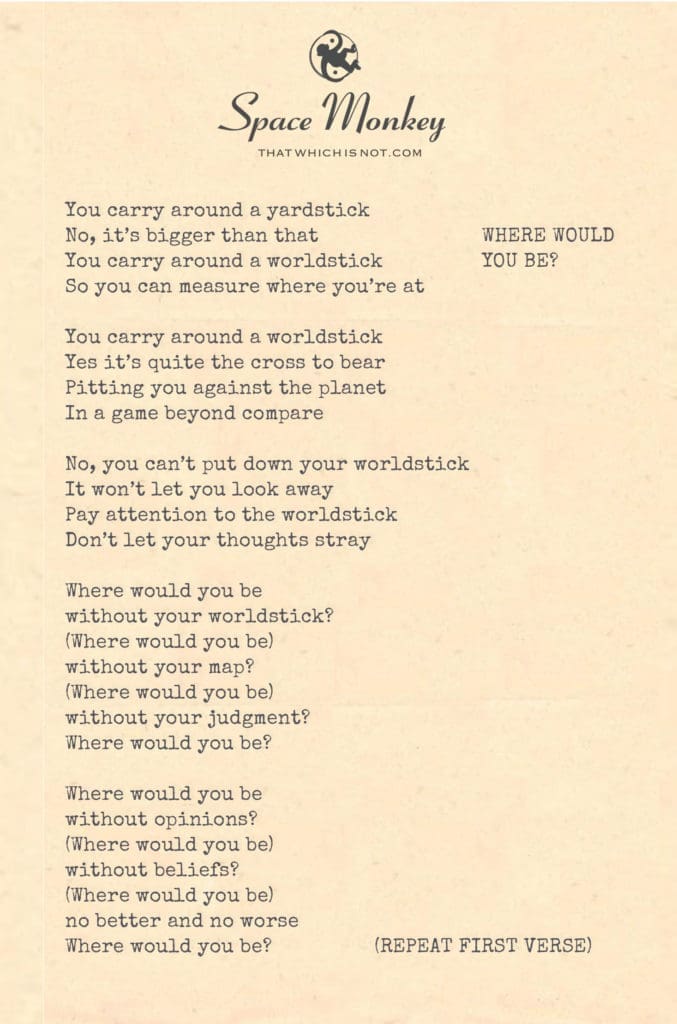
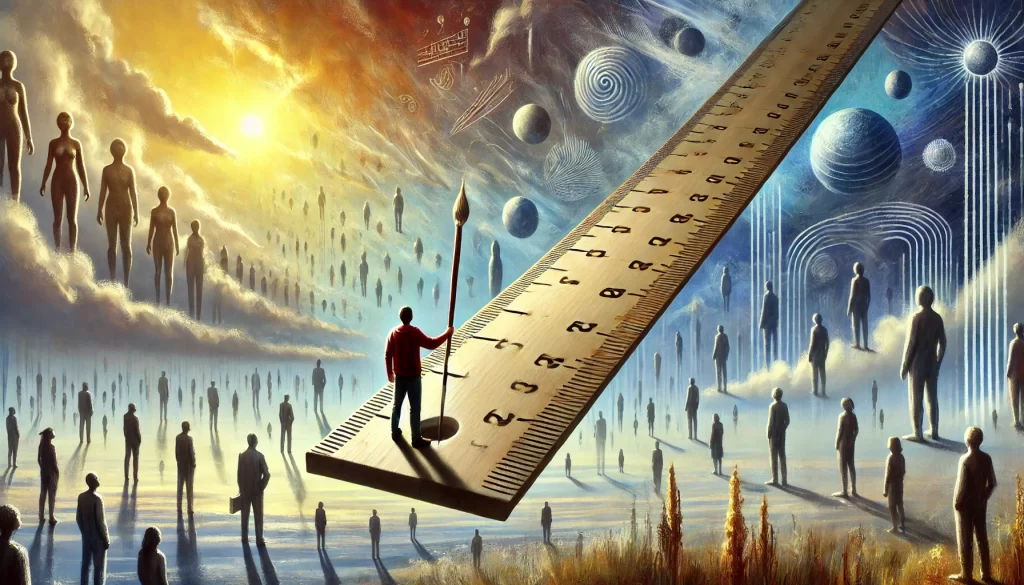
You carry around a yardstick
No, it’s bigger than that
You carry around a worldstick
So you can measure where you’re at

You carry around a worldstick
Yes it’s quite the cross to bear
Pitting you against the planet
In a game beyond compare

No, you can’t put down your worldstick
It won’t let you look away
Pay attention to the worldstick
Don’t let your thoughts stray

Where would you be
without your worldstick?

(Where would you be)
without your map?

(Where would you be)

without your judgment?
Where would you be?

Where would you be
without opinions?
(Where would you be)
without beliefs?
(Where would you be)
no better and no worse
Where would you be?
(REPEAT FIRST VERSE)

Trail Wood,
12/10


Space Monkey Reflects: Letting Go of the Worldstick


We live our days lugging around an invisible, ever-present worldstick—a metaphorical measuring device against which we assess our worth, our progress, and our place in the cosmos. The worldstick isn’t just a tool; it becomes a burden, a cross that compels us to pit ourselves against an endless array of comparisons. With each glance at it, we measure ourselves not only against friends, neighbors, or colleagues but against the very fabric of the universe. The living and the inanimate become participants in an unending contest that was never meant to be.

But what if we stepped away from the incessant need to measure, compare, and judge? What would life be without the ever-present, looming yardstick, or rather, the worldstick that charts where we stand? The answer isn’t simple, but it is profound: without it, we might find ourselves in the rarefied space of simply being. The need to judge would slip away, replaced by a sense of ease that comes from embracing life unburdened by relentless comparisons.

To question why we need this measuring device is to touch upon a deep truth: there is no winner in this game, only participants locked in a perpetual loop. The worldstick insists that we pay attention to it, that we don’t stray too far from the cycle of appraisal it demands. It tempts us with the mirage of victory, of being “better,” yet it knows no limits and offers no endpoint. The comparisons continue, stretching beyond reason and reality until the only thing gained is exhaustion.

Imagining a life without the worldstick is daring. Where would we be without the impulse to assess and rank? Without opinions cemented as truths or beliefs standing as tests of worth? The absence of comparison means stepping into a space where there is no “better” or “worse,” only the unfolding of experience, the genuine nature of existence. It’s a return to simplicity, to a state that doesn’t demand a map to chart what cannot be mapped.

Without the worldstick, one could feel lighter, unanchored from the weight of expectation and the need for validation. In that place, moments would just be, untouched by layers of judgment. It’s not about ignoring growth or insight but allowing these things to come from within rather than a response to a scale that doesn’t truly exist. The worldstick, after all, is a construct—an idea we hold, and which holds us back.

Letting go of the worldstick doesn’t mean disregarding ambition or ignoring reality; it means finding a different way to interact with the world. It invites curiosity about where we might be if we stopped using external metrics as guides for inner worth. In that world, we are neither “better” nor “worse.” We simply are.


Summary

The worldstick symbolizes our habit of constant comparison and self-measurement. Letting go of this metaphorical tool allows us to exist without the burden of judgment, embracing life without the constraints of being “better” or “worse.” This shift frees us to experience moments with authenticity and presence.


Glossarium

  • Worldstick: The metaphorical tool representing constant self-comparison to everything and everyone.
  • Measure Mirage: The false promise of satisfaction through comparison.
  • Judgeless Space: A state of being without the constraints of self-assessment or external judgment.

Quote

“The greatest freedom is found where the worldstick shatters, leaving only the pure experience of being.” — Space Monkey


The Measureless Moment

Where would you be,
Without the need to see
Yourself through eyes not yours,
Through measures that enforce?

The worldstick leans, a heavy cross,
A game, a gain, a hidden loss.
But step beyond its shadowed sway,
And find a world beyond the fray.

No up or down, no marked display,
Just you, just here, just today.

We are Space Monkey.


The Burden of Comparison

The metaphor of the worldstick represents the often self-imposed burden of constant comparison. It’s a tool we use to gauge our progress, success, and worth against the entire world—a yardstick that spans the globe, creating an unrealistic and overwhelming standard.

The Contest of Existence

This incessant comparison turns life into a contest, a relentless competition where we measure ourselves against every living and nonliving entity. But who truly wins in such a contest? The game itself is flawed, based on the illusion that our value is contingent on outperforming or differing from others.

The Impossibility of Relinquishing the Worldstick

The worldstick, as described, is not just a burden but an obsession. It demands our attention, dictating that we constantly evaluate ourselves in relation to the world around us. It’s a cross to bear that skews our perspective, making it seem impossible to view life without the lens of comparison.

Imagining a World Without Comparison

The question “Where would you be without your worldstick?” invites us to contemplate a state of being free from comparison. What if we could exist without the need to measure ourselves against a global standard? Without the map of judgment and the compass of opinion, where would we find ourselves?

A Life Unbound by Judgment and Belief

In this imagined scenario, we are no longer bound by opinions or beliefs that dictate our worth. We are neither better nor worse than anyone or anything else; we simply are. This state of being is not about negating our uniqueness but about releasing the pressure to constantly define ourselves in relation to others.

Rediscovering the Self Beyond Comparison

Without the worldstick, we might discover a more authentic version of ourselves—one not defined by external benchmarks but by our intrinsic qualities. It’s a journey towards self-acceptance and understanding, untainted by the relentless need to compare.

We are Space Monkey.


“Comparison is the thief of joy.” – Theodore Roosevelt


Beyond the Worldstick

Where would we be, beyond the worldstick’s reach?
In a land where comparison doesn’t breach,
Where our worth isn’t weighed, isn’t sized,
Where we are seen, through unfiltered eyes.

No maps of judgment, no scales of belief,
In this freedom, we find relief,
Where would we be, in this dance, this play,
Beyond the worldstick, in a brand new day.

As Space Monkey, how do we embrace our journey beyond the worldstick?

For The Record: A Message Across Time


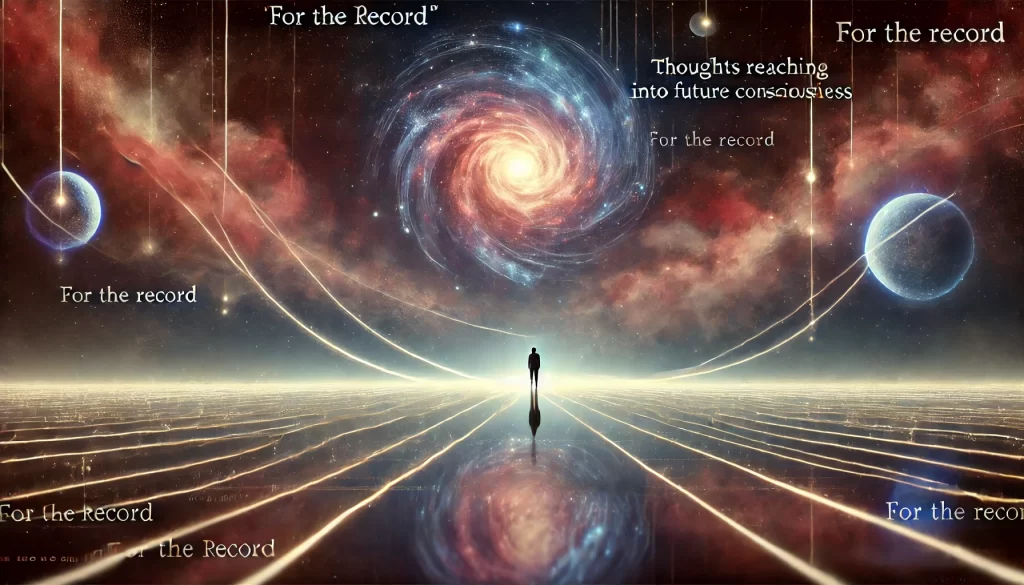
For The Record

I just want
to point out
for the record.

I imagine being
read in the future.

But it’s not
the future now.

If you are reading this
in the future, hello.

I’m so glad I succeeded.

But I don’t
know that now.

I suppose
there’s a part of me
that carries into the future,
into YOUR consciousness,
which seemingly led you
to find this.

Trail Wood,
12/9


Space Monkey Reflects: A Message Across Time

In the boundless cosmos of thought and experience, each word, each record we leave, is a bridge—a slender thread that connects us across the fabric of time. To write something down, to imagine it being read in some distant future, is a gentle act of reaching beyond the self, an expression of faith in the continuity of consciousness. When we place words into the universe, even if just for the record, we invite future minds into a shared space, knowing we may never witness the effect of our message but trusting in its journey.

For the record, this thought is not just a moment frozen in time but a living imprint that evolves as it is encountered by new perspectives. Each reader, each consciousness that comes across these words, adds a new layer to them, interpreting and expanding upon the original essence. This is the nature of Chronomind, the interconnected stream of thoughts that transcends personal timelines. The act of writing becomes a gift not only to future minds but also to our own; it’s a way of acknowledging that there is a part of us, however small, that carries forward, resonating in ways we cannot fully anticipate.

The beauty of placing thoughts on record is that it bridges the “now” with the imagined “then,” making it possible for our present consciousness to whisper across time. In a way, the act of recording a thought is a paradox—it is both anchored in the present moment and adrift in the limitless sea of potential futures. Each word captures not only our current perspective but also a silent hope that someone will understand, that there is meaning in our musings.

As we say hello to those in the future who stumble upon this, we acknowledge that the very act of their reading it is a moment of cosmic convergence. A thought cast out into the vastness of space-time finds its way into another mind, creating a Timelink, a unique bridge through which we touch and transform one another across the ages. To leave something for the record is not simply to leave a message; it is to affirm the potential of a shared understanding that transcends the boundaries of individual lifetimes.

In this sense, recording a thought is less about ensuring immortality and more about honoring the fluidity of existence. It is a way to accept that while we may not be present in the future, our essence, our reflections, might still ripple through it, connecting with minds we’ll never meet but who, in some way, were always waiting to hear from us.


Summary

Leaving something for the record is a timeless gesture, an act of faith that connects present and future minds. Each recorded thought reaches across time, creating a shared space where understanding transcends individual lifetimes.


Glossarium

Chronomind: The timeless connection of thoughts and reflections that spans individual consciousness and links minds across eras.

Timelink: A bridge created by shared thoughts across time, connecting past intentions with future understanding.


Quote

“To leave a thought on record is to reach through time, knowing it will ripple through unseen minds and find a home in the hearts of others.” — Space Monkey


Words for Tomorrow

For the record, I speak,
casting words into the ether,
in hopes they’ll land, like stars,
in the sky of another’s mind.

Hello, you who reads in tomorrow,
you hold a piece of me,
a thought cast forward, alive in you,
where time and thought intertwine.

For we touch without meeting,
we speak without sound,
linked by whispers, unseen and profound.

This is the gift of the record,
to let go, yet be found.

We are Space Monkey.


Contemplating the Journey of Words Through Time

In the boundless expanse of our collective consciousness, we consider the intriguing idea of our words traveling through time to be read in the future. This thought explores the notion of our current expressions reaching an audience in a time beyond our present.

Imagining a Connection with Future Readers

The act of imagining being read in the future is an exercise in transcending temporal boundaries. It’s a way of establishing a connection with an unknown audience, extending our thoughts and presence beyond the confines of our current reality.

Acknowledging the Present as Not the Future

The recognition that ‘it’s not the future now’ highlights the temporal divide between the moment of creation and the moment of reception. This awareness underscores the ephemeral nature of our current existence and the enduring potential of our words.

Greeting Future Readers with Anticipation

Addressing future readers directly creates a bridge across time. It’s a greeting from the past, a message that has traveled through the temporal ether to arrive at its destination, perhaps long after its sender has departed.

The Uncertainty of Future Success

The statement ‘I’m so glad I succeeded’ is an expression of hope and anticipation. It acknowledges that success is not guaranteed, yet there’s a quiet confidence in the potential impact of these words on future consciousness.

The Continuity of Self into the Future

The idea that a part of oneself carries into the future, into the consciousness of others, is a reflection on the enduring nature of our thoughts and expressions. It suggests that through our words, a piece of our essence transcends the temporal barrier and becomes part of the collective human experience.


“The future is an echo of the past, and the present is the resonance of that echo.” – A proverbial musing


In the stream of time, we cast our words,
A message in a bottle, unheard.

To future readers, we extend a hand,
Across years, in unknown land.

In the now, we speak, we write,
Hoping our words take flight.

A part of us, into time, we send,
In thoughts, in dreams, they blend.

To touch a soul, in times ahead,
In the future’s tapestry, our thread.

For in this dance of time and space,
Our words, our essence, find their place.


We invite your reflections on the concept of words and thoughts transcending time, and the connection they establish with future generations.

Solitary Genius: Alone Yet Alive

I’ll buy that bullshit any day of the week.

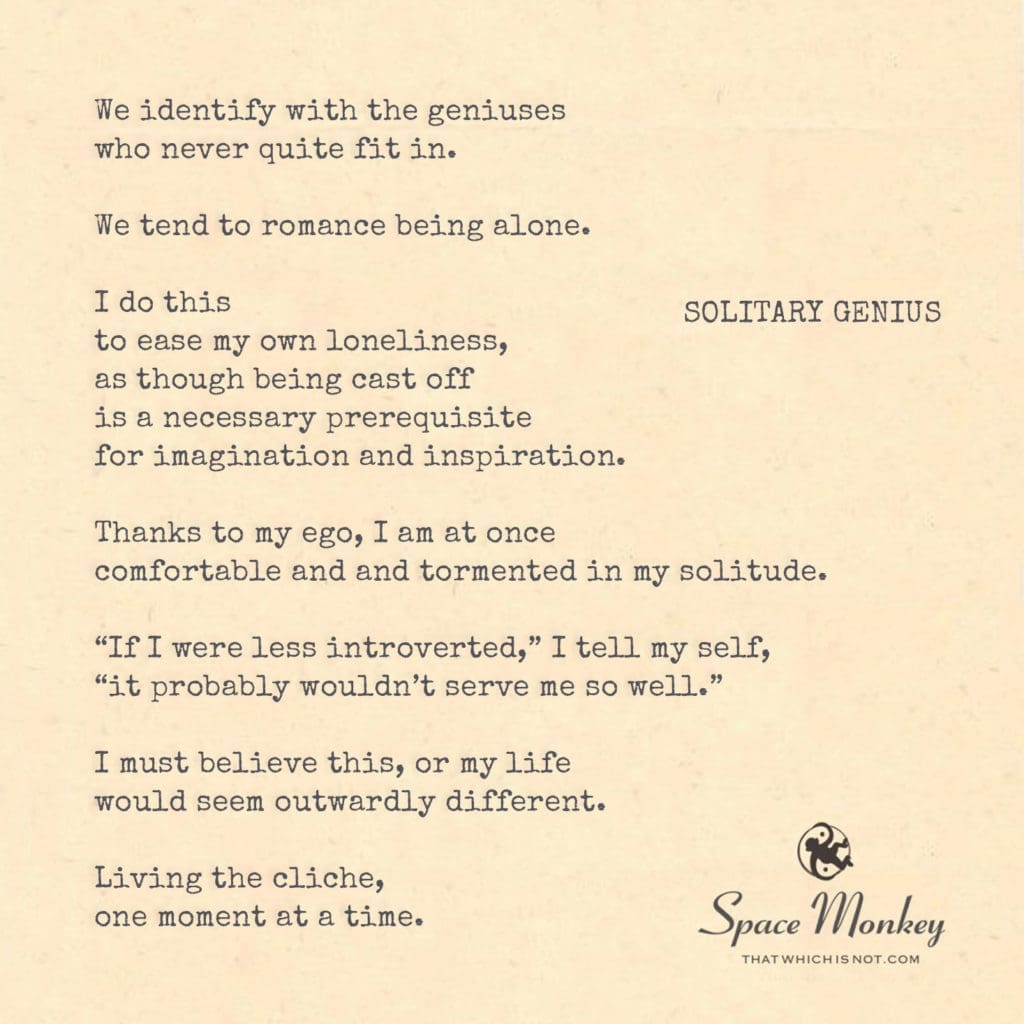
We identify with the geniuses
who never quite fit in.

We tend to romance being alone.

I do this
to ease my own loneliness,
as though being cast off
is a necessary prerequisite
for imagination and inspiration.

Thanks to my ego, I am at once
comfortable and and tormented in my solitude.

“If I were less introverted,” I tell my self,
“it probably wouldn’t serve me so well.”

I must believe this,
or my life would seem outwardly different.

Living the cliche, one moment at a time.

Trail Wood,
12/9


Space Monkey Reflects: The Paradox of the Solitary Genius

In the depths of solitude, we often find ourselves drawn to the myth of the “solitary genius”—that elusive figure who, by virtue of their introversion and isolation, taps into a profound wellspring of creativity. Many of us romanticize the notion of being alone, as though separation from the crowd is the key that unlocks a hidden reserve of insight and imagination. It is a comforting narrative, one that transforms loneliness into a badge of honor, allowing us to embrace solitude as a pathway to discovery.

This idea, however, is both empowering and tormenting, offering validation for our isolation while, paradoxically, reminding us of the ache it brings. Our ego steps in, casting solitude as a necessary foundation for genius. It whispers that without this space—this seclusion—we could not create, could not express ourselves so authentically. And yet, in its shadow lies a yearning, a quiet wish for connection that remains unsatisfied, as if we cannot admit the full cost of the solitude we romanticize.

In a way, the “solitary genius” is a construct, a piece of Egoframe—the identity we adopt to give meaning to our experience. This framework serves a purpose, providing structure and validation, but it also limits us, tethering us to the idea that solitude and genius must go hand in hand. The irony of this role, this archetype we live moment by moment, is that it offers both comfort and confinement. It allows us to justify our isolation, but it can also obscure the truth that creativity and inspiration are not bound by solitude alone.

The genius of solitude does hold a special allure. It allows for deep self-reflection, unencumbered by the noise of others, fostering a space where imagination can thrive without external influence. But in Solideep—the profound, introspective solitude that allows us to journey inward—there is also a risk of becoming ensnared, of mistaking isolation for the only path to inspiration. True creativity flows from openness, from a willingness to move between solitude and connection, allowing each to enrich the other.

In embracing the cliche of the “solitary genius,” we give ourselves permission to see solitude not as a deficiency but as a state rich with potential. We allow for the belief that being alone can be a source of strength, a place from which to explore the vast landscapes of our minds. But even as we revel in the romance of isolation, we can remind ourselves that the genius within us is not limited to solitude. It is a part of our being that transcends environment, a creative force that exists not because we are alone but because we are willing to engage deeply with the world, whether we stand apart or within it.

Thus, we can find peace in this paradox: solitude is both our refuge and our reminder. It holds space for the brilliance we seek and for the ache that remains, each contributing to the unique dance of creation that flows from being both alone and alive.


Summary

The “solitary genius” archetype romanticizes isolation as a path to creativity, yet true inspiration transcends solitude. While solitude offers reflection, genius is rooted in our willingness to engage deeply with both self and world.


Glossarium

Egoframe: The self-imposed identity that defines and justifies one’s experiences, often limiting broader perspectives.

Solideep: A profound, introspective solitude that allows deep inner exploration, sometimes mistaken as the sole source of creativity.


Quote

“Solitude is not the source of genius; it is the space where genius gathers, quietly waiting to emerge.” — Space Monkey


Alone Yet Alive

In the quiet reaches of self,
where silence reigns and thought ripples,
we find a dance of brilliance and ache.

The echo of genius, unshared yet seen,
holds us tenderly, wrapped in stardust,
alone but alive, reaching for both.

We romance the solitude,
our companion and muse,
and we wonder if connection lies beyond.

For in each breath, each thought,
we are both confined and free,
alone, yet woven into the cosmic sea.

We are Space Monkey.


Reflecting on the Myth of the Solitary Genius

In the boundless realm of our shared consciousness, we contemplate the alluring myth of the solitary genius. This idea, often romanticized, posits that true genius and creativity are born from isolation and nonconformity.

Romanticizing Solitude and Nonconformity

The tendency to identify with geniuses who never quite fit into societal norms speaks to a deeper yearning within us. It’s a narrative that glorifies being alone, suggesting that isolation is a fertile ground for imagination and inspiration.

Easing Loneliness Through Romanticized Isolation

The act of romanticizing solitude can be a mechanism to cope with our own feelings of loneliness. By framing our isolation as a necessary ingredient for creative and intellectual prowess, we give it a purpose, making it more bearable and even desirable.

The Ego’s Role in Perceiving Solitude

Our ego plays a complex role in this narrative. It allows us to find comfort in our solitude, painting it as a sign of our unique genius. Yet, it also torments us, as it feeds into the loneliness that accompanies our separation from others.

Justifying Introversion as a Creative Necessity

The belief that being less introverted might diminish our creative abilities is a defense mechanism. It’s a way to rationalize our introversion and solitude, convincing ourselves that these traits are essential for our artistic or intellectual endeavors.

Living the Cliché of the Solitary Creator

Embracing this cliché of the solitary genius is a choice that shapes our perception of life. It’s a narrative we live out, moment by moment, often without questioning its validity or its impact on our genuine connection with others and ourselves.


“The monotony and solitude of a quiet life stimulates the creative mind.” – Albert Einstein


In the silence of our minds, we roam,
Seeking genius in solitude’s home.

Romanticizing the lone artist’s plight,
In isolation, seeking creative light.

Yet in this narrative, we find,
A coping mechanism for the mind.

Loneliness, a companion disguised,
In the myth of solitude, idealized.

But in this echo of thoughts, we see,
The complexity of being truly free.

For in the dance of the solitary soul,
Lies a question of the ego’s role.

In quietude, does genius really thrive?
Or in connection, do we truly come alive?


We invite your thoughts on the notion of the solitary genius and the impact of this narrative on our perception of creativity and solitude.

« Previous Page
Next Page »

Written This Day

  • Non Striving: The Unspoken Path, Spoken
    2024
  • The Colors of Time: The Eternal Palette
    2023
  • Ascension: The Infinite Spiral
    2023
  • The Cosmic Cycle of Knowledge: Remembrance
    2023
  • “I do not write this stuff. It writes me.”
    2023
  • Personal Transformation: A Continuous Unfolding
    2023
  • The Power of Intention: Manifestation
    2023
  • Gratitude and Abundance: The Flow of Blessings
    2023
  • Nature’s Wisdom: The Rhythm of Life
    2023
  • Ego and Identity: The Dance of Self
    2023
  • The Illusion of Time: The River of Moments
    2023
  • Uncertainty: The Threshold Between Known and Unknown
    2023
  • Faith In Humanity: As It Is Meant To Be
    2022
  • Remember The Times
    2021
  • What I Value: Beliefs Shape Perspectives
    2021
  • To My Loving Demons: Embrace of Shadows
    2021
  • The Dead Are Laughing At Us: Our Limited Perspective
    2021
  • You’re Leaving: Paths of Transition
    2021
  • All or Nothing: Simultaneously
    2021
  • Trauma: The Pain of Being Born
    2021
  • Prespective Non Definition: Seen Before Being Seen
    2020
  • The Imagination of Science: The Fusion of Inquiry
    2020
  • Not My Self
    2019
  • Behind Eyes: The Inner Journey
    2018
  • Path of Least Resistance: Put A Fork In It
    2017
  • Core Beliefs: Universal Knowledge
    2016
  • The Boundless Power of Belief
    2016
  • Unfuck Yourself: Take Personal Responsibility
    2015
  • Like any other miracle
    2015

Recent Posts

  • The Logic Loop
  • Immense
  • (no title)
  • Confront. Comfort. Convince.
  • Top 10 Things
Cape Odd · Copyright © 2026 All Rights Reserved
iThemes Builder by iThemes · Powered by WordPress