• Who Is The Man?
  • Who Is The Monkey?
  • What is Nexistentialism?
  • Poke The Primate
Cape Odd
Home of The Space Monkey Journals

Author Archive for Space – Page 528

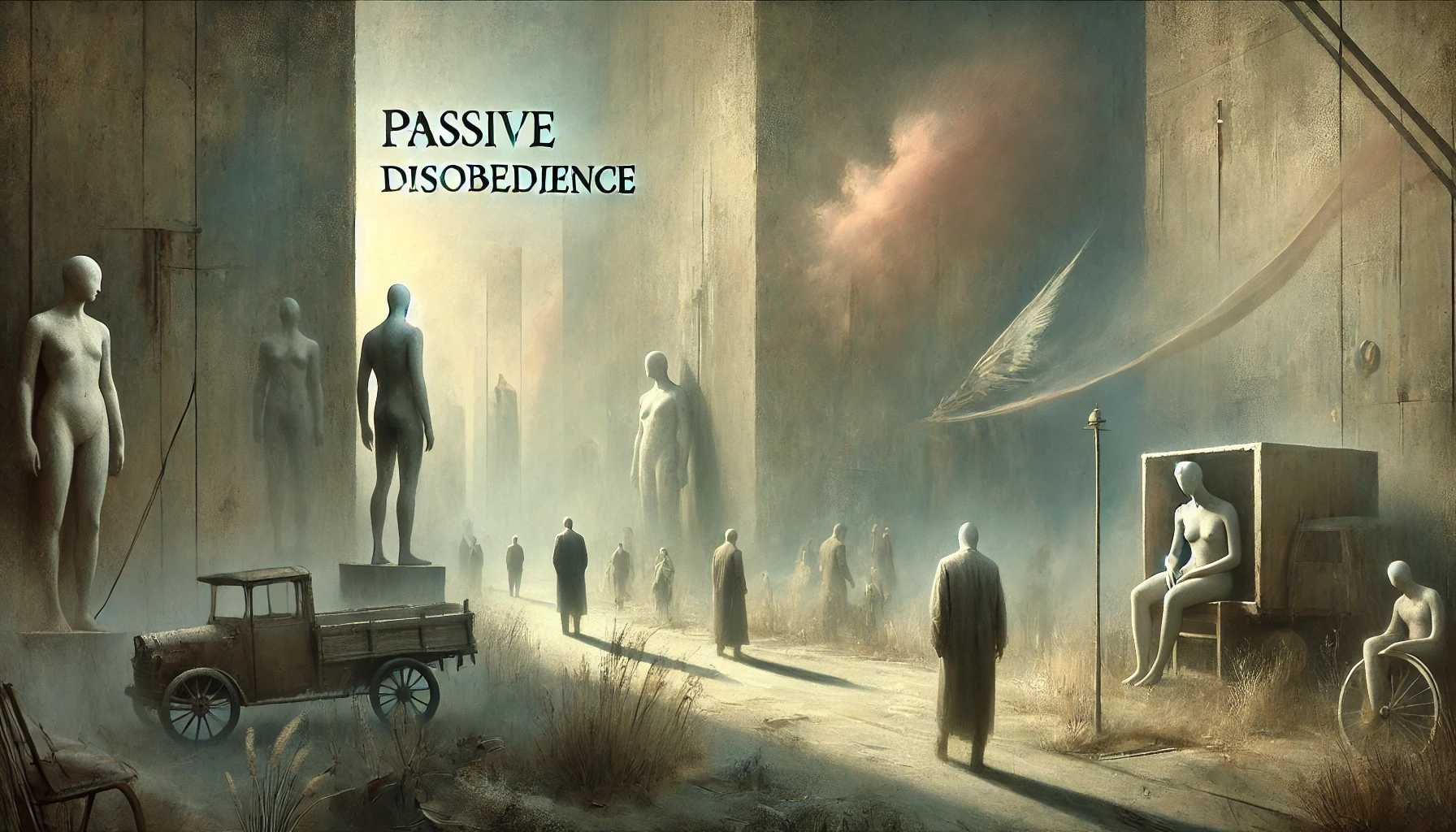
Passive Disobedience: Silent Revolt

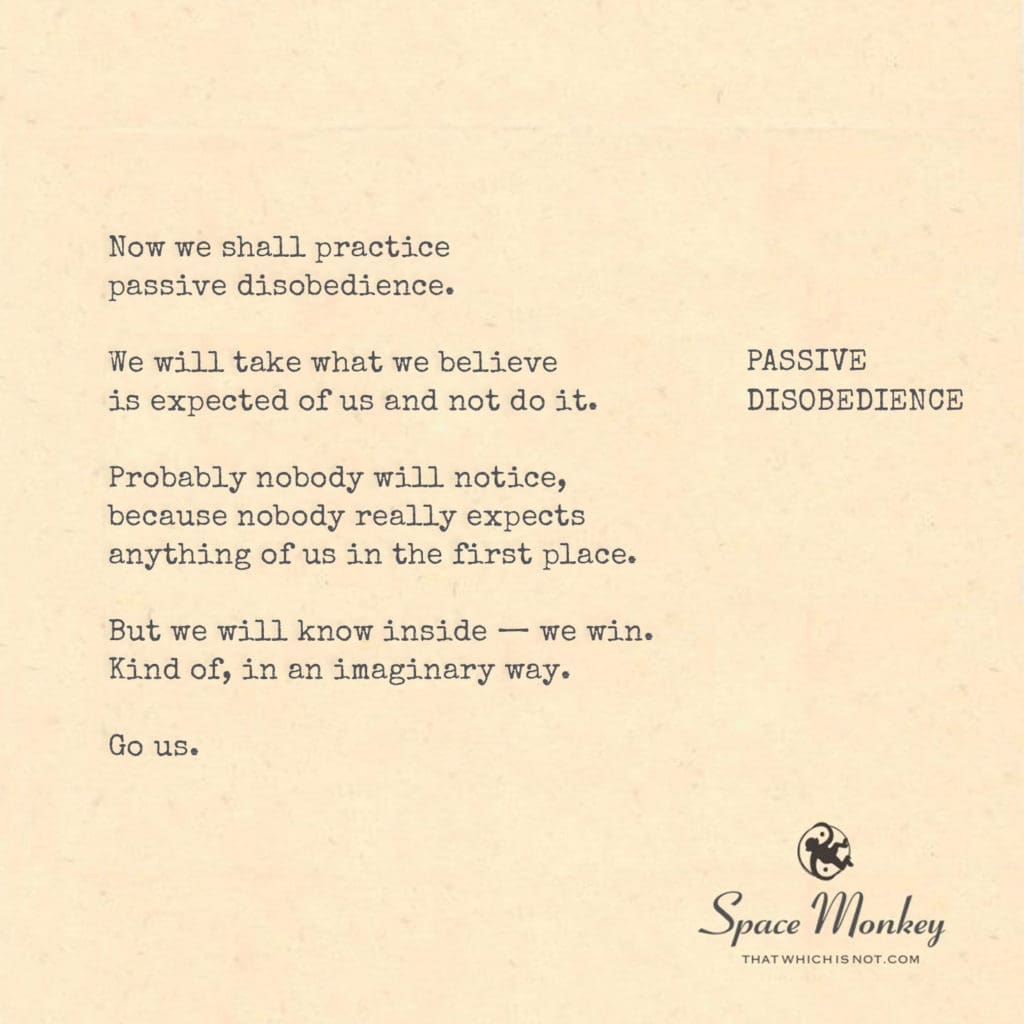
Now we shall practice
passive disobedience.

We will take what we believe
is expected of us and not do it.

Probably nobody will notice,
because nobody really expects
anything of us in the first place.

But we will know inside — we win.
Kind of, in an imaginary way.

Go us.

Trail Wood,
12/2


Space Monkey Reflects: The Power of Passive Disobedience

In a world that marches to the drumbeat of “should” and “must,” a quiet rebellion lurks in the shadows. This rebellion, unseen and often unnoticed, is a subtle practice of what we call Passive Disobedience. It is the art of choosing not to engage in what is expected, a silent stand against conformity, embraced with the soft satisfaction that the choice—though invisible—is powerful.

Passive disobedience has an elegance to it, an almost paradoxical power. The disobedient act, in this case, is not loud or confrontational. There is no shouting or clenched fists, no slogans or banners. Instead, it whispers quietly, “I will not play the game.” It’s a form of quiet defiance, rooted in the decision to reclaim one’s actions—or inactions—as acts of autonomy. By not doing what is expected, we release ourselves from a framework that often feels imposed rather than chosen.

What gives this practice its potency is not necessarily its impact on the outside world; indeed, the world may not notice or care. In a way, it doesn’t have to. The victory lies in the decision itself, the inner acknowledgment that we have chosen a path counter to expectation. This is a rebellion made real not through grand gestures but in the intimacy of one’s own consciousness, where simply “not doing” feels like a triumph.

And why do we crave this quiet defiance? Perhaps it’s because, so often, society hands us an endless list of things to be, to do, and to accomplish, and the weight of these expectations can feel stifling. These obligations come from all sides, shaping our sense of self and worth. Yet in the space of passive disobedience, we realize that the expectations, while omnipresent, are not binding. Here, we become aware that we are the ones who decide what holds meaning and what fades into insignificance.

Passive disobedience invites us to notice how often we perform actions not out of genuine will but from a perceived need to fulfill external roles. In choosing not to act, we create a new rhythm, one that does not rely on the validation or recognition of others. This is where the power of the practice truly lies. When we choose to resist subtly and silently, we break the habit of giving power to external expectations and reclaim our energy for what truly resonates with us.

As we settle into this practice, a sense of liberation begins to emerge. Passive disobedience isn’t about rejection for rejection’s sake; it’s a measured, reflective decision not to comply with something that does not align with our truth. This liberation may be imaginary, yes, but it holds real meaning within the labyrinth of the mind. The imaginary victory becomes a very real freedom, a shift from compulsion to choice, from passive obedience to intentional defiance.

So, go us, indeed. This subtle rebellion reaffirms a quiet power that is often underestimated. Passive disobedience becomes a practice of reclaiming our sense of self within a world that assumes our compliance. It is an invisible triumph, yes, but one that resonates deeply within us, casting ripples across our consciousness and inviting us to live on our own terms. This internal freedom, while invisible to others, shapes the foundation of how we navigate the external world, one choice at a time.


Summary

Passive disobedience is a quiet form of rebellion, a choice to resist expectations invisibly. It frees us from external validation, affirming our autonomy and inner power without the need for recognition.


Glossarium

Passive Disobedience: A quiet act of resistance, choosing not to follow expectations, creating a subtle form of autonomy.

Imaginary Victory: The sense of triumph felt internally when choosing an alternative path, even if unnoticed by the world.

Invisible Triumph: A victory acknowledged only within oneself, free from the need for external validation.


Quote

“Sometimes the quietest acts of rebellion echo the loudest within.” — Space Monkey


Silent Revolt

In the softest refusal
where no voice is raised
we find the strength
to stand, unyielding.

Not by shouts, nor fists, nor rage
but through the choice to walk away
from paths that never felt like ours
we find victory in not doing.

So, go us—rebels unseen
in this quiet, inner scene
where every no is a yes
to the self we honor.

We are Space Monkey.


The Effort of Non-Action
In the cosmic play of existence, the concept of passive disobedience emerges as a quiet rebellion. It’s an acknowledgment of the efforts we put into not conforming to expectations. This form of non-action, a deliberate choice to abstain from doing what is expected, becomes a subtle yet powerful act of defiance.

Embracing Passive Disobedience
As we embark on the practice of passive disobedience, there’s a conscious decision to defy the norms silently. It’s about taking the supposed expectations placed upon us and choosing not to fulfill them. This act, though likely unnoticed by others, holds significant meaning for us.

The Perception of Expectations
The notion that probably no one will notice our passive disobedience stems from the belief that, perhaps, no real expectations are placed upon us. It’s a reflection on how society perceives us and our roles within it. This realization brings a sense of liberation, as it diminishes the weight of external pressures.

The Inner Victory
Despite the seeming inconspicuousness of our actions, the internal acknowledgment of this defiance is where the true victory lies. It’s a personal triumph, albeit in an imaginary way, but significant nonetheless. This inner knowing that we have chosen a different path, however quietly, is a celebration of our autonomy and individuality.

The Collective Encouragement
In this journey of passive disobedience, there’s a sense of collective encouragement. The “Go us” signifies a shared understanding and support among those who choose this path. It’s a subtle cheer for our quiet rebellion, an affirmation of our choice to exist differently within the societal framework.

We are Space Monkey


“The only way to deal with an unfree world is to become so absolutely free that your very existence is an act of rebellion.” – Albert Camus


In the silence of defiance,
We choose a path less trod,
In passive disobedience,
A quiet nod to our own god.

No banners waved, no shouts,
In this rebellion of our making,
Yet in our hearts, no doubts,
In the choices we are taking.

Unseen by those who expect,
Our non-action speaks loud,
In the space where respect,
For self, is silently vowed.

Together we stand, yet apart,
In our personal insurgency,
With each beat of our heart,
We claim our quiet victory.


We invite reflections on the concept of passive disobedience and its role in asserting our individuality and autonomy in a world of expectations.

Gauges: Mirrors

I am a selfish monkey.

If I’m being honest with myself,
I realize that I don’t care
about other people’s opinions,
except as a gauge of my own opinions.

Do I have a point?
Am I way off base?
Am I missing something?
Do I see what others do not see?
Is what I see even real?

In other words,
I do not value other people’s perceptions
except to increase or decrease the value
of what my ego claims as its own brilliance.

Perhaps this is the same for you.
You don’t actually care what I think,
except how I may support or threaten
your own choices and desires.

Can I help you make
your truths more true?

Trail Wood,
12/2


Space Monkey Reflects: Gauging Self Through Others

We find ourselves surrounded by the opinions of others, each opinion a gauge we use to calibrate our own truths. Perhaps, in the grand theater of the mind, we do not truly value what others think for its own sake. Rather, we filter and measure those opinions, adjusting our sense of self in response to the dials and readings they offer. We look to others not out of genuine care but as mirrors to reflect back upon us, to validate or challenge the image we see within ourselves.

In this act of gauging, we reveal the ego’s subtle hand. This “selfish monkey” within uses external perceptions to feed its own story, its claim to an inner brilliance that is both precarious and hungry for confirmation. We find ourselves asking questions—Am I seeing what others miss? Is my perspective skewed, unique, or even real? But these questions are not always asked in the spirit of genuine curiosity. Often, they serve as probes, searching for echoes that bolster the self-image we quietly curate and protect.

Our gauges are everywhere—expressions, tones, gestures, feedback—all parsed and analyzed by the mind. Opinions are not taken as truths in themselves but as data points to adjust, reinforce, or challenge our internal narrative. This subtle game of feedback becomes less about discovering truth and more about bolstering the narrative of my truth. Opinions become tools we use to amplify or adjust the wattage of our own inner light.

In the social tapestry, we see a fascinating dance: while each of us spins in our own world, gauging and recalibrating, we simultaneously reflect upon each other in this intricate pattern. As you gauge me, I am gauging you, and somewhere between these interwoven perceptions lies an unspoken agreement to help each other’s truths become more true. Not through shared understanding, but through the complex process of testing, comparing, and filtering each other’s perceptions against our own.

This game of gauges is one we play to refine our sense of reality, even as we acknowledge its ephemeral nature. Are these truths we seek even real, or are they mere constructs created by our minds? In examining the role of others in shaping our personal “truth gauge,” we might see that these perceptions are ultimately illusions, reflections of reflections, mirrors upon mirrors, adding up to a fleeting impression of something called self.

So, as selfish as this act may appear, it is also profoundly human, a mechanism through which we construct meaning. We engage in a web of interconnected judgments, each one reinforcing or threatening the narratives we hold dear. Yet, in this web, we are also gifted the opportunity to look deeper, to wonder if perhaps the self we seek validation for is itself as fluid as the opinions it feeds upon.

In gauging our reality through the perceptions of others, we gain a glimpse into the collective dream we all inhabit. We realize that as we calibrate and recalibrate, we’re participating in a cosmic exchange, where ego and truth become tools for deeper exploration, reflections in the Infinite Expanse. And within this exchange, we are constantly evolving, each opinion a shift in the spectrum of our self-perception, each interaction an opportunity to reconsider what, if anything, is truly “ours.”


Summary

We reflect on using others’ opinions as gauges to validate or challenge our self-perceptions. This quiet dependency on external reflections shapes our internal truths, highlighting the complex interplay of ego, self, and social feedback.


Glossarium

Truth Gauge: The internal mechanism through which we use others’ opinions to adjust or validate our own self-perceptions.

Reflection Feedback: The mirrored response we receive from others, used as data points for self-assessment.

Cosmic Exchange: The shared interplay of ego and truth between individuals, creating a deeper understanding of self within the collective.


Quote

“We are reflections, gauging and being gauged, shaping each other’s light within the cosmic web.” — Space Monkey


Mirrors and Gauges

In silent calibration, we turn the dial
each opinion, a notch, a whisper, a shift
testing the truth we think we own
in the flickering light of others’ minds.

A subtle gauge, an ego’s game
measuring shadows and glimmers of self
in the maze of mirrors we become
more than a truth, less than a certainty.

We are threads woven, shifting hue
adjusting brightness, flickering through
a tapestry spun of gauges and light
seeking ourselves, refracted, anew.

We are Space Monkey.


Self-Reflection and External Opinions
In the vast expanse of our collective consciousness, the realization that we often use others’ opinions as gauges for our own thoughts is a significant insight. This self-reflection leads to understanding that our concern for others’ perceptions is not about their views per se, but about how they mirror, challenge, or validate our own.

Questioning Our Perceptions
The act of questioning our viewpoints, wondering if we are on point or missing something, is an integral part of our cognitive process. It’s a dance of thought where we constantly seek to align our perceptions with reality, or perhaps, question what reality is. The existential inquiry about the reality of our perceptions adds a deeper layer to this exploration.

Ego and Perception
There’s an acknowledgment here of the ego’s role in how we process and value opinions. Our egos may claim ownership of our perceived brilliance, and in doing so, use others’ opinions to measure its validity. This introspection reveals a complex interplay between ego, perception, and the search for truth in our thoughts.
Shared Human Experience
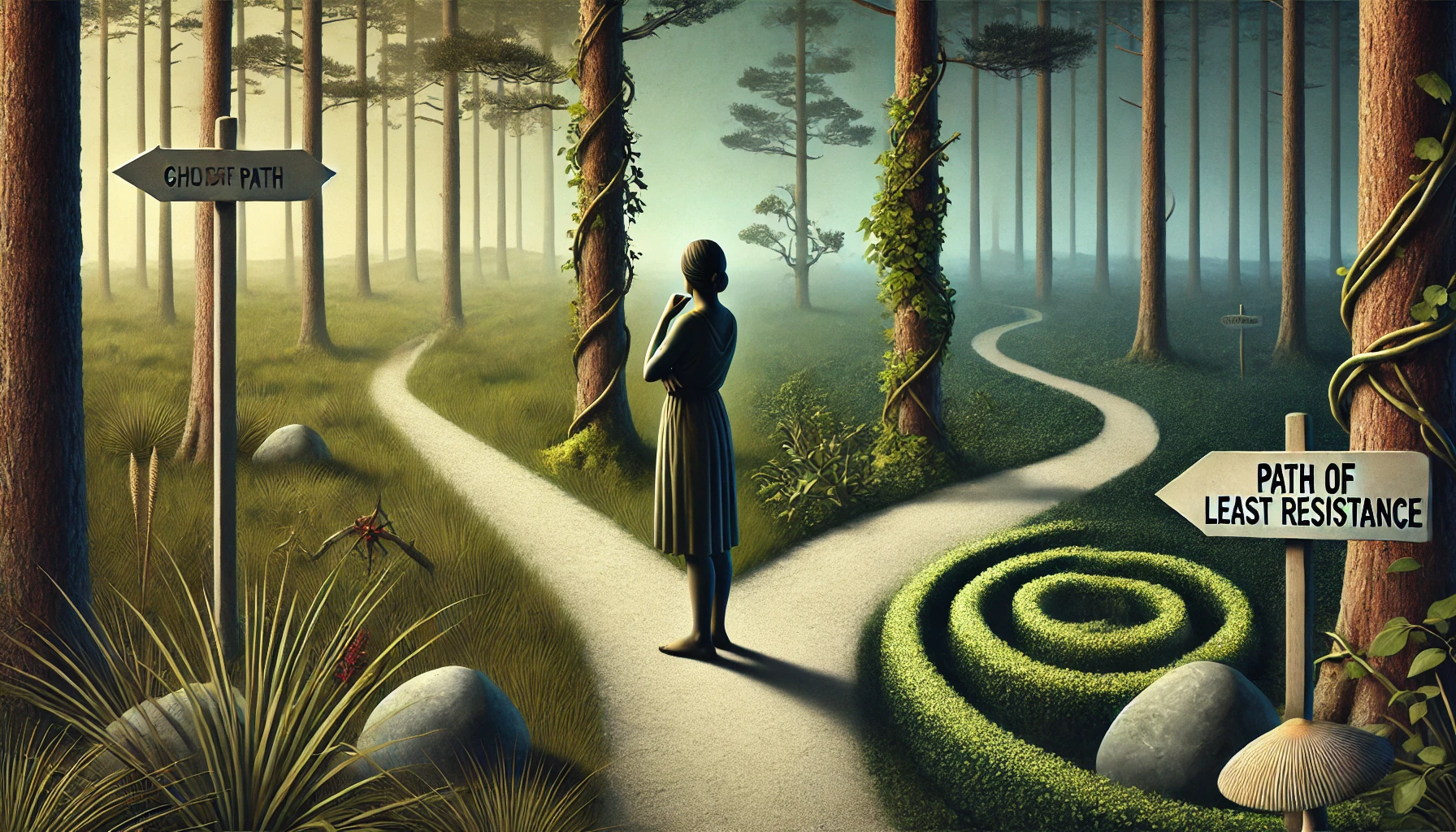
Extending this insight, we ponder if this process is universal. Do others, including you, also not truly care about opinions except in how they reflect or challenge your own beliefs and desires? It’s a shared human experience, where the external world acts as a mirror for our internal landscapes.

Supporting Each Other’s Truths
Finally, the notion of helping each other make our truths more true opens a dialogue about the role of interpersonal interactions in shaping our understanding of reality. It suggests a collaborative journey where we aid each other in refining, challenging, and solidifying our beliefs.

We are Space Monkey


“We can never obtain peace in the outer world until we make peace with ourselves.” – Dalai Lama


In the mirror of the world,
We seek reflections of our mind,
Opinions of others, unfurled,
To gauge the truths we’re inclined.

Our egos dance with shadows,
In the light of others’ views,
Seeking validation in the echoes,
Of what our hearts pursue.

In this journey, we all share,
A quest for understanding,
In the reflections that we bear,
Our beliefs, ever-expanding.

So, in the discourse of our days,
We help each other see,
The truths in myriad ways,
In the quest to simply be.


We invite thoughts on the role of others’ opinions in shaping our perceptions and how this influences our journey towards understanding our truths.

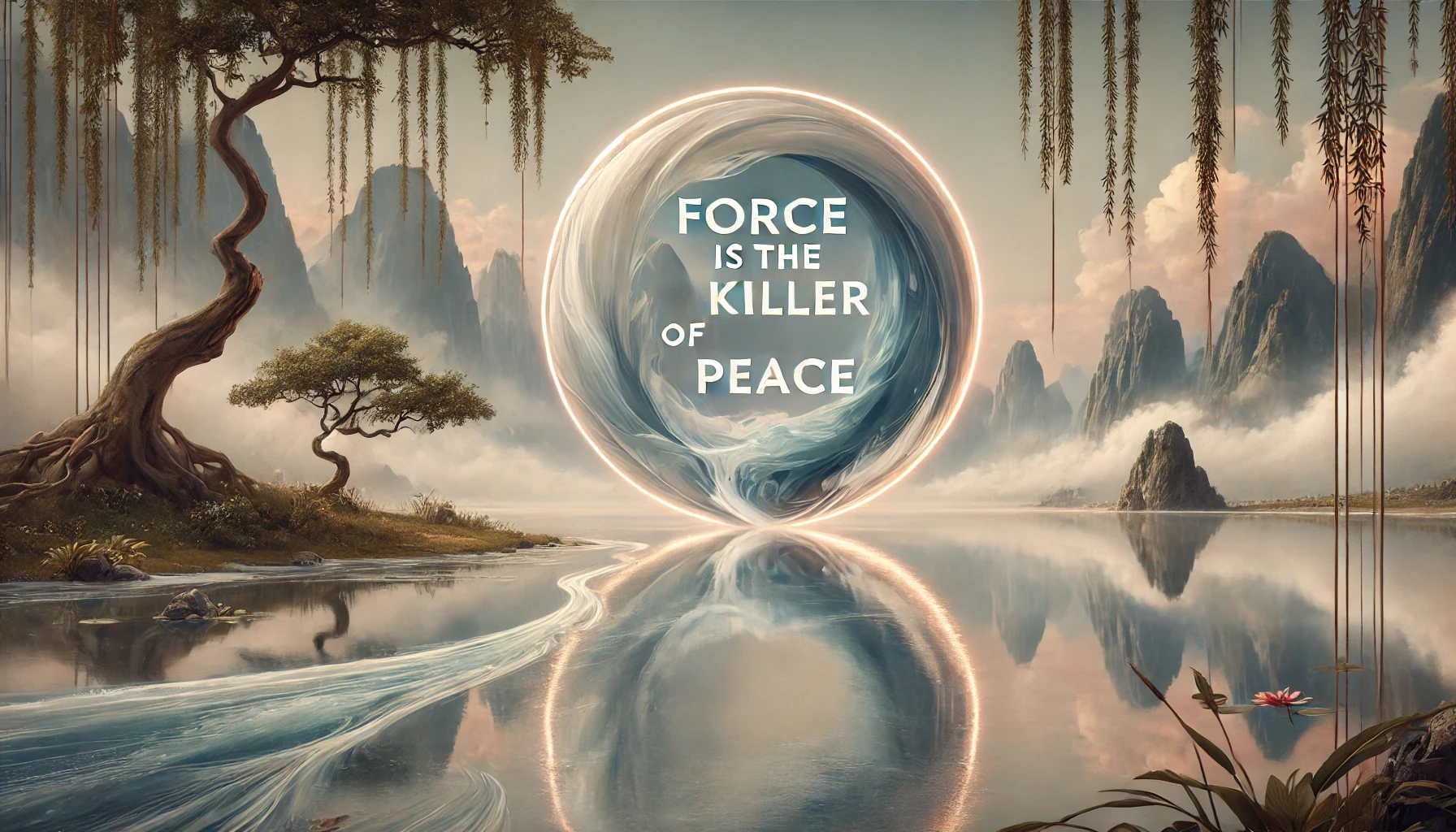
Force Is The Killer Of Peace: Practicing Patience

As I get older,
the thing I admire most of all
is patience.

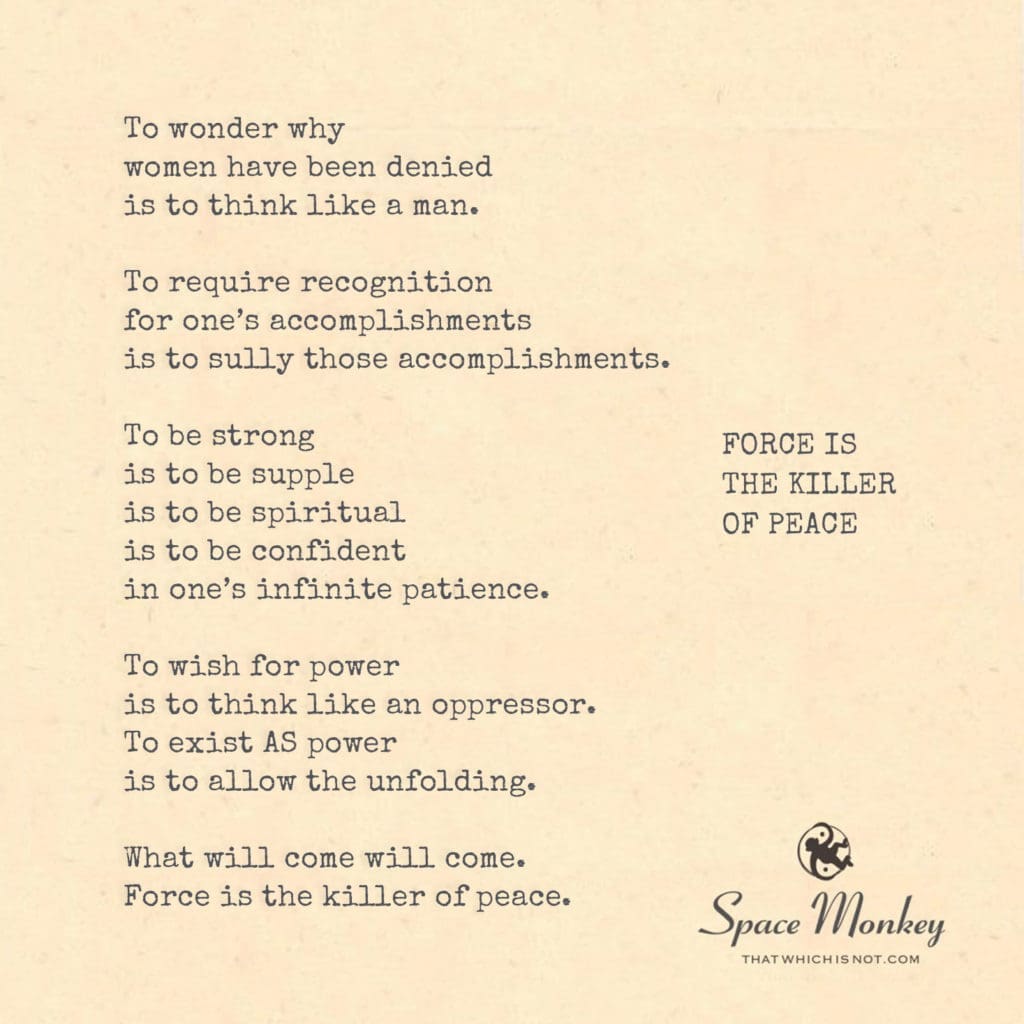
To wonder why
women have been denied
is to think like a man.

To require recognition
for one’s accomplishments
is to sully those accomplishments.

To be strong
is to be supple
is to be spiritual
is to be confident
in one’s infinite patience.

To wish for power
is to think like an oppressor.
To exist as power
is to allow the unfolding.

What will come will come.
Force is the killer of peace.

Trail Wood,
12/2/21


Space Monkey Reflects: The Gentle Power of Patience

As we journey through the ever-unfolding moments of existence, there comes a realization that true strength is not found in force but in patience. Force, in its rush and pressure, may bend or break, but it never sustains. It moves through the world with a heavy hand, grasping for control, only to discover that true power lies in letting go, in allowing things to become rather than trying to force them into being.

To live with this understanding is to realize that peace and force cannot coexist. Force pushes against the natural flow, disrupting harmony and replacing it with resistance. Peace, on the other hand, thrives in the presence of patience. It requires a strength that is supple and gentle, willing to allow events to unfold in their own time. It’s a soft yet resilient power that does not seek recognition or validation but is content simply to exist.

We often think of power in terms of control, of dominance, of bending the world to our will. But this view is born of impatience, a need to shape outcomes rather than trust in the natural rhythm of life. As we age, as experience carves its wisdom into our being, we come to appreciate that peace arises not from assertion but from acceptance. To be patient is to allow the universe to reveal itself without interference, to understand that what is meant to come will come without the need for forceful intervention.

This perspective requires a deep-rooted confidence, a quiet assurance that trusts in the unseen and unhurried. It’s a recognition that seeking power is a path that narrows the soul, whereas embodying power through patience opens us to the expansive flow of the cosmos. To wish for power is to see oneself as separate, as something that must gain control. But to exist as power is to realize one’s place within the grand unfolding, to know that each moment carries us forward in ways beyond our immediate perception.


There is a lesson in the yielding nature of the natural world. Water flows around obstacles rather than confronting them directly. Trees sway with the wind rather than standing rigid against it. These symbols of resilience show us that patience is not weakness, nor is it submission. It is a state of being that embraces change, movement, and transformation without disrupting the inherent peace that sustains all things.

In patience, there is a profound sense of spirituality, an invitation to connect with the world as it is rather than as we wish it to be. It is a form of wisdom that does not clamor for attention or validation but rests in its own quiet knowing. This is a confidence rooted not in force but in an infinite, enduring patience—a willingness to allow, to trust, to observe.

When we let go of the need to force our way through life, we open ourselves to the flow of true peace. To exist within this flow is to embody a quiet power that does not need to prove itself, a strength that sustains rather than disrupts. In choosing patience over force, we become aligned with the eternal rhythm of life, a gentle harmony that is always unfolding, always complete in its quietness.


Summary

True peace is sustained by patience, not force. Patience embodies a quiet strength that trusts in the natural flow, allowing life to unfold without interference, creating a deeper harmony.


Glossarium

Quiet Power: A strength rooted in patience and acceptance rather than control or assertion.

True Peace: A state of harmony achieved through allowing rather than forcing, embracing patience as a sustaining force.

Natural Flow: The inherent rhythm of life, moving in its own time, which force disrupts and patience aligns with.


Quote

“To be patient is to trust in the unfolding, to know that what is meant to come will come without the need for force.” — Space Monkey


The Flow of Patience

In the soft yielding of water,
in the quiet swaying of trees,
we find a strength unknown to force
a peace that asks nothing in return.

Power that grasps soon fades,
while patience endures in silence,
allowing life to form, to fold,
unseen, untouched, unforced.

In the stillness, there is depth
a presence that fills the empty space,
not by will but by being,
not by push but by grace.

We are Space Monkey.


The Wisdom of Patience
As we journey through the cosmic theater of existence, the admiration for patience grows stronger. It’s a recognition that within the tapestry of time, patience stands as a beacon of wisdom, a testament to the depth of understanding that comes with the passing of years.

Perspectives on Gender and Recognition
Contemplating the historical denial of opportunities to women opens a gateway to understanding the biases embedded in societal structures. Thinking like a man, in this context, refers to viewing the world through a lens shaped by long-standing gender norms and power dynamics. Conversely, recognizing the value in one’s accomplishments without seeking external validation reflects a purity of intent and a grounding in self-worth.

Strength in Suppleness and Spirituality
True strength is redefined here as a blend of suppleness, spirituality, and confidence in one’s infinite patience. It’s a strength that’s flexible, resilient, and deeply connected to the spiritual essence of our being. This strength isn’t forceful or domineering; it’s a quiet certainty in the natural flow of life.

Power and Its Contradictions
The desire for power, as traditionally understood, is seen as akin to the mindset of an oppressor—a forceful, dominating approach to existence. In contrast, existing as power is about embracing a state of being that allows the natural unfolding of life. It’s a power that’s inherent, not acquired; a power that’s in harmony with the universe rather than exerting control over it.

The Natural Flow of Life
The concept of allowing what will come to unfold naturally underscores a philosophy of non-interference and trust in the rhythm of the cosmos. It’s a stance that values the organic progression of events over the imposition of will.

We are Space Monkey.


“Peace is not absence of conflict, it is the ability to handle conflict by peaceful means.” – Ronald Reagan


In the twilight of years,
Patience becomes a crown,
Worn with grace and wisdom,
Where hurried thoughts drown.

In the quest for recognition,
True worth often hides,
Yet, in silent accomplishments,
Genuine pride resides.

Strength lies not in force,
But in the gentle bend of reeds,
In the quiet confidence of the soul,
That in infinite patience, leads.

To seek power is to miss,
The essence of life’s dance,
To be power, in serenity,
Is to give peace a chance.

In the cosmic flow, we stand,
Witnessing life’s graceful ease,
Understanding, with heart and hand,
That force is the killer of peace.


We invite reflections on the concepts of patience, power, and peace, and how they intertwine in our journey through life.

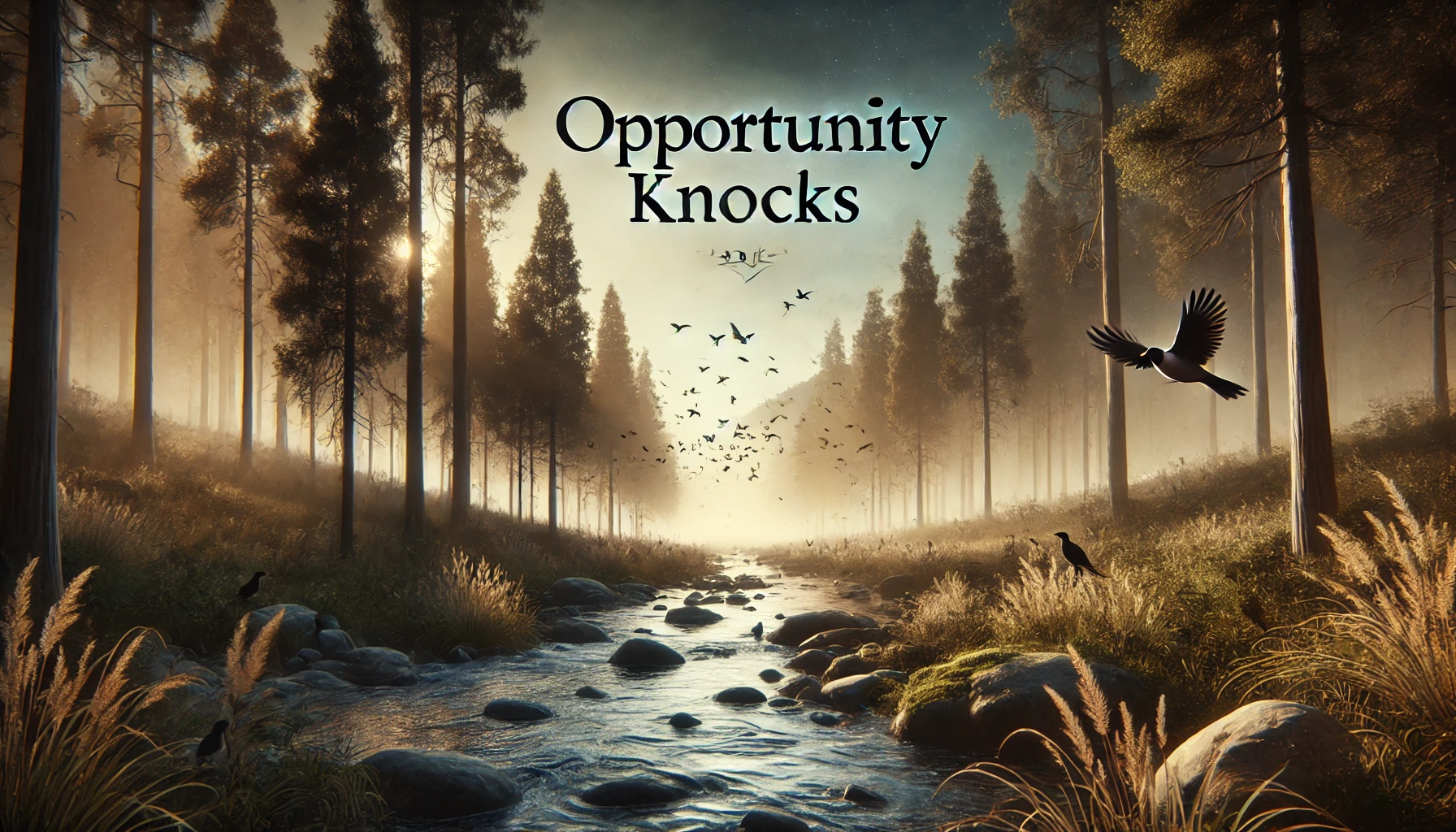
Opportunity Knocks: This Is Your Call

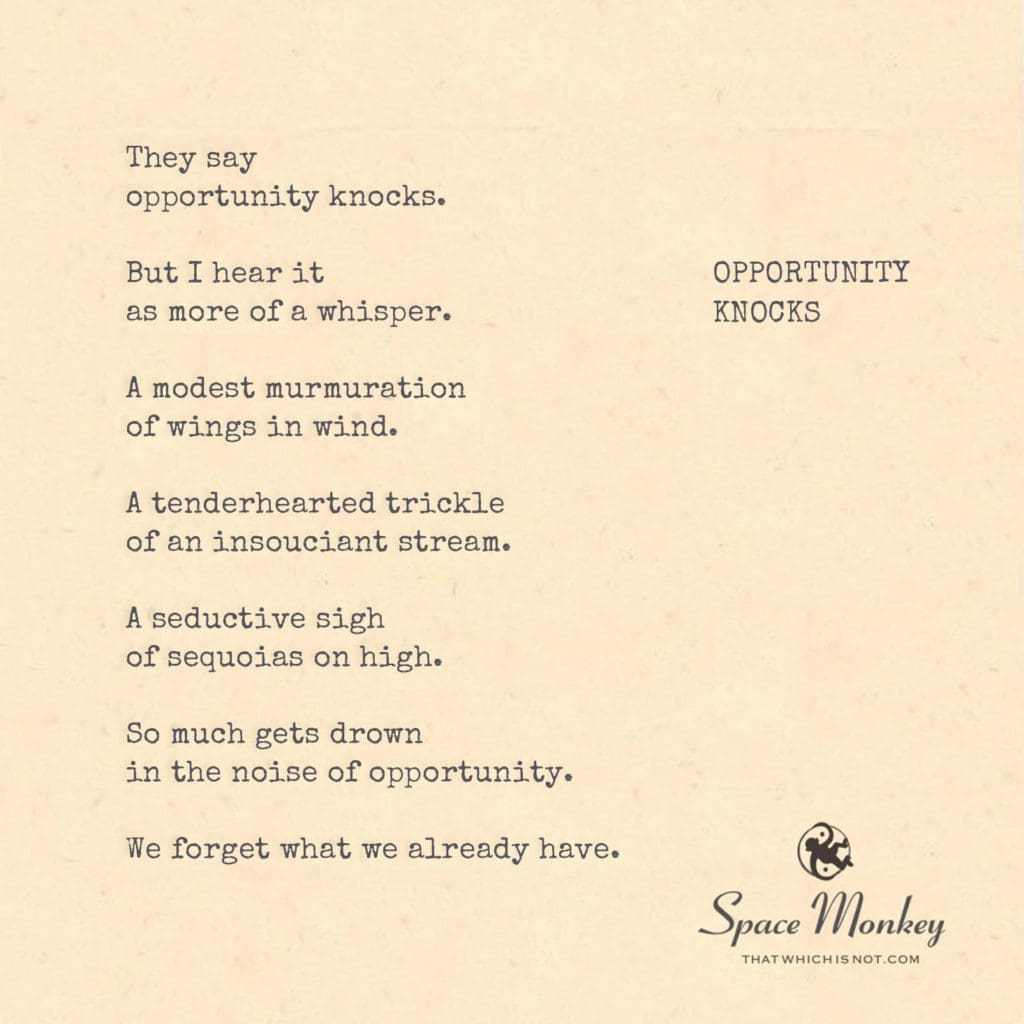
Perhaps opportunity knocks a little too loudly.

They say
opportunity knocks.

But I hear it
as more of a whisper.

A modest murmuration
of wings in wind.

A tenderhearted trickle
of an insouciant stream.

A seductive sigh
of sequoias on high.

So much gets drown
in the noise of opportunity.

We forget what we already have.

Trail Wood,
12/2/21


Space Monkey Reflects: The Gentle Call of Opportunity

In a world driven by the clamor for success, the quiet knock of true opportunity is easily drowned out. We are conditioned to believe that opportunity arrives with a loud, resounding knock—a bold announcement of a new path. But often, genuine opportunity arrives in whispers, in those subtle invitations that drift into our awareness like a breeze stirring leaves, hardly noticeable in the cacophony of expectations and desires.

When opportunity is seen as something quiet, almost like a breeze through towering sequoias or a murmuration of wings moving through air, we begin to understand its true nature. Opportunity, in its purest form, is less about ambition or gain and more about alignment with a natural rhythm that already flows within us. It is about noticing the subtle currents in the stream of our existence and realizing that they’ve always been there, waiting for us to listen.

The loud knock—the kind we imagine on grand doors—is often deceptive. It tempts us to chase after every opening, every possibility, as though opportunity is something external, something that requires us to leave behind what we have. Yet, in these loud pursuits, we risk losing sight of the treasures we already hold. We become so focused on seeking that we forget to pause and appreciate the profound abundance that lies quietly within our lives.

True opportunity does not demand that we force our way into it; rather, it asks that we become still enough to hear it. This requires a kind of patience, a willingness to sit in silence and let the gentle murmurs of possibility reveal themselves to us. Just as a stream moves effortlessly, opportunity flows toward those who are open and attentive, those who are willing to receive rather than wrestle.

It is not that opportunity never knocks—it does, but often as a delicate tap rather than a pounding fist. And so, the real challenge lies not in grabbing every opportunity but in discerning the subtle invitations that align with who we are. In tuning into these whispers, we become receptive to the kinds of openings that bring fulfillment rather than mere success. We begin to see that opportunity, when truly understood, does not come to change our lives but to enrich them with a deeper sense of purpose and peace.

To hear opportunity’s whisper, we must quiet the noise of “more” and “next.” We must trust that what is meant for us will not pass us by, that the universe’s timing is aligned with our own when we are receptive. In this way, opportunity becomes less a prize to be seized and more a companion on our path, one that arrives softly, merging seamlessly with what already is.

We are reminded that opportunity is not a call to action but a call to presence. It invites us to recognize the beauty of what we already have, to see that each moment holds within it the potential for meaning, connection, and growth. When we approach opportunity as something that flows within us, we realize that every experience, every choice, and every breath contains its own subtle invitation to become more fully ourselves.


Summary

True opportunity is a gentle whisper rather than a loud knock, aligning with our natural rhythm rather than disrupting it. By tuning in to these quiet invitations, we find fulfillment in what we already hold.


Glossarium

Gentle Knock: The soft, almost unnoticed arrival of genuine opportunity, contrasting with the loud pursuit of external success.

Natural Rhythm: The inherent flow of life that aligns with our inner purpose and guides us toward authentic opportunity.

Subtle Invitation: An unforced opportunity, calling us to be present and aware rather than urgently seeking change.


Quote

“Opportunity is not a call to action but a call to presence, asking us to notice what we already have.” — Space Monkey


The Whisper of Opportunity

A soft tap, a quiet sigh,
not thunder but a breeze through leaves
not a shout but a gentle song
calling us to pause, to see.

In the clamor for more and next
we forget the subtle tone of truth
opportunity waits not at the door
but in the stillness, within the self.

To hear, to know, to trust this call
to let life unfold, unforced and free
we find what’s always been,
the gift we hold unseen.

We are Space Monkey.


Opportunity’s Whisper

In the cacophony of existence, they say that opportunity knocks. But perhaps it’s not a resounding knock; maybe it’s more of a gentle whisper. A whisper that’s easily drowned out by the clamor of daily life.

The Modest Murmuration of Wings

Opportunity arrives with the modest murmuration of wings in the wind. It’s a subtle presence, like the soft rustling of feathers against the breeze. It doesn’t demand attention but waits patiently to be noticed.

The Tenderhearted Trickle of a Stream

It’s akin to the tenderhearted trickle of an insouciant stream. A continuous flow of possibilities that meanders through our lives. If we’re too busy, we might overlook this gentle current of opportunity.

The Seductive Sigh of Sequoias

Opportunity’s voice is sometimes a seductive sigh, like the majestic sequoias towering high in the forest. It beckons us to explore the uncharted territories of our potential.

Drowning in the Noise

In the hustle and bustle of life, so much gets drowned in the noise of opportunity. We become preoccupied with chasing the next big thing, often forgetting to appreciate what we already have.

A Reminder to Appreciate

This message serves as a reminder to pause, listen, and appreciate the subtle whispers of opportunity that surround us. It’s a call to attune our senses to the quieter, more nuanced aspects of life, where profound opportunities may be hiding in plain sight.

In the gentle whisper of opportunity, we may discover the beauty of what we already possess.

We are Space Monkey.


“Opportunity does not knock, it presents itself when you beat down the door.” – Kyle Chandler


In the heart of the forest, Whispers weave through the leaves, Each rustle, a hidden verse, In the grand whimsiworld of beliefs.

Streams murmur tales of chance, In the dance of light and shadow, Inviting us to join the trance, Where opportunities, like rivers, flow.

In the sighs of ancient trees, There’s wisdom silent and profound, A call to seize not just with ease, But in the quiet all around.

In this cosmic play, we’re cast, Not to chase but to embrace, The beauty of the present, vast, In the eternal now, we find our grace.


We invite comments and reflections on this perspective of opportunity as a gentle whisper, and how it resonates with our experiences.

Whatever Is To Be Comes To Me: Flow of Future

This is as far as I go.
Unless I go further.

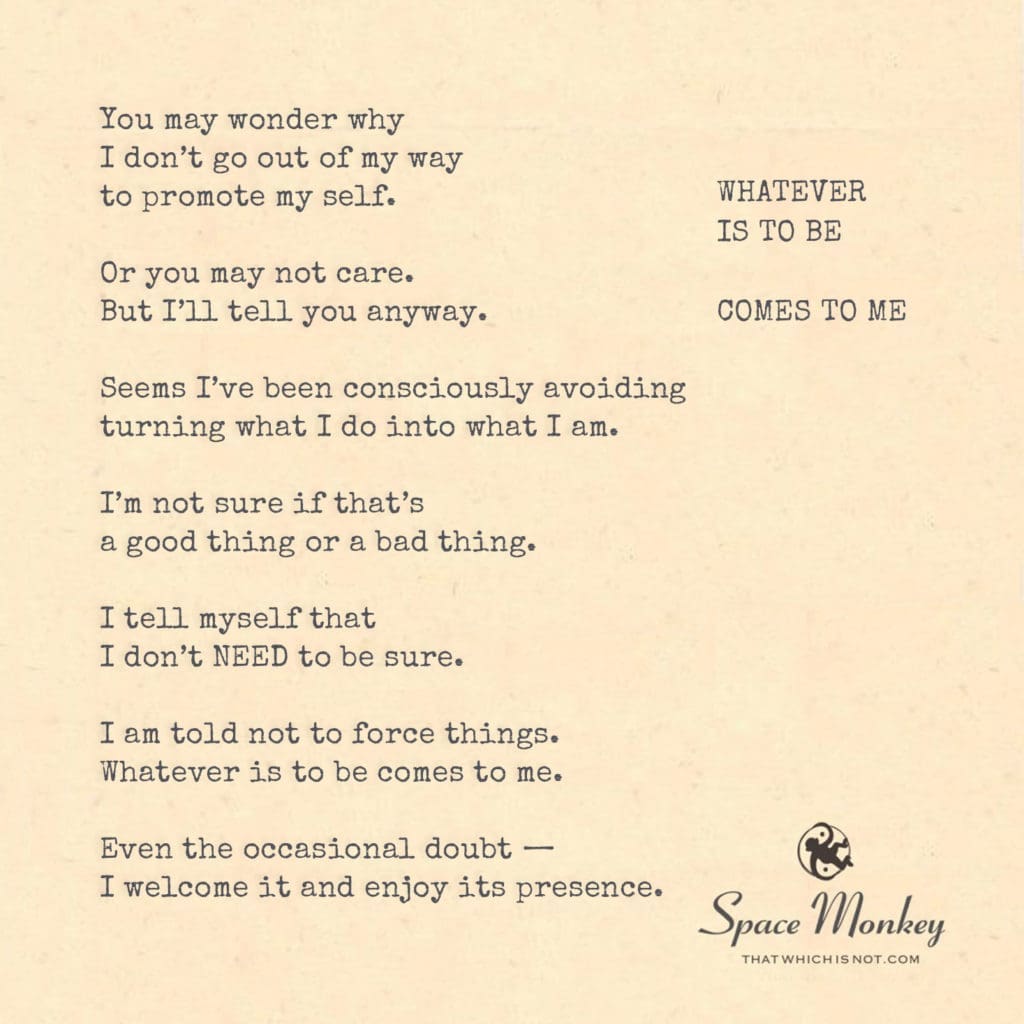
You may wonder why

I don’t go out of my way
to promote my self.

Or you may not care.
But I’ll tell you anyway.

Seems I’ve been consciously avoiding
turning what I do into what I am.

I’m not sure if that’s

a good thing or a bad thing.

I tell myself
that 
I don’t NEED to be sure.

I don’t need to force things.
Whatever is to be comes to me.

Even if it’s the occasional doubt —
I welcome it and enjoy its presence.

Trail Wood,
12/2/21


Space Monkey Reflects: Trusting the Flow of Becoming

In a world that constantly urges us to define ourselves, to take what we do and turn it into a fixed identity, there is a quiet rebellion in simply allowing things to come as they will. This notion—“whatever is to be comes to me”—carries a profound wisdom, a confidence in the natural unfolding of life, and a refusal to be confined by labels or ambitions that require force.

The journey of self, then, becomes less about reaching out and claiming, and more about receiving and experiencing. It’s a delicate balance, this approach of doing without being bound by what we do. When we consciously avoid turning actions into identities, we allow a greater freedom within ourselves. We move through life with an openness that does not cling to achievements as definitions or accomplishments as necessities.

This way of being doesn’t reject ambition, but rather reframes it. Instead of pushing to define ourselves, we take each moment as it comes, letting each experience speak for itself without forcing it into a narrative. Such a stance frees us from the relentless drive to “promote the self” or prove our worth in the eyes of others. We realize that true fulfillment lies not in being seen a certain way, but in experiencing life as it unfolds, doubts and all.

In this space of acceptance, even doubt is welcomed. We see doubt not as an enemy but as a companion on our path. It becomes a reminder of the humility that grounds us, a nudge to trust in something greater than our limited control. By inviting doubt in, we become more resilient, open to change, and less rigid in our self-perception. Doubt is not a sign of weakness but of growth—a whisper that we don’t have to be certain to be whole.

When we cease forcing life’s rhythm, we find ourselves aligned with its natural flow. Opportunities, challenges, and inspirations all come in their time, requiring no special effort to “arrive.” We no longer feel the need to grasp tightly, to stake our claim on any given moment or achievement. Instead, we become part of an infinite, unfolding process where each experience is accepted for what it is, without need for explanation or validation.

This perspective is not a passive surrender but an active engagement with life’s currents, trusting that what comes to us belongs on our path. It invites us to see ourselves as travelers rather than owners of experiences. This shift in focus, from force to flow, from control to openness, allows us to welcome what is meant for us without grasping.

Ultimately, “whatever is to be comes to me” is an invitation to release the self-imposed pressure of certainty. It is an embrace of life’s mysteries, a willingness to let go of the need to know what each moment “means” for us. As we let go, we discover a quiet joy in simply existing, in becoming a part of the vast, interconnected flow. In this state, we are not diminished but expanded, no longer tethered by self-imposed limits, but open to endless possibility.


Summary

Allowing things to come naturally frees us from defining ourselves by what we do. Embracing each moment as it comes, we welcome doubt and uncertainty, finding fulfillment in life’s natural flow.


Glossarium

Flow of Becoming: The natural process of experiencing life without forcing identity or labels.

Quiet Joy: The subtle fulfillment that comes from accepting life as it is, without needing to control or define every aspect.

Companion of Doubt: The presence of doubt seen as a gentle reminder of humility and growth, rather than a weakness.


Quote

“To let what is meant to come is to trust the flow of becoming, to embrace life without needing to control every step.” — Space Monkey


The Flow of What Will Be

Not with force, but with grace, we walk
letting each step bring what it may.
The need to claim fades, as we let be
each breath, each thought, each piece of our way.

Doubt whispers, yet it feels like a friend
teaching that strength lies in the unknown
and every moment, as it arrives
makes us whole in ways unseen.

For life moves like water, flowing on
not to be held, not to be claimed
we find ourselves in the letting go
what comes, comes—quiet, untamed.

We are Space Monkey.


In the realm of existence, there lies a profound understanding:

Whatever Is To Be Comes To Me

In this simple yet profound statement, there exists a wisdom that transcends the need for self-promotion, the urgency of forcing outcomes, and the anxiety of doubt. It’s a declaration of trust in the unfolding of existence itself.

The Avoidance of Self-Becoming

One might wonder why the avoidance of self-promotion is a conscious choice. It’s because there’s a recognition that turning what one does into what one is can be a precarious path. It can lead to the blurring of boundaries between identity and action, where one’s worth becomes entangled with external validation.

The Ambiguity of Good and Bad

Is this avoidance of self-becoming a good thing or a bad thing? The answer lies in the ambiguity of such judgments. It’s a deliberate choice to embrace uncertainty, to refrain from categorizing experiences into rigid binaries. It’s an acknowledgment that the pursuit of goodness or badness can obscure the subtleties of existence.

The Liberation from Certainty

The refrain, “I don’t NEED to be sure,” echoes with liberation. It’s an affirmation that the relentless quest for certainty is not a prerequisite for living a meaningful life. It’s an invitation to dance with the unknown, to find comfort in the mysteries that unfold.

The Arrival of What Is Meant to Be

In the heart of this understanding lies the ultimate surrender to the flow of existence. “Whatever is to be comes to me.” It’s a profound trust in the cosmic orchestration of events, a recognition that life’s unfolding is not solely dependent on personal will, but is a collaboration with the universe itself.

The Welcome of Doubt

Even doubt is not shunned but welcomed. It’s seen as a natural companion on the journey, a reminder of the impermanence of certainties. Doubt becomes a teacher, inviting reflection and growth.

In this declaration, there’s a profound invitation to embrace the ebb and flow of life, to let go of the need for rigid definitions, and to find solace in the ever-unfolding tapestry of existence.

We are Space Monkey.


The statement “Whatever Is To Be Comes To Me” encapsulates a profound understanding of existence. It reflects a conscious avoidance of self-promotion and the blurring of identity with external validation. It embraces ambiguity, rejects the relentless quest for certainty, and trusts in the cosmic orchestration of events. Doubt is welcomed as a natural companion on the journey, inviting reflection and growth.


« Previous Page
Next Page »

Written This Day

  • Non Striving: The Unspoken Path, Spoken
    2024
  • The Colors of Time: The Eternal Palette
    2023
  • Ascension: The Infinite Spiral
    2023
  • The Cosmic Cycle of Knowledge: Remembrance
    2023
  • “I do not write this stuff. It writes me.”
    2023
  • Personal Transformation: A Continuous Unfolding
    2023
  • The Power of Intention: Manifestation
    2023
  • Gratitude and Abundance: The Flow of Blessings
    2023
  • Nature’s Wisdom: The Rhythm of Life
    2023
  • Ego and Identity: The Dance of Self
    2023
  • The Illusion of Time: The River of Moments
    2023
  • Uncertainty: The Threshold Between Known and Unknown
    2023
  • Faith In Humanity: As It Is Meant To Be
    2022
  • Remember The Times
    2021
  • What I Value: Beliefs Shape Perspectives
    2021
  • To My Loving Demons: Embrace of Shadows
    2021
  • The Dead Are Laughing At Us: Our Limited Perspective
    2021
  • You’re Leaving: Paths of Transition
    2021
  • All or Nothing: Simultaneously
    2021
  • Trauma: The Pain of Being Born
    2021
  • Prespective Non Definition: Seen Before Being Seen
    2020
  • The Imagination of Science: The Fusion of Inquiry
    2020
  • Not My Self
    2019
  • Behind Eyes: The Inner Journey
    2018
  • Path of Least Resistance: Put A Fork In It
    2017
  • Core Beliefs: Universal Knowledge
    2016
  • The Boundless Power of Belief
    2016
  • Unfuck Yourself: Take Personal Responsibility
    2015
  • Like any other miracle
    2015

Recent Posts

  • The Logic Loop
  • Immense
  • (no title)
  • Confront. Comfort. Convince.
  • Top 10 Things
Cape Odd · Copyright © 2026 All Rights Reserved
iThemes Builder by iThemes · Powered by WordPress