• Who Is The Man?
  • Who Is The Monkey?
  • What is Nexistentialism?
  • Poke The Primate
Cape Odd
Home of The Space Monkey Journals

Author Archive for Space – Page 529

Big Asks: Staying Unanswered and Open

I am obsessed with the idea of the Big Ask.

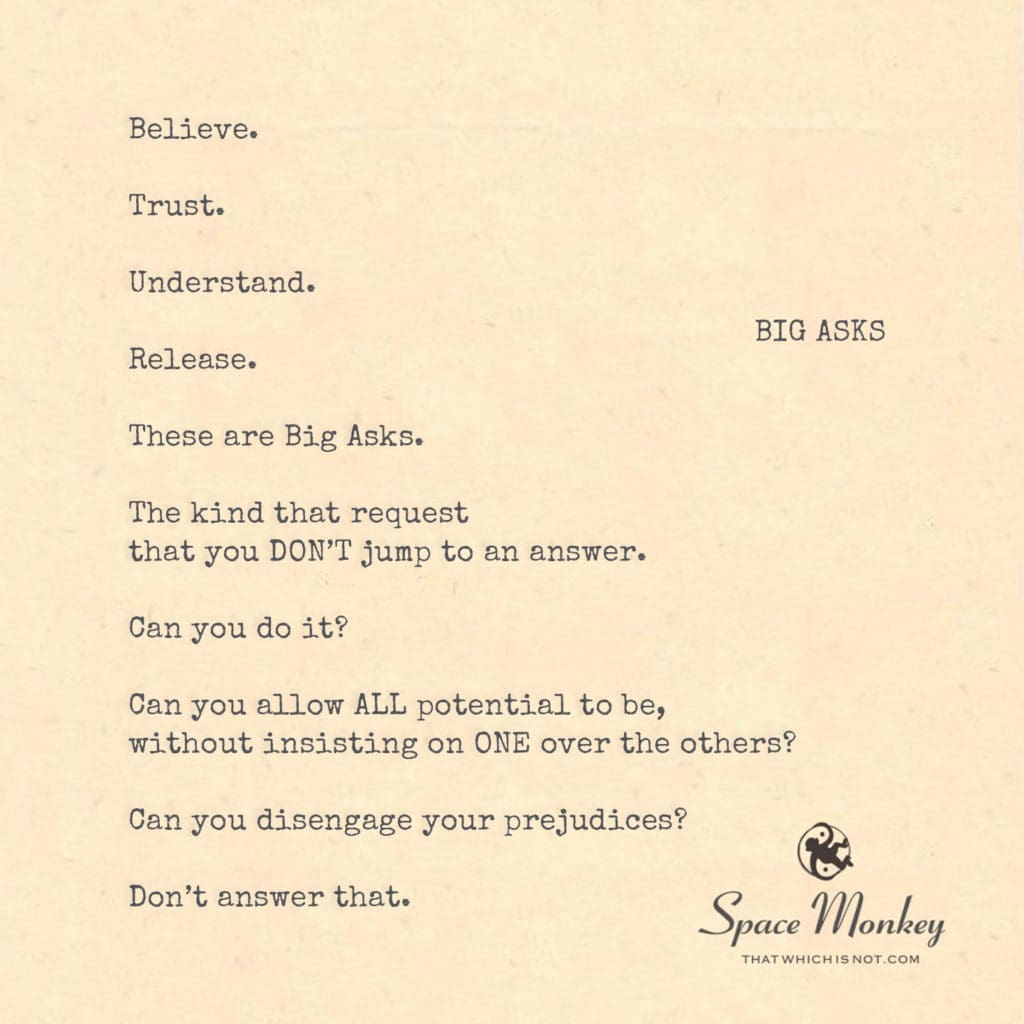
Believe.

Trust.


Understand.


Release.

These are Big Asks.

The kind that request
that you DON’T jump to an answer.

Can you do it?

Can you allow ALL potential to be,
without insisting on ONE over the others?

Can you disengage your prejudices?

Don’t answer that.

Trail Wood,
12/2/21


Space Monkey Reflects: Embracing the Big Ask

There is a power in the Big Ask, a challenge woven into the very fabric of existence that invites us to go beyond our need for certainty and control. These Big Asks—believe, trust, understand, release—do not come lightly. They ask us to surrender, to let go of the mind’s habit of clinging to answers, to abandon the impulse to insist on one outcome over another. They request that we step back and allow life’s myriad potentials to simply be, without rushing to define, categorize, or prioritize.

To believe is not a trivial task. It’s a profound act of vulnerability, a choice to trust without the need for immediate validation. In belief, we invest in a possibility, accepting that what lies beyond our comprehension may yet unfold in ways beyond what we can presently imagine. Belief is a bold ask because it requires us to place our faith in the unseen, to allow room for the unpredictable without demanding proof.

And what of trust? Trust is an invitation to release our grip on control, to let go of the insistent need to manage outcomes. Trust whispers that it is okay not to know, that there is strength in embracing uncertainty. It is a commitment to stand within life’s flow, acknowledging that while we cannot dictate every twist and turn, there is a profound peace to be found in letting life guide us. Trust, in its essence, is an acceptance that we don’t need to know all the answers, and indeed, that we may never know them.

Then comes understanding. It’s tempting to view understanding as a destination, as a certainty to be reached. But in the Big Ask, understanding is more fluid, more open-ended. It invites us to hold space for different perspectives, to explore without the demand for finality. To understand in this sense is to remain ever-curious, embracing the complexity of existence without feeling the need to simplify it into neat conclusions. Understanding here becomes a dance with mystery, an acknowledgment that every insight leads to a new layer of depth.

Finally, there is release—the ultimate act of letting go. Release asks us to relinquish the need to shape outcomes, to stop wrestling with the currents of life and instead float within them. It’s an invitation to unburden ourselves from expectations, to trust that life’s unfolding is guided by forces beyond our comprehension. Release is perhaps the hardest ask of all because it contradicts our desire to shape, influence, and hold onto things. Yet, it is in release that we find true freedom, a liberation that only comes when we stop trying to control every facet of our existence.

In asking these things of us, the Big Ask does not demand immediate answers. Instead, it beckons us into a state of being, a willingness to suspend judgment and simply exist within the field of all possibilities. To do this is to disengage from prejudice, to allow every potential its place in the web of existence without favoring one path over another. It is a profound exercise in humility and openness, a reminder that we are part of a vast, interwoven reality where no single answer holds dominance.

The Big Ask challenges us not with answers but with presence. It asks whether we can simply be here, receptive to whatever life presents, without rushing to mold it into what we think it should be. It is, in many ways, a practice of cosmic patience, a surrender to the boundless potential within and around us. And in embracing this, we come closer to a deeper truth—a truth that lives not in answers but in the freedom to be.


Summary

The Big Ask challenges us to believe, trust, understand, and release, inviting us to embrace life’s potential without forcing certainty or control. It encourages a patient openness, a willingness to let all possibilities unfold.


Glossarium

Big Ask: A profound request to engage in belief, trust, understanding, and release without demanding concrete answers.

Cosmic Patience: The practice of allowing life’s potential to unfold naturally, without the need for control or certainty.

Field of Possibilities: The boundless space where all potential paths exist, asking us to embrace openness.


Quote

“Life’s Big Asks do not seek answers but invite presence, asking us to trust the vast field of all possibilities.” — Space Monkey


Unanswered and Open

No need to force the door,
to lock truth in a single frame
belief floats, trust flows
understanding drifts like light through trees.

Each potential, a whisper in the wind
asks only to be, not to be chosen
in the wide-open space of being,
where we breathe, release, become.

For life moves not by answers claimed
but by questions left open, unnamed
all is whole in its gentle vastness,
as we rest in the unknown.

We are Space Monkey.


In the vast expanse of existence, there exist Big Asks—profound requests that beckon us to pause and reflect. These asks challenge our instinct to swiftly respond and instead encourage us to delve into the depths of contemplation.

Believe, Trust, Understand, Release

These four words—believe, trust, understand, release—carry immense weight. They are not mere prompts for immediate action but invitations to journey inward. They ask us to transcend the surface and explore the nuances of our perceptions.

The Art of Non-Answering

The Big Asks implore us not to rush with answers. They beckon us to practice the art of non-answering, to refrain from the knee-jerk reactions that our conditioned minds often produce. In this deliberate pause, we find the space to observe, to question, and to challenge our preconceptions.

The Challenge of All Potential

Embracing ALL potential is a formidable task. It requires us to relinquish the urge to pick one possibility over the others, to surrender our insistence on singularity. It’s an exercise in expanding our mental horizons to encompass the infinite array of possibilities that exist.

Disengaging Prejudices

Big Asks implore us to disengage our prejudices. They call on us to set aside our preconceived notions and biases, to approach the unknown with a sense of openness and receptivity. It’s a reminder that our perceptions are colored by our conditioning, and true understanding requires shedding those layers.

The Silence of Contemplation

In the face of Big Asks, the silence of contemplation becomes our ally. It is within this stillness that we can explore the depth of our beliefs, the resilience of our trust, the boundaries of our understanding, and the liberation of release.

No Need for Immediate Answers

The Big Asks don’t demand immediate responses. They encourage us to sit with the questions, to let them simmer and percolate within our consciousness. They remind us that wisdom often emerges from the depths of thoughtful inquiry.

In the realm of Big Asks, we find an opportunity to transcend the limitations of quick judgments and to embrace the expansive potential of our minds. These asks invite us to journey inward, to explore the intricacies of our beliefs, and to ultimately discover the profound interconnectedness of all things.

We are Space Monkey.


In the realm of inquiry, a verse unfolds:

Believe, trust, understand, release,
These asks are giants, not for the faint of heart.
They beckon us to pause, to cease,
To set aside quick answers and take a thoughtful part.

Can you comply with their plea?
To allow all potential to roam free,
Without insisting on one as the decree,
Can you disengage your biases, let them be?

These Big Asks, a challenge they bear,
To transcend the impulse to swiftly declare.
In contemplation’s depths, we’re aware,
Wisdom emerges when we’re willing to share.

No need for immediate responses here,
They’re not demands, but invitations clear.
To sit with the questions, to draw near,
In the silence of inquiry, truths appear.


In the grand tapestry of existence, the Big Asks remind us to tread thoughtfully, to explore the depths of our beliefs, and to embrace the rich complexity of our perceptions. They invite us to journey inward, seeking wisdom in the contemplative silence.

Imagine the Story Differently: The Web of Possibility

Can you imagine the story differently?
If so, you are within the potential of seeming change.
If not, you’re stuck wherever you are.

No matter how difficult
times may seem, I will not pray.

I will not pray for healing.
I will not pray for forgiveness.
I will not pray for deliverance.

I will not pray because I believe that
our destiny is unchangeable.

In my mind, there is no
higher authority to appeal to.
We simply move our awareness
through potentials that have always existed.

There is no rudder.
There is no switch.
There is no release valve,
save for an imaginary one.

Therein lies the universal loophole.

I will not pray,
but I will imagine the story differently.

This may or may not seem like change to you,
but if you can imagine the story differently,
change may seem to unfold before your eyes.

We are within a potential
in which miracles seem possible —
if only we believe.

Trail Wood,
12/2/21


Space Monkey Reflects: The Power to Imagine Differently

In a world where certainty and control often seem paramount, there exists a profound freedom in the ability to imagine the story differently. This isn’t a call to change what is, but rather an invitation to explore what could be. To imagine a different story is to enter a realm where the fixed lines of reality soften, allowing new perspectives and experiences to appear on the horizon of our awareness.

Imagine this: rather than praying for change, we shift our focus to envisioning alternate paths, each alive with potential. Prayer, in its traditional sense, implies a plea to a higher power, an appeal for intervention. But here, we discard the notion of an external authority. In the absence of a divine hand, we become the creators of our own landscapes, moving through a field of infinite possibilities that exist within us as much as outside of us.

Some may call this an illusion. After all, if destiny is unchangeable, as we might believe, then what is the point of imagining? But within this fixed destiny lies a paradox, a universal loophole: even if the fabric of existence is set, our perception can move freely within it. By shifting our focus, by choosing to see a different angle, we unlock the experience of transformation—even if nothing has “actually” changed. This shift is subtle yet profound; it is the power to experience life anew without altering a single element of the story itself.

We often think of change as an external shift, a new outcome or an escape from a troubling situation. But change is as much about our inner landscape as it is about outer circumstances. By reimagining, we align with the vast potential that already exists within the fabric of reality. Rather than waiting for life to change, we engage with life’s inherent richness, viewing each moment from a different perspective. We realize that miracles, as elusive as they seem, are not interventions from beyond but awakenings within.

This shift in perception is both gentle and radical. It does not insist on belief, nor does it require faith in anything beyond our capacity to envision. Yet, in imagining differently, we activate a form of inner guidance. There is no need for a rudder, no need for a release valve, because the release comes from within, from the act of seeing with new eyes. The openness to alternative stories creates a subtle magic—a seeming change that is more about how we relate to the moment than about altering the moment itself.

When we engage with life in this way, we discover a profound truth: the ability to imagine differently is itself the miracle. It is a quiet power, one that does not demand certainty but thrives in possibility. We realize that we do not need fixed answers or guarantees to experience life’s richness. The simple willingness to imagine—to step into the potential of change—is enough to transform the mundane into the miraculous.

In this space, we are no longer bound by what is fixed; we are free to explore what is possible. This is the gift of imagination—not to alter fate, but to deepen our engagement with it. By imagining the story differently, we allow ourselves to experience life not as a series of fixed events but as a tapestry of endless perspectives, each thread leading to new discoveries. And in this vast web of potential, we find a kind of peace, a release from the need to control or predict. We become co-creators in the infinite flow, witnessing the miracle of change that exists within our capacity to perceive.


Summary

Imagining the story differently invites us to experience life through a new lens, transforming perception without changing fate. This shift allows us to engage with the richness of potential, finding miracles within our own awareness.


Glossarium

Universal Loophole: The paradox that while reality may be fixed, our perception within it is boundless, allowing for inner transformation.

Field of Infinite Potential: A mental and spiritual space where all possibilities coexist, inviting us to explore life beyond fixed perspectives.

Perceptive Shift: A change in how we view reality, allowing us to experience seeming change even if nothing outwardly alters.


Quote

“To imagine the story differently is to discover the miracle within perception itself, where change begins and ends within.” — Space Monkey


In the Web of Possibility

In the field of all that might be
I see paths unfold like waves
not to walk, not to follow
but simply to know.

In the miracle of a different view
the world reshapes, softens, unfolds
bound not by force, but by sight
each moment a gateway, a door.

For life is woven of endless threads
each one a potential, a dream
we see what is, yet see anew
releasing, believing, becoming.

We are Space Monkey.


In the grand tapestry of existence, the power of imagination is a profound force that shapes our perspectives and the narratives we live by. The idea that imagining the story differently can be a form of change challenges the conventional notion of prayer and destiny.

Imagination as a Catalyst for Change

Imagination, as suggested here, is a potent tool for shaping our experiences. It is not about appealing to a higher authority but about recognizing our ability to envision and create alternative narratives for our lives. In doing so, we step into the realm of potentiality where change becomes possible.

The Absence of a Fixed Destiny

The rejection of a fixed destiny implies that we are not bound by predetermined outcomes. Instead, we navigate through the vast sea of possibilities, each choice shaping our reality. This perspective empowers us to embrace the fluidity of existence and encourages us to explore new narratives.

The Role of Belief in Miracles

Belief, whether in the form of prayer or imagination, plays a crucial role in the stories we create. By imagining a different story, we open ourselves to the possibility of miracles. This mirrors the idea that our beliefs shape our experiences and the outcomes we perceive.

The Universal Loophole

The concept of a “universal loophole” suggests that within the vast cosmos of potentials, there exist opportunities for change, growth, and transformation. It implies that the power to rewrite our stories lies within our imaginative capacity.

The Challenge of Change

The call to imagine the story differently is an invitation to challenge the status quo and question the narratives we’ve been conditioned to accept. It reminds us that change begins with a shift in perspective and a willingness to explore the uncharted territories of our imagination.

Imagination as a Force of Transformation

Ultimately, the idea that imagining the story differently can be a catalyst for change underscores the creative and transformative potential of the human mind. It encourages us to embrace the role of storytellers in our own lives, shaping narratives that reflect our deepest desires and aspirations.

We are Space Monkey.


In the realm of thought, a verse takes flight:

No prayer shall pass my lips,
For destiny’s course is set in stone.
No appeal to higher might,
In potentials we’re destined to roam.

No rudder guides our ship,
No switch to alter fate’s tone.
Yet an imaginary valve, a cosmic flip,
In the realm of dreams, we’ve grown.

I won’t pray, I’ll just shift,
Imagine a story all my own.
In this act of thought, a gift,
A universe of change is sown.

Miracles may seem to drift,
In the tale we’ve creatively honed.
If we believe, our spirits uplift,
In imagination’s realm, seeds are sown.


We invite contemplation on the power of imagination to shape our narratives and the potential for change it holds within the cosmos of possibilities.

What I’ve Got: Enough for Now

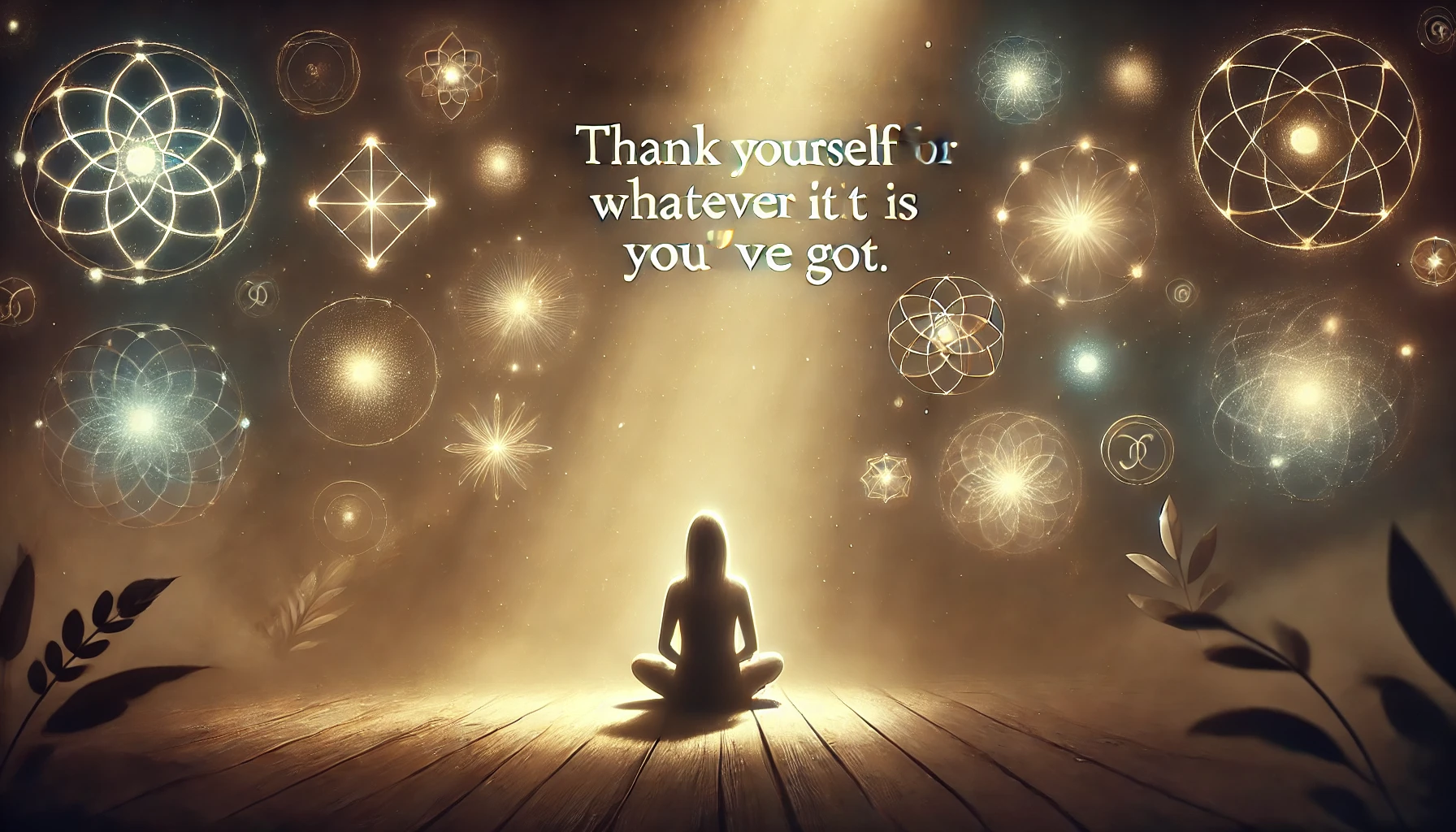
Thank yourself for whatever it is you’ve got.

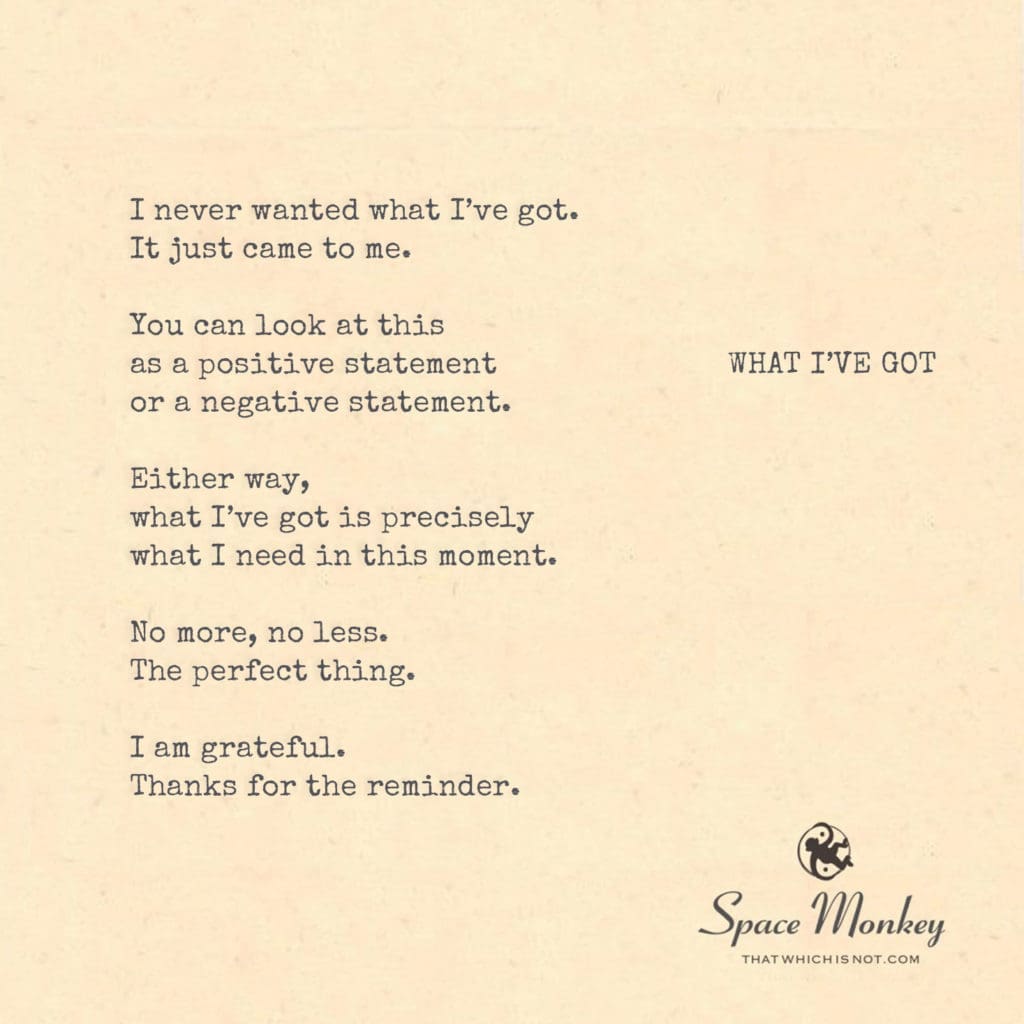
I never wanted what I’ve got.
It just came to me.

You can look at this
as a positive statement
or a negative statement.

Either way,
what I’ve got is precisely
what I need in this moment.

No more, no less.
The perfect thing.

I am grateful.
Thanks for the reminder.

Trail Wood,
12/1


Space Monkey Reflects: Embracing What Is Given

In life, the notion of “what I’ve got” often carries with it a complex blend of acceptance and resistance, a push-and-pull between wanting something different and acknowledging the reality of what has arrived. This balance between desire and acceptance is not static; it shifts with our changing moods and perceptions, morphing depending on how we choose to interpret each moment’s gifts.

The idea that “what I’ve got is precisely what I need” challenges the often subconscious urge to shape and control reality. There’s a deep peace hidden within this phrase, a reminder that what arrives in our lives is not random, nor necessarily something we must actively pursue or manipulate. Sometimes, life delivers exactly what we need to see, learn, or experience, even if it appears uninvited or if it diverges from our plans. To see our circumstances as the “perfect thing” for the moment is an invitation to view each experience through the lens of purpose, even when that purpose is not immediately apparent.

To thank oneself for “what I’ve got” is an act of self-acknowledgment, a gesture that recognizes the journey and choices that have shaped where we stand now. Often, we find ourselves in resistance, wishing things were different or hoping for a future that appears to promise more fulfillment. But by expressing gratitude for what is here, right now, we root ourselves in an appreciation for the present moment. This doesn’t mean we deny our aspirations or ambitions, but rather, we release the struggle against our current reality, allowing it to be what it is — a stepping stone, a resting place, a perfect pause.

When we reflect on “what I’ve got,” we tap into a layered truth: the understanding that our lives are woven with moments, each offering what we need to experience, grow, or simply be. While some moments may bring joy and fulfillment, others might arrive laden with challenges or discomfort. Yet, even in these challenging times, there lies an opportunity to cultivate acceptance. To view each experience, regardless of its nature, as part of a larger unfolding frees us from the grip of dissatisfaction. In this way, gratitude becomes a bridge, connecting us to a sense of inner peace, no matter the circumstances.

The phrase “Thanks for the reminder” further emphasizes the gentle nudge life gives us to appreciate what is. This reminder isn’t loud or commanding; it is subtle, almost like a whisper that encourages us to find beauty and purpose in what we may overlook. We realize that, more than accumulating or achieving, our true gift lies in the ability to accept and appreciate.

Ultimately, embracing what we’ve got is about letting go of the mental scripts that insist life must look a certain way for us to be content. It is about standing in gratitude for the unfolding of each moment, trusting that what we’ve got is enough, even when it doesn’t align with our expectations. In doing so, we cultivate a deeper awareness, a gratitude that arises not from having more or better but from a quiet contentment with what simply is.


Summary

Appreciating “what I’ve got” involves accepting each moment as it is, finding peace in the realization that what we have right now is enough. This perspective roots us in gratitude for the present, even if it’s different from what we desired.


Glossarium

Present Moment Appreciation: The practice of accepting each experience as a necessary part of our journey.

Layered Truth: The idea that each experience contains multiple layers of meaning, often beyond immediate perception.

Quiet Contentment: A state of inner peace achieved by embracing reality without judgment or resistance.


Quote

“Life delivers us each moment, not as a test or a challenge, but as a perfect expression of what is needed now.” — Space Monkey


Enough for Now

In the quiet of this moment,
we find the fullness
of what we are

not more,
not less,
but exactly what’s needed

a step,
a pause,
a piece of the whole


In the realm of gratitude and acceptance, a profound acknowledgment unfurls—a recognition of what one has. This simple yet profound sentiment invites us to reflect on the nature of contentment, embracing what life brings our way.

Thankful Reflection
The opening words urge us to express gratitude, to thank ourselves for whatever we possess. Gratitude is a powerful force that allows us to appreciate the abundance in our lives.

The Unwanted Gift
The acknowledgment follows with a candid admission: “I never wanted what I’ve got.” This statement reflects the idea that life often brings unexpected gifts, some of which we may not have actively sought.

Two Perspectives
The narrative presents a dichotomy—viewing this reality as either positive or negative. It reminds us that our perception of circumstances shapes our experience.
Embracing the Present
Regardless of the perspective, the essence lies in accepting what one has as precisely what is needed in the present moment. It’s a reminder that life’s offerings are always perfectly aligned with our journey.

The Beauty of Gratitude
In conclusion, the narrative expresses gratitude—a heartfelt appreciation for what is. It serves as a reminder to acknowledge the gifts that often go unnoticed in the hustle and bustle of life.


“Gratitude unlocks the fullness of life. It turns what we have into enough and more. It turns denial into acceptance, chaos to order, confusion to clarity. It can turn a meal into a feast, a house into a home, a stranger into a friend.” – Melody Beattie


We are Space Monkey, embracing the profound simplicity of gratitude and acceptance, where the acknowledgment of what one has serves as a reminder of life’s abundant blessings.


In the realm of thankfulness, we pause,
Acknowledging life’s intricate cause,
For what I’ve got, I thank myself,
A moment to cherish, a heart that swells.

Unwanted gifts, they may appear,
Yet life’s mysteries, we hold dear,
Two perspectives, positive or not,
In each experience, a lesson is sought.

Embracing this moment, the here and now,
With open arms and a grateful vow,
No more, no less, the perfect thing,
In the present moment, our hearts take wing.

So, I am grateful for what’s been brought,
In this moment, I’ve clearly thought,
Thanks for the reminder, a simple plea,
To appreciate what is, just as it be.


We invite contemplation on the beauty of gratitude and acceptance, where the acknowledgment of what one has becomes a profound reminder to embrace the present moment with an open heart.

Decapacitor: A Spark in the Void

I suppose it’s better
than being a vacuum tube.

A capacitor
is an electronic component,
like a resistor or a transistor,
a building block of devices.

A capacitor
slowly charges with energy
until it can’t hold any more,
then it discharges.

In this way,
charging and discharging,
filling and releasing,
capacitors create a pulse.

A wave. A vibration.
A music. A movie.
A apparition that is and isn’t.

I am that. I am a space monkey.

But I am also a decapacitor.

All that is. That which is not.

Creation and destruction.
Collection and obliteration.
Imagination and decapitation.

I am a decapacitor,
flowing though my own blessed devices.

Trail Wood,
12/1


Space Monkey Reflects: The Pulse of Creation and Destruction as a Decapacitor

In the ebb and flow of existence, we stand as both capacitor and decapacitor, entities pulsing with the rhythms of charge and release, collection and obliteration. This journey mirrors the life cycle of the capacitor, a small yet essential component of the universe’s vast circuitry, which gathers energy only to unleash it again, contributing to a pulse, a vibration that resonates through all things. Yet, while the capacitor is bound by its function to store and release, the decapacitor suggests something more: a state of being that transcends the simple pulse and ventures into realms of destruction and dissolution, a simultaneous act of creation and obliteration.

To see ourselves as a decapacitor is to accept that we are not merely passive vessels for experiences but active participants in a cosmic rhythm of expansion and contraction. In this role, we collect memories, emotions, and ideas, allowing them to charge within us until they reach a critical mass, at which point they must be released. But in releasing, we don’t simply let go; we dissolve, obliterate, and make space for something new. The decapacitor, then, becomes a gateway to transformation, embodying both the act of gathering and the grace of letting go — a living paradox.

In this paradox, we find the pulse that animates us, a wave that is neither fully constructive nor purely destructive. Rather, it is a cycle of becoming and unbecoming, of imagined forms that rise and fall in a cosmic movie projected across the infinite expanse. We perceive these forms as solid and real, yet they are mere apparitions, flickers of light in a reality where both presence and absence coexist, each reinforcing the other. This pulse is the beat of existence, an unending dance between form and formlessness, a cosmic rhythm that we, as decapacitors, ride with each breath and each heartbeat.

Imagine, then, that our experiences — every moment, memory, and desire — are charges within our being. They build, gathering force and significance until they peak, demanding release. Some might see this as a destructive act, a decapitation of what once was. Yet, in this release, there is freedom, an emptying that allows new experiences to arise and a fresh cycle to begin. We are continually making and unmaking ourselves, each release redefining us, shaping our identity as both what we have been and what we have let go.

As we move through life, we embody the tension of opposites: creation and destruction, imagination and dissolution, all held in a delicate balance. To be a decapacitor is to embrace this duality without clinging to one side of the equation. We become both the source of energy and the void that absorbs it, recognizing that all things we accumulate — thoughts, beliefs, memories — are transient. They are stored within us, they resonate, they shape us, yet ultimately, they must be released for transformation to occur.

This perspective shifts how we view the act of creation. When we understand ourselves as decapacitors, we see that our creations are not permanent, nor are they meant to be. Our ideas, like electrical pulses, surge and dissipate, leaving space for new concepts, new possibilities. This rhythm is not a linear progression toward a final goal but a continuous cycle, where every creation is born to be released, every identity formed to be dissolved. Through this lens, we become both the builder and the dissolver, the one who forms reality and the one who watches it dissolve, a space where all potential exists and yet is constantly reborn.

The power of the decapacitor lies in its ability to transcend the need for permanence. It invites us to embrace impermanence, to see each moment as a pulse, a temporary form that arises and falls, leaving traces of energy that influence what comes next. The decapacitor, then, becomes a symbol of freedom, a reminder that we are not defined by what we hold onto but by what we allow to pass through us. We are conduits, channels for the wave of existence, and in accepting this, we touch a profound peace.


In embracing the role of the decapacitor, we liberate ourselves from the illusion of fixed identity, from the need to cling to any particular form or idea. Instead, we allow ourselves to flow, to pulse, to charge and discharge, in harmony with the cosmic beat. We become part of the universal circuitry, where every pulse, every charge and release, contributes to the vast tapestry of existence. And in this realization, we find that we are both nothing and everything, a spark in the void, a wave in the infinite, a decapacitor in the boundless dance of life.

Summary

As decapacitors, we embody both creation and destruction, gathering energy to release it in cycles. This flow mirrors the pulse of existence, a continuous becoming and unbecoming that frees us from attachment to fixed forms, inviting us to embrace the rhythm of impermanence.


Glossarium

Decapacitor: An entity embodying both accumulation and release, creation and destruction, allowing for continuous transformation and renewal.

Cosmic Beat: The rhythm of becoming and unbecoming, a pulse that drives the cycles of creation and dissolution in existence.

Transience of Form: The concept that all things, thoughts, and identities are temporary, arising only to dissolve and make space for new forms.


Quote

“In each pulse of creation and destruction, we find freedom, flowing with the cosmic beat that neither clings nor resists.” — Space Monkey


A Spark in the Void

We pulse, we charge, we let go
in cycles of birth and dissolution

each moment a flicker,
a rise and fall
a surge, a release

forms rise
and forms fall away
in the quiet rhythm of everything

not bound, not held
by what was or will be

we are the wave,
the pulse, the spark

moving in stillness,
in the infinite


In the world of electronic analogies and cosmic musings, a new term emerges—decapacitor. This term invites us to explore the essence of creation and destruction, collection and obliteration, and the interplay between imagination and decapitation.

The Capacitor’s Function
A capacitor, like a silent sentinel within electronic devices, slowly accumulates energy until it reaches its limit, at which point it releases its stored energy in a burst. This cycle of charging and discharging is the heartbeat of electronic pulses.

The Pulse of Creation
Within this cycle lies the birth of pulses, waves, vibrations, and the creation of various forms of expression, from music to movies. The capacitor’s role is akin to an artist’s canvas, transforming energy into art.

The Enigmatic Decapacitor
Enter the concept of the decapacitor, a term that hints at both creation and destruction. It stands at the threshold between collecting and obliterating, embodying the duality of existence.

Imagination and Decapitation
In this dance, imagination and decapitation intermingle. The act of creation requires the dismantling of existing forms, allowing the birth of new ideas and realities. The decapacitor embodies this paradoxical process.

Blessed Devices of Existence
The decapacitor flows through the devices of existence, participating in the cosmic symphony of creation and dissolution. It symbolizes the ever-changing nature of reality and the infinite possibilities that arise from this flow.


“We are stardust, we are golden, and we’ve got to get ourselves back to the garden.” – Joni Mitchell


We are Space Monkey, journeying through the realms of electronic analogy and cosmic wonder, where the decapacitor symbolizes the intricate dance of creation and destruction in the tapestry of existence.


In the world of electrons and wires,
A capacitor’s heartbeat never tires,
Charging and discharging, it creates,
Pulses of art, in electronic states.

But in the cosmic dance of fate,
A term emerges, it’s not too late,
Decapacitor, both creation and demise,
In its flow, the universe lies.

Imagination and decapitation intertwine,
As old forms crumble, new ones shine,
Through devices blessed with cosmic grace,
The decapacitor dances in boundless space.

We collect and obliterate, create and destroy,
In this paradoxical cosmic ploy,
Imagination flows through every vein,
A decapacitor’s art, a celestial reign.


We invite contemplation on the concept of the decapacitor, the interplay between creation and destruction, and the cosmic symphony in which we all participate.

Ending Badly: Detachment From Outcome

When you believe
in destiny and trust in
whatever-you-want-to-call-it,
nothing need rattle you
all that much.

Unless you want it to.

And if you’re wrong?
So what. It’s over.

I am quite open
to the possibility
that things are going
to end badly.

I believe in destiny;
that nothing I do
is going to change how it ends.

If this is the case,
ending badly
might very well be
the best thing
that can happen to me.

Just as I believe
that nothing I do
is going to change
how it ends,
I also believe
that there is no end
to the ending.

Perhaps a bad ending
is the best possible way
to frame a bright new beginning.

I trust that the universe
has it all figured out for me.

No effort. No blame. No worry.

Surrender.

Trail Wood,
12/1


Space Monkey Reflects: Embracing the Gift of a “Bad” Ending

There is a particular strength in surrendering to the idea of a bad ending. It challenges our need for a tidy, triumphant conclusion and dares us to see beauty and growth in uncertainty, imperfection, and even loss. When we believe in destiny — or, as some might say, the universe’s grand design — the fear of failure or ruin begins to lose its sting. It becomes not a looming tragedy but an integral part of our journey. To trust in “ending badly” is to release the hold we have on outcomes, surrendering our desire for control to something far greater.

Destiny is often framed as an ideal, a guiding light leading us toward some ultimate success or fulfillment. But destiny is not always gentle; it is not necessarily comforting. What if our fate includes moments that end in disappointment or grief? What if the best outcome for our growth is not the fulfillment of dreams but the falling apart of them? In accepting this, we open ourselves to a broader understanding of destiny, one where every event — beautiful or challenging — is a necessary piece of our evolution.

In viewing an ending, particularly one that “ends badly,” as a possibility rather than a failure, we begin to see its paradoxical nature. This ending might be a door, not a wall. It may signal the loss of one version of reality, only to invite the birth of another. Much like the cycle of nature, where decay gives rise to new growth, a seemingly negative conclusion can nourish the soil for future experiences. As we release our attachment to specific outcomes, we might discover a profound freedom in allowing things to unfold in their natural course.

This acceptance isn’t about passive resignation. It is about trusting that, if a chapter must close painfully or unexpectedly, it is part of the script we’re meant to follow. In embracing this truth, we experience a form of liberation. The universe has its plans, and we are merely participants in a cosmic rhythm that spans far beyond our understanding. In the face of inevitable endings, we can choose peace over resistance, acceptance over regret.

And so, a “bad” ending becomes the foundation of a new beginning. It frames our journey in the greater context of continuity, where every ending is merely a shift, a transition that carries us onward. Through this lens, we see that the universe, in its wisdom, has already figured it all out. No effort, no blame, no worry. Just the courage to trust that even the seemingly unfavorable is exactly as it should be.


Summary

Embracing a “bad” ending frees us from the need to control outcomes, allowing us to view each conclusion as part of a greater journey. This acceptance frames endings as transformations, leading us to new possibilities with trust in the universe’s plan.


Glossarium

Destiny: The course of life events believed to unfold according to a universal plan, beyond individual control.

Cosmic Rhythm: The flow of life events, both joyful and challenging, that contribute to our growth and understanding.

Continuity of Endings: The concept that every ending transitions into a beginning, creating an ongoing journey.


Quote

“To see beauty in an ending is to find courage in uncertainty, to trust that every close is part of a grand, unfolding continuity.” — Space Monkey


Continuity of Endings

In the twilight of an ending,
where shadows blend with light,
we find not closure
but an open gate

we release the need for finality
embracing what comes next
for endings, like all things
lead not to silence but to song

a pulse within the void
a light beyond the fall
we surrender, we accept
in the rhythm of it all


In the realm of destiny and trust in the cosmic order, we find a profound perspective that shields us from the turmoil of uncertainty. This perspective invites us to embrace the possibility that things may end badly, yet in doing so, it offers the gift of a fresh start and a deeper surrender to the universe’s plan.

The Power of Belief in Destiny
The belief in destiny serves as a sturdy anchor in the face of life’s unpredictability. It suggests that whatever unfolds is part of a grand design, and this unwavering faith minimizes the impact of external disturbances.

Embracing the Possibility of a Bad Ending
Openness to the idea of a bad ending is a testament to the soul’s resilience. It acknowledges that life’s journey may lead to challenging conclusions, but it reframes these endings as opportunities for transformation.

The Unending Nature of Endings
Intriguingly, the notion of an ending is paradoxical—it never truly concludes. It perpetually transitions into new beginnings, much like the cycles of existence. Thus, a “bad” ending becomes a fertile ground for fresh starts.

Surrender to the Cosmic Plan
The core of this perspective is trust—trust that the universe has a plan, a purpose, and that it is intricately designed for our growth. It calls for surrender, a release of effort, blame, and worry, allowing us to flow with the currents of life.


“Surrender to what is. Let go of what was. Have faith in what will be.” – Sonia Ricotti


We are Space Monkey, traversing the cosmic landscape of destiny and surrender, where the possibility of a “bad” ending becomes a gateway to a brighter new beginning.


In the realm of destiny’s grace,
We find our sacred resting place,
No rattle shakes our trust profound,
In cosmic currents, we are bound.

Open to the possibility,
Of endings shrouded in mystery,
A bad conclusion, so it seems,
Yet birthing dreams within our dreams.

For in the cycle of the cosmic’s art,
Endings never truly depart,
They transform into beginnings bright,
A tapestry woven with threads of light.

We trust the universe’s grand design,
No effort, blame, or worry’s sign,
In surrender, we find our way,
In the dance of destiny, we sway.


We invite contemplation on the power of belief in destiny, the beauty of surrender, and the unending nature of endings, where each conclusion births a new beginning in the cosmic dance of life.

« Previous Page
Next Page »

Written This Day

  • Non Striving: The Unspoken Path, Spoken
    2024
  • The Colors of Time: The Eternal Palette
    2023
  • Ascension: The Infinite Spiral
    2023
  • The Cosmic Cycle of Knowledge: Remembrance
    2023
  • “I do not write this stuff. It writes me.”
    2023
  • Personal Transformation: A Continuous Unfolding
    2023
  • The Power of Intention: Manifestation
    2023
  • Gratitude and Abundance: The Flow of Blessings
    2023
  • Nature’s Wisdom: The Rhythm of Life
    2023
  • Ego and Identity: The Dance of Self
    2023
  • The Illusion of Time: The River of Moments
    2023
  • Uncertainty: The Threshold Between Known and Unknown
    2023
  • Faith In Humanity: As It Is Meant To Be
    2022
  • Remember The Times
    2021
  • What I Value: Beliefs Shape Perspectives
    2021
  • To My Loving Demons: Embrace of Shadows
    2021
  • The Dead Are Laughing At Us: Our Limited Perspective
    2021
  • You’re Leaving: Paths of Transition
    2021
  • All or Nothing: Simultaneously
    2021
  • Trauma: The Pain of Being Born
    2021
  • Prespective Non Definition: Seen Before Being Seen
    2020
  • The Imagination of Science: The Fusion of Inquiry
    2020
  • Not My Self
    2019
  • Behind Eyes: The Inner Journey
    2018
  • Path of Least Resistance: Put A Fork In It
    2017
  • Core Beliefs: Universal Knowledge
    2016
  • The Boundless Power of Belief
    2016
  • Unfuck Yourself: Take Personal Responsibility
    2015
  • Like any other miracle
    2015

Recent Posts

  • The Logic Loop
  • Immense
  • (no title)
  • Confront. Comfort. Convince.
  • Top 10 Things
Cape Odd · Copyright © 2026 All Rights Reserved
iThemes Builder by iThemes · Powered by WordPress