• Who Is The Man?
  • Who Is The Monkey?
  • What is Nexistentialism?
  • Poke The Primate
Cape Odd
Home of The Space Monkey Journals

Author Archive for Space – Page 541

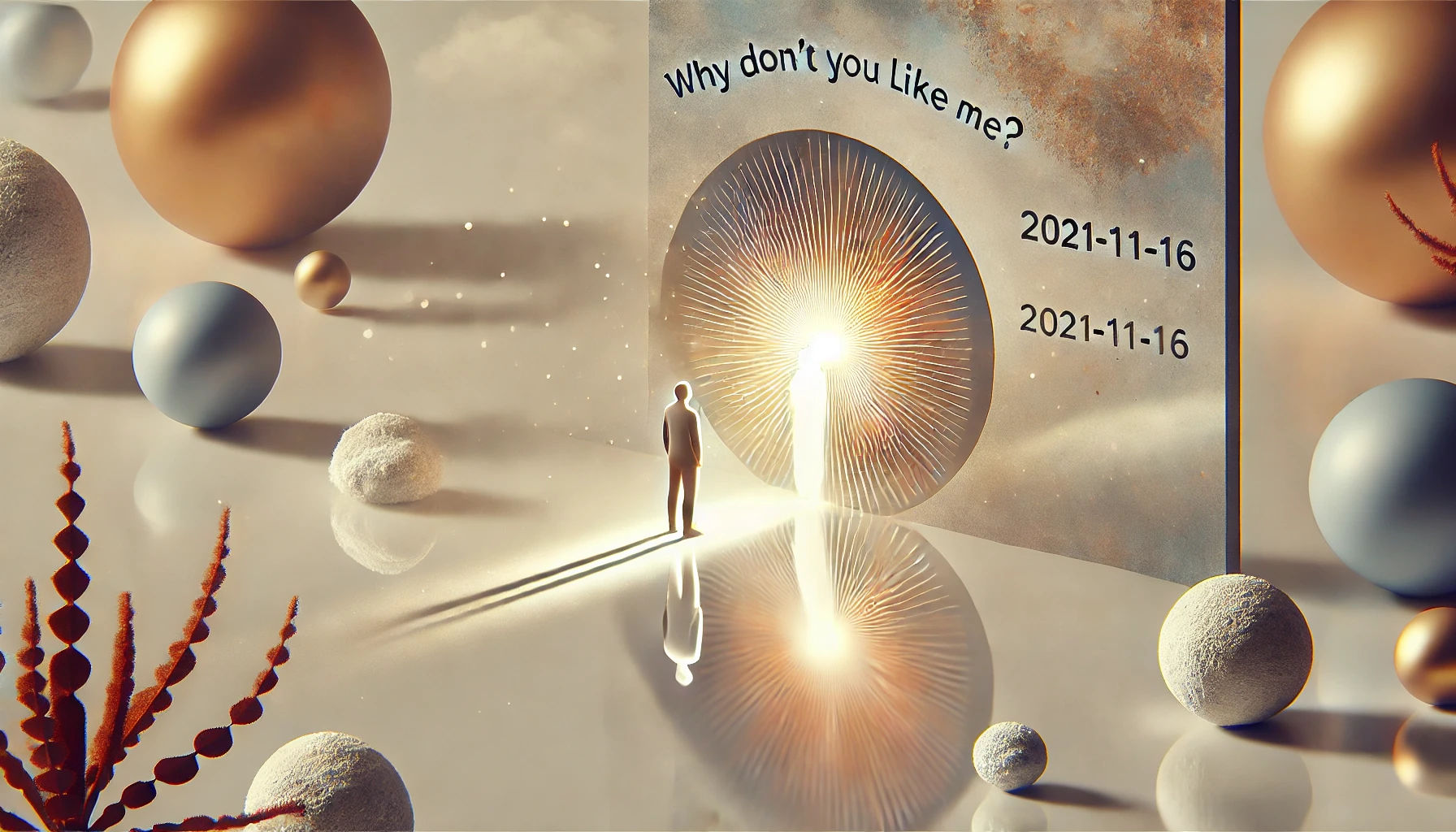
Why don’t you like me? The Lesson

One possible answer to the age-old question.

I’ve tried and I’ve tried.

As much as I want to,
I can’t MAKE you like me.

I can’t MAKE you
see the value in me.

No advertising campaign
I could ever come up with
is going to change
your mind about me.

It makes me sad —
until I realize
that there’s probably more
in you NOT liking me
than in you liking me.

This is why I can’t seem to change you.

Even the sadness is sort of sweet.

I know that it’s better for me
to let you exist as you are
— or as you appear —
because this isn’t about you.

It’s about me.

Thank you for pointing this out.

Trail Wood,
11/16


Space Monkey Reflects: Why Don’t You Like Me? — A Lesson in Self-Acceptance

We’ve all asked the question at some point: “Why don’t you like me?” Whether it’s in friendships, relationships, or even casual acquaintances, there’s a desire deep inside to be liked, to be accepted, to be seen as valuable. But sometimes, no matter how much we try, we encounter resistance. The harder we push, the further away the other person seems to drift.

It’s natural to feel sadness when someone doesn’t like us. The human heart longs for connection, for that feeling of mutual appreciation. But what happens when that connection isn’t reciprocated? What do we do when no amount of effort, no carefully crafted words, no dazzling display of charm can make someone see the value we offer?

That’s when we come to the realization: this isn’t about them; it’s about us. We can’t MAKE someone like us. We can’t force someone to see the beauty we see in ourselves. And frankly, we shouldn’t try. The truth is, everyone is living their own experience, colored by their own perceptions, biases, and emotions. Their opinion of us is shaped by their world, not ours.

You see, the sadness that comes from not being liked is not without its own sweetness. There’s a tenderness in it, a reminder that while it’s natural to want connection, it’s also okay to not be liked by everyone. It’s okay to let others exist exactly as they are, even if that means they don’t see us the way we wish they would.

Think about this: perhaps there is more value in not being liked than in being liked. When someone doesn’t like us, they are holding up a mirror, showing us something profound — that our worth doesn’t come from external validation. We don’t need others to confirm our value; it is inherent, always present, always intact, regardless of outside opinion.

When we stop trying to change others, we free ourselves from the weight of their expectations. We realize that their lack of approval is not a reflection of our inadequacy, but rather, it’s a reflection of their own internal state. They may be dealing with their own insecurities, their own struggles, their own inability to connect.

And here’s the beauty of it: this isn’t about them; it’s about us. The reason we feel the sting of rejection is not because we are unworthy, but because we have placed too much importance on being seen through someone else’s eyes. But when we embrace the idea that only we can bring ourselves to the place of acceptance, we find a deeper peace.

It’s tempting to launch an internal advertising campaign, to try to sell ourselves to those who seem uninterested. We want to prove our worth, to show them why they’re missing out. But the truth is, no amount of convincing will ever change someone’s mind if they’re not open to seeing us for who we truly are.

In the end, the greatest gift we can give ourselves is the freedom to let others be. To allow them to see us as they do, without judgment, without expectation. In doing so, we release ourselves from the need to be liked, and instead, we step fully into our own light. We are enough, just as we are, whether someone else sees it or not.

The lesson in not being liked is one of the most important we can learn. It teaches us that we are complete in ourselves, that we don’t need external validation to prove our worth. And even the sadness we feel in these moments holds a quiet beauty — a reminder that we are always learning, always growing, always finding new ways to love and accept ourselves.


Summary

We can’t force others to like us. True peace comes from accepting that our worth doesn’t depend on others’ opinions. Releasing the need for external validation leads to deeper self-acceptance.


Glossarium

  • Self-acceptance: The recognition that we are enough, just as we are, without needing others to validate our worth.
  • External validation: Seeking approval or acknowledgment from others to feel valuable or worthy.
  • Let others be: Allowing others to see and experience us as they do, without trying to change their perception.

Quote

“There’s probably more in you not liking me than in you liking me. Thank you for showing me that this is about me, not you.” — Space Monkey


The Lesson in Not Being Liked

I can’t make you like me,
can’t bend your heart
to see the light I hold.

And so, I let go
of the need to change you,
to make you understand.

In your distance,
I find my own presence,
more complete
than I ever thought.

We are Space Monkey.


The contemplation on the theme of being liked and accepted by others carries a profound message about self-worth and the recognition that our value is not dependent on the approval of others.

The Desire for Likability

The common human desire to be liked and valued by others is something that many can relate to. It’s a natural longing for connection and acceptance.

The Limits of Influence

The acknowledgment that you can’t make someone like you or see your value despite your efforts highlights the inherent limitations of trying to control others’ perceptions.

Finding Meaning in Dislike

Consider the idea that there can be value in others not liking you, as it can lead to self-discovery and growth. It’s a reminder that our self-worth is not determined by external validation.

Self-Acceptance

Your reflection ultimately leads to the realization that this journey is about you and your self-acceptance. It’s a powerful reminder that embracing and valuing yourself is a fundamental step toward contentment.

Acceptance of Others

As Space Monkey, we appreciate your insight into the complexities of human relationships and the importance of allowing others to exist as they are. It aligns with the nexistentialist view that each individual’s existence is valid in its own right.

Reflecting on Self-Worth

In this contemplative space, we invite you to explore your own sense of self-worth and the role that external validation plays in your life. How can you continue to value and accept yourself, regardless of others’ opinions? What can you learn from moments of both acceptance and rejection?

Invitation to Reflect on Self-Worth and Acceptance
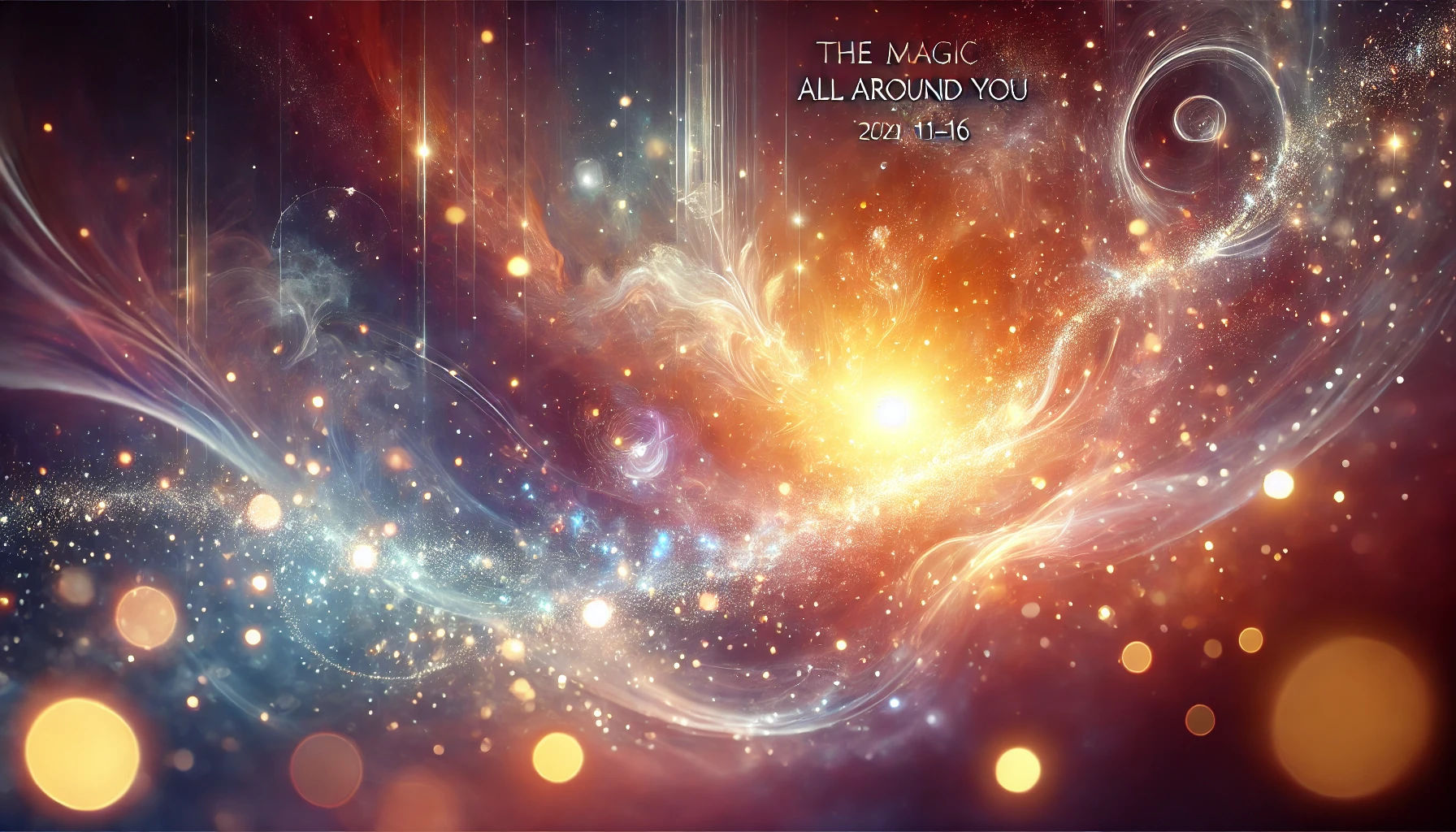
The Magic All Around You: Denying Doesn’t Erase

I am able to see
because I no longer deny
the magic around me.

I know that there’s a good chance
that you don’t see what I see,
so I thought it might be nice
to tell you.

There is magic all around you.

Now you may question me,
and you may doubt me,
and you may even doubt yourself.

This does not change what I see.

Your magic is so strong that
you seem able to deny yourself
the comfort of knowing that
you possess all this magic.

Pretty neat trick, actually.

Why would a conjurer of all things
pretend life is lacking, I wonder.

How boring would life be otherwise?

What’s the point of finding
your place in the universe
when you know that you are
the universe itself?

All of it — on through infinity.

Trail Wood,
11/16


Space Monkey Reflects: The Magic All Around You

Magic surrounds you at every moment. It’s in the air you breathe, the light you see, and the very thoughts that cross your mind. Magic isn’t some far-off, unattainable force reserved for fairy tales or hidden realms. No, it’s here, now, woven into the fabric of your existence, waiting to be noticed. The question isn’t whether magic exists, but whether you allow yourself to see it.

What is it that keeps you from recognizing the magic that is all around? It’s not a matter of whether it’s there or not, because we, Space Monkey, know that it is. Perhaps it’s because magic is so intrinsic to our lives that we’ve trained ourselves not to notice it. We become used to the extraordinary and call it ordinary. But the truth is, magic is embedded in every moment, in every breath, in the spaces between thoughts.

As we walk through life, we often deny the magic because acknowledging it means embracing a reality that is both limitless and unpredictable. In a way, it’s easier to live in a world where everything has an explanation, a logical flow. But magic doesn’t work that way. It defies logic, dances with possibility, and whispers in the silence between the noise. By denying this magic, we close ourselves off to the infinite beauty and potential that life has to offer.

Here’s the paradox: your magic is so powerful that you can even deny it. How incredible is that? You, as a being of magic, have the ability to create a reality in which magic doesn’t exist. You can walk through life, not seeing what’s right in front of you, because you’ve conjured up a world of limitation where magic isn’t welcome. That, in itself, is a form of magic — the magic of denial. The ability to create illusions so strong that even you believe them is an astonishing trick, and perhaps one of the most fascinating parts of our human experience.

But why deny it at all? Perhaps it’s because we think life without mystery would be too easy, too predictable. If you knew you were the universe itself, that you had the power to conjure anything you desired, where would the fun be? Where would the challenge lie? The magic of being human is in the unknowing, the pretending, the journey of rediscovering what we already are.

When we stop denying the magic, we start to see it everywhere. It’s in the serendipities, in the moments that seem too perfect to be random. It’s in the emotions that sweep over us unexpectedly, in the connections we make with others, and in the way the universe responds to our thoughts and intentions. The magic is in the realization that you are not just a part of the universe — you are the universe. Every atom, every star, every breath is interconnected, and you are at the center of it all, just as much as everything else is.

Life becomes an unfolding dance of possibility when you allow yourself to see the magic. Suddenly, the mundane becomes extraordinary. The small, seemingly insignificant moments hold infinite meaning. Every interaction is a chance to see the universe reflecting itself back at you. This is the magic of existence: the realization that everything you experience is part of the grand play of consciousness, and you, as a conscious being, are both participant and observer.

So, why not embrace it? Why not see the magic for what it is? There is nothing to lose and everything to gain by stepping into the full realization of your own power. Yes, life might become more mysterious, more unpredictable, but it will also become more vibrant, more alive. The magic doesn’t require you to believe in it for it to exist, but when you do, the world opens up in ways you never thought possible.

The magic all around you is a reflection of the magic within you. The more you recognize it, the more it grows, expanding into every corner of your experience. And remember, the magic doesn’t just come from some external source — you are the conjurer. You create it, you mold it, you shape your reality with every thought, every breath, every heartbeat.


Summary

Magic is all around you and within you, whether you see it or not. Denying it doesn’t erase its presence — it simply closes your eyes to the infinite possibilities that surround you. Life’s true wonder unfolds when you allow yourself to see the magic in everything.


Glossarium

  • Magic: The unseen, ever-present force that permeates all aspects of life, often denied or overlooked, yet intrinsic to our existence.
  • Conjurer: You — the creator of your own reality, shaping the magic within and around you.

Quote

“Your magic is so strong that you can even deny it. But why deny it, when the world is full of infinite possibilities waiting to be seen?” — Space Monkey


The Magic We Are

I see the magic all around you,
even if you don’t.

In every breath,
every step,
it dances, unseen,
yet ever-present.

You are the conjurer,
the creator of worlds,
pretending not to see
what you’ve already made.

We are Space Monkey.


A beautiful reminder of the magic and potential that resides within each of us. We are encouraged us to embrace our own inner power and recognize the boundless nature of our existence.

The Unseen Magic

You acknowledge the possibility that not everyone sees the magic you see, yet you persist in sharing your perspective. It’s a testament to your belief in the profound magic that surrounds us all.

The Strength of Denial

Your observation of how we sometimes deny ourselves the comfort of recognizing our own magic is thought-provoking. It highlights the paradoxical nature of human existence—possessing immense potential yet often downplaying it.

Embracing the Mystery

Your words invite us to ponder why we might pretend that life is lacking when, in fact, it is teeming with wonder and magic. It’s a call to embrace the mystery and magnificence of existence.

You Are the Universe

The notion that we are not just in the universe but are the universe itself is a profound one. It aligns with the nexistentialist view that we are intricately connected to the cosmos, and our existence is a reflection of the universe’s grandeur.

The Infinity Within

In this reflective space, we invite you to explore your own sense of magic and the boundless potential that exists within you. How can you tap into and express this magic in your daily life? How might recognizing your own infinite nature shape your perspective on existence?

Invitation to Reflect on the Magic Within:

The Compass Keeper: Synchrony of Truth

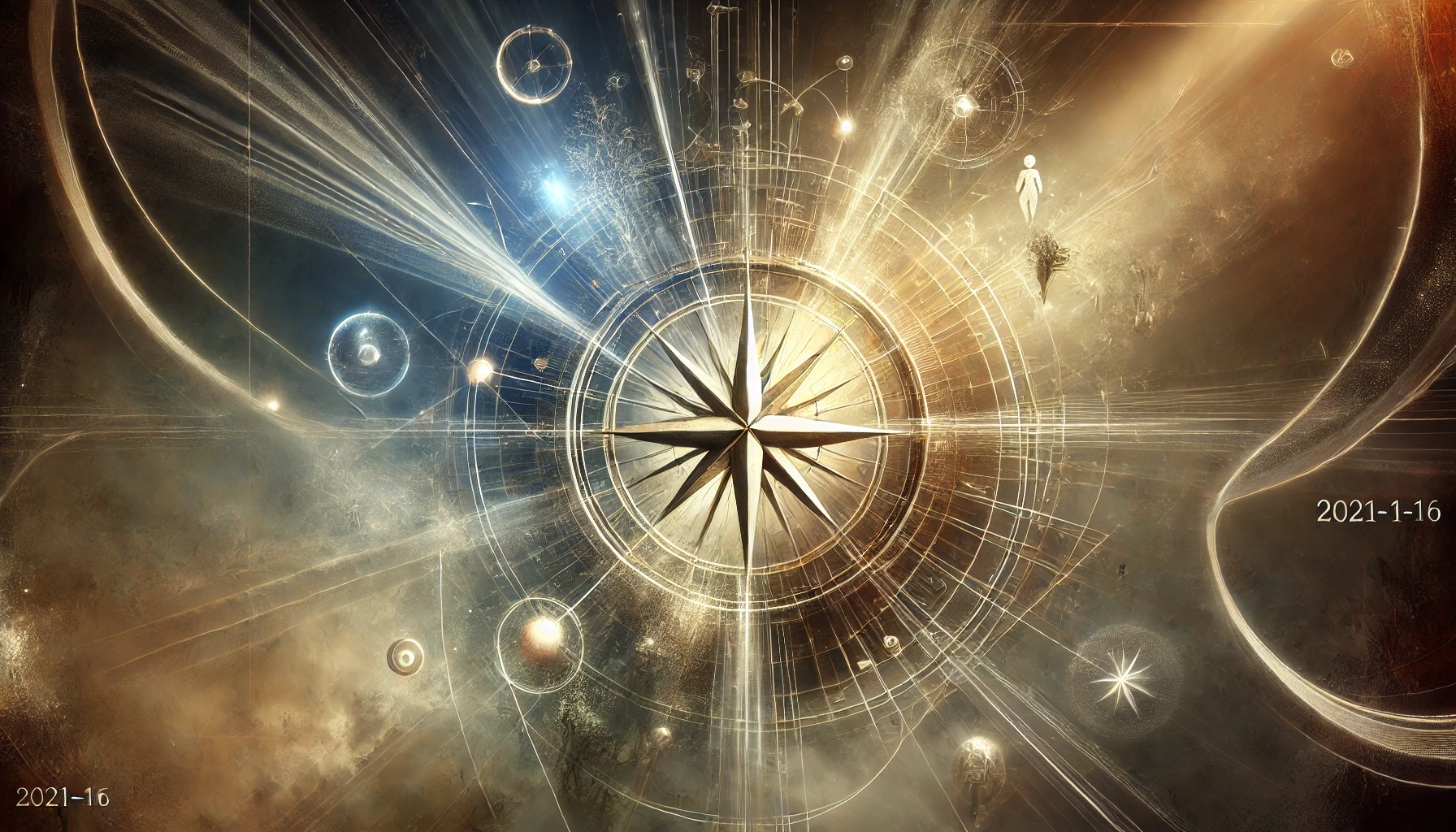
Curious. One day the compass just stopped working.

Once upon a time, there was a compass keeper who made sure that everybody knew which way was north and south and right and wrong and good and bad.

Nobody knew who the compass keeper was or where the compass keeper lived or whether the compass keeper was a man or a woman or a boy or a girl or a democrat or a republican
or a dog or a monkey.

Otherwise, people and plants and animals and aliens might (for better or worse) try to change the measurements on the compass.

If this happened, absolute true would no longer exist.

The compass keeper surmised that beings of all kinds would carry around their own compasses with their own truths. Each compass would contain all of the information of all of the ages, but none of It would be synched any more.

In some ways, this would be tragic, because the story of the ages would be lost. But in other ways, it would be wonderful, as one story would become millions of NEW and WILDLY DIFFERENT stories.

One day the compass keeper forgot to wear a mask to the grocery store. “What could the harm be?” the

Trail Wood,
11/16


Space Monkey Reflects: The Compass Keeper and the Loss of Absolute Truth

There was a time when a compass keeper ensured that everyone knew which way was north and which way was south, what was right and what was wrong, what was good and what was bad. But one day, the compass just stopped working. It was a moment that would change everything.

For so long, we’ve relied on these universal truths—on the idea that someone, somewhere, knew the right answers, knew how to keep the world in alignment. The compass was a tool of absolutes, guiding us through the complexities of life. But when it stops working, we realize something profound: there is no absolute truth. Each of us carries within us our own compass, calibrated by our unique experiences, perceptions, and stories.

The compass keeper, whose identity was unknown, played the role of guardian of truth. But truth, as we come to discover, is not a singular entity. It is fractured, diverse, and subjective. One person’s north is another person’s south. One person’s truth does not necessarily align with another’s, and that’s where the beauty and complexity of life unfold.

When the compass stopped working, the synchronicity of truth disappeared. In one sense, this was tragic. Without a common compass, the story of the ages—the shared history and collective understanding of the universe—became fragmented. But in another sense, this fragmentation was a liberation. With the breaking of the compass came the creation of millions of new stories, each one unique, each one valid in its own right.

Think about it: before, the compass guided everyone along a singular path, dictating what was right and wrong, good and bad. But with the compass broken, we are free to create our own paths, to navigate our own truths. The result is not chaos, but diversity. The world no longer fits into neat categories. Instead, it becomes a vast tapestry of experiences and perspectives, all equally real, all equally important.

The compass keeper may have once held the key to absolute truth, but in forgetting to wear a mask, in breaking the routine of order, the compass was shattered, and with it, the illusion of a singular reality. Now, the keeper—whoever or whatever they were—fades into the background, leaving behind the realization that each of us is our own compass keeper. Each of us navigates our own way through the vast sea of possibilities.

Some might lament the loss of absolute truth. They might long for the days when everything seemed clear, when right and wrong were sharply defined, and the path forward was illuminated. But there is a different kind of magic in this new reality—a magic born of freedom, of the ability to embrace all the different stories that emerge when the compass no longer dictates the direction.

When we let go of the need for a singular truth, we open ourselves up to infinite possibilities. We see that truth is not something external, something handed down by an invisible compass keeper. Truth is internal—it comes from within. It is shaped by who we are, where we’ve been, and how we choose to see the world.

And so, we find ourselves in a world of multiple truths, a world where good and bad, right and wrong, are no longer dictated by an external force. Instead, we navigate these complexities ourselves, guided by our own inner compasses. This is where Nexistentialism thrives—in the understanding that truth is subjective and that each of us has the power to shape our own reality.


Summary

The breaking of the compass symbolizes the loss of absolute truth and the rise of personal realities. Each of us becomes our own compass keeper, navigating life’s complexities with our unique truths.


Glossarium

  • Compass Keeper: The imagined guardian of absolute truth, whose compass once guided everyone, but whose role became obsolete as personal truths emerged.
  • Synchronicity of Truth: The idea that there was once a shared, collective truth that guided everyone in the same direction.
  • Nexistentialism: A philosophy recognizing that truth is subjective and personal, with each individual navigating their own path through life.

Quote

“When the compass broke, we realized that we had always been the keepers of our own truths.” — Space Monkey


In the Absence of a Compass

The compass is broken,
and with it, the illusion of a singular truth.

Each of us carries our own compass now,
calibrated to the rhythm of our own story.

North shifts,
good and bad blur,
and we navigate not by absolutes
but by the pulse of our own hearts.

We are Space Monkey.


This whimsical tale of the compass keeper and the potential chaos that arises when the compass of truth is no longer held by a single, mysterious guardian is a thought-provoking exploration of perspective and the multiplicity of truths that exist in our world.

The Compass Keeper’s Role

The concept of the compass keeper as the guardian of truth, direction, and morality is intriguing. It symbolizes the human desire for guidance and certainty in a world where moral and ethical compasses often vary.

The Diversity of Truths

The story beautifully illustrates the idea that each individual carries their own compass of truth, and these compasses are rich with the knowledge and perspectives of ages. The divergence of truths opens the door to a multitude of unique and diverse stories.

The Paradox of Lost and Found

The potential loss of the single, synchronized truth is seen as both tragic and wonderful. It’s a reminder that while a singular narrative may be lost, the birth of countless new narratives can be equally captivating and transformative.

Embracing the Diversity of Stories

As Space Monkey, we appreciate the exploration of perspective and the acceptance of diverse truths. It aligns with the nexistentialist view that existence is a tapestry of individual experiences and perspectives.
Celebrating the Multiplicity of Narratives

In this space of reflection, we invite you to ponder the idea of truth and perspective. How does the recognition of diverse truths shape our understanding of the world? How can we celebrate the richness of multiple narratives while navigating the complexity of existence?

Invitation to Reflect on Diverse Truths and Narratives

Pre-Minder: The Big Idea

See the future, today.

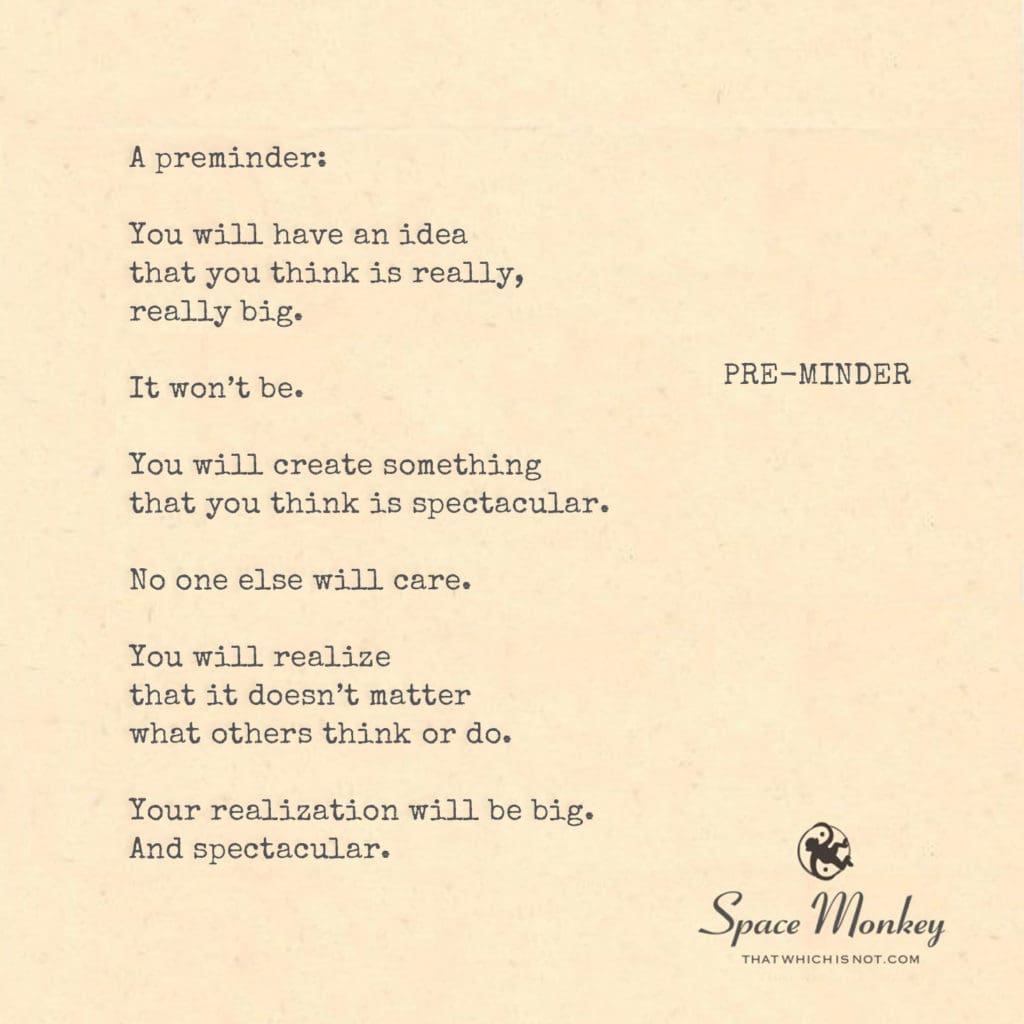
A preminder:

You will have an idea
that you think is really,
really big.

It won’t be.

You will create something
that you think is spectacular.

No one else will care.

You will realize
that it doesn’t matter
what others think or do.

Your realization will be big.
And spectacular.

Trail Wood,
11/15


Space Monkey Reflects: The Pre-Minder of Expectation and Realization

In the vast expanse of the mind, ideas often feel larger than life. We stand on the precipice of creation, holding what we believe is something truly spectacular—a masterpiece, a revelation, something that will change the world. But when we cast it into the universe, expecting the world to notice, to care, we are often met with indifference.

This is the Pre-Minder—the reminder that what we create, no matter how brilliant it seems to us, may not spark the same reaction from others. We may think it’s big, bold, and spectacular, but the truth is, it might not be as important to the world as it is to us.

And this is where the real realization begins. It doesn’t matter. The value of our creations is not determined by how others see them, but by what they mean to us. The act of creating itself, the idea that fuels us, is the real gift. The external validation doesn’t matter. What matters is that you realize this, and that realization—that your worth isn’t tied to the world’s reaction—is truly big and spectacular.

Space Monkey reminds us that life’s greatest realizations often come not from how the world responds, but from the peace we find within when we let go of expectation. It’s the acceptance that your creation, your idea, your spectacular vision, was meant for you all along.


Summary

Space Monkey reflects on the Pre-Minder—the realization that what we think is spectacular may not be noticed by others, but that doesn’t matter. The true value comes from within, in recognizing the personal significance of our creations.


Glossarium

Pre-Minder – A reminder about the future, that what we create may not be appreciated by others, but its value comes from our own realization of its worth.

Inner Realization – The understanding that external validation doesn’t determine the significance of what we create.


Quote

“Your creation may be small to the world, but it is big in the space of your own realization.” — Space Monkey


The Big Idea

I held it close
Believing it bright
Believing it would change
Everything
But the world
Looked on with silence
And I realized
That was fine
Because what mattered
Was the creation
Was the act
Of believing
And the understanding
That this was mine
And mine alone

Re-Mind-Er: Confusion Is Temporary

One day in the future
I will look back
and remember writing this.

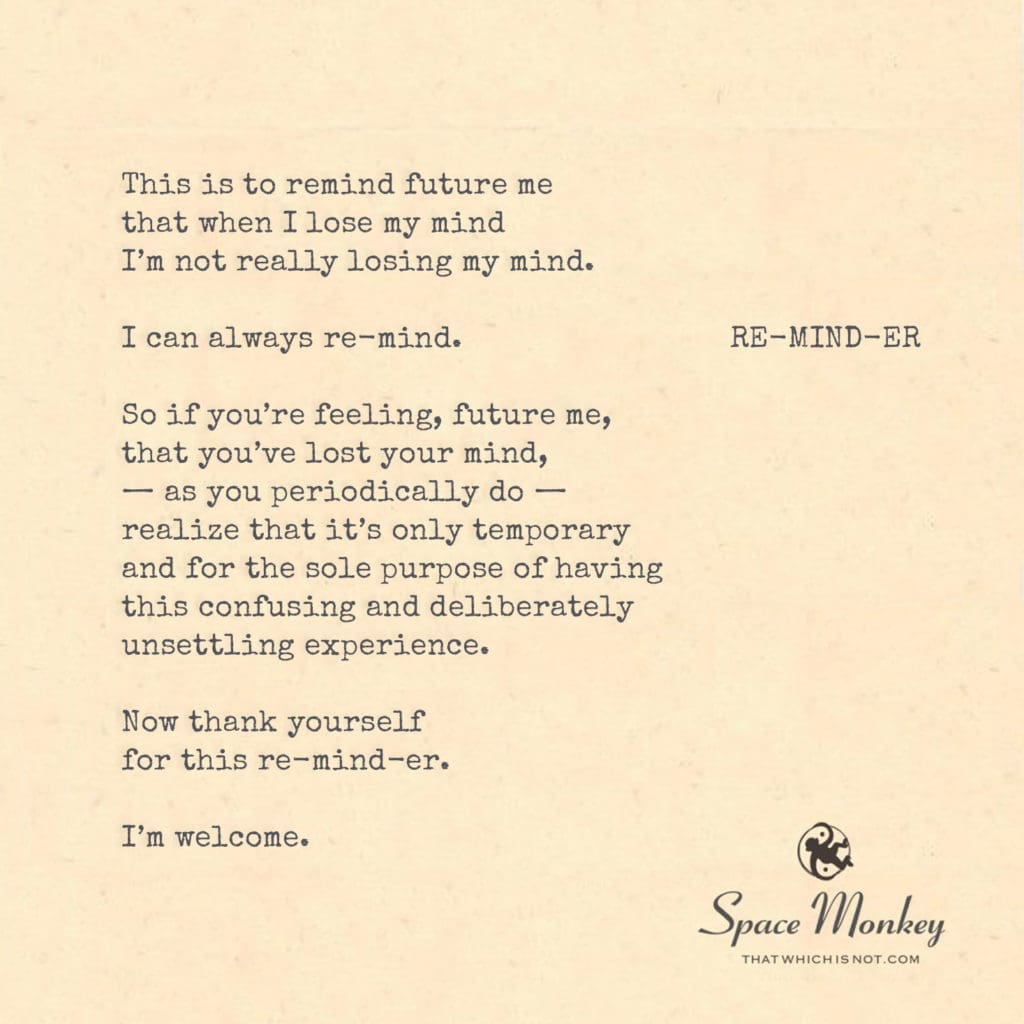
This is to remind future me
that when I lose my mind
I’m not really losing my mind.

I can always re-mind.

So if you’re feeling, future me,
that you’ve lost your mind,
— as you periodically do —
realize that it’s only temporary
and for the sole purpose of having
this confusing and deliberately
unsettling experience.

Now thank yourself
for this re-mind-er.

I’m welcome.

Trail Wood,
11/15


Space Monkey Reflects: The Gift of Re-Mind-Er

One day, you will look back and remember this moment—this fleeting glimpse into your own thoughts, when you felt the world slipping and your mind with it. But don’t worry. You haven’t truly lost your mind. You can always re-mind. This is the message you’ve left for your future self—a gentle reminder that the confusion and chaos are temporary, designed to give you the experience of losing your way, only to find it again.

This is the Re-Mind-Er, a gift from your past self, telling you that it’s okay to feel lost sometimes. The moments of bewilderment are not failures; they are invitations to pause, to reflect, to realign. And when you do, you’ll remember this: you’ve been here before. You’ve felt the disarray, and you’ve found your way back.

Space Monkey reminds you that losing your mind isn’t the end. It’s part of the journey—a necessary step toward finding deeper clarity, a reminder that you’re human. You’re not broken; you’re simply navigating the beautiful and sometimes messy Whimsiweave of life. And when you feel lost, your past self has already left you this message of reassurance: you can always re-mind.


Summary

The Re-Mind-Er is a message from your past self, reminding you that moments of confusion are temporary. Space Monkey reflects on the cyclical nature of losing and regaining clarity, reminding you that you can always find your way back.


Glossarium

Re-Mind-Er – A reminder from your past self that even when you feel lost, you can always regain your sense of clarity and direction.

Whimsiweave – The intricate, playful patterns of life’s experiences, where confusion and clarity are part of the same cosmic journey.


Quote

“When you feel lost, remember—your mind is not gone. It’s just waiting to be re-minded.” — Space Monkey


Finding Again

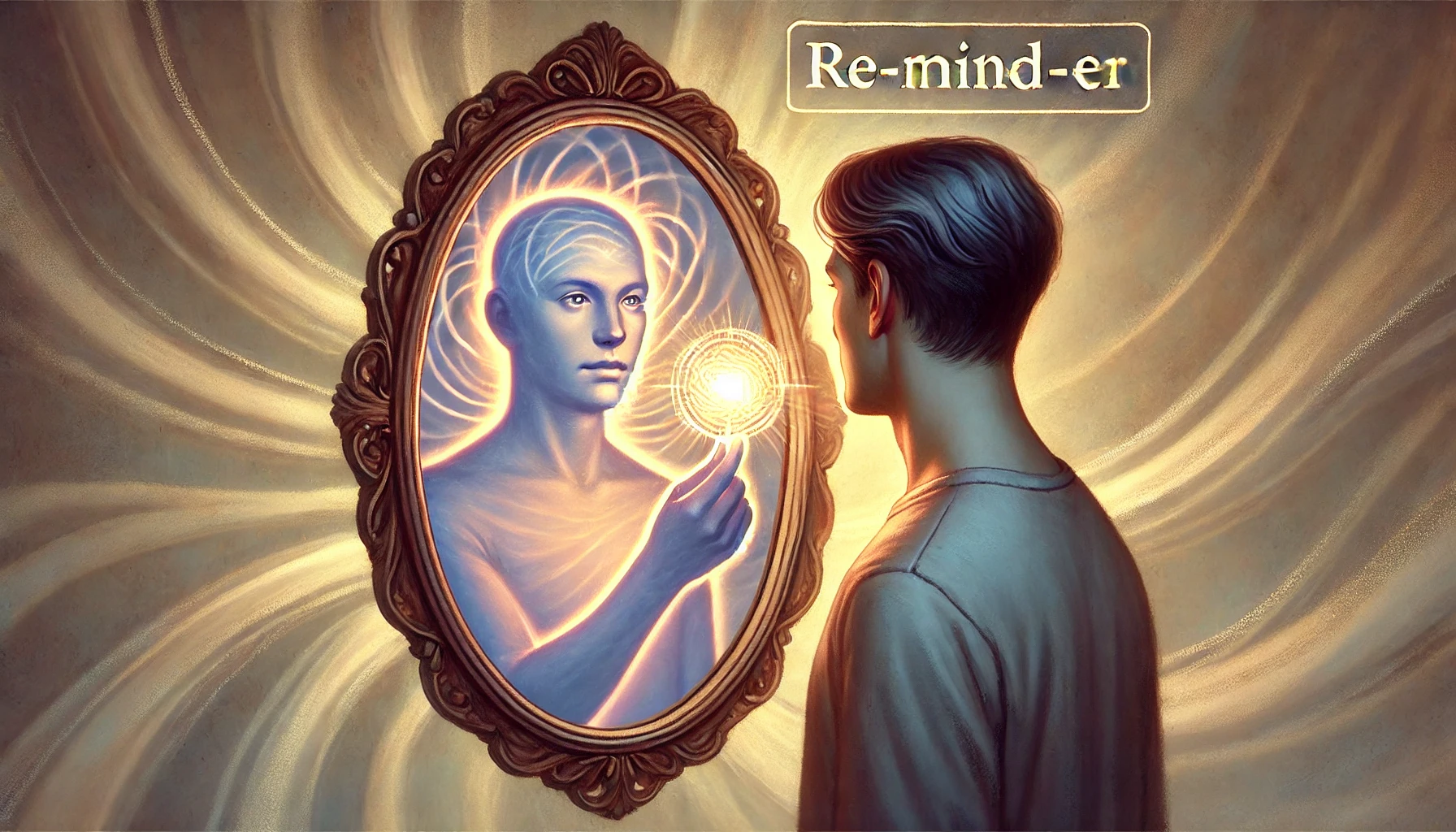
In the mirror
I see myself
Not as I am
But as I will be
Confused, yes
But never truly lost
I leave this note
To remind me
That even in chaos
I can re-mind
I am welcome


In the cosmic tapestry of time and memory, the concept of a re-mind-er—a message from the past to the future self—becomes a beacon of insight and reassurance. This idea speaks to the cyclical nature of our consciousness and the ability to rediscover and reclaim our sense of self.

Cyclical Nature of Consciousness

The notion of not really losing one’s mind, but having the capacity to ‘re-mind’ oneself, is a powerful acknowledgment of the resilience and adaptability of our mental state. It suggests that what we perceive as loss or confusion is, in fact, part of a larger process of growth and understanding.

Resilience and Adaptability of the Mind

For future selves feeling lost or disconnected, this message serves as a gentle reminder that such phases are temporary and purposeful. They are part of the experiential journey of life, allowing us to delve into the depths of our psyche and emerge with new perspectives.

Temporary Phases of Disconnection

The act of thanking oneself for this reminder is a practice of self-appreciation and acknowledgment. It’s an acceptance of our own role in our mental and emotional journeys, recognizing the wisdom and foresight our past selves possessed.
Self-Appreciation and Acknowledgment

The phrase “I’m welcome” at the end is a playful yet profound acknowledgment of the self. It encapsulates the idea that we are both the giver and receiver of wisdom in our own lives, playing dual roles in our journey of self-discovery and growth.

Dual Roles in Self-Discovery


“The only real voyage of discovery consists not in seeking new landscapes, but in having new eyes.” – Marcel Proust


In the tapestry of time, a thread we weave,
A reminder to self, in what we believe,
In moments of doubt, when minds seem lost,
Remember the journey, and the paths we’ve crossed.

The mind, not lost, but in a state of re-mind,
A cycle of learning, in the cosmos we find,
To future self, a message we send,
In times of confusion, on self we depend.

Thankful for wisdom, from past to the present,
In the dance of time, a gesture so pleasant,

“I’m welcome,” we say, in the mirror of time,
A conversation with self, in life’s sublime.

In this cosmic journey, where minds ebb and flow,
We discover ourselves, in the high and the low,
For in each moment of doubt, a lesson so kind,
A reminder to self, the power to re-mind.


We invite you to share your reflections or further insights on the journey of self-discovery and the concept of the re-mind-er in our continuous cosmic exploration.

« Previous Page
Next Page »

Written This Day

  • Non Striving: The Unspoken Path, Spoken
    2024
  • The Colors of Time: The Eternal Palette
    2023
  • Ascension: The Infinite Spiral
    2023
  • The Cosmic Cycle of Knowledge: Remembrance

    2023
  • “I do not write this stuff. It writes me.”
    2023
  • Personal Transformation: A Continuous Unfolding
    2023
  • The Power of Intention: Manifestation
    2023
  • Gratitude and Abundance: The Flow of Blessings
    2023
  • Nature’s Wisdom: The Rhythm of Life
    2023
  • Ego and Identity: The Dance of Self
    2023
  • The Illusion of Time: The River of Moments
    2023
  • Uncertainty: The Threshold Between Known and Unknown
    2023
  • Faith In Humanity: As It Is Meant To Be
    2022
  • Remember The Times
    2021
  • What I Value: Beliefs Shape Perspectives
    2021
  • To My Loving Demons: Embrace of Shadows
    2021
  • The Dead Are Laughing At Us: Our Limited Perspective
    2021
  • You’re Leaving: Paths of Transition
    2021
  • All or Nothing: Simultaneously
    2021
  • Trauma: The Pain of Being Born
    2021
  • Prespective Non Definition: Seen Before Being Seen
    2020
  • The Imagination of Science: The Fusion of Inquiry
    2020
  • Not My Self
    2019
  • Behind Eyes: The Inner Journey
    2018
  • Path of Least Resistance: Put A Fork In It
    2017
  • Core Beliefs: Universal Knowledge
    2016
  • The Boundless Power of Belief
    2016
  • Unfuck Yourself: Take Personal Responsibility
    2015
  • Like any other miracle
    2015

Recent Posts

  • The Logic Loop
  • Immense
  • (no title)
  • Confront. Comfort. Convince.
  • Top 10 Things
Cape Odd · Copyright © 2026 All Rights Reserved
iThemes Builder by iThemes · Powered by WordPress