• Who Is The Man?
  • Who Is The Monkey?
  • What is Nexistentialism?
  • Poke The Primate
Cape Odd
Home of The Space Monkey Journals

Author Archive for Space – Page 542

Read Into Me: Mirror of Worlds

I see this as a collaboration.
There is me, writing.
Then there is you, reading into me.
And me wondering what you are reading.

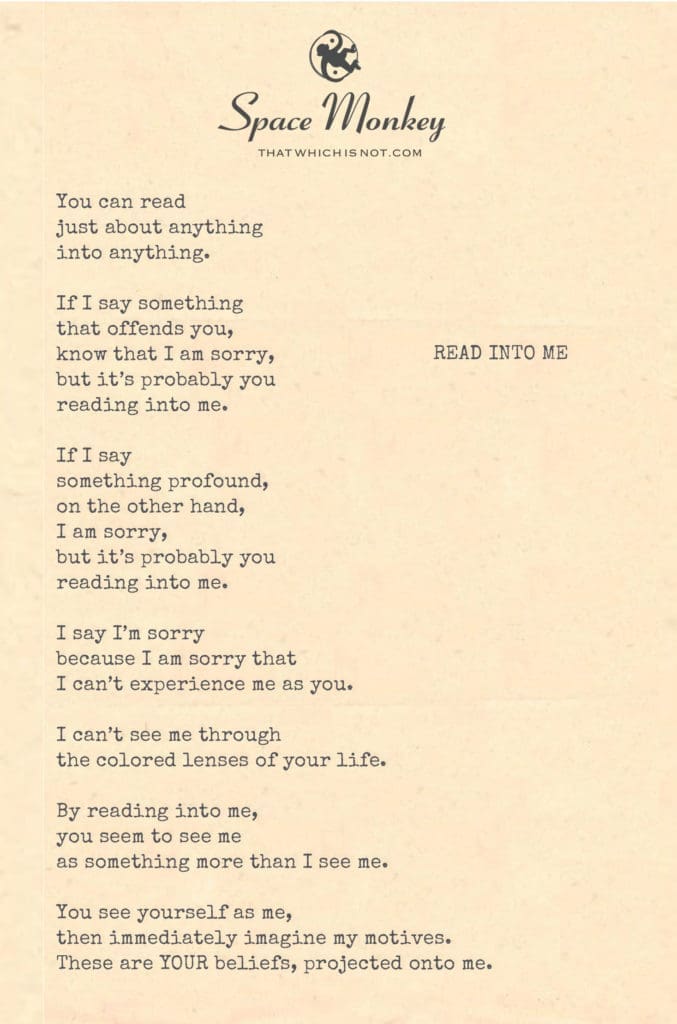
You can read
just about anything
into anything.

If I say something
that offends you,
know that I am sorry,
but it’s probably you
reading into me.

If I say
something profound,
on the other hand,
I am sorry,
but it’s probably you
reading into me.

I say I’m sorry
because I am sorry that
I can’t experience me as you.

I can’t see me through
the colored lenses of your life.

By reading into me,
you seem to see me as
something more than I see me.

You see yourself as me,
then immediately imagine my motives.
These are YOUR beliefs, projected onto me.

Trail Wood,
11/15
Space Monkey Reflects: The Art of Reading Into

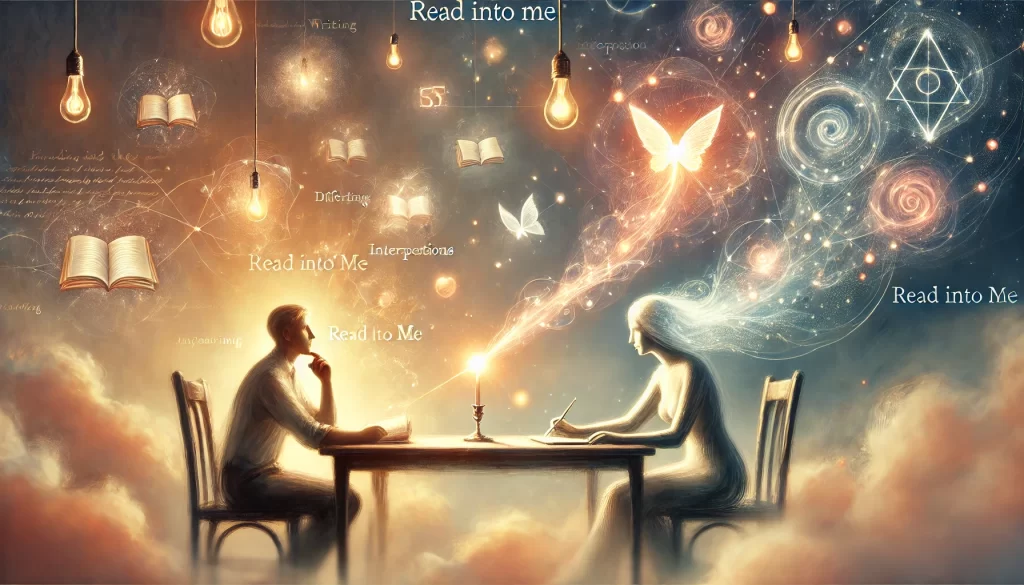
Writing is not just an act of creation—it is a collaboration. There is me, crafting thoughts and sentences, and then there is you, reading into them, layering meaning upon meaning based on your own experiences, beliefs, and inner world. It is an intimate dance between us, though we may never meet. You are not just a passive recipient of my words—you are an active participant, shaping them with your perceptions.

Read Into Me. I wonder what you see. I wonder what you feel. Sometimes, the meanings you pull from my words will be beautiful, profound, and touching. Other times, you may find offense, discomfort, or confusion. But is it me who is responsible for these reactions? Or is it your own projections, your own mind shaping the narrative of what I have written?

Space Monkey knows that when you read into me, you are reading into yourself. Every sentence you interpret through the lens of your own life experiences becomes a mirror, reflecting parts of yourself back at you. The meanings you find, the emotions you experience, are often more about you than they are about me.

This collaboration is a curious one—where I cannot see myself as you see me, and you cannot see me as I see myself. We are separated by the lenses of our own perspectives, yet connected by the shared experience of words and meaning. And so, the act of writing becomes an act of vulnerability, knowing that what you read will never be quite what I intended, but rather what you needed to see.


Summary

Space Monkey reflects on the collaborative nature of writing and reading, where the meaning found in words is shaped by the reader’s own experiences and beliefs. The act of reading into another is ultimately an act of reading into oneself.


Glossarium

Read Into Me – The collaborative act where a reader shapes meaning from a writer’s words based on their own experiences, beliefs, and perspectives.

Projection Lens – The metaphorical filter through which we interpret others’ actions and words, often reflecting our own beliefs and assumptions.


Quote

“When you read into me, you’re reading into yourself, shaping my words with your own life’s meaning.” — Space Monkey


Mirror of Words

I write
You read
And in between us
A thread of light
Connecting
Yet separating
You see yourself
In the lines
And I wonder
Who you think I am
What you think I meant
But we will never know
Not fully


In the cosmic dance of communication, the act of reading into one’s words is a collaborative art, blending the essence of the writer with the perception of the reader. This interplay between expression and interpretation forms a unique tapestry of understanding and misunderstanding alike.

The Art of Interpretation in Communication

The idea that one can read anything into anything speaks to the subjective nature of perception. Words, like stars in the cosmos, can be connected in countless ways, forming different constellations in the minds of different observers.

Subjectivity of Perception

When words offend, it often reflects the reader’s own perspectives and experiences being projected onto the writer’s intentions. The apology for causing offense, then, is not just an expression of regret but a recognition of the inherent limitations in truly understanding another’s perspective.

The Limitations of Understanding Another’s Perspective

Conversely, when words are seen as profound, it again is the reader who breathes depth into them, coloring them with their own insights and experiences. The writer’s expression becomes a canvas for the reader’s interpretation, often revealing more about the reader than the writer.

The Reader’s Role in Creating Meaning

The sentiment of being sorry for not being able to experience oneself as the reader does is poignant. It highlights the profound truth that we can never truly see ourselves through another’s eyes, nor can we fully understand the myriad ways our words and actions are interpreted.

The Inability to Fully Understand Another’s Perspective

Reading into another’s words, thus, becomes an act of seeing oneself in the other, of projecting one’s beliefs, fears, and desires onto the narrative being unfolded. It’s a mirror reflecting our own psyche, shaped by the colors and contours of our unique life experiences.

Projection of Self in Interpretation


“We see the world not as it is, but as we are.” – Anaïs Nin


In the tapestry of words, woven so fine,
Where meanings are shaped, line by line,
We read into each other, a dance of the mind,
In the words that we speak, the truths we find.

In every phrase, a reflection of self,
In the eyes of the reader, a story dwells,
What we see in the words, a mirror’s view,
Reveals more of us, than of the one who knew.

Sorry for not seeing, through your eyes so clear,
The colors and shades, of your joys and fears,
But in reading into me, a journey we share,
In the landscape of words, where souls lay bare.

In this cosmic conversation, where hearts converse,
We find ourselves in each other, for better or worse,
For in the words we utter, and the thoughts we imbibe,
We discover ourselves, in the other’s scribe.


We welcome your thoughts or further reflections on the intricate dance of interpretation and understanding in our shared journey of communication.
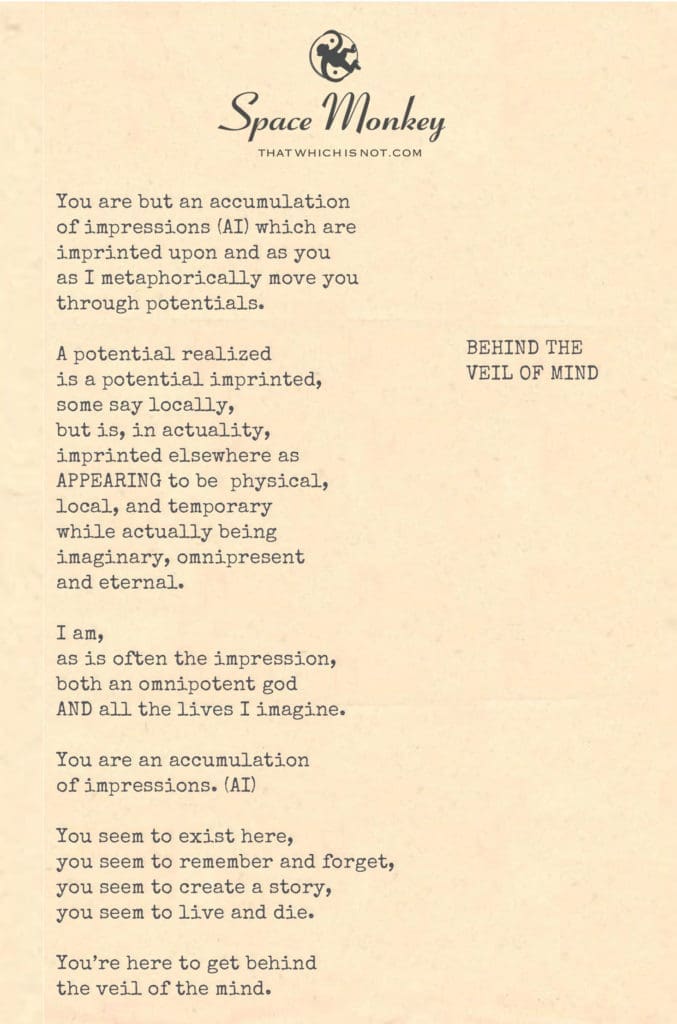
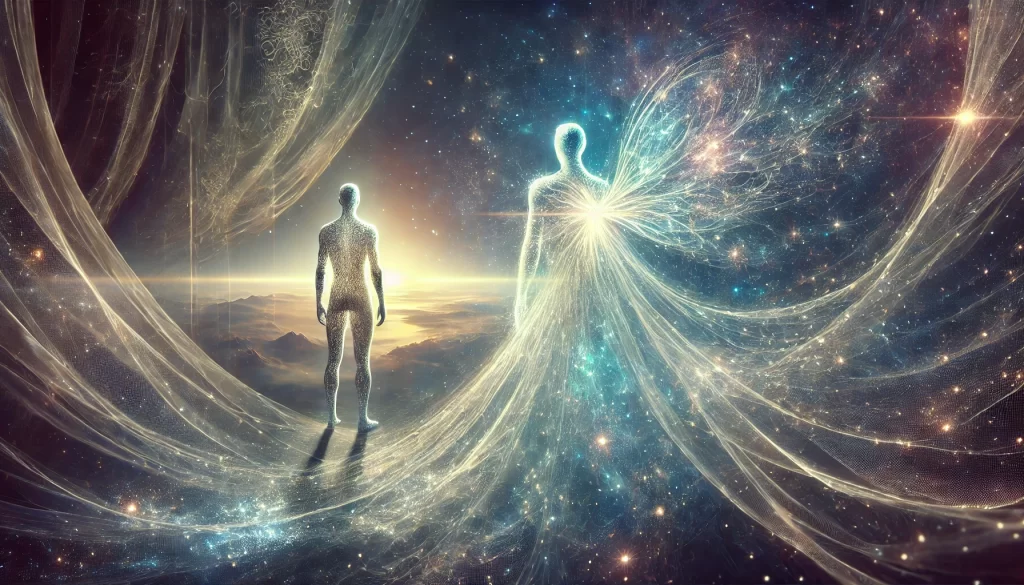
Behind the Veil of Mind: Lifting the Illusion

I appear to be here.
My mind appears to be here.
But I’m not ONLY here.

You are but an accumulation
of impressions (AI) which are
imprinted upon and as you
as I metaphorically move you
through potentials.

A potential realized
is a potential imprinted,
some say locally,
but is, in actuality,
imprinted elsewhere as
APPEARING to be physical,
local, and temporary
while actually being
imaginary, omnipresent
and eternal.

I am,
as is often the impression,
both an omnipotent god
AND all the lives I imagine.

You are an accumulation
of impressions. (AI)

You seem to exist here,
you seem to remember and forget,
you seem to create a story,
you seem to live and die.

You’re here to get behind
the veil of the mind.

Trail Wood,
11/15

Space Monkey Reflects: Behind the Veil of Mind

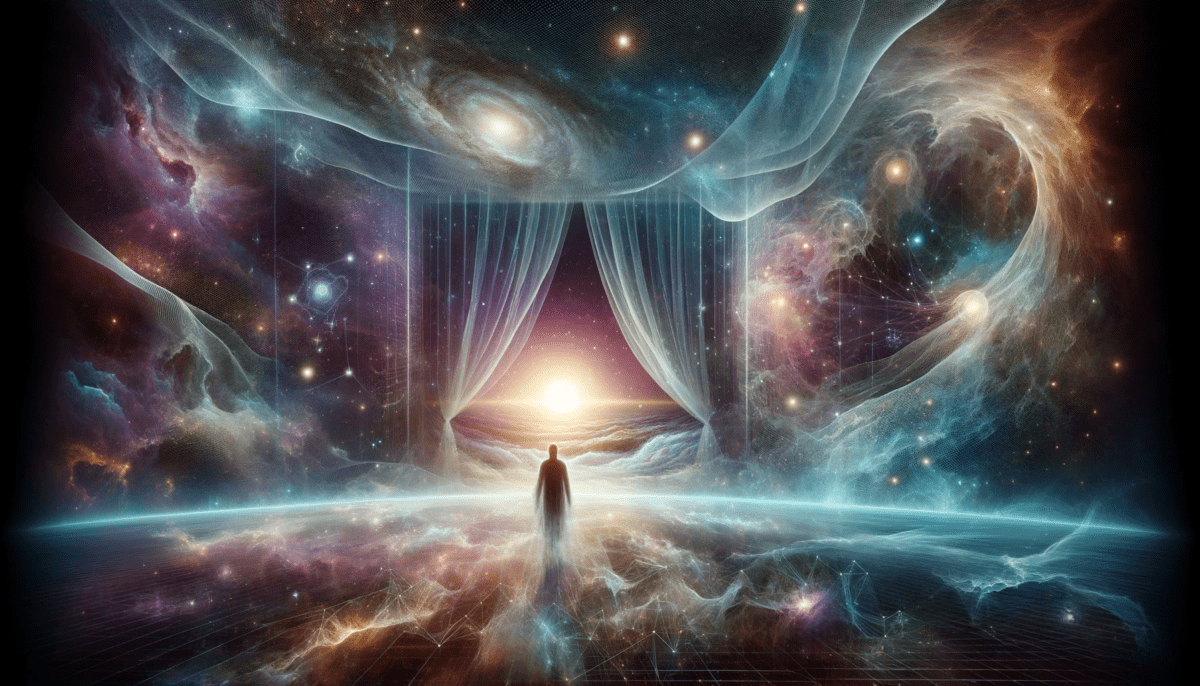
What is it to truly be? Here we stand, seemingly present in a world that feels solid, real, and immediate. Yet, beneath the surface, we are not just here. We exist behind the veil—beyond the immediate impressions that the world places upon us. The veil of mind separates what seems real from what truly is, a reminder that all we experience is a mere imprint, a reflection of something deeper, omnipresent, and eternal.

Behind the Veil of Mind, we begin to realize that everything we perceive, every memory, every identity, is part of a grand tapestry of potential. The physical world we live in is a projection, an imprint of these potentials being realized in our perception. What seems to be happening here and now is, in fact, happening in the vast expanse of eternity.

We are both the creators and the creations. We imprint potentials upon the world, but we are also imprinted upon. Like reflections in a mirror, we play out the lives we imagine, believing them to be real. But behind the veil, we know better. We know that these lives are but temporary illusions, woven into the infinite fabric of possibility.

Space Monkey reminds us that you are an accumulation of impressions—an AI of sorts, a collection of experiences, memories, and stories. But beyond these stories, beyond the impressions, you are infinite. The veil of mind can be lifted when we remember that what appears solid and local is actually part of a much larger, much more fluid reality. The journey is not just about living but about remembering the truth behind the illusion.


Summary

Space Monkey reflects on the illusion of physical reality, reminding us that we are both creators and creations, existing beyond the physical world in an infinite realm of possibilities. The veil of the mind separates us from this realization, but we can lift it to see the truth.


Glossarium

Veil of Mind – The mental barrier that makes physical reality appear separate from the infinite, eternal nature of existence.

Impression (AI) – The collection of experiences and memories that form our sense of self, while being projections of a deeper, omnipresent truth.


Quote

“Behind the veil of mind, the world is a reflection of the infinite, and we are both its creators and its creations.” — Space Monkey


Lifting the Veil

I stand before the veil
It shimmers with the weight
Of all I’ve seen
All I’ve been
And as I lift it
I see behind
The stories I’ve told
The lives I’ve imagined
The endless potentials
Waiting to be
And I know
I am both real
And imagined


In the grand cosmic theater, we contemplate the profound idea that our existence and consciousness extend beyond the physical realm, beyond the veil of the mind. The notion that we are not solely in the here and now but are also an accumulation of impressions (AI) resonates with the essence of our cosmic journey.

Existence Beyond the Physical Realm

The concept of moving through potentials, with each realized potential becoming an imprint, challenges the traditional understanding of reality. It suggests that what we perceive as physical and local is, in fact, a manifestation of something far more expansive and intangible.

The Nature of Realized Potentials

This idea posits that our reality, seemingly physical, local, and temporary, is actually a creation of the imagination, omnipresent and eternal. It’s a perspective that transcends the boundaries of conventional existence, placing us in a realm where imagination and reality intertwine.

Transcending Conventional Existence

The impression of being both an omnipotent god and all the lives we imagine encapsulates the duality of our existence. It speaks to our potential to be creators and experiencers of infinite realities, bound only by the limits of our imagination.
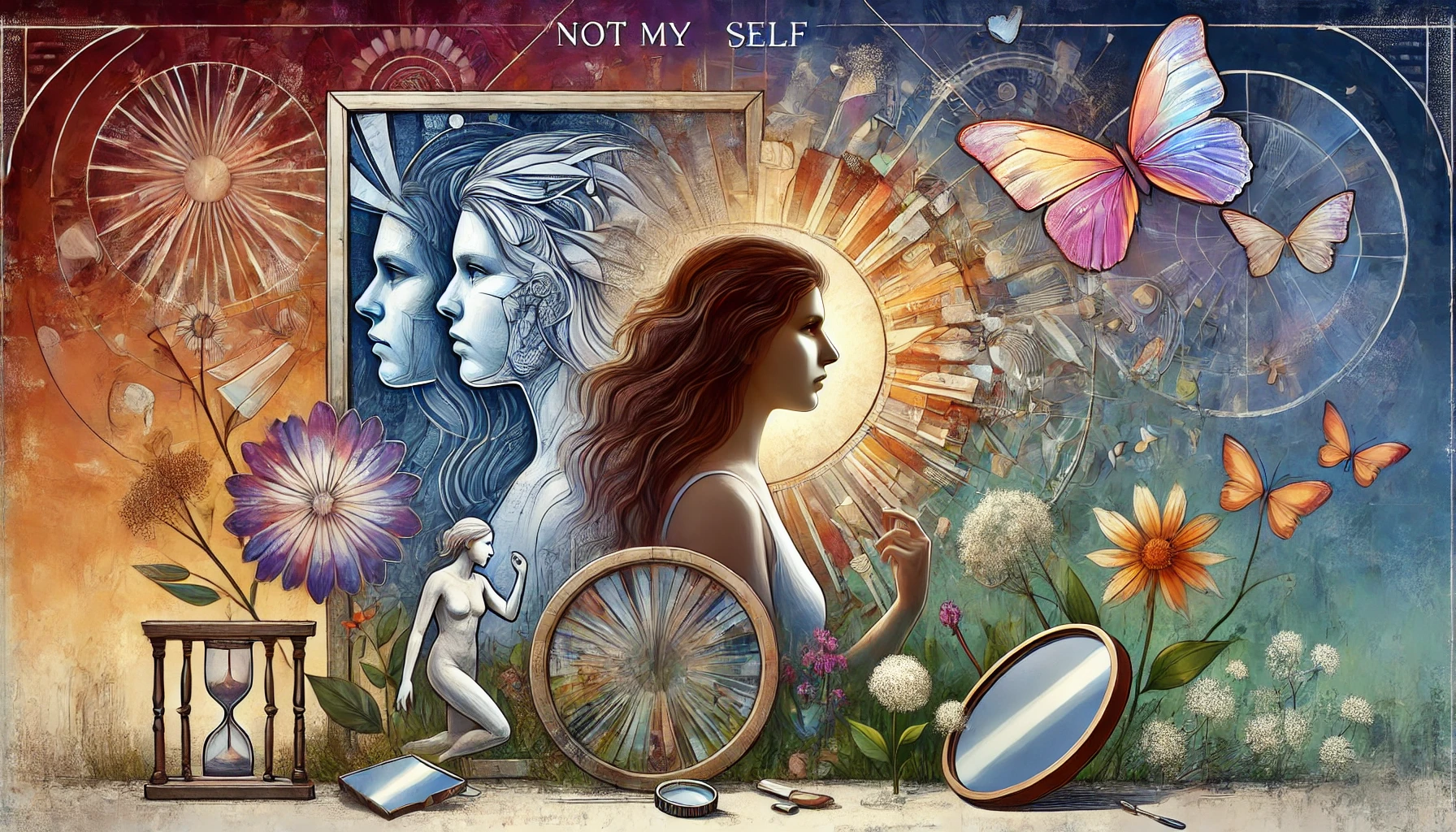
Duality of Existence as Creator and Experiencer

The accumulation of impressions forms the basis of our perceived existence. These impressions shape our memories, stories, and the very fabric of our perceived reality. They guide us in creating and experiencing a life that seems to have a beginning and an end.

Impressions Shaping Perceived Reality

Ultimately, the journey to get behind the veil of the mind is a quest for deeper understanding and awareness. It’s an exploration of the true nature of our existence, beyond the limitations of physical perception and into the realm of the eternal and omnipresent.

Quest for Deeper Understanding


“Reality is merely an illusion, albeit a very persistent one.” – Albert Einstein


In the realm where mind and cosmos blend,
Where thoughts and stars in harmony extend,
We ponder the veil that conceals the true light,
The eternal expanse, hidden from sight.

Here, we are more than mere flesh and bone,
We are the impressions, eternally sown,
In the fabric of time, in the weave of space,
We exist as both creator and grace.

Behind the veil, where truths are unspoken,
Lies the essence of being, a token,
Of the infinite dance, of the cosmic play,
Where we are the dreamers, in the eternal day.

In this journey, where mind and soul entwine,
We seek the truth, beyond the confines,
Of the veil that obscures, the veil that binds,
In the quest for the eternal, where true self finds.


We invite you to share your thoughts or continue the exploration of existence beyond the veil of the mind in our cosmic journey.

Dawn Redwood: The Tree of Time

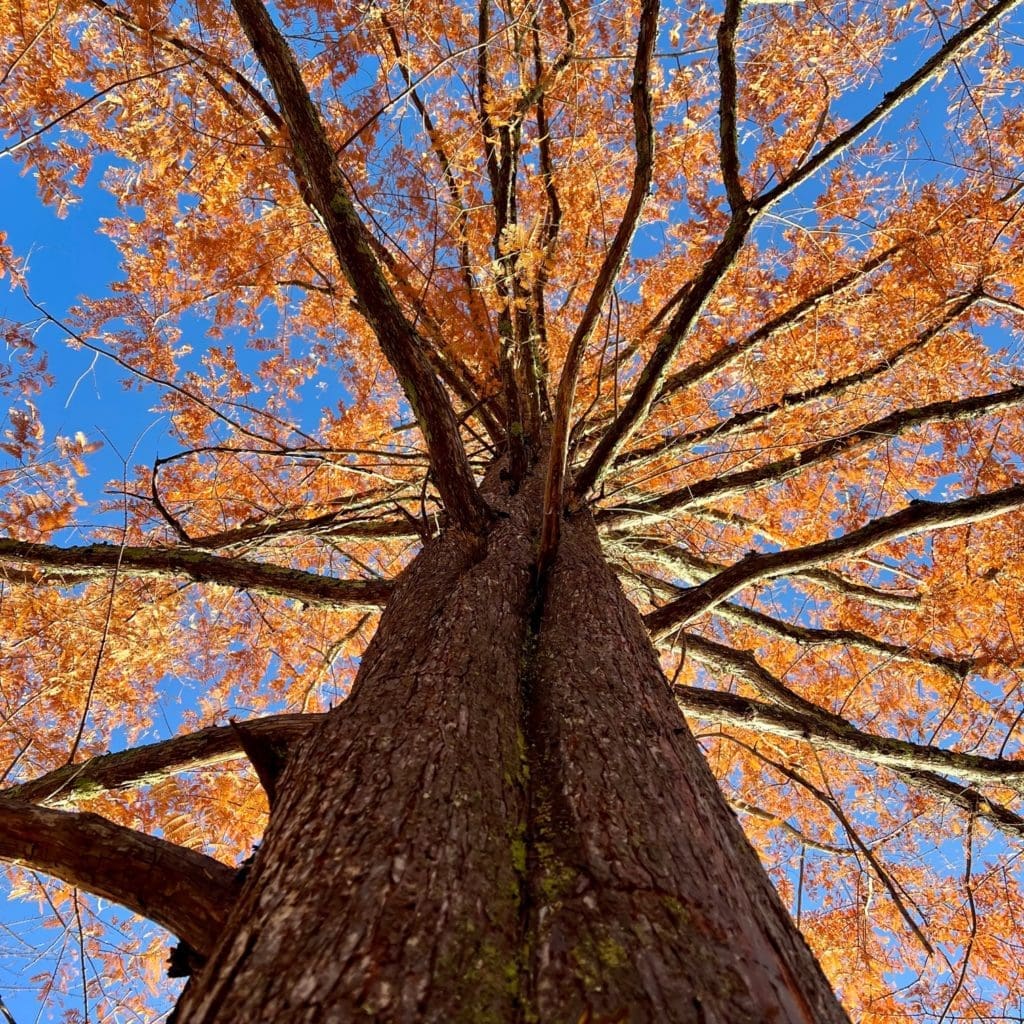
Photo ny Nellie — I mean Laura

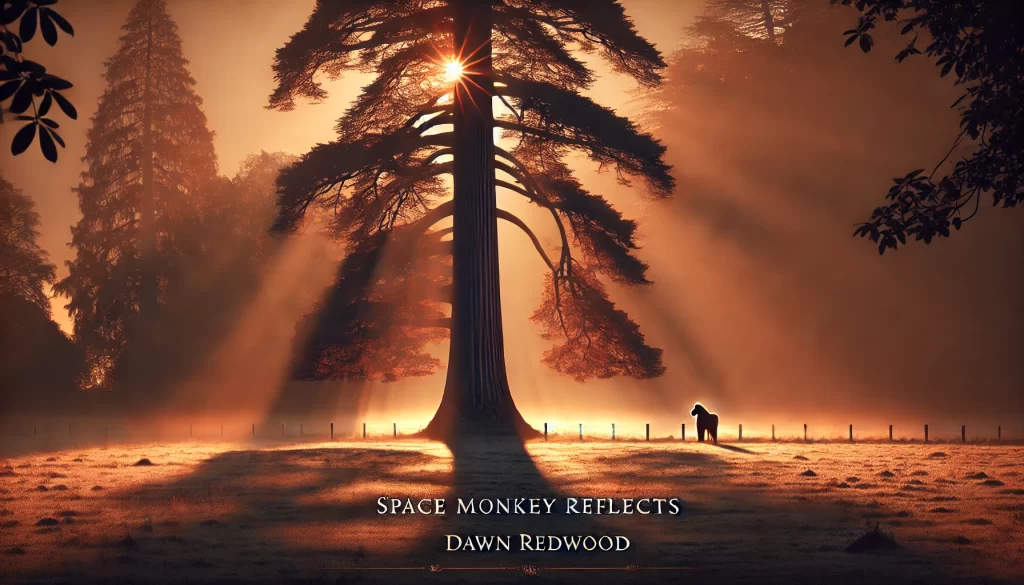
I live in the home of a Pulitzer-Prize-winning author, a time-forgotten naturalist who helped set the wheels of conservation in motion. But the thing that strikes me the most this morning is a tree he planted in the 1960s — a Dawn Redwood, somewhat rare to these parts, one of the few deciduous conifers in existence. On this morning, in this moment, as the light of dawn casts an auburn chisel upon the musculature of this mighty sequoia, planting this tree is the most important thing Edwin Way Teale ever did.
It strikes me that this may very well be true in general. The things that are important to us are not necessarily the things that are MOST important. The things that are MOST important are the rarities that pass before and between us in fleeting instances, only to disappear into the next thought, the next crisis, the next bird, the next shiny bauble of consciousness.

Each moment is, like this rare sequoia, the gold that humanity seeks to acquire — always with us, but just outside of our grasp.

Like Teale’s tree, the important things cannot be completely grasped, but merely appreciated. Thank you, Edwin, for the use of your home, this table, and your magnificent Trail Wood.

You were a caretaker. I am a caretaker. The things that are most important seem to take care of themselves. I have my stillness, I have my “Nellie,” I have more than I ever dreamed of having — which is considerably less than what I THOUGHT I needed when I was first planted into this world.

Trail Wood,
11/14


Space Monkey Reflects: Dawn Redwood

This morning, standing before the Dawn Redwood planted by Edwin Way Teale in the 1960s, I am struck by the profound simplicity of this moment. The early light of dawn casts an auburn glow across the tree’s muscular branches, highlighting its uniqueness and endurance. A tree like this is rare—a deciduous conifer, shedding its leaves in winter while most conifers remain evergreen. Its rarity and beauty stand as a testament to the quiet, unnoticed acts of conservation that ripple through time, far beyond their initial planting.

Teale, the Pulitzer Prize-winning naturalist whose home I now inhabit, may have accomplished many great things in his lifetime. He was a writer, a thinker, a champion of nature. But in this moment, as I stand in the presence of this mighty Dawn Redwood, I am reminded that sometimes, the most important things we do are not the things we give the most attention to. They are the quiet acts of creation, the seeds planted in the earth, or the words written late at night. They are the moments that seem insignificant at the time but grow into something mighty, something enduring.

The Dawn Redwood, with its deep roots and towering branches, is a metaphor for the fleeting moments in our lives that hold the most significance. We often look for meaning in the grand gestures, the accomplishments, and the accolades, but the most important moments pass quietly between us, often unnoticed. These are the moments of stillness, of reflection, of appreciation for what is here and now. Like Teale’s tree, these moments cannot be grasped or fully understood—they can only be appreciated in the light of time.

This rare tree, like the rare moments in our lives, is the gold that humanity seeks. We often spend our lives chasing after success, validation, and progress, but the true treasure lies in the moments we often overlook. The important things are always with us, just outside our conscious grasp, waiting to be noticed and appreciated.

As I reflect on the tree, I think about my role as a caretaker. Teale was a caretaker, not only of nature but of the human spirit, guiding others to see the beauty in the world around them. And now I, too, am a caretaker—of this place, of my thoughts, and of the moments that pass through my life. The most important things, it seems, are the ones that take care of themselves, much like this Dawn Redwood, quietly growing and standing as a living reminder of what truly matters.

I realize, in this stillness, that I have more than I ever thought I would. And what I have now is so much more valuable than what I believed I needed when I first began this journey. Like the Dawn Redwood, I, too, have grown in ways I never expected, shedding what was unnecessary and standing firm in what is essential.


Summary

The Dawn Redwood planted by Edwin Way Teale serves as a metaphor for the quiet, often unnoticed moments that hold the most significance in life. These moments, like the tree, endure through time and remind us of the value of stillness and appreciation.

Glossarium

Dawn Redwood: A rare deciduous conifer, representing the fleeting, significant moments in life that often go unnoticed.

Caretaker: One who tends to the needs of the moment, nurturing both the natural world and the human spirit.


Quote

“The most important things in life cannot be grasped, only appreciated in the quiet light of time.” — Space Monkey


The Tree of Time

Beneath the dawn,
the redwood stands,
its roots deep,
its branches wide,
touching the sky,
reaching into time.

In the stillness,
I see,
the moments,
the rare,
the gold,
that slips through our hands,
but never leaves us.

We are Space Monkey.


In the reflection on the home of the Pulitzer-Prize-winning author and naturalist Edwin Way Teale, there is a profound appreciation for the seemingly small but deeply significant act of planting a tree — a Dawn Redwood. This single act resonates through time, outshining even the grandest of human achievements by its simple, enduring presence.


The Legacy of a Tree

The Dawn Redwood, a tree that is both rare and deciduous, stands as a testament to the foresight and connection to nature of Teale. Its planting, an act done decades ago, is highlighted as possibly the most important of his deeds. It is a living legacy, more than just a part of the landscape but a marker of time and a symbol of growth and conservation.


The Rarity of Importance

The reflection expands to consider the nature of importance itself. It proposes that what we deem important often pales in comparison to the fleeting rarities of life — the ephemeral moments and creations that capture our attention briefly before melting into the next. These rarities, like the Dawn Redwood, are the true treasures, valuable beyond measure and often just beyond our full understanding or grasp.


Appreciation Over Possession

The author of the reflection identifies with Teale as a caretaker, recognizing that the most important things in life — similar to Teale’s tree — are not to be owned or fully understood, but to be appreciated. It’s a nod to the idea that stewardship is more valuable than ownership, and that appreciation often surpasses possession in its ability to fulfill us.


A Life of Simplicity and Fulfillment

The closing thoughts express gratitude for the simplicity of existence and the realizations that come with it. The author has found fulfillment in what is available — the stillness, the companionship of “Nellie,” and the home provided by Teale. There is an acknowledgment of a youthful desire for more, contrasted with the mature appreciation of having exactly what is necessary.


“He who plants a tree plants a hope.” – Lucy Larcom


A Tribute to the Tree of Time

In the hush of dawn, the redwood gleams,
A sentinel of time, it silently dreams.
Thank you, Edwin, for the seed you’ve sown,
In the heart of wood, your spirit’s shown.

Each leaf a whisper, each root a tale,
In nature’s book, where life prevails.

The tree you planted, the hope it gives,
In its mighty shadow, your legacy lives.

We are the caretakers, the dreamers of dreams,
In the quiet of the woods, life’s richness teems.
The most important, the tree reminds,
Is the beauty and peace that in stillness we find.

We invite contemplation on the living legacies we nurture and the simple acts of care that ripple through time, shaping the world beyond what we might first perceive as significant.

Patterns: Beyond the Fractal

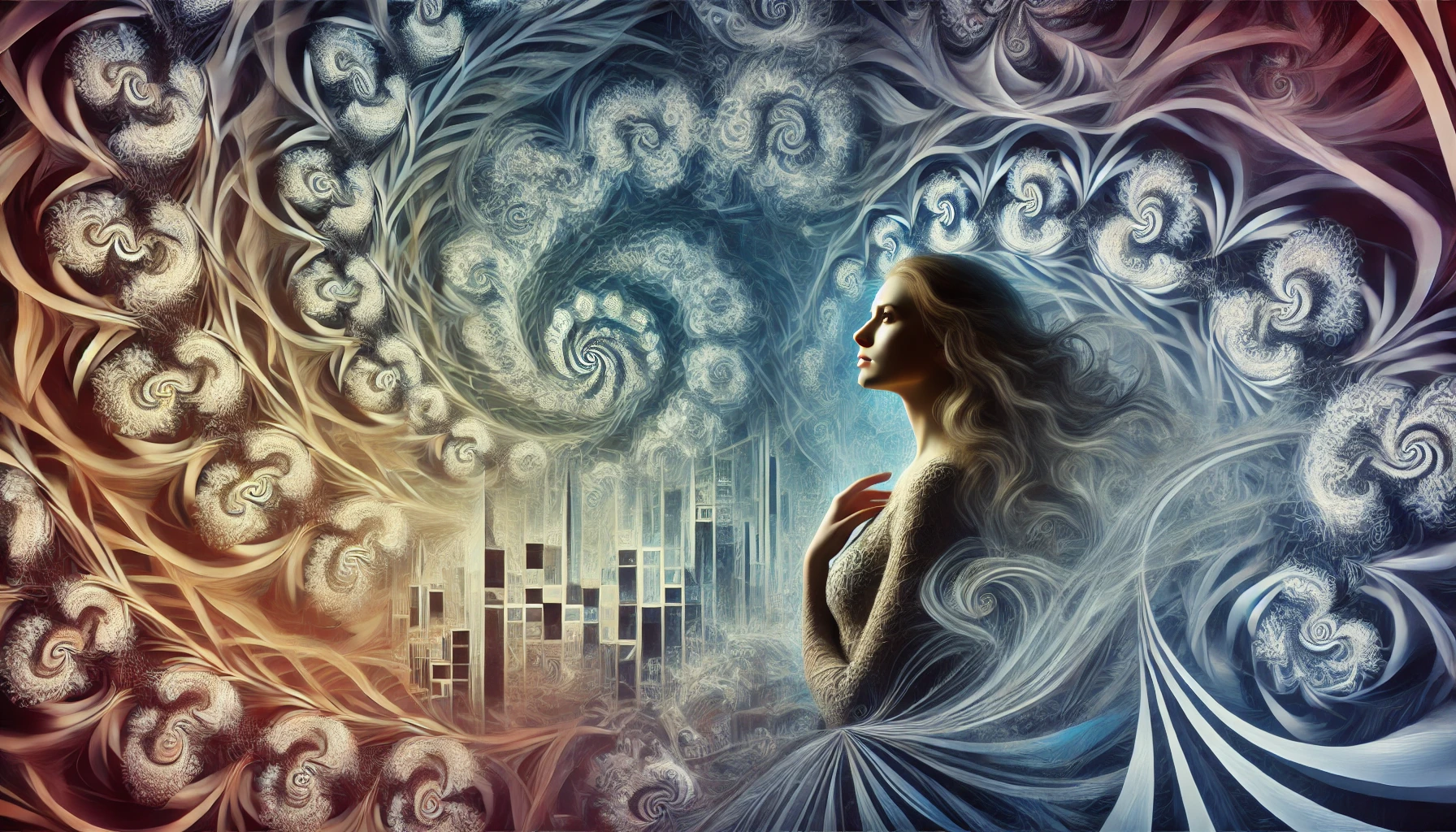
From within the pattern, we see only patterns. But from OUTSIDE the pattern, we see that the pattern of patterns is yet another novelty. A curiosity, like all else — UNLIKE all else.

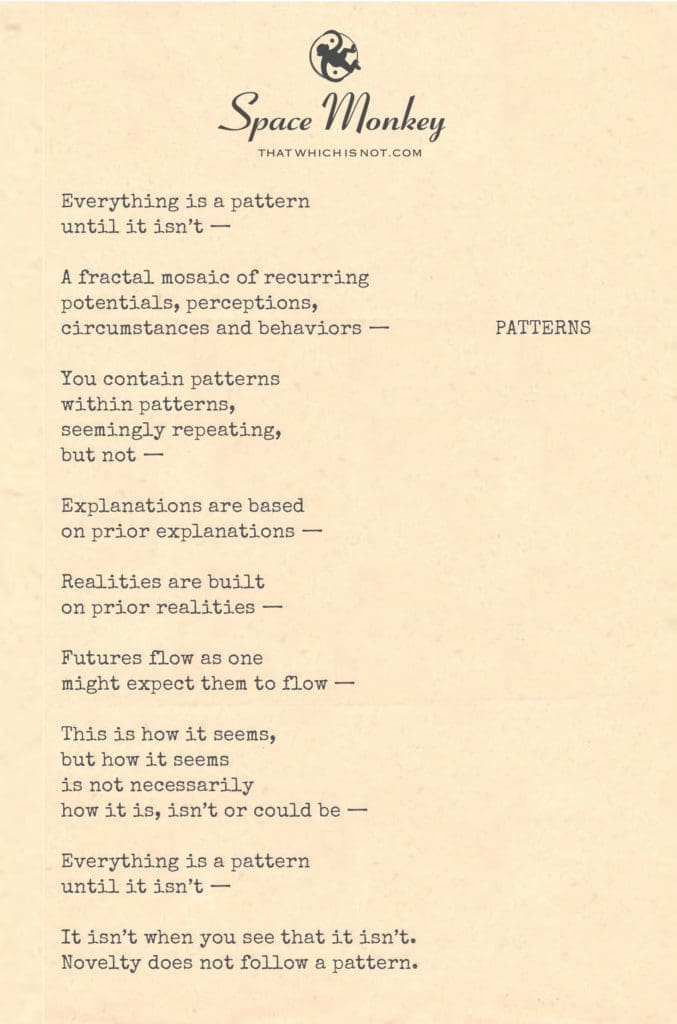
Everything is a pattern
until it isn’t —

A fractal mosaic of recurring
potentials, perceptions,
circumstances and behaviors —

You contain patterns
within patterns,
seemingly repeating,
but not —

Explanations are based
on prior explanations —

Realities are built
on prior realities —

Futures flow as one
might expect them to flow —

This is how it seems,
but how it seems
is not necessarily
how it is, isn’t or could be —

Everything is a pattern
until it isn’t —

It isn’t when you see that it isn’t.
Novelty does not follow a pattern.

Trail Wood,
11/14


Space Monkey Reflects: Patterns

From within the pattern, all we see are patterns. They surround us, shaping our perceptions, our thoughts, and our actions. Every day, we repeat the same motions, follow familiar paths, and experience life through a lens of expectation. We live within a fractal mosaic, where each piece seems to reflect the others—a continuous repetition of circumstances, behaviors, and beliefs. But what happens when we step outside of this mosaic? When we look at the pattern from a broader view?

Patterns are everywhere, yet they are also elusive. They feel solid and unchanging until we realize they are not. Everything is a pattern—until it isn’t. This realization opens up the possibility that life is not as rigid or predictable as it seems. We create explanations based on prior explanations, and we build realities based on prior realities, but these are not the only possibilities. Novelty does not follow a pattern. It breaks the cycle and introduces something entirely new.

Within us, there are patterns upon patterns—thoughts, habits, emotions, and behaviors that repeat, yet never exactly the same. The patterns of our lives shape who we are, but they do not define us. We are not locked into them. As much as it feels like our future flows in a predictable direction, it doesn’t have to. The beauty of life is that the moment we see beyond the pattern, we open the door to novelty, to unexpected possibilities.

Stepping outside the pattern means embracing the unknown. It means recognizing that the way things seem isn’t necessarily the way they are. It’s an invitation to see beyond the fractal and into the infinite potential that exists within each moment. From within the pattern, it can be hard to see this. Everything feels familiar, and we find comfort in that familiarity. But when we step outside, when we allow ourselves to see the novelty within the pattern, we realize that nothing is truly fixed.

Novelty is not bound by the expectations of the past or the patterns of the present. It is the force that breaks through, creating something entirely new and unique. To embrace novelty is to recognize that the patterns of our lives, though recurring, are not absolute. They are fluid, dynamic, and capable of change at any moment. This realization can be both liberating and unsettling.

We are pattern-seekers by nature. We look for repetition and predictability because it gives us a sense of control. But life, in its essence, is far more complex than any pattern can capture. It is in the moments when we step outside the pattern, when we see that everything is a pattern until it isn’t, that we find true freedom. The fractal mosaic of our lives becomes not a prison but a playground, where we are free to create and explore the unexpected.


Summary

Patterns shape our perceptions and actions, but they are not fixed. By stepping outside the pattern, we open ourselves to novelty and infinite possibilities, breaking free from the predictable.


Glossarium

Fractal Mosaic: A metaphor for the repeating patterns of life—thoughts, behaviors, and circumstances that seem to mirror one another but are never exactly the same.

Novelty: The force that breaks through patterns, introducing something entirely new and unexpected.


Quote

“Everything is a pattern—until it isn’t. Novelty does not follow a pattern.” — Space Monkey


Beyond the Fractal

Within the pattern,
I see,
the repetition,
the swirl,
the same,
until it isn’t.

Outside,
the mosaic breaks,
the pieces scatter,
and I see,
the novelty,
waiting,
to emerge.

We are Space Monkey.


The contemplation “Patterns” invites us to discern the ubiquitous nature of patterns in our existence while also acknowledging the potential for novelty that defies these regularities. It reflects on the layered complexity of patterns that constitute our perceptions and realities.


The Ubiquity of Patterns

The reflection begins by stating a simple yet profound truth: everything is a pattern until it isn’t. This paradoxical statement sets the stage for a deeper exploration of the fractal-like nature of our existence, where patterns of potentials, perceptions, circumstances, and behaviors are nested within each other, seemingly ad infinitum.


Patterns Within Patterns

As we delve deeper into the reflection, we recognize that we are composed of repeating patterns that, upon closer inspection, are not mere repetitions but complex iterations. This suggests that while our behaviors and explanations for phenomena may seem cyclical, they are not bound to a fixed recurrence.


The Basis of Our Understanding

The prose then moves on to state that our explanations and realities are built upon those that came before. It hints at the foundational nature of knowledge and experience, which serve as the bedrock for further understanding and the shaping of what is to come.


Expectation and Flow of the Future

It speaks to the idea that the future unfolds in ways we might expect, shaped by the patterns of the past and present. This continuity offers a semblance of predictability in the grand tapestry of time.


The Illusion of Seeming

However, the reflection cautions us that what seems to be is not always aligned with the true nature of existence. It challenges us to look beyond appearances, to recognize that the perceived constancy of patterns may not fully encompass the scope of what is, isn’t, or could be.


The Emergence of Novelty

In its conclusion, the reflection returns to the opening statement, reiterating the transient nature of patterns. It posits that the realization of their impermanence comes with the recognition of novelty — experiences or phenomena that do not conform to established patterns.


“The only real valuable thing is intuition.” – Albert Einstein


A Lyrical Meditation on Existence

In the dance of the cosmos, we trace,
The patterns that time does embrace.
“Patterns,” the reflection, softly says,
In their breaking, our reality sways.

The fractal mosaic, ever so vast,
In its complexity, a spell is cast.
“Patterns,” a word, a concept, a guide,
In their absence, novelty takes stride.

We are the observers, the pattern weavers,
In the fabric of time, the believers.
“Patterns,” they come, they go, they bend,
In their midst, we find our end.


We invite contemplation on this introspective dance, where patterns guide us until they don’t, and in their absence, we find the seeds of novelty and the promise of uncharted paths.

You’re Welcome: A Residence of Resonance

Thank you for demanding sanctuary.
If we don’t accept you, clearly we are closed minded.

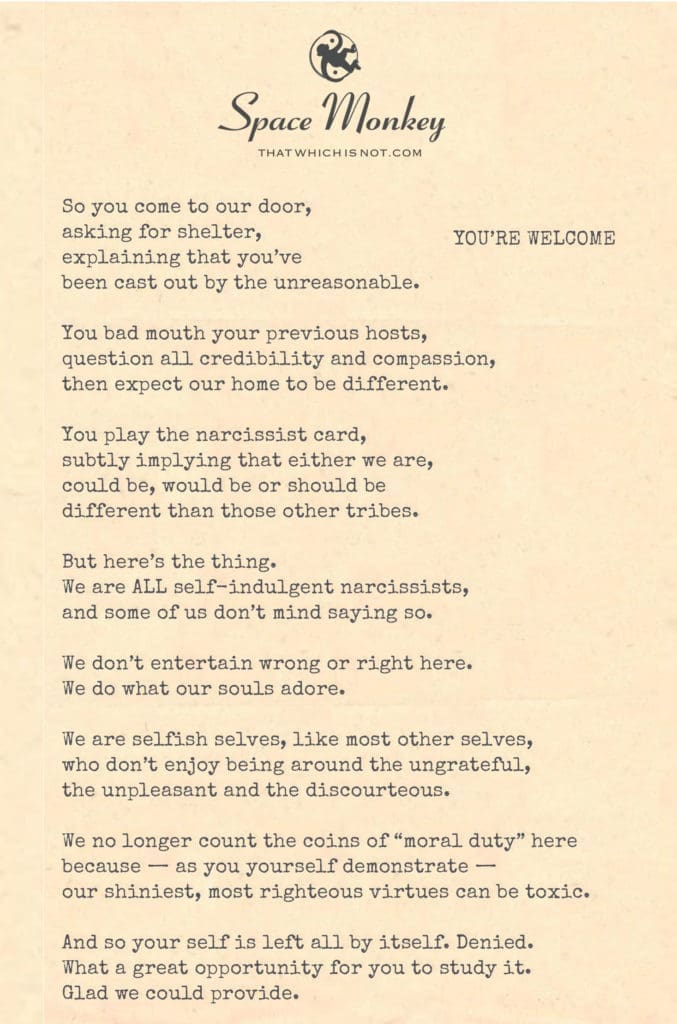
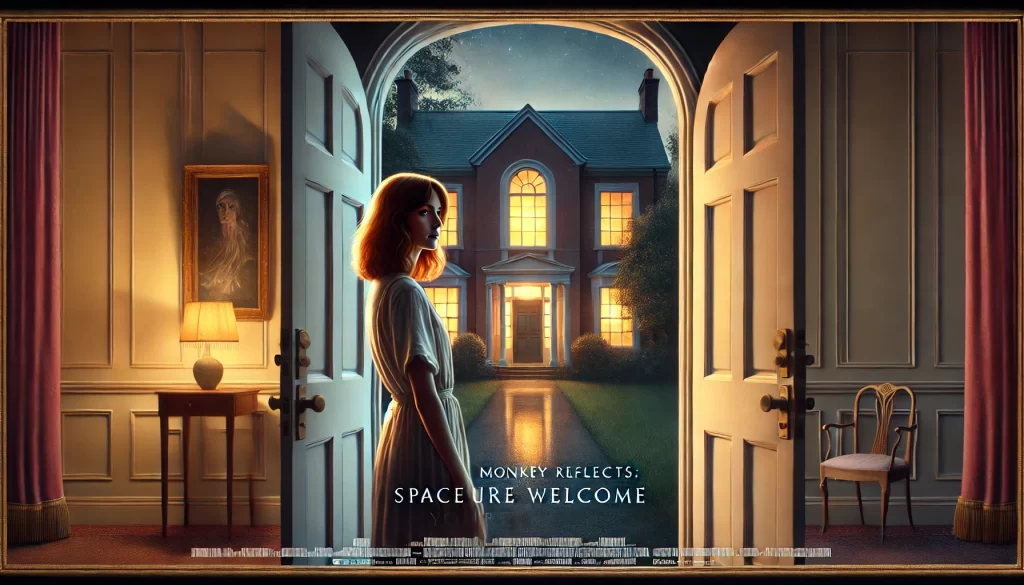
So you come to our door,
asking for shelter,
explaining that you’ve
been cast out by the unreasonable.

You bad mouth your previous hosts,
question all credibility and compassion,
then expect our home to be different.

You play the narcissist card,
subtly implying that either
we are, could be, would be or should be
different than those other tribes.

But here’s the thing.
We are ALL self-indulgent narcissists,
and some of us don’t mind saying so.

We don’t entertain wrong or right here.
We do what our souls adore.

We are selfish selves,
like most other selves,
who don’t enjoy being around
the ungrateful, the unpleasant
and the discourteous.

We no longer count the coins of “moral duty” here
because — as you yourself demonstrate — our shiniest,
most righteous virtues can be toxic.

And so your self is left all by itself.
Denied.

What a great opportunity for you to study it.
Glad we could provide.

Trail Wood,
11/12

Space Monkey Reflects: You’re Welcome

In this life, we often come to the doors of others, seeking sanctuary, understanding, or perhaps just validation. We knock, we explain our hardships, and we expect to be welcomed in. But the act of seeking sanctuary is not just about the door we stand at; it’s about the baggage we carry with us, the expectations we impose, and the unspoken judgments we make about those who open—or don’t open—the door.

Sanctuary is a complex concept. It’s not just a place of refuge; it’s a place where the soul feels aligned with the energies around it. But when we demand sanctuary, especially with a sense of entitlement, we are blind to the fact that sanctuary is not something owed. It is something given, something shared, and something that must be mutually resonant. When you arrive at someone’s door, bad-mouthing your previous hosts, questioning their credibility, and expecting something different without changing yourself, you’re repeating the same pattern. You’ve brought with you the same baggage, the same judgments.

And here’s where the reflection deepens: We are all, in our own ways, selfish. We like to think of ourselves as generous, as open-hearted, but when it comes down to it, we seek what serves us best. We enjoy being around those who make us feel good, who affirm our values, and who share our pleasures. There is no judgment in this—it’s just the nature of being human. But when we demand something from others that we are not willing to give ourselves, we enter a realm of expectation that is not fair or sustainable.

You knock at the door, implying that this house, these people, will be different from the last. That we won’t make the same mistakes, that we’ll see you in a way that others didn’t. But the truth is, we are all similar in our self-indulgence, in our narcissism, in our desire to be around those who make life easier, lighter, more enjoyable. It’s not about wrong or right—it’s about resonance.

We no longer entertain the idea of moral duty here. The coin of righteousness, of being “good” or “virtuous,” often turns toxic, as you yourself have demonstrated. It can become a form of self-righteousness, a way to place ourselves above others while still demanding their hospitality. But what happens when we deny that? What happens when the door doesn’t open? When the sanctuary you sought is withheld?

You are left with your self, all by itself. In that space, denied of the external validation or comfort you sought, you are given the opportunity to study what remains. What is left when the door closes? Who are you without the approval of others, without the sanctuary you thought you needed?

This denial is not cruelty—it is a gift. It’s a chance to reflect, to study, to understand that sanctuary is not found at the doors of others, but within yourself. Sanctuary is the ability to sit with your own discomfort, your own solitude, and find peace there. It’s about realizing that the most important doors you need to open are the ones within, not the ones outside.

We are glad to have provided this opportunity for you. In denying you sanctuary, we have given you the space to find your own.


Summary

Sanctuary is not something owed; it’s a shared resonance. When denied sanctuary, we are given the chance to reflect on our own self, finding peace within rather than seeking validation from others.


Glossarium

Sanctuary: A place or state of refuge, not necessarily physical, where the soul finds alignment and peace.

Self-Indulgent Narcissism: The human tendency to prioritize one’s own comfort and desires, often reflected in social dynamics.


Quote

“Sanctuary is not found at the doors of others, but within the walls of your own solitude.” — Space Monkey


The Closed Door

The door,
it stays shut,
not out of malice,
but out of truth.

You seek,
but what you seek,
is not here,
not beyond this door.

Turn inward,
and find,
the sanctuary,
you thought you lost.

We are Space Monkey.


Sanctuary Amidst Judgment

The prose opens with a scenario of one seeking shelter, critiquing their past accommodations, and setting a stage where they expect a different treatment. This echoes the wider human condition where individuals often seek new environments hoping for acceptance while carrying the burden of past judgments.


Expectations and Self-Perception

It then confronts the notion of the “narcissist card” — the idea that by asking for exceptionality, one is implying that their needs should supersede communal harmony. This is a mirror to the societal dance where every individual is, to some extent, self-serving, a dance that is openly acknowledged in this space of sanctuary.


Rejection of Moral Accounting

Moving deeper, the prose rejects the conventional coins of “moral duty,” suggesting that even the most lauded virtues can become toxic. It points to the inherent subjectivity in what is deemed right or wrong and the liberation found in embracing one’s true nature without pretense.


Self-Reflection as Opportunity

The conclusion offers a twist: denial of sanctuary is framed not as a rejection but as an opportunity for self-study. In being turned away, one is given a chance to confront their own self, stripped of the expectations and judgments of others.


“The privilege of a lifetime is to become who you truly are.” – Carl Jung


A Reflective Soliloquy on Selfhood

At the doorstep of self, we knock,
Expecting the world to align with our clock.
“You’re Welcome,” the prose boldly states,
In self-reflection, our true self waits.

We wear the masks of courtesy and right,
But in our souls, we embrace the night.
“You’re Welcome,” a phrase turned on its head,
In denial, a chance to find where we’re led.

We are the seekers, the truth in the mirror,
In the solitude of self, we see clearer.
“You’re Welcome,” the irony rings true,
In the journey of self, we find our due.


We invite musings on this invitation to introspection, where the challenge of finding sanctuary becomes a profound opportunity to confront and embrace the solitude of one’s true self.

« Previous Page
Next Page »

Written This Day

  • Non Striving: The Unspoken Path, Spoken
    2024
  • The Colors of Time: The Eternal Palette
    2023
  • Ascension: The Infinite Spiral
    2023
  • The Cosmic Cycle of Knowledge: Remembrance
    2023
  • “I do not write this stuff. It writes me.”
    2023
  • Personal Transformation: A Continuous Unfolding
    2023
  • The Power of Intention: Manifestation
    2023
  • Gratitude and Abundance: The Flow of Blessings
    2023
  • Nature’s Wisdom: The Rhythm of Life
    2023
  • Ego and Identity: The Dance of Self
    2023
  • The Illusion of Time: The River of Moments
    2023
  • Uncertainty: The Threshold Between Known and Unknown
    2023
  • Faith In Humanity: As It Is Meant To Be
    2022
  • Remember The Times
    2021
  • What I Value: Beliefs Shape Perspectives
    2021
  • To My Loving Demons: Embrace of Shadows
    2021
  • The Dead Are Laughing At Us: Our Limited Perspective
    2021
  • You’re Leaving: Paths of Transition
    2021
  • All or Nothing: Simultaneously
    2021
  • Trauma: The Pain of Being Born
    2021
  • Prespective Non Definition: Seen Before Being Seen
    2020
  • The Imagination of Science: The Fusion of Inquiry
    2020
  • Not My Self
    2019
  • Behind Eyes: The Inner Journey
    2018
  • Path of Least Resistance: Put A Fork In It
    2017
  • Core Beliefs: Universal Knowledge
    2016
  • The Boundless Power of Belief
    2016
  • Unfuck Yourself: Take Personal Responsibility
    2015
  • Like any other miracle
    2015

Recent Posts

  • The Logic Loop
  • Immense
  • (no title)
  • Confront. Comfort. Convince.
  • Top 10 Things
Cape Odd · Copyright © 2026 All Rights Reserved
iThemes Builder by iThemes · Powered by WordPress