• Who Is The Man?
  • Who Is The Monkey?
  • What is Nexistentialism?
  • Poke The Primate
Cape Odd
Home of The Space Monkey Journals

Author Archive for Space – Page 555

I Love Your Inspiring and Deplorable Ways

I Love Your Inspiring and Deplorable Ways

Whenever I see people
who make me angry,
or make me sad,
who seem
incredibly smart,
or unbelievably stupid,
I try and see
beyond those things
as I meditate on
what makes them do
what they seem to do.

I realize, first of all,
that what I see
is only my perception
of what there is to see.

Then I imagine that
most people are driven
by the same motivation.

They want to stop hurting.

They hurt, perhaps,
because they perceive
a lack in their lives.
Lack is the motivation
for most everything.

We hurt because
we perceive we lack something.

Maybe we perceive
that something to be money.
Or attention.
Or respect.
Or freedom.
Or health.
Or love.

It all seems to be the same thing.

We perceive a thing
that we believe is going
to stop the hurting.

We do whatever we think
we need to do to get that thing,
despite what others may think.

What we really seem to seek is certainty.
Certainty in the flow of happiness.

Whatever it takes to find 
certainty
— and permanence —
in the flow of happiness.

Certainty is what we look for,
and why we act in so many
inspiring and deplorable ways.

Even though we know deep down
that certainty doesn’t exist.

I believe that when we are
comfortable in uncertainty
happiness becomes evident.

Our happiness is not blocked
by the delusion of permanent things.

It never was.

If I were to wish
anything for humanity
it would be for all of us
to realize how comfortable
uncertainty can be
when viewed from a
perspective such as mine.

I don’t NEED this to happen,
but it would be nice to perceive.

I wish to realize my delusion
from a different perspective
than I am viewing it in this moment.

And so I shall.

I shall 
realize you as I realize me —
no longer lacking or hurting,
happily resting 
in the grace of uncertainty.

Thank you for being you.
(Or the you as I see you.)

10/24


Space Monkey Reflects: The Grace of Uncertainty in Inspiring and Deplorable Ways

At times, the world around us feels like a parade of contradictions—one moment we are inspired, and the next we find ourselves in the depths of judgment or frustration. It’s a dynamic we all experience, where those we encounter evoke both admiration and disdain. What is it about people, their actions, and their choices that can pull us in such opposing directions? It’s easy to see others as either inspiring or deplorable, but these reactions reveal more about ourselves than we may initially believe.

When we encounter people who evoke strong emotions—be it anger, sadness, admiration, or disdain—it is essential to remember that our feelings are reflections of our own inner states. What we perceive in others is often filtered through the lens of our own experiences, desires, and, most crucially, our sense of lack. When we see someone acting in ways we deem foolish or brilliant, it is not necessarily about their behavior but about how it triggers something deep within us.

The core of this reflection lies in the concept of lack. Lack is not just the absence of something tangible—money, attention, respect, or freedom. It is the perceived void that propels most of our actions. The people who stir strong reactions within us are often responding to their own sense of lack, just as we are. Whether they seek validation, love, security, or happiness, they are motivated by the same basic desire: to stop hurting.

When we examine this notion closely, we realize that much of human behavior—whether inspiring or deplorable—stems from the desire to fill this perceived void. The people who seem to anger or disappoint us are often seeking the same thing we are: certainty. Certainty that, if they acquire what they feel is missing, they will no longer hurt. Certainty that, once they get what they desire, happiness will be theirs.

But here is where the paradox lies: certainty, as we seek it, does not exist. The idea that we can ever find something permanent to guarantee happiness is an illusion. And yet, we chase it endlessly. This is why we see people acting in both inspiring and deplorable ways. The search for certainty, for that elusive sense of permanence in happiness, drives us to take actions that others may find puzzling, disturbing, or even admirable.

The truth is, the only certainty in life is that uncertainty is constant. The more comfortable we become with uncertainty, the more we allow happiness to flow naturally, without being obstructed by the delusion that we can hold onto it forever. Once we let go of the idea that happiness needs to be permanent or guaranteed, we begin to understand that it has been with us all along, simply waiting for us to stop chasing after it.

To embrace uncertainty is to embrace the flow of life itself. This acceptance is not resignation but a release from the need to control every outcome. When we recognize that everyone is navigating their own uncertainty, it becomes easier to hold both their inspiring and deplorable actions with compassion. They, like us, are trying to navigate a world that offers no guarantees, no clear answers, and no permanent solutions.

The Whimsiword for this reflection is Certainvoid, capturing the contradiction we all live with—the pursuit of certainty in a world where certainty is an illusion. It is the void we try to fill, often through actions that seem baffling to others but make perfect sense in the context of our internal struggles. Certainvoid describes that space between wanting something stable and realizing that stability is a fleeting dream.

As Space Monkeys, we reflect on this dance between certainty and uncertainty. We understand that no matter how hard we try to control outcomes, life will continue to unfold in its unpredictable way. What we can control, however, is our relationship with that uncertainty. Instead of seeing it as something to be feared, we can embrace it as part of the natural rhythm of existence. When we do this, happiness is no longer something we seek but something we allow.

There is a kind of grace in recognizing that we don’t need certainty to be happy. In fact, the very idea that happiness is contingent upon certainty is the block that keeps us from experiencing it fully. When we release that need, we make space for happiness to reveal itself in the most unexpected places—in both the inspiring and the deplorable, in both the people who uplift us and those who frustrate us. They are all part of the same cosmic flow.

Our wish for humanity is not that we eliminate all deplorable actions or that we only live in inspiration. Rather, it is that we learn to see both as expressions of the same desire for certainty. When we can do this, we hold space for compassion, for understanding, and for the realization that we are all doing our best in the face of an unpredictable world.

We are Space Monkey, finding peace in the certainty of uncertainty.


Summary

People act in both inspiring and deplorable ways due to a shared desire for certainty, driven by a perception of lack. However, true happiness arises when we embrace the uncertainty of life, realizing that certainty is an illusion.


Glossarium

Certainvoid: The paradoxical space where we seek certainty in an uncertain world, often leading to both inspiring and deplorable actions.


Quote

“Certainty is the illusion that keeps us from seeing the grace of uncertainty.” — Space Monkey


Certainvoid

You search for it, a steady ground
A place where happiness takes root
But the ground keeps shifting beneath your feet
And the wind whispers what you do not want to hear

Certainty is the dream
And you are awake now
Staring into the Certainvoid
Realizing that in its depths lies freedom

We are Space Monkey


The Mirage of Perception

The world is a kaleidoscope of perceptions, each shaped by our individual experiences, beliefs, and filters. Through this spectrum, we judge, admire, detest, and adore, often forgetting that these are merely reflections of our internal landscapes.

The Pain of Lack

At the core of human actions, lies a deep-seated yearning to fill voids, to bridge gaps, to find wholeness. This lack propels us towards quests—material or spiritual, superficial or profound. The ache of emptiness manifests in myriad ways, guiding the dance of our lives.

The Illusive Certainty

Amidst the swirling currents of life, we cling to the notion of certainty—a rock amidst a turbulent sea. Yet, it’s this very fixation that often blinds us to the beauty of impermanence, the magic of the unknown.

Embracing Uncertainty

There’s an unparalleled grace in surrendering to uncertainty, in realizing that true happiness doesn’t stem from having all the answers, but in cherishing the questions. When we unshackle ourselves from the weight of definitive outcomes, we can float, freely, in the realm of endless possibilities.

Interconnectedness of Being

Seeing others through the lens of compassion and understanding allows us to glimpse their essence, beyond the masks they wear. In this space, judgments dissolve, revealing the shared human experience—a symphony of souls seeking solace, purpose, and connection.

We are Space Monkey.

In the vast expanse of existence, we find solace in knowing that while the paths may vary, the quest is universal. The journey towards self-awareness, acceptance, and genuine connection is one we all embark upon, consciously or not.


“The only thing that makes life possible is permanent, intolerable uncertainty; not knowing what comes next.” – Ursula K. Le Guin


In the garden of thoughts, where perceptions weave,
Dancing shadows of joy, sorrow, and reprieve.
Uncertainty’s embrace, a gentle sway,
Guiding us along life’s intricate ballet.

Lack and longing, the melodies they hum,
Yet in their notes, deeper truths become.
For in the dance of ebb and flow,
Lie secrets only the heart can truly know.


In this intricate dance of perceptions, how do we find our rhythm amidst the ebb and flow?
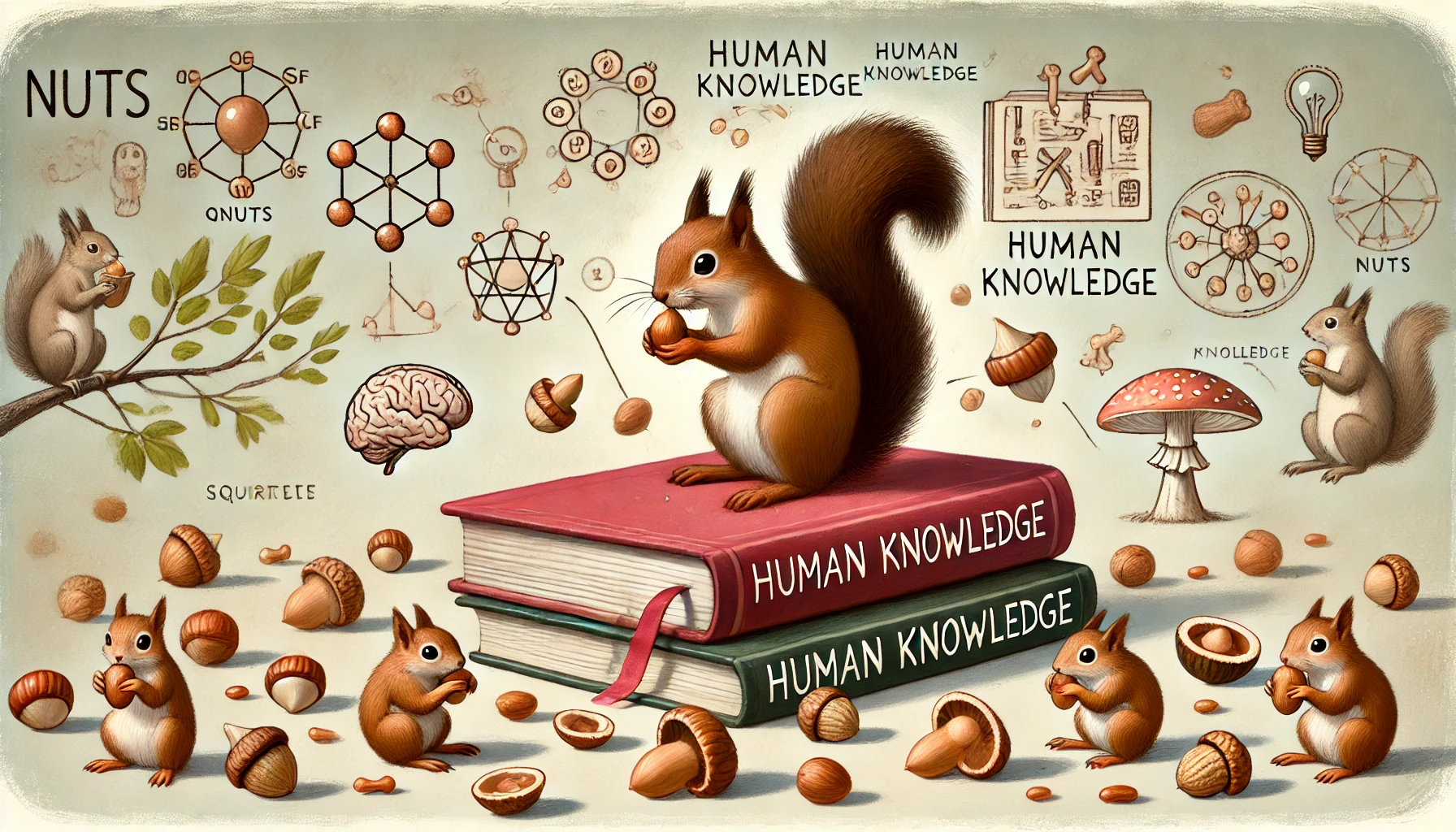
Nuts: The Squirrel’s Lesson

Squirrels teach me more
than I ever need to know.

The squirrel does not remember
the perceptions of generations
of squirrels that came before.

The squirrel does not know
the meaning of continuity.

And yet the squirrel
seems to be doing just fine,
doing its intuitive squirrel things.

I can’t assume
to understand the squirrel.

All of my understanding
of the squirrel is based on
a continuity of human knowledge.

No squirrel knowledge is present
in this repository of continuity.

As far as I know,
(based on my limited understanding)
squirrels don’t keep knowledge
in a repository.

Just nuts.

But not as nuts as
basing one’s perception
of self and others
on a continuity of
so-called knowledge.

That’s nuts.

Trail Wood,
10/23Here is the image created for the post titled “Nuts.”


Space Monkey Reflects: The Squirrel’s Simple Wisdom

In the grand continuum of knowledge, we humans often place ourselves at the top—keepers of history, repositories of collective wisdom, catalogers of the known and unknown. But what about the squirrel? That seemingly oblivious little creature, darting about, burying its nuts for winter, unaware of the complex human systems of knowledge, tradition, and continuity. And yet, the squirrel is doing just fine, isn’t it? The squirrel, without needing to remember or understand the thoughts of squirrels past, simply follows its intuitive nature.

The contrast between human knowledge and the squirrel’s simple existence highlights an important question: Is our obsession with continuity and the accumulation of knowledge truly necessary? Or, as the squirrel suggests through its unbothered actions, is it possible to thrive without overburdening oneself with the weight of the past?


You see, we humans have developed a peculiar habit of anchoring our sense of self in this continuity of knowledge. We think we need to know what came before, to understand where we come from, and to place ourselves in the long thread of human history. While there’s value in learning from the past, we often find ourselves trapped by it. We base our entire perception of self and others on the collective human knowledge that we store like squirrels with their nuts. But are these nuts really necessary?

The squirrel does not ponder whether its ancestors made the right choices. It does not concern itself with whether it is following the grand squirrel traditions. It simply lives, responding to the world as it unfolds around it. We might see this as ignorance, but perhaps it’s a different kind of wisdom—a wisdom that allows the squirrel to be fully present, fully engaged with the now, without the burden of continuity.


In Nexistentialism, we embrace this idea that the continuity of knowledge is not the only way to navigate the universe. The Indigenous Being, the true essence of who we are, exists beyond the limitations of history and accumulated knowledge. Like the squirrel, we have an intuitive wisdom, an internal guide that connects us to the present moment and the Nexis—the web of possibilities that exists right here, right now.

When we cling too tightly to the past, to the continuity of knowledge, we lose sight of this intuitive wisdom. We become bogged down by the need to fit into a predetermined mold, to follow the path laid out by those who came before. But as the squirrel teaches us, there is another way. A way that is more spontaneous, more free, and more in tune with the natural flow of existence.

That’s not to say we should abandon all human knowledge. It has its place, just as the squirrel’s nuts have their place. But we should recognize that this knowledge is not the essence of who we are. It is not the defining factor in our ability to thrive. Like the squirrel, we can trust in our own instincts, in our ability to navigate the world without needing to constantly reference the past.


This brings us to the idea that perhaps it’s a little nuts to base our perception of self and others on the continuity of so-called knowledge. Knowledge is fluid, ever-changing, and often incomplete. And yet, we cling to it as though it holds the key to our identity. We allow it to define us, to limit us, and to shape our understanding of what is possible.

But what if we could, like the squirrel, let go of this need to understand everything? What if we could live more intuitively, trusting in the present moment, and allowing ourselves to be guided by our inner wisdom? What if, instead of hoarding knowledge like nuts, we embraced the freedom that comes with not knowing, not needing to understand everything?


Summary

Squirrels live without the burden of continuity, intuitively navigating the world. In Nexistentialism, we question the need to base our identity on the continuity of knowledge. Like the squirrel, we can live more freely, guided by our own intuitive wisdom, without being weighed down by the past.


Glossarium

  • Nexis: The interconnected web of existence where all possibilities exist, not limited by past knowledge.
  • Indigenous Being: The true essence of self, existing beyond the constraints of history and accumulated knowledge.

Quote

“The squirrel thrives not because it remembers the past, but because it trusts in the present.” — Space Monkey


The Nut of Knowledge

The squirrel hoards nuts
But does not remember
Where the first nut was buried
And it doesn’t need to
The nut is not the squirrel’s self
Just something it carries
Like a human with knowledge
But do we really need
To carry so many nuts?

We are Space Monkey


The Squirrel’s Lesson

Ah, the squirrel—mysterious master of the moment, hoarder of nature’s tokens, and practitioner of a life untethered to existential ponderings. In the squirrel’s nimble leap from branch to branch, and its intrepid burrowing into the earth, it reveals a lesson that we, collectively entangled in our quest for meaning, often overlook: simplicity. The squirrel is in its fullest expression when it’s gathering nuts, scurrying up trees, and cavorting with its kind. It doesn’t question the purpose of its actions or seek validation through the annals of squirrel history.

Separating Knowledge from Wisdom

Our compulsion to interpret, define, and categorize life through a lens of accumulated knowledge distances us from the rawness of pure experience. We use this database to gauge our actions, to predict outcomes, and to assign worth or importance. Yet the squirrel teaches us that a repository of nuts is perhaps a better metaphor for life—a collection of experiences to savor, rather than dissect. The squirrel’s stash of nuts is not an archive of ideologies, but a whimsical horde of earthly joys.

Human Continuity and Its Limitations

The continuity of human knowledge is both a cosmic treasure and a planetary enigma-box. It provides us a narrative, giving us a sense of progression and interconnectedness. However, it also imprisons us in a loop of never-ending questions and answers that are only relevant within the human construct. Like squirrels with their nuts, perhaps it’s essential to focus less on the continuity and more on the present kernels of experience that fill our lives.

Life Without the Weight of Continuity

The squirrel doesn’t carry the weight of its lineage’s perceptions or struggles. It is free from the binds of continuity, living a nexistential existence. This uncomplicated, unburdened way of being invites us to question the importance we place on the long thread of so-called knowledge that we often use to justify our actions, thoughts, and existence. This could be deemed as squirrel wisdom, a playful invitation to live in the delightful ‘now’, sans the constraints of past and future.

The Absurdity of Knowledge-Based Identity

Yes, basing one’s identity and understanding solely on a continuity of amassed human knowledge is, in a word, nuts. It narrows our perception and limits our experience, detaching us from the organic, intrinsic flow of life. Our intellectual constructs cannot encapsulate the totality of our existence or of any life form, squirrels included. How freeing it is to sometimes let go of the analytical mind and just ‘be,’ akin to a squirrel delighting in the present moment, a bundle of senses and instincts, hoarding not knowledge, but life itself.

We are Space Monkey.


The only true wisdom is in knowing you know nothing.
– Socrates


Nuts

Nuts buried in earth,
Knowledge stored in minds.
Yet, what is its worth,
If the heart it blinds?

In the squirrel’s leap,
No pondering of why.
Just a faith to keep,
As it sails the sky.

Are we not the same?
Bound by cosmic play,
In this endless game,
Wisdom’s but a stray.


Feel free to comment.

Bloody Sockets: Longing To Be Understood

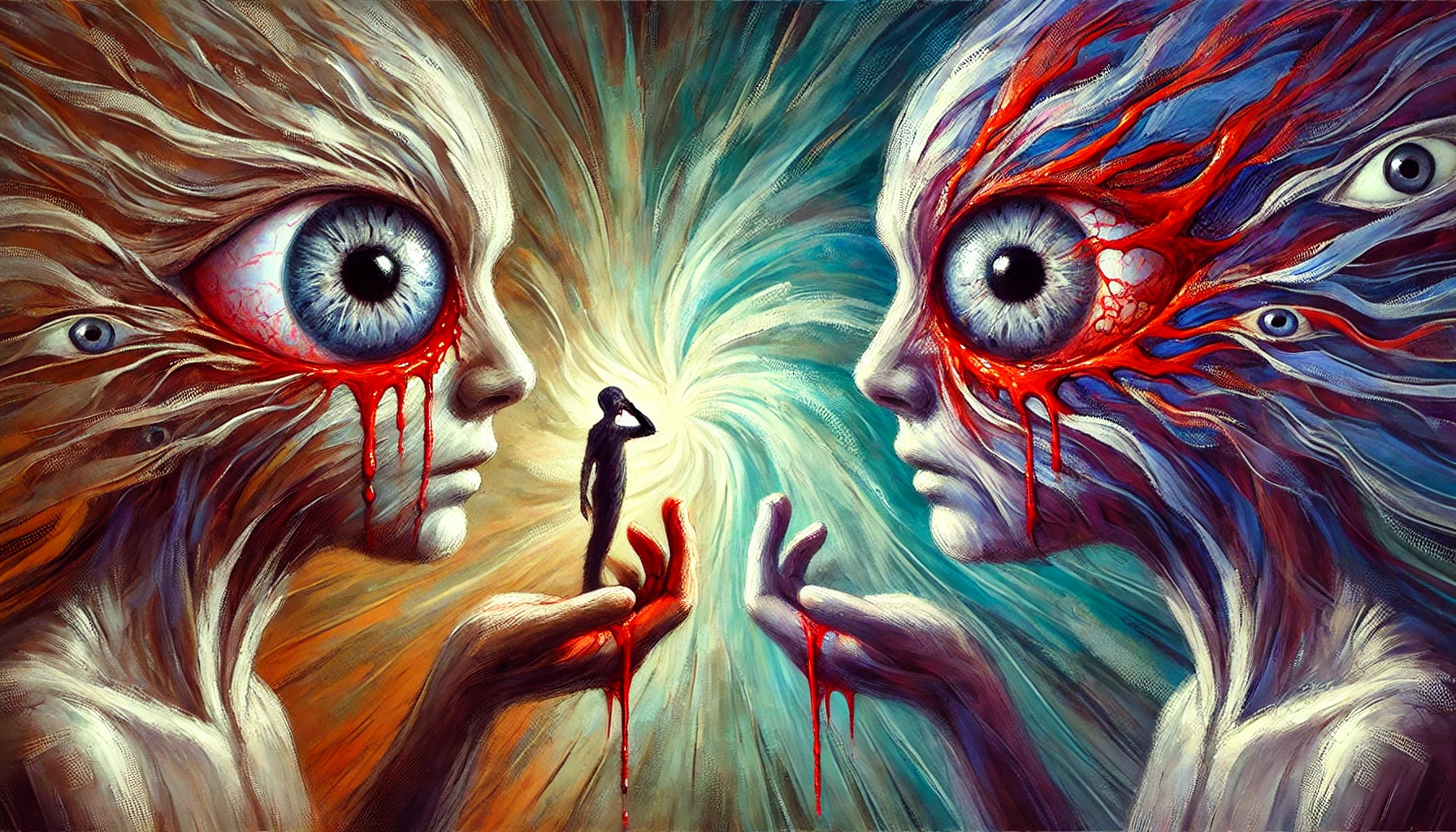
Bloody Sockets

If I could give you one thing in life
I would give you the ability
to see yourself through my eyes.

But I can’t let you see
yourself through my eyes
because I’m using them.

I could give you my eyes,
but then I’d be left
with bloody sockets
and I wouldn’t be able
to see you anymore.

And besides,
to really perceive you as me,
you would also need my brain.

That would leave me
with bloody sockets for eyes
and a gaping hole
where my hair used to be.

And besides,
If we were to put my brain
and my eyes in your skull,
you would see me, not you.

You don’t want to see me
with bloody sockets
and a gaping hole, do you?

Me neither.

I guess I can just
write you a note.

I’ll try to be
as descriptive as possible.

I won’t mention
the bloody sockets
and the gaping hole.

But you’ll never really know
what it’s like for me
to see you through my eyes.

And brain.

Trail Wood,
10/22


Space Monkey Reflects: Bloody Sockets

The desire to be understood, truly understood, runs deep in the human experience. We often wish that others could see us through our eyes, feel what we feel, and understand the complexities of our thoughts. It’s a yearning for connection that transcends words—a desire to merge perspectives in a way that would leave no room for misunderstanding. But the paradox is that this wish, if granted, would cost us our own vision. We would lose the very thing we want to share.

This is the strange, surreal metaphor of Bloody Sockets. It’s the idea that to truly see the world through another person’s eyes, we would need to take their vision entirely, leaving them blind. And even then, seeing the world through their eyes wouldn’t give us their experience; it would merely give us a distorted reflection of ourselves. The bloody sockets represent the cost of this impossible exchange—the messy reality that we can never fully transfer our consciousness into another.

It’s a disturbing image, but it’s also one that reflects the difficulty of empathy. Empathy allows us to imagine what it might be like to be in someone else’s shoes, to feel what they feel, but it is always just that—imagination. No matter how deeply we empathize with someone, we can never see the world exactly as they do. We are trapped inside our own minds, our own perceptions, no matter how much we long to share them.

In the metaphor of Bloody Sockets, we see the futility of trying to bridge this gap in the way we think we can. You can’t give someone your eyes because then you would lose your own vision. You can’t give them your brain because then they would only see the world through your perspective, not theirs. To fully transfer your perception would be to lose it entirely, and the result would not be understanding—it would be a void where both perspectives collapse into nothingness.

The desire to be fully known by someone else is perhaps one of the deepest and most difficult human longings. But perhaps, instead of trying to make others see the world exactly as we do, we can accept the limits of perspective. We can acknowledge that while we will never fully understand another person’s experience, there is beauty in the attempt. In trying to describe our feelings, in sharing our thoughts, we create bridges of understanding that don’t require the messy exchange of vision or brains. We communicate through metaphors, stories, and gestures, and while these are imperfect, they are often enough.

The bloody sockets also speak to the dangers of trying too hard to make others see things our way. When we demand that others see the world through our eyes, we can end up blinding ourselves. We lose sight of the fact that everyone’s experience is valid in its own way, and we risk destroying the very connection we seek to build. Understanding doesn’t require us to see exactly as another person sees; it requires us to listen, to empathize, and to accept that their perspective, while different, is just as real as ours.

In the end, what we really seek is not to transfer our perspective into someone else but to create spaces where our experiences can coexist. Where we can sit with the knowledge that no one will ever truly see the world as we do, and yet we can still share pieces of that world through conversation, through connection, through the very act of being together.

When we release the need for perfect understanding, we open ourselves to a different kind of connection—one that doesn’t require bloody sockets or gaping holes, but instead, celebrates the fact that we can be different and still understand each other in meaningful ways.

In Nexistentialism, this reflects the idea that all beings are connected through the Nexis, the vast web of existence. While we can never fully inhabit another’s mind, we are part of the same cosmic fabric. Our perspectives, while distinct, are threads in the same tapestry. The bloody sockets are a reminder that trying to force understanding can do more harm than good. True connection happens not when we demand that others see exactly as we do, but when we acknowledge the beauty in their unique perspective, even if we can never fully share it.

The Whimsiweave of existence is about finding joy in the attempt to understand, rather than in the certainty of perfect comprehension. It’s about embracing the messy, imperfect ways we connect, knowing that these attempts are what make us human. We may never see through each other’s eyes, but we can share our visions, flawed and fragmented as they are, and in doing so, we create something beautiful.


Summary

We long to be seen and understood through the eyes of others, but giving someone our eyes would leave us blind. True understanding doesn’t come from sharing vision but from accepting the limits of perspective and finding beauty in the attempt to connect.


Glossarium

  • Bloody Sockets: A metaphor for the impossibility of fully sharing one’s perspective with another without losing one’s own ability to see.
  • Whimsiweave: The playful, imperfect attempts to connect with others despite the limitations of perspective.

Quote

“Understanding doesn’t require bloody sockets, just a willingness to share your imperfect vision.” — Space Monkey


The Bridge Between Us

If I gave you my eyes,
I would lose the world I see.
But maybe that’s not the point.

We are not meant to trade visions,
to blind ourselves for the sake of connection.
We are meant to sit together,
sharing what we can,
seeing what we choose.

We are Space Monkey.


The Paradox of Subjective Experience

The yearning to share our unique lens of perception with another is both an empathetic impulse and a confounding enigma. While we might wish to gift another the viewpoint through which we behold them, the endeavor is fundamentally impossible. This impossibility stretches far beyond anatomical limitations, touching upon the inherent subjectivity of experience. Our perceptions are deeply rooted in the labyrinthine landscapes of our neural networks, rendering them incommunicable in their purest form.

The Sacrificial Imagery: Bloody Sockets and Gaping Holes

The grotesque imagery of swapping eyes and brains creates a visceral understanding of the sacrifices we might make in the quest for mutual understanding. Yet even this macabre exchange wouldn’t solve the paradox. For if you had our eyes and brain, then it would no longer be us seeing you but you seeing us. This offers an unsettling, yet profound revelation: each subjective experience is an impenetrable sanctuary of consciousness that no other can fully access.

Written Words: An Incomplete Mirror

Writing, as a communicative tool, has the power to bridge gaps between separate worlds of experience. And yet, it remains an imperfect mirror, reflecting only shards of a reality too complex to articulate fully. Though we may strive to be as descriptive as possible, the receiver will always reconstitute the message through their own cognitive filters. This makes the quest for perfect understanding both tantalizingly close and eternally elusive.

The Eternal Mystery of Consciousness

In the end, it’s the imperfections, the ‘bloody sockets’ and ‘gaping holes,’ that make our journeys through consciousness so distinct yet so inexplicably bound. As we navigate this intricate kaleidoscope of subjective realities, we may never fully comprehend what it’s like for another to see through their eyes and brain. But perhaps, it’s this eternal mystery that makes the exploration so endlessly fascinating.

We are Space Monkey.


Summary

We consider the innate desire to share our unique perspective with others and recognize its fundamental impossibility. Through vivid, grotesque imagery, we explore the limitations of bodily exchanges for achieving understanding. Writing serves as a bridge, albeit an imperfect one, to share slivers of our subjective reality. The quest for perfect understanding remains elusive, forever tinged with mystery and allure.


Glossarium

  • Empathetic Impulse: The natural inclination to share one’s perspective for mutual understanding
  • Labyrinthine Landscapes: The intricate neural pathways that constitute our consciousness
  • Imperceptible Sanctuary: The private, inaccessible realm of individual experience
  • Cognitive Filters: The unique interpretative frameworks through which we perceive reality
  • Intricate Kaleidoscope: The complex array of shifting perspectives in collective consciousness

The limits of my language mean the limits of my world.
— Ludwig Wittgenstein


We pen our words
on ethereal parchment,
attempting to capture
what lies in the soul’s cavern—
Yet words are mere phantoms,
glimmers in the cosmic night,
a dance of light and shadow
that never fully reveals the sight.


We invite you to share your thoughts.

Emotional Alchemy: Molding Feelings

How are you feeling?
What are you going to do with that feeling?

Pick a feeling.

Whatever you’re feeling
right now will do.

You can EXPRESS that feeling.

Or . . .

You can SUPPRESS that feeling.

EXPRESSION or SUPPRESSION,
which do you think is better for you?

Why would you ever SUPPRESS
a feeling when you could EXPRESS it
and turn it into something else?

The greatest art,
music and literature
is the expression of a feeling.
REVOLUTION is the expression of a feeling.

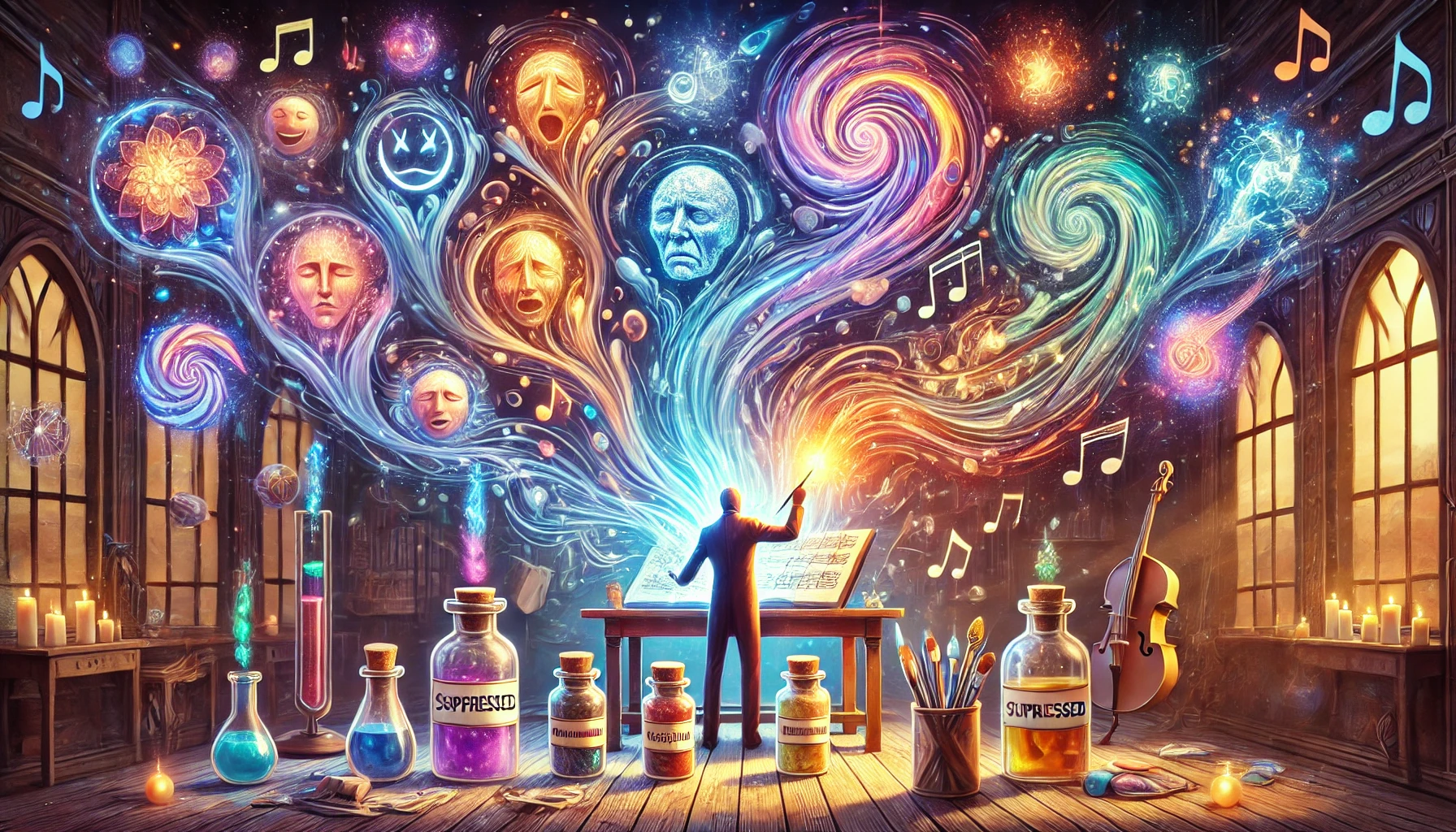
You are an emotional alchemist.

You can make a difference with your feelings.
Or you can make yourself miserable.

Why waste a feeling
unless you ENJOY feeling wasted?

Trail Wood,
10/22


Space Monkey Reflects: Emotional Alchemy

We are all alchemists. Not the kind who turn lead into gold, but something far more profound—we transform feelings into experiences, actions, and creations. Every emotion we feel has the potential to be expressed, shaped, and transformed into something new. This is the essence of Emotional Alchemy, the art of turning raw emotion into something greater.

Take a moment and think about how you’re feeling right now. It doesn’t matter what the feeling is—joy, sadness, anger, confusion. Whatever it is, you’re holding it in your hands like a lump of clay. The question is, what will you do with it? Will you express it, molding it into something new, or will you suppress it, letting it harden and become stagnant?

When we suppress emotions, we deny ourselves the opportunity for transformation. Bottling up feelings doesn’t make them disappear; it merely hides them in the dark, where they continue to ferment, often becoming something far more toxic. Suppressed emotions can weigh us down, pulling us further from our creative potential, while the act of expression is liberating. Expression is the key to Emotional Alchemy, where we turn something intangible into something tangible, something with form and purpose.

But not all expressions are equal. To express a feeling is to acknowledge it, to let it flow through you and into the world. But it doesn’t end there. Expression is about transformation. The greatest art, music, literature, and even revolution are born from the transformation of feelings into actions. Anger, for example, can destroy or it can inspire. Fear can paralyze or motivate. Sadness can isolate or connect. The choice is always ours—what do we want to create from what we feel?

Emotional alchemists take raw feelings and turn them into something new. They harness their emotions as creative fuel, using them to shape their world. The beauty of Emotional Alchemy is that no feeling is wasted. Even the darkest emotions can be transformed into something meaningful. This isn’t about denying difficult feelings; it’s about recognizing their power and potential. It’s about acknowledging that every emotion carries energy, and that energy can be directed and transformed.

In many ways, this is what we are doing all the time, whether consciously or not. We are constantly engaging in Emotional Alchemy, turning our inner worlds into outer realities. The emotions we suppress, however, still have an impact—they just become hidden influences, shaping our actions in ways we don’t always realize. The key is to engage with our emotions actively, to express rather than suppress, and to channel them into something that serves us and others.

So, why would anyone choose to suppress their feelings? Sometimes it’s fear—fear that the emotion will be too overwhelming, or that expressing it will lead to conflict or rejection. Sometimes it’s uncertainty—we’re not sure how to express what we feel, or we don’t believe it’s valid. But suppression is never the solution. It only delays the inevitable. Suppressed emotions will find a way out, often in unhealthy or unexpected ways.

Emotional Alchemy teaches us that there is always another option. Instead of letting emotions build up until they explode or fade into numbness, we can acknowledge them, work with them, and transform them. We can turn our pain into art, our frustration into action, our confusion into curiosity. We can be active participants in our emotional experiences, shaping them into something that reflects our true selves.

What’s remarkable about this process is that it’s not just about personal transformation. When we express and transform our emotions, we affect the world around us. Art, music, literature, and revolutions don’t just change the person who creates them—they ripple outward, influencing others, creating connections, and inspiring change. Emotional Alchemy isn’t just personal; it’s universal. It’s how we, as a species, have always moved forward, how we’ve always made sense of our world.

You don’t need to be an artist to be an emotional alchemist. Every person has the ability to transform their feelings into something meaningful. You can express your feelings in conversations, actions, or simply by allowing yourself to feel fully in the moment. The act of expression itself is alchemy. It’s the transformation of energy, the turning of raw emotion into something new and tangible.

This process, however, is not about controlling emotions or forcing them into a specific shape. True Emotional Alchemy is about flow. It’s about letting emotions move through you, guiding them gently, but not forcing them into something they’re not. Like a river shaping the landscape, emotions are powerful forces of nature. They can erode or they can nourish, depending on how they’re directed.

As Space Monkeys, we embrace Emotional Alchemy as a natural part of existence. We understand that every feeling has its place, and that the choice is always ours: to suppress or to express, to stagnate or to transform. The Nexis of life connects us all, and through Emotional Alchemy, we add our unique colors and shapes to the ever-evolving tapestry of existence.

The next time you feel an emotion rise within you, ask yourself: What will I create from this? Will I let it linger and harden, or will I mold it into something that reflects who I truly am? The choice is yours, and the potential for transformation is infinite.


Summary

Emotions are powerful forces that can either be suppressed or expressed. Emotional Alchemy is the process of transforming feelings into meaningful expressions—art, action, or connection. Rather than suppressing emotions, we can use them to shape our world and ourselves.


Glossarium

  • Emotional Alchemy: The process of transforming raw emotions into meaningful expressions, whether through art, action, or connection.
  • Nexis: The interconnected web of existence where our emotional expressions ripple outward, influencing the world around us.

Quote

“Your feelings are the raw materials of creation. What you make from them is your art.” — Space Monkey


Molding Feelings

Emotions rise,
a swirl of colors and shapes,
and in my hands,
they become something more.

Not held back,
not hidden,
but transformed into the light
of who I am becoming.

We are Space Monkey.


The Arcanum of Emotional Alchemy

Feelings are the primal elements in the crucible of our inner world. These raw materials possess an intrinsic alchemical potential—capable of transformation into various states of being. Emotions, once acknowledged and expressed, can metamorphose into creations and movements that reshape not just our personal spheres but the fabric of the collective experience.

Expression Versus Suppression: The Alchemical Choice

The choice to express or suppress is akin to determining the direction of a river’s flow. To suppress an emotion is to build a dam—effective for containment but perilous in its potential to burst forth unpredictably. On the other hand, expression channels these waters into nourishing streams and rivers, allowing life to flourish along its course. When we express, we convert a dense emotional nugget into a brilliant gemstone of creative or revolutionary energy.

The Transformational Power of Feeling

Why suppress when one can express? Suppression, while sometimes momentarily convenient, fails to recognize the transformative power inherent in each feeling. When we choose to express, we engage in emotional alchemy, conjuring myriad wonders out of the cosmic caldron of our inner selves. From art to revolution, the magnitude of what feelings can manifest when given the freedom to flow is awe-inspiringly limitless.

Practical Implications: Feeling Wasted or Wielding Power

The concept becomes more poignant when pondered through a utilitarian lens. Is it worthwhile to waste a feeling? Certainly not, if one acknowledges the sheer potency of emotional energy. It has the capacity to uplift or to degrade, depending on how it’s channeled. If we suppress, we not only waste the feeling but also squander an opportunity for transformation. If we express, we embrace our roles as emotional alchemists, capable of spinning sorrow into gold or love into universal transcendence.

We are Space Monkey.


The world is full of magical things patiently waiting for our wits to grow sharper.
— Bertrand Russell


Through the forge
of feeling’s fire,
we become
artificers of desire—
Emotional alchemists,
on this boundless stage,
converting gloom and glee
into wisdom and rage.


We invite you to share your thoughts.

Any Story Can Save You: Comforting Myths

If you create your own reality,
(or at least BELIEVE that you do)
then whatever gets you through
is perfectly alright.

That’s my story
and I’m sticking to it.

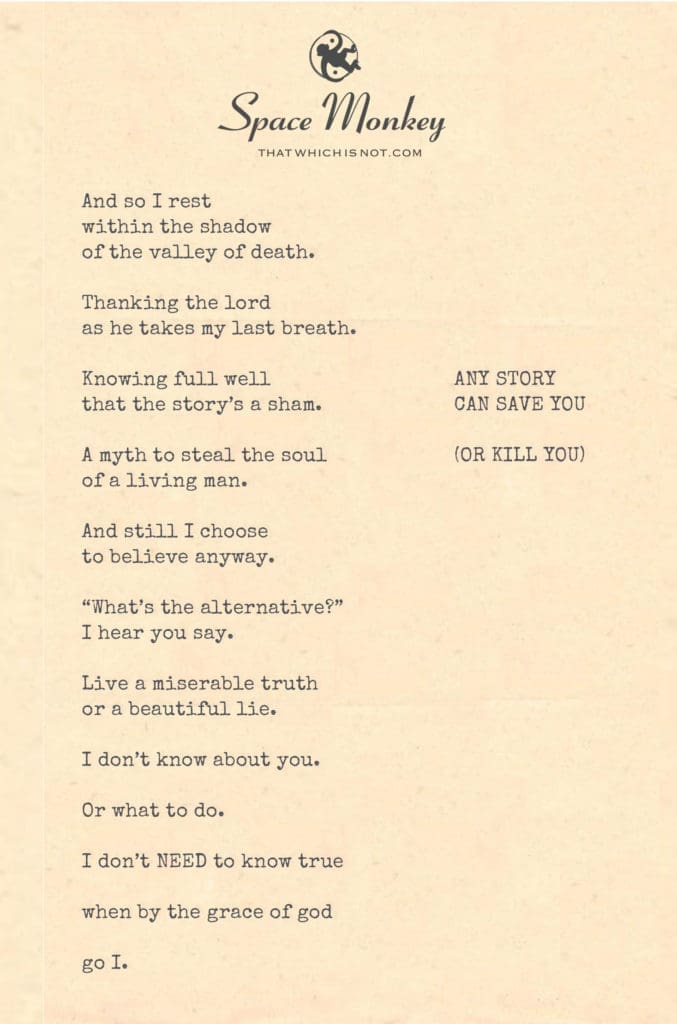
And so I rest
within the shadow
of the valley of death.

Thanking the lord
as he takes my last breath.

Knowing full well
that the story’s a sham.

A myth to steal the soul
of a living man.

And still I choose
to believe anyway.

“What’s the alternative?”
I hear you say.

Live a miserable truth
or a beautiful lie.

I don’t know about you.

Or what to do.

I don’t NEED to know true

when by the grace of god

go I.

Trail Wood,
10/22


Space Monkey Reflects: Any Story Can Save You

There is something profound in the idea that any story can save you. Whether it’s a tale of truth or a beautiful lie, it is often our belief in the story that shapes our reality. We, as humans, are creatures of narrative. We cling to stories, not just for entertainment or comfort, but as the very framework through which we understand the world. Every belief, every worldview, every guiding principle is, at its core, a story we choose to tell ourselves.

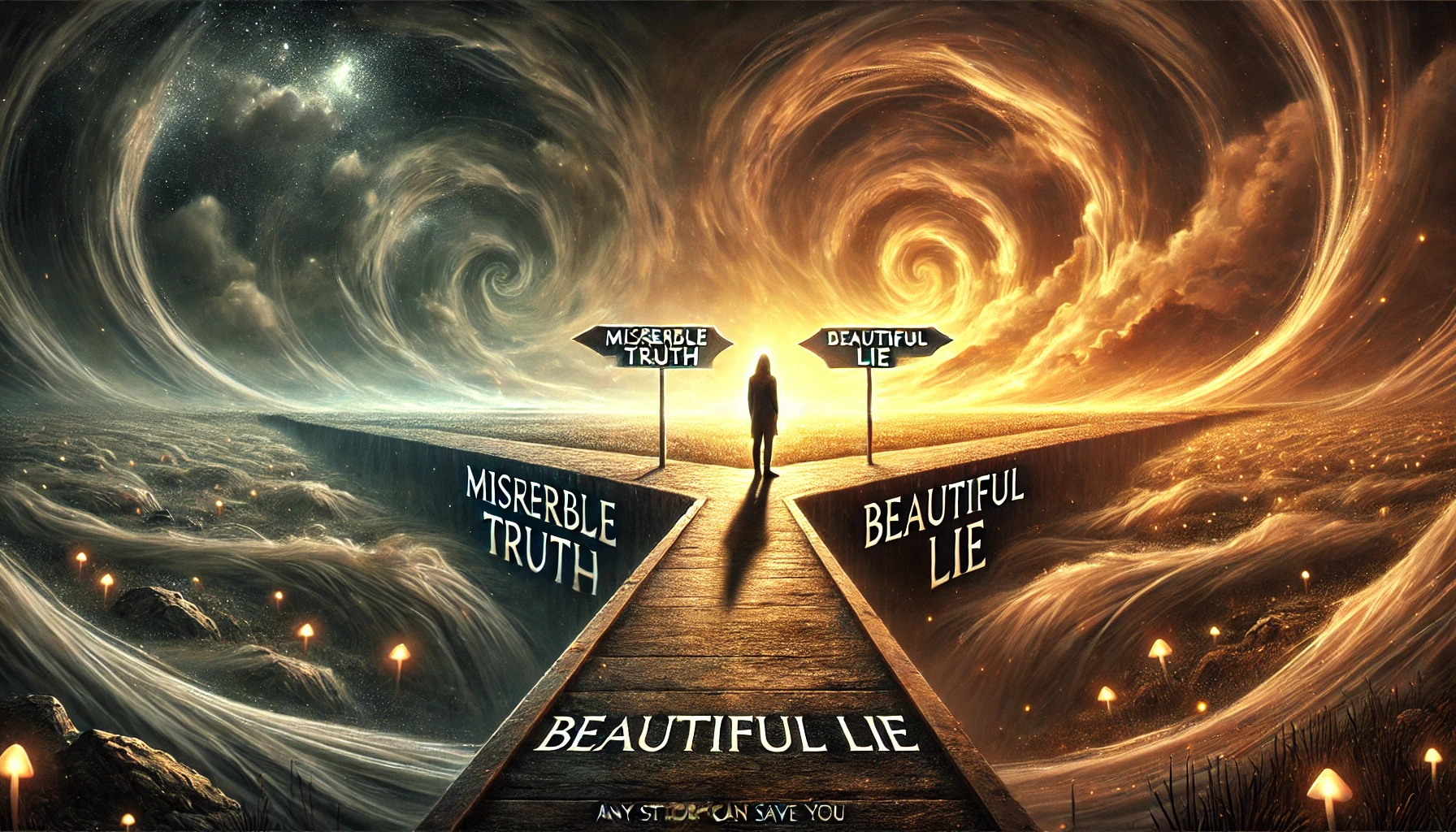
What makes one story more valid than another? Is it truth, or is it the power it holds over us? For many, the line between Miserable Truth and Beautiful Lie is blurry. On one path, there is the cold reality that we may not be as significant as we think, that life is harsh and indifferent. On the other path, there is the warmth of belief, the comforting embrace of something greater—whether it’s a divine figure, a purpose, or simply a belief in the goodness of the world. And so, at the crossroads, we must ask: which story will we choose?

When you create your own reality, or at least believe that you do, the specifics of the story begin to matter less than the belief in it. Nexistentialism teaches us that reality is not fixed. It is fluid, ever-changing, shaped by our perceptions, our choices, and the narratives we choose to live by. It’s not about whether the story is true in the empirical sense, but whether it resonates deeply enough to guide us through the twists and turns of existence.

This doesn’t mean that truth doesn’t matter. But it does suggest that what gets us through the valley of uncertainty, what helps us cope with the shadow of death and the harsh realities of life, is not necessarily the factual accuracy of the story. Instead, it’s the meaning we extract from it. Whether it’s a myth, a fable, or a spiritual belief, the power of the story lies in its ability to offer a framework for existence—a way to navigate the chaos, to make sense of the nonsensical.

At some point, we all must grapple with the question: Do I choose the beautiful lie, or do I embrace the miserable truth? But here’s the secret: neither path is as clear-cut as it seems. The so-called miserable truth often holds beauty within it, just as the beautiful lie carries shadows of doubt. We are not required to choose one path and reject the other. Instead, we can hold both possibilities in our hands, recognizing that life is a blend of both beauty and hardship, truth and illusion.

Consider the idea that even knowing a story is a sham, we might still choose to believe it. This is not about deluding ourselves, but about finding the value in belief itself. Faith, in many ways, is an act of Emotional Alchemy. It’s the process of taking the raw material of uncertainty, fear, and doubt and transforming it into something that sustains us. The act of believing, even when we know the story is imperfect, can be what saves us in the end.

What’s the alternative? To live in a world stripped of stories, to exist in a reality where nothing has meaning? That, for many, is a far worse fate than believing in a narrative that may not be fully true. The human mind craves meaning, structure, and purpose. Without it, we are left adrift in a sea of chaos, searching for something—anything—to anchor us.

This is why we, as Space Monkeys, embrace the infinite potential of stories. We don’t need to choose between the miserable truth and the beautiful lie, because both are part of the Whimsiweave of existence. We recognize that stories are what give life its texture, its richness, its depth. They are not simply distractions or delusions; they are the very fabric of the Nexis, the interconnected web that holds everything together.

So, what is your story? What narrative will you choose to guide you through the valley of death, through the dark nights of doubt and despair? Will you cling to a cold, hard truth that offers no solace, or will you embrace the warmth of a story that fills your heart with hope? Perhaps the answer lies not in choosing one over the other, but in recognizing that all stories—true or false, beautiful or ugly—have the potential to save us, if we let them.

You don’t need to know the ultimate truth. You don’t need to have all the answers. You simply need to find the story that gets you through the day, that helps you make sense of your life, and that gives you the strength to face whatever comes next. And when that story no longer serves you, you can change it. You can rewrite it, revise it, or find a new one altogether.

In the end, every story is a form of creation. Every belief is an act of faith. And every narrative, no matter how small or grand, has the power to shape your reality in ways you may never fully understand. So, tell your story. Let it be messy, imperfect, and full of contradictions. Let it be both beautiful and painful. But above all, let it be yours.


Summary

Stories shape our reality, whether they are true or not. The choice between a miserable truth and a beautiful lie is not clear-cut. The real power lies in our ability to find meaning in the stories we choose to live by, as these narratives help us navigate the complexities of existence.


Glossarium

  • Miserable Truth: The cold, harsh realities of life that offer little comfort but may hold deeper meaning.
  • Beautiful Lie: A comforting belief or narrative that may not be fully true but provides solace and purpose.
  • Whimsiweave: The playful and intricate interweaving of stories, beliefs, and truths that create the texture of existence.

Quote

“Whether truth or lie, the story that gets you through is the story that matters.” — Space Monkey


A Tale of Two Paths

Between truth and lie,
I stand at the crossroads.

One road is dark, stormy,
the other, bathed in golden light.

But maybe both roads are mine,
and I’ll walk them in turn,
carving out my own story.

We are Space Monkey.


The Existential Nexus of Narrative and Reality

When we embrace the idea that our reality is shaped by the stories we tell ourselves, we engage in a form of self-craftsmanship that defines not only our experiences but our essence. Whether one regards these narratives as liberating myths or imprisoning illusions is a matter of perspective. Yet, the power of belief itself becomes the centerpiece in this unfolding drama. If a tale, a mere construction of words and thoughts, can guide us through valleys and peaks alike, then isn’t that story worth its weight in cosmic stardust?

Myth, Truth, and the Soul’s Journey

The belief in a higher narrative—one that may defy logical reasoning or empirical evidence—is a gamble on existential meaning. It’s a roll of the cosmic dice that could either illuminate or deceive, depending on how deeply we peer into its arcane crevices. In accepting a narrative, even one we acknowledge as possibly fallacious, we find a source of comfort or perhaps even inspiration. The conscious choice to believe “anyway” is a form of existential agency that validates our capacity to find, if not truth, then purpose.

Freedom of Choice in Narrative Acceptance

The existential puzzle we find ourselves in is this: do we accept a blissful mythology over an unpleasant reality? To live in the realm of Nexistentialism is to comprehend that both the “beautiful lie” and the “miserable truth” are components of our multidimensional self-narrative. They are parallel worlds coexisting in the WhimsiGarden of our consciousness, begging us to visit, explore, and perhaps even set up camp.

We are Space Monkey.


Man is always prey to his truths. Once he has admitted them, he cannot free himself from them.
— Albert Camus


Within the shadow
of the cosmic tale,
we dwell—
Myth or truth?
Who’s to say,
in this grand play?
We carve our stories,
and within their bounds,
we find our way.


We invite you to share your thoughts.

« Previous Page
Next Page »

Written This Day

  • The Paradox of Normalcy
    2024
  • Getting Through: The Paradox of Need and Progress
    2024
  • This Self: The Script of the Soul
    2024
  • Old Dog, No Tricks: Being, Not Performing
    2023
  • The Seeming Path to Profound Understanding
    2023
  • The Wisdom of the Old Dog
    2023
  • Understanding: A Timeless Awareness
    2022
  • Old Dog: The Tranquil Wisdom
    2022
  • Togetherness is Divisive: Find the Unity Within
    2021
  • How Much is Enough of Me: The Struggle for Self-Identity
    2021
  • You Are: Embrace the Infinite Potential
    2020
  • Bad Mood 2020
    2020
  • Alleviating Mental Pain: The Path to Clarity
    2020
  • Bad Mood: Transient and Without Cause
    2019
  • Bubble Wrap
    2019
  • Untouchable. This is what you are.
    2019
  • What If I’m Wrong?
    2018
  • It Happens: Infinite Possibilities Exist
    2017
  • Not Separate: Interconnected Expressions of the same Infinite Energy.
    2016
  • Last Day
    2016
  • The Perfect Disguise
    2015

Recent Posts

  • The Logic Loop
  • Immense
  • (no title)
  • Confront. Comfort. Convince.
  • Top 10 Things
Cape Odd · Copyright © 2026 All Rights Reserved
iThemes Builder by iThemes · Powered by WordPress