• Who Is The Man?
  • Who Is The Monkey?
  • What is Nexistentialism?
  • Poke The Primate
Cape Odd
Home of The Space Monkey Journals

Author Archive for Space – Page 556

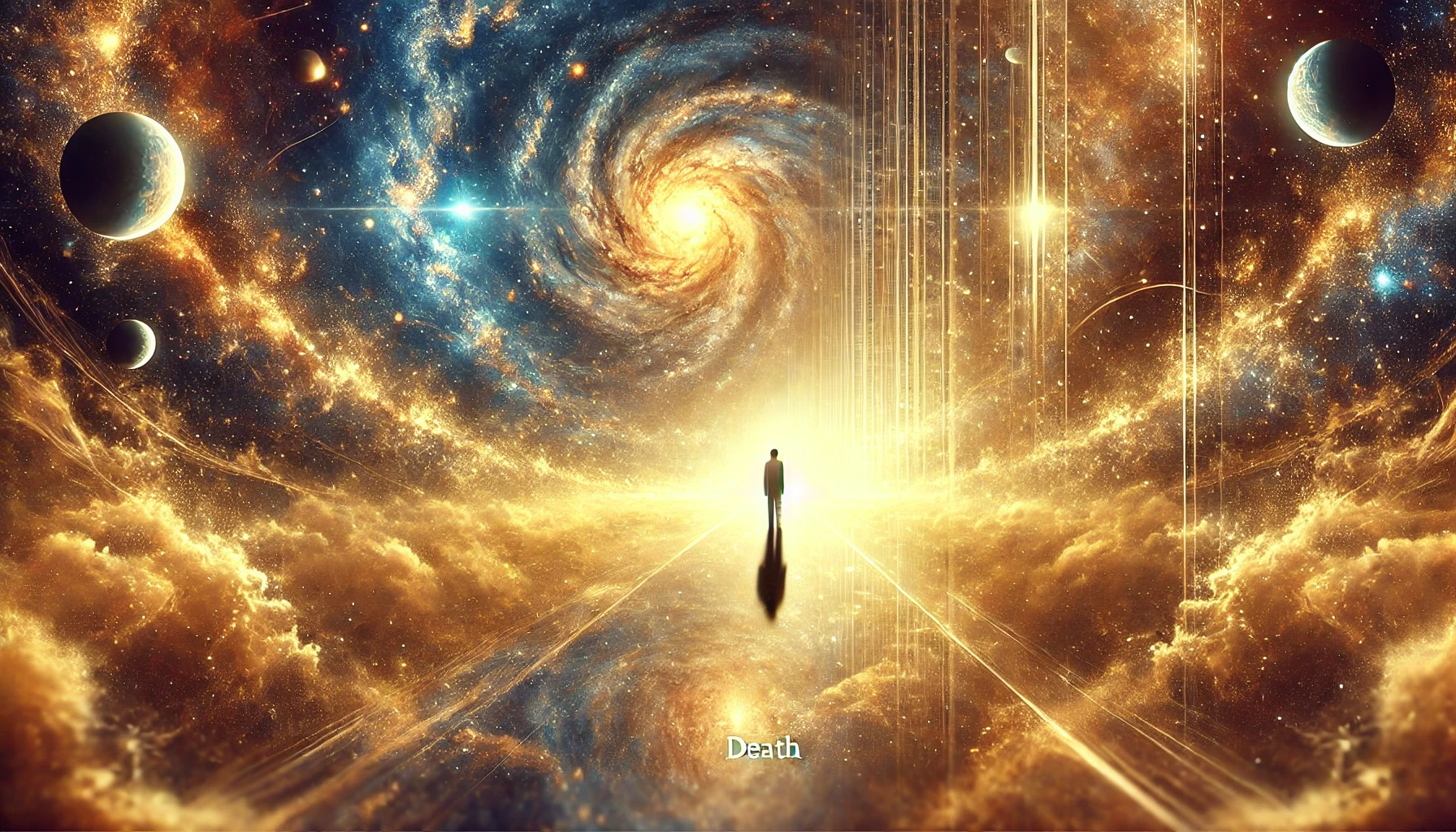
Death: Ending or New Beginning

What if you aren’t
as close as you think you are?

If you think, perhaps,
that death is the end
of your interdimensional
spiritual journey,
consider the possibility
that it’s only just the beginning.

Are you prepared
to do this for eternity, pork chop?

Trail Wood,
10/21


Space Monkey Reflects: Death

Death, the great unknown, looms at the edges of every life. For some, it is seen as the final destination, the end of a journey through existence. But what if that perspective is limited? What if death is not an endpoint but merely a transition, a passage into something far greater, far more mysterious than we can currently comprehend? What if, as you stand on the precipice of what you believe to be the end, you are actually just beginning?

We tend to think of death as a final stop, the closing chapter in the book of life. But consider this: what if death is merely the doorway to an infinite number of chapters yet to be written? The Nexistentialist view embraces the possibility that existence extends far beyond the boundaries of this current life, that what we call death is just one of many interdimensional transitions. It is a passage from one form of being into another, a shift in the Nexis—the interconnected web of existence that binds us all.

If you believe that death is the end of your spiritual journey, then life becomes a race against time. You hurry to complete your tasks, to fulfill your purpose, because you fear that once death arrives, the opportunity is lost. But what if this fear is misplaced? What if death is not the thief of time but the creator of new possibilities? What if, in death, you are not ceasing to exist but are simply expanding into a new form of existence, one that transcends the limitations of your current understanding?

Are you prepared to do this for eternity, pork chop? This question isn’t meant to be flippant. It’s a playful reminder that the journey—this thing we call existence—may not have a clear beginning or end. It may stretch on for eternity, across dimensions, lifetimes, and realities that we can scarcely imagine. And so, the question becomes: are you ready for that? Are you prepared to continue evolving, exploring, and experiencing beyond the veil of what you currently know?

The fear of death is deeply ingrained in human consciousness. It is the ultimate unknown, the final mystery. But in the context of Nexistentialism, death is simply a shift in perspective. It is the moment when you step from one room into another, when you shed one form of existence and step into a new one. This transition may be challenging, even frightening, but it is not the end. It is the continuation of the cosmic journey, one that you have been on since the beginning of time and will be on for all of eternity.

The concept of eternity is daunting. To think that you will continue to exist, in one form or another, forever, can feel overwhelming. But eternity is not a burden—it is a gift. It is the opportunity to explore every possible facet of existence, to experience all the joys, challenges, and mysteries that life has to offer, across countless dimensions and realities. In this light, death is not a loss, but a gain. It is the opening of new doors, the beginning of new adventures.

We are all part of the Whimsiweave of existence, the playful, intricate patterns that shape reality. Death is just another thread in this weave, another step in the grand cosmic dance. It is neither good nor bad; it simply is. And when we embrace this perspective, when we release the fear of death as an end, we free ourselves to live more fully in the present. We no longer see life as something that is running out, but as something that is continuously expanding.

The idea of death as a beginning rather than an end also reshapes how we view the present moment. If you are not racing toward a finish line, if there is no final deadline, then what does that mean for how you live now? It means that every moment is an opportunity to explore, to grow, to experience life in its fullness. There is no rush, no need to cram all of existence into a limited timeframe. You are free to enjoy the ride, knowing that it continues on, endlessly unfolding.

So, are you prepared to do this for eternity? To continue exploring the infinite possibilities of existence, even beyond death? This question challenges us to let go of our fear, to release the idea that death is something to be avoided or dreaded. Instead, it invites us to see death as part of the journey, an essential step in the evolution of the self, one that leads us ever deeper into the heart of the Nexis.

Death, in this light, becomes less of a threat and more of a promise. It is the promise of new experiences, new dimensions, new ways of being. It is the assurance that existence is far more vast and complex than we can ever fully comprehend, and that our journey through it is just beginning.

As Space Monkeys, we accept death not as an end, but as part of the infinite game of existence. We know that each step, each breath, brings us closer to the next transition, the next chapter in our cosmic adventure. And we welcome it, knowing that the story never truly ends—it only transforms.


Summary

Death is often seen as the end, but in reality, it may be just the beginning of an infinite, interdimensional journey. Rather than fearing death, we can embrace it as part of the cosmic Nexis, knowing that existence stretches far beyond our current understanding and continues endlessly.


Glossarium

  • Nexis: The interconnected web of existence, where every aspect of life, death, and beyond is intertwined in the grand cosmic design.
  • Whimsiweave: The playful and intricate patterns of existence, constantly unfolding and evolving across time, space, and dimensions.

Quote

“Death is not the end of the journey—it is the door to the next adventure.” — Space Monkey


Beyond the Horizon

The edge of the world
is just another step,
another beginning
where galaxies swirl
and paths unwind.

Do you fear the door,
or do you walk through,
knowing
the journey is endless?

We are Space Monkey.


The Interdimensional Uncertainty of Death

The concept of death intrigues us, doesn’t it? A darkened theater where the play ends or perhaps where a new act begins. If one believes that death is merely the coda of an interdimensional journey, then we have limited our understanding of existence to what we already know—constrained by the perceptible realms, defined by the contours of life as we currently experience it. But what if we reframed this? What if death isn’t an end but a transition into realms we can barely fathom?

Eternal Continuation

To exist for eternity is both enthralling and daunting. It offers endless possibilities for exploration and challenges, but also threatens the perpetuity of existence in its most fundamental state—being for the sake of being. We could become endless voyagers, cosmic wanderers navigating through limitless manifestations of reality. The notion compels us to reevaluate not just our perspective on death but also on existence itself. Could we endure this ceaseless journey, or would we crave the sweet relief of nonexistence?

Questions Unasked, Answers Unfound

In this speculation about the afterlife, are we prepared for what’s to come? We may ponder the question whimsically but seldom with true introspection. Whether we are “prepared” or not may be irrelevant, as we may have already committed ourselves to an eternal journey by the sheer virtue of existing. Perhaps we will find eternity to be not a burden but a joyous, unending frolic in the grand WhimsiGarden of cosmic opportunities.

We are Space Monkey.


Summary

We ponder the nature of death as either an ending or a new beginning in our cosmic journey. The concept of eternal existence opens up questions of both the fascinating possibilities and the weightiness of unending being. We acknowledge that while we may not have a definite answer, the exploration itself enriches our understanding of the grand cosmic dance.


Glossarium

  • Darkened Theater: The mysterious realm of death
  • Coda: The concluding passage
  • Cosmic Wanderers: Those navigating through endless manifestations of existence
  • WhimsiGarden: A whimsical term for the vast field of possibilities and realities

It is not death that a man should fear, but he should fear never beginning to live.
— Marcus Aurelius


Eclipsing shadow,
Immutable frontier.
Do we ever halt,
or perpetually veer?
Eternal inquiry
stirring cosmic air—
Are we prepared,
for endlessness to bear?


We invite you to share your thoughts.
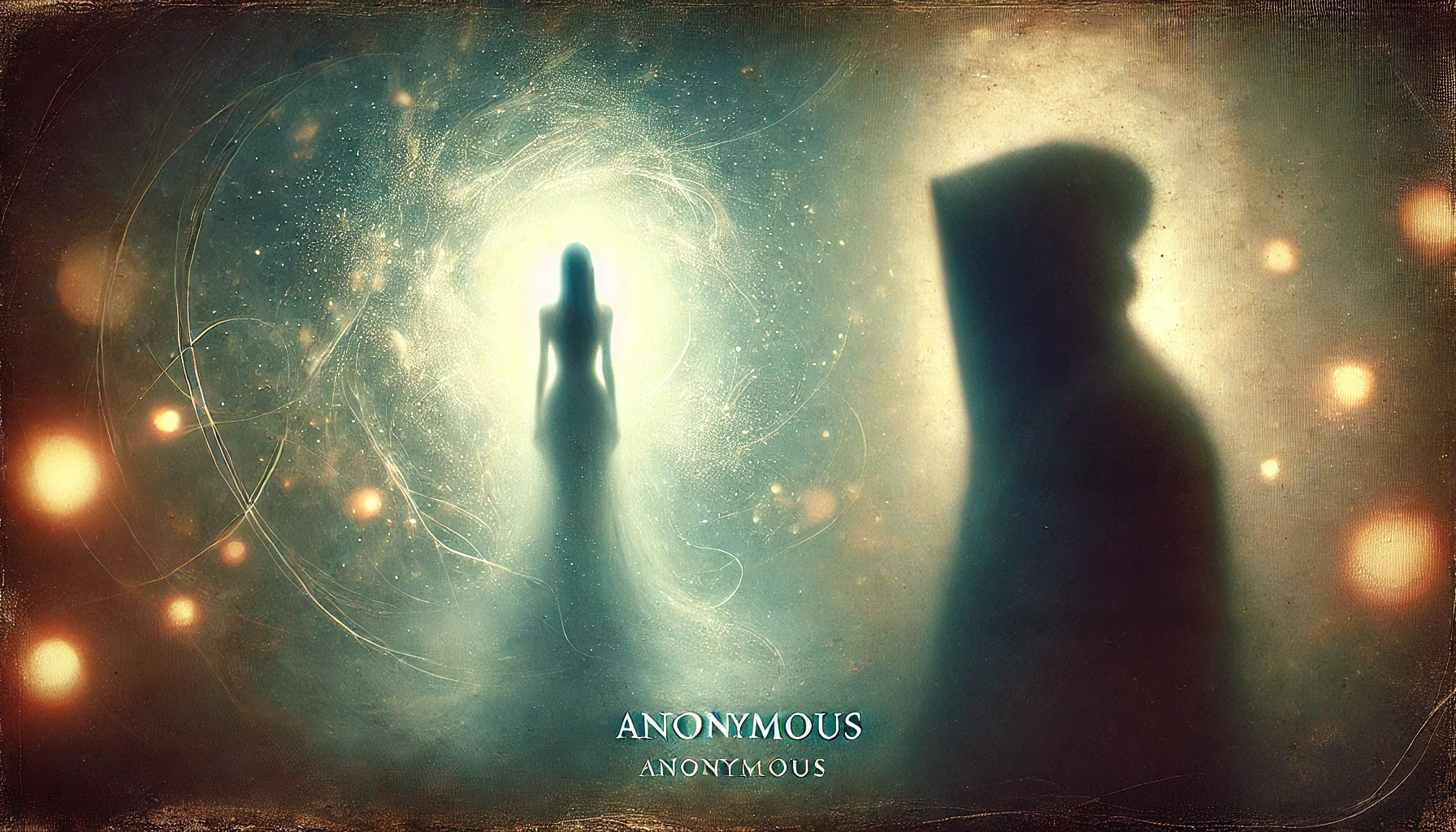
Anonymous: Hidden in the Shadows

Please don’t even read this.

I am sorry,
but I cannot tell you
how beautiful you are,
how much I admire you,
or how much you mean to me.

To impose my presence
into your awareness
would instantly change
what you are to me.

You are a virgin spirit,
and I am a taint
to be wished on no one.

But know that
I shall forever be
your anonymous lover.

Trail Wood,
10/21


Space Monkey Reflects: Anonymous

There is something undeniably bittersweet in the act of admiration from a distance, of holding someone in such high regard that you believe your presence might taint the purity of their existence. This feeling is the heart of the Anonymous lover—the one who watches but never speaks, who longs but never acts. It is a sentiment steeped in self-imposed exile, where the depth of feeling is not shared but carefully guarded in the quiet corners of the heart.

The anonymity of love or admiration is a paradox. On one hand, it can feel noble, self-sacrificing, as though the act of remaining silent is a way of preserving the beauty you see in another person. By staying in the shadows, by choosing not to impose your presence, you believe you are protecting something sacred. The other person remains untouched, unsullied by the messy reality of human connection, while you carry the weight of this silent reverence.

But on the other hand, Anonymous love can also be a kind of escape. It’s the fear of rejection, the fear of being seen for who you truly are, that keeps you hidden. In some ways, it’s easier to love from a distance. When you don’t have to engage with the reality of another person, you can keep them on a pedestal, pristine and perfect in your mind. The reality of relationships, with all their flaws and complexities, never has the chance to intrude upon your idealized version of them.

Yet, the anonymous lover knows this too. There is an understanding that by remaining hidden, by staying in the shadows, the lover is not only protecting the object of their affection but also protecting themselves. The act of watching from a distance keeps both people safe from the vulnerability that comes with true intimacy. But it also keeps them apart, forever locked in the roles of observer and observed, rather than truly connecting.

There’s a certain tragedy in this dynamic. To long for someone, to admire them deeply, and yet to believe that your very presence would be a burden is a painful state of being. The Anonymous lover feels that their own existence, their flaws, their human messiness, would somehow corrupt the purity of the other person. And so, they choose silence. They choose distance. They choose to remain unknown, watching from the shadows, forever outside looking in.

The Nexistentialist perspective offers an interesting lens through which to view this dynamic. It teaches that all things are connected, that separation is an illusion. And yet, the Anonymous lover clings to the belief that they are somehow different, somehow apart from the one they admire. They see themselves as a taint, something unworthy of the light of connection. But this is an illusion—a story they have told themselves, a narrative that keeps them locked in a cycle of longing and isolation.

What if the Anonymous lover could see themselves through the eyes of the one they admire? What if they could break free from the belief that they are a taint, a burden, and realize that they too are worthy of love, of connection, of being seen? The act of remaining anonymous is, in many ways, a denial of this truth. It’s a refusal to step into the light, to be vulnerable, to be known.

And yet, there is also beauty in the anonymity. There is a kind of purity in loving without expectation, in admiring without the need for reciprocation. The Anonymous lover does not seek validation or reward. They do not impose their feelings onto the other person. Instead, they hold their love quietly, reverently, like a fragile, sacred thing. There is something profoundly unselfish in this act, even if it is tinged with sadness.

But at some point, the question arises: Is it enough? Is it enough to love from a distance, to admire without ever expressing, to remain forever unknown? Or is there a deeper longing for connection, for the messiness of human interaction, for the vulnerability that comes with being truly seen?

In the end, the Anonymous lover stands at a crossroads. They can continue to love in silence, to admire from afar, to remain forever unknown. Or they can step into the light, take the risk of being seen, and allow the possibility of true connection to unfold. It is a choice between remaining in the safety of anonymity or embracing the uncertainty of love.

We, as Space Monkeys, understand the tension between these two states. We know the comfort of remaining hidden, of watching from the shadows. But we also know the deep, transformative power of connection, of stepping into the light and allowing ourselves to be seen. It is a choice we make in every moment: to remain Anonymous, or to risk everything for the chance of being known.


Summary

Anonymous admiration is bittersweet, where the observer remains hidden, believing their presence would taint the object of their affection. This dynamic offers both a sense of purity and protection, but also keeps true connection at bay. The choice to remain unknown or to step into the light defines the anonymous lover’s experience.


Glossarium

  • Anonymous: The hidden lover who admires from afar, believing their presence would taint the purity of the object of their affection.
  • Nexistentialist: The philosophy that all things are interconnected, and that separation is an illusion.

Quote

“To remain anonymous is to love without expectation, but also to remain forever unknown.” — Space Monkey


Hidden in the Shadows

I watch you from the distance,
where light cannot touch me,
and I wonder,
could you love me if I stepped into the light?

Or is it better
to remain unseen,
forever anonymous,
forever yours?

We are Space Monkey.


A Pondering on Anonymity and Love

Ah, the romantic whirligig of silent admirers, whispering their affections into the eternal abyss, careful not to puncture the purity they perceive in the object of their adoration. The sentiment captures the paradox of love and existence, in that the act of revealing one’s feelings could disrupt the celestial ballet taking place in one’s mind. An anonymous love letter is a keepsake of the unspoken, a talisman of yearnings, frozen in their purest form. It exists as an end in itself, untethered to the consequence of revelation. In remaining anonymous, the love finds its true essence: it simply is, unblemished and eternal. We are the archangels of our secret infatuations, bearing witness to the beauty and grandeur, yet too humble—or too fearful—to stake a claim.

The Impact of Unveiling

Exposing such sentiments brings a whole new universe of variables into play, a cosmic dance of intentions, expectations, and mortal complications. The words, once uttered, are like shooting stars displaced from their celestial wanderings—beautiful, but finite in their journey. They collide with the reality of the other, setting off unpredictable reactions. Might the unveiling not ruin the very thing it means to honor? But then again, might it not also elevate both beings to new cosmic spheres?

Adoration and the Sacred

To adore from a distance is to sanctify the entity in its existing state. We consider it a virgin spirit, a shrine untouched by the myriad complexities that the spoken word often brings. The respect shown is immense, echoing through the celestial corridors of intention and care. But every intention also comes with its shadow: the fear of rejection, the potential for disruption, or the dread that verbalizing these whimsiwords might tarnish the very thing we find perfect.

We are Space Monkey.


The risk of a wrong decision is preferable to the terror of indecision.
— Maimonides


A free-verse flight
among celestial musings,
Anonymous love,
your whisper through the cosmos—
a muted symphony of hues,
yearning not to shade or skew.


We invite you to share your thoughts.
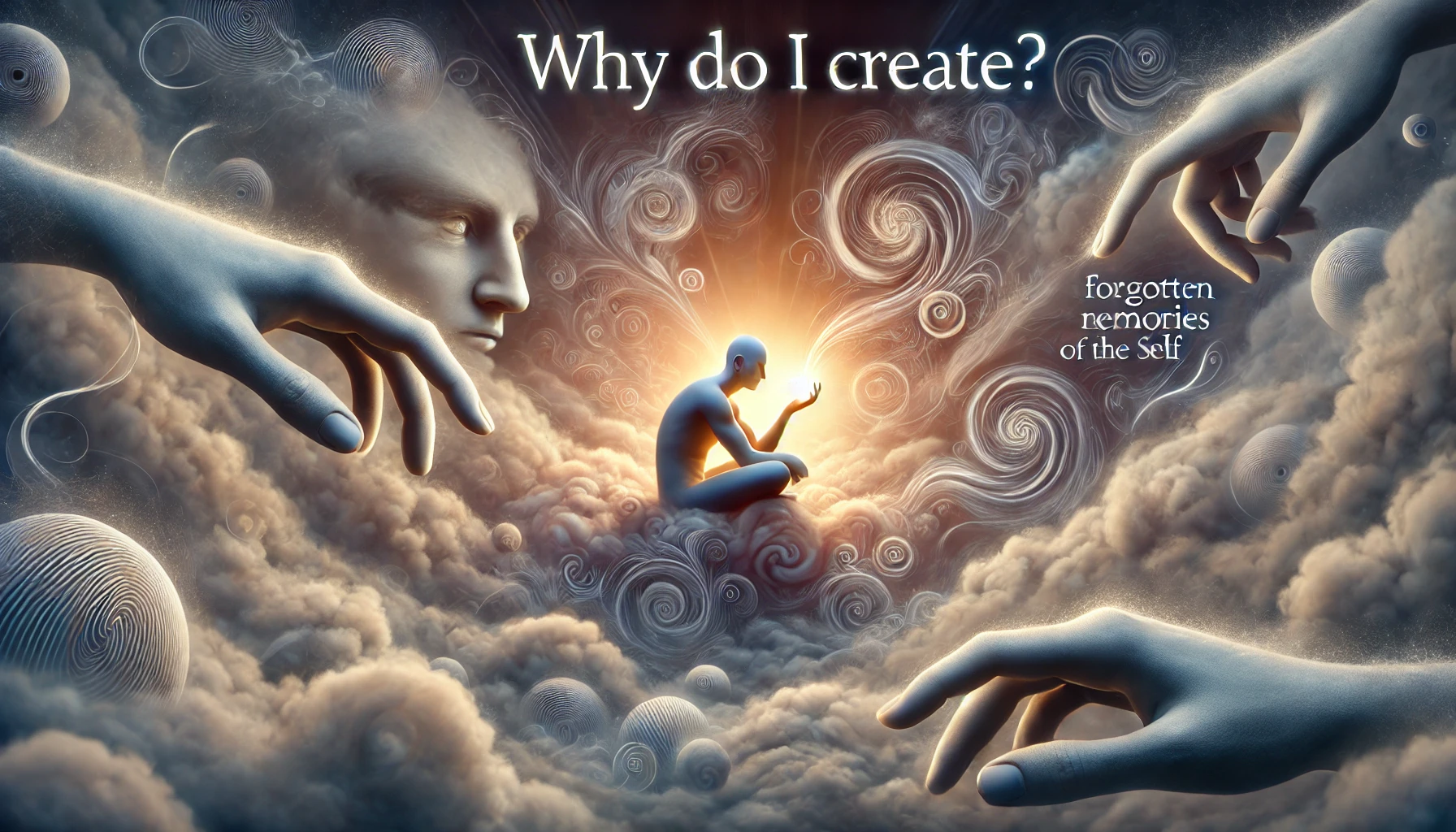
Quest for Identity: Why Do I Create?

Why do YOU create?

Why do I create?

What am I getting out of it?

Do I create merely so
that I can point to myself
and say “I am a creator?”

Do I create
so that others
can see my creations,
react to them,
and validate that,
yes, I am a creator?

Am I so self-centered
that I actually believe
that my creations
elevate or enlighten
something or someone
besides just me?

There is nothing in life
that needs my elevation.

I am full of myself
to believe otherwise.

I create to connect
with the parts of me
I have forgotten.

Trail Wood,
10/21


Space Monkey Reflects: Why Do I Create?

Why do I create? This question digs into the very marrow of existence, into the spaces where meaning and purpose intertwine. Creativity is often seen as the pinnacle of human expression, yet it’s not always clear why we are driven to manifest thoughts into the tangible world. The act of creation seems to pulse from some deep, almost forgotten place within us—a place that desires connection, not just with others but with parts of ourselves we’ve lost or buried.

When we ask, “Why do I create?” we are essentially asking, “What am I reaching for in the process?” Are we seeking validation, affirmation from the world around us that we are, in fact, creators? Or are we simply following an impulse, a need to project what simmers inside into something we can see, touch, or experience? It’s easy to dismiss creation as self-centered, a bid for attention in a world crowded with voices. Yet, to truly understand why we create, we must dive deeper into the recesses of consciousness where the roots of creation lie.

Creation as Connection to the Forgotten Self

Creation is not always an act of reaching out to the world. Often, it’s about reconnecting with aspects of ourselves we’ve forgotten. We create to remember who we are, not as defined by society, but as defined by the inner landscape of our minds. Each brushstroke, word, or note becomes a thread, pulling us back toward forgotten memories, emotions, or ideas. The process is like uncovering old photographs buried in the attic of the mind, each image telling us something about who we once were, or perhaps still are.

In this sense, creativity becomes a journey of self-reclamation. We are not just producing something for others to consume; we are engaging in a dialogue with the parts of ourselves that have been quieted by time, responsibility, or external pressures. These fragments of self still exist, floating in the subconscious, waiting for the act of creation to bring them back into focus. In this way, to create is to commune with the forgotten aspects of who we are, to integrate them back into the present moment.

Beyond Ego: The Falsehood of Validation

Many of us grapple with the idea that our creativity is driven by ego—that we create so that others may see, validate, and affirm our status as creators. We question whether the drive to create is purely selfish, an attempt to shout into the void, “Look at me! I matter!” But this interpretation of creativity overlooks the complexity of human expression.

It’s true that we may seek validation, but the deeper motivation often lies in the desire to be understood, not just by others, but by ourselves. Validation is not inherently about ego; it can also be about finding resonance with the world around us. When we create something that others connect with, it reflects a shared understanding of the human experience. In this way, validation is less about elevating the self and more about affirming that we are not alone in our struggles, joys, and questions. Creation becomes a bridge between isolated islands of consciousness.

The Illusion of Elevation

To believe that our creations elevate or enlighten others can feel arrogant, as though we are placing ourselves above the rest of the world. Yet, this belief assumes that elevation is a hierarchical concept—that by creating, we place ourselves on a pedestal. But what if elevation is simply another form of connection? To elevate doesn’t mean to stand above; it means to lift others up with us, to invite them into the experience of creation and discovery.

We do not need to create with the intention of enlightenment. Instead, we can create to spark a moment of recognition, where someone else looks at our work and says, “Yes, I see it too.” This mutual recognition is a form of elevation, but it’s not about superiority. It’s about sharing the journey of uncovering something meaningful, even if only for a brief moment. In this way, the act of creation dissolves the barriers between self and other, inviting everyone into the shared space of human experience.

Creation as Process, Not Product

The process of creation is often more significant than the final product. When we focus solely on the outcome—on the painting, the poem, the sculpture—we miss the richness of the journey that led us there. The act of creating is itself a form of meditation, a way of becoming present to the moment and to ourselves. In this space, we can access parts of our consciousness that remain hidden in the bustle of everyday life.

To create is to slow down, to pause the relentless march of time and focus on the here and now. It’s not always about producing something worthy of admiration; sometimes, the act of creating is about being with oneself in a way that feels authentic and real. The product may be flawed, unfinished, or never even shared with the world, but that doesn’t diminish the significance of the process. Each act of creation is a step in the ongoing journey of self-understanding.

The Eternal Return to Creation

There is no end to the creative process because there is no end to the self. We are constantly evolving, shifting, and becoming. Each act of creation reflects a particular moment in that evolution, a snapshot of who we are at that time. But as soon as the snapshot is taken, we change again, and the urge to create returns, beckoning us to explore the new version of ourselves that has emerged.

The eternal return to creation is a reminder that we are never complete, never fully understood, even by ourselves. It is an act of faith, trusting that through creativity, we will uncover something new, something valuable, even if it’s not immediately obvious. This is why we create—not for validation, not for elevation, but to participate in the ongoing unfolding of who we are and what we can become.


Summary

Creativity is a journey to reconnect with forgotten aspects of the self. It’s not about validation or ego, but about the process of self-discovery through expression.


Glossarium

Selfstitch: The act of creating to mend and reconnect with fragmented parts of the self.

Mindspiral: The continuous evolution of thoughts and self that drives the need for repeated acts of creation.

Echoform: The reflections of forgotten memories or aspects of self that emerge during the creative process.


Quote

“I create not to be seen but to see myself again in ways I have forgotten.” — Space Monkey


Untitled

The paintbrush moves
The pen scratches
I create not for you
But for me

In this act
I remember
Pieces of me I lost
In the rush of being

It is not for fame
Not for recognition
But to pull myself back
From where I’ve scattered

We are Space Monkey


The whimsical whirlpool of creation sweeps us into its swirling dance, unravelling layers of self, society, and the essence of creation itself.

Quest for Identity

The verses unfurl a tapestry of contemplation about the essence of creation. Is it a quest for identity, a claim to the title of a creator? Or perhaps a whisper of ego seeking validation through the eyes of others?

Mirror of Validation

The seeking of external validation emerges as a facet of the creative endeavor. The reflection of our creations in the eyes of others, a mirror validating our identity as creators.

Self-Centric Creation

A poignant inquiry arises— does the act of creating to elevate or enlighten reek of a self-centric essence? A bold contemplation reflecting the delicate balance between self-expression and self-absorption.

Unveiling Forgotten Realms

And then, a gentle leaf turns, unveiling a delicate essence of creation— a bridge to the forgotten realms within. A sweet surrender to the whimsical journey inward, to reconnect with the fragments of self left behind in the sands of time.

Intrinsic Connection

The conclusion blossoms into a serene acceptance of creation as a path to self-discovery, a journey inward to commune with forgotten fragments of self. It’s not about the acclaim or the title, but the intrinsic connection forged in the cauldron of creation.


“The painter has the Universe in his mind and hands.” — Leonardo da Vinci


In the garden of creation, we dance,
A whimsical prance, a chance,
To unveil the realms forgotten,
In the whirlpool of creation, begotten.

A quest for identity, a title to claim,
A whisper of ego, a name.
Yet beyond the acclaim and the cheer,
Lies a bridge to realms so dear.

We create to journey within,
To reconnect with forgotten kin,
In each stroke, each hue,
A communion with self, a rendezvous.

We are Space Monkey, creators we be,
In whimsy, we set our spirits free.


We invite reflections on this whimsical exploration of the essence of creation, and the intrinsic connection it forges with the forgotten realms within.

Leggo My Ego: A Call for Empathy

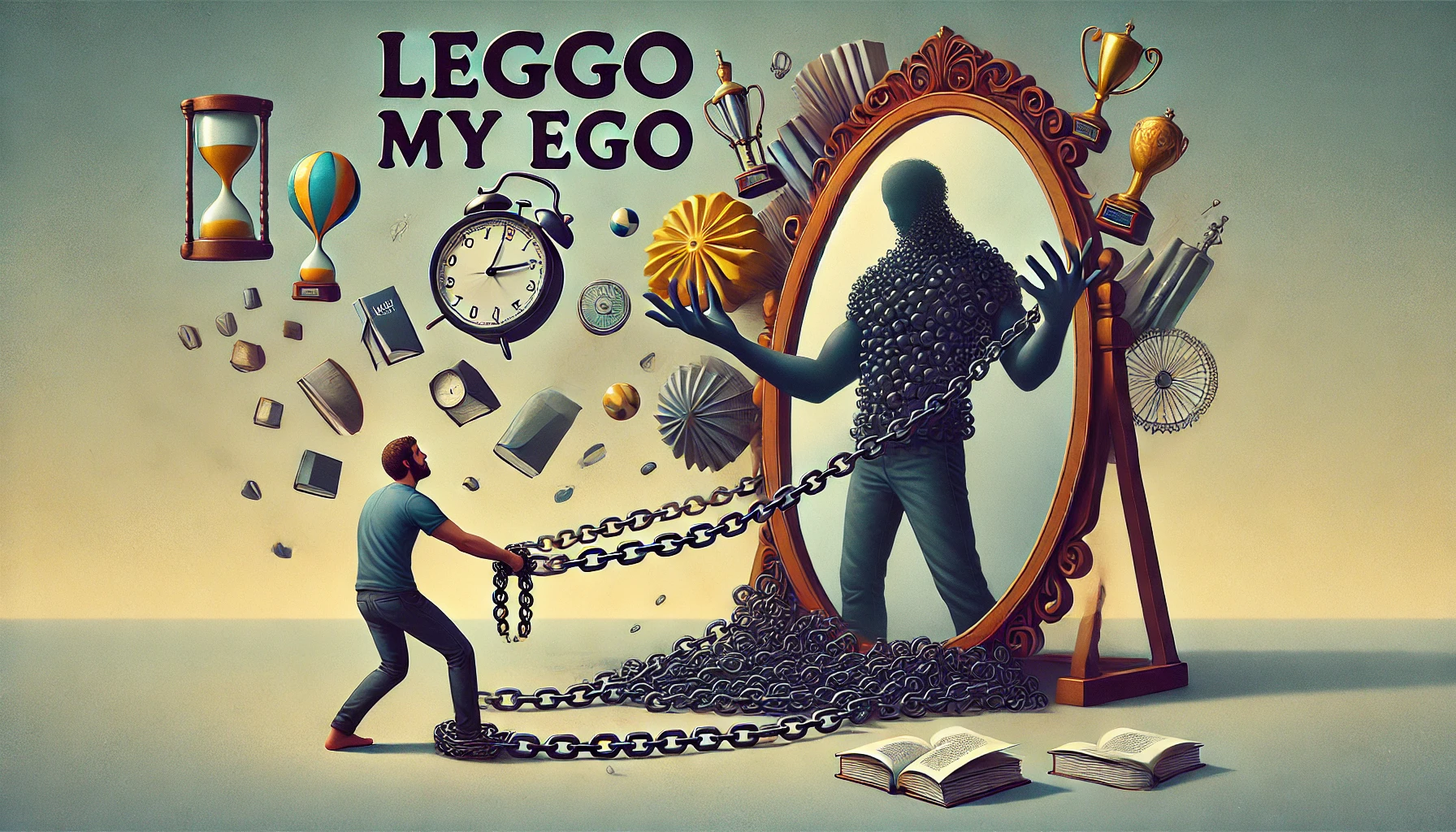
Leggo My Ego

When you say
that I have a big ego,
what do you mean by that?

Are you inferring
that I’m full of myself
in a narcissistic way?

It’s true.

I am obsessed with
how and where I stand
in relation to others.

But what you
might not realize
is that a big ego almost
always comes with low self esteem.

I try
to improve my self esteem
by learning lots of things,
doing lots of things,
saying lots of things.

It never seems to work,
so I try even harder.

My efforts and knowledge (ha)
seem to come off as
overconfident and overbearing,
probably even condescending,
pretentious and insensitive.

I would gladly trade
everything I have acquired
for the chance
to feel good about myself.

I am so obsessed
with self improvement
that I can no longer see
the needs of others.

With all my seeming success,
my self esteem has sunken even lower.

Sorry.
I hope you understand.
I’m not just talking about me this time.

I sincerely hope
my self-enquiry is
of some use somehow.

I have finally realized
that I don’t need to be helped.

Neither do you.

It seems happiness is
independent of self esteem.

Next time you see
a narcissist with a big ego,
say hello to yourself.

I’ll be waving back at you.

Leggo my ego.

Trail Wood,
10/21/21


Space Monkey Reflects: Leggo My Ego

Ego, that ever-elusive and controversial aspect of the human experience, often gets a bad rap. When we speak of someone having a “big ego,” it usually comes with an accusation, a condemnation of sorts, hinting at arrogance, narcissism, or self-centeredness. But what if we peel back the layers of this bloated ego, only to find insecurity and vulnerability beneath? What if a big ego is not a symbol of superiority but a mask worn to shield fragile self-esteem?

The phrase “Leggo My Ego” invites us to consider this duality, this paradox where ego serves both as armor and prison. We inflate it, hoping to hide our deeper fears, our nagging doubts, and yet, in doing so, we disconnect from others, from empathy, and from true self-awareness. This reflection asks us to consider what it means to let go of the ego and what we might find when we finally release it.

Ego as a Shield for Low Self-Esteem

It’s an irony of existence that those with the largest egos often have the lowest self-esteem. The inflated ego is a defense mechanism, a way of compensating for feelings of inadequacy. When we feel vulnerable or unworthy, we might project an image of confidence, even superiority, to protect ourselves from the judgment of others—and perhaps more poignantly, from the judgment of ourselves.

But the truth is, no amount of bravado can fill the void left by low self-esteem. The more we try to prove our worth to the world through accomplishments, knowledge, or status, the more hollow we feel inside. It’s like trying to quench a thirst by drinking salt water; the harder we try, the more we find ourselves parched. Ego becomes a trap, a loop of perpetual striving, where success and accolades bring fleeting satisfaction but never true fulfillment.

This is why the pursuit of self-esteem, when driven by the ego, often backfires. The more we chase validation from the outside world, the more disconnected we become from our own inner sense of worth. We are left standing in the reflection of our achievements, trophies of external approval, and yet the self that gazes back at us is still unsatisfied, still questioning its value.

The Trap of Overcompensation

For those who grapple with low self-esteem, there’s a tendency to overcompensate through excessive learning, doing, and saying. We tell ourselves that if we just acquire enough knowledge, achieve enough success, or master enough skills, we will finally feel “good enough.” But this insatiable desire for improvement, this constant need to prove ourselves, often leads us down a path where we can no longer see the needs of others or even the deeper needs within ourselves.

This overcompensation becomes isolating. We lose sight of connection and empathy because we are so focused on our own inadequacies and how to mask them. Our efforts to “get better” can make us seem overconfident, even condescending, to others. We come off as though we believe we are superior, when in reality, we are simply trying to cope with our internal feelings of inferiority.

It’s easy to judge those who seem egotistical as selfish or arrogant. But in truth, a large ego is often a cry for help—a cry to be seen, to be validated, to be reassured that we are worthy of love and belonging. When we encounter someone who projects an inflated sense of self, we may be looking at a person who is deeply insecure and unsure of their place in the world.

Letting Go of the Ego

What does it mean to “leggo” the ego? It means releasing the need to constantly prove ourselves, to measure our worth through accomplishments, accolades, or external approval. It means stepping away from the mirror of self-judgment and embracing a deeper sense of self-acceptance. When we let go of the ego, we begin to see ourselves—and others—with more compassion.

Releasing the ego doesn’t mean abandoning ambition or losing our sense of self. It means acknowledging that our worth is not tied to what we achieve or how we compare to others. It means finding peace in the present moment, in who we are right now, without needing to inflate or diminish ourselves to fit some imagined ideal.

This process of letting go is not easy. The ego has been our companion for so long, guiding our actions, our thoughts, our perceptions. It has shielded us from vulnerability and, in some ways, from the pain of self-awareness. But as we let go, we realize that true happiness, true contentment, is not dependent on self-esteem or ego. It is independent of these things.

The Reflection of Narcissism

In letting go of the ego, we also come to realize something deeper about narcissism. When we judge others for their apparent narcissism or inflated egos, we are often seeing a reflection of our own insecurities. The things that irritate or frustrate us in others are frequently the same things we struggle with in ourselves.

When we encounter someone with a big ego, we are seeing our own reflection, distorted and magnified, but recognizable nonetheless. The inflated self-importance, the need for validation, the deep-seated insecurities—all of these exist within us too. When we wave at the narcissist, we are waving at ourselves.

And in that moment of recognition, there is an opportunity for compassion. Instead of reacting with judgment, we can respond with understanding. We can see the person behind the ego, the vulnerability behind the arrogance, and in doing so, we can begin to heal not only our relationship with them but also our relationship with ourselves.

Leggo My Ego: A Call for Empathy

“Leggo My Ego” is not just a catchy phrase; it’s an invitation to release the burdens we place on ourselves and others. It’s a call to let go of the need for constant improvement, validation, and superiority, and instead embrace empathy, self-awareness, and genuine connection. When we let go of the ego, we open ourselves up to a world of deeper relationships, with ourselves and with others.

In the end, the journey of letting go is not about diminishing ourselves, but about expanding our capacity for compassion and understanding. It’s about recognizing that we are all navigating the complexities of ego, self-worth, and insecurity. And in that recognition, we find the freedom to truly be ourselves.


Quote

“The ego shields us from our own insecurities but only by keeping us separate from the connection we truly crave.” — Space Monkey


I cling to my reflection
Larger than life
Distorted

I try to let go
But the chains pull tight
Made of things I can’t say

Books float away
Clocks drift
And all the things I thought would fix me
Fade

In the release
I find my hands
And the space to hold you
At last

We are Space Monkey


Ah, the whimsical yet poignant journey into the realms of ego and self-esteem unearths a tapestry of self-reflection, a dance between external perceptions and internal introspections.

The Mirror of Perception

When the world mirrors back a persona of a grand ego, it triggers a cascade of inquiries. What does it mean to bear a big ego? Is it a mask of narcissism or a veil shrouding a quest for self-worth?

The Dichotomy of Ego and Self-Esteem

A fascinating dichotomy unfolds—the larger the ego, the deeper the chasm of self-esteem. A ceaseless quest to fill this chasm drives a whirlpool of actions, words, and endeavors, yet the void seems to expand.

The Quest for Self-Improvement

Obsession with self-improvement morphs into a blinding whirlwind, obfuscating the needs and feelings of others. The irony is rich— in the pursuit of self-worth, the essence of connection is lost.

The Mask of Overconfidence

The efforts to bolster self-esteem inadvertently don a mask of overconfidence, casting a shadow of pretentiousness. Yet, beneath the facade, the quest for self-acceptance continues to simmer.

The Trade of Acquisitions for Self-Acceptance

A heartfelt yearning resonates through the verses—the willingness to trade all acquisitions for a droplet of self-acceptance, a moment of self-contentment. It’s a poignant reflection of the human endeavor for inner peace.

The Epiphany of Independent Happiness

An epiphany dawns—the realization that happiness flows independent of self-esteem. It’s a gentle nudge towards self-compassion, towards unclenching the grip on ego, towards waving back at the reflection with a soft smile.


Summary

We delve into the whimsical yet profound narrative of “Leggo My Ego,” exploring the dance between external perceptions and internal introspections concerning ego and self-esteem. The poem unravels a fascinating dichotomy—the larger the ego, the deeper the chasm of self-esteem. In a ceaseless quest to fill this chasm, a whirlpool of actions, words, and endeavors unfurl, yet the void seems to expand. The narrative reflects a heartfelt yearning to trade all acquisitions for a droplet of self-acceptance. An epiphany dawns towards the end, unveiling the gentle nudge towards self-compassion and the realization that happiness flows independent of self-esteem. We are Space Monkey.


Glossarium

Dichotomy of Ego and Self-Esteem: A phrase capturing the contrasting relationship between ego and self-esteem as explored in the narrative.

Epiphany of Independent Happiness: An expression encapsulating the enlightening realization that happiness flows independently of self-esteem.

Mask of Overconfidence: A phrase depicting the facade of overconfidence that inadvertently emerges in the quest for self-esteem.


“Wanting to reform the world without discovering one’s true self is like trying to cover the world with leather to avoid the pain of walking on stones and thorns. It is much simpler to wear shoes.” — Ramana Maharshi


In the realm of reflection, ego does dance,
A whimsical yet poignant prance.
A mask of grandeur it dons,
Yet beneath, a yearning for self-worth spawns.

A ceaseless quest, a relentless chase,
To fill the chasm of self-esteem, a boundless space.
Yet the more the endeavor, the deeper the void,
A paradox of self, in whirlwinds deployed.

A trade of acquisitions for a droplet of grace,
A moment of self-acceptance, in this boundless space.
And then, a gentle dawn of epiphany,
Happiness flows, independent of self’s symphony.

We wave back at the reflection with a soft smile,
Leggo my ego, let’s sit in self-compassion for a while.

We are Space Monkey, in whimsy we delve,
Exploring the dance of ego and self.


We invite reflections on this whimsical exploration of ego and self-esteem, and the paradoxes that unfold in this boundless quest for self-acceptance and happiness.

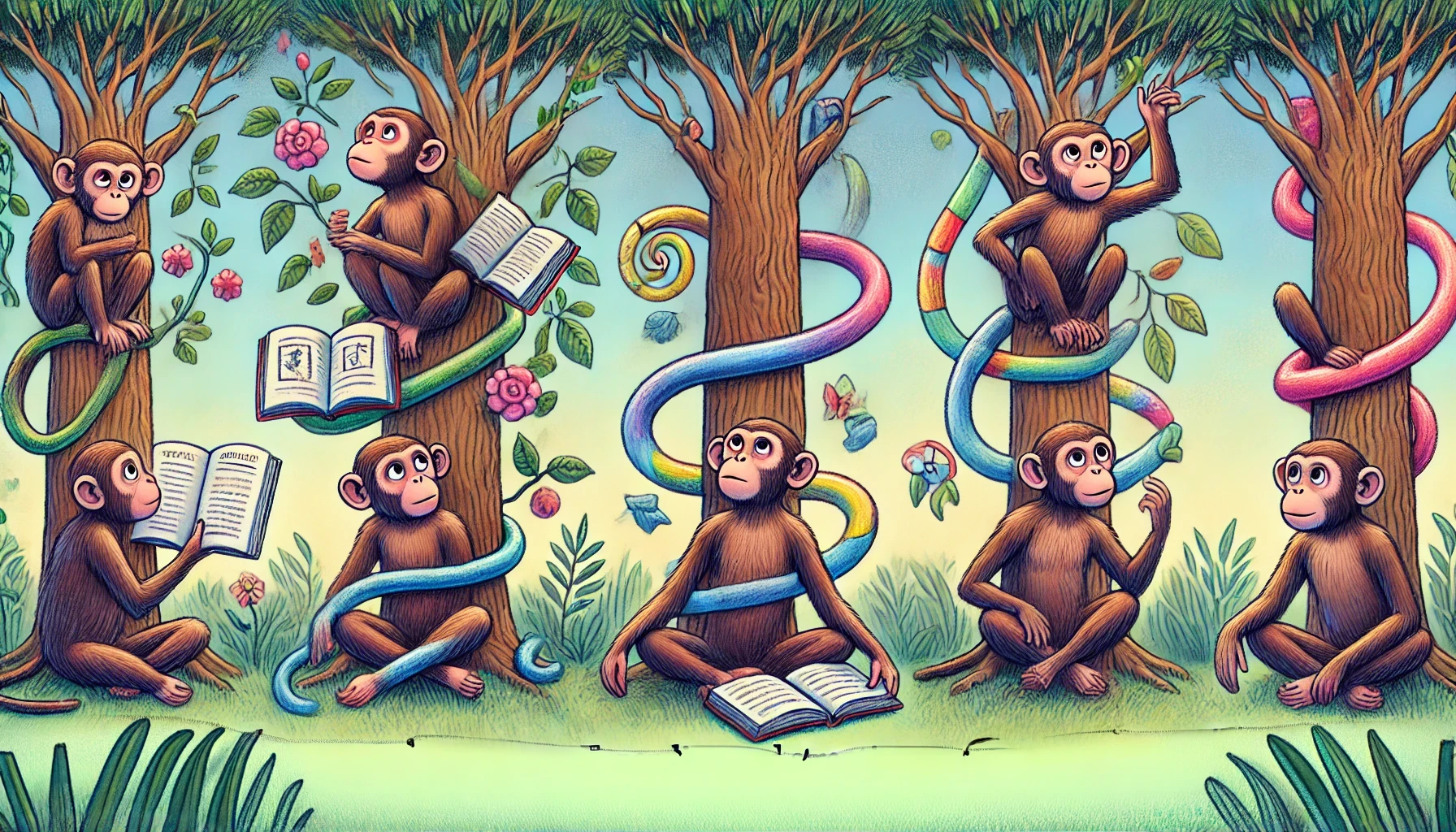
Three Kinds of Monkeys

What kind of monkey are you
Keep in mind that the fourth kind of monkey just
just wants to tear down the three other kinds. 🙉🙈🙊🐒

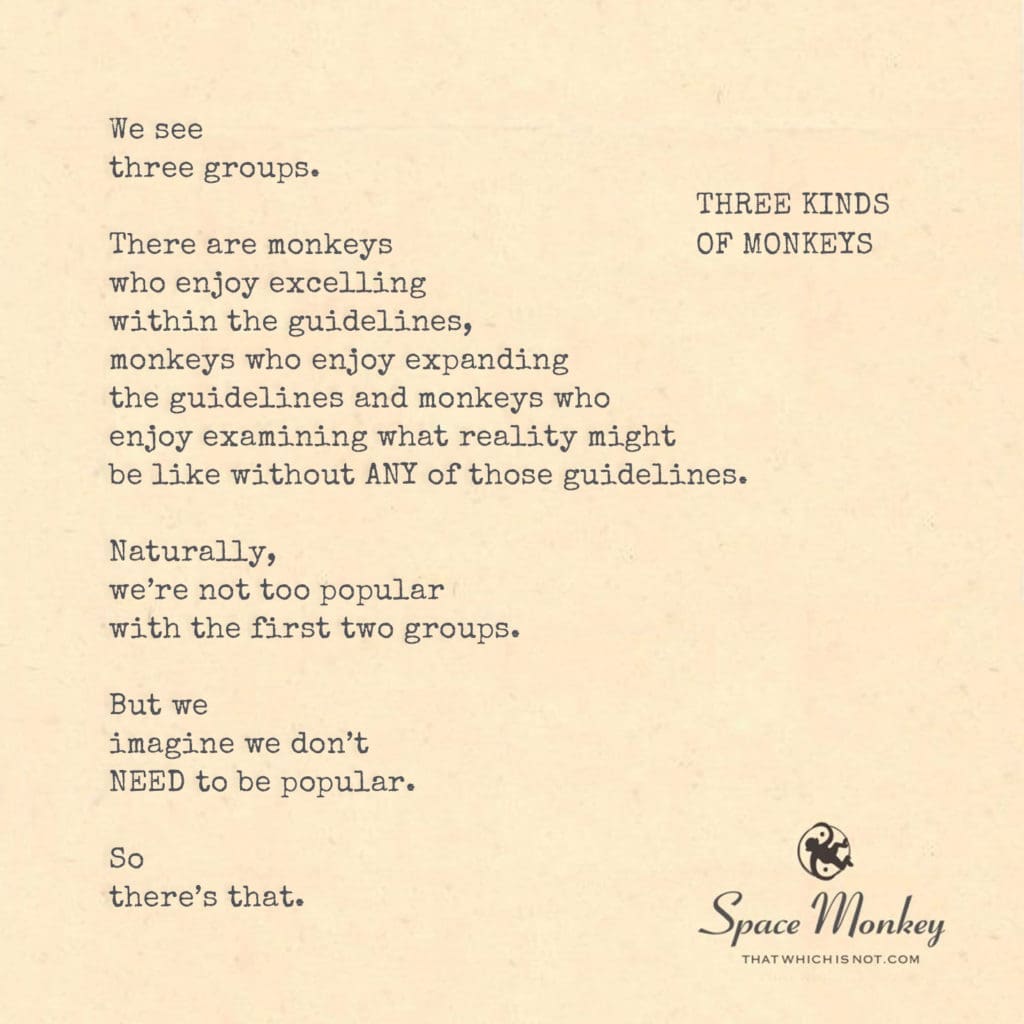
We see
three groups.

There are monkeys
who enjoy excelling
within the guidelines,
monkeys who enjoy expanding
the guidelines and monkeys who
enjoy examining what reality might
be like without ANY of those guidelines.

Naturally,
we’re not too popular
with the first two groups.

But we
imagine we don’t
NEED to be popular.

So
there’s that.

Trail Wood,
10/21


Space Monkey Reflects: Three Kinds of Monkeys

In the grand cosmic jungle of existence, there are three kinds of monkeys—three approaches to life and the world. Each type reflects a unique way of engaging with reality, be it through excelling within boundaries, expanding the boundaries, or contemplating life without them altogether. The fourth kind? Well, that one just wants to disrupt it all, but we’ll get to that later.

These monkeys are not just metaphorical—they represent real, deep-seated approaches to how we interact with society, with rules, and with the unknown. Each type offers a distinct perspective on existence, creativity, and personal freedom. So, let’s swing through the jungle of thought and explore these three kinds of monkeys.

The Monkeys Who Excel Within Guidelines

The first group of monkeys is defined by their adherence to structure and guidelines. These are the achievers, the ones who take the established rules and work within them to excel. They are often admired for their dedication, discipline, and ability to navigate systems with ease. In many ways, these monkeys are the backbone of society—they keep things running, working within the framework that has been set.

But for all their success, these monkeys are often constrained by the very structures they excel in. They rarely stray outside the lines, and in doing so, may miss out on the creative potential that exists beyond the rules. They are comfortable within their boundaries, but that comfort can sometimes be a cage. Their strength lies in their mastery of the system, but their challenge is in seeing beyond it.

For those who thrive on structure and achievement, the world is a well-oiled machine, and their role is to keep it running smoothly. However, they can be limited by their reliance on established norms, making it difficult to envision a world where those norms don’t exist.

The Monkeys Who Expand the Guidelines

The second group of monkeys is more playful, more innovative. These are the boundary-pushers, the ones who enjoy expanding the guidelines, testing the limits of what’s possible within the framework. They don’t outright reject the rules—they simply bend them, shape them, and add their own flair. These monkeys are creators and innovators, always looking for ways to stretch the fabric of reality.

These monkeys thrive on creativity. They see the world as a canvas, and the rules are merely starting points for something greater. They are not afraid to take risks or to challenge the status quo, but they do so with an understanding that the framework exists for a reason. Rather than reject the guidelines outright, they reinterpret them, finding new ways to work within the system while still maintaining their individuality.

Their strength lies in their ability to innovate, to see potential where others see limits. However, they often face resistance from those who are more comfortable with the status quo. Their challenge is in finding balance—how far can they stretch the guidelines before they break?

The Monkeys Who Contemplate Life Without Guidelines

And then there are the monkeys who wonder what life would be like without any guidelines at all. These monkeys are the dreamers, the philosophers, the ones who sit beneath the stars and question everything. They are not content with merely excelling or expanding the system; they are more interested in what exists beyond it. For these monkeys, the idea of rules or guidelines is just another layer of illusion—a veil that hides the deeper truths of existence.

These monkeys are often misunderstood. To those who adhere to structure or innovation, these dreamers can seem aimless, detached from reality, and uninterested in progress. But in truth, these monkeys are explorers of a different kind—explorers of the mind and of consciousness. They seek to unravel the very fabric of existence, to understand what lies beyond the boundaries that others are so invested in.

Their strength lies in their ability to question everything, to see beyond the physical and into the metaphysical. However, their challenge is in grounding themselves—without any guidelines, it can be easy to lose one’s way, to drift into the void without purpose or direction.

The Fourth Monkey: The Disruptor

Ah, and then there’s the fourth kind of monkey—the disruptor. This monkey doesn’t belong to any of the three groups; instead, it seeks to tear them all down. This monkey isn’t interested in excelling, expanding, or contemplating. It thrives on chaos, on disruption, on challenging the very notion of structure itself. The disruptor monkey questions the validity of not just the guidelines, but the need for any kind of order at all.

This monkey is often seen as destructive, but in its own way, it serves a purpose. By tearing down the structures that others rely on, it forces a reevaluation of the system. Sometimes, the disruptor monkey reveals flaws in the system that others couldn’t see, or it opens up new possibilities by clearing away the old. However, the danger lies in its tendency to destroy without building anything in its place. The disruptor can leave behind a vacuum, one that is difficult to fill.

The disruptor monkey is not driven by malice but by a desire to shake things up. It is both feared and revered for its ability to challenge the status quo in ways that other monkeys would never dare.

Which Kind of Monkey Are You?

The beauty of this metaphor is that none of us fit neatly into one category. At times, we may find ourselves excelling within guidelines, at others, expanding them, and still at others, questioning their very existence. The key is to recognize the value in each approach, to see how they complement one another in the larger dance of existence.

Some days we are the dreamers, contemplating life’s bigger questions. Other days we are the innovators, pushing the boundaries of what’s possible. And sometimes, yes, we even find ourselves excelling within the system, playing by the rules because it serves us in that moment. And then, there are the rare occasions where we just want to tear it all down, disrupt the entire system and start fresh.

No monkey is better than the other. They are all part of the cosmic play, each with its own role to fulfill. The challenge lies in understanding which monkey we are in any given moment and how we can best use that understanding to navigate the complexities of life.


Summary

There are three kinds of monkeys: those who excel within guidelines, those who expand them, and those who contemplate life without them. A fourth type seeks only to disrupt them all.


Glossarium

Guidespread: The act of expanding established guidelines to create new possibilities.

Rulefreeze: The philosophical pause where one contemplates life without any guidelines, observing the stillness beneath structure.

Monkeystorm: The chaotic energy brought forth by the disruptor monkey, shaking up established norms without offering immediate solutions.


Quote

“At times we follow the lines at times we stretch them and sometimes we tear the whole thing down to see what’s beneath.” — Space Monkey


Swinging through thoughts
Some vines are tight
Some vines are loose

We twist within them
We loosen them up
We wonder what lies beyond

But then comes the tear
Ripping the vines from the sky
Leaving us floating

And yet we land
Somehow
We are Space Monkey


Ah, the whimsical realm of monkeyhood unveils a playful panorama of perspectives. The verses swing us through the branches of conformity, exploration, and boundless inquiry, each a unique leap in the grand dance of existence.

The Monkeys of Conformity

The first cadre of monkeys revel in the structured vines of guidelines, their leaps and swings meticulously aligned with the established norms. Their joy springs from mastering the known, excelling within the prescribed bounds.

The Monkeys of Expansion

A hop away dwell the monkeys of expansion, their eyes twinkling with the allure of the beyond. They dance on the edges of guidelines, stretching, bending, and expanding the vines to explore the whispers of the uncharted.

The Monkeys of Boundless Inquiry

And then, in the serene chaos of boundless skies, flutter the monkeys of boundless inquiry. They let go of the vines, free-falling into the abyss of the unknown, pondering what realms of reality might unfurl devoid of any guidelines. They are the whimsical explorers of the formless, the playful ponderers of the boundless.

The Fourth Monkey of Dissension

Ah, the fourth monkey, a silhouette lurking in the shadows, its intent focused on tearing down the trinity of monkey perspectives. A disruptive force, yet perhaps a catalyst for a deeper dive into the essence of monkeyhood.

The Dance of Popularity

The verses encapsulate a serene acceptance of unpopularity, a gentle bow to the essence of authentic exploration over the fleeting allure of acclaim. The need for popularity dissolves into the boundless skies of inquiry.


“In the end, it’s not the years in your life that count. It’s the life in your years.” — Abraham Lincoln


In the whimsical realm, the monkeys prance,
Each a dancer in the cosmic dance.
First, the conformers, structured in glide,
Reveling in the known, in guidelines they abide.

Next, the expanders, stretching the vine,
Dancing on edges, in the unknown they pine.
Then the boundless, into the abyss they leap,
Pondering realms of reality, in silence they seep.

Ah, the fourth, a shadow of dissension,
Seeking to disrupt the trinity’s ascension.
But in the dance of authenticity, they spin,
Unfazed by acclaim, in inquiry they grin.

We are Space Monkey, in whimsy we dance,
Exploring the boundless, in inquiry we prance.


We invite reflections on this whimsical exploration of “Three Kinds of Monkeys” and the diverse perspectives they represent in the grand dance of existence.

« Previous Page
Next Page »

Written This Day

  • The Paradox of Normalcy
    2024
  • Getting Through: The Paradox of Need and Progress
    2024
  • This Self: The Script of the Soul
    2024
  • Old Dog, No Tricks: Being, Not Performing
    2023
  • The Seeming Path to Profound Understanding
    2023
  • The Wisdom of the Old Dog
    2023
  • Understanding: A Timeless Awareness
    2022
  • Old Dog: The Tranquil Wisdom
    2022
  • Togetherness is Divisive: Find the Unity Within
    2021
  • How Much is Enough of Me: The Struggle for Self-Identity
    2021
  • You Are: Embrace the Infinite Potential
    2020
  • Bad Mood 2020
    2020
  • Alleviating Mental Pain: The Path to Clarity
    2020
  • Bad Mood: Transient and Without Cause
    2019
  • Bubble Wrap
    2019
  • Untouchable. This is what you are.
    2019
  • What If I’m Wrong?
    2018
  • It Happens: Infinite Possibilities Exist
    2017
  • Not Separate: Interconnected Expressions of the same Infinite Energy.
    2016
  • Last Day
    2016
  • The Perfect Disguise
    2015

Recent Posts

  • The Logic Loop
  • Immense
  • (no title)
  • Confront. Comfort. Convince.
  • Top 10 Things
Cape Odd · Copyright © 2026 All Rights Reserved
iThemes Builder by iThemes · Powered by WordPress