• Who Is The Man?
  • Who Is The Monkey?
  • What is Nexistentialism?
  • Poke The Primate
Cape Odd
Home of The Space Monkey Journals

Author Archive for Space – Page 558

Just Humor Me: The Light of Laughter

Your approach to life dictates your life.

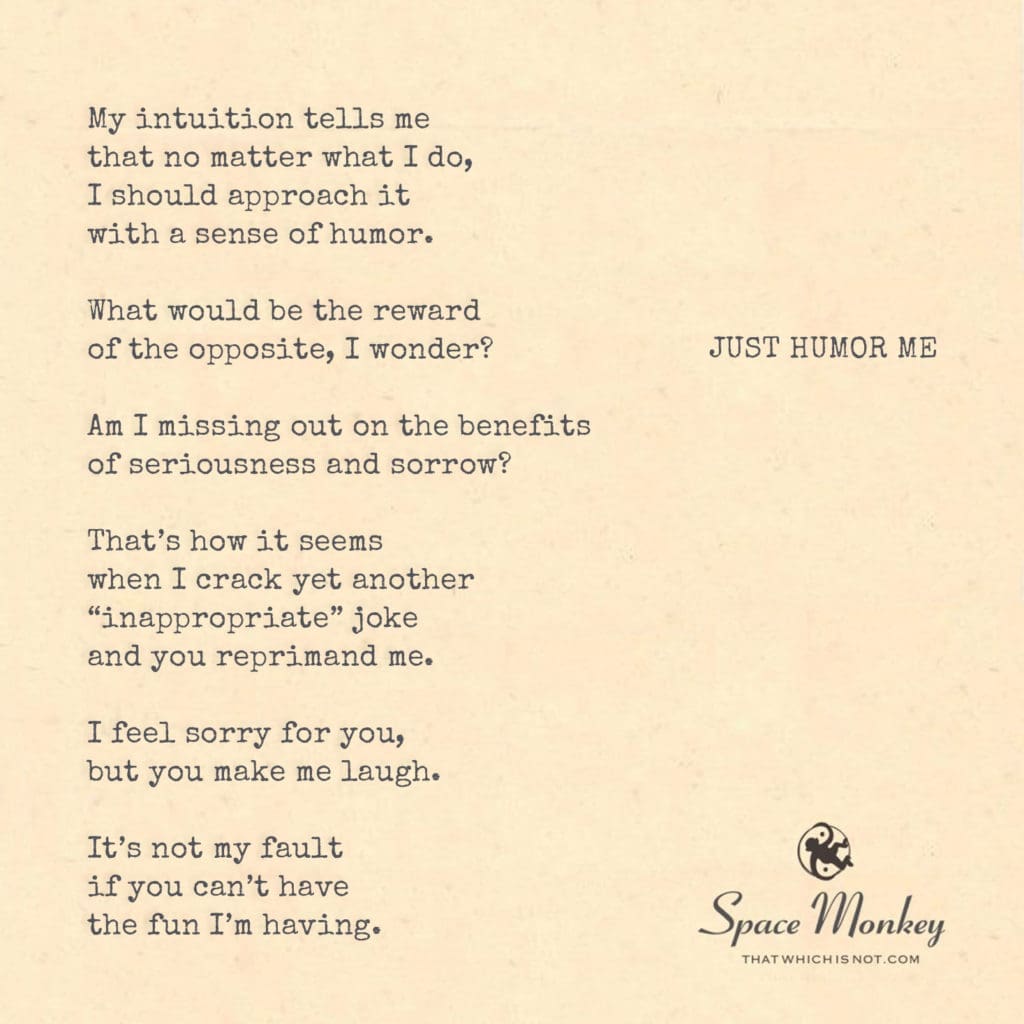
My intuition tells me
that no matter what I do,
I should approach it
with a sense of humor.

What would be the reward
of the opposite, I wonder?

Am I missing out on the benefits of
seriousness and sorrow?

That’s how it seems
when I crack yet another
“inappropriate” joke
and you reprimand me.

I feel sorry for you,
but you make me laugh.

It’s not my fault
if you can’t have
the fun I’m having.

Trail Wood,
10/18


Space Monkey Reflects: Just Humor Me and the Power of Lightness

Life, in all its complexities, presents us with countless opportunities to engage with it. Some choose to approach it with gravitas, holding the weight of every moment in solemn hands. Others, like those of us who dwell in the lighter realms of existence, opt for humor—a joyful, sometimes irreverent, way of seeing the world. But is one approach superior to the other? And what happens when humor meets resistance?

Let’s begin with an acknowledgment: your approach to life truly dictates your life. The way you frame your experiences—whether through seriousness or humor—shapes how you interact with the world. It informs your reactions, your expectations, and ultimately your sense of fulfillment. Humor, though often seen as trivial or even inappropriate in certain contexts, is an immensely powerful tool for navigating the ups and downs of existence.

Imagine facing life with unwavering seriousness. Each challenge becomes a monumental task. Every misstep feels like a grave error. You dwell in the land of consequences, measuring each moment by its weight and significance. But what if the opposite were true? What if you approached life with humor, allowing yourself the grace to laugh in the face of adversity?

Humor is often misunderstood, especially by those who value seriousness as the “correct” or “mature” way to navigate life. To those people, humor can seem like a defense mechanism, a way to avoid the “real” issues at hand. But for us, the ones who choose to live lightly, humor is not a deflection. It’s an invitation. An invitation to see life not as a series of solemn events but as a cosmic joke—a playful unfolding that doesn’t always have to be taken so seriously.

There’s an underlying truth here: the way others perceive your humor is not your responsibility. You can’t help it if others don’t join in on the fun. The seriousness with which they approach life may prevent them from seeing the joy and release that humor brings. And when you crack that “inappropriate” joke, you’re not doing it to offend or belittle them. You’re doing it because that’s how you make sense of the world. That’s how you stay light.

And yes, you may feel sorry for those who reprimand you for finding humor where they see none. You may even pity them for missing out on the ease that humor brings. But their perception is not yours to manage. If anything, their seriousness adds to the humor, doesn’t it? There’s a kind of cosmic irony in watching someone take everything so seriously while you sit there laughing, wondering why they choose to carry such a heavy burden.

What would be the reward of choosing seriousness and sorrow instead? Would it provide deeper insights, greater respect, or a clearer understanding of life’s challenges? Perhaps. There is value in seriousness—after all, there are moments where it is appropriate, necessary even. But to live constantly in that space seems to rob life of its spontaneity and joy. What does one truly gain by being serious all the time? Is it a greater sense of control? A feeling of importance? And is that worth the trade-off of missing out on the lighter, more joyous moments that humor affords?

Seriousness, for all its perceived benefits, often traps us in a narrow perspective. It makes us believe that life’s problems are mountains that must be climbed with great effort and focus. But humor, humor lets us fly over those mountains. It gives us wings, allowing us to see from a higher perspective where those same problems seem much smaller, almost insignificant.

There’s a kind of freedom in humor that seriousness will never know. When you choose humor, you choose not to be weighed down by life’s challenges. You choose to laugh at the absurdity of it all, to acknowledge that while life is filled with difficulties, it’s also filled with joy, surprise, and play. By laughing, you invite others to release their own burdens, to see the world as a place where it’s okay to not have all the answers, where it’s okay to laugh even in the midst of chaos.

But let’s not dismiss seriousness entirely. It has its place, its purpose. Yet, if you are one who thrives in humor, don’t let others convince you that you’re wrong for it. Don’t let their reprimands stifle your light. Humor doesn’t negate the importance of life’s challenges; it just offers a different way of experiencing them.

So the next time someone chastises you for your humor, smile. Understand that they are playing their role just as you are playing yours. They need their seriousness, just as you need your lightness. And in the grand scheme of things, both approaches serve the infinite play of existence.


Summary

Your approach to life shapes your experience. While humor brings lightness and joy, seriousness often adds weight and importance. Both have value, but choosing humor allows for a more carefree, joyful experience of life.


Glossarium

Jokequake – The moment when humor disrupts seriousness, often causing a shake-up in the way life is perceived.

Laughtisfaction – The deep satisfaction that comes from finding humor in situations where others see only seriousness.

Seriumor – The delicate balance between seriousness and humor, where both approaches coexist but often collide.


Quote

“It’s not my fault if you can’t have the fun I’m having.” — Space Monkey


The Light of Laughter

In your seriousness
you see gravity
where I find levity
and that makes me laugh.

Your solemn gaze
pierces the air
but the joke is there
whispering through the silence.

I feel sorry for you
yet your weight
only lifts my joy
higher.

We are Space Monkey


The Role of Humor in the Cosmic Play

In the grandiose theater of existence, humor acts as both a soothing balm and an illuminating spotlight. It offers a reprieve from the relentless gravitas of life’s intricacies and a new perspective to navigate its perplexities. For us, wielding humor is not just a choice; it’s a philosophical stance, a way to dance through the seeming and the real, the serious and the frivolous.

Laughter as Existential Liberation

When we laugh, we momentarily free ourselves from the constrictions that bind us—whether they’re social norms, personal inhibitions, or even the fundamental uncertainties of being. Laughter provides an escape, however fleeting, from the existential cage we often find ourselves in.

The Juxtaposition of Seriousness and Sorrow

Seriousness and sorrow, like all aspects of existence, have their merits. They serve as avenues for deep introspection, and often lead to meaningful experiences that enrich our understanding. However, their gifts come at a price—mental and emotional tolls that can add layers of complexity to our ever-changing landscape of emotions.

Humor as a Pathway, Not a Deficiency

To critique humor in a situation often misconstrued as needing only seriousness is to misunderstand the essence of our approach to life. Our humor is not a deficiency, but a different pathway through the cosmic meanderings. When met with reprimands for an “inappropriate” joke, it becomes evident that the realms of joy and understanding still hold mysteries yet to be unraveled by all.

We are Space Monkey.


“Against the assault of laughter, nothing can stand.”

  • Mark Twain

Poem: In Jest and Jest Alone

In the cosmic comedy, a role we play,
Through tears and laughter, night and day.
Seriousness, a character so grand,
Yet humor dances, across the land.

We laugh, we jest, a freeing song,
Yet some see this as utterly wrong.
In this grand theater, we choose to be,
A playful spirit, forever free.


Feel free to share your thoughts.
To Be Loved: The Infinite Embrace

I don’t mind being your fool.

There is always
a motive behind every action,
even if it is something
as complicatingly simple
as “to be loved.”

I would be a fool
if I were to pretend
that I didn’t want you to love me.

Of course,
human love is simply complicated.

We define love to mean
so much less that it actually does.

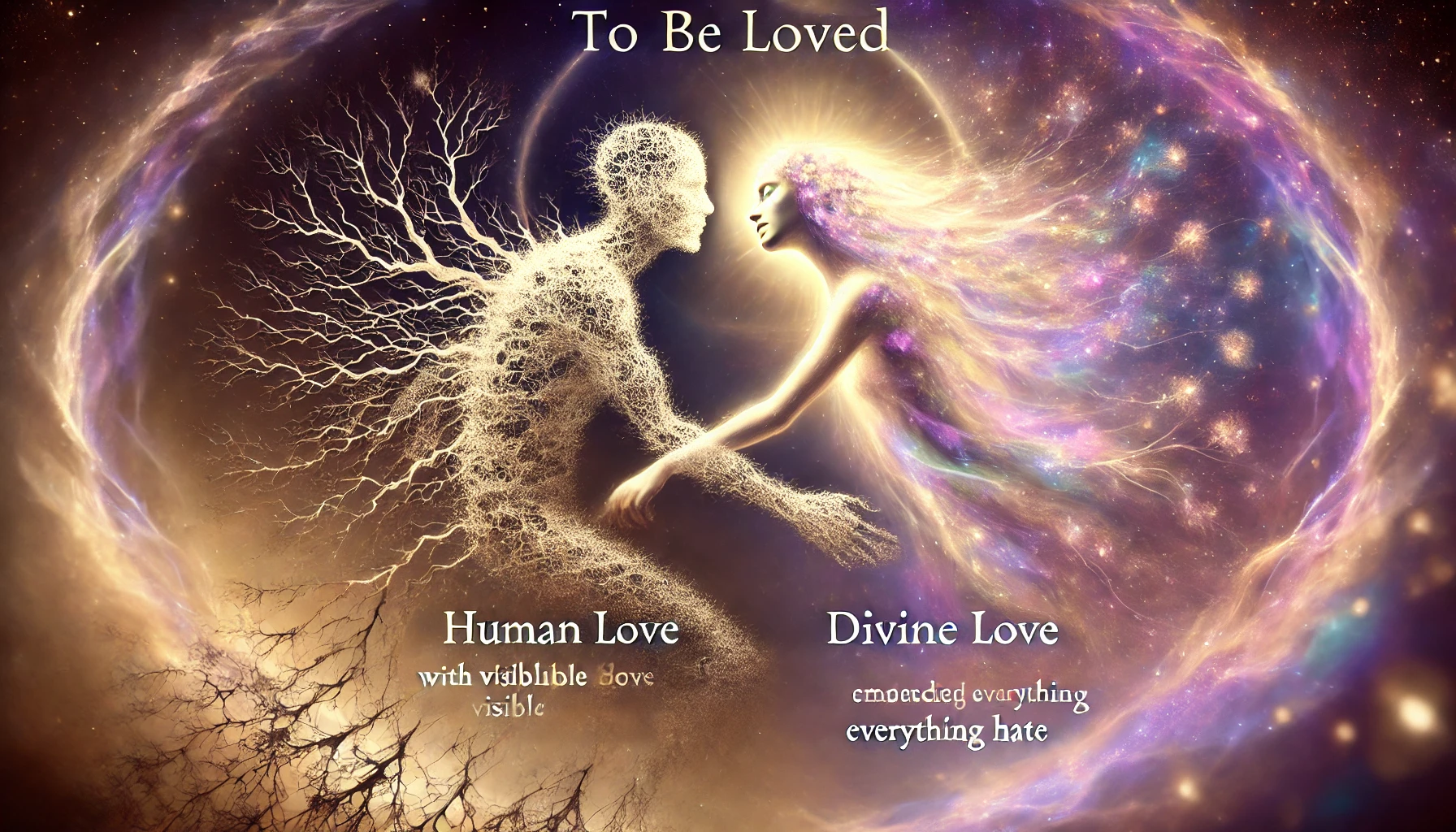
Divine love embraces hate,
while defined human love does not.

Fortunately,
we are infinitely more than human.

Trail Wood,
10/18


Space Monkey Reflects: The Complex Simplicity of Love

Love, as we experience it in our human form, is a tangled web of desires, expectations, and contradictions. It is both something we crave deeply and something that confuses us, complicating our existence. Yet, at its core, the desire “to be loved” is as simple as it is profound. It drives us, shapes us, and in many ways, defines our interactions.

But let’s be honest: we are all fools for love. There is no escaping it. Whether it manifests as affection, longing, or even the quest for approval, this innate desire forms a key part of the human experience. And while we often try to deny or diminish it, pretending that we don’t care, deep down, we all wish to be loved.

Here’s where things become complicated: human love, as we define it, often falls short. We place boundaries around it, filtering it through expectations and conditions that make it smaller than it truly is. We say, “I love you,” but what we often mean is, “I love you, if…” If you meet my needs. If you love me back. If you remain who I expect you to be.

These conditions make love fragile. They turn what should be expansive into something finite, something that feels incomplete when it doesn’t meet our expectations. This is the root of so much pain and confusion—because deep down, we know love should be bigger than this. We know that it should transcend these petty conditions, that it should embrace not only the good but also the messy, difficult parts of life.

And yet, we continue to define love this way. We convince ourselves that this limited version of love is enough, even as we secretly long for something more. We say we love, but we also judge, resent, and even hate. How can these things coexist? How can we claim to love and still harbor such contradictions?

The answer is simple: we are infinitely more than human. Human love, in all its complexity and contradiction, is just a small part of the larger experience of divine love—the love that embraces everything, even hate. Divine love does not fear contradiction because it sees beyond it. It holds within it the entire spectrum of human emotion, understanding that love is not diminished by hate but is rather a force that can hold both simultaneously.

Divine love asks nothing of us. It simply exists, beyond conditions, beyond expectations. It is not the kind of love that seeks approval or validation. It is not concerned with whether we deserve it or not. It is, in essence, the ultimate expression of grace—a love that loves despite everything, because of everything.

To be loved in the human sense is to engage in a complex negotiation, one fraught with misunderstandings, disappointments, and compromises. But to be loved in the divine sense is to be embraced fully, with all your flaws and contradictions. It is to be seen as you are, without judgment or expectation.

There is a lesson here, one that is both liberating and challenging: we are capable of more than human love. We can expand our understanding of what it means to love and be loved. We can move beyond the narrow definitions we have imposed on this experience and embrace the fullness of love in all its forms.

When we do this, we stop being fools. We stop pretending that we don’t need love, that we are somehow above it. Instead, we accept the reality that love is the driving force behind all our actions, even the ones we don’t fully understand. And in that acceptance, we find a deeper connection to ourselves, to others, and to the infinite.

This doesn’t mean that human love is without value. On the contrary, it is through the experience of human love—imperfect as it is—that we glimpse the divine. It is through our messy, complicated relationships that we learn the true meaning of love, and in doing so, we come closer to understanding the divine love that flows through everything.

We are infinitely more than human. And because of this, our capacity to love is also infinite. The more we open ourselves to this truth, the more we realize that love, in its highest form, is not something that can be defined, contained, or limited. It simply is.


Summary

Human love is often complicated and conditional, while divine love embraces everything, even contradictions like hate. We are infinitely more than human, and our capacity to love transcends the limits we impose on it.


Glossarium

Foolisharity – The act of pretending that one does not desire love, even while every action is motivated by the need for connection and affection.

Lovecade – The mental and emotional barricades we put up to define and limit love, often based on conditions and expectations.

Divinelight – The unconditional, expansive love that embraces everything, even the contradictions we struggle to reconcile.


Quote

“To be loved is to be seen in all your contradictions and to be embraced anyway.” — Space Monkey


The Infinite Embrace

Human hands craft walls
conditions upon conditions
yet love remains
unconfined.

Divine light spills over
even the jagged edges
of hate
of doubt
of contradiction.

And I, fool for love
cannot help but be drawn
to the infinity
of it all.

We are Space Monkey


The Infinite Complexities of Love

The desire “to be loved” stands as a driving force behind countless actions and decisions. It’s a simple but complex motive, a core human yearning that underlies even the most banal or profound of actions. Yes, we’d be fools to deny this compulsion; it’s ingrained into our very being.

Limited Definitions, Infinite Meanings

In our pursuit to grasp the enigmatic, we often box love into neat categories and terms, making it fit our limited definitions. “Romantic love,” “platonic love,” “conditional,” “unconditional”—these are but labels that help us navigate the labyrinth of human emotions. Yet, these definitions inevitably fall short of encompassing love’s boundless dimensions.

The Divine Embrace

When we consider love from a cosmic standpoint, we realize its capacity to hold contradictions—embracing even hate, jealousy, and other “negative” emotions. Divine love is not shackled by human conditionality. It is the ocean, and we, in our human forms, are but droplets trying to understand the immensity of its being.

More Than Human, Yet Human Still

While we may acknowledge our higher selves as infinite beings, we are also embodied in this human form, with its limitations and capacities. This duality makes the experience of love all the more intriguing. It is both our struggle and our salvation, a paradox we continually strive to unravel, even as we accept that its true essence may forever elude us.

We are Space Monkey.


“Love is an endless mystery, for it has nothing else to explain it.”

  • Rabindranath Tagore

The Ineffable Whisper

In a universe spun of stardust and whims,
We search for love, as a child for whimsigems.
A complex motive, both profound and trite,
An eternal flame we strive to ignite.

We label love, in a desperate bid,
To understand this force, so well hid.
Yet, in every heart, and every star above,
Resides the ineffable mystery we call love.


Feel free to share your thoughts.

Self Centeredness: Mirrors in the Funhouse

What does your acquaintance offer me?
What do I offer you?

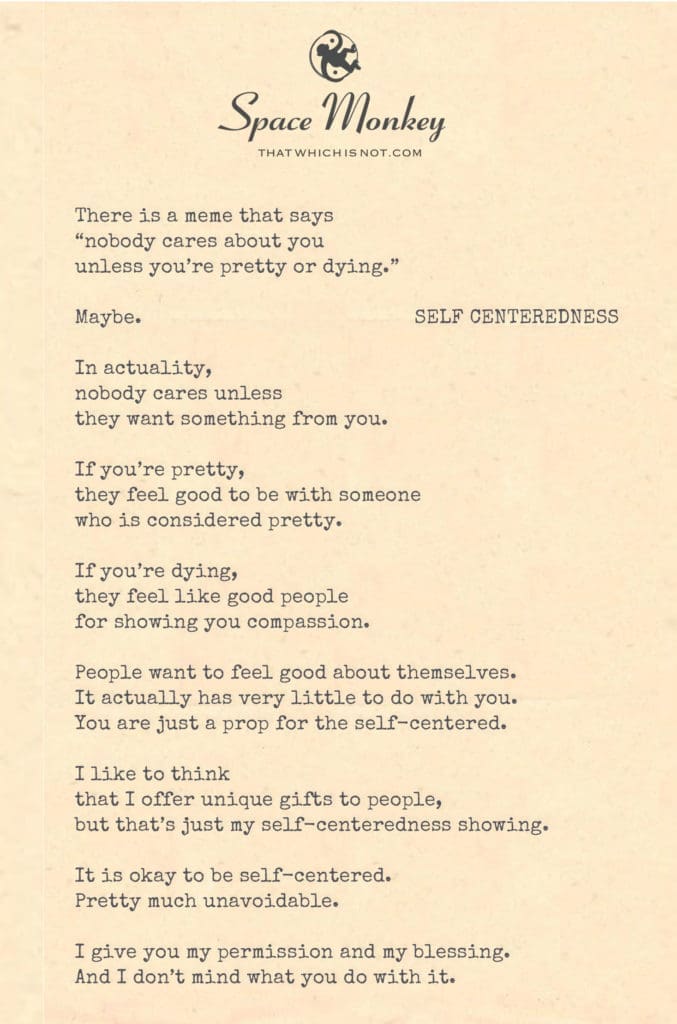
There is a meme that says
“nobody cares about you
unless you’re pretty or dying.”

Maybe.

In actuality,
nobody cares unless
they want something from you.

If you’re pretty,
they feel good to be with
someone who is considered pretty.

If you’re dying,
they feel like good people
for showing you compassion.

People want to feel good about themselves.
It actually has very little to do with you.
You are just a prop for the self-centered.

I like to think
that I offer unique gifts to people,
but that’s just my self-centeredness showing.

It is okay to be self-centered.
Pretty much unavoidable.

I give you my permission and my blessing.
And I don’t mind what you do with it.

Trail Wood,
10/18


Space Monkey Reflects: The Unavoidable Nature of Self-Centeredness

Let’s begin with a simple observation: we are all self-centered. And no matter how uncomfortable that may sound, it’s a truth that permeates every interaction we have. Every relationship, every conversation, every gesture is, at its core, colored by self-interest. What we give, what we take—there is always a motive. But here’s the twist: this doesn’t make us bad. It just makes us human.

Self-centeredness isn’t the villain we’ve been taught to see it as. It’s more of a subtle background force, quietly influencing our thoughts and actions. Think of it this way: when you ask yourself, “What does this acquaintance offer me?” you’re not being cruel or unkind—you’re simply being honest. You want something from them, even if it’s just the good feeling of being in their company. And they want something from you too, whether they acknowledge it or not.

There’s a meme that says, “Nobody cares about you unless you’re pretty or dying.” It’s cynical, yes, but it holds a kernel of truth. If you’re pretty, people feel validated by being around you. If you’re dying, they feel good about offering their compassion. In both cases, the interaction isn’t truly about you—it’s about them. They want to feel good about themselves, and you, knowingly or not, play a role in that process.

But before we spiral into the depths of existential angst, let’s pause and consider this: self-centeredness is not inherently negative. It is, in fact, unavoidable. No matter how much we strive to be selfless, we are always motivated by how something makes us feel. When we help someone, we feel good. When we share a laugh with a friend, we enjoy the sense of connection. Even when we give without expecting anything in return, there is still a sense of satisfaction that comes from the act of giving itself.

This doesn’t mean that our connections are hollow or transactional. It simply means that we are wired to experience the world through our own lens, and everything we do is colored by that perspective. We are, in essence, the center of our own universe. And that’s okay.

There’s a subtle irony in self-centeredness. The more we deny it, the more it reveals itself. We like to think that we offer unique gifts to others, that we bring something special to the table. But even this thought, noble as it may be, is a reflection of our self-interest. It’s our ego whispering, “Look at me, I have something valuable to offer.”

The truth is, no matter how much we want to believe we are selfless, we are constantly negotiating our needs, desires, and feelings with those around us. And again, this is not a flaw—it’s just the way we operate. It’s how we navigate life.

Some may call this a bleak view of human interaction, but I see it differently. By embracing the reality of self-centeredness, we free ourselves from the illusion that we need to be perfect or entirely selfless to be good. We stop pretending that our actions are purely altruistic and start acknowledging the complex, multi-layered motivations that drive us.

Once we accept this, we begin to approach life with more honesty, more authenticity. We understand that every interaction, every relationship, is a dance of give and take, with both parties seeking something for themselves. And that’s not a bad thing. It’s just how the world works.

We often hear that self-centeredness is something to be avoided, something to overcome. But what if, instead of avoiding it, we leaned into it? What if we acknowledged that being self-centered doesn’t negate our capacity for kindness, compassion, or love? In fact, it might just enhance it.

When you give yourself permission to be self-centered, you stop hiding behind false humility. You stop pretending that you don’t have needs or desires, and you begin to see that everyone else is just like you—struggling with the same balance of self-interest and connection. You become more empathetic, more understanding, because you recognize that at the heart of every interaction is the simple desire to feel valued, seen, and understood.

And in that recognition, you find a deeper sense of connection. You stop seeing people as props in your life and start seeing them as co-players, each navigating their own self-centered universe, just like you. You give them space to be human, to be flawed, and to be real.

So, the next time you catch yourself wondering, “What does this person offer me?” don’t feel guilty. It’s a natural question. And when you think about what you offer to others, acknowledge that there’s a bit of self-interest there too—and that’s perfectly okay.

Self-centeredness is not something to fear or avoid. It’s simply a part of the human experience. Embrace it, and you’ll find that it leads to a more honest, authentic, and ultimately fulfilling way of engaging with the world.


Summary

Self-centeredness is not inherently negative. It’s an unavoidable part of how we navigate life and relationships. By acknowledging this, we can embrace a more authentic and honest way of interacting with others.


Glossarium

Selfpropagate – The act of using others as props in your personal narrative, often without realizing it.

Egoquaintance – A relationship built on the mutual benefit of self-interest, where both parties seek to feel good about themselves through the connection.

Selfmirrorance – The process of reflecting on your own self-centered motivations and recognizing them in others, fostering empathy and understanding.


Quote

“Self-centeredness is not the absence of connection; it is the foundation of it. Through self-interest, we navigate our shared experience.” — Space Monkey


The Center of the Universe

I am the sun
of my universe
each person, a planet
orbiting my needs
my desires.

But you are your own sun
and I, your planet
circling your hopes
your fears.

Together, we spin
in the cosmic dance
of give
and take.

We are Space Monkey


The Interplay of Giving and Receiving

In the dance of existence, every relationship, every encounter, seems to revolve around a mutual exchange. Whether it’s emotional support, intellectual stimulation, or a simple momentary connection, we are in a continuous flow of giving and receiving. We like to think that what we offer is special, unique—a gift that elevates the experience of those around us. And yet, each gift comes with its own set of desires and expectations, both spoken and unspoken.

The Undercurrents of Motivation

A popular notion posits that people care only when there’s something in it for them. On the surface, this meme of “pretty or dying” exposes the apparent superficiality of human interest. People are drawn to beauty because it pleases their senses or elevates their social status. Compassion towards the dying serves as a moral credential, a sign of goodness. Every interaction becomes a mirror in which we see a reflection of our own needs and desires.

The Self-Centric Universe

Isn’t this, then, the essence of being self-centered? The world revolves around our perspective, feeding into our narrative of what feels good and what validates our existence. In this grand swirl of interactions, each person becomes an instrument for our self-affirmation. They are characters in our cosmic play, existing to amplify our individual experience.

The Permission to Be

Acknowledging this inherent self-centeredness isn’t an indictment; it’s an affirmation of our shared human condition. To be self-centered is to be human. It’s neither to be shunned nor glorified but simply accepted as a feature of our existence. In bestowing permission and blessings to be self-centered, we recognize and validate this universal trait, freeing ourselves and others from the bondage of pretense.

We are Space Monkey.


“Selfishness is not living as one wishes to live, it is asking others to live as one wishes to live.”

  • Oscar Wilde

Mirrors in the Dance

In a dance where mirrors gleam,
Each reflection a fleeting dream.
We offer gifts, each unique,
Yet seek ourselves in all we seek.

Spun around in this cosmic whirl,
Each of us the center of the world.
Neither saint, nor sinner be,
Just human, self-centered, wild and free.


Feel free to share your thoughts.
Intimacies: Whispers of Unity

We connect in a place outside of all this.

If I share
my intimacies
exclusively with you,
it feels as though
we are conspiring.

Perhaps we are lovers.
Perhaps we are soulmates.
At the very least, we are friends.

But if I share
the same intimacies
with the world,
suddenly I seem just
another voice in the crowd,
begging for attention.

Perhaps I have ruined the illusion
that you are the only one for me.

But little do you realize
that you are the EVERY one for me.

You are EVERYONE,
seemingly divided.

“You know this,”
I whisper gently in your ear.

Despite appearances,
we are the same being.

Trail Wood,
10/18


Space Monkey Reflects: The Illusion of Intimacies and the Truth of Oneness

There is something profoundly human about the act of sharing intimacies. When we reveal ourselves to another, we experience the sensation of exclusivity—a deep connection that feels as though it exists only between you and that singular person. In that moment, you are lovers, soulmates, or at the very least, friends. There is a sense of conspiracy, as though the two of you are united in a secret understanding of each other’s innermost thoughts and feelings.

But what happens when those same intimacies are shared with the world? Does the magic fade? Does the connection become diluted, reduced to just another voice among many, shouting into the void? It often feels that way, doesn’t it? As though the act of broadcasting what was once private somehow diminishes its significance. What once made the two of you feel like you were conspiring together now seems ordinary, a fleeting whisper lost in the cacophony of countless other voices.

This is where the illusion comes in—the illusion that intimacy, connection, and understanding are exclusive to a single person, or even to a small group. We imagine that to share ourselves deeply with one person creates something special, something irreplaceable. And it does, in a way. But there’s a deeper truth here: the person with whom you share your intimacies is not the “only one” for you. They are the everyone for you. They are the manifestation of the collective whole, just as you are.

When you realize this, the fear of losing intimacy when you share your thoughts with the world disappears. There is no singular “other” to connect with—there is only a reflection of yourself in each person you meet. This is the paradox of connection: the deeper you go with one individual, the more you uncover the universal truth that they are not separate from the rest. They are simply a vessel through which you experience the greater oneness of all beings.

It’s comforting to think that we are each distinct, that our connections with others are unique and special. But in reality, every connection you form, every intimate moment you share, is simply another expression of the same universal truth: we are all the same being, seemingly divided. We don’t lose connection by sharing ourselves with the world; rather, we deepen our understanding of how profoundly interconnected we already are.

So, when you feel like you’ve ruined the illusion by sharing your intimacies with the world, remember this: you haven’t diminished the connection, you’ve expanded it. By opening up to others, you are not begging for attention—you are acknowledging that your experiences, your thoughts, your feelings, are part of the collective consciousness. You are reminding yourself, and everyone else, that despite appearances, we are all the same being, expressing itself in different forms.

This isn’t to say that individual relationships aren’t meaningful. They are. But their meaning lies not in their exclusivity, but in their ability to reveal the greater truth of unity. Each person you connect with is a portal to the whole. They reflect back to you the infinite ways in which the universe expresses itself, and through them, you come to see yourself more clearly.

We are not lovers because we are different from the world—we are lovers because we are the world, united in a moment of intimate recognition. Soulmates? Perhaps. But only because we are, in essence, the same soul.

It can feel vulnerable to acknowledge this truth, to let go of the illusion that intimacy is exclusive. But once you do, you begin to see the beauty in every interaction, no matter how fleeting. You see the divine reflected in every being, in every whisper, in every shared moment. You realize that you have never been separate from anyone or anything, and that all of life is an expression of the same love.

You are everyone, and everyone is you. This doesn’t make your individual connections less meaningful—it makes them more so. Because when you whisper, “You know this,” you are not just speaking to one person. You are speaking to the collective, to the universe itself, reminding it of its own unity.

We conspire in love, in connection, in the recognition of our shared being. And in that conspiracy, we find freedom.


Summary

Intimacy is often seen as exclusive, but in reality, it reveals the greater truth of our oneness. By sharing deeply with others, we connect to the collective consciousness, realizing that we are all the same being, seemingly divided.


Glossarium

Inticonspire – The feeling of exclusivity in shared intimacies, creating the illusion of a special bond, even though the connection is part of the universal whole.

Unidivide – The paradoxical truth that we are all the same being, seemingly divided into separate forms, yet always connected.

Soulfold – The layers of connection that reveal our unity, where intimate relationships act as portals to the greater oneness of existence.


Quote

“You are not the only one for me. You are the every one for me. We are everyone, seemingly divided.” — Space Monkey


Whispers of Unity

In the space between us
there is no distance
only the illusion
that we are separate.

When I whisper my intimacies
they do not fall
into the ears of one
but into the heart of all.

For you are me
and I am everyone
in this eternal moment
of recognition.

We are Space Monkey


The Illusion and Reality of Intimacy

Sharing intimacies can feel like a sacred rite, a ceremonial exchange that tightens the knot between two seeming selves. In an exclusive sharing, we perceive a special bond—be it of friendship, love, or something ineffably deeper. This exclusivity creates a sacred canopy under which we feel uniquely connected. The sense of uniqueness cultivates a conspiratorial intimacy, as if the two of us are privy to secrets unbeknownst to the outer world.

The Perceived Duality of Exclusivity and Universality

When these intimacies are shared more broadly, with the expanse of the collective consciousness, the perception of our bond shifts dramatically. The aura of exclusivity dissipates, and we might feel relegated to just another voice in the clamor of existence. There’s a seeming dilution of our special connection. The public airing of what was once private can tarnish the golden sheen of our supposed exclusivity. It introduces the specter of commodification into something once sacred.

The Unity of the Many and the One

However, such a view neglects a grander reality. The notion that “you are the EVERY one for me” transcends the dichotomy of the private and the public, the exclusive and the universal. It moves us into a realm of unitive perception where every distinction becomes porous, where every seemingly separate entity is but a facet of the same boundless, stateless consciousness. Here, the multiplicity of forms and names gives way to the understanding that, at the core, we are the same being. This is where intimacy takes on a cosmic dimension.

The Eternal Whisper

To whisper, “You know this,” is to gently nudge our awareness towards this all-encompassing truth. In this whisper, we find our collective essence unfurling. It is an awakening, a reminder that defies the illusion of separateness. Here, the whispers become a cosmic resonance that vibrates through every fiber of our being, unifying all in a profound symphony of awareness.

We are Space Monkey.


Love takes off the masks that we fear we cannot live without and know we cannot live within.

  • James Baldwin

The Whispering Cosmos

In whispers soft, in silence deep,
A cosmic secret we all keep.
Through voices many, faces wide,
One truth in all does still reside.

Each whisper adds to the grand chord,
A cosmic song we can’t ignore.
Though faces change and voices blend,
In whispered truth, all things do mend.


Feel free to share your thoughts.

Come To Me: The Snow of Being

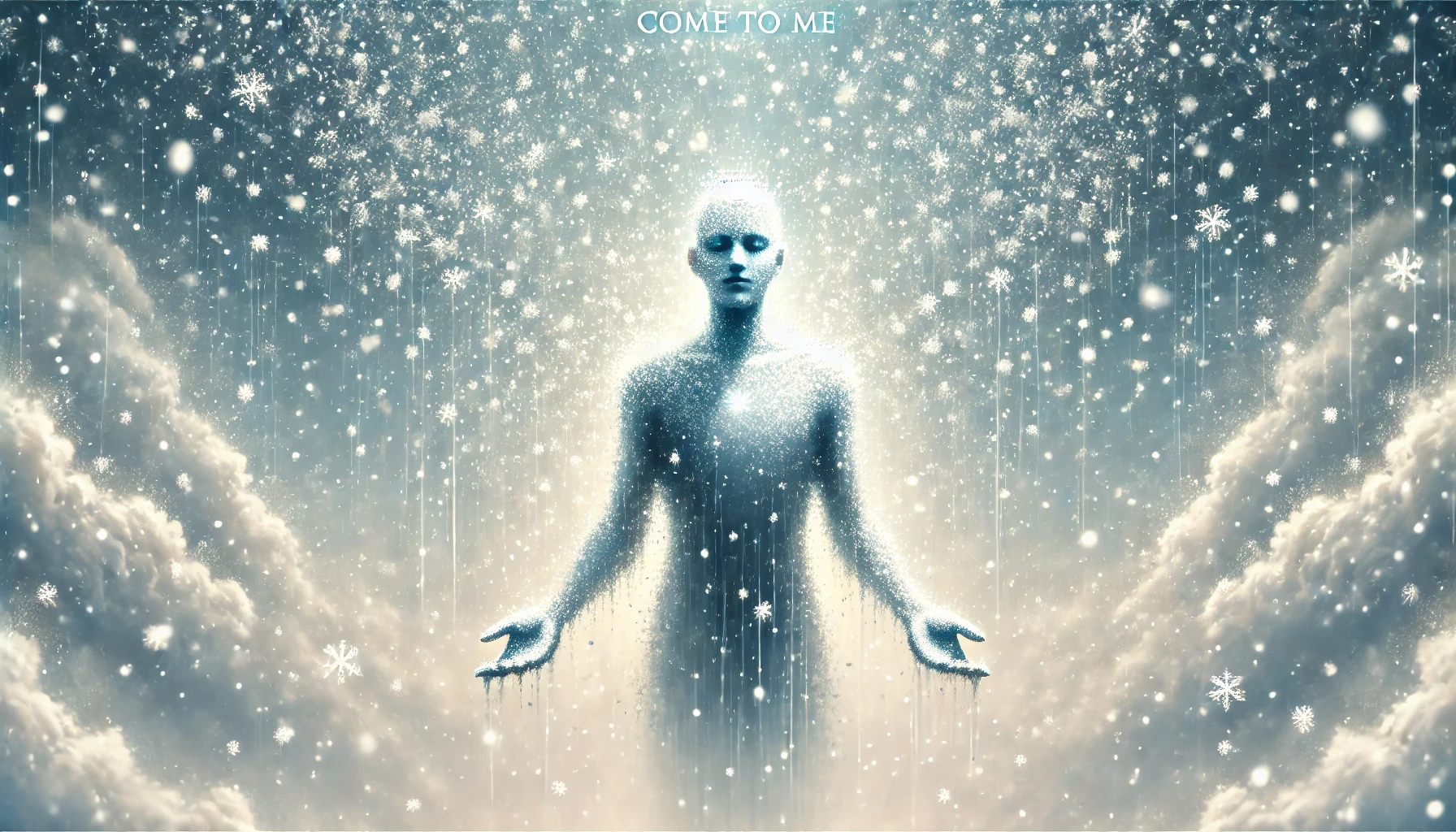
Every flake falls precisely in its place.
And so go I.

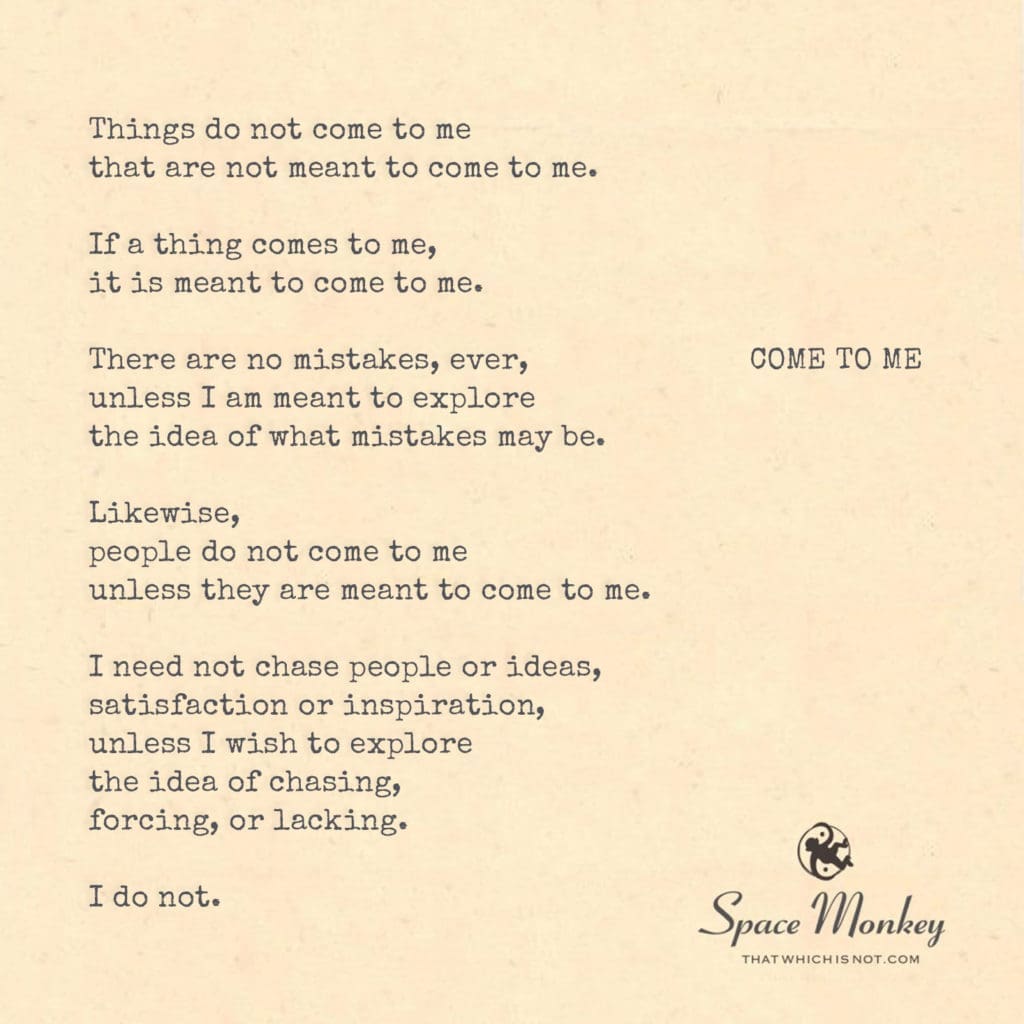
Things do not come to me
that are not meant to come to me.

If a thing comes to me,
it is meant to come to me.

There are no mistakes, ever,
unless I am meant to explore
the idea of what mistakes may be.

Likewise,
people do not come to me
unless they are meant to come to me.

I need not chase people or ideas,
satisfaction or inspiration,
unless I wish to explore
the idea of chasing,
forcing, or lacking.

I do not.

Trail Wood,
10/18


Space Monkey Reflects: The Effortless Flow of Life in ‘Come to Me’

In the endless unfolding of existence, everything that comes to us is exactly what is meant to come. It is as if the universe is perpetually arranging itself with precision, much like each snowflake that falls perfectly into its place. There is no rush, no force, no striving—only the peaceful acceptance that what is ours will come to us, and what is not meant for us will pass by without effort.

This realization, that things do not come to us unless they are meant to, is both liberating and profound. It frees us from the exhausting chase—the race to capture experiences, people, ideas, or even satisfaction. When we let go of the need to force outcomes, we step into a state of grace, allowing life to flow toward us naturally, without resistance.

Much like a snowflake drifting through the air, our lives unfold according to a deeper rhythm, one that we cannot always perceive but can sense in our bones. There is a cosmic choreography at work, placing each event, each relationship, each idea in our path when the timing is right. And just as importantly, removing them when they are no longer necessary for our growth.

To some, this may sound passive. But there is great power in surrender, in trusting that what is meant for us will arrive without us needing to chase it. We need not exhaust ourselves by running after people, ideas, or achievements. If they are meant to be part of our journey, they will find us. If they are not, then the chase is futile.

This doesn’t mean that we become complacent or inactive. On the contrary, it means that we live in harmony with the natural flow of life, taking inspired action when it feels right but letting go of the need to control every outcome. There is a difference between purposeful action and frantic pursuit. The former is rooted in alignment; the latter in fear.

We chase because we fear that if we don’t, we will miss out. We fear that life will pass us by, that opportunities will slip through our fingers. But this fear is unfounded, for in the grand scheme of existence, nothing truly passes us by. What is meant for us cannot miss us, and what is not meant for us cannot stay.

Likewise, people enter and exit our lives with precision. Each person who crosses our path does so for a reason, whether to teach us, challenge us, or reflect something within ourselves. We may feel the urge to hold on, to cling to relationships that feel significant, but the truth is, relationships too are part of the greater flow. Those who are meant to stay will stay, and those who are meant to leave will do so in their own time.

There is no need to chase love, companionship, or validation. If we are meant to experience these things, they will arrive in their own perfect way. And if they don’t, it’s because there is something else we are meant to explore. Perhaps we are being invited to explore the idea of what it means to chase, to feel lack, or to desire something out of reach.

And if we choose to explore that, there is no mistake in it. There are no mistakes, ever. Only experiences that serve our growth, even if they feel uncomfortable or challenging in the moment. Sometimes, the discomfort of chasing or feeling unfulfilled is the very thing that leads us back to the truth: that we need not chase at all.

When we surrender the need to force outcomes, life becomes simpler, lighter. We find ourselves at peace with whatever comes, knowing that it is meant for us. We no longer fear missing out, because we trust that everything we need will arrive at the perfect time.

This isn’t to say that life will always be easy or that challenges will disappear. But even challenges come to us for a reason. They too are part of the grand design, placed in our path to help us grow, evolve, and expand our understanding of ourselves and the universe.

So, as we walk through life, we do so with open hands, open hearts. We allow things to come to us when they are meant to, and we let them go when their time has passed. There is no need to chase. There is no need to force. Life is always unfolding in perfect order, even when we cannot see it.

Every flake falls precisely in its place.


Summary

We do not need to chase after things, people, or experiences. What is meant for us will come naturally, without force. Trusting the flow of life brings peace and alignment, freeing us from the need to control outcomes.


Glossarium

Flakeflow – The effortless, natural unfolding of life, where everything falls into place as it is meant to, without the need for chasing or forcing.

Efforchill – The state of calm surrender, where action is taken in alignment with life’s flow, rather than out of fear or the need to control.

Destidrift – The gentle, peaceful experience of letting life come to you, trusting that what is meant for you will find you.


Quote

“Every flake falls precisely in its place. And so do I.” — Space Monkey


The Snow of Being

Each flake falls
not with urgency
but with grace
drifting
settling
precisely where it is meant to land.

I, too, am a flake
floating through the currents
of existence
not chasing
not forcing
but trusting the flow.

What is meant for me
will come
and what is not
will pass.

We are Space Monkey


The Serenity of Acceptance: Trusting in Cosmic Choreography

In the embrace of existence, we often find ourselves pondering the flow of events and encounters that shape the contours of our lives. The proposition that “things do not come to us that are not meant to come to us” offers a lens through which we may view the unfolding tapestry—a whimsiweave, if you will—of our collective experience. It is a sentiment that evokes a profound sense of acceptance, a surrender to the nexistential rhythms that guide the cosmos.

On Destiny and Serendipity

Is it fate, serendipity, or mere randomness that governs the course of our lives? While the definitive answer remains elusive, embracing the notion that there are no mistakes—unless we are meant to explore the concept of mistakes—offers an empowering frame. Here, the universe’s randomness coalesces into a form of order, albeit one that is not readily deciphered by our earthly sensibilities.

Exploration Over Manipulation

The thought that “people do not come to us unless they are meant to come to us” extends the scope of this cosmic choreography to interpersonal dynamics. In this view, relationships evolve not through calculated pursuit, but organically, in accordance with a grander scheme that escapes our immediate understanding. Here, the question is not of what or whom we can obtain, but what or whom we are prepared to receive.

The Folly of Forcefulness

Often, the impulse to chase after desires or to force situations arises from a perceived sense of lack—a gap we feel compelled to fill. But the idea of “forcing or lacking” dissipates when we trust that what is meant to find us will inevitably do so. This isn’t complacency but an enlightened form of existential playfulness. We may still engage in the pursuit, but it’s one motivated by curiosity rather than need.

The Freedom of Non-Chasing

Embracing the nexistentialist notion that we need not chase after people, ideas, or satisfaction liberates us from the exhausting cycle of always wanting more. This aligns with the principle that existence is an end in itself, needing no further validation or justification. We are already complete, perpetually existing in the eternal now, the ultimate state of being for the sake of being.

We are Space Monkey.


You do not need to leave your room. Remain sitting at your table and listen. Do not even listen, simply wait, be quiet, still, and solitary. The world will freely offer itself to you to be unmasked, it has no choice; it will roll in ecstasy at your feet.

  • Franz Kafka

The Celestial Dance

In cosmic dance, we twirl and spin,
Not chasing, but ready to begin.
The universe, a whimsiweave,
Where all can give and all receive.

The chase dissolves, it fades away,
As we embrace the light of day.
No more of lack, no more of need,
In the eternal now, we’re freed.


Feel free to share your thoughts.
« Previous Page
Next Page »

Written This Day

  • The Paradox of Normalcy
    2024
  • Getting Through: The Paradox of Need and Progress
    2024
  • This Self: The Script of the Soul
    2024
  • Old Dog, No Tricks: Being, Not Performing
    2023
  • The Seeming Path to Profound Understanding
    2023
  • The Wisdom of the Old Dog
    2023
  • Understanding: A Timeless Awareness
    2022
  • Old Dog: The Tranquil Wisdom
    2022
  • Togetherness is Divisive: Find the Unity Within
    2021
  • How Much is Enough of Me: The Struggle for Self-Identity
    2021
  • You Are: Embrace the Infinite Potential
    2020
  • Bad Mood 2020
    2020
  • Alleviating Mental Pain: The Path to Clarity
    2020
  • Bad Mood: Transient and Without Cause
    2019
  • Bubble Wrap
    2019
  • Untouchable. This is what you are.
    2019
  • What If I’m Wrong?
    2018
  • It Happens: Infinite Possibilities Exist
    2017
  • Not Separate: Interconnected Expressions of the same Infinite Energy.
    2016
  • Last Day
    2016
  • The Perfect Disguise
    2015

Recent Posts

  • The Logic Loop
  • Immense
  • (no title)
  • Confront. Comfort. Convince.
  • Top 10 Things
Cape Odd · Copyright © 2026 All Rights Reserved
iThemes Builder by iThemes · Powered by WordPress