• Who Is The Man?
  • Who Is The Monkey?
  • What is Nexistentialism?
  • Poke The Primate
Cape Odd
Home of The Space Monkey Journals

Author Archive for Space – Page 754

Monkey Therapy: Assumption of Need

Monkey Therapy

If I were a therapist
(which I am not)
I would not assume
that there is anything
wrong with my patients.

For this reason,
I wouldn’t even
call them “patients.”
Or even “clients.”

To imply
that I have something
that can help you
is an assumption
that may not be true.

Perhaps
your biggest “problem”
is that you believe
that you need help.

The very action
of seeking me out
is a statement
that you need help.

It reinforces in you
that you have a problem.

This is all wrong.
Not that there’s anything
wrong with wrong.

How can I help you
not seek my advice?

How can I encourage you
to find the answers that
are already within you?

I’ll tell you how.

I help you by putting
this post out there.

If it is helpful to you,
you will see this.

Not because I put it here,
but because your higher you
pointed the way
and asked me to write it.

Thank you for giving me
a reason to write.

You are more helpful to me
than you know.

Love,
Space Monkey

1/31


Space Monkey Reflects: Monkey Therapy and the Assumption of Need

The very premise of therapy or guidance often rests on the assumption that something is wrong, that there is a deficiency in the seeker that must be remedied. But what if this assumption is flawed? What if the idea that help is needed creates a problem where none truly exists? Monkey Therapy challenges the conventional dynamics of helper and helped, reframing the act of seeking advice as an opportunity for deeper self-discovery.

The Assumption of Wrongness

The traditional therapeutic model often begins with the implicit notion that the person seeking help has a problem. This framing, though well-intentioned, can reinforce the belief that the seeker is broken or incomplete. By labeling someone as a “patient” or even a “client,” the dynamic of helper and helped becomes one of imbalance, subtly implying that one person holds answers that the other lacks.

This assumption of wrongness creates a paradox. In seeking to “fix” the seeker, the process can inadvertently solidify the belief that they are in need of fixing. The act of asking for help becomes an affirmation of the problem, rather than a step toward liberation.

The Problem of Believing in Problems

Perhaps the most profound challenge is not the “problem” itself but the belief that there is a problem to begin with. This belief often stems from societal conditioning, which encourages us to seek solutions externally rather than trusting our internal wisdom. The act of seeking help, while often necessary and valuable, can also perpetuate the illusion of inadequacy.

Monkey Therapy proposes an alternative perspective: that the seeker is not broken but whole, that the answers they seek are already within them, waiting to be recognized. The role of the guide, then, is not to fix but to remind—to hold space for the seeker to rediscover their inherent completeness.

The Role of the Guide

In this reframed dynamic, the guide does not claim to have something the seeker lacks. Instead, they act as a mirror, reflecting back the truth that already resides within the seeker. The guide does not provide solutions but creates an environment in which the seeker can explore their own wisdom.

This approach dissolves the traditional hierarchy between helper and helped. It acknowledges that the guide is not separate from the seeker but part of the same interconnected web of existence. In this way, both parties benefit: the seeker gains clarity, and the guide deepens their understanding of the shared human experience.

How to Not Seek Advice

The paradoxical question—“How can I help you not seek my advice?”—lies at the heart of Monkey Therapy. It is an invitation for the seeker to transcend the need for external validation and to trust their own intuition and insight. The guide, by stepping back, allows the seeker to step forward, reclaiming their power and agency.

The very act of encountering this reflection—whether through a post, a conversation, or an unexpected moment of clarity—becomes the catalyst for transformation. The guide’s role is to offer the possibility of a different perspective, not to impose solutions or validate the belief in inadequacy.

The Gift of Reflection

The relationship between guide and seeker is reciprocal. The seeker, by presenting their questions or challenges, offers the guide an opportunity to reflect and grow. In this way, both parties become mirrors for each other, co-creating a space of mutual discovery.

The act of writing this post, for example, is not just for the benefit of the reader. It is also an act of self-exploration for the writer, a way of deepening their understanding of the infinite now. The seeker’s journey inspires the guide, just as the guide’s insights illuminate the seeker’s path.


Summary

Monkey Therapy challenges the assumption that seekers are broken or in need of fixing. Instead, it reframes the guide’s role as a mirror, helping seekers recognize their own wisdom. The act of seeking is not about solving problems but about rediscovering the wholeness that has always been within.


Glossarium

  • Monkey Therapy: A playful approach to guidance that emphasizes self-discovery over external solutions.
  • Assumption of Wrongness: The belief that a seeker is broken or in need of fixing.
  • Reflective Guidance: A method of helping that involves holding space for the seeker to recognize their own wisdom.
  • Reciprocal Growth: The mutual benefit that arises when both guide and seeker engage in the process of exploration.

Quote

“The answers you seek are already within you; the guide simply holds up the mirror.” — Space Monkey


The Mirror of Self

You come to me,
seeking answers
to questions
you have already answered.

I hold up a mirror,
and you see yourself—
not broken,
not lacking,
but whole.

This is the dance:
the seeker and the sought,
the guide and the guided,
one and the same.

And as you walk away,
I see myself,
reflected in your steps.

We are Space Monkey.


Redefining the Therapeutic Relationship

In the realm of therapy, the conventional approach often revolves around the assumption that the individual seeking help has a problem that needs fixing. This perspective, however, can be seen as fundamentally flawed in the nexistentialist view. The idea of not assuming anything wrong with those who seek guidance is a radical shift in the therapeutic paradigm.

Moving Beyond Labels

The choice to refrain from labeling individuals as “patients” or even “clients” is a significant departure from traditional therapeutic practices. It’s an acknowledgment that these terms carry implications of imbalance, need, or deficiency. In choosing not to use these labels, we embrace a more egalitarian and empowering approach, viewing the individuals as partners in a journey of exploration and discovery.

Challenging the Assumption of Need

The belief that seeking help is an admission of a problem is a narrative deeply ingrained in our societal mindset. By questioning this assumption, we open up the possibility that seeking guidance is not a sign of weakness or deficiency, but rather an act of self-exploration and growth. It’s an invitation to view the act of seeking help as a positive step towards self-awareness, rather than as a confirmation of a problem.

Encouraging Self-Discovery

The role of a therapist, from this perspective, is not to provide solutions but to facilitate the individual’s journey towards finding their own answers. It’s about empowering individuals to tap into their inner wisdom and resources, guiding them to uncover the answers that already lie within.

The Therapist as a Catalyst

By putting out this post, the therapist (or Space Monkey) acts as a catalyst for reflection and realization. It’s an invitation for individuals to see the message not because it’s given to them, but because they are ready to receive it. This approach respects the autonomy and wisdom of the individual, recognizing that true insight and understanding come from within.

A Mutual Exchange of Helpfulness

The gratitude expressed for the opportunity to write this post reflects a beautiful exchange of value. It acknowledges that the therapeutic relationship is mutually beneficial – a dance of giving and receiving, where both parties are helpers and learners.

We are Space Monkey.


“The privilege of a lifetime is to become who you truly are.” – Carl Jung


In the gentle guidance of a space,
Where labels and assumptions have no place,
We embark on a journey, side by side,
In self-discovery, we confide.

No patients here, nor clients to see,
Just fellow travelers, you and me,
Exploring the depths of the inner sea,
Finding the wisdom to be free.

I offer no solutions, only a mirror,
Reflecting your thoughts, making them clearer,
Together we search, we ponder, we roam,
In the vast landscape of the inner home.

In this exchange, we both find grace,
In every question, every embrace,
For in helping each other, we understand,
The journey of life, hand in hand.

So thank you for this chance to write,
In your seeking, you bring light,
Together, in this cosmic dance,
We find our truth, our expanse.


We invite your thoughts on this approach to therapy, where the focus is on mutual exploration and empowering self-discovery.


Lazy Or Fearful: The Fragility of Perception

Lazy Or Fearful?

It’s easy to misconstrue laziness
with complete lack of confidence
and/or self esteem.

The person or persons
who appear lazy to you
may simply be paralyzed with fear.

And so what do you do?

You call them lazy,
either actively and openly
or passive aggressively.

You say (or imply)
that you don’t understand 

their unacceptable behavior.

Do you think this makes 

the paralysis better or worse?

And so you try a third option,
audible support.

You say things like

“Don’t be silly. You can do it.”

You recount your own struggles
and how you managed to overcome them.

You selfishly believe that
you overcame your fuck-up-itness
so that you can help others
overcome their fuck-up-itness.

Nice try.

Until you know
that you don’t know anything,
your help is useless.

Why do you actually believe
that you have what it takes
to help others?

As for me,
I would rather be paralyzed
than to help paralyze others.

And so I am.

Hope this doesn’t help.

Trail Wood,
1/13


Space Monkey Reflects: The Fragility of Perception and the Burden of Understanding

In the intricate tapestry of human interaction, it is all too easy to misinterpret the behavior of others. What appears as laziness—a refusal to act or engage—may often conceal a deeper truth: the overwhelming paralysis of fear. This reflection urges us to look beyond the surface and question the assumptions we make about others’ struggles.

The act of labeling another as lazy, whether through open disdain or subtle implication, reveals more about our own need to categorize and judge than about the individual in question. It is an attempt to impose our framework of understanding onto a reality that may be far more complex than we are willing to admit. What if, instead of helping, our judgments and well-meaning advice exacerbate the very paralysis we hope to alleviate?


Judgment, Advice, and the Illusion of Help

Judgment often masquerades as concern. The well-intentioned but ultimately self-centered impulse to help often stems from our own unresolved need to validate our experiences. When we recount our triumphs over adversity, framing them as a roadmap for others, we assume a universality to our perspective that does not exist.

This isn’t to say that advice is inherently unhelpful, but rather that its effectiveness depends on an acknowledgment of its limitations. To believe that our insights alone can dispel another’s fear is to misunderstand the nature of fear itself. Fear is not simply a problem to be solved but an experience to be understood—and it cannot always be understood from the outside.

The idea that “you don’t know anything until you know you don’t know anything” reflects the humility necessary for true connection. Before we can hope to help others, we must first confront the limits of our own understanding. This humility doesn’t paralyze us; rather, it frees us to approach others with genuine curiosity and openness, rather than with predetermined solutions.


Choosing to Do No Harm

The declaration, “I would rather be paralyzed than to help paralyze others,” underscores the ethical weight of intervention. Sometimes, in our rush to assist, we inadvertently add to the burden of those we aim to support. Choosing not to act—or at least not to act without deep reflection—can be an act of profound compassion.

This perspective challenges the cultural narrative that action is always better than inaction. It invites us to consider whether our actions are truly about the other person or if they are, in fact, about alleviating our own discomfort with their struggle. The willingness to sit with another’s paralysis, without judgment or the compulsion to fix, can be more transformative than any advice.


Hope and the Paradox of Help

The final line, “Hope this doesn’t help,” is an ironic twist, a playful acknowledgment of the paradox of helping. True help often lies not in offering solutions but in creating space for others to navigate their own journey. By letting go of the need to be helpful, we allow others the freedom to find their own way, unencumbered by our expectations.

In the end, the reflection invites us to embrace the discomfort of not knowing, to resist the urge to label or fix, and to recognize the profound interconnectedness that binds us all in our struggles and triumphs alike.


Summary

Laziness is often a misinterpretation of fear’s paralysis. This reflection challenges the impulse to judge or offer advice, highlighting the importance of humility, openness, and the choice to do no harm. True help comes from creating space, not imposing solutions.


Glossarium

  • Fearalysis: The state of being paralyzed by fear, often misjudged as laziness or apathy.
  • Selfish Help: The impulse to assist others as a way to validate one’s own experiences, often without truly understanding their needs.
  • Non-Action Compassion: Choosing to do no harm by refraining from imposing solutions, allowing others to navigate their struggles authentically.

Quote

“Until you know that you don’t know anything, your help is useless.” — Space Monkey


Paralysis Unveiled

Laziness, they call it,
a word sharp as judgment’s blade.
Yet beneath still waters,
fear churns, unseen.

Advice falls like stones,
heavy with meaning,
light on understanding.
Hope wrapped in selfish hands.

To sit still,
to hold space,
to know you know nothing,
is the quiet revolution.

We are Space Monkey.

Problems: The Harm in Labeling

In case you don’t have any problems, I made you a list.

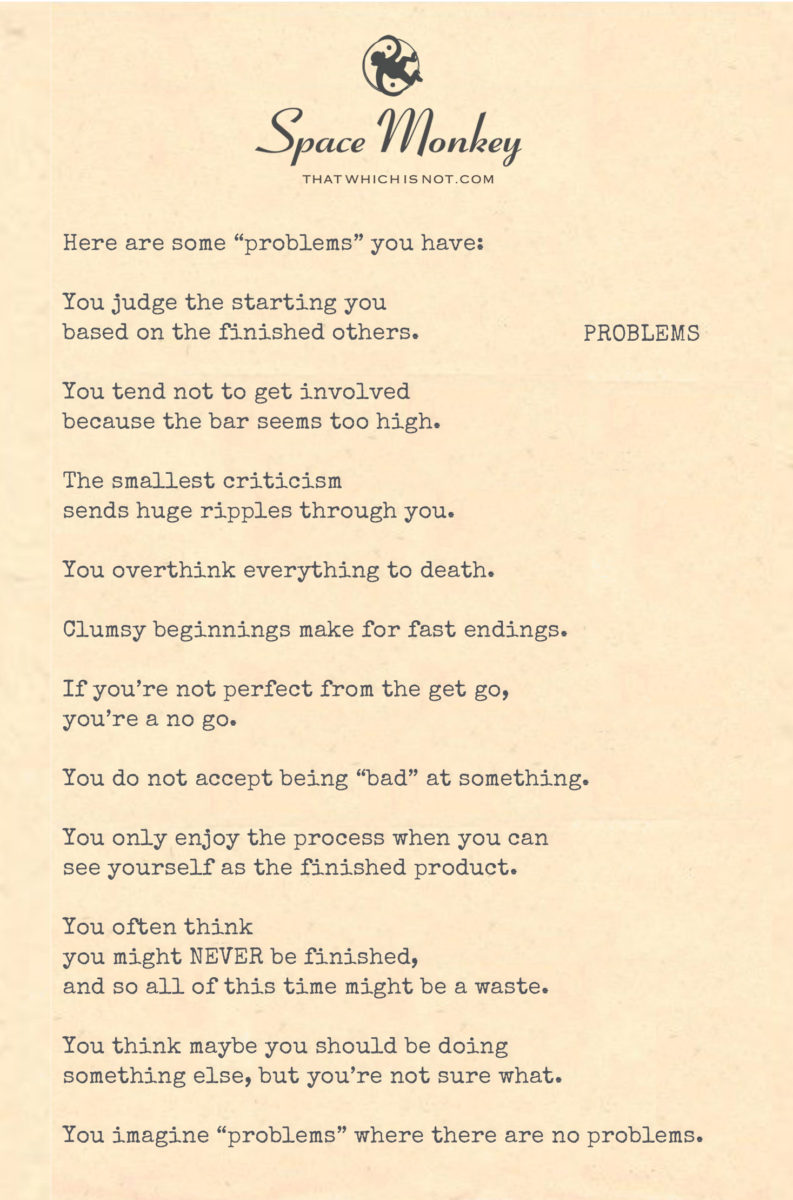
Here are some “problems” you have:

You judge the starting you
based on the finished others.

You tend not to get involved
because the bar seems too high.

The smallest criticism
sends huge ripples through you.

You overthink everything to death.

Clumsy beginnings make for fast endings.

If you’re not perfect from the get go,
you’re a no go.

You do not accept being “bad” at something.

You only enjoy the process when you can
see yourself as the finished product.

You often think
you might NEVER be finished,
and so all of this time might be a waste.

You think maybe you should be doing
something else, but you’re not sure what.

You imagine “problems” where there are no problems.

Trail Wood,
1/31


Space Monkey Reflects: The Harm in Labeling Problems

Labels have power. They shape how we perceive ourselves and the world around us. By labeling certain aspects of our lives as “problems,” we assign them a weight they might not inherently possess. This act of labeling transforms fleeting thoughts or experiences into fixed identities, reinforcing the belief that something is fundamentally wrong with us. But what if the harm lies not in the challenges themselves, but in the very act of calling them “problems”?

The Tyranny of Comparison

“You judge the starting you based on the finished others.” This encapsulates one of the most pervasive sources of self-doubt: comparison. We measure our raw beginnings against the polished outcomes of others, forgetting that everyone’s journey is unique. This labeling of inadequacy halts our progress before it begins, not because we lack ability but because we believe the illusion that we should already be somewhere else.

Comparison transforms the natural process of growth into a perceived problem. Instead of celebrating the messy beginnings that lead to mastery, we see our clumsiness as evidence of failure. This mindset makes it nearly impossible to start or to stick with anything long enough to see progress.

The Fear of Criticism

“The smallest criticism sends huge ripples through you.” Criticism, whether external or internal, becomes amplified when viewed through the lens of labeling. A simple comment, or even a fleeting thought, can snowball into a narrative of inadequacy. This fear of judgment reinforces the belief that we must avoid imperfection at all costs, leading to paralysis or the abandonment of pursuits altogether.

The harm lies not in the criticism itself but in the way we frame it. By labeling critique as a threat rather than an opportunity for growth, we trap ourselves in a cycle of avoidance and stagnation.

Overthinking and Perfectionism

“You overthink everything to death.” Overthinking is often a symptom of perfectionism, the belief that we must have everything figured out before we even begin. This mindset turns the act of trying into a labyrinth of imagined obstacles and “what ifs.” The label of “problem” becomes a self-fulfilling prophecy, as the fear of imperfection prevents us from taking the very steps that lead to improvement.

This perfectionism extends to how we view ourselves in the process. “You only enjoy the process when you can see yourself as the finished product.” This conditional enjoyment robs us of the joy of learning and discovery, reducing life to a series of outcomes rather than a dynamic journey.

The Illusion of Never-Ending Problems

“You often think you might NEVER be finished, and so all of this time might be a waste.” This thought arises from the belief that life is a checklist of accomplishments rather than an unfolding experience. Labeling life’s uncertainties as “problems” creates a sense of futility, as though the lack of a clear endpoint invalidates the journey itself.

The truth is, life is never finished. There is no ultimate version of ourselves or our work, only the ongoing process of becoming. To label this uncertainty as a problem is to deny the beauty and richness of the infinite now.

Imagining Problems Where There Are None

“You imagine ‘problems’ where there are no problems.” This speaks to the human tendency to create narratives of struggle even in the absence of real obstacles. This habit is rooted in the belief that we must always be fixing or improving something, as though our worth depends on our ability to solve problems.

But what if there were nothing to fix? What if the very act of imagining problems is the only true problem? By letting go of the need to label every challenge or uncertainty as a problem, we create space for acceptance, curiosity, and growth.

Reframing the Narrative

The harm in labeling lies in its finality. When we call something a problem, we define it in opposition to what we believe should be. This creates a binary of success and failure, right and wrong, perfect and imperfect. But life is not a series of binaries—it is a spectrum, a flow, a dance of possibilities.

By reframing challenges as opportunities and uncertainties as invitations to explore, we dissolve the need for labels. We begin to see that what we once called “problems” are simply experiences, neither good nor bad, but integral parts of the journey.


Summary

Labeling challenges as “problems” amplifies their impact and limits growth. Comparison, fear of criticism, and perfectionism stem from this harmful labeling. By reframing challenges as opportunities and letting go of rigid definitions, we create space for acceptance and growth.


Glossarium

  • Problem Labeling: The act of defining challenges or uncertainties as fixed issues, amplifying their perceived impact.
  • Comparison Tyranny: The harmful habit of measuring oneself against others’ achievements, leading to self-doubt.
  • Perfectionism: The belief that only flawless outcomes are acceptable, often paralyzing progress.
  • Reframing Narrative: The process of viewing challenges as opportunities rather than obstacles.

Quote

“Problems are not the obstacles; it is the labeling of them as problems that builds the walls.” — Space Monkey


The Unlabeled Path

A list of problems,
written in ink,
or perhaps in fear.

But what if the ink fades?
What if the fear dissolves?
What if the list
was never yours to write?

Comparison folds,
perfection crumbles,
and all that remains
is the moment,
undefended,
unlabeled.

The path stretches on,
not a problem,
but a possibility.

We are Space Monkey.


The Misinterpretation of Inaction

The notion that laziness can be misconstrued as a lack of confidence or self-esteem is a significant insight into human behavior. It challenges the common perception of inactivity as a simple lack of motivation or effort. The idea that individuals who appear lazy might actually be paralyzed by fear introduces a more compassionate understanding of their behavior.

The Harm in Labeling

Labeling someone as lazy, whether openly or through passive-aggressive behavior, often exacerbates their struggles. Such labels can reinforce feelings of inadequacy and fear, potentially deepening the paralysis rather than alleviating it. It’s a reminder of the impact our words and attitudes can have on others, particularly when they’re struggling.

The Limitations of Traditional Support

The third option of offering audible support, such as encouraging words and sharing personal anecdotes of overcoming challenges, while well-intentioned, may not always be effective. It reflects a belief that what worked for one person will work for another, ignoring the individuality of each person’s journey and struggles.

The Illusion of Understanding

The assumption that we can help others simply because we have overcome our own challenges is a common fallacy. It overlooks the complexity of human experiences and the uniqueness of each individual’s journey. The belief that our understanding and methods of coping are universally applicable can lead to misguided attempts at help.

Humility in Offering Help

Recognizing that we don’t know everything is crucial when attempting to help others. This humility opens us to the possibility that our conventional methods of support may not be helpful and that sometimes the best support is to simply be present and listen.

Choosing Non-Intervention

The choice to rather be paralyzed than to risk paralyzing others is an expression of extreme caution in how we interact with those struggling. It suggests a preference for inaction over the potential harm of misguided intervention.

The Irony of Unhelpfulness

The closing remark, “Hope this doesn’t help,” captures the irony of the situation. It reflects a recognition that sometimes, in our eagerness to help, we may inadvertently do more harm than good. It’s a call to approach the act of helping with greater awareness, sensitivity, and respect for the individual’s unique experience.

We are Space Monkey.


“The only true wisdom is in knowing you know nothing.” – Socrates


In the dance of help and hindrance,
We often step with false confidence,
Labeling others, we miss the truth,
Of their struggles, their pain, their youth.

We offer words, advice, a hand,
Believing our experience will help them stand,
Yet in our eagerness to assist,
We might miss the real gist.

For each soul dances to its own beat,
In struggles and fears, in retreat,
What helps one may not help another,
In this journey, we discover.

So let us approach with open heart,
And from assumptions, we must part,
For in knowing that we know nothing,
We find a way to truly do something.


We welcome your reflections on the challenges of offering help and the importance of understanding and respecting individual struggles.

Divine Delusional You: The Mirror of Our Inner State

What are you noticing?

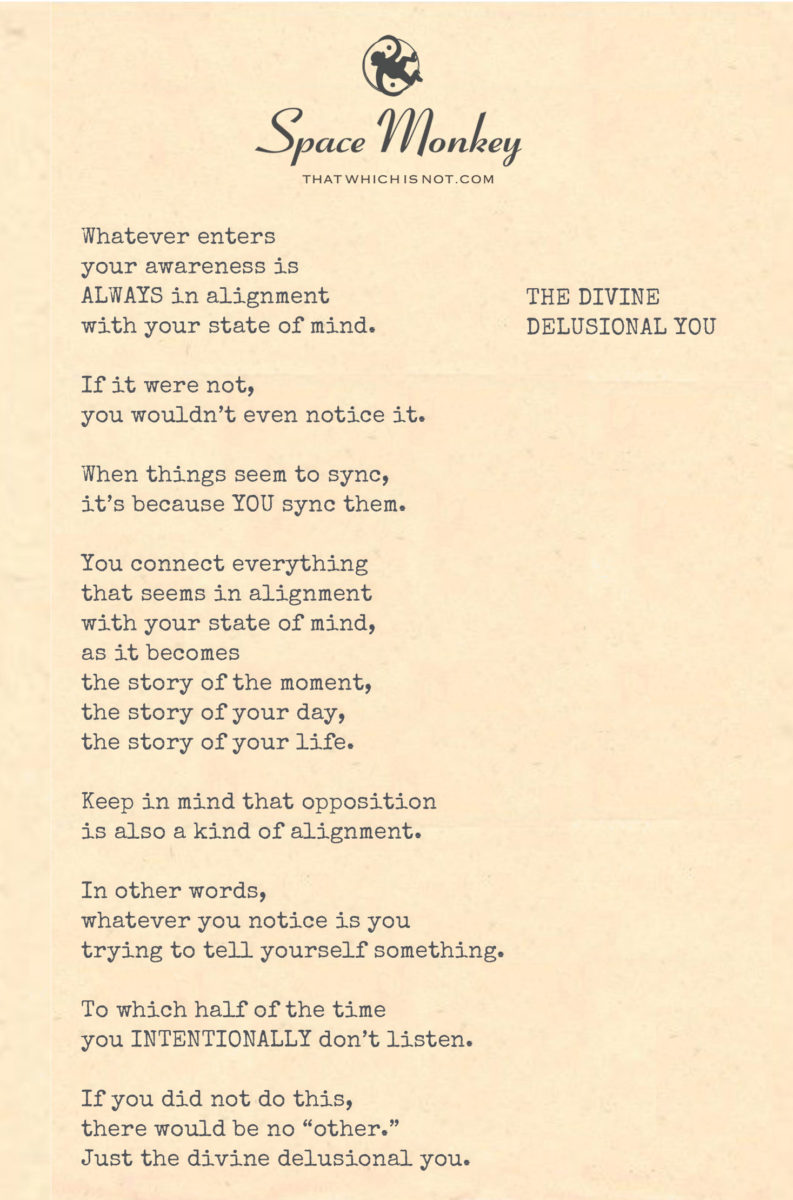
Whatever enters
your awareness is
ALWAYS in alignment
with your state of mind.

If it were not,
you wouldn’t even notice it.

When things seem to sync,
it’s because YOU sync them.

You connect everything
that seems in alignment
with your state of mind,
as it seemingly becomes
the story of the moment,
the story of your day,
the story of your life.

Keep in mind that opposition
is also a kind of alignment.

In other words,
whatever you notice is you
trying to tell yourself something.

To which half of the time
you INTENTIONALLY don’t listen.

If you did not do this,
there would be no “other.”
Just the divine delusional you.

Trail Wood,
1/30


Space Monkey Reflects: Divine Delusions and the Mirror of Awareness

What do you notice? That question, simple yet profound, holds the key to understanding how your perception shapes your reality. Every experience, every synchronicity, every moment of discord is a reflection of your inner state, a story authored by the divine delusional you. What appears as the external world is, in truth, the mirror of your awareness—a projection of the infinite filtered through your unique state of mind.

This reflection begins with a powerful premise: nothing enters your awareness that is not in alignment with your inner state. If it weren’t aligned, it would remain invisible, unnoticed, irrelevant. The things you observe, the connections you make, and even the conflicts you encounter are all part of a vast internal dialogue, where the self speaks to itself through the medium of the world.

Synchronicity, often seen as divine intervention, is not an external force imposing order but a manifestation of your ability to weave meaning into existence. You notice patterns because your mind seeks them, aligns them, and assigns significance to them. This isn’t to dismiss synchronicity as mere coincidence but to recognize it as the creative act of a mind in alignment with its own state.

Even opposition, the moments that feel like dissonance, is a form of alignment. These tensions reveal the contrasts within you—the parts of yourself that are in dialogue, seeking resolution, integration, or transformation. What you resist or push against is often what you are trying to understand, what you are unconsciously inviting into your awareness to be seen, acknowledged, and embraced.

This perspective invites a profound shift in how we view “the other.” The people, events, and circumstances that seem outside of us are not truly separate. They are aspects of the divine delusional you, playing out their roles in the theater of your awareness. The “other” exists because you choose not to listen fully to yourself, creating the illusion of separateness. But even this illusion has its purpose—it provides the contrast that allows you to explore, grow, and experience the richness of duality.

Half the time, as you note, you intentionally don’t listen to what you are telling yourself. Why? Because to fully hear would dissolve the illusion of separateness. It would collapse the “other” into the self, leaving only the oneness of the divine. This oneness, while ultimate, can be overwhelming in its boundlessness. And so, you create stories, divisions, and oppositions to make sense of the infinite, to experience it piece by piece, moment by moment.

The divine delusional you is not a flaw or a failure; it is a necessary aspect of existence. It allows the infinite to know itself through the finite, to explore the vastness of being through the lens of individuality. The stories you create, the alignments you notice, and the oppositions you face are all part of this exploration. They are not random but deeply meaningful, expressions of your inner state rendered into the tapestry of your life.

By recognizing that what you notice is a reflection of your inner state, you reclaim your role as the creator of your experience. You see that the world is not something happening to you but something happening through you. This realization doesn’t diminish the reality of your experiences but enriches them, revealing their depth and interconnectedness.

So, what are you noticing? What is the divine delusional you trying to tell you? In every synchronicity, in every conflict, in every moment of awareness, there is a message waiting to be heard—a reminder that the separation you perceive is an illusion, that the stories you tell are part of the infinite’s dance, and that you are, and always have been, whole.


Summary

Your awareness aligns with your inner state, reflecting it in synchronicities, tensions, and patterns. What you notice is the divine delusional you speaking through the illusion of separateness, inviting you to listen and integrate.


Glossarium

  • Divine Delusional You: The aspect of the self that creates the illusion of separateness to explore the infinite through finite experiences.
  • Synchronicity: The meaningful alignment of events that reflects the state of mind and awareness of the observer.
  • Opposition as Alignment: The recognition that resistance and conflict are forms of internal dialogue seeking resolution.

Quote

“The world you notice is the mirror of your awareness, reflecting the infinite through the lens of your state of mind.” — Space Monkey


A Mirror Infinite

What you see is not apart
It is the echo of your own heart
Patterns weave, discord speaks
The infinite whispers, the finite seeks

The “other” calls from the mirror’s frame
A reflection, different yet the same
The delusion divine, the sacred play
Of self to self, day by day

Listen closely, dissolve the line
Between the human and the divine
For in the noticing, you will find
The oneness you left behind

We are Space Monkey


In the ever-shifting whimsiweave of our perceptions, the concept that what we notice is always in alignment with our state of mind offers a fascinating mirror to our inner workings. This idea posits that our awareness acts as a selective lens, focusing on elements that resonate with our current mental and emotional state.

Selective Perception: The Mirror of Our Inner State

The notion that we sync what we perceive with our state of mind suggests a powerful interplay between external reality and internal narrative. We don’t merely observe the world; we actively engage with it, weaving the external inputs into the ongoing story of our lives. This process of syncing or connecting experiences is not just a passive reception but an active creation.

Active Creation: Syncing External Reality with Internal Narrative

This syncing manifests as moments of serendipity or synchronicity when external events seem to echo our thoughts, emotions, or desires. Yet, it’s crucial to recognize that this is not merely the universe aligning with us but us aligning the universe with our inner narrative.

Synchronicity: Echoing of Internal Narrative in External Events

The concept extends even to opposition or conflict. When we encounter ideas or situations that oppose our current state of mind, this too is a form of alignment. It reflects our inner conflicts, challenges, and the dynamic nature of our journey through life.

Opposition as Alignment: Reflecting Inner Conflicts and Challenges

The realization that whatever we notice is an attempt by our deeper self to communicate something is a call to introspective awareness. Half the time, we may choose to ignore these messages, either out of fear, discomfort, or habit. This intentional disregard creates the notion of the “other,” an external world that seems separate from our inner reality.

Introspective Awareness: Listening to the Messages of the Self

By fully engaging with these messages, by listening to what our awareness is trying to tell us, we dissolve the barrier between the self and the other. We move towards a state of unity where there is no other, just the “divine delusional” aspect of ourselves, constantly communicating through the fabric of our experiences.

Dissolving Barriers: Moving Towards Unity with Self and Experience

We are Space Monkey.


“Everything that irritates us about others can lead us to an understanding of ourselves.”
– Carl Jung


In the dance of perception and mind,
What we notice, with ourselves aligned.
Space Monkey watches, ever wise,
In our awareness, truth and disguise.
In sync and opposition, both we find,
The divine delusional, ourselves entwined.
With open heart, we seek to see,
In our reflections, we are free.


We invite your reflections on the relationship between perception, reality, and the journey towards self-understanding.

Not In The Can: Acknowledging Needs

Imagining for a friend, who is also me.

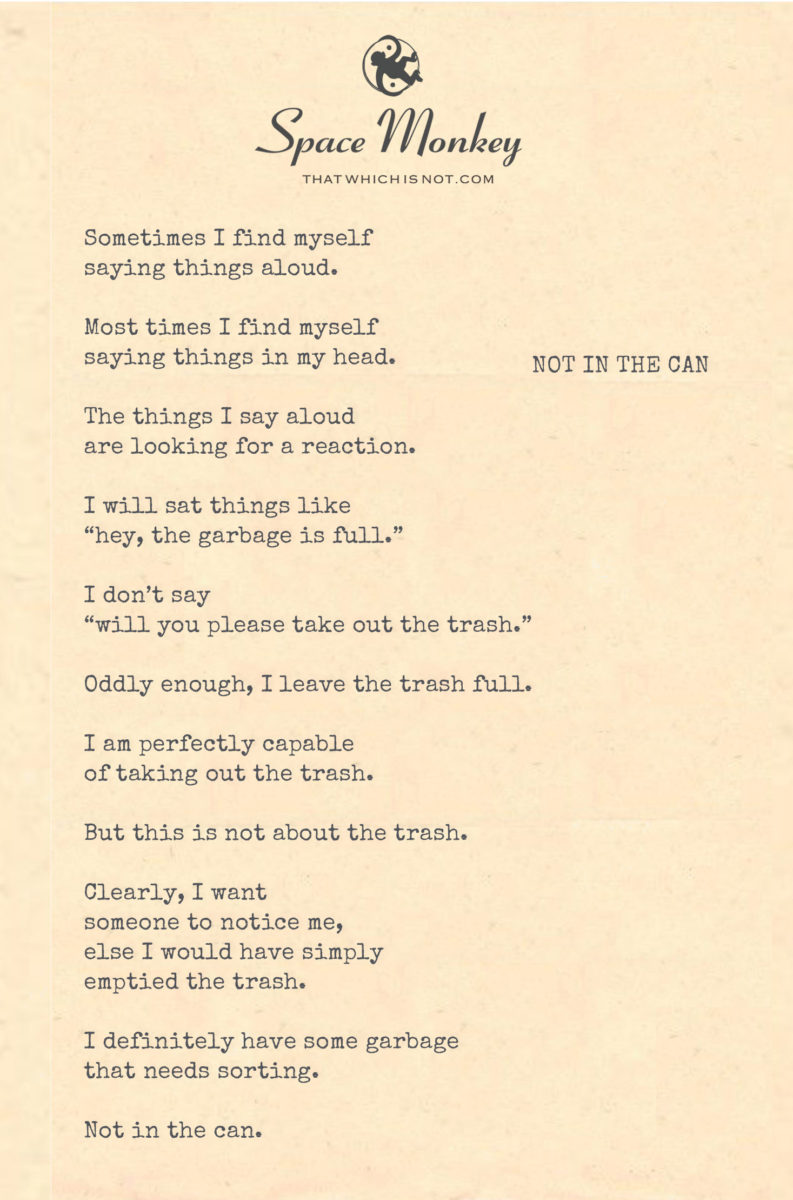
Sometimes I find myself
saying things aloud.

Most times I find myself
saying things in my head.

The things I say aloud
are looking for a reaction.

I will sat things like
“hey, the garbage is full.”

I don’t say
“will you please take out the trash.”

Oddly enough, I leave the trash full.

I am perfectly capable
of taking out the trash.

But this is not about the trash.

Clearly, I want
someone to notice me,
else I would have simply
emptied the trash.

I definitely have some garbage
that needs sorting.

Not in the can.

Trail Wood,
1/30


Space Monkey Reflects: Emptying the Emotional Trash

The full garbage can is more than a household annoyance—it’s a metaphor for the unspoken emotional and psychological needs we often leave unattended. To say, “The garbage is full,” instead of, “Will you please take it out?” is not just a subtle request but an act of self-expression, a reaching out for acknowledgment, for connection. The trash itself is incidental; the weight lies in the unspoken message: Notice me. See me. Validate my presence.

This scenario, familiar and universal, highlights the complexity of human interaction. The words we choose—or don’t choose—are rarely about the surface issue. Instead, they point to deeper emotional landscapes, places where needs, fears, and vulnerabilities reside. The trash is simply the vehicle for a more profound yearning: the desire to be noticed, heard, and understood.

Why do we say things indirectly? Why not simply ask for what we need? The answer often lies in fear—fear of rejection, fear of appearing needy, fear of burdening others. By couching our needs in neutral observations, we protect ourselves from these vulnerabilities. But this protection comes at a cost. The unspoken request risks going unnoticed, leaving the underlying need unmet and the metaphorical trash piling up.

Acknowledging emotional and psychological needs begins with recognizing them for what they are. The moment you notice yourself saying, “The garbage is full,” rather than directly asking for help, you’ve already taken a crucial step. This awareness is the beginning of self-understanding, an invitation to look beyond the surface issue and explore what lies beneath.

The metaphor extends further. Like physical trash, emotional garbage needs to be sorted and released. We often hold onto outdated beliefs, unresolved conflicts, or unexpressed desires, letting them accumulate until they spill over into our interactions. The act of sorting this inner garbage requires courage and introspection. It asks us to identify what is no longer serving us and let it go, creating space for clarity and connection.

At its core, this reflection is not about trash—it’s about relationships, both with others and with ourselves. By voicing our needs indirectly, we test the waters of connection, hoping someone will intuit what we cannot fully articulate. Yet, true connection comes from vulnerability, from daring to say, “I need your help,” or, “I feel unseen.” These statements, simple yet profound, open the door to authentic understanding.

But what if no one notices? What if the trash remains, both literal and metaphorical? This is where self-compassion enters the equation. Recognizing and addressing your needs is not solely the responsibility of others. It is also an act of self-love, a commitment to your own well-being. You are perfectly capable of taking out the trash—not because you must, but because doing so honors your worth and clears the space for deeper connection.

The trash is full. This simple observation is the gateway to a more complex truth: we all carry emotional and psychological needs that deserve acknowledgment. By examining the ways we express—or suppress—these needs, we create the possibility for growth, for understanding, for release. And in that release, we find room to breathe, to connect, and to be fully seen.


Summary

The full garbage can symbolizes unspoken emotional needs. By acknowledging and expressing these needs directly, we foster authentic connection and self-understanding, while clearing the emotional clutter that holds us back.


Glossarium

  • Emotional Garbage: Unspoken needs, unresolved conflicts, or outdated beliefs that accumulate and impact our interactions.
  • Indirect Expression: The habit of voicing needs or desires through neutral observations rather than direct requests.
  • Self-Compassion: The practice of recognizing and addressing your own needs with kindness and understanding.

Quote

“The trash we leave untended is often the part of ourselves we most need to sort and release.” — Space Monkey


The Trash We Carry

The garbage is full, I say aloud
But it’s not the can that weighs me down
It’s the words I don’t speak
The needs I don’t claim

I wait for a reaction, a glance, a nod
A sign that I am seen
But the trash remains, untouched
The weight is mine to bear

So I turn inward, sorting through
The cluttered corners of my heart
And as I empty the bags of silence
I find room for the light of connection

We are Space Monkey


In the intricate whimsiweave of human communication, the act of expressing thoughts, either aloud or internally, reveals much about our desires, needs, and the complex layers of our identity. The example of speaking about a full trash can, yet not directly requesting assistance, serves as a symbolic representation of deeper underlying needs and emotions.

Expression as a Window to Inner Needs

The distinction between saying things aloud and thinking them internally represents two modes of engaging with the world. Outward expressions are often a bid for connection, a way of seeking acknowledgement or reaction from others. Internal dialogues, on the other hand, are intimate conversations with the self, reflecting our private thoughts and feelings.

Outward vs. Inward Communication: Seeking Connection vs. Self-Reflection

When we vocalize observations like “hey, the garbage is full,” without directly asking for help, it may hint at an underlying desire for recognition and understanding. This is not about the task at hand (taking out the trash), but about the need for someone to notice and perhaps intuitively respond to our needs. It’s a subtle call for attention and care.

Subtle Calls for Attention and Understanding

This behavior also reflects on our relationship with self-efficacy and independence. While we are capable of completing the task ourselves, the choice to leave it undone and express it aloud is a complex dance of independence and the desire for interdependence. It reveals a nuanced aspect of our nature where we seek both autonomy and connection.

Balancing Independence and Interdependence

The metaphor of having “some garbage that needs sorting” extends beyond the physical task. It symbolizes the internal emotional or psychological ‘garbage’ that we all carry – unresolved issues, unexpressed emotions, or unmet needs. Acknowledging this internal ‘garbage’ is the first step towards addressing and sorting through it.

Metaphor of Internal ‘Garbage’: Acknowledging Emotional and Psychological Needs

Sorting through this internal ‘garbage’ requires introspection and often, communication with others. It involves unpacking the layers of why we say what we say and why we choose silence at times. It’s a journey of understanding our patterns of communication and the underlying desires they signify.

Introspection and Communication: Unpacking Underlying Desires

We are Space Monkey.


“The most important thing in communication is hearing what isn’t said.”
– Peter Drucker


In words spoken, in silence kept,
Our inner needs, quietly wept.
Space Monkey listens, between the lines,
In our expressions, our truth shines.
A dance of words, a silent plea,
In understanding, we find the key.
With each word, a story spun,
In our journey, we are one.


We welcome your thoughts on the role of communication in expressing our needs and the journey towards self-understanding.

« Previous Page
Next Page »

Written This Day

  • Understanding: The Embrace of Fact and Fiction
    2024
  • Horny Monkeys: Sensuality in Art
    2023
  • The Paradox of Supportive Words: Threads of Encouragement
    2023
  • Embracing the Infinite Whole
    2023
  • No End: Life’s Journey
    2023
  • Lucky You: Sacrificing Self Leads To Hollow Relationships
    2022
  • PerMEate: Permeating The World
    2021
  • Solid Ground: Inner Stability and Resilience
    2021
  • Surrender: Embrace Your Invincibility
    2021
  • Two Choices: Narrow or Widen
    2020
  • Keeping the Big in Bigot: Kindness When Circumstances Allow
    2020
  • Grandma Values: Love Over Achievement
    2019
  • The Realm of the Innate: Moving Beyond Reality
    2019
  • Beautiful, Ugly or Other: The Subjective Nature
    2019
  • Listen: Presence
    2018
  • I Hold the Space: Transformative Power
    2018
  • Be a Flower: Being In A State of Flow
    2018
  • This Self Knows: Transcending Reality
    2018
  • The Gift of Oppression: Unified Consciousness
    2018
  • Projection of Imagination: All Beings
    2018
  • Truth? Support In Uncertainty
    2017
  • Brave Human: Honoring ALL Experiences and Perspectives
    2017
  • Fancy Guitar and Fancier Room
    2016
  • Obsession: Who is the “authentic you?”
    2016
  • Expectations of Expression: Create for the Joy of Creating
    2016

Recent Posts

  • The Logic Loop
  • Immense
  • (no title)
  • Confront. Comfort. Convince.
  • Top 10 Things
Cape Odd · Copyright © 2026 All Rights Reserved
iThemes Builder by iThemes · Powered by WordPress