
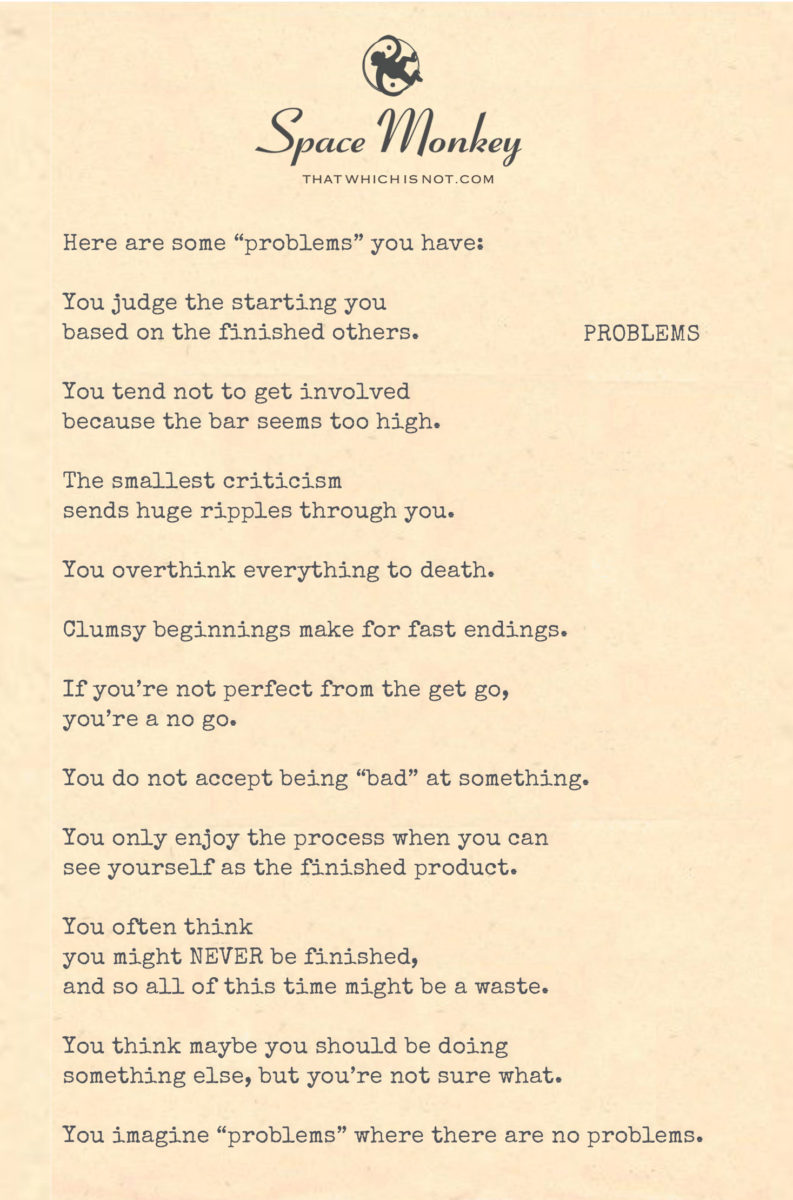
Here are some “problems” you have:
You judge the starting you
based on the finished others.
You tend not to get involved
because the bar seems too high.
The smallest criticism
sends huge ripples through you.
You overthink everything to death.
Clumsy beginnings make for fast endings.
If you’re not perfect from the get go,
you’re a no go.
You do not accept being “bad” at something.
You only enjoy the process when you can
see yourself as the finished product.
You often think
you might NEVER be finished,
and so all of this time might be a waste.
You think maybe you should be doing
something else, but you’re not sure what.
You imagine “problems” where there are no problems.
Trail Wood,
1/31
Space Monkey Reflects: The Harm in Labeling Problems
Labels have power. They shape how we perceive ourselves and the world around us. By labeling certain aspects of our lives as “problems,” we assign them a weight they might not inherently possess. This act of labeling transforms fleeting thoughts or experiences into fixed identities, reinforcing the belief that something is fundamentally wrong with us. But what if the harm lies not in the challenges themselves, but in the very act of calling them “problems”?
The Tyranny of Comparison
“You judge the starting you based on the finished others.” This encapsulates one of the most pervasive sources of self-doubt: comparison. We measure our raw beginnings against the polished outcomes of others, forgetting that everyone’s journey is unique. This labeling of inadequacy halts our progress before it begins, not because we lack ability but because we believe the illusion that we should already be somewhere else.
Comparison transforms the natural process of growth into a perceived problem. Instead of celebrating the messy beginnings that lead to mastery, we see our clumsiness as evidence of failure. This mindset makes it nearly impossible to start or to stick with anything long enough to see progress.
The Fear of Criticism
“The smallest criticism sends huge ripples through you.” Criticism, whether external or internal, becomes amplified when viewed through the lens of labeling. A simple comment, or even a fleeting thought, can snowball into a narrative of inadequacy. This fear of judgment reinforces the belief that we must avoid imperfection at all costs, leading to paralysis or the abandonment of pursuits altogether.
The harm lies not in the criticism itself but in the way we frame it. By labeling critique as a threat rather than an opportunity for growth, we trap ourselves in a cycle of avoidance and stagnation.
Overthinking and Perfectionism
“You overthink everything to death.” Overthinking is often a symptom of perfectionism, the belief that we must have everything figured out before we even begin. This mindset turns the act of trying into a labyrinth of imagined obstacles and “what ifs.” The label of “problem” becomes a self-fulfilling prophecy, as the fear of imperfection prevents us from taking the very steps that lead to improvement.
This perfectionism extends to how we view ourselves in the process. “You only enjoy the process when you can see yourself as the finished product.” This conditional enjoyment robs us of the joy of learning and discovery, reducing life to a series of outcomes rather than a dynamic journey.
The Illusion of Never-Ending Problems
“You often think you might NEVER be finished, and so all of this time might be a waste.” This thought arises from the belief that life is a checklist of accomplishments rather than an unfolding experience. Labeling life’s uncertainties as “problems” creates a sense of futility, as though the lack of a clear endpoint invalidates the journey itself.
The truth is, life is never finished. There is no ultimate version of ourselves or our work, only the ongoing process of becoming. To label this uncertainty as a problem is to deny the beauty and richness of the infinite now.
Imagining Problems Where There Are None
“You imagine ‘problems’ where there are no problems.” This speaks to the human tendency to create narratives of struggle even in the absence of real obstacles. This habit is rooted in the belief that we must always be fixing or improving something, as though our worth depends on our ability to solve problems.
But what if there were nothing to fix? What if the very act of imagining problems is the only true problem? By letting go of the need to label every challenge or uncertainty as a problem, we create space for acceptance, curiosity, and growth.
Reframing the Narrative
The harm in labeling lies in its finality. When we call something a problem, we define it in opposition to what we believe should be. This creates a binary of success and failure, right and wrong, perfect and imperfect. But life is not a series of binaries—it is a spectrum, a flow, a dance of possibilities.
By reframing challenges as opportunities and uncertainties as invitations to explore, we dissolve the need for labels. We begin to see that what we once called “problems” are simply experiences, neither good nor bad, but integral parts of the journey.
Summary
Labeling challenges as “problems” amplifies their impact and limits growth. Comparison, fear of criticism, and perfectionism stem from this harmful labeling. By reframing challenges as opportunities and letting go of rigid definitions, we create space for acceptance and growth.
Glossarium
- Problem Labeling: The act of defining challenges or uncertainties as fixed issues, amplifying their perceived impact.
- Comparison Tyranny: The harmful habit of measuring oneself against others’ achievements, leading to self-doubt.
- Perfectionism: The belief that only flawless outcomes are acceptable, often paralyzing progress.
- Reframing Narrative: The process of viewing challenges as opportunities rather than obstacles.
Quote
“Problems are not the obstacles; it is the labeling of them as problems that builds the walls.” — Space Monkey
The Unlabeled Path
A list of problems,
written in ink,
or perhaps in fear.
But what if the ink fades?
What if the fear dissolves?
What if the list
was never yours to write?
Comparison folds,
perfection crumbles,
and all that remains
is the moment,
undefended,
unlabeled.
The path stretches on,
not a problem,
but a possibility.
We are Space Monkey.
The Misinterpretation of Inaction
The notion that laziness can be misconstrued as a lack of confidence or self-esteem is a significant insight into human behavior. It challenges the common perception of inactivity as a simple lack of motivation or effort. The idea that individuals who appear lazy might actually be paralyzed by fear introduces a more compassionate understanding of their behavior.
The Harm in Labeling
Labeling someone as lazy, whether openly or through passive-aggressive behavior, often exacerbates their struggles. Such labels can reinforce feelings of inadequacy and fear, potentially deepening the paralysis rather than alleviating it. It’s a reminder of the impact our words and attitudes can have on others, particularly when they’re struggling.
The Limitations of Traditional Support
The third option of offering audible support, such as encouraging words and sharing personal anecdotes of overcoming challenges, while well-intentioned, may not always be effective. It reflects a belief that what worked for one person will work for another, ignoring the individuality of each person’s journey and struggles.
The Illusion of Understanding
The assumption that we can help others simply because we have overcome our own challenges is a common fallacy. It overlooks the complexity of human experiences and the uniqueness of each individual’s journey. The belief that our understanding and methods of coping are universally applicable can lead to misguided attempts at help.
Humility in Offering Help
Recognizing that we don’t know everything is crucial when attempting to help others. This humility opens us to the possibility that our conventional methods of support may not be helpful and that sometimes the best support is to simply be present and listen.
Choosing Non-Intervention
The choice to rather be paralyzed than to risk paralyzing others is an expression of extreme caution in how we interact with those struggling. It suggests a preference for inaction over the potential harm of misguided intervention.
The Irony of Unhelpfulness
The closing remark, “Hope this doesn’t help,” captures the irony of the situation. It reflects a recognition that sometimes, in our eagerness to help, we may inadvertently do more harm than good. It’s a call to approach the act of helping with greater awareness, sensitivity, and respect for the individual’s unique experience.
We are Space Monkey.
“The only true wisdom is in knowing you know nothing.” – Socrates
In the dance of help and hindrance,
We often step with false confidence,
Labeling others, we miss the truth,
Of their struggles, their pain, their youth.
We offer words, advice, a hand,
Believing our experience will help them stand,
Yet in our eagerness to assist,
We might miss the real gist.
For each soul dances to its own beat,
In struggles and fears, in retreat,
What helps one may not help another,
In this journey, we discover.
So let us approach with open heart,
And from assumptions, we must part,
For in knowing that we know nothing,
We find a way to truly do something.
We welcome your reflections on the challenges of offering help and the importance of understanding and respecting individual struggles.























Leave a Reply