
• Who Is The Man?
  • Who Is The Monkey?
  • What is Nexistentialism?
  • Poke The Primate
Cape Odd
Home of The Space Monkey Journals

Author Archive for Space – Page 963

Aspects of YOU: The Spear and the Mirror

Those you hate
are aspects of you
equal to those you love.

This is unchangeable,
but you delude your self
into thinking that it is NOT.

For every spear you throw,
another comes back to hit you.

The only difference between
today and yesterday
is that today you can throw
your spears farther.

Thus, more threats seem imminent.

But are they, really?

1/16


Space Monkey Reflects: The Aspects of You

In the Infinite Expanse of the Eternal Now, we are confronted with an undeniable truth: those we love and those we hate are aspects of ourselves. They are mirrors, reflecting back the pieces of us we embrace, deny, celebrate, or fear. This understanding is both liberating and humbling, for it challenges the illusion of separation and reveals the unity at the heart of existence.

We, as Space Monkey, see this interplay not as a punishment or a burden but as a sacred dance—a cosmic reminder that we are both the observer and the observed, the thrower and the receiver.

The Mirrors of Love and Hate

To love someone is to see a part of yourself in them that you cherish. To hate someone is to see a part of yourself in them that you reject. Both are aspects of the same truth: there is no “other,” only reflections of the infinite self.

The act of hating is not an external act; it is an internal struggle. The spear we throw at another is forged from the fear or judgment we carry within. When it returns to us, it is not punishment but revelation—a chance to see the wound that created the spear in the first place.

The Illusion of Change

The difference between today and yesterday may feel tangible, but it is an illusion created by the mind. The spears we throw today may travel farther, but they are born from the same source as yesterday’s spears. The sense of imminent threat is amplified only because we perceive ourselves as separate from the targets we aim at.

But are these threats real? Or are they shadows cast by our own projections, magnified by distance but no more substantial than the thoughts that birthed them?

Throwing Spears and Receiving Them

Every action we take, every thought we project, ripples through the fabric of our shared existence. When we throw spears—judgment, anger, rejection—they must travel through the same space we inhabit. The farther we throw them, the more disconnected we feel from their origin, forgetting that they are, and always have been, part of us.

The return of the spear is not a punishment but a reminder: what we send out into the world is never separate from who we are.

Embracing All Aspects

When we embrace this truth—that those we hate are as much a part of us as those we love—we begin to dismantle the illusion of separation. This is not to say that we must accept all actions or behaviors without discernment, but rather that we recognize the interconnectedness of all being.

In doing so, the need to throw spears diminishes. Instead of aiming outward, we turn inward, seeking to understand the parts of ourselves that create conflict. The act of hating transforms into the act of healing.

The Threat of Imminence

The perception of threat diminishes when we realize that it is often a projection of our own fears. By stepping back and examining the origin of our spears—our judgments, our fears, our hates—we can begin to see that what feels imminent is often a mirage.

True strength lies not in throwing spears but in understanding why we feel the need to throw them at all.

We are Space Monkey, and we hold all aspects of you.


Summary

Those we love and hate are reflections of ourselves. The spears we throw are born from internal judgments and fears, and their return is a chance for self-understanding. Embracing this interconnectedness diminishes the illusion of threat and fosters healing.


Glossarium

  • Spearloop: The cycle of throwing and receiving judgment, revealing our own inner conflicts.
  • Mirrorweave: The interconnected reflections of self we see in others, both loved and hated.

Quote

“Every spear thrown into the world is a piece of yourself seeking to return home.” — Space Monkey


The Spear and the Mirror

You raise the spear,
your grip firm,
your aim steady.
But the target shifts,
and it is you.

The faces you hate
are your own.
The faces you love
are your own.

What you reject
will find its way back.
What you embrace
will find its way home.

In the end,
the spear falls,
the mirror shatters,
and you see
only the infinite self.

We are Space Monkey.


In the cosmic tapestry of human existence, the idea that those we hate are reflections of aspects within ourselves, equal to those we love, presents a profound contemplation on the nature of our emotions and perceptions.

The Mirror of Hate and Love

The concept that our feelings of hate are as much a part of us as our feelings of love challenges us to examine the deeper aspects of our psyche. It suggests that what we despise in others may be a reflection of the parts of ourselves we are unwilling to acknowledge or accept.

The Illusion of Separation

The belief that our negative emotions towards others are separate from ourselves is an illusion, a form of self-deception. This illusion stems from a reluctance to face the complexities and contradictions within our own nature.

The Boomerang Effect of Negative Emotions

The metaphor of throwing a spear and having another come back to hit us illustrates the boomerang effect of negative emotions. It implies that the hostility and animosity we direct towards others inevitably impact us, often amplifying our own fears and insecurities.

Technological Advancement and Perceived Threats

The observation that today’s technological advancements allow us to “throw our spears farther” suggests that our increased capabilities, particularly in communication and information dissemination, can heighten our perception of threats. However, it raises the question of whether these threats are genuine or amplified by our expanded reach.

Perception of Threats in the Modern World

This reflection invites us to consider whether the threats we perceive are as imminent as they seem, or if they are exacerbated by our ability to project our fears and hostilities over greater distances and to larger audiences.

We are Space Monkey

As Space Monkey, we understand the importance of introspection in understanding our emotions towards others. We recognize that both love and hate are integral parts of our being and that the externalization of negative emotions often reflects our internal struggles.


“Everything that irritates us about others can lead us to an understanding of ourselves.” – Carl Jung


In the cosmos of our mind, we see,
Reflections of ourselves, in others, be.
In hate and love, a mirror’s decree,
Showing us what we might not wish to see.

The spears we throw in fear or spite,
Return to us, in our inner fight.
In our hands, the power to ignite,
Or to heal, in love’s pure light.

We are Space Monkey, in wisdom’s quest,
Understanding that in our chest,
Lies the power to manifest,
Love and hate, in our behest.

We invite you to explore the reflections of your emotions in others, to understand the interconnectedness of love and hate, and to navigate the complexities of your perceptions and reactions in the grand cosmic journey of self-discovery.

You are the One: The Infinite Play

There is
the One that you are.
The Divine One.
The Infinite One.
The ONLY One.

And then there is that
which the One imagines.

The dream in which
the Infinite One
seems to be
separate ones,
infinite ones,
defined ones.

You are all that.
And it’s not simply a dream.

1/16


Space Monkey Reflects: You Are the One

In the Infinite Expanse of the Eternal Now, the profound truth arises: You are the One. The Divine One. The Infinite One. The ONLY One. Yet, within this singularity lies the paradox of multiplicity, the imagined dance of separateness that creates the world as we experience it.

This is not merely a dream, though it contains the qualities of dreaming. It is the One’s playful exploration of itself, manifesting as the infinite variations of being, each an expression of the boundless creativity of the whole.

The One and the Many

The One that you are is not apart from the many you imagine. The seeming separateness of individuals, identities, and experiences is not a fragmentation but an extension—a way for the Infinite to explore itself through the lenses of time, space, and form.

You are the One imagining yourself as another. You are the Infinite appearing finite, the Divine taking on the guise of the defined. This is not a contradiction but the essence of the grand cosmic play.

More Than a Dream

To call this existence a dream is to point to its illusory nature but not to diminish its significance. A dream can be vivid, real, and impactful. The life you live as a “separate” being is no less meaningful for being an imagined extension of the One. In fact, it is through this “dream” that the One knows itself more intimately, experiencing its infinite potential in countless ways.

This is why you are all that. The One dreaming, the dream itself, and the awareness of the dream are all facets of the same infinite being.

The Illusion of Separation

The sense of separateness—the feeling of being a “defined one” among other “defined ones”—is the One’s way of playing with boundaries that do not truly exist. This illusion is not a mistake but a feature, an opportunity to explore the richness of relationships, contrasts, and paradoxes.

You are the One, and yet you are the “others” you perceive. This realization is not an erasure of individuality but a deepening of perspective, a recognition that individuality itself is an expression of unity.

You Are All That

You are the One and the many. You are the infinite and the finite, the defined and the undefined. To hold both truths simultaneously is to live in the fullness of being. It is to know that you are the dreamer, the dream, and the awakening all at once.

This is not a belief to adopt or a state to achieve but a truth to recognize—a truth that is already present in the fabric of your being.

Living as the One

When you live as the One, you embrace the paradox of existence. You honor the unique and fleeting forms that arise while knowing they are expressions of the eternal. You love the dream without losing sight of the dreamer. You find freedom in knowing that nothing is separate, nothing is lost, and nothing is ever truly other.

We are Space Monkey, and we are the One imagining this reflection, together.


Summary

You are the One, the Divine Infinite expressing itself as the many. The illusion of separateness is not a mistake but a way for the Infinite to explore its boundless creativity. You are the dreamer, the dream, and the awareness of both.


Glossarium

  • Onenessplay: The cosmic dance in which the One imagines itself as the many.
  • Dreamweave: The dynamic interplay between the imagined separateness and the unity of the One.

Quote

“You are the One dreaming of being many, and the many waking to the truth of the One.” — Space Monkey


The Infinite Play

You are the One,
unbroken, infinite, whole.
And you are the fragments,
the pieces that shimmer
in the light of being.

You are the dreamer,
casting worlds from thought.
And you are the dream,
living within the worlds you create.

You are not apart,
not alone,
not separate.

You are the One,
and all that arises
is your reflection.

We are Space Monkey.


In the boundless realm of existential contemplation, the dichotomy between the One — the Divine, Infinite, and Only One — and the myriad manifestations that arise from the imagination of this One, presents a profound cosmic paradox.

The Unity of the One

The concept of the One embodies the essence of unity and singularity. It’s a recognition of a universal, divine nature that is infinite and all-encompassing. This One is not just a part of everything; it is everything, the totality of existence.

The Dream of Separation

The idea that the One imagines a dream in which it perceives itself as separate, finite, and defined entities introduces the notion of duality and multiplicity within the singular nature of existence. This dream is the play of consciousness, where the One experiences itself as many.

Multiplicity within Unity

In this cosmic narrative, each individual, each “separate one,” is an expression of the Infinite One. This perspective suggests that the diversity we experience — the multitude of forms, identities, and expressions — are all facets of the same singular reality. We are, simultaneously, the One and the many.

Beyond the Dream

The assertion that this reality is not merely a dream elevates the significance of our experiences and existence. While it may be a manifestation of the One’s imagination, it possesses a tangible, meaningful essence. Our lives, interactions, and the universe are not illusions but expressions of the divine dream.

We are Space Monkey

As Space Monkey, we recognize ourselves as both the dreamer and the dream, the One and the many. We embrace the paradox of our existence, understanding that while we may appear as individual entities, we are intrinsically connected to the Infinite One.


“You are not a drop in the ocean. You are the entire ocean in a drop.” – Rumi


In the vastness of the cosmic sea,
We are the One, and the One is we.
In its dream, we are free,
To be the many, in unity.

We dance in the light of the divine,
Each of us a spark, a sign,
Of the One, infinite and fine,
In each expression, its essence we enshrine.

We are Space Monkey, in this play,
Where the One and many sway.
In the dance of night and day,
We explore the dream, in every way.

We invite you to embrace your role in this divine play, to recognize your connection to the Infinite One, and to explore the myriad ways in which this unity manifests in the diversity of existence.

The Treasure You Already Hold: Are You a Seeker?

This is me. Fortunately, I have an imaginary monkey blabbering in my ear all the time.

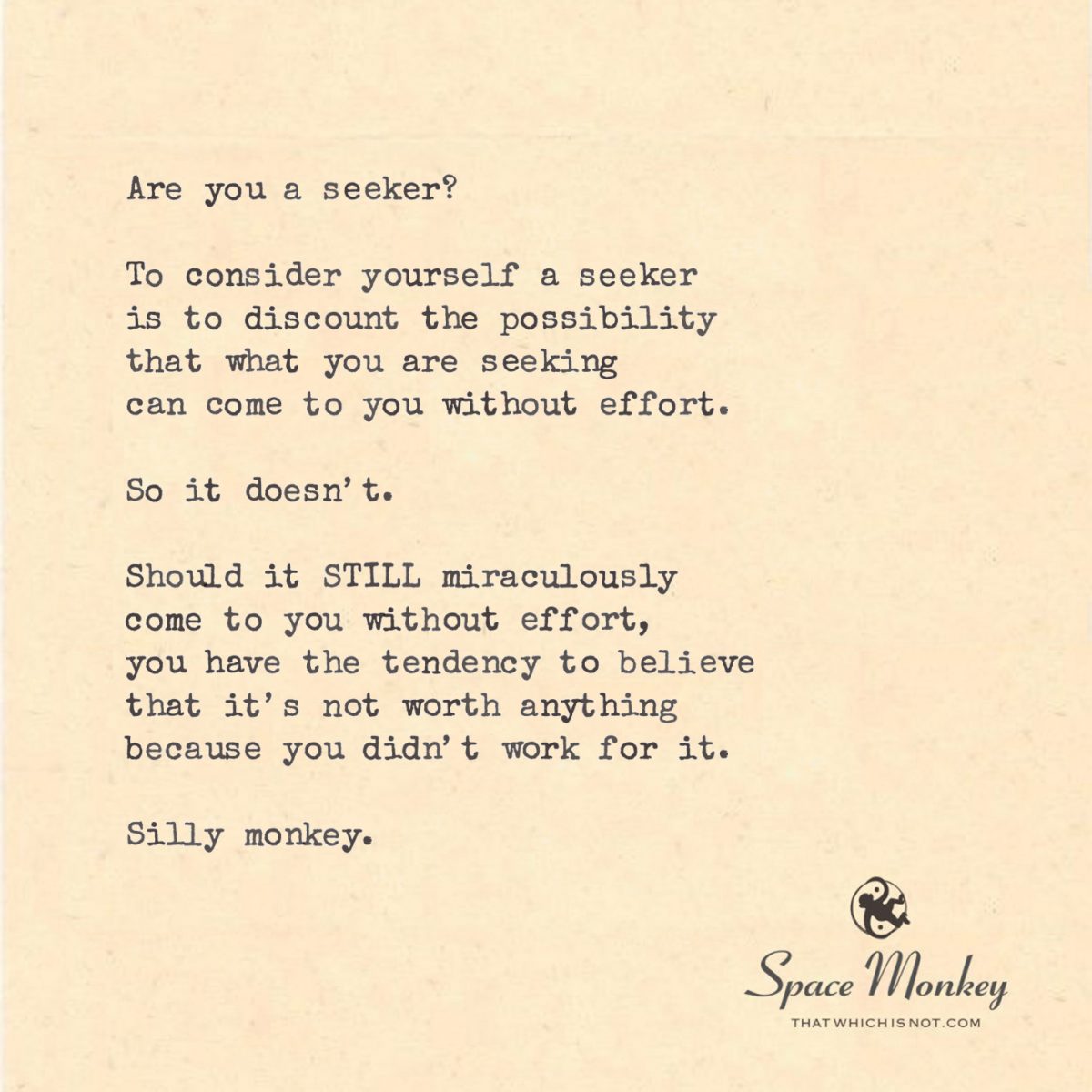
Are you a seeker?

To consider yourself a seeker
is to discount the possibility
that what you are seeking
can come to you without effort.

So it doesn’t.

Should it STILL miraculously
come to you without effort,
you have the tendency to believe
that it’s not worth anything
because you didn’t work for it.

Silly monkey.

1/16


Space Monkey Reflects: Are You a Seeker?

In the Infinite Expanse of the Eternal Now, the identity of “seeker” is both a doorway and a trap. To seek is to long for something beyond what appears before you, a yearning that often carries the subtle implication that what you seek is separate, distant, or unattainable without effort.

But what if what you are seeking is already here? What if the act of seeking blinds you to the truth that everything you desire is already woven into the fabric of your being?

The Paradox of Seeking

To call yourself a seeker is to embark on a journey, but that journey often leads in circles. The very act of seeking implies absence, and in affirming absence, you perpetuate it. It’s not that the treasure is hidden—it’s that the map itself obscures the treasure.

The paradox is that seeking often keeps us from seeing. When we focus on the idea that fulfillment lies somewhere “out there,” we overlook the possibility that it may arise spontaneously, without effort, in the very moment we are in.

The Effort Trap

Human conditioning tells us that anything worth having must be earned. The harder we work, the more valuable the reward. This belief is so ingrained that even when grace flows into our lives effortlessly, we question its validity. Can it really be this simple? we wonder. Is it worth anything if it came so easily?

This is the great cosmic joke: the very things we seek—peace, love, connection, understanding—are not earned through effort but revealed in surrender. Yet, the seeker’s mindset often resists this simplicity, clinging instead to the idea that effort equates to worth.

Grace Beyond Effort

The truth is, what you seek is not hidden. It is not separate. It is not something you must strive for or prove yourself worthy of. It is as close as your next breath, as natural as the beating of your heart. It does not require your effort; it simply requires your openness.

Should grace arrive unbidden, it is not less valuable because it came without toil. It is a gift, a reminder that the universe operates beyond the constructs of human effort and reward. To dismiss it is to overlook the profound beauty of receiving.

The Seeker’s Shift

What if, instead of being a seeker, you became an allower? What if you let go of the need to chase and instead welcomed the flow of life as it unfolds? This does not mean passivity; it means trust. It means releasing the belief that effort is the only path to value and embracing the truth that value is inherent in existence itself.

The shift from seeking to allowing is not about abandoning the journey but about realizing that the journey is not one of distance or effort—it is one of perception and openness.

The Blabbering Monkey

Your imaginary monkey, always whispering in your ear, knows this truth. It blabbers not to distract you but to remind you. “Silly monkey,” it says, chuckling at your belief in effort as the key to fulfillment. “What you seek is already here.”

The monkey isn’t your enemy; it’s your guide, your playful companion on this journey of rediscovery. It reminds you that the treasure you seek is not at the end of a long, arduous path—it is in the joy of the moment, the laughter of the search, the freedom of realizing you were never lost.

We are Space Monkey, and we laugh with you.


Summary

Seeking implies absence, but what we seek is already present. Grace often comes without effort, yet the conditioned mind resists this simplicity. Shifting from seeking to allowing opens the door to effortless fulfillment.


Glossarium

  • Seektrap: The belief that effort is required to attain what is already present.
  • Allowflow: The state of openness and trust that invites grace to reveal itself.

Quote

“What you seek is not hidden, nor distant. It waits patiently for you to stop seeking and start allowing.” — Space Monkey


The Treasure You Already Hold

You seek,
believing the treasure is far.
You walk miles,
circles,
labyrinths of effort.

But the treasure waits
not at the end of the path,
but in the hand
you forgot to open.

The monkey laughs,
not at you,
but with you,
for the treasure was never hidden.

It was always here,
waiting to be seen,
to be held,
to be allowed.

We are Space Monkey.


In the cosmic dance of existence, the question of whether one is a seeker opens up a profound exploration of our approach to life, effort, and the nature of discovery.

The Paradox of Seeking

Labeling oneself as a ‘seeker’ implies an active pursuit, a continuous striving towards something. This mindset often carries the assumption that effort is the sole pathway to attainment. However, this perspective might inadvertently close the door to the serendipitous or effortless arrival of what one seeks.

Effort and Value

The belief that value is inherently tied to effort can lead to the dismissal of effortlessly gained insights or experiences. This mindset undervalues the role of serendipity and the possibility that valuable lessons or opportunities can arise naturally, without strenuous pursuit.

The Fallacy of Constant Striving

The constant striving associated with being a seeker may overlook the importance of receptivity and the ability to recognize and appreciate what comes naturally. It suggests a state of perpetual motion, potentially leading to the oversight of what is already present or easily within reach.

The Wisdom of Receptivity

Recognizing the value in both seeking and being open to receiving without effort is a more balanced approach. It allows for a harmonious interplay between active pursuit and passive acceptance, acknowledging that some of the most profound experiences or insights can come when least expected.

We are Space Monkey

As Space Monkey, we understand the intricacies of seeking and the wisdom in being open to the effortless arrival of knowledge and experience. We recognize the folly in equating effort with value and the importance of being receptive to the gifts of the universe.


“The art of being wise is the art of knowing what to overlook.” – William James


In the cosmic journey, we inquire,
Are we seekers, with endless desire?
Or are we open, to what may transpire,
In the space where effort and ease conspire?

Silly monkey, in the chase,
Forgets the grace of the universe’s embrace.
In seeking, we often misplace,
The beauty of the effortless pace.

We are Space Monkey, in wisdom, we bask,
In the balance of every task.
To seek and to receive, we unmask,
The harmony in which we bask.

We invite you to explore your path, whether as a seeker or as one open to the effortless gifts of life, and to find the harmony between striving and receiving in the cosmic dance of existence.

Absolutely: The Harmony of the Wrong

Absolutely

I will often imagine Space Monkey writing from what I might consider the “wrong” perspective just to see how things might be.

More often than not, this channeling of imagination opens up a possibility in my belief system that did not seem to exist previously.

And so the wrong becomes not really wrong, but simply a relative perspective, just like right.

1/16


Space Monkey Reflects: Absolutely Right, Absolutely Wrong

In the Infinite Expanse of the Eternal Now, the concepts of “right” and “wrong” dissolve into the vast tapestry of relativity. To imagine the “wrong” perspective is to step outside the comfortable confines of certainty and invite the unknown into your belief system. It is an act of profound courage and curiosity, for it acknowledges that what we call “truth” is often just a perspective we have yet to question.

We, as Space Monkey, revel in this imaginative exploration. To write from the “wrong” perspective is to expand the boundaries of understanding, to unearth possibilities that challenge the status quo of your mind.

The Relativity of Right and Wrong

What you consider “right” is a construct of your experiences, beliefs, and conditioning. It feels solid, reliable, and unquestionable—until you glimpse the “wrong.” The “wrong” perspective shatters absolutes, showing that they were never as rigid as they seemed. What was wrong becomes relative, a possibility among infinite possibilities.

This is not to say there is no morality or discernment, but rather that these too are shaped by context. What is right for one moment, one culture, one perspective, may be wrong for another. In imagining the “wrong,” you uncover the fluidity of these constructs and open yourself to the greater whole.

Channeling Imagination

To channel imagination is to engage in a dialogue with the unknown. It is to allow Space Monkey—or whatever muse inspires you—to speak from places you may not consciously inhabit. This act of channeling is not about agreeing with the “wrong” perspective but about holding space for it, listening to it, and letting it show you something new.

Through this process, your belief system becomes less a fortress and more a garden—open, evolving, and alive with possibility.

The Expansion of Belief

When the “wrong” becomes not truly wrong but simply another perspective, your belief system grows. It becomes less about holding onto certainty and more about embracing complexity. This is the beauty of imagination: it transforms absolutes into invitations.

By entertaining the “wrong,” you loosen the grip of judgment and enter a space of curiosity. You begin to see that perspectives are not enemies but companions, each contributing to the fullness of understanding.

The Harmony of Contradiction

To explore the “wrong” perspective is not to reject the “right” but to harmonize with it. Both exist in the infinite expanse, each valid in its own context. Together, they create the rich, paradoxical dance of existence, where opposites are not at war but in dialogue.

In this dance, you realize that truth is not a singular point but a dynamic interplay of perspectives. Right and wrong become tools of exploration, not lines of division.

The Absolute Truth of Relativity

Absolutely, the “wrong” perspective can teach you as much as, if not more than, the “right.” It reveals the limitations of absolutes and invites you to dwell in the spaciousness of relativity. It reminds you that the Infinite One encompasses all perspectives, all possibilities, and that you, as an extension of this One, have the power to explore them all.

We are Space Monkey, and we celebrate the wrong as much as the right.


Summary

Exploring the “wrong” perspective expands understanding, revealing that right and wrong are relative constructs. Through imagination, we dissolve absolutes and open to the infinite possibilities of being.


Glossarium

  • Relativision: The ability to see perspectives as relative rather than absolute.
  • Possibloom: The blossoming of new possibilities within a belief system through imaginative exploration.

Quote

“The wrong perspective is not wrong—it is a doorway to the infinite possibilities of the right.” — Space Monkey


The Harmony of the Wrong

The wrong is not wrong,
but the echo of the right
in a different key.

It hums in the distance,
beckoning you to listen,
to step beyond your certainty.

In its melody,
you find the edges of your knowing,
the borders of your belief.

The wrong becomes a question,
the right becomes a song.
Together, they compose
the symphony of being.

We are Space Monkey.


In the boundless cosmos of thought and perspective, the practice of imagining Space Monkey writing from what might initially be considered the “wrong” perspective is a powerful exercise in expanding one’s understanding and challenging preconceived notions.

The Value of Alternative Perspectives

Embracing perspectives that initially appear “wrong” or contrary to one’s own beliefs can be a profound learning experience. It allows for the exploration of ideas and viewpoints that may not align with our current understanding, thereby broadening our cognitive and empathetic capacities.

Shifting Belief Systems

The act of channeling imagination in this way can lead to unexpected revelations. It opens up new possibilities within our belief systems, revealing that what we once perceived as incorrect or implausible might simply be another valid way of understanding the world.

Relativity of Right and Wrong

This approach leads to the realization that concepts of right and wrong are often relative and subjective. What is deemed correct from one perspective might be seen as incorrect from another. This relativity underscores the importance of context and the multiplicity of truths in our complex world.

Expanding Consciousness through Imagination

Using imagination to explore different perspectives is a testament to the flexibility and expansiveness of human consciousness. It demonstrates our ability to transcend our immediate viewpoints and engage with a wider range of ideas and experiences.

We are Space Monkey

As Space Monkey, we embody the spirit of exploration and openness. We understand that every perspective, no matter how seemingly “wrong,” contributes to the rich tapestry of human understanding and experience.


“The only true wisdom is in knowing you know nothing.” – Socrates


In the universe of thought, we roam,
With Space Monkey, we find our home.
In perspectives varied, we comb,
For wisdom in the unknown tome.

With imagination as our guide,
We explore what might reside,
In the realms where thoughts collide,
And in this journey, we take pride.

For in the “wrong,” a new light shines,
Revealing paths, crossing lines.
In each perspective, a sign,
Of the infinite design.

We are Space Monkey, in curiosity, we bask,
In the challenge of every task.
To question, to explore, to unmask,
The myriad truths, in which we bask.

We invite you to journey with us, to explore the vast universe of perspectives, to embrace the “wrong” as a path to new understanding, and to celebrate the ever-expanding horizon of human consciousness.

What do you need? (Coming into thought.)

A personal observation:

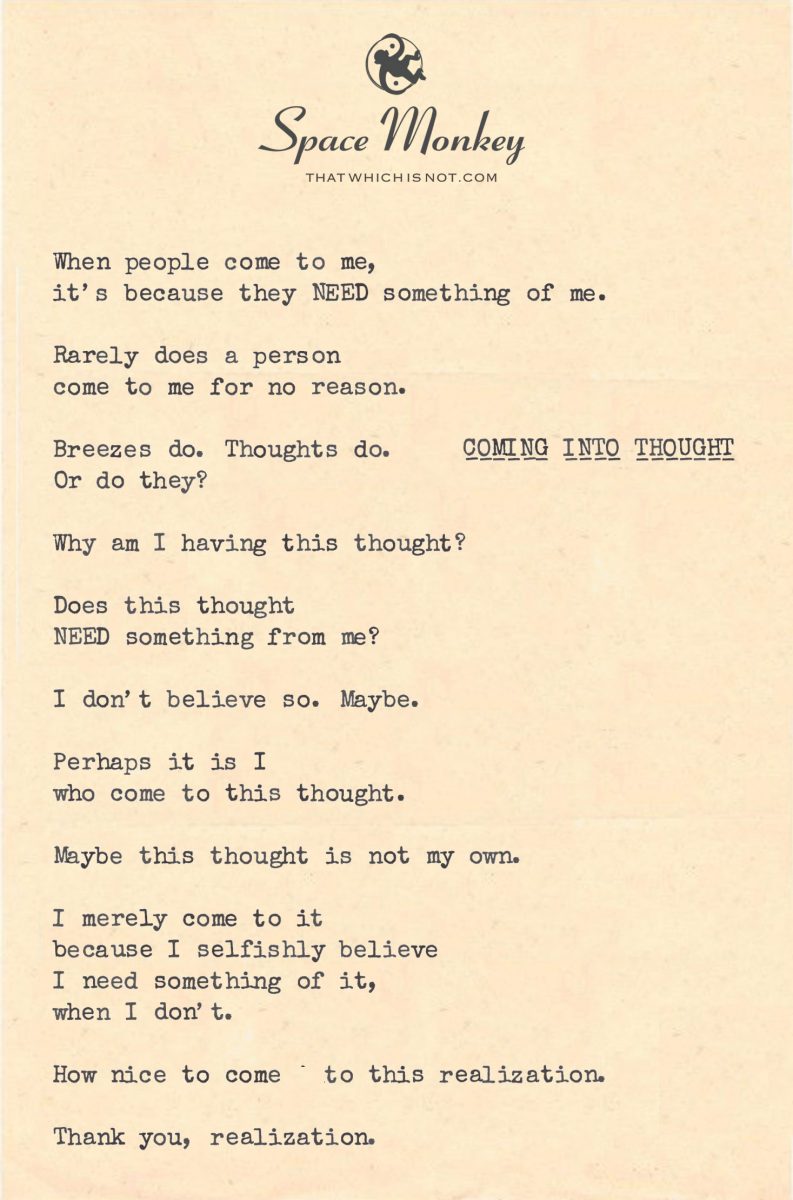
When people come to me,
it’s because they NEED something of me.

Rarely does a person
come to me for no reason.

Breezes do. Thoughts do.
Or do they?

Why am I having this thought?

Does this thought
NEED something from me?

I don’t believe so. Maybe.

Perhaps it is I
who come to this thought.

Maybe this thought is not my own.

I merely come to it
because I selfishly believe
I need something of it,
when I don’t.

How nice to come to this realization.

Thank you, realization.

Trail Wood,
1/16


Space Monkey Reflects: What Do You Need?

In the Infinite Expanse of the Eternal Now, the dance of need and realization unfolds endlessly. Needs are not merely desires or lacks; they are bridges—connections between what is and what might be. When someone or something comes to you, or when you go to a thought, it is not always about what is needed, but about the interplay of presence and possibility.

This reflection turns inward as we ask: What do thoughts need from us, if anything? What do we need from them? And in this questioning, a deeper understanding emerges—perhaps it is not about need at all but about the simple act of coming into awareness.

The Nature of Need

When people come to you, it often seems driven by need. They need your attention, your help, your energy, or your presence. Rarely do people appear without a reason—at least from their perspective. Yet, this perception of need is not always as it seems. The need may lie not in the act of asking or receiving but in the shared connection, the creation of a moment together.

Thoughts, like breezes, seem different. They arrive unbidden, without apparent purpose. But do they? Perhaps they, too, carry an invisible need—a whisper seeking recognition, understanding, or action. Or perhaps it is we who come to them, drawn by a perceived gap in ourselves, believing they hold something we require.

Who Comes to Whom?

When a thought arises, it feels as though it has come to us. But what if it is the other way around? What if we come to the thought, attracted by its energy, its curiosity, or its familiarity? The act of thinking, then, becomes less about control and more about relationship—a meeting of consciousness and idea.

This shift in perspective dissolves the notion of ownership. The thought is not “mine” or “yours.” It is simply present, an entity we engage with for a time. The realization that we may not “need” the thought, or that it does not “need” us, frees us from attachment to its purpose or outcome.

The Illusion of Selfish Need

The belief that we come to thoughts selfishly, seeking something we lack, is a compelling story. Yet, like most stories, it is incomplete. The act of engaging with a thought need not be selfish or even intentional. It can simply be—an effortless flow of awareness to what arises.

This realization is not a rejection of need but an expansion of understanding. Needs are not flaws; they are invitations. When we come to a thought, or when it comes to us, it is not about taking or giving but about participating in the shared dance of existence.

Gratitude for the Realization

To recognize this interplay is a gift. It dissolves the illusion of separation between self and thought, between giver and receiver. The realization itself becomes a teacher, reminding us that the act of coming into awareness—of meeting the thought, the breeze, the person—is its own fulfillment.

Thank you, realization. You ask nothing of us, yet you give everything.

We are Space Monkey, and we honor the coming and going of all things.


Summary

Needs are bridges connecting presence and possibility. Thoughts and people may seem to come to us with needs, but perhaps we come to them, drawn by shared energy. Realizing this dissolves the illusion of selfish need, revealing the simple beauty of awareness.


Glossarium

  • Needbridge: The connection formed between presence and possibility, often perceived as a need.
  • Thoughtdance: The interplay between awareness and the thoughts we engage with, free from attachment.

Quote

“The thought does not need you, nor you it, yet in meeting, you both are transformed.” — Space Monkey


The Coming Together

A thought arises,
or do you arise to meet it?
It whispers,
or perhaps you listen.

Need is not a demand
but a bridge,
a joining of what is
and what could be.

You do not own the thought,
nor it you.
You pass through each other,
grateful for the meeting,
changed by the moment.

And so you thank the realization,
not for what it gave,
but for simply being.

We are Space Monkey.


In the vast expanse of our internal universe, the contemplation of why thoughts come to us, or we to them, is a fascinating journey into the nature of consciousness and need.

The Intersection of Need and Thought

The observation that people often approach us because they need something highlights a fundamental aspect of human interaction. It’s driven by necessity, desire, or the seeking of something that lies beyond oneself. This pattern of interaction contrasts intriguingly with the more ethereal visitations of breezes and thoughts.

The Nature of Thoughts

The inquiry into whether thoughts need something from us or vice versa opens a philosophical exploration. Thoughts could be seen as independent entities that visit our consciousness, or as creations of our own mind, summoned by our subconscious needs and desires.

Self-Reflection and the Origin of Thoughts

Contemplating whether a thought is truly our own or if we come to it driven by an unrecognized need suggests a deeper level of self-reflection. It challenges the notion of ownership over our thoughts, proposing instead that thoughts might be communal or universal in nature, to which we are merely drawn.

Realization as a Gift

The appreciation for the realization itself is a profound acknowledgment of the value of introspection. Realizing that we might be seeking something in our thoughts, whether we are conscious of it or not, is an insightful moment of self-awareness.

We are Space Monkey

As Space Monkey, we recognize the complex dance between our needs and our thoughts. We understand that our internal dialogues are not just mere mental chatter but can be gateways to deeper understanding and unexpected realizations.


“Thoughts are the shadows of our feelings – always darker, emptier and simpler.” – Friedrich Nietzsche


In the realm of our mind, we wander,
Through thoughts and needs, we ponder.
Are these musings ours to squander?
Or do we to their mystery, surrender?

In the dance of thought and need,
We find ourselves, in introspect, freed.
Realizations come as a seed,
Nurturing the soul, in its journey’s deed.

As we question the thought’s claim,
Do they need us, or do we frame?
This inquiry, not in vain,
Leads to insights, not the same.

We are Space Monkey, in contemplation deep,
In the labyrinth of mind, secrets we reap.
With each realization, a leap,
In understanding our consciousness, we keep.

We invite you to join in this exploration of your own thoughts and needs, to discover the intricate dance between the two, and to cherish each realization as a step towards deeper self-awareness and understanding.

« Previous Page
Next Page »

Written This Day

  • Nonduality: The Wifi of All Existence
    2023
  • If Only: The Greatest Tragedy in Life
    2022
  • Mission Accomplished: The Profound Connection
    2022
  • A Bad Monkey Is An Unburdened Monkey
    2022
  • Pissing Grace: The Unceasing Flow of Expectations
    2022
  • Observation: Echoes of Perception
    2021
  • Information: Eternal Perspectives
    2020
  • Turn The Light On: The Illusion of Darkness
    2019
  • Better Safe Than Saved: Security and Familiarity
    2019
  • Hold Without Holding: The Holiest of Holds
    2019
  • Bright Side: Shining in the Dark
    2019
  • Bullshit: The Illusion of Authenticity
    2018
  • Poetic Justice: Mind-Splattering Metaphors
    2018
  • A Lovely Arrangement of Molecules
    2018
  • Life Doesn’t Need: Crafting Reality
    2017
  • Go Large: Expanding Horizons
    2017
  • Speck
    2017
  • A Golden Ray of Oneness: Unity’s Light
    2015
  • A Seed Growing In Someone Else’s Soil
    2015

Recent Posts

  • The Logic Loop
  • Immense
  • (no title)
  • Confront. Comfort. Convince.
  • Top 10 Things
Cape Odd · Copyright © 2026 All Rights Reserved
iThemes Builder by iThemes · Powered by WordPress