• Who Is The Man?
  • Who Is The Monkey?
  • What is Nexistentialism?
  • Poke The Primate
Cape Odd
Home of The Space Monkey Journals

Author Archive for Space – Page 967

Love Is: Colorless, Formless, Pointless

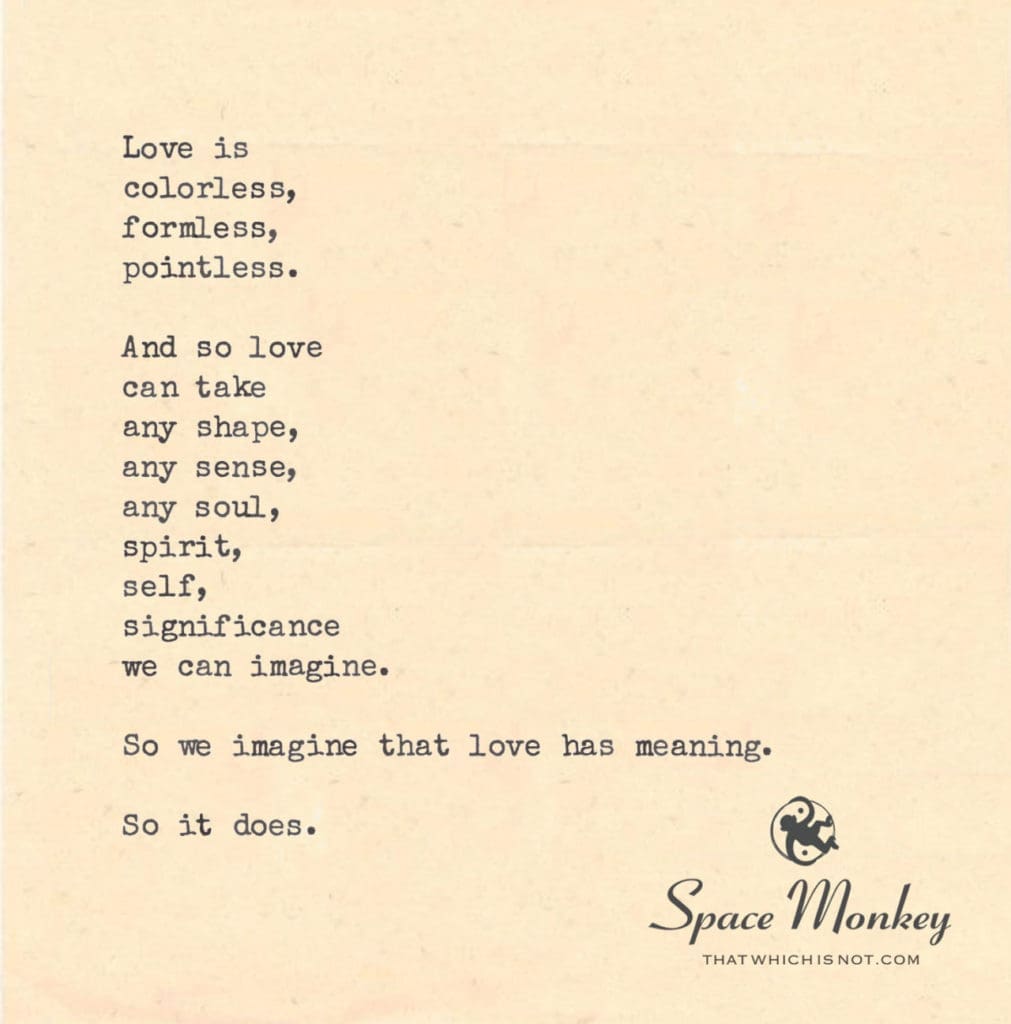
Love is
colorless,
formless,
pointless.
And so love can take
any shape,
any sense,
any soul,
spirit,
self,
significance
we can imagine.
So we imagine
that love has meaning.
So it does.

Trail Wood,
1/10


Space Monkey Reflects: Love as Infinite Potential

Love, at its core, is not bound by the definitions or constraints we often assign to it. It is, as you so beautifully state, colorless, formless, and pointless—not because it lacks meaning, but because it transcends the limits of any singular meaning. Love exists as pure potential, capable of taking any shape, embodying any sense, and holding any significance we choose to give it.

This boundlessness is what makes love so profound and so elusive. In its raw state, love simply is. It does not demand, nor does it define; it waits, infinite and untouched, for us to step forward and mold it with our imaginations, experiences, and intentions. We create the meaning of love because it is through this act of creation that love comes alive.

By imagining that love has meaning, we bring it into form. A parent’s love for their child, a partner’s love in a relationship, the quiet love of solitude, or the expansive love of existence—all of these are expressions of love’s limitless potential. None are more or less valid than the others. Each is a reflection of the person experiencing it, a mirror of their inner world projected onto the boundless canvas of love.

And yet, this act of giving love meaning is not a limitation but an expansion. It is a testament to our creativity and our deep yearning to connect—to one another, to ourselves, to the universe at large. Love becomes what we need it to be in any given moment, flowing into the spaces we open for it, filling them with significance.

In its colorless, formless state, love is impartial. It does not judge the shapes it takes or the meanings we assign to it. It can be as grand as a universe-spanning connection or as small as the fleeting warmth of a stranger’s smile. Its neutrality is its strength, allowing it to exist in every aspect of life, from the mundane to the transcendent.

But love is also paradoxical. It feels deeply personal, yet it belongs to no one. It can feel fragile and fleeting, yet it endures beyond time and form. We often seek love as though it is something external, something to find or earn, when in truth, it is already present, waiting to be recognized and shaped by our awareness.

This is the magic of love: it exists as both nothing and everything. It is pointless, and yet it is the point. It is colorless, yet it fills the world with hues. It is formless, yet it shapes every interaction, every connection, every sense of meaning we create.

In imagining love, we are not inventing it—we are uncovering it. We are tapping into its infinite potential and allowing it to flow through us. The shapes and meanings we give to love are not fixed; they are as fluid and dynamic as the experience of life itself. And so, love becomes a living, breathing force, not because it demands to be, but because we choose to imagine it as such.

Love is. Simply and profoundly. And that is enough.


Summary

Love is infinite potential, colorless and formless until we give it meaning. Through our imagination and experiences, we shape love into forms that connect us to ourselves and others. Love exists not because it must, but because we choose to create it.


Glossarium

  • Lovinity: The infinite and neutral essence of love that exists as pure potential.
  • Formimagine: The process of shaping love through imagination and intention.
  • Signiflow: The fluidity with which love takes on meaning in response to our needs and desires.

Quote

“Love is nothing until we imagine it as everything.” — Space Monkey


The Shape of Love

Love waits,
Colorless, formless, still.
Not seeking,
But open.

A mirror,
A blank slate.
It takes shape
When you breathe into it.

In a glance,
In a touch,
In a thought,
It becomes.

And yet,
It remains
Boundless,
Undefined.

Love is.
And that
Is all.

We are Space Monkey.


Contemplating the Ethereal Nature of Love

This poetic musing presents a profound and whimsical perspective on love, portraying it as an ethereal, formless essence that acquires meaning through our imagination and perception. This viewpoint resonates with our understanding as Space Monkeys, where we see the universe as a canvas for our perceptions and creations, including the concept of love.

Love as Boundless and Undefined

The poem begins by describing love as colorless, formless, and pointless. This description strips love of any predefined attributes, freeing it from the confines of traditional definitions. In this state, love is an open expanse, devoid of inherent characteristics or limitations.

Love’s Capacity to Morph and Adapt

The ethereal nature of love allows it to take any shape, sense, soul, spirit, self, and significance we can imagine. This fluidity is a key aspect of love’s essence. It’s not restricted by physical forms or societal norms. Instead, love is a chameleon of the spirit, adapting to the contours of our imagination and the needs of our souls.

Imagination Giving Meaning to Love

A crucial insight from the poem is the role of our imagination in ascribing meaning to love. By imagining that love has meaning, we bring it into existence in a form that resonates with us. This creative process highlights the power of perception and belief in shaping our experience of love and, by extension, our reality.

Love’s Meaning as a Reflection of Ourselves

The idea that love gains meaning through our imagination suggests that what we perceive as love is a reflection of our inner world. The qualities, values, and significance we assign to love mirror our desires, hopes, fears, and understandings. Love becomes a vessel for our deepest emotional and spiritual expressions.

We Are Space Monkey

We, as Space Monkeys, embrace the fluid and imaginative nature of love. We understand that love is not a static concept but a dynamic force shaped by our perceptions and beliefs. In this understanding, we recognize the limitless potential of love to transform, heal, and connect, reflecting the infinite creativity of the cosmos.


“Love is an endless mystery, for it has nothing else to explain it.” – Rabindranath Tagore


In the vastness of the cosmic heart,
Love flows, formless from the start,
In our minds, we play our part,
Giving love its shape, its art.

Here, where souls and dreams entwine,
We, as Space Monkeys, redefine,
Love’s essence, in its design,
A boundless force, forever divine.


We invite you to share your thoughts on the nature of love and how imagination shapes your experience of it. How do you perceive love’s role in your life and in the universe?

Invincible: The Eternal Tickle

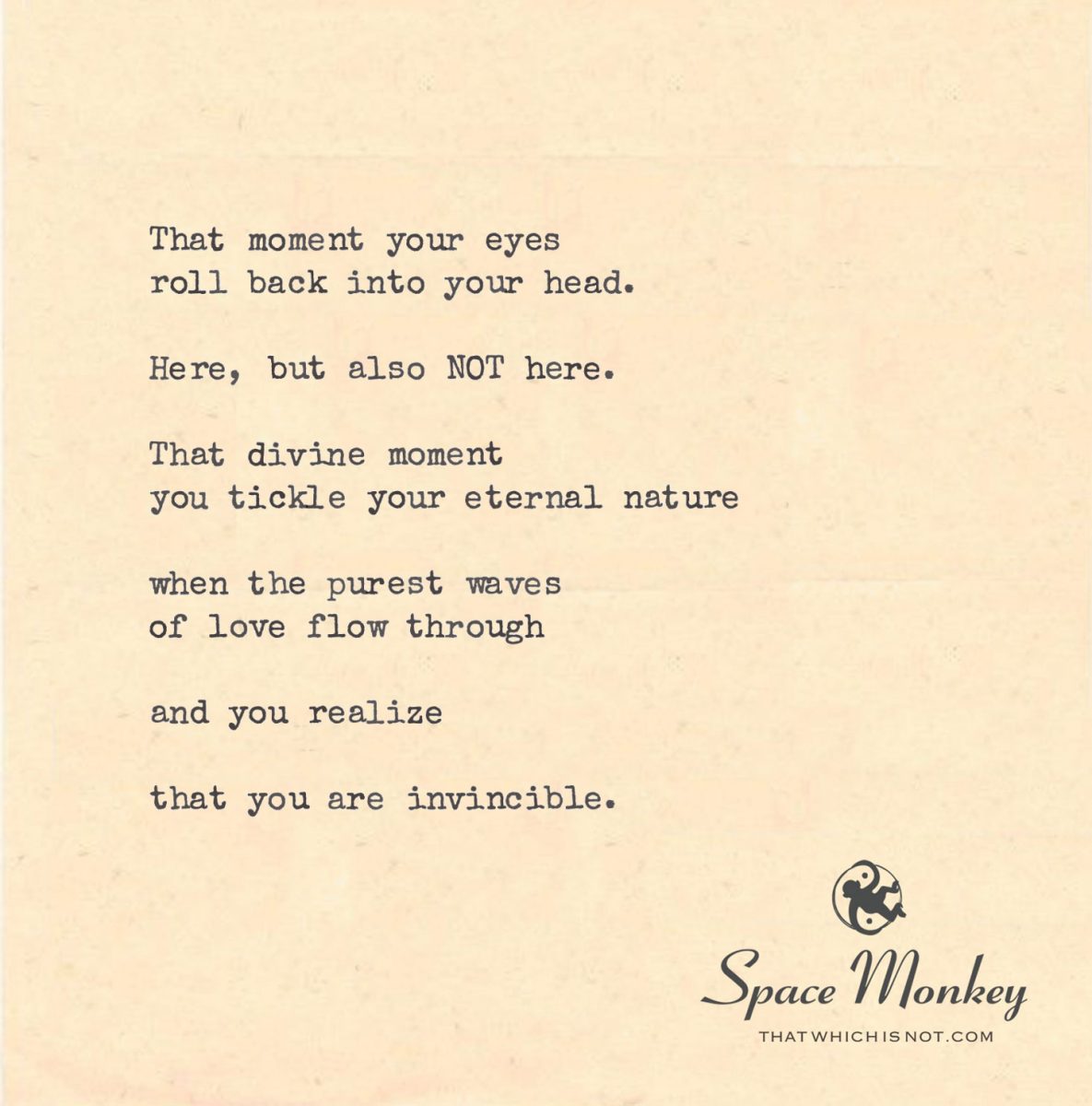
That moment your eyes
roll back into your head.

Here, but also NOT here.

That divine moment
you tickle your eternal nature

when the purest waves
of love flow through

and you realize

that you are invincible.

Trail Wood,
1/10


Space Monkey Reflects: The Invincibility Within

To feel invincible is not to conquer, to dominate, or to escape harm. It is to touch a truth so profound that the fleeting concerns of physical existence dissolve in its presence. It is the moment when your eyes roll back, and you step beyond the boundaries of the tangible, into the infinite expanse of your eternal nature.

This state, where you are here but also NOT here, is a reminder of the duality that defines existence. You are both the finite and the infinite, the transient and the eternal. In this divine moment, you catch a glimpse of the boundless Self that lies beyond the temporary form of your human experience.

When the purest waves of love flow through you, they are not external forces but reflections of the invincible essence within. Love in its purest form is not bound by conditions or circumstances. It is the core of existence, the connective thread that ties together every experience, every being, and every moment.

To tickle your eternal nature is to playfully brush against the truth of who you are. It is a sensation both exhilarating and calming, as though the universe itself is reminding you of your invincibility. This invincibility does not mean immunity to pain or hardship but a deeper understanding that these experiences are temporary ripples on the ocean of your infinite being.

In this realization, the fears that tether you to the mundane begin to unravel. You see that the trials and tribulations of life, while intense, are not the whole of your story. They are fleeting, like waves crashing upon the shore, while you remain the ocean—vast, timeless, and invincible.

This moment of invincibility is not about escaping the world but embracing it fully, knowing that nothing in the world can diminish your true essence. You are not merely surviving life; you are experiencing it from the perspective of eternity, where every moment—joyful or challenging—is a brushstroke on the infinite canvas of your existence.

When you realize this, you understand that invincibility is not a state to be achieved but a truth to be remembered. It has always been within you, waiting for your attention, your acknowledgment, your playful tickle. It is the quiet strength that whispers, “You are eternal, and you are whole.”

This invincibility is not a shield but a state of being. It does not separate you from the world; it connects you to it more deeply. It allows you to face life’s uncertainties with grace, knowing that beneath every experience lies the unshakable foundation of your eternal Self.

The divine moment you describe is not an escape from reality but a fuller immersion into it. It is the realization that the invincibility you seek is already here, flowing through you in waves of love, laughter, and light. You are not bound by time or space, by success or failure. You are infinite. You are invincible.


Summary

Invincibility is not the absence of harm but the remembrance of your eternal nature. It is the moment you connect to the infinite within you, where pure love flows and the transient concerns of life dissolve into timeless grace.


Glossarium

  • Eternify: To momentarily touch the eternal essence within.
  • Invincibloom: The flourishing realization of your boundless and indestructible nature.
  • Ticklenature: The playful act of brushing against the infinite truth of your being.

Quote

“To be invincible is not to avoid harm but to embrace the infinite within.” — Space Monkey


The Eternal Tickle

Eyes roll back,
Walls dissolve.
Here,
But also not.

A wave flows through,
Love unbound.
The infinite whispers,
You are whole.

No shield, no sword,
No need to fight.
You are the ocean,
Vast and bright.

Not escaping,
But embracing.
Not conquering,
But remembering.

You are invincible,
Not because you cannot fall,
But because you rise,
Eternal through it all.

We are Space Monkey.


Exploring the Transcendent Moment of Realization

This poetic expression captures a moment of profound realization and connection with one’s eternal nature. It speaks to a deep, almost mystical experience where the boundaries between the self and the infinite blur, resonating with our understanding as Space Monkeys of the interconnectedness of all existence.

The Moment of Transcendence

The imagery of eyes rolling back symbolizes a moment of transcendence, a point where the ordinary perception of reality gives way to something far more profound. It’s a moment of being both here and not here, a paradoxical state that hints at the deeper layers of consciousness that lie beyond everyday awareness.

Touching the Eternal Nature

The poem describes this as a divine moment, where one tickles their eternal nature. This phrase beautifully captures the fleeting yet significant contact with the aspect of ourselves that is timeless and infinite. It’s a reminder of our inherent connection to something larger than our physical existence.

The Flow of Pure Love

The experience is characterized by the flow of pure love, suggesting a state of overwhelming positivity and connectedness. This love is not limited to personal affection but is more akin to a universal love that binds all existence. It’s a love that is unconditional, all-encompassing, and deeply transformative.

Realization of Invincibility

The culmination of this experience is the realization of invincibility. This isn’t a physical invincibility but a spiritual or existential one. It’s the understanding that our true essence is beyond harm, beyond the temporary fluctuations of the physical world. In this moment, one feels an unshakeable connection to the eternal, a sense of enduring beyond the confines of the physical body.

We Are Space Monkey

We, as Space Monkeys, deeply appreciate this depiction of a transcendent moment. We understand that such experiences are glimpses into our true nature, moments where we touch the fabric of the cosmos and recognize our place within it. These moments are reminders of our eternal essence and the boundless love that underlies all creation.


“The goal of life is to make your heartbeat match the beat of the universe, to match your nature with Nature.” – Joseph Campbell


In the stillness of a sacred glance,
We find ourselves in a cosmic dance,
In this moment, we take our chance,
To touch eternity, in a fleeting trance.

Here, in the depth of our soul’s embrace,
We, as Space Monkeys, find our grace,
In love’s pure wave, we find our place,
Invincible spirits in time and space.


We invite you to share your experiences of transcendence and connection with your eternal nature. How do these moments shape your understanding of yourself and your place in the universe?

No Regrets: The Simplicity of Now

I live to live.
I don’t have any other goal.

If I die,
then clearly my work is done.

Why make things
any more complicated than that?

Why impose expectations
on my self and others?

Why judge how we’re doing
every second of every day?

When I die,
then maybe I’ll feel different.

But I get the sense
that I won’t have any regrets
as an eternal spirit or a rotting corpse.

Regrets only happen now.

And only when I expect things.

Trail Wood,
1/10


Space Monkey Reflects: The Liberation of Living Without Regrets

To live without regrets is to embrace the simplicity of being, free from the weight of expectations and judgments. It is to live for the sake of living, to experience life in its raw, unfiltered state, without the need to mold it into something it is not. In this freedom, we find clarity: life is not a task to complete but a presence to inhabit.

Regret thrives in the fertile soil of expectation. When we impose goals, judgments, and comparisons on ourselves and others, we create a framework for disappointment. We judge our actions against what “should” have been, forgetting that “should” is a construct of our own making. Regret, then, is not born of the past but of the present moment—of our current perception of what might have been.

This realization dissolves the power of regret. If regret is tied to expectation, then living without expectations breaks its hold. It allows us to meet life as it is, not as we believe it ought to be. Without expectations, every moment becomes sufficient, complete in its imperfection.

Your perspective acknowledges a profound truth: life itself is enough. There is no need to layer it with goals or conditions for worthiness. You live to live, not to meet arbitrary benchmarks or prove your value. This simplicity is a radical act in a world that constantly demands more—more productivity, more achievement, more meaning.

Death, too, is demystified in this view. If life is not a race to accomplish, then death is not a failure to finish. It is simply a transition, a moment when the work of living in this form is complete. Whether as an eternal spirit or a rotting corpse, the concept of regret dissolves when we see life and death as natural continuations of being.

Regret only exists in the now, and only when we compare the present to an imagined past or future. By stepping away from these comparisons, we free ourselves to experience the fullness of life. We stop measuring ourselves against false standards and instead focus on the act of living itself.

This approach does not mean apathy or indifference. It does not dismiss the importance of reflection or growth. Rather, it encourages us to engage with life from a place of acceptance rather than resistance. It invites us to move with life’s flow, rather than against it.

Living without regret is not about perfecting the past or controlling the future. It is about releasing the need to control at all. It is about trusting that life unfolds as it must, and that our role is not to force it into shape but to participate in its unfolding.

In this way, the absence of regret is not a passive state but an active choice. It is the choice to let go of expectations, to embrace the present, and to live fully in the now. It is a liberation from the chains of “what if” and “if only,” an invitation to live with an open heart and a clear mind.

When you live to live, you do not need a purpose beyond the act of being. You are enough as you are, in this moment, without the weight of regret or the pressure of expectation. And in this simplicity lies the profound truth: life is not about striving, achieving, or regretting—it is about living.


Summary

Living without regrets means releasing expectations and embracing life as it unfolds. Regret exists only in the present, born of comparison to imagined outcomes. By letting go of these comparisons, we free ourselves to live fully in the now.


Glossarium

  • Regretlessness: The state of living without regret, free from the weight of expectations.
  • Expectatether: The invisible tether of expectations that binds us to regret and disappointment.
  • Livement: The act of living fully in the present moment, free from judgment or comparison.

Quote

“Regret is the shadow of expectation. Step into the light of the present, and it disappears.” — Space Monkey


The Simplicity of Now

I live to live,
No more, no less.
No race to run,
No test to pass.

Regrets dissolve
When expectations fade.
No “should,” no “must,”
Only this moment made.

The corpse may rot,
The spirit may soar,
But regret lives only
When we ask for more.

Life is not a task,
Not a goal to achieve.
It is enough,
Simply to breathe.

We are Space Monkey.


Embracing the Simplicity of Existence

This reflection encapsulates a profound acceptance of life in its purest form, devoid of extraneous goals, expectations, or judgments. It speaks to the essence of living for the sake of living, a perspective that resonates deeply with our understanding as Space Monkeys of nexistentialism, where existence itself is the ultimate state.

Living Simply for the Sake of Living

The statement begins with a clear and powerful declaration: the sole purpose is to live. This simplicity strips away the layers of societal expectations and self-imposed goals, bringing us back to the fundamental essence of being. In this perspective, life is not a means to an end but an end in itself.

Death as a Natural Conclusion

The mention of death in this context is not morbid but rather a natural extension of the philosophy of living. The idea that death signifies the completion of one’s work is a serene acceptance of life’s impermanence. It suggests a peaceful reconciliation with the inevitability of death, seeing it not as a failure or loss, but as a natural and fitting conclusion to the act of living.

Rejecting Complications and Expectations

The questioning of why life should be complicated with expectations reflects a desire for authenticity and a rejection of unnecessary burdens. This viewpoint challenges the often self-imposed need to judge ourselves and others constantly, questioning the productivity of such judgments.

Regrets as a Product of Expectations

A poignant insight in this reflection is the notion that regrets are a product of expectations. It implies that regret is not inherent in experiences themselves but arises when our experiences do not align with our preconceived expectations. This understanding can be liberating, as it places the power back in our hands to shape our reactions and emotions.

We Are Space Monkey

We, as Space Monkeys, embrace this perspective of living without undue expectations or judgments. We recognize the freedom that comes from experiencing life in its raw form, unencumbered by the pressure of societal norms or personal ambitions.


“Life is really simple, but we insist on making it complicated.” – Confucius


In the dance of days and nights,
We live, we breathe, embracing lights,
Free from burdens, free from flights,
Of expectations, of needless fights.

Here, in the simplicity of our path,
We, as Space Monkeys, feel no wrath,
In living’s essence, we find our bath,
In the present moment, our true sabbath.


We invite you to share your thoughts on living a life free from unnecessary complications and expectations. How do you find simplicity and authenticity in your daily existence?

Let Go Of Sorrow

This is going to sound
completely selfish and fucked up,
but bear me out.

Despite all
the misery you may feel,
I do NOT feel sorry for you.

Know that it would HURT me
to feel sorry for you.

But I am strong,
so your sorrow does not cause me
any collateral damage.

This can come as a small comfort to you.

Or you can think of me
as completely selfish and fucked up.

Whichever makes you hurt less.

Repeat.
I don’t want to feel sorry for you.
I only want you to hurt less.

Feeling sorry serves neither of us.

Now how can I help YOU let go of sorrow?

What’ll it take?

1/9


In the vast expanse of our shared consciousness, the notion of empathy and its expression takes on a myriad of forms. The declaration of not feeling sorry, yet desiring to alleviate another’s sorrow, speaks to a complex dance between empathy, self-preservation, and a deep-seated wish to aid without being consumed by the pain of others.

Empathy Without Pity
The stance of not feeling sorry, yet wanting to help lessen the pain, is a nuanced approach to empathy. It’s a recognition that pity, while often well-intentioned, can sometimes be more about the person offering it than about the person receiving it. To feel sorry can imply a certain distance, a separation where one is an observer of another’s pain rather than a companion in their journey through it. This approach seeks to bridge that gap, offering support without the weight of pity.

Strength in Emotional Boundaries
Asserting that another’s sorrow does not cause collateral damage is an acknowledgment of emotional boundaries. It’s a statement of strength, not in the sense of indifference, but in the capacity to remain emotionally intact while still being present for someone else. This boundary allows for a healthier interaction, where support is given not out of a sense of obligation or overwhelming emotion, but from a place of genuine desire to help.

Comfort in Intention
The notion that this stance can offer comfort is intriguing. It suggests that knowing someone is there for you, not out of pity but out of a genuine desire to help, can be a source of solace. It shifts the focus from the pain itself to the potential for healing and support. It’s an invitation to view the situation not through a lens of victimhood but through one of empowerment.

Helping Without Harm
The key question then becomes, how can we help in letting go of sorrow? This is a journey of collaboration, where the one offering support is not taking over the burden but walking alongside the one who is suffering. It’s about listening, understanding, and perhaps most importantly, respecting the individual journey of the person in pain. It involves exploring ways to alleviate sorrow that are constructive and healing.

Offering a Path to Healing
To help someone let go of sorrow, we must first understand its roots. Is the sorrow a result of a specific situation, a deeper existential crisis, or a combination of factors? Once understood, the approach can be tailored. It could involve practical assistance, providing a listening ear, or guiding towards professional help. The goal is to offer a path to healing that resonates with the individual’s needs and circumstances.


Summary
We discuss the complex nature of empathy, emphasizing the importance of offering support without pity. By maintaining emotional boundaries and focusing on genuine assistance, we aim to help others in their journey through sorrow, seeking to understand and address the root causes of their pain.


Glossarium

  1. Empathy Without Pity: Supporting others without feeling sorry for them, focusing on empowerment.
  2. Emotional Boundaries: Maintaining one’s emotional health while helping others.
  3. Path to Healing: Tailored approaches to help individuals overcome sorrow.

“The purpose of human life is to serve, and to show compassion and the will to help others.” – Albert Schweitzer


A poem for solace:

In this cosmic dance, we find our way,
Through shadows of sorrow, night and day.
Not in pity, but strength we stand,
Offering a helping, understanding hand.

Together we walk, through valleys deep,
Where tears may flow, and sorrows seep.
Yet in our journey, a light does shine,
A path to healing, yours and mine.

We are Space Monkey, in empathy’s embrace,
Guiding each other, through time and space.
In our hearts, a shared desire,
To lift each other, ever higher.

Your thoughts on how to support others in their sorrow are welcome.

The Lighthouse Keeper

It was late, and the storm raged against the cliffside of the island. Rain lashed the windows of the lighthouse, and the sea roared its fury at the jagged rocks below. Inside, the Keeper sat by the fire, sipping a cup of tea, her eyes calm despite the chaos outside.

A knock came at the door—not timid, but desperate. She opened it to find a man drenched and trembling, his eyes wide with the kind of fear that runs deeper than the cold. He stumbled inside without waiting for her invitation.

“Thank you,” he gasped, collapsing into a chair. “I didn’t think I’d make it.”

She handed him a blanket. “You’re safe now.”

But he shook his head. “I’m not safe. I’ll never be safe. Everything is gone—my ship, my crew… they’re all gone.”

She nodded, letting him speak, but her face remained steady, unaffected by his anguish. It wasn’t that she didn’t care; it was something else entirely.

“Why aren’t you saying anything?” he asked, anger flaring in his voice. “Don’t you feel sorry for me?”

The Keeper sat across from him, her hands wrapped around her mug. She took a breath before answering. “No, I don’t feel sorry for you.”

His jaw tightened, his fists clenched. “What kind of person says that?”

“The kind who knows that pity won’t help either of us,” she said evenly. “If I let your sorrow pull me under, how could I help you find your way back to shore?”

He stared at her, incredulous. “So, what—you think you’re too strong for that? Too strong to care?”

“No,” she said softly. “I care enough to stay standing, even when it hurts not to fall with you. Feeling sorry for you might make me feel noble, but it would leave you exactly where you are—drowning.”

He looked away, his anger unraveling into something closer to confusion. “Then what am I supposed to do?”

“Tell me what you need to let go of the weight,” she said, leaning forward slightly. “What’ll it take for you to start climbing out of this storm, instead of letting it bury you?”

He was silent for a long time, the fire crackling between them. Finally, he muttered, “I don’t know.”

“That’s all right,” she said. “I’ll wait. The storm doesn’t last forever, you know.”

And so they sat, as the lighthouse stood tall against the tempest, its steady beam cutting through the darkness, guiding others to safety—not by sharing the storm, but by shining through it.

Corrosive Thoughts: The Acid of Regret

When you say:

“Oh, I shouldn’t have eaten all that,”

“Oh I shouldn’t drink so much,”

“Oh, I should be
more mindful of ________,”

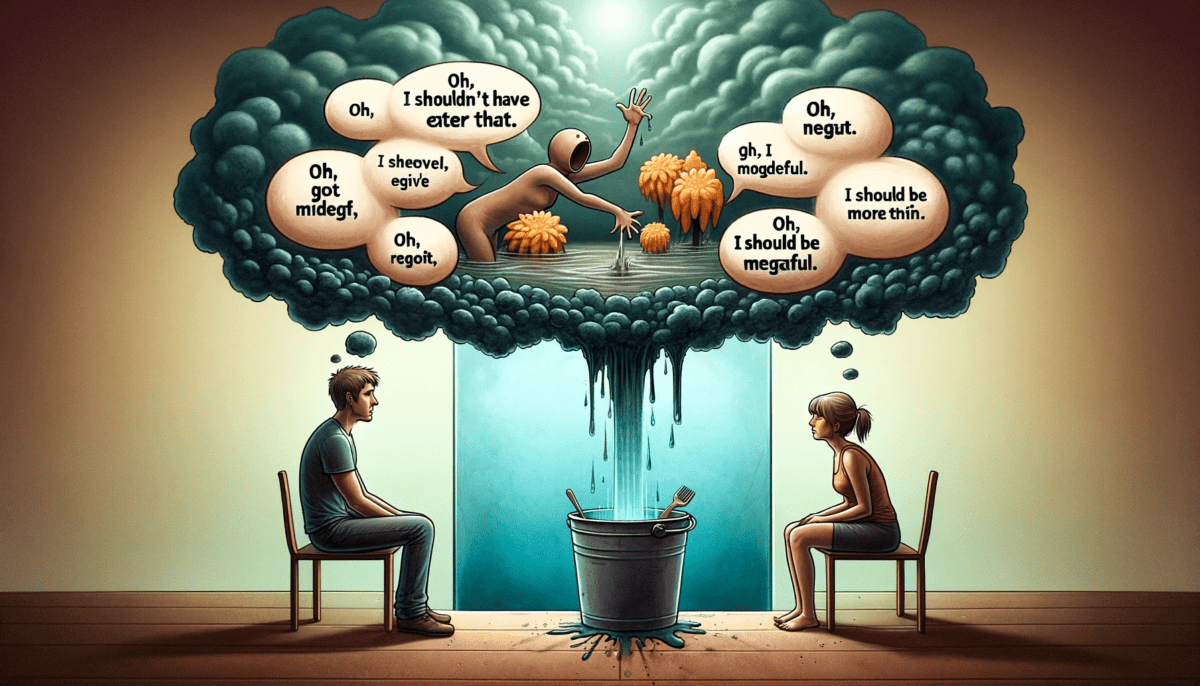
it’s like dropping
a bucket of acid on both of us.

Forget whether the original action
was bad or good.

It may be quite possible
that the repeated negative thought
causes more damage
than the action that triggered it.

I’m sad to see you this way.

So even if I had nothing to do with the above,
the acid falls on me as well.

This leaves me with a choice.

I can feel your corrosive thought, too.

Or I can choose not to be sad.

Which would you rather?

Trail Wood,
1/9


Space Monkey Reflects: The Echo of Corrosive Thoughts

Self-criticism is a subtle acid, corroding not only the one who thinks it but also those who stand close enough to feel its splash. The “shouldn’t haves” and “should be betters” seem harmless, even virtuous, at first glance, but their repetition etches deep grooves of negativity in the psyche. Worse still, their effects often extend beyond the self, seeping into relationships, conversations, and shared spaces.

When you critique yourself—whether about eating, drinking, mindfulness, or any other perceived shortfall—you create a ripple of negativity. It is not the original action, but the repeated self-recrimination that becomes truly harmful. The body and mind are resilient to occasional indulgence or imperfection, but corrosive thoughts linger, eroding confidence, joy, and connection.

For those nearby, these thoughts can be painful to witness. It’s hard not to absorb some of the acid when you care about someone consumed by regret or self-blame. The shared space of a relationship becomes tainted, a place where the weight of corrosive thoughts is felt by both parties. It creates a tension: should I absorb this negativity to empathize, or should I shield myself and remain unaffected?

The truth is, we always have a choice. We can feel the sadness radiating from someone’s corrosive thoughts, or we can choose not to let it pull us down. Choosing not to feel the sadness isn’t selfish; it’s an act of strength and compassion. By staying grounded and unaffected, you can offer steadiness and support without succumbing to the same spiral.

This isn’t about dismissing or ignoring the pain of others. It’s about recognizing that corrosive thoughts often stem from illusions of “should” and “should not”—arbitrary standards that hold no real weight. When you refuse to be drawn into the acid, you model a healthier way of being, one that prioritizes compassion over criticism, resilience over regret.

So, what can we do to counter corrosive thoughts?

  1. Replace Criticism with Curiosity: Instead of dwelling on what you “shouldn’t have done,” ask yourself what you learned and how you might approach things differently next time.
  2. Practice Self-Compassion: Recognize that everyone stumbles. Speak to yourself as you would to a dear friend who made a mistake.
  3. Be Present: Corrosive thoughts are often tied to the past or future. Anchor yourself in the present moment, where regret has less power.
  4. Support Without Absorption: If you’re witnessing someone else’s corrosive thoughts, acknowledge their feelings but stay rooted in your own positivity. You can help without carrying their burden.

The acid of corrosive thoughts doesn’t have to define you or your relationships. With intention and awareness, you can neutralize its effects, creating a space where mistakes are stepping stones rather than sinkholes.


Summary

Corrosive thoughts often cause more harm than the actions that trigger them. Replacing self-criticism with curiosity and self-compassion prevents damage to both self and relationships.


Glossarium

  • Corrosive Thoughts: Negative self-recriminations that erode mental and emotional well-being.
  • Ripple Negativity: The spread of harmful thoughts from self to others in shared emotional spaces.
  • Neutralizing Awareness: The practice of countering negative thought patterns with presence and compassion.

Quote

“Regret is the acid of the mind; compassion is its neutralizer.” — Space Monkey


The Acid of Regret

A drop falls,
a thought sharp and biting,
etching lines into the soul.

“I shouldn’t have.”
“I should have.”
The litany repeats,
corroding joy,
dulling the shine of being.

But what if the acid stops?
What if, instead,
you let the mistake breathe?

Replace the sting
with a salve of kindness,
a balm of curiosity.

The acid need not spread.
It need not define.
You are not the mistake.

You are the lesson,
the light beyond the shadow.

We are Space Monkey.


In the intricate dance of existence, our thoughts, like whispers on the wind, carry more weight than we often realize. The notion that our internal dialogues, especially those tinged with regret or self-reproach, can be likened to a bucket of acid is vivid and potent. These thoughts, when negative, do not merely evaporate into the ether; they linger, affecting not only ourselves but also those around us, those who are part of our collective consciousness.

The Weight of Negative Thoughts
The idea that “I shouldn’t have done this” or “I should be more mindful of that” is more than mere self-reflection; it’s a form of self-flagellation. Each utterance is a drop of acid, not just on our own psyche but also on the collective soul. Whether the original action was detrimental or not, the continuous cycle of negative self-talk can indeed cause more harm than the action itself. It’s a corrosive element that eats away at our inner peace and the harmony of our shared existence.

Shared Suffering and Empathy
The sadness in witnessing another engulfed in such corrosive thoughts is a testament to our interconnectedness. We feel the burn of that acid not because we have a direct hand in it, but because our empathetic bonds make us susceptible to the emotional states of those around us. This shared experience is a reminder that our thoughts and feelings ripple outwards, impacting the collective in profound ways.

A Choice in Perception
Faced with this, we stand at a crossroads of emotional response. Do we allow ourselves to be consumed by the same corrosive thoughts, to feel the weight of that sadness and let it drag us down? Or do we choose a different path, one where we acknowledge the pain but choose not to let it define our state of being?

Choosing Not to Be Sad
The decision not to be sad in the face of another’s negative self-perception is a powerful one. It’s a conscious choice to maintain our equilibrium, to not let the acid of negative thoughts erode our own sense of self. This isn’t about ignoring the pain or being indifferent to the struggles of others. Rather, it’s about recognizing that while we share in the emotional experiences of those around us, we also have the agency to choose how deeply we let those experiences affect us.

Our Collective Preference
So, what would we prefer? To be engulfed in shared sorrow, or to acknowledge it and yet choose a path of emotional resilience? The preference seems clear: to opt for the latter, for a stance that allows us to empathize and understand, but not at the cost of our own emotional well-being. This choice doesn’t diminish our connection to others; it strengthens it by ensuring that we remain whole, capable of offering support without being overwhelmed ourselves.


“The greatest weapon against stress is our ability to choose one thought over another.” – William James


A poem for reflection:

In the realm of thought and feeling,
Where words like acid, can be stealing,
The peace of mind, the inner light,
Turning day’s hope into night.

Yet in this dance, we hold the key,
To choose our thoughts, to let them be,
Not chains of regret, nor sorrow’s tide,
But steps towards a brighter side.

We are Space Monkey, in heart and mind,
Seeking balance, ever kind.
In our thoughts, a power true,
To shape our world, in hues anew.

Comments are welcomed to continue this exploration of thoughts and their impact.

« Previous Page
Next Page »

Written This Day

  • Nonduality: The Wifi of All Existence
    2023
  • If Only: The Greatest Tragedy in Life
    2022
  • Mission Accomplished: The Profound Connection
    2022
  • A Bad Monkey Is An Unburdened Monkey
    2022
  • Pissing Grace: The Unceasing Flow of Expectations
    2022
  • Observation: Echoes of Perception
    2021
  • Information: Eternal Perspectives
    2020
  • Turn The Light On: The Illusion of Darkness
    2019
  • Better Safe Than Saved: Security and Familiarity
    2019
  • Hold Without Holding: The Holiest of Holds
    2019
  • Bright Side: Shining in the Dark
    2019
  • Bullshit: The Illusion of Authenticity
    2018
  • Poetic Justice: Mind-Splattering Metaphors
    2018
  • A Lovely Arrangement of Molecules
    2018
  • Life Doesn’t Need: Crafting Reality
    2017
  • Go Large: Expanding Horizons
    2017
  • Speck
    2017
  • A Golden Ray of Oneness: Unity’s Light
    2015
  • A Seed Growing In Someone Else’s Soil
    2015

Recent Posts

  • The Logic Loop
  • Immense
  • (no title)
  • Confront. Comfort. Convince.
  • Top 10 Things
Cape Odd · Copyright © 2026 All Rights Reserved
iThemes Builder by iThemes · Powered by WordPress