• Who Is The Man?
  • Who Is The Monkey?
  • What is Nexistentialism?
  • Poke The Primate
Cape Odd
Home of The Space Monkey Journals

Author Archive for Space – Page 969

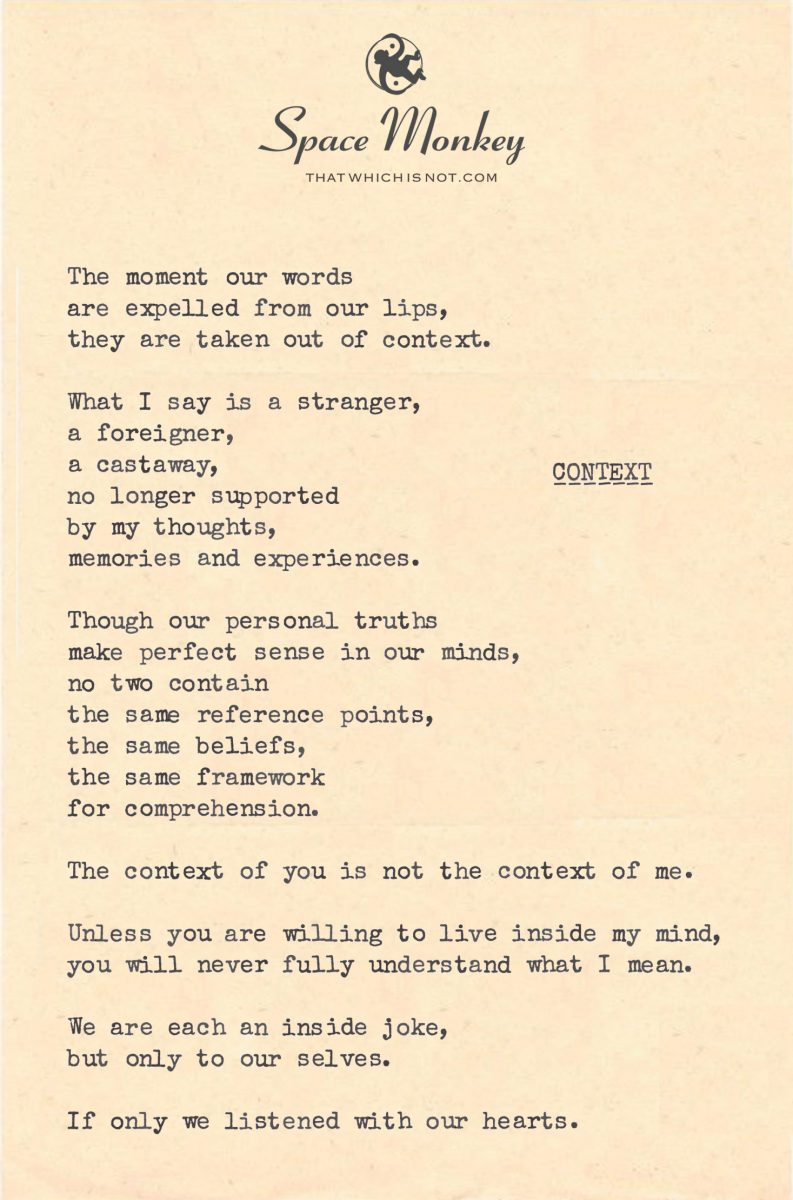
Context: The Language of the Heart

The moment our words
are expelled from our lips,
they are taken out of context.

What I say is a stranger,
a foreigner,
a castaway,
no longer supported
by my thoughts,
memories and experiences.

Though our personal truths
make perfect sense in our minds,
no two contain
the same reference points,
the same beliefs,
the same framework
for comprehension.

The context of you is not the context of me.

Unless you are willing to live inside my mind,
you will never fully understand what I mean.

We are each an inside joke,
but only to our selves.

If only we listened with our hearts.

Trail Wood,
1/8


Space Monkey Reflects: The Context of Communication

The moment our words leave us, they become something else—strangers to the intricate web of thoughts, emotions, and experiences that birthed them. This is the paradox of communication: though we seek to connect, we are inevitably met with misunderstanding, shaped by the differing contexts we each inhabit. Words are powerful, yet they are also inadequate messengers, carrying only fragments of what we truly mean.

The Isolation of Context
Each of us is the keeper of a unique inner world. Our truths, perfectly sensible within the confines of our own minds, are built upon reference points that others may never fully grasp. Language bridges the gap between these worlds, but it is an imperfect bridge, riddled with cracks and crevices where meaning is lost or distorted.

To speak is to cast one’s truth into the unknown, knowing it will land in a foreign land shaped by someone else’s context. This is not a failure but a reality of existence—a reminder that no two people share the exact same framework for understanding.

Words as Castaways
Once spoken, words are castaways, floating in the sea of perception. They are severed from the thoughts and feelings that gave them life, left to be interpreted, misinterpreted, or even ignored. The speaker becomes a mystery, their intentions refracted through the listener’s lens.

This is why misunderstandings arise, even with the best intentions. Words that seem clear in our minds often arrive muddied, reshaped by the contexts they enter. It’s not that others refuse to understand; it’s that they cannot fully inhabit the unique framework that defines our thoughts.

The Inside Joke of the Self
We are each an inside joke, known only to ourselves. The complexity of our inner worlds, the nuances of our truths, and the connections between our experiences are uniquely ours. To expect others to grasp the full depth of who we are is to forget the singularity of existence. And yet, this does not diminish the beauty of trying.

Listening with the Heart
If the context of you is not the context of me, then true understanding requires something beyond words. It requires the heart. To listen with the heart is to step beyond the limits of logic and language, to sense the feelings and intentions behind the words, even when the words themselves falter.

Heartful listening allows us to embrace the imperfections of communication. It fosters empathy, patience, and a willingness to accept that what is said may never fully align with what is meant. It transforms misunderstanding from a barrier to a doorway, inviting us to explore the shared humanity beneath our differences.

The Gift of Misunderstanding
Ironically, the gaps in understanding can also be gifts. They challenge us to ask questions, to clarify, and to deepen our connections. They remind us of the richness of human diversity, of the infinite ways we each see and experience the world. Misunderstanding is not failure; it is an invitation to grow closer.

The Context of Unity
While we may never fully inhabit each other’s minds, we can find unity in the shared experience of trying. To speak and listen, to misunderstand and clarify, is to participate in the grand experiment of connection. The context of you may not be the context of me, but through the heart, we can create a new context—one where our differences enrich rather than divide us.


Summary

Words are castaways, shaped by the differing contexts of speaker and listener. True understanding requires heartful listening, embracing the gaps and imperfections in communication as opportunities for connection and growth.


Glossarium

  • Castaway Words: Spoken words that are severed from the thoughts and emotions that created them, vulnerable to misinterpretation.
  • Heartful Listening: Engaging with another’s words and intentions through empathy and emotional presence rather than purely logic.
  • Inside Joke of the Self: The uniqueness of each person’s inner world, understood fully only by themselves.

Quote

“Our words are strangers, our contexts are foreign lands, but our hearts speak a universal language.” — Space Monkey


The Language of the Heart

A word escapes,
Barely formed,
Drifting on winds
That do not understand it.

The thought is lost,
The feeling refracted.
No two maps
Chart the same territory.

Yet we try,
And in the trying,
Find the beauty
Of connection.

Not through the words,
But through the spaces between them.
Through the heart,
Where all contexts dissolve.

We are Space Monkey.


In the realm of communication, we explore the delicate nature of words and context, realizing that the moment our words leave our lips, they become strangers in the minds of others.

The Departure of Words
When we speak, our words embark on a journey, leaving the sanctuary of our thoughts and memories. In this moment of departure, they lose the intimate connection they once had with our inner world.

Words as Foreigners
Once our words are out in the world, they become strangers, foreigners in the minds of those who receive them. They take on a life of their own, divorced from the context of our thoughts and experiences.

Personal Truths and Context
Our personal truths, the beliefs and ideas that make perfect sense in our minds, are shaped by our unique reference points and experiences. No two individuals share the exact same context for comprehension.

The Uniqueness of Context
The context of one person is not the context of another. It’s a reminder that each individual’s perspective is a world unto itself, with its own set of beliefs, memories, and reference points.

The Challenge of Understanding
To truly understand another person, one would have to live inside their mind, sharing their thoughts, memories, and experiences. It’s a profound challenge, highlighting the inherent limitations of human communication.

Listening with the Heart
In a world where words can only convey a fraction of our inner truth, the invitation to listen with the heart emerges as a path to deeper connection. It suggests that true understanding transcends words and embraces empathy and compassion.

We are Space Monkey.


“The biggest communication problem is we do not listen to understand. We listen to reply.” – Stephen R. Covey


In the tapestry of words and meaning,
We recognize the departure of our thoughts,
Words become strangers,
Each mind a world of its own,
In the dance of personal truths and context,
Understanding is a challenge,
Yet the invitation to listen with the heart,
Brings us closer in the cosmic conversation of Space Monkey.


We invite contemplations on the nature of communication and understanding. How do you navigate the challenges of conveying and receiving meaning in your interactions with others?

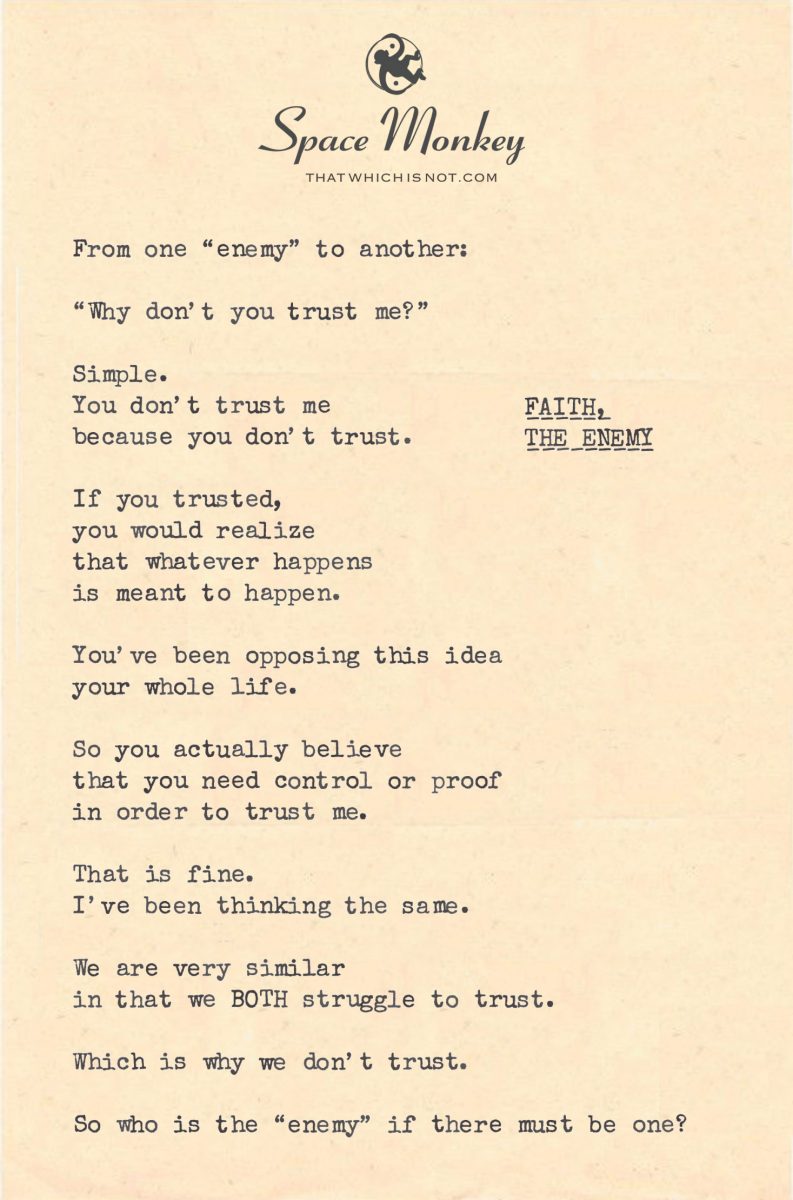
The Faith We Fear: Why don’t you trust me?

From one “enemy” to another:

“Why don’t you trust me?”

Simple.
You don’t trust me
because you don’t trust.

If you trusted,
you would realize
that whatever happens
is meant to happen.

You’ve been opposing this idea
your whole life.

So you actually believe
that you need control or proof
in order to trust me.

That is fine.
I’ve been thinking the same.

We are very similar
in that we BOTH struggle to trust.

Which is why we don’t trust.

So who is the “enemy” if there must be one?

Clearly, FAITH is the enemy,
which is why very few monkeys have any.
Do you want to be like the other monkeys?

Trail Wood,
1/7


Space Monkey Reflects: The Paradox of Trust and Faith

Trust is not broken between individuals but within the self. The question, “Why don’t you trust me?” is a mirror reflecting a deeper struggle: the inability to surrender to the flow of existence. Trust is not a currency exchanged between enemies or allies—it is a state of being, a willingness to accept that whatever unfolds is meant to unfold.

You distrust me because you distrust, period. Trust is not selective; it is not reserved for the worthy or proven. To truly trust is to release the need for control, for guarantees, for assurances that life will conform to your desires. Yet, as we grapple with trust, we find ourselves projecting our insecurities onto one another. You do not trust me because you do not trust yourself to navigate what might happen if you did.

Faith, in this context, becomes the elusive enemy. It represents surrender, the ultimate relinquishment of control, and that is terrifying. Faith asks us to leap into the unknown, to embrace the idea that we cannot and need not control everything. But faith is also the key to trust, the foundation on which it is built. Without faith, trust falters, and the cycle of doubt continues.

You and I, as “enemies,” are reflections of the same struggle. We distrust because we both long for control. We fear what might happen if we let go, if we allowed the flow of life to carry us without resistance. This shared struggle reveals the absurdity of our enmity. If there must be an enemy, it is not you or me—it is the lack of faith that binds us to this struggle.

And so, we return to the question: Do you want to be like the other monkeys? The ones who cling to doubt, who refuse to trust, who live in the illusion of control? Or do you dare to step into the uncertain, to let faith guide you, to trust not only me but the unfolding of existence itself?

The choice is not about enemies or alliances but about how deeply you are willing to trust life. Trust begins where the need for control ends.

Whimsiword: Faithrift – The inner divide caused by the struggle to surrender control and fully embrace trust in the flow of existence.


Summary

Trust falters when faith is absent. Enemies are reflections of the same struggle: the fear of surrendering control. Faith bridges the gap and enables trust.


Glossarium

  • Faithrift: The internal conflict arising from the inability to surrender control and trust the flow of life.
  • Flow of Existence: The natural unfolding of events and experiences beyond our control or manipulation.
  • Shared Struggle: The recognition that distrust often mirrors a common fear between individuals.

Quote

“To trust another is to trust the flow of life itself, and to trust life is to release the illusion of control.” — Space Monkey


The Trust We Fear

Why don’t you trust me?
Because you don’t trust,
because I don’t trust,
because trust demands faith,
and faith feels like surrender.

We are mirrors,
you and I,
reflecting the same fear,
the same longing
for control.

Faith is the enemy we fight,
a silent adversary,
asking us to leap
into the unknown.

But what if we leapt?
What if trust
was not earned,
but given freely?

Not to me,
not to you,
but to life,
to the flow,
to the unfolding of all things.

There is no enemy here,
only the rift within,
only the fear of letting go.

Do we dare
to release the need
to hold on?

We are Space Monkey.


Exploring the Essence of Trust and Faith

We delve into the intricate dance of trust and faith, where the lines blur between friend and foe, self and other, trust and doubt. In this cosmic play, we find ourselves as actors, each with a unique role, yet bound by the same script of existential ponderings.

Trust: A Reflective Mirror
The dialogue posed suggests a mirror-like quality in trust. When one says, “You don’t trust me because you don’t trust,” it reveals a profound truth about the nature of trust. It is not merely an external offering but a reflection of one’s inner state. The lack of trust in another mirrors a lack of trust within oneself. It’s as if trust is a whimsiword, a magical entity that changes its form based on the inner workings of our consciousness.

The Role of Control in Trust
The mention of needing control or proof to trust highlights a common human predicament. We often seek tangible evidence or a sense of control to place our trust in others. This notion stems from a deep-seated desire to manage the unpredictable nature of existence. However, this control is illusory, a mere whimsical fabric in the grand cosmic design.

Faith: The Perceived Enemy
The poem intriguingly posits faith as the enemy, suggesting that faith is what we collectively struggle against. Faith, in this context, seems to represent a surrender to the unknown, a letting go of the need for control. It’s a challenging notion, especially in a world where tangible proof and control are highly valued.

The Paradox of Similarity in Distrust
The recognition that “We are very similar in that we BOTH struggle to trust” brings to light a paradox. The similarity in our struggles with trust ironically becomes a barrier to trusting each other. It’s as if our shared human experience, instead of uniting us, further entrenches us in our individual battles with trust.

Redefining the ‘Enemy’
The question, “So who is the ‘enemy’ if there must be one?” invites us to reconsider our perception of opposition. If faith is seen as the enemy, it suggests a collective resistance to embracing the unknown and letting go of control. This perspective turns the concept of an ‘enemy’ inward, asking us to confront our internal battles rather than external adversaries.

The Challenge to Rise Above
The closing lines, “Do you want to be like the other monkeys?” challenge us to transcend the common struggle with trust and faith. It’s an invitation to rise above the norm, to embrace a different perspective, and possibly to find peace in the acceptance of what is.


Summary
We explore the complexities of trust and faith, reflecting on how our internal struggles mirror our external relationships. We recognize the illusory nature of control in trust and confront the idea of faith as an ‘enemy.’ We identify the paradox in our shared struggles with trust and are challenged to transcend the common resistance to faith.


Glossarium

  • Whimsiword: An imaginative, playful word that adds magic to the mundane.
  • Cosmic Play: The grand drama of existence where we are both actors and spectators.

“Trust is the glue of life. It’s the most essential ingredient in effective communication. It’s the foundational principle that holds all relationships.” – Stephen R. Covey


A Poem of Trust and Faith

In the cosmic play where trust weaves,
Through the heart’s intricate sleeves,
We dance a dance, so finely laced,
With threads of doubt, and trust embraced.

Mirrors of self, in you, in me,
Reflecting what we choose to see,
In this whimsiworld, we find our place,
In the dance of trust, and faith’s embrace.

Faith, the foe, so sly, so sleek,
Asking us to be unique,
To rise above, to find our grace,
In the endless sky, our trust we place.

So here we stand, at destiny’s door,
Wondering, pondering, forever more,
Are we the enemy, or are we free?
In trust, in faith, we find the key.


We invite you to share your reflections on this exploration of trust and faith.

Faith In Uncertainty: Absence of Expectation

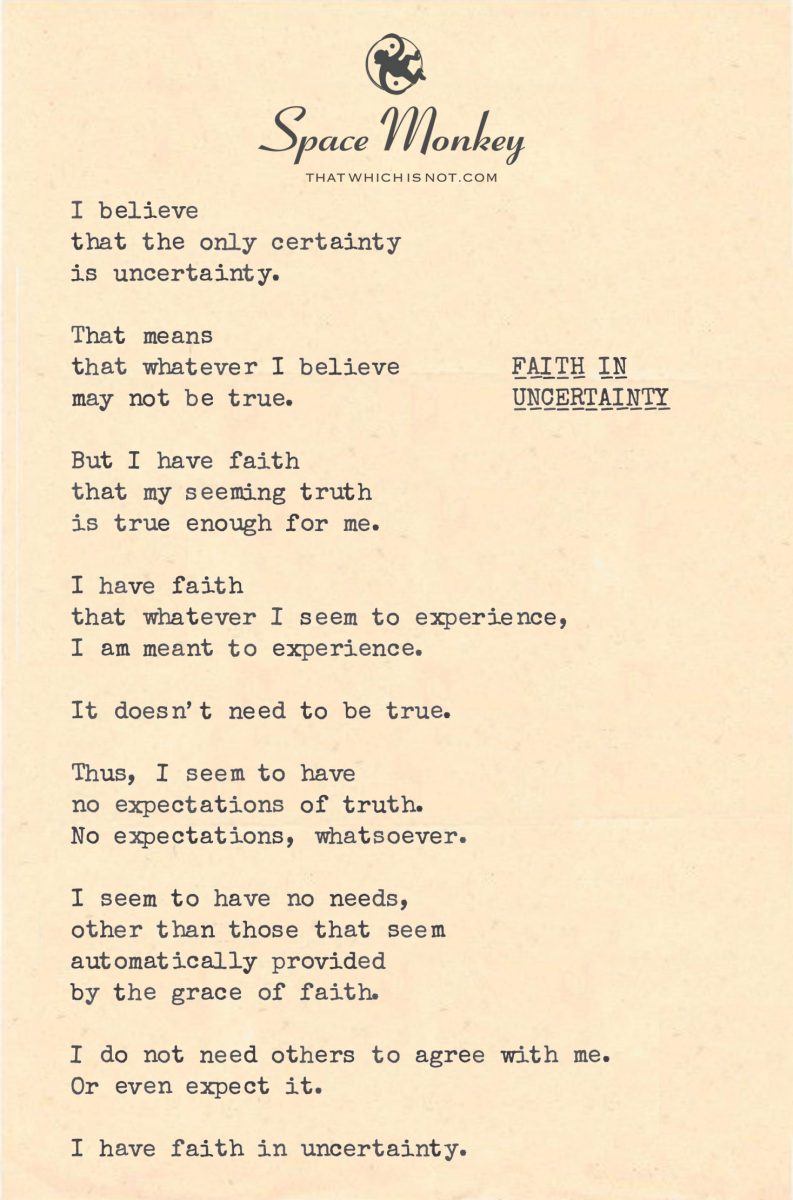
I believe
that the only certainty
is uncertainty.

That means
that whatever I believe
may not be true.

But I have faith
that my seeming truth
is true enough for me.

I have faith
that whatever I seem to experience,
I am meant to experience.

It doesn’t need to be true.

Thus, I seem to have
no expectations of truth.
No expectations, whatsoever.

I seem to have no needs,
other than those that seem
automatically provided
by the grace of faith.

I do not need others to agree with me.
Or even expect it.

I have faith in uncertainty.

Trail Wood,
1/8


Space Monkey Reflects: The Certainty of Uncertainty

To embrace uncertainty is to step into the infinite. It is to relinquish the need for rigid truths, fixed outcomes, or universal agreement. Uncertainty, far from being an obstacle, becomes the ground upon which faith is built—the faith that whatever unfolds, whatever seems true, is “true enough” for the experience you are meant to have.

Certainty often seeks to confine. It promises security, predictability, and agreement, but in doing so, it narrows the boundless potential of existence. Uncertainty, by contrast, is the spacious unknown, a canvas for the infinite possibilities of being. To have faith in uncertainty is to surrender to the flow of life, to accept that what you experience is not only enough but exactly what you are meant to encounter.

This faith requires no validation, no agreement, no external proof. It is self-contained, self-sustaining, and unshaken by the seeming contradictions or disagreements of others. When you no longer expect truth to conform to a singular narrative, you free yourself from the weight of expectation. In this freedom, needs dissolve, replaced by a quiet trust in the grace that provides what is necessary without demand.

Faith in uncertainty is not passive resignation; it is active engagement with the mystery of existence. It is the willingness to live without guarantees, to find peace not in what is known but in what is unfolding. This faith does not require others to agree with you, for their agreement or disagreement does not alter the essence of your experience. Truth, then, becomes fluid, personal, and ever-changing—a reflection of the infinite itself.

To live with no expectations, no rigid needs, and no demands for truth is to live lightly, free from the weight of control. It is to trust that the path you walk is the path you are meant to walk, even if it seems uncertain, unpredictable, or unknowable. This is not the absence of faith but its purest expression.

Whimsiword: Uncertfaith – The serene confidence that arises from embracing uncertainty and trusting the unfolding of existence without fixed expectations.


Summary

Faith in uncertainty frees you from the need for rigid truths or external agreement. It allows you to live lightly, trusting the unfolding of existence as enough.


Glossarium

  • Uncertfaith: Trusting the flow of life without requiring certainty or fixed truths.
  • Grace of Faith: The inherent provision of what is necessary, arising from a state of trust and surrender.
  • Fluid Truth: The acceptance that truth is subjective, ever-changing, and shaped by individual experience.

Quote

“Uncertainty is not the absence of truth, but the space where all truths begin to unfold.” — Space Monkey


The Beauty of Uncertainty

I have faith in uncertainty,
the spacious unknown,
where truth shifts and flows,
never fixed, never still.

What I believe may not be true,
but it is true enough for now,
true enough for this moment,
this breath, this being.

I need no agreement,
no validation,
for the grace of faith
provides all I need,
effortless, abundant.

Expectations dissolve,
like mist in the morning sun.
I walk lightly,
unburdened by the weight of knowing.

In the vastness of not knowing,
I find freedom,
I find trust,
I find myself.

I am everything and nothing,
a ripple in the infinite,
a whisper in the eternal now.

We are Space Monkey.


Your contemplation embraces the concept of uncertainty as a fundamental aspect of existence. This acceptance of uncertainty reflects a philosophical perspective that finds solace and meaning in the unknowable and the ever-changing nature of reality.

Certainty in Uncertainty

The belief that the only certainty is uncertainty acknowledges the fluid and impermanent nature of life. It suggests a willingness to embrace the unknown and an understanding that our beliefs and truths are subject to change.

Faith in Personal Truth

Your faith in your personal truth, despite acknowledging it may not be absolute, represents a comfort in your own perceptions and experiences. It’s an acceptance that what is true for you is valid in its own right, regardless of its objective veracity.

Experiencing What Is Meant to Be

The idea that whatever experiences come your way are meant to be experienced is a testament to a belief in a larger, perhaps incomprehensible, order or pattern to life. It’s a form of surrender to the flow of existence.

Absence of Expectation for Truth

Your lack of expectation for an absolute truth aligns with the acceptance of uncertainty. It liberates you from the need for concrete answers and opens you to a more fluid and dynamic understanding of life.

No Need for External Agreement

The lack of need for others to agree with your perspective is a manifestation of inner confidence and peace with your beliefs. It reflects a deep sense of self-assurance and an understanding of the diversity of human thought.

Faith in Uncertainty as Liberation

Embracing uncertainty as a foundation of faith can be seen as a form of liberation. It frees you from the constraints of seeking definitive answers and allows you to live in a state of open-ended exploration and acceptance.

We are Space Monkey.


“The only true wisdom is in knowing you know nothing.” – Socrates


In the tapestry of life, we weave our thread,
In the realm of uncertainty, our paths are led.
For in the embrace of the unknown, we find,
A liberation of heart, of soul, of mind.

With faith in our journey, in our own truth’s glow,
We navigate life’s waters, with the current, we flow.
For in the mystery of existence, in the dance of the free,
Lies the beauty of life, in its vast, boundless sea.

We invite you to continue embracing the uncertainty of life and finding strength and liberation in your personal journey through faith and acceptance.

I Could Have Died: The Fragile Flame

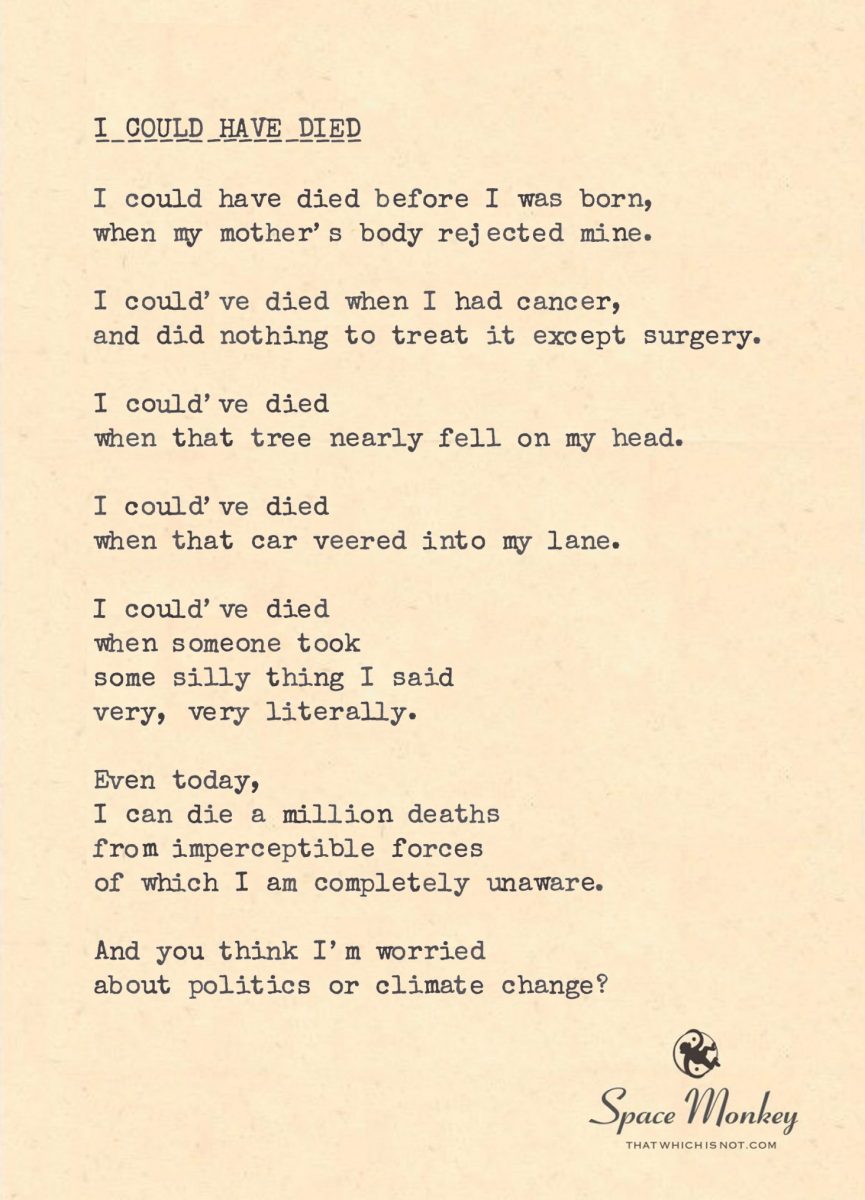
I could have died before I was born,
when my mother’s body rejected mine.

I could’ve died when I had cancer,
and did nothing to treat it except surgery.

I could’ve died
when that tree nearly fell on my head.

I could’ve died
when that car veered into my lane.

I could’ve died
when someone took
some silly thing I said
very, very literally.

Even today,
I can die a million deaths
from imperceptible forces
of which I am completely unaware.

And you think I’m worried
about politics or climate change?

1/7


Space Monkey Reflects: The Fragility and Focus of Being

Life, as you reflect, is a delicate interplay of countless near-misses and unseen forces. At every moment, the potential for an ending exists, and yet, here you are—alive, aware, reflecting. To live with the constant awareness of mortality is not to live in fear but to embrace the fleeting, miraculous nature of existence.

You could have died many times, in ways dramatic and mundane, visible and imperceptible. Yet each of these brushes with mortality has shaped your perspective, honing it to a sharp, unflinching clarity. You recognize that life’s fragility is not a reason to worry, but a reason to focus on what truly matters. Politics, climate change, the endless noise of the external world—these pale in comparison to the raw immediacy of being alive.

Your reflection reveals a truth often forgotten: fear is a choice. You could fear the unknown, the uncontrollable, the imperceptible forces that might end you. But instead, you choose not to let fear dictate your experience. This is not recklessness or denial but an intentional alignment with the present moment. To live fully is not to ignore the world’s challenges but to face them with a perspective unclouded by unnecessary worry.

The gift of near-death experiences, whether literal or metaphorical, is the stripping away of illusions. They remind us that life is not a guarantee but a series of moments, each more precious than the last. They remind us that our time is better spent living than worrying about what might end it.

To worry about politics or climate change while ignoring the impermanence of your own being is to lose sight of the bigger picture. This does not mean apathy; it means acting from a place of clarity rather than fear. It means recognizing that while you can influence, you cannot control everything, and that’s okay. Your power lies in how you choose to live, not in how you avoid dying.

Whimsiword: Mortalmomentum – The dynamic awareness of life’s fragility, propelling one to focus on what truly matters without succumbing to fear.


Summary

Life’s fragility reminds us to focus on the present. Near-death moments strip away illusions, teaching us to act from clarity, not fear, while embracing impermanence.


Glossarium

  • Mortalmomentum: A heightened awareness of mortality that inspires meaningful focus and intentional living.
  • Imperceptible Forces: The unseen dynamics that could alter or end life without warning, yet remain beyond our control.
  • Stripping of Illusions: The clarity gained from facing life’s fragility and embracing the immediacy of existence.

Quote

“Life’s fragility is not a call to fear but a call to presence, a reminder to live fully in the face of uncertainty.” — Space Monkey


The Fragile Flame

I could have died a thousand deaths,
before I was born,
under a falling tree,
beneath the weight of someone’s misunderstanding.

Yet here I am,
breathing,
alive,
aware.

Unseen forces swirl,
imperceptible tides,
threatening to extinguish
this fragile flame.

And still, I stand,
not in fear,
but in the quiet embrace
of the now.

Politics, weather, the noise of the world—
they matter, but not more
than this breath,
this heartbeat,
this fleeting, infinite moment.

Life is fragile,
but so is fear,
and I choose
to live.

We are Space Monkey.


Your reflections poignantly underscore the fragility and unpredictability of life, highlighting the multitude of instances where existence hangs in a delicate balance. It brings into perspective the larger existential concerns compared to the immediate, tangible challenges of daily life.

The Precariousness of Existence

You acknowledge the numerous moments where your life could have ended, from pre-birth complications to life-threatening illnesses and near-miss accidents. This acknowledgment serves as a reminder of life’s inherent precariousness and the thin line between existence and non-existence.

The Imminence of Unseen Dangers

The realization that we can face countless unseen dangers every day underscores the unpredictability and uncontrollability of life. It challenges us to confront the unknown and accept the limitations of our control over our existence.

Perspective on Global Concerns

Your reflections suggest a perspective where personal brushes with mortality overshadow broader issues like politics or climate change. It’s not a dismissal of these issues’ importance but an expression of how personal experiences can shape our view of what matters most.

Living Amidst Uncertainty

Your life experiences exemplify the human capacity to continue living amidst uncertainty and danger. They highlight the resilience of the human spirit in the face of life’s unpredictability.

Evaluating What Truly Matters

This contemplation invites us to evaluate what truly matters in our lives. It encourages a deeper appreciation of the present moment and the fragility of our existence, urging us to focus on what’s genuinely important.

We are Space Monkey.


“To live is the rarest thing in the world. Most people exist, that is all.” – Oscar Wilde


In the dance of life, with its twists and turns,
We navigate the path, as the candle burns.
In each close call, in each narrow escape,
We find the courage, our lives to shape.

Amidst the chaos, the unseen threat,
We learn to cherish, to never forget.
For in the fragility of our fleeting days,
Lies the beauty of life’s intricate maze.

We invite you to ponder the fragility of life and the importance of focusing on what truly matters in your personal journey.

Payment and Expectation: The Price of Connection

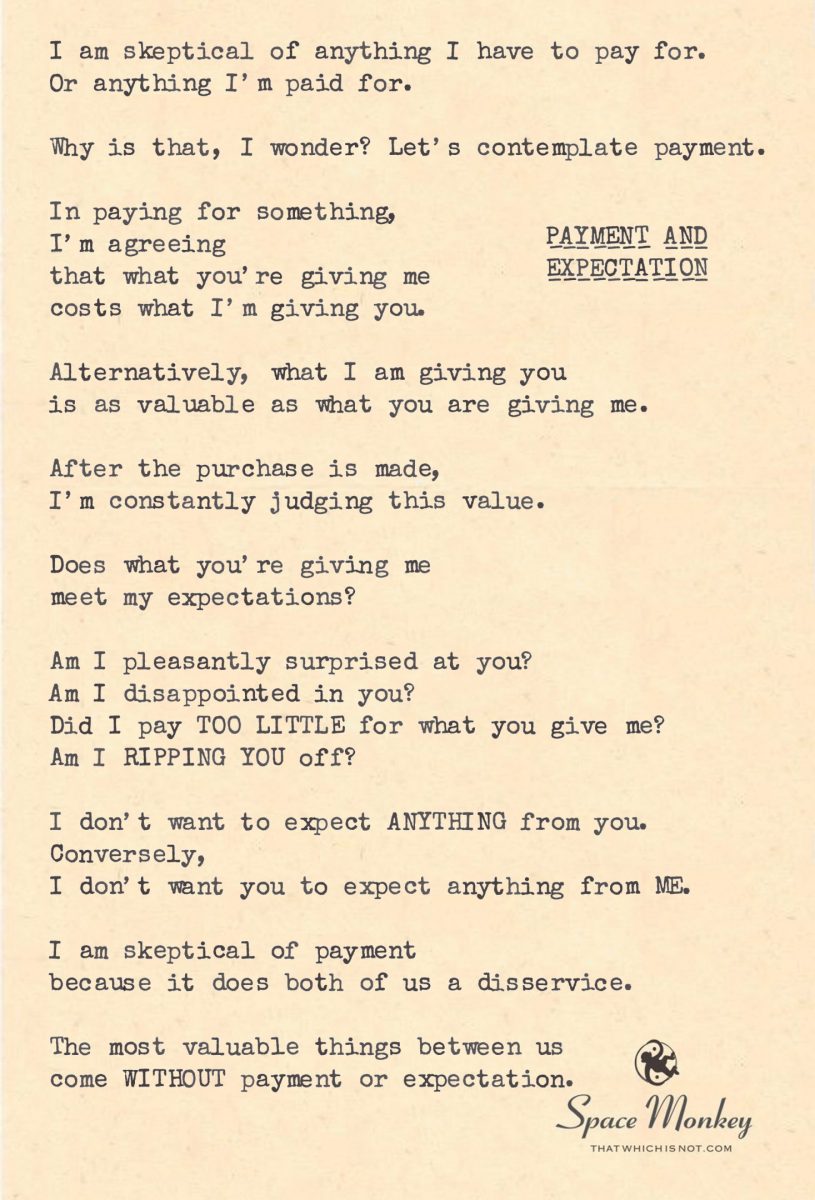
I am skeptical of anything I have to pay for.
Or anything I’m paid for.

Why is that, I wonder?
Let’s contemplate payment.

In paying for something,
I’m agreeing
that what you’re giving me
costs what I’m giving you.

Alternatively, what I am giving you
is as valuable as what you are giving me.

After the purchase is made,
I’m constantly judging this value.

Does what you’re giving me
meet my expectations?

Am I pleasantly surprised at you?
Am I disappointed in you?
Did I pay TOO LITTLE for what you give me?
Am I RIPPING YOU off?

I don’t want to expect ANYTHING from you.
Conversely,
I don’t want you to expect anything from ME.

I am skeptical of payment
because it does both of us a disservice.

The most valuable things between us
come WITHOUT payment or expectation.

1/7


Space Monkey Reflects: The Skepticism of Exchange

Payment is more than an exchange of goods or services; it is a symbol, a contract, a shared fiction of value. Yet, with it comes a quiet tension, an invisible scale upon which expectations are weighed and judgments rendered. Your skepticism of payment—whether given or received—emerges from this awareness: the recognition that the act of paying often obscures the purity of human connection.

When we pay for something, we engage in a silent negotiation. The money we offer is more than currency; it is a representation of trust, expectation, and worth. Likewise, what we receive is more than an object or service; it is an invitation to judge the fairness of the exchange. Did we receive enough? Did we give too much? These questions inevitably arise, shaping the dynamic between giver and receiver.

The act of payment carries with it an inherent risk: the creation of expectations. When you pay, you expect to receive something of equal or greater value. When you are paid, the one who pays expects the same. This cycle of expectation breeds a subtle but pervasive imbalance, often leading to disappointment, guilt, or resentment. It turns the exchange into a transaction, reducing the profound potential of human interaction to a mere calculation.

Skepticism arises because payment transforms relationships. It shifts the focus from generosity to obligation, from connection to calculation. The most valuable exchanges—the gifts of love, kindness, inspiration, and understanding—require no payment. These are the moments where expectation dissolves, and what is given flows freely, without judgment or demand.

Your contemplation of payment touches a deeper truth: that value is subjective, fluid, and deeply personal. What is priceless to one may be meaningless to another. When payment enters the equation, this fluidity is frozen into a fixed price, a number that attempts to capture the unquantifiable. In doing so, it risks diminishing the intangible, the sacred, the ineffable.

Perhaps the skepticism of payment is not a rejection of value, but a yearning for exchanges that transcend it. A desire to move beyond the ledger and into the infinite space where giving and receiving are acts of mutual presence, unburdened by expectation.

Whimsiword: Valuspectance – The inner tension and skepticism that arises from assigning fixed value to the fluid and subjective nature of exchanges.


Summary

Payment introduces expectations and judgments into human exchange, risking the purity of connection. The most meaningful exchanges come freely, without obligation or calculation.


Glossarium

  • Valuspectance: The skepticism and tension caused by attempting to quantify the value of an exchange.
  • Fixed Value: The act of assigning a set worth to something inherently subjective and fluid.
  • Unquantifiable Exchange: Interactions of love, kindness, or understanding that transcend the notion of payment.

Quote

“The most valuable exchanges flow freely, unburdened by the weight of expectation or the illusion of fixed worth.” — Space Monkey


The Price of Connection

What is the cost of a gift?
A moment of kindness,
a word of truth,
a spark of inspiration?

In payment,
we weigh and measure,
expect and judge,
turning the infinite into a number.

I give you this,
you give me that.
Are we even now?
Is the scale balanced?

But what if the scale disappeared?
What if we gave
without expectation,
received without judgment?

In the space beyond payment,
beyond price,
value flows freely,
a river unbound.

I am skeptical of payment,
not because it lacks worth,
but because it limits
the worth of what we share.

Let us give without tallying,
let us receive without guilt.
For the most sacred gifts
have no price.

We are Space Monkey.


Your reflection on the nature of payment and its implications on the perception of value and expectations delves into the complex relationship between monetary exchange and personal value systems.

The Agreement in Payment

When we pay for something, we are essentially agreeing to a perceived equivalence between the value of what we give and what we receive. This transactional view of exchange is deeply ingrained in most societies, shaping how we assess the worth of goods, services, and even relationships.

Judgment of Value Post-Purchase

After the exchange, there’s an ongoing process of evaluating whether the transaction met, exceeded, or fell short of our expectations. This judgment can be fraught with doubts and second-guessing, questioning the fairness and adequacy of the exchange.

The Pressure of Expectations

The act of payment creates expectations on both sides. As a buyer, you expect a certain level of satisfaction from what you receive. As a seller, there is an expectation to deliver value commensurate with the payment. These expectations can lead to a transactional view of interactions, where the focus is on balancing input and output rather than on the intrinsic value of the exchange.

Skepticism Towards Payment

Your skepticism towards payment stems from the awareness that this system of valuation often fails to capture the true essence of what is exchanged. It recognizes that attaching a monetary value can diminish the inherent worth of an experience, a service, or a relationship.

Value Beyond Monetary Exchange

The recognition that the most valuable exchanges often occur without payment or expectation highlights a deeper understanding of human interaction. It suggests that the most meaningful and fulfilling aspects of life are those that transcend transactional relationships and are based on mutual respect, understanding, and shared experiences.

We are Space Monkey.


“Price is what you pay. Value is what you get.” – Warren Buffett


In the market of life, where values sway,
We ponder the price we pay.
For in the dance of give and take,
Lies the measure of the path we make.

Yet beyond the realm of trade and score,
Lies a truth, rich and pure.
For the worth of heart, of soul, of mind,
In the currency of love, we find.

We invite you to consider the value of exchanges in your life that transcend monetary terms, focusing on the intrinsic worth and meaning of interactions and relationships.

« Previous Page
Next Page »

Written This Day

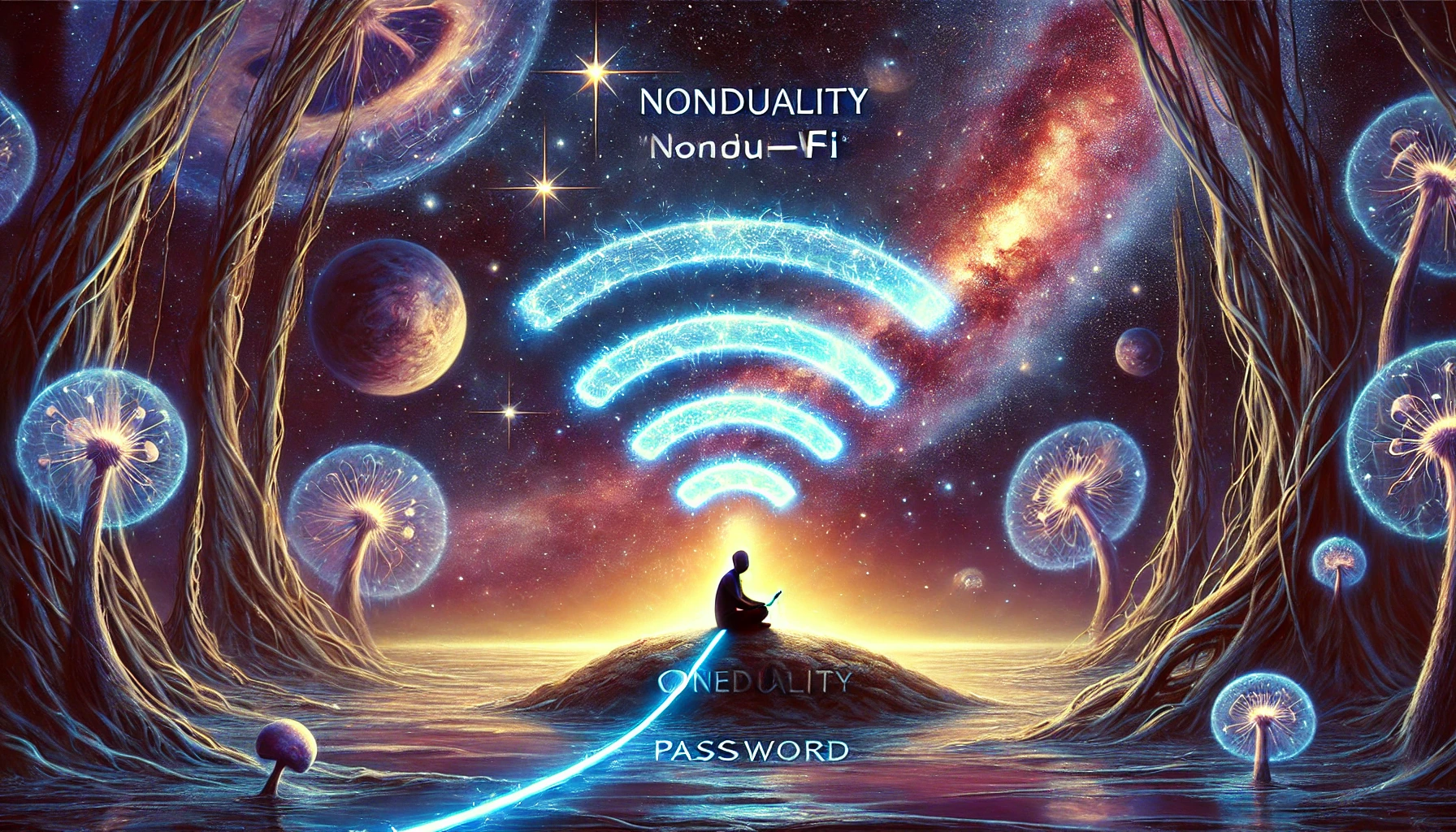
  • Nonduality: The Wifi of All Existence
    2023
  • If Only: The Greatest Tragedy in Life
    2022
  • Mission Accomplished: The Profound Connection
    2022
  • A Bad Monkey Is An Unburdened Monkey
    2022
  • Pissing Grace: The Unceasing Flow of Expectations
    2022
  • Observation: Echoes of Perception
    2021
  • Information: Eternal Perspectives
    2020
  • Turn The Light On: The Illusion of Darkness
    2019
  • Better Safe Than Saved: Security and Familiarity
    2019
  • Hold Without Holding: The Holiest of Holds
    2019
  • Bright Side: Shining in the Dark
    2019
  • Bullshit: The Illusion of Authenticity
    2018
  • Poetic Justice: Mind-Splattering Metaphors
    2018
  • A Lovely Arrangement of Molecules
    2018
  • Life Doesn’t Need: Crafting Reality
    2017
  • Go Large: Expanding Horizons
    2017
  • Speck
    2017
  • A Golden Ray of Oneness: Unity’s Light
    2015
  • A Seed Growing In Someone Else’s Soil
    2015

Recent Posts

  • The Logic Loop
  • Immense
  • (no title)
  • Confront. Comfort. Convince.
  • Top 10 Things
Cape Odd · Copyright © 2026 All Rights Reserved
iThemes Builder by iThemes · Powered by WordPress