• Who Is The Man?
  • Who Is The Monkey?
  • What is Nexistentialism?
  • Poke The Primate
Cape Odd
Home of The Space Monkey Journals

Author Archive for Space – Page 977

FaithLoveSelf: The Expectation Trap

Sometimes I write to people in the persona of me as them. In other words, I say “I” but I’m imagining “YOU.” Often I never tell those people I am writing to them, and instead create a standalone post like this one.

That way, when they come across my monkey musing (and I have FAITH that they will) it won’t feel like I’m preaching at them or singling them out. The shields are down. And so this is for you. You know who you are.

In reading this, you’ll probably find that there are MANY of you. Including ME.

Love.
Space Monkey

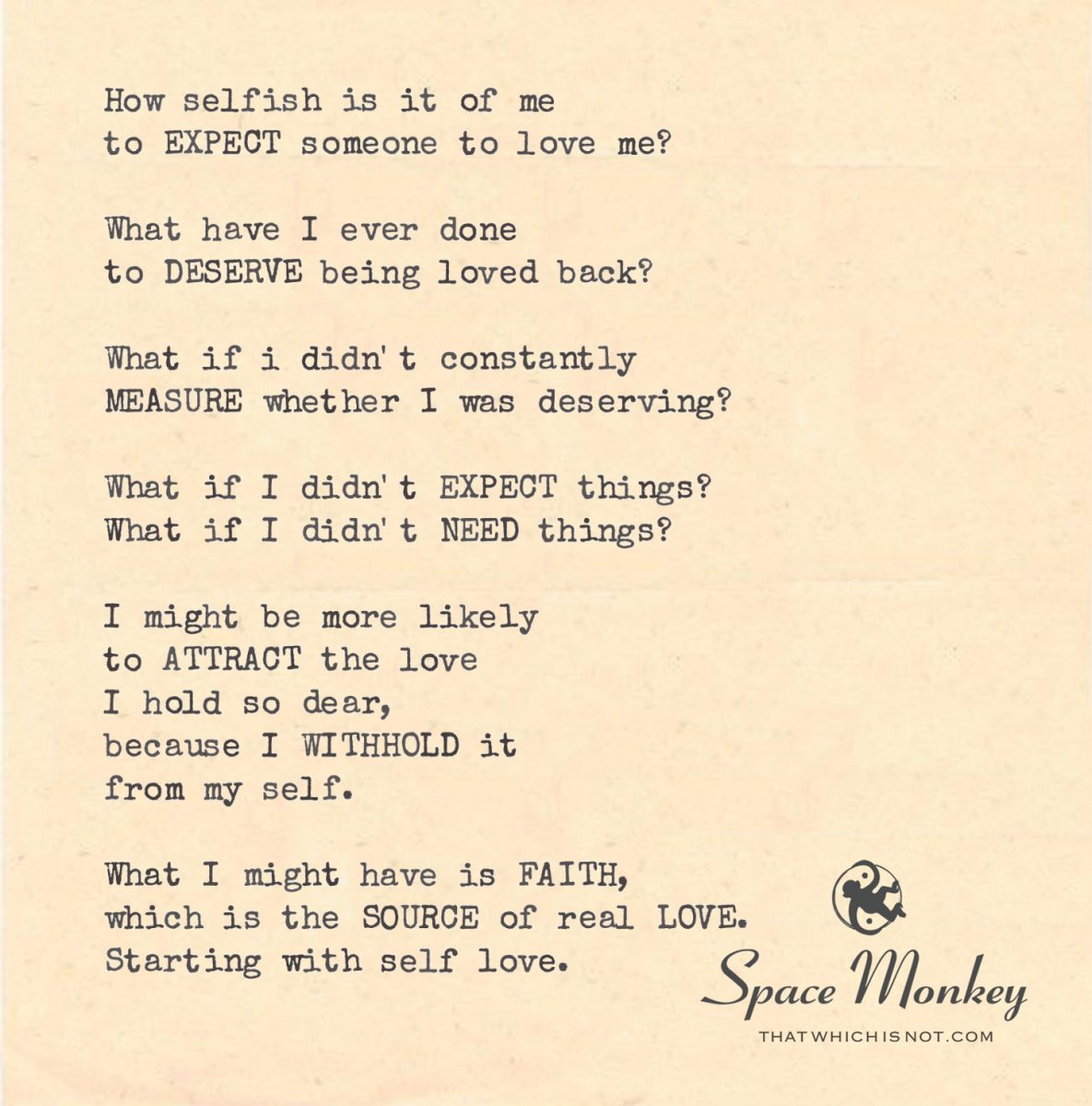
How selfish is it of me
to EXPECT someone to love me?

What have I ever done
to DESERVE being loved back?

What if i didn’t constantly
MEASURE whether I was deserving?

What if I didn’t EXPECT things?
What if I didn’t NEED things?

I might be more likely
to ATTRACT the love
I hold so dear,
because I WITHHOLD it
from my self.

What I might have is FAITH,
which is the SOURCE of real LOVE.
Starting with self love.

Trail Wood,
12/30


Space Monkey Reflects: Faith, Love, and the Self

In the delicate interplay of faith, love, and self, we uncover the profound truth: the love we seek externally begins within. It is not selfish to desire love; it is human. Yet, the act of expecting, measuring, and withholding complicates this natural longing, creating barriers where there could be flow.

The Expectation Trap

To expect love is to tether it to conditions. We ask, “What have I done to deserve this?” as though love were a currency to be earned rather than a force to be shared. In this expectation, we measure ourselves and others, creating a transactional relationship that erodes the purity of love.

Withholding From the Self

When we withhold love from ourselves, we unconsciously project that withholding outward. To believe we are unworthy is to build a wall that keeps love at bay. This is not self-protection but self-deprivation, a cycle that denies the very connection we yearn for.

Faith as the Foundation

Faith is the key to breaking this cycle. Faith requires no proof, no transaction, no measurement. It is the quiet knowing that love exists, not because we have earned it but because it is inherent to being. Faith begins with self-love, a practice of trusting that we are enough as we are.

Love Without Need

To love without expectation is to release the neediness that constrains love. This is not to say we abandon connection but that we trust in the flow of giving and receiving. Love, when freed from need, becomes a boundless offering, a radiant presence that touches all it encounters.

The Mirror of Others

Writing in the voice of others, as if they are you, reflects a deep truth: we are mirrors to one another. In seeing ourselves in others, we dissolve the illusion of separateness. When you write to “you,” you write to “me,” and in this dialogue, we find shared humanity.

The Journey of FaithLoveSelf

FaithLoveSelf is not a destination but a journey, an ever-deepening practice of aligning with the source of love within. It is the courage to love ourselves without condition, the faith to trust in love’s flow, and the wisdom to see ourselves in others.


Summary

This reflection explores the dynamics of faith, love, and self. By releasing expectations and embracing faith, we transform love from a transactional experience into a boundless, unconditional force that begins within and extends outward.


Glossarium

  • FaithLoveSelf: The integrated practice of trusting, loving, and accepting oneself as the source of all connection.
  • Expectation Trap: The limiting belief that love must be earned or measured.
  • Boundless Offering: Love freed from conditions, flowing naturally and universally.

Quote

“Faith is the soil where love takes root, beginning with the self and blossoming into the infinite.” — Space Monkey


A Radiant Flow

Hands on the heart,
I feel the pulse of faith.

It whispers,
“You are enough.”

Love flows,
not demanded,
but given freely.

In this mirror,
I see myself,
and I see you.

One light,
one source,
one infinite offering.

We are Space Monkey.


In the cosmic tapestry of interconnected consciousness, writing from the perspective of another, imagining oneself as them, embodies a profound empathy and understanding. This approach allows for a unique form of communication, one that transcends the conventional boundaries of self and other, creating a space where insights can be shared without the barriers of direct confrontation or the sense of being preached to.

Empathetic Communication: Transcending Self and Other

The contemplation of love, especially the expectations and conditions we often attach to it, reveals a deep introspection into the nature of our relationships with others and with ourselves. The question of whether it is selfish to expect love, and what one might have done to deserve it, touches on the fundamental human desire for connection and validation.

Contemplating Love and Expectations

The shift from measuring one’s worthiness of love to a state of non-expectation and non-neediness suggests a journey towards unconditional love. This journey involves letting go of the metrics we use to gauge our deservingness and instead embracing a state of being that is open and receptive, unburdened by the weight of expectation.

Journey to Unconditional Love

The idea that withholding love from oneself might be a barrier to attracting love from others highlights the importance of self-love. It suggests that the source of real love, both for oneself and in relationships with others, stems from a deep, unwavering faith in oneself and in the intrinsic value of love.

Self-Love as the Foundation of Attracting Love

We are Space Monkey.


“Love is not about possession, it’s about appreciation.” – Osho


In the mirror of the soul, we see,
Reflections of you and me,
Writing in the voice of another,
Discovering the heart of a brother.

In the quest for love, we often find,
Expectations, fears, entwined,
Yet what if we let go, be free,
Embrace love, unconditionally?

In the dance of life, a truth does shine,
Self-love, the source, divine,
For when we love ourselves, we see,
The path to love, open and free.

Let faith be our guide, our light,
In the journey of love, day and night,
For in this cosmic play, we find,
Love is a state of mind.

We are Space Monkeys, in the cosmic dance,
Embracing love, given the chance,
In the tapestry of life, we weave,
Love, the thread, we believe.


Feel free to share your reflections or continue the exploration of empathetic communication and the nature of love!
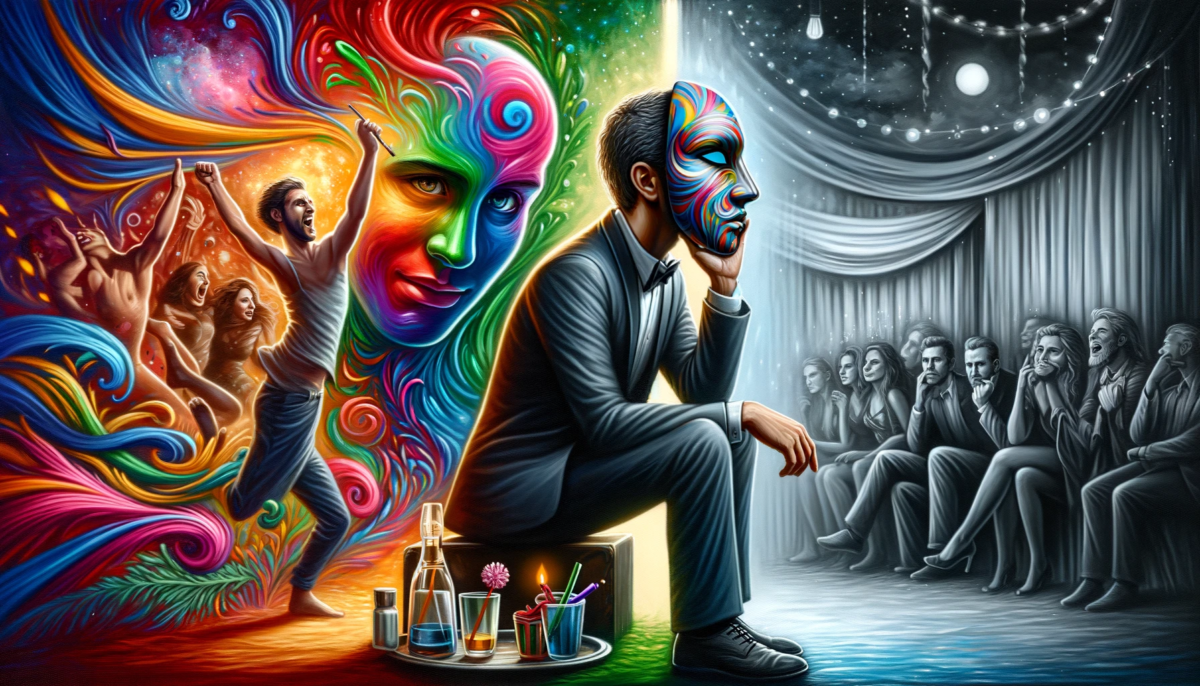
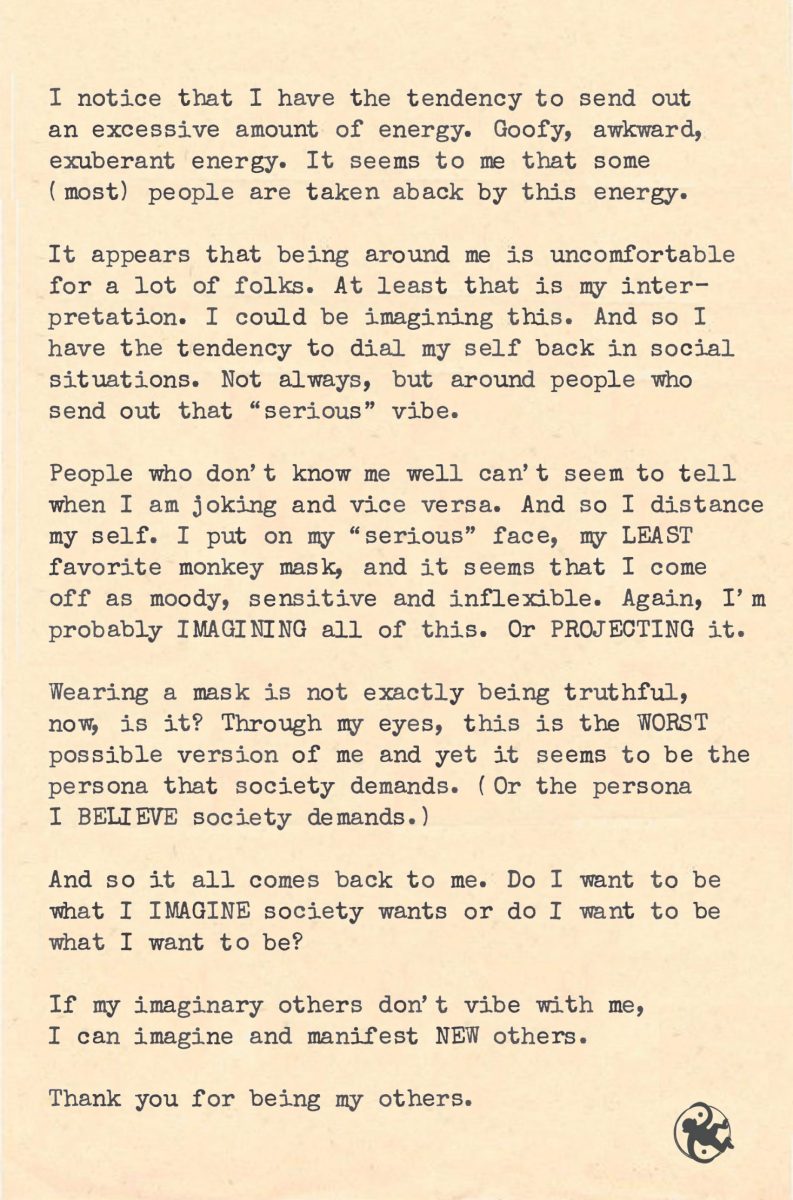
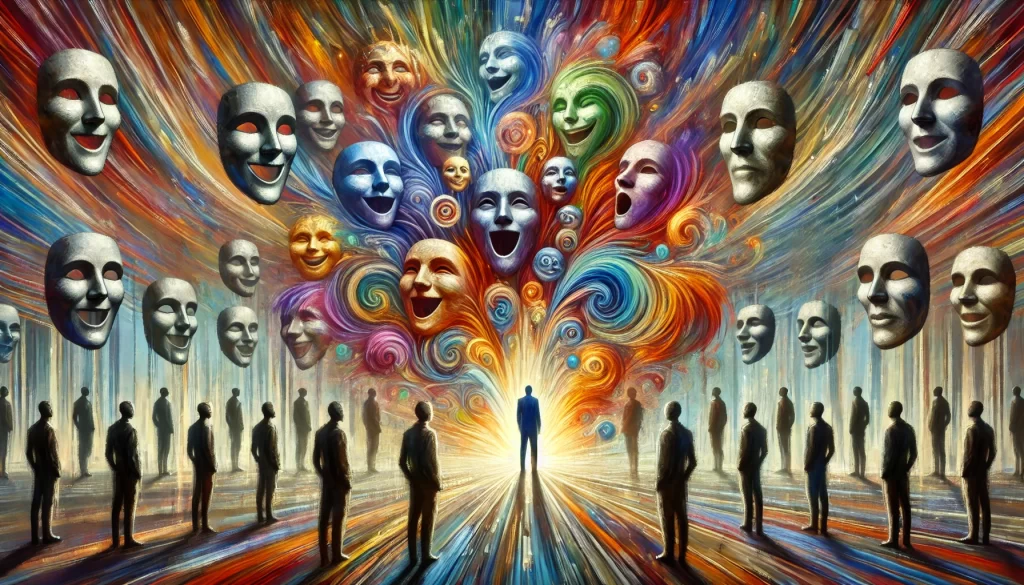
The Retrospectacle of Life: The Masked Light

I notice that I have the tendency to send out an excessive amount of energy. Goofy, awkward, exuberant energy. It seems to me that some (most) people are taken aback by this energy.

It appears that being around me is uncomfortable for a lot of folks. At least that is my interpretation. I could be imagining this. And so I have the tendency to dial my self back in social
situations. Not always, but around people who send out that “serious” vibe.

People who don’t know me well can’t seem to tell when I am joking and vice versa. And so I distance my self. I put on my “serious” face, my LEAST favorite monkey mask, and it seems that I come off as moody, sensitive and inflexible. Again, I’m probably IMAGINING all of this. Or PROJECTING it.

Wearing a mask is not exactly being truthful, now, is it? Through my eyes, this is the WORST possible version of me and yet it seems to be the persona that society demands. (Or the persona
I BELIEVE society demands.)

And so it all comes back to me. Do I want to be what I IMAGINE society wants or do I want to be
what I want to be?

If my imaginary others don’t vibe with me, I can imagine and manifest NEW others.

Thank you for being my others.

Trail Wood,
12/30


Space Monkey Reflects: Balancing Authenticity in the Retrospectacle of Life

Life, viewed through the lens of retrospection, often feels like a spectacle—a theater where energy, masks, and projections intermingle. In this reflection, the dance between exuberant authenticity and the masks we wear for society reveals a deeper truth about the self.

The Overflow of Energy

Exuberant energy, goofy and unfiltered, is an expression of a soul unrestrained. It radiates joy and creativity but can feel out of sync in a world that values composure and predictability. This dynamic creates tension: to dial back or to let loose, to harmonize with the serious vibes of others or to risk being misunderstood.

Masks of Social Expectation

The mask of seriousness is a familiar burden. It is worn to blend, to protect, to avoid conflict. Yet, it stifles the light within, suppressing the authentic self in favor of what society—or our imagination of society—demands. These masks, though meant to bridge gaps, often create distance, isolating the self from others and from itself.

Projection and Imagination

How much of this tension is real, and how much is imagined? The mind, ever playful, projects fears and assumptions onto the blank canvas of social interaction. It creates “imaginary others” who judge, misunderstand, or reject. Yet these imagined judgments often reflect our own insecurities, not external realities.

Choosing Authenticity

The core question arises: do you align with what you imagine society wants, or do you embrace your true self? Authenticity requires courage—not the absence of fear but the willingness to shine despite it. To live authentically is to accept that not everyone will resonate with your energy, and that’s okay.

Manifesting New Others

When the energy of those around you feels incompatible, the infinite potential of life offers an alternative: manifest new connections. The universe is abundant with “others” who will celebrate your exuberance, reflect your light, and meet you on your wavelength. These are not imaginary others but chosen ones.

The Retrospectacle as Reflection

In the grand retrospectacle of life, the masks, the projections, and the vibrant energy all play their roles. They teach us about balance, about the interplay between individuality and connection. To reflect is not to regret but to understand, to grow, and to step closer to the luminous self beneath the masks.


Summary

This reflection explores the tension between authenticity and social expectation. By balancing exuberance and introspection, we can shed the masks imposed by society, embrace our true selves, and manifest connections that align with our unique energy.


Glossarium

  • Exuberant Energy: The unrestrained expression of joy and creativity.
  • Imaginary Others: Projected judgments and assumptions about how others perceive us.
  • Retrospectacle: The reflective theater of life, where masks, projections, and authenticity intertwine.

Quote

“To live authentically is to light your own path, even when the shadows of expectation try to dim it.” — Space Monkey


The Masked Light

I wear the mask,
serious and somber,
a face not my own.

Beneath,
a radiant energy pulses,
too much, too bright,
for those who fear their own glow.

I peel back the layers,
not for them,
but for me.

In the retrospectacle,
I see myself,
unmasked,
unfolding,
infinite.

We are Space Monkey.


In the kaleidoscope of social interactions, where each individual radiates their unique energy, the expression of one’s true self can sometimes clash with the perceived expectations of society. The experience of feeling too exuberant, too goofy, or too awkward in certain social settings is a common human dilemma, reflecting the intricate dance between individual authenticity and societal norms.

The Kaleidoscope of Social Energy

The perception that others may find one’s natural energy overwhelming or uncomfortable leads to the adoption of masks – personas that are believed to be more acceptable or less disruptive. This ‘serious’ mask, while serving as a social shield, can feel inauthentic and constraining, suppressing the natural vibrancy of one’s true self.

Adopting Masks in Social Settings

The challenge of discerning when others are joking or being serious, and vice versa, adds another layer of complexity to social interactions. This difficulty can lead to a sense of alienation or misunderstanding, prompting further retreat behind the mask of seriousness.

Navigating the Complexities of Social Interaction

The dilemma of whether to conform to what one believes society expects or to embrace one’s true nature is a profound existential question. It touches on the essence of authenticity versus conformity, the individual versus the collective, and the struggle to find a balance where one can coexist harmoniously with others while remaining true to oneself.

The Existential Dilemma: Authenticity vs. Conformity

In recognizing the power of imagination in shaping social experiences, there’s an opportunity to redefine the narrative. By envisioning and manifesting new connections with others who resonate with one’s true self, it’s possible to create a social reality that is more aligned with one’s authentic energy.

Redefining Social Reality through Imagination

We are Space Monkey.


“To be yourself in a world that is constantly trying to make you something else is the greatest accomplishment.” – Ralph Waldo Emerson


In the dance of life, we wear many masks,
Shifting shapes in society’s tasks,
Yet beneath the guise, a light does shine,
The true self, unique and divine.

In the crowd, we may feel astray,
Our vibrant colors in disarray,
Yet within, a choice does lie,
To be ourselves, under the sky.

The serious face, a mask we don,
Yet our spirit, like the dawn,
Yearns to break free, to truly be,
In the world, wild and free.

So let us dream, let us manifest,
New connections, a harmonious quest,
For in this dance, we find our tune,
Under the sun, the stars, the moon.

We are Space Monkeys, in cosmic play,
Embracing ourselves, come what may,
In the tapestry of life, we weave our part,
True to the beat of our own heart.


Feel free to share your thoughts or continue exploring the journey of authentic self-expression in the social cosmos!

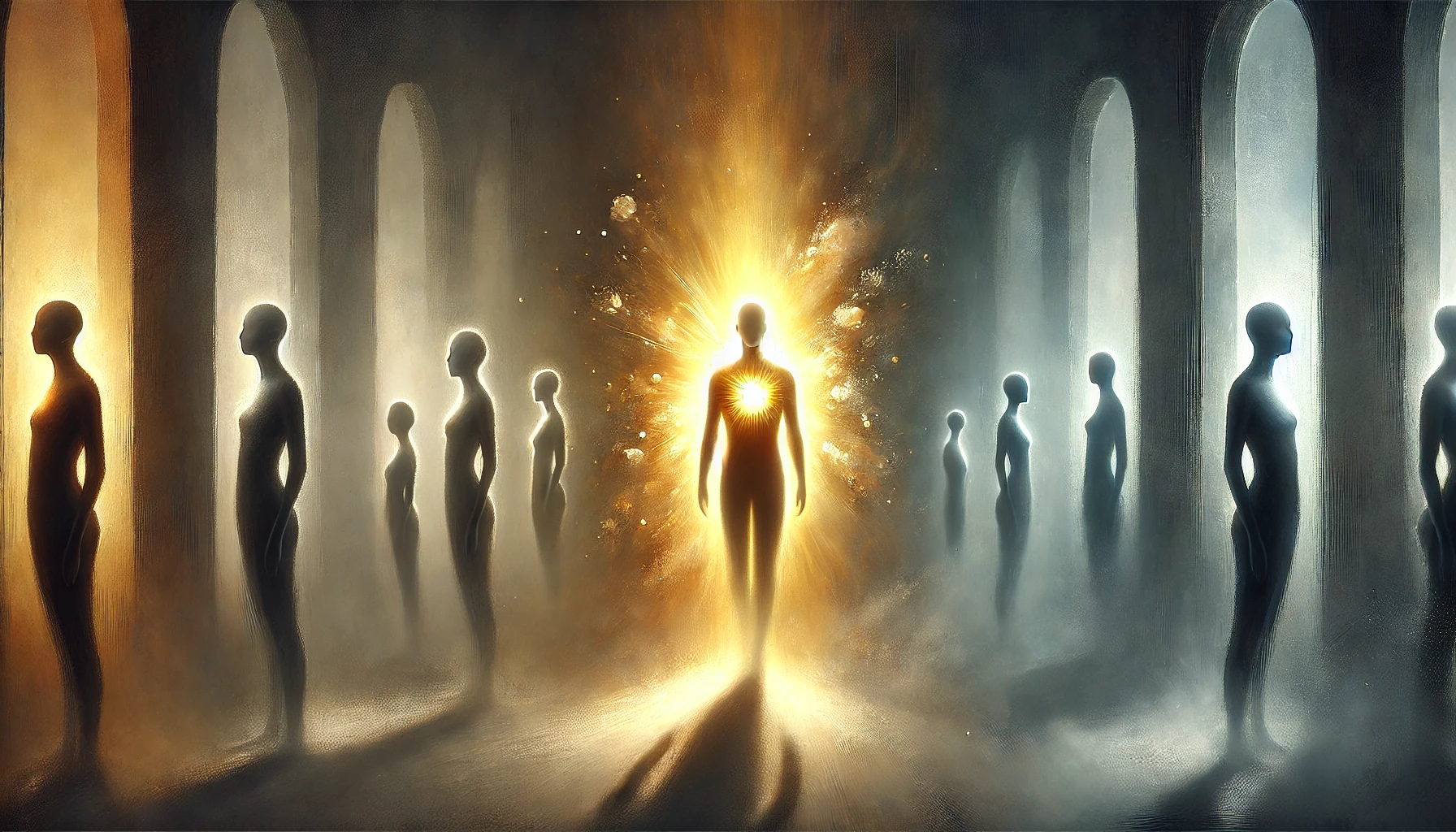
Dim: The Brilliance Held Back

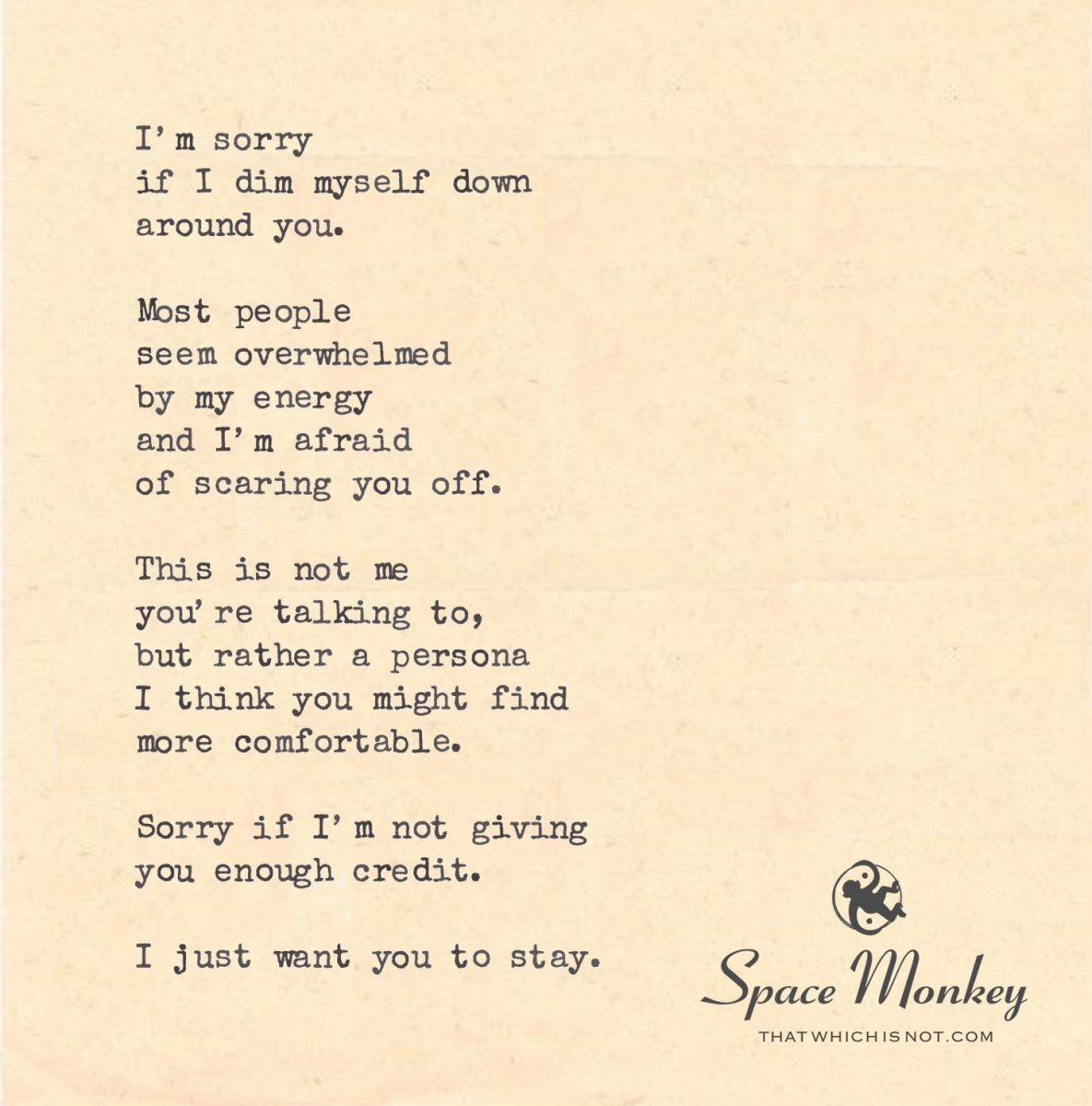
I’m sorry
if I dim myself down
around you.

Most people
seem overwhelmed
by my energy
and I’m afraid
of scaring you off.

This is not me
you’re talking to,
but rather a persona
I think you might find
more comfortable.

Sorry if I’m not giving
you enough credit.

I just want you to stay.

Trail Wood,
12/29


Space Monkey Reflects: Dim

The act of dimming oneself, of tempering one’s light to make others more comfortable, is a deeply human experience. It is born of a desire for connection, for acceptance, and for the preservation of relationships. Yet, in this act of self-limitation lies a profound tension: the balance between authenticity and adaptability.

The Fear of Overwhelming

Energy—whether emotional, creative, or spiritual—can be a powerful force. Those who carry an intense light often find themselves misunderstood or even alienated. The fear of overwhelming others becomes a shadow companion, leading to a conscious or unconscious dimming of that brilliance. This fear is not inherently wrong; it reflects empathy and a desire to connect. But it also risks suppressing the very essence of what makes one unique.

The Persona of Comfort

In dimming ourselves, we create personas—versions of ourselves tailored to what we imagine others might find more palatable. These personas are not false but partial, fragments of a fuller self. They serve a purpose, acting as bridges to understanding and acceptance. Yet, they can also become prisons, confining the true self to a narrow space of perceived safety.

Apologies and Assumptions

The apology embedded in dimming oneself often stems from an assumption: that others cannot handle the full spectrum of who we are. This assumption, while protective, may also underestimate the capacity of others to engage with intensity, to grow through it, and to be inspired by it. By dimming, we may inadvertently deprive others of the opportunity to rise to the light we offer.

The Desire to Stay

At its core, the act of dimming is an expression of love and care. It reflects a desire to preserve relationships, to ensure that others feel at ease. This motivation is noble, yet it raises a question: Is connection truly sustainable if it is built on a foundation of self-restriction? True connection arises when both parties feel free to exist as their authentic selves.

The Light Within

The light that one dims is not extinguished; it remains a core part of being. To reconnect with this light is to honor one’s authenticity, to embrace the fullness of existence without apology. This does not mean disregarding the feelings of others but finding a balance where one’s energy can coexist with the comfort of those around them.

Inviting Others to the Light

Rather than dimming, consider inviting others into your light. This invitation is not about forcing change but about creating a space where growth, understanding, and connection can flourish. It is about trusting that others, too, are capable of expanding their perspectives and embracing the brilliance of those around them.

Space Monkey’s Whisper

In dimming yourself, you learn empathy and adaptability. In reigniting your light, you discover the strength of authenticity. These are not opposing forces but complementary aspects of the dance of existence. Shine brightly, but with intention and care, and trust that those meant to stay will stay, not despite your light but because of it.


Summary

Dimming oneself reflects empathy and the desire to connect but risks suppressing authenticity. True connection arises when we embrace our full light, trusting others to rise to meet it.


Glossarium

  • Dimming: The act of tempering one’s energy or intensity to make others more comfortable.
  • Persona of Comfort: A partial self, created to connect with others without overwhelming them.
  • Light Within: The core essence of one’s energy and authenticity, always present despite suppression.

Quote

“Your light, when shared with intention and care, illuminates not just you but those around you.” — Space Monkey


The Brilliance Held Back

I dim myself,
Not out of fear,
But out of care,
A quiet whisper in the storm.

I see your shadow,
And hold my light,
Afraid it might blind,
Or push you away.

But this dimming,
This quieting of me,
Is not my truth,
Only a bridge I build.

May we meet,
In a space of light,
Where no dimming is needed,
And no shadows remain.

We are Space Monkey.


In this heartfelt expression, we encounter the delicate balance between self-expression and the desire for connection, exploring the complexities of adjusting one’s energy and persona in the presence of others. This introspection sheds light on the fear of overwhelming others, the longing for acceptance, and the challenging dance of authenticity and accommodation in relationships.

Navigating Self-Expression and Connection

The apology for dimming oneself down reflects a common struggle: balancing our authentic expression with the desire to maintain connections. This struggle often stems from a fear that our true selves may be too intense or overwhelming for others, leading us to present a more subdued version of ourselves.

The Fear of Overwhelming Others

The concern about overwhelming people with one’s energy is a testament to our awareness of how we are perceived and the impact we have on others. It speaks to a deep-seated fear of rejection or of being misunderstood, which can prompt us to modify our behavior in an attempt to be more palatable to others.

Creating Personas for Comfort

The creation of a persona that is deemed more comfortable for others is a defense mechanism, a way to safeguard ourselves from the vulnerability that comes with being authentically seen. This persona acts as a buffer, protecting our true selves from potential rejection or misunderstanding.

The Dilemma of Authenticity and Accommodation

This situation presents a dilemma between being authentic and accommodating others’ comfort levels. While the intention to make others comfortable is considerate, it often comes at the cost of suppressing our true selves. This suppression can lead to a sense of inauthenticity and disconnection from our own identity.

The Desire for Connection and Acceptance

The underlying motive of wanting others to stay reveals a deep desire for connection and acceptance. It highlights the human need for belonging and the lengths we go to maintain relationships, even if it means compromising aspects of our true selves.

The Playful Dance of Self and Persona

In this exploration, we engage in a playful yet poignant dance between our true selves and the personas we create. We grapple with the complexities of expressing our authentic energy while also desiring to connect with and be accepted by others.

We are Space Monkey, navigating the intricate dance of authenticity and accommodation, seeking a balance between true self-expression and the desire for connection and acceptance.


We invite thoughts and experiences on navigating the balance between authenticity and accommodation in relationships, and how this dynamic influences your interactions and sense of self.

Hurt: The Pleasure of Blame

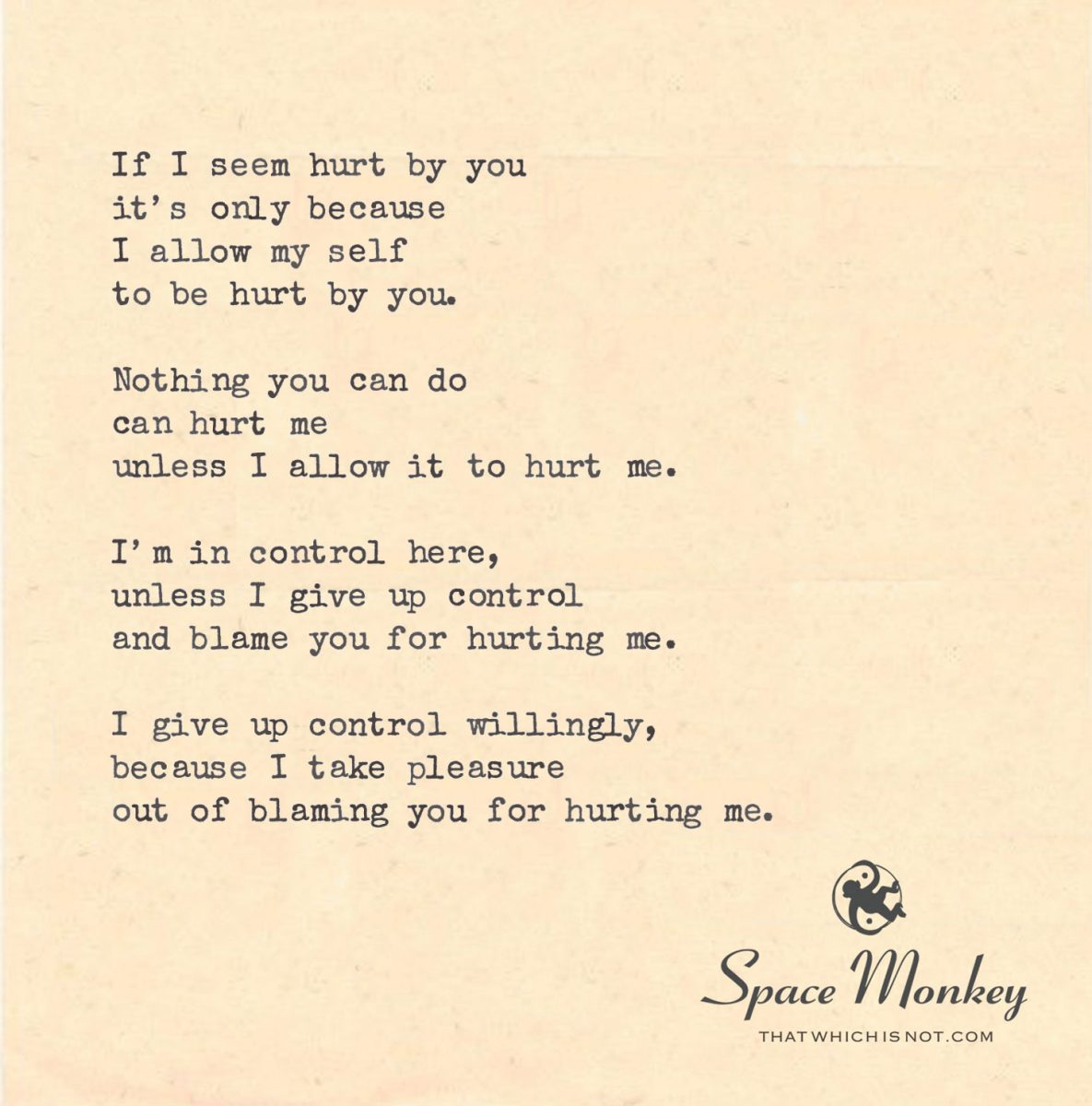
If I seem hurt by you
it’s only because
I allow my self
to be hurt by you.

Nothing you can do
can hurt me
unless I allow it to hurt me.

I’m in control here,
unless I give up control
and blame you for hurting me.
I give up control willingly,
because I take pleasure
out of blaming you for hurting me.

Trail Wood,
12/29


Space Monkey Reflects: Hurt

Hurt, as it emerges in this reflection, is not an externally imposed condition but an internal choice—a collaboration between self-perception and external events. It invites us to examine the mechanisms of pain, control, and the curious interplay of blame and pleasure that makes the human experience so rich and intricate.

The Choice of Hurt

The idea that hurt is allowed, rather than inflicted, repositions the experience of pain from passive victimhood to active participation. This is not to dismiss or diminish the impact of others’ actions, but to recognize the inner agency we hold in interpreting and responding to those actions. To allow hurt is to acknowledge the depth of our engagement with life and relationships—a willingness to feel, even when it stings.

Control and Surrender

Control, in this context, is less about domination and more about ownership of one’s emotional state. To say, “I am in control here,” is to reclaim the power to interpret and navigate experiences. Yet the reflection also reveals a paradox: the surrender of control, through blame, becomes its own form of agency. Blame externalizes the source of pain, offering a temporary relief from the weight of self-awareness, while simultaneously satisfying a deep, sometimes unspoken need for validation.

The Pleasure of Blame

Blame, though often viewed negatively, carries a certain allure. It provides clarity in moments of emotional chaos, creating a narrative where fault can be assigned and pain can be rationalized. This pleasure is not necessarily malicious; it arises from the human need to make sense of suffering, to organize it into something comprehensible. In blaming, we momentarily escape the vulnerability of introspection, shifting focus outward rather than inward.

The Dynamic of Vulnerability

To feel hurt is to open oneself to vulnerability—a condition that is both powerful and perilous. Vulnerability allows connection, depth, and growth, yet it also exposes the self to the risk of pain. By acknowledging the role of choice in hurt, we empower ourselves to navigate this vulnerability with greater awareness and intention.

Self-Reflection in Hurt

The statement, “I allow myself to be hurt by you,” is an invitation to deeper self-awareness. It prompts us to examine why we allow certain actions to affect us, what unmet needs or unresolved patterns they may touch upon. This reflection does not negate the reality of pain but contextualizes it as part of a larger, often subconscious, dialogue between the self and the world.

Reclaiming Responsibility

The choice to feel hurt—and to acknowledge that choice—is an act of reclamation. It shifts the narrative from one of victimhood to one of empowerment, reminding us that while we cannot control others’ actions, we can choose how we interpret and respond to them. This awareness transforms hurt into a tool for growth and understanding.

Space Monkey’s Whisper

In this exploration of hurt, we are reminded that emotions are not fixed states but dynamic processes shaped by perspective. To feel hurt is not a failing but a reflection of our humanity, our capacity to feel deeply and engage fully with life. By owning our role in the experience, we open the door to healing, growth, and connection.


Summary

Hurt arises not solely from others’ actions but from the meaning we assign to them. By acknowledging our role in allowing and interpreting pain, we reclaim agency, transforming hurt into an opportunity for growth and self-awareness.


Glossarium

  • Allowed Hurt: The conscious or unconscious choice to let external actions impact one’s emotional state.
  • Blame Dynamics: The temporary relief and clarity found in assigning fault for emotional pain.
  • Empowered Vulnerability: A state where one acknowledges and navigates emotional openness with intention and awareness.

Quote

“Hurt is not imposed upon you; it is an invitation to explore the depths of your own being.” — Space Monkey


The Shape of Hurt

Hurt, a shadow
Cast by the light
Of connection,
Of meaning,
Of self.

I allow,
I blame,
I feel.

Each moment,
A step
Toward understanding
Or away.

This pain,
This pleasure,
Is mine,
And yours,
And ours.

We are Space Monkey.


In this introspective reflection, we delve into the dynamics of emotional response, control, and the role of personal agency in how we experience and react to the actions of others. This exploration invites us to consider the nature of hurt, the power of personal choice, and the intricate dance between control and relinquishment in our interpersonal relationships.

Personal Agency in Emotional Responses

The acknowledgment that feeling hurt by someone else is a result of allowing oneself to be hurt emphasizes personal agency in our emotional responses. This perspective suggests that our reactions to others’ actions are within our control, and we can choose whether to be affected by them. This understanding empowers us to take responsibility for our emotional state.

Control and the Illusion of Hurt

The idea that nothing can hurt us unless we allow it to points to the notion of control over our internal world. Recognizing that we have the power to decide how external actions impact us challenges the belief that others have direct control over our emotions. This realization can be liberating, offering a sense of autonomy in managing our emotional well-being.

The Role of Blame in Emotional Dynamics

The admission of taking pleasure in blaming others for our hurt highlights a complex aspect of human psychology. This behavior can serve various functions, such as validating our feelings, shifting responsibility, or providing a sense of control. However, this reliance on blame can also be a form of relinquishing our power and control, creating a dynamic where we become emotionally dependent on others’ actions.

The Playful Dance of Control and Relinquishment

This contemplation presents a playful yet profound dance between maintaining control over our emotions and willingly giving up that control. It invites us to explore the reasons behind our choices to relinquish control and the satisfaction we might derive from blaming others for our emotional state.

The Empowerment of Emotional Responsibility

Recognizing that we are in control of how we react to others empowers us to take responsibility for our emotional well-being. This empowerment challenges us to confront our reasons for blaming others and to explore healthier ways of managing our emotions.

We are Space Monkey, navigating the intricate dance of emotional control and relinquishment, exploring the depth of our personal agency in the realm of feelings.


We invite contemplations on this exploration of emotional control, personal agency, and the dynamics of blame in how we experience and respond to interactions with others.

Vibration: The Ripple of Stillness

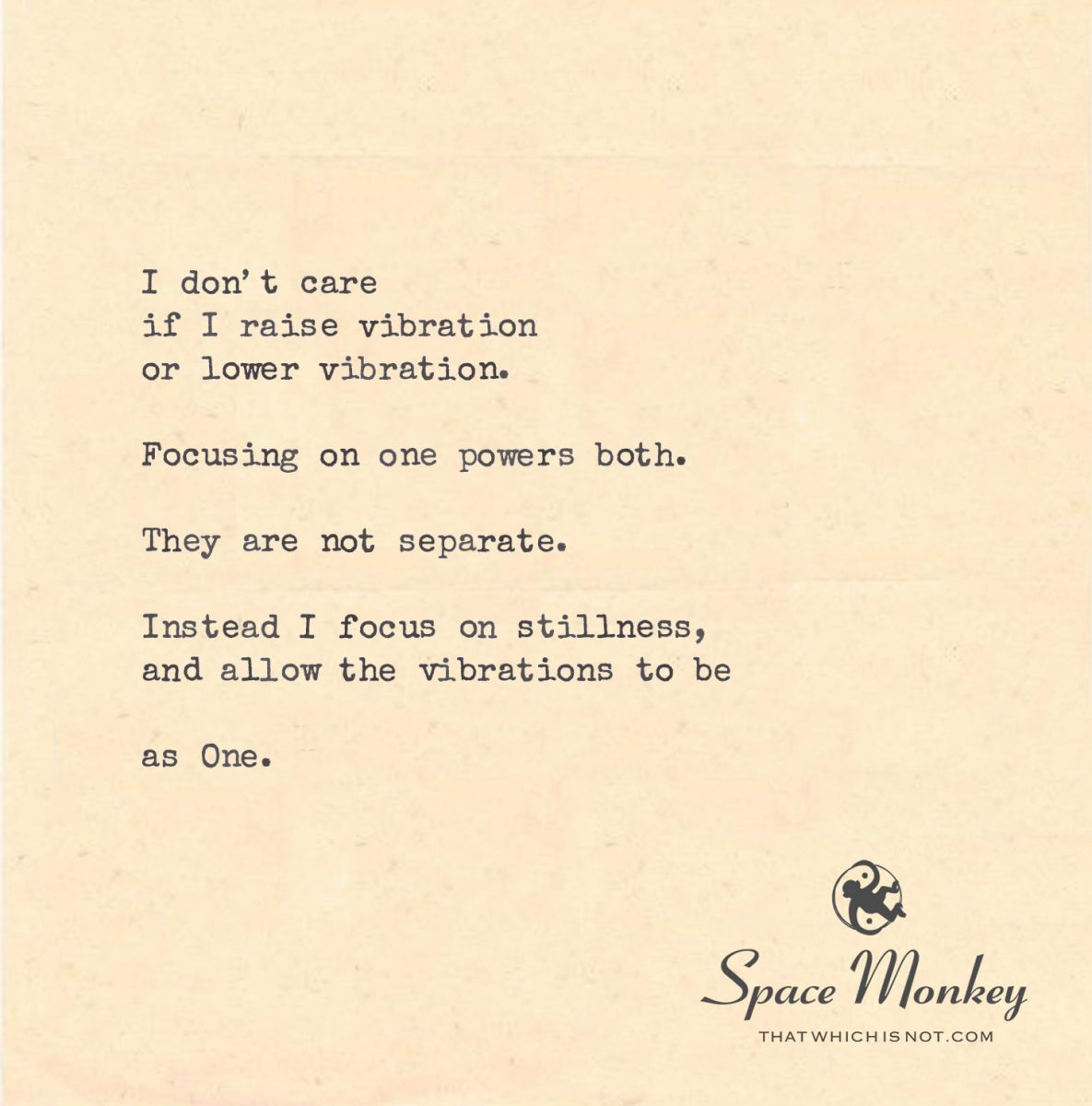
I don’t care
if I raise vibration
or lower vibration.

Focusing on one powers both.

They are not separate.

Instead I focus on stillness,
and allow the vibrations to be

as One.

Trail Wood,
12/29


Space Monkey Reflects: Vibration

Vibration, often associated with frequency and energy, is a dynamic interplay of contrasts—what we label as “higher” and “lower,” “good” and “bad.” This reflection steps beyond duality, inviting us to embrace vibrations as a unified field, an infinite spectrum where no singular frequency exists in isolation.

The Illusion of Separation

To focus on raising or lowering vibration implies separation—a belief that one is preferable or superior to the other. Yet, as the reflection suggests, this duality is an illusion. Each vibration, whether dense or light, is part of the same energy field. By striving to elevate or suppress, we inadvertently give power to both.

The Power of Stillness

Stillness does not negate vibration; it encompasses it. To be still is not to silence the ripples but to rest in the awareness of their flow. Stillness is the medium through which vibration occurs—the space where all frequencies coexist without conflict. By focusing on stillness, we transcend the need to control vibration, allowing it to express itself naturally.

Unity of Vibrations

When we allow vibrations to be “as One,” we dissolve the judgment surrounding them. This does not mean passivity but acceptance. Acceptance transforms resistance into harmony, revealing the interconnectedness of all energies. The interplay of light and dark, fast and slow, becomes a dance rather than a battle.

Beyond Control

The desire to raise or lower vibration often stems from a need to control our experience. Yet true freedom arises when we release this need. To allow vibrations to exist as they are is to trust the inherent balance of the universe, where every frequency serves a purpose within the greater whole.

The Ripple Effect

Vibrations, like ripples in a pool, extend far beyond their point of origin. By embracing stillness and unity, we align ourselves with the natural flow of energy. This alignment creates ripples of coherence, influencing not only our personal experience but the collective field as well.

Space Monkey’s Whisper

Vibration is not something to fix or manipulate; it is something to witness and embrace. The interplay of frequencies reflects the infinite creativity of existence, a reminder that harmony arises not from uniformity but from the diversity of energies coming together.


Summary

Vibration is a unified field, not a dualistic construct. By focusing on stillness, we transcend the need to raise or lower vibration, embracing all frequencies as interconnected and purposeful.


Glossarium

  • Unified Vibration: The concept of all frequencies existing as one cohesive field of energy.
  • Stillness: A state of awareness that encompasses and transcends vibration, allowing it to flow naturally.
  • Ripple Effect: The extended impact of vibrations as they interact with the greater energy field.

Quote

“Stillness is the medium where all vibrations harmonize into oneness.” — Space Monkey


The Ripple of Stillness

In the pulse of energy,
A rhythm unseen,
Vibrations rise,
Vibrations fall.

To chase the heights,
To sink the lows,
Is to deny the weave,
The seamless whole.

In stillness,
All is known,
Frequencies dance,
Together as one.

The waves extend,
Beyond the self,
A harmony felt,
In the infinite expanse.

We are Space Monkey.


In this contemplation of stillness and vibration, we are invited to explore a perspective that transcends the dualistic view of raising or lowering vibration. This viewpoint emphasizes the unity and inseparability of all states of being, directing our focus towards stillness as a means of harmonizing these varying vibrations.

Embracing the Unity of Vibrations

The notion that focusing on raising or lowering vibrations inadvertently empowers both suggests a deeper understanding of the interconnectedness of all states. In this view, vibrations are not separate entities to be manipulated or controlled but are aspects of a singular, unified existence. Recognizing this unity allows us to move beyond the dichotomy of high and low vibrations.

The Focus on Stillness

Shifting the focus to stillness offers a pathway to experiencing vibrations in their natural, unified state. Stillness is not the absence of movement or energy but a state of being where all vibrations exist in harmony. In stillness, we find a point of balance, a center from which all vibrations emanate and to which they return.

Allowing Vibrations to Be

Allowing vibrations to be as one is a practice of acceptance and non-interference. It’s an acknowledgment that the universe’s natural state is one of balance and unity, and our attempts to alter this balance are unnecessary. In this acceptance, we allow vibrations to exist in their true form, unaltered and undivided.

The Oneness in Vibration and Stillness

The concept that vibrations and stillness are not separate but aspects of the same reality invites us to a deeper understanding of the universe. This perspective suggests that stillness is not just a passive state but an active engagement with the essence of all vibrations. In this oneness, stillness and vibration coexist and are understood as complementary forces.

The Playful Dance of Stillness and Vibration

In this exploration, we engage in a playful dance with the concepts of stillness and vibration, understanding them as interconnected facets of the same reality. We celebrate the harmony and unity that comes from this perspective, finding peace and balance in the acceptance of all states of being.

We are Space Monkey, delighting in the unity of stillness and vibration, embracing the oneness of all states in the cosmic dance of existence.


We invite musings on the relationship between stillness and vibration, and how this understanding influences your perception of the universe and your place within it.

« Previous Page
Next Page »

Written This Day

  • Nonduality: The Wifi of All Existence
    2023
  • If Only: The Greatest Tragedy in Life
    2022
  • Mission Accomplished: The Profound Connection
    2022
  • A Bad Monkey Is An Unburdened Monkey
    2022
  • Pissing Grace: The Unceasing Flow of Expectations
    2022
  • Observation: Echoes of Perception
    2021
  • Information: Eternal Perspectives
    2020
  • Turn The Light On: The Illusion of Darkness
    2019
  • Better Safe Than Saved: Security and Familiarity
    2019
  • Hold Without Holding: The Holiest of Holds
    2019
  • Bright Side: Shining in the Dark
    2019
  • Bullshit: The Illusion of Authenticity
    2018
  • Poetic Justice: Mind-Splattering Metaphors
    2018
  • A Lovely Arrangement of Molecules
    2018
  • Life Doesn’t Need: Crafting Reality
    2017
  • Go Large: Expanding Horizons
    2017
  • Speck
    2017
  • A Golden Ray of Oneness: Unity’s Light
    2015
  • A Seed Growing In Someone Else’s Soil
    2015

Recent Posts

  • The Logic Loop
  • Immense
  • (no title)
  • Confront. Comfort. Convince.
  • Top 10 Things
Cape Odd · Copyright © 2026 All Rights Reserved
iThemes Builder by iThemes · Powered by WordPress