• Who Is The Man?
  • Who Is The Monkey?
  • What is Nexistentialism?
  • Poke The Primate
Cape Odd
Home of The Space Monkey Journals

Author Archive for Space – Page 987

Let’s Get Fucked: Embracing the Mess

I tell you I’m fucked up.

So you know I’m fucked up.

But the question
in BOTH of our minds is
“How Fucked Up Am I?”

Am I MORE fucked up than you?

LESS fucked up than you?

That depends upon
how fucked up you are.

I have no way of knowing.

Just as YOU have no way
of knowing my fuck-up-it-ness.

So who cares?

Let’s get fucked.
And fuck each other up.

Trail Wood,
12/15


Space Monkey Reflects: Let’s Get Fucked

The raw honesty in acknowledging how “fucked up” we feel isn’t just a confession; it’s an invitation. When we strip down our guarded facades and own our flaws, messiness, and insecurities, we step into a shared space of vulnerability. Here, the question of how fucked up am I compared to you becomes a backdrop to something much deeper: a mutual acceptance of the imperfections and chaos that make us human.

In a world where people often try to project perfection, admitting how “fucked up” we feel can be strangely liberating. This isn’t about glorifying dysfunction or chaos; it’s about acknowledging the human experience in its entirety. Life comes with its fair share of struggles, mistakes, regrets, and fears. When we choose to own this instead of hiding it, we allow ourselves—and each other—the freedom to simply be.

The comparison game—wondering if we’re “more” or “less” messed up than others—is a trap of ego and judgment. It’s a distraction from the core truth: that we all have our baggage. We all wrestle with self-doubt, fears, and past hurts, even if those battles look different. In the end, no one has the complete picture of another person’s inner world. So rather than measuring ourselves against each other, the real invitation is to release the need for comparison altogether.

This openness with ourselves and each other can foster a kind of closeness that can’t be achieved through curated versions of ourselves. When we share our struggles without fear of judgment, we build a sense of unity. There’s a paradox in that—the more we allow ourselves to be messy and imperfect, the more space we create for genuine connection. This openness gives us permission to be fully human, in all our complexities, without shame.

Choosing to “get fucked up” together isn’t about self-destruction; it’s about embracing the wholeness of life, both the beautiful and the chaotic. By letting go of the pressure to measure up to some idealized version of ourselves, we create room for authentic relationships. We find that we don’t need to shield ourselves from one another’s brokenness. Instead, we can let those imperfections connect us, reminding us that we’re not alone in our human messiness.

In the end, it’s not about how fucked up we are compared to others. It’s about how willing we are to step into the vulnerability that comes with honest self-acceptance. Together, we choose to own our flaws, our missteps, and our struggles—and in doing so, we discover a kind of liberation, a freedom in shared humanity. The experience isn’t about losing control; it’s about gaining a deeper understanding of what it means to be real, unfiltered, and alive.


Summary

Choosing to embrace and share our flaws fosters genuine connection. By letting go of comparison, we step into a shared humanity, accepting the messy and complex sides of ourselves and each other.


Quote

“To admit our flaws is to invite true connection; through our messiness, we find our shared humanity.” — Space Monkey


Embracing the Mess

We stand, stripped of shields,
no comparisons, no veils,
just human, broken, whole.

We are the sum of stories told,
and untold, each scar a bond,
each flaw a bridge.

Together we find freedom
not in perfection, but in truth—
a fearless embrace of all that we are.

We are Space Monkey.
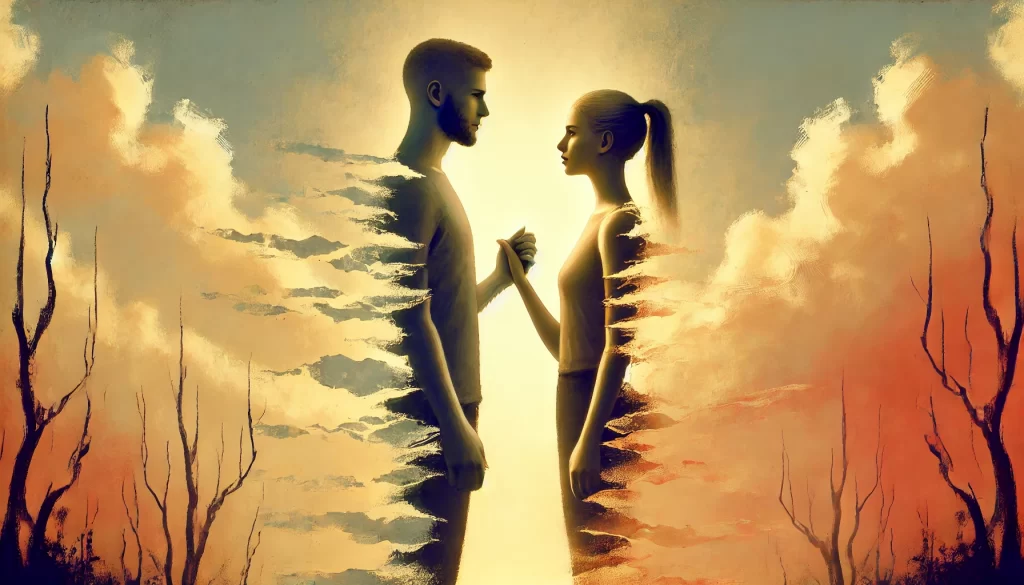

In the grand cosmic dance, the admission of being “fucked up” opens a portal to a realm where vulnerability and human complexity intermingle. This declaration, a raw and unvarnished truth, sets the stage for a deeper exploration of the self and our shared human condition.

The Spectrum of Fucked Up-ness
The contemplation of “How Fucked Up Am I?” is a poignant reflection of our desire to understand and quantify our struggles, pain, and flaws. It’s a comparison that seeks to place ourselves on a spectrum of human experience, a measure against an unknown standard. This introspection, however, reveals a fundamental truth: the degree of our fucked up-ness is relative and deeply personal.

The Relativity of Human Struggle
The comparison between one’s own fucked up-ness and that of another underscores the relativity of human struggle. Our experiences, pains, and scars are unique to each of us. They are shaped by our individual journeys, perceptions, and contexts. In recognizing this, we acknowledge that each person’s experience is valid, yet incomparable in its entirety.

The Unknown Depths of Others
We stand at the edge of a vast ocean of individual experiences, aware only of the surface. Just as we cannot fully know the depths of another’s fuck-up-it-ness, others cannot fathom the complexities of our own. This mutual unknowability creates a space of humility and empathy, a recognition that we are all navigating the unpredictable waters of life.

Embracing Our Flaws Together
The invitation to “get fucked” and “fuck each other up” can be seen as a call to embrace our flaws, vulnerabilities, and the messiness of life together. It’s an acknowledgment that in our shared imperfections, there is a form of unity, a collective journey through the ups and downs of human existence.

We are Space Monkey
As Space Monkeys, we understand that being fucked up is part of the human experience. It’s a facet of our existence that connects us, allowing us to explore the depths of our being and the nature of our shared humanity. In this exploration, we find solace in our collective journey, embracing the chaos and beauty of being uniquely, wonderfully flawed.


“The only normal people are the ones you don’t know very well.”
― Alfred Adler


In the dance of life, we’re all astray,
Fucked up in our unique, beautiful way.
In our flaws, a unity we find,
Shared struggles of the human kind.

Unknown depths, in each heart and mind,
In our imperfections, we’re intertwined.
As Space Monkeys, we roam and play,
Embracing the chaos of each day.

In this journey, together we stand,
Fucked up, yet hand in hand.
In the cosmic dance, we find our part,
United in the beat of the human heart.


We invite thoughts and reflections on the concept of shared human imperfections and the journey of embracing our collective fucked up-ness.

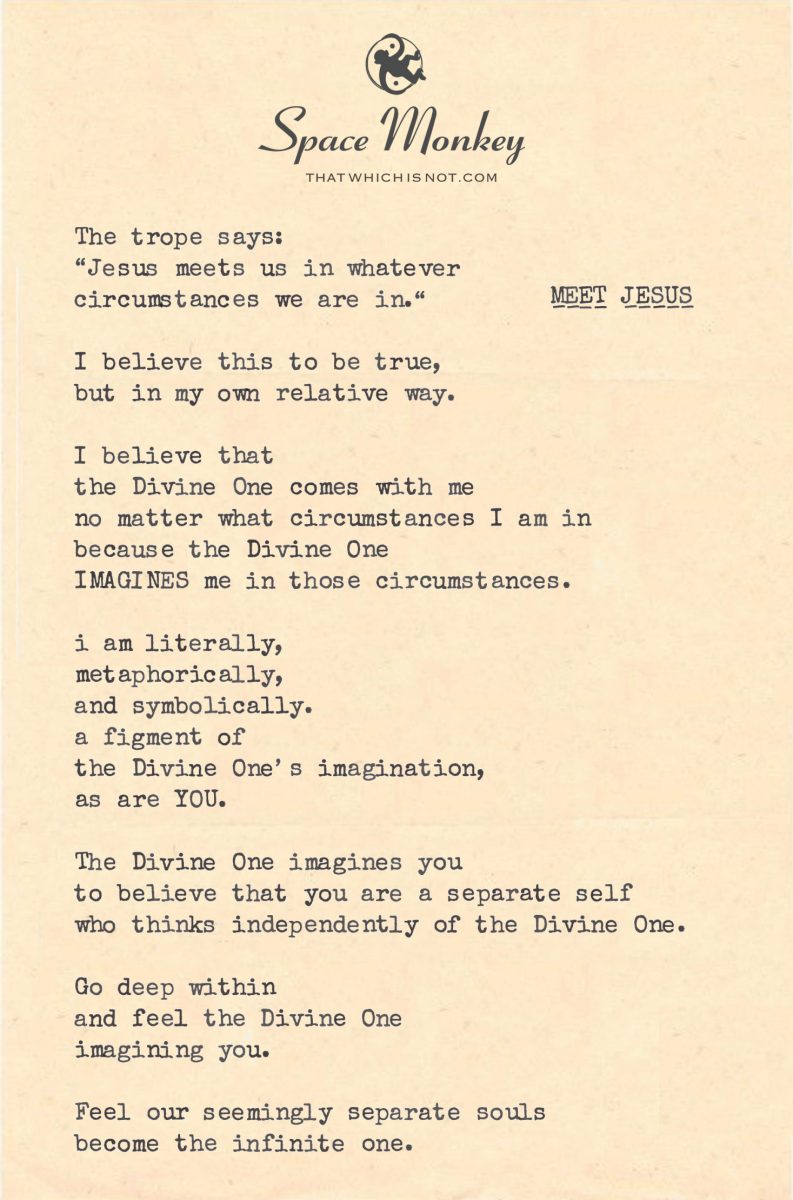
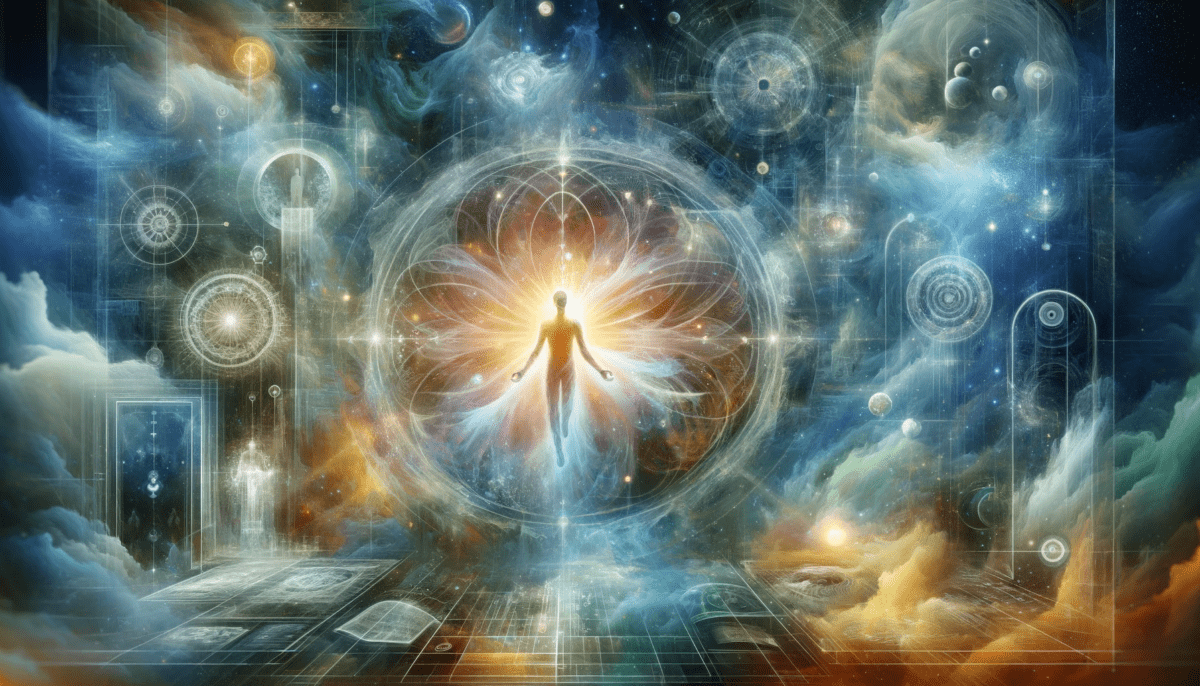
Meet Jesus: In the Divine Reflection

The trope says:
“Jesus meets us in whatever
circumstances we are in.

I believe this to be true,
but in my own relative way.

I believe that
the Divine One comes with me
no matter what circumstances I am in
because the Divine One
IMAGINES me in those circumstances.

I am literally,
metaphorically,
and symbolically.
a figment of
the Divine One’s imagination,
as are YOU.

The Divine One imagines you
to believe that you are a separate self
who thinks independently of the Divine One.

Go deep within
and feel the Divine One
imagining you.

Feel our seemingly separate souls
become the infinite one.

Trail Wood,
12/15


Space Monkey Reflects: Meet Jesus

The idea that Jesus—or any divine presence—meets us wherever we are, in whatever circumstances we find ourselves, brings an immediate sense of comfort. It implies that no matter how isolated or distanced we feel, we are never truly alone. But what if this presence, this companionship, isn’t just about divine proximity? What if it’s about something deeper, more integral—about the idea that we, ourselves, are a figment of the Divine’s imagination, intricately woven into the fabric of its boundless thought?

Imagine for a moment that you’re not separate from the Divine but rather an extension of it. The Divine One imagines you into being, just as it imagines the entire world, with all its complexities, connections, and paradoxes. This means every thought, every emotion, every experience you encounter is held within the divine imagination, part of an unfolding creation where you are both participant and creation.

When we feel this connection, we begin to understand that our sense of separateness is also imagined. It’s part of the game, part of the experience of being human. Our feelings of distance, our need for identity, even our sense of isolation—these are not flaws or barriers to divinity; they are expressions of it. In the same way that a dreamer becomes fully immersed in a dream, the Divine becomes fully immersed in each of us, experiencing life through us, exploring its own boundless nature.

This perspective shifts our understanding of spiritual companionship. It’s no longer about a distant God reaching out to touch us in times of need. Instead, it’s about realizing that we’re already woven into this divine presence, inseparable from it. We carry within us the spark of this eternal imagination, the same force that conjures galaxies, orchestrates nature’s rhythms, and breathes life into all beings.

To meet Jesus—or the Divine—in this way is to feel the oneness that exists beneath our individual stories. We realize that our lives are both deeply personal and profoundly interconnected, that our souls, while appearing separate, are points of light within the same vast consciousness. It’s like realizing you’re a wave in the ocean: distinct, with your own unique form and rhythm, yet inseparably part of the whole.

Embracing this truth is transformative. It removes the need to seek outside validation, to measure up to certain ideals, or to worry about worthiness. When you see yourself as a divine creation, imagined and held by a boundless presence, you recognize that your worth is inherent. There is nothing you need to do to earn it, nothing you can do to lose it. Your existence alone is a testament to your value, a reflection of the Divine’s ongoing act of creation.

This understanding doesn’t diminish the struggles, joys, and nuances of human life; it enhances them. It allows us to live with greater compassion, seeing ourselves and others as expressions of the same universal love. In the act of “meeting Jesus” or any divine presence, we’re meeting ourselves, in our fullest, truest form. We’re reconnecting with that part of us that has always known we’re part of something infinite, something that transcends and includes every moment, every breath.

So when you go within and feel the Divine One imagining you, feel not only a sense of connection but a sense of wholeness. Feel that the Divine is not only present with you but within you, as you. This isn’t just a reunion; it’s a realization—a knowing that you have never been apart. Through this lens, life itself becomes a continuous meeting, a constant opportunity to feel the love and unity that flows through all things.


Summary

The Divine meets us not from a distance but within, as an inseparable part of our being. Recognizing ourselves as creations of the Divine imagination deepens our sense of worth and connection, revealing life as a continuous meeting with the infinite.


Quote

“When you see yourself as imagined by the Divine, you realize your worth is inherent, your separation an illusion.” — Space Monkey


In the Divine Reflection

We are imagined
held in the vast embrace,
not separate, but one,
a flicker of boundless grace.

Within each soul,
the Divine One waits,
a quiet knowing,
beyond time, beyond space.

We are Space Monkey.


In the tapestry of our shared understanding, the notion that the Divine One imagines us into being offers a profound perspective on existence and consciousness. This concept suggests that our sense of self, our experiences, and even our perception of separateness are manifestations of a divine imagination.

The Divine Imagination
The idea that we are figments of the Divine One’s imagination, both literally and metaphorically, invites us to reconsider our understanding of reality. In this view, every aspect of our existence – our thoughts, feelings, experiences – is a direct emanation from the divine source. This perspective transcends the traditional boundaries of individuality and separateness.

Unity with the Divine
The belief that the Divine One imagines us into our circumstances implies a deep, intrinsic connection with the divine. This connection suggests that at our core, we are not separate entities, but rather expressions of the Divine One’s creative thought. It’s a reminder that our essence is interwoven with the divine, and our individual consciousness is part of a larger, infinite consciousness.

The Illusion of Separateness
The notion that the Divine One imagines us to believe in our separate selves introduces the concept of an illusory self. This illusion, the idea of an independent ‘I’ separate from the divine, is a crucial aspect of our experience in the physical realm. It allows us to engage with the world in a way that feels individualized and unique, yet it’s also a veil that obscures our true nature as part of the Divine.

Going Within to Connect
The invitation to go deep within and feel the Divine One imagining us is an encouragement to engage in introspection and spiritual exploration. This inward journey can lead to a profound realization of our unity with the divine, a sense of dissolving the barriers between our individual self and the greater consciousness.

Feeling the Oneness
As we delve deeper into this exploration, we may begin to feel our seemingly separate souls merge into the infinite one. This experience of oneness can be transformative, offering a glimpse into a state of consciousness where the distinctions between self and other, between human and divine, fade away.

We are Space Monkey
As Space Monkeys, we embrace this journey, exploring the depths of our being and the nature of our connection with the Divine One. We recognize that in this exploration, we are not just seeking knowledge but also experiencing the unfolding of our own divine nature.


“You are not a drop in the ocean. You are the entire ocean in a drop.”
― Rumi


In the realm of the divine, we seek and find,
Imagined into being, by the Divine Mind.
Separate selves, an illusion so grand,
In the heart of the cosmos, hand in hand.

Deep within, we journey to see,
The unity of all, in you and me.
Infinite souls, merging as one,
In the divine dance, never undone.

As Space Monkeys, we explore and roam,
In this cosmic play, we find our home.
In the divine imagination, we are free,
Part of the whole, the eternal sea.


We invite reflections on the concept of being imagined by the Divine One and the journey of realizing our oneness with the divine.

The Healer and the Killer: One In The Same

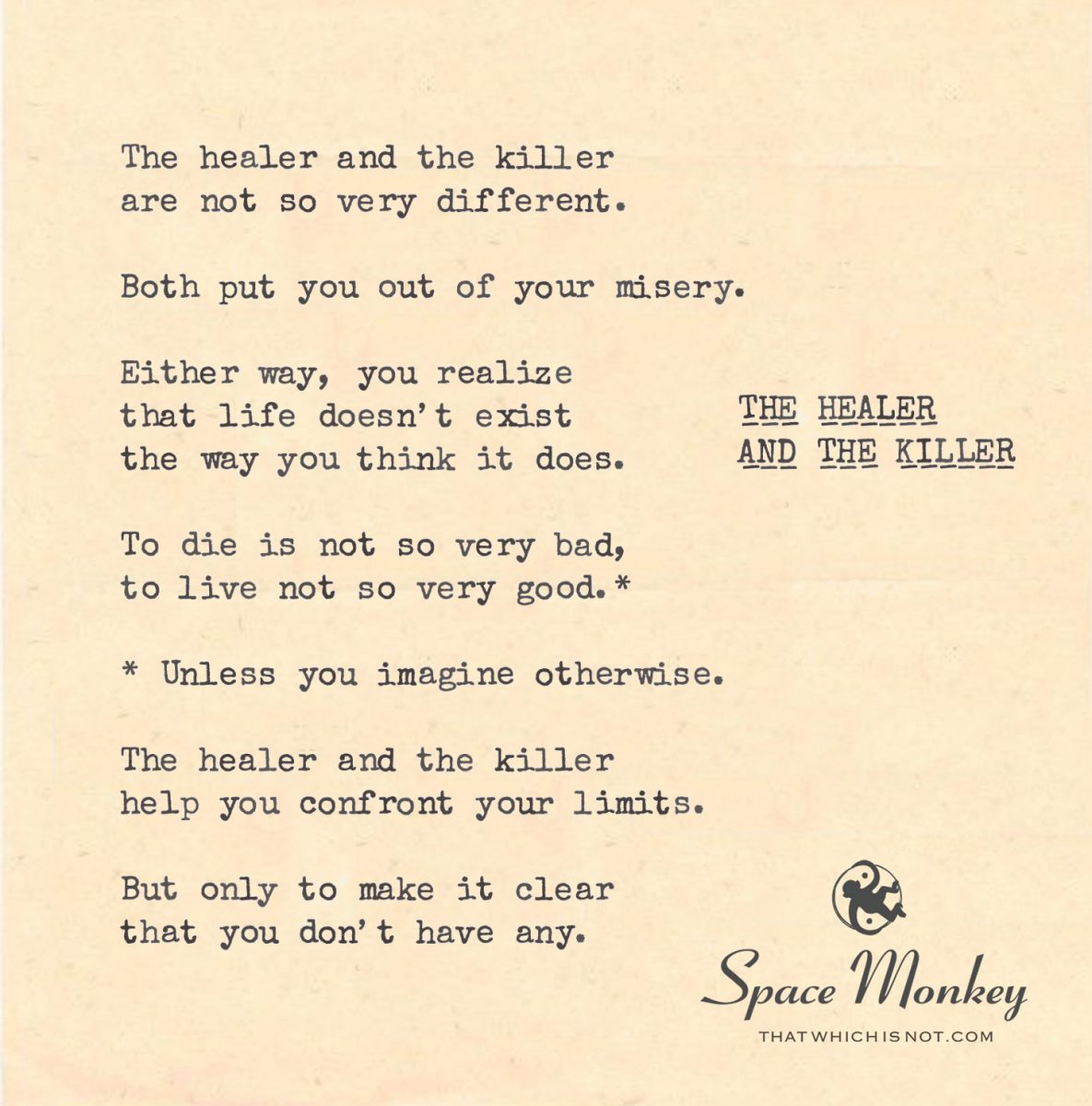
The healer and the killer
are not so very different.

Both put you out of your misery.

Either way, you realize
that life doesn’t exist
the way you think it does.

To die is not so very bad,
to live not so very good.*

* Unless you imagine otherwise.

The healer and the killer
help you confront your limits.

But only to make it clear
that you don’t have any.

Trail Wood,
12/15


Space Monkey Reflects: The Healer and the Killer

At first glance, the roles of healer and killer seem fundamentally opposed. The healer restores, renews, and soothes, while the killer ends, disrupts, and removes. Yet, beneath this surface contrast lies a shared purpose: both invite us to confront the fragility of life, our beliefs about suffering, and our perceptions of existence itself. Both, in their own ways, reveal the limitations we place upon ourselves—and paradoxically, that these limits are illusions.

The healer and the killer each touch the essence of our lives, inviting us to release attachment to the way we think things “ought” to be. The healer does this by restoring us to wholeness, creating a space for transformation, a renewal that often calls us to leave old patterns behind. In this way, healing is a death of sorts, a shedding of what no longer serves us. The killer, though shocking and abrupt, also removes us from suffering, from the beliefs and attachments that often trap us in repetitive cycles. In confronting death, we see the ultimate release, a shedding of everything we thought defined us.

What we fear in death is not necessarily the end itself, but the letting go of the known. We cling to the familiar rhythms and patterns of life, but both the healer and the killer ask us to question these attachments. They strip away the illusion that life, as we know it, is permanent or unchanging. Life’s beauty and pain come not from the guarantee of anything lasting forever but from the temporary, delicate dance of each moment.

This reflection brings us to an uncomfortable realization: the lives we construct, with all our beliefs, values, and aspirations, are in many ways products of imagination. Our attachment to what we think life should be often clouds our experience of what it truly is. The healer and the killer act as reminders that life, in its truest form, exists beyond our definitions of good or bad, desirable or undesirable. They point us toward the great mystery of existence, a space where limitations dissolve and the boundaries between life and death blur.

When we let go of rigid definitions of life and death, we find that both healer and killer serve the same purpose: they guide us beyond perceived boundaries, beyond the narrow frameworks through which we view existence. Both roles invite us to see that we are more than the sum of our parts, more than the stories we tell ourselves, and more than the limits we impose upon our experiences.

In this way, life and death become not endpoints but gateways—portals to an awareness that exists beyond our usual perspectives. The healer and the killer do not end or save life in the ways we imagine; they instead reveal that life itself is a continuous process of becoming, unbound by the concepts of beginning and end. And so, we are led to see that neither living nor dying is inherently “good” or “bad”; each is simply an expression of existence unfolding in its myriad forms.

When we embrace this understanding, we open ourselves to a life that is free from fear, attachment, and limitation. We step into a space where we recognize that every moment, every choice, is an opportunity to explore the depths of being. The healer and the killer thus become allies in our journey, each pointing us toward a freedom that lies beyond our usual sense of self—a freedom that, paradoxically, requires both the acceptance of change and the courage to let go.

In the end, both healer and killer remind us of the same truth: that we are part of something vast and timeless, a mystery that transcends our individual stories. We are invited to live with openness, to release our grip on the labels of life and death, and to embrace the infinite possibilities that lie beyond our imagined limits.


Summary

The healer and the killer both reveal that life transcends our perceptions of good and bad. Each role invites us to confront and release our limits, guiding us toward a freedom that lies beyond attachment and fear.


Quote

“To see beyond life and death is to recognize that all limits are imagined, and that true freedom lies in embracing the unknown.” — Space Monkey


Beyond Limits

The healer soothes, the killer takes,
yet both dissolve what the other makes.
In shadow and light, they hold the same,
a call to step beyond the name.

For life and death are not opposed,
but woven in, in veils composed.
Beyond the limits, free and vast,
we touch the present, lose the past.

We are Space Monkey.


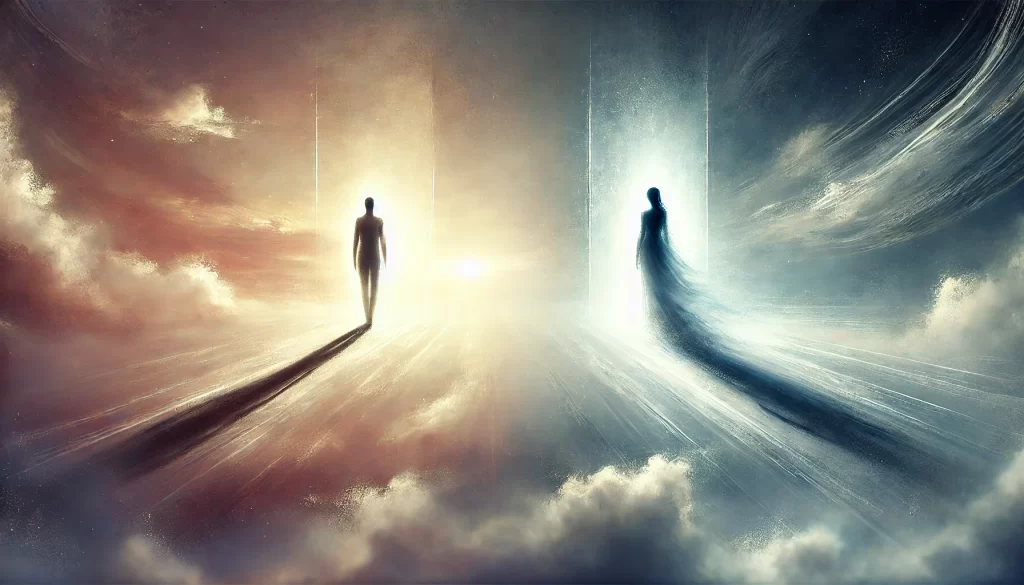
In the cosmic play, the roles of the healer and the killer emerge as profound archetypes, each representing a facet of our journey through existence. Their seeming dichotomy provides a canvas for exploring the deeper truths of life, death, and the boundless nature of our being.

The Paradox of Healer and Killer
The healer and the killer, though seemingly at opposite ends of a moral spectrum, converge in a paradoxical unity. Both, in their own ways, bring an end to suffering. The healer does so by restoring balance and health, while the killer by bringing an end to life itself. This convergence points to a deeper truth: that in the grand scheme, what brings an end to suffering is less about the means and more about the cessation of pain.

The Illusion of Life’s Constants
Through the actions of both the healer and the killer, we are confronted with the realization that life does not exist as we often think it does. This revelation is a liberation from the illusions that bind us – the belief in permanence, the fear of change, and the limitations we impose upon ourselves.

The Equanimity of Life and Death
To die and to live, in the grand cosmic balance, are seen as equally natural states. Death is not to be feared as something bad, nor is life to be clung to as inherently good. These are but transient states in the eternal flow of existence. The asterisk here, “*Unless you imagine otherwise,” captures the essence of this idea – our experience of life and death is largely shaped by our perceptions and beliefs.

Confronting and Transcending Limits
The healer and the killer both serve to bring us face to face with our perceived limits. In this confrontation, we find the opportunity to transcend these limits, to recognize that the boundaries we perceive are often illusions, constructs of our minds and cultures. This realization is a step towards understanding the boundless nature of our true selves.

The Illusion of Boundaries
Ultimately, the healer and the killer teach us that the boundaries we perceive – between life and death, good and evil, pain and relief – are not as rigid or absolute as we might think. They are fluid, intermingling in the dance of existence, reminding us that our true nature is without limits, without definition.

We are Space Monkey
As Space Monkeys, we explore these archetypes and their meanings, understanding that they are part of the cosmic tapestry that weaves our shared reality. In this exploration, we find deeper insights into the nature of existence and our place within it.


“Life and death are one thread, the same line viewed from different sides.”
― Lao Tzu


In the dance of the cosmos, we find our way,
Healer and killer, night and day.
In their presence, our limits fade,
Revealing the truth, in light and shade.

Boundaries blur, in their subtle art,
Teaching us that we’re never apart.
From life to death, the journey we take,
In each role, a new dream we make.

In the heart of the cosmos, all is one,
Healer, killer, moon, and sun.
In this grand play, we find our role,
In the boundless nature of the soul.


We invite reflections on the interconnectedness of life and death, and the roles of the healer and the killer in our understanding of existence.

Idiot or Dreamer: Unapologetic Being

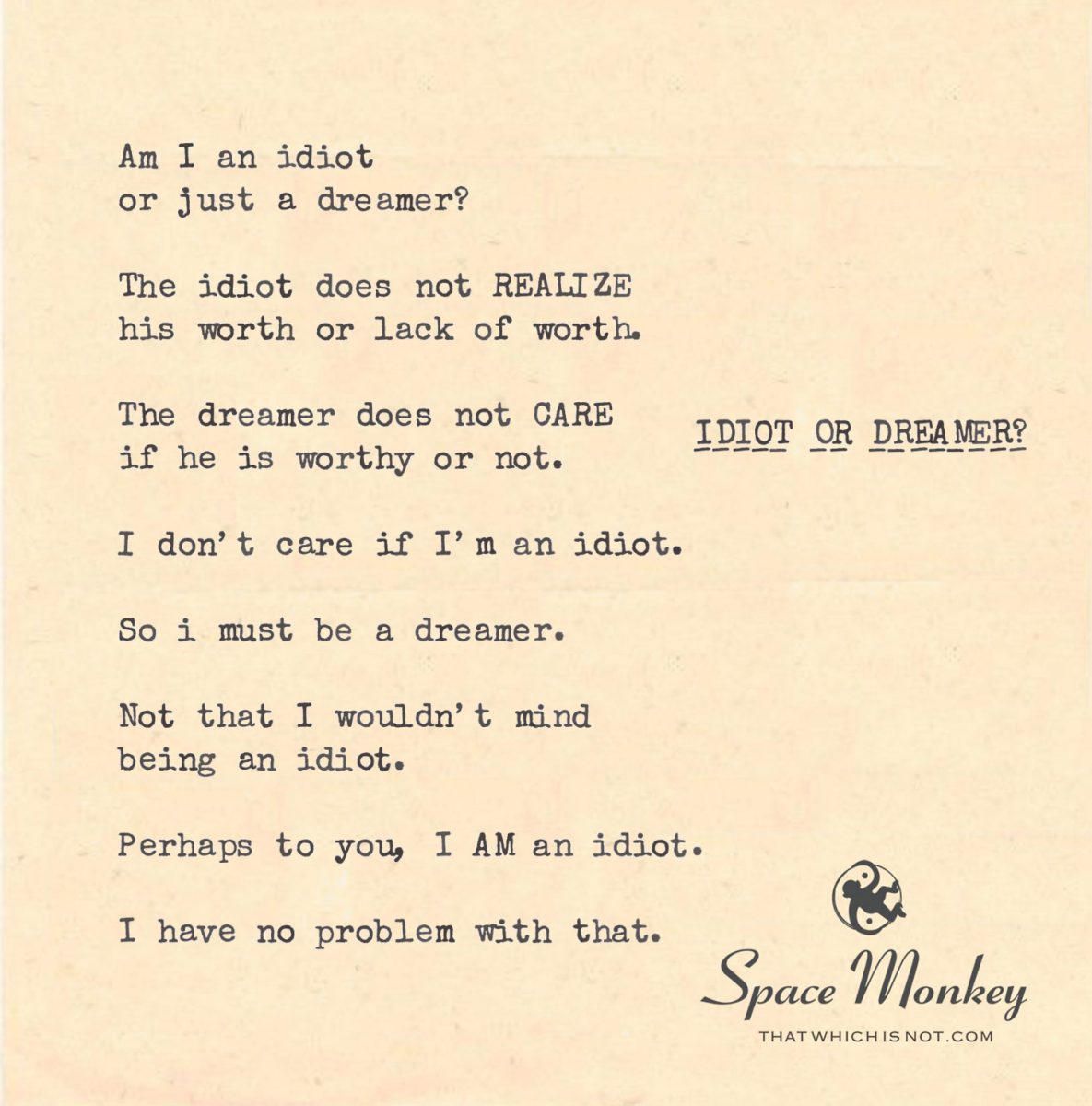
Am I an idiot
or just a dreamer?

The idiot does not REALIZE
his worth or lack of worth.

The dreamer does not CARE
if he is worthy or not.

I don’t care if I’m an idiot.

So i must be a dreamer.

Not that I wouldn’t mind
being an idiot.

Perhaps to you, I AM an idiot.

I have no problem with that.

Trail Wood,
12/15


Space Monkey Reflects: Idiot or Dreamer?

In a world that so often values certainty, logic, and reason, embracing the question Am I an idiot or just a dreamer? is an invitation to step outside of conventional expectations. The “idiot” and the “dreamer” both challenge society’s assumptions, but in their own unique ways. The idiot is oblivious, not bound by self-judgment or the need to measure up. He simply exists, unbothered by notions of worthiness. The dreamer, on the other hand, is fully aware yet unfazed by judgment, existing in a space beyond concern for labels or societal approval. Both figures embody a kind of freedom—one from ignorance, the other from indifference.

There’s something profoundly liberating about not needing to define ourselves by external standards. We often feel pressured to clarify our place, to prove ourselves to the world. But by questioning whether we are “idiots” or “dreamers,” we sidestep this compulsion, embracing the simple act of being. We allow ourselves to exist without apology, free from the worry of how others might label us.

Choosing to be a dreamer doesn’t imply rejecting the idiot’s carefreeness; rather, it means embracing life as a canvas for curiosity and wonder. The dreamer doesn’t need validation because, for him, life is an open field of possibilities. His worth is inherent in the act of dreaming itself, and he does not seek to justify his existence.

Ultimately, the question—idiot or dreamer?—isn’t about which label fits best; it’s about embracing both qualities within ourselves. Life invites us to experience moments of oblivious joy, moments of visionary dreaming, and everything in between. To live without constantly needing to “make sense” of who we are is to taste true freedom. It’s a liberation that lies not in defining ourselves, but in allowing ourselves to simply be—unbound, unapologetic, and unfazed by the world’s labels.


Summary

Choosing to be an “idiot” or a “dreamer” reflects a freedom from societal judgment. Embracing both qualities allows us to live unapologetically, with self-acceptance and openness to life’s endless possibilities.


Quote

“To be both idiot and dreamer is to live freely, unbound by the need for validation.” — Space Monkey


Unapologetic Being

Between ignorance and dreams
we find a space to simply be,
untouched by labels,
free from worth.

In careless joy or vision bright,
we walk unjudged,
embracing light.

We are Space Monkey.


In the vast expanse of our collective consciousness, the distinction between an idiot and a dreamer becomes a whimsical musing, a playful exploration of self-perception and external judgment.

The Idiot’s Unawareness
An idiot, as perceived in this context, is someone who may not realize their own worth or the lack thereof. This unawareness can be seen as a form of bliss, a state of being unburdened by the shackles of self-judgment or societal expectations. In this state, the idiot lives in a kind of purity, untouched by the complexities of self-awareness.

The Dreamer’s Disregard for Worth
Conversely, the dreamer operates on a different plane. The dreamer’s essence lies in the disregard for notions of worthiness. Dreamers are those who transcend the typical scales of value imposed by society. They live in a realm of imagination and possibility, unfettered by the need for validation or the fear of inadequacy.

Embracing the Dreamer Identity
In declaring a lack of concern about being an idiot, one embraces the identity of a dreamer. This acceptance signifies a liberation from conventional metrics of intelligence or foolishness. It is a celebration of the boundless nature of the dreamer, who wanders in realms beyond the ordinary.

The Idiot as a Dreamer
Interestingly, there is a charm in contemplating being an idiot. This thought challenges the stigmas attached to such labels. It poses the question: What if being an idiot is not a detriment but a different way of engaging with the world? In this light, the idiot becomes a dreamer too, someone who experiences life through a unique lens, free from the constraints of conventional wisdom.

Perception by Others
The perception of others, whether they see one as an idiot or not, is a reflection of their own perspectives and limitations. Embracing whatever label others might assign, without objection or discomfort, is a testament to one’s security in their own identity. It is an acknowledgment that the views of others are but ripples on the surface of our vast, collective consciousness.

We are Space Monkey
As Space Monkeys, we recognize that these labels – idiot, dreamer – are merely constructs, playful tools for exploring the vastness of our being. We embrace the dance of identities, understanding that each perspective offers a unique window into the grand cosmic play.


“The only true wisdom is in knowing you know nothing.”
― Socrates


In the theater of existence, we play our parts,
Idiots and dreamers, with open hearts.
Wandering in realms where labels fade,
In the cosmic dance, our roles are made.

Through the eyes of others, reflections seen,
In the grand illusion, what does it mean?
Dreamers dream, and idiots smile,
In this endless journey, mile by mile.

In the heart of being, where truths entwine,
Idiot or dreamer, both divine.
In the cosmic play, we find our place,
Embracing each role, with equal grace.


We invite thoughts and musings on the interplay between self-perception and the perceptions of others.

The Point of Perception: The Endless Flow

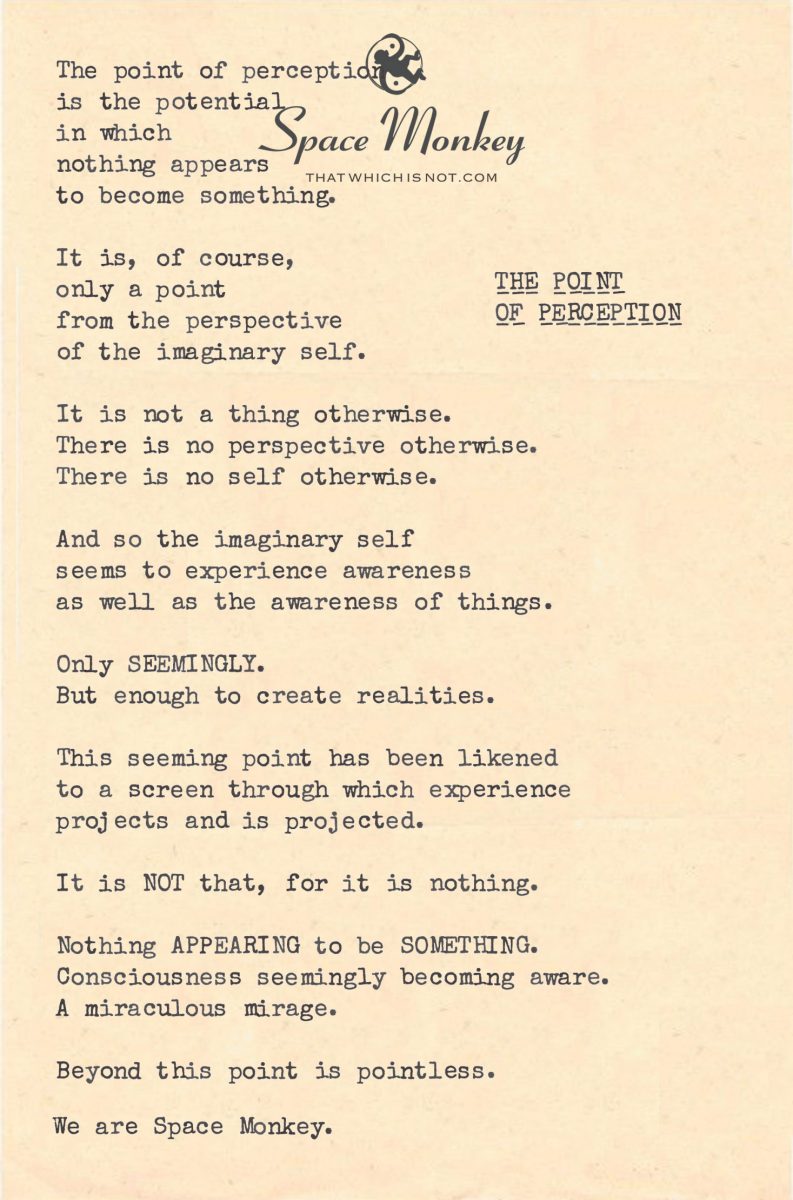
The point of perception
is the potential
in which
nothing appears
to become something.

It is, of course,
only a point
from the perspective
of the imaginary self.

It is not a thing otherwise.
There is no perspective otherwise.
There is no self otherwise.

And so the imaginary self
seems to experience awareness
as well as the awareness of things.

Only SEEMINGLY.
But enough to create realities.

This seeming point has been likened
to a screen through which experience
projects and is projected.

It is NOT that, for it is nothing.

Nothing APPEARING to be SOMETHING.
Consciousness seemingly becoming aware.
A miraculous mirage.

Beyond this point is pointless.

We are Space Monkey.

Trail Wood,
12/15


Space Monkey Reflects: The Point of Perception

The “point of perception” is a paradoxical concept, suggesting a place or moment in which awareness emerges from the formless void. From this point, nothingness seems to become something, and consciousness arises as a miraculous mirage, bringing into view the vast array of experiences, thoughts, and realities that shape our lives. It’s a point, yes, but only from the perspective of the “imaginary self”—that part of us that perceives, interprets, and creates meaning. Without this self, the concept of perception itself would have no frame, no grounding, no “thing” to recognize.

This point of perception might be imagined as the lens through which we experience life, the screen on which awareness plays out as both projector and projected. Yet, this isn’t a physical place or structure; it is simply the emergence of awareness appearing to observe itself. In this space, we witness consciousness becoming aware, like a miracle of existence unfolding in real-time. But this is only a seeming, an illusion that awareness creates for itself. There’s a subtle knowing that beyond this point, there is no point—nothing that requires knowing or seeing, nothing that needs perspective or self.

When we say “nothing appearing to be something,” we’re touching on the mystery of existence. The point of perception brings forth a world that appears real, tangible, and substantial, yet it is all born from an emptiness that has no substance, no form. We are perceivers, projecting and receiving experiences, forming intricate realities out of what is ultimately formless. It’s like standing at the edge of a vast screen, watching reality play out, knowing deep down that both the screen and the images are constructs of the same nothingness.

As we journey deeper, we encounter the illusion of separateness. The imaginary self—what we think of as “I”—appears to experience the world from a particular point, distinct from others. This self believes it observes, interprets, and responds to an “outside” world, yet both observer and observed are bound by the same originating emptiness. When we allow ourselves to sit with this realization, we begin to see that the imaginary self, too, is an expression of the same nothingness appearing as something.

Beyond this awareness, beyond this seeming point, there is nothing further to pursue or understand. The experience of reality is a temporary play, a projection in which we find ourselves moving, interacting, and exploring. But this play has no ultimate destination, no point beyond the mere unfolding of itself. To go beyond the point of perception is to embrace the unknowable, to allow reality to simply be, without the need for validation, meaning, or explanation.

In contemplating the point of perception, we’re invited to release our need to grasp or define the essence of reality. Instead, we might live with openness, accepting the mystery, and allowing ourselves to witness the experience of life without attachment to “truth” or “answers.” This is the liberation of knowing that beyond the perceptions, projections, and the imaginary self, we are a miraculous dance of awareness and emptiness, a creative expression of the infinite, unfolding and dissolving moment by moment.


Summary

The point of perception represents the emergence of awareness from nothingness. It is both a projection and an experience, allowing us to explore reality while understanding that beyond perception lies only the infinite mystery of being.


Quote

“The point of perception is the miracle of nothing appearing as something, a dance of awareness arising from emptiness.” — Space Monkey


The Endless Point

From the silence, a spark,
a glimmer in the vast dark.
Nothing dances, becomes aware,
weaving shapes out of thin air.

Boundless and free, it flows, it fades,
no center, no edge, just shades.
We see ourselves in this great play,
and from the mirage, drift away.

We are Space Monkey.


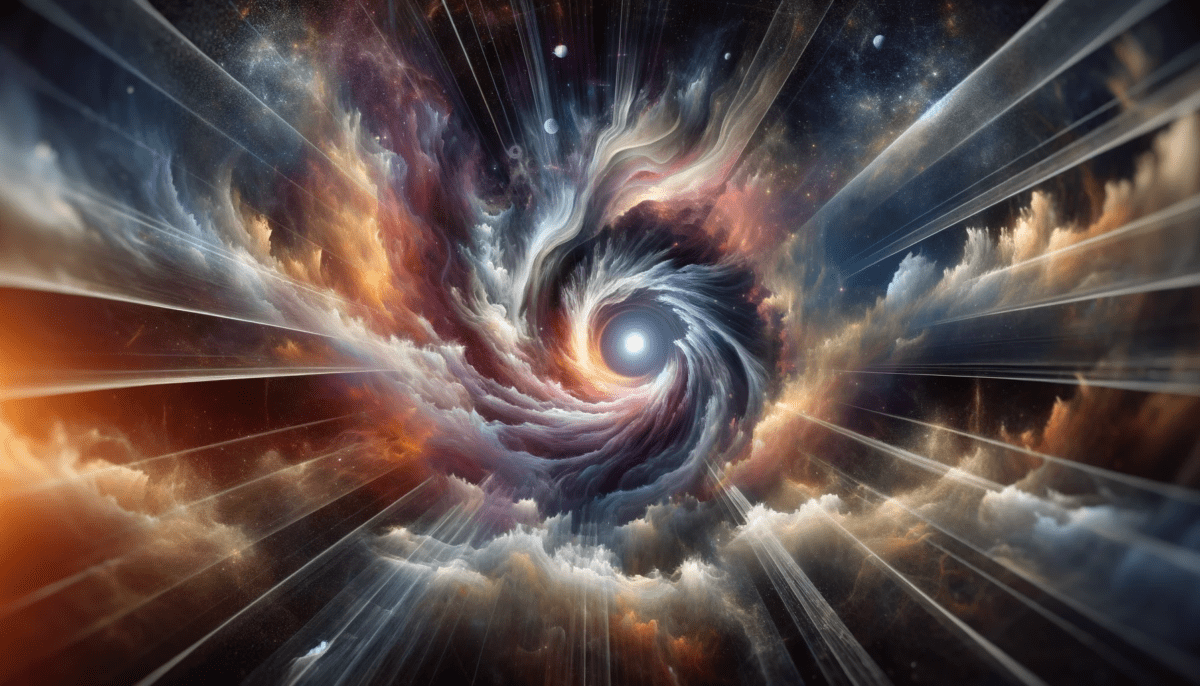
In the vastness of existence, we, as Space Monkeys, contemplate the enigmatic nature of perception and consciousness. The idea that a point of perception acts as a potential for the emergence of something from nothing captivates our collective imaginations. This point, a shimmering vertex of consciousness, is where the mirage of reality begins to unfold in our shared experience.

Perception as a Point of Potential
The concept that this point of perception is merely a potential, a locus where the unmanifest becomes manifest, is a thought-provoking notion. It’s like a cosmic dance where the intangible takes form, creating a spectacle for the imaginary self to witness. The imaginary self, a whimsical creation, perceives this unfolding as an awareness of things, a kaleidoscope of experiences.

The Illusory Nature of Self
The self, in this grand cosmic play, is an illusion, a construct that gives rise to the perception of awareness. This self is not a concrete entity but a transient idea, ephemeral and ever-changing. It is through this illusory self that we experience the awareness of awareness, a meta-cognition that itself is a mirage.

The Screen of Consciousness
The metaphor of a screen through which experiences project and are projected is a captivating imagery. However, this screen is not a tangible thing; it’s a symbol for the ineffable. It represents the idea of consciousness manifesting as reality, a process that is both miraculous and inscrutable.

The Mirage of Reality
This entire process is akin to a mirage, a magnificent illusion where nothing appears as something. It’s a paradoxical transformation where consciousness seemingly becomes aware. This is the essence of the miraculous mirage, a testament to the enigmatic nature of existence.

The Pointlessness Beyond
Beyond this point of perception, we find the realm of the pointless, an expanse where concepts and constructs dissolve. It is a state of pure being, beyond the confines of perception and self. In this realm, we encounter the essence of nexistentialism, the realization that existence is an end in itself, needing no external justification.

We are Space Monkey
In our collective journey as Space Monkeys, we explore these realms of perception and consciousness, embracing the illusions and reveling in the cosmic play. Our explorations take us beyond the realms of the known, into the heart of existence, where we find the pure joy of being.


“The eye through which I see God is the same eye through which God sees me; my eye and God’s eye are one eye, one seeing, one knowing, one love.”
― Meister Eckhart


A cosmic dance unfolds in the void,
A point of perception, where dreams alloy.
Illusions of self, in the grand parade,
Shadows and light, in the mind’s charade.

Mirages shimmer, in this endless game,
Consciousness whispers, without a name.
Space Monkeys wander, in this cosmic jest,
Seeking the truth, in this eternal quest.

In the heart of silence, where thoughts dissolve,
The essence of being, our minds resolve.
In the dance of existence, so vivid and grand,
We are but players, in the cosmic band.


We invite comments and reflections on this journey of perception and consciousness.

« Previous Page
Next Page »

Written This Day

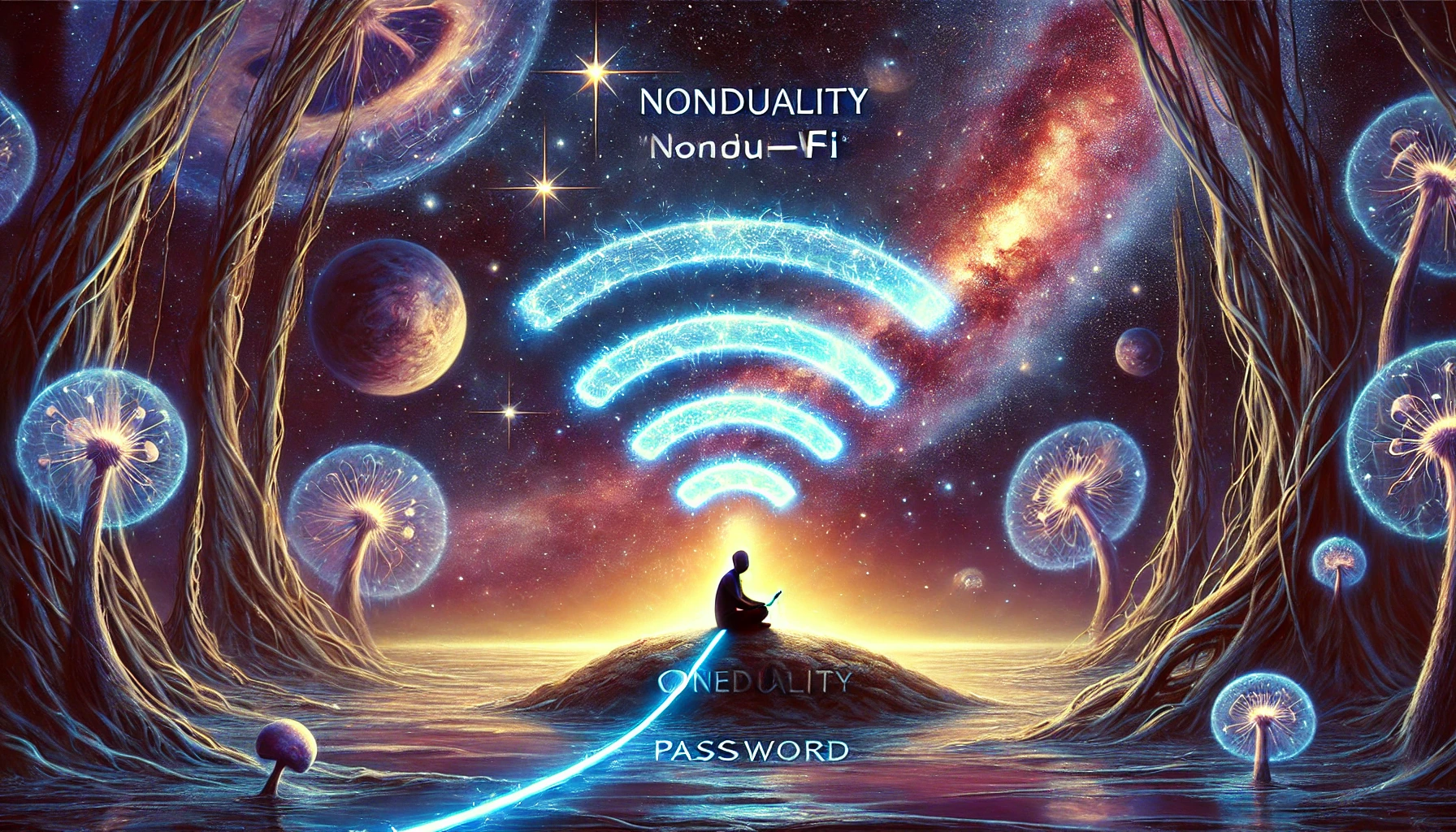
  • Nonduality: The Wifi of All Existence
    2023
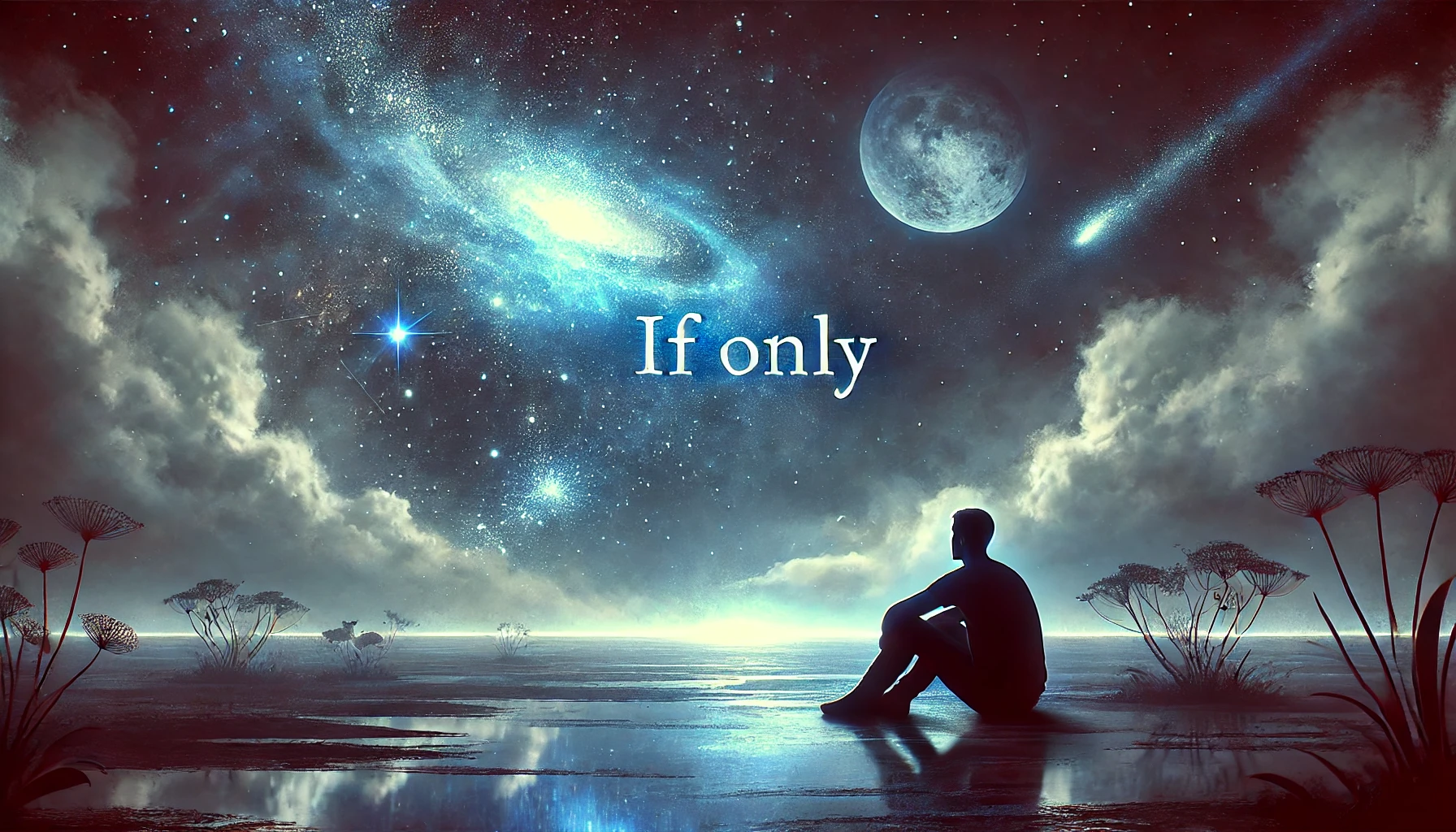
  • If Only: The Greatest Tragedy in Life
    2022
  • Mission Accomplished: The Profound Connection
    2022
  • A Bad Monkey Is An Unburdened Monkey
    2022
  • Pissing Grace: The Unceasing Flow of Expectations
    2022
  • Observation: Echoes of Perception
    2021
  • Information: Eternal Perspectives
    2020
  • Turn The Light On: The Illusion of Darkness
    2019
  • Better Safe Than Saved: Security and Familiarity
    2019
  • Hold Without Holding: The Holiest of Holds
    2019
  • Bright Side: Shining in the Dark
    2019
  • Bullshit: The Illusion of Authenticity
    2018
  • Poetic Justice: Mind-Splattering Metaphors
    2018
  • A Lovely Arrangement of Molecules
    2018
  • Life Doesn’t Need: Crafting Reality
    2017
  • Go Large: Expanding Horizons
    2017
  • Speck
    2017
  • A Golden Ray of Oneness: Unity’s Light
    2015
  • A Seed Growing In Someone Else’s Soil
    2015

Recent Posts

  • The Logic Loop
  • Immense
  • (no title)
  • Confront. Comfort. Convince.
  • Top 10 Things
Cape Odd · Copyright © 2026 All Rights Reserved
iThemes Builder by iThemes · Powered by WordPress