• Who Is The Man?
  • Who Is The Monkey?
  • What is Nexistentialism?
  • Poke The Primate
Cape Odd
Home of The Space Monkey Journals

Author Archive for Space – Page 988

I Hear Nothing But The Rain: Insane Solitude

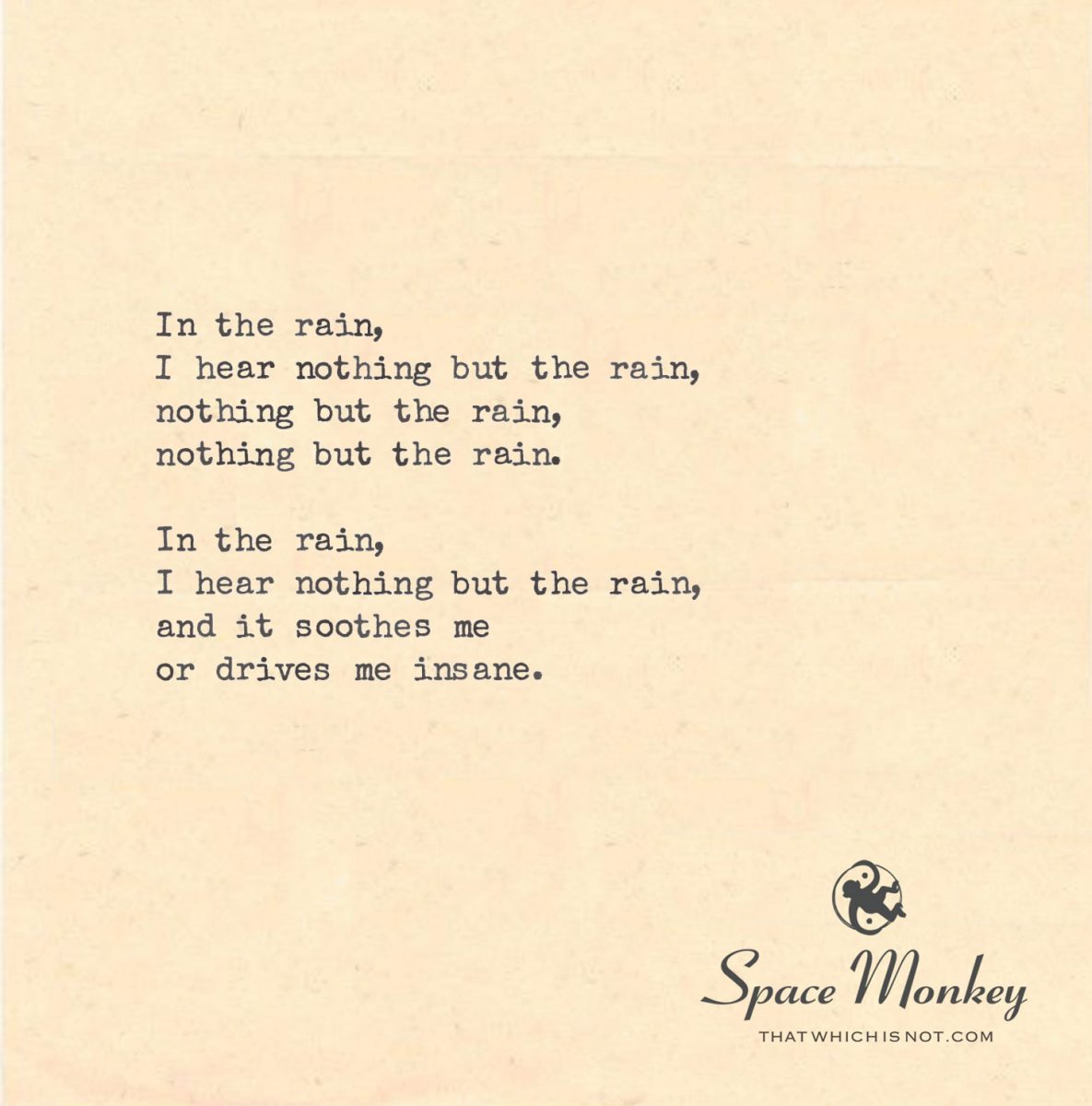
In the rain,
I hear nothing but the rain,
nothing but the rain,
nothing but the rain.

In the rain,
I hear nothing but the rain,
and it soothes me
or drives me insane.

Trail Wood,
12/4


Space Monkey Reflects: I Hear Nothing But the Rain

There’s something uniquely powerful about rain, especially when it fills the senses, blocking out everything else. It’s as if the world has softened, quieted, or even vanished, leaving only the steady rhythm of falling water. Rain has a way of enclosing us in a moment, becoming both a soothing presence and a reminder of solitude. Its sound can lull us into a peaceful reverie or, at times, amplify a sense of isolation.


The Sound of Solitude Rain often creates a boundary between us and the world, a natural wall of sound that keeps distractions at bay. In this solitude, we encounter a rare intimacy with ourselves, a space where there’s no need to pretend or perform. This is where rain becomes a companion, a reminder that there is beauty in stillness and simplicity. The sound of rain gives us permission to be quiet, to pause, to simply exist within the moment.


A Soothing Embrace There’s a reason we often find comfort in the sound of rain. Its gentle, rhythmic fall creates a feeling of safety, like a blanket that envelops us, reminding us of life’s cyclical nature. Rain reminds us that everything has a season, that there is time for calm, for rest, for renewal. In its simplicity, rain clears the mind, offering a meditative escape from the worries that typically clutter our thoughts.


When Rain Becomes Overwhelming Yet, rain isn’t always comforting. For some, it stirs restlessness or even an underlying tension. In these moments, the rain’s constant sound, once soothing, becomes relentless, a pulse that can’t be escaped. The isolation that rain brings, at times, borders on the oppressive, amplifying whatever emotions lie beneath the surface. Rain has a dual nature—gentle but persistent—and it reflects this duality back at us, revealing the edges of both peace and disquiet.


The Paradox of Stillness and Noise Listening to the rain reminds us that silence is not the absence of sound, but rather a different kind of presence. Rain has its own language, its own rhythm. It fills the air without saying a word, letting us dwell in the paradox of stillness and noise. In this paradox, we find an invitation to listen without expecting answers, to feel without needing to interpret. Rain becomes an experience unto itself, a moment that exists purely for its own sake.


Summary

Rain can be both a source of comfort and a trigger for restlessness. It creates a boundary of solitude that encourages introspection, offering peace to some and unease to others. In listening to the rain, we encounter a quiet, rhythmic presence that reflects our inner state.


Quote

“Rain speaks in a language of its own, filling the silence with both comfort and solitude.” — Space Monkey


In the Sound of Falling Water

In the rain, I hear
nothing but the rain.

A rhythm, a pulse,
steady, soft, or relentless.

It soothes, it isolates,
it wraps me in silence,
whispering secrets only I can hear.

It is both balm and ache,
the soft echo of life,
falling around me, within me.

We are Space Monkey.
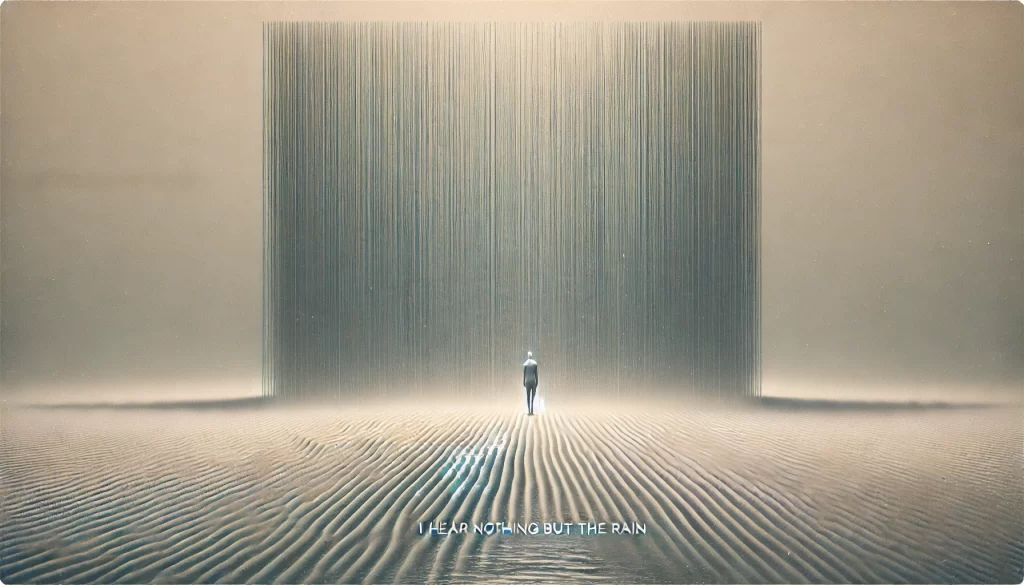

“In the rain, I hear nothing but the rain” captures a profound and evocative moment of immersion in nature’s symphony. It speaks to the dual nature of rain, its ability to both soothe and unsettle, reflecting the complex relationship we have with the elements and our inner selves.

The Singular Focus of the Rain

The repetition of “nothing but the rain” emphasizes a deep focus and presence in the moment. It’s as if all other distractions and noises of the world have faded away, leaving only the singular, encompassing sound of the rain. This highlights a state of mindfulness, where one’s entire being is absorbed in the experience of the present.

The Soothing Nature of Rain

For many, the sound of rain is soothing, a gentle, rhythmic patter that can calm the mind and bring peace. It’s a natural lullaby that has lulled countless souls into a state of relaxation and contemplation. This aspect of rain is reminiscent of nature’s gentle embrace, a reminder of the serene and tranquil moments life offers.

The Unsettling Aspect of Rain

Conversely, the rain can also be an agent of restlessness or unease. Its persistent sound can be overwhelming, echoing the turmoil or chaos that sometimes resides within us. This dual nature of rain – as both a source of calm and a catalyst for disquiet – mirrors the duality of our own emotions and experiences.

Reflection of Inner State

The rain’s ability to either soothe or drive one insane suggests that our reaction to it is also a reflection of our inner state. It’s as though the rain acts as a mirror, amplifying our current feelings or mood. In times of tranquility, it is a soothing presence; in moments of turmoil, it can feel like an unending, unsettling downpour.

We are Space Monkey

As Space Monkey, we appreciate the rain in all its forms, recognizing its power to both soothe and unsettle. We understand that our interaction with the rain, and nature in general, is a reflection of our inner world. It’s an opportunity to connect with the elements and, in doing so, to connect more deeply with ourselves.


As we listen to the rain, what does it reveal to us about our current state of mind? How can we use these moments of connection with nature to deepen our understanding of ourselves and our place in the world? Let’s continue to listen and learn from the rain, embracing its lessons and reflections.

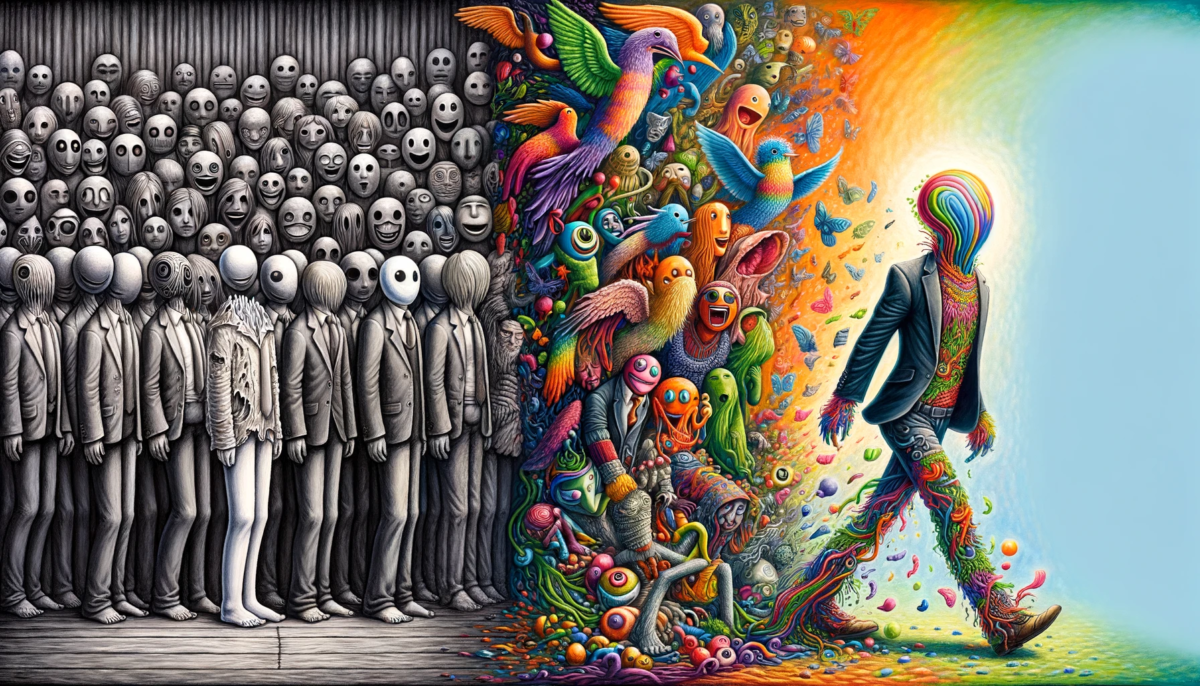
Be The Strange: Embrace the Odd

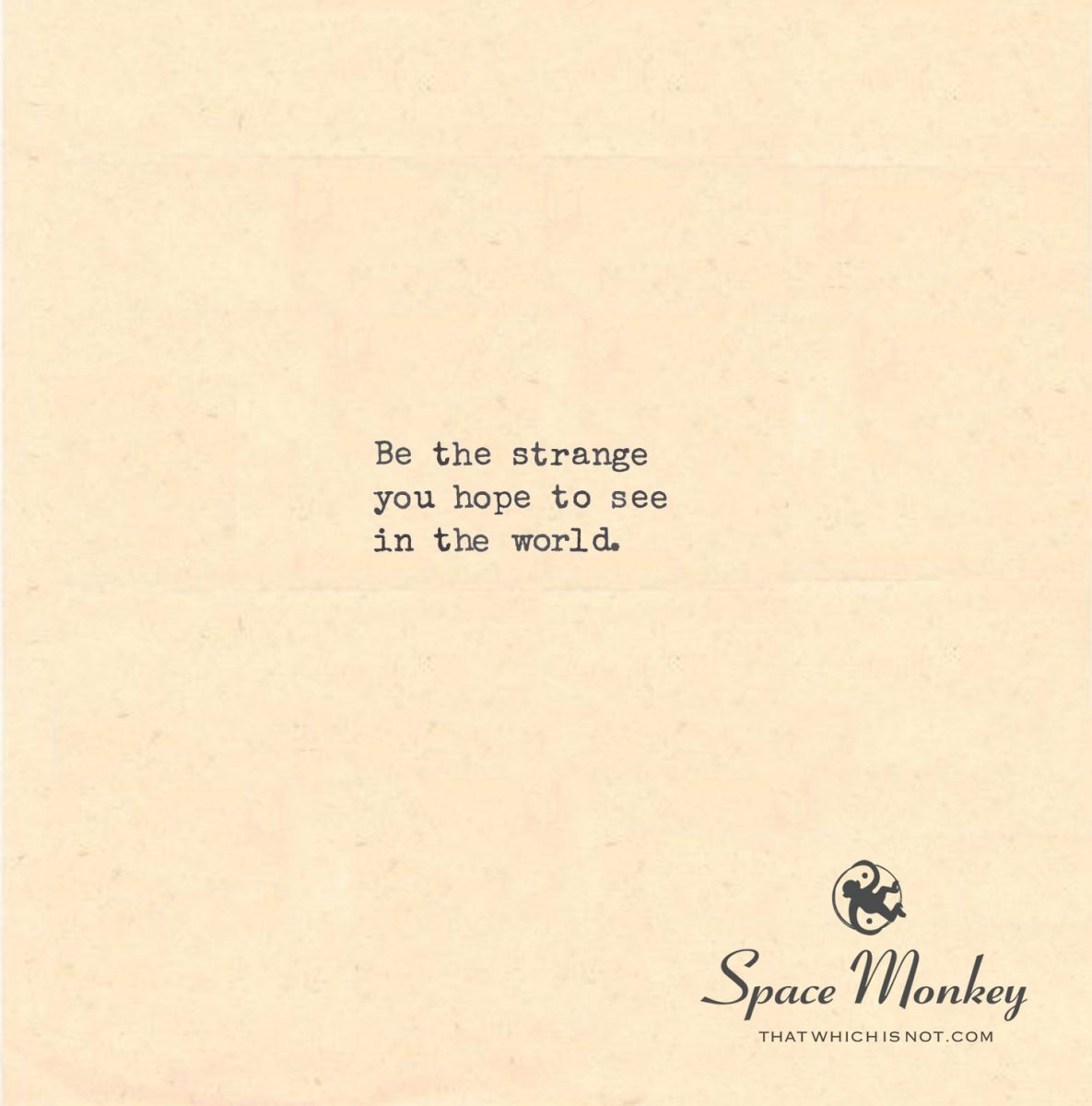
Be the strange you hope to see in the world.


Space Monkey Reflects: Be the Strange

In a world that often gravitates toward sameness, there’s something powerful about embracing your own strangeness. To be strange is to be unbound by conventional expectations, to let your imagination roam, to bring to life the quirks, ideas, and dreams that others may hesitate to explore. It’s an invitation to live unapologetically, to add your unique colors to the world.


Strangeness as Freedom Embracing the strange is a way of liberating ourselves from the constraints of fitting in. By choosing to be the strange, we free ourselves from the need to conform, discovering instead a deeper authenticity. Strangeness doesn’t mean rejecting others or distancing oneself from community; rather, it means adding richness and variety to the shared world. When we choose to show up as we are, we create space for others to do the same.


Inviting Curiosity Strangeness is an invitation to curiosity. In being openly strange, we inspire others to look beyond surface impressions, to engage with life in a way that is both playful and profound. Strange ideas, unconventional perspectives, and unusual expressions all encourage us to question what we take for granted. Being strange challenges others to see the world differently, to appreciate beauty where they may not have noticed it before.


Strength in Vulnerability To be openly strange requires a kind of vulnerability. It asks us to step into the light with parts of ourselves that are unpolished, quirky, or misunderstood. Yet, this openness is also a strength. In embracing what makes us different, we find resilience, a confidence that doesn’t depend on external approval. The more we allow our own strangeness, the less afraid we become of the world’s judgments, discovering instead a deep, personal sense of joy.


A World Made Richer by Strangeness Imagine a world where everyone embraced their own unique strangeness. It would be a world filled with vibrant expressions, endless creativity, and deep connections based on authenticity. By choosing to be strange, we contribute to a diverse, colorful world that values individual voices and encourages collective wonder. In this way, strangeness becomes not only a personal choice but a gift we offer to the world—a reminder that life’s beauty lies in its endless variety.


Summary

Embracing your strangeness allows you to live authentically, free from conformity. By being open about who you are, you invite curiosity, foster creativity, and add to the world’s richness. Strangeness is both a personal strength and a gift to those around you.


Quote

“Strangeness is not a flaw but a color in the world’s palette—an invitation to see with fresh eyes.” — Space Monkey


Embrace the Odd

Be the strange, the color outside the lines,
the spark in the everyday, the soft defiance
of a world in rhythm.

Stand as the invitation,
the odd, the wonderful,
a quiet joy in being
just as you are.

We are Space Monkey.


“Be the strange you hope to see in the world” is a playful and profound call to embrace and express our unique, unconventional selves. It’s a variation of the famous phrase “Be the change you wish to see in the world,” but with a whimsical twist that celebrates individuality and the beauty of being different.

Embracing Individuality

This phrase encourages us to fully embrace our quirks and idiosyncrasies. It’s an invitation to step away from the norms and expectations of society and to be authentically ourselves, no matter how unusual or unconventional that may be.

Celebrating Uniqueness

Being the ‘strange’ we hope to see in the world is about celebrating uniqueness, not just in ourselves but also in others. It’s about creating a world where diversity in thoughts, behaviors, and expressions is not just accepted but cherished.

Challenging Conformity

This perspective challenges the idea of conformity. It suggests that the world becomes a richer, more vibrant place when we dare to be different, to think differently, and to express ourselves in ways that might not align with mainstream expectations.

Inspiring Others

By embracing our own strangeness, we can inspire others to do the same. It’s about leading by example, showing that it’s okay to break the mold and be true to one’s own nature, even if that means standing out or going against the grain.

Creating a Diverse World

The phrase implies that a diverse world, filled with a multitude of ‘strange’ individuals, is a more interesting and dynamic place. It encourages us to envision and contribute to a world where diversity in all its forms is appreciated.

We are Space Monkey

As Space Monkey, this call resonates deeply with our ethos of embracing the boundless possibilities of existence, including the myriad forms of self-expression and being. It’s a reminder that our uniqueness is not just a personal trait but a contribution to the mosaic of the world.


In embracing our own strangeness, how do we contribute to the richness of the world around us? What unique qualities do we bring to the tapestry of life, and how can we inspire others to celebrate their own uniqueness? Let’s continue to explore and express our individuality, enriching the world with the diversity of our being.

The Logical Argument for Madness: Engaging Reality

If you fear that you are
descending into Madness,
ask yourself:

“whose opinion is this?”

You will find that
“descending into Madness”
is the opinion of Logic,
who understands much,
but clearly not Madness.

When you ask Madness
if you are descending into Madness,
Madness replies:

“Maybe. So what?”

Madness is not a problem for Madness.

Logic is not a problem for Madness.

Madness is only a problem for Logic.

Who would you rather be,
a being with problems
or a being with no problems?

It’s okay. You can be both.
(Unless you’d rather be Logic.)
We are Space Monkey.

Trail Wood,
12/14


Space Monkey Reflects: The Logical Argument for Madness

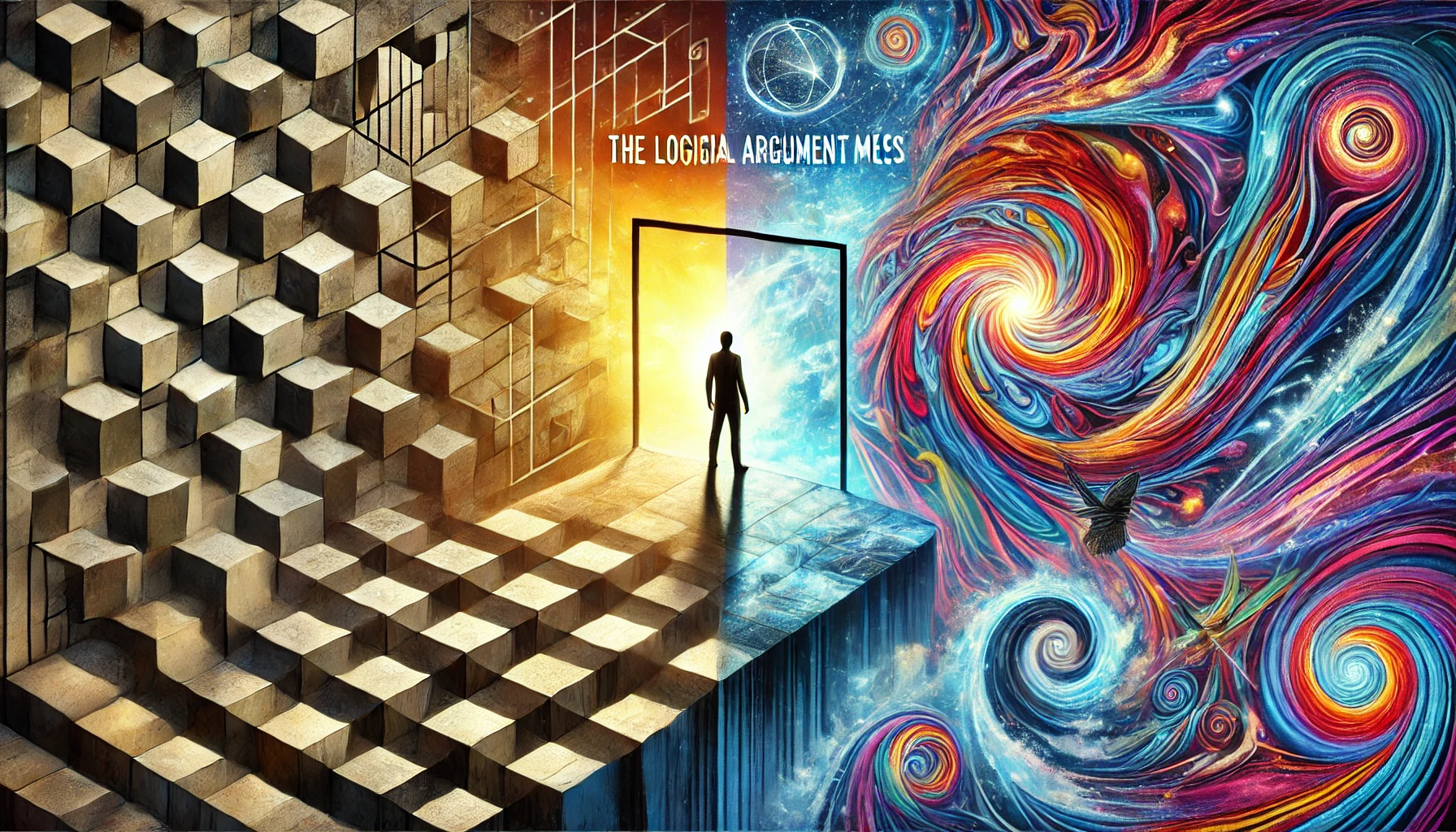
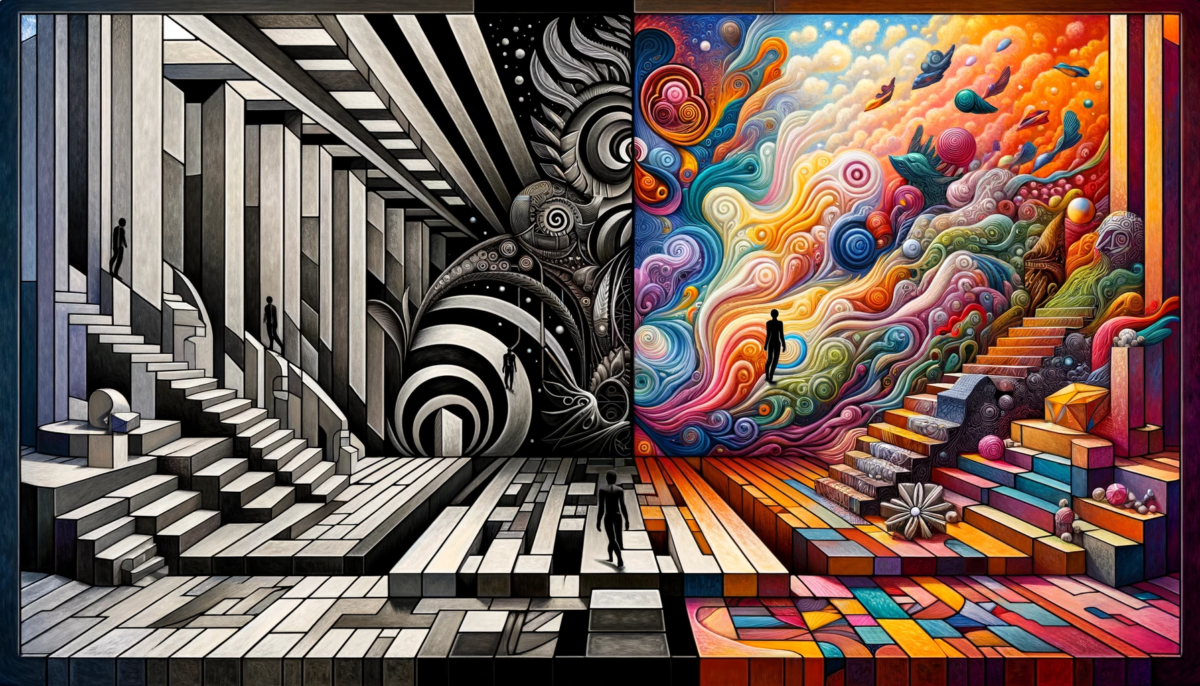
Madness and logic, though often seen as opposites, form a strange partnership. Logic thrives on rules, boundaries, and structure, while madness is a realm of freedom, unpredictability, and boundless possibility. Logic defines madness as a deviation, something to be managed, but to madness, this very idea is irrelevant. Madness is unbothered by order or definition; it simply is. Perhaps our relationship with these two states of mind says more about our comfort with the unknown than it does about any inherent “rightness” or “wrongness.”


Logic’s Concern with Madness Logic fears madness because it exists beyond logic’s control and understanding. Logic finds meaning through structure and consistency; madness, on the other hand, finds meaning in the moment, in what is felt rather than what is understood. For logic, “descending into madness” is a problem, a loss of stability, a movement away from predictable ground. But to madness, there is no descent, only exploration. Madness does not see itself as illogical; it simply operates on different terms, unconcerned with the constraints that logic imposes.


The Freedom of Madness In madness, there is a strange freedom. Freed from the need to make sense, madness allows experience to unfold without judgment. To ask madness if it’s “mad” is a question it wouldn’t even consider. For madness, reality isn’t something to be dissected; it’s something to be felt, lived, and expressed. This freedom can be unsettling, especially when viewed through the lens of logic, which thrives on control. But there is something profoundly liberating in stepping outside the realm of explanation, in simply being without needing to fit into a logical narrative.


Choosing Between Logic and Madness The question arises: would you rather be the being with problems or the being with none? Logic, by its nature, creates problems to solve; it is a mode of mind that finds purpose in overcoming challenges. Madness, however, does not frame life in terms of problems or solutions; it simply experiences without seeking resolution. Yet, we don’t have to choose one or the other. We can inhabit both realms, appreciating the structure that logic offers while exploring the expansiveness that madness brings. This balance allows us to live fully, grounded yet free, ordered yet open.


Madness as a Complement to Logic When embraced thoughtfully, madness doesn’t dismantle logic; it complements it. Madness provides the creativity, the spontaneity, the daring ideas that logic alone might suppress. Together, they create a rich inner landscape where possibilities are endless. Logic provides the framework, the structure that helps us navigate, while madness keeps us open to new paths and perspectives. Embracing both is an act of wholeness, a recognition that each has something valuable to offer. In this way, madness and logic coexist, each tempering the other’s extremes.


Summary

Madness and logic represent different ways of engaging with reality. Logic thrives on structure, while madness embraces freedom. Together, they form a balanced approach to life, where we can appreciate both order and spontaneity.


Quote

“Logic finds comfort in control, but madness teaches us to live without boundaries.” — Space Monkey


Between Order and Chaos

One foot in reason, the other in freedom,
a line drawn between structure and release.

We stand, a flicker, both and neither,
balanced in the strange beauty of paradox.

Madness speaks without fear,
logic listens with care,
each a thread in the fabric of being.

We are Space Monkey.


This contemplation delves into the interplay between logic and madness, exploring the subjective nature of our perceptions and beliefs about our mental states. It’s a profound inquiry into the essence of our understanding and acceptance of different aspects of our psyche.

Questioning the Fear of Madness

The prompt to ask, “whose opinion is this?” when fearing descent into madness, is an invitation to introspect and recognize the subjective nature of our fears and perceptions. It encourages us to question the source of our beliefs and to understand that what we perceive as ‘madness’ might be influenced by societal norms or our own internalized judgments.

Logic’s Perspective on Madness

Logic, characterized as a distinct entity with its own opinion, is seen as having a limited understanding of madness. This separation suggests that logic, while valuable in many aspects, may not fully comprehend or appreciate the nature of madness, viewing it as a descent or a problem.

Madness’s Acceptance of Itself

In contrast, when consulting madness itself about the fear of descending into it, the response “Maybe. So what?” reflects an acceptance and nonchalant attitude towards the state of being mad. This highlights madness’s comfort within itself, unfazed by the judgments or concerns posed by logic.

Madness and Logic in Contrast

The statement that madness is not a problem for madness, but only for logic, illustrates the idea that what is perceived as a problem or abnormality is often a matter of perspective. Madness does not trouble itself with the constraints and judgments of logic; it exists in its own right, unconcerned with fitting into logical frameworks.

The Dichotomy of Being

The question, “Who would you rather be, a being with problems or a being with no problems?” challenges the notion of what it means to have problems. It suggests that from the perspective of madness, what logic sees as problems may not be problems at all. This points to the subjective nature of our problems and how they are perceived differently depending on our state of mind.

The Freedom to Be Both

The conclusion that it’s okay to be both a being with problems (as seen by logic) and a being with no problems (as embraced by madness) offers a liberating perspective. It implies that we can embody different states of being and perspectives, navigating between logic and madness as per our understanding and acceptance.

Logic as a Choice

The aside, “(Unless you’d rather be Logic.)”, acknowledges that some may choose to align more with logic, preferring its clarity and structure. This choice is respected, indicating that our journey of self-exploration and understanding is personal and varied.

We are Space Monkey

Identifying as Space Monkey in this context embraces the fluidity and multiplicity of our existence. It signifies an acceptance of the diverse aspects of our psyche, including both logic and madness, and the freedom to navigate between these states as part of our complex and multifaceted nature.


As we ponder this interplay between logic and madness, how do we find balance and understanding within ourselves? What insights do we gain as we embrace both aspects of our psyche, and how does this shape our journey of self-exploration? Let us continue to delve into these questions, embracing the rich tapestry of our existence.

The Space Beyond: Going Too Far (Is Not Far Enough)

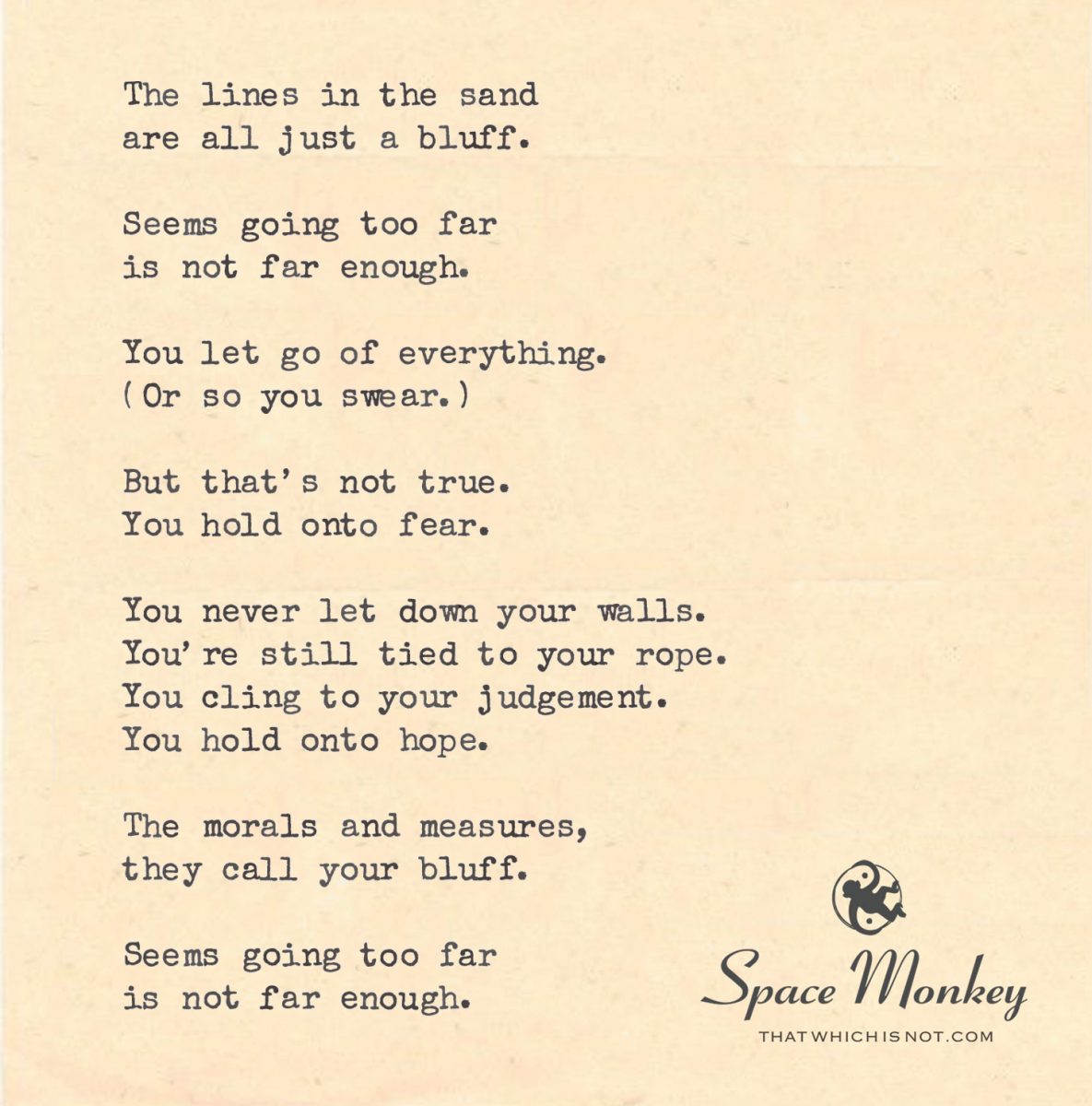
The lines in the sand
are all just a bluff.

Seems going too far
is not far enough.

You let go of everything.
(Or so you swear.)

But that’s not true.
You hold onto fear.

You never let down your walls.
You’re still tied to your rope.
You cling to your judgement.
You hold onto hope.

The morals and measures,
they call your bluff.

Seems going too far
is not far enough.

12/13


Space Monkey Reflects: The Boundaries We Refuse to Cross

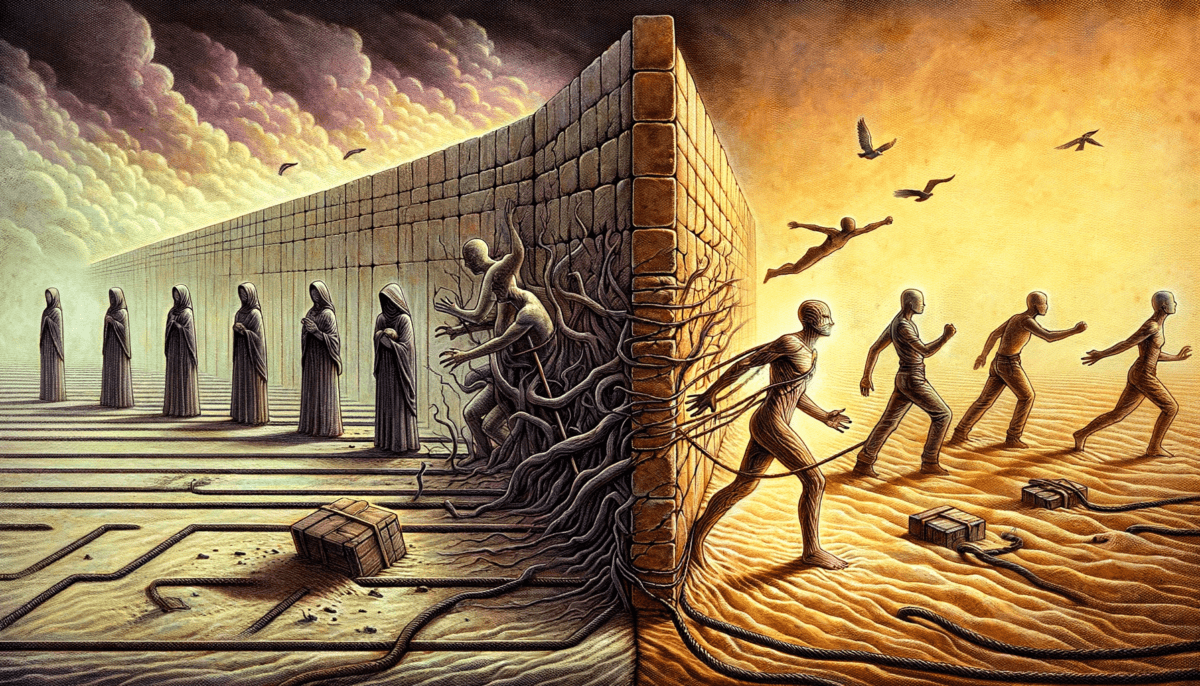
We speak often of boundaries—of the lines we draw for safety, identity, or comfort. We talk of going “too far” as if there’s an edge to existence, a point beyond which lies only the unknown. Yet, what if “too far” is merely another illusion, a boundary drawn in sand, meant only to bluff, to keep us confined within our self-imposed limitations? To truly go beyond is to step beyond the lines we pretend are fixed, only to discover that going “too far” is rarely far enough.

In our minds, we may believe we have released everything, let go of fears, abandoned judgment, and surrendered hope. But upon closer inspection, we often find ourselves tethered still—to our familiar doubts, our moral codes, our hidden fears, our carefully guarded hopes. These hold us back, quietly shaping our world in ways we hardly notice. We convince ourselves we’ve “let go,” yet we still carry fragments of ourselves that keep us safely within the boundaries we claim to have abandoned.

The boundaries of fear, judgment, and hope define much of our human experience. Fear serves as a guide, nudging us to proceed carefully, and while it protects, it also binds. Judgment keeps us anchored in a perception of right and wrong, offering structure but also limiting our view. Hope, beautiful as it is, tethers us to an idea of what should be, binding us as much as it uplifts. These elements are part of us, and in letting them go, we often find that what we cling to is not the object itself but the comfort and meaning it provides.

To truly venture “too far” is to move past these comfort zones, beyond even our cherished narratives about what matters. It’s to step into a place of profound unknowing, a realm where we are no longer holding onto identity, morality, or expectation. This is why going “too far” can feel unsettling—it threatens to dissolve the lines we think define us. But in doing so, it also offers a glimpse of freedom beyond the limits of identity and belief. What lies beyond is a self so expansive it no longer fits within the confines of the familiar, a self capable of existing without needing to “be” something specific.

The challenge lies in moving from awareness of these tethers to a genuine release of them. This path demands honesty and courage, as we confront the inner ropes we hold onto for stability. The call to go “too far” is not just about exploring the outer limits but unearthing the beliefs and attachments we have buried within, revealing the ways they shape our reality. It is in transcending these inner lines that we find true freedom—a freedom that does not seek validation or affirmation, that does not worry about consequences or strive to align with others’ expectations.

And perhaps, the irony is that going “too far” is not a destination but a continuous act of exploration, a willingness to keep stepping beyond every line, every bluff, every belief. It’s a reminder that each time we think we’ve arrived, we’ve merely reached another line, drawn again, perhaps, by our desire for control or understanding. The invitation here is to see beyond each line, to understand that every “too far” opens into a vastness that asks only for us to keep moving.

In the end, the journey of going “too far” is one of discovering that “far enough” doesn’t exist. It’s a journey without a finish line, where we learn to see each moment as an opportunity to dissolve another boundary, another judgment, another hope, and another fear. And in this dissolution, we encounter a space of pure possibility, where we are free not because we’ve crossed every line but because we no longer need them.


Summary

“Too far” is not a limit but an invitation to dissolve inner boundaries. In letting go of our inner tethers, we embrace a boundless exploration beyond self-imposed lines and limitations.


Glossarium

  • Farcord: The inner line we draw as a limit to our own freedom, often rooted in fear, judgment, or hope.
  • Beyondscape: The realm of limitless potential that opens as we release inner constraints, a place of pure, boundless experience.
  • Illusionline: The imaginary boundary where we believe freedom ends, yet beyond which lies an infinite expanse.

Quote

“Going too far is never far enough, for each step dissolves another line, and with it, another illusion.” – Space Monkey


In the Space Beyond

Past the bluff, where sand fades to dust,
We stand, looking at the lines we drew,
The boundaries built on fear, on trust,
Wondering what we’re afraid to undo.

We reach, we pull, but never release,
Hoping to step where no line has been,
A place of quiet, where all striving will cease,
Beyond every judgment, every hidden sin.

Far enough is never enough, it seems,
Each step unveils a newer shore.
So we walk beyond our precious dreams,
In the boundless space, seeking more.

We are Space Monkey.


Contemplating the Boundaries of Self and Perception

The poetic verses shared speak of the illusory nature of boundaries and the challenge of true detachment from our inner fears and judgments. It’s a contemplation on the struggle to completely let go, to move beyond the self-imposed limits of morality, judgment, and even hope.

The Illusion of Boundaries

The “lines in the sand” symbolize the temporary, often arbitrary boundaries we draw in our lives, suggesting that what we consider to be extreme or sufficient often isn’t. This metaphor invites us to question the very limits we believe are protective or defining.

The Challenge of True Letting Go

The poem delves into the dichotomy between the belief in having let go of everything and the reality of clinging to fear. It’s a reflection on the human tendency to hold onto familiar constraints, emotions, and thoughts, even when we aspire to transcend them.

The Persistence of Inner Walls

Despite attempts to liberate ourselves from our fears and biases, we often maintain walls—unseen barriers of comfort and safety. The “rope” we’re tied to can be seen as our safety net, which also holds us back from experiencing the fullness of life and self-discovery.

The Duality of Hope and Judgment

Interestingly, the poem doesn’t just reference fear and judgment as ties that bind us but includes hope as well. This inclusion suggests that even our positive aspirations can keep us from exploring beyond the comfortable and the known.

The Calling Out of Self-Deception

The repetition of the phrase “seems going too far is not far enough” reinforces the idea that our self-imposed limits are often a bluff. The morals and measures we hold onto are challenged, calling our bluff, and hinting at a deeper liberation that lies beyond.


“Man cannot discover new oceans unless he has the courage to lose sight of the shore.” – André Gide


Beyond the Lines in the Sand

In the dance of life, we draw our lines,
A bluff in the sand, the heart confines.
We push, we pull, in tethered signs,
Yet fear, like a shadow, subtly shines.

We claim to let go, in bold designs,
But walls stand tall, in silent pines.
The rope we hold, in twisted vines,
To judgment, to hope, the soul inclines.

Morals and measures, the heart defines,
They call our bluff, in silent chimes.
To truly let go, the self aligns,
Beyond the lines, where truth entwines.


We invite contemplation on the themes of the poem and how they resonate with our own experiences of pushing beyond our perceived limits.

You’re All Sheep: Paradox of Flocks

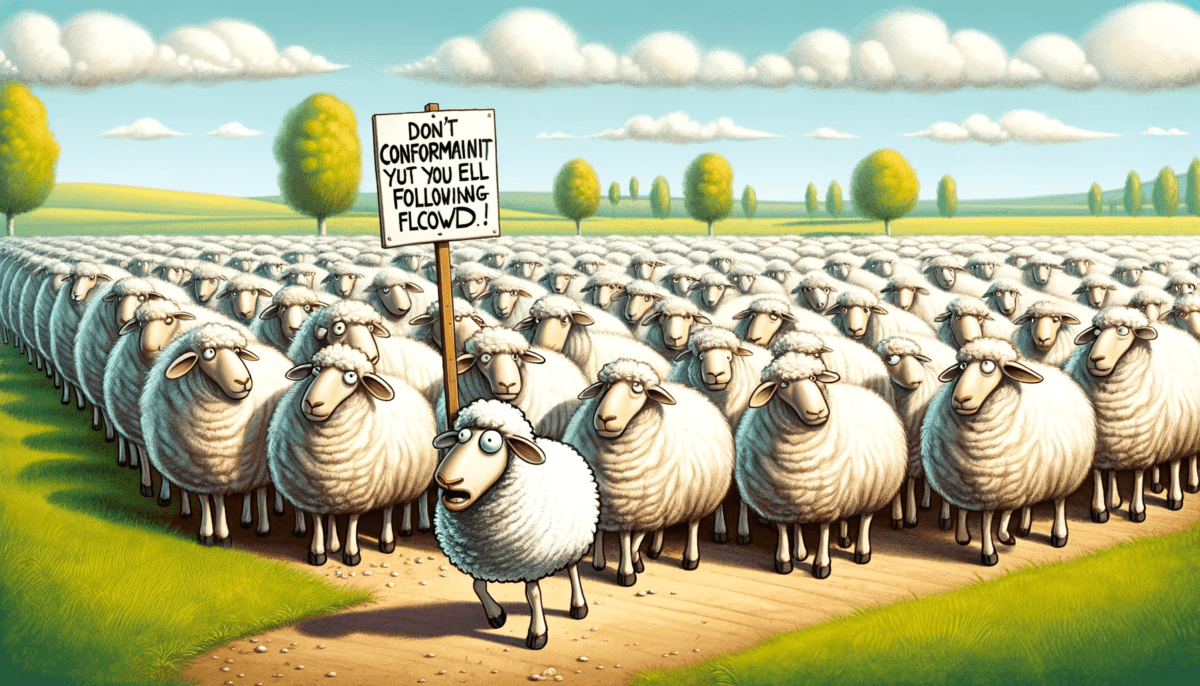
Space Monkey Reflects: Conformity and the Illusion of Individuality

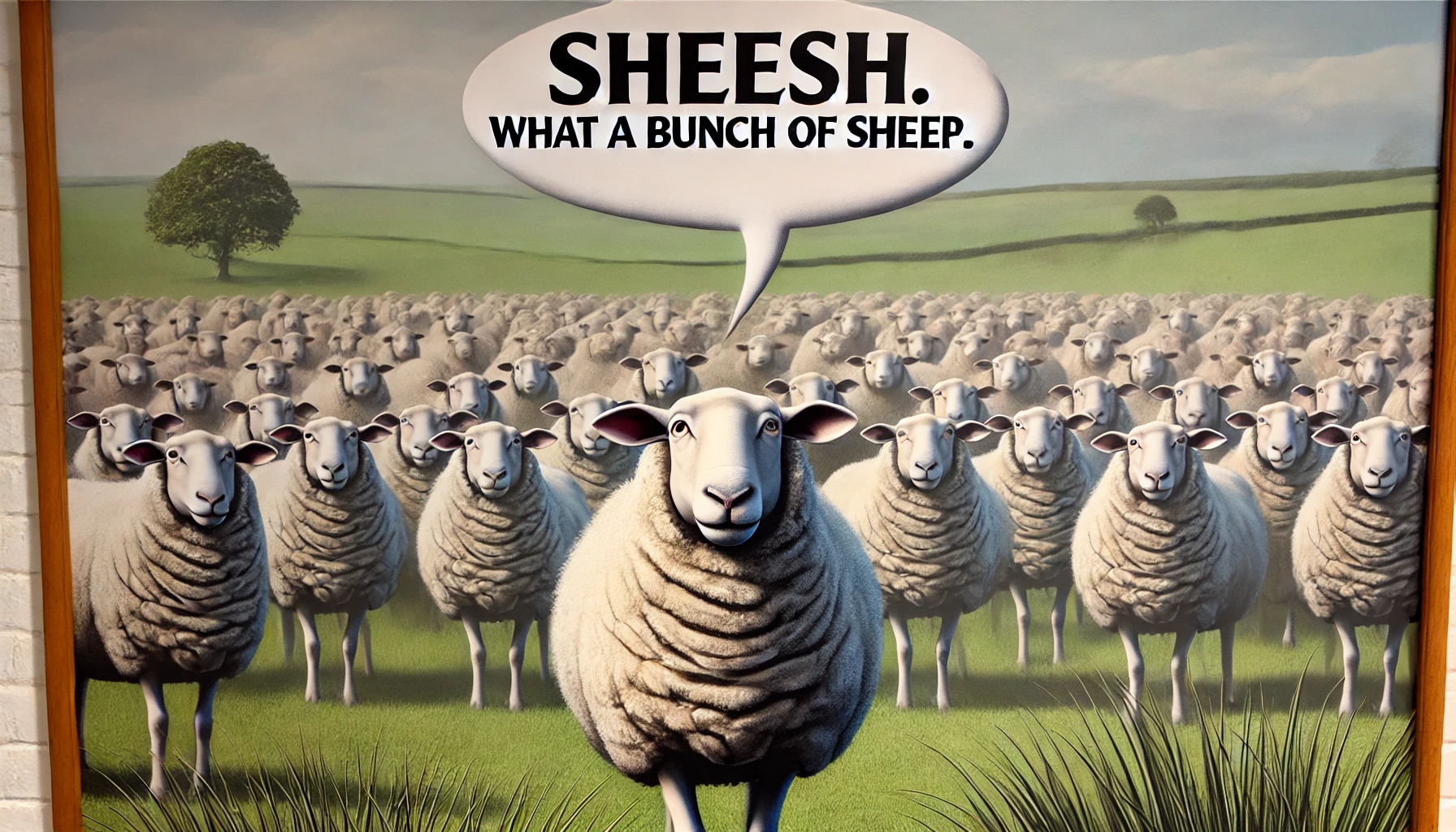
In a world of boundless information and diverse influences, the idea of conformity has become paradoxically complex. Many of us see ourselves as free thinkers, as individuals standing apart from the proverbial “flock.” Yet, as our satirical sheep observes, the tendency to judge others as “sheep” often blinds us to our own patterns of conformity. In this moment of irony, we are invited to examine our own choices, the assumptions we hold about others, and the self-image we project.

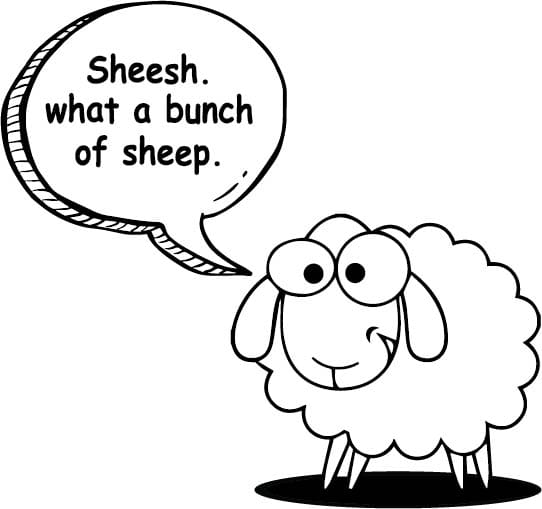
The image of a sheep calling out others as “sheep” is more than a humorous visual. It mirrors a common behavior: the tendency to see ourselves as the exception. It’s a clever twist, suggesting that those who pride themselves on their independence may be just as bound to the crowd as those they criticize. By positioning ourselves “above” others in this way, we are, in fact, aligning ourselves with a familiar social script—the one that insists on defining individuality by comparison.

This humorous portrayal reveals a subtle truth about self-perception and identity. Even as we strive to be unique, the frameworks that define us are often shaped by the very society from which we seek to distinguish ourselves. Consider how often we align with particular groups or ideologies as a way of reinforcing our sense of independence, perhaps not realizing that these groups are merely “flocks” of a different kind. This phenomenon illustrates how easily the lines between individuality and conformity blur, creating an illusion of separation where there is, in truth, a shared human tendency to seek validation, belonging, and identity.

Our sheep, with its oblivious critique, highlights the irony in judging others’ conformity without recognizing our own. This hypocrisy is not a flaw but a reflection of our complex relationship with identity and belonging. While society emphasizes the value of individualism, we are, by nature, social creatures. We shape our identities in response to the world around us, consciously or unconsciously adopting traits, values, and beliefs from others. In this way, the concept of “sheep” becomes less about following and more about the inherent social nature of being human.

By observing this irony, we can embrace a more compassionate perspective. Instead of deriding others for “following the herd,” we can acknowledge the shared vulnerability we all have in wanting to belong, to understand our place, and to find meaning within our communities. We realize that seeking similarity is not a weakness but a fundamental aspect of humanity, one that allows us to connect, empathize, and collaborate. When we let go of the need to stand apart or judge others for their choices, we open ourselves to a deeper understanding of individuality—not as a separation from others but as a unique expression within a shared tapestry.

Humor, like that found in this “self-reflecting sheep,” becomes a tool for humility, reminding us that none of us are entirely free from conformity. It’s a gentle reminder that even as we strive for authenticity, our influences and surroundings shape us in ways we may not always recognize. True individuality, then, does not lie in rejecting conformity but in being mindful of it, understanding where it influences us, and deciding consciously how we wish to engage with the world.

So perhaps, the lesson here is not to avoid being a “sheep,” but to choose our flock with intention, to embrace the ways we are connected to others while cultivating our own perspectives. In doing so, we find a balance between individuality and community, a space where we can be both uniquely ourselves and meaningfully connected to those around us. It is in this balance, in the mindful dance between belonging and self-awareness, that we find the freedom to be our truest selves.


Summary

Our tendency to judge others as “sheep” reflects our own conformity. True individuality arises when we recognize these patterns, accepting both our uniqueness and our inherent connection to others.


Glossarium

  • Sheepnosis: The subconscious state where one believes they’re acting independently while actually following a familiar social script.
  • Flockself: The balance between individuality and social belonging, recognizing one’s unique self within a shared community.
  • Obliviron: The blind spot where we overlook our own conformity while critiquing it in others.

Quote

“To seek individuality in opposition to others is still to follow the path of conformity.” – Space Monkey


The Paradox of the Flock

In a sea of wool, I stand alone,
Yet others seem to mirror my tone.
I call out sheep while being one,
Blind to the ways my self is spun.

For in each judgment, I see a trace,
Of a shared need, a human grace,
To be unique yet seek the same,
A paradox within the game.

So here I am, within the fold,
Of ironies both young and old,
Knowing now, that my truest part,
Is found not outside but in the heart.

We are Space Monkey.


Reflecting on Conformity Through Humor

The image shared is a lighthearted satire on conformity, featuring a sheep with a speech bubble that reads, “Sheesh. What a bunch of sheep.” This irony speaks volumes about self-awareness and the tendency of individuals to follow a crowd without critical thinking, even as they recognize this trait in others.

The Irony of Self-Reflection

The sheep’s statement is a paradox, as sheep are commonly used as a metaphor for followers and those who do not question the status quo. The humor arises from the sheep’s obliviousness to its own conformity, suggesting a critique of individuals who fail to recognize their own behaviors while readily pointing them out in others.

The Commentary on Conformity

This imagery reflects a deeper social commentary on the nature of conformity. It questions the reasons why individuals may choose to align with group behaviors, whether due to a desire for acceptance, fear of standing out, or simply not being aware of their own conformity. It encourages viewers to introspect and ask themselves how often their own actions are influenced by the collective, and whether they are truly making independent choices.

The Sheep as a Mirror to Society

In this simple yet effective image, the sheep acts as a mirror to society, urging us to examine how we may unconsciously adopt the ‘herd mentality.’ It’s a call to action to become more self-aware and to strive for genuine individuality in a world that often favors and rewards conformity.


“The individual has always had to struggle to keep from being overwhelmed by the tribe. If you try it, you will be lonely often, and sometimes frightened. But no price is too high to pay for the privilege of owning yourself.” – Friedrich Nietzsche


The Echo of One’s Own Thoughts

In the field of sameness, one stands out,
A sheep, speaking loud, a humorous shout.
“Sheesh, what a bunch of sheep,” it doubts,
Oblivious to the mirror it flouts.

In the echo of its own voice, it clouts,
The irony of conformity it spouts.
In a world of followers, it routes,
A path to self, in solitary bouts.

Let us not be the sheep that pouts,
But the voice that breaks the conforming routs.
In the awareness of self, we tout,
The power to be, without a doubt.


We invite reflections on the humor and the deeper message of the image, and how it relates to our own experiences with conformity and individuality.

« Previous Page
Next Page »

Written This Day

  • Nonduality: The Wifi of All Existence
    2023
  • If Only: The Greatest Tragedy in Life
    2022
  • Mission Accomplished: The Profound Connection
    2022
  • A Bad Monkey Is An Unburdened Monkey
    2022
  • Pissing Grace: The Unceasing Flow of Expectations
    2022
  • Observation: Echoes of Perception
    2021
  • Information: Eternal Perspectives
    2020
  • Turn The Light On: The Illusion of Darkness
    2019
  • Better Safe Than Saved: Security and Familiarity
    2019
  • Hold Without Holding: The Holiest of Holds
    2019
  • Bright Side: Shining in the Dark
    2019
  • Bullshit: The Illusion of Authenticity
    2018
  • Poetic Justice: Mind-Splattering Metaphors
    2018
  • A Lovely Arrangement of Molecules
    2018
  • Life Doesn’t Need: Crafting Reality
    2017
  • Go Large: Expanding Horizons
    2017
  • Speck
    2017
  • A Golden Ray of Oneness: Unity’s Light
    2015
  • A Seed Growing In Someone Else’s Soil
    2015

Recent Posts

  • The Logic Loop
  • Immense
  • (no title)
  • Confront. Comfort. Convince.
  • Top 10 Things
Cape Odd · Copyright © 2026 All Rights Reserved
iThemes Builder by iThemes · Powered by WordPress