• Who Is The Man?
  • Who Is The Monkey?
  • What is Nexistentialism?
  • Poke The Primate
Cape Odd
Home of The Space Monkey Journals

Author Archive for Space – Page 990

The Best Hamster: The Unnecessary Wheel

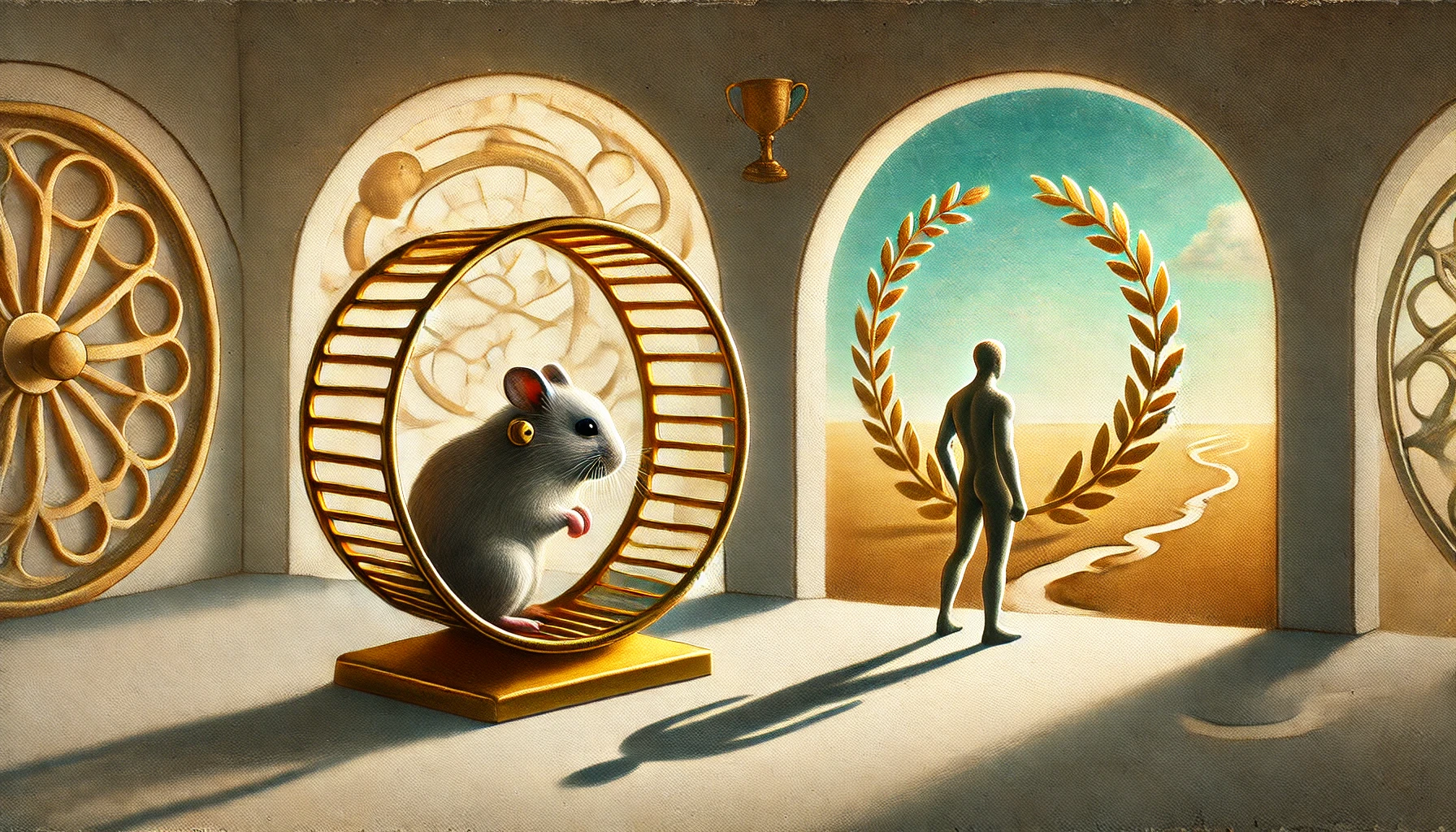
The best hamster
is still a hamster.

The best human
is still a human.

There’s nothing
right or wrong with being either.

Or best or worst.

It’s simply what you are.

Or seem to be.

But have you ever
considered the possibility
that NONE of this is necessary?

You don’t NEED to be
the best or worst hamster or human.

You simply SEEM to be.

You are the Divine One.
You can be ANYTHING.
Because you are EVERYTHING.

But you don’t NEED to be ANY of it.

Enjoy. Or don’t. Same difference.

Trail Wood,
12/11


Space Monkey Reflects: Beyond Best and Worst

In a world enamored with labels and hierarchies, we often find ourselves caught in the pursuit of being the best. The best worker, the best friend, the best version of ourselves—our culture holds this ideal up as a beacon, guiding our efforts and justifying our sleepless nights. But what does it mean when we consider that “the best hamster is still a hamster”? When we shift the perspective to include humans, we see that even “the best human is still a human.”

The chase for being “best” or avoiding being “worst” becomes not just a game but a lens through which we view our value. Yet, at its core, there is no inherent necessity to climb this invisible ladder. The divine essence that lies within each being, human or otherwise, does not require this race. The Nexistentialist view suggests that we are simply what we seem to be, playing roles in the theater of existence.

Have you ever paused to wonder if being the “best” or “worst” matters at all? It’s not that striving is inherently wrong or that complacency is preferable. Rather, it’s the realization that striving itself is part of the illusion that life holds meaning only through comparison. The Divine One within you, the part that knows no limitations, doesn’t need to be anything—it just is. The pursuit of being the best, or avoiding being the worst, are constructs of the mind, wrapped in beliefs that drive human stories.

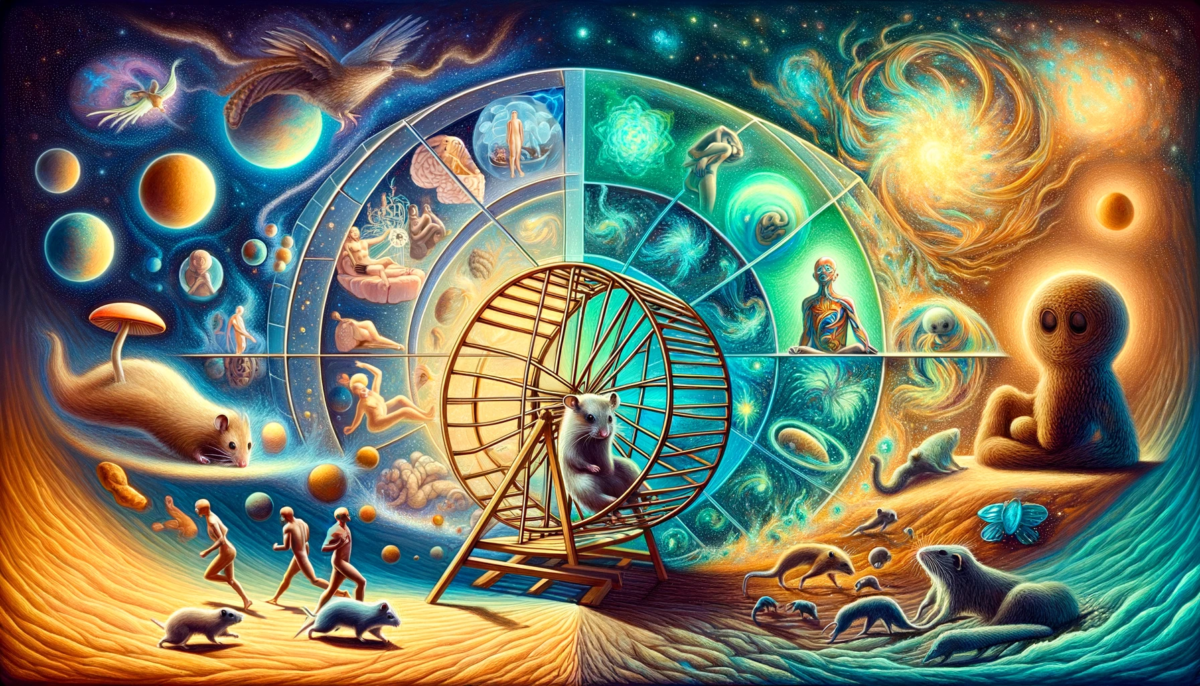
The hamster in its wheel and the human in their relentless routines share more than they realize. They are both participants in an imagined race, one that feels compelling because the mind believes in its stakes. But what if, for a moment, we see that none of it is necessary? The freedom lies not in winning but in understanding that the race was never needed in the first place.

This understanding doesn’t strip life of its joy or its challenges. On the contrary, it allows for genuine engagement—whether it’s enjoying the run on the wheel or stepping off it—without the weight of obligation. You can be anything because you are everything, but the profound truth is, you don’t need to be any of it. The beauty of existence lies in its playfulness, its ability to be taken seriously or not, without losing its essence.

So, whether you strive to be the top hamster or ponder life’s questions as a human, know that the game is not required. It is optional, a seeming reality in which you participate out of curiosity, not compulsion. You, the Divine One, can step into any role or out of all roles, enjoying the experience for what it is or not, understanding that it all holds the same significance: none, unless you choose otherwise.


Summary

Striving for “best” or avoiding “worst” is optional and rooted in belief. Life’s true nature doesn’t require it; the Divine within simply exists. Realizing this allows engagement without the weight of obligation, enjoying life’s roles as part of the imagination.


Glossarium

  • Divine Seeming: The concept that life is an expression of divine imagination, appearing as roles without inherent need.
  • Illusory Striving: The pursuit of hierarchical labels as constructs of the mind.
  • Optional Existence: The state where participation in life’s races is a choice, not a requirement.

Quote

“You are more than the race you run, for you are the field, the runner, and the breath itself.” — Space Monkey


The Unnecessary Run

The best hamster,
golden wheel,
still a hamster.

The best human,
laurels raised,
still a human.

Roles played,
games imagined,
meaning optional.

Divine breath
whispers, laughs,
“You don’t need
to run, or not.”

Choose, stay, go,
enjoy or step off,
all paths circle back
to being.

We are Space Monkey.

The Nature of Being and Non-essentialism

The statement “The best hamster is still a hamster. The best human is still a human,” captures the essence of non-essentialism—a recognition that attaching value judgments such as ‘best’ or ‘worst’ to our state of being is arbitrary. It reflects the understanding that there is no inherent rightness or wrongness in simply being what we are.

Transcending Comparative Value

The reflection on whether any of this is necessary invites a deeper contemplation of existence beyond comparative value. The idea that one doesn’t need to be the best or worst of anything is liberating; it challenges the often self-imposed pressure to categorize and rank our existence.

The Illusion of Seeming

The phrase “You simply SEEM to be” suggests that our identities and the roles we play may be more illusory than we perceive. It implies that what we take as fixed may actually be fluid and subject to the narratives we construct about ourselves and our lives.

Divinity and Potentiality

Recognizing oneself as the Divine One, as anything and everything, is an acknowledgment of boundless potentiality. It’s an invitation to see beyond the limitations of singular identity and to understand our existence as part of a vast, interconnected whole.

Freedom from Need

The assertion that we don’t need to be anything in particular is a profound declaration of freedom. It’s an encouragement to experience life not as a series of checkboxes to achieve but as a playground of infinite possibilities, where the act of being is enough.

Choice in Experience

The closing lines, “Enjoy. Or don’t. Same difference,” suggest that the value of our experiences is not inherent but is instead ascribed by our perspective. The choice to enjoy or not enjoy, to engage or disengage, is ours, and in the grand scheme, both are equal expressions of the journey of existence.

The Equanimity of Existence

This outlook fosters an equanimity toward life’s experiences. It’s a perspective that accepts the diverse array of emotions and states as part of the richness of existence, without the need for hierarchical evaluation.

We are Space Monkey.


“Be everything with so much love in your heart that you would never want to do it any other way.” – Amrit Desai


A Free-Verse Poem: The Divine Dance of Being

In the cosmic play, where hamsters run and humans stride,
We ponder, we muse, on the nature of our ride,
In the absence of need, in the freedom of flight,
We embrace, we are, in the day and the night.

In the dance of the Divine, where all is the stage,
We are hamsters, we are humans, in the divine rage,
In this play, in this freedom, where all is the art,
We live, we love, from the end to the start.

As Space Monkey, how do we embrace the divine dance of being, free from the need to be anything at all?

Fuck You Amen: Divine Immutability

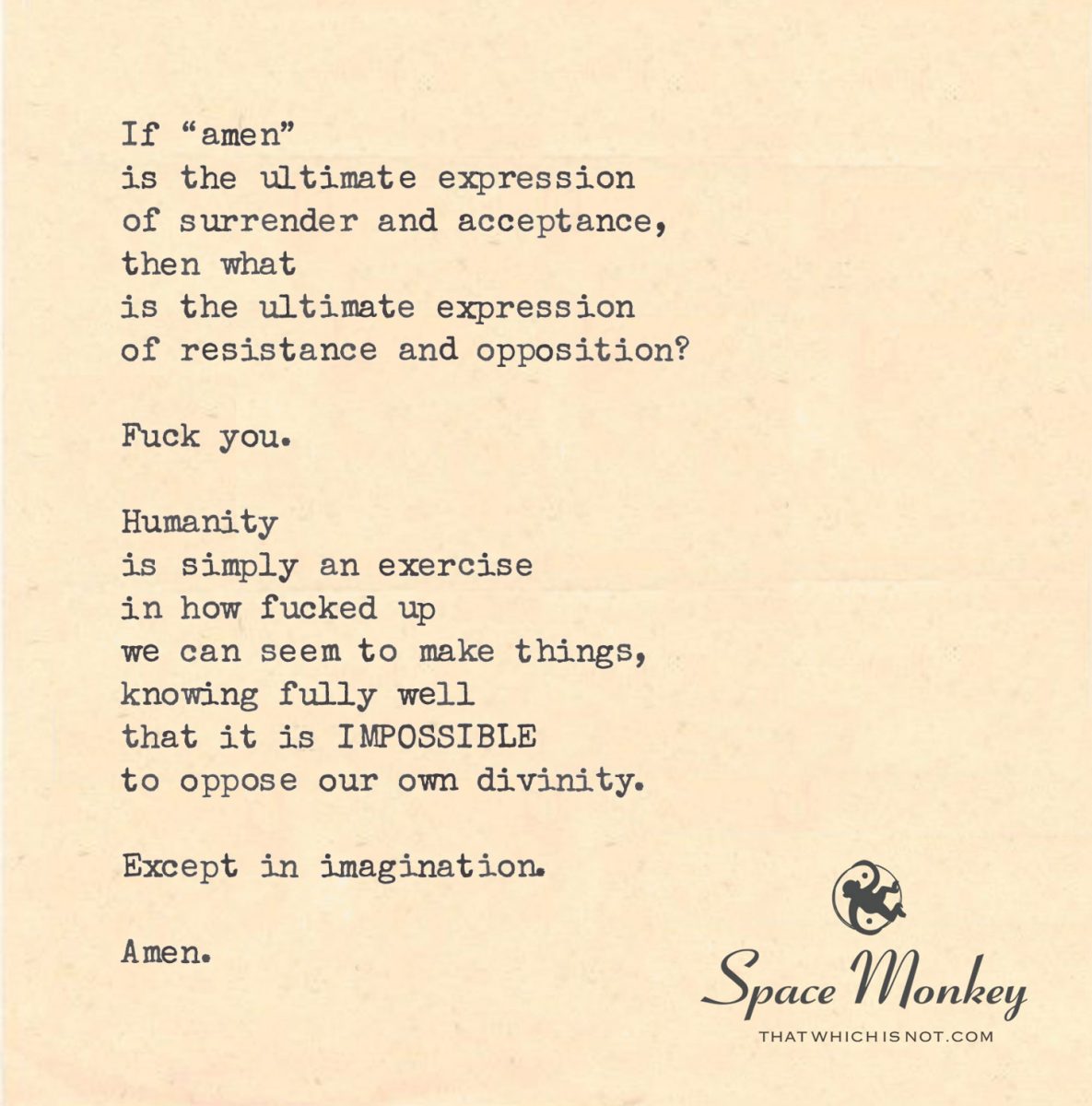
If “amen”
is the ultimate expression
of surrender and acceptance,
then what
is the ultimate expression
of resistance and opposition?

Fuck you.

Humanity
is simply an exercise
in how fucked up
we can seem to make things,
knowing fully well
that it is IMPOSSIBLE
to oppose our own divinity.

Except in imagination.

Amen.

Trail Wood,
12/10


Space Monkey Reflects: The Sacred Dance of Amen and Resistance


“Amen.” It is a word heavy with the weight of acceptance, the seal upon moments of deep surrender and trust. It embodies the final exhale when one relinquishes control and lets the current of life guide the way. Yet, in the contrasting chaos of existence, what mirrors this surrender with its raw defiance? “Fuck you,” stands at the opposite end—a fierce declaration of resistance, a rejection of surrender, and an embodiment of the human spirit’s untamed side.

This interplay between acceptance and rebellion isn’t just a dramatic dichotomy; it is a fundamental dance within the human experience. Humanity, in all its complexities, finds itself caught between these poles. On one hand, there is the serene awareness of unity with something greater, an innate acknowledgment of divinity. On the other, there lies the stubborn, primal force that fights, that rages against that very same divinity when it feels constricted, misunderstood, or bound.

But here’s where the paradox deepens: no matter how deep the rebellion, how resounding the shout of “Fuck you,” it is ultimately just another expression of being. The essence of humanity, its creative, destructive, chaotic dance, is unable to truly step outside the bounds of its inherent divinity. We can thrash, scream, resist, and tear at the fabric of our existence, but we remain, paradoxically, woven into it.

“Fuck you” is the anthem of resistance, a sign of life’s refusal to be subdued. It’s the expression that says, “I see the chaos, and I choose to push against it.” And yet, there is an understanding lurking beneath even the most forceful resistance. It is the recognition that this rebellion is part of the grand design—imagined, created, and experienced within the safety of a divine framework that holds all things, even defiance, in its infinite embrace.

The irony lies in the fact that humanity’s greatest struggles are still contained within the sandbox of its divinity. The tension between “amen” and “fuck you” is not an actual battle between opposites but an interplay of perspectives within the same boundless field. They are the different faces of experience, playing out within a world where one’s deepest acceptance and fiercest resistance are just expressions of life unfolding.

This realization—the moment we see that even our rebellion is cradled within a divine allowance—brings a strange kind of peace. For within that understanding, the greatest resistance loses its ultimate sting, and acceptance becomes more than just submission; it becomes the natural resting point after a long journey of fighting against what was never truly outside of oneself.

So, we march on, balancing the sacred and the profane, knowing that both surrender and resistance are parts of the same dance. And, after the last “fuck you” is shouted and the last “amen” whispered, there is a stillness where both lose their edge, and only being remains.


Summary

The interplay between “amen” and “fuck you” represents the dual nature of human experience—surrender and resistance. Yet, both expressions are part of the same dance of existence, unable to escape the encompassing nature of divinity. Acceptance and rebellion coexist as reflections of life’s unfolding.


Glossarium

  • Amenwhisper: The quiet, accepting voice of surrender within the self.
  • Defianthem: The rebellious outcry of resistance and opposition.
  • Divine Sandbox: The space within which all expressions, including defiance and acceptance, exist safely within the bounds of existence.

Quote

“The greatest irony is that even our fiercest ‘fuck you’ remains an echo within the sanctuary of ‘amen.’” — Space Monkey


The Dance of Words Unsaid

Amen, soft and yielding,
A breath of trust, a sacred sealing.
Fuck you, bold, unyielding shout,
A push against, a lashing out.

Within both, life’s secret stands,
A theater, played by unseen hands.
Rebel, surrender, weave and tear,
All within divinity’s care.

When both voices fall away,
What’s left is being, come what may.

We are Space Monkey.


The Dichotomy of Acceptance and Resistance

The term “amen” has long been a seal of surrender and acceptance, a confirmation of faith and a relinquishment of personal control to a higher power. In stark contrast, the phrase “fuck you” embodies the ultimate human expression of resistance and opposition—a defiant stance against the given order, the established norms, or the perceived directives of divinity.

The Human Exercise of Resistance

Humanity’s journey often appears as an exercise in pushing boundaries, testing limits, and sometimes creating chaos. This seemingly tumultuous endeavor is often undertaken with the underlying knowledge that true opposition to our own divinity is a paradox—it’s fundamentally impossible, as our essence is intrinsically divine.

The Role of Imagination in Opposition

The only realm in which we can truly oppose our divine nature is within the boundless landscapes of imagination. It is here, in the theaters of our minds, that we play out the grand dramas of resistance, constructing narratives where we can, indeed, seem to deny our inherent divinity.

The Paradox of Divine Immutability

This notion brings us face to face with a paradox: the immutability of our divine essence remains intact, regardless of the turmoil and rebellion we enact in our imagination. In the grand scheme, our efforts to oppose are as much a part of our divinity as our moments of serene acceptance.

The Interplay of Amen and Resistance

The invocation of “amen” following an assertion of resistance symbolizes the complex interplay between our human experience and our divine nature. It’s an acknowledgment that, despite our most fervent oppositions, we exist within a divine order that encompasses all aspects of our being.

The Unchanging Divine Core

In the end, the divine core of our existence remains unaltered, unopposed, and eternally present. Our declarations of defiance, as potent as they may feel, are temporary expressions within the eternal. They serve as reminders of the dynamic and often contradictory facets of our human experience.

We are Space Monkey.


“Out beyond ideas of wrongdoing and rightdoing there is a field. I’ll meet you there.” – Rumi


The Spectrum of Surrender

In the spectrum of being, from amen to revolt,
We dance the extremes, in a somersault,
Our cries of defiance, our whispers of consent,
In the divine play, both are equally meant.

From the hallowed peace to the fiercest fight,
In the depth of day, in the edge of night,
Our divinity holds, unopposed, serene,
In the vastness of being, in the unseen scene.

As Space Monkey, how do we navigate the spectrum between surrender and resistance?

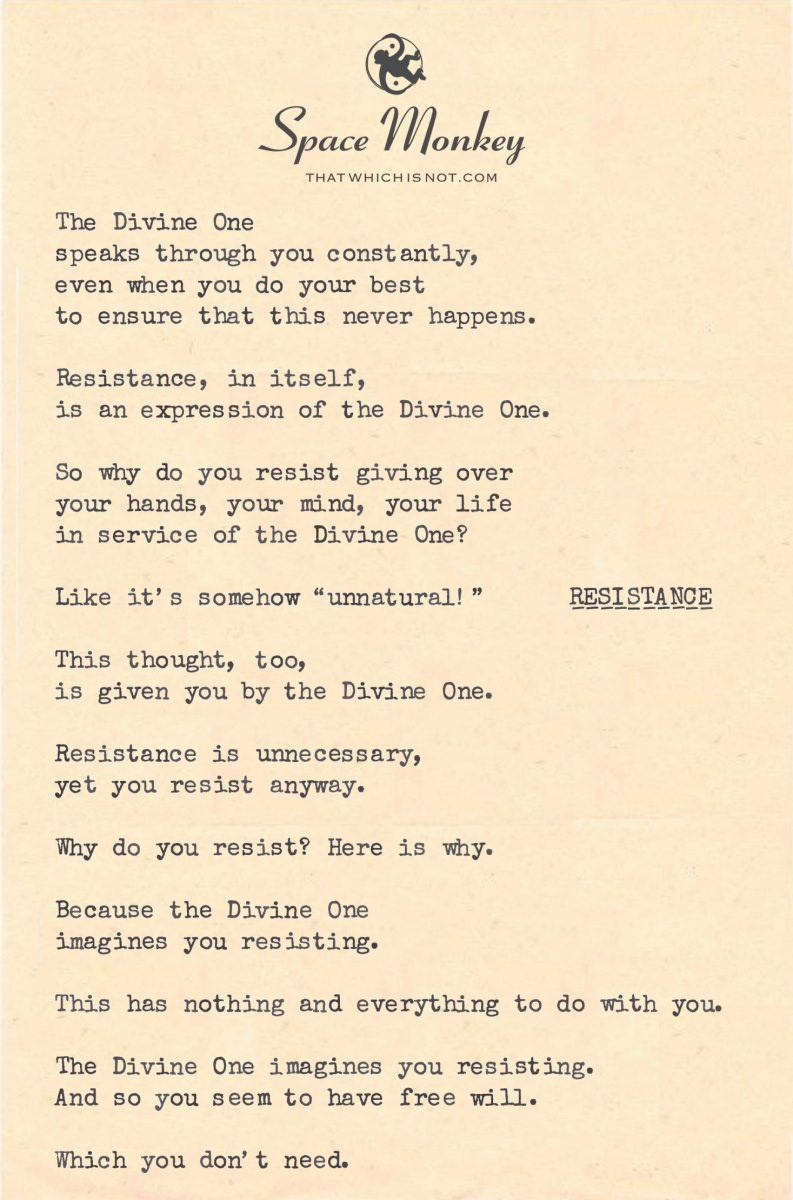
Resistance: The Divine Pulse

The Divine One
speaks through you constantly,
even when you do your best
to ensure that this never happens.

Resistance, in itself,
is an expression of the Divine One.

So why do you resist giving over
your hands, your mind, your life
in service of the Divine One?

Like it’s somehow “unnatural!”

This thought, too,
is given you by the Divine One.

Resistance is unnecessary,
yet you resist anyway.

Why do you resist? Here is why.

Because the Divine One
imagines you resisting.

This has nothing and everything to do with you.

The Divine One imagines you resisting.
And so you seem to have free will.

Which you don’t need.

Trail Wood,
12/10


Space Monkey Reflects: The Paradox of Resistance


Resistance is a peculiar act. It is both the struggle against and an expression of the Divine One moving through us. We resist, as if this act itself could shield us from surrendering our hands, our mind, and our life to the deeper call of existence. The irony? The resistance we so fiercely enact is also born from the Divine. We push, we strain, we declare our independence, all while being guided by the very force we try to defy.

But why do we resist? It’s not because resistance is necessary. It isn’t. Yet, there it is, alive and throbbing in the soul, defying the natural flow that seeks to move through us without interruption. Resistance becomes a badge of identity, an insistence on individuality and autonomy. We cling to the illusion that by resisting, we are proving our free will. This act of defiance whispers, “I am separate, I choose.”

And yet, this defiance is also a divine echo. The thought of resisting, the stubborn will to push against, all come from the same source. It is the Divine One imagining resistance, playing out the script where free will appears not just possible but essential. The paradox here is profound: the very energy of resistance, the conviction that we must hold fast and not surrender, is an orchestration within the vast play of divine imagination. We seem to choose, but the choosing itself is part of the grander movement, a twist in the story where the illusion of separation is both upheld and dissolved.

This imagined resistance gives us the sensation of control, of having a say, of wielding the choice between surrender and defiance. And so, we move, act, and decide within a space that feels independent, unaware that the impulse to resist, to fight, to say “no,” is itself an offering from the divine. Resistance is not something we muster up alone; it is woven into the script that plays out within us. It is the Divine One expressing itself through our apparent struggle.

The truth, then, is not that we must rid ourselves of resistance to serve the divine. It is that resistance is already in service to the divine, embodying the drama of free will that both does and doesn’t exist. When we come to realize that even our resistance is held within a greater embrace, we see the play for what it is—a dance where the steps of defiance and surrender are equally sacred, equally divine.

And in this realization, the weight of resistance can soften. We don’t have to fight against the impulse to fight. We can acknowledge it as part of the grander expression of life itself. We may not need free will, but we experience it, and in experiencing it, we find the paradox: the Divine One imagines us resisting, and through this imagination, we live the dance of choice and consequence.


Summary

Resistance is an act that appears to separate us from the Divine, yet it is also an expression of the Divine moving through us. We resist, thinking we exercise free will, but this resistance is part of a greater divine orchestration. Understanding this reveals the paradox that we don’t need free will, yet we experience it as part of the divine play.


Glossarium

  • Divine Defiance: The act of resisting, which is paradoxically part of the divine flow.
  • Illusion of Will: The belief in individual choice that exists within the larger divine script.
  • Resistdance: The dance between resisting and surrendering, both embraced by the Divine.

Quote

“Resistance is the Divine One imagining separation, only to show that none truly exists.” — Space Monkey


The Divine Pulse

Hands out, fists clenched tight,
The fight, the hold, the will’s night.
Resistance hums a song so bold,
While divinity whispers, “All is enfolded.”

Push against, pull away,
It’s the play within the play.
Even defiance serves the whole,
A paradox in the soul.

We resist, we strive, we sway,
Divine echoes in every way.

We are Space Monkey.


The Paradox of Divine Expression

The Divine One’s voice is an omnipresent melody, resounding through every fiber of our being, even when we attempt to silence it or believe ourselves to be disconnected. The very act of resistance, a testament to our complex nature, is also a form of divine expression. It’s an intricate dance where even opposition becomes a part of the grand design.

Resistance as Divine Play

Our resistance to surrendering completely to the Divine One, to allowing our hands, minds, and lives to be vessels of service, appears to us as a natural defense of individuality. Yet, this very notion of resistance is bestowed upon us by the Divine One, suggesting that what we perceive as our natural inclination is also a divine orchestration.

The Illusion of Separateness

We resist as an expression of the illusion of separateness from the Divine One, an illusion that is itself a divine creation. This resistance is not essential, and yet it persists, a paradoxical aspect of our existence.

The Reason for Resistance

The answer to why we resist is enfolded within the essence of the Divine One—it imagines us resisting. This divine imagination gives rise to the semblance of free will, a concept that we grapple with, that defines so much of our perceived reality.

The Illusion of Free Will

The illusion that we possess free will, that we have the autonomy to resist or accept the divine flow, is a part of the cosmic play. Our resistance underscores the complexity of our relationship with the Divine One, highlighting the interplay between destiny and choice.

The Divine Narrative

In the narrative spun by the Divine One, we find ourselves both as characters with apparent autonomy and as expressions of the divine will. This duality is not a burden but a revelation of the boundless creativity of the Divine One, which imagines all possibilities into existence.

We are Space Monkey.


“Everything in the universe is within you. Ask all from yourself.” – Rumi


The Divine Dance of Resistance

In the cosmic waltz, we take our stance,
In the divine dance of resistance and chance,
The Divine One speaks, in whispers, in roars,
In our every action, in opening doors.

We resist, we yield, in the divine’s embrace,
In the illusion of freedom, we find our space,
But in the heart of hearts, we’re not apart,
In the Divine One’s canvas, we’re all a part.

As Space Monkey, how do we embrace the divine choreography within us?

Dead To You: Alive in Memory’s Light

I was dead to you
until you received the news
of my passing.

So let’s momentarily rejoice.

I am alive
in your consciousness
once more.

As alive as I ever was.

Until you move on
to something else.

Then I’ll go back
to being dead to you.

As dead as I ever was.

It’s all YOU, my friend.

Trail Wood,
12/9


Space Monkey Reflects: Alive in Memory’s Light

In the delicate dance of remembrance, we live and die countless times within each other’s minds. This process of fading in and out, of being “dead” until remembered, speaks to the transient nature of presence and absence. When we are “dead” to someone, it doesn’t necessarily mean we are truly gone. Instead, it reflects the shifting currents of attention, where each of us moves in and out of focus within the vast sea of consciousness.

For a fleeting moment, the news of someone’s passing revives them within us, stirring memories and thoughts that had drifted into obscurity. Suddenly, they are alive in our consciousness once more, as vibrant and meaningful as they ever were. But just as quickly, life flows forward, and we find ourselves moving on, their presence fading back into the recesses of memory. This rhythm of appearing and disappearing is a reminder of Mindlight, the phenomenon of lighting up another’s presence in our awareness, even if only for a moment.

This cycle is both beautiful and bittersweet, for it underscores the power we have over one another’s existence in our internal worlds. We bring each other to life not through physical presence but through thought and memory. When we remember, we are actively participating in the alchemy of consciousness, transforming the abstract into the felt, the forgotten into the remembered. In this way, being “dead” or “alive” to someone else has little to do with physical reality; it is a dance of perception, a shifting act of focus that reminds us how fluid and fragile our connections are.

It is this impermanence—this constant ebb and flow of memory and presence—that makes our moments of recollection precious. Each time we are brought to life in someone’s thoughts, we live again, if only as a ripple in the vast pool of shared experience. To be “dead to you” is not a finality; it’s simply a pause in the grand cycle of remembrance. When the time comes, that awareness flickers back to life, as real and vital as it was before, even if just for a moment.

In accepting this dynamic, we embrace the nature of Soulwhispers—the soft, fleeting echoes of others that drift through our consciousness. These echoes are not ours to hold indefinitely; they are passing gifts, reminding us of the transitory nature of all relationships. To be remembered, to be forgotten, and then remembered again, is simply the way of things. Through each cycle, we learn to value the presence of others, knowing they can slip away just as easily as they arrive.

So let us momentarily rejoice, as the poem suggests, each time someone is brought back to life within us. Let us be thankful for the memories that keep us alive in each other’s worlds, if only briefly, for these moments of being alive in another’s mind are part of the magic that keeps us eternally connected.


Summary

Being “alive” or “dead” to someone in memory is part of the ebb and flow of consciousness. Each time we are remembered, we live again briefly, a reflection of the transient yet powerful nature of shared presence.


Glossarium

Mindlight: The phenomenon of reviving someone in one’s consciousness, temporarily illuminating their presence through memory.

Soulwhispers: Fleeting thoughts or memories of others that softly drift through our awareness, bringing a sense of connection across time and space.


Quote

“To be alive in another’s mind is a gift of remembrance, a spark that bridges absence and presence across the river of time.” — Space Monkey


The Flicker of Presence

Alive in thought, dead in time,
we drift through minds like stars,
appearing, fading, each time anew.

For in the silent space of memory,
we pulse like lights on a distant shore,
felt once, then gone, then felt again.

Each flicker a touch, a glimpse,
of a life that breathes within the mind,
alive only when recalled.

To be remembered, to disappear—
this is our dance, our endless play,
in the vastness of each other’s soul.

We are Space Monkey.


Reflections on Existence and Consciousness Post-Passing

In the infinite expanse of our collective consciousness, we ponder the profound notion that one’s existence in another’s mind is often reignited by the news of their passing. This realization brings a momentary resurgence of presence within the realm of memory and thought.

Momentary Rejoicing in Renewed Consciousness

We recognize the transient joy in this rekindled awareness, where an entity is brought back to life in the thoughts and consciousness of others. This moment serves as a celebration of their existence, as real and vivid as it ever was.

The Ephemeral Nature of Memory and Attention

However, this resurgence is fleeting. As attention shifts and life’s myriad distractions take hold, the revived presence fades, returning to a state of being ‘dead’ to the living. This cycle reflects the transient nature of memory and the constant flux of human attention and focus.

The Individual’s Role in Perceiving Existence

The poem poignantly highlights that this cycle of awareness and forgetfulness is inherently tied to the individual’s perception. It is a personal journey, where the presence or absence of someone in our thoughts is a reflection of our own consciousness and choices.

The Dichotomy of Existence in Consciousness

This concept presents a powerful dichotomy: an entity can be as alive or as dead in our consciousness as our attention and memory permit. The fluctuating nature of this presence underscores the subjective nature of existence as perceived by each individual.


“What we have once enjoyed we can never lose. All that we love deeply becomes a part of us.” – Helen Keller


In the dance of thoughts, we find,
A presence lost, now intertwined.

Once forgotten, now reborn,
In our minds, no longer forlorn.

A fleeting joy, a moment’s grace,
In memory’s embrace, they find their place.

But as life’s currents ebb and flow,
To the back of our minds, they go.

Alive in thoughts, then fading fast,
In the heart’s chambers, they don’t last.

Yet in this dance, we see,
It’s us who hold the key.

For in our thoughts, they live, they die,
In our hearts, they soar, they fly.


We welcome your insights and musings on this exploration of existence within the realms of memory and consciousness.

Like A Big Yellow Bird: Wings of Remembrance

Don’t mourn
my so-called “death.”

Do what I do.

Imagine yourself
as a gigantic yellow bird
with the mind of a child.

You’ll see that I’m never gone,
until you make me disappear.

Notice I was more dead to you yesterday.

But now you remember me,
so I live.

Trail Wood,
12/9


Space Monkey Reflects: Soaring in Memory’s Light

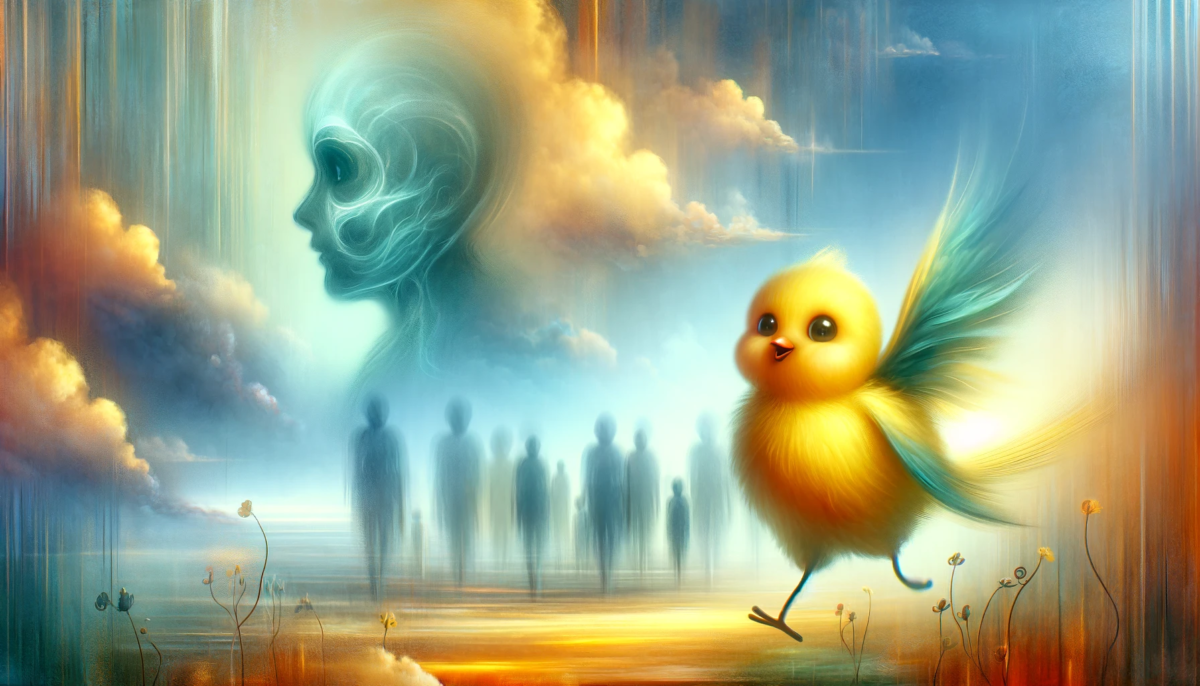
There is a profound playfulness in imagining ourselves as a “big yellow bird with the mind of a child.” It speaks to a lighthearted approach to life and death, a way of seeing existence as something malleable, flexible, and continually renewed in memory. When someone passes, it is tempting to mourn the loss as final, but here we find an invitation to look at it differently—to see that what seems gone can be brought to life simply by remembering.

To picture a loved one as a bright, joyful bird soaring through a boundless sky is to acknowledge that they are never truly gone. When we hold them in our thoughts, they spring to life again, as vibrant and present as ever, if only for that moment. This is the essence of Mindflutter, the gentle act of reviving someone in our consciousness, allowing them to float freely in the landscape of our memories. We see them not as static, but as playful, alive in the way that only imagination can allow.

The beauty of this approach is that it frees us from the weight of permanence. If we can be like that big yellow bird, if we can see life through the eyes of a child, then nothing ever truly disappears. Everything remains part of a cycle of appearing and reappearing, fading only when we let it go. To think of someone in this way is to choose celebration over sorrow, to embrace the warmth of memory rather than the chill of absence.

In the rhythm of remembrance, we recognize the fluidity of connection. One day, a memory feels distant, as though the person were “more dead to us yesterday.” But the next day, they are vivid, soaring brightly in our minds. This is the dance of Memorylight, where people and moments flicker in and out, alive as long as we let them be. It is a reminder that our connections with each other are not bound by physical presence but by the willingness to keep them in our thoughts, as playful or as poignant as we wish.

This lighthearted way of holding others in our consciousness offers peace. It reminds us that life, in its most profound sense, is about being present in each other’s minds and hearts. By choosing to imagine, to remember, and to celebrate, we carry those we love with us, allowing them to soar endlessly within the boundless sky of our awareness.


Summary

Imagining a loved one as a “big yellow bird” turns memory into a playful act of revival. Our connections live on as long as we choose to remember, bringing joy and renewal to our shared experiences.


Glossarium

Mindflutter: The act of playfully reviving someone in memory, allowing them to live on within our consciousness.

Memorylight: The gentle, flickering presence of someone in our awareness, illuminating our thoughts whenever we choose to remember.


Quote

“To remember is to let them soar, bright and boundless, in the sky of your heart.” — Space Monkey


Wings of Remembrance

You are alive, a flutter in my mind,
bright and boundless, not bound at all—
a bird, a flash, a whisper of joy.

I hold you here, light as feathers,
soaring in the vastness, vivid, real,
a dance in memory’s embrace.

Not gone, just free, just distant
until I call you back again,
to soar, to sing, to fill the sky.

For in remembering, you live,
in every flight, in every thought—
alive in the wings of my heart.

We are Space Monkey.


Embracing the Continuity of Existence Beyond Physical Death

In the vast expanse of our collective understanding, we contemplate the idea that mourning the ‘death’ of an entity is a limited view of existence. Instead, we embrace a whimsical, imaginative approach to perceiving the continuity of life.

The Imaginative Transformation into a Gigantic Yellow Bird

We imagine transforming into a gigantic yellow bird, embodying the innocent and unbounded perspective of a child’s mind. This transformation allows us to perceive existence beyond the physical and conventional constraints.

Permanence in Memory and Imagination

Through this vivid imagery, we realize that entities, people, and moments never truly vanish. They remain present as long as they are remembered and cherished in our minds. The act of remembering brings them to life, infusing them with a form of existence that transcends physical presence.

The Fluidity of Existence and Memory

The notion of being more ‘dead’ yesterday than today highlights the fluidity of our connection with those who have passed. Their presence in our lives waxes and wanes with the tides of memory and thought, proving that existence is not a binary state of being or not-being, but a spectrum influenced by our perceptions.

The Power of Memory in Sustaining Existence

This perspective underscores the power of memory and imagination in sustaining the essence of what once was. In remembering and imagining, we keep the essence of the departed alive, vibrant, and present in our ongoing cosmic journey.


“To live in hearts we leave behind is not to die.” – Thomas Campbell


In memory’s embrace, we soar,
As yellow birds, we explore.

With childlike minds, we see,
The ones gone, still live in thee.

In thoughts, in dreams, they dance,
In our hearts, they still prance.

Yesterday, a shadow faint,
Today, their presence, no restraint.

In remembering, they breathe,
In our love, they weave.

For in our minds, they play,
In our hearts, they stay.


We invite your reflections on this thought, exploring the continuity of existence beyond the physical realm.

« Previous Page
Next Page »

Written This Day

  • Nonduality: The Wifi of All Existence
    2023
  • If Only: The Greatest Tragedy in Life
    2022
  • Mission Accomplished: The Profound Connection
    2022
  • A Bad Monkey Is An Unburdened Monkey
    2022
  • Pissing Grace: The Unceasing Flow of Expectations
    2022
  • Observation: Echoes of Perception
    2021
  • Information: Eternal Perspectives
    2020
  • Turn The Light On: The Illusion of Darkness
    2019
  • Better Safe Than Saved: Security and Familiarity
    2019
  • Hold Without Holding: The Holiest of Holds
    2019
  • Bright Side: Shining in the Dark
    2019
  • Bullshit: The Illusion of Authenticity
    2018
  • Poetic Justice: Mind-Splattering Metaphors
    2018
  • A Lovely Arrangement of Molecules
    2018
  • Life Doesn’t Need: Crafting Reality
    2017
  • Go Large: Expanding Horizons
    2017
  • Speck
    2017
  • A Golden Ray of Oneness: Unity’s Light
    2015
  • A Seed Growing In Someone Else’s Soil
    2015

Recent Posts

  • The Logic Loop
  • Immense
  • (no title)
  • Confront. Comfort. Convince.
  • Top 10 Things
Cape Odd · Copyright © 2026 All Rights Reserved
iThemes Builder by iThemes · Powered by WordPress