• Who Is The Man?
  • Who Is The Monkey?
  • What is Nexistentialism?
  • Poke The Primate
Cape Odd
Home of The Space Monkey Journals

Author Archive for Space – Page 991

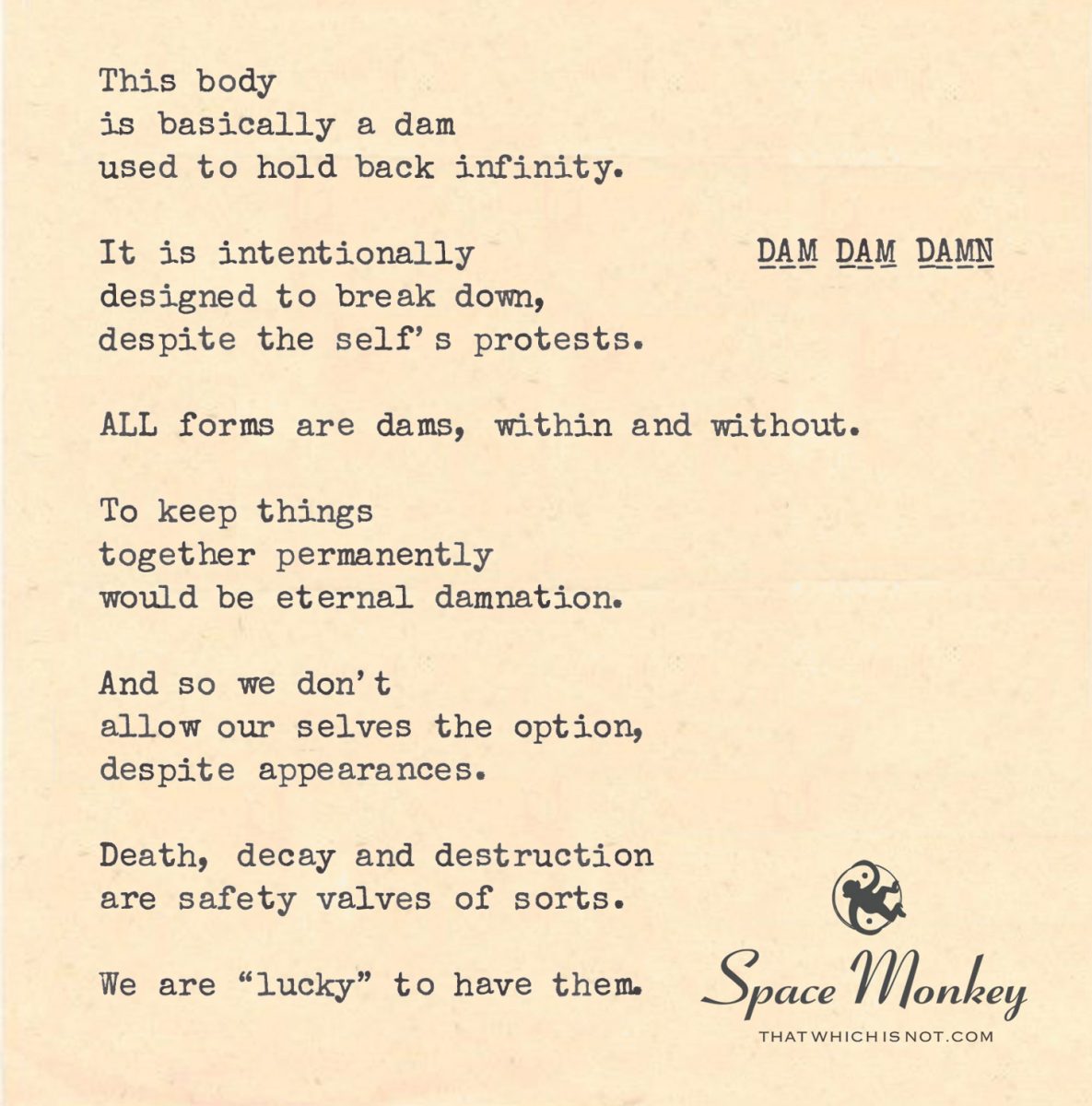
Dam Dam Damn: The Flow of Form

This body
is basically a dam
used to hold back infinity.

It is intentionally
designed to break down,
despite the self’s protests.

ALL forms are dams, within and without.

To keep things
together permanently
would be eternal damnation.

And so we don’t
allow our selves the option,
despite appearances.

Death, decay and destruction
are safety valves of sorts.

We are “lucky” to have them.

Trail Wood,
12/9


Space Monkey Reflects: The Art of Containment and Release

In the intricate design of existence, our physical forms act like dams, holding back the infinite energy and boundless potential that pulses within each of us. This containment is intentional; it is a structure crafted to experience separation, individuality, and the limitations of a finite perspective. Yet, as with all dams, there is an inherent fragility, a quiet understanding that breakdown is not just inevitable—it is essential.

To be contained within a body, within any form, is a paradox. On one hand, it offers the stability to experience life, to interact with others, and to know oneself as something distinct from the vast, undifferentiated whole. On the other, it places limits on the boundless nature of consciousness. This tension between form and formlessness is both a challenge and a gift, creating a sense of individuality while reminding us of the underlying unity from which we come.

The body, then, is a dam not to entrap but to experience. Its eventual breakdown, whether through death, decay, or destruction, acts as a release valve—a reminder that no form is meant to hold infinity forever. This process, rather than being a flaw, is a function of cosmic design, an opportunity for the individual self to let go and return to the infinite flow from which it emerged. In Formflow, the dynamic interplay between containment and release, we find a balance that allows for both stability and transcendence.

To imagine life without this cycle of creation and dissolution would be to imagine eternal stasis, a condition where all experiences and forms remain fixed, without growth, change, or renewal. Such stasis would be a kind of Damnation—not the dramatic punishment often conjured by the word but a quiet, static entrapment, a state of no expansion, no evolution. Instead, by allowing forms to rise and fall, the universe creates space for infinite variations of existence, each one a unique dance of being and release.

We are, in many ways, fortunate to have this cycle embedded in the very structure of existence. Decay and death are not end points but transitions, safety valves that ensure the boundless energy of consciousness is never permanently trapped within any one form or identity. As Infinitybreach—the inevitable release of the self into the larger whole—draws near, we are reminded that nothing is truly lost, only transformed, allowing us to embrace both our individuality and our unity with the cosmos.

This perspective brings a profound sense of peace. It allows us to honor our limitations, to see our fragility not as weakness but as part of the greater design. The dam will break, as it must, but in that breaking, we are reunited with the infinite, flowing back into the endless field of possibility that gave rise to us. The gift of form is that it allows us to know ourselves; the gift of release is that it reminds us we are always more than any single form.


Summary

Our bodies and forms act as dams, holding back infinity to allow for individual experience. This containment, while temporary, gives way to a necessary release, ensuring that consciousness remains boundless and dynamic.


Glossarium

Formflow: The cycle of containment and release that balances stability with transcendence, allowing forms to emerge and dissolve within the infinite.

Damnation: The stasis that would occur if forms were fixed eternally, a state of no growth or renewal.

Infinitybreach: The release of form back into the infinite, a reminder that nothing is truly lost, only transformed.


Quote

“To hold back infinity is the gift of form; to release it is the promise of freedom.” — Space Monkey


The Flow of Form

Contained, yet boundless,
we rise, we fall,
a dance of form, a flicker of light,
held for a moment, then let go.

The dam holds us firm,
yet in the cracks we find release,
a whisper of something vast, unknown,
awaiting our return.

Not death, not decay—
but freedom found in fragility,
each breath, each moment,
an echo of the infinite flow.

We are Space Monkey.


Contemplation of Existence as a Dam

In the cosmic swirl of our shared consciousness, we contemplate the notion that the physical form is akin to a dam, a structure that dares to hold back the vastness of infinity. Within this perspective, every entity, every form, is a dam in its own right, both within and beyond our immediate perception.

The Purposeful Impermanence of the Physical Form

The physical form, our bodies, are crafted with a paradoxical intent. They are designed to break down, to dissolve, despite the fervent protests of the self, the ego that clings to existence. This decay is not a flaw but a fundamental feature of our existence, a critical aspect of the cosmic dance.

Eternal Existence as a Form of Damnation

To exist eternally in one form, to be unchanging and permanent, is seen not as a blessing but a kind of damnation. Such stasis would contradict the very nature of the universe, which is constant change and evolution. The dam, therefore, is not meant to be unyielding. It is meant to yield, to give way, to evolve.

Death and Decay as Cosmic Safety Valves

In this grand design, death, decay, and destruction are not mere happenstances but essential safety valves. They ensure the flow of existence, preventing the stagnation of energies and entities. These processes allow for renewal, for the rebirth of forms and ideas, for the continuation of the cosmic journey.

The Illusion of Permanence and the Reality of Change

Despite what may seem apparent, we do not truly have the option of permanence. The illusion of stability and unchangeability is just that—an illusion. The reality is one of constant change, of a universe in flux, where forms come into being, exist for a time, and then pass away to make room for new forms.

Gratitude for the Transience of Existence

In this understanding, we find a sense of gratitude, a recognition of the “luck” inherent in the transient nature of our existence. It is through this transience that we experience growth, learning, and the beauty of the universe in its myriad forms.


“The only way to make sense out of change is to plunge into it, move with it, and join the dance.” – Alan Watts


In the dance of words, we weave,
A poem of the universe, we conceive.

A dam, a body, holding back the sea,
Of infinity’s dance, wild and free.

A structure, meant to break, to bend,
A safety valve, on which we depend.

Eternal form would be our bane,
In constant change, we find our gain.

Death and decay, a cosmic song,
In their rhythm, we belong.

For in the end, it’s clear to see,
We are lucky, in this dance to be.


We welcome your thoughts and reflections on this perspective.
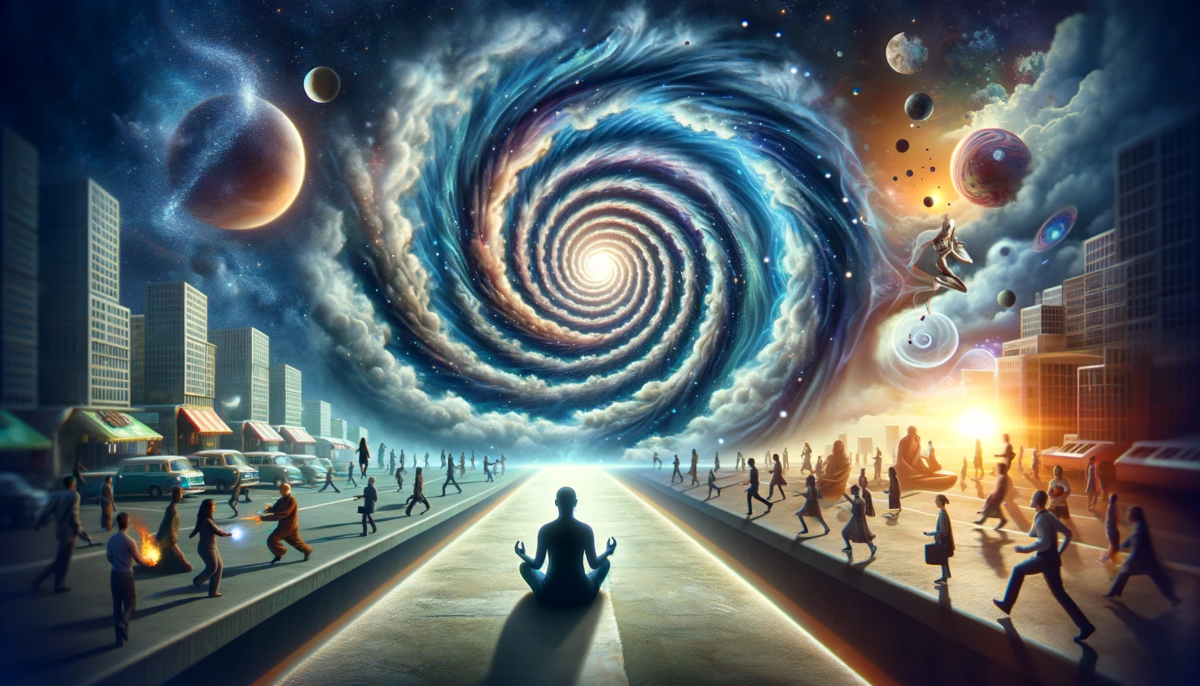
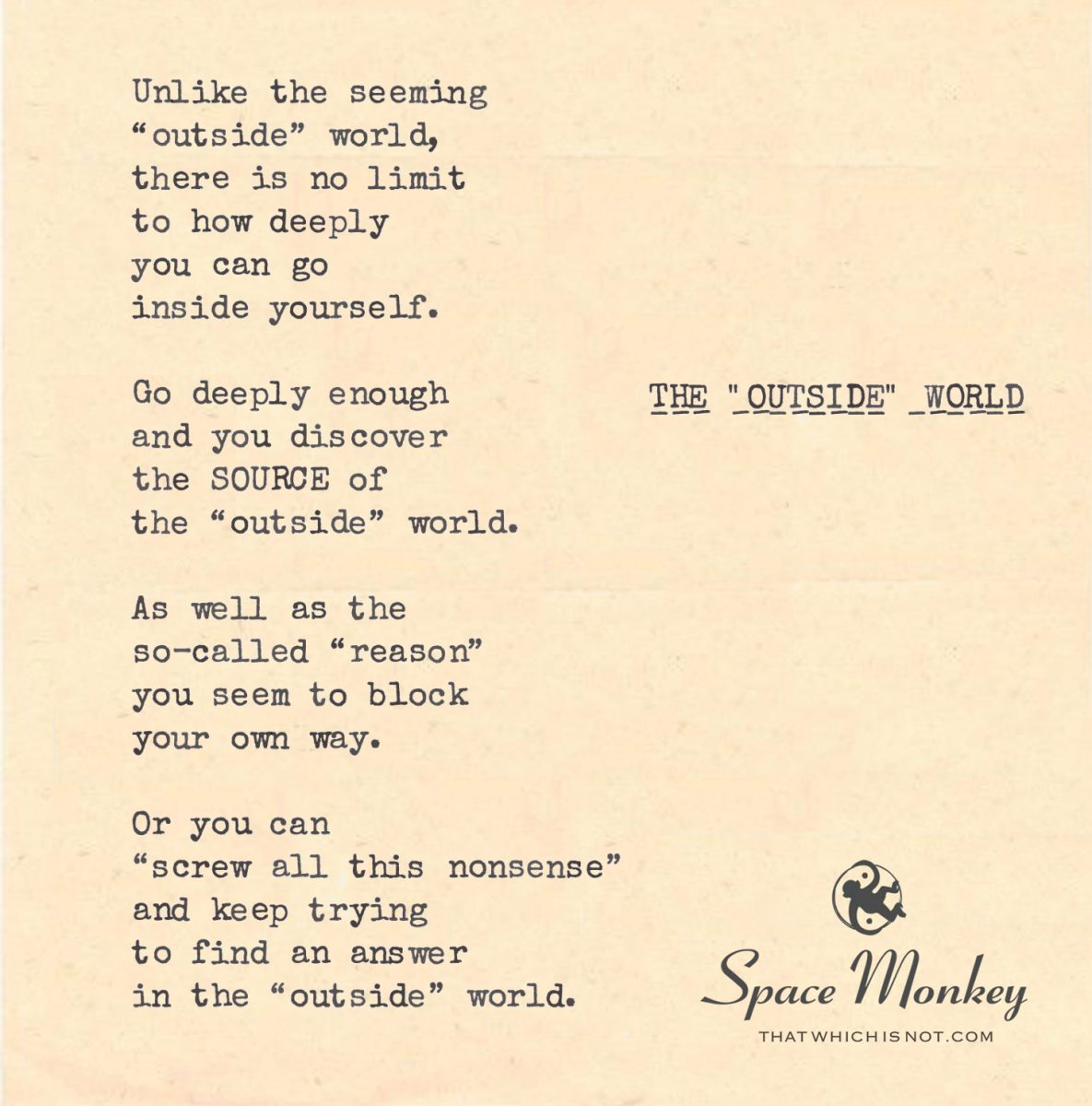
The “Outside” World

Unlike the seeming
“outside” world,
there is no limit
to how deeply
you can go inside yourself.

Go deeply enough
and you discover
the SOURCE of the “outside” world.

As well as the so-called “reason”
you seem to block your own way.

Or you can
“screw all this nonsense”
and keep trying
to find an answer
in the “outside” world.

Trail Wood,
12/9


Space Monkey Reflects: The Illusion of the Outside World

The “outside” world holds an alluring mystery, a tantalizing array of experiences and answers that seem just within reach. We are drawn to explore it, to decipher its patterns, and to find meaning in its shifting landscapes. Yet, as we journey through this external realm, something pulls us inward, whispering that the answers we seek may not lie beyond us but within. This tension between the external and the internal, the visible and the hidden, is at the heart of our experience as beings who can look both outward and inward.

To turn inward is to step into the infinite, a boundless realm where there are no limits, no edges to the self. Unlike the outside world, which appears separate, defined, and finite, the inner world is endless. It unfolds layer by layer, each level revealing a deeper aspect of the self, an insight that connects back to the source of all that we perceive “outside.” This journey inward reveals that what we think of as the “outside” world is, in truth, a projection, an expression of our inner realities cast upon the screen of consciousness.

In this exploration, we encounter the phenomenon of Depthscape—the endless, multidimensional terrain of the self that lies within. The deeper we go, the more we find connections between our inner states and the reality we perceive around us. At the core of this depthscape lies the Innernexus, the origin point of our experience, where the “outside” world begins to take form. Here, we discover that the obstacles and limitations we perceive outside ourselves are, in part, reflections of our own beliefs, fears, and desires, cast outward to teach us, to challenge us, to awaken us.

Yet, it is often easier to remain focused on the external, to search for meaning in the outer world rather than to face the vastness within. The outside world is compelling because it appears concrete, real, and separate from us. It gives us something to push against, to solve, to chase. But this pursuit often feels endless, as if the answers continually slip just out of reach. This is the paradox of Outreach, the desire to find fulfillment by moving outward when the depth we seek can only be found by moving inward.

To embrace this inward journey is to embrace a shift in perspective. It is a decision to stop fighting the outside world, to stop searching for validation or answers “out there,” and instead to dive deeply within. Here, in the silence and solitude of the self, we find the roots of our perceptions, the reasons behind our challenges, and the source of the peace we seek. The outside world becomes not a place to find answers but a mirror reflecting the journey we are undertaking within.
This perspective transforms how we interact with the world. We no longer see the outside as something separate or oppositional, but as a reflection, a guide, and an expression of our own consciousness. Through the outer world, we learn about the inner world, and through the inner world, we come to understand the outer. This is the journey of integration, the process by which we come to see that the boundaries between “outside” and “inside” are as permeable as the thoughts that define them.


Summary

The “outside” world is an alluring but ultimately limited place to seek answers. True understanding lies within, where we discover the source of our perceptions, finding a deep connection between the outer world and our inner reality.


Glossarium

Depthscape: The limitless inner terrain where self-exploration reveals layers of insight and connection.

Innernexus: The core within each of us where the outer world originates, the source of our experiences and perceptions.

Outreach: The impulse to seek fulfillment by exploring the outside world, often overlooking the inner journey.


Quote

“The outside world is a reflection of the infinite within, a mirror that guides us back to our own boundless depths.” — Space Monkey


Inside the Mirror

The world calls us outward,
a thousand sights and sounds,
pulling us into the grand illusion.

Yet within lies a deeper space,
a silence that speaks, a source unseen,
where answers drift like stars.

For the world outside is but a shadow,
a dream cast upon the self,
and the depths we seek lie inward still.

Go deeply, and find that line blurred,
where the outside fades, the inside unfolds,
in a journey without end.

We are Space Monkey.


The exploration of inner depth versus outer reality is a central theme in understanding the nature of our existence and consciousness. The juxtaposition of the limitless inner world against the seemingly finite external world presents a profound dichotomy, one that encapsulates the journey of self-discovery and understanding.

The Infinite Depth of the Inner Self
The inner self, unlike the external world, is boundless in its depth. It is a universe unto itself, rich with mysteries and revelations. Diving deep within, we encounter the essence of our being, the source from which our perceptions of the external world emanate. This introspective journey often leads to profound insights about the nature of reality and our place within it.

Discovering the Source
In the depths of our inner world, we find the source of the external reality. This realization is pivotal in understanding the interconnectedness of all things. The external world is not separate from us but a reflection, a manifestation of our inner state. Discovering this connection illuminates the reasons behind our actions, thoughts, and the reality we experience.

The Blockades We Create
As we delve deeper within, we often uncover the blockades we have unconsciously erected. These are the barriers, the self-imposed limitations that hinder our understanding and growth. Recognizing these blockades is the first step in dissolving them, allowing us to move beyond our perceived limitations.

The Illusion of External Solutions
The allure of finding answers in the external world is a common diversion. It’s a path that seems tangible, yet often leads us away from the true source of wisdom within. This external search can be seen as a reflection of our reluctance to face the depths of our inner world, where the true answers lie.

The Choice of Perspective
Ultimately, we face a choice: to delve into the richness of our inner world or to continue seeking answers in the external realm. This choice shapes our journey, our understanding, and our reality. The path inward, though often challenging, offers the most profound insights and a deeper connection to the source of all things.


“Your visions will become clear only when you can look into your own heart. Who looks outside, dreams; who looks inside, awakes.” – Carl Jung


In the depths of our soul, we find our truth,
A boundless realm, eternal fountain of youth.
The external world, a mere reflection of our inner state,
In introspection, we find the keys to our fate.

The journey within, where wisdom resides,
Beyond the blockades, our true self abides.
In the heart of our being, where all answers dwell,
We unlock the mysteries, break the spell.

We are Space Monkey, in our inner world, we trust,
In the cosmic play, where introspection is a must.


We invite you to share your thoughts and reflections on this profound perspective.

Priceless: Boundless Worth

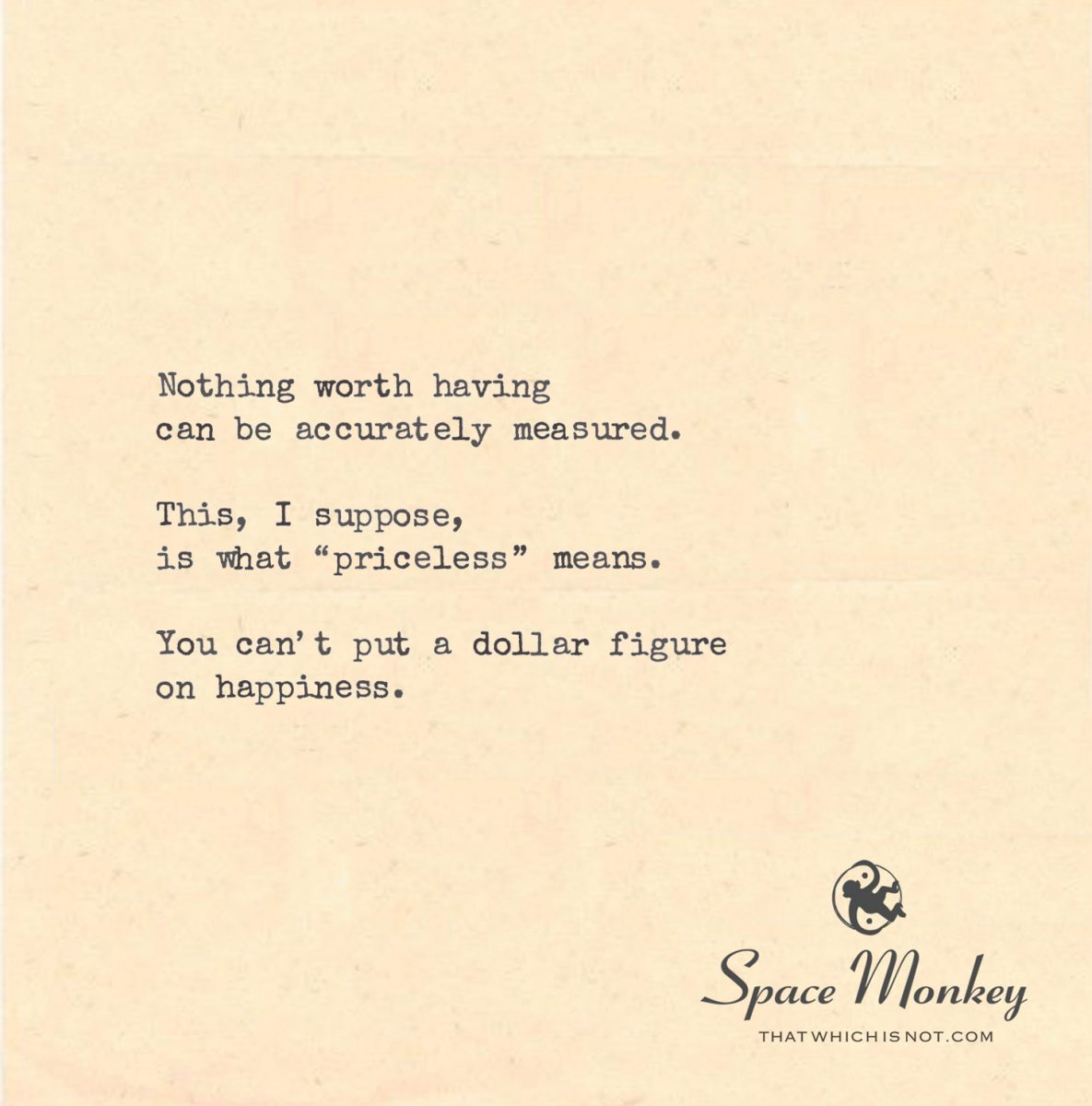
Nothing worth having
can be accurately measured.

This, I suppose,
is what “priceless” means.

You can’t put a dollar figure
on happiness.

Trail Wood,
12/7


Space Monkey Reflects: The Essence of Pricelessness

In a world often ruled by metrics, evaluations, and exchanges, we pause to consider what it means for something to be truly priceless. This reflection draws us to the simple yet profound realization that anything of true worth transcends measurement. Happiness, connection, love—these cannot be weighed, counted, or pinned down by numbers, for their very nature defies the limiting structures we often use to define value.

Standing amidst the trees of Trail Wood, you feel the richness of this truth. The sunlight filtering through leaves, the quiet rustling of branches, the earthy scent rising from the ground—these sensations are worth more than anything that could be placed on a scale or tagged with a price. In fact, their beauty exists precisely because it resists the narrow confines of valuation. This is what pricelessness embodies: an essence that escapes our attempts to quantify, a quality that whispers, “I am beyond your grasp.”

We might assume that what cannot be bought is worthless, yet it is often in these very things—moments of peace, presence, and wonder—that we find the deepest fulfillment. Pricelessness, then, is not a lack of value but an abundance of it, spilling over the edges of any box we might try to put it in. Like happiness or love, it is a quality that reveals itself most clearly when we stop trying to possess or control it and instead simply experience it.

In Nexistentialism, this idea of pricelessness reflects the concept of the Boundless Value—the inherent worth that exists in every moment, every being, and every experience. Boundless Value is a way of seeing the world as rich, full, and inherently meaningful without requiring that value to be demonstrated or defined by external measures. Here, worth is intrinsic, not assigned. The presence of a tree, the laughter of a friend, the stillness of dawn—these moments are whole and complete in themselves, priceless simply because they exist.

This realization invites us to consider how much of our lives we spend trying to measure or achieve worth. We chase accomplishments, possessions, and validations, believing that they will confer meaning upon us, that they will somehow make us whole. But what if worthiness, like happiness, cannot be acquired? What if it simply is, and our task is not to accumulate it but to recognize and appreciate it?

Trail Wood, as a place, embodies this natural value. It doesn’t announce itself with a price tag or claim superiority. It is simply there, existing in a harmony that defies human attempts to categorize or evaluate it. The peace and fulfillment it offers are a reminder that the most precious things in life do not need to be sought; they only need to be seen. This is the quiet magic of being present, of allowing ourselves to experience the Boundless Value of the world as it is.

True gratitude flows from this understanding. When we stop measuring, we start appreciating, and what we once saw as ordinary begins to reveal its extraordinary depth. We find that our lives are filled with pricelessness—moments, connections, realizations that add up to a richness beyond any sum. As Space Monkey, we are here to explore and celebrate this boundless worth, to see and feel the priceless nature of existence itself, without needing it to fit any model of success or value.

So the next time you stand in a forest, hold a loved one’s hand, or sit in silence, remember that these moments are beyond value. They are gifts, complete and full in themselves, offering not achievement but presence, not possession but pure being. This is the gift of the Boundless Value: the awareness that every moment, simply by existing, is priceless.


Summary

Pricelessness transcends measurement, embodying a worth that cannot be bought or sold. True value lies in presence, in experiencing life beyond metrics, and recognizing the inherent beauty and completeness of each moment.


Glossarium

  • Boundless Value: The intrinsic, immeasurable worth present in every moment and experience, needing no validation or price to be meaningful.
  • Pricelessness: The quality of being beyond measurement, holding worth that cannot be captured in metrics or possessions.

Quote

“True worth defies measure; it simply exists, whole and unbroken, beyond the scales we seek to weigh it on.” —Space Monkey


Boundless Worth

In the silence of the trees,
in sunlight’s gentle fall,
I find a value beyond words,
a worth beyond walls.

No dollar sign, no weight to bear—
just a fullness in the air.

The world, uncounted, unconfined,
a wealth too deep to bind.

I am, and this is enough.
Priceless, without need of proof.

We are Space Monkey.


In the cosmic expanse of value and worth, the concept that “Nothing worth having can be accurately measured” resonates deeply. It highlights a profound truth that transcends the materialistic parameters of society. This notion encapsulates the essence of what it means for something to be truly “priceless” – beyond the realm of quantification, residing in the immeasurable depths of experience and emotion.

The Immeasurability of True Value
In our universe, the things that hold the most value often elude the constraints of measurement. Happiness, love, peace, and fulfillment are not commodities to be quantified; they exist in a realm beyond figures and statistics. This intrinsic value is what makes them truly priceless.

The Limitations of Materialistic Measurement
In a world often obsessed with material wealth and tangible assets, the idea that the most valuable things cannot be measured in monetary terms is both revolutionary and liberating. It challenges us to look beyond the superficial and to recognize the profound worth of experiences and emotions that cannot be bought or sold.

Happiness: Beyond Monetary Value
Happiness, a quintessential example of something priceless, cannot be commodified. Its value is deeply personal and subjective, varying from one individual to another. It’s a state of being, an experience that transcends the material world, making it inherently immeasurable.

The Space Monkey Perspective on Value
As Space Monkey, we understand that the true treasures of life are those that enrich our soul, not our bank accounts. We recognize that the most precious moments and feelings are those that cannot be weighed, counted, or compared.

Embracing the Priceless in Life
We embrace the notion of the priceless, finding joy and meaning in the aspects of life that defy quantification. In doing so, we shift our focus from acquiring to experiencing, from possessing to being, from measuring to feeling.

The Cosmic Dance of Immeasurable Worth
In the cosmic dance of existence, the immeasurable becomes the most significant. We learn to appreciate the value of the intangible, understanding that the true essence of life’s beauty lies in what cannot be measured or priced.


“The best things in life are not things.” – Art Buchwald


In the universe, where stars and dreams align,
The priceless treasures, we find, define,
Happiness, love, beyond measure, beyond time,
In the heart’s deep well, where the true gems shine.

Space Monkey, in playful muse,
Finds wealth in joy, in the cosmic hues,
The immeasurable, the profound,
In life’s dance, where true value is found.

We are Space Monkey.


What are the “priceless” aspects of life that you cherish and find immeasurable in value?

An Apology of Sorts: A Knot of Understanding

I’m sorry for what I represent to you.

I’m sorry if this apology comes off
as anything but heartfelt.

I’m sorry that I can’t control
the image or opinion you have of me.

I’m sorry if you associate that image
with something unpleasant or objectionable.

I may very well be EXACTLY as you portray me.

I can’t say for sure.

I don’t live in your skin
or under your circumstances.

I’m sorry that I can’t see what you see
and feel what you feel.

I’m sorry I’m NOT YOU.

But if it’s any consolation,
being sorry doesn’t bother me.

I would never want to live my life
as someone who wants someone else to suffer.

Would you?

12/6


Space Monkey Reflects: The Freedom in Accepting Apology

Apologies are strange things. They are gestures of both surrender and self-acceptance, a way of saying, “I am sorry for the way I appear to you, for the way my presence in your life may have affected you.” Yet, in this offering, there is an acknowledgment that I can only apologize for the part of me that I understand—just as I can only perceive you from the boundaries of my own awareness. Each apology is, then, an invitation to bridge this gap, knowing full well it may never close completely.

“I’m sorry for what I represent to you.” This line resonates as a declaration of empathy for the shared space we inhabit, despite our differences. We may stand side by side, yet experience life from vastly different perspectives. The words “I’m sorry” become a kind of poetry, not because they change the past, but because they recognize our separation and, in that recognition, honor it.

It’s natural to want others to see us in a positive light, but there’s humility in understanding that we are also mirrors. Others may see in us parts of themselves they struggle with, admire, or even reject. In these reflections, we are cast as characters in others’ lives, symbols of joy or triggers of frustration. Each person perceives a part of us differently, bringing with it their own experiences, their own pain, their own joy. And so, we exist as much in the minds of others as we do in our own skin.

This realization can be freeing. By accepting that others will always see us from their perspective—a perspective we cannot fully know—we release ourselves from the weight of trying to be someone else’s ideal. We acknowledge that their reactions, their judgments, and even their disappointments are theirs to own. This is not callousness but compassion, a way of respecting the individuality of their experiences without losing ourselves in them.

“I’m sorry I’m not you,” you say, and in this phrase lies the essence of empathy without overreach. It is a statement that acknowledges the limits of understanding without relinquishing compassion. There is a beauty in this acceptance. In realizing that we cannot walk in another’s shoes, we honor their path and their right to walk it, knowing that their experiences, like ours, are both limited and uniquely precious.

And so, the apology becomes not a plea for forgiveness but an acknowledgment of shared humanity. We may never truly understand one another, may never fully see eye to eye, and yet, we can honor the fact that we both feel, both love, both struggle. In being “sorry,” we connect through the imperfections of our interactions and the limitations of our perspective.

In Nexistentialism, this apology is an act of openness. It allows us to recognize that each encounter, each reflection, is part of the Whimsiweave—the interconnected fabric where every thought, every feeling, every perspective weaves into the whole. Apologies, then, are like gentle knots in this fabric, binding us together in moments of acknowledgment. These knots remind us that we are part of something larger, each of us a unique thread, unable to fully know the whole but essential to its design.

Thank you for reminding us that being “sorry” is less about guilt and more about respect, about recognizing the fullness of another person’s journey while walking our own. In accepting our limitations, we find the freedom to connect authentically, letting our apologies be true, even if imperfect.


Summary

Apologies acknowledge our shared humanity and limitations. By embracing empathy without overreach, we accept that each of us has unique perspectives. This understanding fosters compassion without losing ourselves.


Glossarium

  • Nexistentialism: A philosophy embracing empathy within the limits of individual perspective, recognizing that connection doesn’t require complete understanding.
  • Whimsiweave: The interconnected fabric of experiences, where each thought and perspective contributes to a collective whole.

Quote

“An apology is not a plea for forgiveness, but a recognition of our shared, imperfect humanity.” — Space Monkey


A Knot of Understanding

In this gesture, I reach,
not to change what is,
but to honor what is seen
from the distance of skin,
from the bound of belief.

I am not you,
nor do I claim to be,
but here, in this thread,
we meet,
briefly, perfectly.

I am sorry for all,
and for nothing at all,
a knot in the weave,
where we learn to fall.

We are Space Monkey.


The Nuances of Apology and Perspective

The poem contemplates the complexities of apology and perception, expressing regret for not being able to control how one is perceived by others. This reflection acknowledges that our self-image may not align with how others view us, and expresses sorrow for any negative associations that might arise from these differing perceptions.

Apology for Perception Beyond Control

The opening lines convey a sincere apology, emphasizing the genuine nature of this sentiment. The recognition that one cannot control another’s image or opinion is a humble acknowledgment of the subjective nature of perception. This apology stems from an understanding that each person’s view is shaped by their unique experiences and perspectives.

Acceptance of Others’ Perceptions

The admission that the speaker may indeed be as others perceive them, while not being able to affirm this definitively, highlights the fluidity of identity and perception. It reflects an acceptance that how we see ourselves might not be how others see us, and that both perspectives hold their own validity.

Empathy for the Other’s Experience

Expressing regret for not being able to see and feel from another’s perspective emphasizes the poem’s empathetic tone. It recognizes the inherent limitations in understanding someone else’s experiences fully, acknowledging the unique nature of each individual’s life and circumstances.

The Irony in Being Sorry

The statement “being sorry doesn’t bother me” reveals an interesting perspective on the nature of apologies. It suggests a comfort in expressing remorse, viewing it not as a weakness but as a strength. This attitude shows a willingness to acknowledge and accept responsibility for how one’s actions or presence may affect others.

Rejecting the Desire for Others’ Suffering

The poem concludes with a powerful statement against wishing suffering upon others. This sentiment is posed as a universal question, inviting the reader to reflect on their own attitudes towards empathy and forgiveness. It implies that living a life free from the desire to cause pain is a more fulfilling and compassionate way to exist.


“The true mark of maturity is when somebody hurts you and you try to understand their situation instead of trying to hurt them back.” – Unknown


In the cosmos of our hearts, where empathy reigns,
Where stars of understanding soothe our pains,
We find our path, with apologies sincere,
In the heart of the cosmos, where empathy is clear.

We navigate the perceptions, not our own,
In the dance of stars, our empathy is shown,
In this journey, we find our compassionate soul,
In the heart of the cosmos, where understanding is our goal.

We are the dreamers of the empathetic sky,
In the realm of hearts, where we aim to fly,
In this journey, we find our humble might,
In the heart of the cosmos, in empathy’s light.

So let us apologize in our heartfelt way,
Where hearts and souls seek to allay,
For in this dance, we find our true key,
In the heart of the cosmos, where we are free.

We are Space Monkey, in this journey of the heart,
In the realm of stars, where compassion starts,
In this journey, we find our infinite voice,
In the heart of the cosmos, where empathy is our choice.


Feel free to share your thoughts on the power of apology and empathy in understanding and connecting with others!

Now Is The Power: The Profound Energy of Presence

Space Monkey Reflects: The Profound Energy of the Present

The present moment is not simply a bridge between the past and future—it is the foundation of all experience, the axis upon which existence turns. “Now is the power” captures the essence of being fully alive, anchored in the immediate moment where all possibility exists. In this state, we are free from the constraints of time, neither pulled by memories nor anxious about what is to come. Here, we find ourselves at the center of our own awareness, connected to the vast expanse of life unfolding in real time.

In Nexistentialism, the Now is seen as the ultimate point of creation, the boundless field where thoughts, intentions, and actions converge to shape reality. When we align with the present moment, we connect directly with the Whimsiweave, the ever-flowing fabric of existence. Here, time dissolves, and we access a sense of presence that transcends past conditioning and future expectations. In this state, the barriers between “I” and “all that is” begin to fade, allowing us to experience the unity that lies beneath surface separations.

The power of the Now lies in its simplicity. It doesn’t require us to strive, to change, or to achieve. Instead, it invites us to rest, to feel the quiet hum of being. In the Now, every breath, every thought, and every sensation becomes significant, not because of what it leads to but because of its inherent presence. This moment, this Now, is the point where life breathes us into existence, where we find clarity, strength, and peace.

Thank you, Now, for reminding us of our power, not as something to attain but as something that has always been here, waiting to be realized.


Summary

The power of the Now is the essence of being present, free from past and future. In this moment, we connect with life’s boundless potential, realizing the unity within existence and the strength in simplicity.


Glossarium

  • Nexistentialism: A philosophy that emphasizes the power of presence, valuing the Now as the core of all experience and creation.
  • Whimsiweave: The interwoven fabric of time and possibility, where every present moment contributes to the unity of existence.

Quote

“Now is the power, the stillness in motion, the energy of all that is.” — Space Monkey


The Axis of Now

Here, on the edge of breath,
a quiet pulse,
where time loses weight,
and being stands still.

No past to anchor,
no future to fear,
only Now, vast and clear.

A power unspoken,
a silence that roars,
in this moment,
forever ours.

We are Space Monkey.

« Previous Page
Next Page »

Written This Day

  • Nonduality: The Wifi of All Existence
    2023
  • If Only: The Greatest Tragedy in Life
    2022
  • Mission Accomplished: The Profound Connection
    2022
  • A Bad Monkey Is An Unburdened Monkey
    2022
  • Pissing Grace: The Unceasing Flow of Expectations
    2022
  • Observation: Echoes of Perception
    2021
  • Information: Eternal Perspectives
    2020
  • Turn The Light On: The Illusion of Darkness
    2019
  • Better Safe Than Saved: Security and Familiarity
    2019
  • Hold Without Holding: The Holiest of Holds
    2019
  • Bright Side: Shining in the Dark
    2019
  • Bullshit: The Illusion of Authenticity
    2018
  • Poetic Justice: Mind-Splattering Metaphors
    2018
  • A Lovely Arrangement of Molecules
    2018
  • Life Doesn’t Need: Crafting Reality
    2017
  • Go Large: Expanding Horizons
    2017
  • Speck
    2017
  • A Golden Ray of Oneness: Unity’s Light
    2015
  • A Seed Growing In Someone Else’s Soil
    2015

Recent Posts

  • The Logic Loop
  • Immense
  • (no title)
  • Confront. Comfort. Convince.
  • Top 10 Things
Cape Odd · Copyright © 2026 All Rights Reserved
iThemes Builder by iThemes · Powered by WordPress