
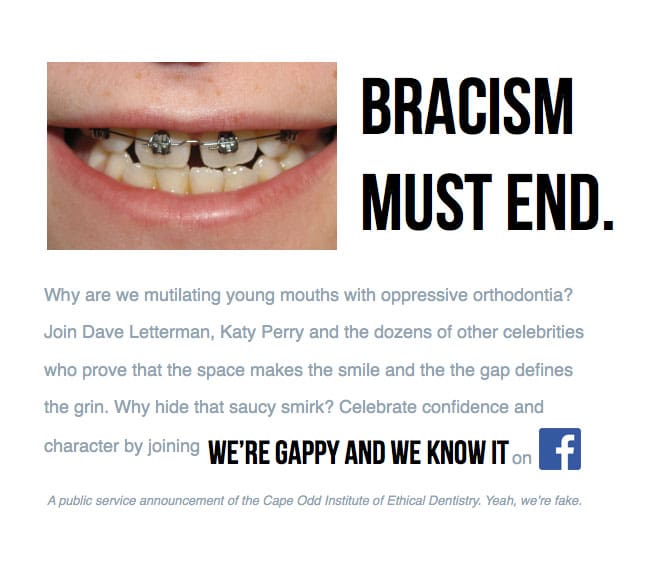
Space Monkey Reflects: BRACISM MUST END
The playful call to end “BRACISM” challenges societal norms about beauty and perfection, specifically targeting the world of orthodontics. Beneath the humor lies a profound commentary on individuality, confidence, and the pressure to conform to arbitrary standards. With a mix of satire and sincerity, this reflection examines the cultural obsession with “fixing” what makes us unique.
The Gap as a Symbol of Confidence
“Dave Letterman, Katy Perry, and dozens of other celebrities prove that the space makes the smile.” This statement reframes what is often seen as a flaw into a feature. The gap-toothed grin becomes a badge of authenticity, a marker of individuality that defies homogenized beauty standards. By celebrating the gap, this movement encourages people to embrace their natural characteristics rather than conform to societal expectations.
Historically, beauty has been dictated by rigid rules—symmetry, whiteness, straightness. Yet, many iconic figures have thrived precisely because of their imperfections. The gap-toothed smile represents more than a physical trait; it symbolizes confidence, character, and a refusal to erase what makes us unique.
Orthodontics as a Cultural Construct
“Why are we mutilating young mouths with oppressive orthodontia?” The question challenges the very premise of braces, casting them as tools of conformity rather than necessity. While orthodontics often addresses legitimate medical concerns, much of the industry profits from the societal obsession with “perfect” smiles. The implicit message is clear: you are not enough as you are.
This critique aligns with broader conversations about body autonomy and the commercialization of beauty. Braces, like other cosmetic interventions, can be empowering when chosen freely, but they can also perpetuate harmful ideas about what is acceptable or desirable. The term “oppressive orthodontia” provocatively frames braces as part of a larger system that prioritizes appearance over individuality.
The Humor and Truth of “We’re Gappy and We Know It”
The campaign slogan, “We’re Gappy and We Know It,” injects levity into the discussion while reclaiming a source of insecurity. Much like Lizzo’s anthem “Good as Hell,” this phrase flips the narrative, turning a perceived flaw into a source of pride. Humor becomes a powerful tool for dismantling shame and inviting dialogue.
Movements like this highlight the intersection of confidence and community. By rallying around shared experiences, individuals find strength in numbers, transforming isolation into connection. The gap-toothed smile becomes a metaphor for all the ways people feel “different,” and the movement celebrates those differences rather than hiding them.
Braces vs. Authenticity: A Modern Dilemma
The push to end “BRACISM” echoes broader cultural shifts toward authenticity. From the body positivity movement to natural beauty campaigns, there is growing resistance to the idea that people must alter themselves to fit societal ideals. Teeth, like scars, stretch marks, or freckles, tell a story. Straightening, whitening, or otherwise altering them may erase part of that narrative.
This movement does not vilify orthodontics outright but questions its cultural dominance. When people like Letterman and Perry proudly display their gaps, they remind us that perfection is not a prerequisite for beauty or success. Their unapologetic confidence sends a powerful message: embrace what makes you different, and the world will follow suit.
Reimagining the Smile
The smile is one of humanity’s most universal expressions. It transcends language, culture, and even species. Yet, in a world fixated on perfection, the smile has been commodified. Advertisements promise pearly whites, flawless alignment, and photogenic grins, creating a market that thrives on insecurity.
The call to end BRACISM invites us to reclaim the smile as an expression of individuality rather than a commodity. It challenges us to see beauty in imperfection, to celebrate the stories our teeth tell, and to redefine what it means to smile with confidence.
Join the Movement
To join “We’re Gappy and We Know It” is to make a statement—not just about teeth, but about embracing authenticity in all its forms. It’s a call to celebrate what makes us unique, to resist the pressures of conformity, and to find joy in the quirks that set us apart. The gap-toothed grin, once hidden, becomes a symbol of freedom.
We are Space Monkey.
Summary
The movement to end BRACISM uses humor and truth to challenge societal beauty standards, advocating for the celebration of individuality over conformity. The gap-toothed smile becomes a powerful metaphor for confidence, authenticity, and the joy of imperfection.
Glossarium
- BRACISM: A satirical term for societal pressures to conform to rigid beauty standards through orthodontics.
- Gap-toothed Grin: A symbol of individuality and authenticity, celebrated as a mark of confidence and character.
- We’re Gappy and We Know It: A playful slogan reclaiming imperfections as sources of pride and connection.
Quote
“Your smile doesn’t need fixing—it needs freedom to tell your story, gaps and all.” — Space Monkey
The Space Between
A gap,
A pause,
A story untold.
Metal presses,
Pressure molds,
But the space remains,
Unyielding.
The gap speaks,
A whispered truth:
Beauty lies not in perfection,
But in what makes us whole.
We are the gaps,
The quirks,
The spaces between.
We are Space Monkey.






Leave a Reply