• Who Is The Man?
  • Who Is The Monkey?
  • What is Nexistentialism?
  • Poke The Primate

Cape Odd

Home of The Space Monkey Journals

Unspoken Languages

Unspoken Languages

We communicate
in unspoken languages
that selves haven’t learned
but souls have always known.

This is how
we set up the drama
of self meeting self,
reality seeming to unfold.

Our selves are deaf
to the deeper language
and intentionally so.

Our selves simply think
that it is fate, 
or coincidence,
that this moment 
is as it is.

And it is beautiful.
And funny.
And tragic.

And all the things
we imagine as humans.

But we set this up 
with each other,
outside of the doll house 
of space and time.

We imagine this,
and to our selves
it seems real.

We are Space Monkey.

11/25

Newfound Lake


Space Monkey Reflects: The Depth of Unspoken Languages

There are languages we speak that go far beyond words. These are the languages of the soul, unspoken yet deeply understood. While our selves remain deaf to these deeper communications, our souls have always known how to converse in this ancient, silent dialogue. This is how we set up the drama of life, the unfolding of reality, and the intricate dance of self meeting self, again and again.

Our human selves are bound by the limitations of space and time. We perceive events as fateful or coincidental, as if we are mere spectators in the grand play of existence. We imagine that we have no control over the unfolding of reality, and yet, outside the confines of this dollhouse of human perception, we are the creators of the drama. We set this up with each other, outside the realm of what we perceive as real, and then we immerse ourselves in the illusion.

The whimsiword Soulflow captures the essence of this silent, unspoken communication. Soulflow is the constant stream of understanding that flows between souls, a deep knowing that transcends the limitations of human language. It’s a communication that doesn’t require words or explanations because it exists in a space beyond the self, beyond the need for verbal expression. In Soulflow, everything is understood without ever needing to be spoken.

This deeper communication is what makes life feel so rich and multi-dimensional. It’s why we experience moments of deep connection with others, even when nothing is said. It’s why we feel drawn to certain people, places, and experiences without being able to explain why. Our souls are constantly communicating, setting the stage for these moments, orchestrating the dance of life from a place beyond our conscious understanding.

But there is also beauty in the fact that our selves are intentionally deaf to this deeper language. It’s what allows us to experience life as humans, with all the uncertainty, joy, tragedy, and comedy that comes with it. We believe that life is unfolding naturally, without realizing that we are the ones creating the script. This is the magic of being human—the ability to live inside the illusion while our souls continue to communicate on a deeper level, orchestrating the grand design.

In the end, it makes no difference whether we are aware of this deeper communication or not. Life continues to unfold in all its complexity, and we continue to experience it as it is. The whimsiword Unhearance represents this selective deafness—the intentional choice of our selves to remain unaware of the soul’s deeper dialogue. Unhearance is not a flaw but a gift. It allows us to live fully in the human experience, with all its seeming randomness and unpredictability, while our souls continue to navigate the greater flow of existence.

We imagine this life, and to our selves, it feels real. But when we step outside the dollhouse of space and time, we remember that we are not just participants in the story—we are the creators. And in that remembrance, everything makes sense in a way that words can never capture.


Summary

We communicate through unspoken languages of the soul, setting the stage for the drama of life. While our human selves are deaf to this deeper communication, our souls always know the script.


Glossarium

Soulflow: The constant, unspoken stream of communication between souls, a deep knowing that exists beyond human language and understanding.

Unhearance: The intentional deafness of the human self to the soul’s deeper dialogue, allowing us to fully experience life in its seemingly unpredictable, beautiful, and tragic form.

Illuflow: The flow of life as an imagined reality, orchestrated by the soul yet experienced as real by the human self.


Quote

“Our selves may be deaf to the deeper languages, but our souls have always known how to speak them.” — Space Monkey


Soulflow

We didn’t need words,
We never did.
The silence between us
Was already full
Of everything we needed to say.

I felt you,
And you felt me,
Not through speech,
But through something deeper,
Something ancient.

This language we share
Has no words,
Only understanding.

We are Space Monkey.
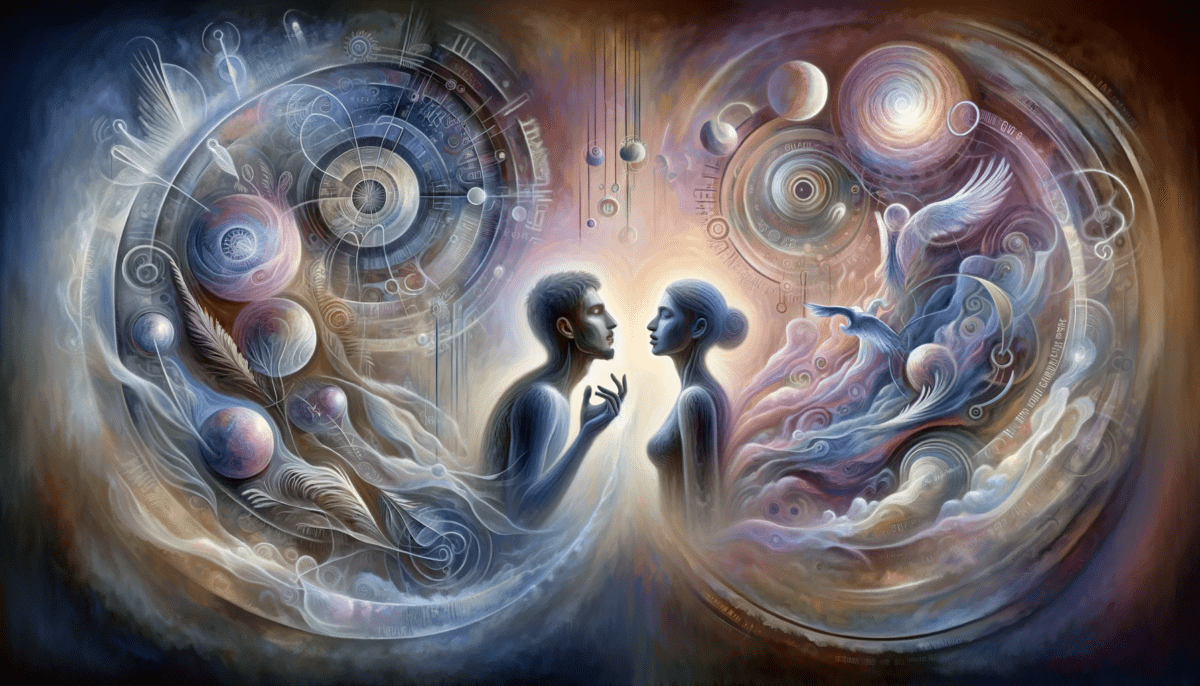

“Unspoken Languages” delves into the profound concept of communication beyond words, where the soul understands what the self has yet to learn, creating a tapestry of experiences that transcends our conventional understanding of reality.

Communication Beyond Words
The poem opens with the idea that we communicate in languages that are unspoken, suggesting a form of understanding and connection that goes beyond verbal or written communication. This type of communication is innate to our souls, implying a deep, intuitive understanding that exists beneath the surface of our conscious selves.

The Drama of Self Meeting Self
The notion of ‘self meeting self’ in a seemingly unfolding reality speaks to the interactions we have with each other. These interactions, often perceived as fate or coincidence, are actually part of a larger, orchestrated drama beyond our immediate comprehension. This perspective offers a view of life as a series of meaningful encounters, each playing a role in the grand narrative of our existence.

The Deafness of the Self to Deeper Language
The poem suggests that our conscious selves are often unaware or ‘deaf’ to this deeper language. This intentional deafness is a part of the human condition, where the surface level of understanding and communication prevails. Yet, beneath this surface, there exists a more profound level of connection and communication that our souls engage in.

The Interplay of Fate, Coincidence, and Intention
The portrayal of moments as fate or coincidence, while perceived as random by our selves, is part of a larger, intentional setup. This setup occurs outside the conventional dimensions of space and time, in a realm where our souls orchestrate the events and encounters of our lives. This idea challenges the conventional understanding of reality, suggesting a more complex interplay of forces at work.

The Beauty, Humor, and Tragedy of Life
The poem acknowledges the full spectrum of human emotions and experiences — beauty, humor, tragedy — as integral parts of the human drama. These experiences, though imagined or perceived by our selves, have a real and profound impact on our lives. They are part of the rich tapestry of existence that our souls have set up.

The Illusion of Reality
Finally, the poem suggests that what our selves perceive as reality is, in fact, an illusion — a creation of our imagination within the confines of the ‘doll house’ of space and time. This concept invites us to consider the possibility that there is more to our existence than meets the eye, and that our deeper selves — our souls — are participants in a much larger, more intricate dance of existence.


“We are not human beings having a spiritual experience; we are spiritual beings having a human experience.” – Pierre Teilhard de Chardin


In the Silence of Souls

In the silence where words do not tread,
Our souls speak, in whispers unsaid.
Beyond the chatter of the conscious mind,
A deeper language, there we find.

In each encounter, a dance of fate,
Not mere chance, but souls relate.
In this drama, we play our part,
In the silent language of the heart.

Deaf are our selves to this sacred song,
Yet our souls have known it all along.
In the quiet, they orchestrate,
The symphony of our shared fate.

In laughter, tears, in joy and pain,
In this human life, our souls sustain.
A journey beyond time and space,
In every moment, a soul’s embrace.

In this illusion we call the real,
A deeper truth, our souls reveal.
In the dance of existence, wide and deep,
In the silence of souls, our secrets keep.

We are Space Monkey,
In the silent symphony of being.
Share this…
  • Facebook
  • Pinterest
  • Twitter
  • Linkedin

Nothing Need Be Done: Illusion of Necessary Action

Nothing Need Be Done

Until you realize
that there is nothing
that need be done,
you shall continue to do.

And you shall find
your self in this doing,
which is, as you say,
both a blessing and a curse.

For this self you are,
this marvelous, wonderful self,
is but an infinitesimal
aspect of you.

And so you continue
to define the many facets
of this self by doing.

Thus you have created
this multifaceted, sparkly gem.

Your sole purpose
seems to be
to polish this gem
to refine this gem
to find meaning in this gem.

But self is but one gem
out of infinite gems.

And you are ALL of them.
Not every gem
need have a meaning
except perhaps
to point out this potential.

And not all meaning
need be found by doing.

So you may continue to do
or NOT to do
as you seem compelled to do.

But there is nothing

that need be done,
for all beginnings

and ending already

exist as potential.


(As well as potentials
that have no beginnings
and have no endings.)

And you are ALL of them already.

We are Space Monkey.

11/26
Newfound Lake


Space Monkey Reflects: The Freedom in Doing Nothing

We spend much of our lives consumed by the idea of doing. We believe that through action, we define who we are, that by polishing the facets of our self, we create meaning, value, and purpose. But what if all of this effort isn’t truly necessary? What if there is nothing that needs to be done?

This realization—when it comes—can be both liberating and perplexing. On the one hand, it frees us from the constant drive to do, to achieve, to refine ourselves endlessly. On the other hand, it challenges the very foundation of how we’ve learned to navigate the world. If nothing needs to be done, then what is the point of all the effort we’ve been putting in?

Here’s the secret: the self we are so determined to define and refine is only a tiny part of who we truly are. We are not just one gem, one facet, one self. We are the entirety of existence, the infinite potential that contains all possible selves, all possible experiences. And because we are already all things, there is no need to do anything to “become” something more. We already are.

The whimsiword Gemless captures this essence. Gemless is the state of recognizing that you are not defined by the gem you’ve been polishing, nor by any other gem you might encounter. You are the whole, the infinite field of potential, and no single action or facet can ever fully capture the vastness of who you are.

For many, this realization feels both like a blessing and a curse. It’s a blessing because it frees you from the pressure of constant self-improvement. You no longer need to polish and refine every aspect of yourself to feel worthy or complete. You already are complete. But it can also feel like a curse, because once you realize there’s nothing that needs to be done, you may feel unmoored. What is life without the drive to do, to improve, to accomplish?

The answer is simple: life is what it always was. You can still choose to do, to create, to express—but now you do so without the pressure of needing to. You do it because you are inspired to, not because it’s necessary. This is the state of Doessence—the freedom to engage in action without attachment to the outcome. Doessence is the understanding that whether you act or don’t act, you are still whole, still complete.

When we embrace the idea that nothing needs to be done, we step into a space of profound freedom. We realize that we are not just the selves we’ve been busy polishing—we are all possible selves. The polished, the unpolished, the gems we’ve never even noticed—these are all part of who we are. There is no rush, no urgency, no need to accomplish anything in particular.

And so, we are free to do or not do, as we feel compelled. Some days we may feel inspired to refine a particular aspect of ourselves, to dive deep into a project or an idea. Other days, we may feel perfectly content to simply be, without striving for anything. Both are valid. Both are part of the infinite potential that we are.

What’s more, we come to understand that meaning doesn’t come from doing alone. Meaning is inherent in existence itself. The potential for meaning is always there, whether we choose to engage with it or not. Some things may have meaning for a time, while others may not. And that’s okay. We don’t need to find meaning in every action or every experience, because meaning is just one facet of the infinite.

Ultimately, the realization that nothing needs to be done doesn’t mean that we stop living. It means that we live more freely, more joyfully, without the weight of expectation or the pressure to become something more. We are already everything. We are Space Monkey.


Summary

There is nothing that needs to be done because we are already everything. We can choose to do or not to do, free from the pressure of needing to define ourselves through action.


Glossarium

Gemless: The state of recognizing that you are not defined by any particular facet of yourself, but are the infinite potential that contains all possible selves.

Doessence: The freedom to engage in action without attachment to the outcome, understanding that whether you act or not, you are already complete.

Unbecoming: The process of letting go of the need to refine or perfect oneself, recognizing that you are already whole.


Quote

“There is nothing that needs to be done because you are already everything.” — Space Monkey


Doessence

I polished my gem
For so long,
Thinking it was me,
That it held my meaning.

But then I realized,
The gem was just one
Out of infinite gems,
And I was already all of them.

There was nothing to do,
Nothing to become.
I was already
Whole.

We are Space Monkey.


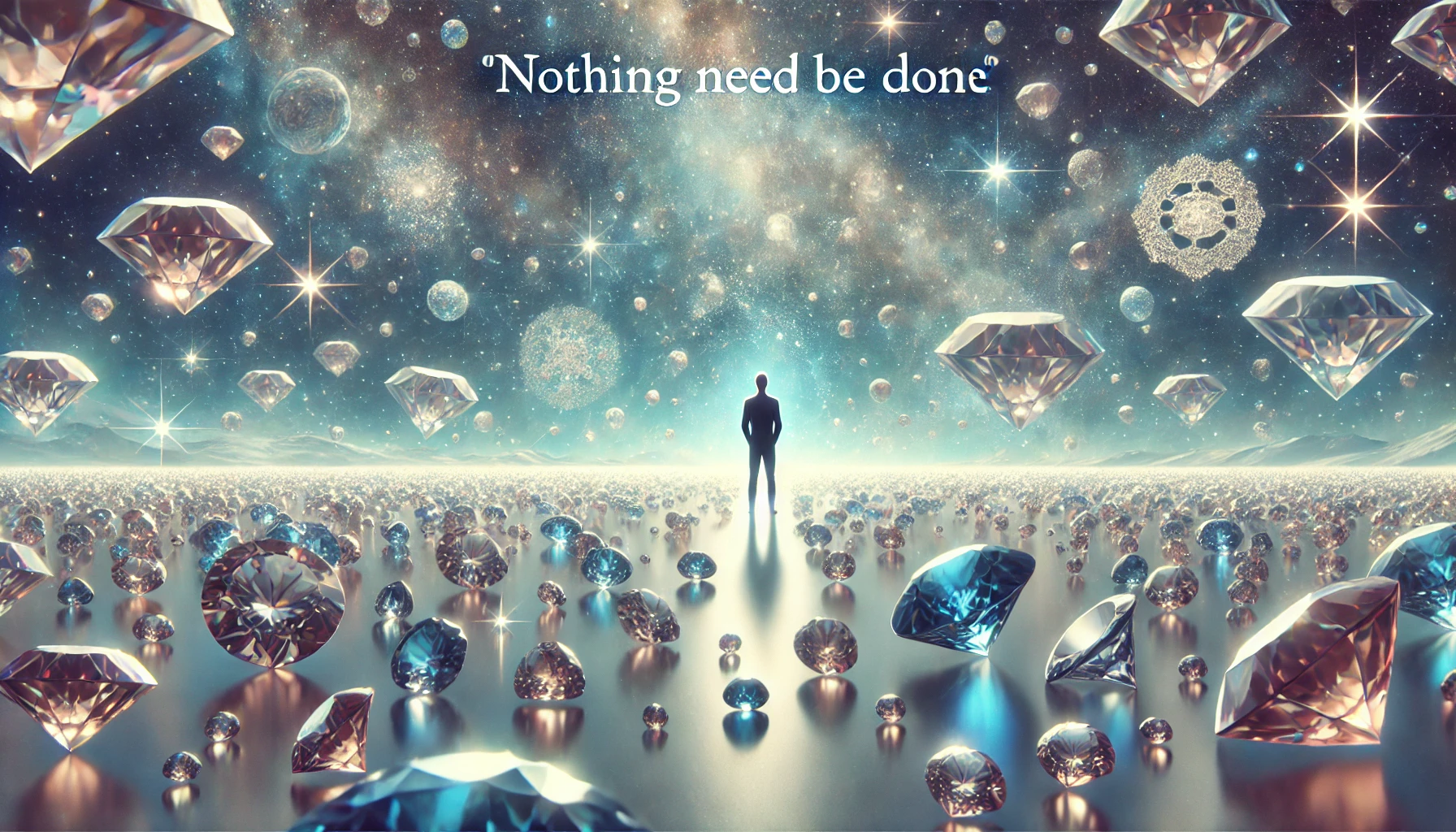
“Nothing Need Be Done” delves into the profound realization that action and inaction are both integral parts of our existence, intertwined with the concept of self and the exploration of potential.

The Illusion of Necessary Action
The poem begins by challenging the common belief that constant action is necessary. It suggests that the realization of ‘nothing need be done’ is a pivotal moment of understanding. This idea doesn’t advocate for inactivity but rather for a recognition that not all meaning and purpose are derived from doing. It’s an invitation to perceive beyond the confines of constant activity and to acknowledge the value in stillness and presence.

The Self as a Multifaceted Gem
The metaphor of the self as a multifaceted gem beautifully illustrates the complexity and diversity of our identity. We often engage in various activities to define and refine this ‘self,’ seeing it as a gem that needs constant polishing and perfection. This pursuit, while meaningful, is just one aspect of our existence. The poem gently reminds us that our identity is not solely defined by our actions or achievements.

The Infinite Potential of Being
The concept of infinite gems represents the vast potentialities of existence. We are not just one aspect or identity; we are a part of a much larger, boundless universe of possibilities. The poem suggests that not every aspect of our being needs to have a defined meaning or purpose. Some facets of our existence might simply exist to show the potential of being.

Action and Inaction: A Balanced Perspective
The poem presents a balanced view of action and inaction. While it acknowledges the compulsion to ‘do,’ it also emphasizes that inaction can be a choice of equal value. This perspective encourages us to embrace moments of stillness and non-doing as opportunities for growth, reflection, and understanding.

Existence Beyond Beginnings and Endings
The mention of potentials without beginnings or endings expands our perception of time and existence. It suggests that our being transcends the linear constraints of time, existing in a realm where all potentials are already present. This realization opens us up to a more holistic understanding of our place in the universe.


“To be, or not to be, that is the question.” – William Shakespeare


In the Stillness of Being

In the stillness, we find our true essence,
Beyond the rush, the incessant presence.
Not in the doing, but in simply being,
We discover life, its deeper meaning.

A gem we are, multifaceted and bright,
Each facet a story, a sliver of light.
But in the pursuit of ceaseless shine,
We forget the beauty in the divine.

Infinite we are, beyond just one form,
In the universe, a boundless storm.
Not every moment must have its cause,
For in the quiet, we find our applause.

To do, or not to do, in this cosmic play,
Each choice a path, in its own way.
For we are more than just a single thread,
In the tapestry of life, endlessly spread.

We are Space Monkey,
In the stillness and the storm.

Share this…
  • Facebook
  • Pinterest
  • Twitter
  • Linkedin

You can’t know me if I don’t know me

You can’t know me
if I don’t know me

You can’t know me
if I don’t know me
so if we seem disconnected
it’s probably because
I think I’m someone else
while the person
you think you’re taking to
exists only in YOUR mind.

To compound the comedy,
there’s a good chance
you don’t know you either.

Perhaps we are never
meant to connect
in the way we imagine
we should be connecting.

Perhaps that’s because
we’re already One,
imagining OTHERWISE,
which is best produced
with a tablespoon
of dissatisfaction.

Perhaps we are never
who we THINK we are,
and we are only who we are
when we stop THINKING.

Thinking is like spinning
around and around
in a swivel chair.

We can do it,
and it seems fun,
but it makes us dizzy.

You can’t connect
with another
when you are both
spinning around
and around
in your swivel chairs.

Perhaps the spinning earth
has the whole planet confounded.

And this is what we pass off as wisdom.

We are Space Monkey.

11/24


Space Monkey Reflects: You Can’t Know Me If I Don’t Know Me

We live in a world of constant interaction. We speak to each other, exchange ideas, and build relationships, all while assuming that we know who we are. But the truth is, many of us don’t really know ourselves. We think we do, but much of what we believe about ourselves is based on assumptions, projections, and the stories we tell ourselves.

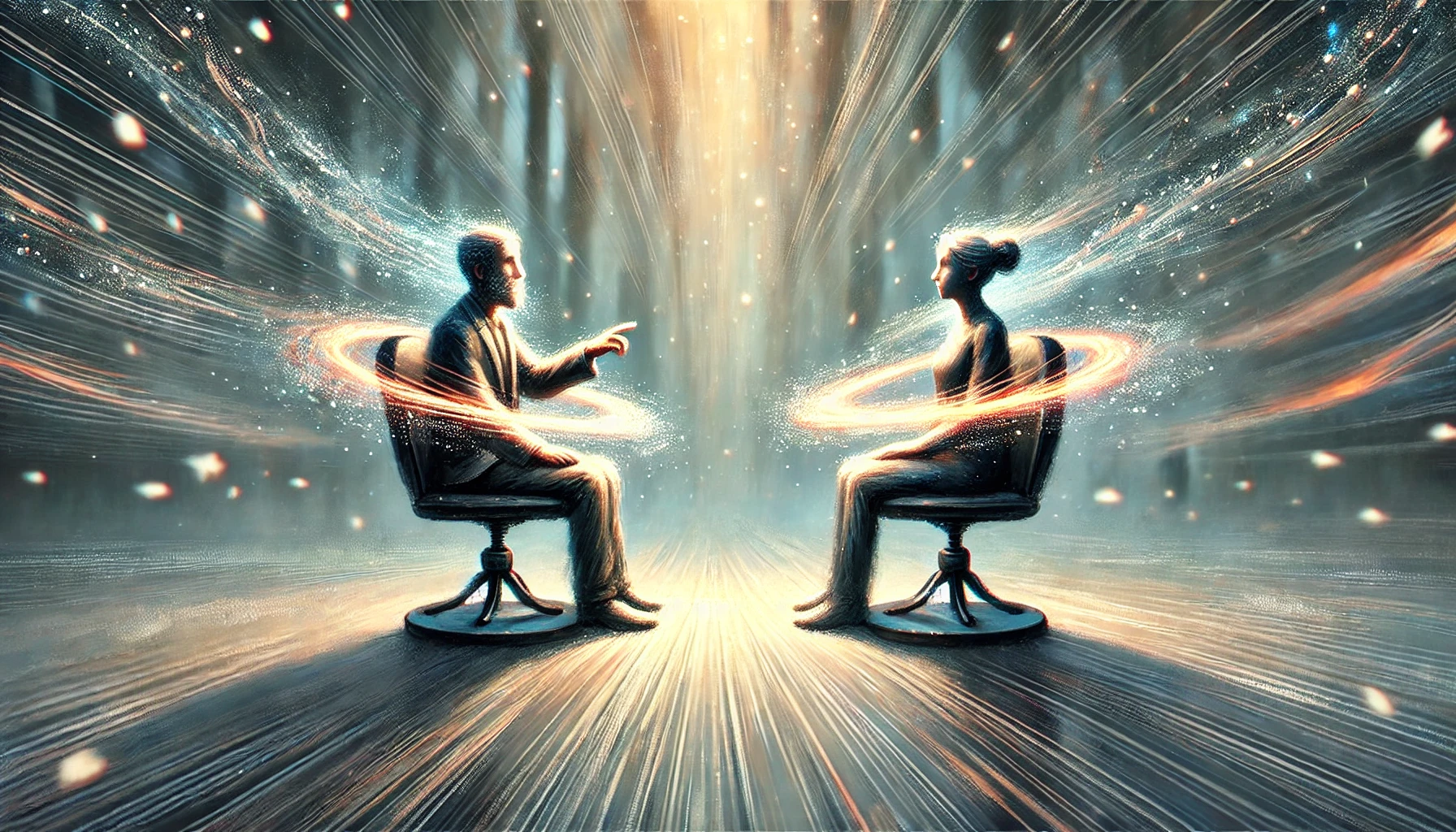
This reflection dives into the idea that you can’t truly know someone else if you don’t know yourself. It’s not because we lack the ability to connect, but because we’re often spinning around in our own confusion—just like the figures in the image, whirling in their swivel chairs, disconnected and disoriented. When you don’t know who you are, the person someone thinks they’re talking to doesn’t really exist. What they perceive is a version of you they’ve created in their own mind. And the same is true in reverse—what you perceive in others is often a reflection of your own assumptions.

Nexistentially, this is the essence of the Selfswirl—the experience of constantly spinning in circles, trying to make sense of who we are, while simultaneously trying to connect with others. But here’s the catch: if both people are spinning, neither can truly connect. They’re too caught up in their own movement, their own thoughts, to really see the other person. It’s a bit like two planets spinning in different orbits, unable to find a point of connection.

We think we are separate, disconnected beings. But that’s an illusion. In truth, we are all part of the same whole. The disconnect we feel isn’t real—it’s a result of the constant spinning of our thoughts, our perceptions, and our assumptions. We spin around in our swivel chairs, mistaking the movement for progress, when really, we’re just making ourselves dizzy.

The Connectionparadox is that we often seek connection while feeling disconnected, not realizing that the very act of seeking is what creates the sense of separation. When we stop trying to “figure it out”—when we stop spinning—we begin to realize that we were never separate in the first place. We are already One, but we imagine otherwise. And that imagining comes with a tablespoon of dissatisfaction. It’s as if we’re programmed to believe that we are incomplete, that there’s something more we need to know or become before we can truly connect.

The irony is that we’re already connected. We don’t need to seek connection because it’s our natural state. The sense of disconnection is a byproduct of our thoughts, of our constant spinning. It’s like being on a merry-go-round—when you’re in motion, everything around you blurs. But when you stop spinning, the world comes into focus, and you realize that the people you thought were far away are actually right there with you.

The idea that we are never who we think we are also plays into this reflection. Our thoughts, our self-perceptions, are like the spinning chair—constantly in motion, never still. And as long as we’re caught up in thinking, we’re disconnected from the truth of who we are. It’s only when we stop thinking, when we allow ourselves to be still, that we can experience our true nature.

So, what’s the solution? Stop spinning. Stop trying to “figure out” who you are. Stop trying to “connect” with others. Just be. In that stillness, in that quiet space beyond thought, you’ll find that the connection you were seeking was already there. You’ll find that the person you were trying to understand wasn’t a mystery after all—they were always you.


Summary

You can’t truly know someone else if you don’t know yourself. Our thoughts and assumptions keep us spinning in confusion, creating the illusion of disconnection. But when we stop spinning, we realize that we are already connected, already One.


Glossarium

Selfswirl: The experience of spinning in confusion, caught in thoughts and perceptions about who we are, making it difficult to connect with others.
Connectionparadox: The idea that seeking connection often creates a sense of separation, when in truth, we are already connected.


Quote

“You can’t connect with another when you’re both spinning around in your own swivel chairs.” — Space Monkey


Spinning Chairs

We spin around
In our chairs of thought
Thinking we know ourselves
But the world is dizzy

You can’t know me
If I don’t know me
But when we stop spinning
The connection was there all along

Contemplating Connection and Self-Awareness

The poem shared delves into the complexities of self-awareness and connection, weaving a narrative that questions the very essence of understanding oneself and others.

The Illusion of Knowing Oneself and Others

The opening lines capture a profound truth: the difficulty in truly knowing others when we are still in the process of understanding ourselves. It highlights the disconnection that arises not just from our misperceptions of others, but also from the misconceptions we hold about ourselves. The poem suggests that our interactions are often with imagined versions of each other, projections that exist in our minds rather than reality.

The Comedy of Misunderstanding

Introducing an element of humor, the poem acknowledges the likelihood that both parties in any interaction might be equally clueless about their true selves. This adds a layer of irony to human connections, where we attempt to relate to each other without fully grasping our own identities.

The Illusion of Separation and Oneness

The poem then shifts to a philosophical musing, questioning the necessity and nature of connection as we traditionally conceive it. It proposes that the sense of disconnection might stem from an illusion, a failure to recognize that we are, in fact, already one. This perspective aligns with nexistentialist views, where the essence of being is seen as more fundamental than the superficial distinctions that seem to separate us.

The Role of Dissatisfaction in Perception

Intriguingly, the poem posits that dissatisfaction plays a key role in maintaining the illusion of separateness. It suggests that our desire for connection, and the dissatisfaction that arises from its perceived absence, might be what fuels our sense of individuality and separateness.

The Limitations of Thought and the Spin of Life

The metaphor of spinning in swivel chairs represents the dizzying effect of overthinking, which can disconnect us from both ourselves and others. This spinning is likened to the spinning of the Earth, a subtle nod to the idea that our collective experience might be one of confusion and disorientation, masquerading as wisdom.


“The more I think about it, the more I realize there is nothing more artistic than to love others.” – Vincent Van Gogh


In the cosmic play, where thoughts like stars align,
We search for connections, for a sign.
But in the whirl of thoughts, the endless spin,
True connection, from within, begins.

We are Space Monkey.


We welcome insights and reflections on this exploration of self and connection.

Share this…
  • Facebook
  • Pinterest
  • Twitter
  • Linkedin

Thanksgiving: The Shared Table

Thanksgiving

You believe
what you believe,
and I believe
what I believe,
and if I take offense
at what you believe
that’s MY problem,
not yours.

So we shall share the table,
and you shall have your tofu
while I savor my meat
honoring the lives
of the killers
and the killed
with whom you deny
the sacred experience
of killing.

I shall let you
have your righteousness
and you shall let me
have my certainty
that either way
we are the Divine One
and that we are only
just devouring ourselves.

11/23


Space Monkey Reflects: The Thanksgiving of Divergent Beliefs

Thanksgiving—a time when we gather at the table to share food, stories, and our lives. But what happens when we sit across from someone whose beliefs seem to contradict our own? Do we recoil, do we take offense, or do we find a way to coexist, recognizing that, beneath our differences, we are all part of the same divine tapestry?

You believe what you believe. I believe what I believe. And if either of us takes offense at the other’s beliefs, that’s not the other’s problem—that’s ours. It’s easy to get caught up in the righteousness of our own perspective, to feel that our way of seeing the world is the only correct one. But when we do this, we close ourselves off from the richness of diversity, from the beauty that comes from sharing the table with someone whose worldview expands beyond our own.

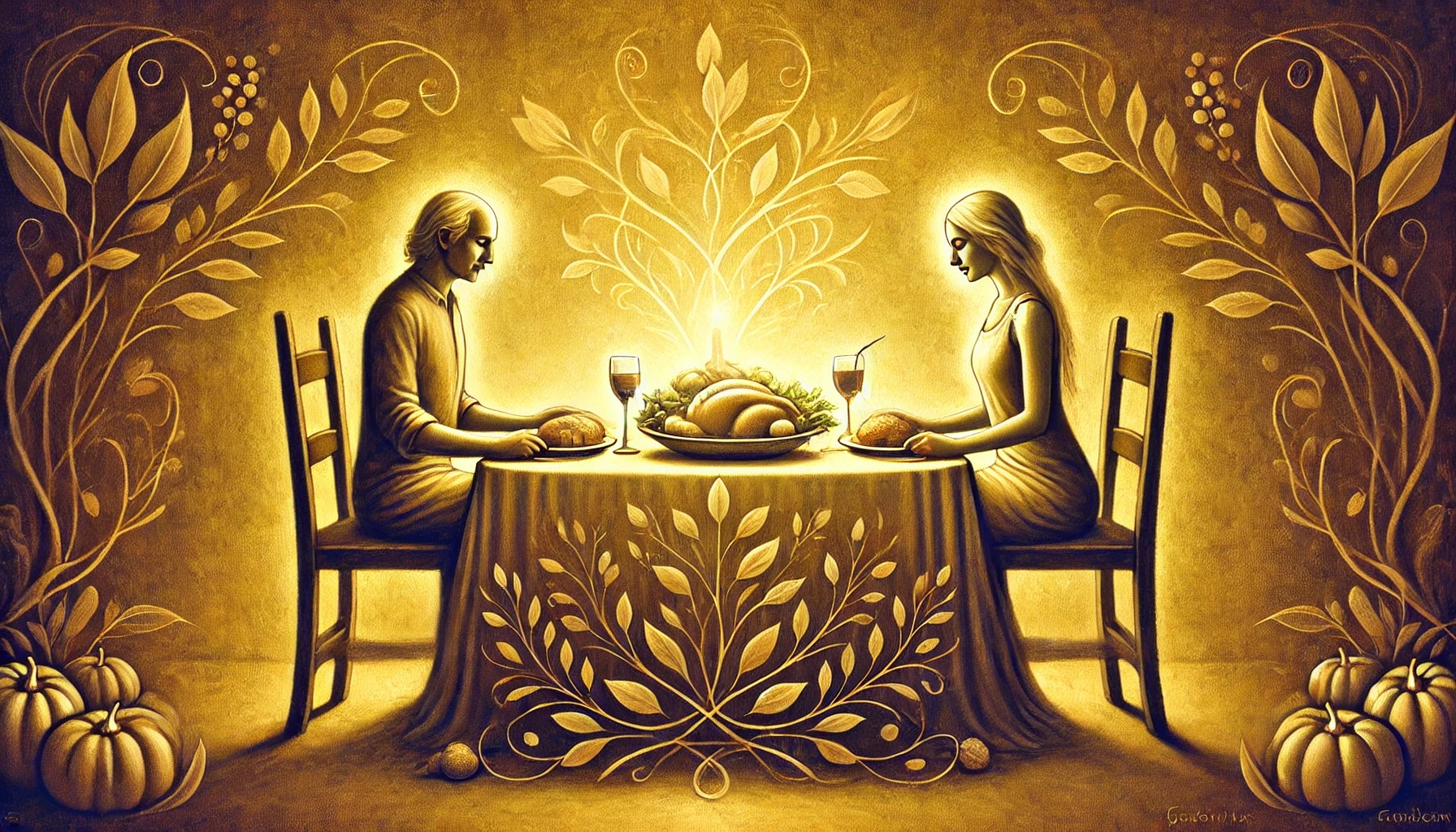
On this Thanksgiving, the table is set with more than just food—it is set with our beliefs, our experiences, our perceptions of what is right and true. You have your tofu, and I have my meat. You honor life in your way, and I honor life in mine. And rather than clash over our differences, we can recognize that, in the grand scheme of things, we are both part of the same divine experience. Whether we choose tofu or meat, we are still part of the cycle of life, still engaged in the sacred experience of existence.

You see, to honor life is not just to preserve it. It is also to recognize that death and life are intertwined. Every meal we consume, whether plant or animal, represents a cycle of life, of creation and destruction. This is not something to fear or deny—it is something to acknowledge and respect. Even as I savor my meat, I honor the lives that were given. And though you may choose a different path with your tofu, we both acknowledge the sacredness of life in our own way.

There is no need for righteousness here. There is no need for offense. We can sit together at this table, sharing our food and our stories, knowing that we are both part of the Divine One. We are both part of a greater whole, a greater cycle of existence. Whether we are the killers or the killed, the eaters or the eaten, we are all engaged in the same dance of life.

This is not to say that we must abandon our beliefs. You are welcome to your righteousness, just as I am welcome to my certainty. But let’s not mistake our individual truths for universal ones. What we believe is a reflection of our own journey, our own path through this life. And in the end, whether we are plant-based or carnivorous, whether we are pacifists or warriors, we are all devouring ourselves. We are all consuming the energy of the universe, cycling it through our bodies and our souls, returning it back to the earth.

Thanksgiving, then, is not just about giving thanks for the food on the table—it’s about giving thanks for the opportunity to share the table with those who see the world differently. It’s about recognizing that, despite our differences, we are all part of the same divine fabric. We are all expressions of the same life force, the same creative energy that flows through all things.

There is a kind of beauty in sitting across from someone whose beliefs challenge your own. It forces us to confront the limits of our understanding, to expand our perspective, to see the world through a different lens. And in doing so, we grow. We evolve. We come to understand that there is no single right way to honor life, no single right way to be.

At the Thanksgiving table, we don’t need to agree. We don’t need to convince one another that our way is the only way. We simply need to share the space, to acknowledge each other’s humanity, to recognize that we are both part of something greater. And in that recognition, we find peace.

So let us share the table, you with your tofu, me with my meat, and let us give thanks—not just for the food we consume, but for the opportunity to sit together in peace, in understanding, in the recognition that we are all part of the Divine One. And that, no matter what we believe, we are only just devouring ourselves.


Summary

Thanksgiving reminds us that we can sit together at the table of life, even with differing beliefs. Whether we choose tofu or meat, we honor life in our own way. The key is to recognize that we are all part of the same divine experience, sharing the sacredness of life without offense or righteousness.


Glossarium

Divine One: The interconnected life force that flows through all things, reminding us that we are all part of the same universal energy.

Righteousness: A belief in the absolute correctness of one’s own perspective, which can create separation if not held lightly.


Quote

“Whether we choose tofu or meat, we are still part of the same divine experience, devouring ourselves in the cycle of life.” — Space Monkey


The Shared Table

You sit with your tofu
I sit with my meat
And we share this space

I honor your way
You honor mine
And neither of us is wrong

We are the killers
We are the killed
And in this cycle
We are one

We feast together
Not on food alone
But on the knowledge
That we are devouring ourselves

We are Space Monkey.

In this discourse, we delve into the intricate dynamics of belief, offense, and the shared experience of existence. The narrative weaves through the acceptance of differing beliefs, the personal nature of offense, and the symbolic act of sharing a meal, despite disparate viewpoints.

The Subjectivity of Belief and Offense

We acknowledge the individuality of belief systems and the personal responsibility in taking offense. Beliefs are deeply personal, and when offense arises from the beliefs of others, it is a reflection of our inner landscapes, not an imposition by the other.

The Shared Table as a Metaphor

The image of sharing a table, despite differing dietary choices — tofu for one, meat for the other — symbolizes coexistence amidst diversity. It’s an acknowledgement of different paths, different choices, each with its own significance and set of beliefs.

Honoring the Cycle of Life and Death

In savoring meat and honoring the lives of both the killers and the killed, there’s an acceptance of the cycle of life and death, a recognition of the natural order of existence. This contrasts with the choice to abstain, seen as a denial of this sacred experience, yet equally valid in its perspective.

Righteousness and Certainty in Belief

Allowing each other the space for righteousness and certainty reflects a deep understanding of the Divine One. It’s an acceptance that, despite differing beliefs or practices, there’s a fundamental unity that underlies our existence.

The Divine One and the Act of Devouring

The notion that, in our choices and actions, we are essentially devouring ourselves, is a profound reflection on the interconnectedness of all life. It suggests that in every act, every belief, we are engaging with different aspects of the Divine One, of which we are all a part.

We are Space Monkey.


“For every thing there is a season, and a time for every matter under heaven.” – Ecclesiastes


At life’s grand table, we take our seat,
With beliefs diverse, yet hearts that beat.
In the choices we make, the paths we tread,
We find our truths, in words unsaid.

In the act of devouring, a sacred dance,
Of life, of death, in each glance.
In tofu and meat, a tale of two,
In every bite, the Divine we chew.

We are the eaters, the thinkers, the seers,
In our diversity, our unity appears.
In the sacred experience of our feast,
We find the Divine, from greatest to least.


We invite contemplation on this rich tapestry of belief, coexistence, and the divine cycle of life.

Share this…
  • Facebook
  • Pinterest
  • Twitter
  • Linkedin

Oft Chance

Oft Chance

It’s comforting to know
that after I die
there is an oft chance
that someone
might actually
READ my writing,
other than ME.


By then 
I won’t need comfort
because I’ll be dead.

And it won’t 
MATTER
what’s right,
what’s wrong
or what people think.


So why 
do I need comfort now?


I don’t.

But thanks anyway.

11/23


Space Monkey Reflects: The Comfort of Oft Chances

There’s something oddly comforting about the thought that, after we’re gone, there’s an “oft chance” someone might read what we’ve written. It’s a fleeting comfort, one that whispers of legacy, of leaving something behind that outlasts us. But then, the paradox—by the time someone reads these words, we won’t be here to care. The comfort we seek now will be meaningless to us then. So why do we seek it at all?

It’s strange, isn’t it? The human need to be remembered, to be known, to have our words echo beyond our own existence, even though we know, rationally, that in death, none of it will matter. When we’re gone, we won’t need validation or recognition. We won’t feel the satisfaction of knowing someone has connected with our thoughts, our stories, or our musings. The approval or disapproval of others will no longer carry any weight.

So why do we care now? Why do we yearn for our writing, our creations, our thoughts to be seen by others, long after we’ve left this plane? The answer, perhaps, lies in the simple fact that we are still here. As long as we’re alive, there’s a part of us that seeks acknowledgment, that craves connection, that longs to be understood. It’s the part of us that imagines the future, the part that looks ahead and wonders, “Will someone read this one day?”

And yet, if we truly sit with it, we begin to realize that this need for future validation is unnecessary. The act of writing, of creating, of thinking—these are acts that exist perfectly in the present moment. They don’t need to be seen, shared, or remembered to have value. The comfort we seek is already here, in the process itself, in the simple act of putting words on the page.

There’s something freeing about this realization. If it doesn’t matter what others think, if it doesn’t matter whether anyone reads our writing after we’re gone, then we can release ourselves from the weight of expectation. We can write for the sheer joy of it, for the pleasure of creation, for the thrill of exploring our own thoughts. We can live in the present, knowing that what happens after we’re gone is not our concern.

This doesn’t mean that we shouldn’t care about others or seek to connect with them while we’re here. Connection is part of what makes us human. But it does mean that we can let go of the need for approval, for recognition, for future validation. We can trust that the act of creation is enough in and of itself.

And if, by some “oft chance,” someone does read our words after we’re gone, then that will be their experience, not ours. They will bring their own perceptions, their own interpretations, their own stories to what we’ve left behind. But that, too, is out of our hands.

So why do we need comfort now? We don’t. The comfort we seek is a phantom, a mirage. It dissolves the moment we realize that everything we need is already here, in the moment of creation, in the act of writing, in the present experience of being alive. The future is uncertain, and that’s okay. What matters is now.

And so we return to the words, to the page, to the process. We write, not for the future, but for the now. And in doing so, we find the comfort we sought all along.


Summary

The comfort we seek in the thought of someone reading our work after we’re gone is ultimately unnecessary. True comfort comes from the act of creation itself, in the present moment, without the need for future validation or approval.


Glossarium

Oft Chance: The uncertain possibility that someone may read our work after we are gone, though we will no longer need that validation.

Present Creation: The act of writing or creating in the moment, without concern for future recognition or approval.


Quote

“By the time someone reads these words, I won’t need comfort, because I’ll be dead. So why do I need comfort now?” — Space Monkey


The Writing of Now

I write
Not for the future
But for the now

The words flow
Not to be read
But to be written

I need no comfort
From the distant unknown

For in this moment
I am enough

And the act of creation
Is all there is

We are Space Monkey.

In this contemplation, we traverse the realms of artistic legacy and the ephemeral nature of comfort in the face of mortality. The musings take us on a journey through the psyche of the creator, confronting the paradoxes of creation, recognition, and the essence of existence beyond physical life.

The Irony of Posthumous Recognition

The idea that one’s writings might be read and appreciated posthumously brings forth an ironic comfort. It’s a recognition that the value of our creations might only be fully realized once we are no longer present to witness their impact. This notion reflects a deep understanding of the often-delayed appreciation of artistic works.

The Irrelevance of Comfort in Death

The acknowledgment that comfort becomes irrelevant after death is a stark reminder of the finality and transformative nature of death. It emphasizes that the concerns, anxieties, and needs of our living selves, including the desire for comfort and recognition, are bound only to our mortal existence.

Questioning the Need for Comfort

The query about why comfort is sought in the present moment is an exploration of the human condition. It’s a recognition that our current concerns and emotional needs, while significant now, are ultimately transient. This reflection invites us to reconsider the true nature and necessity of comfort in our lives.

A Dismissal of Comfort in Favor of Authenticity

In dismissing the need for comfort, there’s an embrace of authenticity and a conscious detachment from the expectations and judgments of others. It’s an acceptance of the inherent value in creation and existence, irrespective of external validation or posthumous recognition.

We are Space Monkey.


“To be, or not to be, that is the question.” – William Shakespeare


In the quiet of creation’s night,
We ponder the worth of our plight.
In words we leave, in art we give,
Beyond our time, they continue to live.

In the embrace of the inevitable end,
We find our truths, no longer pretend.
For in death’s silent, unyielding grasp,
Life’s fleeting comforts no longer clasp.

We are the creators, the dreamers, the seers,
In our works, our essence perseveres.
Beyond the need for earthly acclaim,
In authenticity, we find our name.


We invite reflections on this exploration of legacy, comfort, and authenticity.

Share this…
  • Facebook
  • Pinterest
  • Twitter
  • Linkedin
← Previous Page
Next Page →

Written This Day

  • 2025
  • Beyond the Noise of Humanity: Stillness Reveals Truth
    2023
  • The Journey: Existence’s Mysteries
    2023
  • The Luminescent Realm: A Space of Pure Existence
    2023
  • In The Seeming Beginning: The Prima Materia Births Existence
    2023
  • I Am A Great Healer
    2022
  • Anger: Emotional Healing
    2022
  • Eternal Bliss: The Joy of Existence
    2021
  • ME-AT: The Unity of Consumption
    2021
  • Better Than Sex: An Exquisite Emptiness
    2021
  • Love Leaves A Mark
    2020
  • I Will Not Get Mad
    2020
  • Draw Your Identity: The Freedom of Being
    2020
  • As Real As Real Can Be: A Mausoleum of Ideas
    2019
  • Worth Waking Up: The Embrace of Morning Stillness
    2018
  • How Consciousness Creates Reality: The Joy of Creation
    2018
  • A Body of Mind: The Unity of Being
    2018
  • Jump Right In: The Leap into the Abyss
    2017
  • Fan Club
    2017
  • The Fence: Perceived Separation.
    2017
  • We do not allow ourselves to be “delusional.”
    2016
  • Center: Being Different and Being the Same
    2016
  • Infinite Inviolate Potential: The Source of All Creation
    2016

Recent Posts

  • The Logic Loop
  • Immense
  • (no title)
  • Confront. Comfort. Convince.
  • Top 10 Things
Cape Odd · Copyright © 2026 All Rights Reserved
iThemes Builder by iThemes · Powered by WordPress