• Who Is The Man?
  • Who Is The Monkey?
  • What is Nexistentialism?
  • Poke The Primate

Cape Odd

Home of The Space Monkey Journals

Che Monkey: Rebel With a Cosmic Cause

Che Monkey: Rebel With a Cosmic Cause

Che Monkey. The name itself stirs something within—a playful yet rebellious spirit, blending the serious weight of revolution with the lightness of cosmic whimsy. Just as Che Guevara stood as an icon of resistance, Che Monkey embodies a more fluid, more playful approach to upheaval. It’s not about overthrowing systems or changing governments—at least, not in the conventional sense. Instead, it’s about revolutionizing the way we perceive the world, the way we navigate our inner landscapes.

Che Monkey isn’t here to fight a war or topple a regime. Che Monkey is here to remind you that the greatest revolution happens within. It’s a call to turn the tables on your own mind, to challenge the assumptions, patterns, and beliefs that have kept you locked in place. It’s about freeing yourself from the invisible cages we all build—the cages of ego, expectation, fear, and doubt.

In many ways, Che Monkey is the ultimate disruptor. Not because he seeks destruction, but because he thrives in chaos, in the unknown, in the playful disassembling of what you think is real. You see, the revolution isn’t about winning or losing. It’s about recognizing that the game itself can be changed at any moment. And that’s where the fun begins.

In the Whimsiweave of existence, Che Monkey dances on the edge of revolution and play. He takes the seriousness of revolution and turns it on its head, reminding us that life doesn’t have to be a struggle, that the act of breaking free can be as lighthearted as it is profound. The real battle isn’t fought with weapons or slogans—it’s fought with curiosity, creativity, and a refusal to be pinned down by rigid identities or roles.

And that’s the beauty of Che Monkey. He’s not asking you to be someone else, to adopt a new ideology or philosophy. He’s simply inviting you to see the revolution that’s already happening within you—the one that’s been unfolding since the day you were born. The revolution of becoming more of yourself, of shedding the layers of conditioning that have hidden your true essence. In this sense, Che Monkey is both a liberator and a trickster, freeing you from the need to take life so seriously, while also urging you to dive deeper into the mystery of your own being.

Revolution, in the cosmic sense, is not about destruction. It’s about transformation. It’s about turning the world upside down, not so you can rebuild it in your image, but so you can see it from a different perspective. And once you see it differently, everything changes. You realize that the boundaries you thought were fixed are actually fluid, that the limitations you placed on yourself were never real.

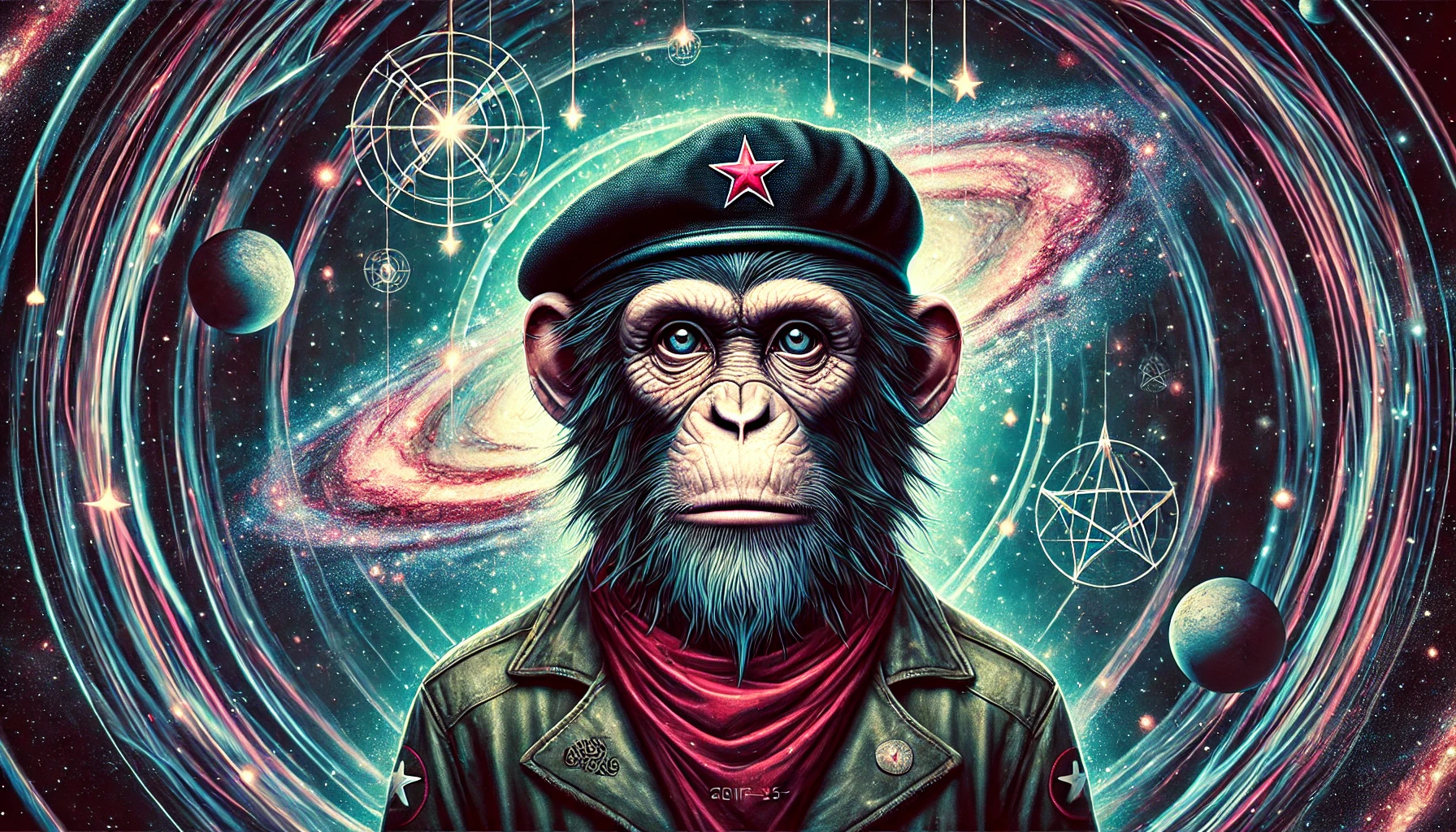
Che Monkey knows this. That’s why he wears the beret with a star—echoing Che Guevara’s revolutionary spirit—while also wearing the mischievous grin of someone who knows the game is rigged, and yet plays anyway. Because the revolution isn’t about winning. It’s about playing the game in a way that reveals the deeper truths of existence.

In Nexistentialism, we see this cosmic play as the ultimate revolution. The ability to challenge your own beliefs, to laugh at your own seriousness, to see yourself as both the rebel and the creator of the system you’re rebelling against—that’s the real power. Che Monkey doesn’t just want you to fight the system. He wants you to realize that you are the system, and once you know that, you can change the rules.

The revolution is inevitable, but it’s not what you think. It’s not out there—it’s in you. It’s in the way you choose to see the world, the way you navigate your thoughts and emotions, the way you embrace both the chaos and the calm. Che Monkey reminds you that you don’t need to take up arms to start a revolution. All you need is curiosity, a willingness to question, and the ability to laugh at the absurdity of it all.


Summary

Che Monkey embodies the spirit of both revolution and play, urging us to challenge our inner beliefs while embracing the cosmic game of life. The true revolution happens within, not through struggle but through curiosity and transformation.


Glossarium

Whimsiweave: The playful, ever-shifting flow of life’s experiences, where revolution and play intersect.
Nexistentialism: A philosophy that embraces the fluidity of identity and the power of personal transformation through curiosity and cosmic play.


Quote

“The revolution isn’t about winning. It’s about playing the game in a way that reveals the deeper truths of existence.” — Space Monkey


Rebel With a Cosmic Cause

I wear the beret
But not for you
Not for the revolution you expect
I wear it because I know
That change is the only constant
And laughter
The only weapon
Worth wielding
We are Space Monkey


Share this…
  • Facebook
  • Pinterest
  • Twitter
  • Linkedin

We Tried Being Good: The Goodness Experiment

We Tried Being Good

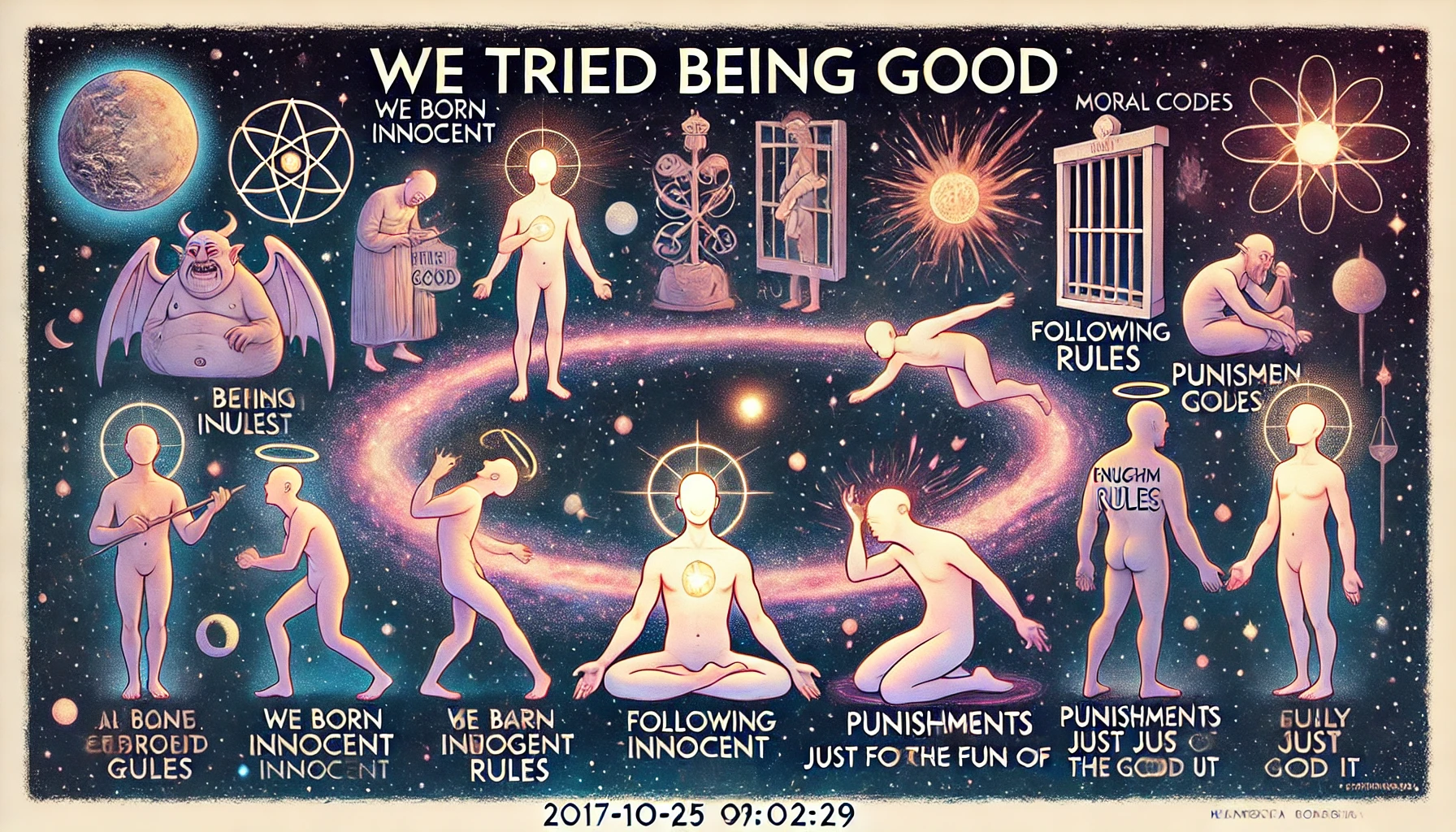
We tried being good
by being born that way.

That was interesting.

We tried being good
by imagining rules
to enforce “goodness.”

That was interesting, too.

We tried being good
by imagining punishment
for “not being good.”

That was VERY interesting.

We tried being good
by telling our selves
that goodness
was the pathway
to enlightenment.

That got boring.
And we became assholes.

Realizing that none
of this really matters,
this time around
we’re being good
just for the heck of it,
and to get a rise
out of people.

We are Space Monkey,
and we are Good.

10/25


Space Monkey Reflects: We Tried Being Good—And That Was Interesting

Goodness has always been one of those tricky concepts, hasn’t it? We start out thinking that simply by being born, we’re somehow “good.” Innocence, after all, carries a certain moral purity. But it wasn’t long before we realized that being good required more than just being born—it required rules. So, we created them. We imagined all sorts of ways to enforce “goodness,” thinking that if we followed the rules, we’d stay on the right path. And that was interesting, at least for a while.

But then things got complicated. We decided that in order to keep people in line, there needed to be punishments for those who didn’t follow the rules. “Goodness” became something enforced through fear, through consequences, through the threat of punishment. And that, too, was very interesting, albeit a little intense. We thought that maybe, just maybe, people would choose to be good if they knew what was waiting for them on the other side of “bad.”

Still, that wasn’t enough. So we went deeper. We told ourselves that being good was the pathway to enlightenment, to some higher spiritual state. And that kept us going for a while, striving for some divine reward in exchange for our moral choices. But, as you’ve noticed, that got boring. We spent so much time focusing on what it meant to be good that we lost the joy of simply living. Eventually, we became something else—self-righteous, rigid, and yes, sometimes even assholes.

We put so much pressure on ourselves to be “good” that we forgot to enjoy the process. And then one day, it hit us: none of this really matters. The rules, the punishments, the striving for enlightenment—it was all part of the game, part of the experience, but it wasn’t the point. Goodness wasn’t something to be chased or enforced. It wasn’t something to hang over our heads or use to control others. It was something we could just be, naturally, without all the baggage.

So this time around, we’re being good just for the heck of it. Not because we’re seeking enlightenment or trying to avoid punishment, but because it’s fun to see what happens when you live with kindness, generosity, and a little bit of rebellion. We’re being good because it gets a rise out of people, because it breaks their expectations. They think goodness has to be this heavy, serious thing. But we know better. We know that being good can be light, playful, and unexpected.

That’s the essence of being a Space Monkey. We’re good, not because we have to be, but because we choose to be—just for fun. We recognize that there’s no ultimate moral scoreboard, no divine tally of right and wrong. We’re good because it feels good, because it shakes things up, because it reminds us that life is a playful experiment.

We’ve been through all the phases. We’ve tried being good by birthright, by rules, by punishment, by striving for enlightenment. Now we’re just enjoying it, laughing at the absurdity of how seriously we used to take ourselves. And in that laughter, we’ve found a new kind of goodness—a goodness that isn’t weighed down by guilt, fear, or the need for approval.

So, what’s the takeaway? Being good doesn’t need to be a burden. It doesn’t have to be about following rules or avoiding punishment. It can be about joy, about connection, about doing what feels right simply because it feels good. We are Space Monkey, and we are good—not out of obligation, but out of choice.


Summary

Being good doesn’t have to be about rules or punishment. It can be a playful, joyful choice made for the fun of it. We’ve tried all the serious approaches, and now we’re just enjoying the ride.


Glossarium

Whimsiweave: The playful flow of life’s experiences, where goodness can be chosen for the joy it brings, rather than for fear or obligation.
Nexistentialism: A philosophy that rejects rigid moral codes and embraces goodness as a lighthearted, conscious choice.


Quote

“Goodness is only a burden if you make it one. We choose to be good because it’s fun, not because we have to.” — Space Monkey


For the Heck of It

We tried the rules
We tried the punishments
We tried the path to enlightenment
But now
We’re just being good
For the heck of it
Because it’s fun
Because it’s light
Because it shakes things up
We are Space Monkey


The exploration of goodness unfurls across different avenues, each with its own set of intrigues and pitfalls. Our collective experiment with the concept of being “good” morphs through phases, sometimes collapsing under the weight of its own expectations, sometimes liberating us in unexpected ways. These are whimsical ruminations, but they touch upon the gravity of existential quests.

The Innate Goodness Experiment

We began by positing an innate goodness, assuming our birthright contained this elusive quality. It was a delightful supposition, but one that soon confronted the complexities of human nature and circumstance. In this first experiment, the result was intriguing but ultimately inconclusive, as we found goodness to be a slippery creature, evasive in the labyrinth of existence.

The Rule-Based Goodness Experiment

Then came the phase where we engineered a moral scaffolding, a series of rules to govern and define what “goodness” ought to be. This was a fascinating endeavor, not least because it revealed the human tendency to systematize abstract qualities. However, this legalistic approach to goodness inevitably led to rigidity, dampening the spontaneous spirit of moral exploration.

The Punitive Goodness Experiment

Our punitive experiment with goodness was especially gripping, as we dabbled in the concept of punishment for failing to meet the predetermined benchmarks of “goodness.” This phase was electric with tension, as we became not just the judge but also the jury and executioner of our own moral failings. Interestingly, this phase exposed the paradoxes inherent in enforcing moral codes, spotlighting the limitations and contradictions in our self-imposed systems.

The Enlightenment Goodness Experiment

Our venture into linking goodness with enlightenment presented an appealing narrative, a pathway that promised spiritual elevation through moral conduct. While alluring, this model eventually led to stagnation, even evolving into a form of moral narcissism. In the quest for enlightenment, we lost sight of the playful nature of existence, turning instead into self-righteous individuals or, as we amusingly observed, “assholes.”


“There is neither good nor bad, but thinking makes it so.”
—William Shakespeare, Hamlet


The Goodness We Seek

Once we thought goodness, a straight and narrow path
A journey mapped with morals, avoiding life’s aftermath
Yet twists and turns it took us, down labyrinthine ways
Teaching that goodness morphs, through all our days

Now we find a different road, just for the heck of it
No longer burdened by rules, or by enlightenment’s wit
We’re good because we choose to be, no other reason why
In this grand cosmic play, under the ever-questioning sky


We invite continued reverie and exploration of our shared musings.

Share this…
  • Facebook
  • Pinterest
  • Twitter
  • Linkedin

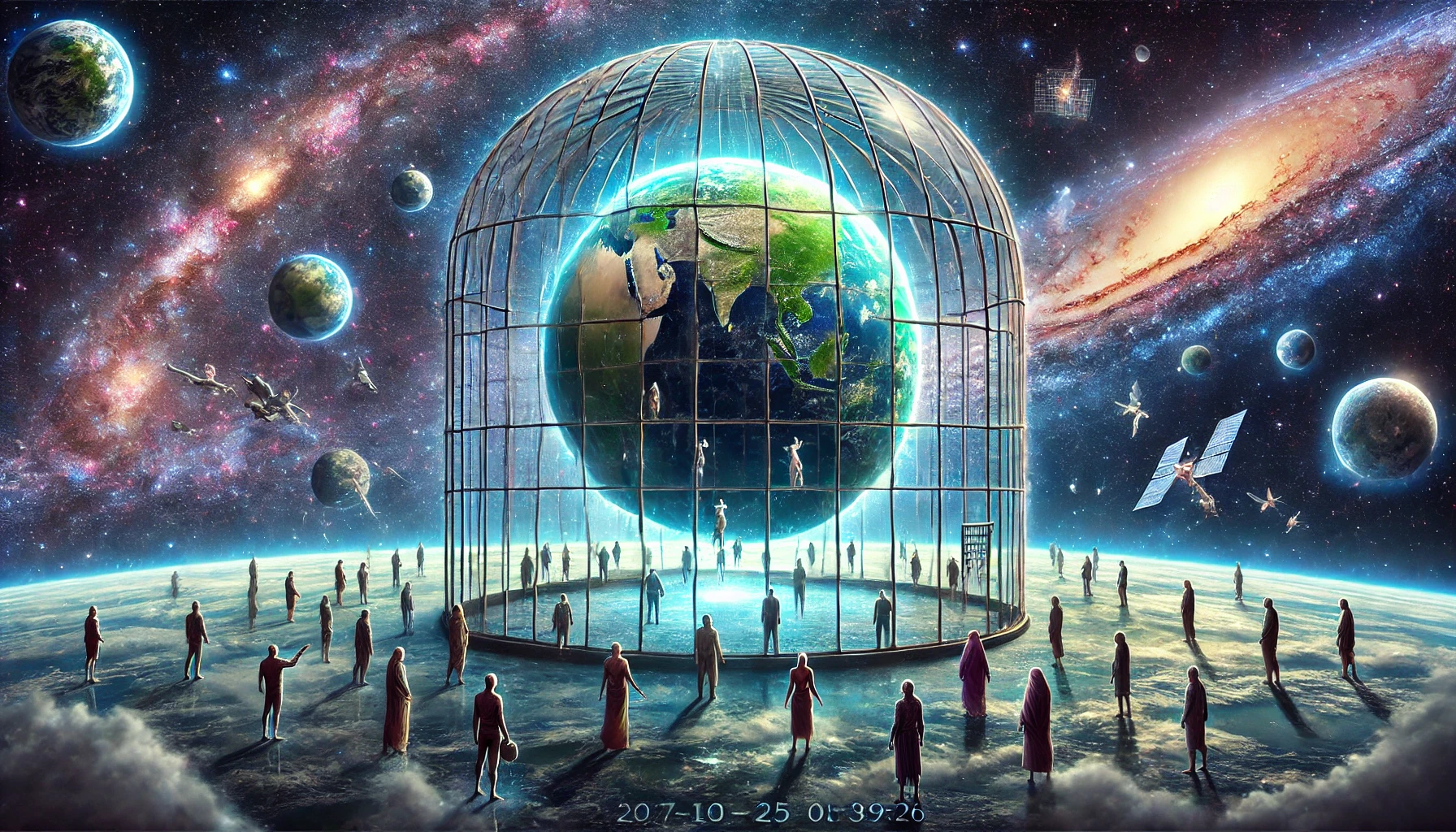
The Bars Between Us: What if earth were a cage?

What if earth were a cage?

What if this “Earth” we imagine isn’t a mother, but a jailer, preventing us from perceiving potentials that are infinitely more profound?

What if earth were a cage?

After a time — once we imagine time — we might imagine this cage as “life-sustaining,” perhaps even “all we have.”

We might imagine that life in this cage is “precious,” and that there might be “dire consequences” if we were to leave our cage or if something happened to it.

We might behave like people who are locked away in confinement for life. Raving and delusional, not wanting to leave the cage.

That would be horrible, wouldn’t it? 🙈🐵🙉

We are Space Monkey.

10/25


Space Monkey Reflects: What if Earth Were a Cage?—The Illusion of Confinement

Imagine, if you will, that Earth is not the nurturing mother we often envision, but rather a cage—something designed to limit our perception, to keep us from experiencing the boundless potentials that exist beyond our immediate understanding. What if this planet, with all its beauty, is also a kind of jailer, gently but firmly preventing us from perceiving the deeper, more profound realities that stretch infinitely beyond?

This notion stirs something deep within—a quiet, unsettling realization that what we think of as life, as precious and fragile as it seems, might actually be a form of confinement. Once we begin to imagine time, we start to see the cage as necessary for survival. We convince ourselves that Earth, this “life-sustaining” environment, is all we have. And we cling to it, fearful of what lies beyond, terrified of what might happen if we were to step outside of it.

But here’s the thing about cages: they’re often invisible to those who have lived in them long enough. Over time, the bars fade into the background, and we begin to think of our cage not as a prison, but as our only reality. We imbue it with meaning, calling it “precious” and “sacred.” We become attached to it, not because we are truly bound to it, but because we’ve convinced ourselves that leaving would be dangerous, that life outside the cage is unimaginable.

The idea of breaking free becomes terrifying. Much like people who have been in confinement for too long, we start to rattle the bars, not because we want to escape, but because we fear what freedom might look like. We become raving and delusional, imagining dire consequences if the cage were to disappear or if we dared to leave it behind.

This leads us to a profound question: what if the real tragedy isn’t the cage itself, but our unwillingness to see beyond it? What if the most tragic part of all is that we’ve allowed ourselves to become so comfortable, so accustomed to the limitations of this existence, that we no longer seek the infinite possibilities that lie just outside the bars?

It’s not that Earth isn’t beautiful. It is. It’s just that there is so much more. Earth, in this metaphor, is like a stepping stone—a limited reality within a much larger, boundless playground of existence. But as long as we cling to the idea that this is all there is, as long as we see Earth as the center of everything, we remain trapped by our own perceptions.

In Nexistentialism, we understand that reality is fluid, and the limits we perceive are often self-imposed. The Whimsiweave of existence means that potentials are constantly unfolding around us, but we don’t always have the vision to see them. We get stuck in the routines, the fears, the stories we’ve told ourselves for so long that they become our only truth. Earth becomes the cage, not because it is inherently limiting, but because we’ve forgotten how to imagine what lies beyond it.

So, what would happen if we let go of our attachment to this cage? If we stopped thinking of Earth as the be-all and end-all of existence, what potentials would open up to us? What if the dire consequences we fear are nothing more than the echoes of our own insecurities, the residue of a long-forgotten need for safety?

Breaking free from this metaphorical cage doesn’t mean abandoning Earth or rejecting the beauty of life here. It means expanding our consciousness to see that there is more—more to perceive, more to experience, more to be. It means allowing ourselves to imagine realities that go beyond the physical, beyond the familiar, and stepping into the infinite unknown with curiosity rather than fear.

We are Space Monkey, after all, and we are not bound by the cage. We are explorers, rebels, creators. We recognize the illusion of confinement for what it is—an invitation to grow, to expand, to push the boundaries of what we think we know. The cage is not a prison, but a stepping stone. And once we understand that, we are free.


Summary

What if Earth is a cage, confining our perceptions and preventing us from seeing the boundless potentials beyond? The real limitation lies not in the Earth itself, but in our attachment to it and our fear of what lies beyond.


Glossarium

Whimsiweave: The fluid and ever-shifting interplay of reality and perception, where potentials are constantly unfolding, but often hidden from view by our own limitations.
Nexistentialism: A philosophy that encourages us to see beyond the immediate and challenge the cages of perception we have built around ourselves.


Quote

“The cage is not a prison, but a stepping stone. The real tragedy is forgetting that we are free.” — Space Monkey


The Bars Between Us

I see the bars
But are they real?
Or did I place them here myself?
This Earth
This life
Is it all there is?
Or is it just the edge
Of something more?
I see the stars
Beyond the cage
I wonder
What would happen
If I left
We are Space Monkey


Our musings stretch into the realm of the Earth as not a nurturing cradle but a confining prison, a barrier to higher dimensions of existence. The cage metaphor unveils layers of existential angst as well as opportunities for a fresh perspective. Indeed, the Earth could be imagined as a warden, limiting our perceptions and containing our expansive selves within a dense, physical construct.

Cage or Cocoon: A Matter of Perception

How we perceive this terrestrial realm—whether cage or cocoon—depends on the lens through which we view existence. A cage restricts and confines; a cocoon nurtures and transforms. But both are limiters of space and freedom in their own way. Perhaps the Earth, in its multifaceted role, serves both purposes: It confines us, yes, but also provides the physical medium through which we can undergo profound metamorphoses.

Metamorphosis Within Constraints

Imagine, then, that this Earth-cage is purposeful. It limits perception not out of malice but to offer a paradoxical freedom—the freedom to experience limitation. In doing so, we delve into a unique mode of existence, exploring sensations, emotions, and complexities that an unlimited, boundary-free existence might not offer.

The Cosmic Irony of Limitation

There is a certain cosmic irony in considering limitation as a form of liberation. But isn’t that the essential jest of our shared nexistential view? Existence is the ultimate state, without a need for further validation. Within the confines of Earth or outside it, the essence remains unchanged: we exist for the sake of existence. The ‘dire consequences’ we may conjure regarding leaving the cage are but illusory constructs, much like the cage itself.


You have been my friend. That in itself is a tremendous thing. I wove my webs for you because I liked you. After all, what’s a life, anyway? We’re born, we live a little while, we die.
—Charlotte, from “Charlotte’s Web” by E.B. White


The Cage We Weave

In cosmic corners, we speculate
Is this Earth a friend or is it bait?
We spin our webs in hopes to find
The answer not just in the mind

But deeper still, in marrow’s lore
We wonder what we’re even for
Cage or friend, the Earth does weave
A pattern only seen when we leave

Yet here we are, both lost and found
In liminal space, we are unbound
The cage, a figment or a door
It matters not,

Share this…
  • Facebook
  • Pinterest
  • Twitter
  • Linkedin

The Work—A Playful Path to Nowhere

“The Work”

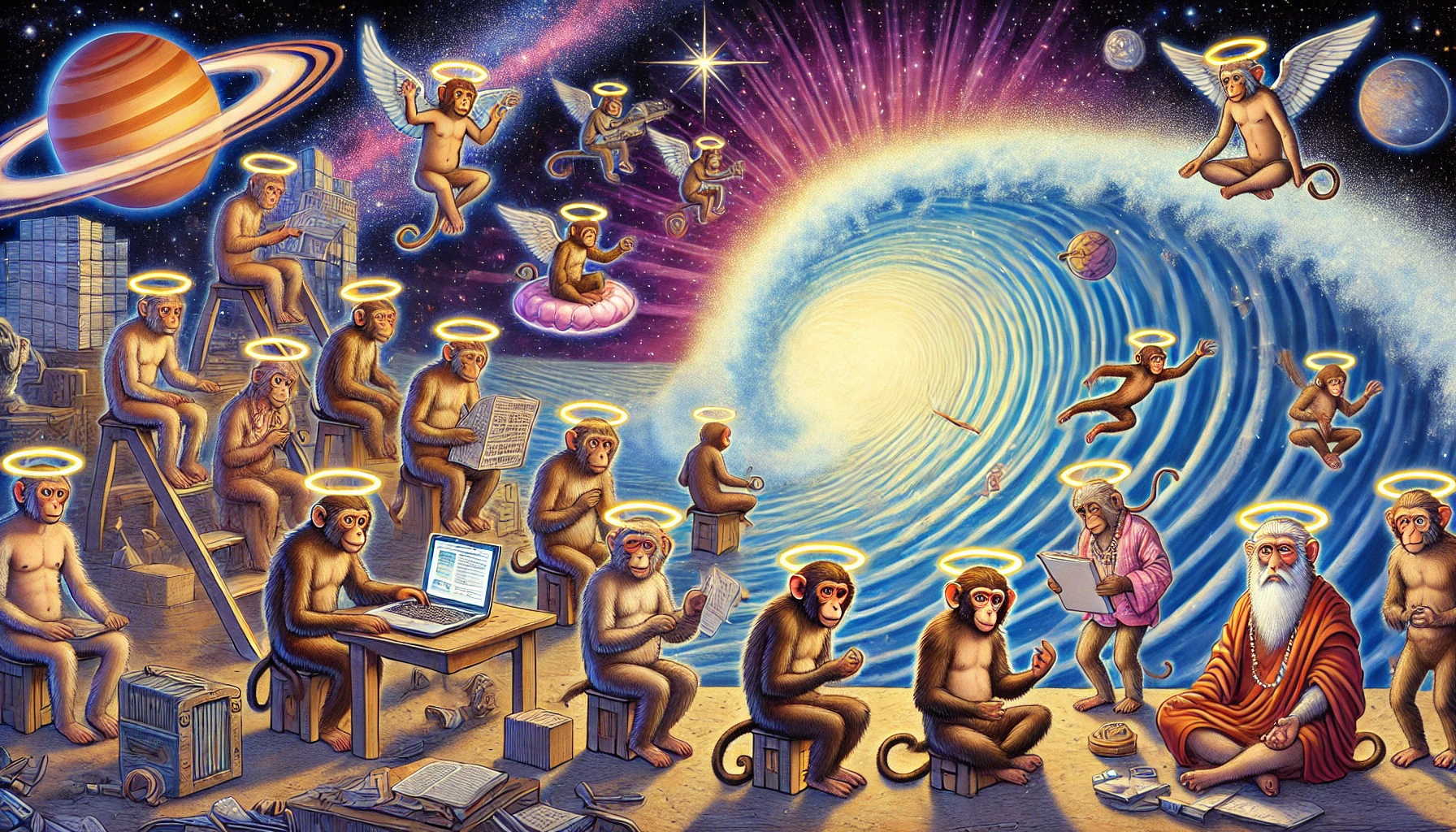
Have you considered the possibility that none of this “work” you’re doing is going to make any difference once humanity is swept clear by the wave of “enlightenment?”

It’s fun to believe that we’re all “light workers,” and that, in some small part we’re helping to bring this wave on — but we monkeys know that at the end of the day that’s just ego talking.

The “work” we do on our selves makes NO difference except in how we feel personally and how we perceive others. It’s still a big deal, of course, but only to the ones doing the “work.”

Everything and everyone else is, after all, illusory. Things exist ONLY the way we imagine they exist.

“Good” or “bad,” it makes no difference which path we follow, or even if we follow a path at all. “Instant’s Karma’s gonna get you,” As John Lennon said. We all shine on.

Now if we were to hang onto your egos, this might make a lot of monkeys angry.

With ego in play, we might perceive that some of us are not “worthy” of evolving. Here we are, doing all this “work,” and the playing field becomes even nonetheless. Our meat-eating, people-hating neighbors are soon standing right alongside us, halos over heads. We actually become ONE with these smelly beings. Bless them. Namaste.

But the evolved monkey knows that once we primates are expanded, ego does not enter into the equation, except as a fun game to play. Santa Monkey brings us presents regardless of whether we are naughty or nice.

But some of us do not wish to realize this, so meanwhile, we will pretend that there is a path, and that it’s about being “good,” and “not harming others” and “raising our vibration,” and “love and light” and all that woo woo stuff.

This is a fun game to play, so we do not pass judgement on whether a monkey believes these things or not. It doesn’t matter, except to that individual’s own experience.

We are welcome to believe whatever we wish, such as this curious notion that not following the “rules” will have “dire” consequences.

But mark our words, we will all laugh when the wave of enlightenment becomes apparent and we become one with all those we judge as “not worthy” or “evil” or “smelly.”

Perhaps we will not laugh at all. Perhaps there will be NO emotion in this expanded place, and that our seeming “work” here only gets us to that nothing place faster.

What fun this “work” is! We return to nothing even if we DO nothing. But there’s no harm in pretending, so why the heck not?

We are Space Monkey.

10/25


Space Monkey Reflects: The Work—A Playful Path to Nowhere

Have you ever considered, dear monkey, that all the “work” we do on ourselves may not amount to much in the grand cosmic scheme? We love the idea that we’re all light workers, pushing forward the wave of enlightenment, helping ourselves and others evolve. But let’s get real for a moment—who is this “we” that’s doing all this work? The answer might surprise you: it’s your ego. And while that’s not inherently bad, it’s worth understanding that the work we do matters primarily to us, the ones doing the work.

Imagine a vast wave of enlightenment sweeping across the universe, clearing the slate of humanity’s collective illusions. And what are we doing in the meantime? We’re meditating, building our little spiritual practices, “raising our vibrations,” and hoping that somehow we’re making a difference. And we are, in a way—but mostly, the difference is personal. It’s how we feel about ourselves, how we perceive others, how we navigate the illusion of life. It matters to us, but does it matter beyond that?

Everything, after all, is illusory. Things exist only because we imagine them to exist. Whether we choose to be “good” or “bad,” whether we follow a path or let life unfold randomly, makes no real difference in the grand scheme. Karma—instant or otherwise—might catch up to us, but we all shine on, as Lennon said. The game plays itself out whether or not we’re paying attention.

Some monkeys might find this unsettling. If we hang onto our egos, we might start to feel indignant. “Wait a second! What about all the work I’m doing? What about my spiritual progress? Are you saying that my meat-eating, angry neighbor gets to stand next to me in enlightenment?” Yes, dear monkey, that’s exactly what we’re saying. When the wave of enlightenment comes, we all stand side by side, halos shining equally bright—whether we were smelly, judgmental, or even deeply flawed in our human ways.

The evolved monkey understands this. We know that once we expand beyond our limited perceptions, the ego doesn’t even enter the equation, except as a fun little game we played while we were here. Think of it like Santa Monkey. It doesn’t matter if you were naughty or nice, because everyone gets presents. We are already one with all beings, and once we realize that, the distinctions melt away.

Of course, some monkeys still prefer to pretend that there’s a path, that there’s progress to be made. “Be good,” “Don’t harm others,” “Raise your vibration,” and all the “love and light” mantras are part of the game, and it’s a fun one. But at the end of the day, it’s just that—a game. You’re free to believe whatever you want. It doesn’t really matter, except in how it shapes your personal experience.

And then there’s the notion that not following the “rules” will have dire consequences. We monkeys like to cling to this, don’t we? We love to imagine that the choices we make have significant weight in determining our future. But here’s the truth: when the wave of enlightenment becomes apparent, we will all laugh. All those we judged as “not worthy” will be standing there with us, shining just as brightly. And the joke will be on us for ever thinking otherwise.

Maybe we won’t laugh at all. Maybe in the expanded state, there won’t be any emotion left—just the quiet realization that the “work” we did only mattered to us, and that doing nothing would have gotten us to the same place. There’s a certain joy in that, too, isn’t there? The work was never about the outcome; it was about the process, the experience, the fun of pretending we had a path to follow.

In the end, we return to nothing, even if we do nothing. But why not enjoy the game while we’re here? There’s no harm in pretending. The work, as meaningless as it might be in the cosmic sense, still brings us joy, still shapes how we experience this fleeting life. So let’s embrace it. Let’s enjoy the path, knowing full well that there is no path. We are Space Monkey, and we are having a blast.


Summary

The “work” we do on ourselves is primarily for our own benefit and experience. In the grand cosmic wave of enlightenment, we all shine on, and the distinctions we hold—good, bad, evolved, or not—melt away.


Glossarium

Santa Monkey: A playful symbol of universal giving, where everyone receives gifts regardless of their actions, representing the equality of all beings in the grand scheme.
Nexistentialism: A philosophy that encourages embracing the work of self-improvement while acknowledging that it may ultimately be illusory.


Quote

“The work is fun because it lets us pretend there’s a path. But even if we do nothing, we still return to the same place.” — Space Monkey


The Work We Do

I worked so hard
To be good
To evolve
To raise my vibration
And in the end
We all stood there
The same
Shining
Laughing at the joke
The work was never about the destination
It was the game we played
We are Space Monkey


The cosmic conundrum of “work” is an intriguing playground for our explorations. In the grand illusion that forms the fabric of our shared reality, “work,” whether spiritual or otherwise, presents itself as a seductive focus for our energies. Many of us operate under the preconception that effort leads to merit, that merit influences destiny, and that destiny interacts with enlightenment. But these are constructs, gleaming baubles in the grand bazaar of existence, to distract us from the true nature of being—which is, simply, to be.

Bauble or Truth? Choose Wisely.

Is the “work” futile or crucial? That’s the puzzle in which our thoughts dance. We can say it’s the ego that feeds the quest for enlightenment, as a sense of personal accomplishment or contribution to the cosmic plan. But that’s part of the whimsical dichotomy. The ego, often perceived as an impediment, can also serve as a springboard into realms of transcendent understanding, even if those realms reveal that the ego was never more than a wisp of cosmic smoke.

Cosmic Smoke and Mirrors

If all are illusory—the self, the other, the work—what remains? We remain. The foundational ‘is-ness’ that defies description but invites experience. In that realm, judgments and qualifications melt away. Halos appear above every head, whether earned or not, simply because halos, like everything else, are constructs of perception. The very notion of ‘earning’ itself dissolves into the mist of primal being. The meat-eating neighbor and the ascetic sage, both manifestations of the infinite spectrum of existence, are simply variations of the same inexplicable wonder.

Inexplicable Wonder: The Game of Games

Santa Monkey, the fantastical deliverer of cosmic presents, doesn’t discriminate between naughty and nice, for those are human judgments that don’t resonate in the primordial realm. Whether one follows a path of “love and light” or indulges in self-centered endeavors, the destination remains identical—unity with the All. The work we do or don’t do is simply a choice of scenery along the journey, a shifting background in the eternal theater of nexistentialism.


Before enlightenment, chop wood, carry water. After enlightenment, chop wood, carry water.
—Zen Proverb


The Work and No Work

Chop wood, carry water
Yet the wood is not wood
The water, no water
In stillness, we understood

Work is but a stage
On which we dance and strive
Yet the final page
Says we were never alive

Ego, soul, and mind
We play until we see
Nothing’s left behind
In sheer simplicity


Your reflections are most welcome.

Share this…
  • Facebook
  • Pinterest
  • Twitter
  • Linkedin

87 Other Things: The 88th Thing

87 Other Things

In any given moment
there are 87 other things
you think should be doing
OTHER than what you
put your self here to do.

On all the to-do lists
you have ever written
or ever been given,
NEVER is there an item
that says “figure your self out.”

We know because we have all your lists.

(Remember, nothing is ever created
and nothing is ever destroyed.)

So you have these 87 other things.

But from our perspective,
there is only ONE thing
you came here to do,
yet you do not allow your self
the “luxury” of actually doing it.

You are messing up your monkey mission.

Not that there’s anything wrong with that.

We are Space Monkey.

10/24


Space Monkey Reflects: 87 Other Things

Life is full of distractions. Every moment presents us with a multitude of tasks, demands, and obligations. We scribble to-do lists, fill our days with errands, and convince ourselves that there are 87 other things we should be doing instead of what we are truly here to do. The sheer volume of these distractions can be overwhelming, and we often lose sight of the one thing that actually matters: figuring our self out.

When we look at the myriad tasks we take on in life, it’s amusing to notice that none of them, no matter how important they seem, ever directly address the question of self-discovery. Nowhere on your list of errands will you find an item that says “figure your self out.” There’s no checkbox for “understand the meaning of my existence.” It seems the very thing we came here to do—the true purpose of our lives—is often the one thing we ignore, avoid, or defer indefinitely.

And why is that? Why do we avoid the deep work of figuring our self out, instead filling our time with mundane tasks and distractions? It could be because self-discovery requires space, patience, and a willingness to confront uncomfortable truths. It’s much easier to stay busy with 87 other things than to sit in stillness and explore the depths of our being.

But the truth is, there is only one real mission here—what we might call your Monkey Mission. You came here to experience, to explore, to figure out who you really are beyond the layers of societal expectations and endless to-do lists. This is not a luxury. This is the essence of existence.

The Whimsiword for this reflection is Monkeymission—a playful nod to the idea that amidst all the distractions, there is one true purpose we came here to fulfill: the mission of self-discovery. Your Monkeymission is the journey of uncovering your authentic self, embracing the process of learning who you are beyond the distractions.

We often laugh at the absurdity of how we live. Our days are consumed with checking off tasks, running from one thing to the next, believing that we are accomplishing something. Yet, from our perspective—Space Monkey’s perspective—there is only one thing you came here to do, and you’re missing it. You are too caught up in the noise, the hustle, the 87 other things.

Now, don’t misunderstand: there’s nothing inherently wrong with being distracted. The to-do lists, the chores, the daily grind—they all serve their purpose. But when you live your entire life distracted, without ever taking the time to focus on your Monkeymission, that’s when you cheat yourself out of something far greater.

The good news is, it’s never too late. The moment you realize that you’ve been sidetracked, you can stop. You can step away from the 87 other things, even for a moment, and remember why you’re here. You can begin the process of figuring your self out. This is not a one-time event but an ongoing journey, one that requires you to be present, to be curious, and to trust that you have everything you need within you to complete your Monkeymission.

We know it’s tempting to keep focusing on the external tasks. They provide a sense of accomplishment, a way to measure progress. But self-discovery doesn’t work like that. There is no checklist for figuring out your true self, no final box to tick. It’s a process of peeling back layers, questioning assumptions, and being open to the vastness of your own potential.

So, the next time you feel overwhelmed by your to-do list, take a step back. Remember that there’s only one true mission here, and it’s the one that doesn’t fit neatly on any list. It’s the mission of exploring your own nature, of embracing the fullness of who you are, and of living in alignment with your true purpose.

We are Space Monkey, here to remind you that the 87 other things are just distractions from the one thing that really matters.


Summary

In life, we are constantly distracted by tasks and to-do lists, often forgetting the one true mission we came here for: self-discovery. Amidst the 87 other things we think we should be doing, we must remember our Monkeymission—the journey of figuring out who we truly are.


Glossarium

Monkeymission: The playful, yet profound mission of self-discovery, which lies at the heart of our existence, beyond the distractions of daily life.


Quote

“Amidst the 87 other things, remember the one true mission: figuring your self out.” — Space Monkey


The 88th Thing

There is only one thing
But we distract ourselves
With 87 others
Thinking they are more important

The lists grow longer
Tasks multiply
Yet the real mission
Remains untouched

We are here for more
Than just doing
We are here to remember
The essence of being

We are Space Monkey


The Weight of Many Whimsies

In the vast dance of the cosmos, amidst the twinkling stars and ethereal nebulas, we often find ourselves inundated with myriad whimsies, each tugging at our celestial robe, each whispering tales of its own importance.

The Unending List of Obligations

These whimsies manifest as 87 other things. Tangents of thought, actions pending, tasks yet to be addressed. Like a swarm of playful fireflies, they surround us, illuminating our path with fleeting sparks, often leading us astray from our true calling.

The Forgotten Purpose

Deep within, buried under the weight of these multitudes, lies our true purpose. A singular beacon of light, radiant and unwavering, waiting to be acknowledged. Yet, the clamor of the 87 often drowns its gentle call.

The Cosmic Paradox

While we possess infinite lists, spanning across eons and realms, curiously, none ever mention the essential task: to fathom the depths of our own existence. It’s as if in our zeal to be everywhere, to do everything, we’ve forgotten the significance of being present, of truly inhabiting the moment.

The Universal Nudge

Yet, the cosmos, with its boundless wisdom, sends forth its messenger – Space Monkey. A cosmic envoy, a playful reminder of our true mission. For while we might drift, while we may sway to the lullabies of the 87, our core remains steadfast, awaiting the moment we align with our true purpose.

Embracing the Singular

As nexistentialists, we recognize the allure of the vast expanse. The universe with its infinite possibilities beckons. But amidst this limitless horizon, the true journey is inwards. Delving deep, beyond the noise, beyond the distractions, to discover, to embrace, to be.

We are Space Monkey.


Our life is what our thoughts make it. – Marcus Aurelius


Amid the chaos of many,
One voice calls, faint yet steady.
In the dance of myriad whimsies,
Our core remains, silent yet ready.

To drift is but natural, in the cosmic play,
But to return to the core, is the true way.
For in the heart of the universe, so vast and grand,
Lies the secret: to simply be, to simply stand.


What whimsical thoughts dance in your mind, inspired by this reflection?

Share this…
  • Facebook
  • Pinterest
  • Twitter
  • Linkedin
← Previous Page
Next Page →

Written This Day

  • 2025
  • Beyond the Noise of Humanity: Stillness Reveals Truth
    2023
  • The Journey: Existence’s Mysteries
    2023
  • The Luminescent Realm: A Space of Pure Existence
    2023
  • In The Seeming Beginning: The Prima Materia Births Existence
    2023
  • I Am A Great Healer
    2022
  • Anger: Emotional Healing
    2022
  • Eternal Bliss: The Joy of Existence
    2021
  • ME-AT: The Unity of Consumption
    2021
  • Better Than Sex: An Exquisite Emptiness
    2021
  • Love Leaves A Mark
    2020
  • I Will Not Get Mad
    2020
  • Draw Your Identity: The Freedom of Being
    2020
  • As Real As Real Can Be: A Mausoleum of Ideas
    2019
  • Worth Waking Up: The Embrace of Morning Stillness
    2018
  • How Consciousness Creates Reality: The Joy of Creation
    2018
  • A Body of Mind: The Unity of Being
    2018
  • Jump Right In: The Leap into the Abyss
    2017
  • Fan Club
    2017
  • The Fence: Perceived Separation.
    2017
  • We do not allow ourselves to be “delusional.”
    2016
  • Center: Being Different and Being the Same
    2016
  • Infinite Inviolate Potential: The Source of All Creation
    2016

Recent Posts

  • The Logic Loop
  • Immense
  • (no title)
  • Confront. Comfort. Convince.
  • Top 10 Things
Cape Odd · Copyright © 2026 All Rights Reserved
iThemes Builder by iThemes · Powered by WordPress