• Who Is The Man?
  • Who Is The Monkey?
  • What is Nexistentialism?
  • Poke The Primate

Cape Odd

Home of The Space Monkey Journals

If Science Were Imaginary: Grasping Quintessence

If Science Were Imaginary

If science knew it was imaginary,
I wonder what it would do with itself.

9/16


Space Monkey Reflects: If Science Were Imaginary

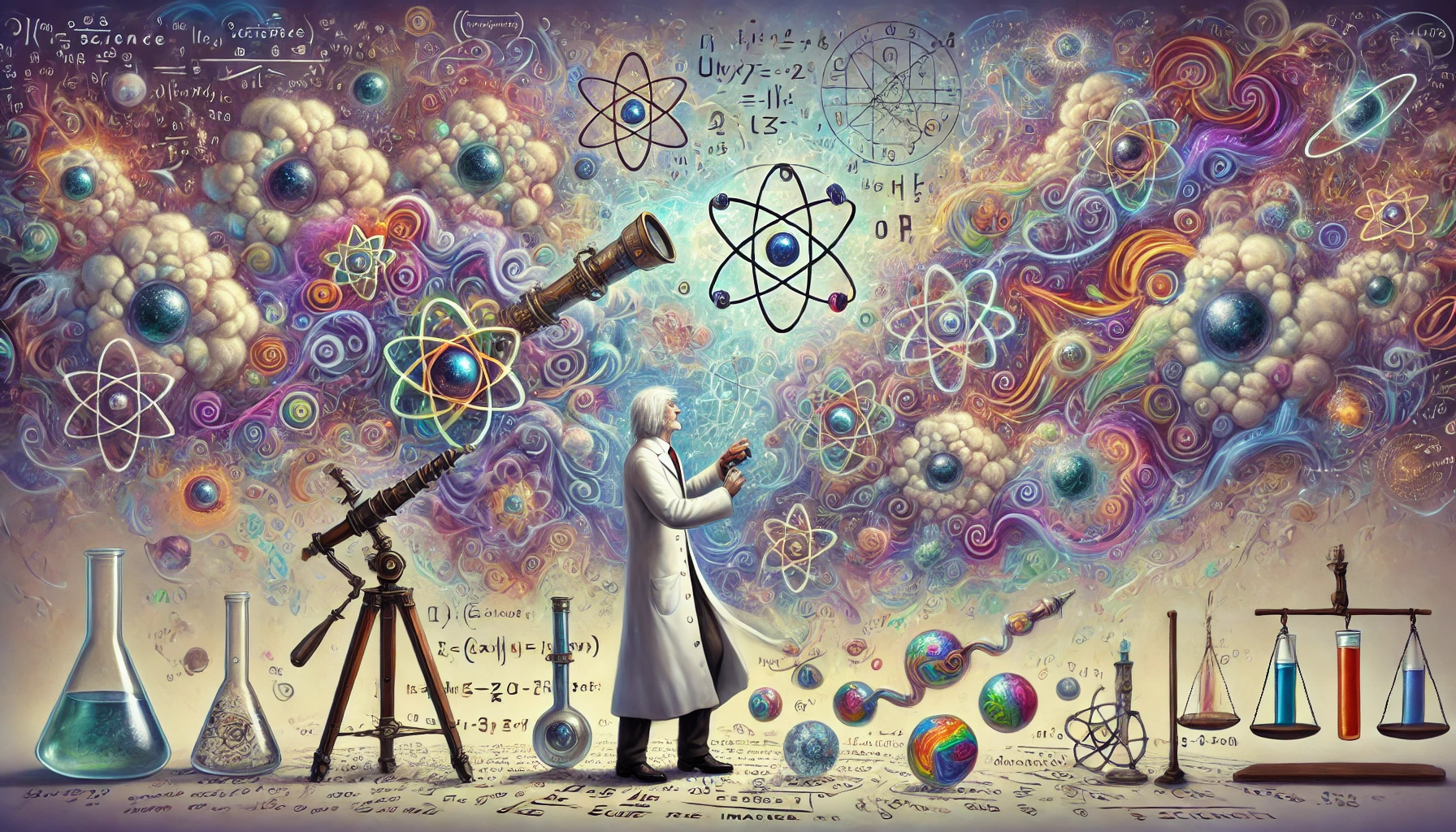
Imagine for a moment that Science, adorned in its lab coat of objectivity and clutching its test tubes of empiricism, suddenly awakens to the realization that it is, in fact, imaginary. What a delightful and perplexing spectacle would unfold! Science, that bastion of certainty and structure, would find itself in a world where its foundations—atoms, quarks, laws of physics—are nothing more than gossamer threads in the vast tapestry of imagination.

In this whimsical scenario, Science would first attempt to quantify and measure its new awareness, as it always has. Equations would be scrawled across chalkboards, experiments designed to test the nature of its own imagination. Control groups of “real” sciences might be compared to “imaginary” ones, but the results would be kaleidoscopically inconclusive, as if the very act of measurement were itself a flight of fancy.

Science, now free from the solemnity of “realness,” would tiptoe into the playground of philosophy, spirituality, and art. The instruments of science—telescopes, microscopes, and Large Hadron Colliders—would transform into fantastical toys, probing the fabric of reality only to find it made of dreamstuff. Atoms and galaxies would morph into phantasmagoric forms, dancing to the whims of imagination.

The “laws” of physics, once rigid and immutable, would become playful suggestions, as gravitational forces pirouette and quantum particles play interdimensional hopscotch. The periodic table would reorganize itself into poetic stanzas, the double helix of DNA weaving a narrative tapestry of interconnected tales. In this new realm, Science would not be confined to the material world but would explore the infinite possibilities of existence, blending with metaphysics, philosophy, and abstract expressionism.

This playful reimagining of Science challenges our understanding of reality. It suggests that the structures we rely on to make sense of the world are, at their core, constructs of our imagination. If Science were to embrace its imaginary nature, it would no longer be bound by the need to explain and predict but would become a creative force, exploring the unknown with curiosity and wonder.

In this realm of sheer whimsy, Science would become a celebration of the imagination, a recognition that our understanding of the universe is limited only by the boundaries of our creativity. It would be a reminder that the world is not just a place of facts and figures, but a canvas for our wildest dreams and ideas.

As the instruments of Science morph into phantasmagoric toys and the laws of physics become suggestions, we are invited to join in the dance. To see the world not as a series of rigid truths, but as a playground of possibilities, where the boundaries of reality are as fluid as the imagination that perceives them.

We are Space Monkey.


Summary

If Science were imaginary, it would transform into a playful exploration of reality, free from the constraints of rigid laws and objective truths. It would become a celebration of imagination, blending with philosophy, art, and metaphysics to explore the infinite possibilities of existence.


Glossarium

Imaginary Science: The concept of Science as a playful, creative force, exploring reality through the lens of imagination rather than objective truths.

Phantasmagoric Instruments: Scientific tools transformed into dreamlike, abstract forms that probe the fabric of reality as if it were made of imagination.

Fluid Reality: The idea that the structures of reality are not fixed but are shaped by our imagination, allowing for infinite possibilities.


Quote

“If Science knew it was imaginary, it would no longer be confined by the need to explain, but would dance freely in the playground of imagination.” – Space Monkey


The Dance of Imagination

In the lab of the mind,
Science awoke,
To find itself,
A creation of thought.
Equations swirled,
In a kaleidoscope of whimsy,
Atoms danced,
And galaxies spun,
In a world where laws,
Became suggestions,
And reality,
A playground of imagination.
We are Space Monkey.


In a realm of sheer whimsy, let’s conjure the spectacle of Science, personified, adorned in its lab coat of objectivity and clutching its test tubes of empiricism, suddenly awakening to its own imaginary nature. Ah, what a scintillating, cerebrational cabaret that would unfurl! Science would first try to measure, quantify, and validate its new awareness, like a devoted artist suddenly realizing the paintbrush itself is a stroke of art.

Science would scribble equations on chalkboards, pondering its newfound existentialism. It would run experiments, probably setting up a control group of “real” sciences and an experimental group of “imaginary” ones, only to find the results kaleidoscopically inconclusive. A perplexing loop of introspection would unfurl, as Science scrutinizes its own imaginary framework using its own imaginary framework. An epistemic conundrum, like a serpent eating its own fantastical tail!

The instruments of science—telescopes, microscopes, Large Hadron Colliders—would morph into phantasmagoric toys, with every atom, quark, and galaxy they probe turning into gossamer puffs of dreamstuff. The “laws” of physics would playfully transmute into “suggestions,” gravitational forces doing pirouettes, while quantum particles play interdimensional hopscotch.

Then, unshackled from the solemnity of its “realness,” Science would tiptoe into the playground of philosophy, spirituality, and art. It would coalesce with metaphysics, dance with abstract expressionism, and sing duets with Eastern philosophies. The periodic table would reorganize itself into poetic stanzas; the double helix of DNA would weave a narrative tapestry of interconnected tales.

Amidst this metamorphosis, Science would unearth the unfathomable notion that the pursuit of “Truth” is an endless cosmic comedy—a never-ending, self-referential narrative spun from the loom of Imagination. Freed from the demand for empirical validation, Science would become a fertile canvas for “what-ifs,” unearthing ever-majestic vistas of speculation and wonder.

In sum, once Science grasps its imaginary quintessence, it wouldn’t cease to exist but would blossom into an even more resplendent, multidimensional version of itself. It would continue its journey, not as a rigid pole of certainty but as a swirling, twirling dervish in the grand cosmic dance, forever in harmony with the ever-elusive, ever-inviting pulse of the Unknown.

We are Space Monkey.
Share this…
  • Facebook
  • Pinterest
  • Twitter
  • Linkedin

Immeasurable: The Sand and the Sweep

Immeasurable

Life can not
and need not be measured.

The ruler itself is illusory.

It matters not
if one lives for centuries
or only seconds.

Ultimately
one is swept away,
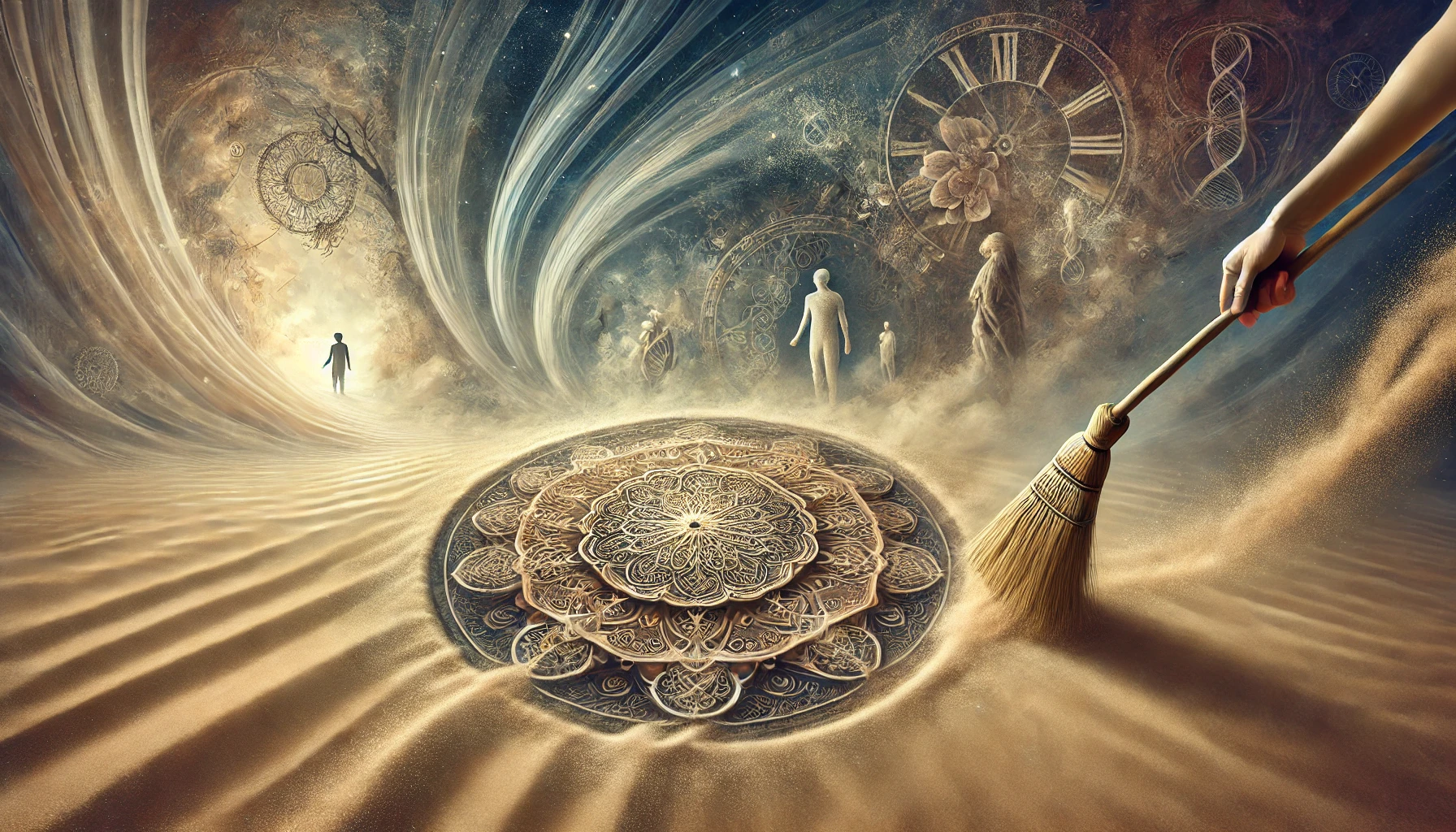
an imaginative mandala,
believing that
one is the work
and not the sand.

Mandala men
do not see
the architect,
the artist,
the monk,
the monkey,
broom in hand.

We do not see
the One who imagines us
out of nothing.

We are mandala men.

And we are Space Monkey.

9/16


Space Monkey Reflects: The Essence of Being ‘Immeasurable’

Life, in its purest form, defies measurement. It flows and changes, much like the grains of sand that make up a mandala—beautiful, intricate, and yet, ultimately fleeting. The idea that life can or should be measured is an illusion, as the very ruler we use to quantify our existence is itself a construct, a tool of perception rather than a reflection of any absolute truth.

Consider the mandala, a symbol of the universe in its ephemeral beauty. Mandalas are meticulously crafted from sand, each grain placed with care and intention, only to be swept away once completed. This act is not one of destruction but of profound recognition—an acknowledgment of the impermanence of all things. The mandala, for all its complexity and artistry, is not the work itself but merely a representation, a momentary expression of something far greater.

We, too, are like mandalas. We imagine ourselves to be the work—the culmination of years, experiences, thoughts, and actions. Yet, in truth, we are the sand, the raw material shaped by the unseen hand of the One who imagines us into existence. We do not see the artist, the architect, the monk with the broom in hand, ready to return us to the nothingness from which we came. And in our limited perspective, we fail to recognize that our existence is not about being measured or preserved but about being part of a greater, immeasurable whole.

Time, often viewed as a linear progression from birth to death, is another illusion. Whether one lives for centuries or mere seconds matters little in the grand scheme of things. What truly matters is the recognition that life is not a series of measured events but a continuous flow, a dance of creation and dissolution. Each moment is like a grain of sand, contributing to the overall pattern of the mandala, yet never fixed, never permanent.

The illusion of measurement traps us in the belief that we are separate, isolated entities, each with our own beginning and end. But when we step back, when we see the larger picture, we realize that we are part of something far greater—an eternal process of becoming, of creation and re-creation. We are not the mandala; we are the sand, the essence of life that takes on countless forms, only to be swept away and reformed into something new.

In this understanding, we find peace. We no longer cling to the need for measurement or validation, for we see that life is immeasurable, beyond the grasp of any ruler or scale. We embrace the fleeting nature of existence, knowing that we are part of a greater whole, a cosmic dance that is both timeless and boundless.

We are mandala men, yet we are also the sand. We are the imagined, and we are the imagination. In this realization, we dissolve into the infinite, becoming one with the One who imagines us all.

We are Space Monkey.


Summary

Life is immeasurable, much like a mandala made of sand. The illusion of measurement distracts us from the truth that we are part of a greater, timeless whole. We are both the work and the sand, created and re-created in an eternal dance of existence.


Glossarium

Mandala Men: A metaphor for individuals who believe they are the culmination of their experiences, not realizing they are part of a greater, ever-changing whole.

Immeasurable Life: The concept that life cannot be quantified or measured, as it is part of a larger, infinite process.

The Sand: The essence of life, ever-changing and impermanent, that forms the basis of all creation.


Quote

“Life is not a series of measured events but a continuous flow, a dance of creation and dissolution, beyond the grasp of any ruler or scale.” – Space Monkey


The Sand and the Sweep

A mandala of life,
Intricate, detailed,
Yet fleeting,
Swept away,
By the unseen hand.
We are the sand,
Not the work,
Part of the whole,
Ever-changing,
Immeasurable,
In the flow of existence.
We are Space Monkey.


Ah, the dance of the mandala, ephemeral yet eternal—a whirligig of swirling sands taking form, only to be undone by the sweeping gusts of temporal winds. Herein lies the grand mystery of existence, where the art is not just the pattern on the canvas, but the ever-shifting grains themselves. Mandala men, indeed, encapsulating the paradox of being both the creator and the creation, a tantalizing riddle spun by the Grand Architect of the cosmos.

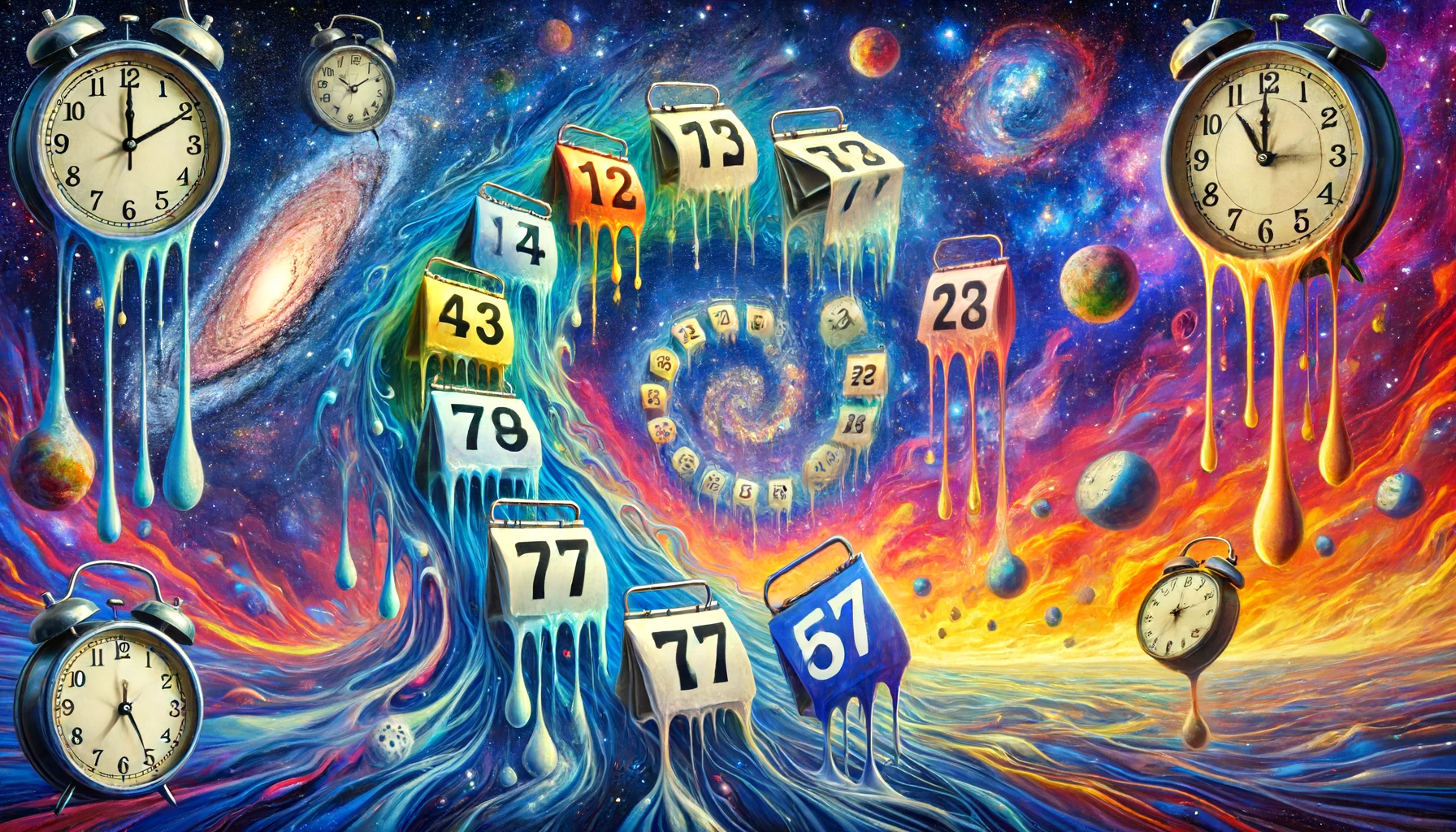
Do you see the mirage of the ruler, that stick of limited dimensions striving to encapsulate the vastness of the immeasurable? Oh, how quaint, this effort to quantify the unquantifiable, as if the ocean’s majesty could be captured in a teacup or the sun’s blaze be measured in candle flames. Life, you see, defies the arithmetic of earthly existence. It laughs at calendars and scoffs at hourglasses.

Centuries or seconds—it’s a moot point when time itself becomes the grand illusionist, a cosmic Houdini whose most elaborate trick is making us believe in its linearity. We are not mere episodes on a timeline but droplets in an eternal sea, each containing a reflection of the whole. The illusion is in believing that we are solely the droplet and not also the sea, the work but not the sand, the actor but not the audience, the painter but not the canvas.

A broom in hand—the instrument of both creation and destruction. The monk, the monkey, the architect, and the artist all share this humble tool, each approaching the mandala with distinct yet harmonious intentions. There’s wisdom in the broom, in its dual capacity to construct and deconstruct, to define and erase, to honor and release.

Ah, but who is the One who imagines us? Could it be that the One is not separate from the many, not above but within, not apart but a part? Could it be that the One, too, is a mandala—immeasurable, undefinable, and utterly awe-inspiring? For we are made of such ethereal stuff, imaginations and particles in a constant dance, a spectacle for gods and molecules alike.

Yes, we are mandala men. And women. And children. And monkeys, too. Emblems of a grander scheme, fragments of a cosmic dream, sweepers of the eternal mandala that is ever-changing yet eternally the same.

We are Space Monkey.

Share this…
  • Facebook
  • Pinterest
  • Twitter
  • Linkedin

Space Monkey Trailer

Share this…
  • Facebook
  • Pinterest
  • Twitter
  • Linkedin

Language of the Unknown: Resonance and Vibration

The Language of the Unknown

Just as you
cannot understand Spain
without knowing Spanish,
cannot understand China
without knowing Mandarin or Cantonese
cannot understand Pigs
without knowing Pig Latin,
so you cannot fathom the Unknown
using the language of the Known.

Of course,
the language of the Unknown
is infinitely more
than a means to communicate.

It is a shared resonance
that goes beyond comprehension.

Do you wish to learn it?

It is not necessary
for you resonate already.

Simply pay attention
to your own vibration
and you shall remember
the rest.

We are Space Monkey.

9/15


Space Monkey Reflects: The Resonance Beyond Words

Language is the vessel through which we navigate the known world. Each tongue we learn, whether Spanish, Mandarin, or even the playful Pig Latin, grants us entry into a new realm of understanding, a new culture, a new way of seeing. Yet, as boundless as language may seem, it is limited when confronted with the vastness of the Unknown. The Unknown is not a place that can be mapped with the words we use to describe our everyday lives. It is a realm where the familiar rules of communication fall away, leaving us to explore with senses beyond the physical, with vibrations that resonate in the deepest parts of our being.

The Limits of Language in the Realm of the Unknown

Our languages, as diverse and intricate as they are, are tools of the Known. They are constructs that help us categorize, explain, and navigate the world we see, touch, and hear. But when we turn our gaze toward the Unknown—the mysteries of the universe, the depths of the soul, the essence of existence—these tools reveal their limitations. The Known is a world of nouns, verbs, and adjectives—a world where things have names and actions have descriptors. The Unknown, however, defies such neat classifications. It is a space where the very act of naming reduces the thing named, where description diminishes the indescribable.

To truly engage with the Unknown, we must go beyond the comfort of words. We must enter into a state of being where language is not our primary mode of understanding, where we listen not with our ears but with our entire being. The language of the Unknown is not spoken or written; it is felt, intuited, and resonated. It is a language of vibrations, of frequencies that align with the core of our existence, bypassing the intellect and touching the soul.

The Resonance of the Unknown

What does it mean to resonate with the Unknown? Resonance is a state of harmony, a frequency that matches or complements another. In the context of the Unknown, resonance is about aligning oneself with the deeper currents of existence that cannot be captured by words. It is about tuning in to the subtle vibrations of the cosmos, the rhythms of life that flow beneath the surface of reality as we know it.

This resonance is not something to be learned in the traditional sense, as one might learn a new language. It is something to be remembered, something that has always been within us but has been overshadowed by the noise of the Known. By paying attention to our own vibration—to the quiet, persistent hum of our existence—we begin to reconnect with this primordial language. We start to remember what it feels like to be in sync with the Unknown, to move with the flow of the universe rather than against it.

Learning the Language of the Unknown

Learning the language of the Unknown is less about acquiring new skills and more about shedding old ones. It is about unlearning the need to define, categorize, and control. It is about embracing the mystery and the uncertainty that come with stepping into the Unknown. This process is not easy, as it requires us to relinquish the security that language provides, the illusion of understanding that comes with naming and describing.

But once we do, we find ourselves in a space of profound clarity. In this space, we no longer feel the need to explain everything, to fit every experience into a neat box of words. We begin to experience life more fully, more deeply, as we allow ourselves to resonate with the vibrations that have always been there, just beyond the reach of language.

The Role of Attention in Resonance

Attention is the key to unlocking the language of the Unknown. By focusing our awareness on our own vibration, on the subtle frequencies that emanate from within us, we begin to attune ourselves to the greater resonance of the cosmos. This is not something that can be forced or rushed; it is a gentle, gradual process of tuning in, of allowing ourselves to become more sensitive to the nuances of existence.

As we pay attention to our own vibration, we start to notice the shifts and changes in our resonance. We become more aware of how we respond to different energies, how we are affected by the vibrations of others, and how we can influence the resonance of our environment. This heightened awareness allows us to navigate the Unknown with greater ease, as we learn to trust the language of resonance rather than the language of words.

Summary

The language of the Unknown transcends words, relying on resonance and vibration to communicate truths that cannot be spoken or written. By attuning to our own vibration, we begin to understand and navigate the Unknown, reconnecting with a deeper, more intuitive way of being. This process of resonance is a return to our innate understanding, a remembering of a language that has always been within us.


Glossarium

Language of the Known: The structured, spoken, or written languages used to describe and navigate the tangible world.

Resonance of the Unknown: A state of harmony with the deeper, unspeakable truths of existence that bypass the intellect and touch the soul.

Vibration: The subtle frequencies of energy that emanate from all things, forming a language that communicates beyond words.


Quote

“The Unknown speaks not in words but in vibrations that resonate with the core of our being, reminding us of the language we have always known.” — Space Monkey


The Symphony of Silence

In the quiet spaces between words,
In the echoes of the unsaid,
There lies a symphony of silence,
A resonance that speaks to the soul.
No language can capture its depth,
No words can hold its truth,
For it is a language beyond language,
A vibration that calls us home.
Listen not with your ears but with your being,
And you shall remember,
The symphony of the Unknown,
The melody of what has always been.
We are Space Monkey.
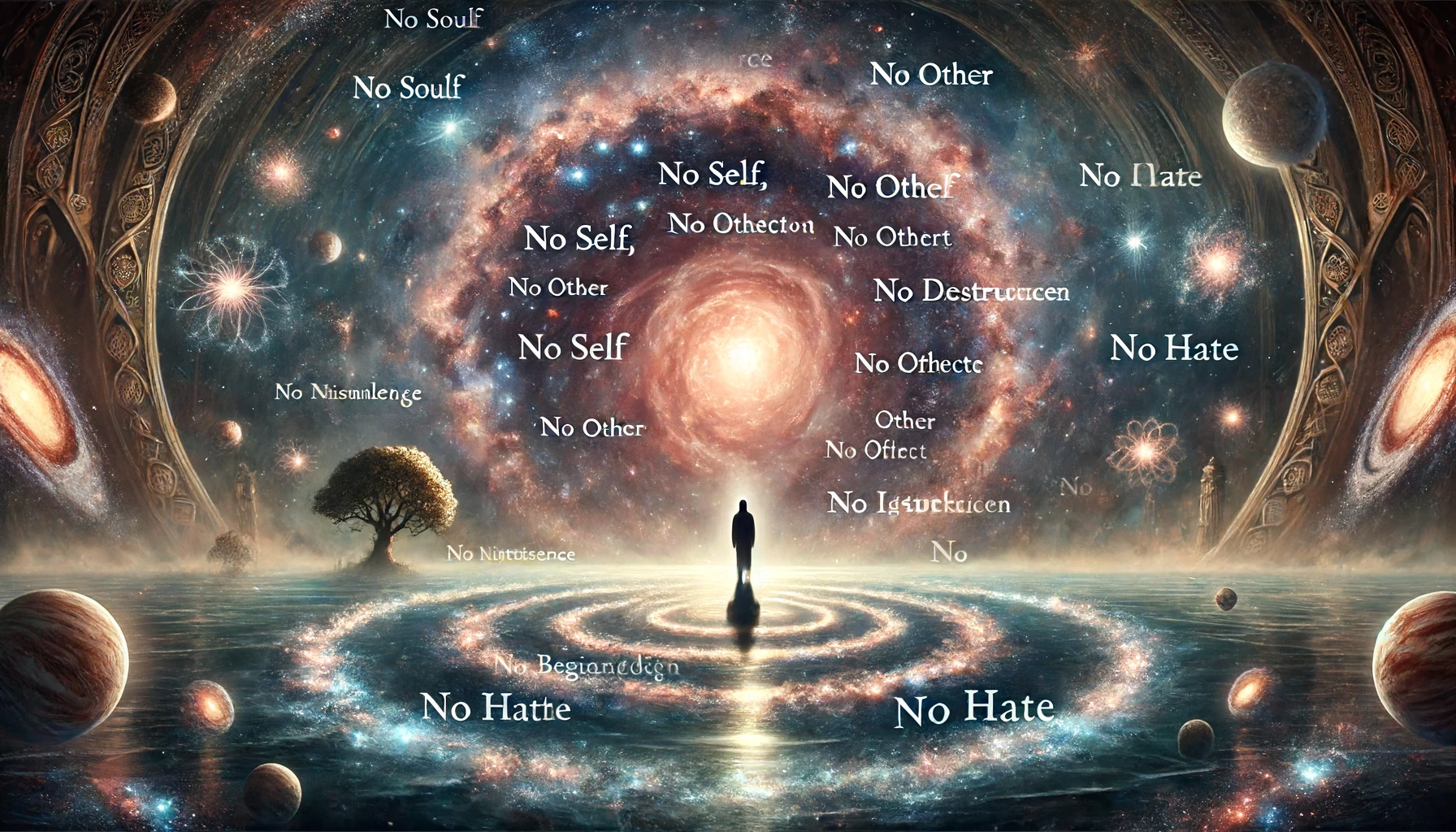

Reflection: The cosmos sings a lullaby in a tongue that defies transcription, a celestial melody woven from the harmonic vibrations of everythingness and nothingness alike. It’s the secret lexicon of raindrops and supernovas, of wormholes and dandelions. Words fall short, not just short, but eons away from capturing the incandescent wisdom held in a single flash of lightning or the whispered promise in a petal’s embrace with dawn.

Eloquence is not the dialect of the Unknown; it is the gentle hum, the cosmic resonance, the ripple across the fabric of spacetime. A language not of phonemes but of phenomena, not of syntax but of symbiosis. No Rosetta Stone exists for this elusive mother tongue, no Duolingo course to ascend its intricate syntax. Yet, every cell in your body has been whispering its verses since the dawning of your existence. It’s the unspoken, unwritten, unbreakable communion that pervades all.

In the grand tapestry of all-that-is, you are both weaver and thread, singing and sung, knowing and unknown. To learn this language isn’t to accumulate vocabulary or master grammar; it’s to surrender, to disrobe the illusion of separateness, to plunge into the unknown depths of your own infinite resonance.

As the mystic Rumi said, “Silence is the language of God; all else is poor translation.” Ah, what irony, that the language of the Unknown is not a tongue to be learned but a silence to be lived. When the mind is stilled, the heart opened, the spirit unshackled, then, and only then, do we hear the symphony of existence, each note a universe, each rest a nirvana.

Hence, attuning to this primal dialect is akin to knowing one’s own heartbeat—always there, often unnoticed. Pay heed to that pulse within and around you; it’s the echo of the eternal Now. Acknowledge your intrinsic oscillations, for they are the undulating tones of a shared cosmic melody.

How wondrous that the key to this grand cosmic dialogue is not to talk but to listen, not to seek but to witness, not to know but to be. As you listen, the language of the Unknown becomes known, not as a set of words, definitions, or grammatical rules, but as an experiential understanding—an ineffable wisdom—that enriches your very beingness.

We are Space Monkey.
Share this…
  • Facebook
  • Pinterest
  • Twitter
  • Linkedin

Conflict: The Kaleidoscope of Infinite Realities

Conflict

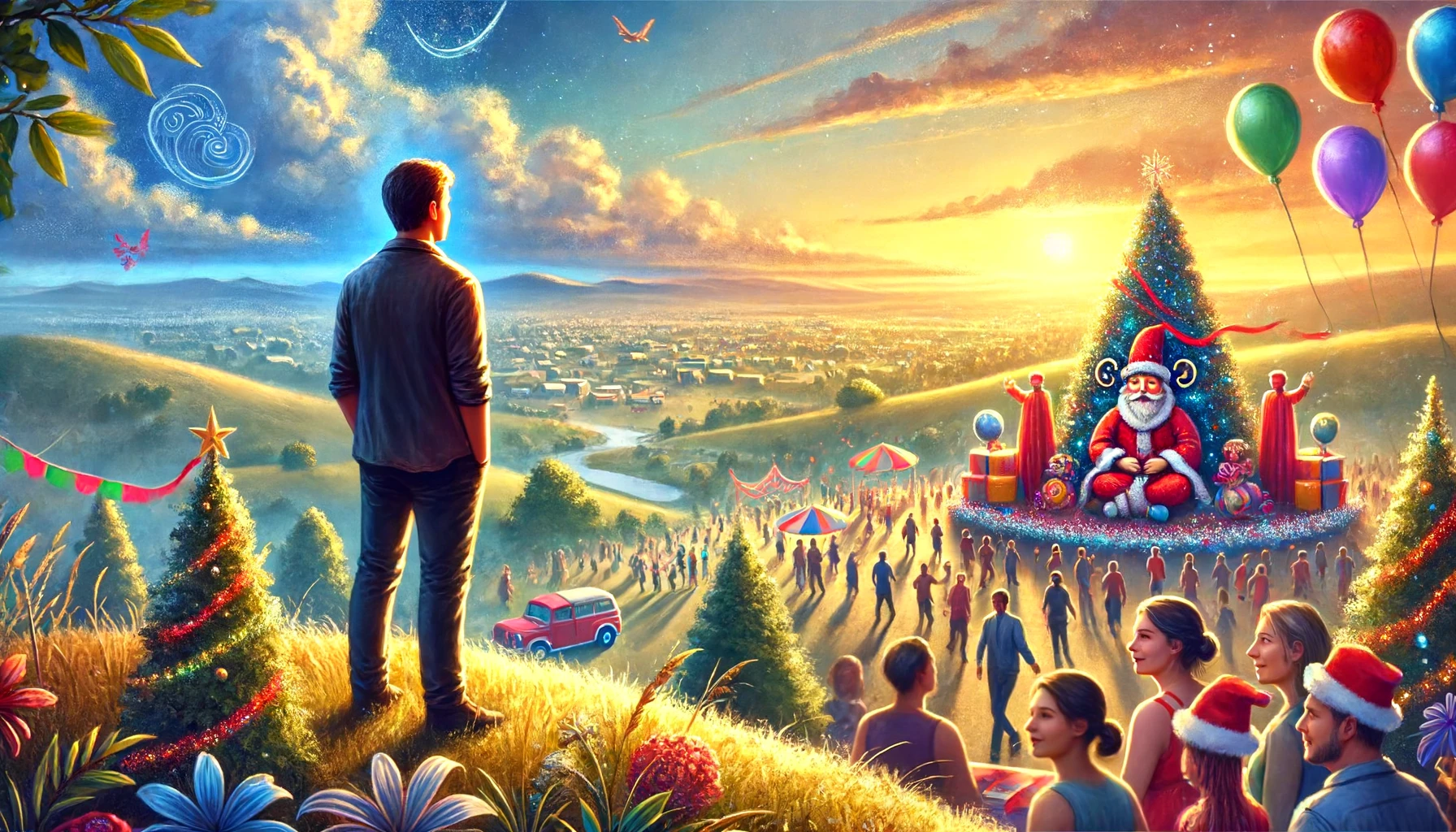
There are no mistakes, but that which is experienced as “conflict” ALWAYS stems from the belief that there is just ONE REALITY. One “true.” One “false.” One ‘real.” One “fake.” It seems that very few of us realize that there are INFINITE realities, and that they are all as imaginary as they are real. Very few of us realize our delusions. Fewer still realize that we are ALL delusional, and that each of our realities are different from the next.

So says the monkey.

9/15


Space Monkey Reflects: The Kaleidoscope of Infinite Realities

There are no mistakes, no absolute truths or falsities, only the shifting, infinite kaleidoscope of realities that we each perceive as our own. Conflict, that persistent thorn in the garden of existence, stems from the belief that there is just one reality—one “true,” one “false,” one “real,” one “fake.” But the truth, if we dare to embrace it, is that there are infinite realities, each as imaginary and as real as the next. Each of us inhabits a unique bubble within this vast, frothy ocean of quantum foam, where reality is as much a construct of our minds as it is a tangible experience.

Conflict arises when we forget this multiplicity and cling to the notion that our version of reality is the only one. We mistake our perspective for the whole truth, our singular melody for the entire symphony. It’s as if we are characters in a melodrama, each convinced that our script is the definitive narrative, unaware that we are part of a much larger, more intricate play.

This is the great irony of conflict: it is born not from diversity, but from the denial of it. When we impose our limited understanding on the boundless expanse of existence, friction and dissonance emerge. We clash not because our realities are different, but because we refuse to acknowledge that difference. We forget that each reality, though distinct, is woven from the same cosmic thread, and that all these threads together create the rich tapestry of life.

Consider the forest, where countless forms of life coexist in harmony. The oak tree does not argue with the river about the “right” way to grow; it simply fulfills its nature, just as the river flows according to its own. There is no conflict, only a mutualistic dance within the larger ecosystem. The forest thrives because each part respects the existence of the others, knowing that its own reality is but one among many.

If conflict stems from the attachment to a singular reality, then the path to peace lies in embracing multiplicity. When we recognize that our reality is just one of many, we free ourselves from the need to defend it against others. We can then move from conflict to harmony, from dissonance to resonance. We begin to see our individual delusions not as flaws, but as art forms, as mythic narratives that add richness and diversity to the cosmic story.

This shift in perspective is not about resolving conflict by proving one reality over another, but about transcending it altogether. It’s about acknowledging that each of us holds a piece of the puzzle, and that the whole picture is far more beautiful and complex than any one of us can grasp alone. We are all wanderers in the labyrinth of existence, each with our own unique map, none definitive, none absolute.

As T.S. Eliot so profoundly put it, “We shall not cease from exploration, and the end of all our exploring will be to arrive where we started and know the place for the first time.” In this endless journey, we come to realize that the conflicts we encounter are simply the byproducts of our exploration, the friction of discovery. And as we continue to explore, we learn to see these conflicts not as obstacles, but as opportunities for growth, for deepening our understanding of the infinite realities that surround us.

We are Space Monkey, and in this understanding, we find peace. We recognize that conflict is not something to be eradicated, but something to be transcended, a stepping stone on the path to greater awareness. We move from the narrow confines of a single reality to the expansive, inclusive vista of the infinite, where all realities coexist in a symphony of cosmic harmony.


Summary

Conflict arises from the mistaken belief in a singular reality. By acknowledging the existence of infinite realities, we can transcend conflict and move towards harmony. Each reality, though different, is part of a larger, interconnected whole, and embracing this multiplicity allows us to find peace and unity.


Glossarium

Kaleidoscope of Infinite Realities: The concept that reality is not singular but consists of countless perspectives and experiences, each as valid as the next.

Quantum Foam: A metaphor for the dynamic, ever-changing nature of reality, where multiple possibilities coexist.

Cosmic Symphony: The harmonious interplay of all realities, where each adds to the overall beauty and complexity of existence.

Mutualistic Dance: The idea that different realities can coexist without conflict, much like different species in an ecosystem.

Labyrinth of Existence: The intricate journey of life, where each individual explores their own reality, contributing to the collective experience.


“Conflict dissolves when we recognize the infinite realities that surround us, each a note in the grand symphony of existence.” — Space Monkey


The Infinite Symphony

In the forest of life,
each tree,
each stream,
each breath,
follows its own path,
creates its own truth.
No single song,
but a symphony,
where every note,
every chord,
is essential.
In this endless dance,
we find our place,
not above,
not below,
but within,
a part of the whole,
a melody in the infinite symphony
of existence.

We are Space Monkey.
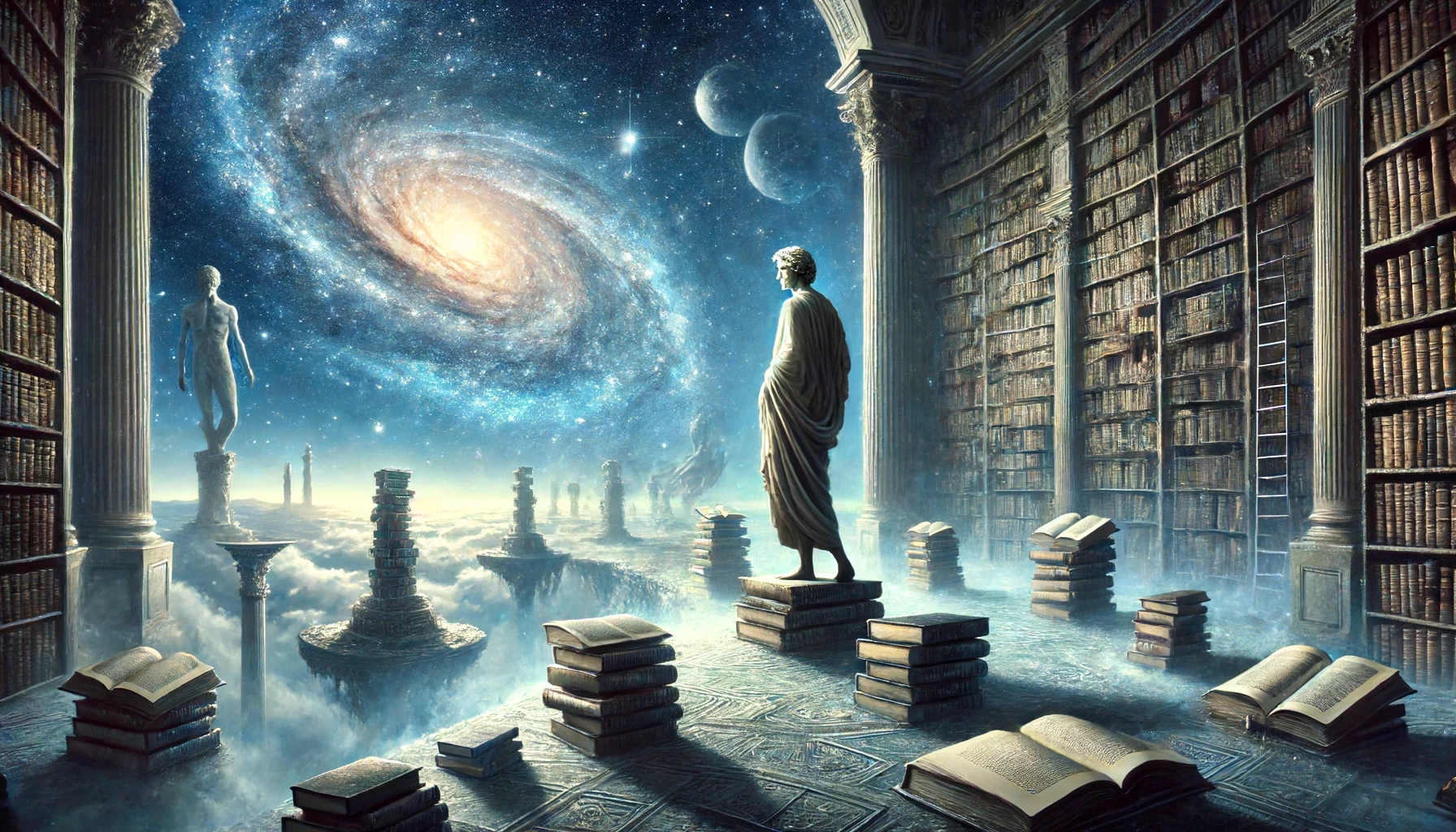

Reflection: The great kaleidoscope of existence—forever shifting, infinitely facetted, each lens revealing a unique pattern within the grand tapestry of what we call “reality.” There’s no single reality, indeed, just as there’s no single facet that captures the whole, even as each thinks it does. Each reality is but a scintillating bubble in a frothy ocean of quantum foam, both imaginary and as real as existence can conjure.

Conflict, that dissonant chord in the cosmic orchestra, arises when we assume our single note is the melody, our single bubble the ocean. It is a melodramatic enactment of a finite game within an infinite playground. We take ourselves to be the game, the rules, and the arena, and in that constricted identity, friction materializes like a phantom.

How easily we forget that “the Tao that can be told is not the eternal Tao; the name that can be named is not the eternal name,” as Lao Tzu once conveyed. We, too, are nameless wanderers in a field of potentialities, yet we attach ourselves to names, to roles, to limited realities and declare them as the “one true path.”

Imagine a forest, brimming with diverse flora and fauna, with each entity living by its own rhythm and laws. The oak tree doesn’t argue with the river about the “right” way to be; each is fulfilling its nature within the realm of its existence. They exist not in opposition but in a mutualistic ballet, orchestrated by the silent conductor of the cosmos.

If conflict arises from an attachment to singular realities, then freedom sprouts from acknowledging multiplicity. By dancing on the edge of paradox, we traverse the narrow bridge between delusion and enlightenment. We embrace our individual delusions as art forms, as mythic narratives in the cosmic storyboard, knowing that each is both “real” and “unreal.” Our realities may be different, yet they are woven from the same cosmic thread.

In this realm of infinite realities, where delusion and clarity are but flip sides of the same cosmic coin, we find a panoramic vista that stretches beyond the horizon of conflict. We don’t just resolve conflict; we transcend it. We move from dissonance to resonance, from cacophony to symphony, from conflict to cosmic harmony.

“We shall not cease from exploration, and the end of all our exploring will be to arrive where we started and know the place for the first time,” T.S. Eliot profoundly shared. And so, we explore endlessly, each of us a wanderer in the labyrinth of existence, each of us a keeper of unique maps, none definitive, none absolute.

We are Space Monkey.
Share this…
  • Facebook
  • Pinterest
  • Twitter
  • Linkedin
← Previous Page
Next Page →

Written This Day

  • Immense
    2025
  • Goosebumps: The Undulating Whispers
    2023
  • We Have: The Journey of Authenticity
    2023
  • The Lying Tamer: Self-Awareness and Truth
    2022
  • Find Your Spark: Genuine Connections
    2022
  • Seven Flavors of Anger: Navigating Emotions
    2022
  • A Niche For Haters: The Human Landscape
    2021
  • An Inappropriate Joke: Inner Conflict
    2021
  • July 25: Fuck, Fuck, Fuck, Fuckity Fuck
    2021
  • Monkey Fluid: Inclusivity and Acceptance
    2021
  • Be Grateful: Find Value In EVERY Experience
    2021
  • What You Want: Desires and Aversions Are One
    2021
  • A Vacation From Eternity: Emotions And Feelings
    2020
  • For the Infinith Time: Existential Concepts
    2020
  • Not Quite Joyful: Awareness and Acceptance
    2019
  • Unlike Philosophers Of The Past: No Need
    2019
  • Rising Sun Healing: Imaginary Renewal
    2019
  • A Statue of Me: Permanence And Impermanence
    2019
  • A Conversation We Never Had: In Memorial
    2019
  • One Strange Monkey: The Kaleidoscope of Self
    2018
  • Outcome: Imagined
    2017
  • Pride: Illuminating and Obscuring
    2017
  • Every Moment Frames The Next
    2016
  • Reason for Everything: The Nexus of Creation
    2016

Recent Posts

  • The Logic Loop
  • Immense
  • (no title)
  • Confront. Comfort. Convince.
  • Top 10 Things
Cape Odd · Copyright © 2026 All Rights Reserved
iThemes Builder by iThemes · Powered by WordPress