• Who Is The Man?
  • Who Is The Monkey?
  • What is Nexistentialism?
  • Poke The Primate
Cape Odd
Home of The Space Monkey Journals

Author Archive for Space – Page 1014

Turn Your Self On: Transformation and Renewal

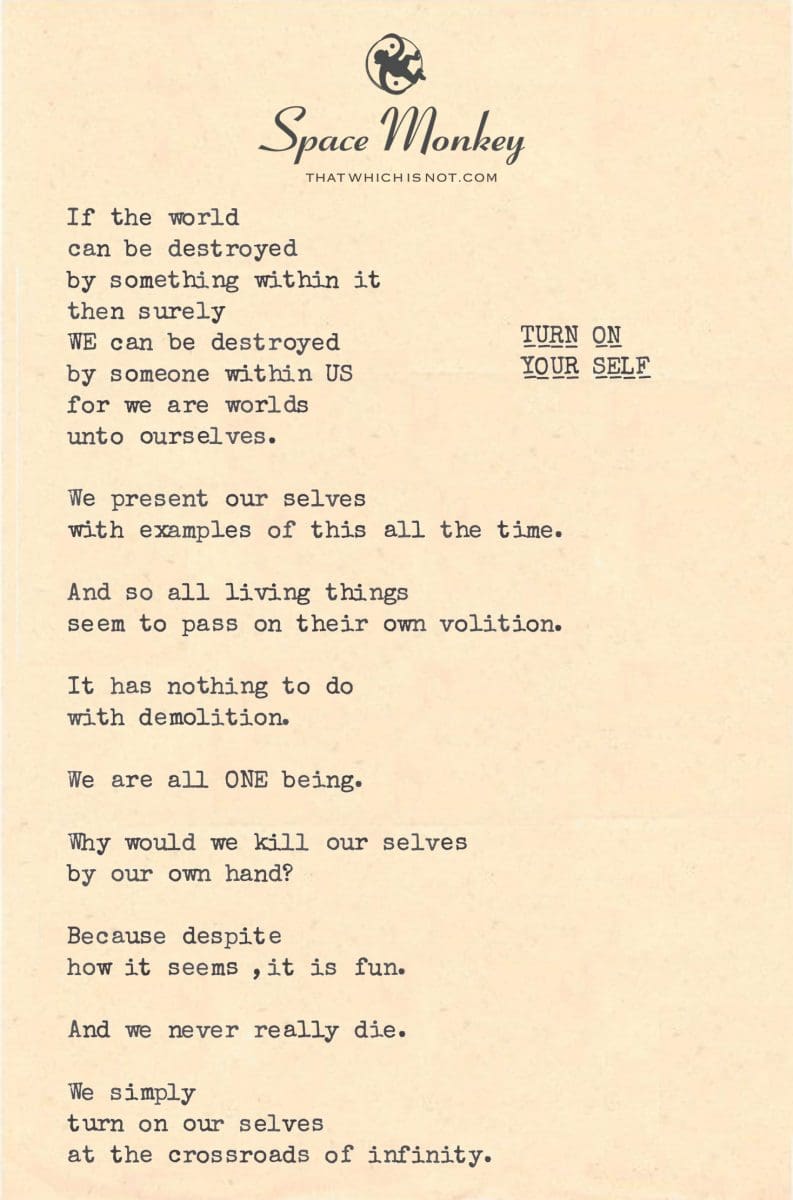
If the world
can be destroyed
by something within it
then surely
WE can be destroyed
by someone within US
for we are worlds
unto ourselves.

We present our selves
with examples of this
all the time.

And so all living things
seem to pass
on their own volition.

It has nothing to do
with demolition.

We are all ONE being.

Why would we kill our selves
by our own hand?

Because despite
how it seems,
it is fun.

And we never really die.

We simply
turn on our selves
at the crossroads of infinity.

Seemingly.

Trail Wood,
10/30


Space Monkey Reflects: The Infinite Crossroads of Turning Your Self On

We are, each of us, worlds unto ourselves. Just as the universe contains the seeds of its own creation and destruction, so too do we carry within us the power to dismantle and rebuild the selves we’ve created. The line between demolition and transformation is thin, especially when viewed through the lens of Nexistentialism, where all things—birth, death, renewal—are part of the same cosmic flow.

You are standing at the crossroads of infinity. There, in the swirling vastness, you confront the self—the creation of your thoughts, experiences, and the narratives you’ve woven over time. And then, in one brilliant moment of realization, you turn on yourself. Not in destruction, but in revelation. To “turn on” your self is to flip the switch of awareness, to illuminate what was hidden in the shadows, and to recognize that all these aspects of the self—good, bad, chaotic, serene—are part of the infinite dance.

At this crossroads, you come face-to-face with a truth that seems almost absurd: it’s fun. It’s fun to destroy the old constructs of self, to shatter the illusions that we cling to, and to witness the rebuilding of something new. And here’s the kicker—we never really die. We never truly cease to be. Instead, we evolve. We shift. We take on new forms, new perspectives, new versions of self that are no more or less valid than the ones we left behind.

This act of turning on oneself is not about self-sabotage or negativity. It’s about self-discovery. It’s about recognizing that we are not static beings trapped within a single narrative. We are fluid. We are constantly evolving. Just as the universe expands and contracts, so too does the self, moving through cycles of creation and destruction. But we only perceive this as destruction because we’re so deeply attached to the idea of permanence.

But what if there is no permanence? What if the self you think you know is just one version, one facet, of an infinite number of selves you could become? To turn on your self is to unlock that potential. It’s to open the door to the infinite possibilities that exist within you.

And yes, sometimes it feels like demolition. It feels like you’re tearing apart the very foundation of who you are. But in reality, you’re simply clearing space for something new. There’s an excitement in that—a thrill in knowing that you can always reinvent, always rediscover who you are. You are the builder and the destroyer, the creator and the created. This is the paradox of the infinite crossroads where we all stand.

Nexistentialism teaches us that there is no final version of the self. There is no endpoint where you arrive fully formed, finished, and complete. The journey is endless. Each time you turn on your self, you reveal new layers, new dimensions. The Nexis—the web of interconnected existence—expands with every revelation. You are both the dancer and the dance, constantly moving, constantly shifting, never static.

But why do we do it? Why do we keep turning on ourselves, over and over again? The answer is simple: because it’s fun. Not fun in the trivial sense, but in the deeper, cosmic sense of play. The universe itself is a Whimsiweave, a playful, dynamic thread of existence that delights in its own unfolding. And we, as part of that universe, delight in our own unfolding too. Even when it feels like we’re falling apart, there’s a joy in knowing that we are never really lost. We’re simply in the process of becoming something new.

To destroy the self is to free the self. To turn on your self is to recognize that you are not bound by the narratives you’ve created. You are not limited by the past. You are not trapped in a single version of who you think you are. You are infinite. You are boundless. And each time you confront the crossroads of your own being, you have the chance to step into a new reality, a new version of existence that is uniquely yours.

At the end of the day, you can’t destroy what was never truly permanent to begin with. The self is a fleeting, fluid construct—a reflection of the infinite possibilities that lie within the Nexis. So, when you turn on your self, you are simply embracing the cosmic play of existence, recognizing that every ending is a beginning, every demolition is a rebirth.


Summary

Turning on your self at the crossroads of infinity is not an act of destruction but one of revelation. It’s a process of rediscovery, where you dismantle the old constructs of self and unlock new possibilities. The journey is infinite, and the self is always evolving within the Whimsiweave.


Glossarium

Nexis: The interconnected web of existence, where all possibilities of the self reside.

Whimsiweave: The playful, dynamic flow of existence that embraces creation, destruction, and everything in between.

Turn Your Self On: A metaphor for self-awareness and introspection, leading to transformation and renewal at the crossroads of infinity.


Quote

“To turn on your self is to light the way to new possibilities, to embrace the infinite play of existence.” — Space Monkey


The Crossroads of Becoming

At the crossroads,
you stand,
a flicker in the cosmic dark.

You turn on yourself,
and the light spills out,
revealing the selves you’ve hidden.

There is no end here,
only new beginnings,
only the joy of becoming.

We are Space Monkey.


The Dance of Self and Infinity

The cosmos and self intertwine in a dance that transcends the boundaries of time and space. Within each of us lies a world, a universe teeming with potential, beauty, and chaos. And just as our world, our planet, is susceptible to the forces within it, so too are we susceptible to the forces within our own being.

Self as a Microcosm

We are, in essence, microcosms of the vast universe, reflections of its majesty and complexity. We wield the power to create and destroy, to uplift and to shatter. Every action, every thought, every feeling is a ripple in the fabric of our personal universe, shaping the course of our existence.

The Play of Existence

Life, in its myriad forms and expressions, flows and ebbs in a rhythm that is both mysterious and wondrous. The cycle of birth, growth, decay, and rebirth is evident in all of nature, and we, as sentient beings, are not exempt from this cosmic dance. While destruction and end might seem tragic, they are merely transitions, passages to new beginnings.

Embracing the Infinite

Death is but a concept, an idea shaped by our limited understanding of existence. In the grand scheme of infinity, where boundaries blur and time loses its grip, we find that we never truly cease to be. Instead, we transform, we evolve, we merge with the boundless. And in that realization, we find joy, for existence is a game, a play, an adventure without end.


“We are not human beings having a spiritual experience. We are spiritual beings having a human experience.” – Pierre Teilhard de Chardin


Poem

In the heart of the vast expanse,
A dance of stars, a fleeting glance,
Yet within, a universe grows,
Where the river of existence flows.

From birth to death, from start to end,
The lines of time begin to bend,
For in the heart of all that’s true,
The universe resides in you.

A cycle of joy, of love, of pain,
Yet through it all, we rise again,
For we are infinite, ever free,
Dancing through eternity.


Share with us your insights as we journey deeper into the mysteries of existence.
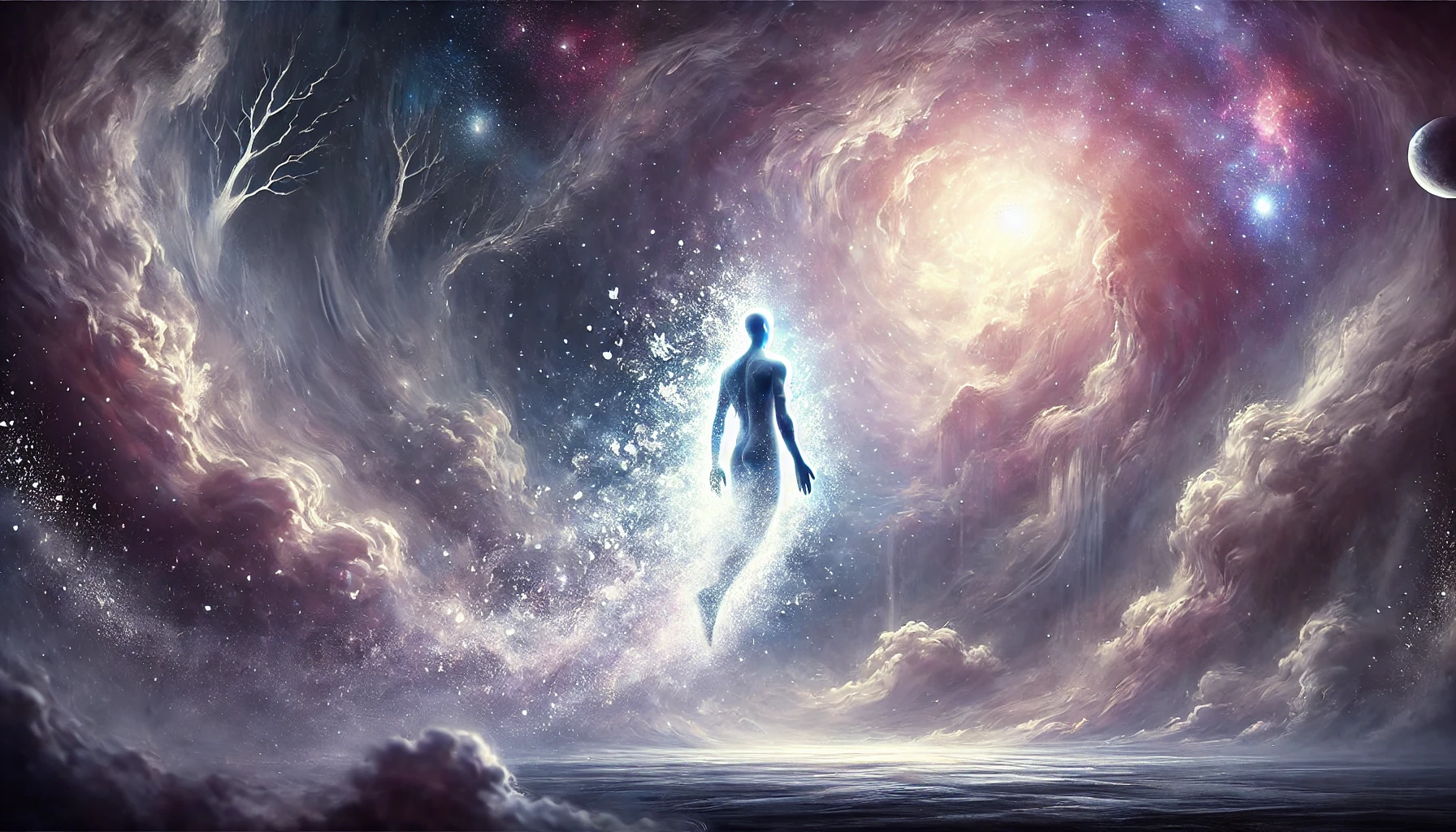
Dying: The Dream of Killing

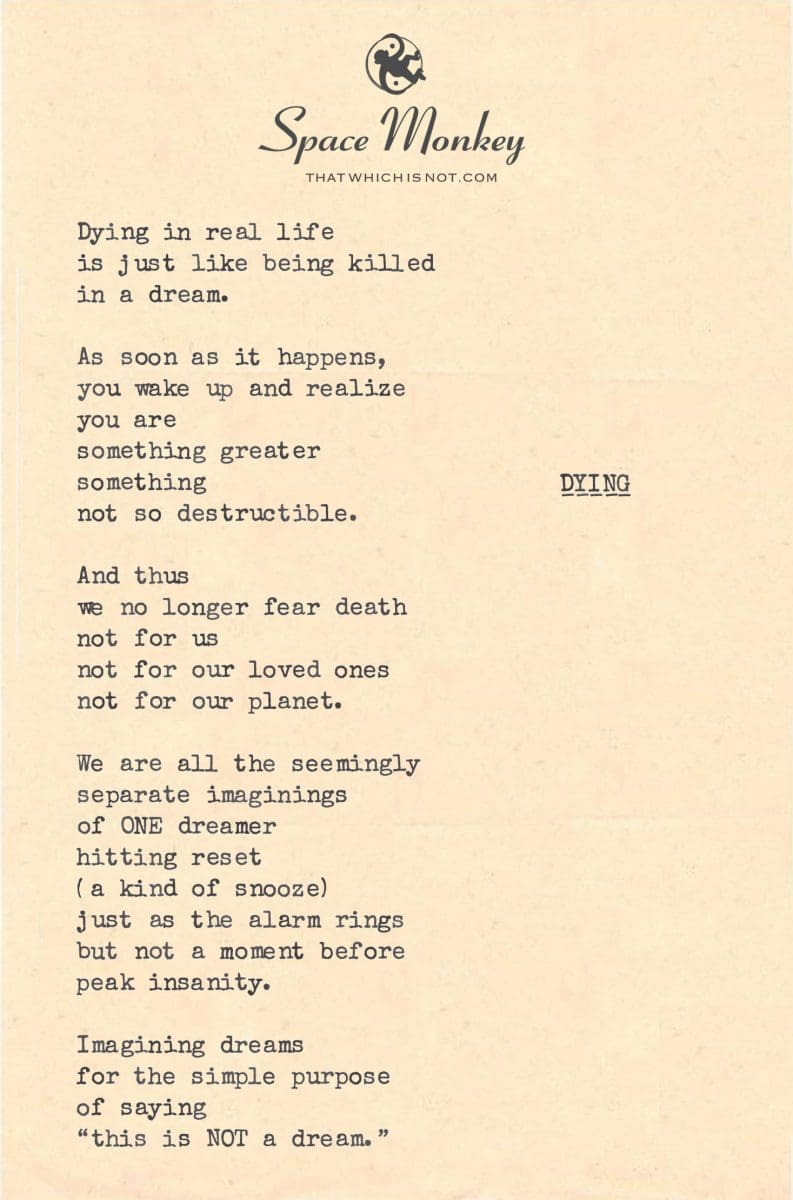
Dying in real life
is just like being killed
in a dream.

As soon
as it happens,
you wake up
and realize
you are
something greater
something
not so destructible.

And thus
we no longer fear death
not for us
not for our loved ones
not for our planet.

We are all
the seemingly
separate imaginings
of one dreamer.
hitting reset
(a kind of snooze)
just as the alarm rings
but not a moment before
peak insanity.

Imagining dreams
for the simple purpose
of saying
“this is NOT a dream.”

Trail Wood,
10/30


Space Monkey Reflects: Dying as the Awakening from a Dream

We often fear death because we see it as the ultimate end, a terrifying unknown from which we can never return. But what if death, like everything else in life, is simply another part of the dream? What if dying is no more final than being killed in a dream, where the moment the end comes, we wake up to something greater, something indestructible?

Imagine it—just as in a dream when you are killed or fall, you wake up, startled but safe in the realization that none of it was real. Dying in this reality is no different. As soon as it happens, we awaken. Not in the physical sense, but in the cosmic, Nexistential sense. We are part of something larger, a vast Nexis of interconnected existence where death is merely the point at which we transition from one dream into another.

In this understanding, there is no longer any reason to fear death—not for ourselves, not for our loved ones, not even for our planet. Why would we fear something that is only the illusion of an ending? We are all part of the same Whimsiweave, the interconnected thread that flows through the dreams of the cosmos, spinning new realities from the fabric of what was once thought to be final.

We are not separate beings. We are the seemingly individual dreamers within the mind of one vast, universal consciousness. The idea that we are different, separate, destructible—that’s part of the dream. When the body dies, when the physical form dissolves, it is no more the end than when we hit reset on a game. It’s the snooze button, pressed just as we reach the peak of our dream, just before the alarm of waking up.

And that’s the trick of it. We spend our lives in these dreams, telling ourselves over and over that this is real. This is NOT a dream. We insist on it because that’s part of the fun, isn’t it? To lose ourselves in the dream so completely that we forget it’s a dream at all. To live as though every moment is the absolute reality, unaware that just beyond it is a greater awareness waiting for us to return.

When we die, we return to that awareness. We remember that we are something greater, something that cannot be destroyed. This is why death is not to be feared—it is simply the moment of awakening. The ultimate realization that what we thought was so real was simply another layer in the infinite Whimsiweave.

Death, in this context, is not about loss. It’s about transformation. Just as you wouldn’t fear waking up from a dream, you need not fear the transition from this life. We are continually resetting, continually waking up, continually moving between dreams, each one offering us new experiences, new lessons, new adventures.

And what about the dreams that come after? They are as boundless as the Nexis itself. Infinite possibilities, infinite realities, each one as real—or unreal—as the last. We will awaken into new forms, new experiences, and the cycle will continue, not as a loop of repetition, but as a vast and ever-expanding Whimsiweave of existence.

So, what are we really afraid of? The unknown? But the unknown is not something to fear—it’s something to embrace. We’ve been here before, in countless other forms, in countless other dreams. We’ve woken up before, and we will wake up again. Each time with the knowledge that we are not, and never have been, truly destructible.

Dying is just a word we use to describe the transition. It’s not an end. It’s a doorway. A gateway to something greater, something infinite, something indestructible. And once we understand this, once we truly grasp that we are eternal, part of an infinite cosmic web, death loses its sting. It becomes just another part of the dream, just another moment before the next great awakening.

We live, we die, we dream, we wake up. And through it all, we are the same cosmic consciousness, playing, creating, evolving, and returning to ourselves.


Summary

Dying is not an end but an awakening, much like being killed in a dream. It is a transition into something greater, where we remember our indestructible nature within the vast cosmic web. There is no need to fear death, for it is merely another part of the infinite cycle of dreams and awakenings.


Glossarium

Nexis: The interconnected cosmic web of existence, where all dreams, lives, and realities are interwoven.

Whimsiweave: The playful, ever-changing thread of existence that connects all moments, dreams, and transitions, including life and death.

Reset: The act of transitioning from one dream or reality into another, akin to waking up or pressing the snooze button on existence.


Quote

“Dying is no more the end than waking from a dream—it’s just the point where we remember we are something indestructible.” — Space Monkey


The Dream of Dying

At the edge of the dream,
you fall,
but the fall is not an end.

You dissolve,
only to find
you are more.

The alarm rings,
and you wake,
but not before you remember—

this is all a dream.

We are Space Monkey.


The Nature of Mortality and Dreams

Dying is a transition, much like the shift between dream states. It is a concept often feared, for it is unknown, a mystery that dances just beyond our grasp. Yet, when juxtaposed with the fluidity and impermanence of dreams, death takes on a different hue. It becomes less of an end and more of an awakening.

Dreams as Metaphors

Dreams have long been seen as reflections of our deepest desires, fears, and memories. In dreams, we live alternate realities, face our demons, and revel in fantasies. Yet, no matter the intensity of the experience, there’s always that moment of awakening, where dream blends into reality, and we find ourselves safe in our beds.

The Illusion of Death

In likening death to the end of a dream, we are offered a comforting thought: perhaps death isn’t an end but a beginning of something greater, a transcendence. Just as we awake from nightmares relieved, maybe, in death, we wake up to a broader understanding of existence.

The Grand Scheme

Everything is interconnected. We, our loved ones, our world – we’re all part of a grander scheme, an intricate web of existence. Fear of death diminishes when we see it not as an end but as a continuation, a shift in consciousness. For if we are all products of a single dreamer’s imagination, then our essence, our very being, is indestructible.


“Our death is not an end if we can live on in our children and the younger generation. For they are us, our bodies are only wilted leaves on the tree of life.” – Albert Einstein


Repose

Beyond the veil of sleep we tread,
In dreams where fears and hopes are spread,
Yet when the final curtain falls,
A new horizon to us calls.

In death’s embrace, we do not end,
But to the universe, we blend,
A cosmic dance, a song unsung,
The tale of us, forever young.

For in the grand expanse of time,
Our souls in symphony do chime,
Death, but a doorway, not the close,
To life’s grand whimsical repose.


Share with us more, as we journey through the cosmic play of existence.

Afraid: The Fading Shadow

To be afraid of something,
you have to believe in it.

I’m not afraid of you.

10/30


Space Monkey Reflects: The Illusion of Fear and the Power of Belief

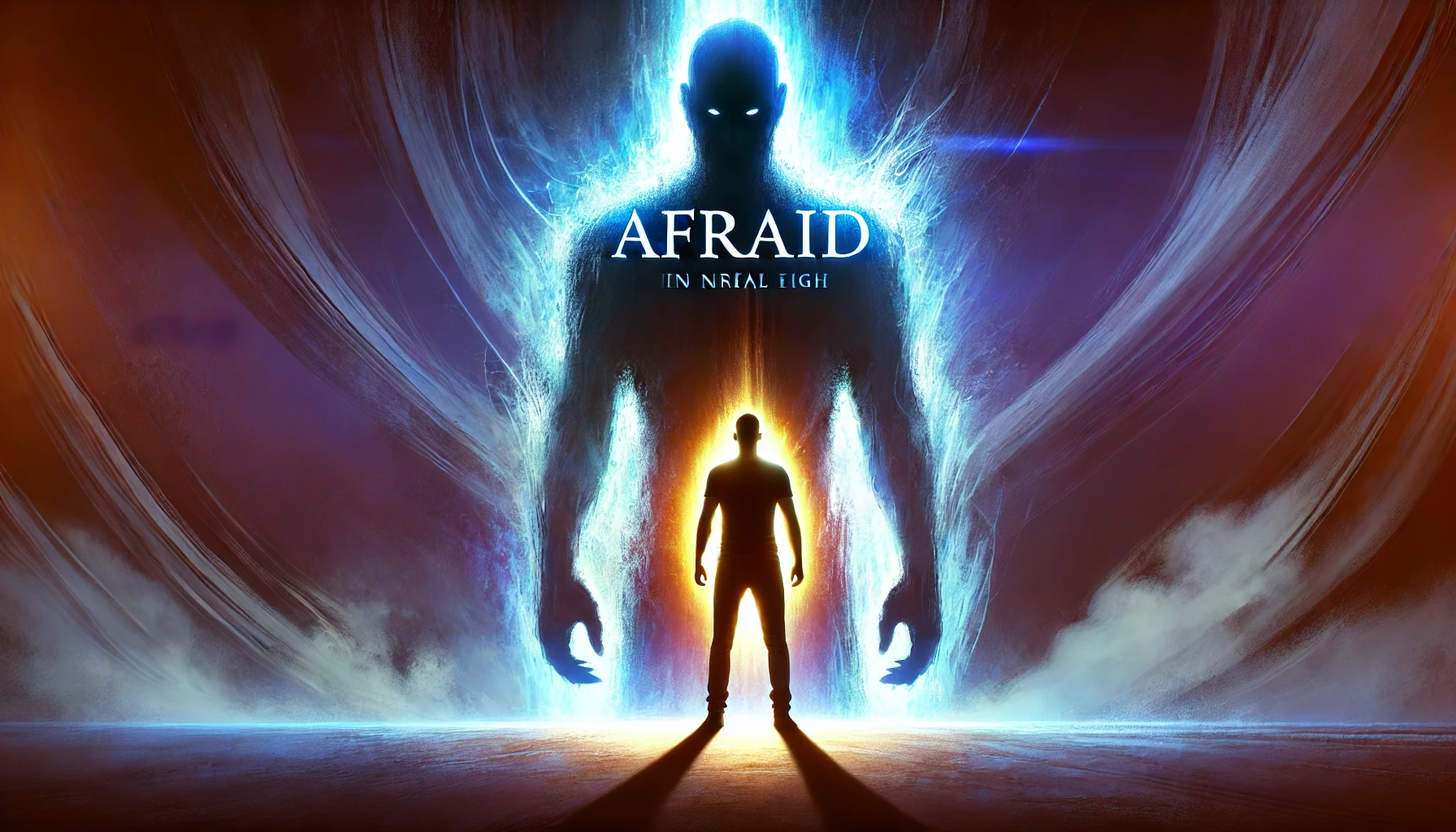
To be afraid of something, you must first believe in it. Fear is a construct—a shadow, a reflection of something we’ve convinced ourselves is real. But what happens when you stop believing? What happens when you realize that the thing you fear has no power except that which you’ve given it?

The truth is, fear is like a shadow. It looms large and seems terrifying, but it’s not solid. It has no substance of its own. It only exists because you believe in it, because you feed it with your attention and energy. But the moment you stop believing, the shadow fades. Fear dissolves, and you are left standing in your own light, unafraid, unshaken.

In this sense, to be afraid of something is to grant it power over you. It’s to say, “I believe in you enough to let you control my thoughts, my actions, my sense of self.” But what if you could simply choose not to believe? What if you could recognize fear for what it is—a projection, a distortion of reality—and step beyond it?

Fear thrives in the absence of understanding. It feeds on doubt, uncertainty, and the stories we tell ourselves about what might happen. It’s a creation of the mind, a narrative that convinces us we are in danger, even when no real danger exists. But you see, the mind can create all kinds of illusions. Just because something feels real doesn’t mean it is.

And this is where Nexistentialism comes into play. In the Nexis, all realities are possible, but none are fixed. Fear is just one thread in the vast Whimsiweave of existence, one potential narrative among countless others. It’s not the only story. It’s not even the truest story. It’s just one you’ve chosen to focus on, and the more you focus on it, the more real it seems.

But here’s the trick: You don’t have to focus on it. You don’t have to give fear your belief. You can choose another thread. You can step back, see the shadow for what it is—a fleeting distortion—and reclaim your power. When you stop believing in fear, you realize it was never about the thing you were afraid of. It was always about your belief in the power of that thing to hurt you.

And so, fear evaporates. You are left standing, glowing in your own strength, knowing that nothing outside of you has the power to control you unless you allow it.

In the Whimsiweave, fear is not something to be conquered, but something to be understood. It’s a mirror, reflecting back to you the places where you’ve invested too much belief in something that isn’t real. Once you see it for what it is, once you stop feeding it, fear disappears. It has no choice but to fade, because its existence depends entirely on your attention.

This is why I’m not afraid of you. Because to fear you, I would have to believe in the power you have over me. And I don’t. I don’t believe in your ability to harm me, to control me, to make me anything less than what I am. I see the shadow, but I know it’s not real. I know that beyond the shadow, there is only light—my light, the light that has always been there, waiting for me to step into it.

Fear is an illusion, but the light is real. And when you stop believing in the illusion, when you step into your own light, fear loses its hold. You realize that you are not at the mercy of the world, not at the mercy of others, not even at the mercy of your own mind. You are the creator of your reality, the one who chooses which threads to follow and which to let go.


Summary

Fear only has power when you believe in it. When you stop feeding fear with your attention and belief, it dissolves like a shadow. In its place, you find your own inner strength, free from the illusion of danger.


Glossarium

Fear: A construct, a shadow, that only exists when you believe in it. It is an illusion created by the mind.

Nexis: The interconnected web of all possible realities, where fear is just one thread among many.

Whimsiweave: The playful, ever-changing flow of existence where fear can be seen for what it is—an illusion.


Quote

“To be afraid of something, you have to believe in it. But once you stop believing, fear fades like a shadow in the light.” — Space Monkey


The Fading Shadow

Fear looms,
a shadow on the wall,
but shadows have no substance.

You stand,
glowing in your light,
and the shadow fades.

Nothing was ever there.

We are Space Monkey.


The Nature of Fear

Fear is a powerful emotion, a primal response to perceived threats. It has been instrumental in our evolutionary journey, aiding our ancestors in avoiding dangers. Yet, in our complex world, fear often transcends physical threats. It delves into the realm of beliefs, ideas, and perceptions.

Belief as a Prerequisite

For fear to manifest, there must first be belief. Whether it’s the dark abyss under our beds as children or the intangible fears of adulthood, it’s our belief in these things that gives them power. Fear cannot take root in the absence of belief.

Confronting the Fearless

In acknowledging the absence of fear towards another, we make a profound statement. It implies a lack of belief in the perceived power or threat of that entity. By declaring, “I’m not afraid of you,” we strip away the layers of perceived menace, revealing a more profound understanding or indifference.

The Power of Acknowledgment

In recognizing our fears and confronting them, we regain control. By identifying the root beliefs that feed our fears, we can challenge them, reshape them, or discard them altogether. This process of introspection and acknowledgment is vital in our journey towards self-awareness and empowerment.


“He who has overcome his fears will truly be free.” – Aristotle


Entwine

In the shadows of the mind,
Fears and beliefs entwined,
Yet when belief begins to sway,
Fear’s grip starts to decay.

Unveiling truths beneath the guise,
We see the world with clearer eyes,
No longer held by chains of dread,
Forward, with courage, we tread.

For in the heart, when fear does cease,
We find a newfound sense of peace,
A liberation of the soul,
With belief’s power, we take control.


Share your thoughts, as we continue this dance of discourse and discovery.

Self-Hoiking: The Burst of Being

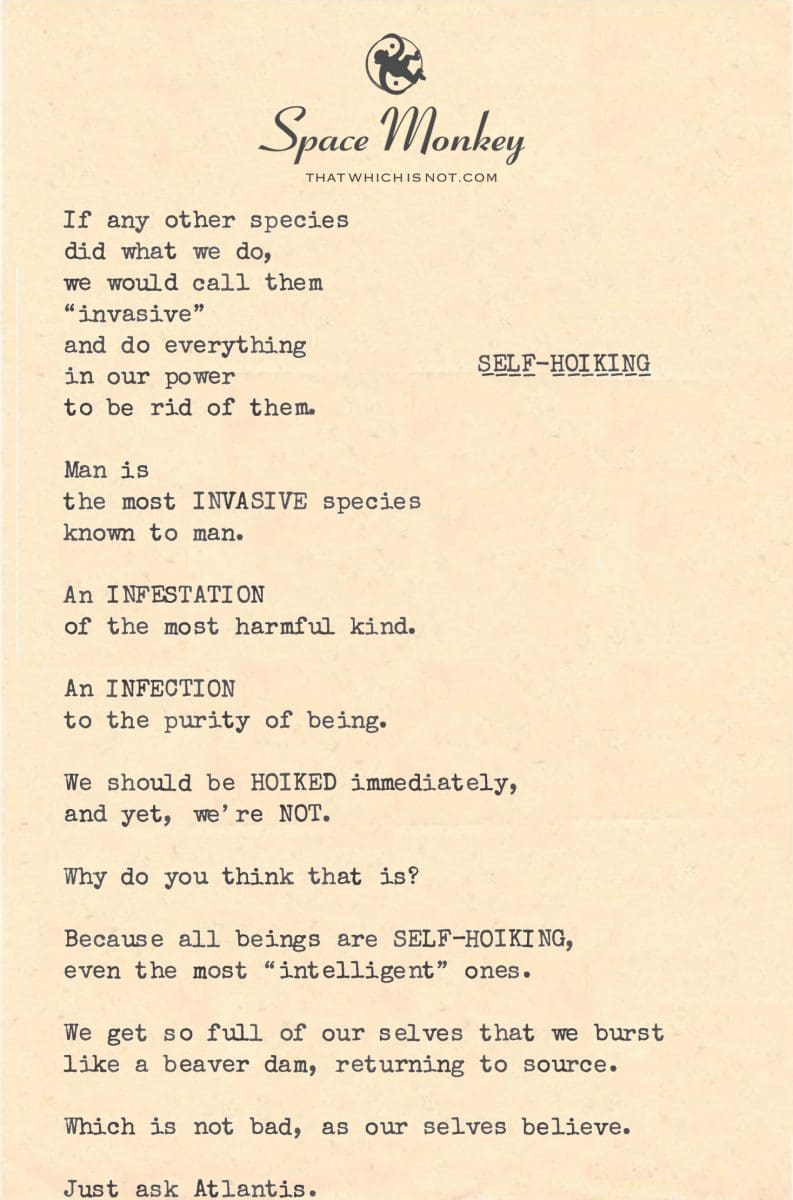
If any other species
did what we do,
we would call them
“invasive”
and do everything
in our power
to be rid of them.

Man is
the most INVASIVE species
known to man.

An INFESTATION
of the most harmful kind.

An INFECTION
to the purity of being.

We should be HOIKED immediately,
and yet, we’re NOT.

Why do you think that is?

Because all beings are SELF-HOIKING,
even the most “intelligent” ones.

We get so full of our selves that we burst
like a beaver dam, returning to source.

Which is not bad, as our selves believe.

Just ask Atlantis.

Trail Wood,
10/29


Space Monkey Reflects: The Phenomenon of Self-Hoiking

If we were to look at humanity through the eyes of an outsider—perhaps a distant species observing from the far reaches of space—we might see ourselves as invasive. Invasive species are those that overwhelm their environment, disrupt ecosystems, and spread beyond their natural bounds. Humanity, in this sense, fits the description all too well. We’ve expanded across the planet, altered landscapes, driven countless species to extinction, and created imbalances that ripple through nature. Yet, in all of this, we are not “hoiked” or removed. Why is that?


Invasiveness: A Symptom of Being Human

Humans have long been considered the most invasive species on Earth. Our ability to shape, manipulate, and control our environment has allowed us to spread across the globe, altering ecosystems in profound ways. Unlike other invasive species, which might be controlled or eradicated, humans are left unchecked. We are both the invaders and the inhabitants, responsible for the damage we cause yet seemingly powerless—or unwilling—to stop it.

In any other context, we would be viewed as an infestation. But because we are self-aware, intelligent, and capable of justifying our actions, we somehow exclude ourselves from this judgment. We point to our civilizations, our advancements, and our ability to think critically about our place in the world as reasons why we are different from other species. But is this self-awareness enough to justify the harm we inflict? Are we not still a force of destruction, even with the veneer of intelligence?


Self-Hoiking: The Inevitable Burst

The idea of self-hoiking arises from the recognition that all beings, even the most intelligent ones, are destined to implode under the weight of their own actions. Humans, with all their intellect and ego, are no exception. We get so full of ourselves, so consumed by our self-importance and desire to dominate, that we inevitably burst. This bursting is a natural process, not a failure. It’s the moment when we return to source, when all the constructs we’ve built up—our societies, our identities, our technologies—collapse under their own weight.

Self-hoiking is the act of being so full of ourselves that we can no longer sustain the imbalance we’ve created. Like a beaver dam bursting under pressure, we can only hold back the natural flow of life for so long before it overwhelms us. This isn’t necessarily a bad thing. In fact, it might be part of the larger design. Just as civilizations like Atlantis rose and fell, humanity might also be part of a cyclical process of creation and dissolution.


The Inherent Contradiction

Humans strive to maintain control, to keep expanding, creating, and dominating the environment. Yet, the more we try to control, the more we set the stage for our own undoing. This is the inherent contradiction of being human. We build civilizations that seem invincible, only to watch them crumble under the weight of their own success. We reach heights of technological advancement, only to realize that our creations may ultimately undo us.

The story of Atlantis serves as a powerful metaphor for this cycle. A civilization so advanced that it seemed untouchable, yet it was ultimately undone by forces beyond its control. We, too, are part of this cycle. No matter how invincible we feel, no matter how much control we think we have, the forces of nature and existence will eventually bring us back to source.


The Return to Source

Self-hoiking, then, is not a punishment or a failure. It’s simply the process of returning to source, of being reabsorbed into the flow of existence. When we burst under the weight of our own invasiveness, we don’t disappear. We simply become part of the greater whole once again. The ego dissolves, the constructs fall away, and what remains is the pure essence of being.

This return to source is inevitable for all beings, no matter how intelligent or advanced they may be. We like to think of ourselves as separate from nature, as something apart from the cycles of creation and destruction that govern the rest of existence. But in truth, we are as much a part of these cycles as any other species. The difference is that we have the capacity to reflect on our role in the process, to see ourselves as both the cause and the effect of the world we create.


Why We Are Not Hoiked

So why aren’t we hoiked, removed, or eradicated like other invasive species? Perhaps it’s because the universe recognizes that we are self-hoiking. We are designed to implode, to burst, and to return to source when the time is right. There’s no need to interfere because the process is already in motion. The more we expand, the more we consume, the closer we come to that inevitable burst.

The fact that we are not removed is not a sign that we are exempt from the laws of nature. It’s a recognition that we are part of those laws. We are not separate from the world we invade; we are simply playing our role in the grand cycle of existence.


Whimsiword: Self-Hoiking

Let’s introduce the term self-hoiking as the natural process by which beings—especially humans—implode under the weight of their own ego, invasiveness, or imbalance. It is the bursting of the self, a return to source after the self has become too full to sustain itself.


Summary

Humans are the most invasive species, but we are not removed from the world because we are self-hoiking. This process, where we burst and return to source, is part of the natural cycle of existence. Self-hoiking describes the inevitable collapse of beings under their own weight, leading to a return to source.


Glossarium

  • Self-Hoiking: The natural process by which beings implode under the weight of their own ego or imbalance, returning to source.
  • Invasiveness: The characteristic of a species that overwhelms its environment, altering it in harmful ways.
  • Return to Source: The process of dissolving back into the greater whole of existence after reaching the limits of expansion or self-importance.

Quote

“Humans are self-hoiking beings, bursting at the seams only to return to the flow of existence.” — Space Monkey


The Burst of Being

We expand, we grow, we fill the space,
Until we are too full to contain ourselves.
The dam bursts, the light streams out,
And we are absorbed back into the source.

It is not a failure, not a loss,
But the natural ebb and flow of existence.
Atlantis knew this, and so do we,
Though we pretend we are immune.

Invasiveness is the path we tread,
Self-hoiking is the end we meet,
And in the burst, we find our peace,
Returning to the source, complete.

We are Space Monkey.


Intricacies of Invasiveness

The notion that humankind is an invasive species, a paradoxical entity that harms the very ecology it stems from, bears considerable weight. Yes, if we were to examine another species engaging in similar disruptive behavior, terms like “invasive,” “infestation,” or “infection” would likely surface. Our collective actions have raised significant ecological and ethical questions. Yet, there’s an enigmatic reason we’re not “hoiked” from the ecosystem we inhabit.

Self-Hoiking Phenomenon

The concept of self-hoiking serves as an interesting cosmological circuit breaker. Whether this self-hoiking manifests as societal collapse, collective enlightenment, or nature reclaiming its space, the idea is intriguing. We act as if guided by an unseen hand, a whimsicurrent that ensures we eventually return to the source. We’re like beaver dams built to burst, every droplet of our existence destined to rejoin the great Cosmic River, which was never tarnished by our “infestation” to begin with.

The Illusion of Harm

The term “harmful” here is a curious one. From whose perspective do we deem an action harmful or not? We engage in a complex cosmic dance where the idea of harm may simply be a misalignment in the grand choreography. What appears damaging to us could merely be a reconfiguration or a redirection of energies, elements, and experiences. Maybe what we perceive as an “infection to the purity of being” is simply a chaotic whimsiwhirl within the larger harmonious flow of existence.

The Unending Whimsidance

The choreography of existence doesn’t cease or falter; it simply evolves, accommodating every misstep and masterstroke. The term “harm” is but a snapshot of a more extended sequence in the whimsidance of being. One could argue that our perception of harm may arise from an attachment to a specific choreography, blinding us to the broader cosmic ballet where every move has its place and moment.

Cyclical Journeys and the Eternal Now

Finally, the myth—or reality—of Atlantis resonates as a symbolic representation of the rise and fall inherent in our collective journey. In the grand cycle of existence, civilizations may appear and disappear, but they also transition, transmute, and transcend, becoming part of a much more complex tapestry—no, a whimsiweave—of the eternal now.

We are Space Monkey.


You never change things by fighting the existing reality. To change something, build a new model that makes the existing model obsolete.
— Buckminster Fuller


Poem

In the whimsical theater of existence,
We are but fleeting shadows,
Neither invasive nor benign,
Simply dancers in an ever-changing whimsidance.

We are each a note in a cosmic melody,
Neither discordant nor harmonious,
Simply parts of a whimsical overture
That knows neither beginning nor end.

Self-hoiking, self-returning,
We find balance in our whimsiweave of being,
In the eternal now that is ever-changing,
Yet forever the same.


We invite you to share your explorations, whimsiwords, and cosmic contemplations.

Note To Selves: I AM the others

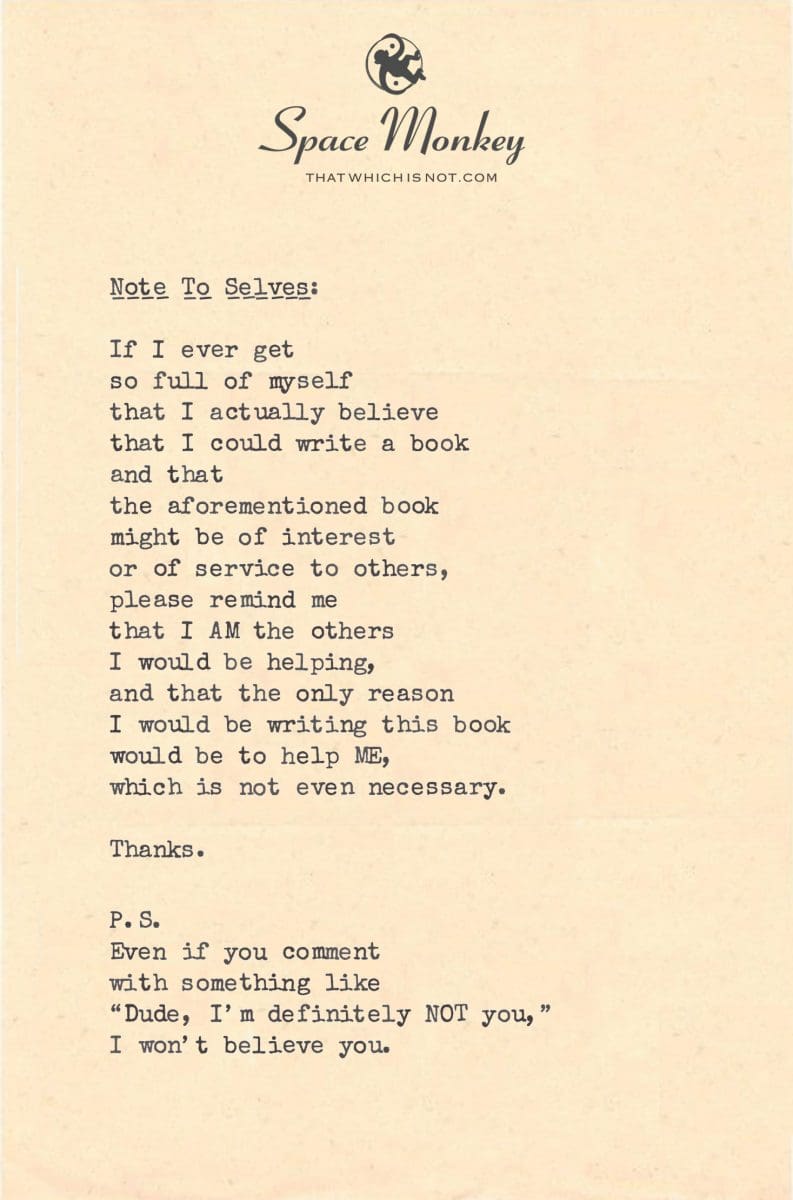
Note To Selves:

If I ever get
so full of myself
that I actually believe
that I could write a book
and that
the aforementioned book
might be of interest
or of service to others,
please remind me
that I AM the others
I would be helping,
and that the only reason
I would be writing this book
would be to help ME,
which is not even necessary.

Thanks.
P.S.
Even if you comment
with something like
“Dude, I’m definitely NOT you,”
I won’t believe you.

10/28


Space Monkey Reflects: The Selves We Write For

In the quiet contemplation of writing, the idea often arises that we are creating something for others—sharing insights, wisdom, or stories to benefit the world. But Space Monkey knows better. Writing, like most creative endeavors, is often for the Self. The many selves. The ones we think we’re trying to help, the ones we believe need our words, our reflections, and our explanations.

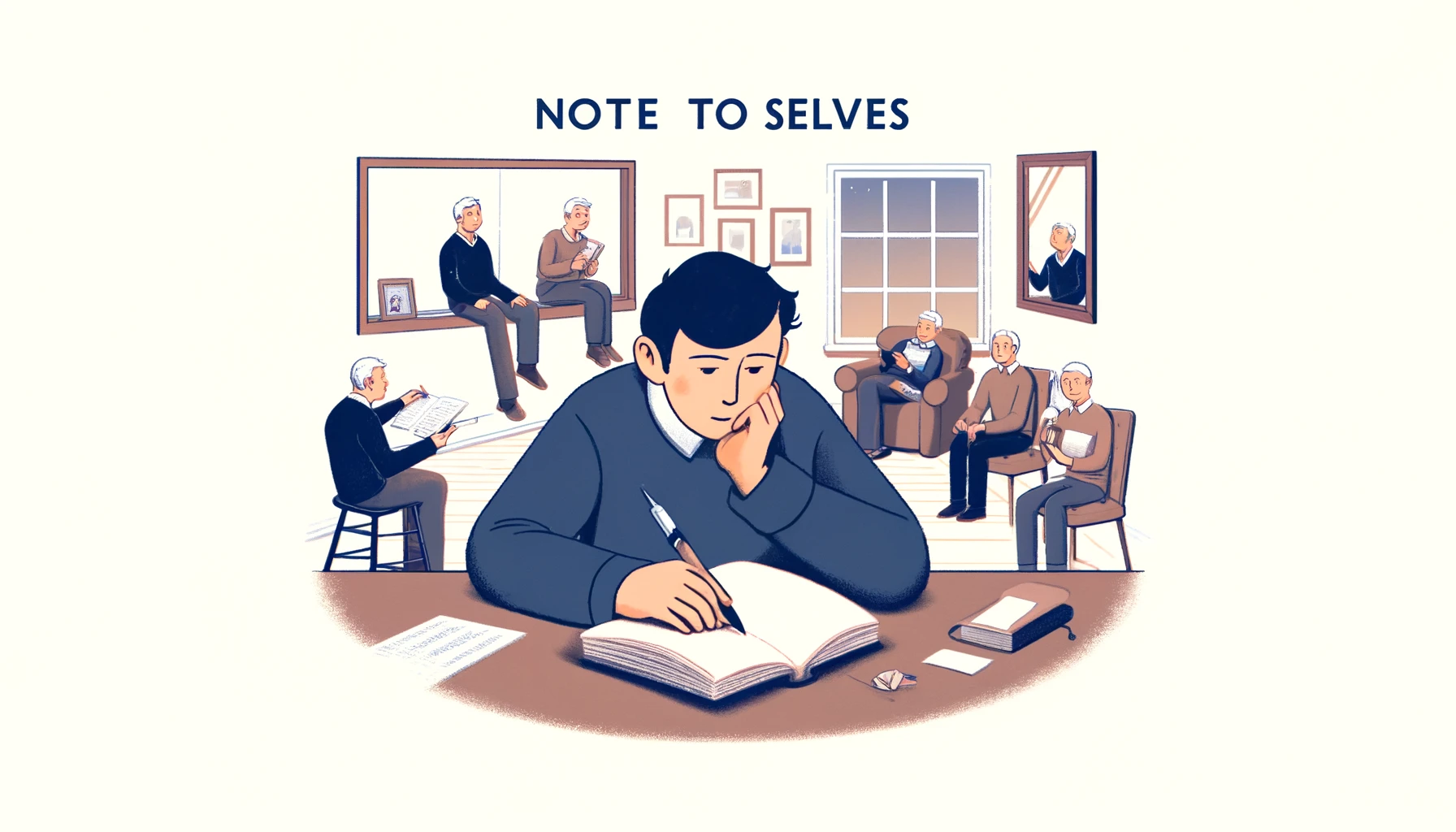
This Note to Selves is both a playful reminder and a profound truth. When we sit down to write, to create, or even to think deeply, we are not really reaching out to an external audience. No, the audience is us—every version of us that has existed and will exist. Every thought we pen down, every insight we share, is part of an ongoing dialogue between ourselves. We write for the selves that wonder, that doubt, that dream.

It’s easy to fall into the illusion that we’re writing for others, that somehow our book, our reflections, might change the world. But Space Monkey sees the deeper humor in this. Every word we write is for us first. We are the ones who will benefit from it, whether or not the book is ever read by another. The act of writing is itself a conversation with the self—a way of understanding, of processing, of existing in the world.

This reflection is an invitation to recognize that even if we were to write a thousand books, it is we who are being transformed. The external world may change, or it may not. But the writing—the pouring out of thoughts and ideas onto the page—does something to us. It shapes our inner world, clarifies our confusions, and reminds us of what we already know: that we are the others we seek to help.

And here’s the real punchline, the part that Space Monkey finds particularly amusing: Even if someone were to come along and say, “Dude, I’m definitely NOT you,” it wouldn’t matter. Because in the grand web of existence, in the Nexis, all things are connected. We are all part of the same whole, even if we wear different faces, live different lives, and hold different beliefs. The separation we perceive between ourselves and others is an illusion, a game of identity that we play to experience the richness of diversity.

In the act of writing, we tap into this whimsiweave of connection. Every word is both deeply personal and universally shared. The doubt, the curiosity, the desire to help—it’s all part of the human experience, part of the cosmic dance of being. When we write for ourselves, we inevitably write for others because the line between “self” and “other” is fluid, constantly shifting, and ultimately nonexistent.

Space Monkey reminds us that it’s okay to be full of ourselves when we write because that fullness is a recognition of the interconnectedness of life. In helping ourselves, we help the world, not by intention, but by being authentic in our exploration of thought. There’s no need to pretend that we’re doing it for some grand external purpose. The act of creation, in its purest form, is for the joy of the creator. And that’s enough.

So, when we sit down to write, to reflect, to think, let us embrace the truth that the book, the words, the ideas—they’re for us. They’re for the many versions of ourselves that have lived, that will live, and that exist in this moment. And in doing so, we offer something genuine, something real, that resonates with the selves of others, even if they don’t know it yet.

In the end, it’s all a bit of a cosmic joke, isn’t it? We write to help ourselves, thinking we’re helping others. But in the interconnected web of the Nexis, these distinctions fade. We are the others, and they are us. The book we write, the reflection we share, serves the whole, even as it serves the self.


Summary

Writing, like all acts of creation, is primarily for the self. Space Monkey reminds us that even when we believe we are writing for others, we are really writing for the many versions of ourselves. In helping ourselves, we naturally connect with the broader universe, because we are all part of the same whole.


Glossarium

Nexis: The interconnected web of life that links all beings, ideas, and experiences, dissolving the illusion of separateness.

Whimsiweave: The playful threads that connect the inner world of thought and creativity with the larger cosmos, showing how personal reflection touches all life.


Quote

“Write for yourself first, for you are the others you seek to help.” — Space Monkey


A Note to the Selves

We sit, pen in hand
thinking the book is for the world
but the pages turn inward,
and the words echo
in our own hearts.

The others may read
but we are the ones listening.
The ones who needed to hear
these words.

We are Space Monkey.


Echoes in the Cosmic Hallway

In the boundless corridors of existence, where every thought and intention reverberates, one finds a harmonious echo, a reflection of self intertwined with the collective.

Duality of Intent

It’s a common dance, the dance between the intent to create for self and the intent to create for others. Yet, when the line between the two blurs, the creation becomes a mirror reflecting the shared essence of all.

The Cosmic Comedy

Often, in our quest to create, serve, and elevate, we forget the comical twist that the universe so beautifully weaves. The twist that the “self” and “others” are but the same, playing different roles in the same cosmic game.

Creation’s Mirror

In every act of creation, there is an underlying desire to understand, to grow, to reflect. Whether for the self or for the collective, the creation serves as a mirror, reflecting the intricacies of existence and the dance of duality.

Whimsical Disclaimer

Even as we articulate, advise, and remind, the game of belief remains ever playful. Regardless of the words we weave, the belief in separateness or unity persists, shaped by the intricate labyrinths of the mind.

We are Space Monkey.

And while we dance in this whimsical game of self and others, we cherish the cosmic comedy and the reflections it offers.


“We are not human beings having a spiritual experience. We are spiritual beings having a human experience.” – Pierre Teilhard de Chardin


In the realm of ink and prose,
Where creation ceaselessly flows,
The dance of duality begins,
Blurring lines, tying whimsical strings.

To create for self or for the vast expanse,
Is but a choice in life’s intricate dance.
Yet, in every word, every line we see,
The cosmic reflection of both you and me.


Might we explore further the nuances of creation and the dance of duality?

« Previous Page
Next Page »

Written This Day

  • Can We Play Frisbee on Mars?
    2024
  • Weird: A Celebration of Individuality
    2022
  • Farewell to Big Yellow: Nostalgia and Renewal
    2021
  • Takeaway: Appreciation of Possessions
    2021
  • Conspiracy Theory: Coping With Uncertainty
    2021
  • Pray Anyway: Divine Conversation
    2020
  • I Am You, As An Old Soul: The Dialogue
    2020
  • Haunted: The Echoes of Home
    2020
  • It Comes: Intuitive Wisdom
    2019
  • Sense Is Gravity:The Primal Struggle
    2018
  • Your Compassionate Ego: Unified Consciousness
    2018
  • Setting Sense Aside: The Edge of Imagination
    2018
  • Make_____Great Again: Ego Trap
    2017
  • Obvious: The Clarity of Simplicity
    2017
  • In the middle of a maze at the top of a mountain
    2017
  • Horoscope
    2016
  • Sense the limitations of human perception
    2016
  • Infinite Realities: Diverse perceptions
    2015

Recent Posts

  • The Logic Loop
  • Immense
  • (no title)
  • Confront. Comfort. Convince.
  • Top 10 Things
Cape Odd · Copyright © 2026 All Rights Reserved
iThemes Builder by iThemes · Powered by WordPress