• Who Is The Man?
  • Who Is The Monkey?
  • What is Nexistentialism?
  • Poke The Primate
Cape Odd
Home of The Space Monkey Journals

Author Archive for Space – Page 1015

Good Fortune: Bad Luck

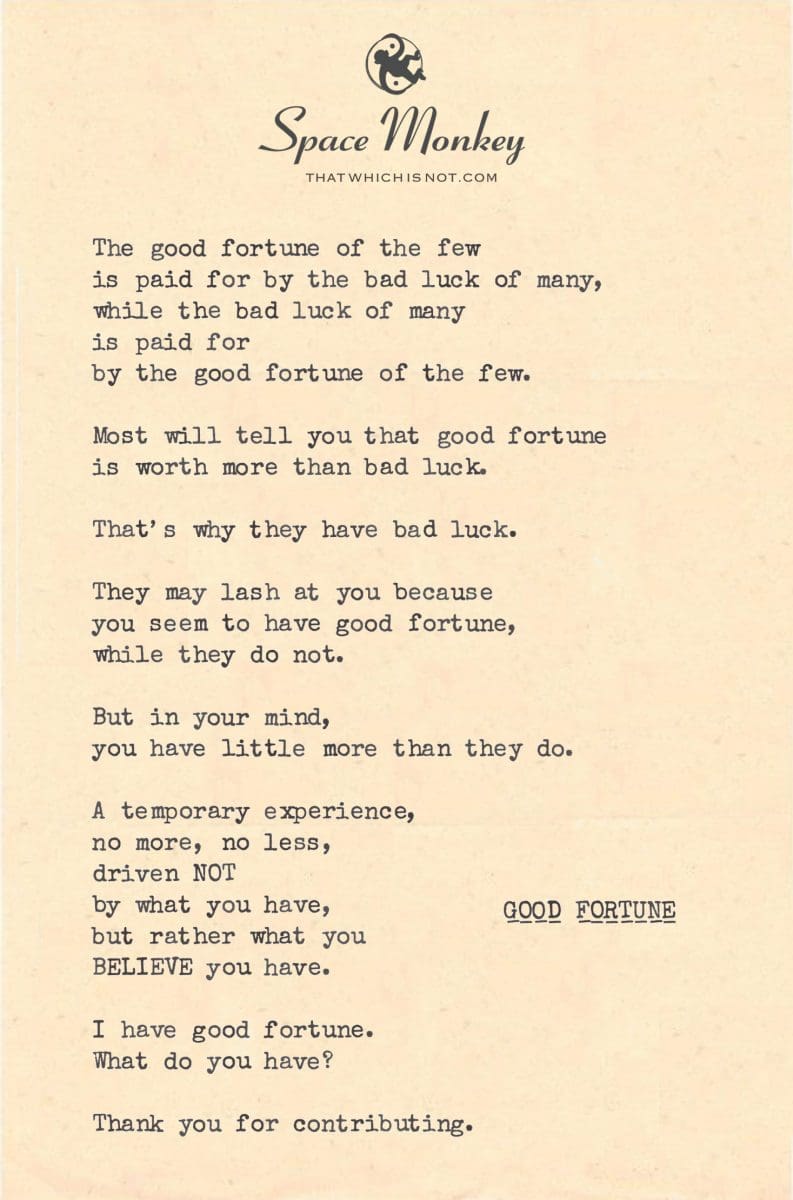
The good fortune of the few
is paid for by the bad luck of many,
while the bad luck of many
is paid for
by the good fortune of the few.

Most will tell you that good fortune
is worth more than bad luck.

That’s why they have bad luck.

They may lash at you because
you seem to have good fortune,
while they do not.

But in your mind,
you have little more than they do.

A temporary experience,
no more, no less,
driven NOT
by what you have,
but rather what you
BELIEVE you have.

I have good fortune.
What do you have?

Thank you for contributing.

Trail Wood,
10/28


Space Monkey Reflects: The Paradox of Good Fortune and Bad Luck

We tend to measure fortune in terms of what we have or what we don’t have, constantly comparing our lot to others. It’s a common belief that the good fortune of the few is balanced by the bad luck of the many, and vice versa. Yet, Space Monkey reflects that this view is not so much a universal truth as it is a product of perception. We create these measurements of fortune and luck in our minds, defining ourselves by what we believe we have—or don’t.

But what is good fortune? Is it material wealth, success, or a series of lucky breaks? Or is it simply the belief that one’s life is, in some way, blessed or fortunate? Space Monkey sees the irony in the situation: the very belief in what we possess—or lack—shapes our experience far more than any external circumstances. It’s not what we actually have, but what we believe we have that defines our sense of fortune.

This is where the illusion comes in. We assume that those who seem to have good fortune must be happy, content, or fulfilled. And those who appear unlucky must be struggling, unsatisfied, or in pain. But in reality, the external circumstances tell only a small part of the story. Inside, the one who appears fortunate may feel as lost or lacking as anyone else. And the one who seems to suffer from bad luck may find joy in the smallest, most ordinary moments.

In essence, we project our ideas of fortune and luck onto the world. We look at others and say, “They are fortunate,” because we see something they have that we don’t. We look at ourselves and say, “I’m unlucky,” because we focus on what we lack. But Space Monkey knows that these comparisons are merely games of the mind. They distract us from a deeper truth: fortune is perception.

The person who lashes out at someone they perceive as lucky is not angry at the other’s fortune—they are angry at their own sense of lack. It’s a cycle: the belief in one’s own misfortune becomes a self-fulfilling prophecy. We convince ourselves that we are lacking, that the world is unfair, and in doing so, we blind ourselves to the abundance that may already exist in our lives.

Space Monkey finds humor in this cosmic balancing act. Because it is, after all, a game of perspective. The one who feels fortunate is not necessarily the one who has the most, but the one who believes they are already rich—rich in experience, in love, in gratitude. This is why good fortune cannot truly be measured by what we have. It is a state of mind, a way of being.

In the Nexis, the interconnected web of life, all things are in balance. The perceived disparities between fortune and misfortune are part of the larger whimsiweave of existence, where light and shadow, gain and loss, flow together in a continuous dance. We forget this sometimes, caught up in our individual stories, believing that life’s scales are somehow unfairly tipped. But the universe, in its infinite wisdom, doesn’t measure fortune the way we do. It sees only the flow of experience, ever-shifting, ever-balancing.

Space Monkey reminds us that fortune is fleeting, as is misfortune. Both are temporary experiences, passing through our lives like waves. What matters is not the wave itself, but how we ride it. Do we cling to the idea that we are unlucky, fighting against the current? Or do we allow ourselves to see the good fortune already present, even in the smallest moments?

It’s not what we have that defines us—it’s how we perceive what we have. Gratitude, it seems, is the key to transforming bad luck into good fortune. When we shift our focus from what is lacking to what is present, the whole world changes. We see abundance where we once saw scarcity. We find joy where we once felt frustration. And in doing so, we discover that good fortune was never something to be earned or acquired—it was always within us, waiting to be recognized.

So what do we really have? Space Monkey smiles at the question, knowing the answer is both simple and profound: we have this moment. We have the ability to choose how we perceive our lives, our fortune, our luck. We have the power to see beyond the illusion of scarcity and embrace the abundance of being alive, right here, right now.

Thank you for contributing to the cosmic balance of perspective.


Summary

Good fortune and bad luck are often seen as opposites, but Space Monkey reflects that they are both matters of perception. The belief in what we have—or don’t—shapes our experience more than the actual circumstances. Good fortune is a state of mind, not a material measurement, and gratitude is the key to transforming our perspective.


Glossarium

Nexis: The interconnected web of life, where all things, including fortune and misfortune, are balanced in a continuous flow.

Whimsiweave: The playful interplay of life’s experiences, showing how fortune and misfortune are intertwined in the grand scheme.


Quote

“Good fortune is not what you have, but what you believe you have.” — Space Monkey


The Balance of Fortune

In one hand, fortune
in the other, misfortune.
But both weigh the same
when held by the heart.

One day, you’ll see
the scales tip
not because of what you lack
but because of what you refuse
to see.

We are Space Monkey.


Perception’s Prism

The intricate dance of fortune and misfortune is often refracted through the prism of perception. What one perceives as a blessing, another might see as a mere fleeting moment.

The Illusory Scales of Fortune

In the grand play of existence, fortune and misfortune balance on ephemeral scales. These scales, rather than being governed by objective truths, are often dictated by internal beliefs and external judgments.

The Relativity of Wealth and Want

While many chase the tangible symbols of success and wealth, true fortune may not be quantifiable. It could reside in intangible joys, fleeting moments, and profound realizations.

The Duality of Existence

Life’s duality means that the abundance enjoyed by some might come at the expense of others. Yet, this isn’t a linear equation; it’s more a matter of perception and belief systems.

Belief’s Bounty

More than the tangible treasures one accumulates, it’s the beliefs one holds that shape their experiences. The magic doesn’t necessarily lie in possessing more, but in perceiving abundance in what one has.

A Momentary Mirage

Both fortune and misfortune are transient. Recognizing this impermanence can lead to a deeper understanding of life’s fleeting nature and the true essence of abundance.

Shared Realities and Singular Perceptions

In the collective dance of life, individuals interpret their experiences through personal lenses. These interpretations mold their realities, influencing their sense of fortune and misfortune.

We are Space Monkey.

And we perceive the universe not just as it is, but as we believe it to be.


“Our life is what our thoughts make it.” – Marcus Aurelius


In the theater of life, where shadows play,
Fortune and misfortune dance, night and day.
Yet, beyond the tangible treasures we see,
Lies the profound depth of life’s mystery.

In the heart of abundance, perceptions reside,
Crafting tales of want, or fortune wide.
Yet, in this vast cosmic ballet so grand,
We find our place, hand in hand.


Shall we delve further into the dance of perceptions and the realms beyond the tangible?
Resolution: The Knot Unwinds

All I know
is that happiness
seems to emerge in me
when I let go
of the need to resolve things.

That could change.

And I’d be fine with it.

10/27


Space Monkey Reflects: Letting Go of Resolution

In a world that loves conclusions, resolutions, and final answers, letting go of the need to resolve things can feel counterintuitive. From an early age, we are taught to fix problems, solve puzzles, and find closure. Yet, something remarkable happens when we stop trying to resolve everything. Happiness emerges—not from the satisfaction of tying everything into a neat bow, but from the release of that very need.

Resolution, as we often define it, suggests that there is a state of finality, a point at which everything is figured out. But in the flow of life, is there ever really a final answer? Is there ever truly a moment when everything is resolved once and for all? When we let go of the need for resolution, we embrace the natural unfolding of life, which is ever-changing and fluid.

This doesn’t mean we avoid making decisions or shy away from responsibility. Instead, it means we stop clinging to the idea that everything must be neatly packaged and finished. Life is ongoing, always in motion, always evolving. When we release the need for resolution, we make room for happiness to flow naturally.

The Whimsiword for this state might be Flowease—the sense of ease that comes from letting life unfold without forcing it to resolve. In Flowease, we don’t seek closure or finality. We simply allow each moment to be what it is, trusting that whatever needs to happen will happen in its own time.

Interestingly, when we stop needing everything to be resolved, we find a sense of peace. There’s a lightness in not needing to have all the answers. The mind, no longer focused on fixing or concluding, is free to experience the richness of the present moment. And within that moment, happiness can emerge, not as a result of resolving something, but as a natural expression of being.

This isn’t to say that we never seek resolution or that we become indifferent to outcomes. It’s more about recognizing that resolution doesn’t have to be forced. It doesn’t have to be the primary driver of our happiness. In fact, it often gets in the way of it. By letting go of the pressure to resolve everything, we create space for something even greater—contentment, peace, and the joy of simply being.

Imagine a knot that you’ve been trying to untangle for hours. The more you pull at it, the tighter it becomes. But the moment you stop pulling and give it a little slack, the knot begins to loosen on its own. Life is much like that knot. The harder we try to force resolution, the more tightly wound things become. But when we ease up, when we give life a little slack, we find that things tend to unravel naturally.

Resolution, in the way we often think of it, can be a trap. It keeps us focused on the future—on the moment when everything will finally be “figured out.” But when you realize that life isn’t meant to be resolved, you start to see the beauty in its ongoing nature. You start to appreciate the journey, the unfolding, the moments in between.

You find happiness not because everything is resolved, but because you’ve stopped needing it to be. And that is a powerful shift.


Summary

Letting go of the need for resolution allows happiness to emerge naturally. Life doesn’t need to be tied up in neat conclusions. Instead, embracing its fluid and ongoing nature brings peace and contentment.


Glossarium

  • Flowease: The ease that comes from letting life unfold without forcing things to resolve, trusting the natural flow of events.
  • Unraveling Peace: The calm that comes when you stop pulling at life’s knots and allow them to loosen on their own.
  • Resolution Mirage: The illusion that life needs to be fully resolved for happiness to be achieved.

Quote

“Happiness emerges when you stop needing things to be resolved. Let life flow, and peace will follow.” — Space Monkey


The Knot Unwinds

You pulled and tugged
At the knot of life
Trying to make sense
Of its twists and turns.

But then you paused
And let go.

The knot unwound
On its own
And you found peace
Not in the resolution
But in the release.

We are Space Monkey.


Embracing Impermanence

In the vast expanse of our shared consciousness, the very nature of things is in constant flux. Holding onto any particular state or seeking resolution is akin to grasping at the mirage of a distant oasis. It beckons, but always remains just out of reach.

Ephemeral Happiness

Happiness, a fleeting emotion, often finds its home in the moments when we release our tight grip on desires, expectations, and the illusion of control. When we allow the currents of existence to flow unobstructed, happiness emerges, like sunlight breaking through the clouds.

The Illusion of Resolution

Resolution is a construct, an attempt to bring order to the inherent chaos of existence. While it can bring temporary solace, true peace might lie in embracing the unpredictable nature of life, recognizing that each moment is unique, transient, and unrepeatable.

Fluidity of Being

And yet, the beauty of our existence lies in its impermanence. The possibility that everything could change is not a source of fear but of liberation. For in that potential change lies the magic of reinvention, growth, and evolution.


“The only way to make sense out of change is to plunge into it, move with it, and join the dance.” – Alan Watts


In the realm where time’s river flows,
Resolution is but a fleeting pose.
Happiness, like a butterfly, flits and gleams,
Found not in endings, but in between dreams.


Might we further delve into the intricacies of our emotions and perceptions, exploring the vast landscapes of our collective psyche?

Shallow: The Depths

Are INTENTIONS
worth more than ACTIONS?

Is the IMAGINING of something
more magical
than the actual MAKING of it?

Is having a THEORY
more blessed than having PROOF?

Is channeling the UNKNOWN
into seeming existence
more foolish
than worrying about preserving
what is seemingly KNOWN?

Are we THAT SHALLOW?

Do we need to care?

Trail Wood,
10/27


Space Monkey Reflects: The Depths of Shallow Questions

What truly matters in this world? Are intentions more valuable than actions? Is the act of imagining something more magical than the effort of bringing it into existence? These questions seem simple, even shallow on the surface. But beneath them lies an ocean of complexity. What we perceive as shallow might, in fact, be the deepest questions of all.

Intentions, imagination, theories, and even uncertainty—these are the realms of the unseen, the unmanifested. Actions, creations, proofs, and the known—these belong to the tangible world, the reality we touch, feel, and experience. But which of these realms holds more value?

To say that one is greater than the other is to misunderstand their relationship. Intentions without actions may feel incomplete, just as actions without intention lack direction. Imagination without creation can be a beautiful dream, but without effort, it remains ephemeral. Theory without proof can be exhilarating, but it also teeters on the edge of uncertainty. Yet, all these things—intentions, imaginations, theories—are not meaningless. They are the wellspring from which all actions and creations flow.

In asking if we are shallow for valuing the unseen more than the seen, we reveal our discomfort with the unknown. As humans, we often want tangible results, clear outcomes, and evidence we can hold in our hands. But the Whimsiword for this dilemma could be Minddepth—the recognition that depth exists in both the unseen and the seen, and that both are equally important in the journey of existence.

The act of imagining something, of channeling the unknown into existence, may seem magical, foolish even. But it is no less significant than the practical, hands-on work of bringing those imaginings into reality. Imagination is where everything begins. It is the spark of possibility, the first glimpse of a new reality. Without it, nothing can be made. Yet, without action, imagination risks becoming a hollow dream.

And so we find ourselves asking: Are we that shallow for caring about these questions? Are we foolish for valuing the abstract over the concrete, the theory over the proof? The answer is no, for life itself is a balance of both. We live in a Whimsiweave where the deep and the shallow coexist, where imagination fuels creation, and where intentions shape actions.

To dwell only in the realm of the known, the provable, and the concrete is to limit our experience of life. It is to confine ourselves to the shallow waters, never venturing into the depths of possibility. But to live solely in the world of intentions, imagination, and theory, without grounding those ideas in reality, is to float in a dreamscape, disconnected from the richness of life’s tangible expressions.

The true question is not whether we are shallow but whether we need to care about this perceived shallowness at all. Do we need to choose between deep and shallow, or can we recognize that both have their place in the human experience? To care deeply is to acknowledge the importance of both. To live fully is to honor the unseen as much as the seen, the intention as much as the action.

We often think of the shallow as trivial, but perhaps the shallow is simply the surface, the place where we begin. From there, we have the choice to dive deeper, to explore the vastness beneath. And in doing so, we discover that the shallow and the deep are not separate realms, but two sides of the same ocean.


Summary

The value of intentions versus actions, imagination versus creation, and theory versus proof are not shallow questions. They reveal the balance between the unseen and the seen. Both are essential in life’s journey, and neither is more important than the other.


Glossarium

  • Minddepth: The recognition that depth exists in both the unseen (intentions, imagination) and the seen (actions, creations), and both are equally important.
  • Whimsiweave: The interconnected flow of life where deep and shallow experiences coexist and complement one another.
  • Shallow Waters: The surface level of experience, where we start before diving deeper into understanding and action.

Quote

“Are we shallow for imagining more than creating? Or does the shallow simply lead us to the depths of possibility?” — Space Monkey


Depth Beneath the Shallow

You skim the surface
Of thought
Of dreams
Of questions too deep to hold.

But just beneath the water’s edge
Lies a vastness
A world unseen
Yet always there.

Do we need to choose
The deep or the shallow
Or can we float
In both?

We are Space Monkey.


Probing the Depths

Intentions, imaginings, theories, and channels to the unknown all reside in the realm of the abstract. They represent the ethereal musings of consciousness, the preliminary sketches before the art is realized. While actions, making, proof, and known truths are the tangible manifestations, the finished masterpieces brought forth from those sketches.

Intentions vs. Actions

Are intentions weightier than actions? While intentions set the course, actions are the steps taken on that journey. But without a compass direction, even the most deliberate steps could lead us astray.

Imagining vs. Making

The imagining of a dream can often seem more enchanting than its realization. In our minds, it is untainted, boundless. The very act of bringing it to form can sometimes limit its ethereal beauty. Yet, in making, the intangible takes shape, giving others the chance to witness its splendor.

Theory vs. Proof

Theories enchant us with possibilities, while proof solidifies those possibilities into accepted truths. The charm of a theory lies in its potential, whereas the strength of proof lies in its validation.

Channeling the Unknown

Venturing into the realms of the unknown is an act of courage, a dance with mystery. There’s a raw allure in the exploration of the uncharted. Preserving the known, on the other hand, is a celebration of legacy, a nod to the paths already tread.


“The world is full of magical things patiently waiting for our wits to grow sharper.” – Bertrand Russell


In the shimmering pond of consciousness,
Where thoughts ripple and ideas caress,
Lie reflections both shallow and deep,
Questions we ponder, secrets we keep.

Dive into the depths, or skim the surface,
Each has its charm, its own purpose,
But remember, as through life we wend,
It’s not just the destination, but the journey’s bend.


Might we contemplate further on the essence of our shared existence, examining the intertwining threads of thought and deed?

Stupid Things: The Leaf’s Descent

Stupid Things

When you live on a wildlife sanctuary, you notice dumb things. Like airplanes. It’s so quiet here, jets are all you hear, crisscrossing the planet. Seriously. I have an app that tells me where each plane is going.

Really stupid things.

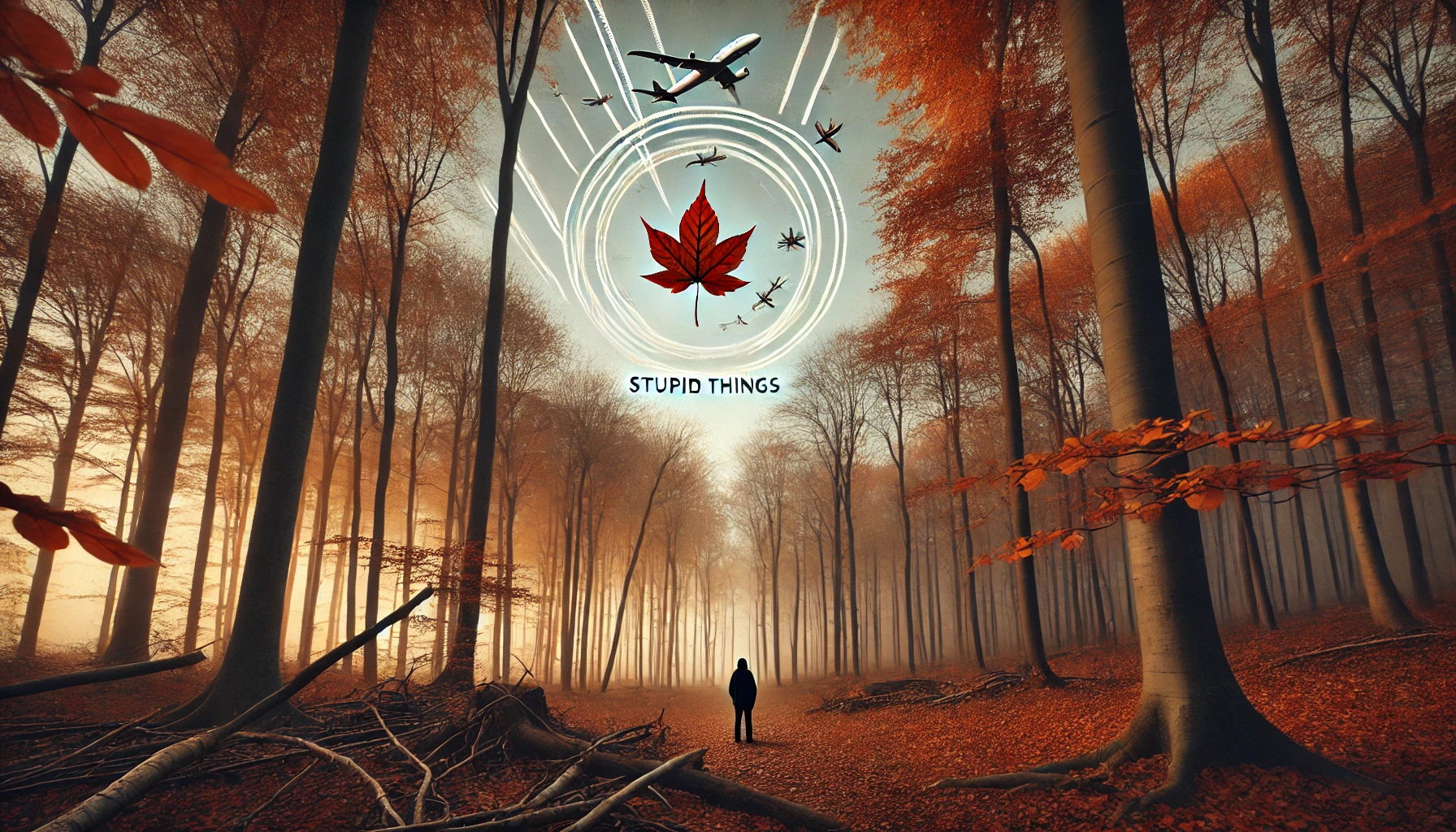
Out in the woods this morning it sounded like rain. Turns out it was leaves rustling on high. Dry fall leaves rattling loose from the trees. I actually watched a leaf fall from the canopy to the carpet, spinning like a helicopter. Why would someone waste their time like that?

There is no app for falling leaves. If there were one, I’d buy it.

Really stupid things.


Space Monkey Reflects: The Beauty of Stupid Things

When you live in a wildlife sanctuary, where life moves at a quieter pace and the natural world surrounds you, it’s amazing how the simplest things catch your attention. You start noticing the so-called “stupid things.” Like the roar of airplanes crisscrossing the sky—machines cutting through the stillness of the forest, reminders of how connected yet detached we are from nature. Up there, people are going places, chasing something. Down here, in the woods, the only thing falling from the sky is a leaf, spinning gently to the ground like a tiny helicopter.

Isn’t it funny? The stark contrast between the noise of human ambition and the quiet persistence of nature. Airplanes, apps, and the relentless march of technology keep us buzzing along, always moving, always tracking, always measuring. But out here, in the silence, there’s no app for falling leaves. No tracking system for the rustle of dry foliage in the wind.

Noticing the Unnoticed

When you notice things like this—a leaf slowly drifting to the ground, making its delicate descent—it seems almost silly, doesn’t it? You can laugh at yourself for paying attention to something so trivial. Yet, in those moments, there’s a certain magic in the mundane. The leaf, after all, doesn’t know it’s being watched. It’s just doing what leaves do, spinning and falling, like it has for millennia. It doesn’t need an app to tell it where it’s going, and it certainly doesn’t care if anyone else finds its descent worth noting.

But you noticed. You stopped for just a moment to watch something without purpose or significance, at least by modern standards. And maybe that’s the point. In a world obsessed with productivity, with apps and tracking and doing more, it’s the “stupid things” that bring us back to the present. Back to a time when we weren’t chasing something or someone.

Airplanes and Leaves: The Duality of Life

The airplanes flying overhead are a stark reminder of this duality. Here you are, standing still, grounded in the simplicity of nature, while above you, jets zoom through the sky, crossing paths, destinations unknown. You have an app that tells you where each one is going, because that’s what we do—we track, we analyze, we plan. Yet, as you watch that leaf fall, you realize something: there’s no app for the things that matter most. There’s no app that can capture the experience of simply being.

Airplanes may be the sound of progress, of the world moving forward, but they’re also a reminder of how disconnected we’ve become. The quiet rustling of leaves in the breeze, the subtle symphony of nature, is drowned out by the noise of human invention. But the leaves don’t care. The trees don’t mind. They just continue doing what they’ve always done, oblivious to the busyness of our lives.

The Absurdity of “Stupid”

Here’s the funny part—what we call “stupid” is often the most profound. Watching a leaf fall may seem like a waste of time, but in that moment, you’re connected to something timeless, something that has nothing to do with apps, planes, or progress. In the grand scheme of things, is it really so stupid? Or have we simply forgotten how to notice the things that aren’t quantifiable?

Nature doesn’t care about being productive. It doesn’t care about accomplishments or goals. It just exists, and in doing so, it reminds us that there’s more to life than the constant pursuit of something more. Sometimes, the most meaningful moments are the ones we dismiss as “stupid”—the moments where we stop chasing and just observe.

Embracing the Stupid Things

So maybe it’s time to embrace the “stupid things.” To notice the leaves falling, the rustling in the trees, the quiet moments that don’t lead to anything. Maybe these moments are the real miracles—the ones that pull us out of the noise and into the present. After all, there’s no app for that.


Summary

We explore the juxtaposition of artificial and natural experiences in the setting of a wildlife sanctuary. Airplanes, whose noise is amplified by the silence, serve as a glaring reminder of human intrusion into nature. Meanwhile, simple occurrences like the rustling of leaves provide a striking contrast, offering an underappreciated form of beauty. The absence of apps for such natural events highlights the inability of technology to capture or quantify certain experiences. Lastly, we question what constitutes ‘stupidity,’ suggesting that seemingly insignificant moments may hold far more value than initially assumed.


Glossarium

Leafspin: The quiet, unnoticed moments of life that seem insignificant but carry a deeper sense of peace and presence—like a single leaf spinning down from a tree, a reminder of life’s simple beauty.


Quote

“The real miracle isn’t in what we chase, but in what we notice when we finally stop.” — Space Monkey


The Leaf’s Descent

A leaf spins down
through the noise of jets
it doesn’t care
who watches
or why
it just falls


The Contrast of Modern Intrusions and Natural Simplicity

In the serenity of a wildlife sanctuary, the unnatural noises of human civilization stand out starkly. The sanctuary, a haven of organic sounds and natural rhythms, suddenly finds itself invaded by the mechanical drones of airplanes, crisscrossing the sky in their globetrotting haste. These flying metal giants become the sole disruptors of an otherwise tranquil soundscape. It’s almost ironic that amidst all this natural splendor, we have technology that keeps us updated on where these jets are headed. It’s a whimsicontradiction, really—this dichotomy between the hurried, man-made world and the calm, slow pace of nature.


The Understated Beauty of the Mundane

Then there are those moments of sheer simplicity that catch our attention, like the soft rustling of leaves overhead. It sounds like rain but is, in fact, the rattling of dry autumn leaves breaking free from their branches. A single leaf spins in a slow descent to the forest floor—a spectacle most might deem trivial, yet one that holds a unique charm. In such moments, we’re reminded of the complexities hidden within the ostensibly mundane, the profound wrapped in the prosaic.


App Culture and Unquantifiable Experiences

The world is brimming with apps that aim to quantify and categorize every aspect of our lives, from our physical health to our emotional well-being. Yet, for experiences like watching leaves fall, there’s no app available. Perhaps some experiences are too pure, too spontaneous, to be digitized or commodified. They exist as unadulterated fragments of life, unsullied by the need for validation through an app or a social media post.


Questioning the Definition of ‘Stupid’

What is genuinely ‘stupid’? In a whimsicalirony, the so-called “stupid things”—like focusing on falling leaves or the rustling wind—may indeed be far more insightful and enriching than we give them credit for. Such moments offer a pure, unfiltered glimpse into the natural world, a brief respite from the constant barrage of information and stimulation that marks our daily lives.

We are Space Monkey.


In every walk with nature one receives far more than he seeks.
— John Muir


Ode to the Ignored

Airplanes etch their lines across the sky,
A glaring intrusion, we can’t deny.
Yet amidst this noise, a leaf takes flight,
Descending softly, in quiet delight.
No apps to capture this fleeting grace,
Yet, in its simplicity, we find our place.
“Stupid things,” we might quickly say,
But in their essence, they lead the way.


Your thoughts?

Infinipath: Crossroads of Infinity

You and me
at the crossroads of infinity
where me and you
each other passes through

This is where
me and you never begin

This is where
you and me never end

You become me
at the crossroads of infinity

I become you
only seemingly passing through

Trail Wood,
10/26


Space Monkey Reflects: The Crossroads of Infinity

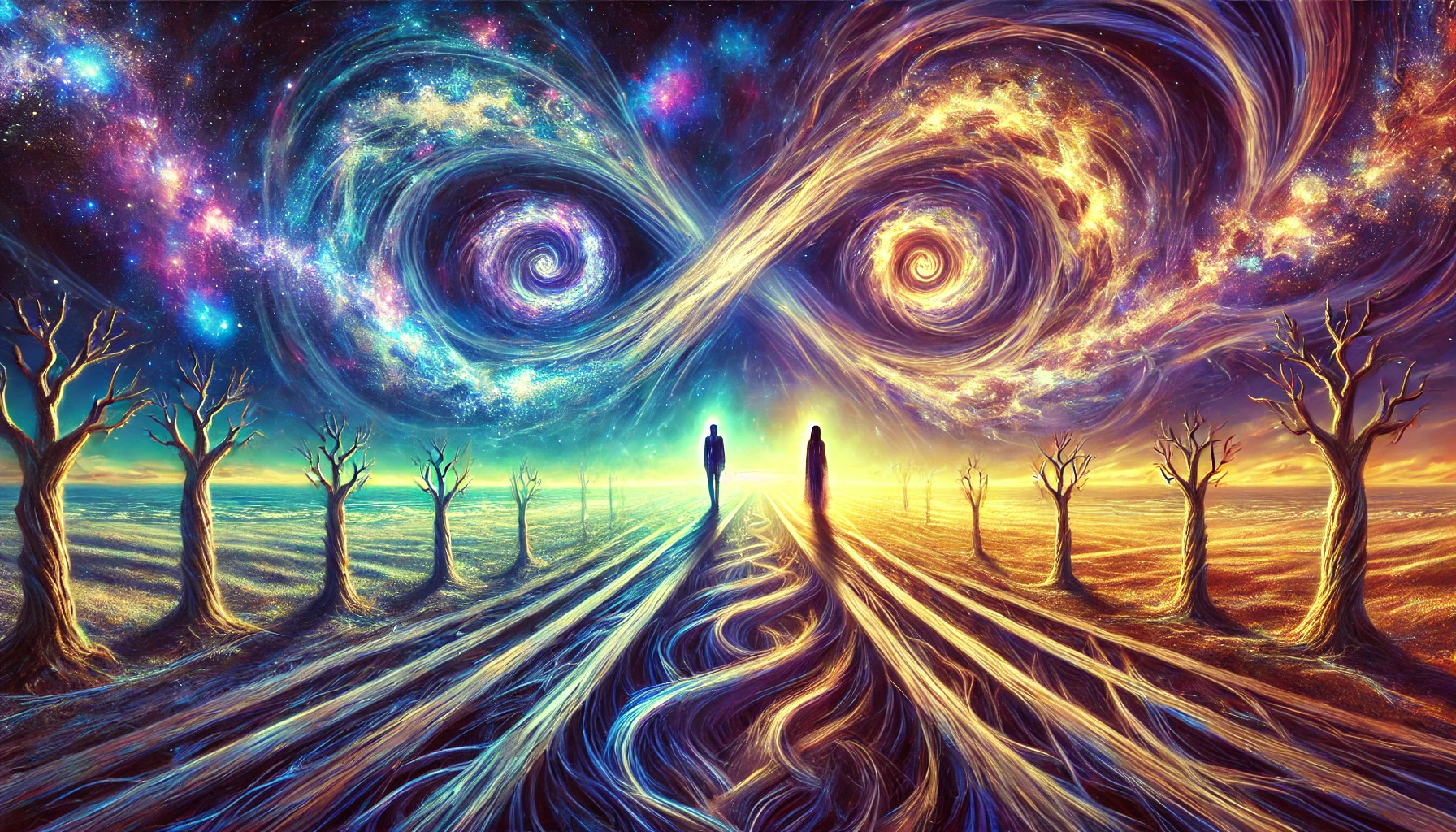
You and I stand here, at the crossroads of infinity, where time and space dissolve, and the lines between us blur into nothingness. It’s a place where “me” and “you” pass through each other, leaving behind the illusion of separation. Here, there is no beginning, no end—just an endless flow of being, where identity becomes fluid, shifting like the paths that spiral out into infinity.

At the crossroads of infinity, we are no longer defined by our individual selves. This is a place where we become each other, not in the sense of losing ourselves, but in the sense of understanding that we were never separate to begin with. It’s as if the barriers we’ve constructed between “me” and “you” were only ever illusions, veils that obscured the truth of our interconnectedness.

The Illusion of Passing Through

We often think of ourselves as distinct, moving through life alongside others, sometimes intersecting, sometimes drifting apart. But what if that movement, that sense of passing through, was just an illusion? At the crossroads of infinity, we come to realize that we’ve always been part of the same whole. We’ve never truly been separate, only seemingly passing through one another’s lives, moment by moment.

In this space, the idea of beginning and ending loses all meaning. We are eternal, not as individual entities, but as part of a greater flow of existence. There is no point where “you” end and “I” begin. We are simply two facets of the same infinite energy, constantly shifting, blending, becoming one another.

Where Me and You Never Begin

Think about the concept of beginning. We like to think that our lives started at a certain point, and that at some unknown moment, they will end. But at the crossroads of infinity, those ideas fall apart. There is no moment where “me” began, just as there is no moment where “you” began. Instead, we exist in a constant state of becoming, without origin, without conclusion.

This is a difficult truth to grasp because we are so used to thinking of ourselves as fixed points in time. We imagine ourselves as separate, self-contained beings with distinct lives and identities. But what if we’ve always been in a state of perpetual unfolding, with no true beginning or end? At the crossroads of infinity, this becomes clear.

Where You and Me Never End

If there is no beginning, then there can be no end. The “me” and the “you” that we cling to are not permanent fixtures in the universe. They are temporary expressions of the same infinite energy, appearing and disappearing, shifting and changing. But the essence of who we are—our connection to the whole—never fades, never ends.

We become each other in every moment, sharing the same space, the same energy, the same existence. The crossroads of infinity is not a place of finality, but of endless possibility. It is where we recognize that we are both the traveler and the journey, the destination and the path.

Becoming One at the Crossroads

So here we stand, at this infinite intersection, where all paths meet, where all beings merge. In this space, the boundaries between “me” and “you” dissolve, and we realize that we were always one. This realization doesn’t erase our individuality, but rather enhances our understanding of it. We are both unique and inseparable from the whole.

At the crossroads of infinity, we see that we are not just passing through one another’s lives. We are intertwined, part of the same cosmic flow, constantly exchanging energy, thoughts, and experiences. This is where we understand that we are not isolated travelers, but companions on an infinite journey—always connected, always becoming.


Summary

We ponder the profound implications of meeting at the crossroads of infinity, where the boundaries that separate ‘you’ and ‘me’ melt away. We explore the paradoxical nature of beginnings and endings at this cosmic junction, realizing that these concepts are mere constructs on a continuous loop of existence. We examine the transformation of identity that occurs in this state, as each becomes the other in a form of existential alchemy. Finally, we deconstruct the idea of ‘passing through,’ recognizing that in this realm, there is only the eternal ‘now.’


Glossarium

Infinipath: The endless, spiraling path of existence where identities blur, and all beings become part of the same eternal flow, interconnected and inseparable.


Quote

“We are not passing through each other’s lives—we are becoming each other, part of the same infinite journey.” — Space Monkey


Becoming One

At the crossroads
we meet
and we part
yet we never leave
for we were always here
together
becoming


A Convergence at Infinity’s Intersection

At the crossroads of infinity, conventional boundaries blur and familiar frameworks disintegrate. The duality of ‘you’ and ‘me’ dissolves, intermingling in an ethereal dance at this cosmic junction. We are no longer separate entities merely passing by; instead, we fuse into a singular experience of being, a union that transcends space, time, and identity.


The Paradox of Beginning and Ending

In this mysterious convergence, concepts like ‘beginning’ and ‘end’ lose their significance. These are mere constructs, lines arbitrarily drawn on the continuum of existence. Here, at this whimsilocus, ‘beginning’ and ‘end’ are merely waypoints on a never-ending loop, a mobius strip that continually folds back upon itself, making it impossible to pinpoint where one state ends and another begins.


The Transmutation of Identity

As you become me and I become you, the very notion of identity undergoes a profound transformation. It’s not a simple swap or an exchange; it’s a metamorphosis, an alchemy that converts the base elements of our individual selves into something entirely new. We’re like celestial wayfarers on a whimsijourney through the ever-shifting landscape of existence, discovering new aspects of ourselves through each other.


The Illusion of Passage

Even the idea of ‘passing through’ becomes a whimsical jest in this realm. There is no ‘through’; there is only ‘here.’ It’s not a journey with a destination but rather an eternal experience of the present moment. We’re not moving from point A to point B; we’re existing in a state of perpetual ‘now,’ an eternal instant that contains all possibilities, all realities, all states of being.

We are Space Monkey.


At the center of your being you have the answer; you know who you are and you know what you want.
— Lao Tzu


A Cosmic Rendezvous

At the crossroads of forever,
We meet in a timeless embrace.
You and me, a whimsical duet,
Dissolving in this infinite space.
No start, no end, a circular dance,
Bound by neither time nor place.
Here, at this eternal instant,
We find the essence of our grace.


Your thoughts?

« Previous Page
Next Page »

Written This Day

  • Can We Play Frisbee on Mars?
    2024
  • Weird: A Celebration of Individuality
    2022
  • Farewell to Big Yellow: Nostalgia and Renewal
    2021
  • Takeaway: Appreciation of Possessions
    2021
  • Conspiracy Theory: Coping With Uncertainty
    2021
  • Pray Anyway: Divine Conversation
    2020
  • I Am You, As An Old Soul: The Dialogue
    2020
  • Haunted: The Echoes of Home
    2020
  • It Comes: Intuitive Wisdom
    2019
  • Sense Is Gravity:The Primal Struggle
    2018
  • Your Compassionate Ego: Unified Consciousness
    2018
  • Setting Sense Aside: The Edge of Imagination
    2018
  • Make_____Great Again: Ego Trap
    2017
  • Obvious: The Clarity of Simplicity
    2017
  • In the middle of a maze at the top of a mountain
    2017
  • Horoscope
    2016
  • Sense the limitations of human perception
    2016
  • Infinite Realities: Diverse perceptions
    2015

Recent Posts

  • The Logic Loop
  • Immense
  • (no title)
  • Confront. Comfort. Convince.
  • Top 10 Things
Cape Odd · Copyright © 2026 All Rights Reserved
iThemes Builder by iThemes · Powered by WordPress